
WWS CSB 16042072017 - Electric saw PARKSIDE - Free user manual and instructions
Find the device manual for free WWS CSB 16042072017 PARKSIDE in PDF.



| Brand | Parkside |
| Model | WWS CSB 16042072017 |
| Product type | Circular saw blade for power saw |
| Package contents | 2 blades: 48 teeth (48 HW) and 42 teeth (42 HW) |
| Tooth material | Uncoated tungsten carbide alloy |
| Tooth shape - 48-tooth blade | Alternate top bevel (ATB) geometry (HW) |
| Tooth shape - 42-tooth blade | Trapezoidal (HW) |
| Suitable use - 48-tooth blade | Softwood and hardwood, composite wood, fibrous materials |
| Suitable use - 42-tooth blade | Non-ferrous metals (aluminium), plastics, lightweight composites, plastic pipes |
| Improper use | Materials containing asbestos, professional use, modifications to the blade |
| Safety - Mandatory equipment | Safety glasses, hearing protection, dust mask (depending on material) |
| Safety - Assembly | Unplug the saw before assembly; use the provided wrench; do not hammer |
| Safety - Cleaning | Allow blade to cool and unplug before cleaning |
| Sharpening | Do not sharpen yourself; have it done by a specialist |
| Tooth replacement | Do not replace a damaged or missing tooth; discard the blade |
| Cleaning | Regularly with a special product (resin cleaner) |
| Storage | In original packaging, dry and protected from external damage |
| Fixing to saw | Flange and nut; clean clamping surfaces, free of grease and oil |
| Reducing rings | Use only fixed reducing rings if necessary |
| Maximum rotation speed | Observe the speed indicated on the blade and saw; do not exceed the limit |
| Compatibility | Circular saws with matching arbor; refer to the saw's instruction manual |
Frequently Asked Questions - WWS CSB 16042072017 PARKSIDE
User questions about WWS CSB 16042072017 PARKSIDE
0 question about this device. Answer the ones you know or ask your own.
Ask a new question about this device
Download the instructions for your Electric saw in PDF format for free! Find your manual WWS CSB 16042072017 - PARKSIDE and take your electronic device back in hand. On this page are published all the documents necessary for the use of your device. WWS CSB 16042072017 by PARKSIDE.
USER MANUAL WWS CSB 16042072017 PARKSIDE
WWS CSB 160-42-07/2017, WWS CSB 160-48-07/2017
WWS CSB 190-42-07/2017, WWS CSB 190-48-07/2017
WWS CSB 210-42-07/2017, WwS CSB 210-48-07/2017
DE AT CH
KREISSAGEBLATT
Operation and Safety Notes
IAN 285782
DE AT CH
FR IT GB
Read the instruction manual before use and store it for future reference.
GB Operation and Safety Notes Page 14
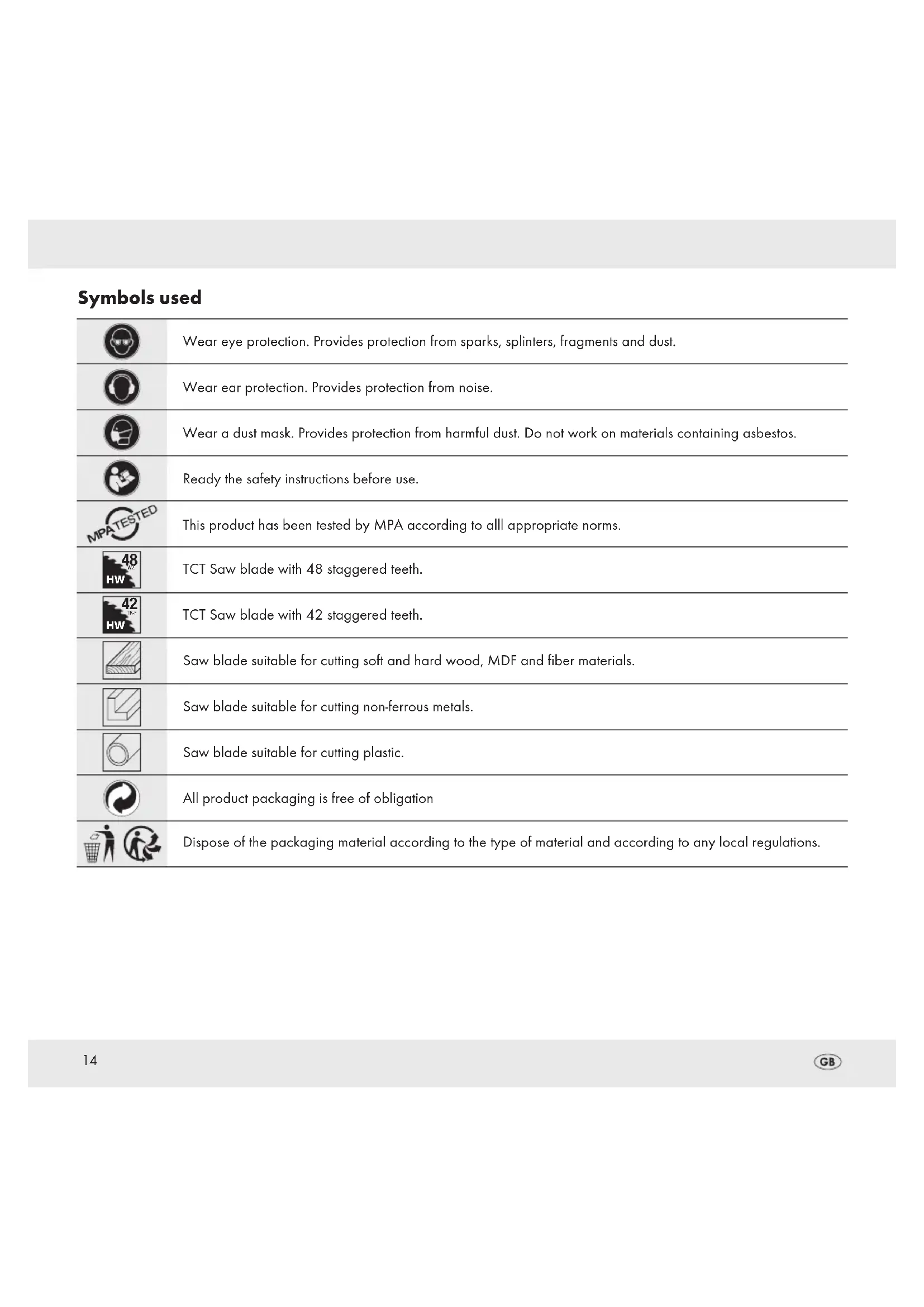
Verwendete Symbole
| Wear eye protection. Provides protection from sparks, splinters, fragments and dust. | |
| Wear ear protection. Provides protection from noise. | |
| Wear a dust mask. Provides protection from harmful dust. Do not work on materials containing asbestos. | |
| Ready the safety instructions before use. | |
| This product has been tested by MPA according to all appropriate norms. | |
| TCT Saw blade with 48 staggered teeth. | |
| TCT Saw blade with 42 staggered teeth. | |
| Saw blade suitable for cutting soft and hard wood, MDF and fiber materials. | |
| Saw blade suitable for cutting non-ferrous metals. | |
| Saw blade suitable for cutting plastic. | |
| All product packaging is free of obligation | |
| Disposition of the packaging material according to the type of material and according to any local regulations. |
Scope of use
The saw blade is designed for private and DIY use only.
- 48 tooth blade for cutting soft and hard wood and 42 tooth blade for cutting soft and hard wood, plastic and non-ferrous metals.
Any other use of the product is expressly forbidden and counts is misuse. The manufacturer cannot be held responsible for damage or injury caused by misuse of the product. Examples of misuse are given in the following non-exhaustive list:
- Use of the saw blade for anything other than its intended purpose
Non-observance of the safety instructions or assembly instructions
Non-observance of the safety warnings or operating instructions - Use of accessories or spare parts that are not suitable for the saw blade
- Use of the saw blade in modified form
Repairs or maintenance of the saw blade carried out by someone other than the supplier or a suitably qualified person - Commercial or otherwise excessive use
The use or maintenance of the saw blade by someone who is not familiar with circular saws or who lacks suitable experience.
Safety instructions
Working safely
- Power tools may only be used by qualified and experienced users.
- Take note of the maximum speed on the saw blade and on the circular saw being used. Ensure the maximum speed marked on the saw blade is equal or higher than the no-load speed on the type label of the machine.
- Inspect the saw blade for signs of damage before use. Damaged or deformed saw blades may not be used and must be replaced.
- Clean the saw blade regularly. Use a suitable cleaning agent.
Fitting and securing the saw blade
- Disconnect the machine from the mains before changing the saw blade.
- Fit the saw blade to the circular saw in such a way that it cannot become loose or detached while using the machine. Follow the fitting instructions provided with the circular saw being used.
- Ensure the saw blade sits cleanly on the saw spindle / flange assembly and that the blade guard or any other parts of the saw do not come into contact with the saw blade.
-
Only use a suitable wrench when tightening the flange nut and take note of any torque settings supplied by the manufacturer of the saw. Ensure the clamping flanges are tight before beginning work.
-
Do not use a hammer or extensions to tighten the flange nut.
- Check the flanges for dirt, grease, oil and water and clean if necessary.
- Only tighten the flange nut in accordance with the instructions supplied with the circular saw.
- Should the spindle diameter or clamping surface of the circular saw be smaller than the saw blade bore, use only pressed or permanently fixed reducer rings. Never use loose reducer rings.
Maintenance / Sharpening the teeth
- Saw blade teeth may only be sharpened by a competent person with relevant knowledge relating to the construction, design and requirements of the saw blade and teeth.
- Do not use saw blades with teeth thinner than 1mm .
- The saw blade may not be modified in any way. Servicing of damaged saw blades is not allowed.
- Damaged or deformed saw blades may not be used and must be replaced.
- Do not replace damaged or missing teeth. Saw blades with damaged or missing teeth must be replaced.
Handling saw blades

- Always wear protective gloves when handling or transporting saw blades.
- Do not wear protective gloves when sawing or operating the circular saw as these could get caught in the rotating saw blade.
Application
Circular saw blades may only be used for cutting, trimming and cutting slots in timber, timber derived products and similar materials such as plastics, light alloys, non-ferrous metals and composite materials according to the instructions supplied by the manufacturer of the circular saw.
Cleaning
- Clean the saw blade regularly.
- Only use suitable cleaning agents when cleaning saw blades. Consult a professional.
- Disconnect the circular saw from the mains and allow the saw blade to cool down before cleaning.
Storage
- Store the saw blade in its original packaging or similar protective packaging to avoid causing damage to the blade.
- Store the saw blades in a dry place away from aggressive substances.
The saw blade's cutting tips are very sharp and a risk of injury exists.



Brand : PARKSIDE
Model : WWS CSB 16042072017
Category : Electric saw