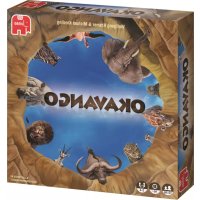
Okavango - Board game Jumbo - Free user manual and instructions
Find the device manual for free Okavango Jumbo in PDF.



| Features | Details |
|---|---|
| Game type | Strategic board game |
| Number of players | 2 to 4 players |
| Recommended age | From 10 years old |
| Game duration | About 60 to 90 minutes |
| Game objective | Explore and develop territories in the Okavango Delta |
| Included materials | Game board, cards, tokens, dice |
| Game instructions | Includes a detailed rulebook |
| Maintenance | Store in a dry place, avoid moisture |
| Safety | Do not ingest pieces, choking hazard for young children |
| Additional information | Ideal for family or friends game nights |
Frequently Asked Questions - Okavango Jumbo
User questions about Okavango Jumbo
0 question about this device. Answer the ones you know or ask your own.
Ask a new question about this device
Download the instructions for your Board game in PDF format for free! Find your manual Okavango - Jumbo and take your electronic device back in hand. On this page are published all the documents necessary for the use of your device. Okavango by Jumbo.
USER MANUAL Okavango Jumbo
Wolfgang Kramer & Michael Kiesling
OKAVANGO
DE WINNAAR VAN HET SPEL
The battle for drinking water
The Okavango River is almost dry and the animals on the African savanna are practically dying of thirst! As a Ranger in the nearby wildlife reserve, you have the important task of forming strong herds of animals and leading them to a delta of the fertile river or to one of the sparse waterholes.
As a Ranger, do you have it in you to restore the natural balance and win the battle for drinking water? The animals are counting on you!
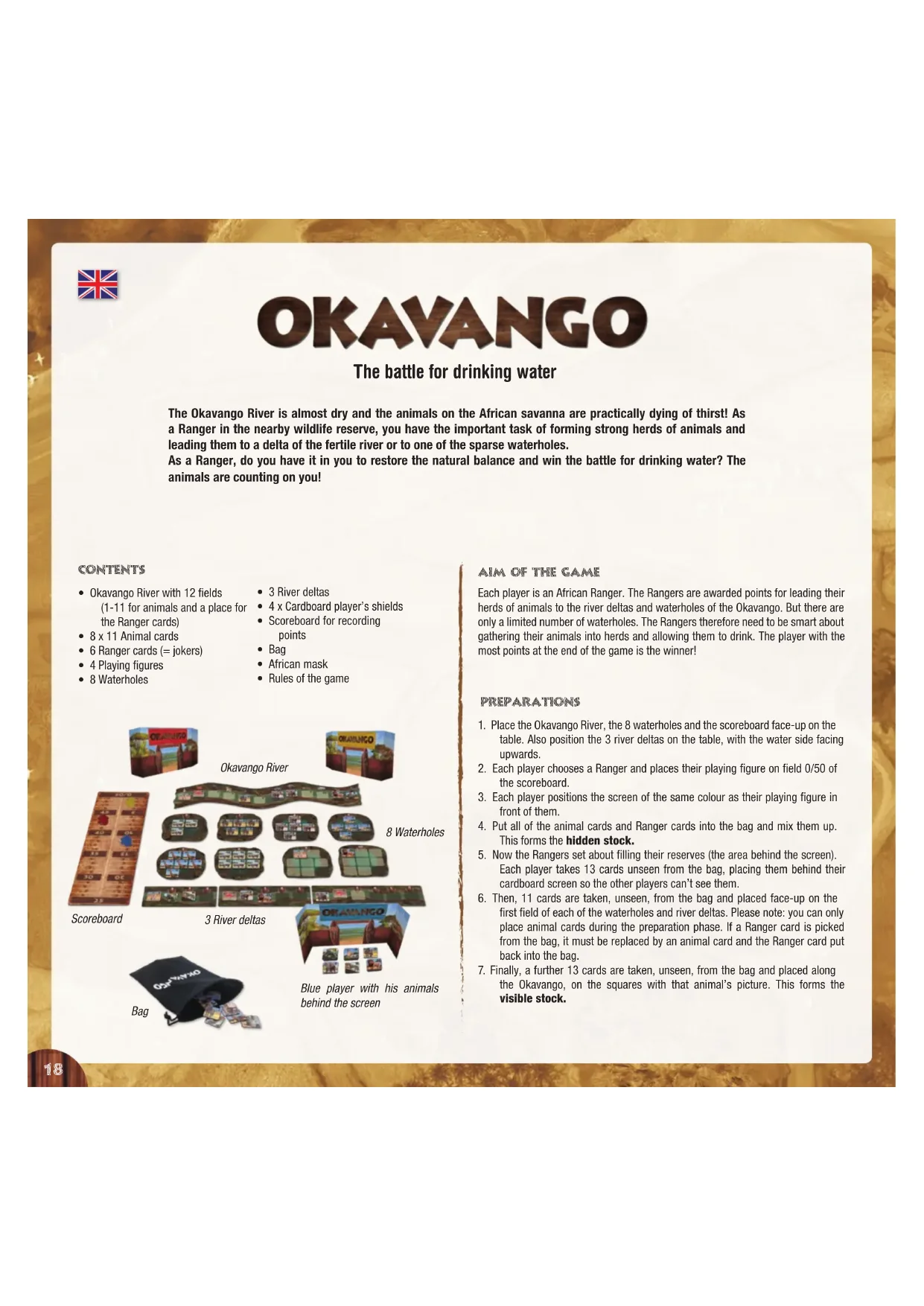
CONTENTS
- Okavango River with 12 fields (1-11 for animals and a place for the Ranger cards)
- 8 x 11 Animal cards
- 6 Ranger cards (= jokers)
4 Playing figures
8 Waterholes
3 River deltas
- 4 x Cardboard player's shields
- Scoreboard for recording
points
- Bag
African mask
- Rules of the game
AIM OF THE GAME
Each player is an African Ranger. The Rangers are awarded points for leading their herds of animals to the river deltas and waterholes of the Okavango. But there are only a limited number of waterholes. The Rangers therefore need to be smart about gathering their animals into herds and allowing them to drink. The player with the most points at the end of the game is the winner!
PREPARATIONS
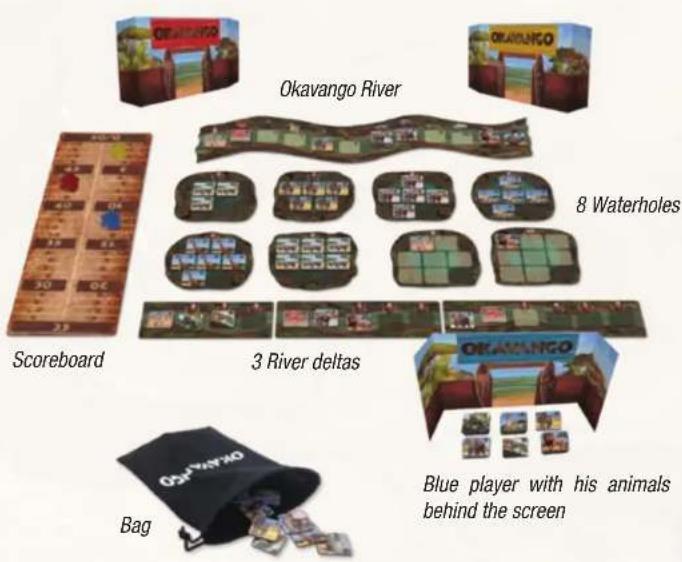
- Place the Okavango River, the 8 waterholes and the scoreboard face-up on the table. Also position the 3 river deltas on the table, with the water side facing upwards.
- Each player chooses a Ranger and places their playing figure on field 0/50 of the scoreboard.
- Each player positions the screen of the same colour as their playing figure in front of them.
- Put all of the animal cards and Ranger cards into the bag and mix them up. This forms the hidden stock.
- Now the Rangers set about filling their reserves (the area behind the screen). Each player takes 13 cards unseen from the bag, placing them behind their cardboard screen so the other players can't see them.
- Then, 11 cards are taken, unseen, from the bag and placed face-up on the first field of each of the waterholes and river deltas. Please note: you can only place animal cards during the preparation phase. If a Ranger card is picked from the bag, it must be replaced by an animal card and the Ranger card put back into the bag.
- Finally, a further 13 cards are taken, unseen, from the bag and placed along the Okavango, on the squares with that animal's picture. This forms the visible stock.
THE AREAS
There are total of 11 areas where animals can drink: 8 waterholes and 3 river deltas.
Only the same kind of animals can drink at each waterhole (otherwise they might eat each other!)
Only different kinds of animals can drink on the fields of the river deltas (there's room for everyone along the delta)!
STARTING THE GAME
The player who has most recently seen a lion starts the game. The player to start places the cardboard African mask in front of him or herself making it clear who started the round. The game continues clockwise.
The Ranger whose turn it is, places either several animals from his reserve that are the same OR several that are different, in front of himself on the table. The Ranger can also choose to pass.
When the Ranger decides to play, he does so in 3 phases during his turn:
- Allowing your animals to drink: bring the same animals to a waterhole or different animals to a river delta.
- Earning points: the number of the waterhole indicates the number of points that can be earned. The points for the river deltas are shown above the respective fields.
- Take the animals from the Okavango (visible stock) to your own reserve. Your turn ends after this.
PHASE 1: ALLOWING YOUR ANIMALS TO DRINK
First the Ranger collects the animals from the waterhole or river delta of their choice. These animals have quenched their thirst and are taken to their own reserve. No animals may be left behind at the waterhole or the river delta.
Now that there is space to drink, the Ranger brings a new herd from their reserve to the empty waterhole or river delta.
NB: Animals that have quenched their thirst may not drink again in the same area. The Ranger always takes these animals back to their own reserve.
Waterhole: The Ranger must replace the drinking herd with the same number OR a higher number of animals of a single kind.
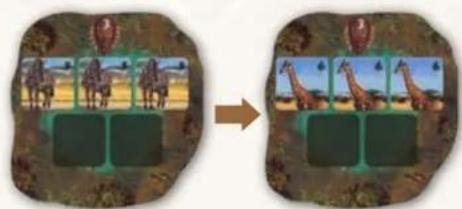
If the Ranger brings the same number of animals, the thirsty animals must have a higher ranking than the animals already drinking at the waterhole.
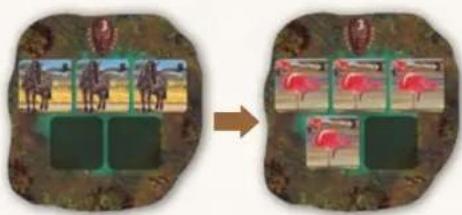
If the Ranger brings a higher number of animals, the ranking doesn't matter.
River delta: Here the Ranger has to replace the drinking animals with different animals AS WELL AS a higher number of animals than at the river delta at that time - the animals' ranking doesn't matter.
If all the white fields at the waterhole or the river delta are occupied, the Ranger may also use the dark green fields. Only 1 animal can be placed on each field. The number of fields of the waterhole / river delta therefore determines the number of animals the Ranger can allow to drink there.
- If all the white and dark green fields of the waterhole are occupied, the Ranger can only replace the drinking herd with a thirsty herd of the same number of animals - they must have a higher ranking.
If all the fields of a river delta are occupied, the animal cards are added to the hidden stock (i.e. in the bag). At that point, the river delta is depleted and must be turned over.
PHASE 2: WINNING POINTS
The African mask indicates the number of points to be earned for each waterhole or river delta. If at least all the white fields of a waterhole or river delta are occupied, the Ranger earns the number of points assigned to that waterhole or river delta.
A record is kept of the number of points for the Ranger on the scoreboard.
Examples of occupying a waterhole worth 6 points:
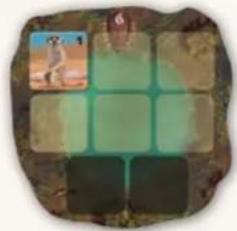
A: When preparing the game, 1 animal is placed on the first field of the waterhole – in this example, a meerkat.
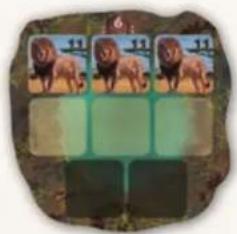
B: The first Ranger takes the meerkat and places 3 lions at the waterhole. They don't get any points for this, because the white fields are not yet fully occupied. The first Ranger places the meerkat in his own reserve.
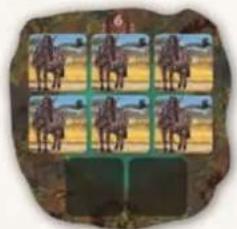
C: The second Ranger takes the 3 lions and places 6 zebras at the waterhole and earns 6 points for doing so. This is because all the white fields are occupied. The Ranger places the 3 lions in their own reserve.
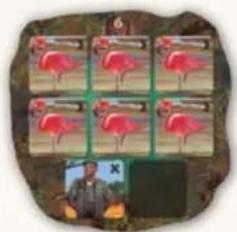
D: The third Ranger takes the 6 zebras and places 6 flamingos as well as 1 Ranger card (joker) at the same waterhole and earns 6 points for doing so (the value shown in the African mask).* The Ranger places the 6 zebras in their own reserve.
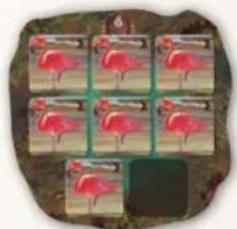
E: The first Ranger plays again and exchanges the Ranger card (joker) for a flamingo. The Ranger can now use the joker somewhere else. After this, the Ranger gets another move but this must not involve the same waterhole.*
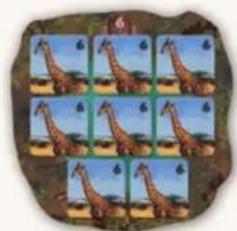
F: The second Ranger takes the 7 flamingos and places 8 giraffes at the waterhole. They earn 6 points for doing so (the value shown in the African mask). The Ranger places the 7 flamingos in their own reserve.
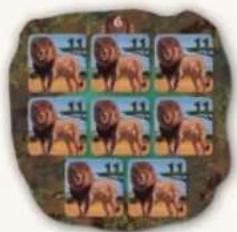
* See Section 1 about Rangers.
G: The third Ranger takes the 8 giraffes and places 8 lions (who are higher ranking) at the waterhole and earns 6 points for doing so (the value in the African mask). The Ranger places the 8 giraffes in their own reserve.
Examples of occupying the river delta with 5 fields:
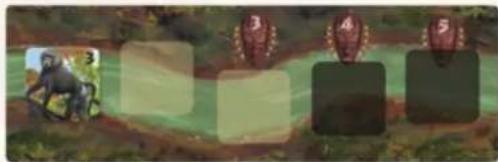
A: When preparing the game, 1 animal is placed on the first field of this river delta – in this case a monkey.
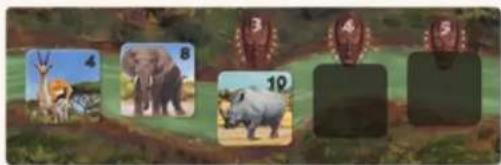
B: The first Ranger takes the monkey and places a gazelle, elephant and rhinoceros at this river delta. They earn 3 points for doing so. This is because all the white fields are occupied. The Ranger places the monkey in their own reserve.
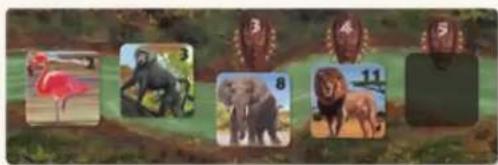
C: The second Ranger takes the gazelle, elephant and rhinoceros and places their own flamingo, monkey, elephant and lion at this river delta and earns 4 points for doing so. The Ranger places the gazelle, elephant and rhinoceros in their own reserve.
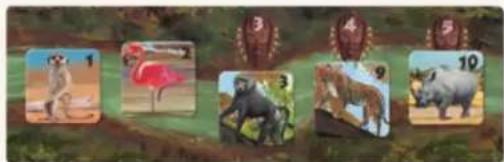
D: The third Ranger takes the flamingo, monkey, elephant and lion and places their own meerkat, flamingo, monkey, leopard and rhinoceros at the river delta and earns 5 points for doing so. The Ranger places the flamingo, monkey, elephant and lion in their own reserve.
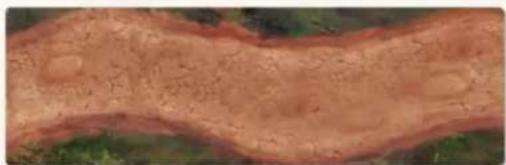
E: All the fields are now occupied and the animals are placed back into the bag (hidden stock) and the river delta is turned over because it is depleted. This river delta cannot be used again during the game.
PHASE 3: TAKING THE ANIMALS FROM THE OKAVANGO TO YOUR OWN RESERVE
The following rules apply when taking animals from the Okavango (= visible stock) to your own reserve:
General:
- At the Okavango, it is not possible to take different animals - only all animals of the same kind OR 1 Ranger card.
- If there aren't any animals at the Okavango (and the visible stock is therefore finished), this phase is scrapped.
Once you have brought the animals to a waterhole during phase 1, animals can only be taken from the Okavango if:
there are just as many as you took to the waterhole, but they are of a lower ranking.
there are fewer than you took to the waterhole. The ranking doesn't matter in this case.
Once you have brought the animals to a river delta during phase 1, animals can only be taken from the Okavango if:
there are fewer than you took to the river delta.
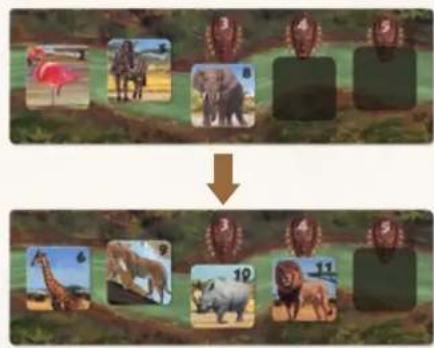
Example:
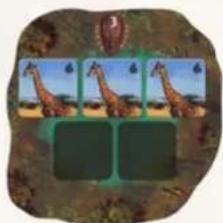
The Ranger has just played 3 giraffes.
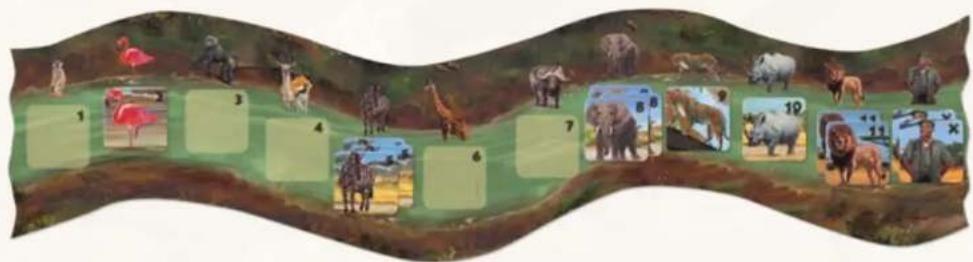
The following animal and Ranger cards are at the Okavango (visible stock).
The Ranger may now take 3 zebras from the Okavango because they have a lower ranking than the giraffes. Or they take two lions (higher ranking, but fewer in number), or the flamingo, or the leopard (higher ranking, but fewer in number), or the rhinoceros (higher ranking, but fewer in number), or 1 Ranger.
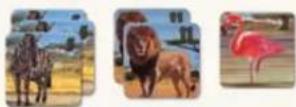
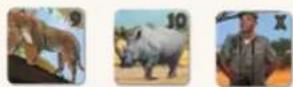
They may NOT take the 3 elephants because they are higher ranking than the giraffes (and there are just as many).
He can only take one ranger, irrespective of however many are available.
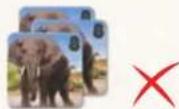

The Ranger places the animal card(s) or Ranger card taken from the Okavango in their own reserve (i.e. behind the screen).
Topping up the Okavango: The animals at the Okavango are topped up using cards from the bag (hidden stock) until there are 13 pieces after the Ranger's turn, for as long as stocks last. If there are too few cards in the bag, the remaining animals are taken to the Okavango. This phase is scrapped if there are no cards in the bag.
PASSING A TURN
If players cannot or do not want to do anything during their turn, they have to pass. In such a case, the Ranger takes 1 card from all the available cards at the Okavango; even if there are more than 1 of these animals in stock. Following this, the Okavango is stocked up again to 13 pieces with a card from the bag (hidden stock) for as long as stocks last.
STOCKS
As mentioned, there is a hidden stock (in the bag) and visible stock (in the Okavango). When the bag is empty, the Okavango can no longer be topped up. When the Okavango is empty as well, the third phase is scrapped: 'taking the animals from the Okavango to your own reserve'. Play continues.
RANGERCARDS
A Ranger card (ranking of X) serves as the joker. This card can therefore be used to represent any animal. Several Ranger cards can be played during a single turn. During their turn, a Ranger can exchange a Ranger card at a waterhole or river delta for the animal it had been used instead of. You may only exchange 1 Ranger card (joker) during your turn. The Ranger may decide whether to immediately use the Ranger card during their turn or whether to take it to their reserve to be used during a later turn.
THE WINNER OF THE GAME
The game ends once all the white fields are occupied. Any player who has not yet had a turn during this round may still play one turn. The game ends after this. The Ranger with the most points at that stage wins the game.
TIP 1: Very few animals drink at the waterhole in the beginning. It makes little sense to replace a small herd at this point with a much bigger herd. You'll need this later! For this reason, always try to keep at least 10 animals in your reserve for as long as possible.
TIP 2: Animals that are in a player's own reserve by the end of the game don't generate any points. For this reason, try to bring as many animals as possible to the waterhole or river delta by the end of the game.

Jumbodiset
© 2018 Jumbodiset Group. All rights reserved.
jumbo.eu
19702