EasyManual
VC100 - Vacuum packaging machines CASO - Free user manual and instructions
Find the device manual for free VC100 CASO in PDF.



Frequently Asked Questions - VC100 CASO
Download the instructions for your Vacuum packaging machines in PDF format for free! Find your manual VC100 - CASO and take your electronic device back in hand. On this page are published all the documents necessary for the use of your device. VC100 by CASO.
USER MANUAL VC100 CASO
natural_image
Exterior view of a COSO German 100-branded scanner device (no visible text or symbols on body)Caso Germany
Braukmann GmbH
Raiffeisenstraße 9
D-59757 Arnsberg
Tel.: +49 (0) 29 32 / 54 76 6 - 99
Fax: +49 (0) 29 32 / 54 76 6 - 77
eMail: kundenservice@caso-germany.de
Internet: www.caso-germany.de
12 Operating Manual ....36
12.1 General....36
12.2 Information on this manual 36
12.3 Warning notices ....37
12.4 Limitation of liability 38
12.5 Copyright protection....38
13 Safety 39
13.1 Intended use....39
13.2 General Safety information ....39
13.3 Sources of danger....40
13.3.1 Danger of burns 40
13.3.2 Danger of fire 40
13.3.3 Dangers due to electrical power....41
13.4 Food storage safety information ....41
14 Commissioning....44
14.1 Safety information....44
14.2 Delivery scope and transport inspection....44
14.3 Functions....45
14.4 Unpacking....45
14.5 Disposal of the packaging....45
14.6 Setup....46
14.6.1 Setup location requirements: 46
14.7 Electrical connection 47
15 Design and Function ....48
15.1 Complete overview ....48
15.2 Panel 49
A Indicator lamp for sealing....49
indicates the seal process ....49
15.3 Rating plate....49
16 Operation and Handing....50
16.1 Operating Instructions....50
16.2 Removing the vacuum chamber 50
16.3 Bags and rolls 51
16.4 Preserve food with vacuum: 51
16.5 Making a bag using the bag roll....52
16.6 Open a sealed bag 53
16.7 Resealing 53
16.8 Storing your vacuum sealing system....53
17 Cleaning and Maintenance....54
17.1 Safety information....54
17.2 Cleaning....55
18 Troubleshooting ....56
18.1 Safety notices....56
18.2 Cause and Action....56
19 Disposal of the Old Device....57
20 Guarantee....58
21 Technical Data ....58
natural_image
Three-step illustration of a CD80 printer with open lid, showing front, side, and top views (no text or symbols)Schritt 1:
Original Operating Manual
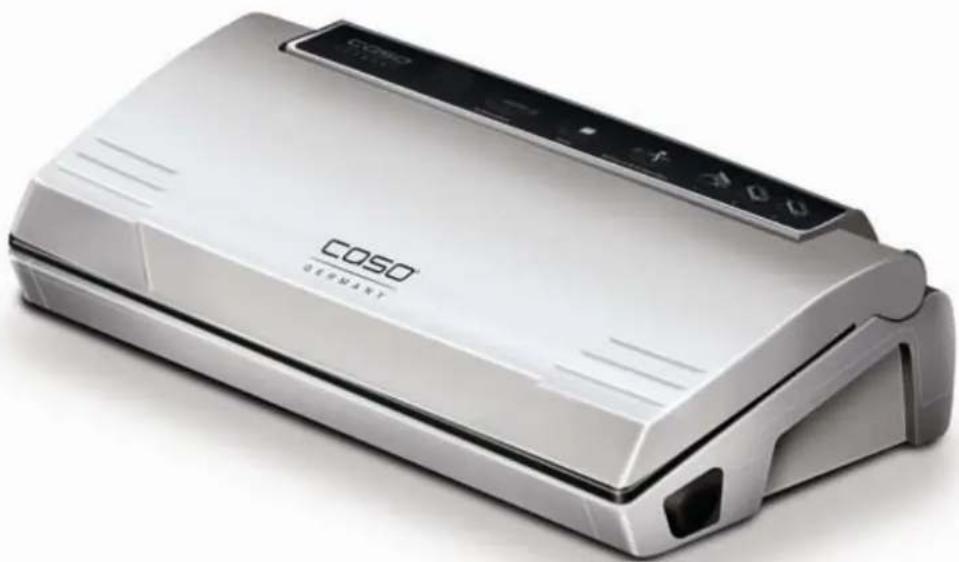
Vacuum Sealer System VC100
natural_image
Exterior view of a COSO printer device (no visible text or symbols on body)12 Operating Manual
12.1 General
Please read the information contained herein so that you can become familiar with your device quickly and take advantage of the full scope of its functions.
Your vacuum sealer system will serve you for many years if you handle it and care for it properly.
We wish you a lot of pleasure in using it!
12.2 Information on this manual
These Operating Instructions are a component of the vacuum sealer system (referred to hereafter as the Device) and provide you with important information for the initial commissioning, safety, intended use and care of the device.
The Operating Instructions must be available at all times at the device. This Operating Manual must be read and applied by every person who is instructed to work with the device:
- Commissioning
- Operation
- Troubleshooting and/or
- Cleaning
Keep the Operating Manual in a safe place and pass it on to the subsequent owner along with the device.
12.3 Warning notices
The following warning notices are used in the Operating Manual concerned here.
⚠GEFAHR
DANGER
A warning notice of this level of danger indicates a potentially dangerous situation.
If the dangerous situation is not avoided, this can lead to death or serious injuries.
▶ Observe the instructions in this warning notice in order to avoid the danger of death or serious personal injuries.
⚠️WARNUNG
WARNING
A warning notice of this level of danger indicates a possible dangerous situation.
If the dangerous situation is not avoided, this can lead to serious injuries.
▶ Observe the instructions in this warning notice in order to avoid the personal injuries.
▲VORSICHT
ATTENTION
A warning notice of this level of danger indicates a possible dangerous situation.
If the dangerous situation is not avoided, this can lead to slight or moderate injuries.
▶ Observe the instructions in this warning notice in order to avoid the personal injuries.
HINWEIS
PLEASE
NOTE
A notice of this kind indicates additional information, which will simplify the handling of the machine.
12.4 Limitation of liability
All the technical information, data and notices with regard to the installation, operation and care are completely up-to-date at the time of printing and are compiled to the best of our knowledge and belief, taking our past experience and findings into consideration.
No claims can be derived from the information provided, the illustrations or descriptions in this manual.
The manufacturer does not assume any liability for damages arising as a result of the following:
• Non-observance of the manual
• Uses for non-intended purposes
- Improper repairs
- Technical alterations
- Use of unauthorized spare parts
All translations are carried out to the best of our knowledge. We do not assume any liability for translation errors, not even if the translation was carried out by us or on our instructions. The original German text remains solely binding.
12.5 Copyright protection
This document is copyright protected.
Braukmann GmbH reserves all the rights, including those for photomechanical reproduction, duplication and distribution using special processes (e.g. data processing, data carriers, data networks), even partially.
Subject to content and technical changes.
13 Safety
This chapter provides you with important safety notices when handling the device.
The device corresponds with the required safety regulations.
Improper use can result in personal or property damages.
13.1 Intended use
This device is only intended for use in households in enclosed spaces for vacuuming bags and canister, as well as sealing vacuum foils.
Uses for a different purpose or for a purpose which exceeds this description are considered incompatible with the intended or designated use.
⚠️WARNUNG
Warning
Danger due to unintended use!
Dangers can emanate from the device if it is used for an unintended use and/or a different kind of use.
▶ Use the device exclusively for its intended use.
▶ Observe the procedural methods described in this Operating Manual.
Claims of all kinds due to damages resulting from unintended uses are excluded.
The User bears the sole risk.
13.2 General Safety information
HINWEIS
Please note
Please observe the following general safety notices with regard to the safe handling of the device.
▶ Examine the device for any visible external damages prior to using it. Never put a damaged device into operation.
▶ If the connection lead is damaged, you will need to have a new connection lead installed by an authorized electrician.
▶ Persons, who are not able to operate the device because of any physical, mental or motor disabilities may only use the device under the supervision or under the instructions of a responsible person.
▶ Do not permit children to use the device, unless they are supervised.
▶ Only qualified electricians, who have been trained by the manufacturer, may carry out any repairs that may be needed. Improperly performed repairs can cause considerable dangers for the user.
▶ Only customer service departments authorized by the manufacturer may carry out repairs on the device during the guarantee period, as otherwise the guarantee entitlements will be null and void in the event of any subsequent damages.
▶ Defective components must always be replaced with original replacement parts. Only such parts will guarantee that the safety requirements are fulfilled.
▶ Do not leave the device unsupervised when it is in operation.
▶ When disconnect, please unplug by grasp the plug and not the cord, to avoid any injury.
▶ Do not immerse in water or any other liquids.
After finished the vacuum work, please always let the machine cover open, don't fasten the cover, it will deform the form gaskets and affect the machine function.
13.3 Sources of danger
13.3.1 Danger of burns
▲WARNUNG Warning
Please observe the following safety notices in order not to burn or scald yourself or others.
▶ To avoid getting burned, never touch the sealing bar while the unit is operating.
13.3.2 Danger of fire
⚠️WARNUNG Warning
There is a danger of fire due to the event the device is not used properly.
Observe the following safety notices to avoid dangers of fire:
▶ Do not set up the device near flammable material.
▶ Keep this appliance away from sources of heat (gas, electric, burner, heated oven).
13.3.3 Dangers due to electrical power
⚠GEFAHR
Danger
Mortal danger due to electrical power!
Mortal danger exists when coming into contact with live wires or subassemblies!
Observe the following safety notices to avoid dangers due to electrical power:
▶ If the connection lead is damaged, you will need to have a special connection lead installed by an authorized electrician.
▶ Do not operate this device if its power cable or plug is damaged, if it does not work properly or if it is damaged or has been dropped. If the power cable is damaged, it will need to be replaced by the manufacturer or his service agency or a similar qualified person, to avoid any dangers.
▶ Do not open the housing on the device under any circumstances. There is a danger of an electrical shock if live connections are touched and the electrical or mechanical structure is altered. In addition, functional faults on the device can also occur.
▶ Before plugging the appliance in or when you operate it, make sure your hands are dry.
13.4 Food storage safety information
This vacuum preservation system will change the way you purchase and store foods. Once you are accustomed to vacuum packing, it will become an indispensable part of your food preparation. Please follow certain procedures when using this appliance to ensure food quality and safety:
- Chemical reactions in the food to air, temperature, moisture as well as enzyme actions, growth of microorganisms or contamination from insects will cause food spoilage.
-
The leading cause for food to lose nutritive value, texture, flavor and quality is oxygen in the air. Most microorganism growth relies on air, for it will carry moisture into and out of foods unless they are protected with moisture-proof packing. Frozen foods being exposed to freezer air will get freezer burn.
-
The vacuum seal packing removes up to 90% of the air from the package. Its approximately 21% oxygen in the air, so 90% air removal leaves a 2% to 3% residual oxygen level in vacuum-sealed foods. When the oxygen level is at or below 5%, as you know, most microorganisms are inhibited from growth.
- In general, there are three categories of microorganisms: mold, yeast and bacteria, they are present everywhere, but only under certain conditions they can cause problems.
- In a low oxygen environment or in the absence of moisture, mold can't grow; in moisture, sugar and a moderate temperature circumstance, yeast can grow with or without air. Refrigeration will slow the growth of yeast and freezing stops it completely.
• Bacteria can grow with or without air. - One of the extremely dangerous type of bacteria is clostridium botulinum and they can grow under the right conditions without air: in the temperature range of 40F – 115F (4°C – 46°C). Conditions for growth are foods lacking acid, low oxygen environment and temperatures greater than 40F (4°C) for extended time.
- Frozen, dried, high in acid, salt or sugar foods can resistant to botulinum. Non-acid foods which include meat, seafood, lye-cured olives, poultry, fish, eggs and mushrooms; low-acid foods which are mostly vegetables; medium-acid foods include overripe tomatoes, onions, chili peppers, figs and cucumbers are easy be infected by botulinum.
- Foods most susceptible to botulinum should be refrigerated for short term and frozen for long-term storage, and consume them immediately after heating.
- Some dried foods, such as flour and cereals may contain insect larvae, if do not vacuum-sealed, larvae may hatch during storage and contaminate the foods. To prevent weevils and other insects from hatching, store these foods in vacuum seal package.
- Avoid spoilage; foods should be stored at low temperatures; few species of microorganisms could grow without air but not at low temperature.
-
If temperatures in the refrigerator greater than 40^ F ( 4^ C) (especially for extended periods of time), it will support the growth of harmful microorganisms, so you should keep the temperature at 40^ F ( 4^ C) or below.
-
The temperature of your freezer should be 0^ F ( -17^ C) or lower, this is ideal temperature for storing foods, although freezing does not kill microorganisms, it retards their growth.
- The vacuum-sealed storage temperature will affect dried foods; their shelf life is extended 3-4 times for every 18°F (10°C) drop in temperature.
HINWEIS
Please note
▶ If perishable foods have been heated, defrosted or unrefrigerated, consume them immediately.
Before vacuum sealing, it's necessary to clean your hands, and all utensils and surfaces to be used for cutting and vacuum sealing foods.
▶ Refrigerate or freeze the perishable foods immediately, if you have vacuum-sealed them, and do not leave them sitting at room temperature.
The shelf life of dry foods such as nuts, coconut or cereals will be extended in vacuum-sealed package, while storing them in dark place. Oxygen and warm temperature will cause high-fat content foods fat to rancidity.
Before vacuum sealing some fruit and vegetables, such as apples, bananas, potatoes and root vegetables, peel them, this will extend their shelf lives.
When vacuum seal some vegetables such as broccoli, cauliflower and cabbage fresh for refrigeration, they will emit gases, so it's need to blanch and freeze these foods before vacuum sealing.
14 Commissioning
This chapter provides you with important safety notices during the initial commissioning of the device. Observe the following notices to avoid dangers and damages:
14.1 Safety information
⚠️WARNUNG
Warning
Personal and property damages can occur during commissioning of the device!
Observe the following safety notices to avoid such dangers:
▶ Packaging materials may not be used for playing. There is a danger of suffocation.
14.2 Delivery scope and transport inspection
As a rule, the vacuum sealer system is delivered with the following components:
• Vacuum sealer system VC100
- Vacuum hose
• 10 top-quality bags
- Operating Instructions
HINWEIS
Please note
▶ Examine the shipment for its completeness and for any visible damages.
▶ Immediately notify the carrier, the insurance and the supplier about any incomplete shipment or damages as a result of inadequate packaging or due to transportation.
14.3 Functions
The main function of this appliance is to store a wide kind of foods for freshness, longer shelf life, flavor and convenience. In general, vacuum packaging keeps food fresh up to three times as long as other traditional food storage methods. Once this appliance will be an indispensable part of your life, you will have less food spoilage and it will save your money.
- Cook in advance to vacuum seal and store individual portions or entire meals. These vacuum bags are not recommended for microwave or boil-in-bag cooking, please use the general cooking methods to reheat the vacuum-sealed foods.
- Prepare foods in advance for picnics and camping trips or barbecues.
- Eliminate freezer burn.
- Package foods, such as meat, fish, poultry, seafood and vegetables to freeze or refrigerate.
- Package dry foods, such as beans, nuts, and cereals to store longer.
- There are many non-food uses for vacuum packing. Keep camping supplies such as matches, first aid kits and clothing clean and dry. Keep flares for auto emergencies ready. Keep and collectibles untarnished.
14.4 Unpacking
To unpack the device, proceed as follows:
- Remove the device out of the carton and remove the packaging material.
14.5 Disposal of the packaging
The packaging protects the device against damages during transit. The packaging materials are selected in accordance with environmentally compatible and recycling-related points of view and can therefore be recycled.

Returning the packaging back to the material loop saves raw materials and reduces the quantities of accumulated waste. Take any packaging materials that are no longer required to "Green Dot" recycling collection points for disposal.
HINWEIS
Please note
▶ If possible, keep the original packaging for the device for the duration of the guarantee period of the device, in order that the device can be re-packaged properly in the event of a guarantee claim.
14.6 Setup
14.6.1 Setup location requirements:
In order to ensure the safe and trouble-free operation of the device, the setup location must fulfil the following prerequisites:
- The device must be set up on a firm, flat and horizontal surface with sufficient load-bearing capacity for the vacuum sealer system and the maximum weight of the food that should be vacuum-sealed.
- Choose the setup location in such a way that children cannot reach the hot sealing strip of the device.
- Do not set up the device in a hot, wet or extremely damp environment or near flammable material.
- The device requires an adequate flow of air in order to operate correctly. Leave a clearance of 10 cm around the device.
- Do not move the vacuum sealer system when it is in operation.
- The electrical socket must be easily accessible so that the power lead can be disconnected easily, in the case of an emergency.
- The installation and assembly of this device in non-stationary setup locations (e.g. on ships) must be carried out by specialist companies / electricians, provided they guarantee the prerequisites for the safe use of this device.
14.7 Electrical connection
In order to ensure the safe and trouble-free operation of the device, the following instructions must be observed for the electrical connection:
- Before connecting the device, compare the connection data (voltage and frequency) on the rating plate with those of your electrical network. This data must agree in order that no damages occur in the device. If in doubt, ask your qualified electrician.
- The electrical outlet must be protected by a 16A safety cut-out switch.
- The connection between the device and the electrical network may employ a 3 meter long (max.) extension cable with a cross-section of 1.5 mm ^2 . The use of multiple plugs or gangs is prohibited because of the danger of fire that is involved with this.
- Make sure that the power cable is undamaged and has not been installed under the oven or over hot or sharp surfaces.
- The electrical safety of the device is only guaranteed if the device is connected to a properly installed protective conductor system. Operations using an electrical outlet without a protective conductor are prohibited. If in doubt, have the house installation checked over by a qualified electrician. The manufacturer cannot be made responsible for damages that are caused by a missing or damaged protective conductor.
15 Design and Function
This chapter provides you with important safety notices on the design and function of the device.
text_image
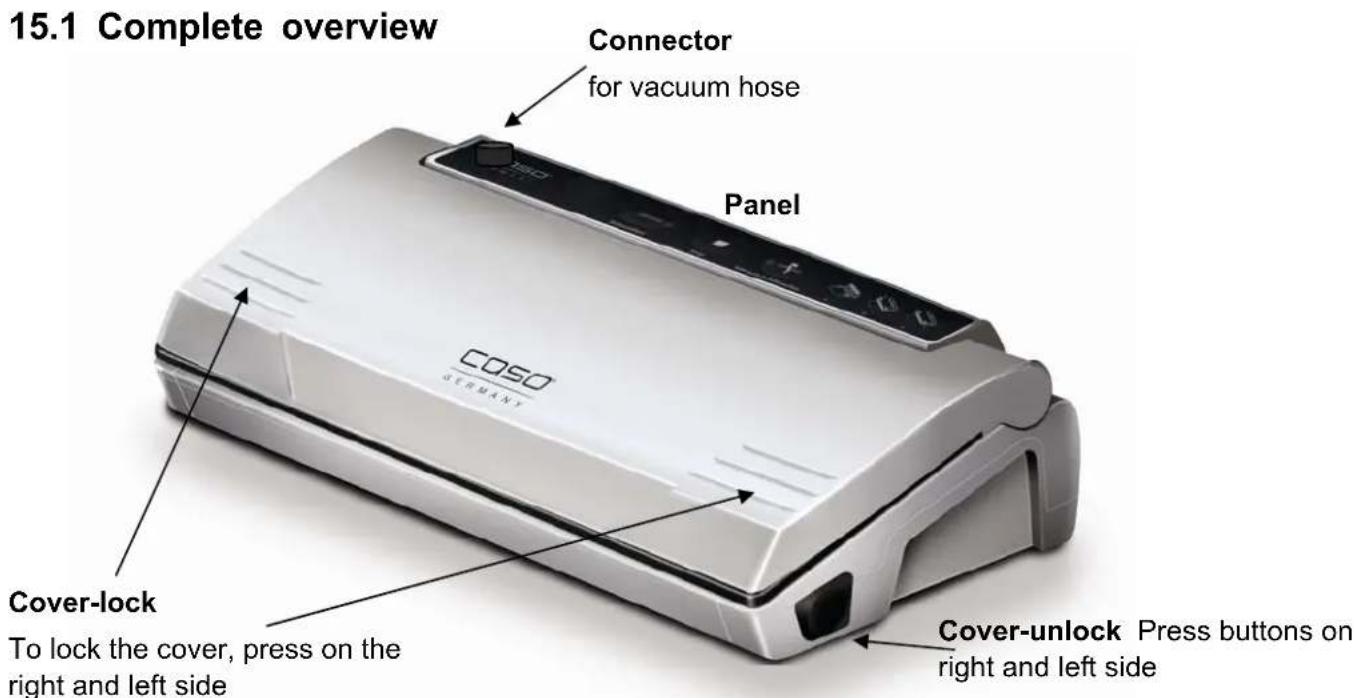
15.1 Complete overview Connector for vacuum hose Panel COSO Cover-lock To lock the cover, press on the right and left side Cover-unlock Press buttons on right and left sideIf you open the cover, you see:
- the Sealing strip, it contains a heating wire covered with Teflon which allows the bag to seal but not to stick to the strip.
- Removable vacuum chamber. The open end of the bag must be placed inside the chamber. This feature makes sure that air cannot escape from the bag and that excess liquid is removed. Easy to remove and clean.
⚠️WARNUNG
Warning
Please observe the following safety notices in order not to burn or scald yourself or others.
▶ To avoid getting burned, never touch the sealing bar while the unit is operating.
15.2 Panel
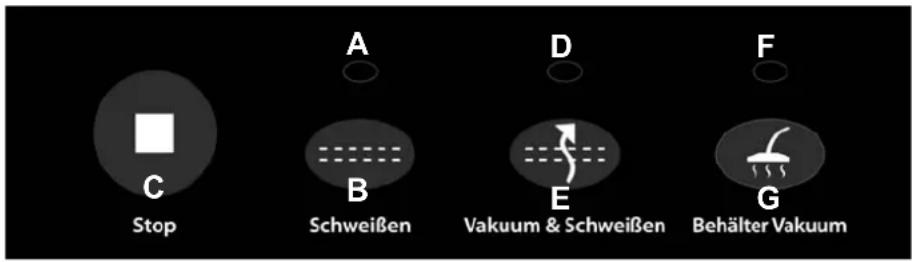
A Indicator lamp for sealing
indicates the seal process
B Button Seal only
For sealing the bag without vacuum
C Stop
switches off the vacuuming and sealing action whenever the operator wants to stop the operation
D Indicator lamp for vacuum
indicates the vacuum process
E Vacuum & Seal
draws air out of the bag and automatically changes operation to seal the bag after vacuum is completed
F Indicator lamp for vacuum in canister
indicates the vacuum process
G Vacuum & Seal canister
draws air out of the canister
15.3 Rating plate
The rating plate with the connection and performance data can be founded on the back of the device.
16 Operation and Handing
This chapter provides you with important notices with regard to operating the device. Observe the following notices to avoid dangers and damages:
16.1 Operating Instructions
After each sealing session and before starting up, check to make sure the unit and all accessories that come in contact with the foodstuff are thoroughly clean. Follow the cleaning instructions on the description page.
natural_image
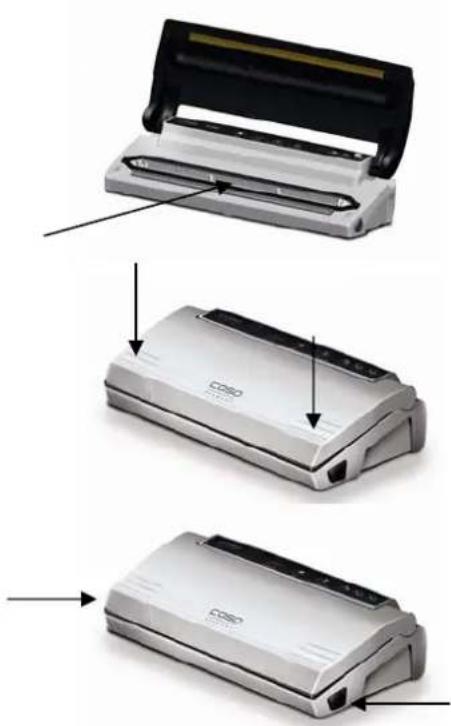
Three-step diagram showing a device being processed, with arrows indicating the process (no text or symbols present)Step 1: Open the lid and place an open side of the bag in the vacuum chamber- with the smooth side up.
Step 2: Press the cover down
Step 3: Press for release (after sealing process)
16.2 Removing the vacuum chamber
- Shift the vacuum chamber and take it out completely.
- To re-seat the vacuum chamber, place the right end into the right side of the recess. Make sure the suction nozzle matches the corresponding hole on the chamber and that the chamber positioning tongue is placed in its seat.
- Make sure that the chamber is firmly fixed.
16.3 Bags and rolls
Please only use specified bags and rolls for vacuuming.
The material of these special foils is different from wrapping film.
Attached you find the order sheet for Profi Vakuumierfoils of Caso Germany.
16.4 Preserve food with vacuum:
Place the unit on a dry place. Make sure the working area in front of the unit is free of obstacles and wide enough to accommodate the food bags.
- Put the food that you want to preserve inside the bag.
- Clean and straighten the open end of the bag, make sure that there are no wrinkles or ripples on the panels of the open ends.
- Make sure that both panels of the bag are located within the rippled area (vacuum plate), but below the round post which is the vacuum pump hole to ensure no vacuum leaking. (see Step1)
- Close the cover and then press down heavily on both sides by using two hands until two click sounds heard (see Step 2).
- Press the "Vakuum"-Button (E) and the corresponding LED control light starts flashing, then the bag will be automatically vacuumed and sealed.
- After that press the two "Cover Lock"-buttons and the process is completed (see Step3).
- Check the appearance of the sealed bag; it should have a stripe across the seal and no wrinkles otherwise the seal may not be complete.
- If you need to interrupt the vacuum operation (e.g. the bag is incorrectly positioned) first presses the "Stop" pushbutton (C) and then the "Cover-Unlock"-buttons.
HINWEIS
Please note
▶ Do not put too much food inside the bag; leave enough empty length in the open end of the bag so that the bag can be placed in the vacuuming plate more positively.
▶ Do not wet the open end of the bag. Wet bags may be difficult to seal tightly.
▶ Clean and straighten the open end of the bag before sealing the bag. Make sure nothing is leaving on the open area of
the bag. Foreign objects or creased bags may cause difficulty to seal tightly.
▶ Do not leave too much air inside the bag. Press the bag to allow extra air to escape from the bag before vacuuming it. Too much air inside the bag increases the vacuum pump loading and may cause that the motor works insufficient to draw away all the air out of the bag.
If the foods you're sealing have sharp edges, such as bones, spaghetti or shellfish, pack the edges with kitchen paper to avoid tearing the bag
▶ Suggest to vacuum seal one bag within 1 minute to let the appliance cool down enough.
In order to vacuum seal liquid-based foods, such as soups, casseroles or stew, freeze them first in a baking pan or tempered dish, vacuum seal them, label and stack them in your freezer as soon as they are in frozen solid.
▶ Blanch the vegetables by cooking briefly in boiling water or microwave oven, cool them down, then vacuum seal them in convenient portions.
▶ To vacuum seal the foods not frozen, two extra inches are required for bag length to allow for expansion while freezing. Place the meat or fish on a paper towel and vacuum seal with the paper towel in the bag, this way will help to absorb moisture from the foods.
Before storing the foods such as tortillas, crepes or hamburger, use wax or parchment paper between them to stack the pieces, this will be easier to remove some of the food, reseal the rest and immediately replace in the freezer.
These vacuum bags are not recommended for microwave or boil-in-bag cooking, please use the general cooking methods to reheat the vacuum-sealed foods.
16.5 Making a bag using the bag roll
- Unroll the foil to the desired length and cut the bag to the appropriate length with precise and clear cut.
- Open the lid and put one end of the bag on top of the black rubber strip, then close the cover (see Step 1).
- Press the cover down heavily on both sides by using two hands until two click sounds heard (see Step 2).
-
Press the "Schweißen"-Button (B) and the corresponding LED control light starts flashing.
-
When the LED light turns off, the bag is sealed.
- Now you have a custom-sized bag.
HINWEIS
Please note
▶ Make sure that the bag you want to use is at least 8cm/3.1in. longer than the food. Add another 2 cm/0.8in. each time the bag is re-used.
16.6 Open a sealed bag
Cut the bag straight across with scissors, just inside the seal.
16.7 Resealing
You can reseal many foods in their original store packages (i.e. potato chip bags), follow the steps shown in chapter “Preserve food with vacuum” to seal when resealing foods.
HINWEIS
Please note
The vacuum preservation system can't be directly used for the vacuum sealing of canisters or canning jars.
16.8 Storing your vacuum sealing system
Keep the unit in a flat and safe place, out of the reach of children.
HINWEIS
Please note
▶ To disconnect remove the plug from the outlet.
▶ Always unplug this appliance from the electrical outlet immediately after using and before cleaning.
17 Cleaning and Maintenance
This chapter provides you with important notices with regard to cleaning and maintaining the device. Please observe the notices to prevent damages due to cleaning the device incorrectly and to ensure trouble-free operation.
17.1 Safety information
▲VORSICHT
Attention
Please observe the following safety notices, before you commence with cleaning the device:
The device must be cleaned and food residues must be removed at regular intervals. If the device is not maintained in a clean condition, this will have a detrimental effect on the service life of the device and can also result in a dangerous condition in the device as well as in the growth of fungus and bacteria.
▶ Switch the vacuum-sealer off prior to cleaning it and unplug the plug from the wall power outlet.
The sealing strip is hot after it is used. There is a danger of burns! Wait until the device has cooled down.
▶ Clean the device after use as soon as it has cooled down. Extended waiting unnecessarily complicates cleaning and can make it impossible in extreme cases. Excessive accumulations of dirt can even damage the device under certain circumstances.
▶ Never immerse the unit into water or the dishwasher.
▶ If dampness penetrates into the device, this can damage the electronic components. Please ensure that no liquid can enter the interior of the device.
▶ Do not use any aggressive or abrasive cleaning agents or solvents.
▶ Do not scrape off stubborn dirt with hard items.
▶ Dry thoroughly before using again.
17.2 Cleaning
◆ Outside of the unit
- Wipe the outside of the unit with a damp cloth or sponge and mild dish soap.
◆ Inside of the device
- To clean the inside of the unit wipe away any food or liquids with a paper towel.
◆ Inside of the device
- The extractable vacuum chamber can be washed under running water (Figure 10) or in the dishwasher – see for this the paragraph “Removing the vacuum chamber”.
◆ Preservation bags
- Washing the bagging material in warm water with a mild dishwashing soap, then rinse the bags well and allow drying thoroughly before reusing.
▲VORSICHT Attention
- Bags used to store raw meats, fish or greasy foods can't be reused.
◆ Vacuum interface: - Unbag the airproof loop of sponge from the interface and put it into warm and soapy water for safe washing.
HINWEIS Please note
▶ The airproof loop of sponge should be dried thoroughly prior to reassembling.
▶ When re-assembling, be careful to prevent any damage and assembles as original position to ensure no vacuum leaking.
18 Troubleshooting
This chapter provides you with important notices with regard to operating the device. Observe the following notices to avoid dangers and damages:
18.1 Safety notices
▲VORSICHT Attention
▶ Only qualified electricians, who have been trained by the manufacturer, may carry out any repairs on electrical equipment.
▶ Improperly performed repairs can cause considerable dangers for the user and damages to the device.
18.2 Cause and Action
In the event of a fault, an error code will appear in the display; it describes the cause of the fault.
| Error | Possible cause | Rectification |
| Vacuum unit is not functioning | Power plug is not plugged in ▶ Plug in mains plug! | |
| Defective power cable or plug ▶ Send device to Customer Service | ||
| Defective electrical socket ▶ Select another electrical socket | ||
| The first weld on the cut off piece of the roll is not being carried out. | Roll is not positioned correctly | ▶ Follow the steps in the chapter “Vacuum packaging in a bag originating on the roll” |
| A complete vacuum is not being created in the bag. | The open end of the bag is not completely inside the vacuum chamber | ▶ Position the bag correctly |
| The bag is defective ▶ Select another bag | ||
| There is dirt on the welding and the normal seals | ▶ Clean the seals and retry correctly once they are dry | |
| The bag is not being welded correctly | The welding bar is overheating so that the bag melts | ▶ Open the cover on the unit and let it cool down for a few minutes |
| The bag does not hold the vacuum after it has been welded shut | The bag is defective | ▶ Select another bag; wrap paper serviettes around any sharp edges on the content |
| There are leaks along the welding seam as a result of creases, crumbs, grease or liquids. | ▶ Open the bag again and clean the upper internal part of the bag and remove any foreign matter that might be on the welding bar before you weld the bag shut again. | |
HINWEIS
Please note
▶ If you are unable to solve the problem with the steps shown above, please contact Customer Service.
19 Disposal of the Old Device
Old electric and electronic devices frequently still contain valuable materials. However, they also contain damaging substances, which were necessary for their functionality and safety.
If these were put in the non-recyclable waste or were handled incorrectly, they could be detrimental to human health and the environment. Therefore, do not put your old device into the non-recyclable waste under any circumstances.
HINWEIS
Please note
- Utilise the collection point, established in your town, to return and recycle old electric and electronic devices. If necessary, contact your town hall, local refuse collection service or your dealer for information.
▶ Ensure that your old device is stored safely away from children until it is taken away.
20 Guarantee
We provide a 24 month guarantee for this product, commencing from the date of sale, for faults which are attributable to production or material faults.
Your legal guarantee entitlements in accordance with § 439 ff. BGB-E remain unaffected by this.
The guarantee does not include damages, which were incurred as a result of improper handling or use, as well as malfunctions which only have a minor effect on the function or the value of the device. Consumables, transit damages, inasmuch as we are not responsible for these, as well as damages, which were incurred as a result of any repairs that were not performed by us, are also excluded from the guarantee entitlements.
This device is designed for use in domestic situations and has the appropriate performance levels.
Any use in commercial situations is only covered under the guarantee to the extent that it would be comparable with the stresses of being used in a domestic situation. It is not intended for any additional, commercial use.
In the event of justified complaints, we will repair the faulty device at our discretion or replace it with a trouble-free device.
Any pending faults must be reported within 14 days of delivery.
All further claims are excluded.
To enforce a guarantee claim, please contact us prior to returning the device (always provide us with proof of purchase).
21 Technical Data
| Device | Vacuum sealer system |
| Name | VC 100 |
| Model | VS2510 |
| Item No.: | 1380 |
| Mains data | 230 V, 50 Hz |
| Power consumption | 120 W |
| External measurements(W x H x D): | 380 x 90 x 170 mm |
| Net weight | 1,8 kg |
CQSO®
GERMANY
natural_image
Exterior view of a COSO printer device (no visible text or symbols on body)22 Mode d'emploi
22.1 Généralités
A Voyant lumineux scellage
natural_image
Exterior view of a COSO Germany electronic device (no visible text or symbols on body)32 Istruzione d'uso
32.1 In generale
natural_image
Three-step diagram showing a device being processed, with arrows indicating the process (no text or symbols present)natural_image
Exterior view of a COSO printer device (no visible text or symbols on body)F Indicator lichte vacuum tank