 ManualGo.com
BGC4U2230 - Aspirateur BOSCH - Free user manual and instructions
Find the device manual for free BGC4U2230 BOSCH in PDF.



Download the instructions for your Aspirateur in PDF format for free! Find your manual BGC4U2230 - BOSCH and take your electronic device back in hand. On this page are published all the documents necessary for the use of your device. BGC4U2230 by BOSCH.
USER MANUAL BGC4U2230 BOSCH
Alle in dieser Anweisung nicht genauer beschriebenen Verfahren wurden auf Basis der Norm EN 60312-1:2017* ausgeführt. *Da der Lebensdauertest für den Motor bei leerem Staubbehälter durchgeführt wird, muss die angege- bene Motorlebensdauer für Prüfung mit halbgefülltem Staubbehälter um 10% erhöht werden. Please keep this instruction manual for future refe- rence. When passing the vacuum cleaner on to a third party, also pass on this instruction manual. Intended use This appliance is intended for domestic use only. This appliance is intended for use up to a maximum height of 2000 metres above sea level. Only use this vacuum cleaner in accordance with the instructions in this ins- truction manual. In order to prevent injuries and damage, the vacuum cleaner must not be used for: Vacuum-cleaning persons or animals Vacuuming up: − hazardous, sharp-edged, hot or glowing substances. − damp or liquid substances. − highly flammable or explosive substances and gases. − ash, soot from tiled stoves and central heating sys- tems. − toner dust from printers and copiers. Spare parts, accessories, dust bags Our original spare parts, original (special) accessories and original dust bags are designed to work with the features and requirements of our vacuum cleaners. We therefore recommend that you only use our original spa- re parts, original (special) accessories and original dust bags. This will ensure that your vacuum cleaner has a long service life and that the quality of its cleaning per- formance will remain consistently high throughout.
Please note Using unsuitable or inferior-quality spare parts, (special) accessories and dust bags can damage your vacuum cleaner. Damage caused by the use of such products is not covered by our guarantee. Safety information This vacuum cleaner complies with the re- cognised rules of technology and the rele- vant safety regulations. The appliance may be used by children over the age of 8 years and by persons with reduced physical, sensory or mental capacity or by persons with a lack of ex- perience or knowledge if they are super- vised or have been instructed on the safe use of the appliance and they have under- stood the potential dangers of using the appliance. Children must never play with the appli- ance. en4 Cleaning and user maintenance must ne- ver be carried out by children without su- pervision. Plastic bags and films must be kept out of the reach of children and disposed of. >= There is a risk of suffocation. Proper use The vacuum cleaner must only be connected and ope- rated as specified on the rating plate. Never vacuum without the dust bag or dust container, motor protection or exhaust filter. >= This may damage the appliance. Keep the vacuum cleaner away from your head when using nozzles and tubes. >= There is a risk of injury. When vacuuming stairs, the appliance must always be positioned below the user. Do not use the power cord or the hose to carry or transport the vacuum cleaner. If the power cord of this appliance is damaged, it must be replaced by the manufacturer, customer service or a similarly qualified person, in order to prevent injury. Fully extend the power cord when using the vacuum cleaner continuously for several hours. When disconnecting the appliance from the mains, pull the plug itself to remove it; do not pull on the power cord. Do not pull the power cord over sharp edges or allow it to become trapped. Pull out the mains plug before carrying out any work on the vacuum cleaner. Do not operate the vacuum cleaner if it is damaged. Unplug the appliance from the mains if a fault is de- tected. For safety reasons, only authorised after-sales service personnel are permitted to carry out repairs and fit replacement parts to the vacuum cleaner. Protect the vacuum cleaner from outside weather con- ditions, moisture and sources of heat. Do not pour flammable substances or substances con- taining alcohol onto the filters (dust bag, motor pro- tection filter, exhaust filter, etc.). The vacuum cleaner is not suitable for use on const- ruction sites. >= Vacuuming up building rubble may damage the appliance. Switch off the appliance when it is not in use. At the end of its service life, the appliance should im- mediately be rendered unusable, then disposed of in an appropriate manner.
Please note The mains socket must be protected by at least a 16-amp circuit breaker. If a circuit breaker is tripped when you switch on the vacuum cleaner, this may be because other electrical appliances which have a high current draw are connected to the same power circuit. To prevent the fuse from blowing, select the lowest power setting before switching the appliance on, and increase the power only once it is running. Instructions on disposal Packaging The packaging is designed to protect the vacuum cleaner from being damaged during transportation. It is made of environmentally friendly materials and can be recycled. Dispose of packaging that is no longer required at an appropriate recycling point. Old appliances Old appliances still contain many valuable materi- als. You should therefore take appliances that have reached the end of their service life to your retailer or recycling centre so that they can be recycled. For current disposal methods, enquire at a retailer or your local council. Disposal of filters and dust bags Filters and dust bags are manufactured from environmentally friendly materials. Provided they do not contain substances that are not permitted in household waste, you can dispose of them with your normal household waste. Notes on the energy label This vacuum cleaner is a general purpose vacuum clea- ner with a primary hose. To achieve the declared energy efficiency and cleaning performance class on carpet and hard floor, please use the interchangeable universal nozzle. These calculations are based on the Commission Dele- gated Regulation (EU) No. 665/2013 of 3rd May 2013 supplementing Directive 2010/30/EU. Unless otherwise stated, all the procedures refer- red to in these instructions were carried out in ac- cordance with the EN 60312-1:2017* standard. *As the motor service test is carried out with the dust collector empty, the stated motor service life must be increased by 10% for tests with the dust collector half filled.5
Congratulations on your purchase of the Bosch Runn`n vacuum cleaner. This instruction manual describes various Runn`n mo- dels, meaning that some of the equipment features and functions described may not be available on your model. You should only use original Bosch accessories, which have been specially developed for your vacuum cleaner, in order to achieve the best possible vacu- uming results. Please keep this instruction manual for future refe- rence. When passing the vacuum cleaner on to a third party, also pass on this instruction manual. Fold out the picture pages. Your vacuum cleaner 1 Adjustable floor tool* (For the same functions, the appearance of the nozzle may differ from the picture) 2 Telescopic tube with sliding switch but without acces- sory connection* 3 Telescopic tube with adjusting sleeve and accessory connection* 4 Flexible hose 5 Handle 6 Foam filter 7 Parking aid on the back of the appliance 8 Exhaust filter lid 9 Power cord 10 Appliance lid 11 Foam filter lid 12 Carrying handle 13 On/off button with electronic suction regulator 14 Filter control display (Sensor Control) 15 Dust container with carrying handle 16 Storage aid on the underside of the appliance 17 Fluff filter cover 18 Multi-purpose nozzle* 19 Accessories holder for multi-purpose nozzle* 20 Professional upholstery nozzle* 21 Professional crevice nozzle* 22 Upholstery nozzle 23 Accessories holder* 24 Crevice nozzle 25 Brush ring (for fitting on the upholstery nozzle)*
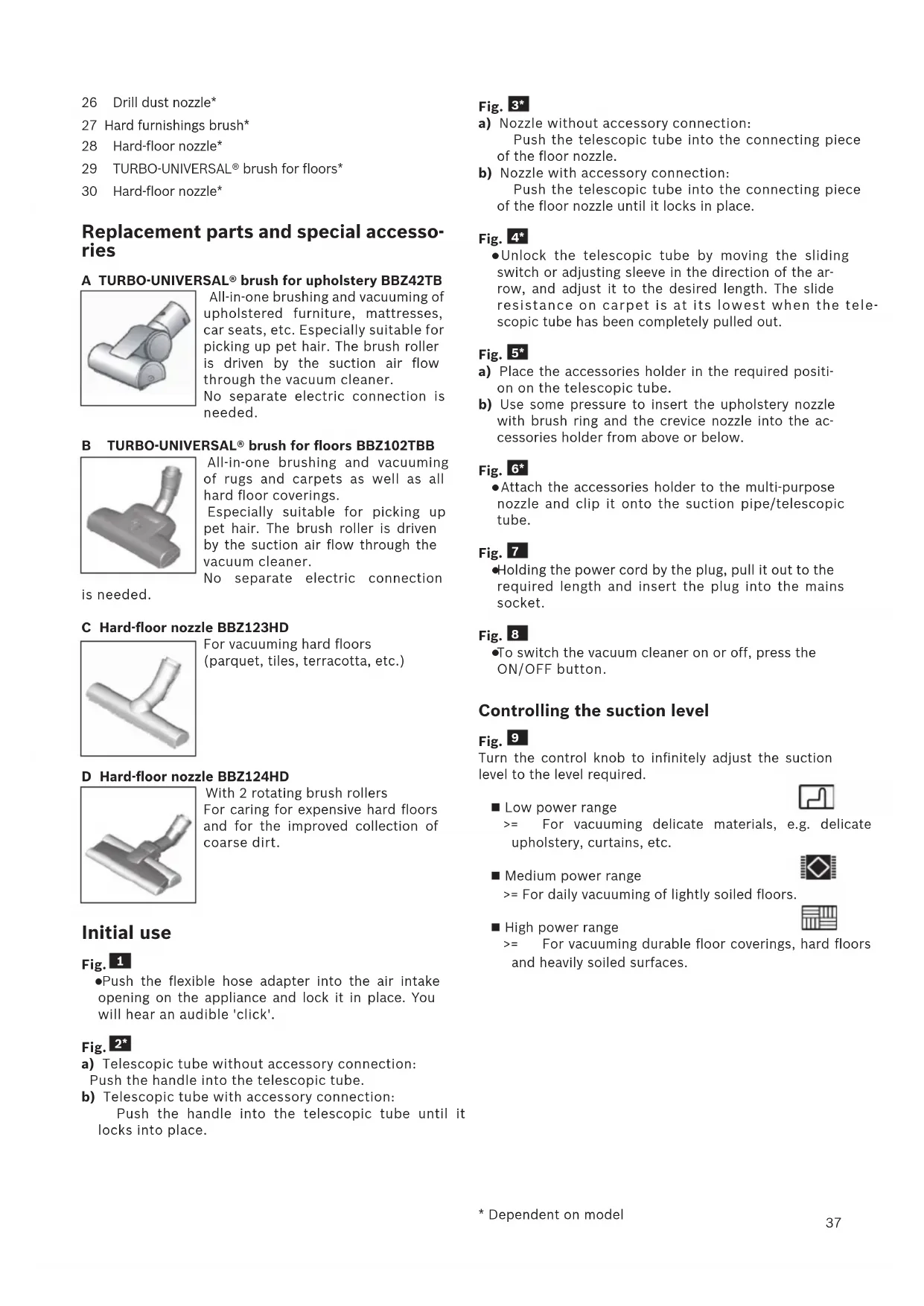
- Dependent on model37 26 Drill dust nozzle* 27 Hard furnishings brush* 28 Hard-floor nozzle* 29 TURBO-UNIVERSAL® brush for floors* 30 Hard-floor nozzle* Replacement parts and special accesso- ries A TURBO-UNIVERSAL® brush for upholstery BBZ42TB All-in-one brushing and vacuuming of upholstered furniture, mattresses, car seats, etc. Especially suitable for picking up pet hair. The brush roller is driven by the suction air flow through the vacuum cleaner. No separate electric connection is needed. B TURBO-UNIVERSAL® brush for floors BBZ102TBB All-in-one brushing and vacuuming of rugs and carpets as well as all hard floor coverings. Especially suitable for picking up pet hair. The brush roller is driven by the suction air flow through the vacuum cleaner. No separate electric connection is needed. C Hard-floor nozzle BBZ123HD For vacuuming hard floors (parquet, tiles, terracotta, etc.) D Hard-floor nozzle BBZ124HD
With 2 rotating brush rollers For caring for expensive hard floors and for the improved collection of coarse dirt. Initial use Fig.
Push the flexible hose adapter into the air intake opening on the appliance and lock it in place. You will hear an audible 'click'. Fig.
a) Telescopic tube without accessory connection: Push the handle into the telescopic tube. b) Telescopic tube with accessory connection: Push the handle into the telescopic tube until it locks into place. Fig.
a) Nozzle without accessory connection: Push the telescopic tube into the connecting piece of the floor nozzle. b) Nozzle with accessory connection: Push the telescopic tube into the connecting piece of the floor nozzle until it locks in place. Fig.
Unlock the telescopic tube by moving the sliding switch or adjusting sleeve in the direction of the ar- row, and adjust it to the desired length. The slide resistance on carpet is at its lowest when the tele- scopic tube has been completely pulled out. Fig.
a) Place the accessories holder in the required positi- on on the telescopic tube. b) Use some pressure to insert the upholstery nozzle with brush ring and the crevice nozzle into the ac- cessories holder from above or below. Fig.
Attach the accessories holder to the multi-purpose nozzle and clip it onto the suction pipe/telescopic tube. Fig.
Holding the power cord by the plug, pull it out to the required length and insert the plug into the mains socket. Fig.
To switch the vacuum cleaner on or off, press the ON/OFF button. Controlling the suction level Fig.
Turn the control knob to infinitely adjust the suction level to the level required. Low power range >= For vacuuming delicate materials, e.g. delicate upholstery, curtains, etc. Medium power range >= For daily vacuuming of lightly soiled floors. High power range >= For vacuuming durable floor coverings, hard floors and heavily soiled surfaces.
Caution Floor nozzles are subject to a certain amount of wear, depending on the type of hard floors you have (e.g. rough, rustic tiles). You must therefore check the underside of the floor nozzle at regular intervals. Worn undersides of floor nozzles may have sharp edges that can damage sensitive hard floors, such as parquet or linoleum. The manufacturer does not ac- cept any responsibility for damage caused by worn floor nozzles. Fig.
Set the adjustable floor nozzle: Rugs and carpets => Hard floors/parquet => If you are vacuuming up relatively large particles, make sure that you vacuum them up successively and careful- ly to ensure that the vacuum channel of the floor nozzle does not become blocked. If necessary, you should raise the nozzle in order to better vacuum up the dirt particles. Vacuuming with accessories Fig. 11* Attach the nozzles to the suction pipe or handle as re- quired: a) Crevice nozzle for vacuuming crevices and corners, etc. b) Upholstery nozzle for vacuuming upholstered furni- ture, curtains, etc. c) Upholstery nozzle with fixed brush ring for vacu- uming window frames, cupboards, profiles, etc. After use, reinsert the crevice nozzle and upholstery nozzle into the accessories holder. d) Professional crevice nozzle Extra-long crevice nozzle for cleaning crevices, cor- ners and narrow spaces, e.g. in a car. e) Professional upholstery nozzle For gently and thoroughly cleaning upholstered fur- niture, curtains, etc. For cleaning the professional upholstery nozzle, sim- ply vacuum it using the handle. f) Hard furnishings brush For cleaning window frames, cabinets, mouldings, etc. g) Hard-floor nozzle for vacuuming hard floor coverings (tiles, parquet flooring, etc.) Cleaning the hard-floor nozzle Fig. 12* a) Vacuum the nozzle from below to clean it. b) Use scissors to cut through threads and hairs wound round the rollers and then vacuum them away. Drill dust nozzle Fig. 13*
Fasten the drill dust nozzle onto the handle and po- sition it on the wall so that the drill hole opening on the nozzle is placed directly over where the hole is to be drilled.
Set the appliance to the lowest power level and then switch it on.
The drill dust nozzle is held in the required position by suction. Depending on the condition of the wall to be drilled, you may need to adjust to a higher power setting to ensure that the drill dust nozzle remains in place. During drilling, the fine dust is automatically vacu- umed up. Turbo brush If your appliance is equipped with a turbo brush, refer to the accompanying instruction manual for instruc- tions on its use and maintenance. Fig.
You can use the parking aid on the back of the vacuum cleaner if you want to stop vacuuming for a short time.
After switching off the appliance, slide the hook on the floor nozzle into the parking aid. Fig.
When vacuuming stairs, the appliance must be positi- oned at the bottom of the stairs. If it does not reach far enough, the appliance can also be carried using the carrying handle or the handle on the dust container. After vacuuming Fig.
Switch off the appliance.
Remove the main plug.
Briefly pull on the power cord and then let go. (The power cord retracts automatically.) Fig. 17*
Unlock the telescopic tube by moving the sliding switch in the direction of the arrow, and slide one tube into the other. Fig.
To store the appliance, use the storage aid on the un- derside. a) Prop up the appliance with the hose or dust contai- ner handle. b) Slide the hook on the floor nozzle into the storage aid. Disassembly Fig.
To remove the flexible hose, press the two catches together and pull out the hose from the appliance's suction opening.
- Dependent on model39 Fig. 20* a) Telescopic tube without accessory connection: To release the connection, turn the handle slightly and pull it out of the telescopic tool. b) Telescopic tube with accessory connection: To release the connection, press the locking collar on the telescopic tube and and pull out the handle. Fig. 21* a) Nozzle without accessory connection: To release the connection, turn the telescopic tube slightly and pull it out of the floor nozzle. b) Nozzle with accessory connection: To release the connection, press the locking collar and pull the telescopic tube out of the floor nozzle. Cleaning and care Emptying the dust container Fig.
In order to achieve the best possible vacuuming re- sults, the dust container should be emptied after every use or, at the latest, when dust in the dust container has reached the marking at any point.
Caution The dust container can only be removed when the appliance is in a horizontal position. Therefore, place the appliance on the floor to unlock the re- lease button. Fig.
a) Press the release button and pull the dust container out of the appliance using the handle. b) Remove the lid from the dust container and empty the dust container. c) Put the lid back on the dust container. d) Remove any dirt which may have been lodged under- neath the container ejector opening. e) Insert the dust container in the appliance, so that it 'clicks' audibly into place. Maintaining the dust separation system Your appliance is equipped with a Sensor Control indi- cator. This function constantly monitors whether your vacuum cleaner is working at its optimum power level. Fig.
In normal operation Fig.
The indicator (blue ring) flashes red when the foam fil- ter needs to be cleaned. The appliance is automatically adjusted to the lowest power level. Cleaning the foam filter Switch off the appliance. Fig.
a) Open the lid of the foam filter by pulling on the lo- cking lever. b) Remove the filter cartridge with foam filter using the tab. Remove the foam filter from the filter cartridge and tap out both parts. c) If they are very dirty, the foam filter and filter cart- ridge should be cleaned under running water. Alternatively, the unit can be cleaned in the washing machine at max. 30 °C using a gentle pro- gramme and the lowest spin speed. TIP: To protect other laundry items, put the filter unit into a laundry bag. d) Allow the foam filter and filter cartridge to dry com- pletely (at least 24 hours) and then reinsert the foam filter into the filter cartridge. e) Insert the filter cartridge with foam filter back into the appliance. Close the lid of the foam filter.
Caution The lid will only close if a filter has been inserted. In the event of a fault The Sensor Control indicator also flashes after the foam filter has been cleaned: Removing a blockage from the dust separation unit Fig.
Switch off the appliance. a) Hold the appliance lid by the recessed handle and open it. b) Unlock the cover by turning it anti-clockwise, and remove it from the appliance. >= Remove the blockage from the collecting unit. c) Put the cover back on and lock it in place by turning it clockwise. >= Close the appliance lid. If the Sensor Control indicator continues to flash red, check whether the nozzle, suction pipe or flexible hose are blocked. This can also trigger the Sensor Control indicator. Exhaust filter care Depending on the model, your appliance is equipped with either a (H)EPA filter Fig.
Depending on the model, your appliance has additional sound insulation behind the (H)EPA or micro filter. This does not have to be cleaned. (H)EPA filter You can determine with which (H)EPA filter your appli- ance is equipped by looking at the imprint on the filter frame next to the reference number:
"washable" – the filter can be washed.
No additional imprint – the filter must be replaced.
- Dependent on model40 Cleaning a washable (H)EPA filter The (H)EPA filter with the "washable" imprint is desig- ned so that it does not need to be replaced, provided the appliance is used as intended in the household. To ensure that the vacuum cleaner is working at its op- timum power level, the exhaust filter should be rinsed out after one year. The filtering action of the filter re- mains intact, even if the filter surface becomes disco- loured. Fig. 27* a) Open the lid of the exhaust filter by pushing and pulling on the locking tab. b) Unlock the (H)EPA filter and remove it from the ap- pliance. c) Tap out the filter unit and rinse it under running wa- ter. Alternatively, the unit can be cleaned in a washing machine at max. 30 °C using a gentle programme and the lowest spin speed. TIP: To protect other laundry items, put the filter unit into a laundry bag. d) Once the (H)EPA filter has dried completely (at least 24 hours), insert it back into the appliance and lock it in place. >= Close the exhaust filter lid. In doing so, push the lock bar upwards until it audibly clicks into place. Replacing the (H)EPA filter (only for appliances without a washable (H)EPA filter) To ensure that the vacuum cleaner can work at its opti- mum power level, the (H)EPA filter should be replaced after one year. Fig. 28* a) Open the lid of the exhaust filter by pushing and pulling on the locking tab. b) Unlock the (H)EPA filter and remove it from the ap- pliance. c) Dispose of the old (H)EPA filter with your household waste. d) Insert the new (H)EPA filter into the appliance and lock it in place. >= Close the exhaust filter lid. In doing so, push the lock bar upwards until it audibly clicks into place. Micro filter Cleaning the micro filter The micro filter is designed so that it does not need to be replaced, provided the appliance is used as inten- ded in the household. To ensure that the vacuum cleaner is working at its op- timum power level, the exhaust filter should be rinsed out after one year. The filtering action of the filter re- mains intact, even if the filter surface becomes disco- loured. Fig. 29* a) Open the lid of the exhaust filter by pushing and pulling on the locking tab. b) Pull the locking tab to unlock the filter unit with foam filter and microfilter and remove it from the appli- ance. c) Remove the foam filter and microfilter from the filter frame. d) Rinse the foam filter and micro filter under run- ning water. Alternatively, they can be cleaned in the washing machine at max. 30 °C using a gentle programme and the lowest spin speed. TIP: To protect other laundry items, put the unit into a laundry bag. e) Once the foam filter and microfilter have dried com- pletely (at least 24 hours), insert them back into the filter frame. f) Insert the filter unit in the appliance and ensure that the locking tabs audibly click into place. g) Close the exhaust filter lid. In doing so, push the lock bar upwards until it audibly clicks into place. Cleaning instructions Always switch off the vacuum cleaner and disconnect the power cord from the mains before cleaning the va- cuum cleaner. The vacuum cleaner and plastic acces- sories can be cleaned with an ordinary plastic cleaner.
Caution: Do not use abrasive materials, glass-cleaning agents or all-purpose cleaning products. Never im- merse the vacuum cleaner in water. Subject to technical modifications.
/S 78# &I+ 'd9& J "4 I
Central Branch Service
North Block, Skyway House,
for exact charges. IL Israel,
- Mo-Sa: 8.00am to 8.00pm
BOSCH Service centre,