RS790 - Diving regulator Tusa - Free user manual and instructions
Find the device manual for free RS790 Tusa in PDF.



Frequently Asked Questions - RS790 Tusa
User questions about RS790 Tusa
0 question about this device. Answer the ones you know or ask your own.
Ask a new question about this device
Download the instructions for your Diving regulator in PDF format for free! Find your manual RS790 - Tusa and take your electronic device back in hand. On this page are published all the documents necessary for the use of your device. RS790 by Tusa.
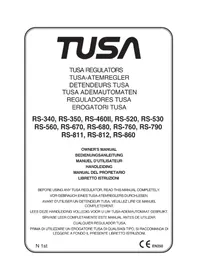
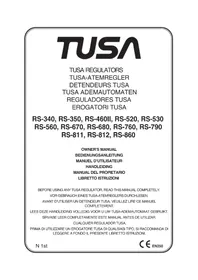
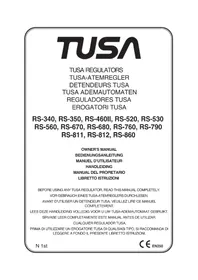
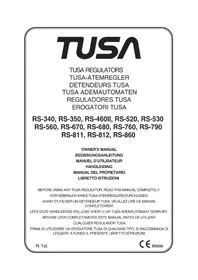
USER MANUAL RS790 Tusa
RS-811, RS-812, RS-860
OWNER'S MANUAL
DIMENSIONS: Height: 2.56 IN. 65 MM
Length: 4.76 IN. 121 MM
Width: 4.09 IN. 104 MM
WEIGHT: (incl. Hose) 0.92 LBS. 418 GRAM
HOSE:Length:30 IN.76 CM
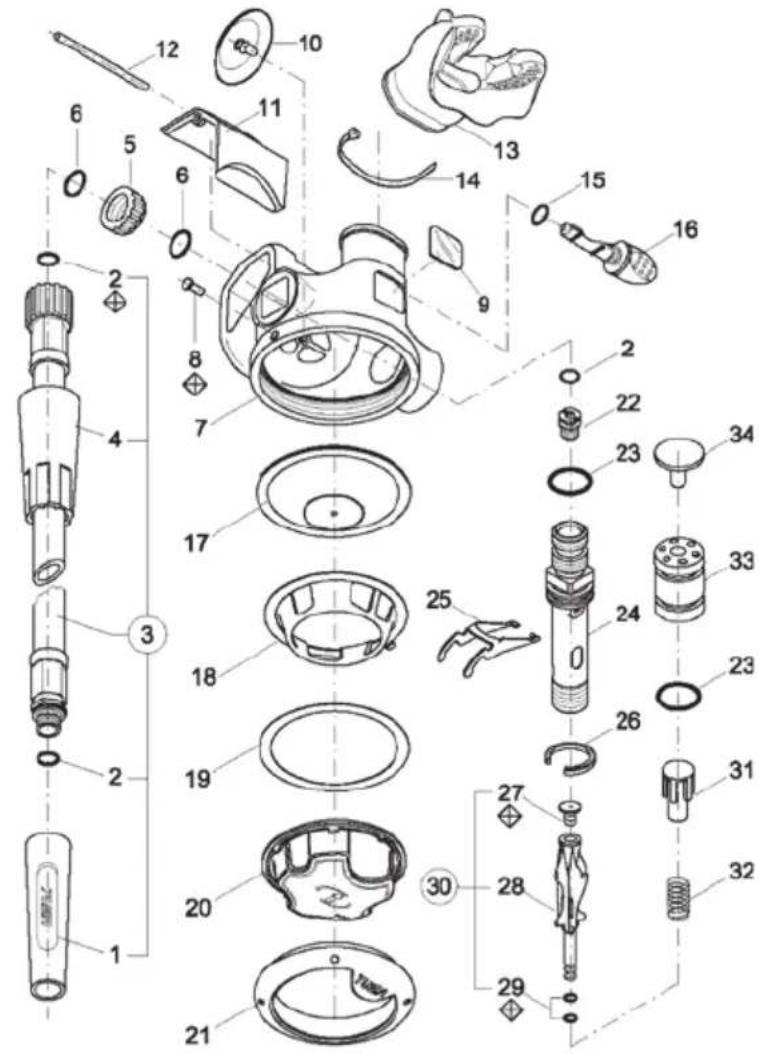
S-90
S-90
| ITEM NO. | PART NO. DESCRIPTION | |
| 1 /S90-010 PROTECTIVE SLEEVE | ||
| 2 /010-EP O-RING | ||
| 3 /S90-020 L.P. HOSE cm.75 | ||
| 4 /S90-030 SLEEVE HOSE | ||
| 5 /S90-040 NUT. JAM UNIF. | ||
| 6 /014-EP85 O-RING | ||
| 7 /S90-050 CASE | ||
| 8 /S90-060 PIN. CASE | ||
| 9 /S90-070 DECAL V.I.V.A. | ||
| 10 /S60-080 EXHAUST VALVE | ||
| 11 /S60-090 COVER EXHAUST | ||
| 12 /S60-100 PIN | ||
| 13 /S60-110 MOUTHPIECE | ||
| 14 TR0-108-BK CLIP LIGHT | ||
| 15 /008-EP85 O-RING | ||
| 16 /S90-080 FLOW VANE | ||
| 17 /S60-190 DIAPHRAGM ASSY | ||
| 18 /S90-090 WASHER ANTIFRCTION | ||
| 19 /S60-370 RING | ||
| 20 /S90-100 PURGE COVER | ||
| 21 /S90-110 RING | ||
| 22 /S60-050 ORIFICE | ||
| 23 /016 O-RING | ||
| 24 /S90-120 HOUSING | ||
| 25 /S90-130 LEVER | ||
| 26 /S90-140 RETAINING CLIP KNOB | ||
| 27 /S90-150 SEAT | ||
| 28 /S90-160 POPPET | ||
| 29 /101-EP O-RING | ||
| 30 /S90-170 POPPET ASSY | ||
| 31 /S90-180 BALANCE CHAMBER | ||
| 32 /S60-270 SPRING | ||
| 33 /S90-190 PLUG | ||
| 34 /S90-200 PLUG | ||
| SPECIFICATIONS | |||||
| DIMENSIONS: | Height: | 2.91 | IN. | 74 | MM |
| Length: | 4.76 | IN. | 121 | MM | |
| Width: | 4.09 | IN. | 104 | MM | |
| WEIGHT:(incl. Hose) | 0.33 | LBS. | 150 | GRAM | |
| HOSE: | Length: | 29 | IN. | 70 | CM |
FOREWORD
CONGRATULATIONS! You are now the owner of one of the many fine TUSA products. Your new regulator is built to exacting standards, using only the highest quality materials. For several years now TUSA has been developing the regulators under the ISO9001 International Quality Assurance System. You have purchased the newest, the most advanced regulator for the Sport Scuba Market available today. The TUSA regulator is the first major improvement to the conventional down stream demand valve since 1988. The second stage is constructed of technologically advanced materials and the performance provides exceptional aspiration flow and allows fully adjustable performance to accommodate beginner and professional divers.
Before you use your new regulator, please read this manual carefully. The following warnings, cautions, and notes were written to make it possible for you to enjoy your diving experience with maximum safety.
We at TUSA want you to have many years of dependable service from your new equipment and have many memorable and safe dives. Thank you for purchasing one of our high quality products.
WARNING:
THIS PRODUCT IS A SCUBA DIVING DEVICE AND REQUIRES PROPER TRAINING BEFORE USE.
CE Certified combinations of TUSA Regulators are listed below:
| Name of Regulator | 1st Stage Model No. | 2nd Stage Safe 2nd Stage | |
| Model No. Cover Model No. | Cover | ||
| RS-340 | R-300 (Yoke-DIN) | S-40 | BLACK |
| RS-350 | R-300 (Yoke-DIN) | S-50 | SILVER |
| RS-460II | R-400II (Yoke -DIN) | S-60 | BLACK |
| RS-520 | R-500 (Yoke-DIN) | S-20 | BLACK |
| RS-530 R-500 (Yoke-DIN) S-30 BLACK | |||
| RS-560 R-500 (Yoke-DIN) S-60 | GREY | ||
| RS-670 | R-600 (Yoke-DIN) | S-70 | SILVER |
| RS-680 | R-600 (Yoke-DIN) | S-80 | BLACK |
| RS-760 | R-700 (Yoke-DIN) | S-60 | GREY |
| RS-790 | R-700 (Yoke-DIN) | S-90 | GREY |
| RS-811 | R-800 (Yoke-DIN) | S-11 | BLACK |
| RS-812 | R-800 (Yoke-DIN) | S-12 | BLACK |
| RS-860 R-800 (Yoke-DIN) S-60 | GREY | ||
RS-460II, 560, 760, 790, 811, 812, 860
Notice:
"The PPE (Personal Protective Equipment) mentioned in this User's Manual was submitted to tests for validation of the design and certified according to Art. 10 of Directive 89/686/EEC by RINA - Via Corsica, 12-16128 Genova ITALY, Notified body n 0474. This device is in compliance with EN 250:2000.
The CE marking means the compliance of the device to the Basic Health and Safety Requirements of Annex II of Directive 89/686/EEC. The number 0098 near the CE identifies the Notified Body GL (Germanischer Lloyd), entitled for the EC quality control system for the final product according to Art. 11.A of Directive 89/686/EEC."
RS-340, 350, 520, 530, 670, 680
Notice:
"The PPE (Personal Protective Equipment) mentioned in this User's Manual was submitted to tests for validation of the design and certified according to Art. 10 of Directive 89/686/EEC by ITALCERT - Viale Sarca 336, 20126 Milano ITALY, Notified body n 0426. This device is in compliance with EN 250:2000.
The CE marking means the compliance of the device to the Basic Health and Safety Requirements of Annex II of Directive 89/686/EEC. The number 0426 near the CE identifies the Notified Body ITALCERT, entitled for the EC quality control system for the final product according to Art. 11.A of Directive 89/686/EEC."
TABLE OF CONTENTS
Technical Specification and Performance Page No.
1 R-300, R-300DIN First Stage. 1
2 R-400, R-400DIN First Stage 2
3 R-500, R-500 DIN First Stage 3
4 R-600, R-600 DIN First Stage 4
5 R-700, R-700 DIN First Stage 5
6 R-800, R-800 DIN First Stage. 6
7 S-11/SS-11Second Stage 7
8 S-12 Second Stage 8
9 S-20/SS-20 Second Stage 9
10 S-30 Second Stage 10
11 S-40 Second Stage 11
12 S-50 Second Stage 12
13 S-60/SS-60 Second Stage 13
14 S-70 Second Stage 14
15 S-80 Second Stage 15
16 S-90 Second Stage 16
SECTION
1 Warning - Read Carefully 20
II Description and Operation 21
2.0 General 21
2.1 First Stage 21
2.2 Second Stage 22
III Pre-Dive Procedures 24
IV AfterDive Procedures 25
V Contaminated Water Diving 26
VI Cold Water Diving 26
VII Scheduled Maintenance 27
VIII "Air Refresher" filter replacement 28
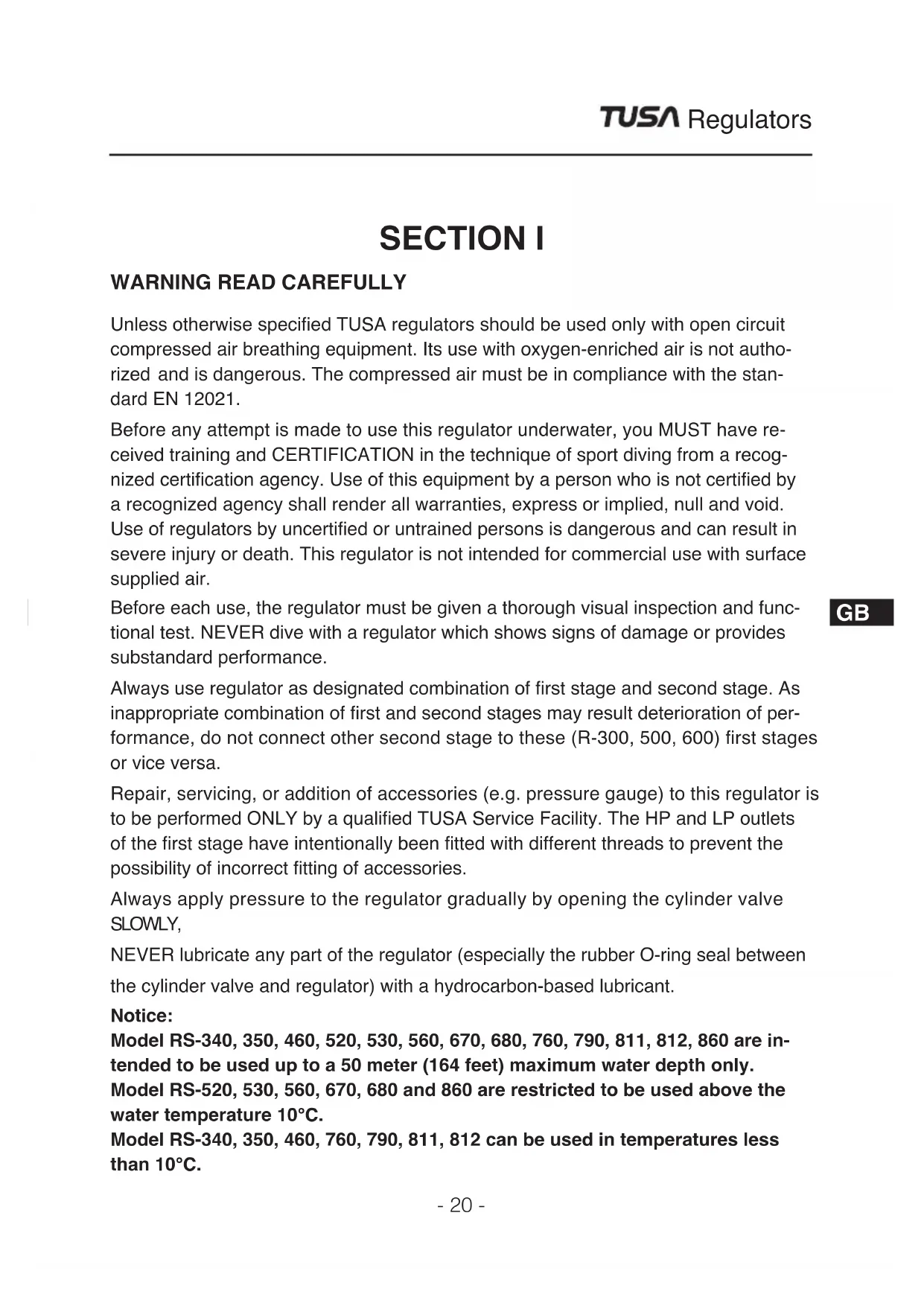
SECTION I
WARNING READ CAREFULLY
Unless otherwise specified TUSA regulators should be used only with open circuit compressed air breathing equipment. Its use with oxygen-enriched air is not authorized and is dangerous. The compressed air must be in compliance with the standard EN 12021.
Before any attempt is made to use this regulator underwater, you MUST have received training and CERTIFICATION in the technique of sport diving from a recognized certification agency. Use of this equipment by a person who is not certified by a recognized agency shall render all warranties, express or implied, null and void. Use of regulators by uncertified or untrained persons is dangerous and can result in severe injury or death. This regulator is not intended for commercial use with surface supplied air.
Before each use, the regulator must be given a thorough visual inspection and functional test. NEVER dive with a regulator which shows signs of damage or provides substandard performance.
Always use regulator as designated combination of first stage and second stage. As inappropriate combination of first and second stages may result deterioration of performance, do not connect other second stage to these (R-300, 500, 600) first stages or vice versa.
Repair, servicing, or addition of accessories (e.g. pressure gauge) to this regulator is to be performed ONLY by a qualified TUSA Service Facility. The HP and LP outlets of the first stage have intentionally been fitted with different threads to prevent the possibility of incorrect fitting of accessories.
Always apply pressure to the regulator gradually by opening the cylinder valve SLOWLY,
NEVER lubricate any part of the regulator (especially the rubber O-ring seal between the cylinder valve and regulator) with a hydrocarbon-based lubricant.
Notice:
Model RS-340, 350, 460, 520, 530, 560, 670, 680, 760, 790, 811, 812, 860 are intended to be used up to a 50 meter (164 feet) maximum water depth only.
Model RS-520, 530, 560, 670, 680 and 860 are restricted to be used above the water temperature 10^ .
Model RS-340, 350, 460, 760, 790, 811, 812 can be used in temperatures less than 10^ .
SECTION II DESCRIPTION AND OPERATION
2.0 GENERAL
TUSA Regulators are BALANCED PISTON and BALANCED DIAPHRAGM type SINGLE HOSE REGULATORS. The regulator reduces high pressure air from the scuba cylinder to ambient pressure suitable for breathing, through the operation of first and second stage regulators. The first stage regulator reduces incoming high pressure air, to an intermediate pressure of approximately 135PSI (÷ 9.5 bar). The second stage regulator, using a diaphragm operated demand valve, further reduces air from intermediate pressure to ambient pressure permitting normal breathing. The first and second stages of the regulator are connected by a low pressure hose. A swivel yoke (TYPE INT) on the first stage body secures the regulator to the cylinder valve, while an O-ring surrounding the outlet orifice on the cylinder valve ensures an airtight connection to the first stage.
2.1 FIRST STAGE
R-300 first stage
In order to achieve natural breathing, a dynamic flow hose with a large inner diameter increases the airflow. The R-300 always supplies the diver with stable air at any tank pressure or depth, delivering maximum breathing ease and comfort for them.
R-400 first Stage
The TUSA R-400 offers a first stage with the balanced diaphragm method. This method features minimum variation in intermediate pressure in response to changes in residual cylinder pressure and depth. The R-400 is engineered for cold water diving (EN-250-2000). It also offers two high high flow LP ports (HFP) that are close to the diaphragm to increase the airflow by approximately 15% .
R-500 first stage
The very popular balanced piston type first stage offers superior reliability for stable air supply regardless of depth or residual pressure.
R-600 and R-600 DRY first stage
With the R-600, offers a compact design weight of just 630g during actual use. This allows the R-670 to only be a total weight of just 1050g for the first and sec
ond stages. The balanced diaphragm method first stage features minimum variation in intermediate pressure in response to changes in residual cylinder pressure and depth. The ports are in left-right symmetry (H.P. × 2 , L.P. × 4 ) for easier attachment to tanks, even for beginners.
R-700 first Stage
The R-700 is a balanced diaphragm first stage with key design and performance characteristics:
1) Four intermediate pressure ports and two high pressure ports, 2) Balanced first stage, with a built-in antifreeze system, 3) Replaceable HP seat and HP poppet for durability and servicing, 4) Two special high flow LP ports (HFP) close to the diaphragm offer approximately 15% greater air flow, 5) Dry balance chamber prevents water contact with the diaphragm and the spring for superior cold water performance. The R-700 meets the European Standards EN250:2000 requirements for cold water conditions.
R-800 first Stage
The R-800 is a balanced piston type first stage offering superior reliability for stable air supply regardless of depth or residual pressure. It is equipped with four intermediate low pressure ports and two high pressure ports.
2.2 SECOND STAGE
Demand system
- The demand system is designed to significantly reduce rubbing resistance of moving parts and air resistance. The result is smoother and more natural valve opening/closing.
Light weight housing
- The second stage main unit is smaller and lighter to reduce water resistance during diving, thus reducing the load on the face during use. The main body materials are super-tough nylon (heat pliable polyamide resin) reinforced with glass fiber for outstanding hardness and shock resistance. The materials also offer superior tensile strength, dimensional stability, heat resistance, weather resistance and chemical resistance.
Intake resistance
- The second stage includes a director to forcibly guide air from the demand valve. That prevents free flow while significantly lessening intake resistance. The result is
one of the lightest intake resistance values in the industry compared with products from other companies.
New mouthpiece
The new mouthpiece, developed on the basis of ergonomic engineering, further enhances the comfort of bite, fit, and stability. Even with a light bite, a high level of stability is achieved, so there is no fatigue from long periods of usage.
Venturi Adjustment Lever (RS-460, 680, 790, 811, 812, SS-60, 80)
The addition of a venturi adjustment lever allows the regulator to power assist the diver when underwater utilizing the natural venture effect. The diver can also adjust the lever to prevent free flow such as on a surface swim.
Swivel joint (RS-340, 350, 670, 680)
For optimum performance and comfort, a swivel joint is fitted between the second stage and the joint section of the low pressure hose. The swivel joint allows flexibility of the hose for eliminate hose tension at the mouthpiece for a more natural and comfortable bite.
"Air Refresher" filter (RS-350)
There are two types of high tech filter built into the second stage. An active carbon filter cleans the air and absorbs smells, while a metal fiber filer eliminates particles as small as 100 microns. This makes sure that the cleanest and safest air is supplied to the diver.
S.E.A. -Sequential Exhaust Assist [PAT.P.] (RS-680)
The Sequential Exhaust Assist (S.E.A.) is an auxiliary exhaust valve, located on top of the S-80 elliptical case to decrease primary exhaustion resistance.
Click Spring Adjustment (RS-670, 680)
The click spring adjustment feature is exclusive to TUSA. It is a 5 position adjustment knob designed to better control breathing resistance.
Adjustable control knob (RS-812)
The adjustable knob designed to better control breathing resistance.
SECTION III PRE-DIVE PROCEDURES
WARNING
Do not attempt to connect low pressure hoses to the high pressure ports with the use of an adapter. Improper connection will cause damage to the equipment and could result in serious personal injury. Low pressure components are not intended to withstand pressures greater than 28Bar ÷ (400 PSI). When installing your accessory hoses, avoid damaging the O-ring. Tighten gently, but firmly into the first stage housing.
SCUBA complying with EN 250 are not intended for more than one user to breathe from at the same time.
If SCUBA are configured and used by more than one diver at the same time, then the cold water and breathing performances may not fulfil the requirements of EN 250.
RS-350, 340
Always connect the Octopus Regulator to the portmarked with SS. Connecting to any other port is strictly prohibited.
PRE-DIVE OPERATING INSTRUCTIONS
- Position the tank valve so the outlet points toward the diver.
- Remove the dust cap from the first stage inlet and place the yoke (or DIN adaptor) in the center of the cylinder valve connection.
- Position the first stage body so that the second stage hose goes over the right shoulder of the diver.
- Hand-tighten the yoke screw or DIN adoptorscrew.
- Check all the hose connections to the first and second stages. If they can be loosened by hand, they should be tightened with a wrench before pressurizing.
- Check the submersible pressure gauge to make sure it indicates zero pressure.
- Open the tank valve slowly to gradually allow air into the regulator.
NOTE: During this operation, depress the second stage purge button to reduce shock to the valve mechanism. Do not perform this operation in a cold environment below 10^ (50^) . Performing this in a cold environment may cause "freeze-up" of the regulator which can render it inoperable. If this occurs, you should contact a TUSA authorized service center.
-
Check the submersible pressure gauge to ensure that it indicates the proper tank pressure.
-
Check the tank/regulator connection for leakage. If leakage exists, it may be caused by incorrect mounting of the regulator on the tank valve, or by a damaged O-ring in the tank valve.
- To confirm that the regulator delivers air properly, first exhale through the mouthpiece to blow any foreign matter out of the second stage, then inhale. A few of these breathing cycles should immediately indicate proper function.
- If you are using the second stage as an Octopus regulator, it is strongly recommended to utilize an Octopus plug to prevent any foreign matter from entering the second stage through the mouthpiece.
- When the second stage is not in your mouth, uncontrolled air delivery can take place. This can be stopped by turning the second stage upside down and allowing it to fill with water. Should the air delivery continue, abort the dive and have the regulator inspected by a TUSA Authorized Service Center.
SECTION IV AFTER DIVE PROCEDURES
Providing the best possible preventative and routine maintenance before, after, and between dives will help to ensure the maximum life of your TUSA Regulator. To achieve this goal, there are a number of simple, yet important, routine maintenance procedures that should be followed by the diver after each use of the equipment. The follo wing procedures should be diligently followed in order to obtain the maximum listed serviceability from your regulator.
- After each day of diving, the regulator must be cleaned, inspected, and prepared for the next use, or for storage. As soon as the regulator is removed from the air cylinder, reinstall the dust cap over the regulator inlet port. This cap is normally attached to the First Stage and therefore has been under water. Be sure to dry a the water out of this cap before securing it over the inlet port. Ensure that the O-ring if fitted, is in place inside the dust cap.
- As soon as possible after diving, the regulator should be soaked in warm, not over 50^ (122^) water to remove salt and mineral deposits. The preferred method is to attach the regulator to a charged air cylinder, open the cylinder valve, and thoroughly soak both the first and second stage regulators. Pay particular attention to directing water into the mainspring cavity of the first stage regulator, the second stage mouthpiece, and the holes in the second stage cover. Depress the purge button several times while the regulator is submerged in water. Dry the regulator by pressing on the purge button with the mouthpiece pointing down. Place the dust cap in position in the yoke, or over the DIN screw.
Soaking regulator parts in warm water will remove more salt and mineral deposits than will conventional rinsing. It will loosen deposits on interior components that rinsing will not (If no charged air cylinder is available, follow the above procedure but be very careful NOT to depress the purge button, or leave dust cap off, when the regulator is submerged in water. Failure to do this will allow water to enter both regulator stages and may result in internal corrosion).
Simply soak the entire exterior of the first stage thoroughly, and proceed as above when cleaning the second stage.
- Store in a clean equipment box, or as an alternative, seal inside a plastic bag. Store in a clean dry place.
- Lightly lubricate the yoke screw with silicone grease.
- Never store the regulator while it is still connected to the diving cylinder.
- Do not use any type of solvent to clean any part of the regulator. Do not expose any part of the regulator to silicone spray, as some aerosol propellants attack or degrade rubber and plastic material.
- Do not carry the diving cylinder by the regulator as such abuse will eventually damage the regulator or the cylinder valve. Do not expose the regulator to unnecessary shocks or impact.
SECTION V CONTAMINATED WATER DIVING
Sophisticated diving gear designed for use in contaminated water provides constant positive pressure inside the regulator case and utilizes redundant exhaust valve passages. TUSA regulators are not designed to provide this requirement and therefore are not recommended for use in contaminated water diving.
SECTION VI RS-350/340/680/790 DRY USE IN COLD WATER DIVING
This is important information. Be sure to read it.
WARNING:
RS-350/340/680/790DRY regulators for the European market have passed the cold water performance test (water temperature: 4^ ) specified by EN250.
When using these regulators in cold water at temperatures of 10^ or below, be sure to observe the following notices.
General Caution Items
-
Before you use the regulator, be sure to receive specialized instruction on cold water diving from a diving instruction authority so that you learn the necessary skills and knowledge.
-
Be sure to receive orientation for the diving environment.
- Be sure to obey the instructions of your instructors and guides.
Equipment Handling Caution Items
The conditions for freezing up of the regulator change in accordance with the breathing conditions of its user (breathing volume, breathing speed, number of breaths) and the environment conditions before and during use.
- Do not take shallow, fast breaths. It makes freezing occur more easily.
- To avoid free flow condition due to freezing NEVER push the purge button while the regulator is outside of the water.
- Store the regulator at room temperature. When diving, store your regulator in its bag to keep it warm until just before use.
- When waiting between dives, always keep your regulator warm. Do not leave it out in a cold environment.
- Your regulator may freeze depending on the conditions. If your regulator freezes, it may free flow. If it does, use breathing technique for free flow conditions.
- When diving in water temperatures of 10^ or below, always swim at a safe depth from which you can perform an emergency swimming ascent.
SECTION VII SCHEDULED MAINTENANCE
- Do not assume that a regulator is in good working order because of storage or infrequent use. Remember that either prolonged or improper storage can still result in internal corrosion and/or deterioration of O-ring seals.
- Have your regulator cleaned and adjusted frequently. The frequency will depend upon the amount of use given the regulator and the conditions of use. However, TUSA strongly recommends inspection, overhaul and scheduled parts replacement at least once a year in order to ensure the optimum functioning of the regulator. Certain parts require replacement at specific intervals. This work must be carried out by a competent service facility. Use as rental equipment and/or in salt, chlorinated (swimming pool), or polluted fresh water might require cleaning and overhaul of the regulator every three to six months. Remember that chlorinated
water is an especially bad environment for regulators as the chlorine chemically deteriorates the neoprene rubber components.
- Regularly inspect the sintered filter in the inlet port of the first-stage. If it is discolored or corroded, replacement by trained personnel is required. Also, at this point, the entire regulator may need a general overhaul with replacement of all soft seals and non-reusable components. Rust or aluminium oxide (grey powder) deposits on the sintered filter are usually an indication that salt water has entered the air cylinder and caused internal corrosion. At this time you air cylinder(s) should be internally inspected by a qualified and competent service control and then cleaned, or hydrostatically tested as required.
- Do not disassemble your regulator. There are no adjustments which can or need to be carried out by the user. Take the regulator to a qualified TUSA dealer or service facility for service. Ensure that only original parts are used to service your regulator.
GB
SECTION VIII "AIR REFRESHER" FILTER REPLACEMENT (RS-350)
- The timing for replacing the filter is the same as for the equipment overhaul. TUSA strongly recommends that you have your filter replaced every 100 dives, or a year after purchase or the last overhaul (or filter replacement) regardless of the conditions of use. The TUSA repair facility will replace the filter during the overhaul, so be sure to have your equipment overhauled at the specified interval. If you have already had your equipment overhauled and only wish to replace the filter, you must also have this work carried out at a specialist outlet or TUSA facility.
- Never try to overhaul the equipment or replace the "Air Refresher" filter yourself, as it could cause a serious accident.
FINAL NOTE
Service your Regulator often- your personal safety and the mechanical integrity of your regulator depend on it.
EINLEITUNG
TABATA AUSTRALIA PTY. LTD.
4D James Ruse Business Park 6 Boundary Road, Northmead, Sydney, NSW 2152, Australia
TEL 02-9890-4555/FAX 02-9890-5222 (Country Code=61)
TABATA CO., LTD. JAPAN 1-3-17, Higashikomagata, Sumida-ku, Tokyo, Japan 130-0005 TEL 03-3624-2816/FAX 03-3623-9902 (Country Code=81)
TABATA MFG. [TAIWAN] CO., LTD.
No.256, Huanqu W. Rd., Dayuan Township, Taoyuan County 337, Taiwan. (R.O.C.)
TEL.03-386-5100/FAX.03-386-5103 (Country Code=886)
www.tusa.com
Copyright TABATA CO., LTD