WP Pilatus Porter - Remote control toy GRAUPNER - Free user manual and instructions
Find the device manual for free WP Pilatus Porter GRAUPNER in PDF.



Frequently Asked Questions - WP Pilatus Porter GRAUPNER
User questions about WP Pilatus Porter GRAUPNER
0 question about this device. Answer the ones you know or ask your own.
Ask a new question about this device
Download the instructions for your Remote control toy in PDF format for free! Find your manual WP Pilatus Porter - GRAUPNER and take your electronic device back in hand. On this page are published all the documents necessary for the use of your device. WP Pilatus Porter by GRAUPNER.
USER MANUAL WP Pilatus Porter GRAUPNER
natural_image
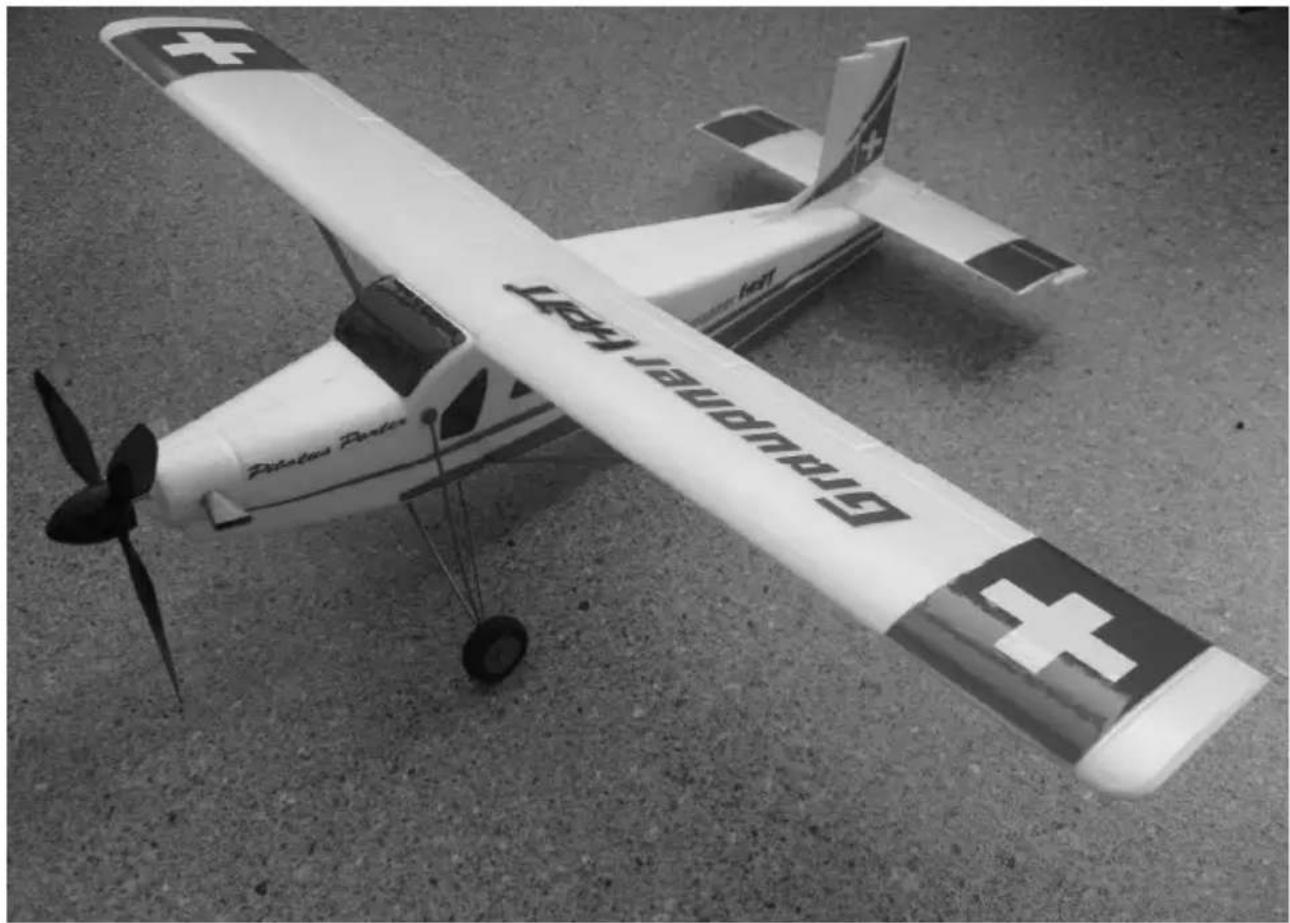
Black-and-white photo of a small model airplane with propeller and fuselage, parked on gravel (no visible text or symbols)natural_image
Close-up of a finger holding a small electronic component with wires, no visible text or symbolstext_image
Hott HOTT HOTTnatural_image
Close-up of a hand holding a small propeller with a black handle, no visible text or symbolsnatural_image
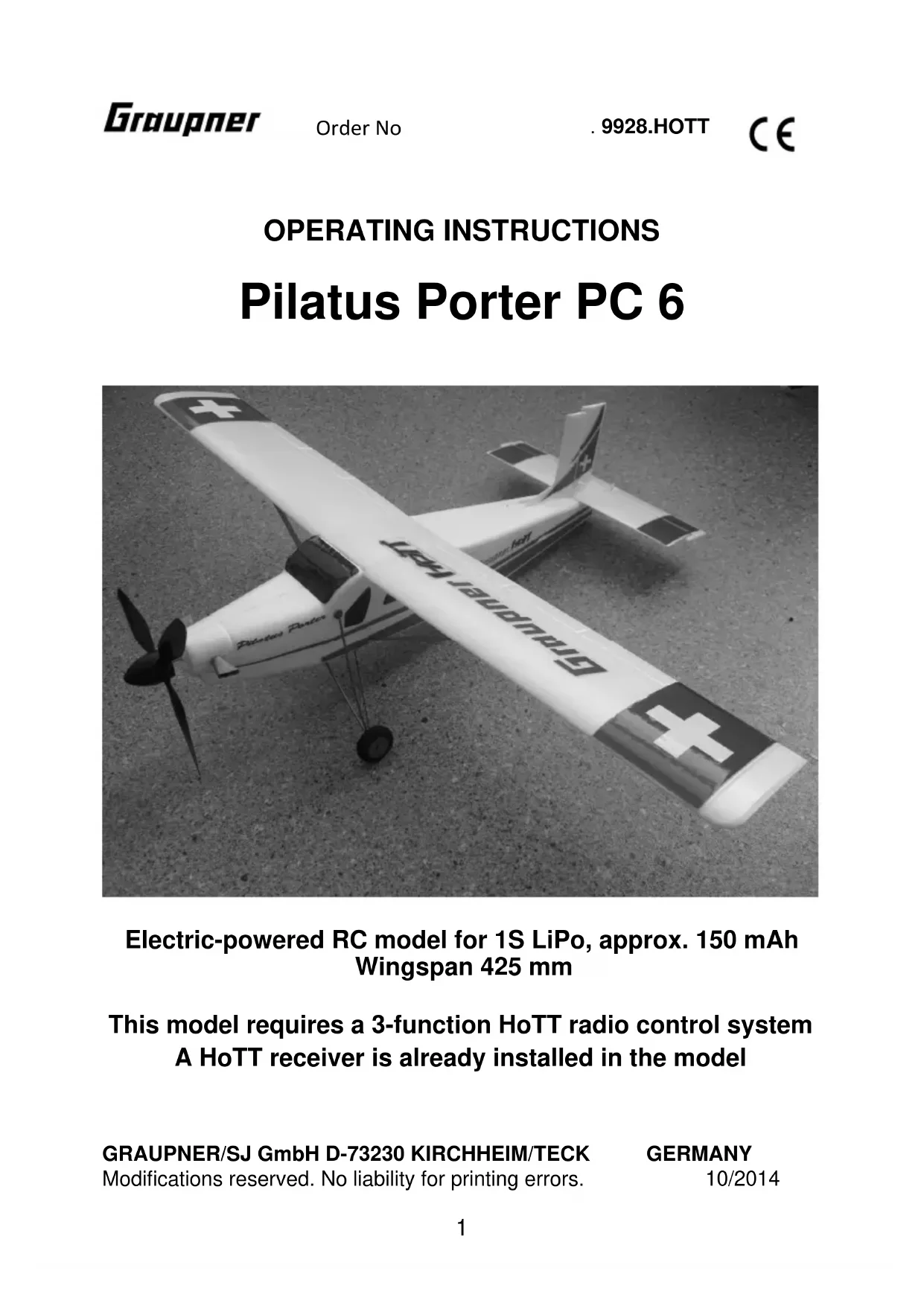
Black-and-white photo of a Model G-1400 propeller aircraft on a gravel ground, no visible text or symbols on the aircraft body.Electric-powered RC model for 1S LiPo, approx. 150 mAh Wingspan 425 mm
This model requires a 3-function HoTT radio control system A HoTT receiver is already installed in the model
Modifications reserved. No liability for printing errors.
GERMANY
10/2014
It really is essential to read and observe the special safety notes included in these operating instructions and the appendix. If you ever dispose of the model, please be sure to pass on the complete operating instructions to the new owner.
Introduction
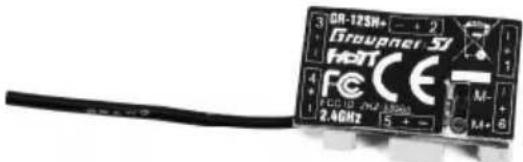
The Pilatus Porter PC 6 is an ultra-lightweight RC model aircraft with very sweet-natured flying characteristics. The model is supplied in “Ready for HoTT” form, i.e. it is fitted with a high-quality GR-12SH+ HoTT receiver and accessories as standard. No adhesive is required to complete the model.
text_image
GR-12SN+ Graupner 51 HcIT FCC FCG 13.2mA 1200A 2.4GHz M- M+The illustration shows the GR-12SH+ HoTT receiver; it is installed in the model's fuselage, and already connected ready for use. The receiver's low-voltage warning is programmed to 3.0 Volt.
Please note that operating instructions for this receiver are supplied separately in the pack.
Essential accessories
Graupner MXS-8 HoTT computer system, 2.4 GHz No. 33200
Graupner Powerbank USB charging station No. 6481
Accessories included as standard
Graupner LiPo USB charge stick
Flight battery: 3.7 V / 150 mAh, 1S No. 9900.20
Charging the LiPo cell using the USB charge stick
text_image
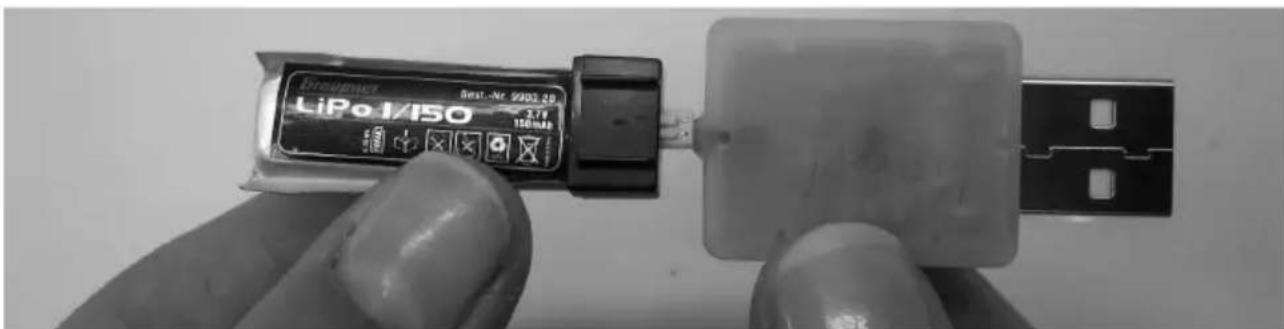
LiPo 1/ISO 3.70 150mAhPush the LiPo cell into the USB charge stick as shown in the illustration, then insert the charge stick in a suitable USB socket. An excellent choice is the Graupner Powerbank, No. 6481. A monitor LED inside the charge stick lights
Modifications reserved. No liability for printing errors.
GERMANY
10/2014
up during the charge process; the cell is fully charged when the LED goes out. Withdraw the LiPo cell when the charge is complete. Place the fully charged LiPo cell in the model's battery compartment and press it onto the hook-and-loop strip. The model is now ready for binding to your HoTT transmitter.
Binding the GR-12SH receiver to the recommended MXS-8 HoTT transmitter
Move the right-hand transmitter stick back to the "Motor off" position, then switch the transmitter on by pressing the Power button.
text_image
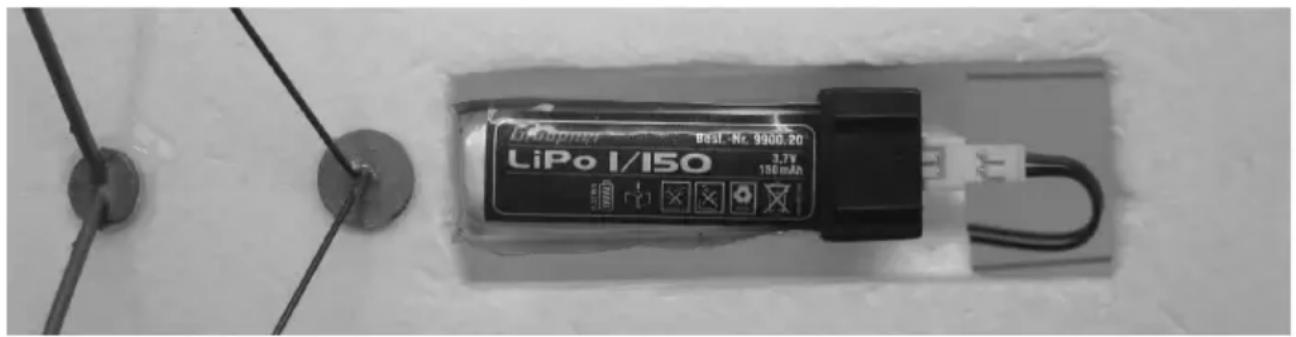
D-Optical B03L. No. 9900.20 LiPo I/ISO 3.7V 150 mAhNow switch the receiver on by plugging in the LiPo cell as shown in the picture; the red LED on the receiver lights up.
Pressing the transmitter's Power button a second time binds the receiver to the transmitter.
Ensure that the transmitter is not too close to the transmitter during “BINDING”, as this could cause the process to fail. We recommend leaving at least 0.5 m between the transmitter and the model.
If you are using a different HoTT computer system, the “BINDING” procedure may be different from that described above. In this case please refer to the chapter entitled “Binding the transmitter and receiver” in the manual supplied with your radio control system.
When the “BINDING” process is complete, carry out a check of the working systems. The servos inside the fuselage are connected to the receiver in the following sequence: socket 1: speed controller; socket 2: rudder servo; socket 3: elevator servo. If you are using stick mode 1 this means that throttle and direction (rudder) are controlled by the right-hand transmitter stick; elevator by the left-hand stick. Pulling the elevator stick back towards you causes the elevator to deflect up; pushing it forward produces down-elevator.
If necessary, correct the direction of rotation of the servos and set them exactly to centre (neutral) using the “Servo settings” menu at the transmitter. This is very important, otherwise the model will not fly straight, and may climb or dive instead of flying level. Now carry out a check of the power system: move the right-hand stick forward, and the motor should run.
Modifications reserved. No liability for printing errors.
GERMANY
10/2014
Final assembly
No adhesive is required to complete the model.
natural_image
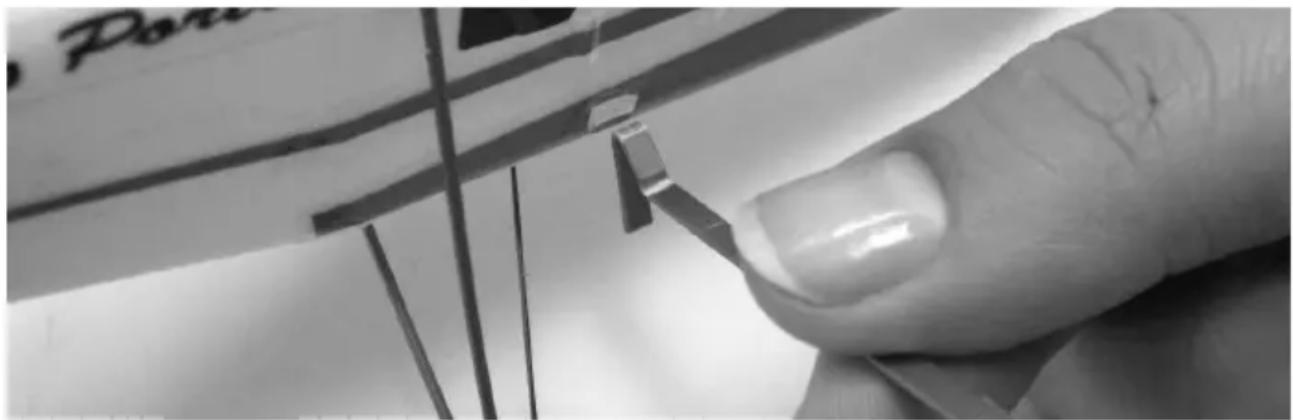
Close-up of a finger holding a small electronic component with wires, no visible text or symbolsFirst push the wing struts into the slots in the fuselage sides.
text_image
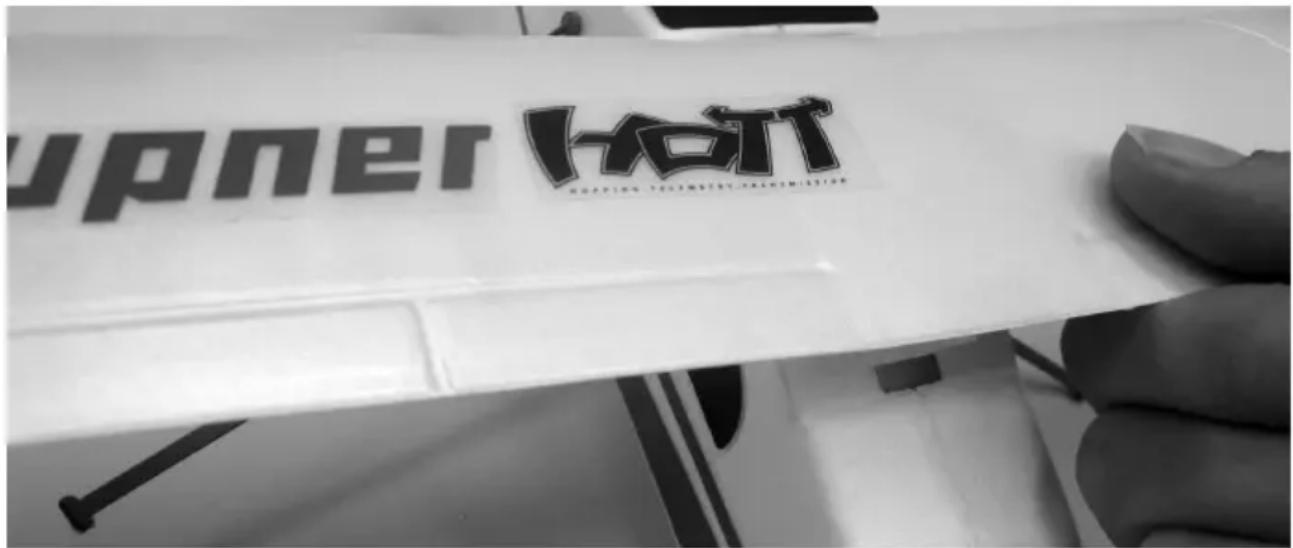
Hott HOTT HOTTNow push the wing forward into the fuselage, and lay the trailing edge down onto the retaining magnet.
text_image
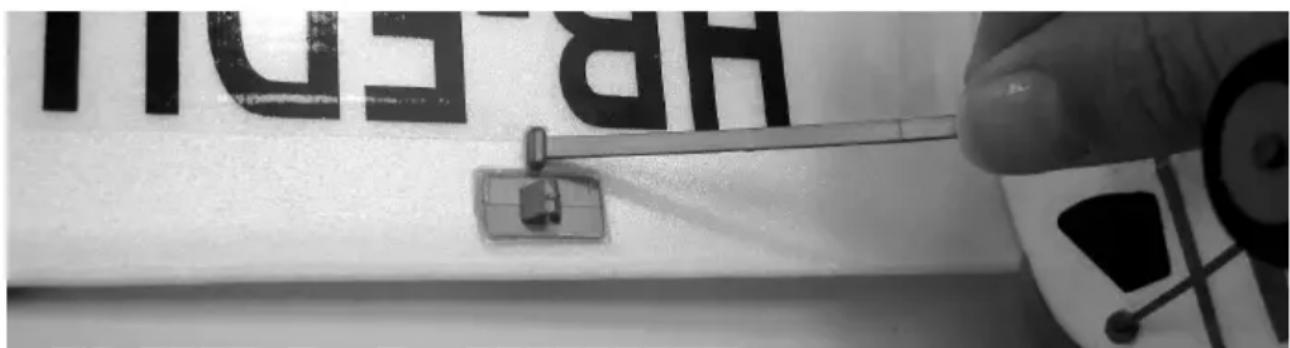
HB-ENSlide the wing struts into the brackets on the underside of the wings, and press them into place.
Modifications reserved. No liability for printing errors.
GERMANY
10/2014
Control surface travels
We recommend the following maximum travels, in each case measured at the trailing edge of the control surface: rudder 5 mm each way, elevator 5 mm up and down. The control surface travels can be adjusted at the transmitter. If you are not sure how to do this, please refer to the appropriate section in your HoTT COMPUTER SYSTEM manual.
Balancing
The correct Centre of Gravity is at a point about 20 mm back from the wing leading edge at the root. You can check the Centre of Gravity by supporting the aeroplane at the appropriate point under the wing roots on two fingertips: the model should now balance level. The Centre of Gravity will automatically be correct, provided that you have made no modifications to the airframe.
Flying
The model should be assembled and prepared completely before flying. First flights require flat calm conditions, or no more than a very light breeze. Since the model is ultra-light at just 44 g ready to fly, it must never be flown in windy conditions. The ideal flying site is a large, open grassy field. Never fly between buildings or amongst trees, as the obstructions cause turbulence in the air, making the aircraft difficult to control. If you are a complete beginner to flying model aeroplanes, we strongly recommend that you ask an experienced modeller to help you check the model, and fly it for the first time.
Switch the motor on and give the aeroplane a gentle hand-launch directly into any wind; do not throw it. The model's nose should be angled up slightly (approx. 15°) when launched. If you have access to a smooth tarmac surface, the Pilatus can also be taken off from the ground.
It is essential to adjust the model's trim carefully, especially during the first flight: this is accomplished by operating the trim buttons below and to one side of the primary sticks. Always land directly into wind, with the motor switched off. Gently apply up-elevator to flare out and reduce speed just before the model touches down. Always land directly into wind.
If you have access to a large hall, the aircraft is also an excellent choice for indoor flying.
Remove the LiPo cell from the model immediately after each flight, and charge it up again. This will avoid deep-discharging the cell, which could cause permanent damage to it.
All of us at GRAUPNER Modellbau hope you have many fine flights with your new
Pilatus Porter PC 6
Modifications reserved. No liability for printing errors.
GERMANY
10/2014
Specification
Wingspan approx. 425 mm
Length approx. 330 mm
All-up weight approx. 44 g
Total surface area approx. 3.3 dm ^4
Total area loading 13.3 g/dm²
Replacement part
110 mm ∅ three-blade propeller with 14 mm ∅ spinner
natural_image
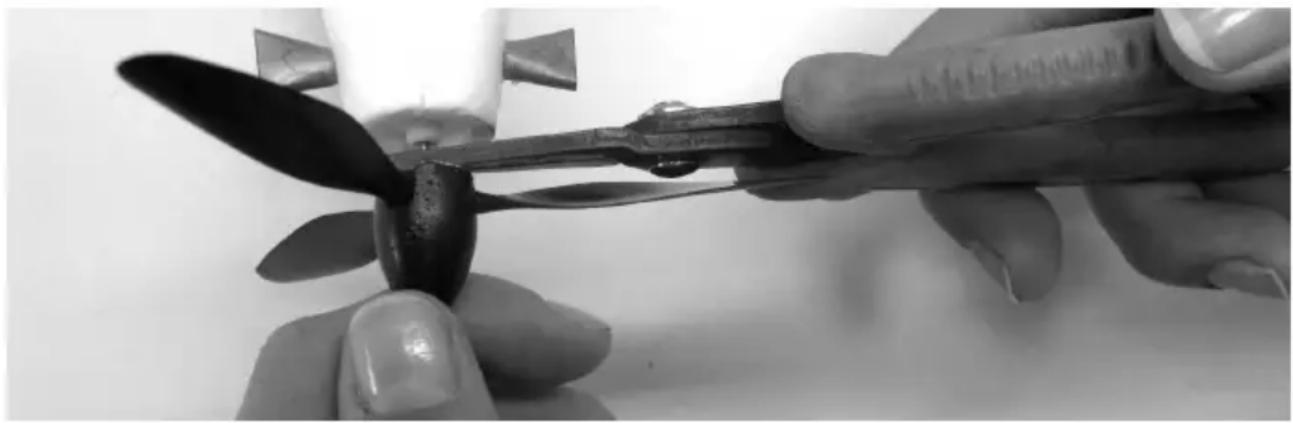
Close-up of hands holding a small propeller with black blades, no visible text or symbolsIf the propeller suffers damage and has to be replaced, hold the motor shaft firmly with pointed-nose pliers while you pull it off, as shown in the picture.
Clamp the motor shaft again when pushing the new propeller onto it.
Replacement part (not included)
Replacement battery, 3.7 V / 150 mAh, 1S Order No. 9900.20
Adhesive for repairs (not included)
UHU plus schnellfest (fast-setting epoxy) Order No. 962
Repair notes
Please note that the high-density foam from which the model is made is not solvent-resistant, and must not come into contact with standard cyano-acrylate adhesives. If repairs are required, we recommend the use of the adhesive stated above.
Important note: disposal of dry and rechargeable batteries:
German regulations state that every consumer has a legal obligation to return all used and exhausted dry and rechargeable batteries.
It is prohibited to dispose of old batteries in the domestic waste. Exhausted dry and rechargeable batteries can be returned to your local community collection point, any Graupner retailer, or any battery retail outlet at no cost to you.
Modifications reserved. No liability for printing errors.
GERMANY
10/2014
After use, any battery supplied by us can also be returned to us at the following address; please apply adequate postage. In so doing you make an important contribution to the protection of our shared environment.
Graupner/SJ GmbH
LiPo cells bear the following symbol in order to indicate that you must not dispose of them in the household waste system. The letters are an abbreviation for the Lithium-polymer metal they contain. Li-Po
Instructions and warning notes on the use of LiPo batteries
Mishandling can result in explosion, fire, smoke and possible contamination.
Neglecting these instructions and warning notes may also result in loss of performance and other faults. The capacity of any LiPo battery declines with every charge / discharge cycle. Storing batteries in excessively hot or cold conditions can also result in a gradual decrease in capacity.
The LiPo battery must be charged using the charger supplied in the pack only. Any modifications to the charger may result in serious damage. The charge station must rest on a non-inflammable, heat-resistant, non-conductive surface when charging is in progress. You should also keep inflammable and volatile materials and objects away from the charging area. Batteries must never be left on charge unsupervised.
Avoid short-circuits
Never short-circuit the battery. Short-circuits cause a very high current to flow, and this heats up the cells, resulting in loss of electrolyte, gassing or even explosion. To avoid the danger of short-circuits, do not handle Graupner LiPo batteries on or over electrically conductive surfaces.
Strength of the cell's outer foil
The aluminium laminate foil can easily be damaged by any sharp object, such as a pin, knife, nail or similar. Any damage to the foil casing renders the battery unusable. If a short-circuit occurs, the battery could catch fire.
Temperatures above 70^ C may also damage the foil ca sing, causing leaks.
This results in loss of electrolyte; the battery is then unusable, and you should dispose of it.
Mechanical shock
In mechanical terms LiPo cells are not as durable as conventional battery cells, and for this reason you should avoid subjecting them to mechanical
Modifications reserved. No liability for printing errors.
GERMANY
10/2014
shocks, e.g. dropping, striking or bending. Never cut, tear, deform or drill into the battery's foil case. Do not bend or twist the LiPo cell.
If the LiPo battery should suffer damage, it must not be used again. Indications of damaged cells are damage to the casing, distortion of the cells, electrolyte smells or escaped electrolyte. Damaged or otherwise defective cells constitute toxic waste, and correct disposal is essential.
General warning notes
Do not incinerate the LiPo battery.
The battery must not make contact with fresh or salt water or drinks. Any contact with liquid, no matter what type, must be avoided. LiPo batteries are not playthings, and must be kept out of the hands of children. Store LiPo batteries out of the reach of children. LiPo batteries should never be left close to babies or toddlers. If a child swallows a battery, seek emergency medical aid without delay.
LiPo batteries must not be placed in a microwave oven or subjected to pressure; these errors may result in smoke, fire or worse.
Never dismantle a LiPo battery. Taking a battery apart may cause internal short-circuits, possibly resulting in gassing, fire, explosion or other problems.
LiPo batteries contain electrolyte and electrolytic vapours which are injurious to health. If electrolyte contacts skin, eyes or other body parts, it must be washed away immediately with plenty of clean water. Be sure to consult a doctor afterwards.
General safety notes
This model aircraft is suitable for young persons of fourteen years or over. It is a legal requirement to obtain third-party insurance before you operate any model aircraft.
Before attempting to operate the model for the first time it is essential to read right through the operating instructions attentively. You alone are responsible for the safe operation of your RC model aircraft. Young persons must be supervised by a responsible adult who is aware of the possible hazards involved in the operation of model aeroplanes.
In legal terms our models are classed as aircraft, and as such are subject to legal regulations and restrictions which must be observed at all times. Our brochure entitled »Modellflugrecht, Paragrafen und mehr« (Model flying law, regulations and more), Order No. 8034.02, contains a summary of these regulations; any model shop should have a copy which you can read.
It is important to use only those parts included in the kit, together with other genuine Graupner accessories and replacement parts as recommended expressly by us. Even if you change a single component in the power train, you can no longer be sure that the whole system will work reliably, and such changes also invalidate your guarantee.
Modifications reserved. No liability for printing errors.
GERMANY
10/2014
Always maintain a safe distance between your model and other people or objects. Never fly low over people or directly towards them.
Radio-controlled models should only be flown in “normal” weather conditions, i.e. a temperature range of -5^ to +35^ . More extreme temperatures can lead to changes in battery capacity, material characteristics, the strength of glued joints and other unwanted effects.
All model flyers should behave in a way which minimises the danger to people and property. Never act in any manner which will disturb other pilots.
Don't operate your model aeroplane in the vicinity of overhead power cables, industrial sites, residential areas, public roads, school playgrounds or sports fields etc.
If you are a beginner to this type of model flying, we recommend that you enlist an experienced model pilot to help you check and test-fly the model.
Propellers powered by a motor constitute a permanent hazard and represent a real risk of injury. Don't touch them with any part of your body. For example, a propeller spinning at high speed can easily cut your finger badly.
Make sure that it is impossible for any object to stall or block the propeller.
If you are to fly your model safely and avoid problems, it is essential that you are aware of its position and attitude throughout each flight. If you detect a control problem or interference during a flight, immediately land the model to prevent a potential accident. Model aeroplanes must always give way to full-size aircraft. Take-off and landing strips should be kept free of people and other obstacles.
Your RC system can only work reliably if the dry cells are in good condition, and rechargeable batteries are kept fully charged.
Manufacturer's declaration on behalf of Graupner/SJ GmbH
Content of the manufacturer's declaration
If material defects or manufacturing faults should arise in a product distributed by us in the Federal Republic of Germany and purchased by a consumer ( § 13 BGB), we, Graupner/SJ GmbH, D-73230 Kirchheim/Teck, Germany, acknowledge the obligation to correct those defects within the limitations described below.
The consumer is not entitled to exploit this manufacturer's declaration if the failure in the usability of the product is due to natural wear, use under competition conditions, incompetent or improper use (including incorrect installation) or external influences.
This manufacturer's declaration does not affect the consumer's legal or contractual rights regarding defects arising from the purchase contract between the consumer and the vendor (dealer).
Modifications reserved. No liability for printing errors.
GERMANY
10/2014
Extent of the guarantee
If a claim is made under guarantee, we undertake at our discretion to repair or replace the defective goods. We will not consider supplementary claims, especially for reimbursement of costs relating to the defect (e.g. installation / removal costs) and compensation for consequent damages unless they are allowed by statute. This does not affect claims based on legal regulations, especially according to product liability law.
Guarantee requirements
The purchaser is required to make the guarantee claim in writing, and must enclose original proof of purchase (e.g. invoice, receipt, delivery note) and this guarantee card. The purchaser must send the defective goods to us at his own cost, using the address stated below.
Fa. Graupner/SJ GmbH, Service Dept., Henriettenstr. 96, D 73230 Kirchheim/Teck, Germany
The purchaser should state the material defect or manufacturing fault, or the symptoms of the fault, in as accurate a manner as possible, so that we can check if our guarantee obligation is applicable.
The goods are transported from the consumer to us and from us to the consumer at the risk of the consumer.
Duration of validity
This declaration only applies to claims made to us during the claim period as stated in this declaration. The claim period is 24 months from the date of purchase of the product by the consumer from a dealer in the Federal Republic of Germany (purchase date). If a defect arises after the end of the claim period, or if the evidence or documents required according to this declaration in order to make the claim valid are not presented until after this period, then the consumer forfeits any rights or claims from this declaration.
Limitation by lapse of time
If we do not acknowledge the validity of a claim based on this declaration within the claim period, all claims based on this declaration are barred by the statute of limitations after six months from the time of implementation; however, this cannot occur before the end of the claim period.
Applicable law
This declaration, and the claims, rights and obligations arising from it, are based exclusively on the pertinent German Law, excluding the norms of international private law, and excluding UN retail law.
Modifications reserved. No liability for printing errors.
GERMANY
10/2014
NOTICE D'UTILISATION
Pilatus Porter PC 6