USER MANUAL AM5i DKN
| The App |
| DKN Motion
DKN
Made for
iPad |
| Switch Bluetooth connection to on.
• Pair DKN Motion.
• Activate DKN Motion App on your tablet.
• Press CONNECT (password 0000)
• Start workout.
DKN Motion supports:
iPad 2
iPad
ANDROID 3.1 and higher |
| "Made for iPod," "Made for iPhone," and "Made for iPad" means that an electronic accessory has been designed to connect specifically to iPod, iPhone, or iPad, respectively, and has been certified by the developer to meet Apple performance standards.
Apple is not responsible for the operation of this device or its compliance with safety and regulatory standards.
Please note that the use of this accessory with iPod, iPhone, or iPad may affect wireless performance.
iPad,iPhone, iPod, iPod classic, iPod nano, iPod shuffle, and iPod touch are trademarks of Apple Inc., registered in the U.S. and other countries. |
Garantia - Warranty - Garantie - Garantie - Garancia - Garanzia - Garantie - Garantia - Eyyuon
This DKN product is designed for residential use only.
Network to the original retail purchaser and authenticated by proof of purchase from a retailer a product sold by an authorized DKN dealer.
This Limited Warranty is not transferable and does not cover normal wear and tear (including, but not limited to, damage and wear to batteries, springs, bearings, running mats, hydraulic systems, ropes, belts, pulleys, power shocks, drive belts and other non-durable parts, etc...).
This Limited Warranty is void if the product is damaged by accident, unreasonable use, improper service, failure to follow instructions provided, modification from its original state, or other causes determined not arising out of defects in material, the consequences of improper treatment, bad installation, wrong assembly or tampering of the parts by incorrect assembly, improper use of the machine (eg. too heavy load in time, weight etc...), problems caused by lack of maintenance, deviations of the standard machine, such as light vibrations or noise, and in case of semi-professional, professional and commercial use (inter alia in sports schools, physio, companies, etc...).
Transport charges, travel charges for technicians, and possible trader and/ or workshop charges are excluded from this warranty, and will be at the sole cost of the owner.
The liability of the manufacturer under this Limited Warranty shall not include any liability for direct, indirect, or consequential damages resulting from any defect nor the use of this machine.
This exerciser has been tested up to a max. body weight of 140kg / 300 lbs.
Follow the carefully the different steps of the assembly instructions.
Use only original parts as delivered.
Before starting the assembly, be sure to check if delivery is complete by using the included parts-list.
For assembly use only suitable tools and ask for assistance with assembly if necessary.
Place the exerciser on an even, non-slippery surface. Because of possible corrosion, the usage of any exerciser in moist areas is not recommended.
Check before the first training and every 1-2 months that all connecting elements are tight fitting and are in the correct condition.
Replace defective components immediately and/or keep the equipment out of use until repair.
For repairs, use only original spare parts.
In case of repair please ask your dealer for advice
Avoid the use of aggressive detergents when cleaning.
Ensure that training starts only after correct assembly and inspection.
For all adjustable parts be aware of the maximum positions to which they can be adjusted/tightened to.
This exerciser is designed for adults. Please ensure that children use the exerciser only under the supervision of an adult.
Ensure that those present are aware of possible hazards, e. g. movable parts during training.
Warning: incorrect/excessive training can cause health injuries.
Please follow the advice for correct training as detailed in training instructions.
Consult your physician before starting with any exercise programme. He can advise on the kind of training and which impact is suitable.
The owner's manual is only for customers' reference.
The supplier can not guarantee for mistakes occurring due to translation or change in technical specification of the product.
All data displayed are approximate guidance and cannot be used in any medical application.
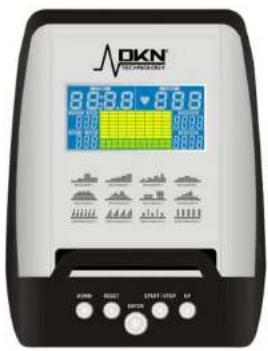
Connect the power adapter, slide the switch to on-position, select user 1 to 4 with UP/DOWN and press ENTER to confirm. Program user data (gender, age, height and weight) using UP/DOWN/ENTER.
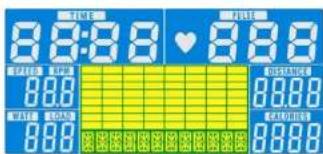
Press ENTER to proceed to landing page (MANUAL, PROGRAM (beginner, advanced or performance)WATT,and CARDIO).
FKnc3ionmbK30nMmandmdeUcrip3ionN
ENTER Press to confirm data entry.
ST/STOP To start or stop the exercise program.
RESET To clear the display and reset all data.
UP To select upward function.
DOWN To select downward function.
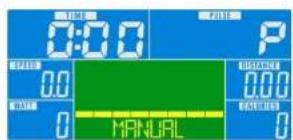
Time:
Displays exercise time.
Distance:
Displays exercise distance.
Calories:
Displays calorieburn.
Speed
Displays speed in km/h.
Watt:
Displays generated energy in WATT.
Pulse:
Hold firmly both sensors on the handgrip (please wipe sensors and hands before starting measuring your pulse) or apply optional cheststrap (moisten slightly the contacts of the strap).
Your current heart rate will be displayed within 30 seconds up to one minute.
A stable figure requires to hold both sensors firmly.
A chest belt transmitter is compulsory for HR training.
YoKrmcompK3ermiIMcompa3ibleM13hM3eMM
op3iIalmcheH3mranImi3aermyrefMOw7KbIbIM
formin3epraedMdlireHmhear3ma3em
regl3raionlM
FormanPmqKeHionImpleaNemdomcon3acM PoKmDKN dealerimorm3iImoKmJDebWEm nnDKN-TechnologycombimormaKnForm moreinformationInfo@dN-deVignibe
TrainingMinMANUALmode
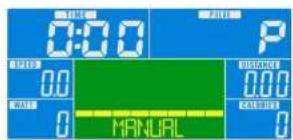
- Select MANUAL and use
UP/DOWN/ENTER to program time.
- Press START
- Use UP/DOWN to adjust load level (32 levels).
- Stop/pause the exercise by pressing STOP.
- Press RESET to exit the program.
TrainingMinMPROGRAMmmode
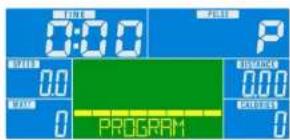
Press UP/DOWN to select beginner, advanced or performance, confirm with ENTER.
- Select profile 1 to 4, confirm selection with ENTER.
- Program target value for time using UP/DOWN/ENTER.
- Press START.
- Eventually use UP/DOWN to adjust load level.
- Stop/pause the exercise by pressing STOP.
- Press RESET to exit the program.
TrainingMinMCARDIOmmode
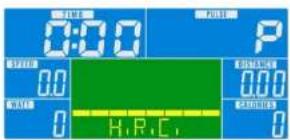
- Select CARDIO using UP/DOWN/ENTER
- Set Target Heart Rate, confirm selection with ENTER (THR default value is 100 Bpm).
- Program target value for program time using UP/DOWN/ENTER and press START.
Upon entering rate in BPM (beats per minute) the load tension will be controlled by current heart rate. The resistance will be auto-adjusted according to current heart rate figure. If your heart rate figure is under the target pulse, the tension will be up-adjusted one level every 30 seconds, up to the maximum level 32. As soon as your heart rate figure has achieved the target pulse, tension will be down adjusted one level immediately. In case of overload the level will be down adjusted one level immediately, and keep down-adjusting each 15 seconds until your heart rate figure has achieved the target pulse.
- Stop/pause the exercise by pressing STOP.
- Press RESET to exit the program.
Chest belt transmitter is compulsory for HR training.
HearmraeMdiNplaPedmiIMmanmapproMimaem Read-0k3bImandMmaPmno3mbemKmedMaMgKidanceminManMcardio-3aIcKlarmrelaeom medicalormparamedicalprogramm
TrainingMinWATTmode
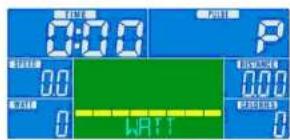
- Select WATT, USE UP/DOWN to program target watts (programmable between 10 up to 350 Watt), confirm with ENTER.
- Program target value for time using UP/DOWN/ENTER.
Press START
- The tension difficulty will be auto-adjusted according to the Watt figure. If the figure is under the target value, the tension difficulty will be up-adjusted one level every 30 seconds, up to the maximum level 32. As soon as you achieved the set value, tension difficulty will be down adjusted one level immediately.
In case of overspec the level will be down adjusted one level immediately, and keep down-adjusting each 15 seconds until you reach the preset value.
- Stop/pause the exercise by pressing STOP.
- Press RESET to exit the program.
Training Instructions
If you have not been physically active for a long period of time and also to avoid health risks you should consult your general physician before starting to exercise.
Everyone, or almost everyone, is fascinated by the champions/athletes among us. We dream away when we have one look at a trained body, full of muscles, in movement, and hope that one day we also have an athletic body like that. It's then that we realize that exceptional performances need exceptional talents, but also daily training, well organized and planned within the smallest detail.
If we compare the genetic inheritance of great athletes to the genetic inheritance of the sporty amateur in general, we only can determine small deviations, which can't explain the difference in performances.
However if we compare the trainings, we do see great differences. In general, athletes on a higher level do not only had years of training, they also benefit from the help of a professional coach and have adapted their lives to their physical condition. Their training program is outlined and planned within the smallest detail and is being regularly evaluated in order to check if the preset goals are being achieved.
The sporty amateur who wants to improve his performances usually starts training without a plan. Sometimes he copies the training program of a well known athlete. This usually slows down his progress and often leads to strain the muscles and sometimes the cardiovascular system. A special, optimal training
program, suitable for everyone, would be wishful.
The incredible complexity and the different adapting processes which our body has to go through every training, don't allow us to use such a training program. Whether you train on muscle development, power, endurance, speed, flexibility or a better coordination of your movements, everyone starts with different initial conditions.
The goal of each training program is to improve your performances. You don't need to become a top athlete, you also can train to lose weight or just to feel better. The optimal performance can be for example, run 5 minutes longer than before at the same tempo and without interruption, or do more push-ups than the day before.
The research on the influence of a sporty training on our body has made lot of progress in the last several years. Even if some questions are still unanswered, the knowledge we achieved from the sporty science and related fields, have proven their use in practice and serve in the first place our top athletes. This doesn't mean we can't use the basics of a training for top athletes for every individual which practice a sport and who wants to improve his performances.
Evaluation of your physical condition
For each level of your training program (development of the muscles, endurance, flexibility, speed, coordination of your movements), we recommend you to find out through some tests on which level you find yourself. But first we recommend you to
consult your physician in order to set up a health report:
- Are you older than 35 years
- Have you not been exercising for a long time
- Do you have overweight
- Are some movements not suitable for you?
- Do you have to take medicines
- Are you suffering from a serious disease or are you having breathing difficulties
- Do you have a metabolic disorder (ex. Diabetes)
- Do you have any infections
- Do you have a fever as a result of any disease
- Do you have an infectious disease
- Are you having problems with your organs
- Do you suffer from hyperventilation
- Are you having any respiration diseases
- Do you have any pain while breathing?
- Or do you have a poor physical condition
If your medical health is satisfactory, you can begin to set up your training program. But before you start, make sure you know your initial capacities - or a diagnose - so it is easier to determine your goals. Only then you can set up a training program which will match your goals.
Diagnosis
Determine your goals.
- Organization (long, mid-long, short term)
Evaluate
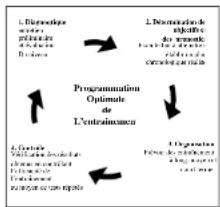
Regularly check your progress, so you can adapt your training program if necessary. The following survey shows the interaction between the 4 elements, which are important in an efficient training program.
Diagnostic - initial level
Before setting up a program, you have to take note of some parameters and take your sizes. These measurements will help you determine your present physical condition. It is the intention to collect all data concerning your personality, your health and your performances.
- Individual data: age, sex, figure, weight, fat percentage, measurements, pictures, etc.
- Data concerning your health : blood pressure, orthopedic data, research of the metabolism, serious diseases, injuries, etc.
- Performance data: endurance tests, power tests, movement tests and speed control is often not necessary in fitness. Coordination of the movements however is crucial because it is very important when you execute the exercises.
"Clumsiness" usually means a lack of exercise. Therefore stick to the preset modules when you exercise, even if it is an endurance sport.
Every test, intellectually or physically, shows you your personal possibilities at a certain moment in time. Even though mathematic results become inadequate after a certain time, the results which you will achieve (after the same test one week later) will be better than the first one, because you have been able to locate your weak points and adapt your training in order to get rid of your shortcomings.
We work in the same way for the body. Let us assume you have taken an endurance test and the result of this test is 20% under the average level. This result must now help you to set up a program to achieve this average level. This shows that the test is the base to set up a training program in order to reach your goal. So it is very important you check your performances on a regular base to see if they measure up to the preset goals. If not, you have to adapt your training program.
The results of these check-ups give you the opportunity to compare your performances with the average performances, but also show if you are making progress. After 6 weeks we begin again with the same test to check if your performances have been improved and how much they have been improved.
Physical features
Weight
Are you happy with your body, often depends on the balance. But what is the ideal weight? Following formulas are known to determine the ideal weight:
Normal weight = girth waist in centimeter 100
- Ideal weight women = normal weight - 15%
- Ideal weight men = normal weight -10%
This formula designed by "Broca" has a limited value. As long as there is no new method to determine the ideal weight, the image we have of ourselves, tells us more than any other number. But a lot of people feel better when they can compare themselves with figures and numbers. Therefore it is sensible to take into account a few well known formulas as the body mass index (BMI) and with some reserve, the waist to hip rate (girth waist - hip).
Body Mass Index (BMI)
The BMI refers to the connection between weight and body shapes, which allows us to set up a better and exact standard than the "Broca" formula.
BMI = present weight (in kg): height in 2 Ex.A man of 70 kg and 1.70 m high has a BMI of 70:1.7m2 = 24.22
In the table beneath you can situate yourself. These values are a guidance and are not guaranteed, especially not for sick persons, children and elderly people.
Women Men
<19 <20 Underweight
19-24 19-25 Normal
24 >25 Overweight
30 >30 Corpulent
40 >40 Obese
Fatpercentage
Body fat expressed in percentage tells us more than numbers about the relation weight/waist. To determine the fat percentage we have to take into account some parameters depending on age. You can determine your fat percentage in different ways. You even find many balances who also can measure your fat percentage. If you want to lose weight, then
the fat percentage is more important than the weight itself, because it is the fat you want to disappear.
| BMI Table
Standard according BMK index related to age.
Age Female Male |
| 17-29 year 15 % | 25 % | |
| 30-39 year 17 % | 27,5 % | |
| Over 40 20 % 30 % | % | |
Connection waist - hip (waist to hip rate) You have determined a higher fat percentage than normal in above chart. This fat can have a different impact on your health. With a simple test, which you can do at home, you can determine if you have a higher risk for cardiac disorders. To execute this test, you have to measure the girth of your waist just above your belly button, without holding in your stomach and in a relaxed position. Than measure the girth of your hips on his widest point. Divide the girth of the waist by the girth of the hips. If the result is lower than 0.9 (for men) and 0.8 (for women), you don't have a higher risk for cardiac disorders than normal.
Measurements
Do also take your other measurements, besides your waist and hips. If you want to improve your silhouette, these measurements can show you the changes your body made during training. This method is still the most precise, fastest and cheapest one. Please pay
attention you take your measurements always on the same place. We advise you to take measurements of the following parts : girth of the neck, shoulders, breast, arms, upper arms, waist, hips, thighs and calves.
Talents are often seen as interesting and attractive in daily life. This is also the case for our figure. If it doesn't measure up to certain criteria, we find a way to change this. Unfortunately we also have to say that the "Rubens" type will not become easily a "topmodel".
So before we begin fighting windmills, it is probably more sensible to take into account our figure. Do we all have to be "topmodels"? Our physical appearance depends strongly on the time we live in. Therefore it is rarely that the body types, you find next, exist. Most people among us are a combination of different types.
Leptosome/ectomorphe type
Features :
- Wider pelvis than shoulders
- Very supple joints
- Weak muscle development
- Weak blood pressure
- Increased pulse in rest
- Weak circulation (less endurance)
Cold hands and feet, dizziness when you stand up
- Intense activity of the nervous system
- Weak metabolism (hard to gain weight)
Contradictory to other types, this type will not be suitable for performances which include power and endurance. An adapted training can improve these shortcomings even though the starting points are not always favorable. The
figure of the ectomorphe types often creates envy by other types. This type has the privilege to eat as many as he wants without gaining weight.
The atlete / mesomorphe type
Features:
Strong and muscular
- Wider shoulders than hips
- The muscular system and the blood circulation are suitable for excellent performances
- Weak blood pressure and pulse in rest by the active mesomorphe types
- Increased blood pressure and pulse by the non-active types
Not susceptible to cold
- Correct general figure
Normal digestion
In case of inactivity or over feeding, the fat stays hanging on the body
Taking into account above features, a moderate training will be enough for the mesomorphe type to improve his performances. The risk on injuries is much higher for this type because the development of the muscles isn't always in proportion to the elasticity of the muscles. We therefore recommend you to invest a lot of time of your training in improving the elasticity of the muscles.
The figure of the athletic type and the active mesomorphe type stands very close to the ideal figure in the 80ties and 90ties. Therefore many of us would like to belong to this category, although they often belong to another category. Those who can't admit that
not everybody can have the perfect body, often remain frustrated.
Endomorphe type
Features:
- Round shapes, holding fat
- Width shoulders, width pelvis (due to overweight)
- More equal distribution of the weight in comparison to the other 2 types
Average figure
- Very suitable for performances aimed at power and endurance
- Easy food insertion and slow digestion make it easy to gain weight
Slow pulse in rest, normal blood pressure (for active types)
Power, endurance and mobility are the greatest trumps of the endomorph. Only the weight, often too high, can be an interference in some situations. Therefore he must pay attention to his food, healthy and adapted to his needs, emphasizing endurance to stabilize his weight.
Taking into account the beauty ideals of this moment, the figure of the endomorph type is not suitable. But above features also show that the active endomorph has the right talents for a good health and a sportive attitude. If the endomorph takes into account his genetic potential, a few extra pounds, can not harm him.
Endurance test
An endurance test may not be executed in following circumstances, except when it is done under medical supervision:
- Serious and chronic illnesses of the respiration
- Illnesses with fever attacks
- Infectious diseases
- Serious increased blood pressure
- Disorders (ex. of the heart or lungs)
Infections
- Taking of medicines (betablockers)
- When you aren't feeling well
The most know endurance test which is used in sports is the "Cooper test". In this test you have to run as hard as you can for 12 minutes and run as much kilometers as you can on an flat underground.
Even it's aim is not to stop, you can slow down and walk. The covered distance is noted and compared with the numbers in the Cooper chart. This chart gives us more information about your performances.
The benefit of this test is that you can do the test whenever you want, you only need a chronometer and a course with a fixed distance.
The disadvantage of this test is that you need some running experience to become a good result. You may not take this test if you are not feeling well (tiredness, feeling unwell, etc...)
| Cooper Test | Data in km, M = male, F = female |
| Age | 20-29 | 30-39 | 40-49 | 50 | 59 | |
| Very well | M | 2.64-2.81 | 2.51-2.70 | 2.46-2.64 | 2.32-2.53 | |
| F | 2.16-2.32 | 2.08-2.22 | 2.00-2.14 | 1.90-2.08 | |
| Well | M | 2.40-2.63 | 2.34-2.50 | 2.24-2.45 | 2.10-2.31 | |
| F | 1.97-2.15 | 1.90-2.07 | 1.79-1.99 | 1.70-1.89 | |
| Average | M | 2.11-2.39 | 2.10-2.33 | 2.00-2.23 | 1.87-2.09 | |
| F | 1.79-1.96 | 1.70-1.89 | 1.58-1.78 | 1.50-1.69 | |
| Weak | M | 1.95-2.10 | 1.89-2.09 | 1.82-1.99 | 1.65-1.86 | |
| F | 1.54-1.78 | 1.52-1.69 | 1.41-1.57 | 1.34-1.49 | |
| Too weak | M | <1,95 | <1,89 | <1,82 | <1,65 | |
| F | <1,54 | <1,52 | <1,41 | <1,34 | |
You also can take another endurance test: the "Harvard-Step-Test. For this test you need a hear rate monitor, a chronometer, a stair or bench. The height of the stairs or bench depends on your length.
| Harvard-Step-Test |
| Height in cm | Height of the step |
| <152 cm 30 cm | |
| <160 cm 35 cm | |
| <175 cm 40 cm | |
| <180 cm 48 cm | |
| >180 cm 50 cm | |
To execute this test, step down and up the bench or stairs every 2 seconds. This makes 30 times/minute up the bench, which gives a total of 120 up-and down steps. Whether you change leg or always use the same leg, this has no effect on the result. Measure your heart rate after 4 minutes. When you are done with the exercise, take your pulse after 60
seconds, and again after 1 minute. In this way you become 3 values which you have to use in the following formula :
A + 3000 divided by heart rate B + 3000 divided by heart rate C = endurance index. Example: when your heart rate is 160 after ending the exercise (heart rate A), 120 a minute later (heart rate B) and 100 after 2 minutes (heart rate C), then you have an endurance index of :
3000:160=18.75
3000:120 = 25.00
3000:100 = 30.00
Endurance index = 18.75 + 25.00 + 30.00 = 73.75
On the basis of the chart below you can adapt your training and divide your powers better according the result of this test. If you take the endurance index from our example (73.75), you can see in the chart below that this value is sufficiently for someone younger than 35 and good for someone older than 35.
| Endurance Index |
| Less than 35 Over 35 |
| < 50 | not sufficient medium |
| 51-60 | medium medium |
| 61-70 | medium fair |
| 71-76 | fair well |
| 77-85 | good very well |
| 86-90 | very well exceptional |
| >90 | excellent exceptional |
Training planning
Overload
Training means making an effort, using our energy reserve. This effort will show a lower performance afterwards. This effort can only be undone if we give our body time to recover and to rest. So both effort and rest are the ingredients of a perfect training. Effort and relaxation are one.
To determine how long we have to rest is not simple because it depends on a lot of elements such as the number of executed exercises, the used weights, the kind of exercise, how long we exercise...etc.
Furthermore, not every muscle needs the same time to recuperate. A small muscle can already be ready during practice, a big muscle can need extra time.
To set up an intelligent training, we recommend you to use some constant parameters during a limited training period. Based on these parameters it is much easier to see if our body has enough time to recuperate.
If you start training, you will feel "tired" after every effort. However the longer you train, the more easy it will become for your body to recuperate and after a while you want feel "tired" anymore and your performances will get better. However if you keep feeling "tired", your body needs more time to recuperate and we even recommend you to stop training for a few days and give your body the rest it deserves.
You will notice that when you resume training, your performances will get better much faster than when you keep training without resting (overload).
Descending or stagnating performances can be signs of overload. Also an increased heart rate can lead to overload, which also increases the risk for injuries.
Muscular trainingperiode
To prevent physical overload by overtraining, we recommend you to train no longer than 4 to 6 weeks on one territory. Divide your training up into different periods and change your program regularly.
- Training unity = one training session
- Micro cycle : all training sessions during 1 week
- Meso cycle : groups 3 to 5 micro cycles. In muscle training, the meso cycle is a training which emphasizes endurance, increase of size or power.
Macro cycle : groups different meso cycles and can take a few months (6 to 12 months).
Now you find some more information about the different features of each territory:
Endurance
A run of 400 meter requires endurance and power. The endurance training will include a preset series and the repetition of it. Attention! the recuperation period is also very important.
The lactic acid in the muscles will increase and will cause a inflamed feeling when the tiredness keeps increasing.
One of the greatest effects of a training with extended efforts is the increase of the tolerance of the acid in the muscles, which can be put into work as follows: there will appear different causes who will neutralize a part of the lactic acid; muscles will no longer be sour,
this brings along a extended action for a few seconds, or by repetition, by which they refuse to go on.
Increase of the muscular mass
he growth of our muscle cells is promoted by an extended stimulant. The use of energetic phosphates of the muscle cells is reduced to a minimum. The corn of the cell, which also contains a product of proteins, under the form of muscle fibres, also works in on the thickness of the muscles.
Maximal power/ effort
The maximum power of the muscle depends on the average thickness, and also on the number of muscle fibres due to movement. The interaction between the nerves and the muscles determine the capacity of a muscle during an effort.
Training period: endurance
Competition sports is one of the basics to set up a training schedule in function of endurance. The sporty amateur once again takes advantage of the benefits of a training set up for a competitive sportsman. As the weights and the repetition of the exercises play an important part in the measurement of our "tiredness" in the training of muscle development, the heart rate is the most important element in the endurance training.
Before we give you some recommendations for cardio training, it is important to know your maximum heart rate. We can determine this rate by a test which will ask a maximum effort of our cardio-vascular system. This test whoever is not suited for the sporty amateur. However we can determine our maximum heart rate by another formula : 220 minus our age.
Starting from this formula, our optimal heart rate in function of age, will be between 70 and 85% of our maximum heart rate obtained during a cardio-vascular training session, and between 60 and 70% during a metabolism training.
We have different ways of training in the endurance sports.
Continuous training
- Training by interval
- Repetition training
- Competition training
Continuous training is most used in leisure sports, training by interval in a less way. Repetition and competition training mostly ask for exceptional and intense efforts and therefore they are not recommended for the sporty amateur.
A continuous training is characterized by a training over a longer period, without interruption of the effort. The most sporty amateurs automatically go for this kind of training.
They often become good results when the level of effort correspond to the optimal heart rate in a certain age category.
The training by interval usually contains a series of efforts and a series of relaxation. The series of relaxation contains moments of partial rest.
Continuous training is chosen by 80 to 90% of the sportsmen who wants to work on endurance. We therefore recommend continuous training to every sporty amateur.
| Age | HR MAX/ min | 60% MAX/ min | 65% MAX/ min | 70% MAX/ min | 75% MAX/ min | 80% MAX/ min | 85% MAX/ min |
| 20 | 200 | 120 | 130 | 140 | 150 | 160 | 170 |
| 25 | 195 | 117 | 127 | 137 | 146 | 156 | 166 |
| 30 | 190 | 114 | 124 | 133 | 143 | 152 | 162 |
| 35 | 185 | 111 | 120 | 130 | 139 | 148 | 157 |
| 40 | 180 | 108 | 117 | 126 | 135 | 144 | 153 |
| 45 | 175 | 105 | 114 | 123 | 131 | 140 | 149 |
| 50 | 170 | 102 | 111 | 119 | 128 | 136 | 145 |
| 55 | 165 | 99 | 107 | 116 | 124 | 132 | 140 |
| 60 | 160 | 96 | 104 | 112 | 120 | 128 | 136 |
| 65 | 155 | 93 | 101 | 109 | 116 | 124 | 132 |
| 70 | 150 | 90 | 98 | 105 | 113 | 120 | 128 |
Training evaluation
The preset program is only effective if you regularly control yourself. It is better to use the term "evaluation" because we evaluate the present data/results in function of the next training cycle.
Even though the preset goals were chosen carefully and realistic, it always is possible that the program of a meso cycle is realized partially.
This can have several causes such as illness, injuries, occupation activities, or other motifs to interrupt your training. If you already reached some goals, but not all of them, you have to adapt your training program for the next meso cycle.
Training diary
The keeping of a training diary can help you in finding the causes when you have not reached your goals. In this diary you can write down different information, which can help you to set up a training program, such as your eating habits, periods of rest and sleep, remarkable results etc. A visit to the dentist for example can influence your training results. If you can take into account certain circumstances, you can avoid a stagnation in your results.
Adaptations of your training are usually important for the intensity of your program, the succession and the repetitions of the exercises and the achieving of results.
Summary
- Make sure if a fitness training doesn't cause problems for your health.
- Evaluate your level of power, endurance, flexibility, speed and coordination before you start training.
- Set realistic goals based on your physical possibilities.
- Set up a training program for a longer period (6 to 12 months)
- Divide your long term planning up into different cycles (meso cycle) of 4 to 6 weeks.
- Make sure there is enough variation in your training. Train on endurance, power and muscle development.
If you choose for endurance training, vary between short, mid-long and long training periods.
During a meso cycle you have to increase the intensity of the training for endurance as well
as for muscle training. Limit the intensity of the training in the beginning of every new cycle.
Evaluate regularly your training to make sure you are on the right track and if you can achieve your most important goals, if not:
- Adapt the next meso cycle
Repeat the initial test
- Do interim tests at the end of every meso cycle
Success
Even after a short period of regular exercises you will realise that you constantly have to increase the pedalling resistance to reach your optimum pulse rate.
The units will be continuously easier and you will feel a lot fitter during your normal day. For this achievement you should motivate yourself to exercise regularly. Choose fixed hours for your work out and do not start training too aggressively.
An old saying amongst sportsmen says:
"The most difficult thing about training is to start it."
Wishing you lots of fun and success with your exerciser.
All data displayed are approximate guidance and cannot be used in any medical application.
Heart rate displayed is an approximate read-out, and may not be used as guidance in any cardio-vascular related medical or paramedical program.
Inn3rKcionMduKsiliNaoionmdelIuordinaeKr
MiMenmarche
ToKcheVmEm3dEncrip3onVmEmfmonc3ionN
ENTER
Surcompensation/Surentrainement
TrainingMinfKnc3iemMANUAL yoefenenMonderm3oorprogrammaieio
Body Mass Index (BMI)
Indice de Massa Corporal (IMC)
| Endurance index |
| Less than 35 | Over 35 |
| < 50 | not sufficient medium |
| 51 – 60 | medium medium |
| 61 – 70 | medium fair |
| 71 – 76 | fair well |
| 77 – 85 | good very well |
| 86 – 90 | very well exceptional |
| > 90 | excellent exceptional |
| Less than 35 | Over 35 |
| Not sufficient medium | |
| Medium medium | |
| Medium fair | |
| Fair well | |
| Good very well | |
| Very well exceptional | |
| Excellent exceptional | |
Piano d'Allenamento
Sovraccarico
Body Mass Index (BMI)
ENTER
HaKmTe, YoBb BoTn BpeKIM HAcTPOKIN NOITBePntb 3aHcEHNApamETPOB.
ST/STOP
YTOb3 3aynCTnB nINOCaHOBUTb npOrpAMMyynpaHHENH.
RESET
IIN ONUCTKINUCNNEH C6pOcTb BCE DaHHbIe.
UP/DOWN
IMT = phaikTHuecknBec(BK): (POCTBM)².
PImeep.ДЯMyKHHbBECOM 70KT n pOCTOM
1,70M IMT COCTABNReT
70: (1,7M)² = 24,22.
B npBbeHNO HmKx Ta6nue Bb MoXeTe HaHTN CBO3aHcHMe DaHbE 3aHcHHe RAIBRTOC OpeHNTPOBOVHbMn H He rapAHTNpyOT To4Hoe 3HaHEMe,OCo6eHHO dnoBbHbX IIOJe, DnI dTeTn NIOUOKNOrO B0sPACTa.
XeHUIHbI
MyKuHbI
Tope3yIbTaTbI 3MepeHn NOMOryBaM
CneHb3apeyIbTaTAMnB Ipocece TpeHHPOBOK. DAnHHb MeTOB BCE ege RAeYBaTec HAnBoJeE TohBIM, BcICTPbIM N DeWeBbIM. Heo6OxMOHNO NmOHtB, YTO N3MePENH BInIOJIHOITc BOHNIX N Tex Je ToKax.Mbl peKOMHeMy N3MePbTb CneDyOuNue Yactn TeNa: OkpyXHoCTb WEn, rpyDi, ppePiNeuH, nNeu, TaNN, 6Beep, roJene HKnp.
Фиура
B NOBCEHHeBHON XIN3HN MBI BNIMM AKTEPOB KAKOeH HHTepeCHbIX INPNIIEKATEbHbIX IIOJeI. 3To OTHOCITcN K HAWeJ CFHype.E CEn ee napaMeTbIe HO COOTBECTBYOT ONPeDENEHOMy KIPTEpIKo,TOMbI CTPEMMCQYTO-TO N3MEHNTbK COXAEHNO,HAM PnIXOxDTCR PN3HaTb,YTO CFHyrpa FPeDa ACTepA He BcERda cTAHOBNbCB CFHyypo APHOnbDa UBepeuHRepe.Ra 3To OTHOCITbcN K HAWEmy TEny.Py6EHC He TA KPOCTo CTaTb TOn MOeJIbIO.Po3TOMy NpeDTEM,KAK HauTaB 6OpToBcR C 6erBOB DOPOKKO, HABEPHO,6yEDTPABINbHEe pInHb BO BHMANHe NaHy fHyTypy.HxHyn NHAM BCEM CTAHOBtCB TOn MOeJIaM? HaSe fM3MeVcCKoe COCTOHN B 3HAHTeBLHO Mepe ONpeDEJIETcB BPEMeHEm,B KOtopOM MBIKNBEM,PO3OMY PNBEDEHbIE HNKe Tnblf Cyrrp BCTpeAOTcR peKo,BoBbHNCTBO NIODe pCedn HAc -3To IIODN PA3HOROTINa.
ActHueckn/3KToMOpΦhBt TUN
Oc6eHHocn:
Ta3 shpe nneu
OueHn6KneCycTaBbI
Cna6oe pa3BnTne MbIu
Hn3Koe KpO8RHOe daBneHne
- YBENHnBnIyNbcB NOKOE
Cna6aIuPKyIaIg (H3K4BbHOCINBOCTb)
XoIOIDHbE pyKn cTyn, roNoBOKpyKeHne npN BCTaBAHN
VHTEHCNBHARDAETIELHOCTHEHPBHOH CHTEbM
CnabM MeTa6oH3M (TaeNo Ha6npaETcB Bec)
BOTNIHNEOTpynXdaHbI TINHe NOxOHT
TnIaDeTeJIbHOCTN, PpeJONARAOUeIeYcNIMe I
BbHOCINBOCTb.AaTmPouBaHHA TeHPoRBKa
No3BOBNTcYctpaNTb DAHbIE HeNOCTaTK, DaKe
B TOM CNYae, ECNI HAaJIbHBe YcNIOBHe
ABNIOTCsBNaROnPraTHbIMN. FInyypa
3KtOMOpOPHOrO TINa O6bMnHO BblBaET 3aBNTb
y npedCTabNTeNeIe DpyNX TINOB.
PpEcdTAbTIEN DAHrTO TINa MOrY eCTb
CKoNbKO XOTAT IN pnp 3TOM He HabuPaTB Bec.
CnoptcmeH/Me3omOpΦhB TnOco6eHHoCTN:
CnIbHn npa3BnTaMyckyNAtypa
- Pnneu wnpe 6eep
MblueHnaCtemaNcUrkyIaIgN KpOBB BENIKOJIeHNO NIOxOaIIT DnA 3HaHHTbHbX HApY30K
HIMKoe KPOBHOe DaBHeHne HnYbc B nOKOE dna AKnBbX npdctabTeIe M3OOMOPFOrO TINa
YBENHNEHOKPOBHOE DABINHENEI NybcDnHeAKNBHbIX NpEcTAbTEneMe3OMOpOPHOrO TINa
Hn3KaBBOcnpmMNUBOCTbKxONoy
- PpaBnIbHaIyIpya
HopmaJIbHoe nIeBapeHne
B Cnyuae HeakmbHOCT NINN 36bItoHORO nTahnXHP HauHHaET CBNAbTC Ta
YuTbBae Bce BbIeCKa3aHoe DnnyuueHnepeyIbTaTOB MeoMOpFO Tnna DoCTaTOHO yMepeHHx TpeHPOBOK, DnlaDnHO TnNA PNCK TpaBM 3NaHTeNb HO BByIE, TAK KAK PA3BNTME MbUHc HE CCErcoOTBETCTByET IN 3NaCTNHOCTN. nOToMY
Mbe PekOMeHdEM 3atpaHbAtb 3aHHTeNbHOB BpEmaTn TpeHNPoBc KcIbTo yBENuHHeNr 3NaCTUHOCn MbUl.
ΦnypblcnpTbHOrO n OChbakTNBHorO
Me3oMOpΦHOr TINOB OChb6N3KKn
nDeaBHOI FOy 90-90rOBo. Po3ToMy
MHOrHe N3 HAc XOTAT npHaJNeXaTb K DaHNo
kATEOpRn, XOTAR 3aactyo 3TO He TaK, IOni,
KOTOpBe HE MOYrPn3HaTb TOf qAkr, YTO
nEaBnHOe Teno He MoKET b YaKaDoro,
06bHNO OChb pacCTpAnBaOTcN.
3HDMOPHbI TnOc06eHHoCTn:
- OkpyrIbIe fOpMbI, JkpOBoIe cKoJIeHnIa
- WnpoKHe pIeH, WnpOKn Ta3 (no npuHHe n36bItoHOro Beca)
Bonee paBHOmeHoe pacnpeDeneHMe Beca No cpaBHeHIO C DByMaIpyTmIM TINAMM
CpeHnHyFHypA
Xopo0no NOxOgTnIeTeHbOCTNaueEHHoHaCNy N BbHocnBocTb
- PnOCToI pNEM NIIuIN MEdIeHHO nIeBepaHne IINpBODIT K BbIcTpOMy HabOpY Beca
H3KIII pIbIc B NIOKe, HOpMaJIbHoE KPOBIAHOE dAJIeNEHe (IJIa kTINBbIX npedctabITenJI)
IaBbIMi K03bIpArim HIDOMOpPob BnRAETcR cnna, BbHocNIbOCTb NIOdBHXNcOHTb. B HEKOTopBX CnYaUxN IpepaDOn Moket cTaT bToBkBeB. PnpctabITb DAnHO r Tnla DoJKeH 6oPaTaB BHMaHHe HAnu, OHa DOJHKha 6bItb DOpOBoi N aDaNTnPoBaHHa K erO nOte6HoCTAm, oBecneuBaT bBbHOCINBOCTb DraSTbMuaUN Beca, YcHtBBA cyueCTBykuune Ha daHbH MOMENT
IeAJIbKpacoTb, fHpya 3HDoomopfHOro Tnna He NoJxOuMt K ToAKomyOpRedenHe.Ho Yka3AnHbB BblIe OocobHooCT TaKae CBiDteTbeCTBYOT, CTOaKTHBbN 3HDoomop6 Obnaaet Heo6XoUmbm TaHaHTaMn Dnro XopoJeoR 3doPobBMy nCIOPTNBHO rTNIA KHN.YUnTBaRe reHeTIueckn NToTeHcuaI a3FDoomoppa, npapa IINuHHN KInorpamM eMy neNoBpeHNT.
TecHaBbIHOCINBOcTB
TCT Ha BbHOCINIOBCT He MOKET BbIONNHTBCa BcNeDyUOxu CNOBxA,3a NCKIoueHnnpoBeHeHnNDaHbNODeHnEMBpaua?
TaeBleI xpoHnueckne pecnpaTophble 3aboneBaHH
3a6oJIeBaHnI,coPbOxKaIooJueceBbICOKOI Tempepatypoi
- HfekuOHhBie 3a6oJIeBAHn
3NaHTeBHOyeyBeNueHneKPOBnHO daBHeHH
HapyweHne fynkui (Hanpimep, cepda nn n ternx)
- HΦeKU
- Pnem MeDnKamEntOB (6eta-6nokatopbI)
- Noxoe camoyBCTBne
BolbuiHCTBO N3BcEThbIX TcTeTOB Ha BbHOCINBOCTb, HcNJIb3yeMbIX B CnOPTe, ABRIIOCTeTcOM Kyepa. PpIbIIOHNHeHH DaHHoro TcTaBaAM Heo6XoIMHO6KaeTbC MaKcImaIbHOBCKOPOCTbOB TceHeHne 12 MInHyT HA MAKcImaJIbHOe pacCToHnHe Ha NlloCKOH NOBepxHOCTn.
HeCMOTpHaTo,HTOeBHO BBLHETC
DbIXKHeHBe 630ctAHOBHK,BblMOXeTe
3aMeIINb 6er nPiOnTu NEuKOM.
PpeoDoJIeHoe paccToTHnE fKnCpUyTc n
cpaBnBaTeTcO 3NaueHnMaM n3 TaBnIebl Kynepe. DAnHHa TO BaNla Da n3AHTeNbHyIO HnΦoMaHIO O BauIN PeayntaTAX.
OCHOBHbIM NpeMMyIeCTBOM DaHHORo TcTeA
RABINRETcTO, YTO BblMOXeTe BblONHHTb ERO B
JIIO6oe BpEMrN 6e3 NOCTOPOHHe NOMOuN.
BaM nOTpe6yETc TOJbKO cekynDomePn
HanpaBnHEMe C fKNCpOBaHHbIM
pacCTOHNm.
HeoctaTkom daHoro Tecta ABnreTcTo,TO
dnoJouyHINX OPOUHX pe3yIbTATOB
Heo6xOIMO IMeBT HeKOTOpBn ONbT B 6ere. Bb
MOKeTe HE bNoIHbTb DaHHb TeCT npNIOXOM
camOyCBTHm (60lb, yCTaIOCTb, He3DopOBoe
coCTOAHne NT.D)
Tect Kynepa
| Test kурета
Женшпа
Возрac | Данны в KM, M = мужшина,Ж =
Женшпа |
| 20-29 | 30-39 | 40-49 | 50-59 |
| Очьх xорошо
M | 2,64-2,81 | 2,51-2,70 | 2,46-2,64 | 2,32-2,53 |
| Ж
Хорошо
M | 2,16-2,32 | 2,08-2,22 | 2,00-2,14 | 1,90-2,08 |
| Ж
Сраздзий
МК | 2,40-2,63 | 2,34-2,50 | 2,24-2,45 | 2,10-2,31 |
| Ж
Сраздзий
МК | 1,97-2,15 | 1,90-2,07 | 1,79-1,99 | 1,70-1,89 |
| Ж
Сраздзий
МК | 2,11-2,39 | 2,10-2,33 | 2,00-2,23 | 1,87-2,09 |
| Очьх сCLAо
M | 1,79-1,96 | 1,70-1,89 | 1,58-1,78 | 1,50-1,69 |
| Ж
Oчьх сCLAо
M | 1,95-2,10 | 1,89-2,09 | 1,82-1,99 | 1,65-1,86 |
| Ж
Oчьх сCLAо
M | 1,54-1,78 | 1,52-1,69 | 1,41-1,57 | 1,34-1,49 |
| <1,95 | <1,89 | <1,82 | <1,65 |
| <1,54 | <1,52 | <1,41 | <1,34 |
BbTaKKe MoKeTe BbINONHtB DpyroTecTHa BbHocNIOBCTb:「RapBapDcKn CTryHeHaTbY Tect".ДЯВbONHHeHnDAHORo Tecta HeO6xOdM MOHOTOP CEpeHOro PNTMa, cekHyDomeP, CTyNeHbKa UNN CkameKa, BvCota CTynHeu INNCKameKn 3aBcNt OT BaWero
pocta.
Tapbapdckm ctyneHnatbI Tect
| PocT, cm | BbICota CTyPeHn |
| <152 cm 30 cm< 160 cm 35 cm< 175 cm 40 cm< 180 cm 48 cm> 180 cm 50 cm | |
Дяыненядан HorTo TeBaTae He
ckameky mI cytehky kXcOJTe C Hee
kaxdIe 2 cekyHbI. B MHNy Bbl BNIOHRe
30 DBKHeHn, YTO B O6UeM DaET 120warOB
BBePx H BN3.CMeHa HOrN IIN NcONb3OBAHne
ToBko OAnOH HnE BNNReH Ta
N3MepTe qactOty cepDeHbIX cokpauehen
yepe3 4 MMHTbI. TocNe OKoHuaHn ynpaKHeHn
n3MepTe nyIbc chepe3 60 cekyHd n eue pa3
yepe3 TakoE xe BpMa. TaKm Obpa3OM, Bbl
NoNYtte 3 hauHEn, KOTOpbe Heo6xOdmo
NoCTaBNb B CneDyUOuYO fOpMyu:
A+3000deHHe Ha YCCB+3000
deHHe Ha YCC C = HJekc
BbHOCNBOCTN.
PnMep:ecn noCne OKOHuaHMy ynpaxHeHna BACnybc coCTaJIeT 160 (YCC A), 120 cNYcty MHyTt (YCC B) n 100 uepez 2 MNHTby (YCC C),TO BAuHNDeKc BbHOcnBOCTn CoCTaBt:
3000:160 = 18.75
3000:120=25.00
3000:100=30.00
HINDEK BbHOCINBOCTN = 18,75 + 25,00 + 30,00 = 73,75
Ha OCHOBAHIN npBVEeHNOH NHXe Ta6nHbI bblMOKeTe I3MeHNb INpORpAMMy CBOe TpeHPOBKN Ipa3DeHNb YCINNBA
COOTBCTBn CpeyIbTaTAMN Tecta. H3 npINBeEHNOH NHE TaNcI, Dn INHDeKCa BByIOCNIOBCTM INPIMPEA (73,75), Bbl BNDITE, YTO DaHHoe 3NaueHene RBNIEcTc DOCTaTOHO XOPOWIM DNRA HeNoBEKa MnaDwe 35NETN OChEBXoPoWIMDNRAeNoBEKa CTapWe 35.net.
Планноьане Тренивки
Ipeperpy3ka
TpneHIOBpKaNoIpa3yMeBaET BInONHeHnE ycinna C nCnOJIb3OBAHmE p3ePba 3eHPRn. BnOcNECTBn DAnHOE yCnnneNtOKaxet MeHbwn pe3yIbTa. Bo3o6HOBnEHn e3Hepn dny cynnn BnIOHNrTcB nPoCeCCOTdXa NBOcTaHOBnEHn OprAHN3Ma. TOnTOmy COctaBnIOUmm Xopooue TpeHIOBKn BcERda RbNIOrTC yCINNe IOTbIX. HanPRAKeHn E paccNa6bHeHne JRAJIOCTOdNIM PNOECOM. OnpeDeneHn BpeMeHH OToDbX bAReTcN CNOxOHn 3aJaAeN, TaKk OHO 3ABNCIT OT MHOKeCTBa 3NMeHTOB, HApNImep, KOINueCTBa BblIOHEnHnn YnpAXHHN, INCNIb3yeMbn BEc, TnN YnpaxHHNIR, DnNTeNBHOCTb TpeHIOBKN I.T.D.
Bonee TORBpEMBAOCCTAHOBHeHnIaP3NNUbIXMbUuP3NNUHO.He6ObnuaMblUcMoKet OTDbXaTbBnPoUceCeTpeHIOBKN, a6BbUoW MbUeMeCETnoTpeBOBaTcDOnONHtEnbHoE BpEMJnIPOBeDEHnHTenJIeKTyAHLHO TpeHIOBKN MblpeKOMeHNyEmBaNCNpOJBaTB HeKOTOpBE NOCTOHHeInapaMeTpbl Ha npToTKeHHnOrpaHnueHHORNEpMODa 3aHnTn.Ha OHOBaHHn TakHXnapaMeTOPBHAMHO pOloe OcEHnTbDOCTaTOHOCbBVPemHn DnBocCTAHOBHeHHOPraHn3Ma.
B npocce TpeHnpOBKn Bbl 6ydeTe
YCbCTBOBaT "ycTanoCt" Nocne kaxdoT0
ycnna. Ondahqem DoJIbSe Bbl TpeHpyTeCb,
Tem npoue 6ydt BaWMeOprAhn3My
BOcCTaHaBnBaTbc, Bbl 3axOTnte
NoYCbTBOBaT "ycTanoCt" eue n 3TO
npBeTeK NOBbIeHNIO BAuNX p3yNbTaTOB.
HeCMOTpHa HTo, ecNbl Bbl 6ydtE YCbTBOBaTb
"ycTanoCt", TO BaWMeOprAhn3My
notpe6yETc6 BoJbWe BpeMeHHa
BOcCTaHOBnEHn E Mbl DaXe peKOMeHNyEM Bam
PekpATNTb TpeHnpOBKn Ha HeckONbKO dHei N
DaT bTeY TOT OTdbX, KOTOpBIOHO
3acnyXBaaet.
Bbl 3amEtNte, qTO NoCne TORo KaBbl
BO3o6HOBnTE TreHnpOBKn BAuIN pe3yNbTaTB
6dyT pactN b6IcTpe, cMecNl6bl Bbl
3aHmAMnCb Be3 OTdbxa (peperpy3ka)
ymehbseHne INN CTarHaunpe3yNBtaTOB
MOKeT 5b1b Pn3HakOM peperpy3kn. K
peperpy3kAm TaKke MOKeT BEcTN i
yBeNtuHHeh NpIbC, qTO MoKeTcTaTB
pnHnoH TpaBMbl.
IpeHODMbIeUHOnTpeHnpOBKn
Bo n36eKaHne fniuuecko neperpy3kn B pe3yIbTaTe nepetpeHINPOBKMbl peKOMHeYEM Bam 3aHmAtbCn He 60nee 4-6 HeJeB BoNDHO obnactn. Pa3dEnitte BaUy TpeHINPOBky Ha nepMOs, nperyJpHo N3MeHReTne nporpaMMy tpeHINPOBKn.
3nemt TpeHnpOBKn =OHO 3aHrTne
MnKpOuNKn BCE3aHrTa 3a1 HeDenIO
MeoKn: rpynbl 3-5 MkKpOuKnOB. B MbIeHNO TReHPOBKe MeoKn npedctabreTc60B 3aHrTne, HnpaBHeHHeHO BaHIOCNBOCTb, yBeHHeHn pa3MeOp Nn Cnbl.
Makpouknn:pynnbpaanHnBx ME30uKnOB B TeueHne HeckoIbKnx MecaeB (6-12 MecaeB).
Tenebp BbMoKeTe y3HaTb HEMHORO 60nBue Opa3NHyHbIX OcoBeHHoCTRX KaDQIOOBACTN:
BerHa 400MeTPOB Tpe6yeT BbHOCINBOCTN m Cnbl. TpeHHOBKA BbHOCINBOCTN BKHJUaet B c6e3 npedBaPntBbHO 3aadHHyo cepno n ee NOBTOEHN. BHIMAHME! OchEh BaxHoe 3aueHne IMeET nepNOBOCCTAHOBNEHn. KOJIueCTBO MOnOHHO KNCOTbI BMbUxax yBEJIuYBaETcR IN MOKET npBECTK BOCNAITIELbHbIM OUsyehnMn pR yBEJIuHmYcTAOCTN. OdHM N3 BaxHeHmX 3ΦfKeTob TpeHHOBKn C npDOJIKTeBbHM YCINNHMO RABIRETCPOCT YTOHOBCTN K HANHIO KNCOTbI BMbUxax, pa6oTa KOTbIX BbINOHRETCr CNeDyOHUMO b6p3aOM: NORAEHne paaNHybX IpNCH, Bb3IBaHOuNX HeTpAIN3AUHcQuACTn MOnOH KNCOTbI; MbLIbI BoJIbe HE OCTAOCT Ocna6BeHHbIM, 3To npBODHT KDNITeBHOmy DeiTHBO HA npOTAAKHEMH NECKONbIX CEkyHD, INB Bpe3ybltATE NOBTOEPHI, KOtbpIM OH CONPTBNIOTcR.
YBeINHHe NMeMbIeHNoMaccbI
PoCT HaIX MbiU pOncXoHIT NOI
DeTCHBEM DnITeNBHO CTMMyTAHNI.
NcOnb3OBAHne 3HepeTHeCcknx foccaTob8
MbueHbX KNETOK COKpaUeHO DO
MNHHyMa.KETKn, KOtOpbie TAKKe
CoDEpKAT BeNKObIE npOyKtBI, BΦOpMe
MbueHbX BOONOKOH, TAKKe paBOtaOT HAD
ToIaHIOH HaIXN MbIU.
MaKcHMaJIbHoe yCnIe
MakCHMaJIbHoe yCnINeMbIuBbI 3aBHCNT OTee cpeDHeN ToIuINbI, a TaKke KOJIueCTBa MbUeYbIX
BOKOKH, pRbOdNmbIX B DVBXeHMe.
B3aMoDeIcTBNe MEJdy HepBaMn Mbluamn
OpneJeT Bo3MOxHOCTN MbUc BO Bpemr
pa60t.b.
IepnoTpeHnPOBKn: BbIHocNBOcTB
CopeBHOBAHRAIOTcOJHMN3OCHOHbIX 3nEMeHTOBIraoCAHRApHaKtma TpeHPOBOK BbIHOCINBOCTNIIOHTeIN CnOpTa CHOBaMOrTy BOCnONb3OBaTCPneIMyUcEeTBAMI TpeHPOBKN DnI CNOpTcMeHO, YAcTByIOuXN B COpeBHOBAHRX. B To BpEmr, KOnDA3MpeHene HAwero yOboHRAY cTANOCNTM MoKET 6blb BbINOJIHeHO Ha OCHOBAHm KOJIuHcCTBa NOBTOpeHm N Beca, INOnb3YeMoR0 B nPouece C TePeHOBKn, TO dAn3MepeHn BbIHocINBOCTN HCNOJIb3yeTc Hau NyIbc
Ipeep TEm, KAK DaTb Bam HeckOblko peKoMeHaLdno KApDnOTpeHINpOBKaM, BaxHo nOnyUHT 3aueHHe MAcKmAbHbOH YactToBt cepDeHbX COKaPseHn. Mbl MoKeM eONpeEnITb DAnHyO BeNHy Hocne npINOxHeH MaKcIMAbHbOH Hary3yKn HA HauSy cepDeHcO-cocYntCyTO CnCTeMy. Ho Tako nCocOb He NOxOxDnI PAnIObTeNe. PO3ToMy Mbl ONpeEnJIeM BaUy MaKcIMAbHbHy OaCTOt cy cepDeHbX COKaPseHn No cIeJyUoei FOpmBye:220 MNHy Baa Bo3pact. OCHOBiBaRb Ha daHHo fOpMyne HaHa onTImaJIbHa YCC, 3aBncsuaAOT Bo3pacta, 6yEd T haoDnTbcB a Dnana3OHe MeKdy 70 n 85% OT MaKcIMAbHbOH CC, noNyehHO B pe3yNbTaTe TpeHnpOBKn cepDeHcoCocyInctO cnCTeMbI, a TaKce B dnaNa3OHe ot 60 do 70 % Ira MetabOnuYeCKo TpeHnpOBKn. Y hacEcb HeckOblk cNoocob TopeHINpOBKn BbHOCMBOCTN.
- HenpepbBnA TpeHnpOBka
- INTepBaJIbHaTpeHIpOBka
TIOBTOPOUaC TpeHnPOBa
CopeBHOBaHHa
HenpebIbHnA TpeHIpOBKa Yaue BCero
ncN01b3yeTcB A kTNBbIX BnDax OTdbixa,
HtepBaJIbHnA TpeHIpOBKa pexe.
PiobTopoiuaScr TpeHOpOBKa n
copeBHOBaHHn OBuHNo Tpe6yOt OT
CNOPTCMeHOB NCKNIIOHTeBbHbIX n
HtEHCNIBbHX Harpy3OK, n No3ToMg He
noXoDDITnI IIO6BteJeI.
HenpebIbHnA TpeHIpOBKa XapakTePm3yETc
npOdoHNITnI 3aHATINMM 6e3
nppeBbAHnY yCInJN. Han6Oonee
nOroTOBNeHHBe IO6BteEN ABTOMaTHUeCKn
neXPOdHT Ha DaHHh TnI TpeHIpOBKn.
Ohn o6bHuO DoCTnAOT xopoWix
pe3yNbTaTob, KOrDa yPoBEh yCInJN
COoBTetCTByet ONTMaIIbHO CC dJn
daHHoro YPOBnH.
HtepBaJIbHnA TpeHIpOBKa O6bHuO CoCTOnT
n3 NocNDoBAteBbIX bCyniN n OTdbixa.
NocNedObaTeBbHOCTb nepMoOb OTBxa
CoEApKNT n BpEm YacCTNuHO rOTdbixa.
HenpebIbHnA TpeHIpOBKa Bblbpaetcra 80-
90% cNoptCMeHOB,KeNaIoUx PabotTa
HaD CBOeB BblOCnBocTbIO. NcTOMy Mbl
peKoMeHMyEhem HenpepbIbHyTO TpeHIpOBKy
BCem NIO6BteJmCnOta.
| 4CC | | 60% | 65% | 70%. | 75% | 80% | 85% |
| 20 | 200 | 120 | 130 | 140 | 150 | 160 | 170 |
| 25 | 195 | 117 | 127 | 137 | 146 | 156 | 166 |
| 30 | 190 | 114 | 124 | 133 | 143 | 152 | 162 |
| 35 | 185 | 111 | 120 | 130 | 139 | 148 | 157 |
| 40 | 180 | 108 | 117 | 126 | 135 | 144 | 153 |
| 45 | 175 | 105 | 114 | 123 | 131 | 140 | 149 |
| 50 | 170 | 102 | 111 | 119 | 128 | 136 | 145 |
| 55 | 165 | 99 | 107 | 116 | 124 | 132 | 140 |
| 60 | 160 | 96 | 104 | 112 | 120 | 128 | 136 |
| 65 | 155 | 93 | 101 | 109 | 116 | 124 | 132 |
| 70 | 150 | 90 | 98 | 105 | 113 | 120 | 128 |
OeHka TpeHnpOBKn
PpeBapntbno 3aahnna nporpamma 3ffeKNBaTNO B TOM cnyae,ecnM bI KOHTPolnye ce6y. Nyue McnOB3oBaTb TepMNU OUEHKA),TAK KMc MOnEHNBAEM Tekyune daHHbe/pe3yNtBtB B BIne FyHKcN CneDyUOeTO TpeHINPOBOHOrO uKnA.
DaeB TOM cnyae, ecn nceN bbl N bblpaHbI BHMATeJIbHO, INOH ABNIOTcpeAblHbIM, BO3MOXHO qACTNHoe BblNOHHe IporpAMMbI B ME3OuKNe. 3TO MOKET npOn30TN B peyJbI Ta6o3HN, TpaBMIs, pOn3BOCTBeHHo DEaTEbHOCTn IN dpYnx pInuHbI, 3actabNoHoume Bac npeBaTb TpeHnpOBky. Ecn Bl yke DoCTnIN HKeOTOpbIX, HO ne BCex ueen, Bbl MoKete N3MeHHT CBOO IpORpAMMy TpeHnpOBKn DnCneDuUeTo Me3OuKNa.
Дневнк TpeHnPoBKN
BeHeHne DHeBnKa TpeHnOBKn NmOKeT BaM onpeDeNtB npuHbI He DoCTKHeNcIeNeI.
B TakOM DHeBnKHe Bbl MokeTe peHcTpnpoBaT
baJInyHyo HfOpMaUIO, No3BOJHOuyo BAM 3aDaBaT bpOrpAMMy TpeHnOBky, HApIMep,
Baun pncTpaTna B eJe, nepmoDb CHa I OTdbXa, BbldAOnuepe pesyNbTaTbN T.D.
HaPmep, Ha pe3yNbTaTb AWeB TpeHnOBpKN
MOKeT NOBnHTb NocSeHne HCTOMATOrIa.
PpHIMaB BO BHIMaHne HEKOTOpBie ycNOBn BA Bbl MoeTe n36BeKAt CtaHauIN B BaWnx 3aHrTnX.
AdaNTaUN BAWHx TpeHnOBOK ObHyBOh BaxHa
Dn INTEHCINBHOCTN Bwae In pOraMMbl,
NoCNEBDAteNbHOCTN N NOBTOPEMOCTN
ynpaxHeHn N DOCTNKeHnpe3yNbTaTOB.
Pe3IOme
- Y6eIITecb, yTO TpeHINOBKN He BbI3bBAOT npo6nem co 3dOpOBbEM.
OueHHTe BAuYpOBBcCINbI, BbIOHCINBOCTN, CkOPOCTN KOpDnHAuNNEpeH YAHANOM TEPHNOBKN
CTaBbTepeaIbHbIeUeJI,OCHOBAHbIeHaBAuNXCNOCO6HOCTX.
IodroToBte nporpammy tpeHnpobok Ha dInTeIbHi nepoD (6-12 MecaueB)
PazdeneBaBdoNOrpOuHbI pHa HnHeCKoJIbKO UKNIOB (Me3OuKbI)AnTEnbHOCTbIO TO 4 Do 6 HeDeNb.
BHOCTe pa3HO6pa3Me B aAsn TpeHnpOBKn. Pa6oTaIte HAD BbIOcNIOBcTbO, CINIO N PA3BTNTmE Mblsi
Ecnn BbOCTaHOBINcH Na nporpAMMe
BbIOHCNOBCTN,IMeHMnTe ee B npeDeIax
KpaTKocPOHyBx, CpeHecPOHyBx IN
DOIOFCPOHyBx NepNOOB.
B Me3oUkne BAM Heo6xOIMO yBeINuHbTaN HHTEHCBHOCht TpeHNPOBKn DnA MbIeuehBXnporpamM NporpamM BblHocInBOCTN.OrpaHuaBae NTHeCHBCHObTpeHNPOBKnBaHaJaE KaKdOHO HOBOUkJa.
Perynpho ouenbain Baun trpeHPOBKN, dnoTO TQObbl NOHTb,HaxoDITcBn Bn BbHa BEPHOM Ntyn CNOcOBh BN DOCTHy BoBNHINCTBA BAXHbXLeNeE, cENHtB:
- 3MeHHTe CNeDyUOuM Me3OuKN
- NOBTOPNE HauJIbHbI TECT
BbINOHnIe npOMeJyTOuHbIe TcTebl B KOHJIe KAKDOrO Me3OuKJIa.
Ycnex
Daxe Ype3 HnpoDoIxNtEnbHoe BpEmr PeyIyRbIx TPEHINPOBOK Bbl yBUNTe, YTO DOnKbI NOCTOHHoYBEInuHBaT CONOTMBENHe HA NepdAnx IJN DOCTXKeHN OPITMaNbHO rNbCa.
NocteHNO ynpaKHeHnB6DyT daBaTbCnPpoJe, n Bb6yTeYCbTBoBaTce6B HEMHOrO NpyUe B TeHeHne DnA.
3To DoJNHO CTAb BaWee MoTnBaUeMn DnpeyIaRbIX TpeHIOBok. BBy6epiTe onpeJeHHBe YacBd 3aHTmN He HauHHeTte TpeHIOBky OeHb arpeccnHo. CTapa NocOBuA cpeD nCnOPTcMeHO rnaNT: «CaMbI CNOxHBm B TpeHIOBKe RbJIraTc ee HauJIo
KeJaem Bam MOpy yDObOblCTBnI yCnHexOB npNcNoJIb3OBAHm TpeHaXepa.
Bce npBBeHbIe daHHbIe RbJIIOCTc npBn3nteHbHM pyKOBoDCTBOM H He MOrTy 6bItb NcNtob3OBAHb B MeINuHNCKHX cTneX OToBpaKaemar qactota cepJeHbIX cOKaPaeHm RbJIETc npBn3nteHbHO HHe MOKeT 6bItb HcNtob3OBAHa B KAcEcTBe pyKOBoDCTBa dA MeINuHNckHX nporpaMM NO neeHHo 60e3NeH cepDeHcOCyDnCTOn CnCTeMbI nnapMeINuHNckHX nporpaMM
PykoBocTBo NOJIb30BaTeN
npdeNa3aHcEO TOnbKO DnCnpaBOyHbIX
ueen NOKynATEN.
NoctabuHHe rapaHTnpyET OTCytCTBne
Oun6ok nepebOda HmI MImeHEnH
TEXHuecknx XapakTePncTKn N3dEHN.
The owner's manual is only for customers' reference. The supplier can not guarantee for mistakes occurring due to translation or changes in technical specifications of the product.
| Nr | Description Specification | Qty | |
| 1 | computer SM2503-71 1 | | |
| 2 | computer fixing screw M5xPC.8x10L 4 | | |
| 3 | bar set φ22.2*1.5t 1 | | |
| 4 | bar cap φ7/8" 2 | | |
| 5 | handpulse set: 700m*2 2 | | |
| 6 | foam grip (upper + lower) | 105xφ20x5.0m/m 2 | |
| 8 | bar post | 1 | |
| 9 | cable (upper) 12 pin | 1 | |
| 10 | semi circle washer | φ8xφ19x2t, Q235 | 4 |
| 11 | handlebar post screw | M8*P1.25*16L(6m/m) | 4 |
| 12 | cover for computer (rear) | ABS | 1 |
| 13 | cover for computer (front) | ABS | 1 |
| 14 | computer cover screw | M5xPC.8x10L 2 | |
| 18 | mainframe | | 1 |
| 19 | cable (lower) | | 1 |
| 20 | knob for seat post | 707A M16xP1.5x22, | 1 |
| 21 | cover for handlebar | | 1 |
| 22 | sensor box screw | M4x10L, 35# | 2 |
| 23 | holder of sensor | | 1 |
| 24 | seat post bushing | φ60 | 1 |
| 25 | C-type ring | φ17, 65Mn | 1 |
| 26 | curved washer | φ17.5xφ25x0.3t 1 | |
| 27 | flat washer | φ17.5xφ25x0.3t 2 | |
| 28 | spring ring | φ40, 65Mn | 1 |
| 29 | bearing | 6023RS | 2 |
| 30 | big pulley | φ232*6 (φ17) | 1 |
| 31 | pedal | FP-J003-9*16* | 1 |
| 32 | driving belt | J6 1066mm/m | 1 |
| 33 | axle set | 185L(φ232) | 1 |
| 34 | screw M8xP1.25x12Lx5t | 3 | |
| 35 | chaincover (L) | | 1 |
| Nr | Description Specification | Qty | |
| 36 | chaincover(R) | 1 | |
| 37 | screw | M4x50L | 7 |
| 38 | screw | M8xP1.0x20L(30#) | 2 |
| 39 | crank arm (L) | | 1 |
| 40 | crank arm (R) | | 1 |
| 41 | screw | M5x16L | 4 |
| 44 | front stabilizer | 1 | |
| 45 | front stabilizer cap (R) | | 1 |
| 46 | front stabilizer cap (L) | | 1 |
| 47 | flat washer | φ8"φ19"2T 8 | |
| 48 | screw | M8xP1.25x20L(6mm) | 8 |
| 49 | rear stabilizer | | 1 |
| 50 | rear stabilizer cap (L) | | 1 |
| 51 | rear stabilizer cap (R) | | 1 |
| 52 | flat washer | φ7xφ12x1t, Q235 | 2 |
| 53 | bar stamping | 4.0t(Q235) | 1 |
| 54 | spring washer φ7x2, 65Mn | 2 | |
| 55 | bushing | φ7xφ12x40mmL(Q235) | 1 |
| 56 | screw | M7xP1.0x30L/30# | 1 |
| 57 | T knob screw | M7xP1.0x65L(46L) | 1 |
| 58 | screw | M3'12L 2 | |
| 59 | idler | | 1 |
| 60 | idler wheel | φ24xφ37x20.5mmL | 1 |
| 61 | curved washer | φ10.5xφ15x0.3t, 65Mn | 2 |
| 62 | flat washer | φ10xφ14x1t | 1 |
| 63 | rylon nut M8'30# | 1 | |
| 64 | flat washer | φ8.5xφ25x1t | 1 |
| 65 | screw | M8xP1.25x20L, 3T | 1 |
| 66 | idler wheel spring | ODφ16xφ2.0x45T(65Mn) | 1 |
| 67 | flat washer | φ6xφ13x1t, Q235 | 1 |
| 68 | hexagonal screw | M6xP1.0x12L | 1 |
| 69 | seat post 500L | | 1 |
| 70 | seat slider knob | 7/16"x20L | 1 |
| Nr | Description | Specification | Qty | |
| 71 | cap for slider | 20*40, PVC | | 2 |
| 72 | socket for slider | | | 1 |
| 73 | seat slider | | | 1 |
| 76 | saddle | ND 24A | | 1 |
| 77 | flywheel | φ250x32W | | 1 |
| 78 | bearing | G203 (RS) | | 1 |
| 79 | flywheel axle | φ11.5x115L | | 1 |
| 80 | small pulley | J8xφ34 (Q235) | | 1 |
| 81 | bearing | 6000RS | | 1 |
| 82 | one way bearing set | | | 1 |
| 83 | bearing | 6003RS | | 1 |
| 84 | bearing | 6300RS | | 1 |
| 85 | flat washer | φ30xφ34x1t, Q235 | | 1 |
| 86 | star washer | φ10xφ17x1t, 30# | | 1 |
| 87 | nut | 3'8'-26x4.5t, 30# | | 5 |
| 88 | flat washer | φ10xφ14x1t | | 1 |
| 89 | magnetic brake set | 10 | | 1 |
| 90 | hex nut | M6 | | 2 |
| 91 | adjustor of flywheel | M6*φ18*63L | | 1 |
| 92 | screw | M8*22L | | 1 |
| 93 | flat washer | φ6xφ13x1t, Q235 | | 2 |
| 94 | bushing | φ10xφ14x6mmL(Q235) | | 1 |
| 95 | hex screw | M6xP1.0*16L, 30# | | 1 |
| 96 | flat washer | φ8*φ19*2T | | 1 |
| 97 | spring washer φ6, 5Mn | | | 2 |
| 98 | hex screw | M6x20L | | 1 |
| 99 | flat washer | φ6xφ16x1t, Q235 | | 1 |
| 100 | bushing | φ6*φ12*5L | | 1 |
| 101 | AC adaptor | 230V 50HZ,9VDC 1.5A | | 1 |


DKN-Benelux
Zwaarveld 58
9220 Hamme
Belgium
DKN-Espana
Avenida Camino Cebolla no, 7
(Polig. Ind.)
46138 Rafelbunyol
Valencia
Spain
DKN-France
Centre Auvergne Entreprise
1000 South Fremont Avenue 38
Suite 38
Alhambra Los Angeles
California CA 91803
USA
DKN-Suisse
Thurgauerstrasse 74
8050 Zürich
Switzerland