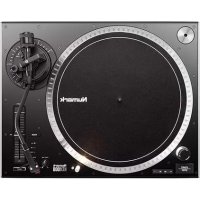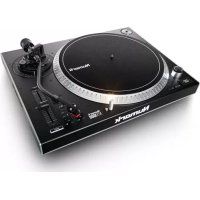
NTX1000 - Turntable NUMARK - Free user manual and instructions
Find the device manual for free NTX1000 NUMARK in PDF.



Frequently Asked Questions - NTX1000 NUMARK
User questions about NTX1000 NUMARK
0 question about this device. Answer the ones you know or ask your own.
Ask a new question about this device
Download the instructions for your Turntable in PDF format for free! Find your manual NTX1000 - NUMARK and take your electronic device back in hand. On this page are published all the documents necessary for the use of your device. NTX1000 by NUMARK.
USER MANUAL NTX1000 NUMARK
User Guide (English)
Introduction
Box Contents
| NTX1000 | Counterweight & Scale Ring |
| Platter | Additional Counterweight |
| Dustcover | RCA Stereo Cable |
| Felt Slipmat | Power Cable |
| Headshell | User Guide |
| 45 RPM Adapter | Safety & Warranty Manual |
Support
For the latest information about this product (documentation, technical specifications, system requirements, compatibility information, etc.) and product registration, visit numark.com.
For additional product support, visit numark.com/support.
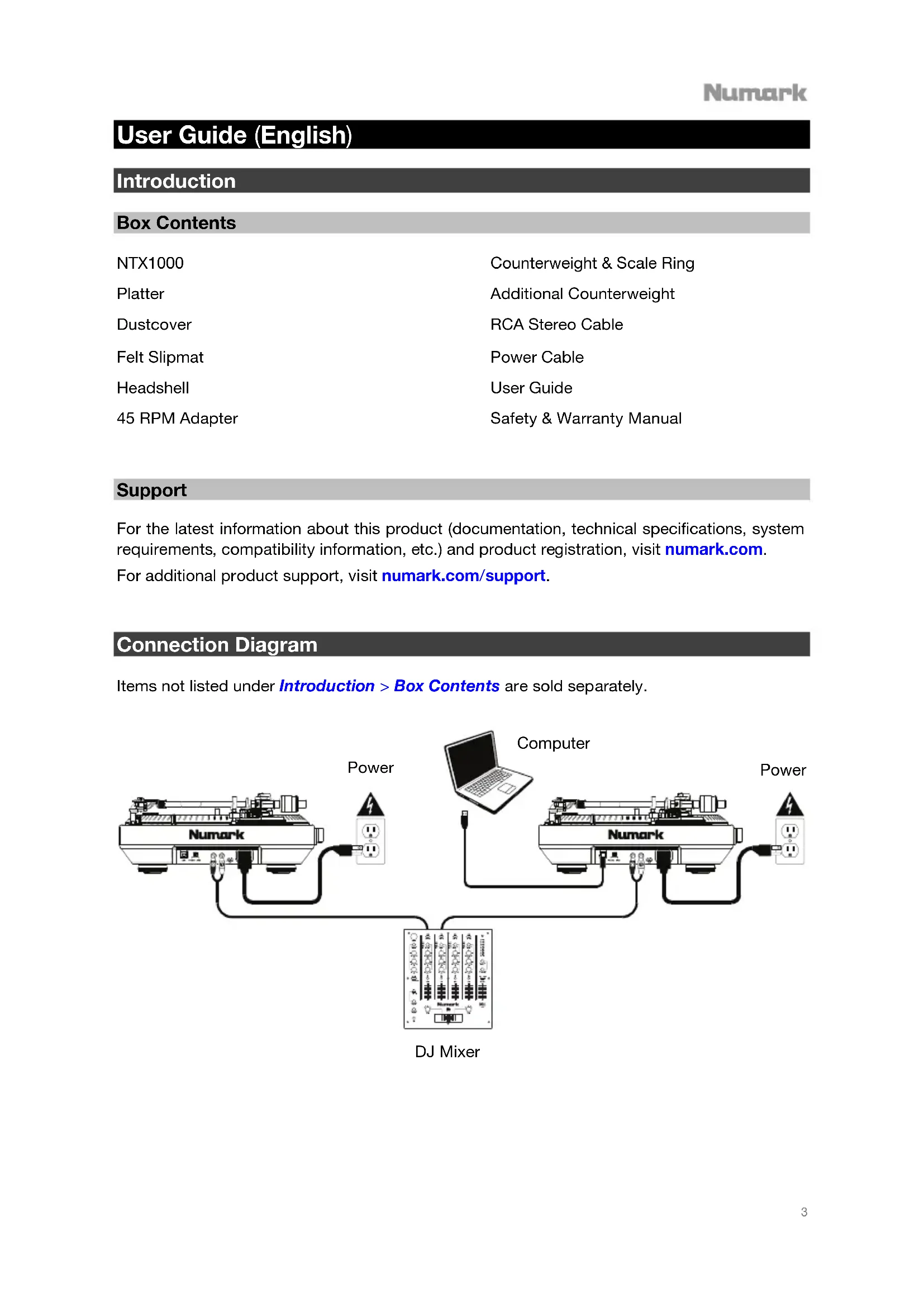
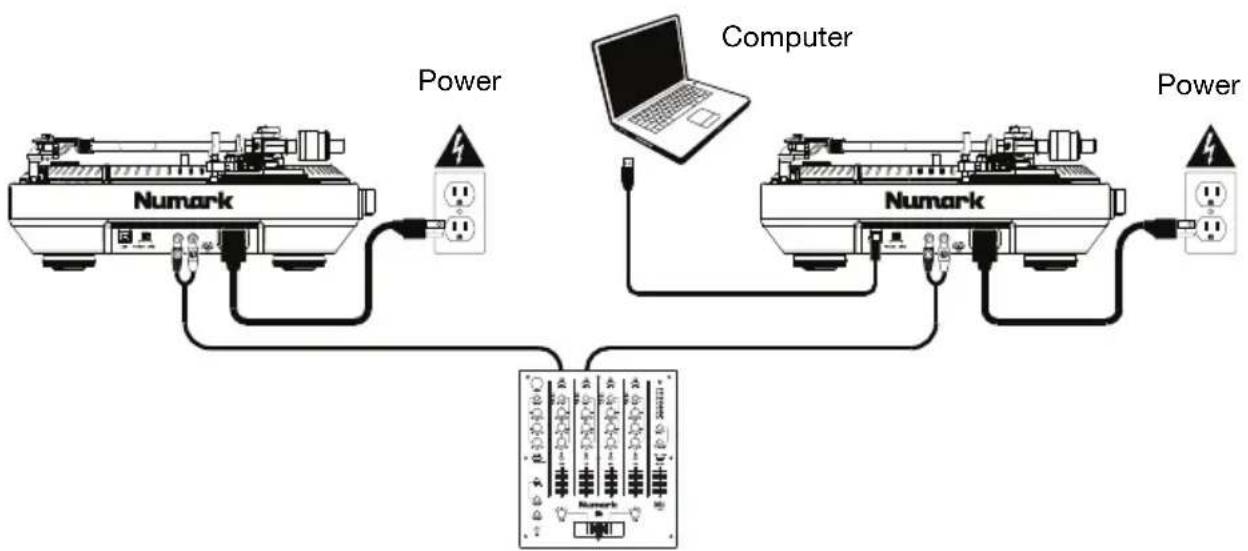
Connection Diagram
Items not listed under Introduction > Box Contents are sold separately.
-
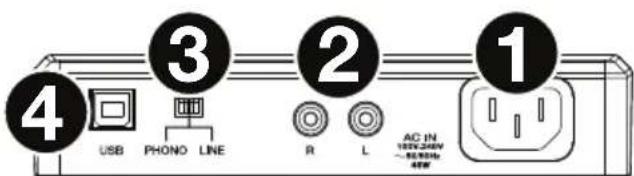
Power Input: Use the included power cable to connect this input to a power outlet, and then power on the unit.
-
RCA Outputs: Use standard RCA cables to connect this output to a mixer, speaker or amplifier system. Use the Phono/Line switch to set the level of the output.
-
Phono/Line Switch: Set this switch to the appropriate position, depending on the device you are connecting the RCA Outputs to. When connecting to a phono-level input, set this switch to Phono. When connecting to a line-level input, set this switch to Line.
Note: When set to Line, audio is lost when the power is turned off. When set to Phono, audio continues when power is turned off, allowing for motorless performance from the platter.
- USB Port: Use a standard USB cable to connect this USB port to your computer. You can listen to your records through your computer as long as you have configured your computer's sound input and output options correctly.
Note: When NTX1000 is connected to a computer via USB, the Phono/Line switch must be set to Line.
text_image
4 USB PHONO LINE 3 2 R L AC IN 100V AC ~ 80V AC 40WTop Panel
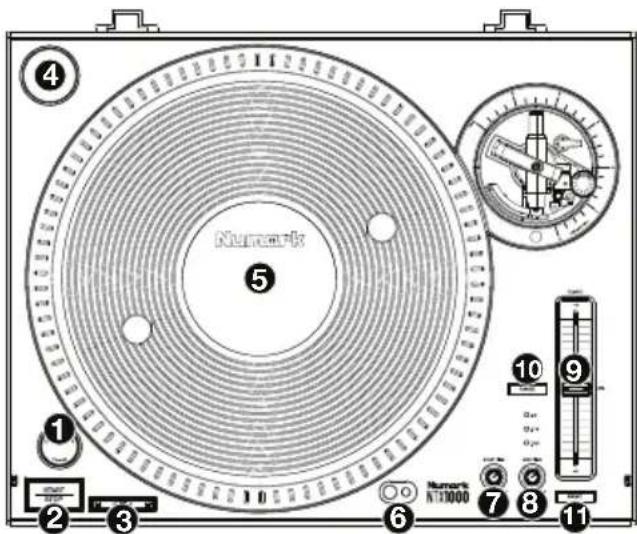
- Power Switch & Strobe Light: Turn this dial at the top of the strobe light to power NTX1000 on or off.
The strobe light illuminates the edge of the platter, which indicates whether or not the phase of the platter's rotation is constant. As the platter rotates, look at the vertical lines on its edge under the light's strobing. If the phase is constant, the lines will appear to be still. If the rotation is out of phase, the lines will appear to move or "drift."
- Start/Stop: Press this button to start and stop the platter's motor. If the platter appears not to be functioning, make sure it is properly secured (see Setup > Platter).
text_image
4 Nunoark 5 1 2 3 6 7 8 9 10 Nunoark NTX3000- 33 & 45 RPM Buttons: Press one of these buttons to set the rotation speed (RPM) of the platter. The lit button indicates the current selection.
- 45 RPM Adapter Holder: Place the 45 RPM adapter here when not using it.
- Platter: Place the platter onto the motor before using it. See Setup > Platter for detailed information on securing the platter.
- Target Light: This light illuminates the platter so you can view the grooves on your record (for placing the stylus). To turn it on, press the smaller button next to it. To turn it off, push the light downward into the base until it locks in place.
- Start Time: Controls the rate at which the platter regains its normal playback speed.
-
Stop Time: Controls the rate at which the platter slows to a complete stop ("brake time").
-
Pitch Fader: Move this fader to increase or decrease speed of the platter (and therefore the pitch of the track). In the center position, the pitch is at 0%. Use the Pitch Range button to set the full range of the pitch fader.
- Pitch Range: Press this button to cycle through the available ranges of the pitch fader: ±8%, ±16%, and ±50%. The lights above the button indicate the current selection.
- Pitch Reset: Press this button to return the speed of the platter to 0% pitch adjustment immediately, regardless of the position of the pitch fader.
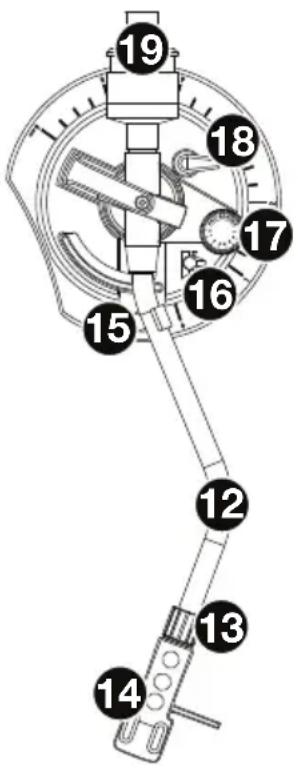
Tonearm
See Setup > Tonearm for additional details on these controls.
- Tonearm: With the tonearm lever in the “raised” position, gently move the tonearm so it rests over your record on the platter. To play your record, move the tonearm lever to the “lowered” position, which will lower the tonearm onto your record.
- Tonearm Lock Nut: This nut secures the headshell and cartridge assembly to the tonearm. Turn the cartridge clockwise to loosen it or counterclockwise to tighten it. Do not over-tighten it.
- Headshell: Mount your cartridge (not included) on this headshell, and then attach the headshell to the tonearm lock nut. (Remember to remove the plastic cover from your cartridge before using it.) The headshell is user-replaceable and compatible with many standard cartridges.
Note: To prevent damage, we recommend removing the headshell and cartridge assembly before packing or transporting NTX1000.
- Tonearm Clip: Close this clip to secure the tonearm while it is not being used. The clip remains in the "up" position while open.
-
Tonearm Lever: Move this lever between its two positions to raise or lower the tonearm. Raise the tonearm before moving it toward or away from the record, and lower it once it is in place.
-
Anti-Skate Dial: Turn this dial to compensate for inward tracking forces that occur with certain cartridges as the stylus nears the center of the record. In most cases, set this to 0. If you experience excessive skipping during back-cueing or scratching while nearing the center of the record, increase this dial's setting in small increments and test its performance.
- Height Adjustment & Lock Lever: Turn this large dial to set the height of the tonearm. Move the small Lock lever (above the Anti-Skate Dial) counterclockwise or clockwise to unlock or lock the height adjustment, respectively. See Setup > Tonearm to learn how to set the appropriate height.
- Counterweight & Scale Ring: The counterweight balances the headshell and cartridge assembly so the tonearm can apply the proper amount of stylus pressure to the record. See Setup > Tonearm to learn how to properly balance the tonearm.
Note: If your headshell is heavier than expected, there is an additional counterweight included, which you use with this counterweight to balance your tonearm properly.
text_image
Technical diagram of a mechanical device with numbered components for identificationSetup
Platter
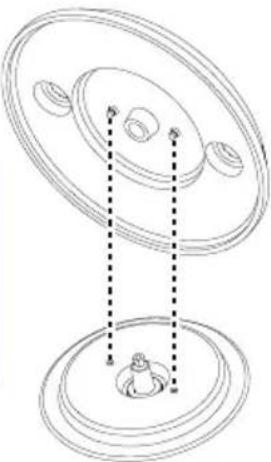
Place the platter onto the motor by aligning the pins in the bottom of the platter with the holes in the motor. Press it down firmly. Check to make sure that it rotates uniformly and does not wobble excessively, and then place the slipmat onto the platter.
Important:
- Incorrect platter setup can lead to poor turntable performance, platter instability or permanent motor damage.
- Make sure that the felt slipmat is always placed on top of the platter while using the turntable. Failure to use the slipmat may cause damage to your media as well as damage to the turntable.
natural_image
Technical line drawing of a mechanical component with concentric ovals and a central base (no text or symbols)Tonearm
natural_image
Diagram showing a mechanical lever and a balance scale with directional arrows (no text or labels)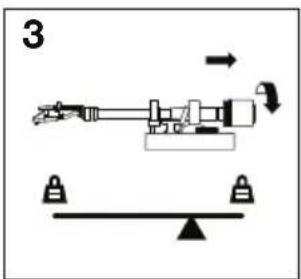
text_image
3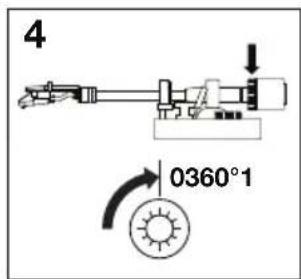
text_image
4 0360°1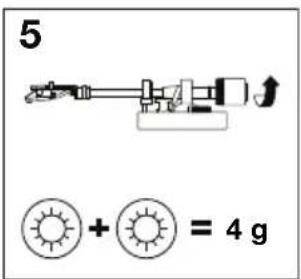
text_image
5 + = 4 gImportant: Refer to the documentation for your cartridge to determine the proper stylus pressure/weight (in grams) and tonearm height (in millimeters).
- Make sure the cartridge is on the tonearm. Turn the tonearm lock nut clockwise to loosen it or counterclockwise to tighten it. Do not over-tighten it! Remove the plastic cartridge cover (needle cover) before operating the turntable.
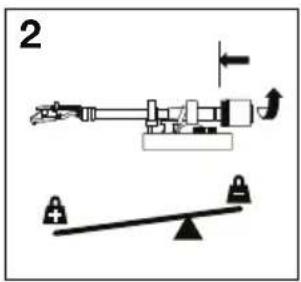
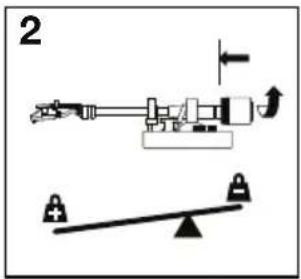
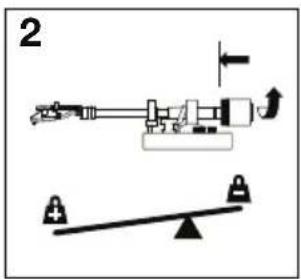
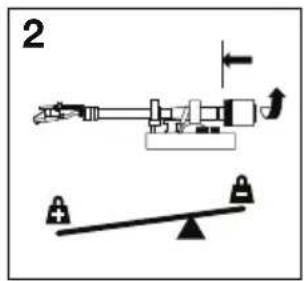
- Attach the counterweight and scale ring to the tonearm, and then rotate the counterweight counterclockwise (while you are facing the scale ring) until it is in the complete forward position.
Note: This is also the maximum amount of pressure that can be applied to the cartridge.
-
Now there should be a feeling of weight and resistance when the headshell is raised and lowered. Begin rotating the counterweight clockwise (while you are facing the scale ring) until the weight and resistance feeling is gone. If done properly, the tonearm will pivot with very little resistance back and forth indicating that there is exactly 0 grams of stylus pressure.
-
With the counterweight in its new position further away from tonearm pivot point, grasp the scale ring only and rotate it until 0 is in the vertical position.
-
Finally, rotate the counterweight and scale ring counterclockwise until you reach the desired weight. A complete revolution of the scale ring corresponds to 3 g, so if the scale rotates 360^ beyond the 0 point, add 3 to the new scale ring reading.
If you cannot achieve the desired weight during this step, remove the counterweight and scale ring from the tonearm entirely, attach the additional counterweight (included) to the end of the tonearm, and then start again from Step 2 above. This is not a common occurrence, though there may be some DJ headshells and cartridges that are heavier than normal.
- Push the small Lock lever (above the Anti-Skate Dial) counterclockwise to unlock the height adjustment dial. Place the stylus on your record, and then move the tonearm lever to raise or lower the tonearm so it is parallel with the record. Push the Lock lever clockwise to lock the height adjustment dial.
text_image
Technical diagram of a mechanical device with numbered parts for identificationInstalación
Plato
natural_image
Technical line drawing of a mechanical component with two concentric ovals and a base, showing internal features and dashed alignment lines (no text or symbols)Brazo de lectura
text_image
2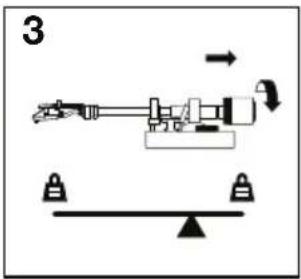
text_image
3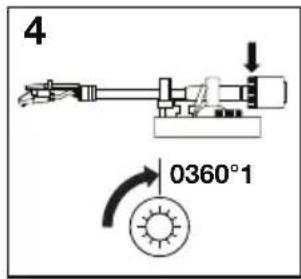
text_image
4 0360°1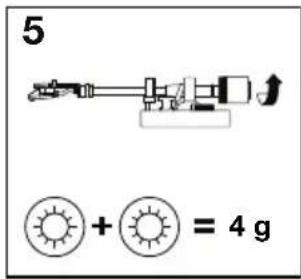
text_image
5 + = 4 gtext_image
Technical diagram of a mechanical device with numbered parts for identificationInstallation
Plateau
natural_image
Technical line drawing of a mechanical component with two concentric ovals and a central base (no text or symbols)Bras de lecture
text_image
2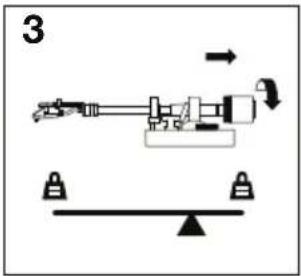
text_image
3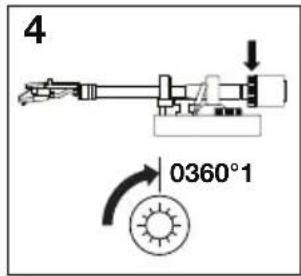
text_image
4 0360°1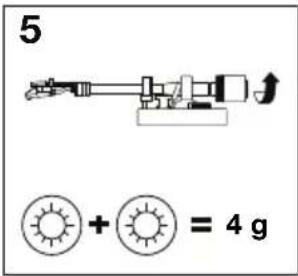
text_image
5 + = 4 gtext_image
Technical diagram of a mechanical device with numbered parts for identificationConfigurazione
Piatto
natural_image
Technical line drawing of a mechanical component with two circular parts and a base, showing alignment lines (no text or symbols)Braccio
text_image
2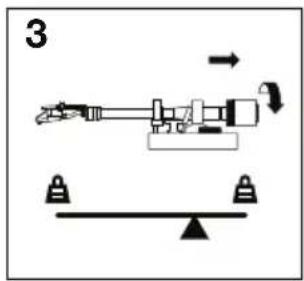
text_image
3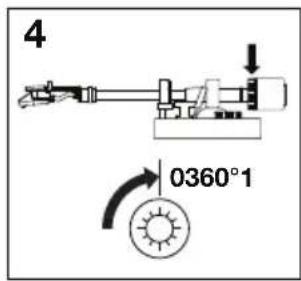
text_image
4 0360°1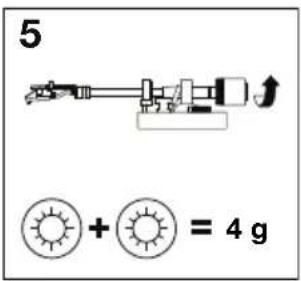
text_image
5 + = 4 gtext_image
Technical diagram of a mechanical dial with numbered parts for identificationnatural_image
Technical line drawing of a mechanical assembly with two concentric ovals and a small central component (no text or symbols)Wichtig:
text_image
5 + = 4 gTechnical Specifications
| Motor Drive | Direct Drive – 16 Pole, 3 Phase | |
| Starting | 4 kgf/cm (in 2 kgf/cm (stable) | |
| Starting | < 0.7 second time | |
| Braking | 9 Step Electric System Servo Brake | |
| Rumble | -50 dB (System2 Unweighted) | |
| Platter | Material | Aluminum |
| Diameter | 13" / 331 mm | |
| Weight | 2.43 lbs. / 1100 g | |
| Tonearm | Effective | 9.2 Length.5 mm |
| Overhang | 0.8" / 20.95 mm | |
| Offset | 20° Angle | |
| Speeds | 331⁄3, 45 RPM< 0.15% wow & flutter | |
| Output | Switchable phono-level and line-level via stereo RCA cable | |
| Pitch Range | ±8%, ±16%, ±50% | |
| Connections | (2) RCA outputs (1 stereo pair)(1) IEC power input(1) USB port | |
| Power | Connection | IEC |
| Input | 100–240 V/Hz Voltage 50/60 Hz | |
| Consumption | 45 W | |
| Dimensions(width x depth x height) | 17.7 x 14.5" x 6.1"45.0 x 36.8 x 15.6 cm | |
| Weight | 17.9 lbs.8.14 kg | |
Specifications are subject to change without notice.
Trademarks & Licenses
Numark is a trademark of inMusic Brands, Inc., registered in the U.S. and other countries.
All other product names, company names, trademarks, or trade names are those of their respective owners.