ManualGo.com
WED4616FW - Dryer WHIRLPOOL - Free user manual and instructions
Find the device manual for free WED4616FW WHIRLPOOL in PDF.


Download the instructions for your Dryer in PDF format for free! Find your manual WED4616FW - WHIRLPOOL and take your electronic device back in hand. On this page are published all the documents necessary for the use of your device. WED4616FW by WHIRLPOOL.
USER MANUAL WED4616FW WHIRLPOOL
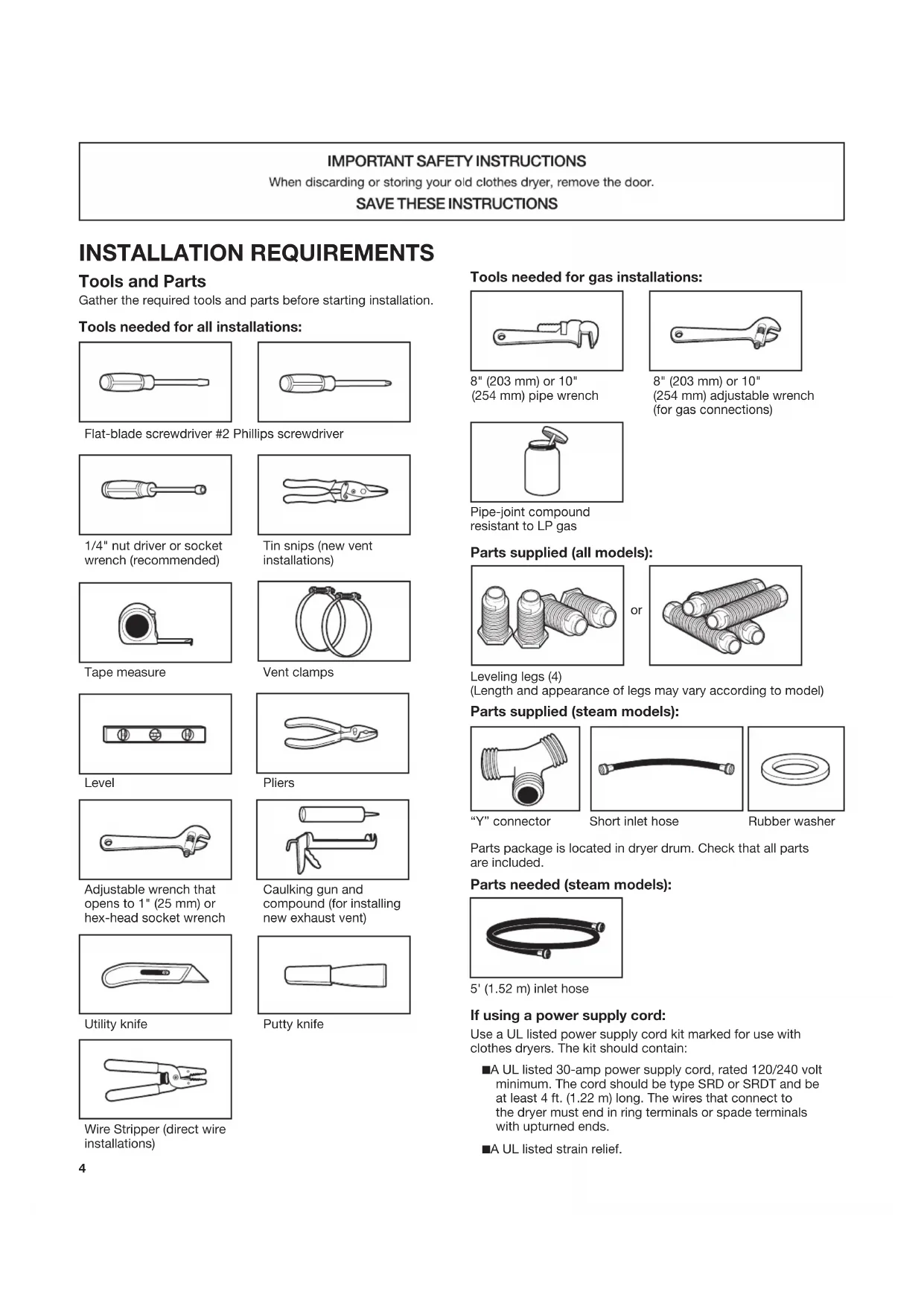
DÉPANNAGE ............................................................................. 42 Gas and Electric Dryer Installation Instructions 29" Wide Models Instructions d’installation de la sécheuse à gaz et électrique Modèles de largeur 29" Para obtener acceso al manual de uso y cuidado en español, o para obtener información adicional acerca de su producto, visite: www.whirlpool.com o www.maytag.com Tenga listo su número de modelo completo. Puede encontrar el número de modelo y de serie dentro de la cavidad superior de la puerta.2 DRYER SAFETY34 Tools and Parts Gather the required tools and parts before starting installation. Tools needed for all installations: Level Tape measure Pliers Flat-blade screwdriver #2 Phillips screwdriver Adjustable wrench that opens to 1" (25 mm) or hex-head socket wrench Tin snips (new vent installations) Caulking gun and compound (for installing new exhaust vent) Vent clamps 1/4" nut driver or socket wrench (recommended) Utility knife INSTALLATION REQUIREMENTS Putty knife Parts supplied (steam models): “Y” connector Short inlet hose 5' (1.52 m) inlet hose Rubber washer Parts needed (steam models): Parts package is located in dryer drum. Check that all parts are included. Parts supplied (all models): Tools needed for gas installations: 8" (203 mm) or 10" (254 mm) pipe wrench 8" (203 mm) or 10" (254 mm) adjustable wrench (for gas connections) Pipe-joint compound resistant to LP gas Leveling legs (4) (Length and appearance of legs may vary according to model) Wire Stripper (direct wire installations) If using a power supply cord: Use a UL listed power supply cord kit marked for use with clothes dryers. The kit should contain: ■ A UL listed 30-amp power supply cord, rated 120/240 volt minimum. The cord should be type SRD or SRDT and be at least 4 ft. (1.22 m) long. The wires that connect to the dryer must end in ring terminals or spade terminals with upturned ends. ■ A UL listed strain relief. or5 Parts needed: (Not supplied with dryer) Check local codes. Check existing electrical supply and venting. See “Electrical Requirements” and “Venting Requirements” before purchasing parts. Mobile home installations require metal exhaust system hardware available for purchase from the dealer from whom you purchased your dryer. For further information, please refer to the “Assistance or Service” section in your “Use and Care Guide.” Optional Equipment: (Not supplied with dryer) Refer to your “Use and Care Guide” for information about accessories available for your dryer. Location Requirements You will need: ■ A location allowing for proper exhaust installation. See “Venting Requirements.” ■ A separate 15 or 20-amp circuit needed for gas dryers and 30-amp circuit needed for electric dryers. ■ If you are using power supply cord, a grounded electrical outlet located within 2 ft. (610 mm) of either side of dryer. See “Electrical Requirements.” ■ A sturdy oor to support dryer and a total weight (dryer and load) of 200 lbs. (90.7 kg). The combined weight of a companion appliance should also be considered. ■ Level oor with maximum slope of 1" (25 mm) under entire dryer. If slope is greater than 1" (25 mm), install Extended Dryer Feet Kit, Part Number 279810. If not level, clothes may not tumble properly and automatic sensor cycles may not operate correctly. ■ For garage installation, place dryer at least 18" (460 mm) above oor. ■ Steam models only: Cold water faucet located within 4 ft. (1.2 m) of the water ll valves, and water pressure of 20-100 psi (137.9-689.6 kPa). You may use the water supply for your washer using the “Y” connector and short hose which are provided. IMPORTANT: Do not operate, install, or store dryer where it will be exposed to water, weather, or at temperatures below 45°F (7°C). Lower temperatures may cause dryer not to shut off at end of automatic sensor cycles, resulting in longer drying times. NOTE: No other fuel-burning appliance can be installed in the same closet as a dryer. Installation clearances: For each arrangement, consider allowing more space for ease of installation and servicing, spacing for companion appliances, and clearances for walls, doors, and oor moldings. Space must be large enough to allow door to fully open. Add spacing on all sides of dryer to reduce noise transfer. If a closet door or louvered door is installed, top and bottom air openings in door are required. Check code requirements. Some codes limit, or do not permit, installation of the dryer in garages, closets, mobile homes, or sleeping quarters. Contact your local building inspector. Dryer Dimensions Front View
/4"(717 mm) NOTE: Minimum height of leveling legs should be 1/2" (13 mm), or to match the height of the accompanying washer. Side View 29" (737 mm)
(101 mm) Steam Non-Steam Mobile home – Additional installation requirements This dryer is suitable for mobile home installations. The installation must conform to the Manufactured Home Construction and Safety Standard, Title 24 CFR, Part 3280 (formerly the Federal Standard for Mobile Home Construction and Safety, Title 24, HUD Part 280) or the Canadian Manufactured Home Standard CAN/CSA-Z240 MH. ■ Metal exhaust system hardware, available for purchase. For further information, please reference the “Assistance or Service” section of the “Use and Care Guide.” ■ Special provisions must be made in mobile homes to introduce outside air into the dryer. The opening (such as a nearby window) should be at least twice as large as the dryer exhaust opening. For gas dryers mobile home installations: ■ Mobile Home Installation Hold-down Kit Part Number W10432680 is available to order. For further information, see “Assistance or Service” section in your “Use and Care Guide.” Installation spacing for recessed area or closet The dimensions shown are for the minimum spacing allowed. ■ Additional spacing should be considered for ease of installation and servicing. ■ Additional clearances might be required for wall, door, and oor moldings. ■ Additional spacing of 1" (25 mm) on all sides of the dryer is recommended to reduce noise transfer. ■ For closet installation, with a door, minimum ventilation openings in the top and bottom of the door are required. Louvered doors with equivalent ventilation openings are acceptable. ■ Companion appliance spacing should also be considered.7 ELECTRICAL REQUIREMENTS –
U.S.A. ONLY (SPÉCIFICATIONS
ÉLECTRIQUES – ÉTATS-UNIS SEULEMENT) Electrical Requirements It is your responsibility: ■ To contact a qualied electrical installer. ■ To be sure that the electrical connection is adequate and in conformance with the National Electrical Code, ANSI/NFPA
70 - latest edition and all local codes and ordinances.
The National Electrical Code requires a 4-wire power supply connection for homes built after 1996, dryer circuits involved in remodeling after 1996, and all mobile home installations. A copy of the above code standards can be obtained from: National Fire Protection Association, One Batterymarch Park, Quincy, MA 02269. ■ To supply the required 3 or 4 wire, single phase, 120/240 volt, 60 Hz, AC only electrical supply (or 3 or 4 wire, 120/208 volt electrical supply, if specied on the serial/rating plate) on a separate 30-amp circuit, fused on both sides of the line. Connect to an individual branch circuit. Do not have a fuse in the neutral or grounding circuit. ■ Do not use an extension cord. ■ If codes permit and a separate ground wire is used, it is recommended that a qualied electrician determine that the ground path is adequate. Electrical Connection To properly install your dryer, you must determine the type of electrical connection you will be using and follow the instructions provided for it here. ■ This dryer is manufactured ready to install with a 3-wire electrical supply connection. The neutral ground conductor is permanently connected to the neutral conductor (white wire) within the dryer. If the dryer is installed with a 4-wire electrical supply connection, the neutral ground conductor must be removed from the external ground connector (green screw), and secured under the neutral terminal (center or white wire) of the terminal block. When the neutral ground conductor is secured under the neutral terminal (center or white wire) of the terminal block, the dryer cabinet is isolated from the neutral conductor. ■ If local codes do not permit the connection of a neutral ground wire to the neutral wire, see “Optional 3-wire connection” section. ■ A 4-wire power supply connection must be used when the appliance is installed in a location where grounding through the neutral conductor is prohibited. Grounding through the neutral is prohibited for (1) new branch-circuit installations, (2) mobile homes, (3) recreational vehicles, and (4) areas where local codes prohibit grounding through the neutral conductors. 4-wire receptacle (14-30R) If your outlet looks like this: Then choose a 4-wire power supply cord with ring or spade terminals and UL listed strain relief. The 4-wire power supply cord, at least 4 ft. (1.22 m) long, must have 4 10-gauge solid copper wires and match a 4-wire receptacle of NEMA Type 14-30 R. The ground wire (ground conductor) may be either green or bare. The neutral conductor must be identied by a white cover. 3-wire receptacle (10-30R) If your outlet looks like this: Then choose a 3-wire power supply cord with ring or spade terminals and UL listed strain relief. The 3-wire power supply cord, at least 4 ft. (1.22 m) long, must have 3 10-gauge solid copper wires and match a 3-wire receptacle of NEMA Type 10-30R. If connecting by direct wire: Power supply cable must match power supply (4-wire or 3-wire) and be: ■ Flexible armored cable or nonmetallic sheathed copper cable (with ground wire), covered with exible metallic conduit. All current-carrying wires must be insulated. ■ 10-gauge solid copper wire (do not use aluminum) at least 5 ft. (1.52 m) long. If using a power supply cord: Use a UL listed power supply cord kit marked for use with clothes dryers. The kit should contain: ■ A UL listed 30-amp power supply cord, rated 120/240 volt minimum. The cord should be type SRD or SRDT and be at least 4 ft. (1.22 m) long. The wires that connect to the dryer must end in ring terminals or spade terminals with upturned ends. ■ A UL listed strain relief.8 4-wire receptacle (14-30R)
ELECTRIC DRYER POWER HOOKUP –
CANADA ONLY ELECTRICAL REQUIREMENTS It is your responsibility: ■ To contact a qualied electrical installer. ■ To be sure that the electrical connection is adequate and in conformance with Canadian Electrical Code, C22.1-latest edition and all local codes. A copy of above codes standard may be obtained from: Canadian Standards Association, 178 Rexdale Blvd., Toronto, ON M9W 1R3 CANADA. ■ To supply the required 4 wire, single phase, 120/240 volt, 60 Hz, AC only electrical supply on a separate 30-amp circuit, fused on both sides of the line. A time-delay fuse or circuit breaker is recommended. Connect to an individual branch circuit. ■ This dryer is equipped with a CSA International Certied Power Cord intended to be plugged into a standard 14-30R wall receptacle. The cord is 5 ft. (1.52 m) long. Be sure wall receptacle is within reach of dryer’s nal location. If using a replacement power supply cord, it is recommended that you use Power Supply Cord Replacement Part Number
For further information, please reference service numbers located in “Assistance or Service” section of your Use and Care Guide. GROUNDING INSTRUCTIONS
SAVE THESE INSTRUCTIONS
For a grounded, cord-connected dryer: This dryer must be grounded. In the event of malfunction or breakdown, grounding will reduce the risk of electric shock by providing a path of least resistance for electric current. This dryer is equipped with a cord having an equipment- grounding conductor and a grounding plug. The plug must be plugged into an appropriate outlet that is properly installed and grounded in accordance with all local codes and ordinances.
WARNING: Improper connection of the equipment-
grounding conductor can result in a risk of electric shock. Check with a qualied electrician or service representative or personnel if you are in doubt as to whether the dryer is properly grounded. Do not modify the plug provided with the dryer: if it will not t the outlet, have a proper outlet installed by a qualied electrician.
ELECTRICAL REQUIREMENTS ■ 120 Volt, 60 Hz, AC only, 15- or 20-amp fused electrical supply is required. A time-delay fuse or circuit breaker is recommended. It is also recommended that a separate circuit serving only this dryer be provided.9 Gas Supply Requirements Gas type Natural gas:This dryer is equipped for use with Natural Gas. It is design-certied by CSA International for LP (propane or butane) gases with appropriate conversion. ■ Your dryer must have the correct burner for the type of gas in your home. Burner information is located on the rating plate in the door well of your dryer. If this information does not agree with the type of gas available, please reference the “Assistance or Service” section of the Use and Care Guide. GROUNDING INSTRUCTIONS
SAVE THESE INSTRUCTIONS
For a grounded, cord-connected dryer: This dryer must be grounded. In the event of malfunction or breakdown, grounding will reduce the risk of electric shock by providing a path of least resistance for electric current. This dryer is equipped with a cord having an equipment- grounding conductor and a grounding plug. The plug must be plugged into an appropriate outlet that is properly installed and grounded in accordance with all local codes and ordinances.
Improper connection of the equipment- grounding conductor can result in a risk of electric shock. Check with a qualied electrician or service representative or personnel if you are in doubt as to whether the dryer is properly grounded. Do not modify the plug provided with the dryer: if it will not t the outlet, have a proper outlet installed by a qualied electrician. LP Gas Conversion: IMPORTANT: Conversion must be made by a qualied technician.No attempt shall be made to convert the dryer from the gas specied on the model/serial rating plate for use with a different gas without consulting your gas company.
Option 1 (Recommended Method) Flexible stainless steel gas connector: ■ If local codes permit, use a new exible stainless steel gas connector (Design Certied by the American Gas Association or CSA International) to connect your dryer to the rigid gas supply line. Use an elbow and a 3/8" are x 3/8" NPT adapter tting between the stainless steel gas connector and the dryer gas pipe, as needed, to prevent kinking. Option 2 (Alternate Method) Approved aluminum or copper tubing ■ Must include 1/8" NPT minimum plugged tapping accessible for test gauge connection, immediately upstream of the gas connection to the dryer. ■ 1/2" IPS pipe is recommended. ■ 3/8" approved aluminum or copper tubing is acceptable for lengths under 20 ft. (6.1 m) if local codes and gas supplier permit. ■ If you are using Natural gas, do not use copper tubing. ■ Lengths over 20 ft. (6.1 m) should use larger tubing and a different size adapter tting. ■ If your dryer has been converted to use LP gas, 3/8" LP compatible copper tubing can be used. If the total length of the supply line is more than 20 ft. (6.1 m), use larger pipe.NOTE: Pipe-joint compounds that resist the action of LP gas must be used. Do not use TEFLON tape. ■ Must include shut-off valveIn the U.S.A.:An individual manual shut-off valve must be installed within six (6) ft. (1.8 m) of the dryer in accordance with the National Fuel Gas Code, ANSI Z223.1. The location should be easy to reach for opening and closing. In Canada:An individual manual shut-off valve must be installed in accordance with the B149.1, Natural Gas and Propane Installation Code. It is recommended that an individual manual shutoff valve be installed within six (6) ft. (1.8 m) of the dryer. The location should be easy to reach for opening and closing. †®TEFLON is a registered trademark of Chemours.10 Dryer gas pipe ■ The gas pipe that comes out through the rear of your dryer has a 3/8" male pipe thread.
■ Use an elbow and a 3/8" are x 3/8" NPT adapter tting between the exible gas connector and the dryer gas pipe, as needed, to avoid kinking. ■ Use only pipe-joint compound. Do not use TEFLON
tape. ■ This dryer must be connected to the gas supply line with a listed exible gas connector that complies with the standard for connectors for gas appliances, ANSI Z21.24 or CSA 6.10.
BURNER INPUT REQUIREMENTS
Elevations above 2,000 ft. (610 m): ■ When installed above 2,000 ft. (610 m), a 4% reduction of the burner Btu rating shown on the model/serial number plate is required for each 1,000 ft. (305 m) increase in elevation. Gas supply pressure testing ■ The dryer must be disconnected from the gas supply piping system during pressure testing at pressures greater than 1/2 psi. A. 3/8" exible gas connectorB. 3/8" pipe to are adapter tting C. 1/8" NPT minimum plugged tappingD. 1/2" NPT gas supply lineE. Gas shutoff valve
Screw in leveling legs
Using a wrench and tape measure, screw leveling legs into leg holes until bottom of foot is approximately 1/2" (13 mm) from bottom of dryer (so that the dryer height matches that of the accompanying washer). Now stand the dryer on its feet. Slide the dryer until it is close to its nal location. Leave enough room to connect the exhaust vent. For mobile home use Gas dryers must be securely fastened to the oor. Mobile home installations require a Mobile Home Installation Hold-down Kit. For ordering information, please reference the “Use and Care Guide.” Prepare dryer for leveling legs
Power supply cord 4-wire receptacle(NEMA Type 14-30R): Go to steps 1-2 on page 12 for power supply cord strain relief; then steps 3-6 for 4-wire Power Supply Cord Connection section. Then, go to Venting Requirements.3-wire direct connection: Go to steps 1-2 on page 13 for direct wire strain relief; then steps 3-7 for 3-wire Direct Wire Connection section. Then go to Venting Requirements.4-wire direct connection: Go to steps 1-2 on page 13 for direct wire strain relief; then steps 3-8 for 4-wire Direct Wire Connection section. Then go to Venting Requirements. Power supply cord 3-wire receptacle(NEMA Type 10-30R): Go to steps 1-2 on page 12 for power supply cord strain relief; then steps 3-5 for 3-wire Power Supply Cord Connection section. Then go to Venting Requirements. NOTE: If local codes do not permit connection of a cabinet-ground conductor to neutral wire, go to “Optional 3-wire Connection” section. This connection may be used with either a power supply cord or a direct wire connection. Direct Wire
2. Remove terminal block cover
Before you start, disconnect power. Remove hold-down screw (D) and terminal block cover (A).A. Terminal block cover B. External ground conductor screwC. Center terminal block screwD. Hold-down screw E. Neutral ground wireF. Hole below terminal block cover12 Put power supply cord through the strain relief. Be sure that the wire insulation on the power supply cord is inside the strain relief. The strain relief should have a tight t with the dryer cabinet and be in a horizontal position. Do not further tighten strain relief screws at this point.For 3-wire Power Supply Cord Connection, continue to step 3 on page 13.For 4-wire Power Supply Cord Connection, continue to step 3 on this page. Attach power supply cord to strain relief
Attach power supply cord strain relief Remove the screws from a 3/4" (19 mm) UL listed strain relief (UL marking on strain relief). Put the tabs of the two clamp sections (C) into the hole (B) below the terminal block opening so that one tab is pointing up (A) and the other is pointing down (D), and hold in place. Tighten strain relief screws just enough to hold the two clamp sections (C) together.
Power supply cord strain relief
POWER SUPPLY CORD CONNECTION
4-wire Power Supply Cord Connection Remove center terminal block screw (B). Remove neutral ground wire (E) from external ground conductor screw (A).
Prepare to connect neutral ground wire and neutral wire
IMPORTANT: A 4-wire connection is required for mobile homes and where local codes do not permit the use of 3-wire connections. A. 4-wire receptacle (NEMA type 14-30R)B. 4-prong plugC. Ground prongD. Neutral prongE. Spade terminals with upturned endsF. 3/4" (19 mm) UL listed strain reliefG. Ring terminals
Connect neutral ground wire and neutral wire
Connect neutral ground wire (E) and neutral wire (white or center) (C) of power supply cord under center terminal block screw (B). Tighten screw.
Connect ground wire (F) (green or bare) of power supply cord to external ground conductor screw (A). Tighten screw.
5. Connect ground wire
E. F. G.13 3-wire Power Supply Cord Connection Use where local codes permit connecting cabinet-ground conductor to neutral wire. A. 3-wire receptacle (NEMA type 10-30R)B. 3-wire plugC. Neutral prongD. Spade terminals with upturned endsE. 3/4" (19 mm) UL listed strain reliefF. Ring terminalsG. Neutral (white or center wire) Connect remaining wires
Connect remaining wires to outer terminal block screws. Tighten screws. Finally, reinstall terminal block cover. Secure cover with hold-down screw. Now, go to Venting Requirements.Remove center terminal block screw (B).
Unscrew the removable conduit connector (A) and any screws from a 3/4" (19 mm) UL listed strain relief (UL marking on strain relief). Put the threaded section of the strain relief through the hole (B) below the terminal block opening. Reaching inside the terminal block opening, screw the removable conduit connector onto the strain relief threads (C).
Put direct wire cable through the strain relief. The strain relief should have a tight t with the dryer cabinet and be in a horizontal position. Tighten strain relief screws.For 3-wire Direct Wire Connection, continue to step 3 on page 15.For 4-wire Direct Wire Connection, continue to step 3 on the next page.
2. Attach direct wire cable
to strain relief Direct wire strain relief
4. Connect neutral wire
Connect neutral wire (white or center) (C) of power supply cord to center terminal block screw (B). Tighten screw.
5. Connect remaining wires
Connect remaining wires to outer terminal block screws. Tighten screws. Finally, reinstall terminal block cover. Secure cover with hold-down screw. Now, go to Venting Requirements.
DIRECT WIRE CONNECTION
G.14 4-wire Direct Wire Connection IMPORTANT: A 4-wire connection is required for mobile homes and where local codes do not permit 3-wire connections. Direct wire cable must have 5 ft. (1.52 m) of extra length so dryer may be moved if needed. Strip 5" (127 mm) of outer covering from end of cable, leaving bare ground wire at 5" (127 mm). Cut 1
" (38 mm) from remaining 3 wires. Strip insulation back 1" (25 mm). Shape ends of wires into hooks. 1"(25 mm)
3. Prepare your 4-wire cable
for direct connection To connect wires to terminal block, place hooked end of wire under terminal block screw, facing to the right, squeeze hooked end together, and tighten screw.
4. Connect wires to terminal block
5. Prepare to connect neutral
ground wire and neutral wire
Remove center terminal block screw (B). Remove neutral ground wire (E) from external ground conductor screw (A).
7. Connect ground wire
Connect ground wire (green or bare) (F) of direct wire cable to external ground conductor screw (A). Tighten screw.
6. Connect neutral ground wire
and neutral wire Connect neutral ground wire (E) and place hooked end (hook facing right) of neutral wire (white/center wire) (C) of direct wire cable under center screw of terminal block (B). Squeeze hooked ends together and tighten screw. Place hooked ends of remaining direct wire cable wires under outer terminal block screws (hooks facing right). Squeeze hooked ends together and tighten screws. Finally, reinstall terminal block cover. Now, go to Venting Requirements.
8. Connect remaining wires15
3-wire Direct Wire Connection Use where local codes permit connecting cabinet-ground conductor to neutral wire.
Remove center terminal block screw (B). Direct wire cable must have 5 ft. (1.52 m) of extra length so dryer may be moved if needed. Strip 3
" (89 mm) of outer covering from end of cable. Strip insulation back 1" (25 mm). If using 3-wire cable with ground wire, cut bare wire even with outer covering. Shape wire ends into hooks. 1"(25 mm) 3½"(89 mm)
3. Prepare your 3-wire cable
for direct connection To connect wires to terminal block, place hooked end of wire under terminal block screw, facing to the right, squeeze hooked end together, and tighten screw.
4. Connect wires to terminal block
1. Prepare to connect neutral
ground wire and neutral wire
Remove center terminal block screw (B). Remove neutral ground wire (E) from external ground conductor screw (A). Optional 3-wire Connection You must verify with a quali ed electrician that this grounding method is acceptable before connecting. Connect remaining wires
Place hooked ends of remaining direct wire cable wires under outer terminal block screws (hooks facing right). Squeeze hooked ends together and tighten screws. Finally, reinsert tab of terminal block cover into slot of dryer rear panel. Secure cover with hold-down screw. Now, go to Venting Requirements.
Place hooked end of neutral wire (white or center) (C) of direct wire cable under center terminal block screw (B). Squeeze hooked end together. Tighten screw.
Connect neutral ground wire and neutral wire
Connect neutral ground wire (E) and neutral wire (white or center wire) (C) of power supply cord or cable under center terminal block screw (B). Tighten screw. Connect remaining wires
Place hooked ends of remaining wires under outer terminal block screws (hooks facing right). Tighten screws.
Connect external ground wire
Connect a separate copper ground wire (G) from the external ground conductor screw (A) to an adequate ground. Finally, reinsert tab of terminal block cover into slot of dryer rear panel. Secure cover with hold-down screw. Now, go to Venting Requirements.
A combination of pipe ttings must be used to connect dryer to existing gas line. A recommended connection is shown. Your connection may be different, according to supply line type, size, and location. A. 3/8" exible gas connectorB. 3/8" dryer pipe C. 3/8" to 3/8" pipe elbowD. 3/8" pipe-to- are adapter tting Open shut-off valve in supply line; valve is open when handle is parallel to gas pipe. Then, test all connections by brushing on an approved noncorrosive leak-detection solution. Bubbles will show a leak. Correct any leaks found.
1. Connect gas supply to dryer
Remove red cap from gas pipe. Using a wrench to tighten, connect gas supply to dryer. Use pipe-joint compound on threads of all non- ared male ttings. If exible metal tubing is used, be sure there are no kinks. NOTE: For LP gas connections, you must use pipe-joint compound resistant to action of LP gas. Do not use TEFLON
Closed valveOpen valve
3. Open shut-off valve
Non- ared male ttingFlared male tting G17 VENTING Venting Requirements 4"(102 mm) 4" (102 mm) heavy metal exhaust vent
WARNING: To reduce the risk of re, this dryer MUST BE
EXHAUSTED OUTDOORS. IMPORTANT: Observe all governing codes and ordinances. Dryer exhaust must not be connected into any gas vent, chimney, wall, ceiling, attic, crawlspace, or a concealed space of a building. Only rigid or exible metal vent shall be used for exhausting. ■ Only a 4" (102 mm) heavy metal exhaust vent and clamps may be used. ■ Do not use plastic or metal foil vent. Rigid metal vent: ■ Recommended for best drying performance and to avoid crushing and kinking. Flexible metal vent: (Acceptable only if accessible to clean) ■ Must be fully extended and supported in nal dryer location. ■ Remove excess to avoid sagging and kinking that may result in reduced airow and poor performance. ■ Do not install in enclosed walls, ceilings, or oors. ■ The total length should not exceed 7
ft. (2.4 m). NOTE: If using an existing vent system, clean lint from entire length of the system and make sure exhaust hood is not plugged with lint. Replace plastic or metal foil vents with rigid metal or exible metal vents. Review “Vent System Chart” and, if necessary, modify existing vent system to achieve best drying performance. Exhaust hoods: ■ Must be at least 12" (305 mm) from ground or any object that may obstruct exhaust (such as owers, rocks, bushes, or snow). Elbows: ■ 45° elbows provide better airow than 90° elbows. Clamps: ■ Use clamps to seal all joints. ■ Exhaust vent must not be connected or secured with screws or other fastening devices that extend into interior of duct and catch lint. Do not use duct tape. See “Venting Kits” for more information. Recommended Styles: Acceptable Style: Louvered hood Box hood Angled hood Good Better18 Plan Vent System Recommended exhaust installations Typical installations vent the dryer from the rear of the dryer. Other installations are possible.
A. Dryer B. Elbow C. Wall D. Exhaust hood E. Clamps F. Rigid metal or flexible metal vent G. Vent length necessary to connect elbows H. Exhaust outlet Standard rear offset exhaust installation Alternate installations for close clearances Venting systems come in many varieties. Select the type best for your installation. Two close-clearance installations are shown. Refer to the manufacturer’s instructions. Over-The-Top installation (also available with one offset elbow) Periscope installation NOTE: The following kits for close clearance alternate installations are available for purchase. Venting Kits For more information, call 1-866-698-2538 (Whirlpool) or 1-800-344-1274 (Maytag), or visit us at www.applianceaccessories.com (Whirlpool) or www.maytag.com (Maytag). In Canada, call 1-800-688-2002 (Whirlpool and Maytag) or visit us at www.whirlpoolparts.ca (Whirlpool) or www.maytag.ca (Maytag). Part Number Descriptions 8171587RP 0"-5" Metal vent periscope 4396037RP 0"-18" Metal vent periscope 4396011RP 18"-29" Metal vent periscope 4396014 29"-50" Metal vent periscope 4392892 In-Wall metal DuraVent™ Periscope 4396028 Sure Connect™ venting kit (over-the-top installation) 4396009RP 5' Universal connect vent, exible dryer venting 4396010RP 6' SecureConnect™ vent, exible dryer venting 4396013RB Dryer vent installer’s kit 4396033RP 5' exible dryer venting with clamps 4396727RP 8' exible dryer venting with clamps 4396004 Dryer offset elbow 4396005 Wall offset elbow 4396006RW DuraSafe™ close elbow 4396007RW Through-the-wall vent cap 4396008RP 4" steel dryer venting clamps - 2 pack 8212662 Flush mounting louvered vent hood 4"19 Special provisions for mobile home installations: The exhaust vent must be securely fastened to a noncombustible portion of the mobile home structure and must not terminate beneath the mobile home. Terminate the exhaust vent outside.Determine vent path: ■ Select route that will provide straightest and most direct path outdoors. ■ Plan installation to use fewest number of elbows and turns. ■ When using elbows or making turns, allow as much room as possible. ■ Bend vent gradually to avoid kinking. ■ Use as few 90° turns as possible. Determine vent length and elbows needed for best drying performance: ■ Use following “Vent System Chart” to determine type of vent material and hood combinations acceptable to use.NOTE: Do not use vent runs longer than those speci ed in “Vent System Chart.” Exhaust systems longer than those speci ed will: ■ Shorten life of dryer. ■ Reduce performance, resulting in longer drying times and increased energy usage.The “Vent System Chart” provides venting requirements that will help achieve best drying performance.Number of90° turns or elbowsType of ventBox/louvered hoodsAngled hoods0 Rigid metal 64 ft. (20 m) 58 ft. (17.7 m)1 Rigid metal 54 ft. (16.5 m) 48 ft. (14.6 m)2 Rigid metal 44 ft. (13.4 m) 38 ft. (11.6 m)3 Rigid metal 35 ft. (10.7 m) 29 ft. (8.8 m)4 Rigid metal 27 ft. (8.2 m) 21 ft. (6.4 m) Vent System Chart
Install exhaust hood and use caulking compound to seal exterior wall opening around exhaust hood. Connect vent to exhaust hood
Vent must t over the exhaust hood. Secure vent to exhaust hood with 4" (102 mm) clamp. Run vent to dryer location using straightest path possible. Avoid 90° turns. Use clamps to seal all joints. Do not use duct tape, screws, or other fastening devices that extend into interior of vent to secure vent, because they can catch lint.Number of90° turns or elbowsType of ventBox/louvered or angled hoods0 Rigid metal 160 ft. (48.8 m)1 Rigid metal 150 ft. (45.7 m)2 Rigid metal 140 ft. (42.7 m)3 Rigid metal 130 ft. (39.6 m)4 Rigid metal 120 ft. (36.6 m)5 Rigid metal 110 ft. (33.5 m) Vent System Chart (29" Wide Long Vent WED/WGD4870 and WED/WGD4975 Models Only)20 Turn cold water off, remove and replace rubber washer
Turn cold water faucet off and remove washer inlet hose. Remove old rubber washer from inlet hose and replace with new rubber washer. For non-steam models, skip to “Connect Vent.” The dryer must be connected to the cold water faucet using the new inlet hoses. Do not use old hoses.
(Steam Models Only) Tighten couplings
Using pliers, tighten the couplings with additional two-thirds turn. NOTE: Do not overtighten. Damage to the coupling can result. Attach short hose and “Y” connector
Attach 2 ft (0.6 m) inlet hose to cold water faucet. Screw on coupling by hand until it is seated on faucet. Then attach “Y” connector to end of the 2 ft (0.6 m) inlet hose. Screw on coupling by hand until it is seated on “Y” connector. Attach long hose to “Y” connector and tighten couplings
Attach dryer 5 ft (1.5 m) inlet hose ends to the “Y” connector. Attach washer cold inlet hose to other side of “Y” connector. Screw on coupling by hand until it is seated on connector. Using pliers, tighten the couplings an additional two-thirds turn. NOTE: Do not overtighten. Damage to the coupling can result. 4"(101 mm)
/4"(768 mm) Attach long hose to dryer ll valve and tighten coupling
Attach other end of long hose to ll valve at top of dryer back panel. Screw on coupling by hand until it is seated on ll valve connector. Using pliers, tighten the coupling an additional two-thirds turn. NOTE: Do not overtighten. Damage to the coupling can result. Turn on cold water faucet Check that the water faucet is turned on.
1. Connect vent to exhaust outlet
2. Move dryer to nal location
Using a 4" (102 mm) clamp, connect vent to exhaust outlet in dryer. If connecting to existing vent, make sure vent is clean. Dryer vent must t over dryer exhaust outlet and inside exhaust hood. Check that vent is secured to exhaust hood with a 4" (102 mm) clamp. Move dryer to nal location. Avoid crushing or kinking vent. Check for leaks Check for leaks around “Y” connector, faucet, and hoses.
Not Level LEVEL Not Level Check levelness of dryer from side to side. Repeat from front to back. NOTE: The dryer must be level for the moisture sensing system to operate correctly.
2. Tighten and adjust leveling legs
If dryer is not level or the same height as the washer, prop up using a wood block. Use wrench to adjust legs up or down, and check again for levelness. Once legs are level, make sure all four legs are snug against the oor before tightening them.22 COMPLETE INSTALLATION CHECKLIST
Check that all parts are now installed. If there is an extra part, go back through steps to see what was skipped.
Check that you have all of your tools.
Dispose of/recycle all packaging materials.
Check dryer’s nal location. Be sure vent is not crushed or kinked.
Check that dryer is level. See “Level Dryer.”
Remove lm on console and any tape remaining on dryer.
Wipe dryer drum interior thoroughly with a damp cloth to remove any dust.
Read “Dryer Use” in your “Use and Care Guide.”
Set the dryer on a full heat cycle (not an air cycle) for 20 minutes and start the dryer.
Be sure the water faucets are on.
Check for leaks around “Y” connector, faucet, and hoses.
If you live in a hard water area, use of a water softener is recommended to control the buildup of scale through the water system in the dryer. Over time, the buildup of lime scale may clog different parts of the water system, which will reduce product performance. Excessive scale buildup may lead to the need for certain part replacement or repair. If the dryer will not start, check the following: ■ Dryer is plugged into a grounded 3-prong outlet. ■ Electrical supply is connected. ■ Household fuse is intact and tight, or circuit breaker has not tripped. ■ Dryer door is closed.
When the dryer has been running for 5 minutes, open the dryer door and feel for heat. If you feel heat, cancel cycle and close the door. If you do not feel heat, turn the dryer off and check to see whether gas supply line shut-off valve is open. ■ If the gas supply line shut-off valve is closed, open it, then repeat the 5-minute test as outlined above. ■ If the gas supply line shut-off valve is open, contact a quali ed technician. NOTE: You may notice an odor when the dryer is rst heated. This odor is common when the heating element is rst used. The odor will go away.
(OPTIONAL) NOTE: Magnetized screwdriver is helpful. Place towel on top of dryer to avoid damaging the surface.
1. Place towel on dryer
2. Remove bottom screws
Open dryer door. Remove bottom screws from dryer cabinet side of hinges. Loosen (do not remove) top screws from dryer cabinet side of hinges. Lift door until top screws in dryer cabinet are in large part of hinge slot. Pull door forward off screws. Set door (handle side up) on top of dryer. Remove top screws from dryer cabinet.
3. Lift door off top screws23
Remove screws at top, bottom, and side of door (4 screws) that hold the inner and outer door together. Holding door over towel on dryer, grasp sides of outer door and lift to separate it from inner door. Set outer door aside. NOTE: Do not pry apart with putty knife or screwdriver. Do not pull on door seal or plastic door catches.
5. Remove screws from door
Remove the door catch, bezel, and plug from the inside of the inner door by squeezing and pulling/pushing them. Place the door catch, bezel, and plug on the sides opposite from where they were. Plug Catch and bezel
Rotate outer door 180º and set it back down on inner door. Reattach outer door panel to inner door panel so handle is on the side where hinges were just removed. Insert 4 door screws.
Flip door over so handle side is down.
9. Attach door hinges
Reattach door hinges to dryer door so that the larger hole is at the bottom of the hinge.
4. Remove screws from hinges
Remove screws attaching hinges to door.24
12. Insert screws in hinge holes
on dryer cabinet NOTE: Two people may be needed to reinstall door. Insert screws into the bottom holes on left side of dryer cabinet. Tighten screws halfway. Position door so large end of door hinge slot is over screws. Slide door up so screws are in bottom of slots. Tighten screws. Insert and tighten top screws in hinges. Use a small, at-blade screwdriver to gently remove 4 hinge hole plugs on left side of dryer cabinet. Transfer plugs into hinge holes on opposite side of dryer cabinet.
11. Remove and transfer
hinge hole plugs Remove door strike and door strike plug from dryer cabinet. Insert the door strike into door strike plug hole and secure with screw. Insert door strike plug into original door strike hole and secure with screw.
10. Remove door strike and
door strike plug Door strike plugDoor strike Close door and check that door strike aligns with door catch. If it is needed, slide door catch left or right within slot to adjust alignment.