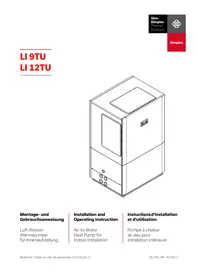
LI 12TU - Water pump DIMPLEX - Free user manual and instructions
Find the device manual for free LI 12TU DIMPLEX in PDF.



Frequently Asked Questions - LI 12TU DIMPLEX
User questions about LI 12TU DIMPLEX
0 question about this device. Answer the ones you know or ask your own.
Ask a new question about this device
Download the instructions for your Water pump in PDF format for free! Find your manual LI 12TU - DIMPLEX and take your electronic device back in hand. On this page are published all the documents necessary for the use of your device. LI 12TU by DIMPLEX.
USER MANUAL LI 12TU DIMPLEX
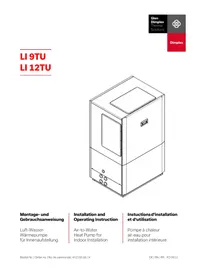
Installation and Operating Instruction
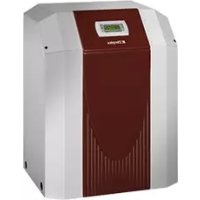
Air-to-Water Heat Pump for Indoor Installation
Glen Dimplex Thermal Solutions
Garantieurkunde GDTS
Glen Dimplex Thermal Solutions
1 Please Read Immediately. EN-2
1.1 Important Information: EN-2
1.2 Intended Use EN-2
1.3 Legal Regulations and Directives EN-2
1.4 Energy-Efficient Use of the Heat Pump.. EN-3
2 Purpose of the Heat Pump. EN-3
2.1 Application EN-3
2.2 Operating Principle.. EN-3
2.3 Functional description for integrated thermal energy metering .EN-3
3 Scope of Delivery EN-4
3.1 Basic Device.. EN-4
3.2 Switch Box.. EN-4
3.3 Accessories pack.. EN-4
4 Accessories. EN-5
4.1 Remote control EN-5
4.2 Building management technology.. EN-5
5 Transport EN-5
6 Set-UP. EN-6
6.1 General Information EN-6
6.2 Condensed Water Pipe EN-6
6.3Sound EN-6
7 Installation EN-6
7.1 General Information EN-6
7.2 Air Connection EN-7
7.3 Heating System Connection EN-8
7.4 Temperature sensor EN-8
7.5 Electrical connection EN-10
8 Start-UP EN-11
8.1 General Information EN-11
8.2 Preparation EN-11
8.3 Procedure EN-11
9 Maintenance / Cleaning EN-12
9.1 Maintenance EN-12
9.2 Cleaning the Heating System.. EN-12
9.3 Cleaning the Air System EN-12
10 Faults / Trouble-Shooting EN-12
11 Decommissioning/Disposal. EN-12
12 Device Information EN-13
13 Product information as per Regulation (EU) No 813/2013, Annex II, Table 2. EN-15
Anhang / Appendix / Annexes A-1
Maßbilder / Dimension Drawings / Schémas cotés A-II
Diagramme / Diagrams / Diagrammes.. A-IV
Stromlaufpläne / Circuit Diagrams / Schémas électriques. A-VII
Hydraulische Einbindungsschema / Hydraulic integration diagram / Schema d'intégration hydraulique. A-XIV
Konformitätserklarung / Declaration of Conformity / Déclaration de conformité ............ A-XVI
1 Please Read Immediately
1.1 Important Information:
ATTENTION!
When operating or maintaining a heat pump, the legal requirements of the country where the heat pump is operated apply. Depending on the refrigerant quantity, the heat pump must be inspected for leaks at regular intervals by a certified technician, and these inspections must be recorded.
ATTENTION!
When transporting the heat pump, ensure that it is not tilted more than 45^ (in any direction).
ATTENTION!
The transport securing device is to be removed prior to commissioning.
ATTENTION!
Do not restrict or block the area around the air intake or outlet.
ATTENTION!
Only operate the heat pump with the air ducts connected.
ATTENTION!
With fully demineralized water, it is important to ensure that the minimum permissible pH value of 7.5 (minimum permissible value for copper) is complied with. Failure to comply with this value can result in the heat pump being destroyed.
ATTENTION!
Ensure that there is a clockwise rotating field: With incorrect wiring the starting of the heat pump is prevented. A corresponding warning is indicated on the display of the heat pump manager (adjust wiring).
ATTENTION!
It is not permitted to connect more than one electronically regulated circulating pump via a relay output.
ATTENTION!
Operating the heat pump at low system temperatures may cause the heat pump to break down completely.
ATTENTION!
The integrated dirt trap must be cleaned at regular intervals.
ATTENTION!
Before opening the device, ensure that all circuits are isolated from the power supply.
ATTENTION!
Any work on the heat pump may only be performed by authorised and qualified after-sales service technicians.
1.2 Intended Use
This device is only intended for use as specified by the manufacturer. Any other use beyond that intended by the manufacturer is prohibited. This requires the user to abide by the relevant project planning documents. Please refrain from tampering with or altering the device.
1.3 Legal Regulations and Directives
This heat pump is designed for use in a domestic environment according to Article 1, Paragraph 2 k) of EU directive 2006/42/ EC (machinery directive) and is thus subjectments of EU directive 2014/35/EU (low-voltage directive). It is thus also intended for use by non-professionals for heating shops, offices and other similar working environments, in agricultural establishments and in hotels, guest houses and similar / other residential buildings.
The construction and design of the heat pump complies with all relevant EU directives, DIN/VDE regulations (see CE declaration of conformity).
When connecting the heat pump to the power supply, the relevant VDE, EN and IEC standards are to be fulfilled. Any further connection requirements stipulated by local utility companies must also be observed.
When connecting the heating system, all applicable regulations must also be adhered to.
This unit can be used by children aged 8 and over and by persons with limited physical, sensory or mental aptitude or lack of experience and/or knowledge, providing they are supervised or have been instructed in the safe use of the unit and understand the associated potential dangers.
Children must not play with the device. Cleaning and user maintenance must not be carried out by children without supervision.
ATTENTION!
When operating or maintaining a heat pump, the legal requirements of the country where the heat pump is operated apply. Depending on the refrigerant quantity, the heat pump must be inspected for leaks at regular intervals by a certified technician, and these inspections must be recorded.
More information can be found in the accompanying log book.
1.4 Energy-Efficient Use of the Heat Pump
With the purchase of this heat pump you are helping to protect the environment. A prerequisite for energy-efficient operation is the correct design of the heat source system and heating system (radiators and circulation pump).
It is particularly important for the efficiency of a heat pump to keep the temperature difference between heating water and heat source as small as possible. For this reason, it is advisable to design the heat source and heating system very carefully. A temperature difference of approx. one Kelvin increases the power consumption by around 2.5% . When designing the heating system, it should be borne in mind that special consumers such as e.g. hot water preparation should also be considered and dimensioned for low temperatures. Underfloor heating systems (panel heating) are optimally suited for heat pump use on account of the low flow temperatures (30^ to 40^)
It is important to ensure that the heat exchangers are not contaminated during operation because this increases the temperature difference, in turn reducing the COP.
Correct adjustment of the Heat pump manager is also important for energy-efficient use of the heat pump. Further information can be found in the Heat pump manager's operating instructions.
2 Purpose of the Heat Pump
2.1 Application
The air-to-water heat pump is to be used exclusively for the heating of heating water. It can be used in newly built or previously existing heating systems.
The heat pump is suitable for mono energy and bivalent operation down to an external temperature of -20^ .
Proper defrosting of the evaporator is guaranteed by maintaining a heating water return flow temperature of more than 18^ during continuous operation.
The heat pump is not designed for the increased heat consumption required when a building is being dried out. The additional heat consumption should be met using special devices provided by the customer. If a building is to be dried out in autumn or winter, we recommend installing an additional heating element (available as an accessory).
NOTE
The device is not suitable for operation with a frequency converter.
2.2 Operating Principle
Outside air is drawn in by the ventilator and fed via the evaporator (heat exchanger). The evaporator cools the air, i.e. it extracts heat from it. This extracted heat is then transferred to the working medium (refrigerant) in the evaporator.
The heat is "pumped" to a higher temperature level by increasing its pressure with the aid of an electrically driven compressor. It is then transferred to the heating water using the liquifier (heat exchanger).
Electrical energy is used to raise the temperature of the heat in the environment to a higher level. Because the energy extracted from the air is transferred to the heating water, this type of device is called an air-to-water heat pump.
The air-to-water heat pump consists of the main components evaporator, ventilator and expansion valve, as well as the compressor, the liquefier and the electrical control system.
At low ambient temperatures, humidity accumulates on the evaporator in the form of frost reducing the transfer of heat. Uneven accumulation during this process does not indicate a fault. The evaporator is defrosted automatically by the heat pump as required. Steam may be emitted from the air outlet depending on the atmospheric conditions.
2.3 Functional description for integrated thermal energy metering
The compressor manufacturer's performance specifications for different pressure levels are stored in the heat pump software. Two additional pressure sensors for determining the current pressure level are installed in the refrigerating circuit, one before and one after the compressor. The current heat output can be calculated from the compressor data stored in the software and the current pressure level. The integral for the heat output over the runtime gives the quantity of thermal energy supplied by the heat pump, which is displayed separately for heating, domestic hot water preparation and swimming pool water preparation on the heat pump manager's display.
3 Scope of Delivery
3.1 Basic Device
The heat pump contains the components listed below.
The refrigeration circuit is "hermetically sealed" and contains the fluorinated refrigerant R410A included in the Kyoto protocol. Information on the GWP value and CO_2 equivalent of the refrigerant can be found in the chapter Device information. The refrigerant is CFC-free, non-ozone depleting and non-combustible.
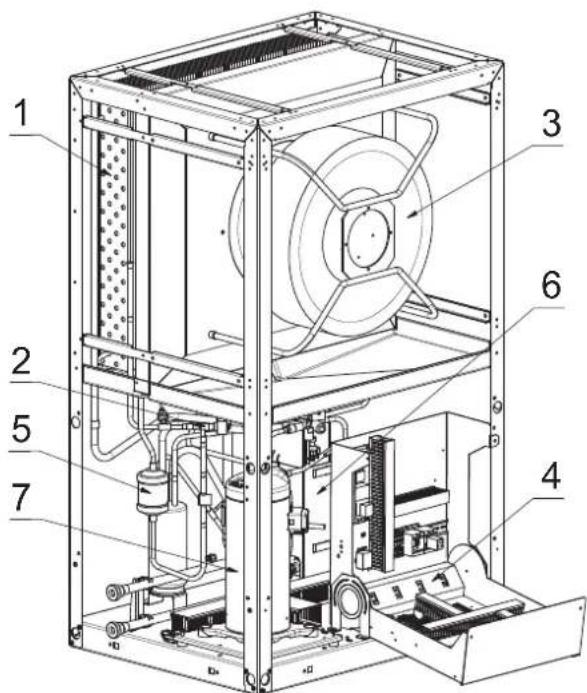
The switch box is located in the heat pump. It can be swung out after removing the lower front cover and loosening the fastening screw located in the upper right-hand corner.
The switch box contains the supply connection terminals, as well the power contactors, the soft starter unit and the heat pump manager.
The heat pump manager is a convenient electronic regulation and control device. It controls and monitors the entire heating system on the basis of the external temperature, including hot water preparation and safety systems.
The customer must install the external temperature sensor, which is included in the scope of supply of the heat pump manager together with the necessary fixing accessories.
The enclosed operating instructions describe the function and use of the heat pump manager.
3.3 Accessories pack
On top of the heat pump:
1 x insulating mat, duct connection
1 x small sealing ring, air intake
1 x large sealing ring, air outlet
In the switch box:
1 x external sensor with mounting material
Under fan:
8 x vent plugs 0 30 - black
Outside the packaging:
1 x installation and operating manual
4 Accessories
4.1 Remote control
A remote control adds convenience and is available as a special accessory. Operation and menu navigation are identical to those of the heat pump manager. Connection takes place via an interface (special accessories) with RJ 12 Western plug.
NOTE
In the case of heating controllers with a removable operating element, this can also be used directly as a remote control.
4.2 Building management technology
The heat pump manager can be connected to a building management system network via supplementation of the relevant interface plug-in card. The supplementary installation instructions of the interface card must be consulted regarding the exact connection and parameterisation of the interface.
The following network connections can be made on the heat pump manager:
Modbus
EIB, KNX
Ethernet
5 Transport
ATTENTION!
When transporting the heat pump, ensure that it is not tilted more than 45^ (in any direction).
Use a pallet for transporting the heat pump to the final installation location. The basic device can be transported with a lift truck, hand truck or by means of 3/4'' pipes fed through the holes in the base plate or frame.
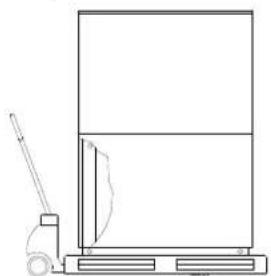
The heat pump and the transport pallet are joined by four transit bolts. These must be removed.
Before using the transport holes in the frame, it is necessary to remove the lower side panel assemblies. This is done by loosening each of the two screws at the base and then withdrawing the panels by unhooking them from above. Rehang the panels by gently pushing them in an upwards direction.
Be careful not to damage any components when inserting the pipes through the frame.
At the installation location, 8 black dust caps, which are included in the packaging of the device, must be snapped into the transport holes.
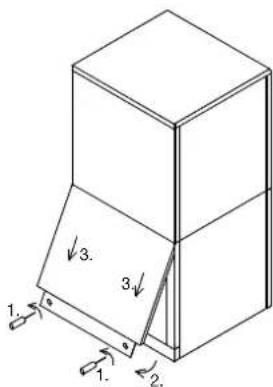
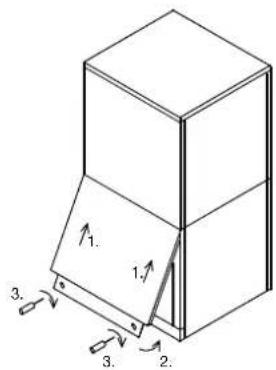
Opening the cover Closing the cover
After the transport, the transport securing device is to be removed on either side at the bottom of the unit.
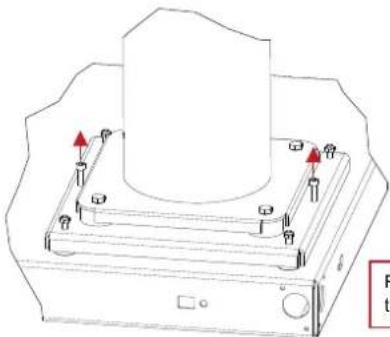
Remove/screw in transport lock
ATTENTION!
The transport securing device is to be removed prior to commissioning.
6 Set - U P
6.1 General Information
The device is designed to enable several connection options. The position of the air outlet opening can be moved from right (factory default) to left or top by turning over one of the two screwed on covers.
By replacing the bottom side cladding sections, it is also possible to move the hydraulic connection from left (factory default) to right. The different connection options (see cap. 1) are shown in the dimension drawing.
The air-to-water heat pump must be installed in a frost-free, dry room on an even, smooth and horizontal surface. The entire frame should lie directly on the floor to ensure an adequate soundproof seal. If supporting feet are used, the heat pump must be installed horizontally. In this case, the specified sound level can be up to 3 dB(A) higher, and additional sound insulation measures may be necessary.
The heat pump must be installed so that maintenance work can be carried out without being hindered. This can be ensured by maintaining a clearance of 1m in front of the heat pump and to the side on which the heating water connections are located.
The side panel assemblies must not be covered by connecting pipes.
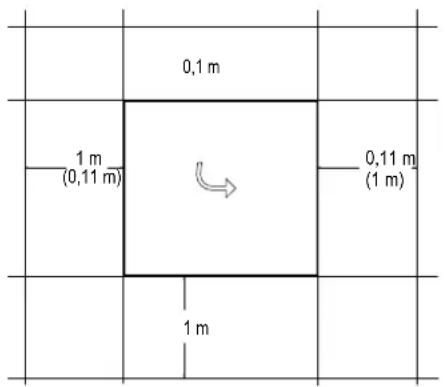
Neither frost nor temperatures higher than 35^ must occur in the installation location at any time of the year.
Never install the device in rooms subject to high humidity. Condensation can form on the heat pump and air circuit if the humidity exceeds 50% and the external temperature is below 0^ .
If the heat pump is installed on an upper storey, the load-bearing capacity of the ceiling should be checked. On account of the acoustics, measures for isolating possible vibrations should also be very carefully planned in advance as well. Installation on a wooden floor is not recommended.
6.2 Condensed Water Pipe
Condensed water that forms during operation must be drained off frost-free. To ensure proper drainage, the heat pump must be mounted horizontally. The condensate pipe must have a minimum diameter of 50~mm and must be fed into a sewer in such a way that it is safe from frost. Do not discharge the condensate directly into clearing tanks or cesspits, as aggressive vapours or a condensed water pipe which has not been laid in a frost-free manner could destroy the evaporator.
6.3 Sound
We recommend connecting the heat pump to the heating system using a flexible hose to prevent solid-borne noise transmission to the heating system if requirements regarding noise are high.
- Installed air ducts should be sound-isolated from the heat pump to prevent the transmission of solid-borne sound to the ducts.
If the transport restraint screws are not removed from the compressor, acoustic emissions from the device are significantly louder!
7 Installation
7.1 General Information
The following connections need to be established on the heat pump:
-Fresh and exhaust air
- Flow and return flow of the heating system
- Condensate outflow
- Voltage supply
- Temperature sensor
7.2 Air Connection
ATTENTION!
Do not restrict or block the area around the air intake or outlet.
ATTENTION!
Only operate the heat pump with the air ducts connected.
The glass fibre reinforced concrete air ducts offered as accessories are moisture-resistant and diffusion-free (exhaust air duct 600 × 600 and inlet duct 750 × 750 ). When using the air duct for the air outlet side ( 600 × 600 ), the "insulating mat duct connection" (in the accessory pack) is to be adhered to the air outlet on the desired connection side.
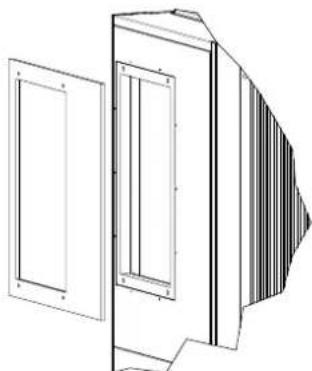
The sealing collar is used to seal the air ducts on the heat pump. The air ducts are not screwed directly onto the heat pump. Only the rubber seal comes into direct contact with the heat pump when the system is installed correctly. This guarantees easy assembly and disassembly of the heat pump and also ensures that solid-borne sound is well insulated.
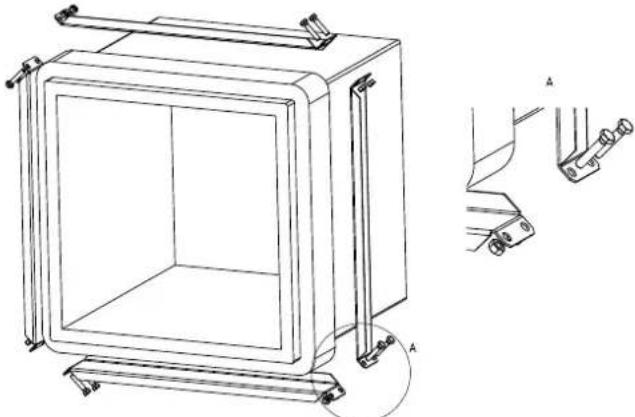
If an alternative air duct is being used to that which has been supplied as an accessory, care must be taken to ensure that it does not reduce the cross sectional area of the air intake and air outlet sides. The "small and large sealing rings" included in the scope of supply can be used for sealing the heat pump connection. They also function as vibration isolators.
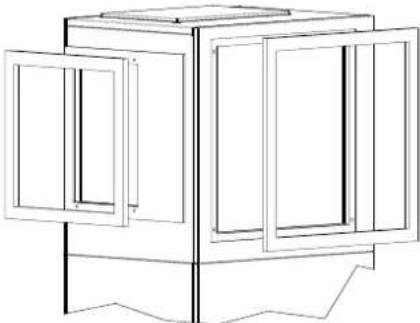
The large sealing ring can be used to position the air intake opening of the heat pump directly onto an appropriately constructed wall opening.
It must be ensured that the interior side of the wall opening is lined with thermal insulation to prevent the wall from becoming cold and to prevent moisture from penetrating the wall.
When very short air ducts are used on the air outlet, the exterior side of the wall opening must be fitted with a safety guard or an air deflector grille suitable for preventing body parts (fingers or arms, especially those of children) coming into contact with the ventilator in the heat pump.
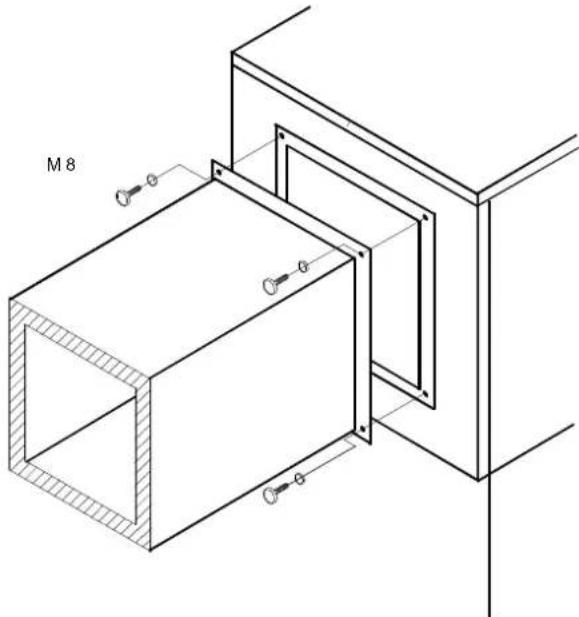
If flange-mounted air ducts are used, connecting stubs are secured on the air inlet and air outlet sides with 4 M8 hexagon bolts in the threaded holes provided (the hexagonal long nuts). When doing this, ensure that both air duct stubs only touch the insulation. There should be no contact with the external sheeting.
Care must also be taken to ensure that suitable vibration isolation and duct insulation are provided.
7.3 Heating System Connection
The heating system connections on the heat pump have a 114 external thread. Use a spanner to firmly grip the transitions when connecting the heat pump.
The connection on the heating side can also be made towards the right. To do this, the left and right bottom front panels must be removed. The two connecting pipes, including pipe supports, must be moved from the left to the right side of the device. The front panels must then be re-mounted the opposite way around.
Before connecting the heating water system to the heat pump, the heating system must be flushed to remove any impurities, residue from sealants, etc. Any accumulation of deposits in the liquifier could cause the heat pump to completely break down. For systems in which the heating water flow can be shut off via the radiator or thermostat valves, an overflow valve must be installed in a heating bypass behind the heat pump by the customer. This ensures a minimum heating water flow rate through the heat pump and helps to avoid faults.
Once the heating system has been installed, it must be filled, de-aerated and pressure-tested.
Consideration must be given to the following when filling the system:
Untreated filling water and make-up water must be of drinking water quality (colourless, clear, free from sediments)
Filling water and make-up water must be pre-filtered (pore size max. 5 m
Scale formation in domestic hot water heating systems cannot be avoided, but in systems with flow temperatures below 60^ , the problem can be disregarded. With high-temperature heat pumps and in particular with bivalent systems in the higher performance range (heat pump + boiler combination), flow temperatures of 60^ and more can be achieved. The following standard values should therefore be adhered to with regard to the filling and make-up water according to VDI 2035, sheet 1: The total hardness values can be found in the table.
Fig. 7.1:Guideline values for filling and make-up water in accordance with VDI 2035
| Total heat output in kW | Total alkaline earths in \( \mathrm{{mol}}/{\mathrm{m}}^{3} \) and/or mmol/l | Specific system volume (VDI 2035) in l/kW | ||
| < 20 | \( \geq {20} < {50} \) | ≥50 | ||
| Total hardness in \( {}^{ \circ }\mathrm{{dH}} \) | ||||
| < 50 | \( \leq {2.0} \) | ≤16.8 | \( \leq {11.2} \) | \( < {0.11}^{1} \) |
| \( {50} - {200} \leq {2.0} \) | \( \leq {11.2} \leq 8 \) | 4 | ||
| \( {200} - {600} \leq {1.5} \) | \( \leq {8.4} \) | \( < {0.11}^{1} \) | ||
| > 600 | < 0.02 | \( < {0.11}^{1} \) | ||
- This value lies outside the permissible value for heat exchangers in heat pumps.
For systems with an above-average specific system volume of 50 l/kW, VDI 2035 recommends using fully demineralized water and a pH stabiliser to minimize the risk of corrosion in the heat pump and the heating system.
ATTENTION!
With fully demineralized water, it is important to ensure that the minimum permissible pH value of 7.5 (minimum permissible value for copper) is complied with. Failure to comply with this value can result in the heat pump being destroyed.
Minimum heating water flow rate
The minimum heating water flow rate through the heat pump must be assured in all operating states of the heating system. This can be accomplished, for example, by installing either a dual differential pressureless manifold or an overflow valve. The procedure for setting an overflow valve is described in the chapter "Start-up". When the minimum heating water flow rate is undershot, the plate heat exchanger in the refrigeration circuit can freeze, which can lead to total loss of the heat pump.
The nominal flow rate is specified depending on the max. flow temperature in the device information and must be taken into account during planning. With design temperatures below 30^ in the flow, the design must be based on the max. volume flow with 5 K spread for A7/W35.
The specified nominal flow rate (See "Device Information" on page 13.) must be guaranteed in every operating status. An installed flow rate switch is used only for switching off the heat pump in the event of an unusual and abrupt drop in the heating water flow rate and not to monitor and safeguard the nominal flow rate.
NOTE
The use of an overflow valve is only recommended for panel heating and a max. heating water flow of 1.3m^3 /h System faults may result if this is not observed.
Antifreeze
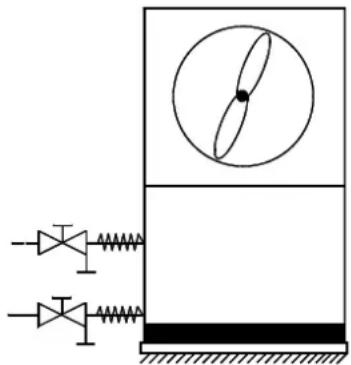
A method of manual drainage (see illustration) should be provided for heat pumps which are exposed to frost. The antifreeze function of the heat pump manager is active whenever the heat pump manager and the heat circulating pump are ready for operation. If the heat pump is taken out of service or in the event of a power failure, the system has to be drained. The heating circuit should be operated with a suitable antifreeze if heat pump systems are implemented in buildings where a power failure can not be detected (holiday home).
7.4 Temperature sensor
The following temperature sensors are already installed or must be installed additionally:
External temperature sensor (R1) supplied (NTC-2)
Return temperature sensor (R2) installed (NTC-10)
Flow temperature sensor (R9) installed (NTC-10)
7.4.1 Sensor characteristic curves
| Temperature in °C | -20 | -15 | -10 | -5 | 0 | 5 | 10 | ||
| NTC-2 in kΩ 14.6 11.4 | 8.9 7 | 1 5.6 | 4.5 3.7 | ||||||
| NTC-10 In kΩ | 67.7 | 53.4 | 42.3 | 33.9 | 27.3 | 22.1 | 18.0 | ||
| 15 | 20 | 25 | 30 | 35 | 40 | 45 | 50 | 55 | 60 |
| 2.9 | 2.4 | 2.0 | 1.7 | 1.4 | 1.1 | 1.0 | 0.8 | 0.7 | 0.6 |
| 14.9 | 12.1 | 10.0 | 8.4 | 7.0 | 5.9 | 5.0 | 4.2 | 3.6 | 3.1 |
The temperature sensors to be connected to the heat pump manager must correspond to the sensor characteristic curve illustrated in Fig.7.2 on pag. 9. The only exception is the external temperature sensor included in the scope of supply of the heat pump (see Fig.7.3 on pag. 9)
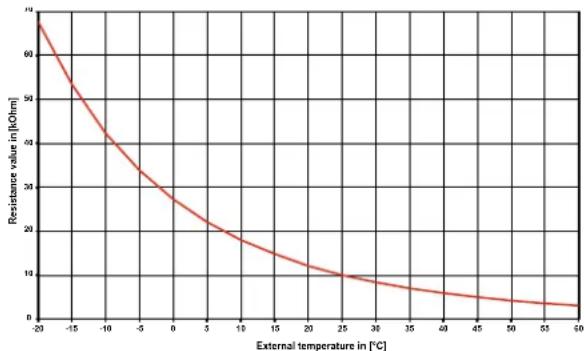
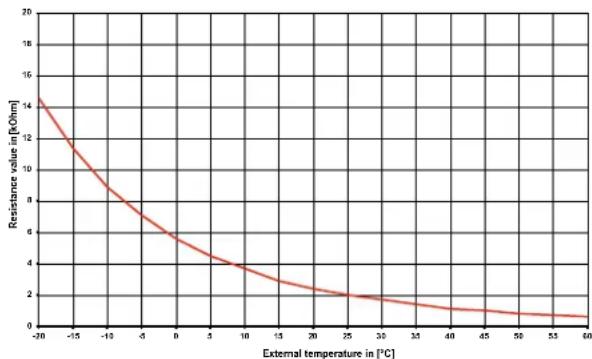
Fig. 7.2: Sensor characteristic curve NTC-10
Fig. 7.3: Sensor characteristic curve, NTC-2 according to DIN 44574 External temperature sensor
7.4.2 Mounting the external temperature sensor
The temperature sensor must be mounted in such a way that all weather conditions are taken into consideration and the measured value is not falsified.
mount on the external wall on the north or north-west side where possible
- Do not install in a "sheltered position" (e.g. in a wall niche or under a balcony)
Not in the vicinity of windows, doors, exhaust air vents, external lighting or heat pumps
Not to be exposed to direct sunlight at any time of year
| Dimensioning parameter sensor lead | |
| Conductor material | Cu |
| Cable-length | 50 m |
| Ambient temperature | 35 °C |
| Laying system | B2 (DIN VDE 0298-4 / IEC 60364-5-52) |
| External diameter | 4-8 mm |
7.4.3 Installing the strap-on sensor
It is only necessary to mount the strap-on sensors if they are included in the scope of supply of the heat pump but have not yet been installed.
The strap-on sensors can be fitted as pipe-mounted sensors or installed in the immersion sleeve of the compact manifold.
Mounting as a pipe-mounted sensor
Remove paint, rust and scale from heating pipe.
- Coat the cleaned surface with heat transfer compound (apply sparingly).
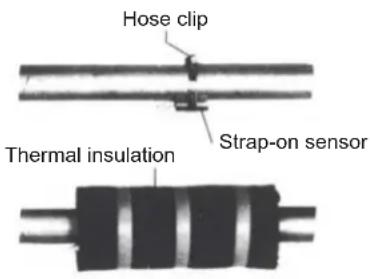
- Attach the sensor with a hose clip (tighten firmly, as loose sensors can cause malfunctions) and thermally insulate.
7.4.4 Hydraulic distribution system
The compact manifold and the dual differential pressureless manifold function as an interface between the heat pump, the heating distribution system, the buffer tank and, in some cases, even the hot water cylinder. A compact system is used to simplify the installation process, so that a lot of different components do not have to be installed individually. Further information can be found in the relevant installation instructions.
Compact manifold
The return sensor can remain in the heat pump, or should be installed in the immersion sleeve. The remaining empty space between the sensor and the immersion sleeve must be filled completely with heat transfer compound.
Dual differential pressureless manifold
In order for the heating circuit pumps of the generator and consumer circuits to supply the flow to the return sensor, this must be installed in the immersion sleeve of the dual differential pressureless manifold.
7.5 Electrical connection
7.5.1 General
All electrical connection work must be carried out by a trained electrician or a specialist for the specified tasks in accordance with the
installation and operating instructions,
country-specific installation regulations (e.g. VDE 0100),
- technical connection conditions of the energy suppliers and supply grid operators (e.g. TAB) and
local conditions.
To ensure that the frost protection function of the heat pump works properly, the heat pump manager must remain connected to the power supply and the flow must be maintained through the heat pump at all times.
The switching contacts of the output relay are interference-suppressed. Therefore, depending on the internal resistance of the measuring instrument, a voltage can also be measured when the contacts are open. However, this will be much lower than the line voltage.
Extra-low voltage is connected to controller terminals N1-J1 to N1-J11; N1-J19; N1-J20; N1-J23 to N1-J26 and terminal strip X3; X5.1. If, due to a wiring error, the line voltage is mistakenly connected to these terminals, the heat pump manager will be destroyed
7.5.2 Electrical installation
1) The electric supply cable for the output section of the heat pump (up to 5-core) is fed from the electricity meter of the heat pump via the utility blocking contactor (if required) into the heat pump Connection of the mains cable to the switch box of the heat pump via terminal X1: L1/L2/L3/N/ PE.
An all-pole disconnecting device with a contact gap of at least 3mm (e.g. utility blocking contactor or power contactor) and an all-pole circuit breaker with common tripping for all external conductors must be installed in the power supply for the heat pump (stripping current and characteristic in compliance with the device information).
ATTENTION!
Ensure that there is a clockwise rotating field: With incorrect wiring the starting of the heat pump is prevented. A corresponding warning is indicated on the display of the heat pump manager (adjust wiring).
2) The three-core electric supply cable for the heat pump manager (heating controller N1) is fed into the heat pump. Connection of the control line to the switch box of the heat pump via terminal X2: L/N/PE.
Details on the power consumption of the heat pump are listed on both the product information sheet and the type plate.
The (L / N / PE 230V,50Hz) supply cable for the heat pump manager must have a constant voltage. For this reason, it should be tapped upstream from the utility blocking contactor or be connected to the household current, as important protection functions could otherwise be lost during a utility block.
3) The utility blocking contactor(K22) with 3 main contacts (1 / 3 / 5 / / 2 / 4 / 6) and an auxiliary contact (NO contact 13/ 14) should be dimensioned according to the heat pump output and must be supplied by the customer.
The NO contact of the utility blocking contactor (13/14) is looped from terminal strip X3/G to connector terminal X3/A1. CAUTION! Extra-low voltage!
4) The contactor (K20) for the immersion heater (E10) of mono energy systems (HG2) should be dimensioned according to the radiator output and must be supplied by the customer. It is controlled (230 V AC) by the heat pump manager via terminals X2/N and X2/K20.
5) The contactor (K21) for the flange heater (E9) in the hot water cylinder should be dimensioned according to the radiator output and must be supplied by the customer. It is controlled (230 V AC) by the heat pump manager via terminals X2/N and X2/K21.
6) The contactors mentioned above in points 3, 4 and 5 are installed in the electrical distribution system. Mains cables for the installed heaters must be laid and secured in accordance with the valid standards and regulations.
7) All installed electric cables must have permanent wiring.
8) The heat circulating pump (M13) is activated via the contact N1-J13/NO5. The connection points for the pump are X2/M13 and X2/N. When using pumps where the switching capacity exceeds the output, a coupling relay must be interposed.
9) The auxiliary circulating pump (M16) is activated via the contact N1-J16/NO9. The connection points for the pump are X2/M16 and X2/N. When using pumps where the switching capacity exceeds the output, a coupling relay must be interposed.
10) The domestic hot water circulating pump (M18) is activated via the contact N1-J13/NO6. The connection points for the pump are X2/M18 and X2/N. When using pumps where the switching capacity exceeds the output, a coupling relay must be interposed.
11) The return flow sensor is integrated into the heat pumps and is connected to the heat pump manager via the control line. The return flow sensor must be installed in the immersion sleeve in the manifold only when a dual differential pressureless manifold is used. The single-core wires are then connected to terminals X3/GND and X3/ R2.1. Bridge A-R2 (situated between X3/B2 and X3/1 when delivered) must then be moved to terminals X3/1 and X3/2.
12) The external sensor (R1) is connected to terminals X3/GND and X3/R1.
13) The domestic hot water sensor (R3) is included with the domestic hot water cylinder and is connected to terminals X3/GND and X3/R3.
7.5.3 Connecting an electronically regulated circulating pump
Electronically regulated circulating pumps have high starting currents, which may shorten the service life of the heat pump manager. For this reason, a coupling relay is installed or must be installed between the output of the heat pump manager and the electronically regulated circulating pump. This is not necessary if the permissible operating current of 2 A and a maximum starting current of 12 A are not exceeded in the electronically regulated circulating pump or if express approval has been issued by the pump manufacturer.
ATTENTION!
It is not permitted to connect more than one electronically regulated circulating pump via a relay output.
8 Start - U P
8.1 General Information
To ensure that start-up is performed correctly, it should only be carried out by an after-sales service technician authorised by the manufacturer. These measures can also include an additional warranty under certain conditions (see Warranty).
8.2 Preparation
The following items need to be checked prior to start-up:
All of the heat pump connections must be established as described in Chapter 6.
All valves that could impair the proper flow of the heating water in the heating circuit must be open.
The air intake and air outlet paths must be clear.
The ventilator must turn in the direction indicated by the arrow.
The settings of the Heat pump manager must be adapted to the heating system in accordance with the controller's operating instructions.
Ensure the condensate outflow functions.
- Both the accessories pack in the switch box and that which is located under the ventilator must be removed.
8.3 Procedure
The heat pump is started up via the heat pump manager. Adjustments should be made in compliance with the instructions.
If an overflow valve is fitted to maintain the minimum heating water flow rate, the valve must be adapted to the requirements of the heating system. Incorrect adjustment can lead to faulty operation and increased energy consumption. We recommend carrying out the following procedure to correctly adjust the overflow valve:
Close all of the heating circuits that may also be closed during operation (depending on the type of heat pump usage) so that the most unfavorable operating state - with respect to the water flow rate - is achieved. This normally means the heating circuits of the rooms on the south and west sides of the building. At least one heating circuit must remain open (e.g. bathroom).
The overflow valve should be opened far enough to produce the maximum temperature spread between the heating flow and return flow listed in the following table for the current heat source temperature. The temperature spread should be measured as close as possible to the heat pump. The heating element of mono energy systems should be disconnected during start up.
| Heat source temperature From To | Max. temperature spread between heating flow and return flow | |
| -20 °C -15 °C 4 K | ||
| -14 °C -10 °C 5 K | ||
| -9 °C -5 °C | 6 K | |
| -4 °C | 0 °C | 7 K |
| 1 °C | 5 °C | 8 K |
| 6 °C | 10 °C | 9 K |
| 11 °C | 15 °C | 10 K |
| 16 °C | 20 °C | 11 K |
| 21 °C | 25 °C | 12 K |
| 26 °C | 30 °C | 13 K |
| 31 °C | 35 °C | 14 K |
At hot water temperatures under 7^ , start-up is not possible. The water in the buffer tank must be heated to a minimum of 18^ with the second heat generator.
To ensure a problem-free start-up, the following procedure is to be implemented:
1) Close all consumer circuits.
2) Ensure that the heat pump has the correct water flow.
3) Use the manager to select the automatic operating mode.
4) In the special functions menu, start the "Start-up" program.
5) Wait until a return temperature of at least 25^ has been reached.
6) Now slowly reopen the heating circuit valves in succession so that the heating water flow is constantly raised by slightly opening the respective heating circuit. The heating water temperature in the buffer tank must not be allowed to drop below 20^ during this process. This ensures that the heat pump can be defrosted at any time.
7) When all heat circuits are fully open and a return temperature of at least 18^ is maintained, the heat pump start-up is complete.
ATTENTION!
Operating the heat pump at low system temperatures may cause the heat pump to break down completely.
9 Maintenance / Cleaning
9.1 Maintenance
To protect the paintwork, avoid leaning or putting objects on the device. External heat pump parts can be wiped with a damp cloth and domestic cleaner.
NOTE
Never use cleaning agents containing sand, soda, acid or chloride as these can damage the surfaces.
To prevent faults due to sediment in the heat exchanger of the heat pump, ensure that the heat exchanger in the heating system can not be contaminated. We recommend protecting the evaporator by installing a bird guard in the inlet duct. At least 80% of the cross section of the grating should be open. In the event that operating malfunctions due to contamination still occur, the system should be cleaned as described below.
9.2 Cleaning the Heating System
ATTENTION!
The integrated dirt trap must be cleaned at regular intervals.
The maintenance intervals should be defined according to the degree of soiling in the system. The filter insert should also be cleaned.
For cleaning, the heating circuit must be made pressureless in the vicinity of the dirt trap, the filter compartment unscrewed, and the filter insert removed and cleaned. Assembly carried out in reverse order requires attention to correct assembly of the screen inserts and tightness of the screw joints.
The ingress of oxygen into the heating water circuit may result in the formation of oxidation products (rust), particularly if steel components are used. These products enter the heating system via the valves, the circulating pumps and/or plastic pipes. It is therefore essential - in particular with respect to the piping of underfloor heating systems - that only diffusion-proof materials are used.
NOTE
We recommend the installation of a suitable corrosion protection system to prevent the formation of deposits (e.g. rust) in the condenser of the heat pump.
Residue from lubricants and sealants may also contaminate the heating water.
In the case of severe contamination leading to a reduction in the performance of the liquifier in the heat pump, the system must be cleaned by a heating technician.
Based on current information, we recommend using a 5% phosphoric acid solution for cleaning purposes. However, if cleaning needs to be performed more frequently, a 5% formic acid solution should be used.
In either case, the cleaning fluid should be at room temperature. We recommend flushing the heat exchanger in the direction opposite to the normal flow direction.
To prevent acidic cleaning agents from entering the heating system circuit, we recommend connecting the flushing device directly to the flow and return flow of the liquifier of the heat pump.
It is important that the system be thoroughly flushed using appropriate neutralising agents to prevent any damage from being caused by cleaning agent residue remaining in the system.
Acids must be used with great care and all relevant regulations of the employers' liability insurance associations must be adhered to.
The manufacturer's instructions regarding cleaning agent must be complied with at all times.
9.3 Cleaning the Air System
Air ducts, evaporator, ventilator and condensate outflow should be cleaned of contamination (leaves, twigs, etc.) before the heating period. Do this by opening the front of the heat pump. To do this, the heat pump must be opened at the side. The bottom section should be opened first, followed by the top section.
ATTENTION!
Before opening the device, ensure that all circuits are isolated from the power supply.
Remove and rehang the side panel assemblies as described in Chapter 4.
To prevent the evaporator and the condensate tray from being damaged, do not use hard or sharp objects for cleaning.
10 Faults / Trouble-Shooting
This heat pump is a quality product and is designed for trouble-free operation. In the event that a fault should occur, it will be shown on the heat pump manager display. Simply consult the Faults and Trouble-shooting page in the operating instructions of the heat pump manager. If you cannot correct the fault yourself, please contact your after-sales service technician.
ATTENTION!
Any work on the heat pump may only be performed by authorised and qualified after-sales service technicians.
11 Decommissioning/Disposal
Before removing the heat pump, disconnect it from the power source and close all valves. The deinstallation of the heat pump must be performed by technical personnel. Observe all environmentally-relevant requirements regarding the recovery, recycling and disposal of materials and components in accordance with all applicable standards. Particular attention should be paid to the proper disposal of refrigerants and refrigeration oils.
12 Device Information
| 1 Type and order code | LI 9TU LI 12TU | |||
| 2 Design | ||||
| 2.1 Heat source Air Air | ||||
| 2.2 Model Universal Universal | ||||
| 2.3 Controller Integrated Integrated | ||||
| 2.4 Thermal energy metering Integrated Integrated | ||||
| 2.5 Installation location | Indoors | Indoors | ||
| 2.6 Performance levels | 1 | 1 | ||
| 3 Operating limits | ||||
| 3.1 Heating water flow / return | °C | up to 60 ± 2K / from 18 | up to 60 ± 2K / from 18 | |
| 3.2 Air | °C -20 to +35 | |||
| 4 Flow / sound | ||||
| 4.1 Heating water flow rate internal pressure differential according to 14511 | m³/h / Pa | 1.5 / 19300 | 2.0 / 27300 | |
| minimum heating water flow rate | m³/h / Pa | 0.7 / 5400 | 0.9 / 6100 | |
| 4.2 Sound power level according to EN 12102 device/external1 | dB(A) | 49 / 52 | 50 / 53 | |
| 4.3 Sound pressure level at a distance of 1 m indoors 12 | dB(A) | 42 | 43 | |
| 4.4 Air flow rate with an external static pressure differential | m³/h /Pa | 4000 / 0 | 4400 / 0 | |
| m³/h /Pa | 3700 / 25 | 4100 / 25 | ||
| 5 Dimensions, weight and filling quantities | ||||
| 5.1 Device dimensions 3 | H x W x L mm | 1560 x 960 x 750 | 1560 x 960 x 750 | |
| 5.2 Weight of the transportable unit(s) incl. packaging | kg | 256 | 270 | |
| 5.3 Device connections for heating system | Inches | G 1 1/4" | G 1 1/4" | |
| 5.4 Air duct connection (air intake side) | mm | 726 x 726 | 726 x 726 | |
| 5.5 Air duct connection (air outlet side) | mm | 552 x 355 | 552 x 355 | |
| 5.6 Refrigerant / total filling weight | type / kg | R410A / 3.7 | R410A / 4.6 | |
| 5.7 GWP value / CO 2 equivalent | --- / t | 2088 / 8 | 2088 / 9 | |
| 5.8 Refrigeration circuit hermetically sealed | yes | yes | ||
| 5.9 Lubricant / total filling quantity | type / litres | Polyolester (POE) / 1.2 | Polyolester (POE) / 1.2 | |
| 6 Electrical connection | ||||
| 6.1 Supply voltage / fuse protection | 3-/PE 400V (50Hz) / C10A | 3-/PE 400V (50Hz) / C13A | ||
| 6.2 Control voltage / fuse protection | 1-/N/PE 230V (50Hz) / C13A | 1-/N/PE 230V (50Hz) / C13A | ||
| 6.3 Degree of protection according to EN 60 529 | IP 21 | IP 21 | ||
| 6.4 Starting current limiter | Soft starter | Soft starter | ||
| 6.5 Rotary field monitoring | yes | yes | ||
| 6.6 Starting current | A | 16 | 19 | |
| 6.7 Nominal power consumption at A7/W35 / max. consumption 4 | kW | 1.8 / 3.3 | 2.4 / 4.4 | |
| 6.8 Nominal current at A7/W35 / cosφ | A / --- | 3.5 / 0.75 | 4.1 / 0.85 | |
| 6.9 Power consumption of compressor protection (per compressor) | W | -- | 70; thermostatically controlled | |
| 6.10 Power consumption of fan | W | 130 | 130 | |
| 7 Complies with the European safety regulations | ||||
| 8 Additional model features | 5 | 5 | ||
| 8.1 Type of defrosting | Reverse circulation | Reverse circulation | ||
| 8.2 Frost protection, condensate tray / water in device protected against freezing 6 | Yes Yes | |||
| 8.3 Max. operating overpressure (heat source/heat sink) bar | 3.0 | 3.0 | ||
| 9 Heat output / COP | ||||
| 9.1 Heat output / COP 4 | EN 14511 EN 14511 | |||
| at A-7 / W35 kW / --- 7 | ||||
| kW / ---8 | 5.4 / 3.0 7.1 / 3.1 | |||
| at A2 / W35 kW / --- 7 | ||||
| kW / ---8 | 6.8 / 3.9 9.4 / 4.0 | |||
| at A7 / W35 kW / --- 7 | ||||
| kW / ---8 | 8.5 / 4.7 | 11.5 / 4.8 | ||
| at A7 / W55 kW / --- 7 | ||||
| kW / ---8 | 7.5 / 2.9 | 10.3 / 3.0 | ||
| at A10 / W35 kW / ---7 | ||||
| kW / ---8 | 8.9 / 5.0 | 12.0 / 5.1 | ||
- The specified sound levels apply if the supporting feet (available as an option) are not used. If the supporting feet are used, the level can increase by up to 3db (A).
- The specified sound pressure level corresponds to the operating noise of the heat pump in heating operation with a flow temperature of 35^ . The specified sound pressure level represents the free sound area level. The measured value can deviate by up to 16 dB(A), depending on the installation location.
- Please note that additional space is required for pipe connections, operation and maintenance.
- These data indicate the size and capacity of the system according to EN 14511. For an analysis of the economic and energy efficiency of the system, the bivalence point and regulation should be taken into consideration. These specifications can only be achieved with clean heat exchangers. Information on maintenance, commissioning and operation can be found in the respective sections of the installation and operating instructions. The specified values have the following meaning, e.g. A7 / W35: Heat source temperature 7^ and heating water flow temperature 35^ .
- See CE declaration of conformity
- The heat circulating pump and the heat pump manager must always be ready for operation.
- 2-compressor operating mode
- 1-compressor operating mode
13 Product information as per
Regulation (EU) No 813/
2013, Annex II, Table 2
| Information requirements for heat pump space heaters and heat pump combination heaters | ||||||||
| Model | LI 9TU | |||||||
| Air-to-water heat pump | yes | |||||||
| Water-to-water heat pump | no | |||||||
| Brine-to-water heat pump | no | |||||||
| Low-temperature heat pump | no | |||||||
| Equipped with a supplementary heater | no | |||||||
| Heat pump combination heater | no | |||||||
| Parameters shall be declared for medium-temperature application, except for low-temperature heat pumps. For low-temperature heat pumps, parameters shall be declared for low-temperature application. | ||||||||
| Parameters shall be declared for average climate conditions: | ||||||||
| Item Symbol Value Unit Item Symbol Value | Unit | |||||||
| Rated heat output (*) | Prated | 4 | kW | Seasonal space heating energy efficiency | ηs | 118 | % | |
| Declarated capacity for heating foer part load at indoor temperature 20°C and outdoor temperature Tj | Declared coefficient of performance or primary energy ratio for part load at indoor temperature 20 °C and outdoor temperature Tj | |||||||
| Tj = -7°C | Pdh | 5,0 kW | j = -7°C | COPd | 2,02 - | |||
| Tj = +2°C | Pdh | 6,6 kW | j = +2°C | COPd | 3,02 - | |||
| Tj = +7°C | Pdh | 8,2 kW | j = +7°C | COPd | 4,07 - | |||
| Tj = +12°C | Pdh | 9,6 kW | j = +12°C | COPd | 5,26 - | |||
| Tj = bivalent temperature | Pdh | 4,5 kW | j = bivalent temperature | COPd | 1,75 - | |||
| Tj = operation limit temperature | Pdh | 4,5 kW | j = operation limit temperature | COPd | 1,75 - | |||
| For air-to-water heat pumps: | For air-to-water heat pumps: | |||||||
| Tj = -15°C (if TOL < -20°C) | Pdh | 3,5 kW | j = -15°C (if TOL < -20°C) | COPd | 1,31 - | |||
| Bivalent temperature | Tbiv | -10 °C | For air-to-water heat pumps: Operation limit temperature | TOL | -10 | °C | ||
| Cycling interval capacity for heating | Pcych | - | kW Cyc | Operating interval efficiency | COPcyc | - | - | |
| Degradation co-efficient (**) | Cdh | 0,90 | - | Heating water operating limit temperature | WTOL | 60 °C | ||
| Power consumption in modes other than active mode | Supplementary heater | |||||||
| Off mode | POFF | 0,015 | kW Rated | Type of energy input | Psup | 0 | kW | |
| Thermostat-off mode | PTO | 0,020 | kW | Type of energy input | electrical | |||
| Standby mode | PSB | 0,015 | kW | |||||
| Crankcase heater mode | PCK | 0,000 | kW | |||||
| Other items | For air-to-water heat pumps: Rated air flow rate, outdoors | |||||||
| Capacity control | fixed | For water-/brine-to-water heat pumps: Rated brine or water flow rate, outdoor heat exchanger | ||||||
| Sound power level, indoors/outsides | LWA | 49/52 | dB | -3700 | m³/h | |||
| Emissions of nitrogen oxides | NOx | - | mg/kWh | m³/h | ||||
| For heat pump combination heater: | ||||||||
| Declared load profile | - | Water heating energy efficiency | ηwh | - | %o | |||
| Daily electricity consumption | Qelec | - | kWh | Daily fuel consumption | Qfuel | - | kWh | |
| Contact details | Glen Dimplex Deutschland GmbH, Am Goldenen Feld 18, 95326 Kulmbach | |||||||
| (*) For heat pump space heaters and heat pump combination heaters, the rated output Prated is equal to the design load for heating Pdesignh , and the rated heat output of a supplementary capacity for heating sup(Tj). | ||||||||
| (**) If Cdh is not determined by measurement nthen the default degradation is Cdh = 0,9 | ||||||||
| (-) not applicable | ||||||||
| Model LI 12TU | ||||||
| Air-to-water heat pump yes | ||||||
| Water-to-water heat pump no | ||||||
| Brine-to-water heat pump no | ||||||
| Low-temperature heat pump no | ||||||
| Equipped with a supplementary heater no | ||||||
| Heat pump combination heater no | ||||||
| Parameters shall be declared for medium-temperature application, except for low-temperature heat pumps. For low-temperature heat pumps, parameters shall be declared for low-temperature application. | ||||||
| Parameters shall be declared for average climate conditions: | ||||||
| Item Symbol Value Unit Item Symbol Value | Unit | |||||
| Rated heat output (*) Prated 6 kW | Seasonal space heating energy efficiency ηs | 126 % | ||||
| Declared capacity for heating foer part load at indoor temperature 20°C and outdoor temperature Tj | Declared coefficient of performance or primary energy ratio for part load at indoor temperature 20 °C and outdoor temperature Tj | |||||
| Tj = -7°C Pdh 6,9 kW Tj = -7°C | COPd 2,22 - | |||||
| Tj = +2°C Pdh 8,9 kW Tj = +2°C | COPd 3,17 - | |||||
| Tj = +7°C Pdh 11,2 kW Tj = +7°C | COPd 4,18 - | |||||
| Tj = +12°C Pdh 13,0 kW Tj = +12°C | COPd 5,27 - | |||||
| Tj = bivalent temperature Pdh 6,4 kW Tj = bivalent temperature COPd 2,00 - | COPd 2,00 - | |||||
| Tj = operation limit temperature Pdh 6,4 kW Tj = operation limit temperature COPd 2,00 - | COPd 2,00 - | |||||
| For air-to-water heat pumps: | For air-to-water heat pumps: | |||||
| Tj = -15°C (if TOL < -20°C) Pdh 5,5 kW Tj = -15°C (if TOL < -20°C) | COPd 1,63 - | |||||
| Bivalent temperature Tblv -10 °C | For air-to-water heat pumps: Operation limit temperature TOL -10 C | |||||
| Cycling interval capacity for heating Psych -kW Cycing interval efficiency COPcyc - | - | - | ||||
| Degradation co-efficient (**) Cdh 0,90 -Heating water operating limit temperature WTOL 62 °C | ||||||
| Power consumption in modes other than active mode | Supplementary heater | |||||
| Off mode POFF 0,015 kW Rated heat output (*) Psup 0 kW | Type of energy input electrical | |||||
| Thermostat-off mode PTO 0,020 kW | ||||||
| Standby mode PSB 0,015 kW | ||||||
| Crankcase heater mode PCK 0,000 kW | ||||||
| Other items | For air-to-water heat pumps: Rated -4400 | |||||
| Capacity control fixed | air flow rate, outdoors | |||||
| Sound power level, indoors/ outdoors LWA 50/53 dB | For water-/brine-to-water heat pumps: Rated brine or water flow --- | |||||
| Emissions of nitrogen oxides NOx mg/kWh | rate, outdoor heat exchanger | |||||
| For heat pump combination heater: | ||||||
| Declared load profile - | Water heating energy efficiency ηwh | - | % | |||
| Daily electricity consumption Qelec - kWh Daily fuel consumption Qfuel | - | kWh | ||||
| Contact details Glen Dimplex Deutschland GmbH, Am Goldenen Feld 18, 95326 Kulmbach | ||||||
| (*) For heat pump space heaters and heat pump combination heaters, the rated output Prated is equal to the design load for heating Pdesignh , and the rated heat output of a supplementary capacity for heating sup(Tj). (**) If Cdh is not determined by measurement nthen the default degradation is Cdh = 0,9 (-) not applicable | ||||||
Table des matieres
1 A dire immediatement! FR-2
der Luftfuhrung/Bevel on all sides for sealing the edges and improving the air circuit./
3.3 Last / Load / Charge
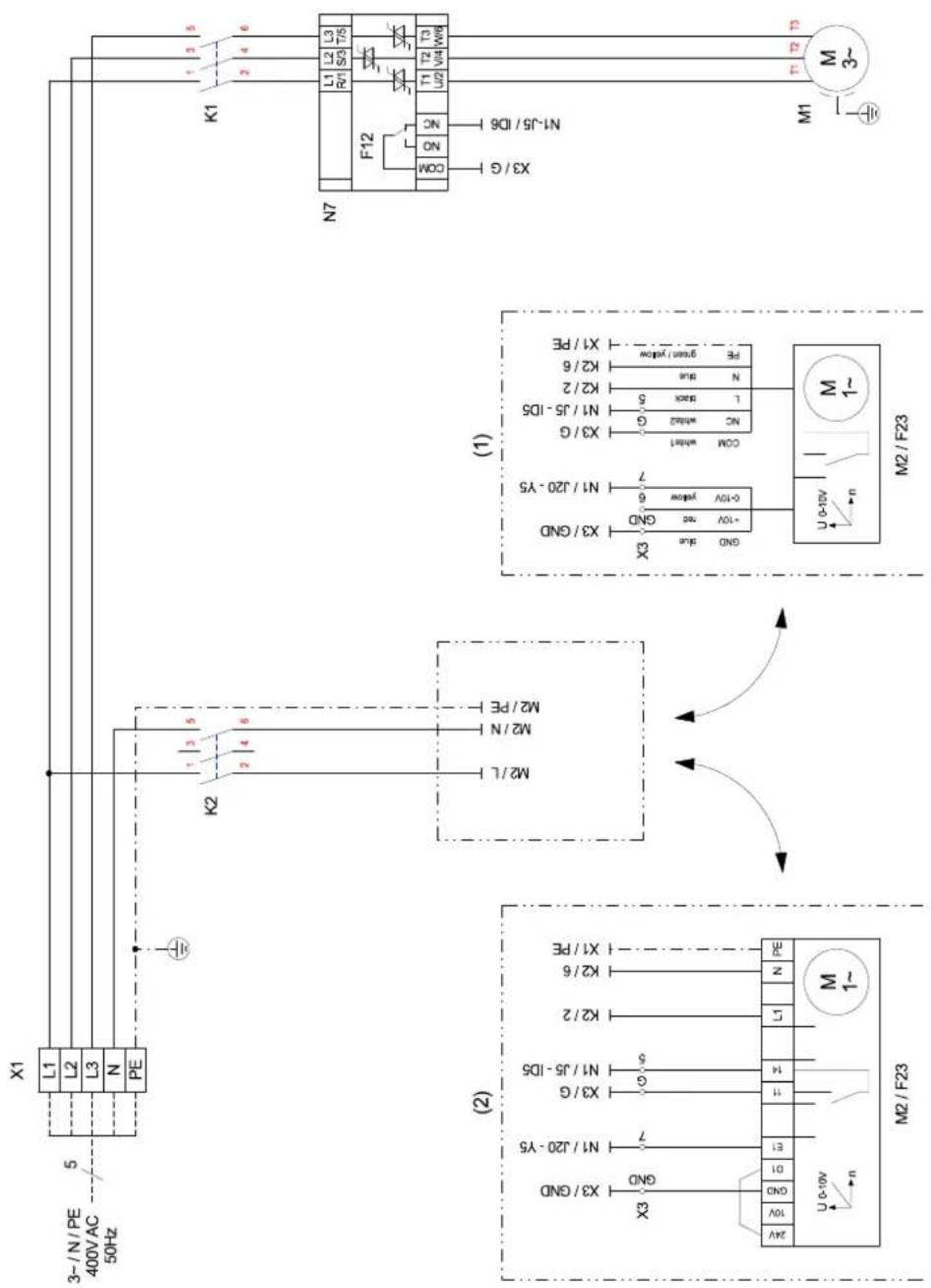
3.4 Anschlussplan / Circuit Diagram / Schémaelectrique
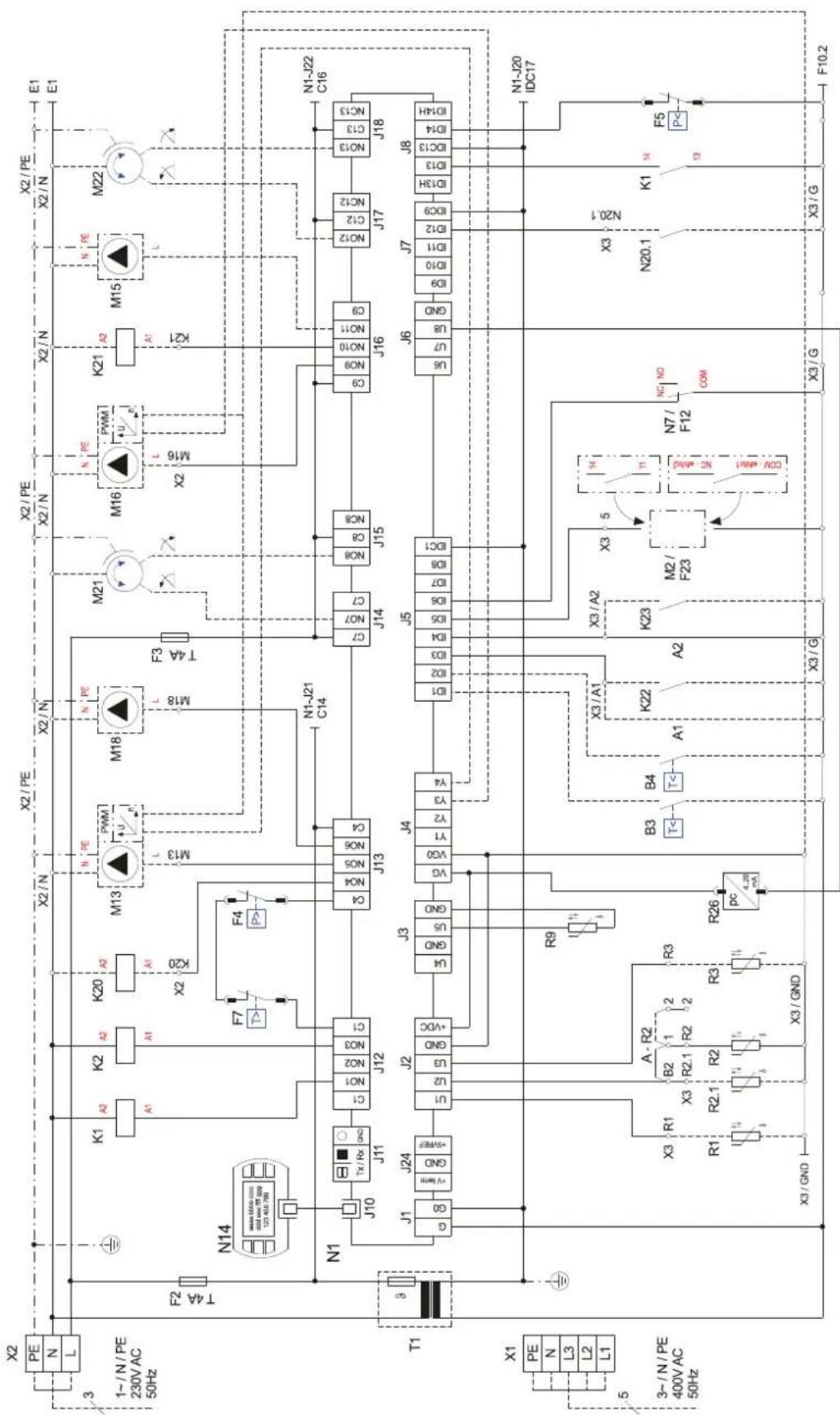
3.5 Anschlussplan / Circuit Diagram / Schémaelectrique
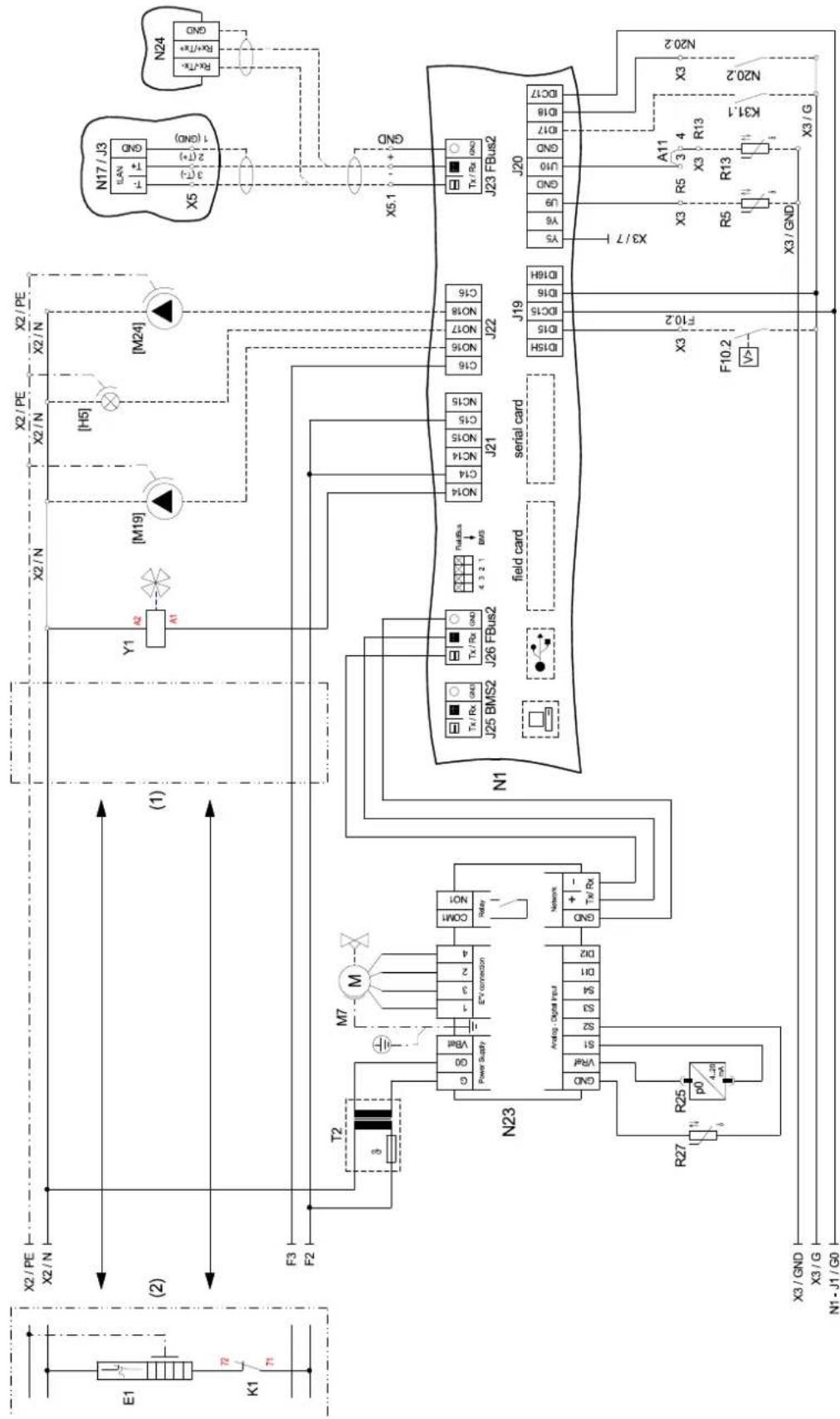
3.6 Legend / Legend / Légersd
| A1 Brücke EVU-Sperne, muss eingelegt werden, wenn kein EVU-Sperschütz vorhanden ist (Kontakt offen = EVU-Sperre | Utility block (EVU) bridge must be inserted if no utility blocking contactor is present (contact open = utility block). | Pont de blocage de la société d'électricité, à insérer en absence de contacteur de blocage de la société d'électricité(contact ouvert = blocage de la société d'électricité) | |
| A2 Brücke Sperne: muss entfern't werden, wenn der Eingang genutzt wird (Eingang offen = WP gespent) | Block bridge: Must be removed when the input is being used (input open = HP blocked). | Pont de blocage : à retirer si l'entree est utilisée (entree ouverte = pompe à chaleur bloquée) | |
| A11 Brücke Solar bei Verwendung eines Solamodus muss die Brücke entfern't werden und die Klemmstellen mit dem Solar-Modul verbunden werden. | Solar bridge: When a solar energy module is used, the bridge must be removed and the solar energy module connected to the terminal connections. | Pont solaire : en cas d'utilisation d'un module solaire, retirer le pont et connecter les bornes au module solaire. | |
| A - R2 Brücke Rücklauffühler: - muss versetzt werden, wenn doppelt differenzdruckloser Verteil und „Heizkresumkehventil" verwendet wird. Neue Klemmstellen: X3 / 1 und X3 / 2 | Return sensor bridge: - Must be moved when a dual differential pressureless manifold and a "heating circuit reversing valve" are used. New terminal connections: X3/1 and X3/2 | Pont sonde sur circuit de退还: - à déplacer si le distributeur double sans pression différentielle et la « vanne d'inversion du circuit de chauffage » sont utilisés. Nouveaux emplacements de borne: X3 / 1 et X3 / 2 | |
| B3* Thermostat Warmwasser Hot water thermostat Thermostat eau chaude | |||
| B4* Thermostat Schwimmbadwasser | Swimming pool water thermostat | Thermostat eau de piscine | |
| E1 Ölumpfleizung M1 Oil sump heater M1 Chauffage carter à hülle M1 | |||
| E9* Tauchelizkörper Warmwasser | Immersion heater for hot water | Résistance immershée éau chaude sanitaire | |
| E10* 2. Wärmerzeuger | 2ndheat generator | 2ème générateur de chaleur | |
| F2 Sicherung für Stecklammen J12; J13 und J21 | Fuse for plug-in terminals J12; J13 and J21 | Fuse pour bornes enchables J12; J13 et J21 | |
| 5x20 / 4,0AT | 5x20 / 4,0AT | 5x20 / 4,0AT | |
| F3 Sicherung für Stecklammen J15 bis J18 und J22 | Fuse for plug-in terminals J15 to J18 and J22 | Fuse pour bornes enchables J15 à J18 et J22 | |
| 5x20 / 4,0AT | 5x20 / 4,0AT | 5x20 / 4,0AT | |
| F4 Pressstat Hochdruck | High-pressure switch | Pressstat haute pression | |
| F5 Pressstat Niederdruck | Low-pressure switch | Pressstat basse pression | |
| F7 Heilgasthermostat | Hot gas thermostat | Thermostat gaz chaudi | |
| F10.2* Durchflusschalter Sekundärkreis | Flow rate switch for secondary circuit | Commutateur de début circuit secondaire | |
| F12 Stömeledekontakt N7 | Fault signaling contact N7 | Contact de signalisation de défauts N7 | |
| F23 Stömeledekontakt M2 | Fault signaling contact M2 | Contact de signalisation de défauts M2 | |
| [H5]* Bedienteil | Remote fault indicator lamp | Témoin de tédétection de pannes | |
| J1 Spannungsversorgung | Voltage supply | Alimentation en tension | |
| J2-3 Analogeingeange | Analogue inputs | Entres analogiques | |
| J4 Analogaingeange | Analogue outputs | Sorties analogiques | |
| J5 Digitaleingeange | Digital inputs | Entres numériques | |
| J6 Analogaingeange | Analogue outputs | Sorties analogiques | |
| J7-8 Digitalingeange | Digital inputs | Entres numériques | |
| J10 Bedienteil | Control panel | Unité de commande | |
| J11 frei free | free | ||
| J12-J18 230V AC - Ausgänge | 230V AC outputs 230V AC - outputs | Sorties 230 V AC | |
| J19 Digitalingeange | Digital inputs | Entres numériques | |
| J20 Analogaingeange; Analogeingeange, Digitaleingeange | Analogue outputs; Analogue inputs, Digital inputs | Sorties analogiques, entres analogiques, entres numériques | |
| J21-22 Digitalaingeange | Digital outputs | Sorties numériques | |
| J23 Bus-Verbindung zu Modulen | Bus connection to modules | Raccordement Bus aux modules | |
| J24 Spannungssversorgung für Komponenten | Power supply for components | Alimentation en tension des composants | |
| J25 Schnittstelle | Interface | Interface | |
| J26 Bus - Verbindung intern | Bus connection internal | Raccordement interne au bus | |
| K1 Schutz M1 | Contactor M1 | Contacteur M1 | |
| K2 Schutz M2 | Contactor M2 | Contacteur M2 | |
| K20* Schutz E10 | Contactor E10 | Contacteur E10 | |
| K21* Schutz E9 | Contactor E9 | Contacteur E9 | |
| K22* EVU-Sperschütz | Utility blocking contactor | Contacteur de coupure du fournisseur d'énergie | |
| K23* Hilfsrelais für Sperreingang | Auxiliary relay for disable contactor | Relais auxiliaire pour entrée du contacteur de blocage | |
| K31.1* Anforderung Zirkulation Warmwasser | Domestic hot water circulation request | Demande circulation ECS | |
| M1 Verdichter | Compressor | Compresseur | |
| M2 Ventilator | Ventilator | Ventilateur | |
| M7 Stellmotor für Expansionsventil | Actuator for expansion valve | Servomoteur pour détendeur | |
| M13* Heizungsumwätzpume | Heat circulating pump | Circulator de chauffage | |
| M15* Heizungsumwätzpume 2. Heizkreis | Heat circulating pump for heating circuit 2 | Circulator de chauffage pour le 2e circuit de chauffage | |
| M16* Zusatzumwätzpume | Auxiliary circulating pump | Circulator supplémentaire | |
| M18* Warmwasserladepume | Hot water loading pump | Pompe de charge eau chaude sanitaire | |
| [M19]* Schwimmbadwasserumwätzpume | Swimming pool circulating pump | Circulator de la piscine | |
| M21* Mischer Hauptkreis oder 3. Heizkreis | Mixer for main circuit or heating circuit 3 | Mélangeur circuit principal ou 3ème circuit de chauffage | |
| M22* Mischer 2. Heizkreis | Mixer for heating circuit 2 | Mélangeur 2e circuit de chauffage | |
| [M24]* Zirkulationspume Warmwasser | Domestic hot water circulating pump | Pompe de circulation eau chaude sanitaire | |
| N1 Regeleinheit | Control unit | Unité de régulation | |
| N7 Sanitanaufsteuerung M1 | Soft start control M1 | Commande de démarriage progressif M1 | |
| N14 Bedienteil | Control panel | Unité de commande | |
| N17* Erweiterungsmodul pCOe | Extension module pCOe | Module d'extension pCOe | |
| N20* Wärmedemengäähner | Thermal energy meter | Compteur de chaleur | |
| N23 Ansteuerung elektronisches Eypansionsventil E*V connection (1 = grün; 2 = gelb; 3 = braun; 4 = weiß) | Control for electronic expansion valve E*V connection (1=green; 2=yellow; 3=brown; 4=white) | Commande détendeur électronique connexion E*V(1=vert; 2=jaune; 3=marron; 4=blanc) | |
| N24* Smart RTC | Smart RTC | Smart RTC | |
| R1* Außenfuhler | External sensor | Sonde extérieure | |
| R2 Rücklaufhürher Heizkreis | Return sensor for heating circuit | Sonde de retour circuit de chauffage | |
| R2.1* Rücklaufhürher Heizkreis im doppeldetifferenzdrucklosen-Verteiler | Return sensor for heating circuit in dual differen-tial pressureless manifold | Sonde de retour circuit de chauffage dans le distri-buteur double sans pression différentielle | |
| R3* Fühler 2. Heizkreis Sensor heating circuit 2 Sonde 2e circuit de chauffage | |||
| R9 | Vorlaufhürfer Heizkreis | Flow sensor for heating circuit | Sonde aller circuit de chauffage |
| R13* Fühler regenerativ, Raumfühler, Fühler 3. Heizkreis | Renewable sensor, room sensor, sensor for heating circuit 3 | Renewable sensor, room sensor, sensor for heating circuit 3 | Sonde mode régératif, Sonde d'ambiance, Sonde 3ème circuit de chauffage |
| R25 | Drucksensor Kältekreis - Niederdruck pO | Pressure sensor for refrigerating circuit - low pressure pO | Capteur de pression circuit réfrigerant - basse pression pO |
| R26 | Drucksensor Kältekreis - Hochdruck pc | Pressure sensor for refrigerating circuit - high pressure pc | Capteur de pression circuit réfrigerant - haute pression pc |
| R27 | Sauggasfuhrer Regelung | Suction gas sensor Controller | Sonde de gaz d'aspiration Régulation |
| T1 | Sicherheitstransformator 230 / 24 VAC - | Safety transformer 230 / 24 V AC | Transformateur de sécurité 230 / 24 V AC |
| T2 | Sicherheitstransformator 230 / 24 VAC - N23 | Safety transformer 230 / 24 V AC - N23 | Transformateur de sécurité 230 / 24 V AC - N23 |
| X1 | Klemmleiste Einspeisung Last | Terminal strip, infeed | Alimentation bornier |
| X2 | Klemmleiste Spannung = 230V AC | Terminal strip voltage = 230 V AC | Tension bornier = 230 V AC |
| X3 | Klemmleiste Kleinspannung < 25V AC | Terminal strip, extra-low voltage < 25 V AC | Faible tension bornier < 25 V AC |
| X5.1 | Busverteilerklemme u. a. für N24 | Bus distribution terminal for N24 etc. | Réglettes bus pour N24 entre autres |
| Y1 | 4-Wege-Umschaltventil | Four-way valve | Vanne d'inversion 4 voies |
| * | Bauteile sind bauseits anzuschreiben / beizustellen | Components must be connected / supplied by the customer | Les pieces sont à raccorder / à fournir par le client |
| [ ] | Flexible Beschaltung - siehe Vorkconfiguration (Änderung nur durch Kundendienst!) | Flexible switching - see pre-configuration (changes by after-sales service only!) | Commande flexible - voir pré-configuration (modification uniquement par le SAV!) |
| -------- | wirkssleitung verdahrtet | Wired ready for use | câblé en usine |
| -------- | bauseits bei Bedarf anzuschreiben | To be connected by the customer as required | À raccorder par le client au besoin |
| (1) | nur bei LI 9TU | only in case of LI 9TU | uniquement pour LI 9TU |
| (2) | nur bei LI 12TU | only in case of LI 12TU | uniquement pour LI 12TU |
ACHTUNG!
Plug-in terminals N1-J1 to J11, J19, J20, J23 to J26 and terminal strip X3, X5.1 are connected to extra-low voltage. A higher voltage must on no account be connected.
ATTENTION!
Safety valve combination
Shutoff valve with check valve
Shutoff valve with drainage
Flexible connection hose
Tuyau de raccordement flexible

Rückschlagklappe
Check valve
Clapet anti-retour

Air-to-water heat pump
Buffer tank connected in series
Hot water flange heater
Contactor for flange heater
Heat circulating pump for main circuit
Auxiliary circulating pump
Hot water loading pump
External wall sensor
Additional return flow sensor
You can find and download the current CE conformity declaration at:
https://gdts.one/li12tu
- Installation and Operating Instruction
- Glen Dimplex Thermal Solutions
- Please Read Immediately. EN-2
- Purpose of the Heat Pump. EN-3
- Scope of Delivery EN-4
- Accessories. EN-5
- Transport EN-5
- Set-UP. EN-6
- Installation EN-6
- Start-UP EN-11
- Maintenance / Cleaning EN-12
- Faults / Trouble-Shooting EN-12
- Decommissioning/Disposal. EN-12
- Device Information EN-13
- Product information as per Regulation (EU) No 813/2013, Annex II, Table 2. EN-15
- Anhang / Appendix / Annexes A-1
- Please Read Immediately
- Important Information:
- ATTENTION!
- Intended Use
- Legal Regulations and Directives
- Energy-Efficient Use of the Heat Pump
- Purpose of the Heat Pump
- Application
- NOTE
- Operating Principle
- Functional description for integrated thermal energy metering
- Scope of Delivery
- Basic Device
- Accessories pack
- On top of the heat pump:
- In the switch box:
- Under fan:
- Outside the packaging:
- Accessories
- Remote control
- Building management technology
- Transport
- Set - U P
- General Information
- Condensed Water Pipe
- Sound
- Installation
- General Information
- Air Connection
- Heating System Connection
- Minimum heating water flow rate
- Antifreeze
- Temperature sensor
- Sensor characteristic curves
- Mounting the external temperature sensor
- Installing the strap-on sensor
- Mounting as a pipe-mounted sensor
- Hydraulic distribution system
- Compact manifold
- Dual differential pressureless manifold
- Electrical connection
- General
- Electrical installation
- Connecting an electronically regulated circulating pump
- Start - U P
- General Information
- Preparation
- Procedure
- Maintenance / Cleaning
- Maintenance
- Cleaning the Heating System
- Cleaning the Air System
- Faults / Trouble-Shooting
- Decommissioning/Disposal
- Device Information
- Product information as per
- Regulation (EU) No 813/
- 2013, Annex II, Table 2
- Table des matieres
- A dire immediatement! FR-2
- Last / Load / Charge
- Anschlussplan / Circuit Diagram / Schémaelectrique
- Anschlussplan / Circuit Diagram / Schémaelectrique
- Legend / Legend / Légersd
- ACHTUNG!
Brand : DIMPLEX
Model : LI 12TU
Category : Water pump