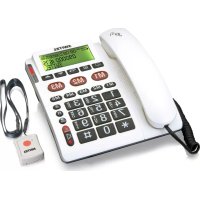
TF520 - Phone SWITEL - Free user manual and instructions
Find the device manual for free TF520 SWITEL in PDF.



| Product type | Landline phone with automatic emergency call function |
| Power supply | Power adapter 230 V AC / 9 V DC, 300 mA (max. consumption 3.91 W); or 4 AA batteries 6 V (base) and 1 A23 battery 12 V (emergency transmitter) |
| Main functions | Automatic emergency call, +40 dB amplifier, hands-free mode, 99-contact directory, call lists (last 15), 5 direct selection keys, 3 emergency call keys, waterproof emergency transmitter with wrist strap/neck cord |
| Hearing aid compatibility | Yes, Premium handset compatible with most hearing aids |
| Display | Screen with icons (battery, ringer, hands-free, emergency call, etc.); adjustable contrast to 4 levels |
| Directory | 99 contacts with name (max. 10 characters) and number (max. 22 digits); alphabetical sorting; voice answer possible |
| Call memory | Last 15 dialed numbers and last 15 incoming calls (CLIP); combined list |
| Direct selection keys | 5 keys (M1 to M5) for frequent numbers |
| Emergency call keys | 3 large red programmable keys for automatic emergency call |
| Emergency transmitter | Splash-proof, with wrist strap and neck cord, limited range near base, A23 12V battery |
| Amplifier | +40 dB activated by key, with sound adjustment (treble/bass); permanent mode possible via menu |
| Hands-free mode | Integrated speaker, adjustable volume to 8 levels |
| Settings | Ringer (5 levels, 3 melodies), key tones, contrast, voice guide, languages (FR, DE, EN, IT, NL, SV), flash timing (100/300/600 ms), dialing system (tone/pulse) |
| Ringer | Volume adjustable from 0 (silent) to 4; 3 different ringtones |
| Care and cleaning | Clean with a soft, lint-free cloth; do not use solvents or cleaning products |
| Safety | Use according to instructions; do not open the device; use only the supplied power adapter; separate disposal of electronic waste and batteries |
| Warranty | 24 months from purchase date, excluding batteries and damage due to misuse |
| Package contents | Base unit, handset, coiled cord, emergency transmitter with wrist strap/neck cord, telephone cable, power adapter, batteries (4x AA + 1x A23), wall mount, user guide |
Frequently Asked Questions - TF520 SWITEL
User questions about TF520 SWITEL
0 question about this device. Answer the ones you know or ask your own.
Ask a new question about this device
Download the instructions for your Phone in PDF format for free! Find your manual TF520 - SWITEL and take your electronic device back in hand. On this page are published all the documents necessary for the use of your device. TF520 by SWITEL.
USER MANUAL TF520 SWITEL
natural_image
White Siemens 80000 serial communication phone with keypad and attached cable (no visible text or symbols on main body)Bedienungsanleitung
Mode d'emploi
Operating Instructions
SWITEL
POWERTEL TF 520
Operating Instructions 69
Declaration of Conformity 92
Inhaltsverzeichnis
text_image
+ AA - - AA + + AA - - AA +^1 CLIP: Calling Line Identification Presentation
Menüstruktur
8 Menüstruktur
Hauptmenü
text_image
+ AA - - AA + + AA - - AA +flowchart
graph TD
    A["Block 1"] --> B["Block 2"]
    B --> C["Block 3"]
    C --> D["Block 4"]
    D --> E["Block 5"]
    E --> F["Downward Arrow"]
    F --> G["Downward Arrow"]
    G --> H["Downward Arrow"]
    H --> I["Downward Arrow"]
    I --> J["Downward Arrow"]
    J --> K["Downward Arrow"]
    K --> L["Downward Arrow"]
    L --> M["Downward Arrow"]
    M --> N["Downward Arrow"]
    N --> O["Downward Arrow"]
    O --> P["Downward Arrow"]
    P --> Q["Downward Arrow"]
    Q --> R["Downward Arrow"]
    R --> S["Downward Arrow"]
    S --> T["Downward Arrow"]
    T --> U["Downward Arrow"]
    U --> V["Downward Arrow"]
6 Touche communication/OK
7 Touche «vers le bas» / Diminuer le volume en mains libres ▼
8 Touche «vers le haut» / Augmenter le volume en mode mains-libres ▲
9 Écran
7 Installations PABX / Services confort
Touche R et services confort
^1 CLIP: Calling Line Identification Presentation
Structure du menu
8 Structure du menu
Menu principal
The image is too blurry to recognize any text content.
Services confort, 37
Touche communication/OK, 29
Touche R et services confort, 37
text_image
+ AA - - AA + + AA - - AA +^1 CLIP: Calling Line Identification Presentation
Struttura di menu
8 Struttura di menu
Menu principale
7 PBX / Supplementary Services 81. . . . . .
. . . . 8 Menu.Structure 82
9 Phone Book 83.
10 Calls Missed and Redialling List ..... 85
11 In Case of Problems 87
12 Maintenance / Guarantee 88
13 Index 89
Safety Information
1 Safety Information
Please read this operating instruction manual thoroughly.
Intended use
The telephone is suitable for telephoning within a public telephone network system. Any other use is considered unintended use. Unauthorised modification or reconstruction is not permitted. Under no circumstances open the equipment or complete any repair work yourself.
Installation location
Prevent excessive exposure to smoke, dust, vibration, chemicals, moisture, heat and direct sunlight.
Power adapter plug

on: Only use the power adapter plug supplied because other power supplies could damage the telephone. Ensure access to the power adapter plug is not obstructed by furniture or such.
Hearing aid compatibility
Using the premium receiver, the telephone is perfectly adapted for hearing aids and is compatible with most commercially available hearing aids. However, due to the wide range of hearing aids available, there is no guarantee that the telephone will function problem-free with every model.

on: This phone is capable of providing extremely loud volumes when the amplification is activated and the volume control is set to maximum. The utmost caution is necessary when the phone is used jointly by people with normal hearing and others with impaired hearing.
Disposal
In order to dispose of your device, take it to a collection point provided by your local public waste authorities (e.g. recycling centre). According to laws on the disposal of electronic and electrical devices, owners are obliged to dispose of old electronic and electrical devices in a separate waste container. The symbol indicates that the device must not be disposed of in normal domestic waste!
Risks to health and the environment from batteries!

Never open, damage or swallow batteries or allow them to pollute the environment. They could contain toxic and ecologically harmful heavy metals. You are legally obliged to dispose of power packs and batteries at the point of sale or in the corresponding containers provided at collection points by local public waste authorities. Disposal is free of charge. The above symbols indicate that the batteries must not be disposed of in domestic waste and that they must be disposed of at an authorised collection point.
Packaging materials must be disposed of according to local regulations.
2 Preparing the Telephone
Safety information

tion: It is essential to read the Safety Information in Chapter 1 before starting up.
Checking the package contents
The package contains:
| Content | TF 520 |
| Base unit 1 | |
| Power adapter plug 1 | |
| Receiver 1 | |
| Helix cable for receiver 1 | |
| Emergency call unit with wrist strap and neckband (splashproof) | 1 |
| Telephone connection cable 1 | |
| Batteries, type AA 6 V 4 | |
| Battery, type A23 12 V (installed in emergency call unit) | 1 |
| Wall installation bracket 1 | |
| Operating manual 1 |
Important note
Your device is supplied with an energy-efficient switching power supply (Input 230 V AC , Output 9 V DC , 300 mA). The adaptor input power without load is approx. 0.1 W. The average efficiency is >68.46 %. The electrical consumption is max. 3.91 W.
Preparing the Telephone
Connecting the base unit
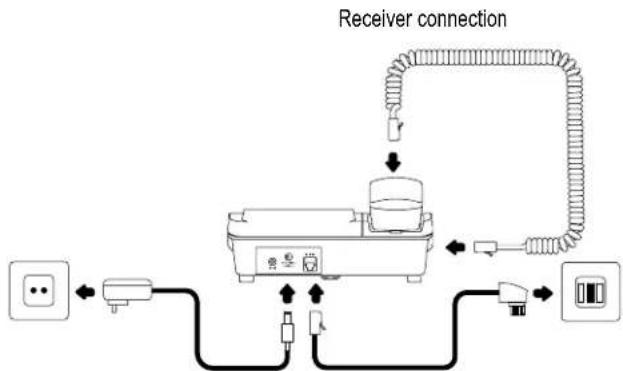
Connect the telephone as illustrated in the diagram. For reasons of safety, only use the power adapter plug and telephone connection cable supplied.
flowchart
graph TD
    A["Power Supply"] --> B["Switch"]
    B --> C["Coiled Pipe"]
    C --> D["Receiver Connection"]
    D --> E["Device with Press"]
    E --> F["Output Outlet"]
Mains power outlet Telephone line socket

The telephone can be operated with or without the power adapter plug. If you want to operate the telephone without the power adapter plug, ensure that sufficiently charged batteries of the correct type are properly installed.
Preparing the Telephone
Inserting the batteries
Pay attention that the telephone is not connected to the telephone line socket and/or mains power socket when the batteries are being inserted or replaced.
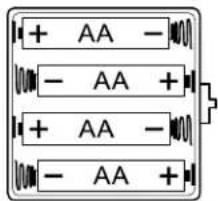
Insert the batteries in the open battery compartment. Only use batteries of the type AA 6 V. Pay attention to the correct polarity. Close the battery compartment cover.
text_image
+ AA - - AA + + AA - - AA +Insertion of batteries is not absolutely essential. The telephone can be operated with or without batteries. If you want to operate the telephone without batteries, the power adapter plug must be connected.
Attention: If you operate the telephone without batteries, it is not possible to make a call or an emergency call in the event of a power failure!
If the batteries are no longer fully charged or are empty, the battery icon ☐ appears in the display. Replace the batteries.
Setting the time and date
Menu Structure, Page 82
Diverse settings
Various settings for the telephone can be defined using the menu, e.g. dialling mode (TONE/PULSE), ringing tone (RING MEL), key tone (KEY-TONE), display contrast (CONTRAST), announcement of key pressed (VOICE), illumination of LEDs and much more; ☐Menu Structure, Page 82.
Private branch exchanges
The information on Page 81 explains how to install your telephone in a private branch exchange.
Wall installation
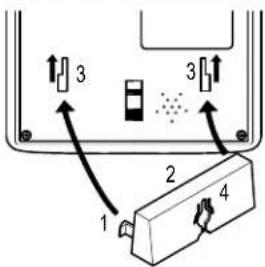
Feed the guide tabs (1) on the wall-mounting bracket (2) in the slots (3) on the rear side of the telephone. Slide the wall bracket (2) 10 mm upwards until it audibly snaps into place. Drill a hole in the wall and insert a screw leaving about 5 mm of the screw projecting from the wall. Guide the mounting hole (4) in the wall mounting bracket (2) over the screw and slide the telephone downwards.
Attention: Ensure there are no cables in the wall at the point where the hole is drilled.
text_image
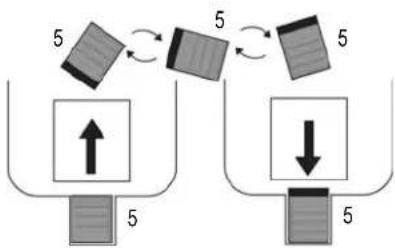
1 2 3 4Turn the hook (5) in the receiver cradle so that the receiver can be placed on-hook.
flowchart
graph TD
    A["Block 1"] --> B["Block 2"]
    B --> C["Block 3"]
    C --> D["Block 4"]
    D --> E["Block 5"]
    E --> F["Downward Arrow"]
    F --> G["Downward Arrow"]
    G --> H["Downward Arrow"]
    H --> I["Downward Arrow"]
    I --> J["Downward Arrow"]
    J --> K["Downward Arrow"]
    K --> L["Downward Arrow"]
    L --> M["Downward Arrow"]
    M --> N["Downward Arrow"]
    N --> O["Downward Arrow"]
    O --> P["Downward Arrow"]
    P --> Q["Downward Arrow"]
    Q --> R["Downward Arrow"]
    R --> S["Downward Arrow"]
    S --> T["Downward Arrow"]
    T --> U["Downward Arrow"]
    U --> V["Downward Arrow"]
3 Operating Elements
Telephone
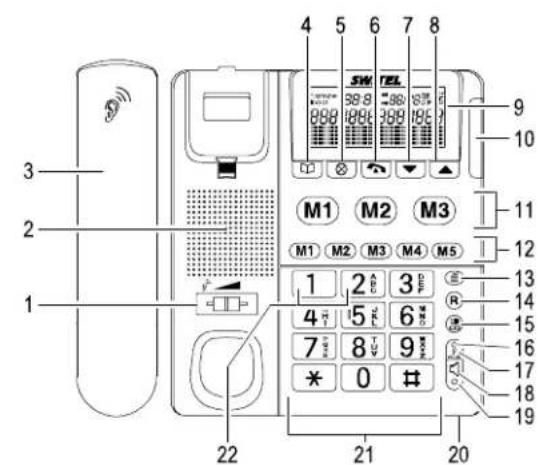
1 Receiver volume slide control
2 Loudspeaker (for handsfree function)
3 Receiver
4 Phone book button
5 Delete/Back button ☒
6 Call/OK button
7 Scroll down button / Lower handsfree volume ▼
8 Scroll up button / Raise handsfree volume ▲
9 Display
10 Call/SOS LED
11 Large red SOS call buttons (3 pieces) M1 M2 M3
12 One-touch dialling buttons (5 pieces) M1 M2 M3 M4 M5
Emergency call unit
24 SOS call button ○
25 Battery charge capacity LED
13 Menu button ≡
14 R-button R
15 Missed calls and redialling button
16 Amplifier LED
17 Amplifier button (+40 dB)
18 Handsfree button
19 Handsfree LED
20 Microphone
21 Digit keys (including Star
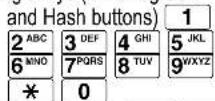

23 Tone slide control
The buttons in this operating manual are depicted with a uniform contour. Variations in the symbols on the telephone buttons compared to those depicted here are possible.
Operating Elements
text_image
3 2 1 4 5 6 7 8 SW TEL 38 8 38 8 888 1888 1888 M1 M2 M3 M1 M2 M3 M4 M5 1 2 3 4 5 6 7 8 9 * 0 #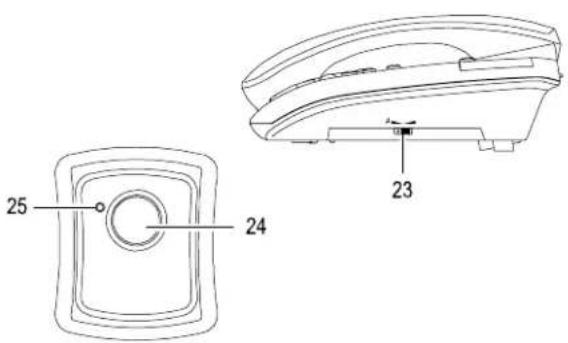
text_image
25 24 23Operating the Telephone
4 Operating the Telephone
Display and explanation of operation sequences
| Enter the digits or letters | |
| * | Press the button depicted briefly |
| 2 x * | Press the button depicted twice, briefly |
| 2 sec. * | Press the button depicted for 2 sec. |
| Hold * | Press and hold the button depicted |
| Release * | Release the button depicted |
| ( ) Phone rings | |
| ▲ | Pick up the receiver |
| - | Replace the receiver on-hook |
| » | Speak your text |
| >Text | |
LANGUAGE or 🔒 Text or icons in the display
Icons in the display
The display lights up when a button is pressed and for a short time after.
Icon Description
| The battery icon appears in the display if there are no batteries in the base unit and when the batteries installed are no longer full or are empty. Insert fully charged batteries; Page 72. | |
| The icon with the crossed-out bell appears in the display when the ringing volume has been switched off (level 0, muted); Page 75. | |
| The handsfree icon appears in the display when the handsfree function has been activated; Page 77 | |
| The telephone icon appears in the display when new entries have been recorded in the missed calls and redial-ling list; Page 85 |
Icon Description
| (•) | The SOS icon appears in the display as soon as an automatic emergency call (SOS) has been initiated and has not yet ended; Page 78. |
| CID | The CID icon appears in the display when phone numbers in the missed calls and redialling list are viewed which were previously called; Page 85 |
| ● | The redialling icon appears in the display when phone numbers in the missed calls and redialling list are viewed which were previously dialled; Page 85 |
| ▲ | The amplifier icon appears in the display when the amplifier for the receiver volume has been permanently set to +40 dB via the menu; Page 75 |
Navigating in the menu
| All the functions can be accessed via the various menus. Refer to the Menu Structure Page 82 for information on how to access each respective function. | |
| Open the main menu | |
| Select the submenu required | |
| Open the submenu | |
| Select the setting required | |
| Use the digit keys to enter numbers or letters | |
| Confirm the entries | |
| Cancel the programming and saving processes and return to Standby mode | |
| Every process is automatically cancelled if there is no input within 15 seconds. | |
Telephoning
5 Telephoning
Taking a call
If a call is received, the Call/SOS LED flashes.


Take the call
or
| ○ Take the call (handsfree function) |
| If the caller number display (CLIP) is available on your telephone line (1-3* Page 81) and you have selected VOICE:ON via the menu, the phone number of the caller is announced prior to the ringing tone. |
| If the phone number of a caller has been stored in the phone book (1-3* Page 83) and a name vocally recorded for it, the name recorded is announced between the first two rings. |
Displaying the duration of a call
The duration of a call is displayed in minutes and seconds during the call.
Ending a call

or (if the handsfree function is active)

Making a call
Enter the phone number
(max. 22 digits)


or

Dial the phone number
(handsfree function)

text_image
It is also possible to pick up the receiver first to obtain the dialling tone. The digits then entered are dialled immediately. It is not possible to correct wrong digits individually using this dialling procedure.Setting the ringing volume
The ringing volume can be altered to one of 5 different volume levels using the menu; ☐ Page 82:
•Level 0: Ringing volume off (mute)
•Level 1: Ringing volume quiet
•Level 4: Ringing volume loud
Setting the receiver volume
Adjust the receiver volume using the slide control which is located underneath the receiver when on the base unit:
- Slide control to the left: Receiver volume becomes quieter.
- Slide control to the right: Receiver volume becomes louder.
Amplifying the receiver volume to +40 dB
The receiver volume can be increased to +40 dB by pressing the Amplification button.


You can use the menu to set-up the telephone so that the amplification is set to +40 dB directly without the need to press the Amplification button. Open the menu and select BOOST LOCK:ON; ☐Menu Structure, Page 82.
Receiver tone control
The tone control only works when the receiver volume amplification to +40 dB has been activated (amplification LED lights up).
You can adjust the tone produced in the receiver using a slide control on the right-hand side of the housing.
Telephoning
Redialling and calling back missed calls
The telephone stores the last 15 phone numbers in a calls missed and redialling list; Page 85.
Open the list
▼ or ▲ Select the required phone number
Dial the phone number
- In the case of numbers dialled, the redialling icon ⬆ appears in the display.
- In the case of missed calls, the CID icon CID appears in the display (Caller Identification).
Dialling phone numbers from the phone book
Phone numbers must have been stored in the phone book for this function; Page 83.
Open the phone book
▼ or ▲ Select the entry required
Dial the number
One-touch dialling buttons
The telephone is provided with 5 one-touch dialling buttons (M1 to M5) (M = Memory) which you can use to dial frequently required numbers.
Programming one-touch dialling buttons
Enter the phone number
(max. 22 digits)
Press and hold M1, M2, M3,
M4 or M5 SAVED
Assign the phone number to a one-touch dialling button
Phone numbers assigned cannot be deleted, they can only be overwritten by new phone numbers.
Dialling using one-touch dialling buttons
M1, M2, M3
M4 or M5 Press the required one-touch dialling button
or
Dial the number
SOS (emergency call) buttons
The telephone is provided with 3 large red SOS buttons which can be used to dial important phone numbers quickly and easily.
Programming SOS buttons
Please note that the phone numbers which are assigned to the 3 SOS buttons are called in succession in the event of an automatic SOS call, beginning with M1; Page 78.
Enter the phone number
(max. 22 digits)
Press and hold M1, M2,
or M3 SAVED
Assign the phone number to the SOS button
Phone numbers assigned cannot be deleted, they can only be overwritten by new phone numbers. In order to change the cursor position in an existing entry, press the Scroll Up and Scroll Down buttons. To delete characters, press the Delete/Back button.
Dialling using the SOS buttons
M1, M2 or M3
Press the required SOS button
or
Dial the number
Telephoning
Service buttons
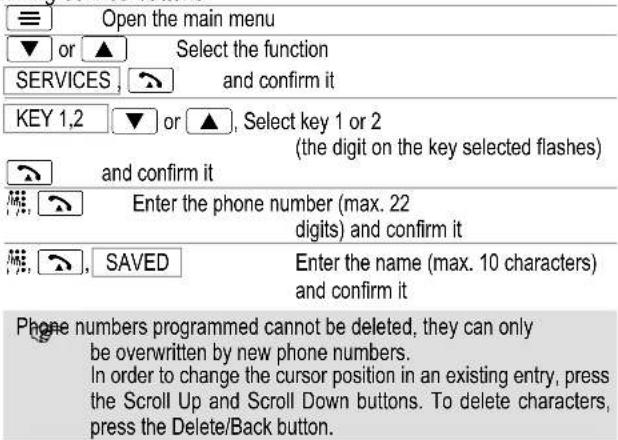
You can program special service numbers for the 1 and 2ABC buttons and then call these numbers quickly and easily using the corresponding buttons.
Programming service buttons
text_image
Open the main menu ▼ or ▲ Select the function SERVICES, ↻ and confirm it KEY 1,2 ▼ or ▲, Select key 1 or 2 (the digit on the key selected flashes) and confirm it Enter the phone number (max. 22 digits) and confirm it SAVED Enter the name (max. 10 characters) and confirm it Phone numbers programmed cannot be deleted, they can only be overwritten by new phone numbers. In order to change the cursor position in an existing entry, press the Scroll Up and Scroll Down buttons. To delete characters, press the Delete/Back button.Dialling using the service buttons

text_image
Press and hold 1 or 2 ABC Press the required service button until the phone number is displayed or Dial the numberHandsfree function
Use the handsfree function in order to listen to callers via the loudspeaker and talk to them without having to hold the receiver to your ear.
Activate the handsfree function during a call
When the handsfree function is activated, the handsfree LED lights up red. Speak towards the microphone. The microphone is at the front right of the base unit.
Deactivate the handsfree function during a call
text_image
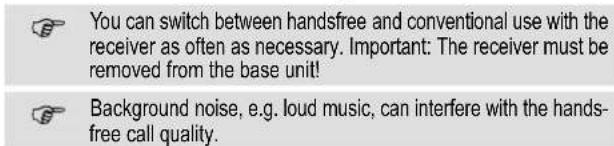
You can switch between handsfree and conventional use with the receiver as often as necessary. Important: The receiver must be removed from the base unit! Background noise, e.g. loud music, can interfere with the hands-free call quality.Adjusting the volume for the handsfree feature
You can adjust the handsfree volume to one of 8 levels using the Scroll Up and Scroll Down buttons (quiet = level 1 to loud = level 8).

Automatic Emergency Call (SOS)
6 Automatic Emergency Call (SOS)
An automatic SOS call can only be made when ALARM FUNC:ON is activated in the menu; ☐Menu Structure, Page 82, the telephone is operated via the power adapter plug or when 4 charged batteries are installed in the telephone and 1 charged battery is installed in the emergency call unit.
The emergency call unit can be used to dial an emergency services exchange or specific persons for assistance.
There are several emergency services exchanges available. In some countries, these may be subject to a charge. You can also use the equipment as a private emergency call device within the family.
How the automatic SOS call works
The telephone reacts as follows after starting an automatic SOS call:
• A loud SOS signal sounds for 15 seconds on the base unit. The Call/SOS LED flashes at the same time.
If you have activated QUIET AL::ON in the menu, the SOS alarm signal is not played. Only the Call/SOS LED flashes.
•The handsfree function is switched on.
•The numbers assigned to the 3 SOS call buttons are dialled in succession:
• The first number dialled is that assigned to the large red M1 button.
- It rings for maximally 60 seconds. If the call is not taken within this time, the call is ended.
•The SOS alarm signal sounds again on the base unit for 15 seconds.
- The number assigned to the large red M2 button is then dialled for 60 seconds.
- If this call is not taken within the specified time, the same procedure is repeated as before; the alarm signal is sounded for 15 seconds and then the phone number assigned the large red M3 button is dialled
If no phone numbers have been assigned to the three large red buttons M1, M2 or M3, no phone number is dialled but the SOS alarm signal sounds.
- As soon as one of the SOS calls is taken, the person taking the call hears the outgoing alert message in a continuous cycle.
When the telephone leaves the factory, the following outgoing alert message is already recorded: "This is an emergency call, to accept this call, press zero." However, you can record your own outgoing alert message; Page 79.
- When the person receiving the SOS call presses the [0] button on their phone, this ends the outgoing alert message and a connection to the SOS caller is automatically established. The person making the SOS call automatically uses the handsfree function.
If the SOS call is not taken by anyone, the telephone then repeats the cycle and calls the phone numbers assigned to the large red SOS buttons M1, M2 and M3 in the same sequence. The telephone completes a maximum of 4 complete cycles which takes approx. 15 minutes. If the call is not taken, the automatic SOS call is automatically stopped.
Assigning phone numbers to the SOS buttons
Page 76
Starting SOS calls
In order to call for assistance, correctly functioning phone numbers must be programmed and assigned to the SOS buttons.
Automatic SOS call via the emergency call unit
Pay attention that there is always a fully charged battery in the emergency call unit, the emergency call unit is registered on the telephone and it is within range of the telephone!
Press and hold the SOS button on the emergency call unit for at least 1 second.
While the SOS button is being pressed, the battery charge capacity LED lights up.
Automatic SOS call via the telephone
Hold M1, M2 or M3 Start the automatic SOS callprocess
Ending the automatic SOS call by the SOS call sender
3 sec. ◎End automatic SOS call
or
End automatic SOS call
or
End automatic SOS call
Ending the automatic SOS call by the SOS call recipient
Take the automatic SOS call
0 Take the automatic SOS call
Converse with the SOS caller
1 2 End the automatic SOS call
Ending the automatic SOS call
The automatic SOS call ends automatically when none of the calls made to the 3 phone numbers assigned to the SOS buttons are answered.
Automatic Emergency Call (SOS)
Outgoing alert message
An outgoing alert message is already recorded on the telephone: "This is an emergency call, to accept this call, press zero." You can replace this message with one of your own.
The outgoing alert message is repeated continuously until the person taking the call presses the [0] button on their phone. Therefore, be sure to end your own outgoing alert message with the sentence: "Press the 0 button to take this SOS call".
When recording your alert message, ensure the caller knows who is making the call. Ensure that your message clearly states that it is an emergency call and you require assistance.
Playing your outgoing alert message
≡ Open the main menu
▼ or ▲ Select the required submenu
AL.MESSAGE
Play the outgoing alert message
Recording the outgoing alert message
The outgoing alert message may be a maximum of 30 seconds long.
≡ Open the main menu
▼ or ▲ Select the required submenu
AL.MESSAGE
Hold Start recording
Release End recording
Deleting the outgoing alert message
[≡] Open the main menu
▼ or ▲ Select the required submenu
AL.MESSAGE
Hold < 3 sec. Complete the deleting process
Automatic Emergency Call (SOS)
Registering/Deregistering the emergency call unit on the telephone
Registering the emergency call unit on the telephone
Up to 5 emergency call units can be registered on the telephone.

Open the main menu

▲ Select the required submenu

T and confirm it

▲ Select the required submenu

... and confirm it


Register the emergency call unit

istration process proved unsuccessful, the message ERROR appears briefly in the display.
Deregistering the emergency call unit on the telephone

possible to deregister all the emergency call units in the process! Any emergency call units which are subsequently required must be registered on the telephone again!

Open the main menu

▲ Select the required submenu

T and confirm it

▲ Select the required submenu

and confirm it
Emergency call unit battery
Checking the battery
- Press the SOS button ☐ on the emergency call unit briefly. The battery charge capacity LED lights up while the button is pressed.
- If the battery charge capacity LED no longer lights up on pressing the SOS button ○, replace the battery.
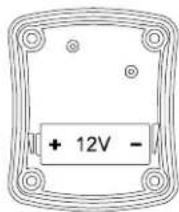
Changing the battery
-
Remove the 4 screws on the rear side of the emergency call unit using a crosstip screwdriver.
-
Open the cover of the battery compartment using a narrow screwdriver, for example.
-
Change the battery. Only use a battery of the type A23 12V. Pay attention to the correct polarity.
-
Close the cover of the battery compartment in the reverse sequence.
7 PBX / Supplementary Services
R button on private branch exchanges
If the telephone is connected to a private branch exchange, functions such as transferring calls and automatic call back can be used via the R button. Refer to the operating manual provided with your private branch exchange as to which Flash time must be set in order to use these functions. The sales outlet where you purchased the exchange can provide information as to whether the telephone will work properly with the exchange.
Setting the Flash time
Menu Structure, Page 82
Dialling pause
When using private branch exchanges, it is necessary to dial an access code to obtain the dialling tone for an outside line. When using some older private branch exchanges, it takes a little time before the dialling tone becomes audible. In the case of such private branch exchanges, a dialling pause can be inserted after the number for an outside line in order to continue dialling directly without having to wait for the dialling tone.
Insert a dialling pause
"P" appears in the display
After dialling the number for the outside line, the telephone waits approx. 3 seconds before dialling the actual phone number.
The pause can also be entered with the phone number in the phone book.
R-button and supplementary services
Your telephone supports supplementary services provided by your telephone network provider, such as brokering, call waiting and conference facilities. These supplementary services can be used by implementing the R button. Please contact your telephone network provider regarding which Flash time must be set to use the supplementary services. Also contact your telephone network provider with regard to enabling supplementary services. Setting the Flash time; Page 82.
Caller number display (CLIP ^1 )
If this function is available with your telephone line, the number of the caller appears in the display when the phone rings. If the phone number has been stored in the phone book, the name associated with it appears in the display.
If the name for a phone book entry has been spoken, the name recorded is played between the first two ringing tones. This means it is not necessary to go to the phone to see who is calling.
If the caller has suppressed transmission of their phone number, the corresponding message appears in the display. The phone number cannot be displayed and, as a result, is not stored in the missed calls and redialling list.
The caller number display function is an optional service offered by telephone network providers. Contact your network provider for further information.
Menu Structure
8 Menu Structure
Main menu
Open the main menu by pressing the ≡ button.
Confirm each entry by pressing the ↗ button.
TIME/DATE ▲/▼ to change the digits
SERVICES KEY 1,2
Use ▲/ ▼ to select digit 1 or 2 ^1
Enter number Enter name
TONE/PULSE ^2 TONE/PULSE
N CALL LED ^3 ON/OFF
FLASH4 100 / 300 / 600
KEYTONE ON/OFF
CONTRAST 1/2/3/4
RING LIGHT ^5 ON/OFF
AL.MESSAGE Alert message is spoken
QUIET AL. ON/OFF
ALARM FUNC ON/OFF
BOOST LOCK ON/OFF
^1 The digit selected flashes.
^2 Dual tone multi-frequency mode (DTMF) (tone dialling mode) and pulse dialling mode
^3 Defines whether the Call/SOS LED should light up when new calls are recorded in the missed calls and redialling list.
^4 In ms
^5 When the phone rings, the Call/SOS LED flashes faster than usual.
| RING VOL 0/1/2/3/4 | |
| RING MEL 1/2/3 | |
| VOICE6ON/OFF | |
| PENDANT PAIRING | |
| NAME REC | DELETE? |
| STORE NO. Enter number Enter name | |
| LANGUAGE DEUTSCH | |
| ENGLISH | |
| SVENSKA | |
| NEDERLANDS | |
| FRANCAIS | |
| ITALIANO | |
^6 When a button is pressed, a voice accompanies the action. This voice can be activated and deactivated, as required.
9 Phone Book
You can use the phone book to store up to 99 phone numbers together with the associated names. Phone numbers may have a maximum of 22 digits and characters, names a maximum of 10 characters.
- Always enter the area access code with the phone numbers so that incoming local calls can also be assigned to a phone book entry.
- When the memory capacity is used up, the message FULL appears when an attempt is made to store another number. To create space, an existing entry must first be deleted.
- The phone book entries are arranged alphabetically. To access the required phone book entry directly, press the first letters of the corresponding name.
- If no button is pressed for 30 seconds while the phone book is open, the phone book is closed and the phone returns to Standby mode.
Entering names
Names may have a maximum of 10 characters.
Letters are also imprinted on the digit keys. Letters, digits and special characters are entered by pressing the relevant key the respective number of times.
To enter the same letter twice, press the button to enter the letter. Wait until the cursor skips one position forwards. Enter the letter again.
1 Enter a space
Delete character
▼ or ▲ Change cursor position
(character flashes)

New characters can always be inserted in existing text in front of the cursor position.
Creating phone book entries
≡ Open the main menu
▼ or ▲ Select the required function
STORE NO., and confirm it
Enter the phone number
(max. 22 digits) and confirm it
SAVED Enter the name (max. 10 characters)
NAME REC and confirm it
Hold
Release ▼Record the name
A recording may take a maximum of 4 seconds. Recording is then automatically stopped.
When recording has stopped, the name recorded is played back.

Recording a name is an optional function and can also be completed separately, if necessary. Advantage of recording a name: When a call is received from this number, the name recorded is played twice between the first two rings. This means, it is not necessary to go to the phone to see who is calling.
Editing phone book entries
Open the phone book
▼ or ▲ Select the phone book entry
2 sec. ≡ Initiate the editing process
Change the number and confirm it
Change the name and confirm it
Hold
Release Record the name
Phone Book
Deleting phone book entries
Deleting a single entry
Open the phone book
▼ or ▲ Select the phone book entry
DELETE? Activate the deleting process
2 sec. ☒ Confirm the deleting process
Deleting all entries
Open the phone book
▼ or ▲ Select a phone book entry
2 sec. ☒ DEL ALL? Activate the deleting process
2 sec. ☒ Confirm the deleting process
Voice output for phone book entries
A name can be recorded for each phone number stored in the phone book. When you subsequently select an entry in the phone book, the recording you made for it is played and you can hear the entry you have selected.

Names can be recorded for phone book entries at the time they are created or later for existing phone book entries.
Recording a name
≡ Open the main menu
▼ or ▲ Select the required function
NAME REC, and confirm it
▲ or ▼ Select the phone book entry
Hold Start recording
Release End recording
If you do not release the button, recording is automatically stopped after 4 seconds.
Deleting a recording
Open the phone book
▼ or ▲ Select the phone book entry
2 sec. ≡ Initiate the editing process
Change the number, if necessary, and confirm it
Change the name, if necessary, and confirm it
NAME REC Hold
(« longer acoustic signal»)
Release Complete the deleting process
10 Calls Missed and Redialling List
The last 15 phone numbers of incoming calls and the last 15 phone numbers dialled are stored in a combined calls missed and redialling list (subsequently referred to simply as the "list").
New calls
If new calls have been recorded in the list, the phone icon 📞 appears in the display. If N CALL LED:ON is activated in the menu, the red, flashing Call/SOS LED indicates that new calls have been stored in the list. As soon as the entries have been viewed, the Call/SOS LED goes out. ☐ Menu Structure, Page 82
Displaying phone numbers in the list
| ● | Open the list |
| The newest entry is at the top. | |
| or | |
| ▼ | Open the list and display the newest entry |
| or | |
| ▲ | Open the list and display the oldest entry |
| ● | Select the second oldest entry and view it |


Select the entry and view it
- In the case of entries received on that day, the time is also displayed. In the case of older entries, the date is displayed.
- In the case of numbers redialed, the redialling icon ⬆ appears in the display.
Calls Missed and Redialling List
- In the case of missed calls, the CID icon CID appears in the display (Caller Identification).
- In the case of new missed calls, which have not previously been viewed, the telephone icon 📞 appears in the display.
Messages in the display
| Display Description | |
| NO NUMBER This relates to an international call or a call from a private branch exchange. | |
| PRIVATE The caller has suppressed transmission of his/her phone number or the call has come from a private branch exchange. | |
Calling phone numbers in the list
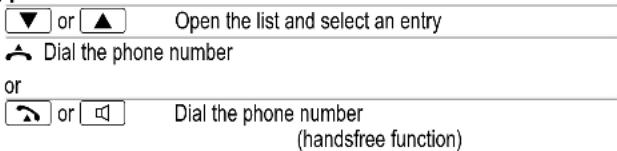
text_image
▼ or ▲ Open the list and select an entry ▲ Dial the phone number or ◀ or □ Dial the phone number (handsfree function)Calls Missed and Redialling List
Storing numbers from the list in the phone book
A phone number in the list can be stored in the phone book directly.
▼ or ▲ Open the list and select an entry
Hold ≡ Start the storing process

Edit the phone number if necessary (max. 22 digits) and confirm
SAVED
NAME REC Enter the name (max. 10 characters) and confirm it

A recording may take a maximum of 4 seconds. Recording is then automatically stopped.
When the number in the phone book is stored together with a name, the name entered also appears in the list.
Deleting numbers from the list
Deleting individual phone numbers
▼ or ▲ Open the list and select an entry
DELETE? Activate the deleting process
Hold ☒ Confirm the deleting process
or ▼ or ▲ Cancel the deleting process
Deleting all phone numbers
Before deleting the phone numbers, check whether the entries have been viewed.
▼ or ▲ Open the list and select an entry
2 sec. ☒ DEL ALL? Activate the deleting process
Hold ☒ Confirm the deleting process
or ▼ or ▲ Cancel the deleting process
11 In Case of Problems
Service hotline
Should problems arise with the telephone, please refer to the following information first. In the case of technical problems, you can contact our hotline service, Tel. 0900 00 1675 within Switzerland (Swisscom fees at time of going to print: CHF 2.60/min). In the case of claims under the terms of guarantee, contact your sales outlet. There is a 2 year period of guarantee.
Problems and solutions
| Problems Solutions | |
| No telephone calls possible - | The telephone line is not connected properly or is defective. Only use the telephone connection cable supplied.- The power adapter plug is not plugged in or there is a complete power failure. |
| Some functions, e.g. +40 dB amplification or handsfree, do not work | - Check that the batteries are inserted correctly, are the correct type and they are not empty. |
1 CLIP: Calling Line Identification Presentation = Displays the caller's phone number.
In Case of Problems
| Caller numbers (CLIP ^1 ) are not displayed | - The caller number display function is an optional service offered by telephone network providers. Contact your network provider for further information.- The caller has suppressed the transmission of their phone number. |
| No automatic SOS call can be made. A double beep tone is issued instead. | - ALARM FUNC OFF is activated in the menu.- No phone numbers have been programmed and assigned to the SOS buttons.- The telephone's power adapter plug is not connected properly.- 4 charged batteries have not been inserted in the telephone.- No battery has been inserted in the emergency call unit. |
Maintenance / Guarantee
12 Maintenance / Guarantee
Maintenance
- Clean the housing surfaces with a soft, fluff-free cloth.
- Never use cleaning agents or solvents.
Guarantee
SWITEL equipment is produced and tested according to the latest production methods. The implementation of carefully chosen materials and highly developed technologies ensure trouble-free functioning and a long service life. The terms of guarantee do not apply where the cause of equipment malfunction is the fault of the telephone network operator or any interposed private branch extension system. The terms of guarantee do not apply to the batteries or power packs used in the products. The period of guarantee is 24 months from the date of purchase.
All deficiencies related to material or manufacturing errors within the period of guarantee will be redressed free of charge. Rights to claims under the terms of guarantee are annulled following tampering by the purchaser or third parties. Damage caused as the result of improper handling or operation, normal wear and tear, incorrect positioning or storage, improper connection or installation or Acts of God and other external influences are excluded from the terms of guarantee. In the case of complaints, we reserve the right to repair defective parts, replace them or replace the entire device. Replaced parts or devices become our property. Rights to compensation in the case of damage are excluded where there is no evidence of intent or gross negligence by the manufacturer.
If your device does show signs of a defect within the period of guarantee, please contact the sales outlet where you purchased the SWITEL device, producing the purchase receipt as evidence. All claims under the terms of guarantee in accordance with this agreement can only be asserted at the sales outlet. No claims under the terms of guarantee can be asserted after a period of two years from the date of purchase and hand-over of the product.
Declaration of Conformity
This device fulfils the requirements stipulated in the EU directive:
1999/5/EC directive on radio equipment and telecommunications terminal equipment and the mutual recognition of their conformity. Conformity with the above mentioned directive is confirmed by the CE mark on the device.
To view the complete Declaration of Conformity, please refer to the free download available on our web site at www.switel.com.
13 Index
A
Amplifier button (+40 dB), 73
Amplifier LED, 73
Amplifying the receiver volume, 75
Automatic emergency call (SOS), 78
Automatic SOS call, 78
Automatic SOS call via the emergency call unit, 79
Automatic SOS call via the telephone, 79
B
Base unit, 71
Battery charge capacity LED, 73
C
Call/Emergency call LED, 73
Call/OK button, 73
Call/SOS call LED, 85
Caller number display (CLIP), 81
Calling back missed calls, 76
Calling phone numbers in the list, 85
Calls missed and redialling list, 85
Changing the emergency call unit battery, 80
Checking the emergency call unit battery, 80
Creating, 83
D
Date, 72
Deactivate the automatic SOS call, 82
Declaration of Conformity, 88
Delete/Back button, 73
Deleting, 84
Deleting a recording, 84
Deleting numbers from the list, 86
Deleting the outgoing alert message, 79
Deregistering the emergency call unit on the telephone, 80
Dialling pause, 81
Dialling phone numbers from the phone book, 76
Dialling using one-touch dialling buttons, 76
Dialling using the service buttons, 77
Dialling using the SOS buttons, 76
Digit keys, 73
Display, 73, 74
Display messages, 85
Displaying phone numbers in the list, 85
Disposal, 70
DTMF, 82
Dual tone multi-frequency mode, 82
E
Editing, 83
Emergency call buttons, 76
Emergency services exchange, 78
Ending a call, 75
Ending the automatic SOS call, 79
Ending the automatic SOS call by the SOS call recipient, 79
Ending the automatic SOS call by the SOS call sender, 79
Entering names, 83
Entering text, 83
Explanations, 74
G
Guarantee, 88
H
Handsfree, 77
Handsfree button, 73
Handsfree function, 77
Handsfree LED, 73
handsfree volume, 77
Hash button, 73
Hearing aid compatibility, 70
|
Icons in the display, 74
Inserting the batteries, 72
Installation location, 70
Intended use, 70
L
Loudspeaker, 73
M
Main menu, 82
Maintenance, 88
Making a call, 75
Menu button, 73
Menu structure, 82
Microphone, 73
Mute the automatic alert message, 82
N
Navigating in the menu, 74
New calls indicator, 85
0
One-touch dialling buttons, 73, 76
Operating elements, 73
Operating the telephone, 74
Outgoing alert message, 78, 79
Index
P
Package contents, 71
Phone book, 83
Phone book button, 73
Phone book entries, 83
Playing your outgoing alert message, 79
Power adapter plug, 70
Private branch exchanges, 81
Problems, 87
Problems and solutions, 87
Programming one-touch
dialling buttons, 76
Programming service buttons, 77
Programming SOS buttons, 76
Pulse, 82
Pulse dialling mode, 82
R
R button on private branch exchanges, 81
R-button, 73
R-button and supplementary services, 81
Receiver, 73
Receiver volume slide control, 73
Record alert message, 82
Recording a name, 84
Recording the outgoing alert message, 79
Redialling, 76
Registering the emergency call unit on the telephone, 80
S
Safety information, 70
Saving, 83
Scroll down button, 73
Scroll up button, 73
Selecting the ringing melody, 82
Service buttons, 73, 77
Service hotline, 87
Setting the contrast, 82
Setting the date and time, 82
Setting the display contrast, 82
Setting the Flash time, 81
Setting the language, 82
Setting the Recall time, 82
Setting the receiver volume, 75
Setting the ringing tone, 82
Setting the ringing volume, 75, 82
SOS alarm, 78
SOS call button, 73
SOS call buttons, 73
Star button, 73
Starting SOS calls, 79
Starting up, 71
Storing numbers from the list
in the phone book, 86
Supplementary services, 81
Switching the key tone on/off, 82
T
Taking a call, 75
Talk time, 75
Telephoning, 75
Time, 72
Tone control, 73, 75
Tone dialling mode, 82
Tone slide control, 73
Troubleshooting, 87
V
Voice output for phone book entries, 84
W
Wall installation, 72
Notes
SWITEL
Declaration of conformity
This equipment complies with the European R&TTE directive.
To view the complete Declaration of Conformity, please refer to the free download available at our web site: www.switel.com.

Version 1.0 - 13.06.2012