Green ME - Coffee machine Promac - Free user manual and instructions
Find the device manual for free Green ME Promac in PDF.


Frequently Asked Questions - Green ME Promac
User questions about Green ME Promac
0 question about this device. Answer the ones you know or ask your own.
Ask a new question about this device
Download the instructions for your Coffee machine in PDF format for free! Find your manual Green ME - Promac and take your electronic device back in hand. On this page are published all the documents necessary for the use of your device. Green ME by Promac.
USER MANUAL Green ME Promac
natural_image
Line drawing of a commercial espresso machine with two main units and control knobs (no text or symbols)PUSH

PROMAC

Gentile cliente,
First of all, thank you choosing PROMAC.
We are confident that the product you have purchased will come up to all your expectations-just as all our other products are designed to do. The product that you are about to use is the outcome of pain - staking research and tests. The PROMAC's consistency assures quite sure that the equipment we have supplied you with, is the most functional, safe and satisfactory of its kind to be found on the market, as regards both its design and its efficiency. The booklet of instructions for its correct use and maintenance will help you to get the best possible service out of your machine. We trust you will find our explanations clear and we may continue, in the future, to count you among our esteemed customers.

natural_image
Line drawing of a coffee machine with internal components and a black arrow indicating a specific part (no text or symbols present)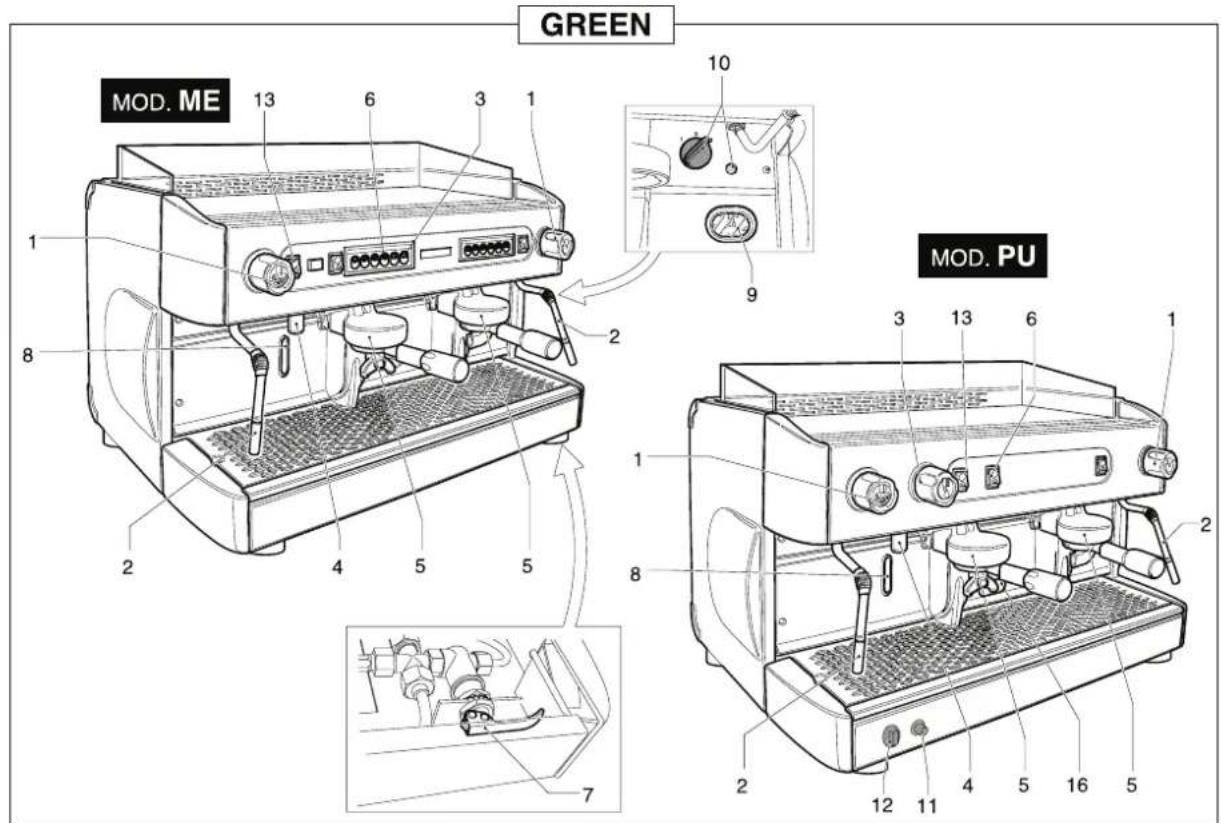
text_image
GREEN MOD. ME 13 6 3 1 10 9 2 8 4 5 5 MOD. PU 1 3 13 6 1 1 8 2 7 12 11 4 5 16 5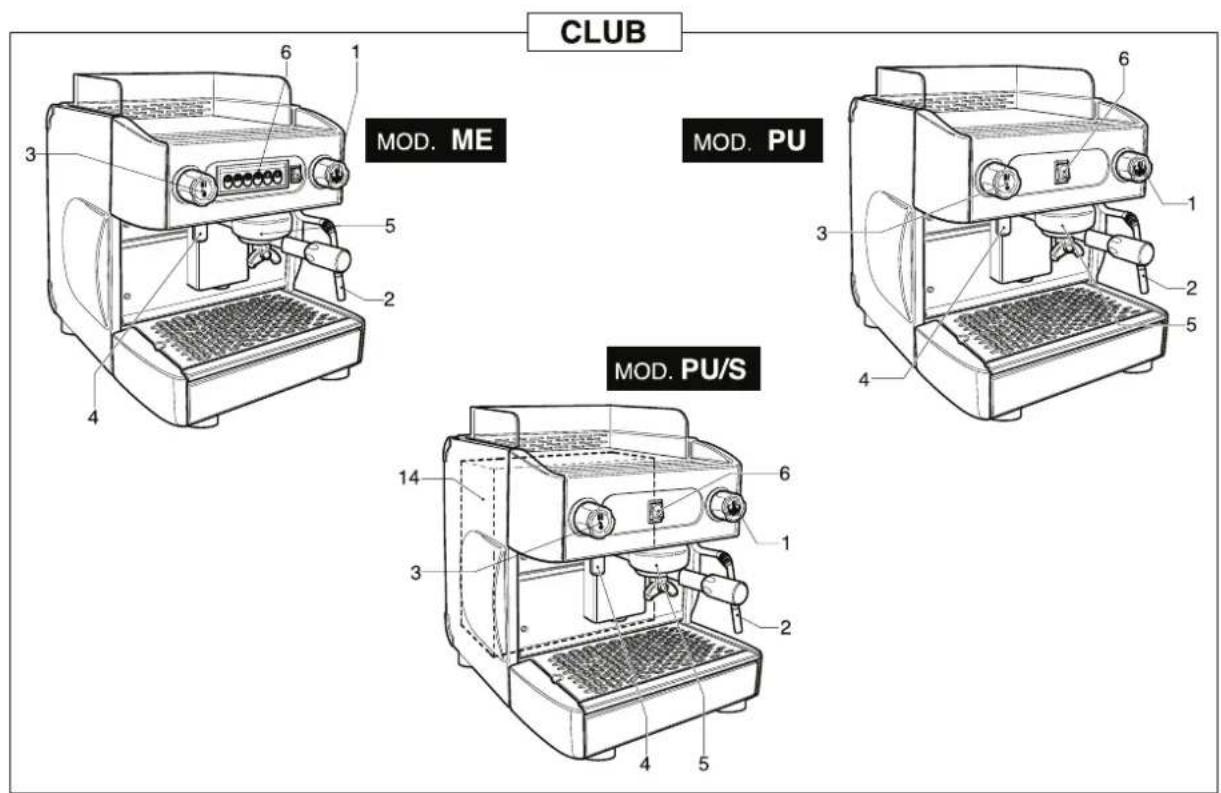
text_image
CLUB MOD. ME MOD. PU MOD. PU/SFig. 3
text_image
H D C B A Fig. 4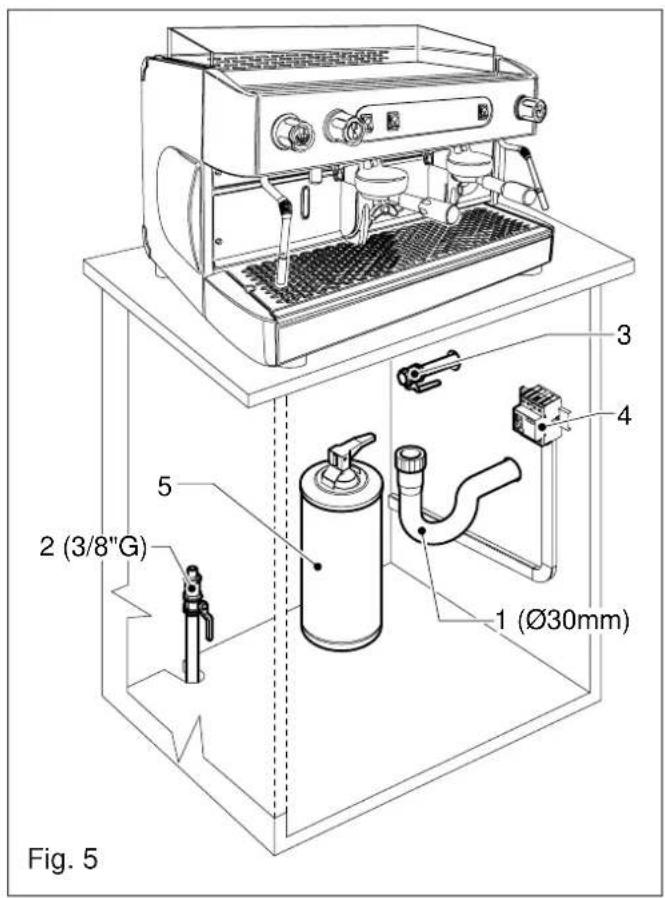
text_image
Fig. 5 2 (3/8"G) 5 1 (∅30mm) 4 3 5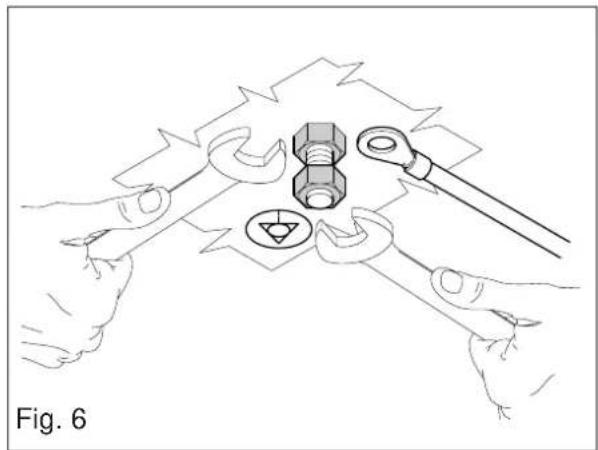
natural_image
Illustration of hands using wrench and wrench tools to adjust a bolt and nut (no text or symbols)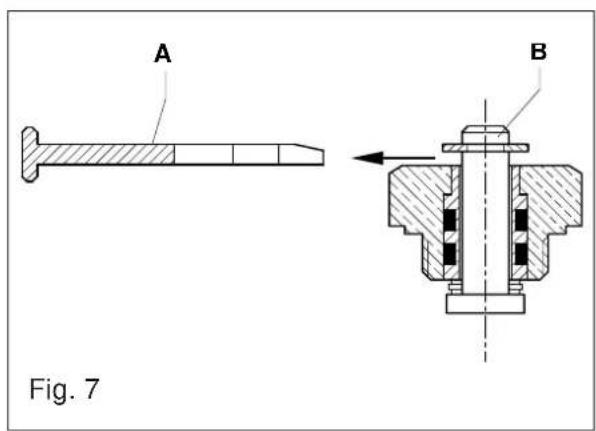
text_image
A B Fig. 7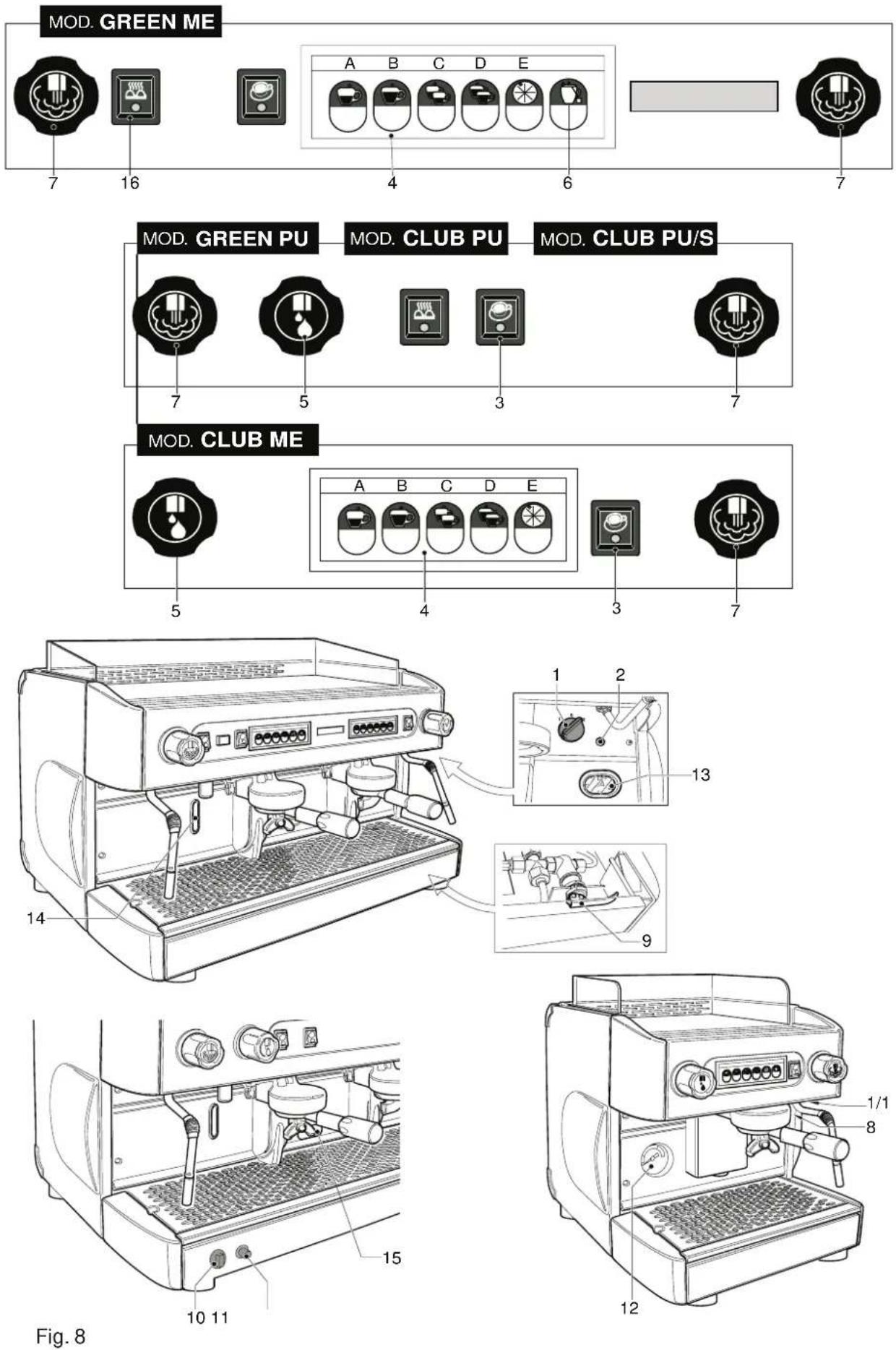
text_image
MOD. CLUB PU/S B A C Fig. 9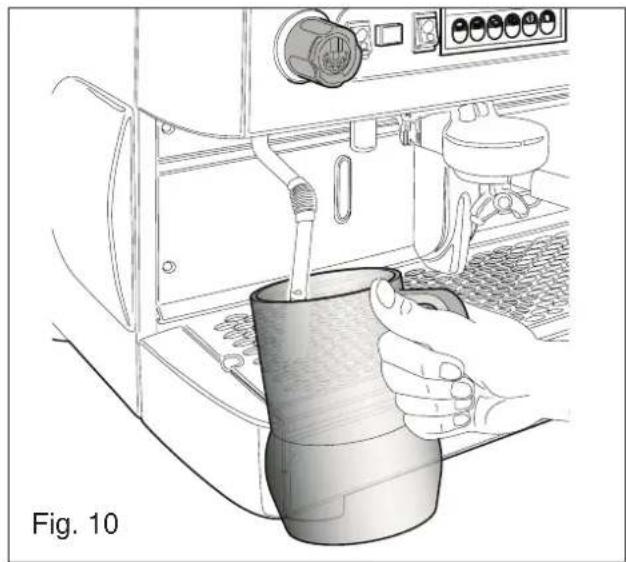
natural_image
Illustration of a hand pouring liquid into a mug inside a machine (no text or symbols visible)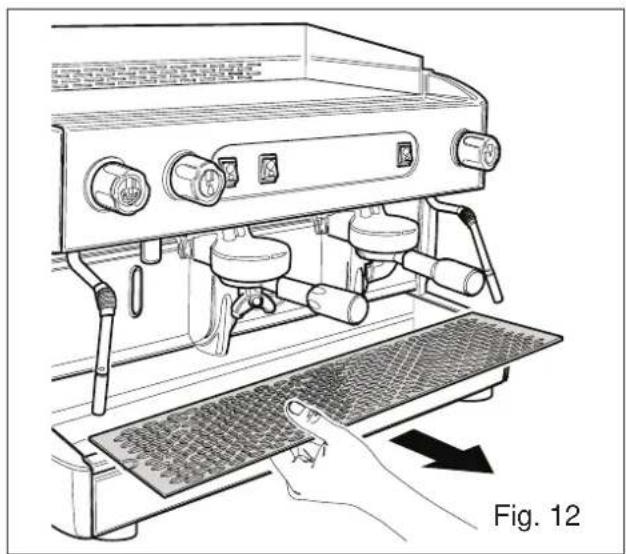
natural_image
Line drawing of a coffee machine with a hand operating the grater (no text or symbols present)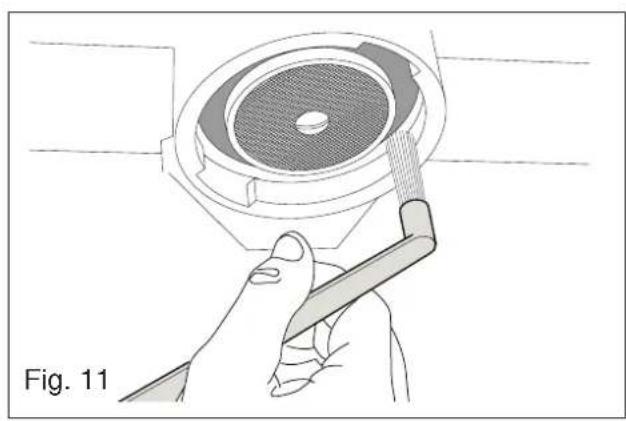
natural_image
Illustration of a hand using a tool to adjust or install a speaker into a circular component (no text or symbols visible)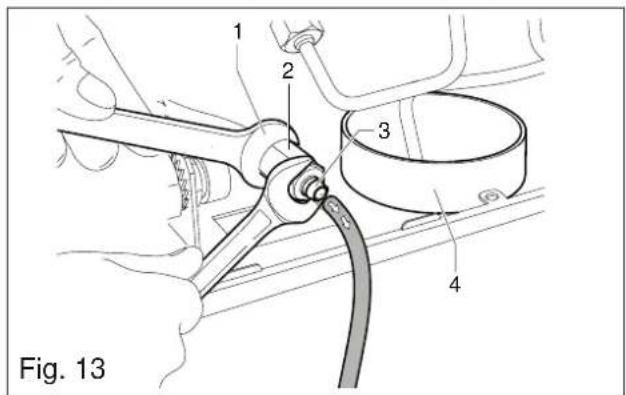
text_image
1 2 3 4 Fig. 13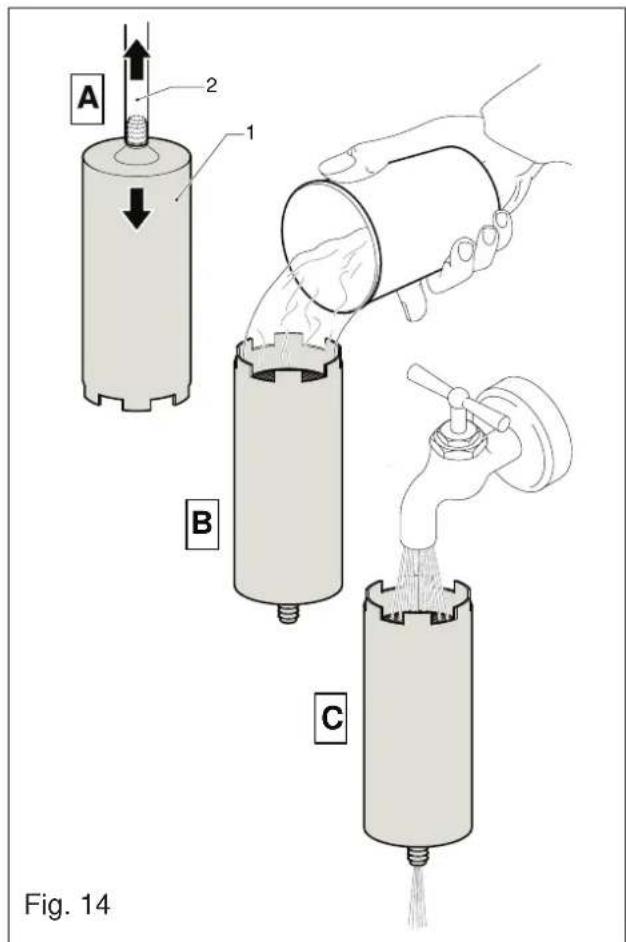
text_image
A 2 1 B C Fig. 14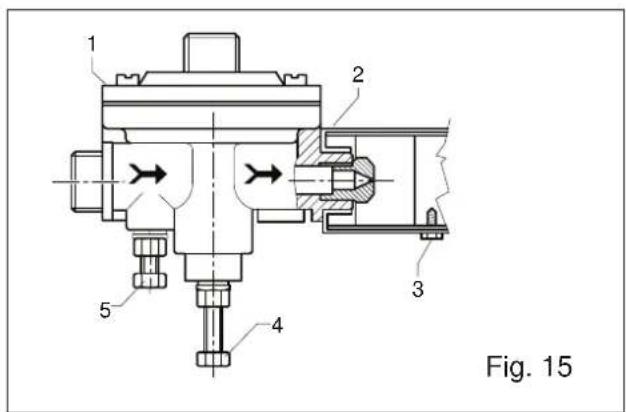
text_image
Fig. 15I ITALIANO 10-27
F FRANCAIS 28-45
D DEUTSCH 46-63
GB ENGLISH 64-81
E ESPAÑOL 82-99
P PORTUGUÊS 100-117
SCHEMI ELETTRICI 118-128
SCHEMAS ELECTRIQUES
SCHALTPLANE
WIRING DIAGRAMS
ESQUEMAS ELECTRICOS
ESQUEMAS ELÉTRICOS
SCHEMI IDRAULICI 129-134
SCHÉMAS HYDRAULIQUES
HYDRAULIKPLÄNE
HYDRAULIC DIAGRAMS
ESQUEMAS HIDRÁULICOS
ESQUEMAS HIDRÁULICOS
text_image
>3 sec A B C D E F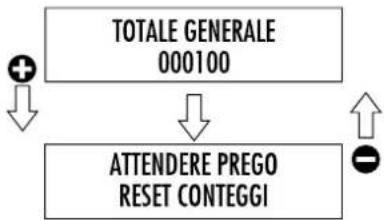
flowchart
graph TD
    A["TOTALE GENERALE 000100"] --> B["ATTENDERE PREGO RESET CONTEGGI"]
    B --> C["Feedback Loop"]
    C --> A
text_image
>3 sec A B C D E F
CONTATORE FILTRO AZZERATO ATTEND.

9.2. Programmation technique 37
7.1. Commandes Fig.8
text_image
>3 sec A B C D E F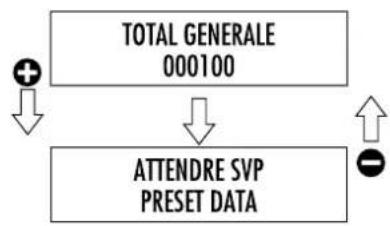
flowchart
graph TD
    A["TOTAL GENERALE 000100"] --> B["ATTENDRE SVP PRESET DATA"]
    B --> C["Feedback Loop"]
    C --> A
13. VERSION MACHINE AVEC CHAUFFAGE D'APPOINT AU GAZ (Fig.15)

text_image
>3 sec A B C D E F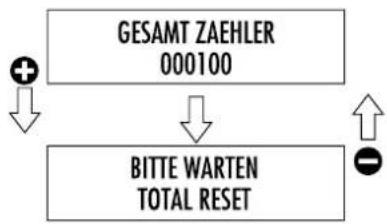
flowchart
graph TD
    A["GESAMT ZAEHLER 000100"] --> B["BITTE WARTEN TOTAL RESET"]
    B --> C["+"]
    B --> D["-"]
    C --> E["↓"]
    D --> F["↑"]
ALARM FLOW METER GR.X
BITTE WAEHLEN PROMAC SPA
9.2.7 Preinfusion
The operations marked with this symbol are to be undertaken exclusively by an installation technician

The operations marked with this symbol are to be undertaken by the user.
GB ENGLISH
CONTENTS
Machine identification data 65
-
General safety rules 65
-
Description ......66
2.1. Specifications and composition .....66
2.2. Machine equipment 67
2.3. Mechanical protective devices .....67
2.4. Electric safety devices ....67
2.5. Aerial noise 67
2.6. Vibrations 67
- Technical data 67
3.1. Dimensions and weights 67
- Use 68
4.1. Precautionary measures ....68
- Transport 68
5.1. Packaging 68
5.2. Inspection on receipt 68
- Installation 69
6.1.Connections to be made by the user .....69
6.1.1. Water and gas supply 69
6.1.2. Electric supply 69
6.2. Preliminary operations .....70
6.3. Antisuction valve installation .....70
6.4. Positioning 70
- Setting up 70
7.1.Controls 70
7.2. Control instruments .....71
7.3. Starting up ....71
- Use 72
8.1. Preparing coffee 72
8.2. Preparing cappuccino .....72
8.3. . Warming a beverage .....72
8.4. Preparing tea, camomile, etc....73
- Adjustments and settings of the dose .... 73
9.1.For ME models 73
9.2.Technical programming ....73
9.2.1. Reading of consumed drinks and reading of calculated litre ....76
9.2.2. Setting consumed drinks to zero .....77
9.2.3. Setting litres to zero .....77
9.2.4. Mobile jumpers .....78
9.2.5. Alarm signalling ....78
9.2.6. Absence of pulses of volumetric counter .....78
9.2.7 Pre-brewing .....78
- Maintenance ....79
10.1.Daily 79
10.2. Weekly 79
10.3. Periodical 80
10.3.1. Renewal of water n the boiler mod.CLUB PU - ME 80
10.3.2. Renewing the water in the boiler
mod.ME 80
10.3.2. Regeneration ....80
-
Stopping the machine ....80
-
Troubleshooting ....80
-
Machines with alternative gas heater version 81
VERSIONS: GREEN ME - PU 1 / 2 / 3 / 4 Groups
GREEN COMPACT ME - PU 2 Groups
CLUB ME - PU - PU/S - 1 Group
The label illustrated on the EC declaration of conformity of this instruction manual corresponds to the identification label placed on the machine Fig. 2.
Label identification (Fig.1):
1 Manufacturer
2 Model and version
3 Voltage
4 EC conformity mark (if required)
5 Serial number
6 Boiler data
7 Machine total absorption
8 Protection level
9 Motor power
10 Heating element power
11 Frequency
12 Conformity marks
13 Year of manufacture
COVER
Symbols

Warning signal. The instructions which refer to this signal must be followed with great care in order to avoid accidents or damage to the machine.
This manual is an integral and essential part of the product and must be delivered to the user. The warnings contained in it must be read carefully, as they supply important indications relating to the safety of installation, use and maintenance. Keep this manual for future reference.
1. GENERAL SAFETY RULES
- Don't leave the packing elements (plastic bags, polystyrene foam, nails, cardboard, etc.) within the reach of children, as these elements are potential sources or danger.
- Check that the data on the machine corresponds to that of the electrical supply network, before connecting the equipment.
- Adaptors, multiple sockets and /or extensions must not be used.
- In doubt, request an accurate check on of the plant by qualified personnel. The electric system must be provided with the following safety devices:
- efficient earth connection;
- section of conductors suitable for absorption capacity
-
efficient earth leakage protection circuit breaker.
● Install the machine on a water repellent surface (laminate, steel, ceramic, etc.) away from heat sources (oven, cooking stove, fireplace, etc.) and in conditions in which the temperature may not go below 5°C. KEEP WARM. -
Do not leave the machine exposed to atmospheric agents or place them in damp rooms such as bathrooms.
- Do not obstruct the suction or dispersion grills and do not cover with cloths, etc.
- Keep the packed machine in a dry place, not exposed to atmospheric agents and in conditions in which the temperature does not go below 5°C. Do not stack more than three items of the same kind. Do not place heavy items on the packaging.
- In an emergency, such as fire, unusual noise, overheating, etc., take immediate action, disconnecting the power and closing gas and water taps.
- Only use original spare parts in order to avoid compromising the safety and proper functioning of the machine.

Erroneous installation may cause damage to people, animals and things for which the manufacturer cannot be held responsible
2. DESCRIPTION
The machines have been designed to prepare espresso coffee and hot beverages.
A positive-displacement pump inside the machine powers the heater in which the water is heated. By pressing the appropriate buttons, water is supplied to the spouts in the form of hot water or steam, according to needs.
Model CLUB PU/S has an incorporated water-tank and does not, therefore, need to be connected to the waterworks. A water-softener inside the tank softens the water, filtering the calcium salts in it.
The machine consists of a steel supporting structure on which the mechanical and electrical components are fitted. These are completely covered with panels in varnished steel and stainless steel.
The beverages are dispensed at the front of the machine, where all the buttons, control devices and dispensers are to be found.
There is a cup-warming plate on the top of the machine.
2.1. Specifications and composition (Fig.3)
A B C D E F
| CLUB PU ok - 1 1 1 - | |||||||
| CLUB ME | - ok 1 1 1 - | ||||||
| CLUB PU/S | * | ok - 1 1 1 - | |||||
| COMPACT PU | ok - 2 1 1 - | ||||||
| COMPACT ME | - ok 2 2 1 - | ||||||
| GREEN PU | ** | ok | - | 2/3/4 | 2 | 1 | - |
| GREEN ME | ** | - | ok | 2/3/4 | 2 | 1 | *** |
| GREEN PU | ok - 1 1 1 - | ||||||
Legend:
A Semiautomatic system; manual dispensing start and stop.
B Automatic system; electronic control of coffee and hot water doses dispensed.
C N. of coffee dispensing units.
D N. of steam spouts.
E N. of hot water spouts.
F Dispaly.
* Incorporated water-tank and softener (does not need to be connected to the water supply.)
** Gas heated version available on request (only 2/3/4 coffe groups).
*** For versions with 2-3-4- coffee groups only
1 Steam tap
2 Steam spout
3 Hot water switch
4 Hot water spout
5 Coffee dispensing unit
6 Coffee dispensing button
7 Manual water load button
8 Level indicator
9 Gauge
10 Main switch and pilot light for switch on
11 Gas ignition device (for designed models)
12 Gas tap with valve (for designed models)
13 Cup heater engagement switch.
14 Water-tank (only on model CLUB PU/S)
15 Orange pilot light for lack of water
16 Check opening (model with gas heating system)
2.2. Machine equipment
| CLUB1 Group | COMPACT2 Groups | 3 Groups 4 Groups | |
| 1 dose filter holder 1 1 1 1 | |||
| 2 dose filter holder 1 2 3 4 | |||
| Filters 2 3 4 5 | |||
| Blind filter 1 1 1 1 | |||
| 0,8 mt. supply pipe | 1 2 2 2 | ||
| 1,8 mt. supply pipe | 1 1 1 1 | ||
| 2 mt. drainage pipe | 1 1 1 1 | ||
| Pipe connections 1 1 1 1 | |||
| Instruction manual | 1 1 1 1 | ||
| Brush | 1 1 1 1 | ||
| Wiring diagram | 1 1 1 1 |
Models equipped with gas connections (when applied).
2.3. Mechanical protective devices
The machine is equipped with the following protective devices:
- complete panelling protection of all the parts subject to heat and of the steam and hot water supplier;
- cup-warmer plate supplied with a tray to collect spilt liquids;
● work surface provided with grill and tray to collect spilt liquids; - buttons in a safe place above the dispensing area;
● expansion valve in the hydraulic system and valve on the boiler to avoid overpressure;
● nonreturn valve on the hydraulic system to avoid flowing back to the main supply.
3. TECHNICAL DATA
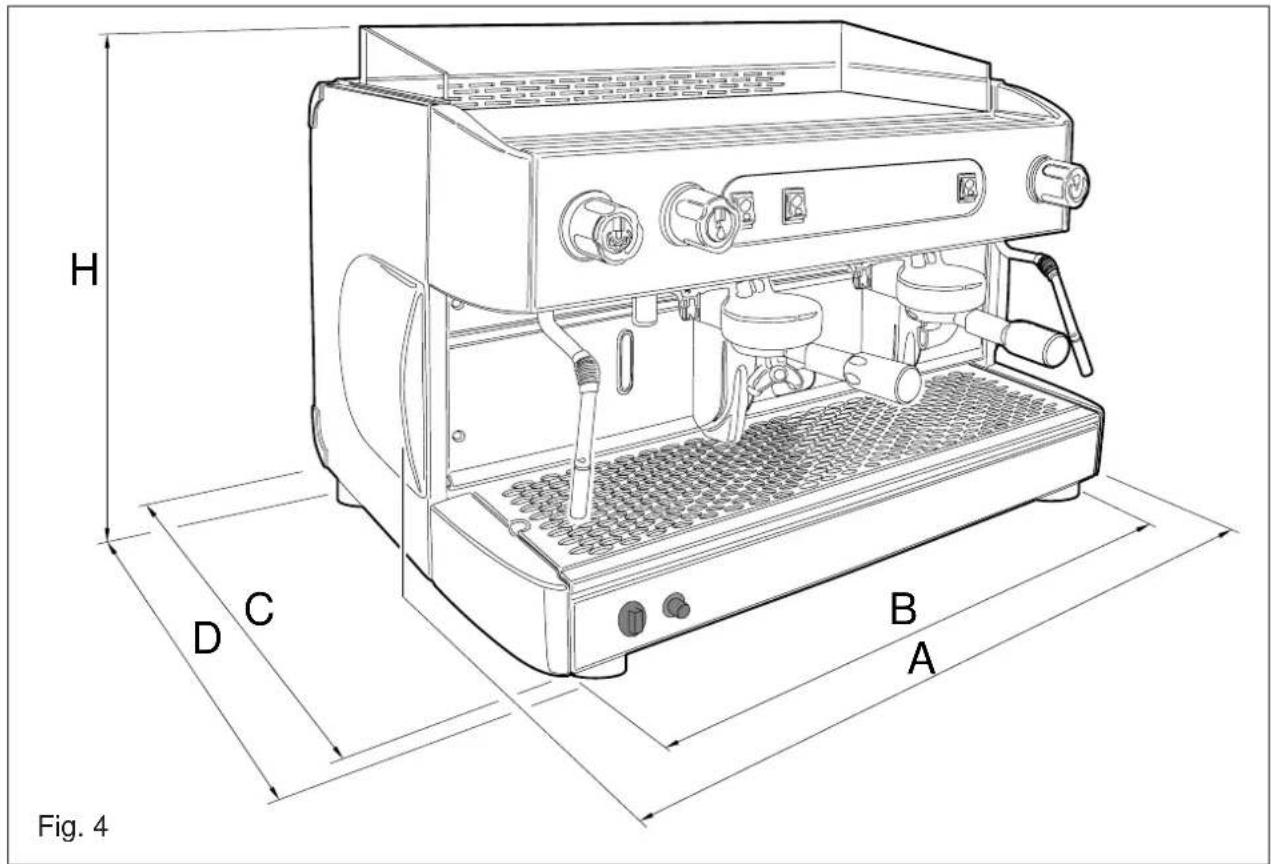
3.1. Dimensions and weights (Fig.4)
2.4. Electric safety devices
The safety devices provided are:
● thermal protection on the pump motor;
● gas failure thermocouple and thermocouple control thermostat automatically closing gas tap;
● resistance protection thermal relai.
2.5. Aerial noise
Noise level in the work place does not usually exceed 70dB(A).
2.6. Vibrations
The machine is supplied with rubber vibration damping feet. In normal working conditions, the machine does not produce vibrations harmful to the operator and the environment.
| CLUB 1 Group | 2 gr. COMPACT | 2 Groups | 3 Groups | 4 Groups | ||
| A mm | 430 | 625 | 625 | 810 | 1050 | 1290 |
| B mm | 234 | 436 | 436 | 621 | 861 | 1101 |
| C mm | 540 | 540 | 540 | 540 | 540 | 540 |
| D mm | 370 | 310 | 310 | 310 | 310 | 310 |
| H mm | 570 | 570 | 570 | 570 | 570 | 570 |
| Boiler capacity in litr. | 4 | 5 | 5 | 11 | 16 | 22 |
| Machine weight kg | 30 | 50 | 67 | 68 | 88 | 108 |
| Water inlet | 3/8 | 3/8 | 3/8 | 3/8 | 3/8 | 3/8 |
| ∅mm drainage | 14 | 14 | 14 | 14 | 14 | 14 |
| Packaging | ||||||
| Package nr. | 1 | 1 | 1 | 1 | 1 | 1 |
| Volume m3 | 0,21 | 0,27 | 0,27 | 0,44 | 0,55 | 0,67 |
| Dimensions L x P x H mm | 500x690x600 | 660x670x600 | 660x670x600 | 910x670x720 | 1150x670x720 | 1390x670x720 |
| Gross weight kg | 34 | 54 | 71 | 73 | 93 | 114 |

You'll find all the technical data on electric connection, on the machine identification label Fig. 1.
Machines provided with gas heating have a standard connection kit to carry out the following connections with:
- direct stiff pipe;
- copper and double cone pipe;
- rubber support.

Gas connections must be made in compliance with the safety regulations in force in the relative country.
4. USE
The machine have been designed, manufactured and protected to be used to make express coffee and hot beverages (tea, cappuccino, etc.). Any other use is to be considered unsuitable and therefore dangerous.

The manufacturer cannot be held responsible for any damage caused to people or things due to unsuitable, erroneous or irrational use of the machine.
The operator must always follow the indications contained in this manual. In the case of a failure or if the machine is not working properly, switch it off and do not attempt any direct repair. CContact the service centre.
The user must not:
● touch the hot surfaces and dispensing areas;
● place liquid containers on the machine;
● put his hands under the spouts during use;
● transport the machine or carry out maintenance operations when the plug is connected or when the machine is hot;
- wash the machine with water or steam jet;
- completely or partially immersethe machine in water;
● leave the machine exposed to heat sources;
● use the machine if the cable is damaged;
- touch the machine when his hands or feet are wet or damp;
- use the machine when there are children in its proximity;
- allow the machine to be used by children or unfit people;
- obstruct the suction or dispersal grills with cloth or any other thing;
● leave the side doors open (mod. CLUB PU/S);
● do not use the machine when wet or very damp.
4.1. precautionary measures
This machine may only be used with foodstuffs. It cannot be used for heating liquids or grinding any other kind of product that could damage and pollute it.

The manufacturer cannot be held responsible for damage to people or things caused by unsuitable, erroneous or irrational use.
5. TRANSPORT
5.1. Packaging
The machine is delivered in a strong cardboard box with internal protection.
The packaging bears symbols which must be observed during handling and stocking of the item.

Always keep the package in a vertical position during transport. Do not turn it over or lay it on its side and avoid bumping and exposure to atmospheric agents.
5.2. Inspection on receipt
Check that the machine received corresponds to the one indicated on the delivery note, including any accessories.
Check that it has not been damaged during transport and, if so, inform the forwarder and our customer service office immediately.

The packing elements (plastic bags, poly - styrene foam, nails, cardboard, etc.) must not be left within reach of children as they are potential sources of danger. Do not dispose of the packing elements in the environment; consign them to firms authorized for their disposal.

6. INSTALLATION
The appliance is only to be installed in locations where use and maintenance is led to trained personnel.
The machines are fitted with height adjustable feet.
The support surface shall be levelled, dry, smooth, steady and stable and at such a height that the cup-warming surface is at over 150 cm from ground. Do not use water jets or install where water jets are used.
In order to guarantee normal operation, the machine must be installed in areas that the environmental temperature is between +5^ ÷ +32^ end humidity of not over 70% .
It does not need to be anchored to the surface and it does not require any technical operations to dampen vibrations in order to operate properly.
It is recommended to leave the area around the machine free to facilitate its use and the performance of any maintenance operations.
If the machine is wet or very damp, wait until it is completely dry before installing or using it. It is always necessary to request an accurate control to qualified service people in order to find any possible damage to the electric components.
Reserve an area near the machine for the installation of the coffee grinding and dosage machine (see relevant documentation).
The machine is usually equipped with a water softener, type DP2 or DP4, which must be connected by the user in compliance with the laws in force. Should a different softener be installed, refer to the documentation of the relevant product.
A dreg drawer should be fitted by the installer.

6.1. Connections to be made by the user.

Connections must be carried out by qualified personnel in full accordance with federal, state and local regulations.
6.1.1. Water and gas supply (Fig.5)

This equipment is to be installed to comply with the applicable federal, state or local plumbing codes.
Connections must be installed close to the machine.
1) Water drainage pipe 1, having a minimum internal diameter of 30 mm, equipped with a water-trap accessible for inspection.
2) Water supply pipe 2, with a 3/8"G cut-off tap.
3) Gas supply pipe 3, with a cutoff tap.
4) Main switch
5) Volumetric pump (if external to the machine)
6) Softener

Make sure that the maximum supply pressure does not exceed 6.5 Mpa; otherwise, install a pressure reducer.

The machine with gas heating must be installed in compliance with current local laws.

6.1.2. Electricity supply
The machine is supplied ready for connection according to the required electrical specifi - cations.
Before connecting the machine ensure that the plate details comply with those of the electric distribution network.
The electrical connection cable must be directly connected to the connection provided according to current legislation. Ensure that the earthing system is efficient and in compliance with current legal requirements.
The earthing system and the lightening protection system must be realized in accordance with the provisions of current legislation.
For the supply network use a cable in compliance with standards with protective conductor (earthing wire).
For three-phase power use a cable with 5 conductors (3 phases + neutral + earth).
For single phase power supply use a cable with 3 conductors (phase + neutral + earth).
In both cases it is necessary to provide an automatic differential switch 4 (Fig. 5) at the start of the power cable, complete with magnetic release elements in accordance with the identification plate details (Fig. 1). The contact opening must be equivalent or over 3 mm.
Remember that each machine must be fitted with its own safety elements.

WARNING:
Should the power supply cable be damaged it is to be replaced by the manufacturer or by its technical assistance service or by person with equivalent qualification, in order to prevent any risks.

6.2. Preliminary operations (Fig.6)
POTENTIAL-EQUALIZING CONNECTION
This connection, which is the one called for by several norms, avoids electrical potential differences, building up between any equipment that may be installed in the same room. There is a terminal clip on the under side of the base of the machine to which an external potential-equalizing wire should be connected.
This connection is absolutely necessary and must be made right after the machine is installed.
Use a wire whose cross-sectional area conforms to the existing norms.

6.3. Antisuction valve installation (Fig.7)
On the top of the boiler there is the antisuction valve.
When installing the machine be sure to remove the plastic fork "A" and check that the pin "B" is not blocked.
This operation is very important for the correct working of the machine.

6.4. Positioning
●Place the machine on the horizontal surface previously prepared.
Before connecting, thoroughly wash the mains water pipes:
● Leave the water supply taps running at full pressure for several minutes.
● Connect to the mains water supply.
- Connect the machine to the socket.
- Connect the gas pipe
Thoroughly wash all the water pipes of the machine:
- Leave the water supply taps running at full pressure.
- Switch on main switch (pos.1 - Fig.8): wait until the boiler fills up to the level set.
- Switch on main switch (pos.2 - Fig.8) to begin heating the water in the boiler.
- Operate each unit in order to allow the water to escape for about one minute; repeat the operation twice.
- Deliver steam from the steam jets for about one minute.
- Deliver hot water for about one minute; repeat the operation twice.
- Switch off switches 1 and 2.
● Empty the water from the boiler: see point 10.3
IMPORTANT

Should the machine not deliver water for over 24 hours, wash the internal components before beginning work, repeating the operations as described above
7. SETTING UP
7.1. Controls Fig.8
1 Main switch.
Three-position switch:
0 off;
1 activates the pump to fill the boiler;
2 turns on the whole machine and activates the heating elements.
1/1 Main switch.
Two-position switch with led (for mod. CLUB); turn on the switch, led on, the machine is turned on and the pump is activated, filling the boiler with water and the heater starts to work.
2 Green pilot lamp.
When on, indicates that machine is powered (main switch on).
3 Coffee dispensing switch.
Two-position switch with led (mod. PU): turn on the switch, led on, coffee is dispensed; turn off the switch, led off, dispensing of coffee is interrupted.
4 Electronic coffee delivery button panel.
6 buttons with relative led (mod.ME):
A Press the button, the led of the selected button will remain on and the leds of the other buttons will switch off, the dispensing of one strong coffee will start.
The leds will switch on again at the end of the dispensing.
B Press the button, the led of the selected button will remain on and the leds of the other buttons will switch off, the dispensing of one long coffee will start.
The leds will switch on again at the end of the dispensing
C Press the button, the led of the selected button will remain on and the leds of the other buttons will switch off, the dispensing of two strong coffees from the same group will start.
The leds will switch on again at the end of the dispensing
D Press the button, the led of the selected button will remain on and the leds of the other buttons will switch off, the dispensing of two long coffees from the same group will start.
The leds will switch on again at the end of the dispensing
E Press the button to stop the dispensing under way.
To stop a dispensing under way started with A-B-C-D- buttons, press the same button activated or button E STOP
5 Hot water supply handwheel (mod. PU).
Tap: turn a anticlockwise to open and clockwise to close.
6 Dose of hot water supply switch (mod. ME).
Press the button to obtain the delivery of a dose of hot water.
7 Steam supply handwheel.
Tap: turn in an anticlockwise direction to open and clockwise to close.
8 Orange pilot lamp (mod. CLUB PU/S-ME).
When on indicates a lack of water in the tank and consequent stop of machine.
9 Manual filling button.
Press down to fill the boiler.
10 Valved gas power tap (models with gas heating).
Open: vertical position;
Closed: turn 90° in clockwise direction.
11 Piezoelectric button(models with gas heating).
Firing button: press down firmly to give off the spark to light the gas for the burner.
7.2. Control instruments (Fig.8)
12 Gauge with mobile needle on a fixed dial with a single scale and colour indicator areas (mod. CLUB).
Visual control of boiler pressure.
13 Gauge with mobile needle on a fixed dial with a double scale and colour indicator areas (excluding mod. CLUB).
Visual control of the pump and of the boiler pressure.
14 Minimum and maximum water level indicator (excluding mod. CLUB).
Visual control of water level in boiler.
15 Control window(models with gas heating).
Visual control of lighting and functioning of the flame of the gas burner.
16 Cup-warmer on/off switch (optional).


7.3. Starting up
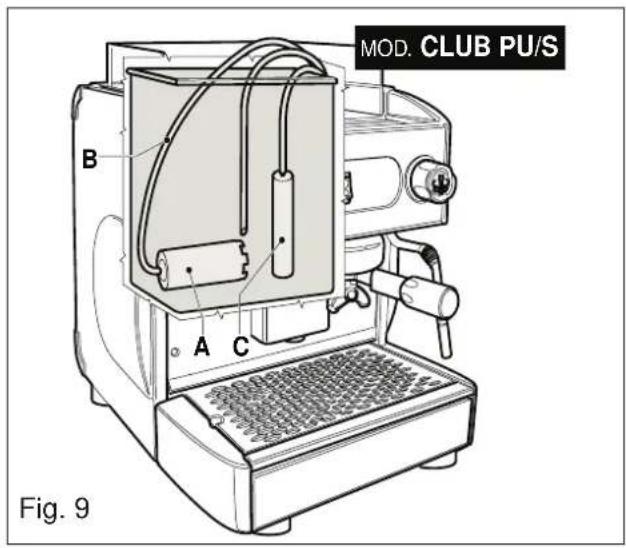
Model CLUB PU/S-ME (Fig.9)
- Open the lid on the water-tank and check that the softener 1 has been inserted in the dip pipe 2;
● Ensure that the air trap 3 has been inserted in the appropriate housing;

If the air trap is not properly positioned, the machine may not heat or properly indicate the lack of water in the tank.
- Fill the tank with 2 litres of water and close the lid;
● Turn on main switch 1/1; the boiler is filled and the heater is activated;
● Wait for the machine to reach its working pressure, gauge needle 12 Fig.8 on green area, and to reach the correct thermal balance.
Model CLUB ME - PU Fig.3
● Turn on the water supply tap Fig.5;
● Turn on the main switch 1/1 Fig. 8, the boiler is filled and the heater is activated;
● Wait for the machine to reach its working pressure, gauge needle 12 Fig.8 on green area, and to reach the correct heat level.
Models GREEN ME - PU
● Turn on the water supply tap Fig.5;
● Turn the main switch 1 Fig.8 in an anticlockwise direction to position 1; the pump is activated, filling the boiler;
- When the correct level is reached, the pump stops. Turn the main switch 1 Fig.8 in a clockwise direction to position 2 to begin heating the water in the boiler;
- Wait for the machine to reach its working pressure, gauge needle 13 Fig.8 on green area, and to reach the correct heat level.

Filling time is preset to a maximum of 2 minutes so it is possible that this is not long enough for some models (ME 3-4 units) to reach the required level. In this case, turn the main switch off and on again to complete filling by starting another filling cycle.
Lack of water is indicated on models ME by leds blinking on the button panel.
Models with automatic water level automatically control the water level.
Models with gas
● Turn on the water supply tap Fig.5;
● Turn the main switch 1 Fig.8 in an anticlockwise direction to position 1; the pump is activated, filling the boiler;
- When the correct level is reached, the pump stops. Turn the main switch 1 Fig.8 in a clockwise direction to position 2 to begin heating the water in the boiler;
● Turn the gas tap 10 Fig.8 to the vertical open position and hold down the incorporated button, at the same time repeatedly pressing hard on the piezoelectric button 11 until the spark lights the gas flame (carry out this operation looking through window 15 Fig.8). Hold the tap button 10 down for approx. 30 seconds to allow the safety system to keep the flame alight.
If the flame goes out, repeat the operation.

Should the flame not light up, avoid insisting and close the gas tap by turning it 90^ in a clockwise direction.
● Wait for the machine to reach its working pressure, gauge needle 13 Fig.8 on green area, and to reach the correct heat level.

8. USE
The machine has a top shelf on which the cups are kept and heated, ready for use. This is very important to obtain good coffee as the pre-warmed cup stops the coffee from growing cold too quickly.
8.1. Preparing coffee

It is dangerous to dispense coffee without a filter-holder in the unit.
● Unclamp the filter-holder from the dispensing unit and knock any grouts out into the drawer especially provided for this purpose, taking care not to damage the rim of the filter.
● Use the filter for 1 or 2 coffees, as required.
- Fill the filter with the measure of coffee, level it off and press it down gently with the presser.
- Remove any ground coffee that has stuck to the rim of the filter while pressing.

If ground coffee is left on the rim of the filter, a leaktight seal is not ensured, with consequent leaking of water and coffee grounds.
- Lock the filter-holder into the dispensing unit firmly to obtain a leaktight seal;
- Place the cups under the spouts and start pouring.
Model PU (Fig.8)
- Press switch 3 to begin dispensing. Once the desired quantity has been obtained, turn the switch back to its initial position to stop dispensing.
Model ME (Fig.8)
● Press the button according to the desired coffee:
A = 1 small coffee;
B = 2 small coffees;
C = 1 long coffee;
D = 2 long coffees.
Dispensing is automatic according to the dose selected.
To deliver a different dose, press key E (led on) to begin continuous delivery.
Press key E again to stop delivery.
To interrupt delivery effected with keys A-B-C-D, press the same key that was used.
- When the coffee has been poured, leave the filter-holder attached to the dispensing unit until the next coffee is required.

When pouring, beware of the hot parts of the machine, especially the coffee dispensing units, the steam and hot water spouts. Do not put your hands for any reason under the units and the spouts when they are operating.
The grinding of the coffee beans is of fundamental importance to the making of good coffee, and the granular texture of the resulting grounds should be such that it takes 25-30 seconds to produce the beverage. If the coffee is ground too coardsely the coffee will be pale in colour and weak in flavour, with only a very small amount of white cream, and if the grounds are too fine, the coffee will be dark with no cream. Good coffee can only be made if the beans are freshly and uniformly ground (only possible when the blades of the coffee grinder are sharp) and are then measured out into the correct quantities (roughly 6 grams per measure).
The importance of freshly ground coffee beans is due to the fact that once ground, they rapidly lose their aromatic qualities, and fats present in the beans go rancid.
8.2. Preparing cappuccino (Fig.10)
● Use a high and narrow jug, half-filled with milk;
- Place the jug under the spount 1 so that the nozzle touches the bottom;
● Turn on the steam tap 2 and lower the jug so that the nozzle is almost at the surface of the milk;
● Continuously move the jug up and down so that the nozzle moves in and out of the milk, causing it to froth;
● Turn off the steam tap 2, pour the milk into a cup and add the express coffee.

Immediately after carrying out this operation, clean the spout with a sponge or a clean cloth so that the milk does not dry on it. Be careful as the the spout is hot and may burn your hand. Delivery time must not exceed 5 minutes.
8.3. Heating a beverage
●Immerse the steam spout into the liquid to be heated;
● Gradually turn on the steam tap 7 (Fig.8); the steam that bursts in the liquid heats it to the desired temperature.
● Turn off the steam tap when the desired temperature has been reached.

Immediately after carrying out this operation, clean the spout with a sponge or clean cloth. Be careful as the spout is hot and may burn your hand.
8.4. Preparing tea, camomile, etc.
- Place the jug under the hot water spout 4, Fig.3 and use the delivery control according to the model Fig. 8. When the desired quantity has been obtained, close the tap (dispensing is automatically halted according to the quantity set for models GREEN ME).
During the delivery of hot water electronically dosed, delivery can be interrupted by pressing button 6 Fig. 8.
To adjust the doses, see Paragraph 9.
- Add the desired product.
When purified water is used, these beverages often assume a darker colour. Should the user prefer a lighter coloured drink, draw fresh water from an ordinary tap and proceed with the heating phase as described in point 8.2.
9. ADJUSTING AND SETTING THE DOSE
9.1. Models ME
The doses of coffee and hot water dispensed can be adjusted on the electronically controlled models.
- Place the filter-holder with the ground coffee under the unit to be programmed and the cup (or cups) under the corresponding spouts;
- Keep the E key Fig. 8 of the keyboard located onto the first group on the left hand side pressed for 5 seconds. The flashing leds of the E keys indicate the enabling of the programming phase.
- Within 5 seconds press the appropriate key (A-B-C-D) and visually check the delivery; when the quantity delivered corresponds to the desired amount, press the same key again; delivery ceases and the volume of the dose is automatically memorized.
- Carry out any other adjustment with the same procedure which will also apply for hot water dispensing buttons (2 different doses) Fig.8.

Do not make adjustments to units that do not have a filter-holder with coffee and corresponding cups.
The adjustment made to the first unit on the left also applies to the other units. If you wish to obtain different doses from the other units, the unit on the left must first be adjusted, followed step-by-step by the others.
At the end of the programming phase wait at least 5 seconds before beginning the selections.
The data memorised is permanently stored within the memory even in the case of complete absence of electric power.

9.2 Technical programming (Mod.GREEN ME)
The entrance in the TECHNICAL PRO - GRAMMING environment enables the programming of special parameters or functions.
To access TECHNICAL PROGRAMMING proceed as follows:
- Turn off the machine
- Keep buttons A and E –group 1- pressed at the same time
- Turn on the machine
- Wait (approx.3.seconds) for the machine to enter programming
- Release the buttons
Some buttons belonging to the push button panel of group 1 perform specific functions (other than dispensing functions) when "TECHNICAL PRO - GRAMMING" is under way.
| A | + | Function of “incrementing” numerical values or selection of “preset” options concerning the parameter being programmed. |
| B | - | Function of “decrementing” numerical values or selection of “preset” options concerning the parameter being programmed. |
| C ENTER | Function of confirming some operations during programming. | |
| E MENU’ | Function of selecting/choosing the parameter to be programmed. | |
- By accessing TECHNICAL PROGRAMMING in the mode described above, the display will show the first TECHNICAL parameter, i.e. the set LANGUAGE.
If you want to modify the displayed parameter, act on buttons A (+) B (-) to select the different options available. - To display the next parameter press E. The USER NAME setting will be displayed. If you want to modify the parameter (message) act on buttons A (+) or B (-), to select the letters of the alphabet; when the letter/symbol/number under the flashing cursor is the desired one, press button C (ENTER) to confirm the letter/symbol/number and go to the selection of the next letter/symbol/number.
- To display the next parameter press E. The setting of the continuous dispensing button will be displayed.
If value 0000 is set, the button function will be to STOP any dispensing.
If value 0001 is set, the button function will be to START continuous dispensing.
To increment or decrement the numerical value, press A (+) or B (-).
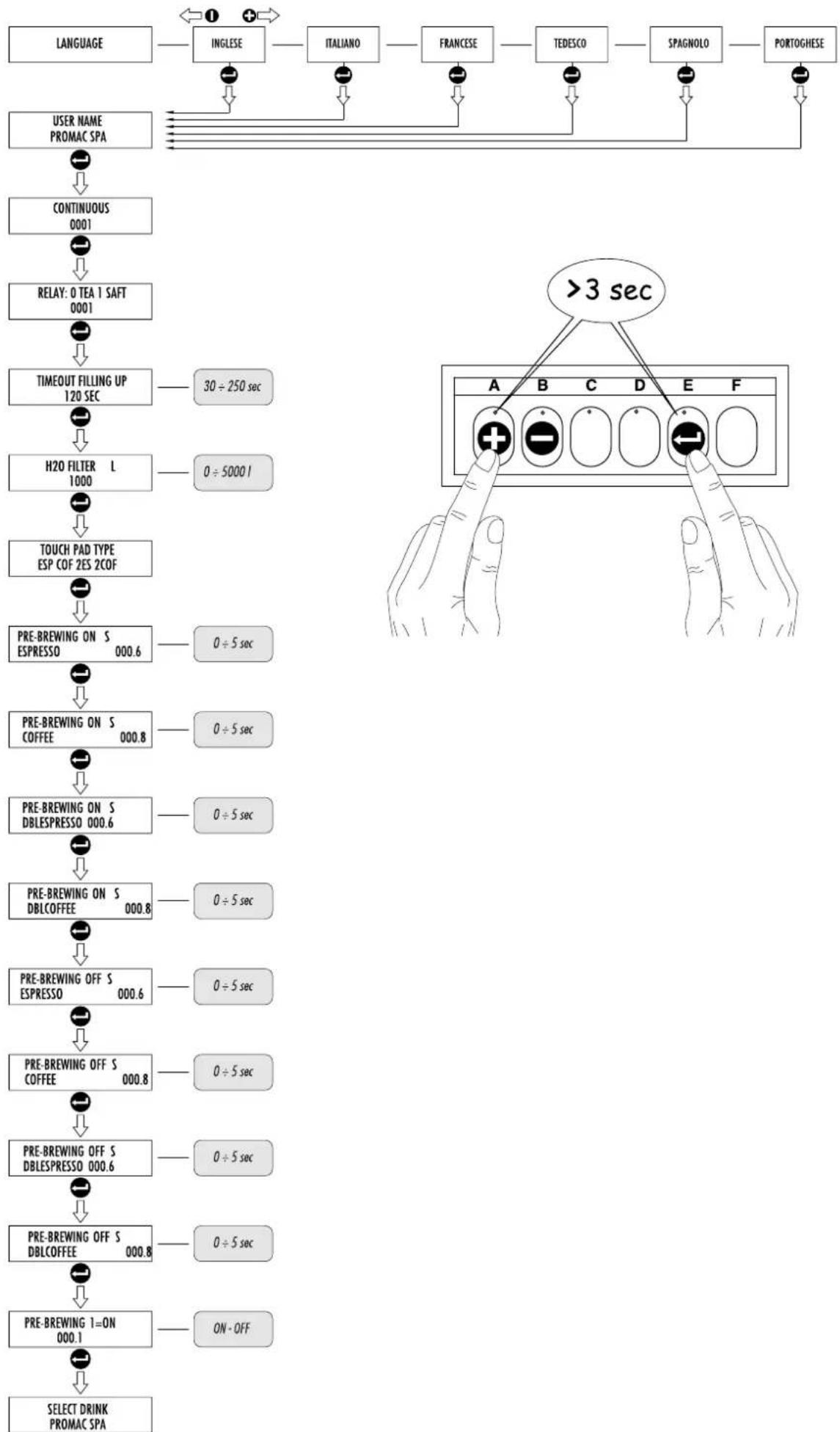
flowchart
graph TD
    A["LANGUAGE"] --> B["INGLESE"]
    B --> C["ITALIANO"]
    C --> D["FRANCESE"]
    D --> E["TEDESCO"]
    E --> F["SPAGNOLO"]
    F --> G["PORTOGHESE"]
    H["USER NAME PROMAC SPA"] --> I["CONTINUOUS 0001"]
    I --> J["RELAY: 0 TEA 1 SAFT 0001"]
    J --> K["TIMEOUT FILLING UP 120 SEC"]
    K --> L["H2O FILTER L 1000"]
    L --> M["TOUCH PAD TYPE ESP COF 2ES 2COF"]
    M --> N["PRE-BREWING ON S ESPRESSO 000.6"]
    N --> O["PRE-BREWING ON S COFFEE 000.8"]
    O --> P["PRE-BREWING ON S DBLESPRESSO 000.6"]
    P --> Q["PRE-BREWING ON S DBLCOFFEE 000.8"]
    Q --> R["PRE-BREWING OFF S ESPRESSO 000.6"]
    R --> S["PRE-BREWING OFF S COFFEE 000.8"]
    S --> T["PRE-BREWING OFF S DBLESPRESSO 000.6"]
    T --> U["PRE-BREWING OFF S DBLCOFFEE 000.8"]
    U --> V["PRE-BREWING 1=ON 000.1"]
    V --> W["SELECT DRINK PROMAC SPA"]

    X["A"] --> Y[">3 sec"]
    Y --> Z["A B C D E F"]
    Z --> AA[">3 sec"]
    AA --> AB[">3 sec"]
    AB --> AC[">3 sec"]
    AC --> AD[">3 sec"]
    AD --> AE[">3 sec"]
    AE --> AF[">3 sec"]
    AF --> AG[">3 sec"]
    AG --> AH[">3 sec"]
    AH --> AI[">3 sec"]
    AI --> AJ[">3 sec"]
- When the User Name is set, press button E to display the choice of the function related to SAFETY or TEA2 actuator.
If you want to modify the parameter act on buttons A (+) or B (-); 0000 will mean that you have chosen to use SIC/EVTEA2 relay as EVTEAS2, 0001 will mean that you have chosen to use SIC/EVTEA2 actuator as SAFETY. - To display the next parameter, i.e. LEVEL TIMEOUT, just press button E (MENU).
If you want to modify the Level Time-out parameter, press buttons A (+) or B (-) to increase or decrease its value. - When Time-out has been programmed, to go to the next menu press E (MENU) and LITRES PROGRAMMING will be displayed for setting.
If you want to modify the "water filter" parameter related to the litres calculated, press buttons A (+) or B (-) to increase or decrease its value. - When LITRES parameter has been programmed, go to the next parameter by pressing E (MENU) for the setting of the type of PUSH BUTTON PANEL used on dosing and this will apply to all push button panels used for the three groups.
Select "Esp - Cof - 2Es - 2Cof" - Press E to display the setting of ON times of solenoid valve EVx during PRE-INFUSION.
The first programmable ON time is related to buttons A of each group.
If you want to modify the ON parameter act on buttons A (+) or B (-) to increase or decrease its value. - At the end of the programming of pre-infusion ON time on buttons A of each group, press button E (MENU) to go to the setting of pre-infusion ON time of B buttons of each group.
If you want to modify the ON parameter act on buttons A (+) or B (-) to increase or decrease its value. - At the end of the programming of pre-infusion ON time on buttons B of each group, press button E (MENU) to go to the setting of pre-infusion ON time of C buttons of each group.
If you want to modify the ON parameter act on buttons A (+) or B (-) to increase or decrease its value. - At the end of the programming of pre-infusion ON time on buttons C of each group, press button E (MENU) to go to the setting of pre-infusion ON time of D buttons of each group.
If you want to modify the ON parameter act on buttons A (+) or B (-) to increase or decrease its value. - At the end of the programming of pre-infusion ON time on buttons D of each group, press button E (MENU); to display the new programmable parameter, i.e. the setting of OFF times of solenoid valve Evx during PRE-INFUSION starting from buttons A of each group.
If you want to modify the OFF parameter act on buttons A (+) or B (-) to increase or decrease its value.
- At the end of the programming of pre-infusion OFF time on buttons A of each group, press button E (MENU) to go to the setting of pre-infusion OFF time of B buttons of each group.
If you want to modify the OFF parameter act on buttons A (+) or B (-) to increase or decrease its value.
- At the end of the programming of pre-infusion OFF time on buttons B of each group, press button E (MENU) to go to the setting of pre-infusion OFF time of C buttons of each group.
If you want to modify the OFF parameter act on buttons A (+) or B (-) to increase or decrease its value.
- At the end of the programming of pre-infusion OFF time on buttons C of each group, press button E (MENU) to go to the setting of pre-infusion OFF time of D buttons of each group.
If you want to modify the OFF parameter act on buttons A (+) or B (-) to increase or decrease its value.
- At the end of the programming of pre-infusion OFF time on buttons D of each group, press button E (MENU.)
Now there is the possibility of really enabling or disabling the pre-infusion function during dispensings.
If you want to modify the pre-infusion enabling/disabling parameter, act on buttons A (+) or B (-); 0000 means that you have chosen not to use the pre-infusion functions during dispensings, while 0001 means that you have chosen to use it.
- When you have chosen to enable or disable the pre-infusion function during dispensing, if button E (MENU) is pressed, the system will go to idle-on status and TECHNICAL PROGRAMMING will therefore be terminated.
Note: After accessing the TECHNICAL PROGRAM MING environment, if you want to exit you shall scroll all menus by pressing button E (MENU) until you go back to idle on status (Select Drink); no automatic exit time-out from technical programming phase is provided.
9.2.1 Reading of consumed drinks and reading of calculated litres
There is the possibility of reading the consumed drinks (coffee and tea) according to the procedure described hereafter.
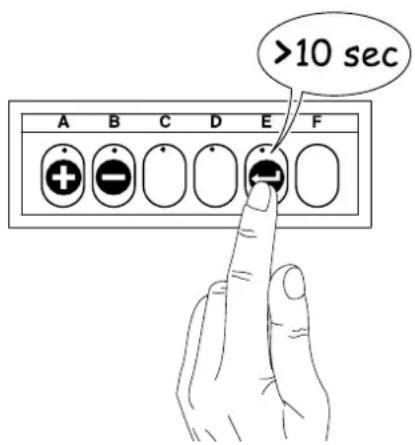
To access READING OF CONSUMED DRINKS and LITRES, just press button E (exclusively from push button panel of group 1) and keep it pressed more than 10 seconds.
To exit from the environment of READING OF CON SUMED DRINKS and LITRES, press again the same button at any time.
In this case, buttons A and B perform the special function of incrementing/decrementing the displayed values concerning the reading of consumed drinks.
“Cumulative Total” means the total coffee dispensings made, i.e. the sum of all dispensings made by pressing buttons A-B-C-D-E of each group.
Tea dispensings ARE NOT INCLUDED in the Cumulative Total.
Dosing also offers the possibility of analyzing the details of the total dispensings made by every single "button" of each group.
From the "Cumulative total", by pressing button A the total related to button A of group 1 will be displayed.
Now whenever button A of group 1 is pressed, all totals concerning the single buttons of every group will be displayed in sequential modes ( 1^ , 2^ , 3^ , 4^ and 5^ button for 1^ , 2^ and 3^ group).
If button B of group 1 is pressed, this will enable to go back to the previous total reading.
At the end of the readings concerning the coffee doses of every single group (button 5, group 3), the pressure of button A will enable the user to read the total TEA dispensings made; in this case it will be a total as no reading division between tea1 and tea2 is provided.
If button A is pressed again, this will enable to read the litres calculated up to that moment.
text_image
>10 sec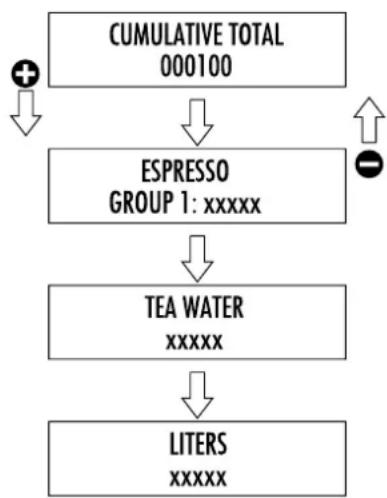
flowchart
graph TD
    A["CUMULATIVE TOTAL 000100"] --> B["ESPRESSO GROUP 1: xxxxx"]
    B --> C["TEA WATER xxxxx"]
    C --> D["LITERS xxxxx"]
    A -->|+| E
    B -->|-| F
9.2.2 Setting consumed drinks to zero
If you want to set to zero the total related to every single button of each group, just follow the procedure below.
If you are already in the reading environment of consumed drinks and litres, act on button B (group 1) (backing of readings of consumed drinks and litres) until the display shows "Cumulative total". If you are not in the reading environment, enter it by pressing button A (group 1) for more than 10 seconds.
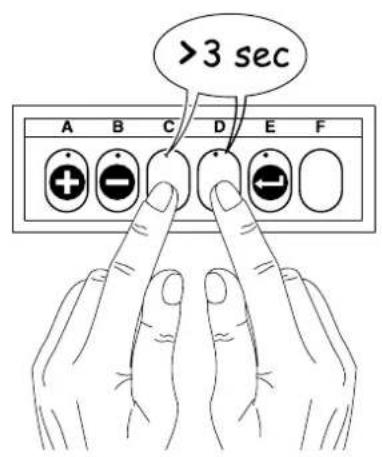
When the display shows "Cumulative Total" press button C and D (group 1) and keep them pressed at the same time for at least 3 seconds.
The totals related to every single button will be automatically set to zero.
WARNING. The "Cumulative Total" i.e.the total resulting from the sum of all dispensings made for every single button of each group cannot be set to zero.
Note: the setting to zero of consumed drinks DOES NOT SET TO ZERO the reading of consumed litres, to set to zero this parameter please refer to the relevant paragraph.
To exit from the READING environment of CONSUMED DRINKS and LITRES press the button again at any time.
text_image
>3 sec A B C D E F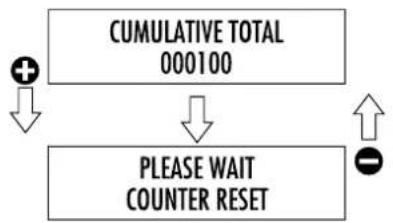
flowchart
graph TD
    A["CUMULATIVE TOTAL 000100"] --> B["PLEASE WAIT COUNTER RESET"]
    B --> A
9.2.3 Setting litres to zero
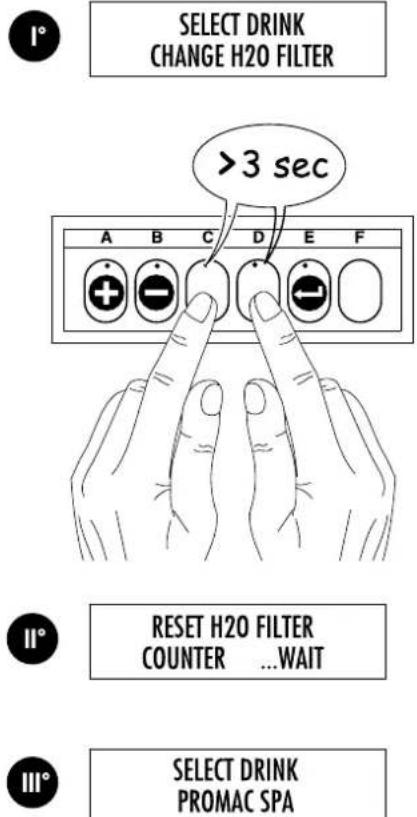
When the display shows (Fig.1°) it means that the value set in TECHNICAL PROGRAMMING of the litres that can be purified by the filter has been exceeded.
To set this signalling to zero just supply the machine by keeping buttons C and D pressed at the same time (group 1)
Now the display will show the Reset operations (Fig. II°).
Wait for dosing to go back to idle-on.
Then the display will go back to the initial setting (Fig.III°).
This procedure will set the litre reading to zero and "eliminate" the "Change H2O Filter" indication.
text_image
I° SELECT DRINK CHANGE H2O FILTER >3 sec A B C D E F II° RESET H2O FILTER COUNTER ...WAIT III° SELECT DRINK PROMAC SPA9.2.4 Mobile jumpers
3d5 MAESTRO dosing is provided with a mobile jumper suitable for the following function:
- P1 mobile jumper
OPEN: dosing is provided with a HIGH level sensitivity and safety (approx. 1,4 M)
CLOSED: dosing is provided with a NORMAL level sensitivity and safety (approx. 400K)
NOTE: the status relevant to the mobile jumper (open/closed) is detected by 3d5 dosing upon switching on. Do not carry out any variation with board in ON (power supplied) as the modification is detected only after a further Power OFF/ON.
9.2.5 Alarm signalling
Level time out (filling) in the boiler
Whenever the level probe detects lack of water (probe uncovered) the filling phase is enabled (EVCAR + PUMP) while the microcontroller activates an internal timer for the duration of this phase.
If EVCAR+ PUMP remain excited continuously for a time longer than time-out (x seconds) set by means of WIZARD of through the TECHNICAL PROGRAM MING, dosing is inhibited in all its main functions. Keyboards are disabled and all actuators inhibited in every operation
All leds installed on the push button panels start flashing ( 12 ON, 12 OFF) to visually signal the alarm phase to users.
The display will show:
ALARM: TIME-OUT FILLING-UP BOILER
To exit from alarm signalling, perform a Power OFF/ON of the machine (switching off/on).
9.2.6 Absence of pulses of volumetric counter (5 seconds)
After starting a coffee cycle with volumetric control (EVx + PUMP in both dispensing and programming phase), dosing will check the proper running of the volumetric counter by measuring the pulses sent by the microcontroller.
If no pulse is measured for a period longer than 5 consecutive seconds, the led related to the selected dose will start flashing ( 12 ON, 12 OFF).
After 1 minute (volumetric counter Time-out) of absence of pulses of the volumetric counter, the dose under way will be automatically stopped.
ALARM FLOW METER GR.X
SELECT DRINK PROMAC SPA
9.2.7 Pre-brewing
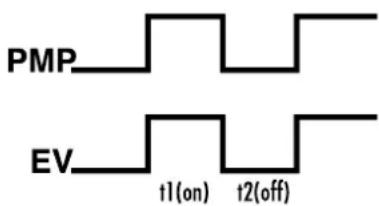
Dosing can be configured so that the dispensing of doses 1 Espresso and 2 Espresso is preceded by pre-brewing. When the dose is started, after time t1, the group solenoid valve switches off and is kept off for time t2.
PRE-BREWING ENABLING:
Start up the machine by keeping button A pressed to enable pre-brewing. The correct enabling of the PRE-BREWING function is confirmed when the leds of buttons A and B are lit.
PRE-BREWING DISABLING:
Start up the machine by keeping button B pressed to disable pre-brewing. The correct disabling of the PRE-BREWING function is confirmed when the leds of buttons C and D are lit.
Switch off the machine and switch it on again and check the desired setting.
When the pre-brewing function is enabled, the regular dispensing cycle is preceded by a short timed water jet used to moisten the coffee tablet before the actual dispensing.

WARNING: If the function is enabled, the pre-brewing will be enabled also in the dose programming phase; wait for the end of this phase before programming the coffee dispensing doses.
text_image
PMP EV t1(on) t2(off)
10. MAINTENANCE
Maintenance operations have to be carried out when the machine is off and cold and the plug is disconnected. Some particular operations have to be effected when the machine is operating.
Do not clean the machine by using metal or abrasive devices, such as steel wool, metal brushes, needles, etc. or general detergents (alcohol, solvents, etc.)
When necessary, use special detergents for coffee machines that can be bought in specialized service centres.
Use a clean cloth or sponge that does not leave hairs or fluff (preferably cotton or linen).
- Carefully clean the outside surface, following the grain of the satin finish on the parts in stainless steel.
- Clean the steam and hot water spouts, check that the nozzles are not encrusted (if they become encrusted, be careful not to deform or damage them).
● Clean the spray units and the seals under the casing of the delivery units using the special brush supplied - Remove the filter-holders of the machine and remove the filters and the clamp which secures the filter, use a brush to remove any coffee deposits and rinse with hot water in order to dissolve any grease deposits.
10.2. Weekly

Operations to be carried out with the machine operative and under pressure.
- Place the supplied blind filter in the filter-holder, put in a spoonful of detergent in powder for coffee machines and fit the filter-holder in the unit to be cleaned.
- Press the coffee dispensing button and draw water for approx. 30 seconds.
- Stop and start dispensing several times until clean water comes out of the discharge unit tube.
- Remove the filter-holder, take out the blind filter and insert a normal one. Replace the filter-holder on the unit and rinse by drawing water several times.
● Make a coffee to eliminate any unpleasant taste.
Washing cycle (Mod.GREEN ME)
The WASHING CYCLE enables the cleaning of the coffee groups and is activated as follows:
Press continuous button E and then button first dose A belonging to the group to be washed.
The display will show (on designed models):
WASHING GROUP
No.5 cycles will be performed as follows: 7-second dispensing and 3-second interval
Model CLUB PU/S - ME

Operation to be carried out when the machine is off and cold and the plug is disconnected.
- Remove the lid on the water-tank;
- Remove the air trap C and softener A Fig.9;
● Take out the water-tank, empty and clean it;
● Thoroughly rinse the water-tank and replace it in the machine; - Place the air trap in its guide and the softener horizontally on the bottom of the water-tank;
● Fill the tank with clean water and close the lid.

If the air trap is not in the correct position, the machine cannot heat or indicate a lack of water in the tank.
Cleaning the filters and delivery heads (Fig.12)

Operation to be carried out when the machine is off and cold.
● Prepare a solution of 4 sachets of detergent powder Code 69000124 dissolved in a litre of boiling water in a stainless steel, plastic or glass container (NOT ALUMINIUM OR IRON).
- Remove the filters and immerse them with the filter holders in the prepared solution, leaving them for at least 20/30 minutes (all night is better).
- Remove them from the container and rinse them thoroughly in running water.
- Remove the cup rack (Fig.12), slide out the drip tray and clean them both.
- Check and clean the drainage sump, removing any sludge with the help of a spoon.

10.3. Periodical maintenance
10.3.1. Renewal of water in the boiler models CLUB PU - ME (Fig,13)
To be carried out only by qualified personnel.
- Turn off the machine and wait for the pressure in the boiler to diminish (gauge needl on "0").
- Insert a rubber hose into the hose-end fitting (3) (Fig.13)
- Use the wrench (1) to immobilize the fitting (2) and loosen the hose-end fitting (3).
- Allow the water to flow out completely; then, close the fitting (3) and remove the rubber hose.
● Refill the boiler (paragraph 7.3.).

10.3.2. Renewing the water in the boiler models ME (excluding CLUB ME - ME).

Operation to be carried out when the machine is on and under pressure.
● Draw the water from the boiler by pressing the delivery control key 6 Fig.8;
- Repeat this operation several times to enable an adequate change of water;
- Wait until the correct operating pressure has been reached (guage needle Fig.8 on green area)) before making coffee.
10.3.3. Regeneration (Fig.14)
Model CLUB PU/S - ME

Operation to be carried out when the machine is off and cold and with the plug disconnected.
To be effected after the consumption of approx.15 litres of water (average hardness calculated as 35 degrees on the French scale) or at least once a month.
● Prepare a solution in a glass of water adding three teaspoons of fine salt (the salt must be properly dissolved).
● Drain the water-tank, see point 10.2.
- Slide the softener 1 Fig.14 off the rubber tubing 2 and turn it over.
- Pour the solution through the filter and the resin, letting it flow down freely.
● Wait about 5 minutes, then hold the softener under a tap and rinse it with water. When the water coming out of the softener is no longer salty, the resins are regenerated and the softener is ready for use once again.
● Put the softener back on the rubber tube and replace it horizontally on the bottom of the tank.
- On completion of this operation, the machine can be started up again by repeating the procedure described in paragraph 7.3.
Softener DP8 - DP12
Regenerate the water softener within the time-limits specified for the softener as follows:
DP8
nr.1 regeneration per month for 500 coffees/day; nr.2 regenerations per month (once a fortnight) for 1000 coffees/day.
DP12
nr.1 regeneration per month for 1000 coffees/day; nr.2 regenerations per month (once a fortnight) for 2000 coffees/day.
This table has been drawn up according to a water hardness of 25 degrees calculated on the French scale.
See the documentation included with the softener for the instructions for use.
11. STOPPING THE MACHINE
A - Temporary stop
● Carry out cleaning and maintenance operations.
● Wind up the cable and fasten it to the machine with sticky tape.
● Cover the machine and place it in a dry room. Do not leave it exposed to atmospheric agents and do not allow it to be touched by children or unift persons.

To disconnect from the main power supply, consult qualified personnel.
B - Definitive stop
- Besides carrying out the operations necessary for a temporary stop, cut off the cable, pack the machine in cardboard, polystyrene or other packing material and consign it to firms authorized for its disposal or to second-hand goods dealers.
12. PROBLEMS AND REMEDIES

Check operations to be carried out by the user with the plug disconnected.
For any type of problem or inconvenience not specifically indicated, disconnect the plug and contact our service centre without attempting any direct repairs.
A) The machine does not start:
- check that the plug is connected;
- In case of power failure wait for the power to return and check if the earth leakage protection circuit breaker or the main switch is on;
- check the condition of the plug and the supply cable; if damaged have them replaced by qualified personnel.
B) There is water under the machine:
- check that the drainage tray is not obstructed.
C) Slow dispensing: - check that the filters and delivery heads are clean;
- check that the coffee is not too finely ground.
D) Irregular steam delivery: - check that the nozzles are not obstructed.
11. MACHINES WITH ALTERNATIVE GAS HEATER VERSION (Fig.15)

N.B. Installation of the machine and any adjustment or adaptation to the type of gas should be done by a technically qualified person.

The machine leaves the factory all set for use with liquid gas (GPL).
The gas regulator (1) is therefore fitted with the appropriate injector shown in the table below:
| Model | Nominal thermic capacity | GPL G30 - 29 mbar | Natural gas G20 - 20 mbar |
| 2 Gr. | 2,5 KW (2150 Kcal/h.) | 75 102 | |
| 3-4 Gr | 3,3 KW (2850 Kcal/h.) | 90 135 |
The primary air intake regulator (2) is set with the reference notch showing “GPL” corresponding to the fixture screw (3).
The flame is regulated (minimum and maximum) to suit this type of gas.
If the machine is to be used with a different type of gas, it will be necessary to replace the injector in accordance with the above table and to rotate the primary air regulator (2), which, in the case of natural gas, will have to be set with the reference notch showing "N" corresponding to the securing screw (3).
To do this, it will of course be necessary to loosen the securing screw (3) and to tighten it again after rotating the primary air intake regulator (2).
Connections to mains gas, from the gas tap available in the room to the valve fitted on the machine, must be carried out in accordance with the regulations in force, using a flexible pipe or a rigid pipe of soft copper. In the latter case, the special rubber-pipe fitting in connected tightly to the valve by means of the biconical nozzle and securing nut supplied.
The flexible pipe is fitted over the end of the mains outlet and secured with the metal strip supplied.
Alternatively, the soft copper pipe can be connected up, again using the special biconical nozzle and the appropriate nuts, directly to the valve.
Once the machine has been connected up to the gas main, and after filling the boiler up with water in accordance with the instructions in the booklet ("INSTRUCTIONS FOR USE AND MAINTENANCE"), the burner can be lit in the following manner:
- Open the gas exclusion tap.
- Press on the gas valve knob, on the machine rotate it 90° anti-clockwise, and keep it pressed in. At the same time, press the piezoelectric lighter one or more times – the lighter knob bears a symbol resembling a spark – until the burner lights up.
- Wait about 20 seconds, then release the valve knob and the burner should stay lit – the flame is visible through the special hole in the panel behind the dispenser units.
N.B.
Should the burner not light up, do not persist, but release the valve knob, and then check that lighter spark on the burner is in order and about 5 mm long.
Should the flame go out when the valve knob is released, check the position of thermocouple and the circuit connected to it.
The flame should be bright blue; if not, slightly regulate the primary air intake (2) until the desired effect is achieved.
Wait until the machine reaches the correct pressure, according to instructions. Otherwise, adjust the gas pressure regulator, which has two regulating screws.
The one that protrudes more (4) serves to regulate the boiler's operating pressure, while the other (5) serves to set the flame at the minimum.
When the machine is pressurized, check to see that the minimum flame is correct by adjusting the screw (4) if necessary; after loosening the locking-nut, unscrew the screw until it feels loose (the main gas-pipe is closed), and check whether, under these conditions, the low flame remains lit, thus acting as a pilot.
If the flame is too high, it will be necessary to regulate screw (5), turning it slightly clockwise, of course after having loosened the locking-nut. If, on the contrary, the flame tends to go out, then regulate screw (5) by turning it anti-clockwise, until a very low, but constant flame is obtained. Having achieved this correct adjustment of the minimum flame, hold the screw still and lock it with the locking-nut.
Then rotate the screw (4) clockwise until there is a there is a high flame, and wait for the boiler to reach the desired operating pressure: if the flame dies down before reaching the required pressure, tighten screw (4) further; if the flame dies down at a higher pressure, then unscrew the screw.
Check once or twice by opening the steam tap to release the pressure in the boiler, then hold screw (4) still and lock it with the locking-nut.
I ITALIANO 10-27
F FRANCAIS 28-45
D DEUTSCH 46-63
GB ENGLISH 64-81
E ESPAÑOL 82-99
P PORTUGUÊS 100-117
SCHEMI ELETTRICI
SCHEMAS ELECTRIQUES
SCHALTPLANE
WIRING DIAGRAMS
ESQUEMAS ELECTRICOS 118-128
ESQUEMAS ELÉTRICOS
SCHEMI IDRAULICI
SCHÉMAS HYDRAULIQUES
HYDRAULIKPLÄNE
HYDRAULIC DIAGRAMS
ESQUEMAS HIDRÁULICOS 129-134
ESQUEMAS HIDRÁULICOS
text_image
>3 sec A B C D E F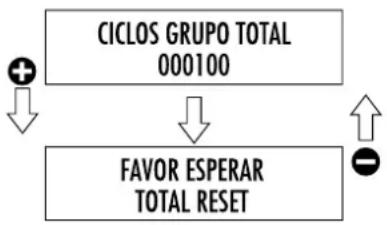
flowchart
graph TD
    A["CICLOS GRUPO TOTAL 000100"] --> B["FAVOR ESPERAR TOTAL RESET"]
    B --> A
9.2.3 Reseteo litros
text_image
>3 sec A B C D E F
CONTAT. FILTRE MISE A ZERO

ALARME FLOW METER GR.X
text_image
>3 sec A B C D E F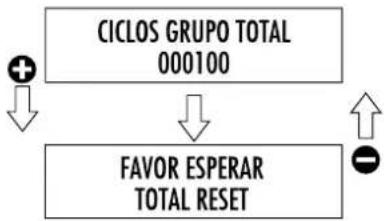
flowchart
graph TD
    A["CICLOS GRUPO TOTAL 000100"] --> B["FAVOR ESPERAR TOTAL RESET"]
    B --> A
text_image
>3 sec A B C D E F
CONTAT. FILTRE MISE A ZERO

ALARME FLOW METER GR.X
GB Reserved property.
Partial or total reproduction of this manual is forbidden without written authorisation of PROMAC Italia srl.
PROMAC Italia srl reserves the right to effectuate, in any given moment, any modifications which are considered necessary.
Espresso coffee Machines and Bar equipment
PROMAC Italia s.r.l. - 20025 LEGNANO (MI) - Italy
Via Cremona, 1
Telefono 0331 455102 - Fax 0331 484218