PX400 E - Rowing Machine REX - Free user manual and instructions
Find the device manual for free PX400 E REX in PDF.
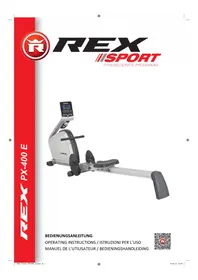


| Product type | Rowing machine |
| Brand | Rex |
| Model | PX400 E |
| Dimensions (L × W × H) | 220 cm × 50 cm × 96 cm |
| Weight | 42 kg |
| Maximum user weight | 130 kg |
| Flywheel | 4 kg |
| Resistance | 16 levels, computer-controlled |
| Braking system | Magnetic brake |
| Power supply | 220-240 V / 50 Hz adapter |
| Display | LCD: time, distance, calories, pulse, SPM, watt |
| Training programs | Manual, Profile (12), Pulse (55/75/90% and TAG), Race, User (4), Fitness test |
| Heart rate measurement | Hand grip sensors + chest belt included |
| Folding and transport | Folding mechanism with transport wheels |
| Warranty | 2 years |
| Standard | DIN EN 957-1/7, domestic use |
| Accessories included | Bottle holder, bottle, chest belt, assembly tools |
| Maintenance | Slightly damp soft cloth; check screw tightness every 2 to 4 weeks |
| Cleaning | Do not use aggressive products, avoid any liquid in the console |
| Safety | Do not use by persons with reduced physical capabilities without supervision; keep children and animals away |
Frequently Asked Questions - PX400 E REX
User questions about PX400 E REX
0 question about this device. Answer the ones you know or ask your own.
Ask a new question about this device
Download the instructions for your Rowing Machine in PDF format for free! Find your manual PX400 E - REX and take your electronic device back in hand. On this page are published all the documents necessary for the use of your device. PX400 E by REX.
USER MANUAL PX400 E REX
4. STROKES/TOTAL STROKES
C Pulse program (HRC - 55%/75%/90%/TAG)
Preface GB-23 Identification of important notes GB-23 Important safety instructions . GB-24 Exploded view GB-25 Parts list GB-26 Assembly GB-29 Folding mechanism/Transport GB-31
Exercise 10.3.2. (Continued.)
Exercise Notes 20 A Intensity . GB-32 B Frequency GB-32 C Motivation GB-32 D Organisation of workout sessions GB-32 1.Warming up phase GB-32 2. Workout phase . GB-33 3. Cooling down phase . GB-33 E Rowing technique GB-33
Operation GB-35
Default settings GB-35 Button functions . GB-35 Display information. GB-36 Exercise parameters. 20 Exercise 10.3.2 (Continued)
A Manual GB-37 B Profile programmes GB-37 C Pulse programme. GB-38 D Racing programme GB-38 E User programme. GB-39 F Fitness test . GB-39
Care/Maintenance GB-40 Technical data GB-40 Disposal GB-40 Warranty GB-41
Preface

Congratulations on your purchase of our fitness machine. You have purchased a really excellent product and will certainly enjoy using it.
To avoid injuring yourself or damaging the machine, please read the operating instructions carefully
before using the machine for the first time. Keep the operating instructions in a safe place.
Identification of important notes
Particularly important notes are identified in the operating instructions as follows:

This warning alerts you to possible hazards to your health or life or that of other persons which may occur with the handling or operation of this machine.

This note alerts you to possible hazards for your machine.
This information provides you with additional advice and tips.
Important safety instructions

Keep the operating instructions in a safe place. Make sure they are included in case you sell or pass the fitness machine on to someone else.

It is important for you to read through the instructions completely before assembling and using the machine.
The safe and highly productive use can only be achieved if the machine is properly assembled, maintained and used correctly. It is your obligation to inform all users of this machine about the hazards and safety precautions before use.
The machine complies with DIN EN 957-1/7 and is suitable only for private home use and may not be used commercially or for therapeutic purposes.
Use the machine only in dry indoor rooms at room temperature. Protect it from moisture, dust/dirt and extreme temperature fluctuations.
Only set up the machine on a solid, level surface and use a protective cover for the floor/carpet. Remove all sharp-edged objects from the surroundings and leave a free space of at least 0.5 m around the machine.
Make sure to prevent liquids (including perspiration!) from leaking into the inside of the machine or in the fitness computer.
Use the machine only as specified! If you find defective components during the assembly or the inspection, or if you hear unusual noises during use, stop your training immediately. Do not use the machine until the problem has been remedied.
Before using the exercise machine, check to see if all screws and nuts have been securely fastened and tightened.
The safety level of the machine can only be maintained if it is regularly checked for damage and wear. Have professionals carry out repairs and use only original spare parts.
Keep the machine away from children and house pets. It is only suitable for adults.
The machine is not designed for use by persons with restricted physical, sensory or mental abilities or lack of experience and/or knowledge unless they are supervised by a person responsible for their safety or have received instructions on how to use the machine from such a person.
The approved maximum weight of the user may not exceed 130 kg.
Before you begin training, consult your doctor to determine whether training could represent a risk to your health. Your doctor's advice is imperative if you are taking medication that affects your heart rate, blood pressure or cholesterol level.
Be aware of your body's signals! Incorrect or excessive training can impair your health or even damage it. Stop if any of the following symptoms occur: pain, tightness of chest, irregular heartbeat, shortness of breath, feelings of lightheadedness, dizziness or nausea. If only one of these conditions occurs, consult your doctor before continuing your exercise programme.
Wear suitable clothing when working out! Do not wear loose clothing with which you could get caught in the machine or which could restrict or hinder your movements.
Use caution when lifting and moving the machine to, e.g., prevent injuries to your back. Always use lifting techniques if possible, or get someone to help you.
To operate, use only the supplied original mains adapter. The machine as well as the mains adapter is only intended for indoor operation. The power source to be used may only be a protected 220-240 V/50 Hz power outlet! Mortal danger!
Disconnect the mains plug after your workout or when cleaning or maintaining your exercise machine.
Exploded view
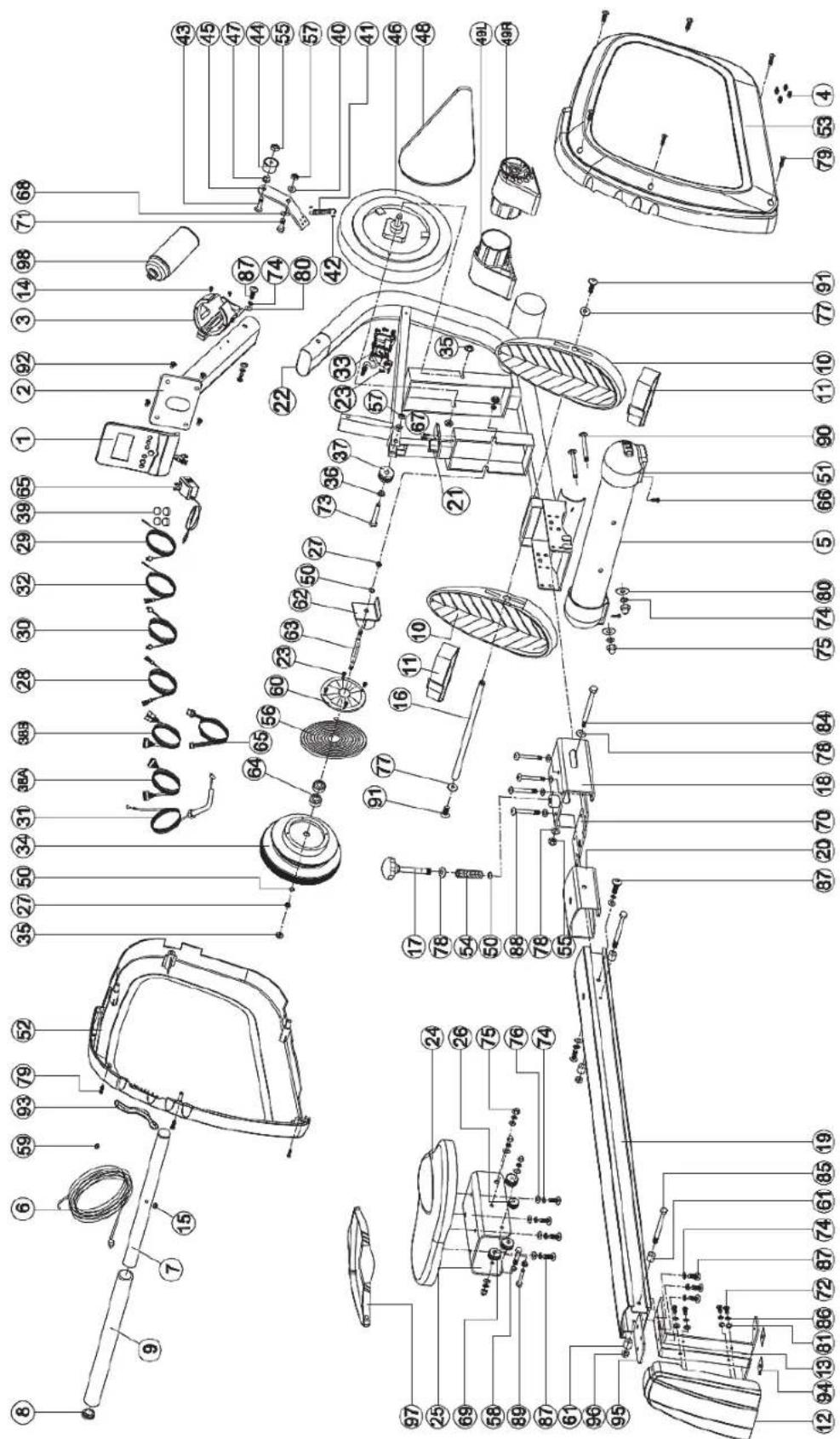
Parts list
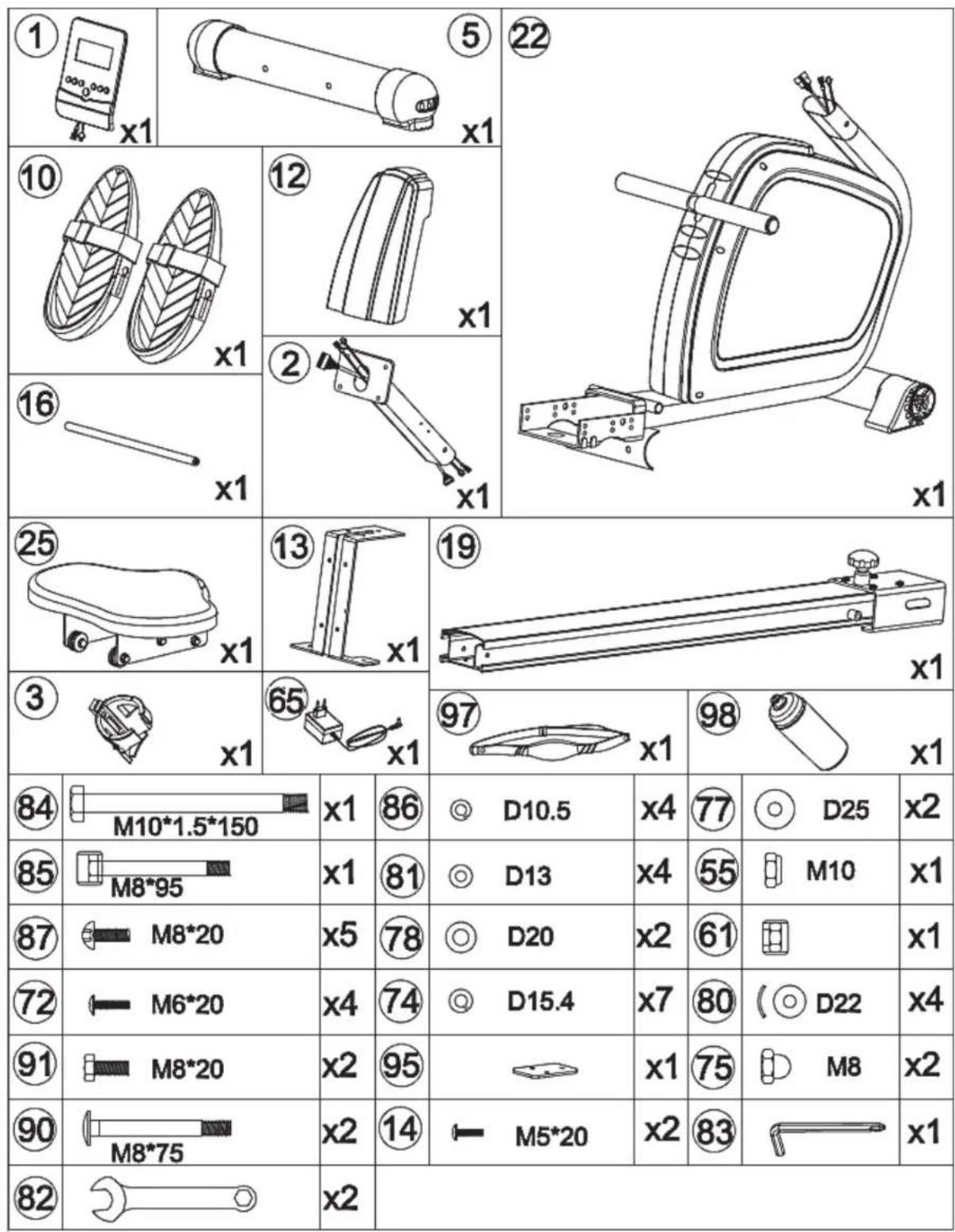
| No. | Name | Size | |
| 1 Display | 1 | ||
| 2 Frame tube 1 | |||
| 3 Drink bottle holder 120 x 87 x 3T 1 | |||
| 4 Screw D6 x 26.5 x 7.7 4 | |||
| 5 Foot D60 x 1.5T x 440L 1 | |||
| 6 Traction cable D5 x 2000L 1 | |||
| 7 Handle D25.4 x 400 x 1.4T 1 | |||
| 8 Plug D25.4 x 31L 2 | |||
| 9 Soft grip | D23 x 4T x 400L | 1 | |
| 10 | Tread | 315 x 137.5 x 67 | 2 |
| 11 | Loop | 440 x 50 | 2 |
| 12 | Cover | 330 x 196 x 69 | 1 |
| 13 | Angle bracket | 1 | |
| 14 | Screw M5 x 0.8 x 20L | 2 | |
| 15 | Guide sleeve | D10.5 x D7.5 x 9T | 1 |
| 16 | Pin | D12 x 444L 1 | |
| 17 | Locking screw | D50 x M10 x 1.5 x 115.5L | 1 |
| 18 | Rail support | 1 | |
| 19 | Rail | 115 x 69.5 x 1210L | 1 |
| 20 | Rail | 63 x 59 x 110 x 3T | 1 |
| 21 | Sensor holder | 30 x 28 x 21 | 1 |
| 22 | Main frame 1 | ||
| 23 | Self-locking screw | ST4.2 x 15L | 8 |
| 24 | Pushing device | 380 x 280 x 35 | 1 |
| 25 | Seat | 1 | |
| 26 | Roll | D32 x D18 x 10 2 | |
| 27 | Nut | D9.5 x 5T(3/8"-26UNF) | 3 |
| 28 | Pulse cable | 450L | 1 |
| 29 | Pulse cable | 1 | |
| 30 | Pulse cable | 450L | 1 |
| 31 | Cable | 1 | |
| 32 | Pulse cable | 1 | |
| 33 | Motor | 1 | |
| 34 | Rope winding | D160 x 76L 1 | |
| 35 | Nut | 3/8"-26UNF x 6.5T | 4 |
| 36 | Distance sleeve | D13.5 x D10 x 9 | 2 |
| 37 | Belt pulley D45 x 26L | 1 | |
| 38A | Computer cable A | 1 | |
| 38B | Computer cable B | 1 | |
| 39 | Round magnet | M02 | 4 |
| 40 | Washer, plastic | D10 x D24 x 0.4T | 1 |
| 41 | Spring | D2.2 x D14 x 65L | 1 |
| 42 | Plastic sleeve | D3 x 30L | 2 |
| 43 | Allen screw | M10 x 35L | 1 |
| 44 | Guide | D23.8 x D38 x 24 | 1 |
| 45 | Guide clip | 156 x 62.2 x 5T | 1 |
| 46 | Flywheel | D232 x 122L | 1 |
| 47 | Socket | D20 x D14 x 11.5 | 1 |
| 48 | Belt | 300 PJ5 | 1 |
| 49L | Transport roll left | D60 x 83 L | 1 |
| 49R | Transport roll right | D60 x 83 L | 1 |
| 50 | Locking ring | S-10(1T) | 3 |
| 51 | Height adjustment | D60x79 L | 2 |
| 52 | Cover left | 1 | |
| 53 | Cover right | 1 | |
| 54 | Spring | D13 x D1.2 x 85.5L | 1 |
| 55 | Nut | M10 x 1.5 x 10T | 1 |
| 56 | Vorttex disc | 20 x 0.7T | 1 |
| No. | Name | Size |
| 57 Nut M8 x 1.25 x 8T 2 | ||
| 58 Guide D12 x D8.2 x 12.6L 6 | ||
| 59 Damper D11 x 7L 1 | ||
| 60 Spring shackle D121 x 3T 1 | ||
| 61 rear damper D24 x D8 x 22 4 | ||
| 62 Holder 1 | ||
| 63 Shaft D10 x 120.7 1 | ||
| 64 Guide bearing 6000ZZ | 2 | |
| 65 Mains adapter 9 VA, $00 MA | 1 | |
| 66 Self-locking screw ST4 x 1.41 x 10L | 2 | |
| 67 Screw M5 x 0.8 x 10L 2 | ||
| 68 Washer D21 x D8.5 x 1.5T | 1 | |
| 69 Roll D37.4 x D8 x 11 | 4 | |
| 70 Counter plate 100 x 78 x 3T | 1 | |
| 71 Screw M8 x 25, 15MM, 8.8 | 1 | |
| 72 Screw M6 x 1.0 x 20L 4 | ||
| 73 Screw M8 x 1.25 x 55.5L | 1 | |
| 74 Spring clip D15.4 x D8.2 x 2T | 17 | |
| 75 Cap nut M8 x 1.25 x 15L, 8.8 | 6 | |
| 76 Washer D16 x D8.5 x 1.2T | 16 | |
| 77 Washer D25 x D8.5 x 2.0T | 2 | |
| 78 Washer D20 x D11 x 2T | 3 | |
| 79 Screw ST4.2 x 1.4 x 20L | 13 | |
| 80 Washer D22 x D8.5 x 1.5T | 4 | |
| 81 Washer D13 x D6.5 x 1.0T | 4 | |
| 82 Spanner 139 x 5T | 2 | |
| 83 Hexagonal socket spanner M6, 8.8 | 1 | |
| 84 Screw M10 x 1.5 x 150L 1 | ||
| 85 rear damper M8 x 1.25 x 95L | ||
| 86 Spring clip D10.5 x D6.1 x 1.3T | 4 | |
| 87 Allen screw M8 x 1.25 x 20L,8.8 | 11 | |
| 88 Allen screw M8 x 1.25 x 75L, 8.8 | 4 | |
| 89 Allen screw M8 x 1.25 x 35L,8.8 | 6 | |
| 90 Allen screw M8 x 1.25 x 75L, 8.8 | 2 | |
| 91 Screw M8 x 1.25 x 20L, 8.8 | 2 | |
| 92 Screw M5 x 0.8 x 10L 4 | ||
| 93 Rope guide | 1 | |
| 94 Rubber foot 35 x 35 | 2 | |
| 95 Counter plate 93 x 50 x 4T | 1 | |
| 96 Nut M8 x P1.25 x 6T | 2 | |
| 97 Chest strap | 1 | |
| 98 Drink bottle | 1 | |
Assembly
WARNING
- Place the machine and the rear foot (5) on the floor as illustrated.
- Screw the rear foot (5) together with the main frame (22). Use the two Allen screws (90), two cap nuts (75), two spring clips (74) and two washers (80) for this.
STEP1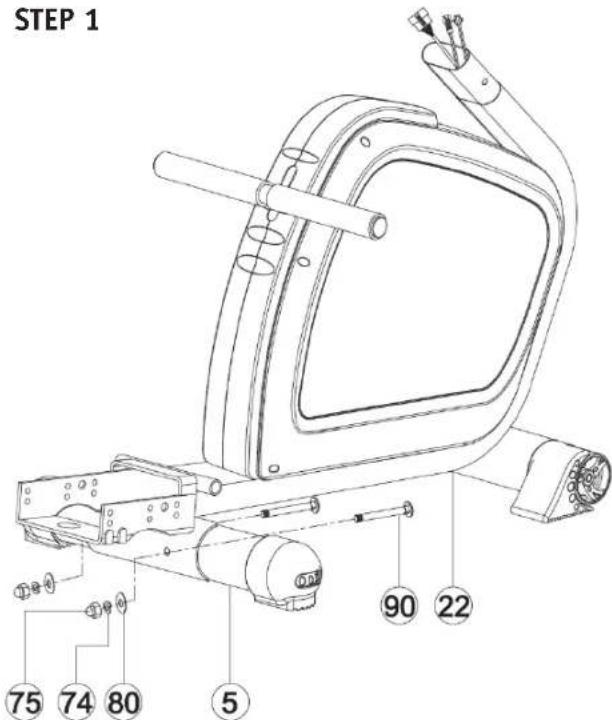
WARNING
- Place the counter plate (95) into the underside of the rail (19) as illustrated (see Fig. 1).
- Screw the angle bracket (13) to the rail with three screws (87), three spring clips (74) and the counter plate (see Fig. 1).
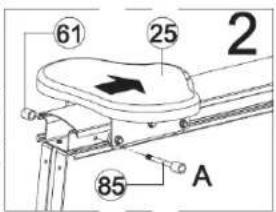
- Push the seat (25) into the guide of the rail (see Fig. 2).
- Screw the rear dampers (85 + 61) into the rail (see Fig. 2).
- Likewise, mount the front dampers into the rail.
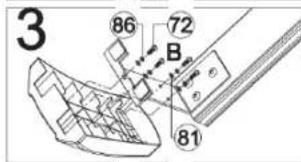
- Attach the rear cover with four screws (72), four spring clips (86) and four washers (81) as illustrated (see Fig. 3).
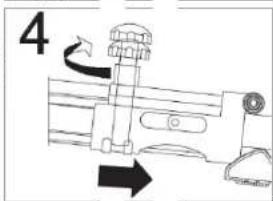
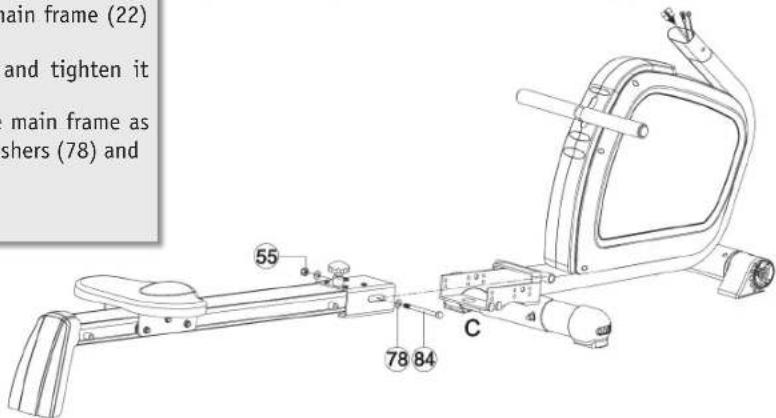
- Place the pre-assembled rail in the main frame (22) as illustrated (see Fig. 4).
- Press down the locking screw (17) and tighten it clockwise up to the stop (see Fig. 4).
- Now screw the rail together with the main frame as illustrated. Use the screw (84), two washers (78) and the cap nut (55).
STEP 2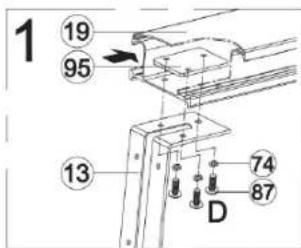
Assembly
WARNING
- Mount both treads (10) to the main frame as illustrated. Here, use two screws (91), two washers (77), the pin (16) as well as both treads (10).
STEP 3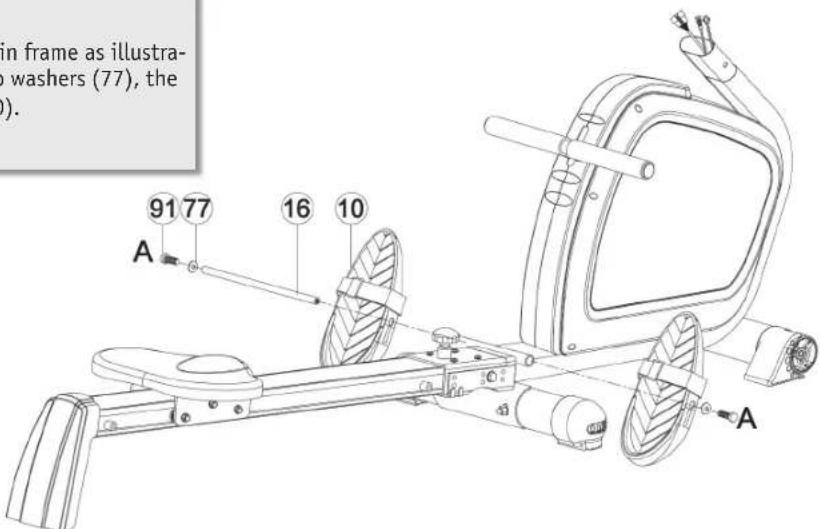
WARNING
- Join the upper and lower computer cables in the centre of the frame tube as illustrated.
- Mount the frame tube (2) to the main frame using two screws (87), two spring clips (74) and two washers (80).
- Fasten the drink bottle holder (3) to the frame tube (2) using two screws (14).
- Push the drink bottle (98) into the holder.
- Connect the computer cables to the display (1) (see Fig. (b)).
- Fasten the display (1) to the designated retaining plate using four screws (92).
- Insert the plug of the mains adapter (99) into the socket at the left front side of the machine.
- Then insert the mains adapter (99) into the power outlet. The machine is ready to operate.
STEP 4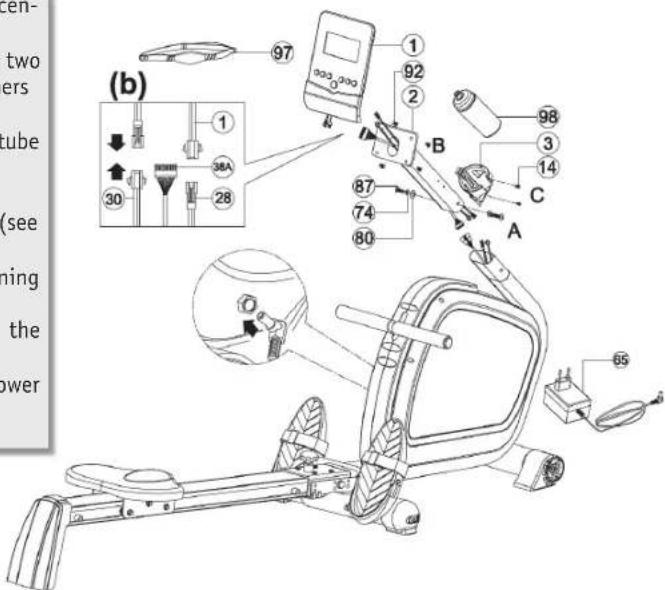
Folding mechanism
Folding together
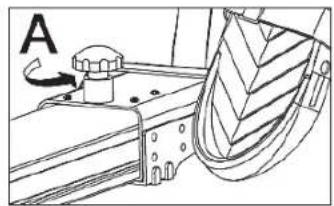
- Release the locking screw until it snaps back audibly (see Fig. A).
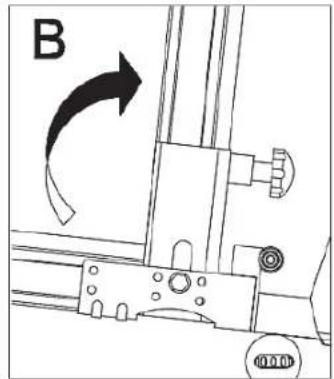
- Pull back the rail briefly and unfold it until it engages (see Fig. B).
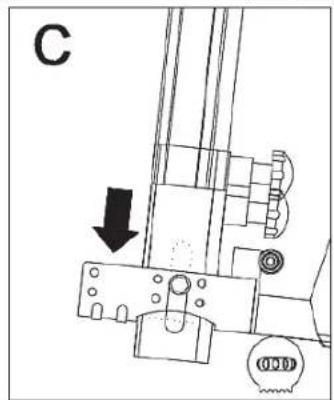
- Make sure that the rail is engaged securely (see Fig. C).
Opening out
- Pull up the rail and then open it out downwards.
- Push the rail up to the stop in the direction of the main frame.
- Press down the locking screw and tighten it clockwise up to the stop.
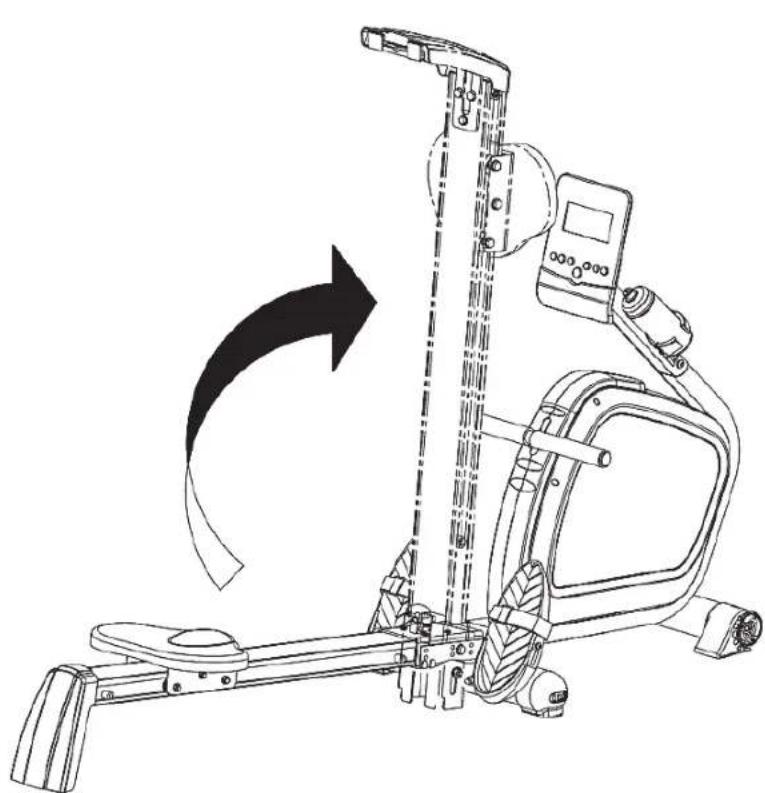
Transport
To shift the machine, it must be first folded together (see "Folding together"). Make sure that the rail is engaged securely. Slowly tilt the machine back until it stands on the transport rolls. You may now carefully move the machine to the desired location. When choosing a suitable location, please observe the safety instructions at the beginning of these operating instructions.
Exercise
Using your fitness machine will provide you with numerous advantages. It will improve your physical fitness, emphasize your muscles, and help you lose weight in conjunction with a calorie-reduced diet.
DESIGNING YOUR WORKOUT/NOTES
To achieve an optimal workout, you should consider several important things regarding the manner (of working out) and organization of your workout before you begin. To improve your health and body, you should consider the following factors when planning your workout:
A Intensity
The workout must be organised in such a way that the physical effort during the workout is higher than your normal effort. But breathlessness or exhaustion may not occur. During an effective workout, your pulse should be between 70% and 85% of your maximum pulse (see also the "Workout Phase" chapter).
During the first few weeks of your workout, your pulse should be at roughly 70% of your maximum pulse and slowly increase to 85% of your maximum pulse in the following weeks and months. The workout requirements could be increased, e.g., by extending the workout duration and/or increasing the levels of difficulty according to your increasing condition. The following resources can help you to check your pulse rate:
a) You can feel your pulse rate yourself and count the beats per minute (e.g. at your wrist) -> Measurement of pulse rate by the usual methods. b) You can measure your pulse with the sensor surfaces attached to the handle. c) You can also determine your pulse rate using specific calibrated pulse measuring devices.
Pulse measurement by sensor is only an orientation, as movement, friction, perspiration etc. can cause deviations from the actual pulse. The pulse beat related electrodermal effect of some people is so low that the result is insufficient for accurate pulse measurement.
B Frequency
Experts recommend 3-5 workout sessions per week, depending on your training goal. Your workout should be accompanied by a balanced and healthy diet. An average adult requires at least 3 workout sessions per week to change their body weight or improve their condition, or 2 workout sessions per week to maintain their current condition.
C Motivation
To successfully complete a training programme, regularity is a very important point. Mental preparation as well as a fixed time period and space per workout session will also contribute to that goal. We recommend you always keep your personal goal in sight and if possible, to workout only when you are in a good mood. Work out continuously so that each day helps you come closer to your training objective.
D Organisation of workout sessions
There are three workout phases that should be done during every workout:
a) Warming up phase b) Workout phase c) Cooling down phase
1. Warming up phase
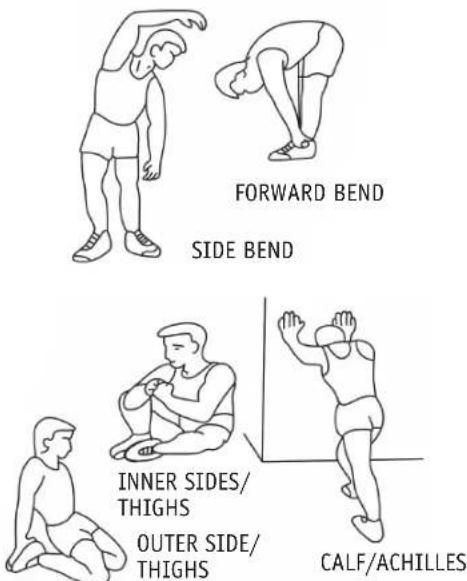
This phase contributes to improved circulation in your body and correct muscle function. It also decreases the risk of cramps and muscle injury. It is therefore recommended to start with a few stretching exercises (see figure) before every workout session. Each exercise should last approx. 30 seconds. Avoid sudden movements and do not strain your muscles. Stop the stretching exercise as soon as it hurts.
2. Workout phase
When working out, make sure you keep an even and consistent speed. Optimal training means choosing a workout that keeps your pulse at a value of approx. 70% - 85% of your maximum pulse (target zone). Use the graphic to read the matching target zone for you.
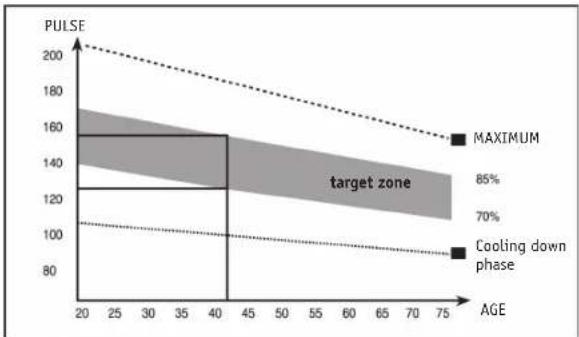
The workout phase should last at least 12 minutes. At the beginning, a workout time of approx. 15-20 minutes is usual.
When you work out for the first time you should not specify a particular time. Above all, make sure that you execute the technique cleanly. Also, a high stroke rate should scarcely be of any importance. You should only work out until you start to feel tired.
3. Cooling down phase
This phase is intended to relax your muscles and your cardiovascular system. To do so, e.g. reduce your speed for approx. 5 minutes. Then repeat the stretching exercises as described in Phase 1. Remember not to make any sudden movements in this phase and do not strain your muscles.
E Rowing technique
As opposed to other workout devices, rowing not only moves your legs but also your upper body and the center of your body. You practically have a full body workout. The joints of your legs, upper body, back, and arms are exercised gently and uniformly. Compared to other forms of sport, your body consumes considerably more calories.
Rowing is divided into recovery and drive phases:
Recovery phase
- Start the rowing movement by stretching out your arms.
The back is straight and upright, the chin lifted, the gaze directed to the front.
- Lean your upper body forwards.
The posture is upright, the back straight, the chin lifted, the gaze directed to the front. The knees are completely extended and the feet are placed on the foot rest. The shoulders are relaxed and the arms are completely extended. The upper body is bent slightly forwards (from the hip) and the shoulders are located in front of the hips.
- Move your body to the compressed front drive position.
The arms and the upper body remain in the forward leaning position. The seat is moved forwards. Knees and hips bend simultaneously and evenly (make sure that the knees only begin to bend behind the handle). Rolling forwards occurs in a controlled and slow manner (this phase serves as recovery) and the rolling movement is braked slowly shortly before the front drive position is reached.
Drive phase
- Extend your knees.
The posture is upright and active, the back is straight. The knees and hips are extended quickly and powerfully (arms remain extended). Pressure is exerted through the feet to the foot rest. The leg and torso forces are transferred through the extended arms to the handle. The knees are extended completely at simultaneous withdrawal of the shoulders.
- Lean your upper body backwards.
As soon as the hands are located above the knees, the arm stroke begins (see Point 3). The upper body is bent backwards from the hips.
- Draw in the arms.
The drive direction leads the handle to the lower costal arch, with the elbows close to the body. The entire pulling action occurs with consistent physical effort. You are back in the recovery phase.

The drive phase is a continuous and fluid movement. The recovery phase should be approximately twice as long as the drive phase. During the recovery phase, slowly roll forward and push off quickly and powerfully during the drive phase. Throughout, ensure that the wrists are not bent. They should always remain as an extension of the lower arms to avoid joint problems and wasting strength. It is also important for your shoulders to remain relaxed to prevent neck tension. Rowing incorrectly will primarily overstrain your back. This can be avoided by using the correct technique.
Operation
DEFAULT SETTINGS
After inserting the mains plug to make the device ready for operation, you must enter the current time and date to ensure it is displayed correctly.
Setting
- Use the UP/DOWN buttons to choose the correct value and confirm with the MODE button. Enter the following values in succession: Hour/Minute/Year/Month/Day.
BUTTON FUNCTIONS
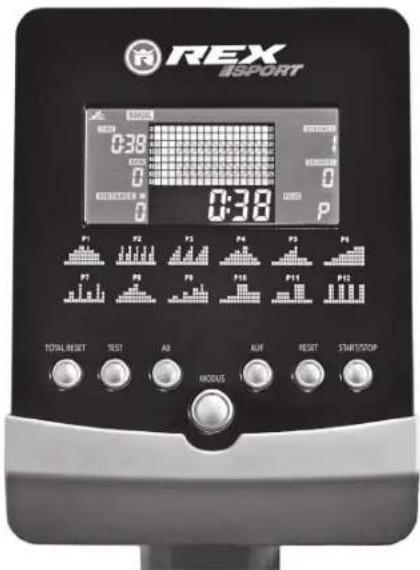
START/STOP:
Start and stop your training with this button.
UP/DOWN:
You can select various programmes and values with the UP/DOWN buttons. You can also increase or reduce the intensity levels during your workout with these buttons.
RESET:
This button will reset the value you just entered. If the RESET button is pressed for approximately 4 seconds, this will reset all set programme values. This button will also return you to the programme selection.
MODUS (MODE):
With this button you can confirm your selected programmes and values (such as workout parameters). During your workout, this button will let you call up different display information in the centre of the display.
TEST:
The TEST button lets you carry out a fitness test. Please refer to the Fitness Test chapter for more information.
TOTAL RESET:
This button will reset all entered values and parameters to the factory settings.
DISPLAY INFORMATION
The LCD switches to the SLEEP mode automatically after 4 minutes of inactivity. In this mode, the fitness computer displays the temperature, time and the date for approx. 1 minute before it switches off completely. Pressing any button will interrupt the SLEEP mode.
1. TIME/TIME 500 M
The computer displays the current workout time. If a specific time is entered, the time will run backwards (countdown) and you will hear an acoustic signal when this time has elapsed (0:00). (Specific time max. 1-99 minutes). It alternately displays the time to 500 metres.
2. SPM
The computer indicates the current strokes per minute.
3. DISTANCE
The computer shows you the distance you have travelled. If a specific distance is entered, the display will run backwards (countdown) and you will hear an acoustic signal when this time has elapsed (0.00). (Specific distance max. 0.1-99.9 km)
4. STROKES/TOTAL STROKES
The computer displays the number of strokes performed. If a specified value is entered, the display will count down and an acoustic signal will sound when the entered value has elapsed (specified value: 10-9990). The display will alternately show the total strokes performed since the last TOTAL RESET.
5. CALORIES/WATT
Here the computer shows you the calories you have burned during the workout. When entering a specific calorie count, you can choose from 10 to max. 9990 kcal in increments of 10. In this case, the display counts down to zero. After the specified number has elapsed, an acoustic signal will be emitted. The wattage (10-350) is also displayed alternately.
6. PULSE
The PULSE display reflects your current pulse rate in heartbeats per minute. Under certain circumstances, it can take up to 2 minutes until the pulse rate is displayed. The chest strap should have skin contact at all times and be briefly moistened before donning.
7. INTENSITY LEVELS
Each programme has 16 intensity levels. The LCD shows the levels using 8 horizontal bars as well as numbers (1-16). One bar corresponds to one intensity level. The flashing column reflects the progress of time or the route, depending on the respective specification.
With the UP/DOWN buttons you can increase or decrease the intensity levels even during the ongoing workout. This is not possible for programmes which automatically set the intensity levels (such as H.R.C. programme).
WORKOUT PARAMETERS
Workout parameters are objectives you can set for every workout programme. The following workout parameters are available:
| Parameter Setting range Standard | value Step Note | |||
| Time | 1:00~99:00 | 00:00 | +/- 1 | |
| Distance | 0,1~99,9 | 0,0 | +/- 0,1 | |
| Strokes | 10~9990 | 0 | +/- 10 | |
| Calories | 10~9990 | 0 | +/- 10 | |
| Pulse | 30~240 | 0 | +/- 1 |
You can generally select or even combine several exercise parameters. Some parameters cannot be set in particular programmes.
The workout parameters can only be specified after you have selected a workout programme. You will find a more detailed description in the setting description of the respective programmes.
WORKOUT PROGRAMMES
After switching on the machine, the required workout programme can be selected with the UP/DOWN buttons. You can set further sub-programmes (if available) with the MODE button and the UP/DOWN buttons.
The following workout programmes are available:
Manual (MANUAL)
Profile programmes (PROG) (P1-P12)
Pulse programmes (HRC) (55%/75%/90%/TAG)
Racing programmes (RACE)
User programmes (USER)
A Manual (MANUAL)
This workout programme lets you determine the level of difficulty yourself.
- Select the Manual programme (MANUAL) with the UP/DOWN buttons and confirm with the MODE button.
- Now set an intensity level (L1-L16) suitable for you with the UP/DOWN buttons.
- If you wish to specify one or several workout parameters, use the MODE button to select the required parameter(s). You set the values with the UP/DOWN buttons and confirm with the MODE button.
- Finally, press the START/STOP button to begin the workout. This is also possible if you have not selected a workout parameter before.
As soon as one of the preset parameters has counted down to zero, you will hear an acoustic signal and the workout programme stops automatically. If you have preset further parameters, you can continue the programme after pressing the START/STOP button.
During the workout, you can increase or decrease the intensity levels (L1-L16) with the UP/DOWN buttons. You can interrupt your workout by pressing the START/STOP button. Press the START/STOP button again to continue your workout. If you wish to stop your workout completely, press the RESET button instead. This will bring you back to the programme selection.
B Profile programmes (PROGRAM)
The Profile programmes offer a selection of 12 subprogrammes with very different intensity courses.
- Select the Professional I programme "PROGRAM" with the UP/DOWN buttons and confirm with the MODE button.
- Now set one of the 12 sub-programmes (P1-P12) by pressing the UP/DOWN buttons and confirm with the MODE button.
- Choose an intensity level (L1-L16) suitable for you with the UP/DOWN buttons.
- If you wish to specify one or several workout parameters, use the MODE button to select the required parameter(s) and set the values with the UP/DOWN buttons.
- Finally, press the START/STOP button to begin the workout. This is also possible if you haven't selected a workout parameter before.
As soon as one of the preset parameters has counted down to zero, you will hear an acoustic signal and the workout programme stops automatically. If you have preset further parameters, you can continue the programme after pressing the START/STOP button.
During the workout, you can increase or decrease the intensity levels (L1-L16) with the UP/DOWN buttons. You can interrupt your workout by pressing the START/STOP button. Press the START/STOP button again to continue your workout. If you wish to stop your workout completely, press the RESET button instead. This will bring you back to the programme selection.
C Pulse programme (HRC - 55%/75%/90%/TAG)
The intensity level for the Pulse programme is specified by the computer and is adapted automatically according to current pulse and set heart rate or programme. The intensity levels will also increase or decrease during your workout in dependence on your pulse.
55 % target pulse = 55 % of (220 - Age) 75 % target pulse = 75 % of (220 - Age) 90 % target pulse = 90 % of (220 - Age)
TAG = Target pulse programme (Target pulse you specified)

Make sure you always work out with the target pulse specification suitable for you. Observe the notes and the exercise parameters chapter.
- Select the Pulse programme "HRC" with the UP/DOWN buttons and confirm with the MODE button.
- Set your age using the UP/DOWN buttons and confirm with the MODE button.
- Now set one of the sub-programmes (55%/75%/90%/TAG) by pressing the UP/DOWN buttons and confirm with the MODE button.
- If you wish to specify one or several workout parameters, use the MODE button to select the required parameter(s) and set the values with the UP/DOWN buttons.
- Finally, press the START/STOP button to begin the workout. This is also possible if you haven't selected a workout parameter before.
As soon as one of the preset parameters has counted down to zero, you will hear an acoustic signal and the workout programme stops automatically. If you have preset further parameters, you can continue the programme after pressing the START/STOP button.
You can interrupt your workout by pressing the START/STOP button. Press the START/STOP button again to continue your workout. If you wish to stop your workout completely, press the RESET button instead. This will bring you back to the programme selection.
D Racing programme (RACE)
In the racing programme you may race against the computer.
- Select the racing programme (RACE) using the UP/DOWN buttons and confirm with the MODE button.
- Select the intensity level (L1-L16) of the computer using the UP/DOWN buttons and confirm with the MODE button.
- Set the distance (500-10,000 metres) using the UP/DOWN buttons and confirm with the MODE button.
- Use the UP/DOWN buttons to set your desired intensity level (L1-L16) and confirm with the MODE button.
- Finally, press the START/STOP button to start the race.
Both boats and the respective progress of the race are shown in the display (upper boat U = User/ lower boat PC = Computer). The respective winner is shown at the end.
During the race, you can increase or decrease the intensity levels (L1-L16) with the UP/DOWN buttons. You can interrupt the race at any time by pressing the START/ STOP button. Press the START/STOP button again to continue the race. If you wish to stop the race completely, press the RESET button instead. This will bring you back to the programme selection.
E User programme (USER)
The User programme lets you create an individual Professional I programme according to your requirements. You may freely choose the intensity levels and sequences. The programme is saved after the entry and will be available to you the next time you work out
- Select the User programme (USER) with the UP/DOWN buttons and confirm with the MODE button.
- Select the User (U1-U4) using the UP/DOWN buttons and confirm with the MODE button.
- You can create your own Professional I programme now with the UP/DOWN buttons (power of intensity level) and the MODE button (select/confirm column).
- To save the profile, press the MODE button for approx. 3 seconds.
- If you wish to specify one or several workout parameters, then use the MODE button to select the required parameter(s) and set the values with the UP/DOWN buttons.
- Finally, press the START/STOP button to begin the workout. This is also possible if you haven't selected a workout parameter before.
As soon as one of the preset parameters has counted down to zero, you will hear an acoustic signal and the workout programme stops automatically. If you have preset further parameters, you can continue the programme after pressing the START/STOP button.
During the workout, you can increase or decrease the intensity levels (L1-L16) with the UP/DOWN buttons. You can interrupt your workout by pressing the START/STOP button. Press the START/STOP button again to continue your workout. If you wish to stop your workout completely, press the RESET button instead. This will bring you back to the programme selection.
F Fitness test (TEST)
The measurement of your heart recovery rate serves as indication of your physical and athletic condition. The faster your heart rate returns to its normal rate after the exercise (heart recovery rate), the "fitter" you are.
After your completed workout, press the TEST button to start the fitness test.
After 60 seconds, the computer will show the result of the measured heart recovery rate as school grades:
F 1.0 = Very good to F 6.0 = unsatisfactory
It is advisable to work out consistently to improve your heart recovery rate to the value F 1.0.
To return to the programme selection, press the TEST button again.
Care/Maintenance
We recommend checking all machine parts that could loosen (screws, nuts, etc.) regularly every 2 to 4 weeks, depending on the frequency of use. Use a soft, perhaps slightly moistened cloth to clean. Do not use aggressive cleaning agents. Keep liquids of any type away from the computer and the
machine interior, as the liquids could cause considerable functional impairments. The belt in the lower area of the exercise machine can develop rubber skid marks. This is completely normal.
Technical data
Dimensions: approx.
220 cm (L) × 50 cm (B) × 96 cm (H)
Weight: approx. 42 kg
Classification: HC
Max. Weight load: 130 kg
Flywheels: 4 kg
Resistance:
16-fold
computer-controlled
Brake system: Magnetic braking system, computer-controlled
Disposal
Disposing of the fitness machine (without battery)
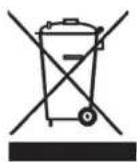
At the end of its useful life, the fitness machine may not be disposed of in normal household rubbish. Instead, it must be deposited at a collection point for the recycling of electrical and electronic devices. The battery must be removed from the fitness machine beforehand and disposed of separately (see the chapter Disposing of the battery).
Packaging recycling

The packaging material is partially reusable. Dispose of the packaging in an environmentally friendly manner and add it to the recyclable waste. Dispose of the packaging at a public collection point. Enquire of your city/municipal administration for your nearest available disposal point.
Disposing of the battery
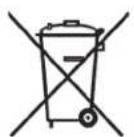
Batteries do not belong in the household rubbish. As the consumer, you are legally obliged to return spent batteries and rechargeable batteries. Dispose of the batteries at a public collection point.
Warranty
- You may only assert warranty claims within a period of max. 2 years as of the purchase date. Our warranty is limited to the elimination of material and fabrication defects, or the replacement of the machine. Realisation occurs according to our choice through repair to the machine. Our warranty is free of charge.
The malfunction and its causes are always examined by our customer service and includes:
- Spare parts delivery for the repair work within the scope of the warranty
Repair or replacement of the defective component
(Replaced spare parts will be passed to our possession.)
- For eligible warranty claims, the costs for shipping and the costs for disassembly and installation will be charged at our expense. Warranty claims must be verified by submitting the purchase receipt.
- The buyer agrees to use the purchased machine for no other purpose than as designated in the operating instructions.
- The warranty expires if the machine is modified by third parties, or changed by installing outside parts, or defects that occurred in initial conjunction with the change. Further, the warranty claim also expires if the regulations regarding the management of the machine were not observed.
- Not included in the warranty:
- Expendable items not associated with repair work on recognised malfunctions.
- All maintenance work or other work that developed due to wear, accident or operating conditions as well as use with disregard to the manufacturers' specifications.
All events, such as noise development, vibrations, wear, etc. that do not affect the machine qualities.
All events, such as noise development, vibrations, wear, etc. that do not affect the machine qualities.
- Damage caused by:
- installing parts by third parties or the efforts of the user to remedy the damage himself.
- Components subject to wear or use (except clear material or manufacturer defects), such as: - Bearings - Lamps - Stickers - Belts - Batteries, etc. Costs for maintenance, inspection and cleaning work.
- Warranty claims only authorize the customer to demand the elimination of the defect. Claims for return or reduction of the purchase price only apply after subsequent improvement fails.
- The examination and decision about a warranty claim is incumbent upon the manufacturer.
- The replacement of direct or indirect damage will not be granted.
- Warranty claims will only be considered if lodged with SI-Zweirad-Service-GmbH directly after finding the defect.
- An executed warranty will neither renew nor extend the period of warranty. Asserting warranty claims after the period of warranty has expired is precluded.
- Arrangements other than the above-mentioned only then apply if they are confirmed by the manufacturer in writing.
- If your machine sustained damage during the delivery, please record all damage on the delivery note. Have the supplier (market, carrier) sign the damage report and then contact us immediately.
- Should you have a technical problem with the machine you have acquired, our customer service staff are available:
SI-Zweirad-Service GmbH Phone: 0524241089824
Lindenstraße 50 Fax: 05242/410872 33378 Rheda-Wiedenbrück E-Mail: si-service@prophete.net Germany www.rex-sport.de
AT CH
SI-Zweirad-Service GmbH Phone: +495242 41089824 Lindenstraße 50 Fax: +495242 410872 -33378 Rheda-Wiedenbrück E-Mail: si-service@prophete.net Germany www.rex-sport.de
Sommaire
Avant-propos F-43
Identification des remarques importantes F-43
4. STROKES/TOTAL STROKES
Programmes Pouls (HRC) (55%/75%/90%/TAG)
Course Program (RACE)
C Pulse Programs (HRC - 55%/75%/90%/TAG)
D Course Program (RACE)
4. STROKES/TOTAL STROKES
Pulse program (HRC) (55%/75%/90%/TAG)
C Pulse Program (HRC - 55%/75%/90%/TAG)
UP/DOWN (INCREASE/DECREASE):
- STROKES / TOTAL STROKES
Pulse program (HRC) (55%/75%/90%/TAG)
A Manual (MANUAL)


- STROKES/TOTAL STROKES
- C PULSE PROGRAM (HRC - 55%/75%/90%/TAG)
- PREFACE
- IDENTIFICATION OF IMPORTANT NOTES
- IMPORTANT SAFETY INSTRUCTIONS
- EXPLODED VIEW
- PARTS LIST
- ASSEMBLY
- FOLDING MECHANISM
- FOLDING TOGETHER
- OPENING OUT
- TRANSPORT
- EXERCISE
- DESIGNING YOUR WORKOUT/NOTES
- A INTENSITY
- B FREQUENCY
- C MOTIVATION
- D ORGANISATION OF WORKOUT SESSIONS
- WARMING UP PHASE
- WORKOUT PHASE
- COOLING DOWN PHASE
- E ROWING TECHNIQUE
- RECOVERY PHASE
- DRIVE PHASE
- OPERATION
- DEFAULT SETTINGS
- SETTING
- BUTTON FUNCTIONS
- START/STOP
- UP/DOWN
- RESET
- MODUS (MODE)
- TEST
- TOTAL RESET
- DISPLAY INFORMATION
- TIME/TIME 500 M
- SPM
- DISTANCE
- CALORIES/WATT
- PULSE
- INTENSITY LEVELS
- WORKOUT PARAMETERS
- WORKOUT PROGRAMMES
- A MANUAL (MANUAL)
- B PROFILE PROGRAMMES (PROGRAM)
- C PULSE PROGRAMME (HRC - 55%/75%/90%/TAG)
- D RACING PROGRAMME (RACE)
- E USER PROGRAMME (USER)
- F FITNESS TEST (TEST)
- CARE/MAINTENANCE
- TECHNICAL DATA
- DISPOSAL
- DISPOSING OF THE FITNESS MACHINE (WITHOUT BATTERY)
- PACKAGING RECYCLING
- DISPOSING OF THE BATTERY
- WARRANTY
- AT CH
- SOMMAIRE
- C PULSE PROGRAMS (HRC - 55%/75%/90%/TAG)
- D COURSE PROGRAM (RACE)
- UP/DOWN (INCREASE/DECREASE)
Brand : REX
Model : PX400 E
Category : Rowing Machine