ManualGo.com
VPLSW631C - Projector SONY - Free user manual and instructions
Find the device manual for free VPLSW631C SONY in PDF.



Frequently Asked Questions - VPLSW631C SONY
Download the instructions for your Projector in PDF format for free! Find your manual VPLSW631C - SONY and take your electronic device back in hand. On this page are published all the documents necessary for the use of your device. VPLSW631C by SONY.
USER MANUAL VPLSW631C SONY
VPL-SW636C/SW631C/SW631/SX631
4-587-024-04 (1) K:\081\XP JP\new3\01_JP\01JP01COV.fm masterpage:Right 4-587-024-06 (1)© 2015 Sony Corporation Data Projector
VPL-SW636C/SW631C/SW631
VPL-SX631 お買い上げいただきありがとうございます。電気製品は安全のための注意事項を守らないと、火災や人身事故になることがあります。この簡易説明書と付属の CD-ROM に入っている取扱説明書をよくお読みのうえ、製品を安全にお使いください。お読みになったあとは、いつでも見られるところに必ず保管してください。簡易説明書 JPQuick Reference Manual __ GBGuide de référence rapide _ FRManual de referencia rápida__ ESKurzreferenz _____________ DEGuida rapida all’uso_______ IT______________ CSКраткое справочное руководство__ RU
VPL-SW636C/SW631C/SW631/SX631
VPL-SW636C/SW631C/SW631/SX631
VPL-SW636C/SW631C/SW631/SX631
VPL-SW636C/SW631C/SW631/SX631
VPL-SW636C/SW631C/SW631/SX631
VPL-SW636C/SW631C/SW631/SX631
VPL-SW636C/SW631C/SW631/SX631
VPL-SW636C/SW631C/SW631/SX631
VPL-SW636C/SW631C/SW631/SX631
VPL-SW636C/SW631C/SW631/SX631
VPL-SW636C/SW631C/SW631/SX631
AVPL-SW636C/SW631C/SW631/SX631
VPL-SW636C/SW631C/SW631/SX631
脚VPL-SW636C/SW631C/SW631/SX631
VPL-SW636C/SW631C/SW631/SX631
㩷VPL-SW636C/SW631C/SW631/SX631
VPL-SW636C/SW631C/SW631/SX631
VPL-SW636C/SW631C/SW631/SX631
VPL-SW636C/SW631C/SW631/SX631
VPL-SW636C/SW631C/SW631/SX631
VPL-SW636C/SW631C/SW631/SX631
VPL-SW636C/SW631C/SW631/SX631
VPL-SW636C/SW631C/SW631/SX631
VPL-SW636C/SW631C/SW631/SX631
WARNING Before operating the unit, please read this manual thoroughly and retain it for future reference. WARNING To reduce the risk of fire or electric shock, do not expose this apparatus to rain or moisture. To avoid electrical shock, do not open the cabinet. Refer servicing to qualified personnel only. WARNING
THIS APPARATUS MUST BE
EARTHED. WARNING When installing the unit, incorporate a readily accessible disconnect device in the fixed wiring, or connect the power plug to an easily accessible socket-outlet near the unit. If a fault should occur during operation of the unit, operate the disconnect device to switch the power supply off, or disconnect the power plug. CAUTION About the LAN connector For safety, do not connect the connector for peripheral device wiring that might have excessive voltage to this port. WARNING 1 Use the approved Power Cord (3-core mains lead) / Appliance Connector / Plug with earthing-contacts that conforms to the safety regulations of each country if applicable. 2 Use the Power Cord (3-core mains lead) / Appliance Connector / Plug conforming to the proper ratings (Voltage, Ampere). If you have questions on the use of the above Power Cord / Appliance Connector / Plug, please consult a qualified service personnel. IMPORTANT The nameplate is located on the bottom. For kundene i Norge Dette utstyret kan kobles til et IT- strømfordelingssystem. For the customers in the U.S.A. This equipment has been tested and found to comply with the limits for a Class A digital device, pursuant to part 15 of the FCC Rules. These limits are designed to provide reasonable protection against harmful interference when the equipment is operated in a commercial environment. This equipment generates, uses, and can radiate radio frequency energy and, if not installed and used in accordance with the instruction manual, may cause harmful interference to radio communications. Operation of this equipment in a residential area is likely to cause harmful interference in which case the user will be required to correct the interference at his own expense. You are cautioned that any changes or modifications not expressly approved in this manual could void your authority to operate this equipment. All interface cables used to connect peripherals must be shielded in order to comply with the limits for a digital device pursuant to Subpart B of part 15 of FCC Rules. This device complies with part 15 of the FCC Rules. Operation is subject to the following two conditions: (1) This device may not cause harmful interference, and (2) this device must accept any interference received, including interference that may cause undesired operation. For the customers in Canada CAN ICES-3 (A)/NMB-3(A) For the customers in Europe, Australia and New Zealand WARNING This equipment is compliant with Class A of CISPR 32. In a residential environment this equipment may cause radio interference. For the customers in Europe This apparatus shall not be used in the residential area.3
WARNING For the customers in Taiwan only
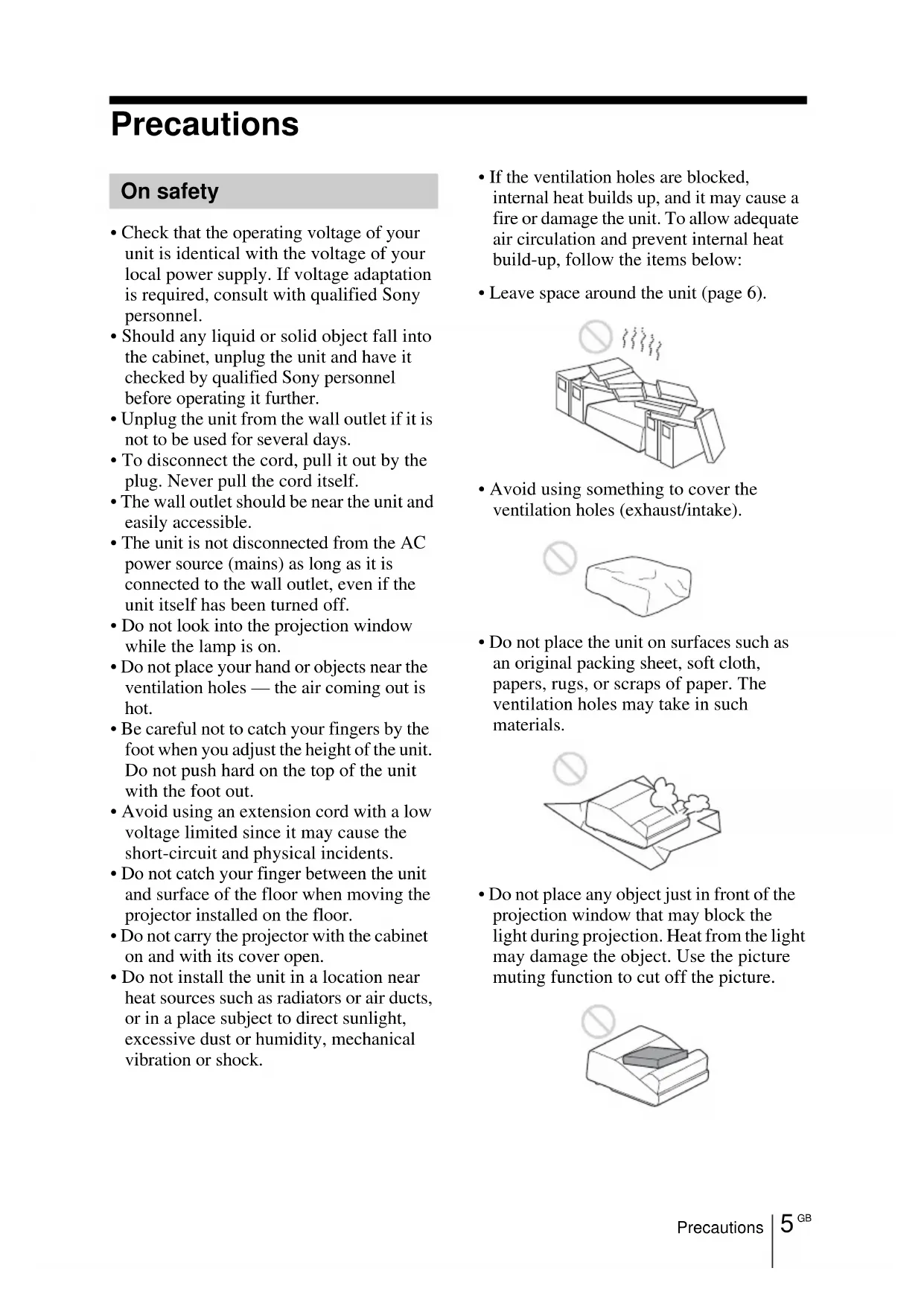
- Check that the operating voltage of your unit is identical with the voltage of your local power supply. If voltage adaptation is required, consult with qualified Sony personnel.
- Should any liquid or solid object fall into the cabinet, unplug the unit and have it checked by qualified Sony personnel before operating it further.
- Unplug the unit from the wall outlet if it is not to be used for several days.
- To disconnect the cord, pull it out by the plug. Never pull the cord itself.
- The wall outlet should be near the unit and easily accessible.
- The unit is not disconnected from the AC power source (mains) as long as it is connected to the wall outlet, even if the unit itself has been turned off.
- Do not look into the projection window while the lamp is on.
- Do not place your hand or objects near the ventilation holes — the air coming out is hot.
- Be careful not to catch your fingers by the foot when you adjust the height of the unit. Do not push hard on the top of the unit with the foot out.
- Avoid using an extension cord with a low voltage limited since it may cause the short-circuit and physical incidents.
- Do not catch your finger between the unit and surface of the floor when moving the projector installed on the floor.
- Do not carry the projector with the cabinet on and with its cover open.
- Do not install the unit in a location near heat sources such as radiators or air ducts, or in a place subject to direct sunlight, excessive dust or humidity, mechanical vibration or shock.
- If the ventilation holes are blocked, internal heat builds up, and it may cause a fire or damage the unit. To allow adequate air circulation and prevent internal heat build-up, follow the items below:
- Leave space around the unit (page 6).
- Avoid using something to cover the ventilation holes (exhaust/intake).
- Do not place the unit on surfaces such as an original packing sheet, soft cloth, papers, rugs, or scraps of paper. The ventilation holes may take in such materials.
- Do not place any object just in front of the projection window that may block the light during projection. Heat from the light may damage the object. Use the picture muting function to cut off the picture. On safetyGB 6 Precautions
- Do not use the Security bar for the purpose of preventing theft for transporting or installing the unit. If you lift the unit by the Security bar or hang the unit by this bar, it may cause the unit to fall and be damaged, and may result in personal injury. For dealers
- Make sure the projector is installed on the wall securely; otherwise, it may fall and cause death or serious injury. Be sure to use Sony’s Projector Wall Mount.
- Be sure to secure the cabinet cover firmly when installing to the wall firmly.
- Never mount or move the projector by yourself. Be sure to consult with your Sony dealer or a qualified installer.
- When installing the unit on a wall or ceiling, be sure to use a safety wire, etc., to prevent the unit from falling. Entrust the installation to a Sony dealer or qualified installer.
- Before installing the unit on a wall or ceiling, make sure that the mounting surface is strong enough. If you install the unit without first confirming that the mounting surface is strong enough, the unit may fall.
- When installing the unit, leave space between any walls, etc. and the unit as illustrated.
- Avoid using if the unit is tilted more than 15 degrees horizontally.
- Always install the unit horizontally or vertically. Otherwise the projected image may be unevenly colored or the lamp life may be deteriorated. Safety precautions for installing the unit On Installation More than 10 cm (4 inches)More than 30 cm (11
- Avoid using the unit in a location where the temperature or humidity is very high, or temperature is very low.
- Avoid installing the unit in a location subject to direct cool or warm air from an air-conditioner. Installing in such a location may cause malfunction of the unit due to moisture condensation or rise in temperature.
- Avoid installing the unit in a location near a heat or smoke sensor. Installing in such a location may cause malfunction of the sensor.
- Avoid installing the unit in a very dusty or extremely smoky environment. Otherwise, the air filter will become obstructed, and this may cause a malfunction of the unit or damage it.
- When using the unit at an altitude of 1,500 m or higher, set “High Altitude Mode” to “On” in the Installation menu. Failing to set this mode when using the unit at high altitudes could have adverse effects, such as reducing the reliability of certain components.
- Set “Installation Attitude” on the Installation menu correctly to suit to the Installation angle. Continuing to use the wrong setting may affect component reliability.
- Be sure to disconnect the AC power cord from the AC outlet before cleaning.
- If you rub on the unit with a stained cloth, the cabinet may be scratched.
- If the unit is exposed to volatile materials such as insecticide, or the unit is in contact with a rubber or vinyl resin product for a long period of time, the unit may deteriorate or the coating may come off.
- Do not touch the projection window with bare hands.
- On cleaning the projection window surface: Wipe the projection window gently-with a soft cloth, such as a glass cleaning cloth. Stubborn stains may be removed with a soft cloth lightly dampened with water. Never use solvent such as alcohol, benzene or thinner, or acid, alkaline or abrasive detergent, or a chemical cleaning cloth.
- On cleaning the cabinet: Clean the cabinet gently with a soft cloth. Stubborn stains may be removed with a soft cloth lightly dampened with mild detergent solution and wrung, followed by wiping with a soft dry cloth. Never use solvent such as alcohol, benzene or thinner, or acid, alkaline or abrasive detergent, or a chemical cleaning cloth. To obtain the best picture, the front of the screen should not be exposed to direct lighting or sunlight. On cleaning the projection window and the cabinet On IlluminationGB 8 Precautions The temperature of the projector’s cabinet may increase during or immediately after use; however, this is not a malfunction. Use a screen with an even surface. Since the projector is equipped with a fan inside to prevent internal temperature from rising, there may be some noise. This is a normal result of the manufacturing process and does not indicate a malfunction. If, however, in a case of abnormal noise, consult with qualified Sony personnel. The lamp used as a light source contains mercury that has high internal pressure. A high-pressure mercury lamp has the following characteristics:
- Brightness of the lamp will be lowered as the elapse of time used.
- The lamp may break with a loud noise as a result of shock, damage, or deterioration caused by the elapse of time. The lamp may become unlit and may burn out.
- The lamp life varies with individual differences or usage conditions of each lamp. Therefore, it may break or will not light even before the specified replacement time.
- It may possibly break after the replacement time has elapsed. Replace the lamp with a new one as soon as possible if a message displayed on the projected image, even if the lamp normally lights. This unit is precision equipment. When carrying the unit, do not subject the unit to shocks, or fall. It may damage the unit. The LCD projector is manufactured using high-precision technology. You may, however, see tiny black points and/or bright points (red, blue, or green) that continuously appear on the LCD projector. This is a normal result of the manufacturing process and does not indicate a malfunction. Also, when you use multiple LCD projectors to project onto a screen, even if they are of the same model, the color reproduction among projectors may vary, since color balance may be set differently from one projector to the next. If the room temperature where the projector is installed changes rapidly, or if the projector is moved suddenly from a cold to a warm place, condensation in the projector may occur. As the condensation may cause malfunction, be careful in adjusting temperature settings of the air conditioner. If condensation occurs, leave the projector turned on for about two hours before use.
OR SECURITY PROBLEMS OF ANY
- Depending on the operating environment, unauthorized third parties on the network may be able to access the unit. When connecting the unit to the network, be sure to confirm that the network is protected securely.
- Communication content may be unknowingly intercepted by unauthorized third parties in the vicinity of the signals. When using wireless LAN communication, implement security On Heat Dissipation On Screen On Fan On Lamp For carrying On LCD Projector On Condensation Notes on security9
Precautions measures properly to protect the communication content.
- From a safety standpoint, when using the unit connected with the network, it is strongly recommended to access the Control window via a Web browser and change the access limitation settings from the factory preset values. Changing the password regularly is also recommended.
- Do not browse any other website in the Web browser while making settings or after making settings. Since the login status remains in the Web browser, close the Web browser when you complete the settings to prevent unauthorized third parties from using the unit or harmful programs from running.
- Always make a test recording, and verify that it was recorded successfully. SONY
INCLUDING, BUT NOT LIMITED
REIMBURSEMENT ON ACCOUNT
OF FAILURE OF THIS UNIT OR ITS
OTHER MEDIA OR STORAGE
- Always verify that the unit is operating properly before use. SONY WILL NOT
BE LIABLE FOR DAMAGES OF ANY
KIND INCLUDING, BUT NOT
LIMITED TO, COMPENSATION OR
REIMBURSEMENT ON ACCOUNT
OF THE LOSS OF PRESENT OR
WARRANTY, OR FOR ANY OTHER
USERS OF THIS UNIT OR MADE BY THIRD PARTIES.
- SONY WILL NOT BE LIABLE FOR
THE LOSS, REPAIR, OR
SYSTEMS OR ANY OTHER MEDIA
DISCONTINUATION OF ANY
SERVICES RELATED TO THIS UNIT
THAT MAY RESULT DUE TO
CIRCUMSTANCES OF ANY KIND. NotesGB 10 Checking the Supplied Accessories Checking the Supplied Accessories RM-PJ8 Remote Commander (1)Lithium battery (CR2025) (1)The battery is already installed. Before using the remote commander, remove the insulation film.AC power cord (1)Quick Reference Manual (this manual) (1)Operating Instructions (CD-ROM) (1)Projector Station for Network Presentation application (CD-ROM) (1)IFU-PN250A/IFU-PN250B Interactive Pen Device (2) (VPL-SW636C/SW631C only)Size AAA (R03) manganese batteries (4) (VPL-SW636C/SW631C only)USB A-B cable (5m) (1) (VPL-SW636C/SW631C only)Interactive Presentation Utility 2 application (CD-ROM) (1) (VPL-SW636C/SW631C only)The manual can be read on a computer with Adobe Reader installed.You can download Adobe Reader free from the Adobe website. 1 Open the index.html file in the CD- ROM. 2 Select and click on the manual that you want to read. If you have lost or damaged the CD-ROM, you can purchase a new one from your Sony dealer or Sony service counter. 1 Close all running applications. 2 Insert the supplied CD-ROM into the CD-ROM drive of the computer. 3 Open the CD-ROM and run the executable file that is appropriate for your OS. Windows: when the message “User Account Control” is displayed, click “Allow” or “Yes.” 4 Follow the on-screen instructions to install the software. Using the CD-ROM manual Note Installing Projector Station for Network Presentation11
Checking the Supplied Accessories Remote Commander 1 Pull out the lithium battery compartment. Pull out the battery compartment with a stick as shown in the illustration. 2 Insert a lithium battery. 3 Close the lithium battery compartment. Installing batteries One lithium battery (CR2025) is supplied for the RM-PJ8 Remote Commander. To avoid risk of explosion, use a lithium battery (CR2025). Interactive Pen Device 1 Remove the battery cover. The battery cover is attached to the Interactive Pen Device by a small strap. Be careful not to break the strap when opening the battery cover. 2 Insert two size AAA batteries. 3 Re-attach the battery cover. Installing batteries Four size AAA (R03) batteries are supplied for the IFU-PN250A/IFU-PN250B Interactive Pen Device. To avoid risk of explosion, use size AAA (R03) manganese or alkaline batteries. CAUTION Danger of explosion if battery is incorrectly replaced. Replace only with the same or equivalent type recommended by the manufacturer. When you dispose of the battery, you must obey the law in the relative area or country. Installing Batteries With the 3 (plus) side facing up.GB 12 Connecting the Projector Connecting the Projector You can connect the projector to external devices with an RGB or HDMI output terminal. In addition, you can use the following methods to connect the projector to external devices: USB terminal (Type B) ( ) For connecting to a computer with a USB terminal (“Playing Video and Audio using USB Connection”). USB terminal (Type A) ( ) For connecting a USB memory device (“Using USB Media Viewer”). LAN terminal For connecting to a computer via a hub or router (“Presentation Function via Network”). USB A-B cable (not supplied)ComputerUSB terminal (Type A) USB memory device (not supplied) LAN cable (straight type)(not supplied)Computer LAN terminalWired connectionComputerWireless connectionHub, Wireless router, etc.13
Connecting the Projector USB terminal (Type A) ( ) For connecting a USB wireless LAN module IFU-WLM3 (not supplied) (“Presentation Function via Network”).
- Undesignated USB wireless LAN modules do not work.
- When connecting/disconnecting the USB wireless LAN module, make sure that the projector is in Standby mode (Standby Mode: “Low”), or the AC power cord is unplugged from the wall outlet.
- For connecting to the access point, access to the Web browser, and input the settings for the access point to connect. For details, see “Setting the WLAN Network of the projector”.
- The factory default settings for “Access Pt. (Manual)” are as follows. SSID: VPL + MAC address for LAN Security Method: WEP(64bit) Password: sony1 Notes USB wireless LAN module IFU-WLM3 (not supplied)ComputerWireless router, access pointGB 14 Selecting the Menu Language Selecting the Menu Language The factory setting for the language for displaying menus, messages, etc. is English.To change the on-screen language, proceed as follows: 1 Plug in the AC power cord into a wall outlet. 2 Turn on the projector. Press the ?/1 key. 3 Press the MENU key to display the menu. If the display cannot be properly seen, adjust the focus, size, and position of the projected image (page 17). 4 Select the menu language.
Projecting an Image Projecting an Image The size of a projected image depends on the distance between the projector and screen. Install the projector so that the projected image fits the screen size. For details on projection distances and projected image sizes, see “Projection Distance and Lens Shift Range”.
- Project the image on a flat surface.• Due to the characteristics of ultra short throw projector, the image may appear uneven on a projection surface that is not absolutely flat. This is not a malfunction of the projector. 1 Plug the AC power cord into the wall outlet. 2 Connect all equipment to the projector. 3 Press the ?/1 key to turn on the unit. 4 Turn on the connected equipment. 5 Select the input source. Press the INPUT key on the projector to display the menu for switching input signal on the screen. Press the INPUT key repeatedly, or press the V/v key to select an image to be projected. 6 When projecting a computer image, switch your computer’s output to external display. The method to switch the output varies depending on the type of computer. Notes ComputerVideo equipmentProjectorWall outlet
6GB 16 Projecting an Image (Example) To project image files stored in a USB memory device, see “USB Media Viewer”. To play video and audio using USB Connection, see “Playing Video and Audio using USB Connection”. To use Presentation Function via Network, see “Presentation Function via Network”. 7 Adjust the focus, size and position of the projected image (page 17). Open the side cover, and adjust the lens shift dials, focus lever and zoom lever. Open the side cover Press A and open the side cover in the direction of the arrow shown on the illustration below.
Projecting an Image Adjusting the Projected Image Focus Size (Zoom) Focus lever Zoom leverGB 18 Projecting an Image Position (Lens shift) Position Adjusting the tilt of the projector with the feet You can adjust the height of the projector using the feet. By changing the tilt of the projector with feet, you can adjust the position of the projected image.
- Be careful not to let the projector down on your fingers.
- Do not push hard on the top of the projector with the foot extended. Lens shift dial VFor adjusting lens shift, turn each dial with your hand, screwdriver, etc.Lens shift dial H Foot19
Projecting an Image Changing the aspect ratio of the projected image Press the ASPECT key on the remote commander to change the aspect ratio of the projected image. You can also change the setting in Aspect of the Screen menu. Correcting trapezoidal distortion of the projected image (Keystone feature) If the image becomes trapezoidal, set the keystone manually. 1 Press the KEYSTONE key on the remote commander or select V Keystone in the Installation menu. 2 Use the V/v/B/b keys to set the value. The higher the value, narrower the top of the projected image. The lower the value, the narrower the bottom.
- Since the Keystone adjustment is an electronic correction, the image may be deteriorated.
- Depending on the position adjusted with the lens shift feature, the aspect ratio of the image may change from the original or projected image may be distorted with Keystone adjustment.
- If you perform keystone adjustment and use mouse mode, the position of the Interactive Pen Device and the computer cursor may not match. In this case, perform the calibration again. (VPL- SW636C only) Notes Increase the number towards plusIncrease the number towards minusGB 20 Projecting an Image Fitting the projected image to the screen (Digital Shrink adjustment) If the projected image exceeds the size of the screen, you can shrink and adjust the position of it. 1 Select “Rid. digitale” in the Installation menu. 2 Set the shrinking rate. Press the V/v/B/b key to adjust the value. The more the value increases towards the plus side, the smaller the projected image becomes. 3 Press the ENTER button to display the shift adjustment menu and adjust the display position of the projected image. Press the V/v/B/b key to adjust the display position.
- If the shrinking rate is set to “0,” you cannot move the image. If the projector is projecting an image with a resolution that is different from the panel display resolution of this projector, it may not be possible to move the image.
- When you use the PC Free Interactive function or mouse mode, do not perform Digital Shrink adjustment. The position of the Interactive Pen Device may slip off out of the image (VPL- SW636C only). Displaying a pattern You can display a pattern for adjusting the projected image or a grid pattern with the PATTERN key on the remote commander. Press the PATTERN key again to restore the previous image. You can use a grid pattern as a guide to write text or to draw lines and shapes on the whiteboard or blackboard without using a computer. You cannot use this key when “Type A USB”, “Type B USB” or “Network” is selected as the input. Automatically adjusting Phase, Pitch, and Shift of the projected image while a signal is input from a computer (APA (Auto Pixel Alignment)) Press the APA key on the remote commander. Press again to cancel adjusting during the setting. You can also set APA in the Screen Menu. If Smart APA in the Function menu is set to “On”, executes APA automatically when a signal is input. Notes Note
Projecting an Image 1 Press the ?/1 key on the unit or the remote commander. The projector starts shutdown and turns off. If you press the ?/1 key within 10 seconds again, shutdown is cancelled. Do not turn off the projector soon after the lamp lights. It may cause a malfunction of the lamp (does not light ,etc.). 2 Unplug the AC power cord from the wall outlet. Turning off without displaying the confirmation message Press and hold the ?/1 key on the unit for a few seconds. If you turn off the unit soon after the lamp is turned on, the confirmation message will be displayed and may take a longer time for the unit to turn off. ECO gauge This gauge indicates the current effectiveness of the projector’s ECO function. (For details on the ECO function, see “ECO MODE key” and “ECO”.) The leaf icons are displayed when the projector is shut down. The number of displayed icons varies according to how much energy is saved as a result of using the ECO function. Turning Off the Power Note Note ECO gaugeGB 22 Using Interactive Presentation Utility 2 (VPL-SW636C/SW631C only) Using Interactive Presentation Utility 2 (VPL-SW636C/SW631C only) Using the mouse function of the Interactive Pen Device (main only), you can control a computer and applications on the projected screen just like a mouse. Also when employing the drawing function of a different application, you can use the Interactive Pen Device to directly draw onto the projected file, and save the drawings. How to operate the mouse function of the Interactive Pen Device (main only)
- Left-click: tap the screen with the tip of the Interactive Pen Device.
- Double-click: tap the screen twice with the tip of the Interactive Pen Device.
- Drag and drop: move the Interactive Pen Device while touching the screen. By starting Interactive Presentation Utility 2, you can use the Interactive Pen Device to draw lines and shapes on the projected screen. In the whiteboard mode, the projected screen can be used as an electronic whiteboard and you can select the background image from your photo library or the template. By using both the main and sub Interactive Pen Device, two people can draw on the projected screen simultaneously. The main device can use all the functions, whereas the sub device can use only the drawing function. Use of these functions requires installation of Interactive Presentation Utility 2. For Interactive Presentation Utility 2 software update, visit Sony’s web site. https://www.servicesplus.sel.sony.com/ http://pro.sony.eu/InteractiveUtility Desktop modeWhiteboard mode draw Erase Save23
Using Interactive Presentation Utility 2 (VPL-SW636C/SW631C only)• The interactive function works by a detector in the projector, which picks up infrared rays emitted from the tip of the Interactive Pen Device. Observe the precautions noted below.- Avoid placing the projector where the Interactive Pen detector is directly exposed to fluorescent light or other strong light.- Do not cover the pen tip of the Interactive Pen Device or the Interactive Pen detector.- Infrared data communication or noise from another device may cause improper operation.• Observe the precautions noted below during the calibration.- Avoid placing obstacles between the interactive detector and the screen.- Do not move the projector and the screen.• If Calibration Auto does not calibrate properly, try the following methods.- Shield the screen from strong, direct outside light.- Reduce the ambient light while Calibration Auto is performed.- If Calibration (Auto) still does not calibrate properly after reducing the lighting as suggested above, click Calibration (Manual(Main)) or Calibration (Manual(Sub)), then calibrate manually.- If you use a screen which is not white, Calibration Auto may be inaccurate.• The maximum screen size at which the Interactive function works is 100 inches.• Images may not be projected properly depending on the operating environment or the application. Use Input-A, Input-B, or Input-C to project the images properly. Make sure the computer and projector are connected with an AV cable. For details on connecting the AV cables, see “Connecting the Projector”. Installing Interactive Presentation Utility 2 System Requirements
- CPU: Celeron 2.1GHz or faster
- Memory: 256MB or more (512MB recommend)
- Available hard drive space: 1GB or more
*1: 32bit edition and 64bit edition 1 Close all running applications. 2 Insert the supplied CD-ROM into the CD-ROM drive of the computer. Open the CD-ROM and double-click “Interactive Presentation Utility 2.exe”. Notes Connecting a Computer with a USB Cable For Windows USB terminal (Type A)ComputerAV cableUSB A-B cable (not supplied)GB 24 Using Interactive Presentation Utility 2 (VPL-SW636C/SW631C only) 3 Follow the on-screen instructions to install the software. To uninstall Interactive Presentation Utility 2, click [Start]-[All Programs]-[Interactive Presentation Utility 2]-[Uninstall]. Setting Interactive Presentation Utility 2 1 Connect the projector and computer with the AV cable and USB cable (page 23), and project the image with the projector. For details on connecting the AV cable for image signals (VGA), see “Connecting the Projector”. 2 Set “Interactive Mode” to “PC Interactive” in “Interactive.” (VPL-SW636C only) 3 Start Interactive Presentation Utility 2. To start Interactive Presentation Utility 2, click [Start]-[All Programs]-[Interactive Presentation Utility 2]-[Interactive Presentation Utility 2]. After the application starts, the icon appears in the taskbar, and the toolbar appears on the screen. Taskbar ToolbarProjector connected to computer. Projector not connected to computer.25
Using Interactive Presentation Utility 2 (VPL-SW636C/SW631C only) Calibration Auto/Manual Calibration aligns the points where the pen (Main and Sub) is pointing and where the projector displays the cursor on the screen. “Calibration Auto” allows you to execute the calibration automatically. Click “Calibration” to select “Calibration Auto.” The calibration starts automatically. Operating with the Interactive Pen Device With the Interactive Pen Device, you can use the functions of the toolbar on the screen. See “User’s Guide of Interactive Presentation Utility 2” for details. Closing Interactive Presentation Utility 2 Click the icon in the Taskbar to display the pop-up menu, then select [Exit].
Main Pen toolbar a Calibration (Auto) b Calibration (Manual (Main)) c Calibration (Manual (Sub)) d Saving calibration dataGB 26 Using Interactive Presentation Utility 2 (VPL-SW636C/SW631C only) Installing Interactive Presentation Utility 2 System Requirements
- Available hard drive space: 250MB
- OS: Mac OS X 10.6.x/10.7.x/10.8.x/10.9.x/10.10.x Use of the interactive function requires installation of Interactive Presentation Utility 2. 1 Close all running applications. 2 In the CD-ROM, double-click [Interactive Presentation Utility 2.pkg]. 3 Follow the on-screen instructions to install the software. To uninstall Interactive Presentation Utility 2, from the Application folder move the [Interactive Presentation Utility 2] folder into the Trash, then empty it. Setting Interactive Presentation Utility 2 1 Connect the projector and computer with the AV cable and USB cable (page 23), and project the image with the projector. For details on connecting the AV cable for image signals (VGA), see “Connecting the Projector”. 2 Set “Interactive Mode” to “PC Interactive” in “Interactive.” (VPL-SW636C only) 3 Start Interactive Presentation Utility 2. Open the folder [Application] - [Interactive Presentation Utility 2] and double-click [Interactive Presentation Utility 2.app]. After application starts, each icon appears in the Dock and the toolbar appears on the screen. For Mac27
Using Interactive Presentation Utility 2 (VPL-SW636C/SW631C only)Icon for Interactive Presentation Utility 2 Calibration Auto/Manual Calibration aligns the points where the pen (Main and Sub) is pointing and where the projector displays the cursor on the screen. “Calibration Auto” allows you to execute the calibration automatically. Click “Calibration” to select “Calibration (Auto).” The calibration starts automatically. Operating with the Interactive Pen Device With the Interactive Pen Device, you can use the functions of the toolbar on the screen. See “User’s Guide of Interactive Presentation Utility 2” for details. Closing Interactive Presentation Utility 2 Click the icon in the Dock to display the pop-up menu, then select [Exit]. Dock Toolbar
Main Pen toolbar a Calibration (Auto) b Calibration (Manual (Main)) c Calibration (Manual (Sub)) d Saving calibration dataGB 28 Using the PC Free Interactive Function (VPL-SW636C only) Using the PC Free Interactive Function (VPL-SW636C only) The PC Free Interactive function enables you to draw on the screen with the Interactive Pen Device with only the projector. The data you draw in the whiteboard mode can be saved in the projector. In the desktop mode, you can draw with the Interactive Pen Device, using an image from the external device as a background. 1 Set “Interactive Mode” to “PC Free” in “Interactive”. 2 Perform calibration. CalibrationAuto/Manual (Main)/Manual (Sub): Performs calibration for the PC Free Interactive function. If you select “Auto”, the projector performs the calibration automatically. If you select “Manual (Main),” the calibration for the main pen will be performed manually. If you select “Manual (Sub),” the calibration for the sub pen will be performed manually.• Before performing the calibration, the message “Do you wish to start calibration?” will be displayed. If you select “Yes”, the projector performs the calibration.• If you already have started the Interactive Presentation Utility 2 on the computer, perform the calibration of Interactive Presentation Utility 2.• If you display the menu or the warning/caution messages etc., are displayed during the calibration, calibration will stop. In addition, if you stop operating the calibration for more than 20 seconds, the manual calibration will also stop. Setting the PC Free Interactive Function Notes29
Indicators Indicators You can check the projector status or abnormality by checking the lighting/flashing status of the ON/STANDBY indicator and WARNING indicator on the front. If the indicators flash in red, address the problem in accordance with “Warning indicators and remedies” (page 30). Operating status indication Indicator status Operating status Meaning Standby The power is supplied to the projector and the projector is in a standby mode according to the setting. Warm-up/Cool- down The projector is warming up after it is turned on, or cooling down after turned off. Power on The projector is ready for projection. Other standby status The projector is in With No Input (Lamp Cutoff). ON/STANDBY indicatorWARNING indicator (Off)(Flashes in green) (Off)(Lights in green) (Off)(Lights in orange) (Off)(Lights in red)GB 30 Indicators Warning indicators and remedies If the indicators flash in a manner other than described above, unplug the AC power cord and make sure the ON/STANDBY indicator turns off, then plug the AC power cord into the wall outlet and turn on the projector. If the problem still persists, consult with qualified Sony personnel. Indicator status The number of flashes Meaning Remedies Twice The lamp cover is not attached securely. Check how the lamp cover is attached and install securely. Three times The lamp does not light properly. The temperature of the lamp is unusually high. Turn off the projector and turn it on again after the lamp has cooled. If the same symptom occurs, turn off the projector again and remove the lamp (page 31), then check if the lamp is not broken. If the lamp is not broken, reattach the lamp and turn on the projector again. If the symptom occurs again, the lamp may be exhausted. In this case, replace the lamp with a new one (page 31). If the lamp is broken, do not exchange the lamp by yourself. Consult a qualified Sony consultant. Twice The temperature in the projector is abnormal.
- Check if the air filter is clogged, then clean or replace it (page 33).
- Check if the ventilation holes (intake/exhaust) are not blocked by the wall or an object and secure a sufficient gap.
- Check the ambient temperature and use the projector within the range of operating temperature. (Flashes in red) (Lights in red) (Flashes in red) (Flashes in red) Both indicators flash31
Replacing the Lamp Replacing the Lamp Replace the lamp with a new one if a message displayed on the projected image. Use an LMP-E220 projector lamp (not supplied) for replacement.
- The lamp remains hot after the projector is turned off. If you touch the lamp, you may burn your finger. When you replace the lamp, wait for at least an hour after turning off the projector for the lamp to cool sufficiently.• Do not allow any metallic or inflammable objects into the lamp replacement slot after removing the lamp, otherwise it may cause electrical shock or fire. Do not put your hands into the slot.
- If the lamp breaks, contact qualified Sony personnel. Do not replace the lamp yourself.
- When removing the lamp, be sure to pull it out straight, by holding the designated location. If you touch a part of the lamp other than the designated location, you may be burned or injured. If you pull out the lamp while the projector is tilted, the pieces may scatter if the lamp breaks any may cause injury. 1 Turn off the projector, and disconnect the AC power cord from a wall outlet. 2 When the lamp has cooled sufficiently, open the lamp cover by loosening 1 screw. 3 Loosen the three screws on the lamp (1) then pull out the lamp by its grab (2). CautionNotes GrabGB 32 Replacing the Lamp 4 Insert the new lamp all the way in until it is securely in place (1). Tighten the three screws (2). The power will not turn on if the lamp is not secured properly. 5 Close the lamp cover and tighten the 1 screw. 6 Connect the AC power cord to a wall outlet and turn on the projector. 7 Reset the lamp timer for notification of the next replacement time. Select “Lamp Timer Reset” on the Function menu then press the ENTER key. When a message appears, select “Yes” to reset the lamp timer. Note Caution For the customers in the U.S.A. and Canada Lamp contains mercury. Dispose according to applicable local, state/ province and federal laws. For additional information, see www.sony.com/mercury33
Cleaning the Air Filter Cleaning the Air Filter When a message appears on the projected image indicating time for a filter cleaning, clean the air filter (page 29). If the dust cannot be removed from the air filter even after cleaning, replace the air filter with a new one. For details on a new air filter, consult with qualified Sony personnel. If you continue to use the projector even after the message is displayed, dust may accumulate, clogging it. As a result, the temperature may rise inside the unit, leading to a possible malfunction or fire. 1 Turn off the projector, and disconnect the AC power cord from the AC outlet. 2 Open the side cover. Press A and open the side cover in the direction of the arrow shown on the illustration below. 3 Remove the air filter holders. Push B and remove the two air filter holders in the direction of the arrow. 4 Clean the air filters with a vacuum cleaner. Remove the four air filters as illustrated below then clean with a vacuum cleaner. There are two air filters for one air filter holder. Caution
Side cover Air filter holder
BGB 34 Cleaning the Air Filter 5 Reattach the air filters on the air filter holders then put them back in the projector. Be sure to attach the air filters firmly. Otherwise, a malfunction may occur. 6 Reattach the side cover. Note