9137 BK3R Curve - Scale SALTER - Free user manual and instructions
Find the device manual for free 9137 BK3R Curve SALTER in PDF.


User questions about 9137 BK3R Curve SALTER
0 question about this device. Answer the ones you know or ask your own.
Ask a new question about this device
Download the instructions for your Scale in PDF format for free! Find your manual 9137 BK3R Curve - SALTER and take your electronic device back in hand. On this page are published all the documents necessary for the use of your device. 9137 BK3R Curve by SALTER.
USER MANUAL 9137 BK3R Curve SALTER
Instructions and Guarantee

Register your product today at www.homedicsgroup.com/register
IMPEDAN CEMETRE KORPER-ANALYSE-WAAGE BASCULA ANALIZadora DEL CUERPO
PESAPERSONE RILEVA-GRASSO BALANCA DE ANALISE CORPORAL KROPPSANALYSEVEKT
LICAAMSANALYSE WEEGSCHAAL KEHON KOOSTUMUKSEN ANALYYSIVAAKA KROPPSANALYSVAG
KROPSANALYSEVAGT ELEKTROMOS KONYHAMERLEG VAHA PRO ANALYZU TELA
VUCUT ANALIZ TARTISI ZYTAPIA ME ANAAYTH OMATO BECbI-AHAJIN3ATOP
WAGA BODY ANALYSER OSOBNA VAHA S ANALYZATOROM

GB
ULTIMATE ACCURACY This Salter Ultimate Accuracy Scale features 50g increments for precise weight management.
HOW DOES THIS SALTER SCALE WORK? This Salter scale uses BIA (Bio Impedance Analysis) technology which passes a tiny electrical impulse through the body to determine fat from lean tissue, the electrical impulse cannot be felt and is perfectly safe. Contact with the body is made via stainless steel pads on the platform of the scale. This method simultaneously calculates your personal weight, body fat, total body water, BMI, Basal Metabolic Rate and muscle mass, giving you a more accurate reading of your overall health and fitness. This scale will also display weight, body fat and total body water for children and young adults aged 6-17 years. Muscle mass, BMI and BMR are not shown for this age range.
This scale stores the personal data of up to 12 users. As well as being an analyser scale, this scale can be used as a conventional scale.
NEW FEATURE! This scale features our convenient step-on operation. Once initialised the scale can be operated by simply stepping straight on the platform - no more waiting!
PREPARING YOUR SCALE 1. Open the battery compartment on the scale underside.
- Remove isolating tab from beneath the battery (if fitted) or insert batteries observing the polarity signs (+ and -) inside the battery compartment. 3. Close the battery compartment. 4. Select kg, st or lb weight mode by the switch on the underside of the scale. 5. For use on carpet attach enclosed carpet feet. 6. Position scale on a firm flat surface.
INITIALISING YOUR SCALE 1. Press the platform centre and remove your foot.
- '0.0' will be displayed. 3. The scale will switch off and is now ready for use.
This initialisation process must be repeated if the scale is moved.
At all other times step straight on the scale.
OPERATING YOUR SCALE 1. Step on and stand very still while the scale computes your weight. 2. Your weight is displayed. 3. Step off. Your weight will be displayed for a few seconds. 4. The scale will switch off.
PERSONAL DATA ENTRY
- Press the button to turn the scale on.
- While the user number is flashing, select a user number by pressing the or buttons. Press the button to confirm your selection.
-
The male or female symbol will flash. Press button until the correct symbol is flashing, then press the button.
-
The age display will flash.
Press and as necessary to set your age, then press the button.
Child Mode: When the age is set from 6-12 years child mode is automatically selected. A small child icon will appear.
NOTE: In child mode only weight, body fat and body water are displayed.
5. The height display will flash.
Press or as necessary to set your height, then press the button.
Athlete Mode: When the age is set from 15-50 years Athlete Mode is available. To select Athlete Mode press the button until it displayed, then press the
button. An athlete is defined as a person who is involved in intense physical activity of approximately 12 hours per week and who has a resting heart rate of approximately 60 beats per minute or less.
6. The display will show your settings, then switch off. The memory is set.
7. Repeat procedure for a second user, or to change user details.
NOTE: To update or overwrite the memorised data, follow the same procedure, making changes as required.
WEIGHT & BODY FAT READINGS
Position the scale on a flat level surface.
- Press the button.
- Select your user number by pressing the Ar buttons.
- WAIT while the display reconfirms your personal data then shows a zero reading.
- When zero is displayed, WITH BARE FEET, step onto the platform and stand still.
Ensure your feet are in good contact with the 2 metal pads on the platform.
- After 2-3 seconds your weight will be displayed.
- Remain standing on the scale while your other readings are taken.
- Your weight will be displayed followed by your body fat percentage, total body water percentage, muscle mass percentage, BMI and Basal Metabolic Rate (BMR).
BODY FAT -WHAT DOES IT MEAN?
The human body is made up of, amongst other things, a percentage of fat. This is vital for a healthy, functioning body - it cushions joints and protects vital organs, helps regulate body temperature, stores vitamins and helps the body sustain itself when food is scarce. However, too much body fat or indeed too little body fat can be damaging to your health. It is difficult to gauge how much body fat we have in our bodies simply by looking at ourselves in the mirror. This is why it is important to measure and monitor your body fat percentage. Body fat percentage gives you a better measure of fitness than weight alone - the composition of your weight loss could mean you are losing muscle mass rather than fat - you could still have a high percentage of fat even when a scale indicates 'normal weight'.
NORMAL HEALTHY RANGE OF BODY FAT PERCENTAGE
BODY FAT % RANGES FOR BOYS*
Age Low Optimal Moderate High
| 6 ≤12.4 12 | 5 -19.5 | 19.6 - 22.6 ≥22.7 | ||
| 7 ≤12.6 12 | 7 - 20.4 | 20.5 - 24.0 ≥24.1 | ||
| 8 ≤12.7 12 | 8 - 21.3 | 21.4 - 25.4 ≥25.5 | ||
| 9 ≤12.8 12 | 9 - 22.2 | 22.3 - 26.7 ≥26.8 | ||
| 10 ≤12.8 12.9 - 22.8 | 22.8 22.9 - 27.8 ≥27.9 | |||
| 11 ≤12.6 12.7 - 23.0 | 23.0 23.1 - 28.2 ≥28.3 | |||
| 12 ≤12.1 12.2 - 22.7 | 22.7 22.8 - 27.8 ≥27.9 | |||
| 13 ≤11.5 11.6 - 22.0 | 22.0 22.1 - 26.9 ≥27.0 | |||
| 14 ≤10.9 11.0 - 21.3 | 21.3 21.4 - 25.8 ≥25.9 | |||
| 15 ≤10.4 10.5 - 20.7 | 20.7 20.8 - 24.9 ≥25.0 | |||
| 16 ≤10.1 10.2 - 20.3 | 20.3 20.4 - 24.2 ≥24.3 | |||
| 17 ±9.8 | 9.9 - 20.1 | 20.2 - 23.8 ≥23.9 | ||
| 18 ±9.6 | 9.7 - 20.1 | 20.2 - 23.5 ≥23.6 |
BODY FAT % RANGES FOR GIRLS+
Age Low Optimal
Moderate High
| 6 ≤14.4 14 5 - 23.0 23.1 - 26.1 ≥26.2 | ||
| 7 ≤14.9 15 0 - 24.5 24.6 - 27.9 ≥28.0 | ||
| 8 ≤15.3 15 4 - 26.0 26.1 - 29.6 ≥29.7 | ||
| 9 ≤15.7 15 8 - 27.2 27.3 - 31.1 ≥31.2 | ||
| 10 ≤16.0 16.1 - 28.2 28.3 - 32.1 ≥32.2 | ||
| 11 ≤16.1 16.2 - 28.8 28.9 - 32.7 ≥32.8 | ||
| 12 ≤16.1 16.2 - 29.1 29.2 - 33.0 ≥33.1 | ||
| 13 ≤16.1 16.2 - 29.4 29.5 - 33.2 ≥33.3 | ||
| 14 ≤16.0 16.1 - 29.6 29.7 - 33.5 ≥33.6 | ||
| 15 ≤15.7 15.8 - 29.9 30.0 - 33.7 ≥33.8 | ||
| 16 ≤15.5 15.6 - 30.1 30.2 - 34.0 ≥34.1 | ||
| 17 ≤15.1 15.2 - 30.1 30.2 - 34.3 ≥34.4 | ||
| 18 ≤14.7 14.8 - 30.8 30.9 - 34.7 ≥34.8 |
BODY FAT % RANGES FOR MEN**
Age Low Optimal Moderate High
| 19-39 | ≤8 | 8.1 - 19.9 | 20 - 24.9 | ≥25 |
| 40-59 | ≤11 | 11.1 - 21.9 | 22 - 27.9 | ≥28 |
| 60+ | ≤13 | 13.1 - 24.9 | 25 - 29.9 | ≥30 |
BODY FAT % RANGES FOR WOMEN**
Age Low Optimal Moderate High
| 19 - 39 | ≤21 | 21.1 - 32.9 | 33 - 38.9 | ≥39 |
| 40 - 59 | ≤23 | 23.1 - 33.9 | 34 - 39.9 | ≥40 |
| 60+ | ≤24 | 24.1 - 35.9 | 36 - 41.9 | ≥42 |
Source: Derived from HD McCarthy, TJ Cole, T Fry, SA Jebb and AM Prentice: "Body fat reference curves for children". International Journal of Obesity (2006) 30, 598-602.
^* Source: Derived from: Dympa Gallagher, Steven B Heymsfield, Moonseong Heo, Susan A Jebb, Peter R Murgatroyd, and Yoichi Sakamoto: "Healthy percentage body fat ranges: an approach for developing guidelines based on body mass index 1-3". Am J Clin Nutr 2008;72:694-701.
The Body Fat % ranges published are for guidance only. Professional medical guidance should always be sought before embarking on diet and exercise programs.
BODY WATER -WHY MEASURE IT? Body water is the single most important component of body weight. It represents over half of your total weight and almost two thirds of your lean body mass (predominantly muscle). Water performs a number of important roles in the body: All the cells in the body, whether in the skin, glands, muscles, brain or anywhere else, can only function properly if they have enough water. Water also plays a vital part in regulating the body's temperature balance, particularly through perspiration. The combination of your weight and fat measurement could appear to be 'normal' but your body hydration level could be insufficient for healthy living.
NORMAL HEALTHY RANGE OF BODYWATER PERCENTAGE
BODY WATER CHART***
BF%Range Optimal BW% Range
| Men | 4 to 14% | 70 to 63% |
| 15 to 21% | 63 to 57% | |
| 22 to 24% | 57 to 55% | |
| 25 and over | 55 to 37% |
| Women | 4 to 20% | 70 to 58% |
| 21 to 29% | 58 to 52% | |
| 30 to 32% | 52 to 49% | |
| 33 and over | 49 to 37% |
**Source: Derived from Wang & Deurenberg: "Hydration of fat-free body mass". American Journal Clin Nutr 1999, 69:833-841.
For those using Athlete Mode: note that athletes may have a lower body fat range and a higher body water range than shown above, depending on their type of sport or activity. Body water measurement results are influenced by the proportion of body fat and muscle. If the proportion of body fat is high, or the proportion of muscle is low then the body water results will tend to be low. It is important to remember that measurements such as body weight, body fat and body water are tools for you to use as part of your healthy lifestyle. As short term fluctuations are normal, we suggest you chart your progress over time, rather than focus on a single days reading.
The Body Water % ranges published are for guidance only. Professional medical guidance should always be sought before embarking on diet and exercise programmes.
WHY SHOULD I KNOW MY MUSCLE MASS? According to the American College of Sports Medicine (ASCM), lean muscle mass may decrease by nearly 50 percent between the ages of 20 and 90. If you don't do anything to replace that loss you're losing muscle and increasing fat. It is also important to know your muscle mass % during weight reduction. At rest, the body burns approximately 110 additional calories for each kilo of muscle gained. Some advantages of gaining muscle mass include:
- Reversing the decline in strength, bone density and muscle mass that accompanies age
- Maintenance of flexible joints
- Guide weight reduction when combined with a healthy diet.
This product is for domestic use only. Pregnant women should only use the weight function.
CAUTION: Do not use this product if you have a pacemaker or other medical device fitted. If in doubt, consult your doctor.
WHAT DOES MY BMI VALUE MEAN? Body Mass Index (BMI) is an index of weight-for-height that is commonly used to classify underweight, overweight and obesity in adults. This scale calculates your BMI value for you. The BMI categories shown in the chart and table below are recognised by the WHO (World Health Organisation) and can be used to interpret your BMI value.
Your BMI category can be identified using the table below.
BMI Category BMI Value Meaning Health Risk Based Solely On BMI
| < 18.5 | Underweight | Moderate |
| 18.6-24.9 | Normal | Low |
| 25-29.9 | Overweight | Moderate |
| 30+ | Obese | High |
IMPORTANT: If the chart/table shows that you are outside of a 'normal' healthy weight range, consult your doctor before taking any action. BMI classifications are for adults (age 20+ years) only.
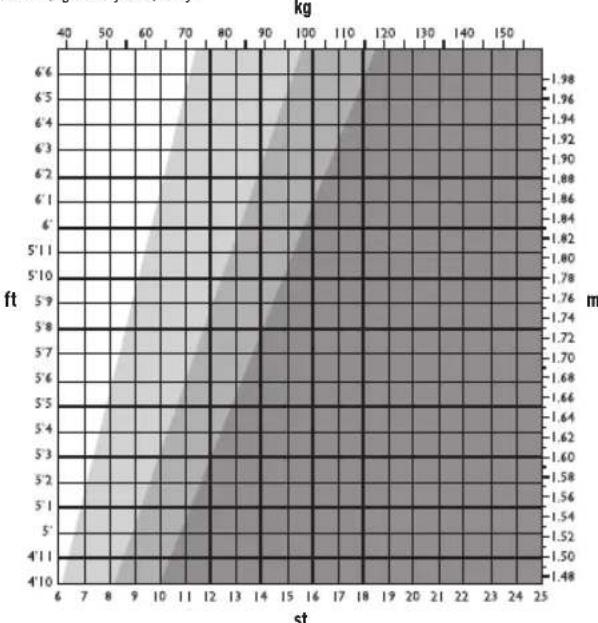
BASAL METABOLIC RATE (BMR) - WHAT DOES IT MEAN? Your Basal Metabolic Rate (BMR) is an estimation of the energy (measured in calories) expended by the body, at rest, to maintain normal body functions. This continual work makes up about 60 - 70% of the calories the body uses, and includes the beating of your heart, respiration, and the maintenance of body temperature. Your BMR is influenced by a number of factors, including age, weight, height, gender, dieting and exercise habits.
QUESTIONS & ANSWERS
How exactly is my body fat and water being measured? This Salter Scale uses a measurement method known as Bioelectrical Impedance Analysis (BIA). A minute current is sent through your body, via your feet and legs. This current flows easily through the lean muscular tissue, which has a high fluid content, but not easily through fat. Therefore, by measuring your body's impedance (i.e. its resistance to the current), the quantity of muscle can be determined. From this, the quantity of fat and water can then be estimated.
What is the value of the current passing through me when the measurement is taken? Is it safe? The current is less than 1mA, which is tiny and perfectly safe. You will not be able to feel it. Please note however, that this device should not be used by anyone with an internal electronic medical device, such as a pacemaker, as a precaution against disruption to that device.
If I measure my body fat and water at different times during the day, it can vary quite considerably. Which value is correct? Your body fat percentage reading varies with body water content, and the latter changes throughout the course of the day. There is no right or wrong time of the day to take a reading, but aim to take measurements at a regular time when you consider your body to be normally hydrated. Avoid taking readings after having a bath or sauna, following intensive exercise, or within 1-2 hours of drinking in quantity or eating a meal.
My friend has a Body Fat Analyser made by another manufacturer.
When I used it I found that I got a different body fat reading. Why is this?
Different Body Fat Analysers take measurements around different parts of the body and use different mathematic algorithms to calculate the percentage of body fat. The best advice is to not make comparisons from one device to another, but to use the same device each time to monitor any change.
How do I interpret my body fat and water percentage readings? Please refer to the Body Fat and Water tables included with the product. They will guide you as to whether your body fat and water reading falls into a healthy category (relative to your age and sex).
What should I do if my body fat reading is very 'high? A sensible diet, fluid intake and exercise program can reduce your body fat percentage. Professional medical guidance should always be sought before embarking on such a program.
Why are the body fat percentage ranges for men and women so different?
Women naturally carry a higher percentage of fat than men, because the make-up of the body is different being geared towards pregnancy, breastfeeding etc.
What should I do if my water percentage reading is 'low'? Ensure that you are regularly taking sufficient water and work towards moving your fat percentage into the healthy range.
Why should I avoid using the Body Analyser Scale whilst pregnant? During pregnancy a woman's body composition changes considerably in order to support the developing child. Under these circumstances, body fat percentage readings could be inaccurate and misleading. Pregnant women should therefore only use the weight function.
ADVICE FOR USE AND CARE Always weigh yourself on the same scale placed on the same floor surface. Do not compare weight readings from one scale to another as some differences will exist due to manufacturing tolerances. • Placing your scale on a hard, even floor will ensure the greatest accuracy and consistency. • It is recommended that you measure at the same time of the day, preferably early evening before a meal for the most consistent results. • Your scale rounds up or down to the nearest increment. If you weigh yourself twice and get two different readings, your weight lies between the two. • Clean your scale with a damp cloth. Do not use chemical cleaning agents. • Do not allow your scale to become saturated with water as this can damage the electronics. • Treat your scale with care - it is a precision instrument. Do not drop it or jump on it. • Caution: the platform may become slippery when wet.
TROUBLESHOOTING GUIDE You must have bare feet when using body fat and total body water measurements. The condition of your skin on the bottom of your feet can affect the reading. To get the most accurate and consistent reading, wipe your feet with a damp cloth, leaving them slightly moist before stepping on the scale.
WARNING INDICATORS
Lo Replace battery.
0-Ld Weight exceeds maximum capacity.
Err Out of range, incorrect operation or poor feet contact. Unstable weight. Stand still.
TECHNICAL SPECIFICATION
80 cm - 220 cm Athlete mode = 15-50 years
2'7" - 7'3" d = 0.1 % body fat
6-100 years d = 0.1% body water
Male/Female d = 0.1% muscle mass
12 user memory d = 1 kcal BMR
Child mode = 6 - 12 years
WEEE EXPLANATION This marking indicates that this product should not be disposed with other household wastes throughout the EU. To prevent possible harm to the environment or human health from uncontrolled waste disposal, recycle it responsibly to promote the sustainable reuse of material resources. To return your used device, please use the return and collection systems or contact the retailer where the product was purchased. They can take this product for environmental safe recycling.
BATTERY DIRECTIVE This symbol indicates that batteries must not be disposed of in the domestic waste as they contain substances which can be damaging to the environment and health. Please dispose of batteries in designated collection points.
GUARANTEE This product is intended for domestic use only. Salter will repair or replace the product, or any part of this product, (excluding batteries) free of charge if within 15 years of the date of purchase, it can be shown to have failed through defective workmanship or materials. This guarantee covers working parts that affect the function of the product. It does not cover cosmetic deterioration caused by fair wear and tear or damage caused by accident or misuse. Salter shall not be responsible for any type of incidental, consequential or special damages. Opening or taking apart the product or its components will void the guarantee. Claims under guarantee must be supported by proof of purchase and be returned carriage paid to Salter (or local Salter appointed agent if outside the UK). Care should be taken in packing the product so that it is not damaged while in transit. This undertaking is in addition to a consumer's statutory rights and does not affect those rights in any way. For UK Sales and Service contact HoMedics Group Ltd, HoMedics House, Somerhill Business Park, Five Oak Green Road, Tonbridge, Kent TN11 0GP, UK. Helpline Tel No: (01732) 360783. For Ireland, please contact Petra Brand Masters, Unit J4 Maynooth Business Campus, Maynooth, Co. Kildare, Ireland. Tel +00 353 (0) 1 6510660. e-mail sales@petrabrandmasters.ie.
www.salterhousewares.com/servicecentres

*Fonte: Estratto da HD McCarthy, TJ Cole, T Fry, SA Jebb e AM Prentice: "Body fat reference curves for children". International Journal of Obesity (2006) 30, 598-602.
**Fonte: Estratto da Dyrmpa Gallagher, Steven B Heymsfield, Moanseong Ho, Susan A Jebb, Peter R Murgatroyd e Yoichi Sakamoto: "Healthy percentage body fat ranges: an approach for developing guidelines based on body mass index 1-3". Am J Clin Nutr 2000;72:694-701.
PERGUNTAS E RESPOSTAS
NORMAL SUNN KROPPS FETTPROSENT
KROPPSFETT%NIVA FOR GUTTER* Alder Lav Optimal Moderat Ho
| 6 ≤12.4 12 | 5 -19.5 | 19.6 - 22.6 | ≥22.7 | ||
| 7 ≤12.6 12 | 7 - 20.4 | 20.5 - 24.0 | ≥24.1 | ||
| 8 ≤12.7 12 | 8 - 21.3 | 21.4 - 25.4 | ≥25.5 | ||
| 9 ≤12.8 12 | 9 - 22.2 | 22.3 - 26.7 | ≥26.8 | ||
| 10 ≤12.8 12 | 9 - 22.8 | 22.9 - 27.8 | ≥27.9 | ||
| 11 ≤12.6 12 | 7 - 23.0 | 23.1 - 28.2 | ≥28.3 | ||
| 12 ≤12.1 12 | 7 - 22.7 | 22.8 - 27.8 | ≥27.9 | ||
| 13 ≤11.5 11 | 6 - 22.0 | 22.1 - 26.9 | ≥27.0 | ||
| 14 ≤10.9 11 | 1.0 - 21.3 | 21.4 - 25.8 | ≥25.9 | ||
| 15 ≤10.4 10 | 5 - 20.7 | 20.8 - 24.9 | ≥25.0 | ||
| 16 ≤10.1 10 | 4 - 20.3 | 20.4 - 24.2 | ≥24.3 | ||
| 17 ±9.8 | 9.9 - 20.1 | 20.2 - 23.8 | ≥23.9 | ||
| 18 ±9.6 | 9.7 - 20.1 | 20.2 - 23.5 | ≥23.6 |
KROPPSFETT%NIVA FOR JENTER
| Alder Lav Optimal Moderat Høy | |||
| 6 ≤14.4 14 | 5 - 23.0 | 23.1 - 26.1 | ≥26.2 |
| 7 ≤14.9 15 | 0 - 24.5 | 24.6 - 27.9 | ≥28.0 |
| 8 ≤15.3 15 | 4 - 26.0 | 26.1 - 29.6 | ≥29.7 |
| 9 ≤15.7 15 | 8 - 27.2 | 27.3 - 31.1 | ≥31.2 |
| 10 ≤16.0 16.1 | - 28.2 | 28.3 - 32.1 | ≥32.2 |
| 11 ≤16.1 16.2 | - 28.8 | 28.9 - 32.7 | ≥32.8 |
| 12 ≤16.1 16.2 | - 29.1 | 29.2 - 33.0 | ≥33.1 |
| 13 ≤16.1 16.2 | - 29.4 | 29.5 - 33.2 | ≥33.3 |
| 14 ≤16.0 16.1 | - 29.6 | 29.7 - 33.5 | ≥33.6 |
| 15 ≤15.7 15.8 | - 29.9 | 30.0 - 33.7 | ≥33.8 |
| 16 ≤15.5 15.6 | - 30.1 | 30.2 - 34.0 | ≥34.1 |
| 17 ≤15.1 15.2 | - 30.1 | 30.2 - 34.3 | ≥34.4 |
| 18 ≤14.7 14.8 | - 30.8 | 30.9 - 34.7 | ≥34.8 |
KROPPSFETT%NIVA FOR MENN** Alder Lav Optimal Moderat Ho
| 19 - 39 ≤8 8.1 | - 19.9 | 20 - 24.9 ≥25 | ||
| 40 - 59 | ≤11 | 11.1 - 21.9 | 22 - 27.9 | ≥28 |
| 60+ | ≤13 | 13.1 - 24.9 | 25 - 29.9 | ≥30 |
KROPPSFETT%NIVA FOR KVINNER** Alder Lav Optimal Moderat Hoy
| 19 - 39 | ≤21 | 21.1 - 32.9 | 33 - 38.9 | ≥39 |
| 40 - 59 | ≤23 | 23.1 - 33.9 | 34 - 39.9 | ≥40 |
| 60+ | ≤24 | 24.1 - 35.9 | 36 - 41.9 | ≥42 |
NORMAL SUNN KROPPSVANNPROSENT
m = 311 ;
WAARSCHUWINGSMELDINGEN
Lo Batterij verwangen.
BASALSTOFSKIFTE (BMR) - HVAD BETYDER DET?
**Forros: Szarmazasi hely: Dymona Gallagher, Steven B Heymsfield, Moonseong Heo, Susan A Jebb, Peter R Murgatroyd, es Yoichi Sakamoto: "Healthy percentage body fat ranges: an approach for developing guidelines based on body mass index 1-3". Am J Clin Nutr 2000;72:694-701
27-73" d=0.1% testzir
MEREHN HMOTNOSTI A TELESNEHO TUKU
- Yasekrani yanip soner.
| 6 | ≤14.4 | 14.5-23.0 | 23.1-26.1 | ≥26.2 |
| 7 | ≤14.9 | 15.0-24.5 | 24.6-27.9 | ≥28.0 |
| 8 | ≤15.3 | 15.4-26.0 | 26.1-29.6 | ≥29.7 |
| 9 | ≤15.7 | 15.8-27.2 | 27.3-31.1 | ≥31.2 |
| 10 | ≤16.0 | 16.1-28.2 | 28.3-32.1 | ≥32.2 |
| 11 | ≤16.1 | 16.2-28.8 | 28.9-32.7 | ≥32.8 |
| 12 | ≤16.1 | 16.2-29.1 | 29.2-33.0 | ≥33.1 |
| 13 | ≤16.1 | 16.2-29.4 | 29.5-33.2 | ≥33.3 |
| 14 | ≤16.0 | 16.1-29.6 | 29.7-33.5 | ≥33.6 |
| 15 | ≤15.7 | 15.8-29.9 | 30.0-33.7 | ≥33.8 |
| 16 | ≤15.5 | 15.6-30.1 | 30.2-34.0 | ≥34.1 |
| 17 | ≤15.1 | 15.2-30.1 | 30.2-34.3 | ≥34.4 |
| 18 | ≤14.7 | 14.8-30.8 | 30.9-34.7 | ≥34.8 |
an diapopouc napayovtec, onwnc nukia, to pao, to uoc, to pulo, oitaiptpikec ouvtheickai ouvtheics aoknonc.
EPOTHEEIGKAIANTANTHEEIG
Nc akipicc metpatai to linoc kai to vepo tou oomegac pou; Autn n Cuyapia Tc Salter xnpoiomoei ia mebdo metponc, ywotn wC Bioelectrical Impedance Analysis (BIA).Eva noL uKPO noooTO pEmuTOC nepVa ano to oomega ac, eowTuV neAATuv Kau Tov NIOWvAC. Auto To peuja nepVa eukola mea ano tv aIINO uko IATO, Tnu Exei uynlnepeikKTIOTa ae UyPo, alaOxToo eukola meaa ano to Ainoc. Suvenwc, pTePVOTn TOnvBETn Avtotaon TOnomegaCac (dN, Tnv avrtotaon TO tOe pUa), mOpoe i naPooBDIOPIeIN nooTNTa TuMw. Ano auto, mnpoe va unOAnoytei ng nooTNTa Tou Ainoc kai Tou vepou.
Noan nooontnpeuatoe npva ano eoou atav aauavetai n eptpon; Eiva aopae; To peua evia lyoteo ao 1mA, to onio evia noa liy kai anolaata oapalec. Dev npopeite kav va to wioete. Tneiwote, wotoo, ot ni ouokeun auten dev npenev xpaonnoietai ano atoua me onoiadniye OEWTEPIK NAKTPOVIK iatpkn oukeun, onac bnatodotnc, wcnpovlaen ano diakomtnk ouokeun.
Eav metnoo to aiooc kai to vepou tou oawatoc ouo diaopopetikc wpc mec eo aty npepa, uopei va diaepovn anuavtka. No taun eivn oownt; H metponou nooootou tou oawatikou oinou cokai ealaoyoe tnv nepiekitoknta tou vepou tou oawatoc kai to vepo oto oomega aaalekata th diapkeia tnc npac. Dev unapxei oawotn h aooc npac yia tn metpon, aalpovvtie va metpieote octakxovika diaostnata, otav eowpeite oti to oomega ac evai kavovika evudatuveo. Anopeuyete va metpieote meta ano mauvo n aouvva, meta ano etvton aokon nEvTOC 1-2 wovn to n otynou nnu nneate yeaan nooTNTUVPWn ano tn otynou nou payate eva yua.
Evac piloc/ma piln oue exi ma oukeun avauon comega kou linouc aalou kataakeuaotn. Otav n xpnoumonioina, bianiotwa on n metpon Tou ouwpatikou lounoc ntabiaopopetki. Iati oubaive auto; Odiapopoe c ouokec avauon comega koulinou naipvovu veptoae ano diaopopetka mepn Tou ouwatoc kai xpnoiouiovui diapopetkoic aagnatikou acyopiouc iaTov unolaojato Tou nooootou Tou oomega tikoianoc H kauapetn oubouyn eivan va mny oukypivete tic metpoei twv diaopowou ooueov, aala va xnpoiouoneite tvn idia ouokeun kade qopa yia va npakokouthetaine oonaiadneote alayy.
IwCepunveuwTcetpnoeicTuVnoootWaioucKaiVEpuTuOomegaTouoou;AvatpeTeOToucniavaceZomegaKaiVEPOuOuvodeouvToPoiov.0aacKaBoynoyouuOvoBpeiteEcvNMeTPOONTOAIoucKaiTuVEPOU OtoomegaocJuniuteOEuauykntyopia(oe oxenme TnuNkiaKai To piooac).
Tnpenei va kavv eav n metpnon tou oomegaikou oov linouc evai nou 'uynh'; Mia loyki biata, any npov kai eva npoypauma aaknonc mnpoov va meowou to nooootou oomegaikou oac linouc. Ta npenei va cntate na'ta iatpikn Kaobnyon npiv npoeite ae teioiu edouc npoypauna.
Iati to eupoc tou nooootou oawatikou linouc tov avdpw diapepei
toco nolu ano autow yuvvaukow; H yuvaikec ano tn qvoon touc exouv uynlotepo
nooo toa liouc ano touc avpoc, einei on diaoppwon tou oawatoc touc evai
diapopetikn layw tc nkiiejevcn kunong, Tou gnlaouk.
T npenei va kavv eav n etponou tou noootou vepou tou oomegaocou evai 'xamn'; Ilvete taikia enapkn nooToTa vepou kalnpoaanote to noo0to Tou oomegakou aac limou,va euninnte oto uyie eupoc.
Fiatipnpenv anopoeuy tn xpon tnc yuyapic me avaut oomega to cnuiaoc kata n diapkeia ntc ekyuouuvn, n ouvean tou oomega tnc yuvaiac aalce onayavtikya via uonotpiie to avattuoooevo npepoc. Yno autc tic ouvthke, ie pnetpaeic tou nooootou tou oomegakou ainouc, monei v eivai avakpiieic kai napaiavntikec, suveniow, oc eykuueyuvaike, npenei va xpanoiotovu movo th aeitoupya cuynionc.
ZYMBOYAE TIA TH XPHSH KAI THN OPONTIDA NaVva cuyieote otny iDia Cuyapia, n oioia eiva tonoBteJevn otiv ia etnpaveia danedou. Mny ouykpivee metpnoec papuc miacuyapac meiac aalnc, o otioec ba dapepuov looyu katoakeuaotikov avoxw. Av tonoBteOeT n Cuyapia oac oeaknpo, enine do daene, eoqawicete t neyaleutepn duvatni akpiieia kai enavaanmuotnta wv npetpoeew. Na cyioteTnv ia wpa kaede epa, pnv yeuatooeke kai xwipc va opate nanoutoa. Mia kai npw eiva nolu vupic to npui. H Cuyapia oac kavei otpyyyoloinon npoc ta enawn npoc ta katw, otny nanaoteepn evdeen. Av cuyotierte duo opepc kai otpenoeic diaepouv, ta bpapc oac pbioketai metae Tuw duo petaeew. KaBapicTe Tn Cuyapia eve uyp navi. Mny npaionoteite xnnkka Kabapiatika. Mny apyveTne Tn Cuyapia va koepei tvepo, apow etai Ba kataotpaoov Ta nektpovikra TNC kukawata. Metaepiciote Tn Cuyapia oac npoektika - eviav evpyavo ankiieic. Mny tv npyveTve a neoei kai mnu avebaive Tn avw nncmdwtac. PpooyxH: H nlatoppma ptoei va maiprav avivat bepveyn
OADHFOZ ANTIMETONIEI HPOBAHMATON Ipenei va iote Eunolntot otav xnpouoieite tic metrhoic oomegaikou kai ouvoiaokou vpou tou owpatoc. H kataotaan Tou depaoc Tou neaatoc acnopei va empeaei n tepnon.
vaIaBETe TIV NIO aKpIbN KAI OUENI METPON, NIV NAtnoE EAnwO tN Cuyapia, OKouniTe TA NELaTc Aoc MeVA ELappwC BpeyEvo Naiv, apnvovtac To EaappuC uypa.
Pn yctaHOBKe BEcOB B dpyrom MeTe npoceDpy HnHnHaHn3auin Cneyet NOBTOPTb. Bo BCEx OCTaIbHbIX cIyuaX DoCTaTOH NoCtO BCTaTb Ha BeCbI.
IPOUEDYPA B3BEEUBAHNA 1. BCTaHbTe Ha BeCbH cTOnTE HEnoDBNHO KOHNCHMA ONpeJeHnEBAe.2.Ha DmCnPe 6yDet OTObpaKeH TeKyuM BEc
3.CouDInTe C BocB.3HaueHHe Beca 6yIe T OTo6paKaTbCae Hee HecKnobKcEkyHd
4.3aTEM BeCbI BbIKHIOHaTcA
BBOI INPECOHANbHbIX DAHHbIX
1.ДЯВКИОЧЕНBAECOBHAXMNTEKHONKYCTaHOBnTb).
2.ПиMuHrAoUeMnHmKaTopeHomepaNoIb3ObaTeYcNOMoUbKHOITOKBbIePeHTeHyKnHbHmOHepeNoIb3ObaTeYaNIOIqTBepXdEHHBaIbOpaHaXMMtEKNOHky(YCTaHOBntb).
3. HauHET MIRATb CMMBONI nona
Haximma KhoNky ,do6eTecb, yTo6bl 3aMnraI HyKbI CMBON, a 3aTEM HaxMMTe KhoNky (yCTaHOBmTB).
- HanHTMIRATbHIMDKaTOPB03pacta.
JaYcTAHOBKN3HaueHMA Bo3pTa HAXMauTe Heo6XoDMMe KOIMueCTBO pa3 KHOKN, aTaTEM HAXMUTE KHONKY (YcTAHOBNTb).
TeTckn peKm: KOrDa yCTaHOBHeHoe 3HaueHe B03paTa HaxoMTcB DmIa3OHe ot 6 do 12 net, AToMaTHueCKn BKIOuHaTeCra TeCKn peKm. Byet OTo6paXeH MaIehbKn CmMBonpe6eHka, KaN oKa3aHo Ha cNe dyUeMpncyHke.
PpmeHne. B detcKOM peKHMe OTO6paKaIOTC TOnbKO pOKaTeENBeca, KOINcCTBO KINPOBIO TKAHN KOINcCTBA BObl BOprAH3Me.
- NaHcHTMnraTbMHnDkaTop poCTa.
IyCTAHOBKN 3HaueHnPoCTa HAKMaiTe Heo6xOIMMoE KOINcETBO pa3 KHONK
A 3aTEM HAXMITE KHONKY (YCTAHOBNTb).
CnpTnBbI pexHM: CnpTnBbI pexKM DoCTyneH, cEmYcTaHOBNe H03pact 10 15 do 50 net. JIa Bbl6opa CnpTnBbHO pexKIMHaXkMauTe KHOKNy NOKA He OTo6pa3NTc CMBON, a3aTeMa HxKMIte KHOKNy (YctAHOBITb). K KaterOpnn CnpTcMeHO BTOHCOTcR Mua, 3aHmuaOuueCe HTEChNBHBMN Nm3UeCKMM yypKaHHeHHMOM OKo7 12 cacB hEeIO N MeEOUme PnBc CB COCTOHNN NOKOHE Bbiie 60 ydapOB B MNHyTu.
-
Ha dncnnee 6dyt OTobpaJxHehbl Baun HactpoKm, a 3aTeM Bcbl OTKnHouATcN. NamrtyctAHOBnHa.
-
NOBTOPHTIpoUeDpyPINBTOPO NOIb3OBATeN IINIINIIMHeHn DaHHbIX TEKUYeO NOJIb3OBATeN.
PnmeHne. TObbHnHMeHb DaHHe B nMaTn, cEyTe OncHHpoeDye, BHOCA HeoXoDMbIe H3MeHeHa.
M3MEPENHE BCAI KIMPOBOI TKAHINB OPTAHN3ME
YCTAHOBHTBecbHaPOBHOH NOBepxHOCTN.
1. HaxMMTe KHNkY (CTaHOBnTb).
2.CnMOOJIbIO KHOIOK BBOePeITHe HxHbHbHOMeP noB3oBaTeNA.
3. 0xkntecb noTBepeHnHa nCnnee nepcoHaBbIX daHHbx, a 3aTEM - OTo6paKeHn HynEBO 3NaueHn.
4. PnOTo6paKeHH HnyeBOro 3HaueHHe BCTaHbTe 6OCHKOM Ha NpTaFOpMy I CTOnTe HeNoDnBHXo.CTynH DoNkHBi HaxoDITBCa B NIOTHOM KOHTaKTc C2 MetaJIuNueCKMn NpACTINHAMn Ha NpTaFOpMe.
5. Upe3 2-3 cekynbIb 6yIet oTo6paXeH TeKyuIin BEc.
6.CToIeHaBecaxHEnoDBMNXHOdoOKOHuaHNIM3MepeHH.
7. HapaCy CBecOM 6byyT OTobpaXeHb CNeIkyUme NOKa3aTeM: IpoeHT HpaB OpraHIM3Me, INHbI npoEHT BObl B OpraHIM3Me, IpoeHT MblueHNOH MaCbI, INHeKc MaCbI TeA (BMI) INHTHCUBHOCTb OCHOBHOrO OBeMa BeJeCTB (BMR).
KOLINYECTBO XHPOBOI TKAHN B OPTAHN3ME — YTO 3TO 03HAAYET?
Yenobueeckoe Teno, NOMMO Bcero Ipooyero, Coepjxnt onpepehenHHI npoeeH JnnpoBOI TKAHN.30JXn3HeHNO HeO6xoHIMO dIg HOpMaIbHO r3DopOBoro oprAHIN3Ma.JXpOBAI TKaHb NpUdAeT n6KoCTb CytTabAM 3aUIMaEAT KIn3HeHHbIe OPAHbI, NmORAeT peryHNPoBAT Temnepatpy Tena, CoXPaHET BHTAMMHBI n pnpiaet OpanH3MMy CNB IIpn HeNoctaTOHOM NTAHNI. TEM He MeHee N3bIKo HnH NoedctaTOK JXpOBAI TKAHN B OprAHIN3Me MoKeT b6Itb ONaCHbIM D3DopOBbI. PaccMatPUBA Ce6B B 3epkANO, Oehb CNOxHIO OeHNb, CKONko JxnpoBOI TKAHN coepjHXITc BOprAHIN3Me.
BOT NOYEMy BAXHNO 3M3MePbI KHOHTPOINPOBaT IpoeHTHOe COepeKahHe JIKPOBOI TKAHN B OprAHN3Me. IpoeHTHOe COeepKaHHe JIKPOBOI TKAH N B OprAHN3Me ABJNEcA
60one BaxhBM NOKa3aTeJIe moCTOAHM 3DOpOBBa, yem O6uH BEc. PnCHNXEHMMBeca 3TO MoKET O3Haayb NotepHO MblueHou MaCCb BmecTo XnpoBOJ. Daxe eCINMBcB1 NOKa3bBAIoT HOPMaJIbHb BEc, npoUeTHOe CoepKaHMe XnpoBOJ TKAHNMOKET 6bIb IIO-NpEKMHE MyBCOKHM.
HOPMAJIbHbIyYPOBEHbXKPOBOI TKAHI (%)
| ПОЛСЕТНOE COДЕРЖАНОЕ XИЮВОЙ TKAHИ B OРТАИЗME IOHOΙΥЕΨ*Boэразн Изгий ONТМалький Средный ВсICOKИŋ | |||
| 6 ≤12.4 12.5 - 19.5 19.6 - 22.6 ≥22.7 | |||
| 7 ≤12.6 12.7 - 20.4 20.5 - 24.0 ≥24.1 | |||
| 8 ≤12.7 12.8 - 21.3 21.4 - 25.4 ≥25.5 | |||
| 9 <12.8 12.9 - 22.2 22.3 - 26.7 ≥26.8 | |||
| 10 ≤12.8 12.9 - 22.8 22.9 - 27.8 ≥27.9 | |||
| 11 ≤12.6 12.7 - 23.0 23.1 - 28.2 ≥28.3 | |||
| 12 ≤12.1 12.2 - 22.7 22.8 - 27.8 ≥27.9 | |||
| 13 <11.5 11.6 - 22.0 22.1 - 26.9 ≥27.0 | |||
| 14 <10.9 11.0 - 21.3 21.4 - 25.8 ≥25.9 | |||
| 15 ≤10.4 10.5 - 20.7 20.8 - 24.9 ≥25.0 | |||
| 16 <10.1 10.2 - 20.3 20.4 - 24.2 ≥24.3 | |||
| 17 ≤9.8 9.9 - 20.1 20.2 - 23.8 ≥23.9 | |||
| 18 ≤9.6 9.7 - 20.1 20.2 - 23.5 ≥23.6 | |||
| ПОНДЕТСОДЕРЖANHE XИРОВОД TKAHIN B OPORTAH3ME DEBYUKEK* | |||
| Возр发布时间 | Нзкий Onтималький | Сразднй | Високий |
| 6≤14.4 | 14.5-23.0 | 23.1-26 | 1≥26.2 |
| 7≤14.9 | 15.0-24.5 | 24.6-27 | 9≥28.0 |
| 8≤15.3 | 15.4-26.0 | 26.1-29 | 6≥29.7 |
| 9≤15.7 | 15.8-27.2 | 27.3-31 | 1≥31.2 |
| 10≤16.0 | 16.1-28.2 | 28.3-32 | 1≥32.2 |
| 11≤16.1 | 16.2-28.8 | 28.9-32 | 7≥32.8 |
| 12≤16.1 | 16.2-29.1 | 29.2-33 | 0≥33.1 |
| 13≤16.1 | 16.2-29.4 | 29.5-33 | 2≥33.3 |
| 14≤16.0 | 16.1-29.6 | 29.7-33 | 5≥33.6 |
| 15≤15.7 | 16.8-29.9 | 30.0-33 | 7≥33.8 |
| 16≤15.5 | 16.6-30.1 | 30.2-34 | 0≥34.1 |
| 17≤15.1 | 16.2-30.1 | 30.2-34 | 3≥34.4 |
| 18≤14.7 | 14.8-30.8 | 30.9-34 | 7≥34.8 |
| ПОUCTHOE COДЕРЖANHE XИРОВОТ TXKAN B OPTAHN3ME MYXQUH** | ||||
| Возр发布时间 | Боротький Onтималынь | Сраздnum | Бусоки | |
| 19-39 | ≤8 | 8.1-19.9 | 20-24.9 | ≥25 |
| 40-59 | ≤11 | 11.1-21.9 | 22-27.9 | ≥28 |
| 60+ | ≤13 | 13.1-24.9 | 25-29.9 | ≥30 |
| ПОДЕТНOE COДЕРЖANHE XИРОВОЙ TKAHN B OРТАH3ME JEXEHUN** | ||||
| Возразн НИЗКIN ONTNIMЛБNH Cрedingу | ||||
| 19-39 | ≤21 | 21.1-32.9 | 33-38.9 | ≥39 |
| 40-59 | ≤23 | 23.1-33.9 | 34-39.9 | ≥40 |
| 60+ | ≤24 | 24.1-35.9 | 36-41.9 | ≥42 |
*NCTOZHUMB. BbIepeKHH N3 nyblnkaumH; HD McCarthy, TJ Cole, T Fry, SA Jebb n AM Prentice: (XapaxtekncnHKnok3aTeHnpoctHrTO coepEckHaJI Kupobov kTuHy uTeyen). JxpyHn International Journal of Obesity (2006 r), 0, 598-602.
** UtoHnK: BbIepKn H3 NyibnKaun; Dympna Gallagher, Steven B Heymsfield, Moonseong Heo, Susan A Jebb, Peter R Murgatroyd Yoiichi Sakamoto: (3hAeHHN npouENTHO OOpejHKnH JxpoBON TKAHN B 3apoBOM TONE): (noXdoK papaotBe peKoMeHauaHa oCHOBAHm HnEkeKa MaccBtena 1-3). Am J Clin Nutr 2000;72:694-701.
3aHNeHHPOIeHTHOO cEepKJHAnHJI KINOpOBI TKAHINPbHEeHNbHKNIOHTBHO B O3aHOKOMTENbHbIXcJIeHX.
KOLHCTBO BOIDBI BOPAHN3ME-3A4EM ETO H3MEPrtb?
Boda AIBNIEcA OCHOBHcOCTaBnIOUeOpraHIm3Ma. Ha ee IOnIO npHXoDITCA Gonee nonOBHHb BceM MacbI Tena N OOTIN DBe TpeT erO 63KuPOBo cOCTaBnIOUe(B OCHOBHOMMbIeHcHMOscBbl).Boda BbIOnIIHaET MHOKeCTBO BAXbIXbXyHKUIM B opRAH3Me.Bce KNTKN Tena, HAOIDTAcN IO OHN B KOKE, XeNE3ax, MbIHuaX, MO3re HmIte-NiHo eEe, MOrTy PnaBnIbHO FyHKUHOHPOBaTb TONbKO TorDa, KOJa B HIX DoCTaTOHBOda. Boda TAKHe UprTaE Xn3HeHBOBaHXyIOpoB bPeryNUpOBAHm TEnNOo6MeHa, B uactHOCTn Uepe3 nToOTIoJIeHHe COeTaHne NOKa3aTeJe o6uei MACCbI Tena M MacCOBoI DOJI N XUPBOB TKAHN MOKe 6bITb «HOPMaIbHbIM», HO npn STom yOpBEHb BOJb B oPraH3Me MoXeT 6bITb HeIOCTaTOeH Jn HOPMaIbHoo Xn3HeTeJIbHOCTn.
HOPMAJIbHbI YPOBEHb BOdI B OPTAHN3ME (%)
| Тол[b]оОПЕДЕLEH[b]е моДел** | ||
| Пробenthoe соржанee Жирobов Тканн | Опимал[b]oe proцenthoe соржанe BovbI | |
| Му[ku[h]ы | 4do 14% | 70 do 63% |
| 15 do 21% | 63 do 57% | |
| 22 do 24% | 57 do 55% | |
| 25 u 6ол(e) | 55 do 37% | |
| Жени[b] | 4do 20% | 70 do 58% |
| 21 do 29% | 58 do 52% | |
| 30 do 32% | 52 do 49% | |
| 33 u 6ол(e) | 49 do 37% | |
XtOcHnK BbDepKnn H3 Wng & Deurenberg: (CoepeKaHne BoBb I Be6xMPOBOI coCTABnHOeip orpAHHMa). (AmePKaHckn JxpyHan MeuHnCKOro NTAHm) Nutr 1999, 69.8-841.
ДлгТeX,KTO 3aHMaeTcCnOpTom:yHTMe,YTO B 3aBcNMOCTH OT Bnla CnOpTa copekhaHne JxipOBO TkaHb BoprAhn3Me Moxtet bItb MehIbe,aBObl-60nbIe, yem Ykazao HbIiHe. Ha pezylbTaIb I3MpeHnE KOnuYeCTBa BObl BoprAhn3Me OKa3bIaTe BnHnHE COoTHoUHe HxipOBO N MblueVHIO TKAHb BoprAhn3Me. EcnB OprAhn3Me HabIoJaTe cnoBbIeHoe CoepKaHnE XipOBO MaCbI INH3KOE copekHaNe MbIeUHm MacCbI,To copExpaHne BoBI BoprAhn3Me,CKopee BCero,TakKe 6ydt Hm3KM.BaHXo NOMHITb,YTO TAKHe NOKa3aTeIN,KaK Bec Tena, PnpouEHoe CoepKaHn E XipOBO TkaHb NOBdi,ABNHO TNIbU ODHMN HcpeKTB,KOTopBle MOxHO HcNoIb3OBAbTdI NEpexoDA K3IOPOBOMO Opb3y K3HN.B Pa3hIbe DnH NOKa3aHnMOrfYT OTHNuATCB,NO3OMY HeobxOIMO cmeNTb 3a N3MEHHeHHMMB TeUeyHe NdITnEBHO BpEmEHn,A HE DeNtB BBIOBdHa OHOCOBAHn pAOBbX pe3yJIbTaOB H3MepeHn. 3HaehnPiocHTHO CoepKaHn BObl B OprAhn3Me PnBBeDeHb NCKJIOHTeJIb HO B03HaKOMITENbHbIX CEJAX.
PpexKdyeemceTbHaHnetyH3aHATbcCnoptOM6b3aTeNbHO npokohcybltpyIeBcCBpaqom.
3AYM HXKHO 3HATbMbIIEUHYIO MACCY?
IIO DAHHBM AMEpHKAChKO KOnnEJa CnOPTHBHmMeHNHb,6e3KIpOBaBA MIIueHAA MACCA MOKET CHMKAtCBa DO 50% B 8o3paTe 0T 20do90net. EcnHe KOMNEHCPOBAtb 3Ty notePb,6yET TepBaB MaIIueHAA MCAa, aJIKPOBaH HApactaTb. TaKae BaxHO 3HaB npoeHTHO oepKaHMe MbIueHO MMBcBO BVPMa CHXHEHBe BE.CoCTOHN NOKO OprAHUMom pAcxOyETc OKNO 110 DONOHHTENbHbIX KAnOpH Ha KaKdb KnNOrpAMM npnpOCTaMbIueHOO MaccB
PpemmyuectBaIOBbIeHnMbIeHouMaccbI:
60pb6a co CHIXeHMeM MbIeHcHn Cnbl, IpOuHOCTN KcTeE N MbIeHcHm Maccb, COPiPOBQKaIOUIM CTapeHHe;
- NODepjKaHne TNOKOCTN CyCTaBOB;
B COUETAHIN CnpabnHNO NOOpaHHo DmTeOH —CeneHAnpabNHeHOe CHHXKeHMe BEca.
3To n3dInne npedna3aHcHcHo TOnbKO dN6bTobOro HcN0nB3oBaHHa. Ipim 6BepeMeHHocn CnElyet NOnb3oBaBcR BecAMn ToNko D8BeeUHMBAHm.
PPEUYPEXEHEHVE:He noIb3yIeTcB 3TNM 3NDenm,ecn y Bac yCTAHOBEN 3NeKTPoHHb CTMyyIaTOp cepua HnDpyoe MeuHckoe yCTPOCTBO.B Cnyae comHEnHn PpOKOHcyIbTHpyTeC CBpaOm
YO NOKA3bBAET 3HAUYEHNE MOEFO NHDEKCA MACCbI TEA? HNDEKcMACbI Tena (IMT) -3TO COOTHOUHNE BECA KPOCTY, KOtOpoe O6bHNO MCnOblSyETcRdONPpeHENHE NDocTATOHMO MacCbI Tena, u36bTOHOUH MAc5bTea N OXHPeHryB3POCBxHIOe.3TH BcEpaCmTBIBaHOB TaW IMT. Kateropu IMT, NOkAZAHHeB bRpAphKe HrTaBnE Hnke, npnHaHb CEmHpOH OrpAraZaMei 3dpabOoPAhenHnMoryTb6bH NCIOB3OBAHb IOn POpEHNHBA WABO CoCTOHNHBA. Baua Kateropu INDKECa MACbI Tena MoKet 6bITb ONPeDNEHa H3 NIKKeJeNyUe To ABnLb.
Lo 3aMeHnTe 6aTapeKy.
0-Ld Bec npeBbIaT MaKcMmaJIbHbI.
Err 3a rpaHmuaMn Dnana3oHa, HeBepHna Onpaun Hnn nnoxO KoHTAKT cctonamH. HeCTabMbHbB Bec. CToIe HenoDbHXHO.
TEXHNUECKNEXAPAKTEPNCTUKN
80cm-220cm CnpTnBbHbIpeKMM=15-50NET
2'7" - 7'3" d = 0,1% KMPOBOI TKAHIN BOPRAHM3ME
6-100netd=0,1%BOdbBOPraHn3Me
MxHHa/KeHnHa d=0,1%MbIeHOrMaCCbI
Pamrha 12 noh3oBateNe d=1KkJ (1 KINOKaIOpnH INHTeHCNBHO Dcckmpekm6-12net OCHOBHOrO 6MeHaBEIeCTB
NORCHEHNE WEEJ DaHHaMapKINPOBka O3Haauet, YTO B CtpaHax EBpONbHe DONYCKAETcYtINMnIPOBaTbPn6OpBMecTe CDPyHMn B6ItOBbIMn OTXoAMn. TtObIe H aHectn YuapeBaOkpyKaIOuE cpeE N3DopOBbHO HacENHeB Pe3yblTa HeBepHOYtINMzAUm OTXoOB, Pn6OpCneYEt CdaTb Ha nepepaboTKy, TtObIe oBeceuHTb EKOnOHnHO NBTOPhoe McNOb3BOAHme MaTePmaJIbHbIX pcycpOB. BEpHrte B6BumBy nToTpe6BenHm np6Op Ueep CmCTmy Bo3BpaTb CcbpaOTxOdo HCBXtAEcB C pPeDnPrTHmEO3HNHou TOPOBIM, Rde Bblnp6bpnnnp6Op. TaBbCMoKeTe CtaTb 3OT npOyKT Ira KOnOrHueckn Be3onAcH nepepaboTKn.
HHTPYKUNK BATAPREM DaHHb CMBON O3Haayet, YoBatape He CNeIeYrTINM3NPOBAtc BOMeCTHO C6bITOBbIM MYCOPOM, NocOKnBky OHn COepkata BeueCTBa, CnOCo6HbIe HaHeCTn BpeN OKpyKaIOUeI CpeN 3DOpOBbY. YTNm3NpyTe 6BatapEn B CneuAnbHo PnpEHa3NaueHHbIX DnA 3TO rPiemMbX pNkTx.
TAPAHTHHbE 3To H3dneI npedha3aHcHcO ToBko Jn6 b6tOBoro
ncnoh3oBAHHa. KomnHaH Salter o63yETc ocUeCTBnA B6ecnNaTHb peMOHT nnn
3aMeHY cTPOJCTBa HnIOBO erO 3eMeHTA B TceHHe 15 net C MoneHTa NOKYNK
npn YCNOBBM, Yo HNCnPABHOCTb BO3HNKNA H3-3a PmOBODCTBEHHORo DeEkeTA. Ta
rapaTHNpaPocPTpAAHETc HA BCE KOMNoHEbI, OkaBBAIOue BnHMHe na paboty
BecOB. IpaTHN He paCpOCTpaHaeTc H aYxUdHeNE BHEWOrE BnDA BCNECTBHe
ECTeCTBeHHORo M3HOCA Hn Hn OpePekDHeN B p3eybTahe HnpabINbHO
ncnoh3oBAHHa. Pn camOToTeJIbHOM BCKpbITn np6Oba rapaTHra AHHynpyetc.
Ioknyatnelb o63an npedocabntb Doka3atenbCTba npno6pehenna daHHoro
yctpoiCTBa n o6ecneHTB erO DCtABky B KOMNAHNO Salter (nHm MeCHMOy aREHTy,
ecnn NOKynka 6bila npo3BeDeha 3a npedeamn Benko6pHTAH).Bo n36ekahne
NOBpeKHeHN BO BPEMA TPAHCIOPTPOBKM BEcbl DOONKbHb 6bIb yNAKOBAHb
COOTBETCYUOM m0pa3OM.3To o63aTeNBCTBO ABnTcA DonONHEHM K
3AKOHbIM npabam noptbeNTen H NIKOMM o6p3AM He 3atparmbaet 3n npaba.
Pi BoNPocam TexHHNECKORO 6cbNyKBAHNAIBOApaauaiTbc: 000 Maltum, 2/1 build2,
4th Tverskaya-Yamskaya st,Moscow,125047,Russia.e-mail info@homedics-russia.ru.
www.salterhousewares.com/servicecentres
PL
Tryb Geographic = 6-12 lat
MERANIE HMOTNOSTI A TELESNEHO TUKU
This product is intended for domestic use.
ADVICE TO THE USER This product is a sensitive electronic instrument and as such may temporarily be affected by Radio Transmitting Devices being used in close proximity to it (such as Mobile Phones, Walkie Talkies, CB Radios, Radio Model Controllers, and some Microwave Ovens, etc.) Additionally, extreme levels of Electrostatic Interference may cause this product to temporarily malfunction. In such case it may be necessary to remove and re-install the battery to re-establish normal working. If the problem persists then contact your local agent.
F COMPATIBILITE ELECTROMAGNETIQUE
Homedics House, Somerhill Business Park
Five Oak Green Road, Tonbridge,
Kent TN11 OGP
www.salterhousewares.co.uk IB-9173-0415-01