3D9 - Range hood CDA - Free user manual and instructions
Find the device manual for free 3D9 CDA in PDF.

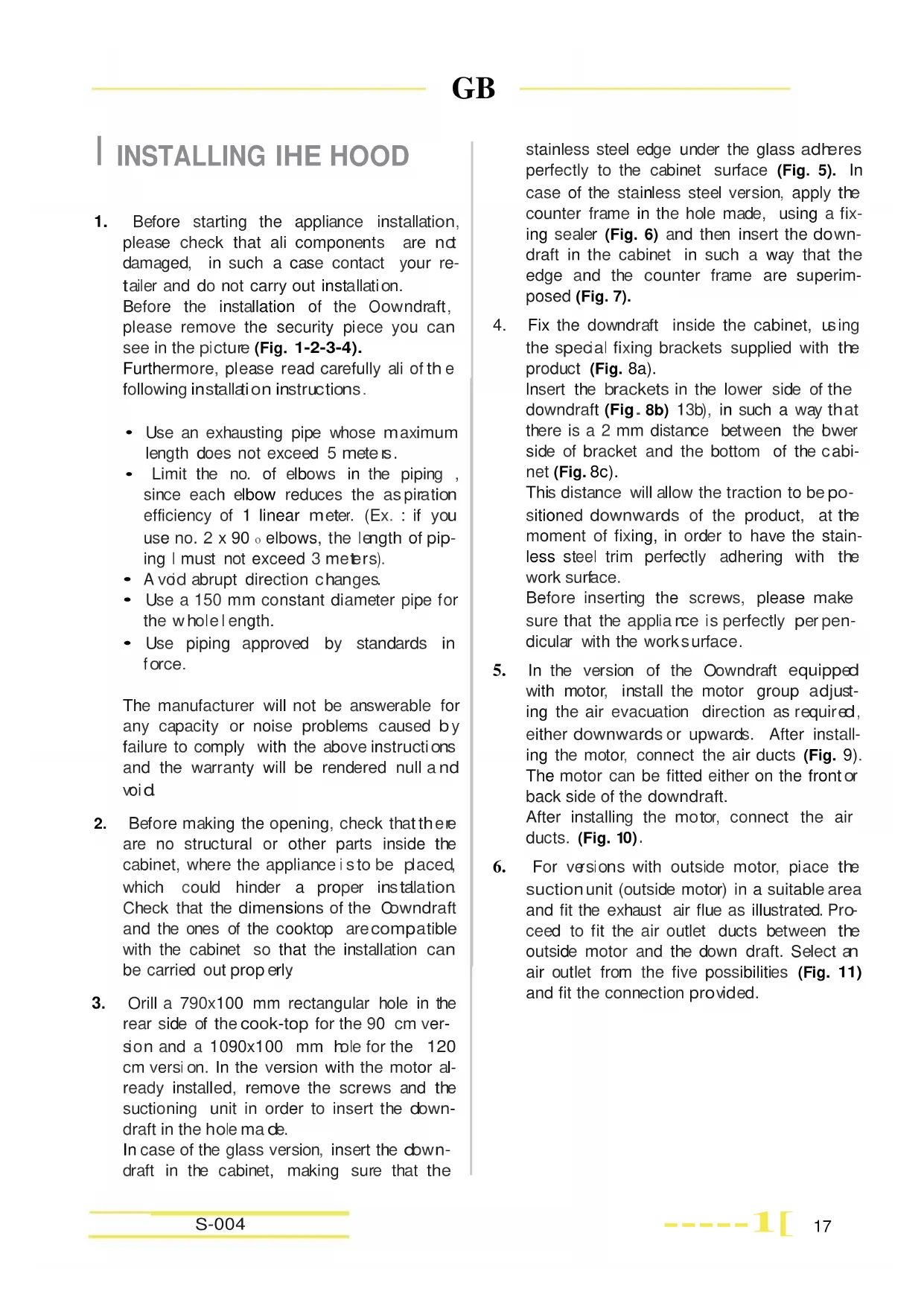


| Product type | Built-in downdraft extractor hood |
| Brand | CDA |
| Model | 3D9 |
| Category | Hood |
| Available version | Extraction (external) or recirculation (filtering) |
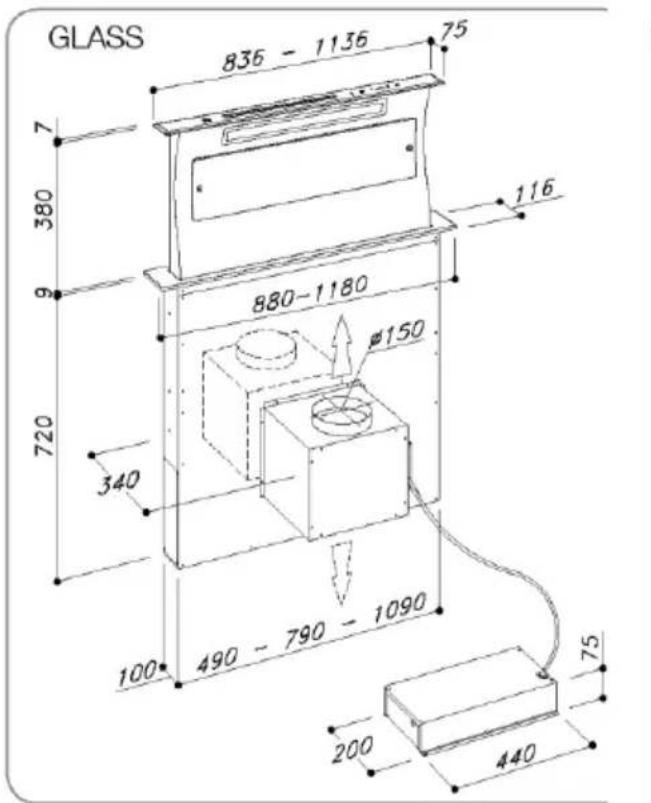
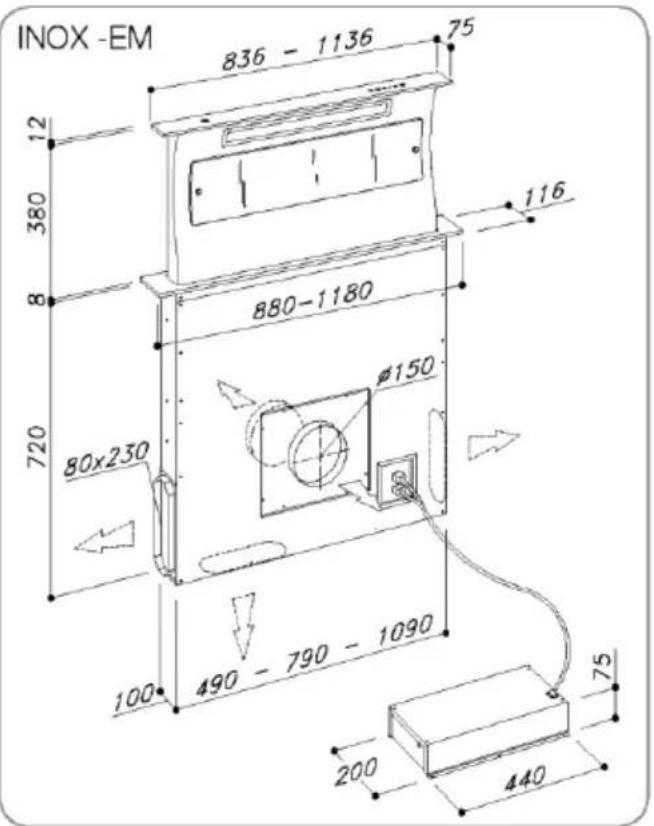
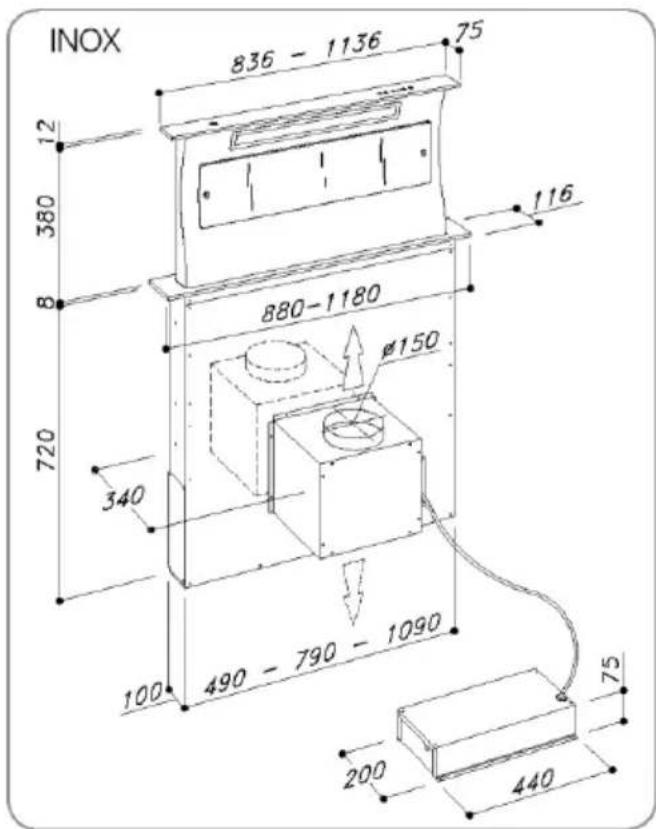
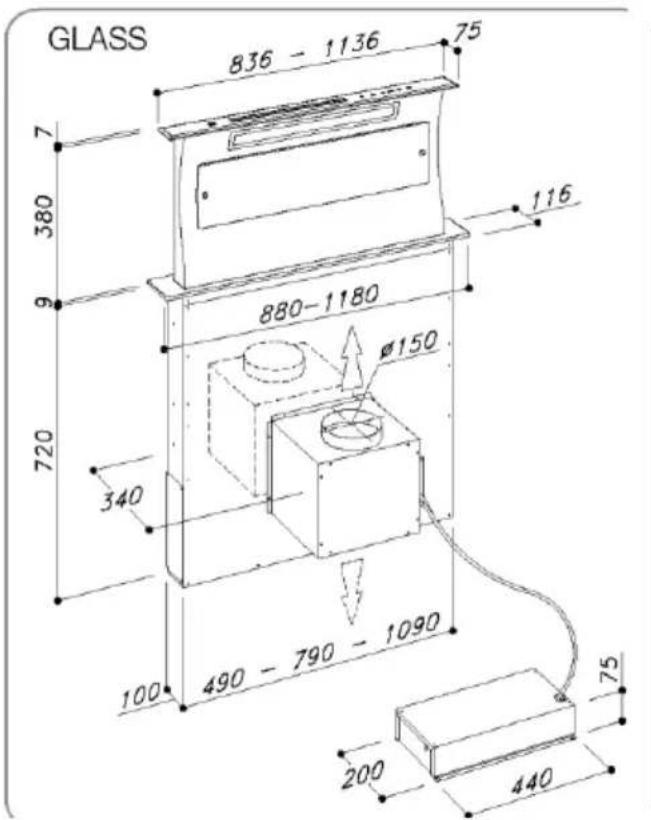
| Cut-out dimensions (width x depth) | 90 cm model: 790 x 100 mm; 120 cm model: 1090 x 100 mm |
| Motor type | Integrated or external motor (depending on version) |
| Number of speeds | 4 speeds + timer function (10 min delayed shut-off) |
| Lighting | Integrated LED (separate control for Glass version, linked to opening for Stainless Steel version) |
| Power supply | 220-240 V single phase, 50 Hz, cable H05 WF 3x0.75 mm² |
| Recommended electrical protection | Residual current device (RCD) ≤ 30 mA |
| Minimum distance to cooking surface | 400 mm (between open downdraft and cooking surface) |
| Exhaust duct diameter | 150 mm (max 5 m long, limit bends) |
| Materials | Stainless steel or glass (depending on version) |
| Filter types | Metal grease filter (washable) and activated carbon filter (replaceable) |
| Grease filter maintenance | Clean every 30 hours of operation (manual or dishwasher) |
| Carbon filter replacement | Every 6 months (or based on usage) |
| Safety | Anti-jamming (panel stop and retraction), auto shut-off after 4 h, filter saturation indicator |
| Additional functions | Automatic carriage calibration, stand-by function, reset button |
| Compliance | European directives 2006/95/EC (Low Voltage) and 2004/108/EC (Electromagnetic Compatibility) |
Frequently Asked Questions - 3D9 CDA
User questions about 3D9 CDA
0 question about this device. Answer the ones you know or ask your own.
Ask a new question about this device
Download the instructions for your Range hood in PDF format for free! Find your manual 3D9 - CDA and take your electronic device back in hand. On this page are published all the documents necessary for the use of your device. 3D9 by CDA.
USER MANUAL 3D9 CDA
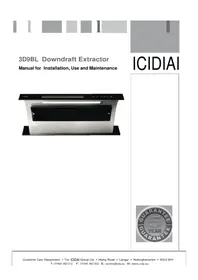
3D9BL Downdraft Extractor Manual for Installation1 Use and Maintenance
ICIDIAI

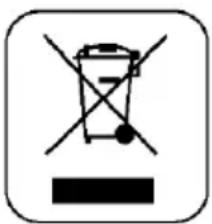
The symbol on the product or on its packaging indicates that this product may not be treated as household waste. Instead it shall be handed over to the applicable collection point for the recycling of electrical and electronic equipment. By ensuring this product is disposed of correctly, you will help prevent potential negative consequences for the environment and human health, which could otherwise be caused by inappropriate waste handling of this product. For more detailed information about recycling of this product, please contact your local city office, your household waste disposal service or the shop where you purchased the product. This appliance is marked according to the European directive 2002/96/EC on waste electrical and electronic equipment (WEEE).
B: [J]ff Tasto ON/OFF
A prodotto spento:
It is designed to work in both suctioning mode, with outside evacuation, and filtering mode.
N
Keep these instructions for use with the appliance. If the appliance should be sold or passed on to others, make sure that the instructions are passed on with it. We thank you for taking note of these suggestions before installing and using the appliance. They have been written for your personal safety and the safety of others.
SAFTEY INSTRUCTIONS
These hoods have been designed far personal use in the home. The appliance must be used by adults. Make sure that children do not come into contact with the appliance and that they do not use it to play with. Make sure that children do not operate the controls.
- When the appliance is delivered, check the overall appearance of the packaging.
Any remarks should be written on the delivery coupon, of which you keep a copy.
Your appliance is designed far normal do mes tic use.
It is not designed far commercia or industrial use, or far purposes other than those far which it was designed.
- Any consequences of or damage from incorrect installation or incorrect use of the appliance will not be covered by the manufacturer's guarantee.
- Do not ever change or try to change the characteristics of this unit. This would be a danger. Repairs must be performed only by an authorised specialist.
Always disconnect the hood before carrying out cleaning or maintenance operations.
- Adequately ventilate the area in case the hood is activated simultaneously with other appliances powered from non-electrical sources
so that the hood does not ventilate these combustion fumes.
- It is prohibited to cook food afer open flames or operate gas hobs without pots or pans on them under the hood itself (the flames sucked into the hood might damage the appliance).
- Deep frying under the appliance must be done under constant supervision as hot oils and fats may ignite.
Respect the guidelines far cleaning and replacement of the filters. Accumulated deposits of grease are a fire hazard.
- This appliance must not be used aver cook tops powered by wood or coal or in any case, aver cook tops with power levels that could damage the appliance.
Never use steam or high-pressure devices far cleaning your hood (regulations regarding electrical safety). - Never use the hood without the grease filters.
- The minimum distance between the open down draft and the surface above it needs to be 400 mm .
- When moving the down draft, never piece hands inside the operating radius of the pullout carriage.
Constantly seeking to improve our products, we reserve the right to modify their technical, functional, or aesthetic characteristics as they evolve In the case of the versan with external motor, far normal downdraft operation, it is necessary to use an extraction unit (external motor) made by the same manufacturer.
The air collected must not be conveyed into a flue used far smoke or fumes from appliances powered by anything other than electricity (central heating systems, etc.). As far as concerns discharging air from the flue, respect the guidelines of the competent authorities.
CONTENTS
OESCRIPTION OF THE APPLIANCE 16
INSTALLING THE HOOO 17
Grease filter removal, mounting the carbon filter 18
Electrical hook up of the hood 19
HOW THE HOOO WORKS 20
CLEANING THE HOOO 22
OPERATIONAL ANOMALIES 23
AFTER SALES SERVICE 23
DESCRIPTION OF THE APPLIANC
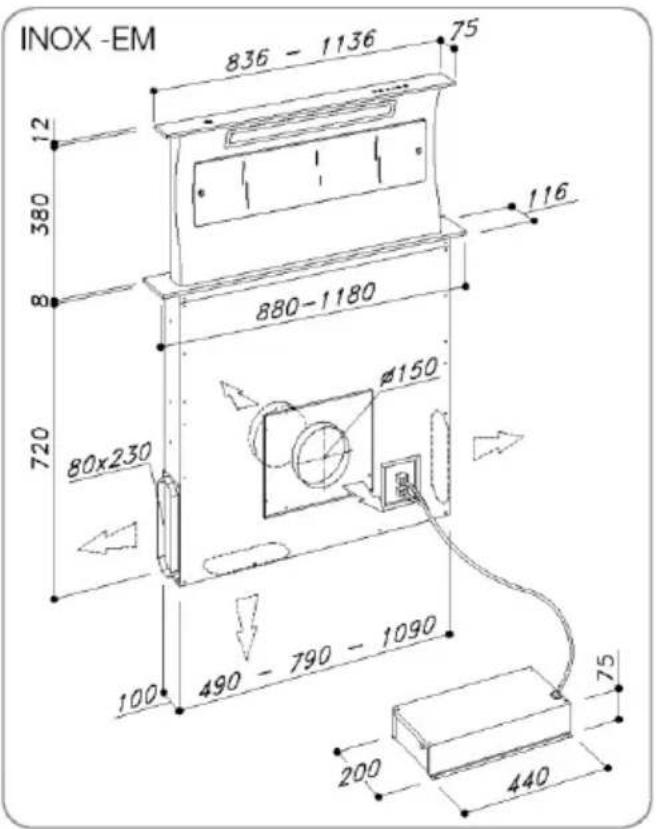
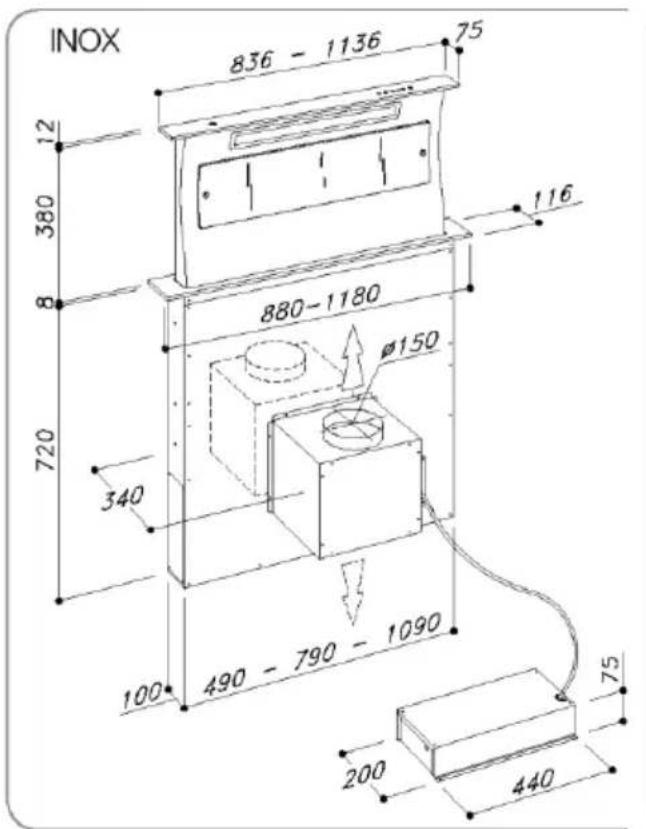
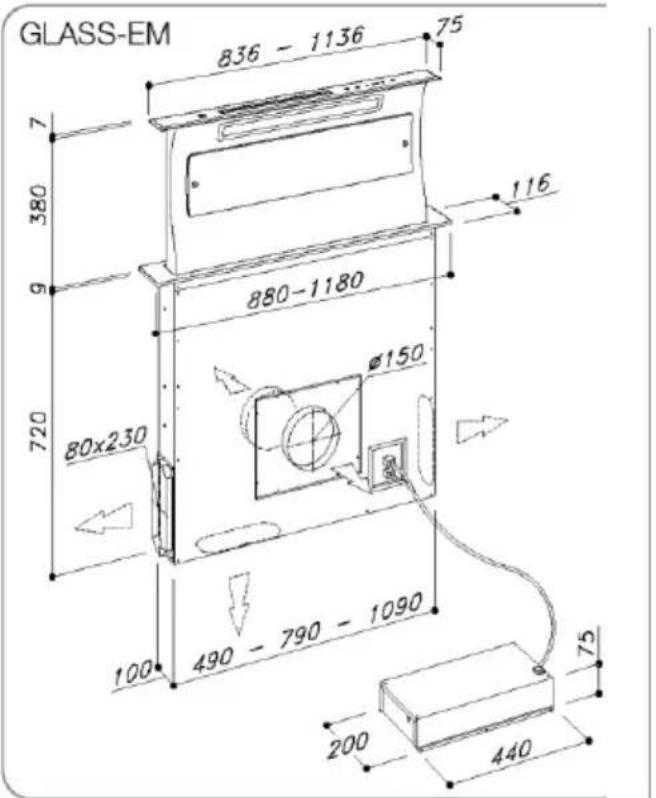
INSTALLING IHE HOOD
- Before starting the appliance installation, please check that all components are not damaged, in such a case contact your retailer and do not carry out installation.
Before the installation of the Owndraft, please remove the security piece you can see in the picture (Fig. 1-2-3-4).
Furthermore, please read carefully all of the following installation instructions.
- Use an exhausting pipe whose maximum length does not exceed 5 meters.
- Limit the no. of elbows in the piping, since each elbow reduces the aspiration efficiency of 1 linear meter. (Ex.: if you use no. 2 × 90 elbows, the length of piping I must not exceed 3 meters).
- A void abrupt direction changes.
- Use a 150 mm constant diameter pipe for the whole length.
- Use piping approved by standards in force.
The manufacturer will not be answerable for any capacity or noise problems caused by failure to comply with the above instructions and the warranty will be rendered null and void
- Before making the opening, check that there are no structural or other parts inside the cabinet, where the appliance is to be placed, which could hinder a proper installation. Check that the dimensions of the Cowndraft and the ones of the cooktop are compatible with the cabinet so that the installation can be carried out properly
- Orill a 790 × 100 mm rectangular hole in the rear side of the cook-top for the 90 cm version and a 1090 × 100 mm hole for the 120 cm version. In the version with the motor already installed, remove the screws and the suctioning unit in order to insert the downdraft in the hole made.
In case of the glass version, insert the down-draft in the cabinet, making sure that the
stainless steel edge under the glass adheres perfectly to the cabinet surface (Fig. 5). In case of the stainless steel version, apply the counter frame in the hole made, using a fixing sealer (Fig. 6) and then insert the downdraft in the cabinet in such a way that the edge and the counter frame are superimposed (Fig. 7).
- Fix the downdraft inside the cabinet, using the special fixing brackets supplied with the product (Fig. 8a).
Insert the brackets in the lower side of the downdraft (Fig. 8b) 13b), in such a way that there is a 2mm distance between the bwer side of bracket and the bottom of the cabinet (Fig. 8c).
This distance will allow the traction to be positioned downwards of the product, at the moment of fixing, in order to have the stainless steel trim perfectly adhering with the work surface.
Before inserting the screws, please make sure that the appliance is perfectly perpendicular with the work surface.
- In the version of the Owndraft equipped with motor, install the motor group adjusting the air evacuation direction as required, either downwards or upwards. After installing the motor, connect the air ducts (Fig. 9). The motor can be fitted either on the front or back side of the downdraft.
After installing the motor, connect the air ducts. (Fig. 10).
- For versions with outside motor, piace the suction unit (outside motor) in a suitable area and fit the exhaust air flue as illustrated. Proceed to fit the air outlet ducts between the outside motor and the down draft. Select an air outlet from the five possibilities (Fig. 11) and fit the connection provided.
GB
- Piace the metal box with the electronic components in an easily reachable area far eventual technical assistance operations. (Fig. 12), connecting the three connectors (9 pale connector far the actuator contra and the safety contrai, 4 pale connector far neon lamp turn on and push-buttonconnector).
- Far outside motors, connect the motor unit cable to therelevant connector on the electrical components box.
- Power the appliance.
UTILISATION
This product is intended to extract fumes, fats, and steam from cooking. It is designed to work in both suctioning mode, with outside evacuation, and filtering mode
Outside-discharge version
The cooker hood can be mounted in the version with outside discharge of suctioned air: in this case it is necessary to connect the exhausting channel to the outside (exhausting pipes are not supplied with the products.)
Check valve blockage
Before connecting the air exhaust hose, make sure that the check valves are free to turn over freely.
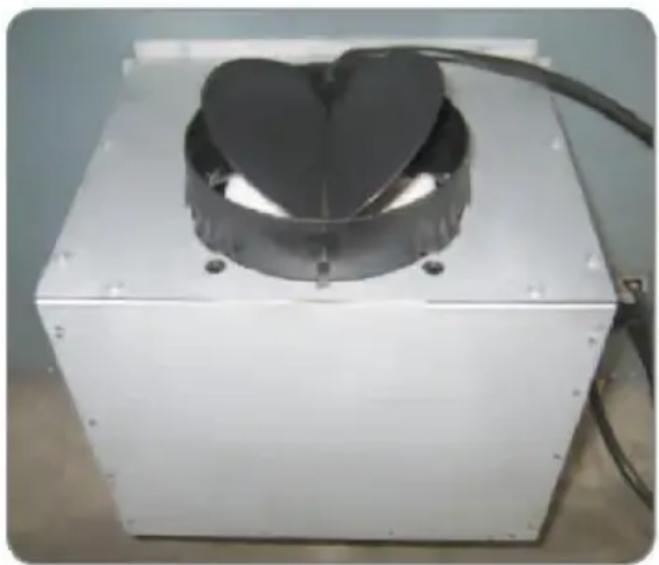
Far hoods with outside air exhaust, fit a check valve to prevent wind and returning air from entering.
Filtering mode
Filtering mode
In case fumes and vapour cannot be evacuated outside, the appliance can be used in the filtering mode
Carbon filters are required far this type of hood.
Air recycled through the charcoal filters is reintroduced in to the kitchen, thanks to a duct conveying the air on one side of the cabinet (Fig. 13).
&CAUTION&
Installation must conform to the regulations in force regarding the ventilation of enclosed environments. In particular, discharged air must not be channelled into a conduit used for exhaust discharge or discharge from devices that operate with gas or other combustible materials. The use of unused conduits is not permissible without the approval of a qualified technician.
GREASE FILTER REMOVAL, MOUNTING THE CARBON FILTER
Grease filters and charcoal filters mounting and removal operations have to be carried out with the downdraft in the open position.
In order to do it, push the ON/OFF key.
Then remove the front panel by unscrewing the two front screws using a suitable tool (Fig. 14), remove the grease filter (Fig. 15) and then insert the charcoal filters (Fig. 16), making them slide down-wards.
The charcoal filters replacement should be carried out accordingly to how often the downdraft has been used, anyway once every 6 months.
After having replaced the filters, remount the front panel, paying special care in placing the two rubber rings between the panel and the sc rew.
ELECTRIAL HOOK UP OFTHE HOOD

N
Piac the metal box containing the electronic components at a distance of no less than 65 cm from gas-operated cook tops or in any case, 65 cm from the extraction point of the hood.
&NorA&
We recommend installing the metal box containing the electronic components at least 10cm above floor level and data suitable distance from ali heat sources (e.g. oven sides or cook top).
&cAUrloN&
This appliance is fitted with an H05 WF 3 conductor, 0.75mm2 (neutral, phase, and ground) power cable. This can be hooked up to a 220 - 240 V mono-phase electrical network by way of a CEI 60083 regulation power socket that must remain accessible after installation, in conformity to installation regulations.
We decline all responsibility in case of accident caused by a lack of ground connection or incorrect ground connection. The appliance must be fed through a differential protection device (RCD), with anominal residual current not exceeding 30mA . If the power cable is damaged, cali the after-sales service to avoid any risk.

This appliance is fitted with an H05 WF 3 conductor, 0.75mm2 (neutral, phase, and ground) power cable. This can be hooked up to a 220 - 240 V mono-phase electrical network by way of a CEI 60083 regulation power socket that must remain accessible
after installation, in conformity to installation regulations.
&oANGER&
If the hood presents some form of anomaly, unplug the appliance or remove the fuse corresponding to the appliance's power line.
If the appliance has no plug or if the plug is not easily accessible, then a device needs to be fitted to cut it off from the mains electricity; this device must have an opening distance between contacts on allopes of at least 3mm
ELECTRIAL HOOK UP
&NorA&
This appliance conforms to the European Directives 2006/95/EC (Low Voltage Directive) and 2004/108/EC (Electromagnetic Compatibility).
When you install the appliance and carry aut maintenance, it must be unplugged from the power source or the fuses must be disengaged or removed. Electrical hook up must be carried aut before the appliance is installed in the cabinet.
Check that:
the power source is sufficient,
- power cords are in good condition.
- The diameter of the cables conforms to installation regulations.
IHOW}HE HOOD WORKS
SDD4 MODEL STAINLESS STEEL ANO GLASS VERSION (Fig. 17)
A: Light ON/OFF key
GLASS Version :
Lighting turns on and off independently from the extractable unit position.
STAINLESS STEEL Version:
Lighting turns on and off only with the extractable unit open.
By pushing this key with the extractable unit closed, the extractable unit will open and then the lighting will turn on.
IDB: DFF ON/OFF key
With the appliance turned off:
The key starts the suctioning panel extraction and, when it is fully open, activates the 2nd speed of the motor.
With the suctioning panel open:
The key turns the motor off, turns the lighting off, if on, and draws back the suctioning panel.
C:J:(-)Key
It reduces the motor speed from the 4th speed to complete turn off, without closing the extractable unit.
D:231 Indicators
- It shows the speed set by turning on only the related led.
It signals the filters saturation by turning on all eds.
It shows the calibration reset by flashing all of the leds.
E: (+) Key
It increases the motor speed from the 1st to the 4th one, without moving the suctioning panel.
F: (9 Timer
After 10 minutes from its setup, it allows to stop the motor, close the extractable unit and turn the lights off, if on.
This function is active when signaled by the flashing of the "D" led related to the speed setup.
Push the key again to annui this function.
Other functions:
Automatic turn off:
After 4 hours of continuous working from the last setup, the appliance turns off and closes automatically.
Grease filters saturation:
After 30 hours of working, the speed indicators "D" will aliflash simultaneously, signaling the grease filters saturation.
To reset this alarm, push the "TIMER" key when the downdraft is completely off and the extractable unit is closed.
Calibration:
The cooker-hood carries aut its self-calibration every 3 complete cycles of its extractable unit.
By pushing the "TIMER" key 6 times consecutively (MAX break between one push and the other is 3 sec.) all the leds will flash and the calibration will be reset.
After the next 3 cycles the downdraft will carry aut its self-calibration.
NN &
This operation has to be carried out by a specialized technician.
Stand-by:
When the extractable unit is closed and the light is switched off, the contrai panel, after 6 seconds, activates the Stand-by function, reducing the brightness of the leds.
This function can be stopped by pressing ON/OFF or LIGHT button.
Security system:
While the extractable unit is closing and there is an obstacle, the Owndraft rises again thanks to a security system.
Careful maintenance helps guarantee proper operation and good results from an appliance aver time.
&CAUTION&
The hood must be unplugged tram the electrical power source, both by unplugging the appliance from the socket as well as de-activating the breaker, before removing the metal filters.
After cleaning, you must replace the metal filters as outlined in the instructions.
| MAINTENANCE | HOW TO PROCEED? | ACCESSORY PRODUCTS TO USE |
| External surfaces and accessories | Do not use metallic scrubbers, abrasive products, or hard brushes. | To clean the external surfaces of the hood and the light housing screen use only commercially available household detergents diluted in water. Then rinse with clean water and dry with a soft cloth. |
| Charcoal filter with extractable unit open | After 30 hours of functioning, the downdraft will signal the grease filter saturation. The saturation is signaled by the blinking of the 4 central leds. Far both models, the reset function is activated by pushing the timer key while the extractable unit is open. | The grease filters can be washed by hand or in the dishwasher. These filters need to be cleaned on a regular basis because otherwise they may present a fire risk. Refit the grease filters and front panel, making sure that the pane is properly fitted at the sides so that it does not cause the downdraft to stop operating. |
| Active carbon filter | In the recirculation mode, you must substitute the active carbon filter periodically. To remove the carbon filter it is necessary first of alito remove the grease filter and then to pull the plastic key of the panel itself to remove it from its seating. Follow these steps in reverse arder to insert the active carbon filter. Replace the used carbon filter on an average of every six months. |
| SYMPTOM | SOLUTION |
| The hood does not work... | Check that: • There is not a power outage. • A specific speed has actually been selected. • The 9 pale connection is inserted properly. • The red reset key, found aver the electric system box, is pushed. • Make sure that the wires are inserted properly in the 9 pale connection, in the connector itself (during the connection phase, an excessive pressure could bend the contacts). |
| The hood has low output... | Check that: • The motor speed selected is sufficien tfar the quantity of fumes steam present. • The kitchen is ventilated well enough to allow far air intake. • The char coal filter is not worn (filtering version cooker hood). • The air outlet channel is free and compliant with paragraph 2. • The non-return valves of the suctioning unit are free to rotate. |
| The hood stops in the middle of operation. | Check that: • There is not a power outage. • The omnipolar device has not tripp ed. |
AFTER SALES SERVICE
Any maintenance on your equipment should be undertaken by:
Either your dealer,
- Or another qualified mechanic who is an authorized agent far the brand appliances.
&NOTA&
When calling, please mention the appliance details (Type Fig. 18a and equipment Fig. 18b and production date Fig. 18c).
QThis information is mentioned on the rating label and the production date one placed on the lower side of the downdraft.
AL'ATTENTION DEL'UTILISATEUR
IOIN B:IOIFTEcIaON/OFF
BESCHRIJVING VAN HET APPARAAT 56
INSTALLEREN VAN DE AFZUIGKAP 57
BESCHRIJVING VAN HET APPARAAT

DEKAP INSTALLEREN
| Energy Efficiency Information | |||
| Attribute | Symbol | Value | Units |
| Model Identification | 3d9 | ||
| Annual Energy Consumption | AECHood | 59.8 | kWh |
| Time increase factor | f | 0.9 | |
| Fluid Dynamic Efficiency | FDEHood | 30.2 (A) | |
| Energy Efficiency Index | EEIHood | 56.4 | |
| Measured airflow at Best Efficiency Point | QBEP | 344.0 | m³/h |
| Measured Pressure at Best Efficiency Point | PBEP | 477.0 | Pa |
| Measured Pressure at Best Efficiency Point | QMAX | 477.0 | m³/h |
| Measured electric power at Best Efficiency Point | WBEP | 151.0 | W |
| Nominal lighting power | WL | 14.0 | W |
| Average illumination of the lighting system on the cooking surface | EMiddle | 122.0 | Lux |
| Measured power consumption in standby | PS | 0.5 | W |
| Measured power consumption off mode | PO | 0.0 | W |
| Sound power level | LWA | 61.0 | dBA |
| Grease Filter Efficiency | GFEHood | 63.0 (E) | % |
| Lamp efficiency | LEHood | 8.7 (E) | % |
- 3D9BL DOWNDRAFT EXTRACTOR MANUAL FOR INSTALLATION1 USE AND MAINTENANCE
- ICIDIAI
- B: [J]FF TASTO ON/OFF
- A PRODOTTO SPENTO
- N
- SAFTEY INSTRUCTIONS
- CONTENTS
- DESCRIPTION OF THE APPLIANC
- INSTALLING IHE HOOD
- GB
- UTILISATION
- OUTSIDE-DISCHARGE VERSION
- CHECK VALVE BLOCKAGE
- FILTERING MODE
- CAUTION
- GREASE FILTER REMOVAL, MOUNTING THE CARBON FILTER
- ELECTRIAL HOOK UP OFTHE HOOD
- NORA
- CAURLON
- OANGER
- ELECTRIAL HOOK UP
- CHECK THAT
- IHOW}HE HOOD WORKS
- SDD4 MODEL STAINLESS STEEL ANO GLASS VERSION (FIG. 17)
- A: LIGHT ON/OFF KEY
- GLASS VERSION
- STAINLESS STEEL VERSION
- IDB: DFF ON/OFF KEY
- WITH THE APPLIANCE TURNED OFF
- WITH THE SUCTIONING PANEL OPEN
- C:J:(-)KEY
- D:231 INDICATORS
- F: (9 TIMER
- OTHER FUNCTIONS
- AUTOMATIC TURN OFF
- GREASE FILTERS SATURATION
- CALIBRATION
- NN
- STAND-BY
- SECURITY SYSTEM
- AFTER SALES SERVICE
- NOTA
- AL'ATTENTION DEL'UTILISATEUR
- IOIN B:IOIFTECIAON/OFF
- BESCHRIJVING VAN HET APPARAAT
- DEKAP INSTALLEREN
Brand : CDA
Model : 3D9
Category : Range hood