MCD 893 - Browser CALIBER - Free user manual and instructions
Find the device manual for free MCD 893 CALIBER in PDF.



| Product Type | Portable GPS Navigator |
| Brand | Caliber |
| Model | MCD 893 |
| Screen | Color touchscreen, about 4.3 inches |
| Dimensions | Approx. 12 x 8 x 2 cm |
| Weight | Approx. 200 g |
| Power Supply | Built-in rechargeable lithium-ion battery and 12 V cigarette lighter adapter |
| GPS Receiver | Built-in, WAAS/EGNOS compatible |
| Main Functions | Door-to-door navigation with vector maps, full or partial address search, points of interest (POI), multi-point routes, Simple and Advanced modes, voice commands, smart zoom, route recording (track logs), 2D/3D display |
| Available Languages | Interface and voice instructions in multiple languages (French, English, German, Dutch, etc.) |
| Safety | Safety mode disabling the touchscreen above 10 km/h; speed limit and radar warnings |
| Maintenance and Cleaning | Clean with a soft, dry cloth; avoid moisture and extreme temperatures |
| Spare Parts and Repairability | Contact an authorized service; standard parts (mount, cable, adapter) are available from the manufacturer |
| General Information | Nav N Go navigation software; map updates via PC; supports SD memory cards for additional map storage |
Frequently Asked Questions - MCD 893 CALIBER
User questions about MCD 893 CALIBER
0 question about this device. Answer the ones you know or ask your own.
Ask a new question about this device
Download the instructions for your Browser in PDF format for free! Find your manual MCD 893 - CALIBER and take your electronic device back in hand. On this page are published all the documents necessary for the use of your device. MCD 893 by CALIBER.
USER MANUAL MCD 893 CALIBER
Navigation software for mobile devices
UK
DocVersion
Copyright note
The product and the information contained herein is subject to change without prior notification.
This manual may not, in whole or in part, be reproduced or transmitted in any form either electronically or mechanically, including photocopying and recording, without the express written consent of Nav N Go Kft..
© 2008 - Nav N Go Kft.
Whereis® map data is © 2006 Telstra Corporation Limited and its licensors
Data Source © 2006 Tele Atlas N.V.
Austria: © BEV, GZ 1368/2003
Denmark: © DAV
France: © IGN France
Great Britain: Ordnance Survey data with permission of Her Majesty's Stationery Office © Crown Copyright
Italy: © Geonext/DeAgostini
Northern © Ordnance Survey of Northern Ireland
Ireland:
Norway: © Norwegian Mapping Authority, Public Roads Administration / Map solutions
Switzerland: © Swisstopo
The Netherlands: Topografische ondergrond
All rights reserved.
Thank you for choosing MCD893 as your door-to-door in-car navigator. Read the Quick Start Guide first and start using MCD893 right away. This document is the detailed description of the software. You can easily discover MCD893 while you are using it; however, we still recommend that you read this manual to understand the screens and the features of MCD893.
Table of contents
1Warnings and Safety information 5
2 Getting started with MCD893 6
2.1 Simple and Advanced modes 8
2.2 Hardware buttons 9
2.3 Buttons and other controls on the screen 9
2.4 Using the map 10
2.5 MCD893 concepts 17
3 Navigating with MCD893 26
3.1 Selecting the destination of a route 26
3.2 Creating a multi-point route (inserting a via point) 38
3.3 Creating a multi-point route (appending a new destination) 39
3.4 Editing the route 39
3.5 Viewing the whole route on the map (Fit-to-Screen) 40
3.6 Watching the simulation of the route 40
3.7 Enabling Safety Mode 41
3.8 Pausing the active route 41
3.9 Deleting the next via point from the route 41
3.10 Deleting the active route 42
3.11 Using Track Logs 42
3.12 Saving a route 43
3.13 Loading a saved route 43
4 Reference book (Advanced mode) 45
4.1 Map screen 45
4.2 Find menu 60
4.3 Route menu 60
4.4 Manage menu 61
4.5 Settings menu 66
5 Glossary 75
6 End User Licence Agreement 77
7. Limitations of use 79
8. Non-warranty, limitation of responsibility 80
9. Sanctions 81
1Warnings and Safety information
MCD893 is a navigation system that helps you find your way to your destination with a connected GPS receiver. MCD893 does not transmit your GPS position; others cannot track you.
It is important that you look at the display only when it is safe to do so. If you are the driver of the vehicle, we recommend that you operate MCD893 before you start your journey. Plan the route before your departure and stop if you need to change something in the route.
MCD893 has a Safety Mode: if you turn on Safety Mode, you cannot change anything in MCD893 while the vehicle is moving at a speed of 10km/h (6 mph) or higher. Unless only passengers operate MCD893, we strongly encourage you to turn on Safety Mode.
You must obey the traffic signs and follow the road geometry. If you deviate from the route that MCD893 recommended, MCD893 changes the instructions accordingly.
Never place mobile devices where it obstructs the driver's view, where it is in the deployment zone of an airbag or where it might cause injuries in an accident.
For more information, consult the End User Licence Agreement.
2 Getting started with MCD893
MCD893 is optimised for in-car use. You can use it easily by tapping the screen buttons and the map with your fingertips.
MCD893 can plan routes throughout the whole installed map set; you do not need to change maps or switch to a poorly detailed general map to navigate between map segments or countries.
| Tasks | Instructions |
| Using the retractable stylus | You do not need a stylus to use MCD893. Tap the buttons and the map with your fingertips. |
| Double tapping the screen | You do not need to tap the screen twice for any action. With buttons and controls, a single tap is enough. |
| Tapping and holding the screen | You do not need this to access the basic navigation functions. Tap and keep pressing the following buttons to reach extra functions: • Tap and hold on the Map screen: you can set the minimum and maximum zoom level of Smart Zoom. • Tap and hold any of the buttons on the Map screen: you can set or reset the zoom value of the button (2D map). • Tap and hold any of the buttons on the Map screen: you can set or reset the tilt and zoom values of the button (3D map). • Tap and hold on list and menu screens: the Navigation menu appears. • Tap and hold on keyboard screens: you can delete several characters quickly. • Tap and hold or in long lists: you can turn the page continuously. • Tap and hold the buttons in the Quick menu to open screens from the Manage menu or the Settings menu related with the function of the button. |
| Gestures (drag&drop) | You do not need gestures to access the basic navigation features. You need to drag and drop the screen only in cases like: • Moving the handle on a slider. • Moving the map: grab the map, and move it in the desired direction. • Shortcut to open the Map screen: slide your finger from the |
| bottom right corner to the bottom left corner on any screen. • Shortcut to open the Navigation menu : slide your finger from the top left corner to the bottom left corner on any screen. |
Start using MCD893
When MCD893 is started the first time, you need to do the following:
- Select the written language of the application. Later you can change it in Settings.
- Select the language and speaker used for voice guidance messages. Later you can change it in Settings.
- Select whether to start the program in Simple mode or in Advanced mode. Later you can switch between the two operating modes in Settings.
After this, the Navigation menu appears and you can start using MCD893.
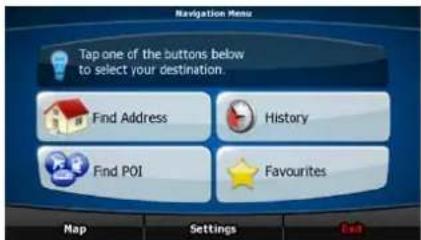
The Navigation menu in Simple mode:
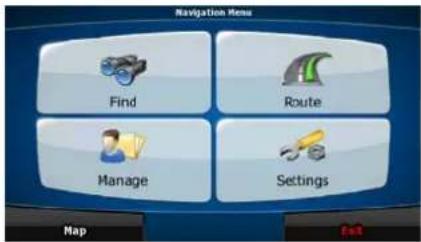
The Navigation menu in Advanced mode:
The typical way of using MCD893 is to select a destination, and start navigating. You can select your destination in the following ways (not all of them are available in Simple mode):
Use the selected location on the map (the Cursor).
- Enter a full address or a part of an address, for example a street name without a house number or the names of two intersecting streets.
- Enter an address with postal code. This way you do not need to select the name of the settlement and the search for street names might be faster as well.
- Use a coordinate
- Use a saved location:
a Favourite
a POI
the History of previously set destinations and waypoints
2.1 Simple and Advanced modes
The two operating modes of MCD893 mainly differ in the menu structure and the number of available features. The controls and screen layouts are the same.
- Simple mode: you have easy access to the most important navigation functions and the basic settings only. The rest of the settings are set to values that are optimal for typical use.
- Advanced mode: you have access to the full functionality of MCD893.
To switch from Simple mode to Advanced mode: on the startup screen (Navigation Menu),
tap
Settings
Advanced Mode
To switch from Advanced mode to Simple mode: on the startup screen (Navigation Menu),
tap

Simple Mode
The features and settings available in each mode are as follows:
| Type of action Available in | Simple mode | Available in Advanced mode |
| Navigating to a selected map point | Yes | Yes |
| Navigating to a street address | Yes | Yes |
| Navigating to an incomplete address | Yes | Yes |
| Navigating to an intersection | Yes | Yes |
| Navigating to recent destinations (History) | Yes | Yes |
| Navigating to Favourites | Yes | Yes |
| Navigating to a POI | Yes | Yes |
| Navigating to coordinates | No | Yes |
| Creating a multi-point route | No | Yes |
| Saving a map point as a Favourite destination | Yes | Yes |
| Saving a map point as a POI | No | Yes |
| Saving a map point as a location of a Road Safety Camera | No | Yes |
| Mark a map point with a Pin | No | Yes |
| Saving the active route | No | Yes |
| Saving Track Logs | No | Yes |
| Map Screen settings | No | Yes |
| Menu settings | Only background picture | Yes |
| Sound settings | Only Master volume | Yes |
| Route Planning options | Yes | Yes |
| Regional settings | Only language selection | Yes |
| Warnings | No | Yes |
2.2 Hardware buttons
You can use MCD893 mostly by tapping the touch screen. The device has only a few hardware buttons.
You can turn mobile devices on or off at any time. When mobile devices is switched off, MCD893 does not calculate your GPS position and it does not update the route or the driving instructions.
When you turn the device on again, MCD893 continues navigating as soon as the GPS receiver has determined your position.
2.3 Buttons and other controls on the screen
When you are using MCD893, you usually tap buttons on the touch screen.
You only need to confirm selections or changes in MCD893 if the application needs to restart, it needs to perform a major reconfiguration, or you are about to lose some of your data or settings. Otherwise, MCD893 saves your selections and applies the new settings without confirmation as soon as you use the controls.
| Type | Example | Description | How to use it |
| Button | Info | Tap it to initiate a function, to open a new screen, or to set a parameter. | Tap it once. |
| Icon | Shows status information. | Some icons also function as a button. Tap them once. | |
| List | When you need to select from several options, they appear in a list. | Turn the page with the and buttons and tap the value that you want. | |
| Slider | When a feature has several different unnamed values, MCD893 shows an indicator on a gauge that displays and sets a value from a range. | Drag the handle to move the slider to its new position. Tap the slider where you want the handle to appear; the thumb jumps there. | |
| Switch | When there are only two choices, a checkmark shows whether the feature is enabled. | Tap it to turn the switch on or off. | |
| Virtual keyboard | Wdrimster,Lndm,putdiplem <Enter Street Name> >300 Q W E R T U I O P A S D F G H J K L Y C V B N M Space | Alphabetic and alphanumeric keyboards to enter text and numbers. | Each key is a touch screen button. |
2.3.1 Using keyboards
You only need to enter letters or numbers in MCD893 when you cannot avoid it. You can type with your fingertips on the full-screen keyboards and you can switch between various keyboard layouts, for example ABC, QWERTY, or numerical.
| Task | Details |
| Switching to another keyboard layout, for example from a Latin QWERTY keyboard to a Greek keyboard | Keys on the list o f available keyboard types. |
| MCD893 remembers your last keyboard choice and offers it the next time you need to enter data. | |
| Correcting your entry on the keyboard | Remove the unneeded character(s): tap ← Tap and hold the button to delete the entire input string. |
| Entering a space, for example between a first name and a family name or in multi-word street names | Space Tap |
| Entering small or capital letters | aA to cycle through entering lower case letters, capital initials or all capitals. |
| Entering symbols | /! Tap switch to a keyboard of symbol characters. |
| Finalising the keyboard entry | Done Tap |
2.4 Using the map
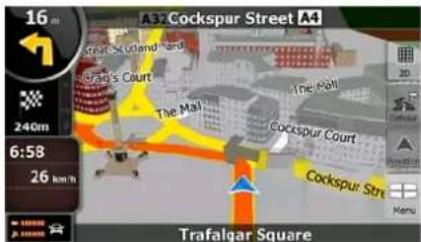
The map screen is the most frequently used screen of MCD893. It can be accessed from the
Navigation menu by tapping
2.4.1 Checking the details of a map location
If you are interested in the details of your current position during navigation:
-
Check the bottom line of the map. It shows the current street and house number information.
-
For further details, tap Position to open the Position menu.
-
Tap

The address, the coordinate and the list of nearby POIs will
You can check the details of any other location by selecting it on the map:
-
Tap the map anywhere to open the map control buttons.
-
Tap the desired location on the map. The Cursor ( ) appears there. The address of the location is displayed at the bottom of the map.
-
For further details, tap

to open the Cursor menu.
- Tap The address, the coordinate and the list of nearby POIs will be displayed.
It is even easier if you select the desired point in the Find menu. Then the Cursor menu
opens automatically. You only need to tap the Info button.
2.4.2 Manipulating the map
Position markers on the map:
- Current GPS position:

Selected location (Cursor):

The following controls help you modify the map view to best suit your actual needs. Most of these controls appear only if you tap the map once, and disappear after a few seconds of inactivity.
| Action | Button(s) | Description |
| Moving the map with drag&drop | No buttons | You can move the map into any direction: tap and hold the map, and move your finger to the direction in which you want to move the map. If GPS position is available and you have moved the map, the button appears. Tap this button to return to the GPS position. |
| Opening/closing map control buttons | Tap this button to show or hide the following map control buttons: • Zoom in/out • Rotate left/right (3D map only) • Tilt up/down (3D map only) • Zoom preset buttons (2D map only) • Tilt and zoom preset buttons (3D map only) • Return to GPS position button • Smart Zoom button | |
| Zooming in and out | + - | Changes how much of the map is displayed on the screen. MCD893 uses high-quality vector maps that let you see the map at various zoom levels, always with optimised content. It always displays street names and other text with the same font size, never upside-down, and you only see the streets and objects that you need. Map scaling has different limits in 2D and in 3D map view modes. |
| Tilting up and down | ↑ ↓ | Changes the vertical view angle of the map in 3D mode. |
| Rotating left and right | → ← | Changes the horizontal view angle of the map in 3D mode. When GPS position is available, MCD893 always rotates the map so its top faces your direction of travel (Track-Up orientation). You can turn away from Track-Up with these buttons. If GPS position is available and you have rotated the map, the button appears. Tap this button to re-enable the automatic map rotation. |
| Viewing modes | 2D 3D | Gives you the following map perspectives in MCD893: • classic top-down view (2D) • perspective view (3D) The value always shows the mode the button switches to: If you are in 2D mode, you can see the button and you need to tap it to switch to 3D mode. |
| Smart Zoom | MCD893 can automatically rotate, scale and tilt the map and give you the optimal view:When you are approaching a turn, MCD893 zooms in and raises the view angle to let you easily recognise your manoeuvre at the next junction.If the next turn is at a distance, MCD893 zooms out and lowers the view angle to show you the road in front of you.Tap this button once to enable Smart Zoom.Tap&hold the button to set the zoom limits of Smart Zoom. | |
| Returning to normal navigation (back to the GPS position with automatic map rotation) | Tap this button to move the map back to the current GPS position. If the map has been rotated in 3D mode, automatic map rotation is also re-enabled. | |
| Zoom preset buttons (available in Advanced mode only) | Tap one of the preset buttons to set the zoom level to a fix, predefined value. Smart Zoom is disabled. These buttons are available in 2D mode.Tap&hold any of the buttons to set its value to the current zoom level, or to reset it to its original value. | |
| Tilt and zoom preset buttons (available in Advanced mode only) | Tap one of the preset buttons to set the tilt and zoom levels to fix, predefined values. Smart Zoom is disabled. These buttons are available in 3D mode.Tap&hold any of the buttons to set its value to the current tilt and zoom levels, or to reset it to its original value. | |
| Map scale | MCD893 shows the scale of the map in 2D mode. | |
| Fit-to-screen | Fit to Screen | This button does not appear on the Map screen. It is available on the following screens:Plan on Map screen: When you have an active route, you can display it in its full length on the map.Track Information scree n: A track log can be displayed in its full length on the map. |
2.4.3 Status information and hidden controls on the map
The following information appears in the rounded field in the top left corner, the Turn Preview field. When tapping this area, the result depends on the information currently shown.
| Icon | Information | Details | Action |
| There is no active route in Simple | If there is no route to be navigated in Simple | Tap this area to open Find Address. | |
| mode | mode, this icon appears in the Turn Preview field. | ||
| There is no active route in Advanced mode | If there is no route to be navigated in Advanced mode, this icon appears in the Turn Preview field. | Tap this area to open Find. | |
| There is no valid GPS position. | If an active route exists, and there is no valid GPS position, the view of the sky above you is shown with coloured dots for each satellite. Some dots need to turn green to be able to navigate. | Tap this area to open the Route Information screen. | |
| If the icon is a static picture, route calculation is needed | GPS position and an active route are available, but automatic off-route recalculation is switched off, and you deviated from the route. | Tap this area to make MCD893 recalculate the recommended route. | |
| If the icon is animated, route calculation is in progress | MCD893 is calculating or recalculating the route. | Nothing happens if you tap this area of the screen. | |
| Next route event (next manoeuvre) | GPS position and an active route are available, and you navigate the recommended route. This area gives you information about the type and distance of the next route event. | Tap this area to open the Route Information screen. |
The following area appears next to the above described rounded area. When tapping this area, the result depends on the information currently shown.
| Icon | Information | Details | Action |
| There is no valid GPS position | If there is no valid GPS position, this symbol appears here. | Tap this area to open the GPS Data screen to check the signal status or the connection settings. | |
| Traffic restriction | When GPS position is available, but there is no route to be navigated, the traffic restriction of the upcoming intersection is shown here if there is any. | Nothing happens if you tap this area of the screen. | |
| Second route event (manoeuvre | When GPS position and an active route are both | Tap this area to open the Itinerary screen with the turn by turn guidance instructions. | |
| 220m | after the next manoeuvre | available, this field shows the route event that follows the next route event shown in the above described area. | |
| 120 m | Approaching a Road Safety Camera | This icon appears when you are approaching a Road Safety Camera, and the warning for cameras is enabled in Settings. | Tap this area to suppress the audible camera warning. |
| Stop | Stops the running simulation | This icon appears during Route Fly Over , Route Simulation, and Track Log playback. | Tap this area to stop the simulation. |
| 22.4% | Route recalculation progress | During route recalculation, this field shows the recalculation progress between 0% and 100%. | Nothing happens if you tap this area of the screen. |
| Indicator strip | - sounds muted/enabled - Track Log recording | Nothing happens if you tap this area of the screen. |
The following symbols appear in the Indicator strip:
| Icon | Description |
| The sound output of MCD893 is muted. | |
| The sound output of MCD893 is enabled. | |
| MCD893 records a Track log when GPS position is available. | |
| Track log recording is disabled. |
The following information can be seen in the three data fields shown on the map screen. Tap this area to open the Trip Information screen where you can select which values to be shown in these three fields.
When there is no active route, these fields show the following information: current speed, compass and the current time of day.
| Icon | Type | More information | |
| Compass | Shows the direction of your heading both when the map is automatically rotated (3D) and when the map is always facing North (2D). | ||
| 24km/h | Speed information | There are speed values that can be shown: • Current speed • Speed limit on the current road | |
| 1:05 | Time information | There are time values that can be shown: • Current GPS time • Time remaining to reach the destination • Time remaining to reach the next via point • Estimated arrival time at the destination • Estimated arrival time at the next via point | |
| 230 m | Distance information | There are distance type values that can be shown: • Distance remaining to reach the destination • Distance remaining to reach the next via point • Current altitude | |
The next area is a combined status field. Tap this area to open the Quick menu.
| Icon | Status for | More information |
| &…… | GPS position quality | The more lit bars, the better is the GPS position. |
| Vehicle type | The symbol displays the vehicle type used for route calculation. |
2.4.4 Using the Cursor (the selected map location)
First, place the Cursor at the desired map location with one of the following options:
- Use the Find menu to select a location. The map returns with the selected point (the Cursor) in the middle, and the Cursor menu appears with the available options.
- Tap the screen and tap again to place the Cursor at the desired location. Now tap

to open the Cursor menu.
You can perform the following actions:
| Button | Action |
| Set as Start | In the active route, uses the Cursor as the start point by replacing the current GPS position (available in Advanced mode only) |
| Set as Destination | In the active route, uses the Cursor as the destination by replacing the previous destination |
| Insert as Via | In the active route, uses the Cursor as a via point (an intermediate destination) preceding the destination (available in Advanced mode only) |
| Continue | In the active route, uses the Cursor as the destination while keeping the previous destination as a via point (available in Advanced mode only) |
| Routing Methods | Shows the different routes calculated by the available routing methods. Choose the one that suits your needs the best.(available in Advanced mode only) |
| Save as POI | Saves the Cursor as a POI(available in Advanced mode only) |
| Add to Favourites | Saves the Cursor as a Favourite location |
| Save as Camera | Saves the Cursor as a Road Safety Camera location (available in Advanced mode only) |
| Place Pin | Marks the map with a Pin at the Cursor (available in Advanced mode only) |
| Info | Opens a screen with the name, address and coordinate information of the Cursor, and the list of POIs near it |
2.5 MCD893 concepts
2.5.1 Smart Zoom
Smart Zoom is a lot more than just a usual automatic zoom:
While following a route calculated by MCD893: when approaching a turn, it will zoom in and raise the view angle to let you easily recognise your manoeuvre at the next junction. If the next turn is at a distance, it will zoom out and lower the view angle to be flat so you can see the road in front of you.
- While driving without an active route in MCD893: Smart Zoom will zoom in if you drive slowly and zoom out to the limit set here when you drive at high speed.
Enabling Smart Zoom
Tap the map to let the map control buttons appear, and then tap to enable Smart Zoom.
Fine-tuning Smart Zoom
Tap the map to let the map control buttons appear, and then tap and hold to open the Smart Zoom Settings window. Modify the zoom limits of Smart Zoom if necessary.
2.5.2 Position markers
2.5.2.1 Current GPS position and Lock-on-Road

When your GPS position is available, MCD893 marks your current position with the icon on the map. The exact location of the position marker depends on the vehicle type for route calculation.
The vehicle type can be selected in Route settings or in the Quick Menu.
If you choose pedestrian: The icon is at your exact GPS position. The direction of the icon shows your actual heading.
- If you choose any of the vehicles: The icon is aligned to the nearest road to suppress GPS position errors. The direction of the icon is one of the directions of the route.

Position
To use the current GPS position, tap Position. The Position menu appears and you can save the GPS position as one of the following:
a Favourite
- a Road Safety Camera
a POI
- a map marker Pin
2.5.2.2 Returning to normal navigation
When GPS position is available, and you have moved the map (the icon is moving or is not even visible), or you have rotated the map in 3D mode, the button appears. Tap it to move the map back to the GPS position and re-enable Track-up map orientation (automatic map rotation).
Note!
Even if you move the map while you are driving, MCD893 continues navigating if there is an active route: it plays the voice instructions and displays the turn preview icons according to your current GPS position.
2.5.2.3 Selected location (Cursor)
If you select a location in the Find menu, or you tap the map when the map control buttons are visible, the Cursor appears at the selected point on the map. MCD893 displays the Cursor
with a radiating red dot ( ) to make it visible at all zoom levels, even when it is in the background of a 3D map view.
When the Cursor is set, tap Cursor. The Cursor menu appears and you can use the Cursor as one of the following:
the start point of a route
a via point in a route
the destination of a route
You can also search for POIs around the Cursor.
Or you can save the location of the Cursor as:
a Favourite
- a Road Safety Camera
a POI
- a map marker Pin
2.5.2.4 Original position in the Cursor menu
When the Cursor menu is open, a special icon ( ) shows the Cursor position the menu was opened with.
You can move and zoom the map, and you can set the Cursor to a different place. The usual
Cursor ( ) appears, and the buttons of the Cursor menu initiate actions for this new location.
To return to the original Cursor position, tap The map jumps back to the position with which the Cursor menu was opened, and the icon appears again.
2.5.3 Daytime and night colour schemes
MCD893 uses different colour schemes during the day and during the night.
Daytime colours are similar to paper road maps.
- The night colour schemes use dark colours for large objects to keep the average brightness of the screen low.
MCD893 offers different daytime and night colour schemes. It can also switch automatically between the daytime and the night scheme based on the current time and GPS position a few minutes before sunrise, when the sky has already turned bright, and a few minutes after sunset, before it becomes dark.
2.5.4 Colour scheme in tunnels
When entering a tunnel, the colours of the map change. All buildings disappear, the large objects (such as surface waters or forests) and the empty areas between roads become black.
However roads and streets keep their original colours from the daytime or night colour scheme currently used.
After leaving the tunnel, the original colours return.
2.5.5 Route calculation and recalculation
MCD893 calculates the route based on your preferences:
- Route calculation method:
Fast
Short
Economical
Easy
- Vehicle types :
Car
Taxi
Bus
- Emergency vehicles
- Bicycle
- Pedestrian
Road types
Unpaved Roads
- Permit Needed
Motorways
- Toll Roads
Charge Roads
- Ferries
Cross-border Planning
- Carpool Lanes (appears only when used in the USA)
2.5.6 Itinerary
The Itinerary is the list of the route events, that is, the driving instructions.
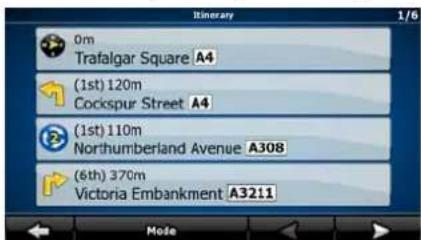
When you are on the Map screen, you can display the Itinerary in one of the following ways:
- Tap the area between the Turn preview and the Travel data fields where the symbol of
the second next manoeuvre is displayed (for example

In Advanced mode, tap the following buttons:
You have the following options on the itinerary screen:
| Button | Description |
| Any of the list items | Opens the map with the selected manoeuvre in the middle. |
| Mode | Changes the detail level of the Itinerary. The levels are as follows: • Detailed Instructions: all intersections are listed • Itinerary: only significant intersections (the ones announced in voice guidance) are listed • Road list: the list of the roads used while navigating the route |
| , | Turns the page for additional list items. |
When the map is open with a manoeuvre in the middle:
| Button | Description |
| + | Zooms in the map. |
| - | Zooms out the map. |
| < img src=""> | Moves the map to show the previous or next manoeuvre. |
| Avoid... | Opens a screen where you can avoid a part of the route starting from the selected manoeuvre. |
2.5.7 Track Logs
MCD893 can log the track that you drive.
A Track Log is a recording of how your GPS position changed and it is independent of the route MCD893 calculated.
Track Logs can be recorded, renamed, replayed, shown on the map, exported to a memory card in GPX format, and deleted.
Independently of the normal track log, you can instruct MCD893 to record the native GPS data received from the GPS device. These logs are saved as separate text files on the memory card, and they cannot be shown or replayed in MCD893.
To turn on NMEA/SIRF log saving, tap the following buttons:


Track Logs
Create NMEA/SIRF Log
2.5.8 Route demonstration
A simulation drives you through the route, following the driving instructions. You can choose from a simulation at high speed or at normal driving speed.
You can use it, for example, to see which bridge MCD893 planned for the route; if you do not want to take that bridge, you can avoid it.
Fly Over
Route demonstrations can be started from the Route menu by tapping the
(high speed simulation) or the
Simulate
(simulation at normal speed) button.
2.5.9 POI (Points of Interest)
A point of interest (POI) is a location that someone might find useful or interesting. MCD893 is delivered with thousands of POIs and you can also create your own POIs in the application.
POI locations are marked on the map with special icons. POI icons are quite large so you can easily recognise the symbol. The icons are also semi-transparent: they do not cover the streets and intersections behind them.
POIs are grouped into several levels of categories and subcategories. The icon of a POI that comes with the map shows the symbol of the POI category. If you save your own POI, you can select an icon for it independently of the POI category you have put it in.
Saving POI
To save a POI, place the Cursor ( ) at the desired location, then tap the following
buttons:

More Options...

the desired location, then tap the following
Managing POI
You can select which POI groups to show and which ones to hide on the map, and from which zoom levels POI icons are visible. At the same place you can manage your saved POIs. A saved POI can be renamed, moved to a different POI group, its icon can be changed, or a phone number and additional information can be added to it. Tap the following buttons:


POI
2.5.10 Road Safety Cameras
The location of a Road Safety Camera is a special POI. They cannot be searched like other POIs, and there is a special proximity warning only for cameras.
| Is the device shipped with a built-in database of Road Safety Cameras? | No |
| Can you upload Road Safety Camera locations from POI Warner? | Yes |
| Can Road Safety Camera locations be uploaded in a text file? | Yes |
| Can you save the Cursor as the location of a Road Safety Camera? | Yes |
Saving Road Safety Cameras
To save the location of a Road Safety Camera, place the Cursor ( ) at the desired location, then tap the following buttons:
Camera warning
The warning for Road Safety Cameras can be turned on in Warning Settings. Tap the
following buttons: Menu, Settings Speed Camera Warning
When you approach a Road Safety Camera with the warning enabled, the following happens:
Visible Warning: The type of the camera is displayed in the secondary Turn Preview
field (for example 120 m
- Audible Warning: If there is no speed limit given for the camera, or your speed is under the given speed limit, single beeps warn you about the camera.
If you exceed the speed limit of the camera, the following also happens:
Visible Warning: A symbol with the speed limit appears in the corner of the map
40 (for example: ),
Audible Warning: A special alert sound is played.
2.5.10.1 Camera types
There are different types of Road Safety Cameras.
| Symbol | Type | Description |
| Fixed | Some speed cameras stand by the roadside, looking in one direction, measuring one or both directions of the traffic. They measure your current speed. For these speed cameras you can specify the controlled traffic direction and the speed limit. MCD893 warns you when you approach these speed cameras in the measured direction. If your speed exceeds the speed limit near the speed camera, MCD893 plays a special warning sound. | |
| Mobile | Some speed cameras are operated from vehicles. They do not always work and they are not set to check a preset speed limit. The warning is similar to fixed speed cameras, but as there is no speed limit given, only the proximity is announced. | |
| Built-in | Some speed cameras are built into traffic lights. They work like fixed speed cameras, but they are difficult to spot. The warning for proximity and speeding is the same as for the fixed speed cameras. | |
| Section control | These speed cameras work in pairs, and do not measure your current speed but your average speed between the two speed cameras. Both identify your car and record the exact time you pass them. They use the difference between the two points in time to calculate your average speed.MCD893 warns you when you approach one of these speed cameras, but as you pass by, the warning stays on, and your average speed is measured until you reach another speed camera of this type. If your average speed exceeds the speed limit between the two speed cameras, you receive the same special warning sound as with the other speed camera types.In the rare case MCD893 cannot register the moment you pass the second speed camera (for example, it is placed at the exit of a tunnel where GPS position is not yet available) the warning continues. Just tap the speed camera symbol displayed on the screen to stop the warning. | |
| Red light | These cameras check if you obey traffic lights. The warning is similar to mobile speed cameras: as there is no speed limit given, only the proximity is announced. |
2.5.10.2 Camera directions
A speed camera can measure the speed of one direction of the traffic, both directions, or even several directions in an intersection, when they are mounted on a rotating base. The same directions apply to red light cameras. MCD893 warns you only if you drive in a measured or possibly measured direction. The measured direction of the camera appears with the following symbols:
| Symbol | Description |
| The camera checks the speed of the direction into which you are driving. | |
| The camera checks the speed of the opposite driving direction. | |
| The camera checks the speed in both directions on the road. | |
| The camera can check the speed in any direction. |
2.5.11 Speed limit warning
Maps sometimes contain information about the speed limits of the road segments. This information may not be available for your region (ask your local dealer) or may not be fully correct for all roads on the map.
You can configure MCD893 to warn you if you exceed the current limit. Tap the following
buttons:


Warnings
Warn When Speeding
When you exceed the speed limit, the following happens:
- Visible Warning: A symbol with the speed limit appears in the corner of the map (for example: 50).
Audible Warning: A voice message is played using the selected voice guidance profile.
3 Navigating with MCD893
You can set up your route in MCD893 in several ways:
- if you need a simple route (a route with only one destination, without any intermediate via points), you can select the destination and start navigating to it right away
you can plan a multi-point route (available in Advanced mode only) - you can also plan a route independently of your current GPS position or even without GPS reception (available in Advanced mode only)
3.1 Selecting the destination of a route
MCD893 offers you several ways of choosing your destination and via points (intermediate destinations):
Use the selected location on the map (the Cursor).
- Enter a full address or a part of an address, for example a street name without a house number or the names of two intersecting streets.
- Enter an address with postal code. This way you do not need to select the name of the settlement and the search for street names might be faster as well.
- Use a coordinate
- Use a saved location:
a Favourite
a POI
the History of previously set destinations and waypoints
Tip!
If you are going to use a route later, save it before you start navigating. Tap
the following buttons:


Save Route
3.1.1 Selecting the Cursor as the destination
- Locate your destination on the map: move and scale the map as needed.
-
Tap the location that you want to select as your destination. The Cursor ( ) appears.
-
Tap Cursor to open the Cursor menu.
-
The map appears with the selected point in the middle. Tap

Navigate To

(Simple mode) or
m : x = 1 或 3x + 4y + 1 = 0
(Advanced mode) from the Cursor menu. Then, and you can start navigating.
Tip!
If you know that you will use a destination later, when the Cursor menu
3.1.2 Entering an address or part of an address
If you know at least a part of the address, it is the quickest way to select the destination of the route.
Using the same screen, you can find an address by entering:
the exact address, including house number
the centre of a settlement
- an intersection
- the midpoint of a street
- any of the above, starting the search with the postal code
3.1.2.1 Entering an address (Europe)
In some countries, states are not used in addressing. After selecting the country, the next step is to define the settlement. There are four lines on the screen:
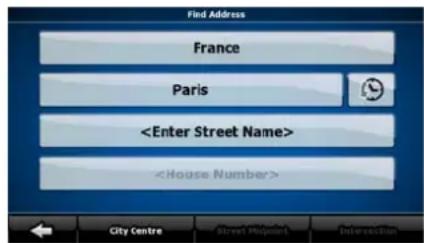
The procedure is explained starting from the Navigation menu.


(Simple mode), or
(Advanced)
1. Tap the following buttons: mode).
2. By default, MCD893 proposes the country and settlement where you are. If needed, tap the button with the name of the country, and select a different one from the list.
3. If needed, change the settlement:

- To select the settlement from the list of recently used ones, tap the button.
-
To enter a new settlement:
-
Tap the button with the name of the settlement, or if you have changed
the country/state, tap
- Start entering the settlement name on the keyboard.
- Get to the list of search results:
After entering a couple of characters, the names that match the string appear in a list.
Done to open the list of results before it appears automatically.
-
Pick the settlement from the list.
-
Enter the street name:
-
Tap
-
Start entering the street name on the keyboard.
- Get to the list of results:
After entering a couple of characters, the names that match the string appear in a list.
Done
- Tap
automatically.
to open
the list of results
before it appears
-
Pick the street from the list.
-
Enter the house number:
-
Tap
-
Enter the house number on the keyboard.
Done
- Tap
to finish entering the address.
- The map appears with the selected point in the middle. Tap
(Simple mode) or
Set as Destination
(Advanced mode) from the Cursor menu. Then, end you can start navigating.
3.1.2.2 Entering an address (North America, Australia)
In some countries, the state is also used in addresses. If you are in one of these countries, or choose any of them from the list of countries, five lines appear on the screen:
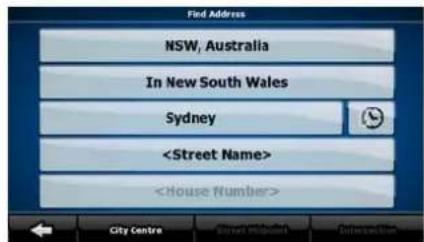
The procedure is explained starting from the Navigation menu.
(Simple mode), or

Find Address (Advanced
-
Tap the following buttons: mode).
-
By default, MCD893 proposes the country, state and settlement where you are. If needed, tap the button with the name of the country, and select a different one from
the list. If you select a new country, you also need to select the state, or tap
to search for a settlement regardless of the state it is in.
- If you have not changed the country, you still have the possibility to change the state. Tap the button with the name of the state, and select from the list.
-
If needed, change the settlement:
-
To select the settlement from the list of recently used ones, tap the button.

-
To enter a new settlement:
-
Tap the button with the name of the settlement, or if you have changed
the country/state, tap
- Start entering the settlement name on the keyboard.
- Get to the list of search results:
After entering a couple of characters, the names that match the string appear in a list.
Done Tap automatically.
to open the list of results before it appears
-
Pick the settlement from the list.
-
Enter the street name:
-
Tap
- Start entering the street name on the keyboard.
- Get to the list of results:
After entering a couple of characters, the names that match the string appear in a list.
Done Tap automatically.
-
Pick the street from the list.
-
Enter the house number:
-
Tap
- Enter the house number on the keyboard.
- Tap
to finish entering the address.
- The map appears with the selected point in the middle. Tap
Set as Destination
(Simple mode) or (Advanced mode) from the Cursor menu. The route is then automatically calculated, and you can start navigating.

Navigate To
3.1.2.3 Entering an address if house numbering is restarted
There are long roads where the house numbering is restarted at some point. This way the same house number can appear twice or even more times on the same road. If this is the case, after giving the house number, you need to select the appropriate address by the district/suburb information.
The procedure is explained starting from the Navigation menu.
(Simple mode), or
Find Address (Advanced)
1. Tap the following buttons: mode).
2. By default, MCD893 proposes the country/state and settlement where you are. If needed, tap the button with the name of the country/state, and select a different one from the list.
3. If needed, change the settlement:
- To select the settlement from the list of recently used ones, tap the button.

-
To enter a new settlement:
-
Tap the button with the name of the settlement, or if you have changed
the country/state, tap
- Start entering the settlement name on the keyboard.
- Get to the list of search results:
After entering a couple of characters, the names that match the string appear in a list.
Done to open the list of results before it appears automatically.
-
Pick the settlement from the list.
-
Enter the street name:
- Tap
- Start entering the street name on the keyboard.
- Get to the list of results:
After entering a couple of characters, the names that match the string appear in a list.
Done
- Tap
automatically.
to open the list of results before it appears
-
Pick the street from the list.
-
Enter the house number:
-
Tap
-
Enter the house number on the keyboard.
Done
-
Tap to finish entering the address.
-
A list appears with the matching addresses. Tap the desired one.

Navigate To
- The map appears with the selected point in the middle. Tap
(Simple mode) or (Advanced mode) from the Cursor menu. The route is then automatically calculated, and you can start navigating.
3.1.2.4 Entering an address without knowing the district/suburb
Long roads can run across several districts or suburbs. You may not know if a particular house number is in which of them. In this case, follow the instructions below:
The procedure is explained starting from the Navigation menu.
- Tap the following buttons: mode).
(Simple mode), or


(Advanced
- By default, MCD893 proposes the country/state and settlement where you are. If needed, tap the button with the name of the country/state, and select a different one from the list.
-
If needed, change the settlement:
-
To select the settlement from the list of recently used ones, tap the button.

-
To enter a new settlement:
-
Tap the button with the name of the settlement, or if you have changed
the country/state, tap
- Start entering the settlement name on the keyboard.
- Get to the list of search results:
After entering a couple of characters, the names that match the string appear in a list.
- Tap to open the list of results before it appears automatically.
-
Pick the settlement from the list.
-
Enter the street name:
- Tap
- Start entering the street name on the keyboard.
- Get to the list of results:
After entering a couple of characters, the names that match the string appear in a list.
Done
- Tap to open the list of results before it appears automatically.
Search in All
-
Instead of picking one of the streets, tap
-
Enter the house number:
-
Tap
-
Enter the house number on the keyboard.
-
Tap to finish entering the address.
-
A list appears with the matching addresses. Tap the desired one.

Navigate To
- The map appears with the selected point in the middle. Tap
Set as Destination (Simple mode) or (Advanced mode) from the Cursor menu. The route is then automatically calculated, and you can start navigating.
3.1.2.5 Selecting an intersection as the destination
The procedure is explained starting from the Navigation menu.
- Tap the following buttons: mode).
(Simple mode), or


- By default, MCD893 proposes the country/state and settlement where you are. If needed, tap the button with the name of the country/state, and select a different one from the list.
-
If needed, change the settlement:
-
To select the settlement from the list of recently used ones, tap the button.

-
To enter a new settlement:
-
Tap the button with the name of the settlement, or if you have changed
the country/state, tap
- Start entering the settlement name on the keyboard.
- Get to the list of search results:
After entering a couple of characters, the names that match the string appear in a list.
- Tap to open the list of results before it appears automatically.
-
Pick the settlement from the list.
-
Enter the street name:
- Tap .
- Start entering the street name on the keyboard.
- Get to the list of results:
After entering a couple of characters, the names that match the string appear in a list.
Done
- Tap
to open the list of results before it appears
-
Pick the street from the list.
-
Tap the
Intersection
button.
If only a few intersecting streets exist, their list appears immediately.
- In case of a longer street, a keyboard screen appears. Start entering the name of the intersecting street on the keyboard. As you type, if the matching streets can be shown on one screen, their list appears automatically.
- Tap the desired intersecting street in the list.

Navigate To
- The map appears with the selected point in the middle. Tap
Set as Destination
(Simple mode) or (Advanced mode) from the Cursor menu. The route is then automatically calculated, and you can start navigating.
3.1.2.6 Selecting a city centre as the destination
The City Centre is not the geometric centre of the settlement but an arbitrary point the map creators have chosen. In towns and villages, it is usually the most important intersection; in larger cities, it is an important intersection.
The procedure is explained starting from the Navigation menu.

Find Address


(Advanced
1. Tap the following buttons: mode).
2. By default, MCD893 proposes the country/state and settlement where you are. If needed, tap the button with the name of the country/state, and select a different one from the list.
3. If needed, change the settlement:
- To select the settlement from the list of recently used ones, tap the button.
- To enter a new settlement:

- Tap the button with the name of the settlement, or if you have changed
the country/state, tap
- Start entering the settlement name on the keyboard.
- Get to the list of search results:
After entering a couple of characters, the names that match the string appear in a list.
Done to open the list of results before it appears automatically.
-
Pick the settlement from the list.
-
Tap the
City Centre
button.
- The map appears with the selected point in the middle. Tap

Navigate To
(Simple mode) or
(Advanced mode) from the Cursor menu. The
route is then automatically calculated, and you can start navigating.
3.1.2.7 Entering an address with a postal code
All of the above address searching possibilities can be performed with entering the postal code instead of the settlement name. Find below an example with a full address:
The procedure is explained starting from the Navigation menu.

Find Address:


- Tap the following buttons: mode).
(Simple mode), or
(Advanced
- By default, MCD893 proposes the country/state and settlement where you are. If needed, tap the button with the name of the country/state, and select a different one from the list.
-
Tap the button with the name of the settlement, and enter the postal code:
-
Start entering the postal code on the keyboard.
- Get to the list of results:
After entering a couple of numbers, the ones that are a match appear in a list.
Done
- Tap
automatically.
to open
the list
of results
before it appears
-
Pick the settlement from the list.
-
Enter the street name:
-
Tap
-
Start entering the street name on the keyboard.
- Get to the list of results:
After entering a couple of characters, the names that match the string appear in a list.
Done
- Tap
automatically.
to open
the list
of results
before it appears
-
Pick the street from the list.
-
Enter the house number:
- Tap
- Enter the house number on the keyboard.
Done
- Tap
to finish entering the address.

Navigate To
- The map appears with the selected point in the middle. Tap
Set as Destination
(Simple mode) or (Advanced mode) from the Cursor menu. The route is then automatically calculated, and you can start navigating.
3.1.2.8 Tips on entering addresses quickly
- When you are entering the name of a settlement or a street, MCD893 only displays those characters that appear in possible search results. The other characters are greyed out.
Done
button
- When entering the settlement name or the street name, tap the
after a couple of letters; MCD893 lists the items that contain the character set.
You can speed up finding an intersection:
-
Search first for the street with a less common or less usual name; fewer letters are enough to find it.
If one of the streets is shorter, search for that one first. You can then find the second one faster. -
You can search for both the type and the name of a road. If the same word appears in several names, for example in the name of streets, roads and avenues, you can obtain the result faster if you enter the first letter of the street type: For example, enter Pi A to obtain Pine Avenue and skip all Pine Streets and Pickwick Roads.
- You can also search in postal codes. This is useful when a street name is common and it is used in several districts of a city.
3.1.3 Selecting the destination from your Favourites
You can select a location that you have already saved as a Favourite to be your destination.
The procedure is explained starting from the Navigation menu.

(Simple mode) or


- Tap the following buttons: (Advanced mode).
-
Tap the Favourite that you want to set as your destination.
-
The map appears with the selected point in the middle. Tap

Navigate To
(Simple mode) or (Advanced mode) from the Cursor menu. The route is then automatically calculated, and you can start navigating.
3.1.4 Selecting the destination from the POIs
You can select your destination from the POIs included with MCD893 or from the ones you have previously created.
The procedure is explained starting from the Navigation menu.
- Tap the following buttons: mode).
(Simple mode), or


(Advanced)
- Select the area around which the POI should be searched:

- Around Address: The POI will be searched around a given address.

- Around Cursor: The map appears with the Cursor in the middle. Modify the location of
the Cursor if necessary, then tap the given location.

The POI will be searched around
GPS Position: The POI will be searched around the current GPS position.

Destination: The POI will be searched around the destination of the active route.
-
Route: The POI will be searched not around a given point but by the size of the detour it means from the active route. This can be useful if you search for a later stopover that causes only a minimal detour. For example upcoming petrol stations or restaurants.
-
You can narrow the search with the following:
-
Select the POI group (e.g. Accomodation), and after that, if needed, select the POI subgroup (e.g. Hotel or Motel).
To find the POI by its name, tap and use the keyboard to enter a part of the name.

-
To list all POIs in a given POI group, tap
-
[optional] When finally the list of results appear, you can sort the list:
- By name: sort the list alphabetically (available when you search around a single location)
- sort the list by the distance from your current position in a straight line (available when you search around a single location)
- sort the list by the distance to drive on route from your current position (available when you search along the active route)
Order by Detour: sort the list by the size of the needed detour (available when you search along the active route)
-
Tap the desired POI in the list.
-
The map appears with the selected point in the middle. Tap
Set as Destination (Simple mode) or (Advanced mode) from the Cursor menu. The route is then automatically calculated, and you can start navigating.
3.1.5 Selecting the destination with a saved POI search criteria
POI search criteria can be saved in the POI section of the Manage menu, but MCD893 is already shipped with some saved criteria you can use instantly when searching for a POI.
The procedure is explained starting from the Navigation menu.
- Tap the following buttons: mode).
(Simple mode), or

- Tap
-
Select one of the saved criteria, and the list of matching POIs appear.
-
Tap the desired POI in the list.
-
The map appears with the selected point in the middle. Tap
(Simple mode) or (Advanced mode) from the Cursor menu. The route is then automatically calculated, and you can start navigating.
3.1.6 Selecting the destination from the History
The destinations that you have set earlier appear in the History.
The procedure is explained starting from the Navigation menu.
- Tap the following buttons: (Advanced mode).
(Simple mode), or

- If necessary, turn the page with

to see earlier destinations.
-
Tap the desired item.
-
The map appears with the selected point in the middle. Tap

Navigate To
Set as Destination (Simple mode) or (Advanced mode) from the Cursor menu. The route is then automatically calculated, and you can start navigating.
3.1.7 Selecting the destination by entering its coordinate
This feature is available in Advanced mode only.
The procedure is explained starting from the Navigation menu.
- Tap the following buttons:

- [optional] Tap coordinates.
Coordinate Display Format
to change the format of the displayed
- Tap the latitude or longitude value to change the coordinate.
-
Enter the coordinate values in WGS84 format on the keyboard: the latitude (N or S) and the longitude (E or W).
-
Tap
- The map appears with the selected point in the middle. Tap

Navigate To
(Simple mode) or (Advanced mode) from the Cursor menu. The route is then automatically calculated, and you can start navigating.
3.2 Creating a multi-point route (inserting a via point)
Multi-point routes are created from simple routes, so a route must be active first. One of the ways of expanding the route is to keep the destination, and to add via points (intermediate destinations).
This feature is available in Advanced mode only.
- Select a new location as you did in the previous sections. This will be the additional destination in the route.
-
The map appears with the selected point in the middle, and the Cursor menu opens automatically.
-
Tap

to add the point as an intermediate destination preceding the route.
- [optional] To add more points to the route, repeat the above steps as many times as you like.
If you insert a via point in a route that is already a multi-point route, you will automatically be taken to the Edit Route screen where you can determine the position of the intermediate route
point. When you enter the screen, the new via point is placed as the last via point before the final destination. The new point is the selected point in the list.
You have the following options:
| Button | Action |
| ↑ | The selected point moves up in the list (becomes a via point to be reached earlier). Tap this button repeatedly, and the point becomes the start point of the route. |
| ↓ | The selected point moves down in the list (becomes a via point to be reached later). Tap this button repeatedly, and the point becomes the final destination of the route. |
| ○ | The route is reversed. The start point becomes the destination, the destination becomes the start point, and all via points are to be reached in the opposite order than before. |
| Optimise | The route is optimised. The start point and the destination remain at their position, but the via points are reordered to make the shortest possible route. |
| Remove | The selected point is removed from the route. The route remains as it was before adding the new point. |
Every time a new point is added, the route is recalculated automatically, and you can start navigating right away.
3.3 Creating a multi-point route (appending a new destination)
Multi-point routes are created from simple routes, so a route must be active first. One of the ways of expanding the route is to add a new destination. The previous destination becomes the last via point of the route.
This feature is available in Advanced mode only.
-
- Select a new location as you did in the previous sections. This will be the additional destination in the route.
-
The map appears with the selected point in the middle, and the Cursor menu opens automatically.
-
Tap More Options...
to open the full Cursor menu with the additional functions.
- Tap Continue previous one to the last in
- [optional] To add more points to the route, repeat the above steps as many times as you like.
Every time a new point is added, the route is recalculated automatically, and you can start navigating right away.
3.4 Editing the route
This feature is available in Advanced mode only.


Edit Route
Tap the following buttons:
The list of route points appear with the start point at the top of the list and the final destination at the bottom. If several via points exist, you might need to turn the page.
Tap one of the route points in the list. You have the following options:
| Button | Action |
| ↑ | The selected point moves up in the list (becomes a via point to be reached earlier). Tap this button repeatedly, and the point becomes the start point of the route. |
| ↓ | The selected point moves down in the list (becomes a via point to be reached later). Tap this button repeatedly, and the point becomes the final destination of the route. |
| ○ | The route is reversed. The start point becomes the destination, the destination becomes the start point, and all via points are to be reached in the opposite order than before. |
| Optimise | The route is optimised. The start point and the destination remain at their position, but the via points are reordered to make the shortest possible route. |
| Remove | The selected point is removed from the route. |
As soon as you leave this screen, the route is recalculated automatically, and you can start navigating right away.
3.5 Viewing the whole route on the map (Fit-to-Screen)
The map can be moved and scaled to show the whole line of the route. You do not need to manipulate the map manually. The Plan on Map feature does it for you.
In Advanced mode you have the following options to enter Plan on Map:
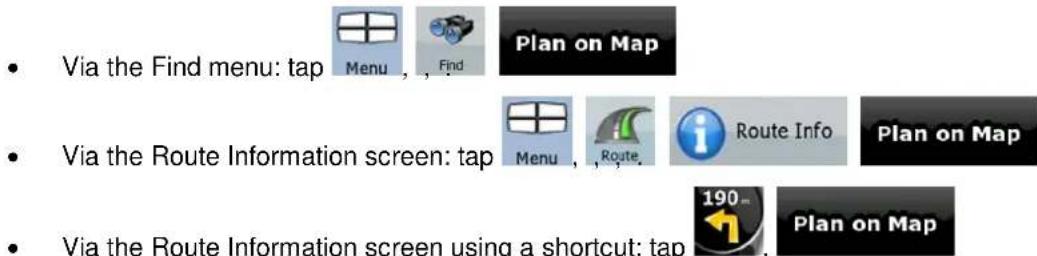
In Simple mode the last option is available only.
3.6 Watching the simulation of the route
This feature is available in Advanced mode only.
The procedure is explained starting from the Map screen.
- Tap the following buttons:
- The Route menu appears. There are two ways of running the route simulation:
Fly Over
- Tap to run the simulation at high speed to give you a quick overview of the route.
Simulate
-
Tap to run the simulation at normal speed and with voice guidance instructions announced. This option is for demonstration purposes, or for checking difficult parts of the route in advance.
-
The simulation can be aborted any time by tapping

3.7 Enabling Safety Mode
This feature is available in Advanced mode only.
Safety Mode disables the touch screen above 10km / h (6 mph) to keep your attention on the road. While driving, you will not be able to set a new destination or to change settings. The only screen control that remains enabled is the gesture that puts you back on the Map screen.
The procedure is explained starting from the Map screen.
Tap the following buttons:




3.8 Pausing the active route
You do not need to pause the active route: when you start driving again, MCD893 restarts the voice instructions from your position.
3.9 Deleting the next via point from the route
The easiest way to delete the upcoming route point (the next via point) in both Simple mode and Advanced mode is to open the Route Information screen by tapping the Turn Preview
61 m field ( ) on the Map screen, and then tapping
In Advanced mode, you have another option. Tap the following buttons:




3.10 Deleting the active route
The easiest way to delete the active route in both Simple mode and Advanced mode is to
open the Route Information screen by tapping the Turn Preview field ( ) on the Map
Delete screen, and then tapping Route
In Advanced mode, you have another option. Tap the following buttons:

Delete Route
Note!
If via points exist in the active route, you cannot delete the route immediately
on the Route Information screen. Tap Skip Next Via repeatedly until all via
Delete Route points disappear and the button appears. Tap it to cancel the whole route.
3.11 Using Track Logs
MCD893 can record the track (how your GPS position changed) that you drive.
Tip!
You do not need to select a destination and create a route for this; you can also record your driving path while cruising.
This feature is available in Advanced mode only.
The procedure is explained starting from the Map screen.
Recording the travelled path (creating a Track Log)
-
Start driving.
-
Tap the following buttons:
-
Start the recording: tap the


Track Logs
You return to the map and you can continue driving.
Stop Recording
- Repeat the above steps, then tap labels the Track Log with a time
Recording later to stop the recording. MCD893 mp.
(As an alternative, you can tap the the Track Log recording.)

button in the Quick menu to start, and later to stop
Simulating a Track Log on the map
- Tap the following buttons:


Track Logs

- Locate the desired Track Log, and then tap the button next to it.
- The map returns, and the Track Log simulation (a life-like replay) begins.
- You can stop the replay any time by tapping the Stop button.
Changing the colour of a Track Log
- Tap the following buttons:


Track Logs
- Tap the desired Track Log and then tap one of the colour buttons.
3.12 Saving a route
This feature is available in Advanced mode only.
The procedure is explained starting from the Map screen.
- Tap the following buttons:


Save Route
- Enter a name for the saved route, and then tap
When you save a route, MCD893 not only saves the route points but the whole itinerary:
If you updated your map since you first saved the route, MCD893 recognises the change, and recalculates the driving instructions according to the latest available map information.
- MCD893 deletes from the route the via points that you already left behind during navigation together with the road segments used to reach it. To avoid this, if you want to save the route, you need to save it before you start navigating.
3.13 Loading a saved route
This feature is available in Advanced mode only.
The procedure is explained starting from the Map screen.
- Tap the following buttons:


Load Route:
-
Tap the route you wish to navigate.
-
In the very likely case when the start position of the saved route is different from the current GPS position, you need to confirm whether you want to stop navigating from the current GPS position to use the start point of the loaded route.
If you choose this option, the automatic off-route recalculation will be disabled.
- If you choose to keep the current GPS position as the start point, the route will be recalculated starting from your current position.
- The map appears, and you can start navigating.
4 Reference book (Advanced mode)
On the following pages you will find the description of the different menu screens of MCD893 in Advanced mode. In Simple mode, these functions work the same way, but only a few of them are available.
The Navigation menu:
MCD893 starts with the Navigation menu. From there you can access the following screens:
| Screen | Button | Description |
| Map | Map | The Map screen. |
| Find | Find | Selecting the destination (for example an address or a POI) or using the search engine of MCD893 for any other reason (for example to look for the phone number of a POI). |
| Route | Route | Managing the active route (obtaining information about it, changing or deleting it or parts of it) or planning a route without GPS reception. |
| Manage | Manage | Managing user data, such as saved locations (POIs, Favourites, Pins, and History items), Saved Routes, and Track Logs. |
| Settings | Settings | Managing the behaviour of MCD893, for example the map layout during navigation, the used languages or the warnings. |
4.1 Map screen
MCD893 is primarily intended for land navigation. That is why maps in MCD893 look similar to paper road maps. However, MCD893 provides much more than regular paper maps: you can customise the look and the content of the map.
The most important and most often used screen of MCD893 is the Map screen.
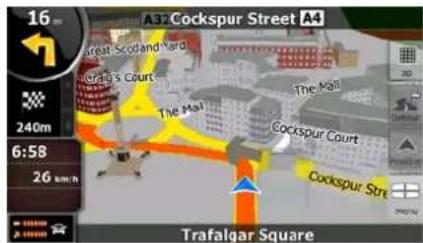
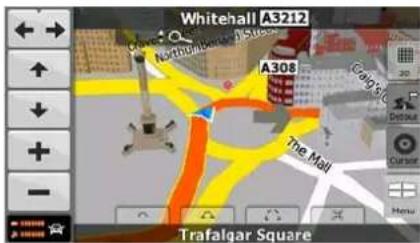
During navigation, the screen shows route information and trip data (left screenshot), but when you tap the map, additional buttons and controls appear for a few seconds (right screenshot). Most parts of the screen behave as buttons.
| Symbol | Name | Action |
| 85 | Turn Preview, that is, the next route event | Opens the Route Information screen |
| 220m | Second upcoming route event | Opens the Itinerary |
| 4:04 24 m 0:02 | Trip data | Opens the Trip Information screen |
| GPS position quality | Opens the Quick menu | |
| Vehicle used in route calculation | Opens the Quick menu | |
| Top row | Next street | n/a |
| Bottom row Current street and house numbers on left and right | n/a | |
| Map view modes | Switches between 2D and 3D map modes | |
| Menu | Menu | Opens the Navigation menu |
| Detour | Detour | Opens the Detour screen, two ways of modifying the route: • the list of Saved Search Criteria • a button to avoid parts of the route |
| Position | Position menu (appears when navigating a route) | Opens the Position menu |
| Cursor | Cursor menu (appears when there is no GPS position or the Cursor is not at the current GPS position) | Opens the Cursor menu |
| Open/Close Map control buttons | Tap this button to show or hide the following map control buttons: • Zoom in/out • Rotate left/right (3D map only) • Tilt up/down (3D map only) • Zoom preset buttons (2D map only) • Tilt and zoom preset buttons (3D map only) • Return to GPS position button • Smart Zoom button | |
| ←, → | Rotate left, rotate right | Rotates the 3D map left or right |
| ↑, ↓ | Tilt up, tilt down | Tilts the 3D map |
| +,- | Zoom in, zoom out Scales the map | Map |
| Return to GPS position (appears when GPS position is available and you have moved the map) | Tap this button to move the map back to the current GPS position. If the map has been rotated in 3D mode, automatic map rotation is also re-enabled. | |
| Enable Smart Zoom (replaces the previous button if there is no GPS position or the map has not been moved) | Tap this button once to enable Smart Zoom. Tap&hold the button to set the zoom limits of Smart Zoom. | |
| Zoom preset buttons (available in Advanced mode only) | Tap one of the preset buttons to set the zoom level to a fix, predefined value. Smart Zoom is disabled. These buttons are available in 2D mode. Tap&hold any of the buttons to set its value to the current zoom level, or to reset it to its original value. | |
| Tilt preset buttons (available in Advanced mode only) | Tap one of the preset buttons to set the tilt and zoom levels to fix, predefined values. Smart Zoom is disabled. These buttons are available in 3D mode. Tap&hold any of the buttons to set its value to the current tilt and zoom levels, or to reset it to its original value. | |
| Current GPS position (on nearest road) | n/a | |
| Cursor (selected map location) | n/a | |
| Lane information | n/a | |
| Orange line | Active route | n/a |
| 250 m 500 m | Map scale (2D map only) | n/a |
4.1.1 Icons on the map
There are several status icons on the map. Most of them also function as a button. The information they provide is as follows:
GPS position quality
Vehicle type used for route calculation
Sound status (muted or enabled)
- Track log recording status
4.1.1.1 GPS position quality and Vehicle type indicator
This is a complex indicator, and a button that opens the Quick menu.
The GPS reception quality shows the current accuracy of the position information.
| Icon | Description |
| MCD893 has no connection to the GPS receiver: GPS navigation is not possible. Devices with a built-in GPS receiver are permanently connected. On such devices, the icon does not appear in normal circumstances. | |
| MCD893 is connected to the GPS receiver, but the signal is too weak and the receiver cannot determine the GPS position. GPS navigation is not possible. | |
| Only a few satellites are received. Position information is available, but elevation (altitude) cannot be calculated. GPS navigation is possible, but the position error may be significant. | |
| Altitude information is available, the position is a 3D position. GPS navigation is possible. |
The remaining part of the field shows the vehicle type used for route calculation.
| Icon | Vehicle type |
| Car | |
| Taxi | |
| Bus | |
| Emergency vehicles | |
| Bicycle | |
| Pedestrian |
4.1.1.2 Status indicator strip
This is a complex indicator. In one strip it indicates the following status information:
| Icon | Description |
| The sound output of MCD893 is muted. | |
| The sound output of MCD893 is enabled. | |
| MCD893 records a Track log when GPS position is available. | |
| Track log recording is disabled. |
4.1.1.3 Next two route events (Turn Preview fields)
There are two fields reserved on the Map screen to display the next two manoeuvres (route events that are listed in the Itinerary). Both the type of the event (turn, roundabout, exiting motorway, etc.) and its distance from the current GPS position is displayed.
Most of these icons are very intuitive and you also know them as road signs. The following table lists some of the frequently shown route events. The same symbols are used in both fields:
| Icon | Description | |
| 190m | 100m | Turn left. |
| 61m | 220m | Turn right. |
| 17m | 68m | Turn back. |
| 160m | 190m | Bear right. |
| 40m | 220m | Turn sharp left. |
| 580m | 670m | Keep left. |
| 300m | 68m | Continue straight in the intersection. |
| 260m | 180m | Enter roundabout. The number of the exit is shown in the circle, but only for the next turn. |
| 280m | 670m | Enter motorway. |
| 5.5km | 190m | Exit motorway. |
| 150m | 90m | Board ferry. |
| 340m | 100m | Leave ferry. |
| Icon | Description |
| 210m, 330m | Approaching the next via point. |
| 320m, 330m | Approaching the destination. |
In certain situations when route events are not important, these fields show other useful pieces of information.
4.1.2 Objects on the map
4.1.2.1 Streets and roads
MCD893 shows the streets in a way that is similar to how the paper road maps show them. Their width and colours correspond to their importance: you can easily tell a motorway from a small street.
Tip!
If you prefer not to see street names during navigation, turn them off.
4.1.2.2 3D object types


To enable or disable 3D visualisation on the map, tap the following buttons: Menu, Settings,

Map Screen
3D Settings
MCD893 supports the following 3D object types:
| Type | Description |
| 3D landmarks | Landmarks are 3D artistic or block representations of prominent or well-known objects. 3D landmarks are only available in selected cities and countries. |
| Elevation model | Hills and mountains are shown in the background of the 3D map view, and illustrated by colour on the 2D map. |
| Elevated roads | Complex intersections and vertically isolated roads (such as overpasses or underground tunnels) are displayed in 3D. |
| 3D buildings | Full 3D city building data that represents actual building size and position on the map. Building data is limited to the city centre of major cities in the US and Europe. |
| 3D terrain | 3D terrain map data shows changes in terrain, elevations or depressions in the land when you view the map, and use it to plot the route map in 3D when you navigate. |
4.1.2.3 Elements of the active route
MCD893 shows the route in the following way:
| Symbol | Name | Description |
| Current GPS position | Your current position displayed on the map. • In pedestrian mode it is the exact GPS position. • If a vehicle is selected for route calculation, the arrow is put on the nearest road. | |
| Cursor (selected map location) | The location selected in the Find menu, or a map point selected by tapping the map. | |
| Start point | The first point of the route. Normally, if GPS position is available, it is the start point of the route. If there is no valid GPS position, MCD893 uses the last known GPS position as the start point. When you are using a saved route, MCD893 asks you if you want to use your GPS position or the first point in the saved route as the start point. You can also modify the start point in the Cursor menu. If you do so, the automatic off-route recalculation needs to be turned off to keep the selected point as the start point. If the automatic off-route recalculation is disabled for any of the above, tapping the icon in the Turn Preview field not only initiates a route recalculation from the current GPS position, but it will re-enable the automatic off-route recalculation as well. | |
| Via point | A via point is an intermediate destination. You can place as many via points as you want. | |
| Destination (end point) | The last point of the route, the final destination. | |
| Route colour | The route always stands out with its colour on the map, both in daytime and in night colour mode. The active leg of the route is always displayed in a brighter shade than the inactive (upcoming) legs. | |
| Active leg of the route | The section of the route on which you are driving. If you have not added any via points (only a destination), the entire route is the active leg. If you have added via points, the active leg is the part of the route from your current location to the next route point (the next via point, or the destination if there are no more via points to reach). | |
| Inactive legs of the route | The future sections of the route; each of them becomes active when you reach the via point at its beginning. | |
| Streets and roads that are excluded from the navigation | You can choose whether you want to use or avoid certain road types. However, when | |
| MCD893 cannot avoid such roads, the route will include them and it will show them in a colour that is different from the route colour. | ||
4.1.3 Detour menu
This screen contains quick detour possibilities during navigation. It can be opened directly

from the Map screen by tapping
You have the following options:
- On the main part of the screen you can see the first page of Saved Search Criteria. Select any of the criteria to quickly receive the list of nearest matching POIs, and instantly plan a new route to the desired one, or insert it as a via point in your active route.
In Advanced mode more buttons appear at the bottom:

- If you have used the above function before, tap this button to clear the restrictions from the map.
4.1.4 Cursor menu
As soon as you select one point in the Find menu, the map appears with the Cursor menu, a menu with possible actions for the selected point.
Alternatively, when you tap the map, control buttons appear. Tap again to place the Cursor, a
radiating red dot. Now tap Cursor, and the Cursor menu opens with a list of options.
In order to show a part of the map with the Cursor menu, it contains only a few buttons first.
Tap More Options... to get all the options.
| Button | Description |
| ← | Closes the Cursor menu, and returns to the previous screen. |
| - | Zooms out the map. |
| + | Zooms in the map. |
| - | With the Cursor menu open, you can still move or scale the map, and tap the map anywhere to place the Cursor to a new location, but when you use this button, the Cursor jumps back to the place where it was at the time when you opened the Cursor menu. |
| Displayed at the Cursor if it is at the same location with which the Cursor menu was opened. | |
| Displayed at the Cursor if it has been relocated since the Cursor menu was opened. | |
| Info | Opens a new screen with the address and coordinate of the Cursor, and the list of nearby POIs. |
| More Options... | Opens the full-screen Cursor menu with all the possible options. |
| Set as Destination | A new route is calculated with the Cursor as the destination. The previous route is deleted. |
| Remove Destination | If the Cursor is at or near the destination, this button replaces the previous one, and deletes the current destination from the route. The last via point is promoted as destination, or if there are no via points, the route is deleted. |
| Insert as Via | The Cursor is added to the active route as an intermediate route point, a point to be reached before the destination. If there is already a via point in the route, the Edit Route screen opens to let you decide where the new via point is to appear in the route. |
| Remove Via | If the Cursor is at or near one of the via points, this button replaces the previous one, and deletes the selected via point from the route. The route is recalculated without the deleted point. |
| Continue | The Cursor is appended at the end of the route as the new destination. The previous destination is demoted, and becomes the last via point. |
| Routing Methods | This button is similar to the Set as Destination button, but a new screen opens, and the route is calculated with all the possible route calculation methods (Fast, Short, Economical and Easy). Observe the results, and choose one of the routes to navigate. |
| Set as Start | The Cursor becomes the start point of the route. This means that the route will not be started from the current GPS position, and Automatic Off-route Recalculation needs to be turned off to keep the start point the selected one. |
| Remove Start | If the Cursor is at or near the selected start point, this button replaces the previous one, and deletes the start point from the route. The current GPS position is used again as the start point, and Automatic Off-route Recalculation is re-enabled. |
| Save as POI | The Cursor is saved as a user POI. Select the POI group and give a name for the POI, then select a suitable icon, enter a phone number, and additional information if you like. |
| Place Pin | Map locations can be marked with Pins. Unlike POIs, a Pin has no name and other details, only a colour to let you tell one from another on the map. |
| Remove Pin | If the Cursor is at or near a Pin, this button replaces the previous one, and deletes the Pin the Cursor is near to. |
| Save as Camera | The Cursor is saved as the location of a Road Safety Camera (speed camera or red light camera). A new screen appears where you can set the type of the camera, the direction of the measured traffic, and the speed limit checked (if applicable). |
| Edit Camera | If the Cursor is at or near a Road Safety Camera, this button replaces the previous one, and opens a new screen where you can edit the details of the camera. |
| Add to Favourites | The location of the Cursor is added to the list of frequently visited destinations, the so called Favourites. You can give a name for the Favourite. |
4.1.5 Position menu
When you follow the recommended route on the map (the Cursor is the current GPS position), the Position menu replaces the Cursor menu. It does not contain buttons that modify the current route, as the GPS position is not useful as a route point.
To open the Position menu, tap Postion.
4.1.6 Route Information screen
The Route Information screen has all the data and some of the functions you need while you navigate. There are two ways to open this screen:
It can be opened directly from the Map screen by tapping the Turn Preview field (
In Advanced mode, from the Navigation menu tap the following buttons:


Route Info
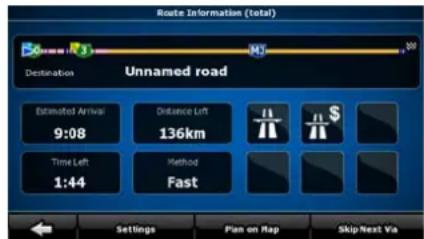
In the top section of the screen you see information about the current route. The fields on this screen are continuously updated while you keep the screen open.
When you open the screen, all fields contain information about reaching your final destination. Tap any of the fields to see data on the via points starting from the first one through the final destination again.
You have the following data and functions on this screen:
| Name | Description | Function |
| Route line | The upper part of this screen shows your planned route as a horizontal line. Its leftmost point is the start of the route, the rightmost one is the final destination, and you can see your via point flags along the line, spaced in proportion to their distance. | Tap this field to change the content of all data fields to via point information. |
| Estimated Arrival | Shows the estimated arrival time at the final destination of the route based on information available for the remaining segments of the | Tap this field to change the content of all data fields to via point information. |
| route. The calculation cannot take into account traffic jams and other possible delays. | ||
| Distance Left | Shows the distance you need to travel on the route before reaching your final destination. | Tap this field to change the content of all data fields to via point information. |
| Time Left | Shows the time needed to reach the final destination of the route based on information available for the remaining segments of the route. The calculation cannot take into account traffic jams and other possible delays. | Tap this field to change the content of all data fields to via point information. |
| Method | This field shows how the route was calculated. It either displays the Route Calculation Method or the Vehicle field from the Route Planning options. If you have chosen Car, Taxi or Bus, the type of the route (Fast, Short, Easy or Economical) will be displayed here; if you have selected Emergency, Bicycle or Pedestrian, this information will be displayed here. | Tap this field to change the content of all data fields to via point information. |
| Warning icons | In these square fields graphical symbol are displayed in case warnings are attached to the planned route. These are warnings, so icons always show information for the whole route, even if the data fields display values from your current position to a via point only. | Tap any of the icons for an explanation. |
| Settings | Opens the Route Planning options screen from the Settings menu. | |
| Plan on Map | Opens the map screen designed for route planning. | |
| Skip Next Via | Appears only if at least one via point exists. | Deletes the next via point from the route. |
| Delete Route | Appears only if there are no via points in the route. | Deletes the active route. |
4.1.7 Trip Information screen
The Trip Information screen has both route and travel data you might need during your
4:04 24 m3 journey. It can be opened directly from the Map screen by tapping the Trip Data field (0:02
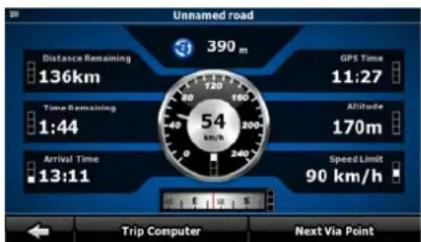
The fields on this screen are continuously updated while you keep the screen open.
When you open the screen, all route data fields contain information about reaching your final
Next Via Point
destination. Tap and the fields concerning your route display data for the next via point. Tap the button repeatedly to toggle between the two possibilities.
You have the following data and functions on this screen:
| Name | Description | Function |
| or | Shows whether the route data fields show information about the final destination (checked flag) or about the next via point (yellow flag). | |
| Field next to the flag | Shows the name or number of the current street or road. | |
| Turn Preview | Shows the type and distance of the next route event. | |
| Compass | Shows the current heading. | Tap this field to show it on the map screen in one of the Trip Data fields. |
| Speedometer | Shows the current speed both graphically and as a number. | Tap this field to show it on the map screen in one of the Trip Data fields. |
| Distance Remaining | Shows the distance you need to travel on the route before reaching your final destination. | Tap this field to show it on the map screen in one of the Trip Data fields. |
| Time Remaining | Shows the time needed to reach the final destination of the route based on information available for the remaining segments of the route. The calculation cannot take into account traffic jams and other possible delays. | Tap this field to show it on the map screen in one of the Trip Data fields. |
| Arrival Time | Shows the estimated arrival time at the final destination of the route based on information available for the remaining segments of the route. The calculation cannot take into account traffic jams and other possible delays. | Tap this field to show it on the map screen in one of the Trip Data fields. |
| GPS Time | Shows the current time corrected with time zone offset. The accurate time comes from the GPS satellites, and the time zone information comes from the map or it can be set manually in Regional settings. | Tap this field to show it on the map screen in one of the Trip Data fields. |
| Altitude | Shows the elevation if it is provided by the GPS receiver. | Tap this field to show it on the map screen in one of the Trip Data fields. |
| Speed Limit | Shows the speed limit of the current street if the map contains it. | Tap this field to show it on the map screen in one of the Trip Data fields. |
| Trip Computer | Opens a new screen with three resettable Trip Computers. | |
| Next Via Point | Tap this button to change the content of the Route Data fields to show information about the next via point. | |
| Destination | If you tap the previous button, this one replaces it. | Tap this button and the Route Data fields show information about the final destination again. |
Most of the fields on this screen have a symbol next to them. This symbol shows whether the field it is attached to is shown on the map as a Trip Data. It also shows the position of the data as follows:
| Symbol | Description |
| This value is not shown on the map screen. | |
| This value appears on the map screen in the Trip Data area. This is the value at the top. | |
| This value appears on the map screen in the Trip Data area. This is the value in the middle. | |
| This value appears on the map screen in the Trip Data area. This is the value at the bottom. |
4.1.7.1 Trip Computer screen
The Trip Computer screen provides collected trip data. It can be opened from the Trip
Trip Computer
Information screen by tapping
The fields on this screen are continuously updated while you keep the screen open.
You can switch between the trips, pause then resume them, or reset their data.
You have the following functions on this screen:
| Name | Description | |
| Pause | Pauses the trip currently shown on the screen. Values on the screen stop changing. | |
| Resume | This button replaces the previous one if it has been activated. Tap it to resume collecting trip data. | |
| Reset | Reset all counters of the currently shown trip. Collecting trip data is restarted only when MCD893 receives a position from the GPS. | |
| Cycles through all trips. | ||
4.1.8 Quick menu
The Quick menu is a selection of controls that are frequently needed during navigation. It can
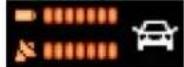
be opened directly from the Map screen by tapping
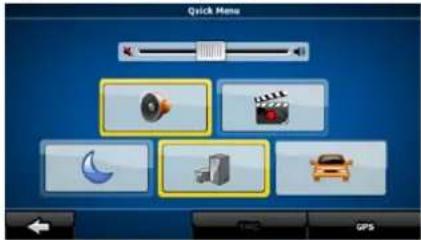
If you tap any of the switches in the Quick menu except for the Vehicle type, the Map screen immediately returns. A switch is on if its lamp is lit. The Vehicle type button is different. It is a multi-value button. It opens a list of available choices, and the symbol of the selected vehicle is shown on the button.
| Name | Main function (single tap) | Function (tap and hold) |
| Master Volume slider | Adjusts the sound volume of the device. All sounds of the application are involved. | No action. |
| If you only adjust the volume, you need to use this button to return to the Map screen. | Opens the Navigation menu. | |
| Mutes all sounds of MCD893. | Opens Sound settings. | |
| Switches between the daytime and night colour schemes manually. This will not disable the automatic switching between the two schemes: the other colour scheme returns at the next scheduled time. | Opens Colour Profiles settings. | |
| 3D buildings can be displayed on the map. Use this switch to suppress them temporarily. | Opens 3D Settings. | |
| Tap this button and select the Vehicle type to be used for route calculation. Otherwise it is selected in Route Planning options in Settings. Changing the Vehicle type triggers an automatic route recalculation. | Opens Route Planning options. | |
| Turns track log recording on or off otherwise controlled on the Manage Track Logs screen. | Opens Manage Track Logs. | |
| GPS | Opens the GPS Data screen with satellite information, data coming from the GPS receiver, and a shortcut to the GPS Settings screen if needed (GPS receiver detection is automatic). | No action. |
4.1.9 GPS data screen
Tap the following buttons: to see the status of the GPS reception.
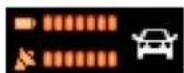
to open the GPS Data screen and
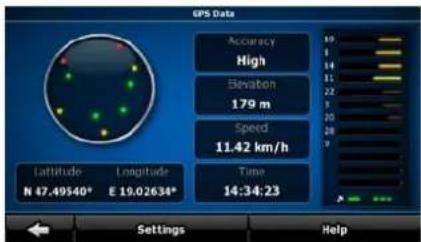
| Icon | Colour | Name | Description |
| Green | GPS position quality indicator | MCD893 has a connection to the GPS receiver and GPS position information is available in 3D: MCD893 can calculate both your horizontal and vertical GPS position. | |
| Yellow | MCD893 has a connection to the GPS receiver and GPS position information is available in 2D: only the horizontal position is calculated, MCD893 cannot calculate your vertical GPS position. | ||
| Grey | MCD893 has a connection to the GPS receiver but GPS position information is not available. | ||
| Red | MCD893 has no connection to the GPS receiver. | ||
| Green, blinking | GPS connection quality indicator | MCD893 is connected to the GPS receiver. | |
| Yellow, blinking | MCD893 has no connection to the GPS receiver but it is still trying to establish a connection. | ||
| Red, blinking | MCD893 has no connection to the GPS receiver and does not try to establish a connection. | ||
| Sky view circle | The virtual sky shows the visible part of the sky above you, with your position as the centre. The satellites are shown at their current positions. The GPS receives data from both the green and yellow satellites. Signals from the yellow satellites are only received, while green ones are used by the GPS to calculate your current location. | ||
| n/a | Coordinates | Your current GPS position in WGS84 format. | |
| n/a | Status bar for the satellites | Dark bars are for the yellow and lit bars are for the green | |
| satellites. The more satellites your GPS tracks (the green ones), the better is your calculated position. | |||
4.2 Find menu
Select the destination of your route. Tap the following buttons: Menu, Find
| Button | Description |
| Find Address | If you know at least a part of the address, this is the quickest way to find the location. |
| Find POI | You can select your destination from the thousands of POIs included with MCD893 or from the ones you have previously created. |
| History | The destinations that you have already entered in MCD893 are available in the History list. |
| Find Coordinate | You can select your destination by entering its coordinates. |
| Favourites | You can select as your destination a location that you have already saved as a Favourite. |
| Plan on Map | Opens a special 2D map screen optimised for route planning. Only the Zoom in and Zoom out buttons and the route modification buttons of the Cursor menu appear. |
4.3 Route menu
Save, load and edit your routes. Tap the following buttons:
| Button | Description |
| Route Info | Opens a screen with useful route data. |
| Itinerary | You can browse the driving instructions that MCD893 follows during navigation. You can exclude manoeuvres or streets to adjust the route to your preferences. |
| Edit Route | You can modify the route: remove route points or change their order. |
| Delete Route | Erase the active route with all its route points (start point, via points and destination). If you later decide that you need the |
| same route, you will have to rebuild it from scratch. | |
| Save Route | You can save the active route for later use. |
| Load Route | You can load a previously saved route for navigation. |
| Settings | Opens the Route settings screen with controls to modify the vehicle, the road types used for route calculation , or the route calculation method. |
| Fly Over | You can run a demonstration of the route at high speed. |
| Simulate | You can run a demonstration of the route at normal speed. |
4.4 Manage menu
You can manage the content that MCD893 stores. Tap the following buttons:
| Button | Description |
| Saved Routes | Renaming or deleting saved routes |
| History | Deleting History items |
| Track Logs | Recording, simulating, renaming or deleting track logs, assigning colour to them to be shown on the map |
| Favourites | Renaming or deleting Favourites |
| POI | Creating, updating or deleting POIs Creating, updating or deleting POI groups Modifying POI visibility settings |
| Saved Search Criteria | Creating, renaming or deleting Saved Search Criteria |
4.4.1 Manage Saved Routes
You can manage the previously saved routes. Tap the following buttons:
| Button | Description | |
| Button with the name of the saved route | Opens the selected route for editing. | |
| Button | Description | |
| × | Deletes the selected route. | |
| Clear All | Clears the list of saved routes. | |
| ×, × | Turns the page for additional list items. | |
4.4.2 Manage History
You can manage the list of locations you used lately. Tap the following buttons:


History
| Button | Description |
| Deletes the selected item in the History. | |
| Clear History | Deletes the entire History. |
| , | Turns the page for additional list items. |
4.4.3 Manage Track Logs
You can record Track Logs, then play them back, display them on the map, and see their
| details. Tap the following buttons: | Menu, | Manage | Track Logs |
| Button | Description |
| Record | Starts recording the track that you drive. (You can also start recording a track log in the Quick menu.) |
| Stop Recording | Stops the ongoing Track Log recording. (You can also stop the track log recording in the Quick menu.) |
| Button with the name of the track log | Shows the details of the selected Track Log. |
| Starts a simulated playback of the selected Track Log on the map. | |
| Turns the page for additional list items. |
When track log details are shown:
| Button | Description |
| Button with the name of the Track Log | Opens a keyboard screen to let you rename the Track Log. |
| — | Tap this button to hide the Track Log on the map. No colour will be assigned to the Track Log. |
| ● | Tap one of the coloured buttons to assign a colour to the Track Log. The Track Log will be shown on the map with this colour. |
| Fit to Screen | The map returns with the Track Log. The map is scaled to show the whole Track Log. |
| Delete | Deletes the selected Track Log. |
| Export | Saves the Track Log on the inserted memory card in GPX format. |
4.4.4 Manage Favourites
You can manage the list of your Favourites. Tap the following buttons: Menu , Manage ,

| Button | Description | |
| Button with the name of the Favourite | Opens the selected Favourite for editing. | |
| Deletes the selected item in the list of Favourites. | ||
| Clear All | Cleared the list of Favourites. | |
| Turns the page for additional list items. | ||
4.4.5 Manage POIs
You can manage your POIs, and set the POI visibility for both your POIs and the ones that
came with the product. Tap the following buttons: Menu, Manage POI
| Button / Icon | Description | |
| Button with the name of the POI group | Opens the list of the subgroups of this POI group. The new list behaves the same as this one. | |
| Button with the name and address of a POI item | Opens the selected POI for editing. Only the POIs you have created appear in this list. | |
| Edit | Opens the selected POI group for editing. | |
| My POI | Tap to filter the list to contain only the POIs that you saved. | |
| All | Tap to see all POIs in the list. | |
| New Group | Creates a new POI group at the given group level. | |
| Turns the page for additional list items. | ||
| This POI group is not shown on the map. | ||
| This POI group and all its subgroups are shown on the map. | ||
| This POI group and some of its subgroups are shown on the map. | ||
| This POI group contains POIs that you saved. | ||
When a POI group is open for editing:
| Button | Description | |
| Off | Items in the POI group will not be shown on the map. | |
| Close | Medium | The distance buttons set the zoom level from which the items in the POI group will be shown on the map. |
| Same Visibility in Subgroups | Subgroups under the edited POI group will inherit its visibility settings. | |
| Button with the icon of the POI group | Tap this button to select a new icon for the POI group. | |
| Remove | Deletes the edited POI group. You are only allowed to remove POI groups that you have created. | |
When a POI item is open for editing:
| Button | Description | |
| Button with the name of the POI | Tap this button to rename the POI. | |
| Button with the icon of the POI | Tap this button to select a new icon for the POI. | |
| Tap this button to enter a telephone number for the POI. | ||
| Tap this button to enter additional information for the POI. | ||
| Delete | Tap this button to delete the selected POI. | |
| Change Group | Tap this button to move the POI to another POI group or subgroup. | |
4.4.6 Manage Saved Search Criteria
You can manage the list of search criteria previously saved to easily find frequently searched
POI types. Tap the following buttons:
| Button | Description | |
| Button with the name of the Saved Search Criteria | Tap to rename the saved query. | |
| Deletes the selected item in the list. | ||
| Clear All | Deletes the entire list. | |
| Turns the page for additional list items. | ||
| <Add new search> | Tap to save a new search criteria. Similar to how you search for a POI, select the search reference first, then select the POI group or subgroup to search in. | |
4.4.7 User Data Management
You can manage the data you have saved (Pins, POIs, Favourites, History, and Track logs)
and the settings you have made in the program. Tap the following buttons:
User Data Management
| Button | Description |
| Remove Pins | Map locations can be marked with Pins using the Place Pin button in the Cursor menu. Tap this button to remove all your Pins from the map. |
| Backup User Data | All user data and the current settings will be saved on the inserted memory card. There is always one backup file. If you perform a backup later, the previous backup will be overwritten with the new information. |
| Restore User Data | All user data and settings will be overwritten with the information stored in the backup file. Data and settings created after the latest backup will be lost. |
| Delete User Data | All user data will be deleted, and settings will return to their factory defaults. |
| Reset Factory Settings | All settings will return to their factory defaults, but no user data will be deleted. |
4.5 Settings menu
You can configure the program settings, and modify the behaviour of MCD893. Tap the
following buttons: Menu, Settings
The Settings menu has two pages of submenus. Tap to access the other options.
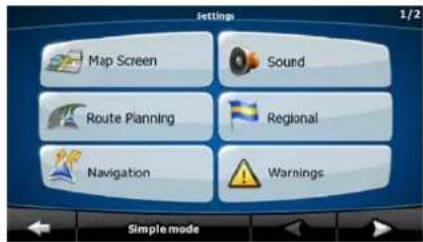
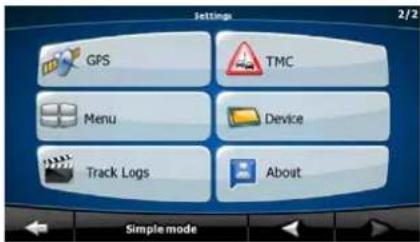
| Button | Description |
| Map Screen | You can fine-tune the appearance and content of the Map screen. |
| Sound | You can adjust the sounds of MCD893. |
| Route Planning | These settings determine how routes will be calculated. |
| Regional | These settings allow you to adjust the application to your local language, measurement units, time and date and their formats, as well as choose the voice guidance profile you prefer. |
| Navigation | You can control how MCD893 behaves during navigation. |
| Warnings | You can enable some handy warnings, and disable the touch screen in a moving vehicle with Safety Mode. |
| GPS | You can set up the connection to the GPS receiver. |
| Menu | You can modify the look and behaviour of the Menu screens. |
| Device | You can change some device settings to control the screen backlight when MCD893 is running. |
| Track Logs | You can set up an automatic Track Log saving, and fine-tune its settings. |
| About | This screen has no navigation feature. It merely provides information about the maps and licenses included with your navigation system. |
| Simple Mode | You can switch to Simple mode. In Simple mode only a few of the above settings are available. The rest of the settings are set to values that are optimal for typical use. |
4.5.1 Map Screen settings
You can fine-tune the appearance and content of the Map screen. Tap the following buttons:


Map Screen
| Button | Description |
| 3D Settings | Use 3D settings to determine which of the present 3D objects are shown on the map, and adjust the level of 3D visual detail. The options are as follows:Landmarks: Landmarks are 3D artistic or block representations of prominent or well-known objects. 3D landmarks are only available in selected cities and countries.Elevated Roads : Complex intersections and vertically isolated roads (such as overpasses or underground tunnels) are displayed in 3D.Building Visibility: Full 3D city building data that represents actual building size and position on the map. Building data is limited to the city centre of major cities in the US and Europe.Terrain Detail Level: 3D terrain map data shows changes in terrain, elevations or depressions in the land when you view the map, and use it to plot the route map in 3D when you navigate. |
| Colour Profiles | MCD893 is able to show the map and the menus in different colours during the day and during the night. Select the colour profiles to be used in each mode, and select the automatic or manual switching between the daytime and night colour profiles. |
| Elevation on 2D Map | 2D maps can also display 3D information. These top-down maps can display elevation by colours and shading. |
| Show Street Names | Street names and POI icons can be disturbing on the map during navigation. With this switch you can suppress these map elements when MCD893 is following your position on the map. If you move the map, both the street names and POI icons reappear immediately. |
| Lane Information | Some maps contain lane information to help you position your car in the upcoming intersection. This setting tells MCD893 whether to display this information at the top or at the bottom of the map. |
4.5.2 Sound settings
You can adjust the sounds of MCD893. Tap the following buttons: Menu, Settings, Sound
| Button | Description |
| Master Volume | Use the switch to mute all sounds of the device and then to re-enable them again. The position of the fader determines the volume level.The loudness of MCD893 is independent of your device settings.When you exit the program, the device default settings return. |
| Voice Guidance Volume | The slider adjusts the loudness of voice prompts. In its leftmost position, the voice guidance is suppressed; in its rightmost position, the master volume applies. |
| Key Sounds | Key sounds are audible confirmation of either pressing hardware buttons or tapping the touch screen.The switch turns the key sounds on or off. Key sounds are played at the master volume level. |
| Dynamic Volume | When driving at high speed, the noise in the car may be too loud to clearly hear the voice guidance and other sounds. Using Dynamic Volume you can instruct MCD893 to increase the volume when your speed exceeds a certain minimum, and reach its highest volume at the given maximum speed. |
4.5.3 Route Planning options
These settings determine how routes will be calculated. Tap the following buttons:


| Button | Description |
| Vehicle | You can set the type of vehicle you will use to navigate the route. Based upon this setting, some of the road types will be excluded from the route (e.g. motorways for pedestrians), or some of the restrictions may not be taken into account (e.g. emergency vehicles have only a few restrictions). |
| Road Types Used for Route Planning | To let the route fit your needs, you can also set which road types are to be considered for or to be excluded from the route, if possible.Excluding a route is a preference. It does not necessarily mean total prohibition. If your destination can only be accessed using some of the excluded road types, they will be used, but only as much as necessary. In this case a warning icon will be shown on the Route Information screen, and the part of the route not matching your preference will be displayed in a different colour on the map. |
| Route Calculation Method | You can choose from different route types. The routing method can also be chosen while creating the route: when thedestination is selected, tapRouting Methodsin the Cursormenu. |
Vehicle types:
Car
Taxi
Bus
Emergency vehicles
- Bicycle
- Pedestrian
Road Types Used for Route Planning:
| Type | Description |
| Motorways | You might need to avoid motorways when you are driving a slow car or you are towing another vehicle. |
| Unpaved roads | MCD893 excludes unpaved roads by default: unpaved roads can be in a bad condition and usually you cannot reach the speed limit on them. |
| Toll roads | By default MCD893 includes toll roads (pay roads where there is a per-use charge) in the routes. If you disable toll roads, MCD893 plans the best toll-free route. |
| Charge roads | Charge roads are pay roads where you can purchase a pass or vignette to use the road for a longer period of time. They can be enabled or disabled separately from toll roads. |
| Permit needed | You might need a permit or permission from the owners to use certain roads or to enter certain areas. MCD893 excludes these roads from the route calculation by default. |
| Ferries | MCD893 includes ferries in a planned route by default. However, a map does not necessarily contain information about the accessibility of temporary ferries. You might also need to pay a fare on ferries. |
| Cross-border planning | In some cases the route calculated according to your other navigation and route preferences would lead through another country. If you wish to always stay within the same country, turn this option off. |
| Carpool lanes | This control appears only when navigating in the USA. You should check whether you are allowed to use carpool lanes before enabling this road type. |
Route Calculation Method types:
| Option | Description |
| Fast | Gives the quickest possible route if you can travel at or near the speed limit on all roads. Usually the best selection for fast and normal cars. |
| Short | Gives a route that has the smallest total distance of all possible routes between the route points. Usually practical for pedestrians, cyc lists or slow vehicles. |
| Economical | Combines the benefits of Fast and Short: MCD893 calculates as if it |
| were calculating the Fast route, but it takes other roads to save petrol. | |
| Easy | Results in a route with fewer turns. With this option, you can make MCD893 to take, for example, the motorway instead of series of smaller roads or streets. |
4.5.4 Regional settings
These settings allow you to adjust the application for your local language, measurement units, time and date and their formats, as well as choose the voice guidance profile you prefer. Tap
the following buttons:


Regional
| Button | Description |
| Program Language | This button displays the current written language of MCD893. By tapping the button, you can select a new one from the list of available languages. The application will restart if you change this setting; you are asked to confirm this. |
| Voice Profile | This button shows the current language of the voice guidance. By tapping the button, you can select a new one from the list of available languages and speakers. Tap any of these to hear a sample voice prompt. Just tap OK when you have selected the new spoken language. |
| Units | You can set the distance units to be used by the program. MCD893 may not support all the listed units in some voice guidance languages. If you select a measurement unit not supported by the chosen voice guidance language, a warning message will appear. |
| Set Date & Time Format | You can set the date and time format. Various international formats are available. |
| Time and Time Zone Settings | You can access time and time zone settings. MCD893 helps you with correcting the device time to the ever accurate GPS time. MCD893 can also help you set the time zone based on your current GPS position. |
Time and Time Zone Settings:
| Button | Description |
| Auto Time Correction to GPS | Use this feature to synchronise the clock of your device to the very accurate time provided by the GPS receiver. |
| Use Auto Time Zone | Use this feature to synchronise the time zone of the clock of your device to the time zone based on your current GPS position. This is useful if you travel abroad. |
| Set Time Zone | Set time zone manually if you do not want to synchronise the time zone automatically. This allows you to use Auto Time |
| Correction and apply a time zone offset to obtain the desired time. | |
| Compare GPS and device times | The current time of the GPS receiver and the device clock are displayed. Please note that the GPS clock is only available with GPS reception. This allows you to check whether any correction is needed. |
4.5.5 Navigation settings
You can control how MCD893 behaves during navigation. Tap the following buttons:


Navigation
| Button | Description |
| Keep Position on Road | This feature allows car drivers to always correct GPS position errors by matching the vehicle position to the road network. For pedestrian navigation, this feature is automatically disabled to let the software show your exact position. By turning off this feature you also turn off the GPS position error filtering. The position shown on the map will be sub ject to all position errors and position fluctuations. |
| Off-route Recalculation | This switch tells MCD893 whether to automatically recalculate the route when you deviate from it. If this feature is turned off, you need to initiate route recalculations manually otherwise navigation will be stopped until you return to the originally recommended route. Setting another point than the current GPS position as the start point of the active route will automatically disable this feature. |
| Restore Lock-to-Position | If you have moved or rotated the map during navigation, this feature moves the map back to your current GPS position and re-enables automatic map rotation after the given period of inactivity. |
| Automatic Overview | This feature switches the map view to Overview mode when the next route event is at a distance. Overview is a zoomed out 2D view to let you see the surrounding area. You have the following controls for Automatic Overview: • Turn Distance for Overview : The map view will be switched to Overview mode if the next route even is at least as far as this value. • Default Zoom Level: Overview mode will appear with this zoom level. You can scale the map in Overview mode but next time Overview appears again, this zoom level will be applied. |
4.5.6 Warning settings
You can enable some handy warnings, and disable the touch screen in a moving vehicle with
Safety Mode. Tap the following buttons:
| Button | Description |
| Warn When Speeding | Maps may contain information about the speed limits of the road segments. MCD893 is able to warn you if you exceed the current limit. This information may not be available for your region (ask your local dealer), or may not be fully correct for all roads in the map. This setting lets you decide whether you wish to receive the warnings. You can set the relative speeding at which the application warns you (100% is the current speed limit):In Built-up Areas: in cities and townsElsewhere: at all other locationsThere are two types of warnings. You can turn them on or off independently:· Audible Warning : A voice message is played using the selected voice guidance profile.·Visible Warning: A symbol with the speed limit appears in the corner of the map (for example: 50). |
| Speed Camera Warning | This feature allows you to receive a warning when approaching a Road Safety Camera. You must ensure on your own liability that using this feature is legal in the country where you intend to use it. You have the following options:· Audible Warning : beeps can be played while you are approaching the camera, or just alert sounds if you exceed the speed limit while approaching one of these cameras.·Visible Warning : the type of the camera and the controlled speed limit appears on the Map screen while you are approaching one of these cameras. |
| Warn if Too Fast for a Pedestrian | Enable this warning to be alert if pedestrian mode is activated and you drive fast. You are asked if you want to change to car navigation mode. This way you can be sure you will not be routed via one-way roads in the wrong direction as a pedestrian could, for example. |
| Safety Mode | Safety Mode disables the touch screen above 10 km/h (6 mph) to keep your attention on the road. While driving, you will not be able to set a new destination or to change settings. The only screen control that remains enabled is the gesture that puts you back on the Map screen. |
4.5.7 GPS settings
You can set up the connection to the GPS receiver. Tap the following buttons:
| Button | Description |
| GPS receiver ... | The first line of the screen informs you about the connection status of the GPS receiver. Connecting the GPS receiver is automatic in MCD893, so normally you will not need this screen of settings at all. |
| GPS Enabled | Turn the connection to the GPS receiver on or off. Turning off the GPS receiver can be useful for indoors use or demonstration purposes. |
| Port | The communication port used between the GPS receiver and the application. |
| Baud Rate | The communication speed used between the GPS receiver and the application. |
| Autodetect | Tap this button and let MCD893 find and connect the GPS receiver. |
4.5.8 Menu settings
You can modify the look and behaviour of the Menu screens. Tap the following buttons:


Menu
| Button | Description |
| Animation | You can activate and deactivate the Menu animations. When animation is turned on, buttons on Menu and keyboard screens appear in an animated way. |
| Background | You can choose the image to be used as the menu background image. |
| Skin | You can choose from a list of available skins to change the look of MCD893. |
4.5.9 Device settings
You can change some device settings to control the screen backlight when MCD893 is

| Button | Description |
| Power Management | You can set how the backlight will behave when the screen has not been touched for a while. You have the following options: |
| • Backlight Always On: The screen is continuously lit. • Use Device Settings: The backlight settings of the device will be applied in MCD893. | |
| Backlight Intensity at Daytime | You can set the backlight level for daytime use. |
| Backlight Intensity at Night | You can set the backlight level for night use. |
4.5.10 Track Log settings
You can set up an automatic Track Log saving, and fine-tune its settings. Tap the following


Track Logs
buttons:
| Button | Description |
| Update Interval | This is how often track points will be saved. Position information is normally received once a second from the GPS. If you do not need such a detailed log, you can increase this number to save track log space. |
| Enable Auto-saving | When auto-saving is enabled, you do not need to turn track log saving on and off manually. MCD893 will automatically start recording the track log as soon as GPS position is available. |
| Track Log Database Size | This figure shows how much memory is used by the automatically saved track logs. |
| Track Logs Max. Size | You can set the maximum database size for the automatically saved track logs. When the limit is reached, the oldest automatically saved track logs will be deleted. |
| Create NMEA/SIRF Log | Independently of the normal track log, you can instruct MCD893 to record the native GPS data received from the GPS device. These logs are saved as separate text files on the memory card, and they cannot be shown or replayed in MCD893. |
5 Glossary
2D/3D GPS reception
The GPS receiver uses satellite signals to calculate its (your) position and need at least four signals to give a three-dimensional position, including elevation. Because the satellites are moving and because objects can block the signals, your GPS device might not receive four signals. If three satellites are available, the receiver can calculate the horizontal GPS position but the accuracy is lower and the GPS device does not give you elevation data: only 2D reception is possible.
Active route
The currently navigated route. You can save and load routes in MCD893, but only one route can be active at any given time, and it is always active until you delete it, reach your destination or you quit MCD893. See also: Route.
City Centre
The City Centre is not the geometric centre of the settlement but an arbitrary point the map creators have chosen. In towns and villages, it is usually the most important intersection; in larger cities, it is an important intersection.
GPS accuracy
Several factors have impact on the deviation between your real position and the one given by the GPS device. For example, signal delay in the ionosphere or reflecting objects near the GPS device have a different and varying impact on how accurately the GPS device can calculate your position.
Map
MCD893 works with digital maps which are not simply the computerised versions of traditional paper maps. Similarly to the paper road maps, the 2D mode of digital maps show you streets, roads, and elevation is also shown by colours. In 3D mode, you can see the altitude differences, for example valleys and mountains, elevated roads, and in selected cities 3D landmarks and 3D buildings are also displayed.
You can use digital maps interactively: you can zoom in and out (increase or decrease the scale), you can tilt them up and down, and turn them left and right. In GPS-supported navigation, digital maps facilitate route planning.
North-up map orientation
In North-up mode the map is rotated so its top always faces North. This is the orientation in 2D map view mode and in Overview mode. See also: Track-up map orientation.
Overview mode
You can instruct MCD893 to automatically switch to Overview mode if the next route event is in a distance. In Overview mode the map is shown in 2D but scaled down to a predefined zoom level. When you approach the next route event, the previous 2D or 3D map view returns automatically.
Route
A series of destinations to be reached one after the other. A simple route contains one start point and only one destination. Multi-point routes contain one or more via points (intermediate destinations). The last route point is the final destination and the route is cut into different legs (from one destination to the next).
Scheme
MCD893 comes with different colour schemes for the map for daytime or night use. Schemes are custom graphic settings for the map and they can have different colours for streets, blocks or surface waters in 2D and 3D modes, and they display shades or shadows in different ways in 3D mode.
One daytime scheme and one night scheme is always selected. MCD893 uses them when it switches from day to night and back.
Track-up map orientation
In Track-up mode the map is rotated so its top always points in the currend driving direction. This is the default orientation in 3D map view mode. See also: North-up map orientation.
Road Safety Camera
A special POI type for speed cameras and red light cameras. Different data sources are available, and you can also mark the position of a Road Safety Camera on the map.
You can configure MCD893 to warn you when you approach one of these cameras.
6 End User Licence Agreement
- The contracting parties
1.1. Contracting parties to present Agreement are, on the one hand:
Nav N Go Kft (23 Berc utca, H-1016 Budapest, Hungary; Hungarian reg.no.: 03-09-111944) as Licensor
and
the legal user (as defined in Section 2) of the object of present Agreement according to Section 4, hereinafter referred to as User on the other hand (hereinafter jointly referred to as Parties).
- Conclusion of the Agreement
2.1. The Parties hereby acknowledge that present Agreement shall be concluded by implicit conduct of the Parties, without a signature of the Parties.
2.2. The User hereby acknowledges that following the lawful acquisition of the software product constituting the object of present Agreement (Section 4), any degree of use, installation to a computer or other hardware, installation of such hardware into a vehicle, pressing of the "Accept" button displayed by the software during installation or use (hereinafter referred to as actions of use) shall be deemed as implicit conduct resulting in the conclusion of the Agreement between the User and the Licensor.
2.3. Present Agreement shall by no means entitle persons who unlawfully acquire, use, install on a computer, install in a vehicle or utilise in any manner whatsoever the software product.
2.4. The end user licence agreement between the Parties shall be concluded with terms set forth in present Agreement.
2.5. The time of conclusion of present Agreement is the time of executing the first action of use (commencement of use).
3. Applicable law
3.1. In issues not regulated by present Agreement the jurisdiction of the Republic of Hungary shall be applicable, with specific reference to the Act No. 4 of 1959 on the Civil Code (CC) and to Act No 76 of 1999 on Copyrights (CA).
3.2. Present agreement is issued in English and in Hungarian. In case of dispute the Hungarian text shall prevail.
4. The object of the Agreement
4.1. The object of present Agreement shall be the navigation guidance software product of Licensor (hereinafter referred to as software product).
4.2. The software product shall include the operating computer program, its complete documentation, and the map database belonging thereto.
4.3. Any form of display, storage, coding, including printed, electronic or graphic display, storage, source or object code of the software product, or any other as yet indefinable form of display, storage, or coding, or any medium thereof shall be deemed as part of the software product.
4.4. Error corrections, additions, updates used by the User as defined in Section 2 following the conclusion of present contract shall also be deemed as part of the software product.
5. Owner of copyrights
5.1. The Licenseer - unless contractual or legal regulations state otherwise - is the exclusive owner of all material copyrights vested in the software product.
5.2. Copyrights extend to the whole software product and its parts separately as well.
5.3. The owner(s) of the copyrights of the map database forming part of the software product is (are) natural person(s) or corporate entity(es) as listed in the appendix to present Agreement or in the "About/Map" menu item of the operating computer program (hereinafter referred to as Database Owner). Licensor hereby states that Licensor has obtained sufficient
usage and representation rights from the Database Owner in order to utilise and give into further utilisation the map database as set forth in present Agreement.
5.4. In conclusion and execution of present Agreement the Database Owner is represented by Licensor in relations to the User.
5.5. By concluding present Agreement, Licensor shall withhold all rights vested in the software product, except for those that the User is entitled to according to explicit legal regulations or that of present Agreement.
6. Rights of the User
6.1. The User is entitled to install the software product on one hardware device (desktop, handheld, portable computer, navigation device) at a time, and to run and use one copy thereof.
6.2. The User is entitled to make one security copy of the software product. However, if the software product is operational after installation without the use of the original media copy, then the original media copy is deemed to be a security copy. In all other cases, the User is only entitled to use the security copy if the original media copy of the software product has become unsuitable for proper and legal use without any doubt, such state thereof being supported by acceptable proof.
7. Limitations of use
7.1. The User is not entitled
7.1.1. to multiply the software product (to make a copy thereof);
7.1.2. to lease, rent, lend, distribute, transfer it to a third person with or without a consideration;
7.1.3. to translate the software product (including translation (compilation) to other programming languages);
7.1.4. to decompile the software product;
7.1.5. to modify, extend, transform the software product (in whole or in part), to separate it into parts, compose it with other products, install it in other products, utilise it in other products, not even with the aim of achieving a co-operation with other products;
7.1.6. apart from using the computer program, to obtain information from the map database included in the software product, to decompile the map database, to use, copy, modify, extend, transform the map database in whole or in part or the group of data stored therein, or to install it in other products, utilise it in other products, not even with the aim of achieving a co-operation with other products;
8. Non-warranty, limitation of responsibility
8.1. Licensor hereby informs the User that although the greatest care was taken in producing the software product, yet with respect to the essence of the software product and the technical limitations, the Licensor does not warrant for the software product being completely error free, and the Licensor is not bound by any contractual obligation by which the software product obtained by the User should be completely error free.
8.2. The License does not warrant that the software product is suitable for any purpose defined either by the License or the User, and does not warrant that the software product is capable of co-operating with any other system, device or product (e.g. software or hardware).
8.3. The Licensor does not assume any responsibility for damages incurred due to an error in the software product (including errors of the computer program, the documentation and the map database).
8.4. The Licensor does not assume any responsibility for damages incurred due to the software product not being applicable for any defined purpose, or the error or lack of cooperation thereof with any other system, device or product (e.g. software or hardware).
8.5. The Licensor shall hereby also draw the attention of the User with great emphasis to the fact that while utilising the software product in any form of transportation, observing the traffic regulations and rules (e.g. use of obligatory and/or reasonable and suitable security measures, proper and generally expected care and attention in the given situation, and special care and attention required due to utilising the software product) is the exclusive responsibility of the User; the Licensor shall not assume any responsibility for any damages occurred in relation to utilising the software product during transportation.
8.6. By concluding present Agreement the User shall especially acknowledge the information stated in Section 8 above.
9. Sanctions
9.1. The Licenseer hereby informs the User that according to regulations of the CA, should the Licensee find its rights to be breached, the Licensee may
9.1.1. claim the acknowledgement of such breach by court;
9.1.2. claim ceasing the breach and ordering the person under breach from continuing such;
9.1.3. claim that the person under breach give proper compensation (even by way of publicity, to the expense of the person under breach);
9.1.4. claim the return of the increase of assets due to the breach;
9.1.5. claim ceasing the breaching situation, the restitution of the state before the breach, to the expense of the person in breach, and may claim the destruction of instruments and materials used for the breach, and that of the objects created by the breach;
9.1.6. claim damages.
9.2. The Licensor hereby also informs the User that the breach of copyrights and related rights is a crime according to Act IV of 1978 on the Criminal Code, which may draw as a sanction a sentence of two years in prison in basic cases and up to eight years in prison in qualified cases.
9.3. For disputes arising from present Agreement the parties hereby agree on the exclusive competence of - depending on value and title disputed - either the Central Court of Budapest Districts (Pesti Kozponti Keruleti Bíroság) or the Municipal Court of Budapest (Fóvárosi Bíroság).
Data Source © 2006, Tele Atlas N.V.
Autriche: © BEV, GZ 1368/2003
Danemark: © DAV
France: © IGN France
Grande- Ordnance Survey data with permission of Her Majesty's Stationery Office ©
Bretagne : Crown Copyright
Italie: © Geonext/DeAgostini
Irlande du Nord :© Ordnance Survey of Northern Ireland
Norvege: © Norwegian Mapping Authority, Public Roads Administration / Map solutions
Suisse: © Swisstopo
Italian: © Geonext/DeAgostini
Nordirland: © Ordnance Survey Nordirland
Norwegen: © Statens kartverk, Statens vegvesen / Map solutions
m = 311
Tippen Sie auf

March 2008, DocVersion
Copyrightmededeling
Data Source © 2006, Tele Atlas N.V.
Noord-Ierland: © Ordnance Survey of Northern Ireland
Noorwegen: © Norwegian Mapping Authority, Public Roads Administration / Mapsolutions