MF 3 - Heating Jøtul - Free user manual and instructions
Find the device manual for free MF 3 Jøtul in PDF.



User questions about MF 3 Jøtul
0 question about this device. Answer the ones you know or ask your own.
Ask a new question about this device
Download the instructions for your Heating in PDF format for free! Find your manual MF 3 - Jøtul and take your electronic device back in hand. On this page are published all the documents necessary for the use of your device. MF 3 by Jøtul.
USER MANUAL MF 3 Jøtul
GB - Installation and Operating Instructions 8
natural_image
Exterior view of a vintage portable stove with arched top and side legs (no visible text or symbols)
1.0 Relationship to the authorities 8
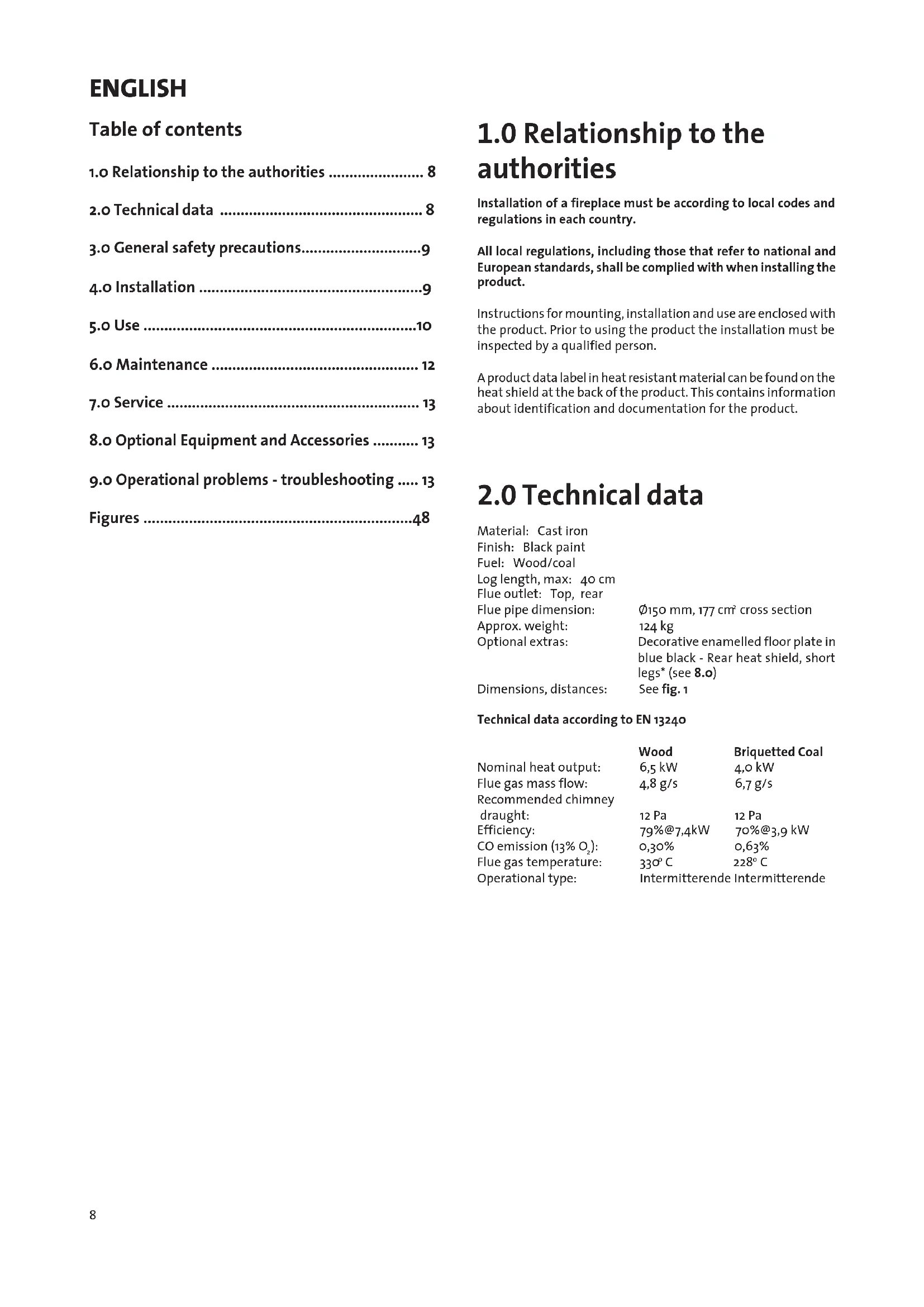
2.0 Technical data 8
3.0 General safety precautions....9
4.0 Installation 9
5.0 Use ....10
6.o Maintenance 12
7.0 Service 13
8.o Optional Equipment and Accessories ...... 13
9.0 Operational problems - troubleshooting ..... 13
Figures 48
1.0 Relationship to the authorities
Installation of a fireplace must be according to local codes and regulations in each country.
All local regulations, including those that refer to national and European standards, shall be complied with when installing the product.
Instructions for mounting, installation and use are enclosed with the product. Prior to using the product the installation must be inspected by a qualified person.
A product data label in heat resistant material can be found on the heat shield at the back of the product. This contains information about identification and documentation for the product.
2.0 Technical data
Material: Cast iron
Finish: Black paint
Fuel: Wood/coal
Log length, max: 40 cm
Flue outlet: Top, rear
Flue pipe dimension: 150 mm, 177 cm ^2 cross section
Approx. weight: 124 kg
Optional extras: Decorative enamelled floor plate in blue black - Rear heat shield, short legs* (see 8.0)
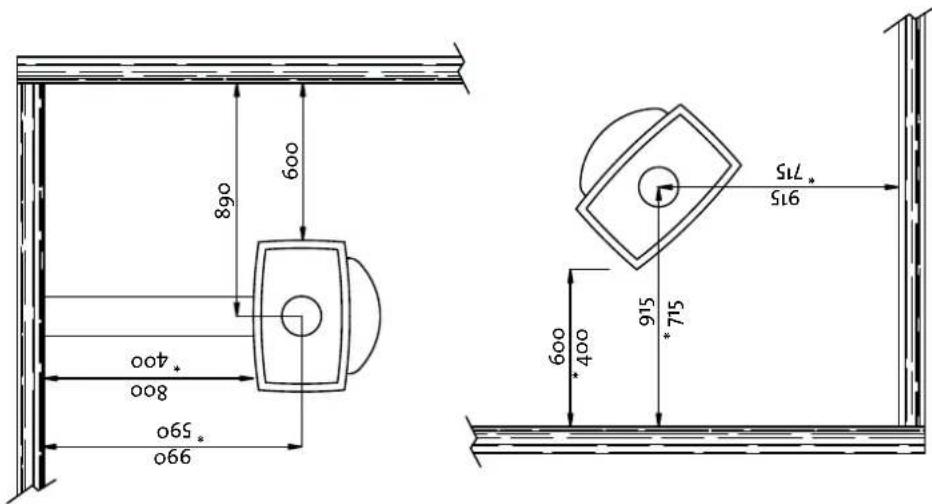
Dimensions, distances: See fig. 1
Technical data according to EN 13240
| Wood | Briquetted Coal | |
| Nominal heat output: | 6,5 kW | 4,0 kW |
| Flue gas mass flow: | 4,8 g/s | 6,7 g/s |
| Recommended chimney draught: | 12 Pa | 12 Pa |
| Efficiency: | 79%@7,4kW | 70%@3,9 kW |
| CO emission (13% O_2 ): | 0,30% | 0,63% |
| Flue gas temperature: | 330°C | 228°C |
| Operational type: | Intermitterende | Intermitterende |
3.0 Safety precautions
3.1 Fire preventive measures
Any use of the fireplace may represent some danger. Therefore, respect the following instructions:
- Ensure that furniture and other combustible materials do not get too close to the fireplace.
- Let the fire die. Never extinguish it with water.
- The fireplace gets warm when used and may cause burns if touched.
- Ash must be properly disposed of outdoors, or emptied where it does not present a fire hazard.
3.2 Air supply
Warning! Please ensure that there is adequate ventilation of outdoor air in the room in which the fireplace is to be installed.
An inadequate air supply could cause flue gas to escape into the room. This is very dangerous! Symptoms of this include smoky smell, drowsiness, nausea and feeling ill.
Ensure that air vents in the room where the fireplace is located are not blocked!
Avoid using mechanical fan vents in a room with a fireplace. This may cause negative pressure and draw poisonous gasses into the room.
However if ventilation to the outdoors is connected to the fireplace, the use of mechanical fan vents will not affect the use of the fireplace.
4.0 Installation
N.B. Check that the fireplace is free of any damage prior to commencing installation.
The product is heavy! Make sure you have assistance when erecting and installing the fireplace.
4.1 Assembly prior to installation
- After unpacking the stove - take out the items which are packed inside. These items are an ash lip and a plastic bag of screws for component assembly.
- Lift up the top plate. In this way it is easier to move the stove and to make the installation of the flue pipe more secure.
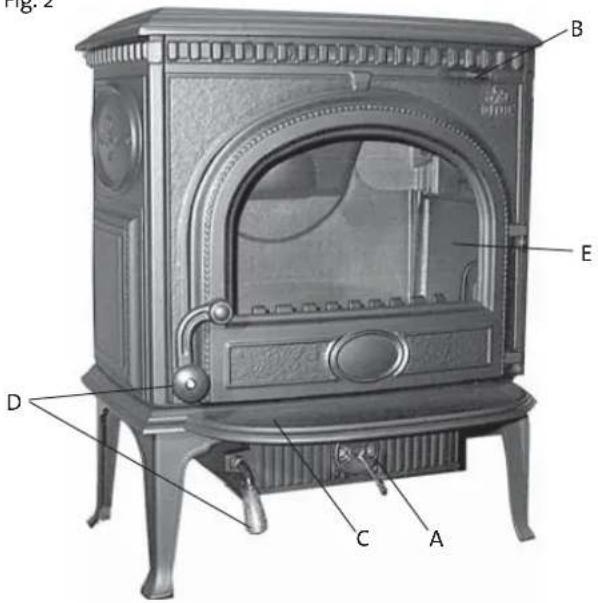
- Install the ash lip by hooking it onto the front, just below the door. Fig. 2C.
- Screw the door handle knob to the front door handle. Fig. 2D.
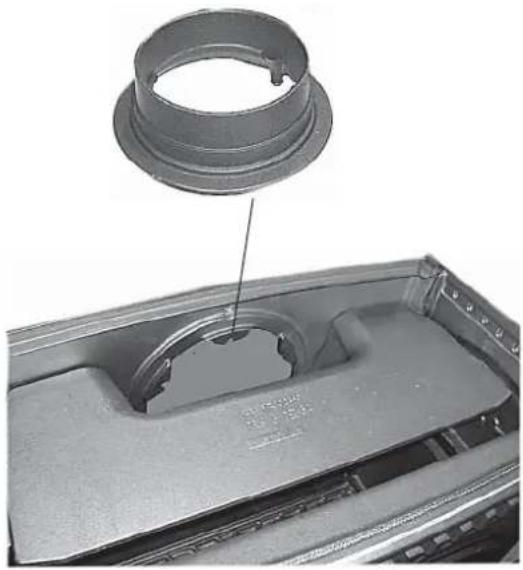
Mounting the flue outlet
From the factory the stove is delivered for the outlet to be in the back.
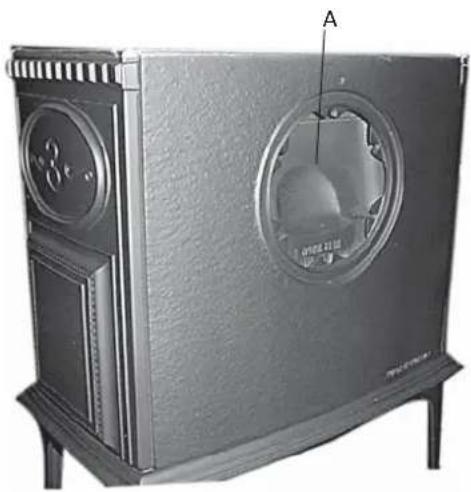
- Fasten the flue outlet (fig. 3) from within with three screws (fig. 4A).
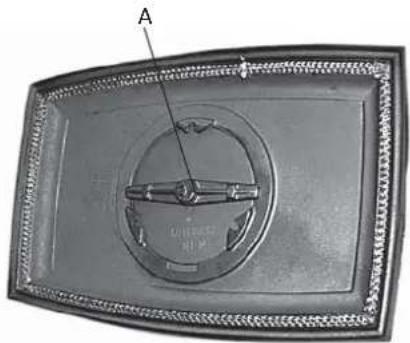
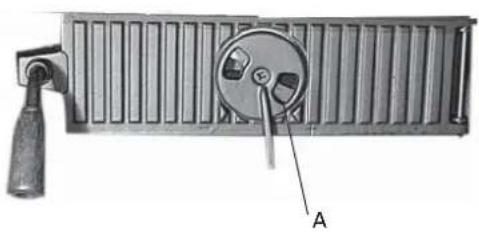
- When installing a top flue outlet, loosen the traverse (fig. 5A) and remove the top cover plate.
- Fasten the cover on the back side and replace the top plate.
4.2 Floor
Foundations
Ensure that the floor is strong enough for the fireplace. See «2.0 Technical data» for weights.
Wooden floor protection
If the fireplace is to be mounted on a combustible floor, a heat shield is to be mounted on the back of the stove to protect the floor from the radiant heat (Optional equipment). See point «8.0 Optional equipment».
Additional the floor has to be covered under and in front of the fireplace with a plate made of metal or other non-combustible material. The recommended minimum thickness is 0.9 mm.
Any flooring made of combustible material, such as linoleum, carpets, etc. must be removed from under the floor plate.
Requirement for protecting combustible flooring in front of fireplace
The front plate must be in accordance with national laws and regulations. Contact your local building authority regarding restrictions and installation requirements.
4.3 Walls
Distance to wall made of combustible material - see fig. 1
You may use the fireplace with an uninsulated flue pipe provided the distances to walls made of combustible materials are as shown in fig. 1.
Distance to walls covered by a firewall
Contact your local building authority regarding restrictions and installation requirements.
Firewall requirement
The firewall must be at least 100 mm thick and be made of brick, concrete-stone or light concrete. Other materials and constructions with satisfactory documentation may also be used.
Distance to non combustible walls - see fig. 1
By non combustible one means a non load-bearing wall of solid brickwork/concrete.
Contact your local building authority regarding restrictions and installation requirements.
4.4 Ceiling
There must be a minimum distance of 1200 mm to a combustible ceiling above the fireplace.
ENGLISH
4.5 Chimneys and flue pipes
- The fireplace can be connected to a chimney and flue pipe approved for solid fuel fired appliances with flue gas temperatures specified in «2.0 Technical data.
- The chimney's cross-section must be at least as big as the flue pipe's cross-section. See «2.0 Technical data» when calculating the correct chimney cross-section.
- The fireplace should not be connected to a shared chimney. Contact your local building authority regarding restrictions and installation requirements.
- Connection to the chimney must be carried out in accordance with the installation instructions from the supplier of the chimney.
- Before making a hole in the chimney the fireplace should be test-mounted in order to correctly mark the position of the fireplace and the hole in the chimney. See fig. 1 for minimum dimensions.
- Ensure that the flue pipe is inclined all the way up to the chimney.
- Use a flue pipe bend with a sweeping hatch that allows it to be swept.
Be aware of the fact that it is particularly important that connections have a certain flexibility in order to prevent movement in the installation leading to cracks.
N.B. A correct and sealed connection is very important for the proper functioning of the product.
The chimney draught should never exceed 2.5 mm H_2O (25 Pa) when the fireplace is in use. If the draught is too strong you can install and operate a flue damper to control the draught.
In case of chimney fire:
- Close all hatches and vents.
- Keep the firebox door closed.
- Check the loft and cellar for smoke.
- Call the fire service.
- Before use after a fire an expert must check the installation in order to ensure that it is fully functional.
4.6 Control of functions (fig. 2)
When the product is set up, always check the control functions. These shall move easily and function satisfactorily.
Jøtul MF 3 is equipped with the following controls:
Always use quality firewood or briquetted coal (see point 5.6). This will give you optimal results, any other fuel may damage the fireplace.
5.2 Jøtul's definition of quality firewood
By quality firewood we mean logs of, for example, birch, beech, and pine.
Quality firewood should be dried so that the water content is maximum 20%.
To achieve this the wood should be chopped at the latest in late winter or early spring. It should be cut and stacked so that air circulates around it. The stacks should be covered on top so as to avoid absorbing excessive rainwater. The logs should be taken indoors in autumn for use during the winter season.
The amount of energy obtainable from of 1 kg of quality firewood varies very little. On the other hand the specific weight of the different kinds of wood varies considerably. As an example, a certain volume of birch will provide less energy (kWh) than the same volume of oak, which has a higher specific weight.
The amount of energy produced by 1 kg quality firewood is about 3.8 kWh. 1 kg of completely dry firewood (0% humidity) produces about 5 kWh, while firewood with a humidity level of 60% produces only around 1.5 kWh/kg.
Consequences of using damp wood may include:
- Appearance of soot/tar on the glass, in the fireplace and in the chimney.
• The fireplace emits little warmth. - Risk of chimney fire as a consequence of accumulation of soot in the fireplace, flue pipe and chimney.
• The fire may die out.
Be especially careful never to lay a fire using any of the following materials:
• Household waste, plastic bags, etc.
- Painted or impregnated wood (highly toxic)
- Chipboard or laminated boards
- Driftwood
This may harm the product and pollute the atmosphere.
N.B. Never use combustible liquids such as petrol, kerosene, red spirit or similar to start the fire. This may cause harm to both yourself and the product.
5.3 Log length and amount
The maximum length of logs to be used is 40 cm. Jøtul MF 3 has a nominal heat output of 6,5 kW. This is equivalent to a consumption of approximately 2,1 kg of quality firewood per hour.
An important factor for proper fuel consumption is that the logs are the correct size. The size of the logs should be:
Kindling:
Length: 20-30 cm
Diameter: 2-5 cm
Amount per fire: 6-8 pieces
Firewood (split logs):
Length: 30 cm
Diameter: Approx. 8 cm
Intervals for adding wood: Approx. 45 - 50 minutes
Size of the fire: 1,7 kg
Amount per load: 2 pieces
5.4 First time use
• Light the fire as described under «5.5 Daily use».
- Light the fire for a couple of hours and ventilate any smoke and smell from the product.
- Repeat this a couple of times.
N.B. Odours when using the fireplace for the first time
Painted products: the fireplace may emit an irritating gas when used for the first time, and it may smell a little. The gas is not toxic, but the room should be thoroughly ventilated. Let the fire burn with a high draught until all traces of the gas have disappeared and no smoke or smells can be detected.
Enamelled products: Condensation may form on the surface of the fireplace the first few times it is used. This must be wiped off to prevent permanent stains forming when the surface heats up.
5.5 Daily use
The product is intended for intermittent combustion. By intermittent combustion one means normal use of a fireplace, meaning that each fire should burn down to embers before new firewood is added.
- Open both air vents (fig. 2A and 2B). Use a glove, for example, as the handle can become hot.
- Place two medium sized logs in/out on each side of the base.
- Crumple some newspaper (or birch bark) between these and add some kindling wood in a criss-cross pattern on top and light the newspaper. Gradually increase the size of the wood. (see point 5.3)
- Leave the door slightly open until the logs catch fire. Close the door and ash door vent when the firewood has ignited and the fire is burning well.
- Then regulate the rate of combustion to the desired level of heating by adjusting the air vent (Fig. 2B).
Nominal heat emission is achieved when the air vent is open approximately 40% and the ash door vent (Fig. 2B) closed.
Adding firewood
- Each fire should burn down to embers before new firewood is reloaded. Open the door slightly and allow the negative pressure to level out prior to opening the door completely.
- Add the wood and make sure that the air vent is fully open for a few minutes until the wood has caught fire.
- The air vent (fig. 2B) can be turned down once the wood has properly ignited and is burning well.
N.B. Danger of overheating: the fireplace must never be used in a manner that causes overheating.
Overheating occurs when there is too much wood and/or air so that too much heat is developed. A sure sign of overheating is when parts of the fireplace glow red. When this happens, reduce the ventilation opening immediately.
Upon suspicion of excessive/poor draught in the chimney, seek professional help. See also «2.0 Technical data» and «4.5 Chimney and flue pipe» for information.
5.6 Jøtul's definition of briquetted coal
By briquetted coal we mean coal that meets specification in EN 13240 Table B.2 (Briquetted fuel for closed appliances.) For example Phurnacite.
5.7 First time use
• Light the fire as described under «5.4 First time use».
Intervals for adding briquetted coal: Approximately every 135 minutes
Amount per load: 1,45 kg
5.8 Daily use
To burn coal successfully there must be air passing through the grate.
- Open the vent in the ash door fully (fig. 2A).
- Open the air vent (fig. 2B).
- Crumple some newspaper (or birch bark) and add some kindling wood in a criss-cross pattern (see point 5.3). Add coal on the top, and light the newspaper.
- Leave the door slightly open until the kindling wood catch fire.
- As the fire establishes itself, the air vent can be closed up gradually (fig.2B).
- Then regulate the rate of combustion to the desired level of heating by adjusting the ash door air vent (Fig. 2A). (Use a tool, for example a glove, as the handle can become hot.)
Refuelling
When more fuel is needed, remember to rake the existing embers to ensure ash is deposited into the ash pan. Then add more fuel, being careful not to fill above the level of the log retainer.
As fresh fuel is added, it is advised that the ash door vent is opened to allow the fire to achieve the required temperature. Once this is achieved regulate the air vents as before.
Ash removal
Do not let the ash build up to the grate as this may cause the great to over heat and distort.
5.9 Thermometer
When burning coal we recommend the use of a stove thermometer. The thermometer is available from all well equipped dealers and shall be placed on the top of the stove.
Persistent overfiring of the stove (temperatures of 280^ C or more) will hasten the need for replacement parts that are excluded from the warranty.
ENGLISH
5.10 Using fireplace during the transition from winter to spring
During a transitional period with sudden fluctuations in temperature, negative smoke draught or under difficult wind conditions, disturbances in the chimney draught may occur so that the smoke gasses are not drawn out.
One should then use less firewood and have a larger opening in the air vents so that the wood burns fresher and faster. In this was the draught in the chimney will be maintained.
To avoid accumulated ash, it should be removed more often than usual. See «6.2 Ash removal».
6.0 Maintenance
6.1 Cleaning the glass
Jøtul MF 3 is equipped with an air wash for the glass. Air is sucked in through the air vent above the fireplace and down along the inside of the glass.
However, some soot will always stick to the glass, but the quantity will depend on the local draught conditions and adjustment of the air wash vent. Most of the soot layer will normally be burned off when the air wash vent is opened all the way and a fire is burning briskly in the fireplace.
Good advice! For normal cleaning, moisten a paper towel with warm water and add some ash from the burn chamber. Rub it over the glass and then clean the glass with clean water. Dry well. If it is necessary to clean the glass more thoroughly we recommend using a glass cleaner (follow the instructions on the bottle).
6.2 Ash removal
Jøtul MF 3 is equipped with an outdoor ash pan, which makes it easy to remove the ashes.
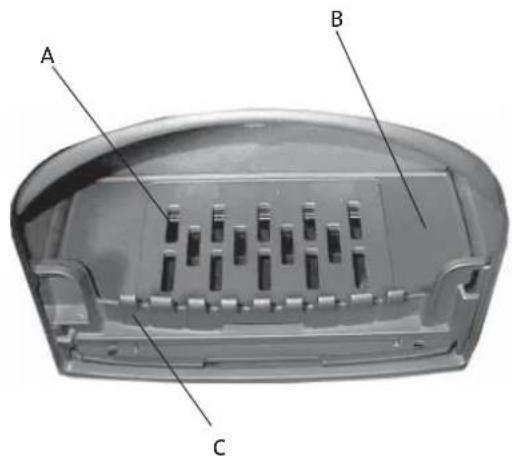
- Scrape the ash through the grate in the base plate and into the ash pan (fig. 7).
- Use something like a glove to grab the handle on the ash pan and take away the ash. Make sure that the ash pan doesn't fill up so high that it keeps ash from coming through the grate into the pan.
- Make sure the door to the ash pan is securely shut when the stove is in use.
- Ashes should be placed in a metal container with a tight fitting lid.
Also see the description below about how to handle ash: «3.0 Safety precautions».
6.3 Cleaning and soot removal
Soot deposits may build up on the internal surfaces of the fireplace during use. Soot is a good insulator and will therefore reduce the fireplace's heat output. If soot deposits accumulate when using the product, they can be easily removed by using a soot remover.
In order to prevent a water and tar layer from forming in the fireplace you should regularly allow the fire to burn hot in order to remove the layer. An annual internal cleaning is necessary to get the best heating effect from the product. It is a good idea to do this in connection with sweeping the chimney and flue pipes.
6.4 Sweeping of flue pipes to the chimney
- For rear-mounted flue pipes lift the top plate and sweep the pipe through the opening.
- For top mounted flue pipes the product can be swept through the flue pipe's sweeping hatch, or the baffle plate must be taken down. See point 7.1 on how to do this.
6.5 Checking the fireplace
Jøtul recommends that you personally check your fireplace carefully after sweeping/cleaning. Check all visible surfaces for cracks.
Also check that all joints are sealed and that the door and top plate gaskets are in the correct position. Any gaskets showing signs of wear or deformation must be replaced.
Thoroughly clean the gasket groove, apply ceramic glue (available from your local Jøtul dealer), and press the gasket well into place. The joint will dry quickly.
6.6 Exterior maintenance
Painted products may change colour after several years of use. The surface should be cleaned and brushed free of any loose particles before new Jøtul stove paint is applied.
Enamelled products must only be cleaned with a dry cloth. Do not use soap and water. Any stains can be removed with a cleaning fluid (e.g. oven cleaner).
7.0 Service
Warning! Any unauthorised change to the product is illegal. Only use original spare parts.
7.1 Replacing the baffle plate - burn plates - grate - inner bottom (fig. 7)
- Remove the ash retainer (fig. 7C).
- Lift the baffle plate forward and to the side and edge it out of the door.
- Remove the burn plates (fig. 2E).
- Remove the ash grate and then lift up and remove the inner bottom plate (fig. 7A and 7B).
For re-installation follow the same procedure in reverse order.
8.0 Optional equipment
Floor plate
A decorative enamel floor plate is available for your Jøtul MF 3 in blue black enamel. The dimensions of the plate are: 630 x 759 x 17 mm.
Short legs - height 155 mm
Black paint - cat. no. 350173
(*only to be used on non combustible floor.) See «2.0 Technical data»
Rear heat shield - cat. no 350319
Assembly instruction follows the product.
9.0 Reasons for operational problems - troubleshooting
Poor draught
- Check the length of the chimney so that it covers the requirements stipulated in national laws and regulations. See also «2.0 Technical data» and «4.5 Chimney and flue pipe» for information.
- Ensure that the minimum cross-section of the chimney is in accordance with «2.0 Technical data».
- Make sure that there is not anything preventing the flue gasses from escaping: Branches, trees, etc.
The fire extinguishes
• Make sure that the wood is sufficiently dry
- Find out whether there is negative pressure in the house, close mechanical fans and open a window close to the stove
- Check that the air vent is open.
- Check that the flue outlet is not clogged by soot
Unusual amount of soot on the glass
Some soot will always stick to the glass, but the quantity depends on:
• Humidity of the wood
- Local draught conditions
• Regulating the air vent.
Most of the soot will normally burn off when the air vent is opened all the way and a fire is burning briskly in the fireplace. See also «6.1 Cleaning of glass - good advice»
FRANCAIS
Sommaire
Plaque de convection - cat. No. 350319
Durchmesser: 2 - 5 cm
Brennholz (Scheite):
Länge: 30 cm
Durchmesser: ca. 8 cm
Min. mål gulvplate / measure floorplate
X / Y = Acc. to national regulatives and regulations.
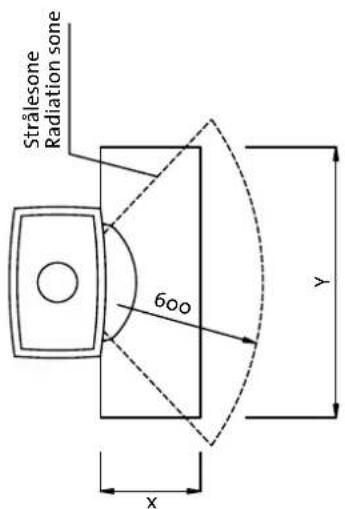
text_image
Strålesone Radiation sone 600 x y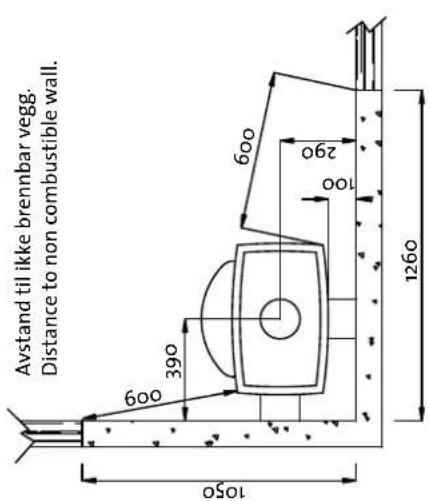
text_image
Avstand til ikke brennbar vegg. Distance to non combustible wall. 1050 390 600 100 290 1260
Målene gjelder ubehandlede produkter. Etter lakkering eller emaljering kan målene variere noe.
Dimensions refer to untreated products. After painting or enamelling dimensions may have small divergences.
Avstand til brennbar vegg.
Distance to combustible wall.
* Med skjermplate montert.
* With heat shield mounted.
text_image
990 *590 800 +400 890 600 600 *400 915 *715 915 *7154-4424-P02
Combustible wall
Non combustible wall
4-4424-P02
Min. mål gulvplate / measure floorplate
X / Y = Acc. to national regulatives and regulations.
text_image
Strålesone Radiation sone 600 x y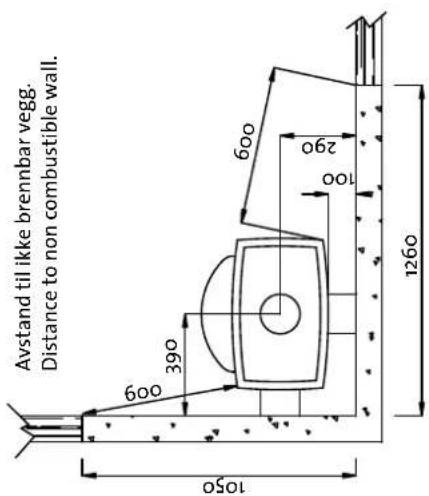
text_image
Avstand til ikke brennbar vegg. Distance to non combustible wall. 1050 390 600 290 100 1260Combustible wall
Combustib
(1) 本报告所载资料是:
Fig. 2
text_image
Fig. 2 B E D C AFig. 3
natural_image
Close-up of a mechanical component with a circular top and internal cavity, no visible text or symbolsFig. 4
natural_image
Exterior view of a vintage portable air conditioner unit with labeled component A (no text or symbols beyond label)Fig. 5
natural_image
Close-up of a metallic tray with a circular dial and labeled component A (no readable text or symbols beyond label)Fig. 6
natural_image
Mechanical component with a handle and circular dial labeled A, no visible text or symbolsFig. 7
text_image
A B CQuality control of stoves and fireplaces
Jøtul pursue a policy of constant product development. Products supplied may therefore differ in specification, colour and type of accessories from those illustrated and described in the brochure.
Jøtul AS has a quality system that conforms to NS-EN ISO 9001 for product development, manufacturing, and distribution of stoves and fireplaces. This policy gives our customers quality and safety piece of mind as a result of Jøtul's vast experience dating back to when the company first started in 1853.