DDLE LCD 24 - Heating AEG - Free user manual and instructions
Find the device manual for free DDLE LCD 24 AEG in PDF.



User questions about DDLE LCD 24 AEG
0 question about this device. Answer the ones you know or ask your own.
Ask a new question about this device
Download the instructions for your Heating in PDF format for free! Find your manual DDLE LCD 24 - AEG and take your electronic device back in hand. On this page are published all the documents necessary for the use of your device. DDLE LCD 24 by AEG.
USER MANUAL DDLE LCD 24 AEG
Electronically controlled instantaneous water heater
Operating and installation instructions 18
- General information 19
- Safety 19
- Appliance description 20
- Settings 20
- Cleaning, care and maintenance 20
- Troubleshooting 20
INSTALLATION
- Safety 21
- Appliance description 21
- Preparations 21
- Installation 22
- Commissioning 26
- Shutting down 26
- Troubleshooting 26
- Maintenance 27
- Specification 28
GUARANTEE
ENVIRONMENT AND RECYCLING
SPECIAL INFORMATION
-
The appliance may be used by children aged 8 and up and persons with reduced physical, sensory or mental capabilities or a lack of experience and know-how, provided that they are supervised or they have been instructed on how to use the appliance safely and have understood the resulting risks. Children must never play with the appliance. Children must never clean the appliance or perform user maintenance unless they are supervised.
-
Risk of scalding: The tap can reach temperatures in excess of 60^ .
- Ensure the appliance can be separated from the power supply by an isolator that disconnects all poles with at least 3mm contact separation.
- Secure the appliance as described in chapter "Installation / Installation".
- Observe the maximum permissible pressure (see chapter "Specification / Data table").
- Drain the appliance as described in chapter "Installation / Maintenance / Draining the appliance".
OPERATION
1. General information
The chapters "Special Information" and "Operation" are intended for both the user and qualified contractors.
The chapter "Installation" is intended for qualified contractors.

Note Read these instructions carefully before using the appliance and retain them for future reference. Pass on the instructions to a new user if required.
1.1 Safety instructions
1.1.1 Structure of safety instructions

KEYWORD Type of risk Here, possible consequences are listed that may result from failure to observe the safety instructions. Steps to prevent the risk are listed.
1.1.2 Symbols, type of risk
| Symbol Type of risk | |
| ! | Injury |
| Electrocution | |
| Burns (burns, scalding) | |
1.1.3 Keywords
| KEYWORD | Meaning |
| DANGER | Failure to observe this information will result in seri-ous injury or death. |
| WARNING | Failure to observe this information may result in seri-ous injury or death. |
| CAUTION | Failure to observe this information may result in non-serious or minor injury. |
1.2 Other symbols in this documentation

Note General information is identified by the symbol shown on the left.
» Read these texts carefully.
| Symbol Meaning | |
| ! | Material losses (appliance damage, consequential losses and environ-mental pollution) |
| Appliance disposal | |
» This symbol indicates that you have to do something. The action you need to take is described step by step.
1.3 Units of measurement

Note
All measurements are given in mm unless stated otherwise.
2. Safety
2.1 Intended use
This appliance is intended for domestic use. It can be used safely by untrained persons. The appliance can also be used in a non-domestic environment, e.g. in a small business, as long as it is used in the same way.
This pressurised appliance is suitable for heating domestic hot water or for reheating preheated water. The appliance can supply one or more draw-off points.
Any other use beyond that described shall be deemed inappropriate. Observation of these instructions and of instructions for any accessories used is also part of the correct use of this appliance.
2.2 General safety instructions

CAUTION Burns
During operation, the tap can reach temperatures in excess of 60^ There is a risk of scalding at outlet temperatures in excess of 43^

CAUTION Burns
If operating with preheated water, e.g. from a solar thermal system, the DHW temperature may vary from the selected set temperature.

WARNING Injury
The appliance may be used by children aged 8 and up and persons with reduced physical, sensory or mental capabilities or a lack of experience and know-how, provided that they are supervised or they have been instructed on how to use the appliance safely and have understood the resulting risks. Children must never play with the appliance. Children must never clean the appliance or perform user maintenance unless they are supervised.
Where children or persons with limited physical, sensory or mental abilities are allowed to use this appliance, we recommend a permanent temperature limit. A qualified contractor can set the limit for you.

Material losses
Protect the appliance and its tap against frost.
2.3 CE designation
The CE designation shows that the appliance meets all essential requirements according to the:
Low Voltage Directive
Electromagnetic Compatibility Directive The maximum permissible mains impedance is indicated in chapter "Specification".
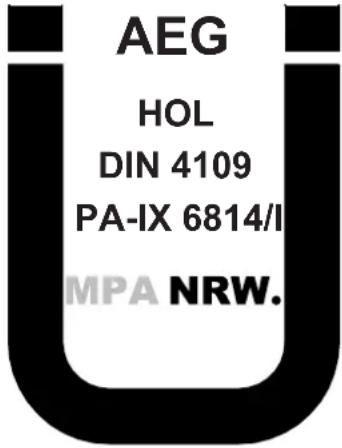
2.4 Test symbols
See type plate on the appliance.
Country-specific approvals and certifications: Germany
A general test certificate as verification of suitability regarding noise emissions has been issued for this appliance, based on the State Building Regulations [Germany].
3. Appliance description
The electronically controlled instantaneous water heater with automatic output matching keeps the outlet temperature constant up to the output limit. The temperature is then selected via the draw-off tap.
Heating system
The bare wire heating system has a pressure-tested plastic casing. The heating system is suitable for hard and soft water areas; it has low susceptibility to scale build-up. This system ensures rapid and efficient DHW availability.

Note
The appliance is equipped with an air detector that largely prevents damage to the heating system. If, during operation, air is drawn into the appliance, the appliance shuts down for one minute, thereby protecting the heating system.
4. Settings
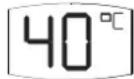
The DHW outlet temperature can be variably adjusted. The selected temperature is displayed. At temperatures over 43^ , the colour of the display changes from blue to red to indicate a risk of scalding.
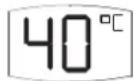
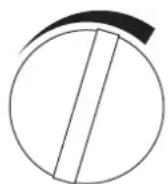
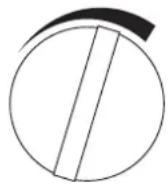
Turn the temperature selector to the required temperature.

Note
If the outlet temperature is not sufficiently high when the draw-off valve is fully open and the temperature selector is set to maximum, then more water is flowing through the appliance than can be heated by the heating system (appliance is at its output limit).
» Reduce the water volume at the draw-off valve.
Recommended setting for operation with a thermostatic valve
Set the temperature at the appliance to the maximum temperature.
Following an interruption of the water supply

Material losses
Following an interruption of the water supply the appliance must be recommissioned by carrying out the following steps, in order to prevent the destruction of the bare wire heating system.
» Disconnect the appliance from the power supply by removing the fuses/tripping the MCBs.
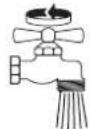
» Open the tap for one minute until the appliance and its upstream cold water inlet line are free of air.
Switch the mains power back ON again.
5. Cleaning, care and maintenance
Never use abrasive or corrosive cleaning agents. A damp cloth is sufficient for cleaning the appliance.
» Check the taps regularly. Limescale deposits at the spouts can be removed using commercially available descaling agents.
6. Troubleshooting
| Problem Cause Remedy | ||
| The appliance will not start despite the DHW valve being fully open. | There is no power. Check the fuses/ MCBs in your fuse box/distribution panel. | |
| The flow rate is too low. The aerator in the tap or the shower head is scaled up or contaminated. | Clean and/or descale the aerator or shower head. | |
| Required tempera-ture >45 °C is not achieved. | The water supply has been interrupted. | Vent the appliance and the cold water inlet line (see chapter "Settings"). |
| The cold water | inlet temperature is >45 °C. | Reduce the cold water inlet temperature. |
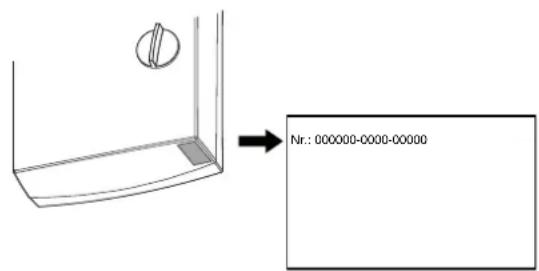
If you cannot remedy the fault, notify your qualified contractor. To facilitate and speed up your enquiry, please provide the serial number from the type plate (000000-0000-0000):
INSTALLATION
7. Safety
Only a qualified contractor should carry out installation, commissioning, maintenance and repair of the appliance.
7.1 General safety instructions
We guarantee trouble-free function and operational reliability only if original accessories and spare parts intended for the appliance are used.

Material losses
Observe the maximum inlet temperature. Higher temperatures may damage the appliance. You can limit the maximum inlet temperature by installing a central thermostatic valve.
7.2 Instructions, standards and regulations

Note
Observe all applicable national and regional regulations and instructions.
The protection rating IP 25 (hoseproof) can only be ensured with a correctly fitted cable grommet.
The specific electrical resistance of the water must not fall below that stated on the type plate. In a linked water network, observe the lowest electrical water resistance (see chapter "Specification / Application areas / Conversion table"). Your water supply utility will advise you of the specific electrical water resistance or conductivity.
8. Appliance description
8.1 Standard delivery
The following are delivered with the appliance:
- Wall mounting bracket
- Threaded studs, screws and rawl plugs for the wall mounting bracket
Installation template
2 twin connectors (cold water with shut-off valve)
Flat gaskets
Cable grommet (power cable from above/below) - Screws/rawl plugs for fixing the back panel in the case of water connection on finished walls
8.2 Accessories
Tap
ADEo 70 WD bath pressure tap
Installation accessories
Pipe assembly, undersink installation UT 104, connections: Finished walls, G 3/8, top. Water connections with 12mm compression fittings.
Universal mounting frame
Mounting frame with electrical connections.
Pipe assembly for undersink appliances
This assembly for undersink installation is required if you need to have the water connections (G % A) above the appliance.
Pipe assembly for offset installation
This pipe assembly with pipe bends is required if you need to have the appliance vertically offset against the water connection by approx. 90mm downwards.
Pipe assembly for replacing a gas water heater
This pipe assembly is required if the installation has existing gas water heater connections (cold water connection on the left and DHW connection on the right).
Load shedding relay (LR 1-A)
The load shedding relay for installation in the distribution board provides priority control for the instantaneous water heater when other appliances, such as electric storage heaters, are simultaneously being operated.
ZTA 3/4 - central thermostatic valve
Thermostatic valve for central premixing, for example for an instantaneous water heater with a solar thermal system.
9. Preparations
9.1 Installation site

Material losses
Install the appliance in a room free from the risk of frost.
» Always install the appliance vertically near the drawoff point.
The appliance is suitable for undersink and oversink installations.
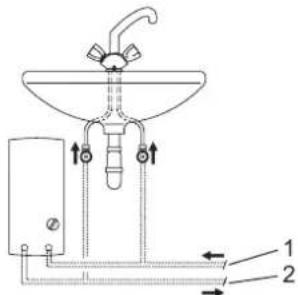
Undersink installation
26_02_02_1345
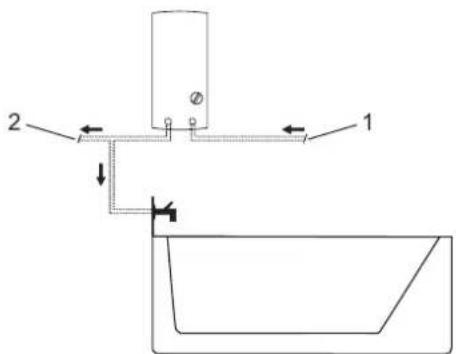
Oversink installation
26_02_02_1344
Mount the appliance on the wall. The wall must have a sufficient load-bearing capacity.
9.2 Water installation
A safety valve is not required.
Flush the water line thoroughly.
Ensure that the flow rate (see chapter "Specification / Data table", On) for switching on the appliance is achieved. If the flow rate is not achieved, remove the flow limiter (see chapter "Installation / Removing the flow limiter").
Increase the mains water pressure if the required flow rate is not achieved with the draw-off valve fully opened.
Taps
Use appropriate pressure taps. Open taps are not permitted.

Note
Never use the shut-off valve in the cold water inlet to reduce the flow rate. It is intended to shut off the appliance.
Permissible water pipe materials
Cold water inlet pipe:
Galvanised steel pipe, stainless steel pipe, copper pipe or plastic pipe
DHW outlet pipe:
Stainless steel pipe, copper pipe or plastic pipe

Material losses
If plastic pipework systems are used, take into account the maximum inlet temperature and the maximum pressure (see chapter "Specification / Data table").
Flexible water connection lines
» If the appliance is installed with flexible water connection lines, ensure that the bayonet fittings of the pipe bends do not become twisted inside the appliance.
» Secure the back panel at the bottom with two additional screws.
10. Installation
10.1 Standard installation
- Electrical connection from above; installation on unfinished walls
Water connection, installation on unfinished walls - DDLE LCD 18/21/24: Connected load 21 kW preset
For further installation options, see chapter "Installation alternatives":
- Electrical connection from below on unfinished walls
- Electrical connection for finished walls
- Connecting a load shedding relay
- Undersink installation, water connections - from above
Water installation for finished walls
Operation with preheated water
Temperature limit
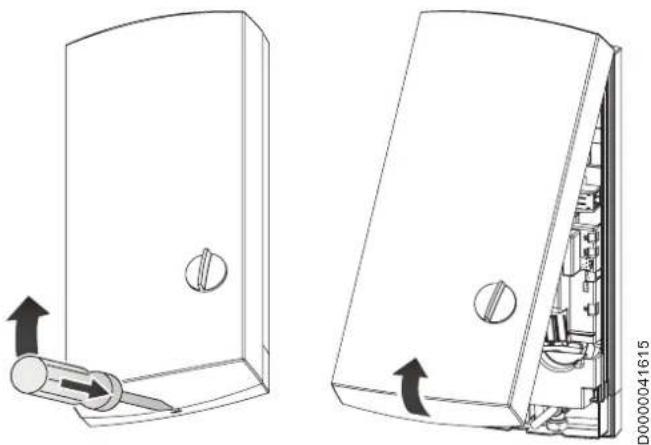
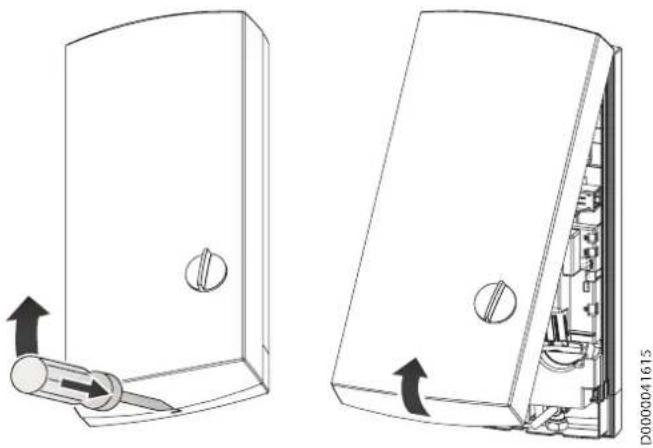
Opening the appliance
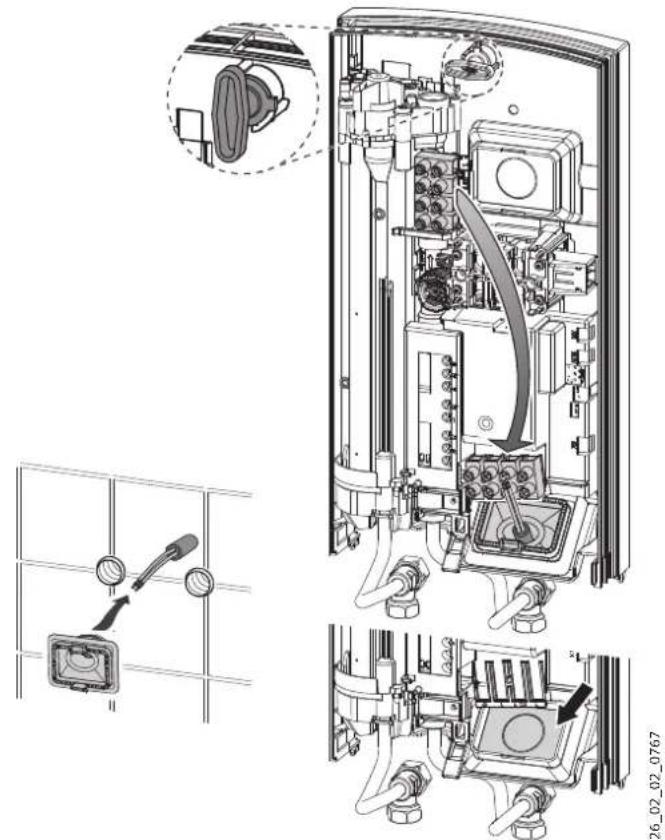
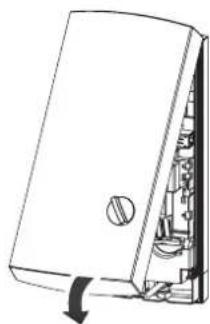
» Open the appliance by releasing the snap lock.
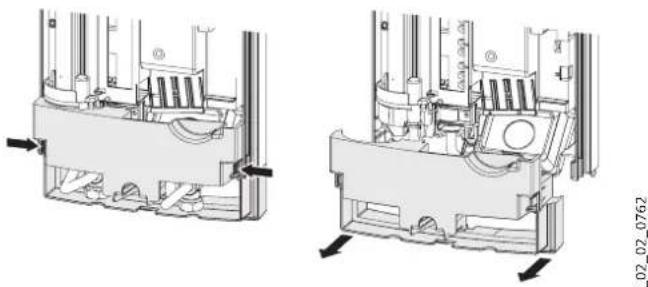
26_02_02_0762
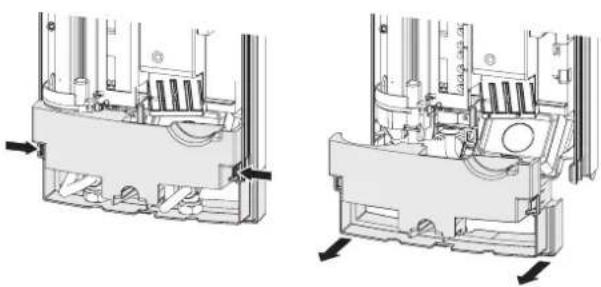
» Remove the back panel by pressing the two locking hooks and pulling the lower part of the back panel forwards.
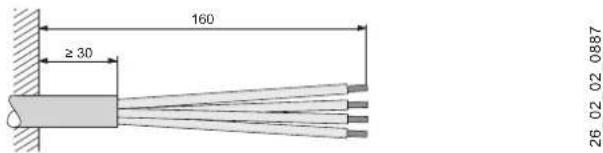
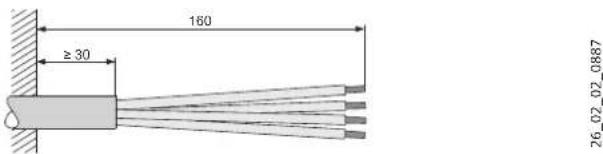
Preparing the power cable
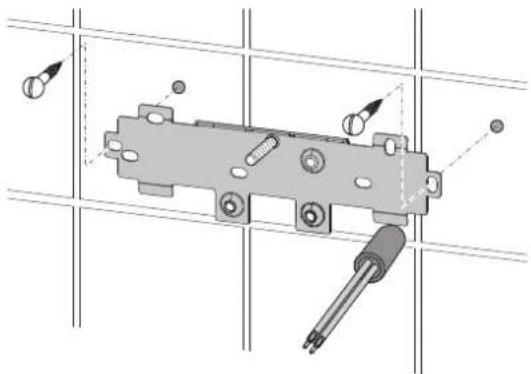
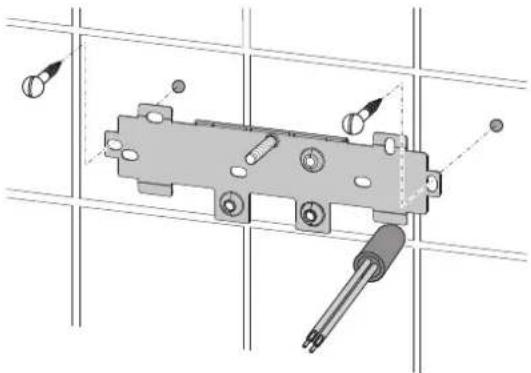
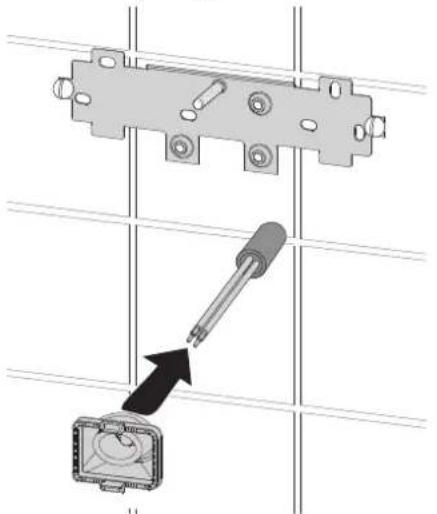
Fitting the wall mounting bracket
26.02.02.0972
» Mark out the holes for drilling with the installation template. If the appliance is to be installed with water connections on finished walls, also mark out the fixing holes on the lower part of the template.
Drill the holes and secure the wall mounting bracket with 2 screws and 2 rawl plugs (screws and rawl plugs are part of the standard delivery).
» Fit the threaded stud provided.
» Mount the wall mounting bracket.
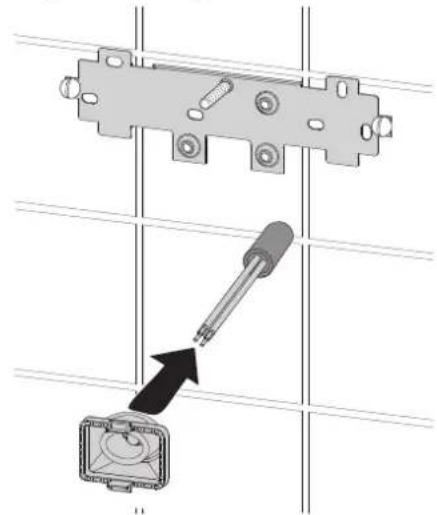
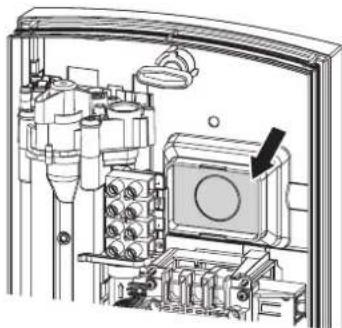
Fitting the cable grommet
26_02_02_0950
» Fit the cable grommet. In the case of a connecting cable >6mm^2 , enlarge the hole in the cable grommet.
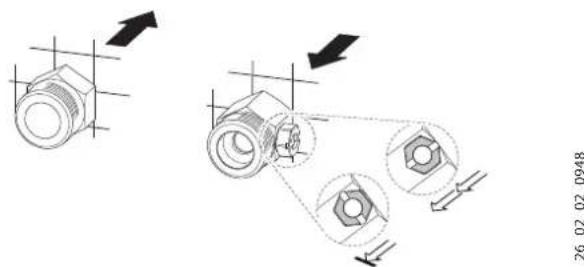
Making the water connection
Material losses
! Carry out all water connection and installation work in accordance with regulations.
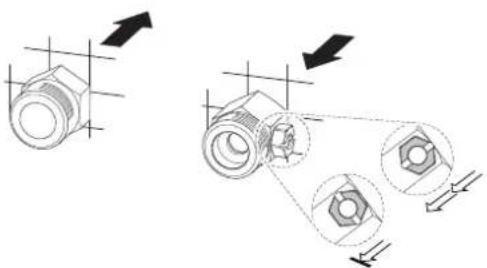
26_02_02_0948
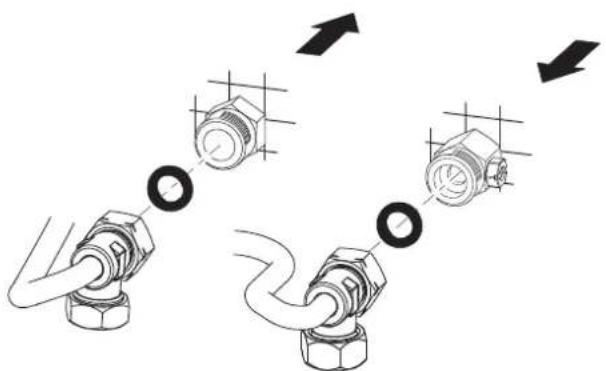
» Seal and insert the twin connectors.
Material losses
Never use the shut-off valve in the cold water inlet to reduce the flow rate.
Preparing the back panel
Material losses
If you break out the wrong knock-out by mistake, you should use a new back panel.
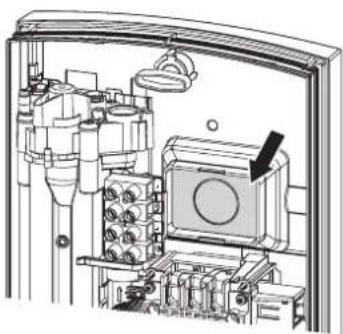
D0000041893
Break out the cable grommet knock-out in the back panel. Deburr the sharp edges with a file if necessary.
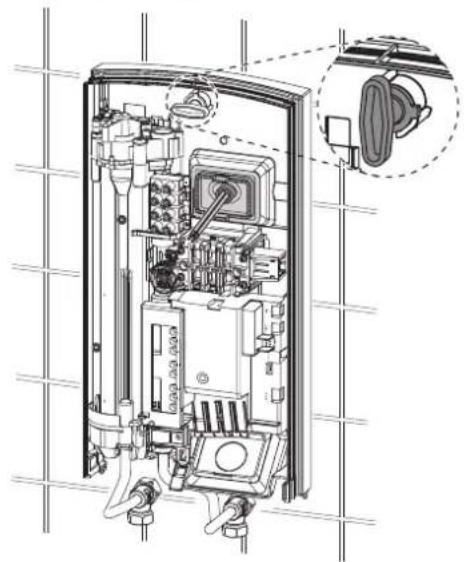
Installing the appliance
D0000041894
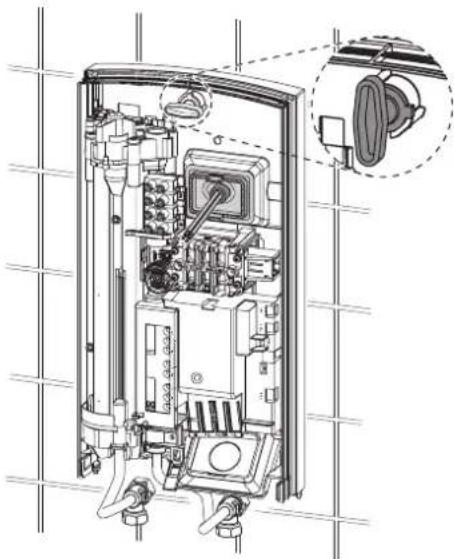
Push the back panel over the threaded stud and the cable grommet. Pull the cable grommet by the locking hooks into the back panel using pliers, until both locking hooks audibly click into place.
Remove the transport plugs from the water connections.
Press the back panel firmly into place and lock the fixing toggle by turning it clockwise through 90^ .
D0000041925
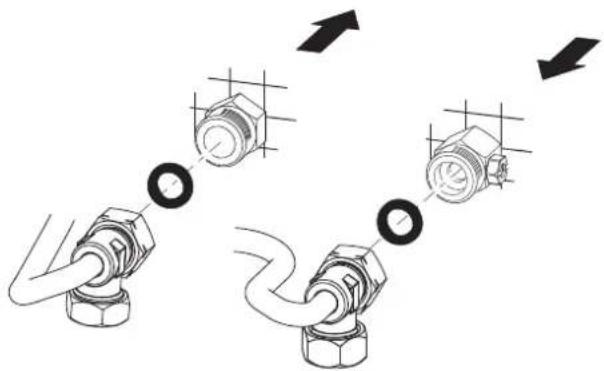
Screw the water connection pipes with flat gaskets on to the twin connectors.
Material losses
The strainer must be fitted for the appliance to function.
» When replacing an appliance, check whether the strainer is installed (see chapter "Maintenance").
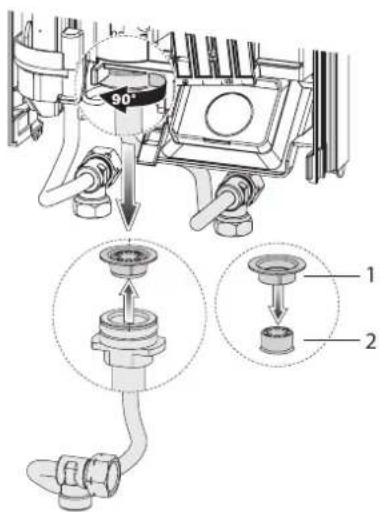
Removing/replacing the flow limiter

Note
If you use a thermostatic valve, the flow limiter must not be removed.
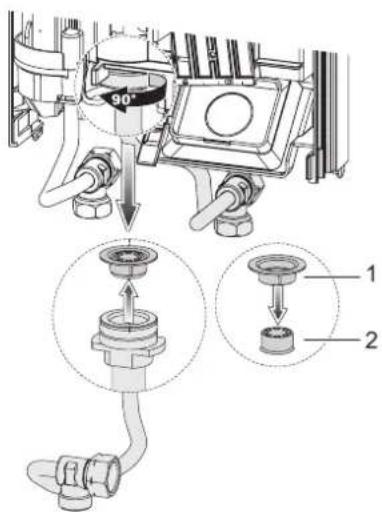
26-02-0771
1 Plastic profile washer
2 Flow limiter
» Remove the flow limiter and refit the plastic profile washer.
DDLE LCD 18/21/24: Replacing the flow limiter
If 24 kW connected load has been selected, replace the fitted flow limiter (white) with the flow limiter supplied (orange, fixed to the cold water pipe).
Making the electrical connection

WARNING Electrocution
Carry out all electrical connection and installation work in accordance with relevant regulations.

WARNING Electrocution
Connection to the power supply is only permissible in the form of a permanent connection in conjunction with the removable cable grommet. Ensure the appliance can be separated from the power supply by an isolator that disconnects all poles with at least 3mm contact separation.

WARNING Electrocution
Ensure that the appliance is earthed.

Material losses
Observe the type plate. The specified voltage must match the mains voltage.
» Connect the power cable to the mains terminal (see chapter "Specification / Wiring diagram").
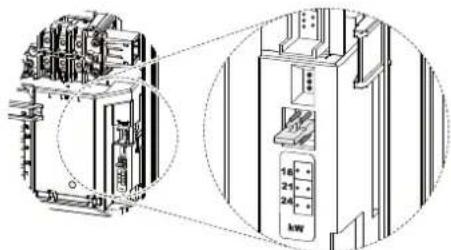
DDLE LCD 18/21/24: Re-plugging the coding card
In its delivered condition, the appliance is plugged to 21 kW. When changing to a different connected load, carry out the following steps:
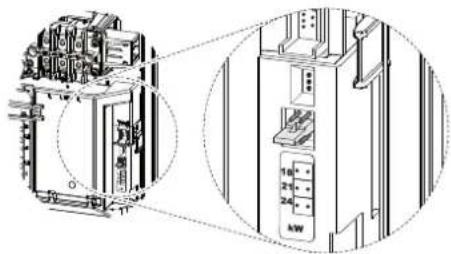
00000047341
» Re-plug the coding card according to the selected connected load (for selectable connected load and fuse protection of the appliance, see “Specification / Data table").
Tick the selected connected load on the type plate. Please use a ballpoint pen to do this.
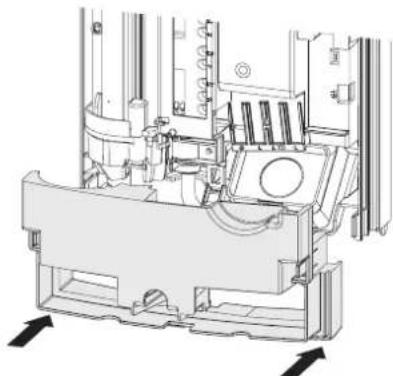
Fitting lower section of back panel
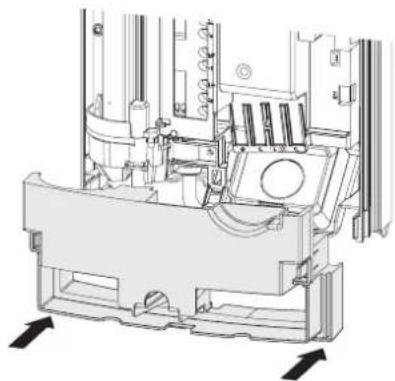
26 02 02 1348
Fit the lower part of the back panel into the back panel and click into place.
Align the mounted appliance by loosening the fixing toggle, aligning the power supply and back panel, and then re-tightening the fixing toggle. If the back panel of the appliance is not flush, the appliance can be secured at the bottom with two additional screws.
10.2 Alternative installation methods
10.2.1 Electrical connection from below on unfinished walls
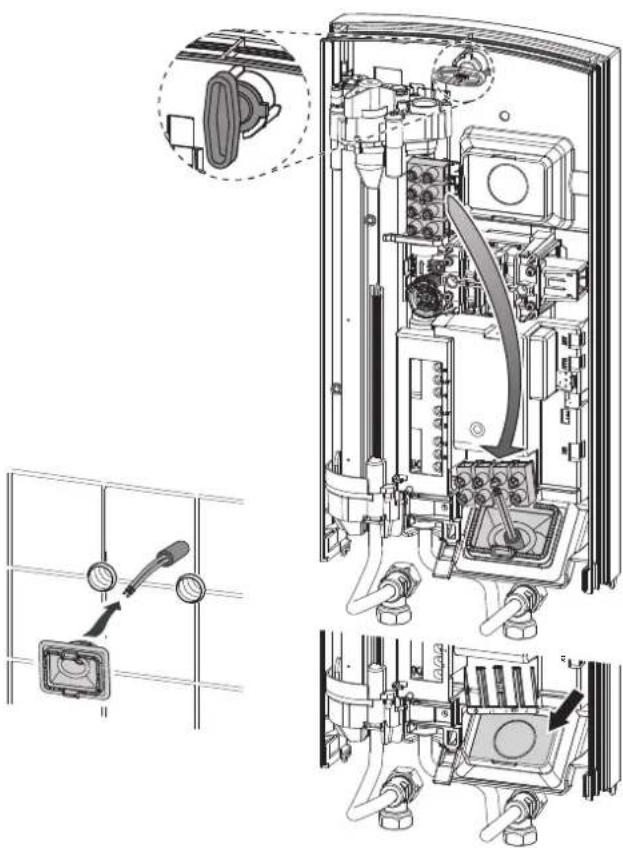
2007
» Fit the cable grommet.
Material losses If you break out the wrong knock-out by mistake, you should use a new back panel.
Break out the cable grommet knock-out in the back panel. Deburr the sharp edges with a file if necessary.
» Reposition the mains terminal in the appliance from the top to the bottom.
» Push the back panel over the threaded stud and the cable grommet. Pull the cable grommet by the locking hooks into the back panel using pliers, until both locking hooks audibly click into place.
Press the back panel firmly into place and lock the fixing toggle by turning it clockwise through 90^ .
10.2.2 Electrical connection for finished walls

Note
This type of connection changes the protection rating of the appliance.
» Change the type plate. Cross out "IP 25" and mark the box "IP 24". Please use a ballpoint pen to do this.

Material losses
If you break out the wrong knock-out by mistake, you should use a new back panel.
Cut or break out the required entries in the back panel cleanly (for positions, see chapter "Specification / Dimensions and connections"). Deburr the sharp edges with a file if necessary.
» Route the power cable through the cable grommet and connect it to the mains terminal.
10.2.3 Connecting a load shedding relay
Install a load shedding relay in the distribution board in conjunction with other electric appliances, e.g. electric storage heaters. The relay responds when the instantaneous water heater starts.

Material losses
Connect the phase that switches the load shedding relay to the indicated terminal of the mains terminal in the appliance (see chapter "Specification / Wiring diagram").
10.2.4 Undersink installation, water connections - from above
An undersink installation with water connections from above can be achieved with the additional pipe assembly for undersink appliances. Cleanly break out the water pipe knock-outs in the back panel and fit the pipe set.
10.2.5 Water installation for finished walls

Note
This type of connection changes the protection rating of the appliance.
» Change the type plate. Cross out "IP 25" and mark the box "IP 24". Please use a ballpoint pen to do this.
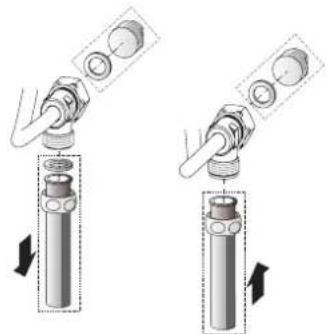
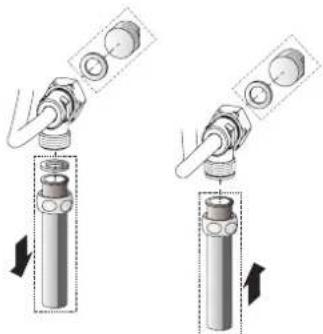
26_02_02_0765
» Fit water plugs with gaskets to seal the connection on unfinished walls.
» Fit a suitable pressure tap.
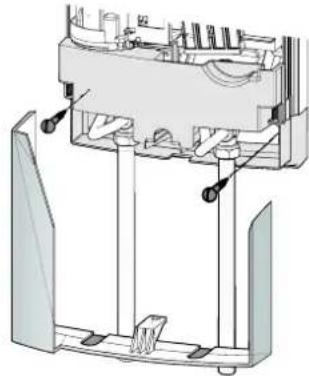
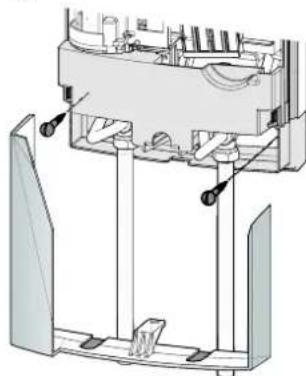
26_02_02_1006
» Click the lower part of the back panel into place in the upper part of the back panel.
» Secure the connection pipes to the appliance.
» Secure the back panel at the bottom with two additional screws.

Material losses
If you break out the wrong knock-out by mistake, you should use a new back panel.
Cleanly break out the knock-outs in the appliance cover. Deburr the sharp edges with a file if necessary.
Push the lower part of the back panel under the connection pipes of the tap and click the lower part of the back panel into place.
» Secure the connection pipes to the appliance.
10.2.6 Operation with preheated water
You can limit the maximum inlet temperature by installing a central thermostatic valve.
10.2.7 Temperature limit

CAUTION Burns
If operating with preheated water, the set temperature limit and anti-scalding protection may be ineffective.
In this case, limit the temperature with an upstream central thermostatic valve.
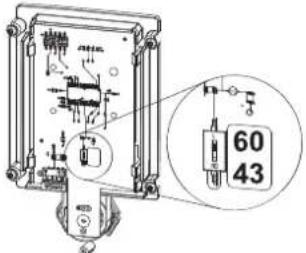
You can set the temperature limit inside the appliance cover to 43^
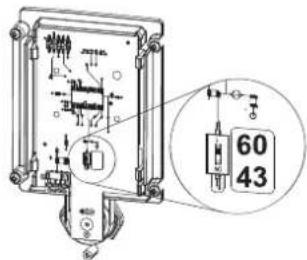
D0000041912
» Switch the temperature limit to 43^ .
After enabling the temperature limit, you can only select temperatures between 30 and 43^ .
10.3 Completing the installation
Open the shut-off valve in the twin connector or the cold water inlet line.
11. Commissioning

WARNING Electrocution Commissioning may only be carried out by a qualified contractor in accordance with safety regulations.
11.1 Initial start-up
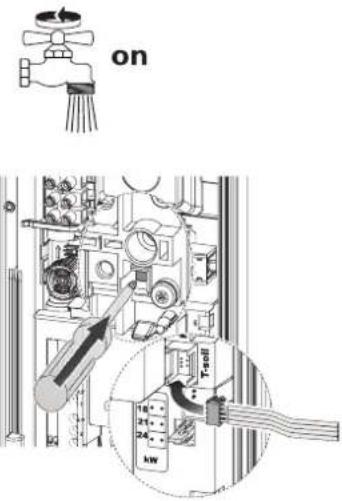
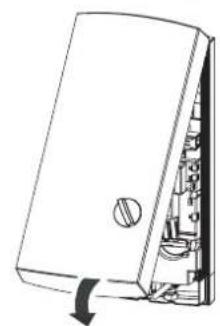
D0000041981
Open and close all connected draw-off valves several times, until all air has been vented from the pipework and the appliance.
» Carry out a tightness check.
Enable the safety pressure limiter by firmly pressing the reset button (the appliance is delivered with the safety pressure limiter disabled).
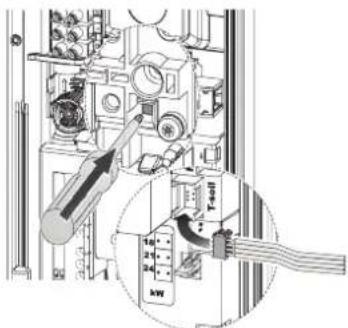
Plug the temperature selector cable plug into the PCB.
Fit the appliance cover, ensuring it clicks into place. Check that the appliance cover is seated correctly.
Switch the mains power ON.
» Check the function of the appliance.
Appliance handover
» Explain the appliance function to users and familiarise them with its operation.
» Make users aware of potential dangers, especially the risk of scalding.
» Hand over these instructions.
11.2 Recommissioning
Vent the appliance and the cold water inlet line (see chapter "Settings").
See chapter "Initial start-up".
12. Shutting down
» Isolate all poles of the appliance from the power supply.
Drain the appliance (see chapter "Maintenance").
13. Troubleshooting

WARNING Electrocution To test the appliance, it must be supplied with power.
Possible indications of diagnostic traffic light (LED)
| Red Illuminates in the event of a fault |
| Yellow Illuminates during heating mode |
| Green Flashing: Appliance is supplied with mains power |
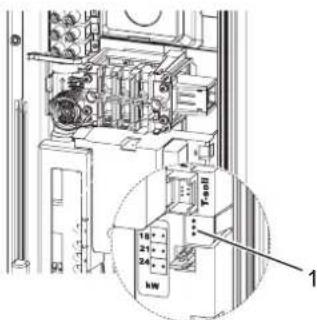
D0000041794
1 Diagnostic traffic light
| Fault / diagnostic traffic light LED display | Cause Remedy | |
| Inadequate flow rate. The strainer in the | appliance is dirty. Clean the strainer. | |
| The set temperature is not achieved. | One phase down. | Check the fuses/MCBs in your fuse box/distribution panel. |
| The heater does not switch on. Air is defe | ected in the water and heating output is briefly switched off. | The appliance restarts after one minute. |
| No hot water and no traffic light display. | The MCB/fuse has responded/blown. | Check the fuses/MCBs in your fuse box/distribution panel. |
| The safety pressure limiter has tripped. | Remove the cause of the fault (e.g. faulty pressure | washer). |
| Protect the heating system against overheating by opening a draw-off valve downstream of the appli-ance for one minute. This depressurises and cools down the heating system. | ||
| The PCB is faulty. Check the PCB and | replace if required. | Enable the safety pressure limiter at flow pressure by pressing the reset button (see chapter "Commis-sioning"). |
| Traffic light display: Green flashing or constantly ON | The PCB is faulty. Check the PCB and replace if required. | |
| No hot water at a flow rate of > 2.5 l/min. | The flow meter DFE is not plugged in. Plug the flow meter plug back in. | |
| The flow meter plug is faulty. | Check the flow meter and replace it if required. | |
| Traffic light display: Steady yellow light, flashing green light | The high limit safety cut-out has responded or its lead is broken. | Check the high limit safety cut-out and replace it if required. |
| No hot water at flow rate > 2.5 l/min. | ||
| The heating system is faulty. | Check the heating system resistor, and replace it if required. | |
| The PCB is faulty. Check the PCB and | replace if required. | |
| Traffic light display: Yellow constantly on; green flashing | The outlet sensor is unplugged or the lead is bro-ken. | Plug in the outlet sensor or replace it if required. |
| Traffic light display: Red constantly on; green flashing | The cold water sensor is faulty. | Check the PCB and replace if required. |
| No hot water Accurate temperature delivery > 45 °C is not reached. | The cold water inlet temperature exceeds 45 °C. | Reduce the cold water inlet temperature to the ap-pliance. |
| Traffic light display: Red constantly on; green flashing | The outlet sensor is faulty (short circuit). | Check the outlet sensor and replace it if required. |
14. Maintenance

WARNING Electrocution Before any work on the appliance, disconnect all poles from the power supply.
Draining the appliance
You can drain the appliance for maintenance work or to protect it from frost.

WARNING Burns Hot water may escape when draining the appliance.
» Close the shut-off valve in the twin connector or the cold water inlet line.
» Open all draw-off valves.
Undo the water connections on the appliance.
Store the dismantled appliance in a room free from the risk of frost, as water residues remaining inside the appliance can freeze and cause damage.
Cleaning the strainer
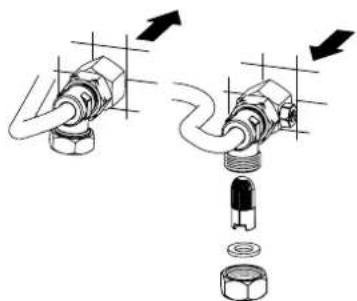
26_02_02_0949
If dirty, clean the strainer in the cold water threaded fitting. Close the shut-off valve in the cold water inlet line before removing, cleaning and refitting the strainer.
15. Specification
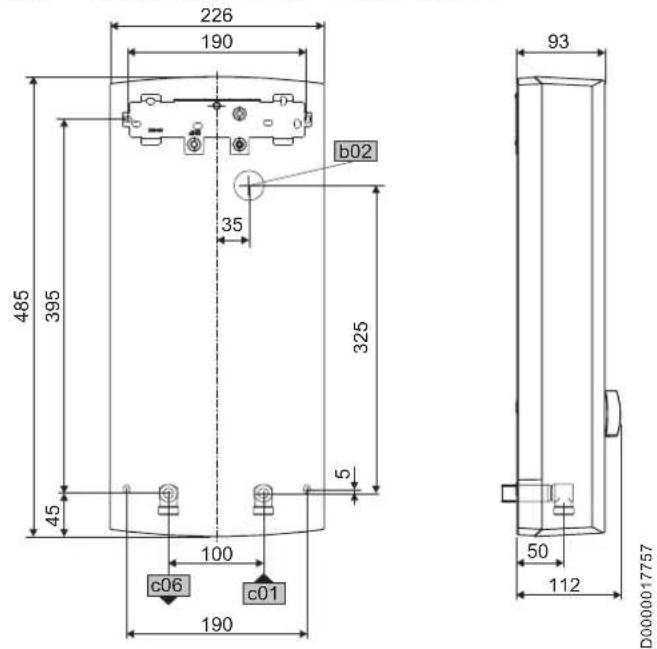
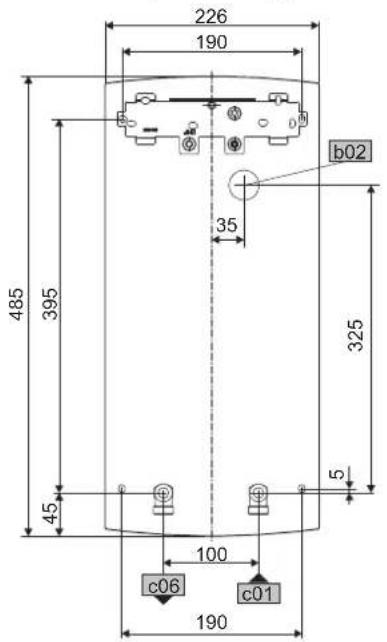
15.1 Dimensions and connections
| b02 Entry electrical cables I | ||
| c01 Cold water inlet Male thread G 1/2 A | ||
| c06 DHW outlet Male thread G 1/2 A |
0000019778
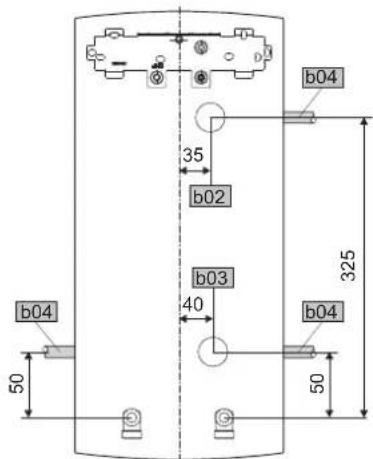
Alternative connection options
| b02 | Entry electrical cables I |
| b03 | Entry electrical cables II |
| b04 | Entry electrical cables III |
15.2 Wiring diagram
3/PE 380-415V
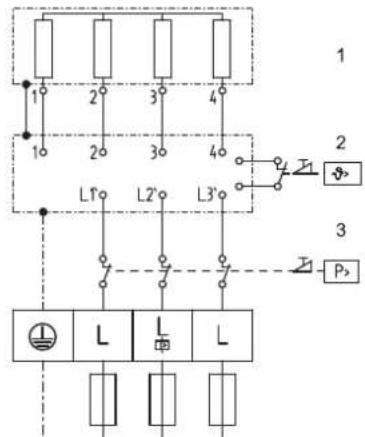
1 Heater
2 High limit safety cut-out
3 Safety pressure limiter
Load shedding relay LR 1-A
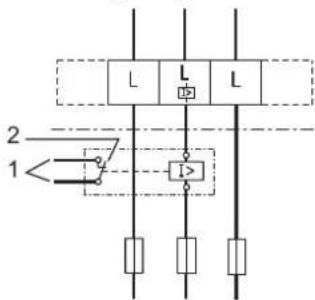
1 Control cable to the contactor of the second appliance (e.g. electric storage heater).
2 Control contact opens when switching the instantaneous water heater on.
15.3 DHW output
DHW output is subject to the mains voltage, the appliance's connected load and the cold water inlet temperature. The rated voltage and rated output can be found on the type plate (see chapter "Troubleshooting").
Specific electrical resistance and specific electrical conductivity (see chapter "Data table").
| Standard specifica- tion at 15 °C | 20 °C | 25 °C | ||||||
| Re-sist- ance ρ | Conductivity σ | Re-sist- ance ρ | Conductivity σ | Re-sist- ance ρ | Conductivity σ | |||
| Ωcm | mS/m | μS/cm | Ωcm | mS/m | μS/cm | Ωcm | mS/m | μS/cm |
| 900 | 111 | 1111 | 800 | 125 | 1250 | 735 | 136 | 1361 |
| 1000 | 100 | 1000 | 890 | 112 | 1124 | 815 | 123 | 1227 |
| 1100 | 91 | 909 | 970 | 103 | 1031 | 895 | 112 | 1117 |
| 1200 | 83 | 833 | 1070 | 93 | 935 | 985 | 102 | 1015 |
| 1300 | 77 | 769 | 1175 | 85 | 851 | 1072 | 93 | 933 |
15.5 Pressure drop
Taps
| Pressure drop at taps at flow rate of 10 l/min | ||
| Mono lever mixer tap, approx. | MPa | 0,04 - 0,08 |
| Thermostatic valve, approx. | MPa | 0,03 - 0,05 |
| Hand shower, approx. | MPa | 0,03 - 0,15 |
Sizing the pipework
When calculating the size of the pipework, a pressure drop for the appliance of 0.1MPa is recommended.
15.6 Fault conditions
In case of faults, loads up to a maximum of 95^ at a pressure of 1.2 MPa can occur temporarily in the installation.
15.7 Details on energy consumption
Product data complies with EU regulations relating to the Directive on the ecodesign of energy related products (ErP).
| DDLE LCD 18 | DDLE LCD 18/21/24 | DDLE LCD 27 | ||
| 222392 | 222394 | 222395 | ||
| Manufacturer | AEG Haustechnik | AEG Haustechnik | AEG Haustechnik | |
| Load profile | S | S | S | |
| Energy efficiency category | A | A | A | |
| Annual power consumption | kWh | 477 | 477 | 481 |
| Energy conversion efficiency | % | 39 | 39 | 39 |
| Default temperature setting | °C | 60 | 60 | 60 |
| Sound power level | dB(A) | 15 | 15 | 15 |
| Special information on measuring efficiency | None | Information at Pmax. | None |
15.8 Data table
| DDLE LCD 18 DDLE LCD 18/21/24 DDLE LCD 27 | |||||||||
| 222392 222394 222395 | |||||||||
| Electrical data | |||||||||
| Rated voltage | V | 380 | 400 | 415 | 380 | 400 | 415 | 380 | 400 |
| Rated output | kW | 16.2 | 18 | 19.4 | 16.2/19/21.7 | 18/21/24 | 19.4/22.6/25.8 | 24.4 | 27 |
| Rated current | A | 24.7 | 26 | 27 | 27.6/29.5/33.3 | 29/31/35 | 30.1/32.2/36.3 | 37.1 | 39 |
| MCB/fuse rating | A | 25 | 25 | 32 | 32/32/35 | 32/32/35 | 32/32/35 | 40 | 40 |
| Phases | 3/PE | 3/PE | 3/PE | ||||||
| Frequency | Hz | 50/60 | 50/60 | 50/- | 50/60 | 50/60 | 50/- | 50/60 | 50/60 |
| Specific resistance ρ15≥ (at ∅cold ≤25 °C) | Ω cm | 900 | 900 | 1000 | 900 | 900 | 1000 | 900 | 900 |
| Specific conductivity σ15≤ (at ∅cold ≤25 °C) | μS/cm | 1111 | 1111 | 1000 | 1111 | 1111 | 1000 | 1111 | 1111 |
| Specific resistance ρ15≥ (at ∅cold ≤45°C) | Ω cm | 1200 | 1200 | 1300 | 1200 | 1200 | 1300 | 1200 | 1200 |
| Specific conductivity σ15≤ (at ∅cold ≤45°C) | μS/cm | 830 | 830 | 770 | 830 | 830 | 770 | 830 | 830 |
| Max. mains impedance at 50 Hz | Ω | 0.379 | 0.360 | 0.347 | 0.284 | 0.270 | 0.260 | 0.254 | 0.241 |
| Application limits | |||||||||
| Max. permissible pressure | MPa | 1 | 1 | 1 | |||||
| Max. inlet temperature for reheating | °C | 45 | 45 | 45 | |||||
| Values | |||||||||
| Max. permissible inlet temperature | °C | 65 | 65 | 65 | |||||
| On | l/min | >2.5 | >2.5 | >2.5 | |||||
| Flow rate limit at | l/min | 8 | 8 / 8 / 9 | 9 | |||||
| DHW delivery | l/min | 9.4 | 9.4/11.0/12.6 | 14.2 | |||||
| Δθ on delivery | K | 26 | 26 | 26 | |||||
| Hydraulic data | |||||||||
| Nominal capacity | I | 0.4 | 0.4 | 0.4 | |||||
| Versions | |||||||||
| Temperature setting range | °C | 30-60 | 30-60 | 30-60 | |||||
| Heating system heat generator | Bare wire | Bare wire | Bare wire | ||||||
| Colour | white | white | white | ||||||
| IP rating | IP25 | IP25 | IP25 | ||||||
| Dimensions | |||||||||
| Height | mm | 485 | 485 | 485 | |||||
| Width | mm | 226 | 226 | 226 | |||||
| Depth | mm | 93 | 93 | 93 | |||||
| Weights | |||||||||
| Weight | kg | 3.6 | 3.6 | 3.6 | |||||
Guarantee
The warranty conditions of our German companies do not apply to appliances acquired outside of Germany. In countries where our subsidiaries sell our products, it is increasingly the case that warranties can only be issued by those subsidiaries. Such warranties are only granted if the subsidiary has issued its own terms of warranty. No other warranty will be granted.
We shall not provide any warranty for appliances acquired in countries where we have no subsidiary to sell our products. This will not affect warranties issued by any importers.
Environment and recycling
We would ask you to help protect the environment. After use, dispose of the various materials in accordance with national regulations.
REMARQUESPARTICULIERES
UTILISATION
10.3 Montage aflsuiten
Ecn He yka3aHO uHoe, Bce pa3MepbI npBedeHb B MmI Numetpax.
2. TexHnka 6e3onacHOCTN
2.1 NcnoJb3ObaHHe no Ha3HaueHnIO
Pnp6op npedha3hauen nla 6bIbTOBO uCnOlb3OBaHn. Inero 6e3oNaCHoro 06cnykBaHn NOb3OBaTeHn He Tpe6yeTc npoxoNTb INCTpyKTax. Bo3MOxHO nCnOlb3OBaHne npu6opa HToNbKO B 6bIty, Ho n, HanpImep, Ha npEepnptnxMajoro 6n3HeCa npu ycNoBn CO6NIODeHn Tex Xe yCNOBn EKcnNyataun.
Pnp6op HAnOpHOro Tnna npEHa3HaueH dna HarpeBa BOO npOBHOBn BObI Nn DOnONHtBHO r ODoRpeBa BObI, HarpTeo paHee. Pnp6op MoKet oBeCneuBaTb OdHy nN HeckonbKO ToeK OTbopa.
IIO6oe HHOe Hn He yKa3aHHe B HAcToIeM pyKOBOCTBE NcNoIb3OBAHne DaHHOro YcTPOcTBa CHTaTeTCa NcNoIb3OBAHNEM He No Ha3HaueHInIO. NcNoIb3OBAHne NO Ha3HaueHInIOpa3yMeBaET co6JIOpEHe Tpe6oBaHn HAcToIeRpyKOBOCTBa, a TaKKe pyKOBOCTB K NcNoIb3yEmbIM pINHaJNeXHOCTM.
2.2 06uye yka3aHnno TeXnKe 6e3onacHOCTn

OCTOPOXHO!Oxor!
Bo Bpempa60tbpapMaTypa MoKet HArpeBaTbcn Do TemnepaTypbicBbIwe 60^
Pn TemnepaType BObI Ha BixOe BblIe 43°C cyueCTByeOnacHocTb O6BapuBaHna.

OCTOPOXHO! Oxor!
B pexime 3Kcnpnyataunn C nCnoJb3ObaHne m npedBa-puTebHO NOORpeToB OdbI, HAnpMep, n3 CONHeHoi CNCTeMbI OTONNEHNA, TEMpepatypa npuroTOBNeHHoR ropaye BObbl MoKeT OTKIOHrbcr O T3aDaHHoN Tempepatypbl.

PNEyPEXKDEHNE!TpaMa!
DeTAM CTAPWE 8 neT, a TAKKHe NnUaM cOrpaHNeHHbIMN fN3nuecknMn, ceHCOPhbIMN uYMCTBeHHbIMN cNoC06HOCTA Mn, He IMeIOUM ONbTA Hne BnadeIOOM INHOpMaueH e np6ope, pa3peSeHcNOB3oBaTB np6Op TOIbKO nO pncMoTpOM dpyrNX nIu nn Noce coOTBetCTBYUeO rHCTpykTaKa O npabnax 6e3onachoro NOB3OBAHN n NotEHuaNbHO nOnacHO t Cnyae HecO6nOJeHN 3TNx npabUN. He donyckatb wanoctei DeTe c np6OpOM. DeTu moryT bInoINHbT uMCTky np6Opa n Te BVnbl TexHmeeCKORo 06CnyXnBAHn, KOtOpBle 06bHuO npON3BOJATCR NOnb3OBaTeEN, ToIbKO nO pncMoTpOM B3POcJIbIX.
Ecn np6opom noIb3yIOCTeTn nn nIaC o rpaHnueHHbIMn fN3nueckmM, ceHCOPbIMn yMCTBeHHbIMn cNoCo6HOCTMnTOMbI peKOMEHdyEMyCTaHOBNTpexkIM NOCToHHoro orpaHnueHnra Tempepatypbl. BInONHTb daHHyo HactpoKy MOKeT CneuNaJNT.

MaTePnAaBbHbI yuepe6
Ib0BteBdoJKeH o6ecneuHTb 3aunTy BoOnpoBoDa n apMaTpybl OT 3aMep3AHn.
2.3 3HaKCE
3NaCCEBnTeBCTByET,TO np6Op COOTBeTCTByET BcEM OCHOBBHIM Tpe6OBAHNM:
DInpeKTNbI EC no Hn3KOBoNtHOMy 6OpydoBaHIO
DInpeKTHBbI 063NeKTPomarHHTHO COMBecTMMOCTN. MakcunmabHo donyctTMoe noJHoe cOpPOTNBHeHne ceTu yka3aHO B rnaBe «Texnueckne xapaKTepNCTNKU
2.4 3NaK TexHnueckOro KOHTpOJIa
Cm.3aBODckyTO Ta6nUKy Ha npIbOpe.
Ebpa3nckoecooTBeTCTBne

[JaHHbN pIi6Op COOTBeTCTByE Tpe6OBAHnM 6e3OaCHOCTN TexHHueCKOro perlAmEHTa TamoxKeHHOro COIO3a nPoJSeH coOTBEcTBYIOUne IpoueJeBpNoTBePexDeHHn COOTBeTCTBnR.
2.5 3HaK TexHnueckoro KOHTpOJa
Cm.3aBODckyTO Ta6nnyKaHa npBope.
TocyapCTBeHHbIe DOnyckn n CBnTeJIbCTBa: TepMaHn
B coOTBeTCTBm CO CTpOnTeHbHbIMn HOpMaMn IN paBnAmN BeDMCTBOM NO Ha3Opy BbIaHO 06uee CbnDeTeJIbCTBO O NIOdTBePckHeHH BO3MOKHOCTN IcNoIb3OBAHnnpi6opaC TOKN 3peHnraero WymOBbIX XapaKTePNCNTK.
3.Описане устpoиства
PpOToHbI BDOHaRpeBaTeBc 3JNeKtpoHHbIM ynpaBHeHnEM ABTOMaTneCKN peryUnpye TMOHocTb HArpeBa, YTONo3BOJrE ToecneuHTb NocToHHyU TempepaTy PBOdHa BbXode CuyetOM npedeJIbHOm MOUHocTN np6Opa. PnppeBbIweHN npedeJIbHOm MOUHocTN np6Opa peryUnpoBaHne TempepaTypb BOd bOcUeCTBnETcN pnpomu BoDopa3-6OpHO npMaTypbl.
HarpeBaTeBbHcNCTema
HarpeBaTeBHaCnCTema COTKpbTbIM HarpeBaTeBbHbIM 3eMeNTOM 3aunueHa repMeTNuHBIM nlaCTNKOBbIM KOpNycOM. HarpeBaTeBHaCnCTema PnroDHa DnMaRKOu N XecTKoB BObl, TAK KA OHa npakTnueckn HeBOcPnMmUBA K 06pa3ObaHIO HauNN. HarpeBaTeBHaCnCTema ObecneuBaet 6bICTpoE u 0f0eKtNBHOe ChA6XeHne ropuey BoOn.

yKa3aHne
Pn6op ochaen cnctemo 6hApyKeHHBa BO3dyxa, KOtopa npdeTbpaaaet NobpeKdHne CnCTembl Ha- rpeBa. Ecn Bo Bpem 3kCnnyataunnp60paB Hero nonadaet BO3dyx, np6op otKnOuaet HarpeB Ha Ondy MNHyTy, 3aunuaa TEm cambIM CBOH HarpeBaTeNbHyo cnCTeMy.
4. Hactpoikn
TemnepaTpa ropuey BoBbHa BbIXOe peryuPyeTc6ecctynenHato.Ha dncnnee OTObpaKaetc3haueHne 3aadHHoTEMnpaTpyb.Ecn TMnepaTpa npebbiwaet 43^ to cBet INdkauMN MeHETc C CHeRo Ha KpaChb, npedynpeKdA06 onacnoCTN oBapnbAHna.
D0000041982
» YctaHOBNTb pyuKy pepyIaTopa Ha HyxHyIO TemnepaTypy.
yka3aHne Ecnnpa3p
Ecnn pa3daTochb Kpan ropaye BoBb NOHocTbO OTKpbIT, TempeaTypa yCTaHOBneHa MaKcMmaIbHoe 3NaueHne, Ho npn 3Tom BODa Ha BbIXoJe HeOCTaTOU HO HarpTa, 3NaHT Yepe3 np6Op npoxoJNT 6OnbWe BObl, qem MoKeT Harpeb HArpeBaTeNbHbI 3NeMeHT (doCTnHyta npeDBehna MouHocTb np6opa).
B TaKOM Cnyuae Heo6xOJMo CHN3nTb paCXoD BOdBi Ha pa3daTOOH MBeHTUne.
PekomeHdaqnnIra NaCTpoek npnNCNoIb3OBAHmN TepMoCtataNpyuOeApMaTypbl
YcTaHOBnTb pyuKy peyIaTopa TempepaTypbHa MaKcImaJIb-Hoe 3NaueHne.
Pocne OTKIOUeHnnoDauN BODbI
MaTePnaIbHbIyuep6
Pocne OTKIOUOeHn BDOcH6KeHn Heo6xOaHmO CHOBaBKnIOuHTb np6Op, BbINONHn CNeyIOuJe wArN, 4TO NOMOKeT n36ExKaTb NOBpeKdEHN HArpeBaTeNb HOI cNCTeMbICrOlbIM 3JIeKTPoDm.
»O6ecTouNb np6Op,OTKIOUHyN ppeOxpaHnteHn.
OTKpbTb BENTnIb apMaTybl Ha OndHy MmHyTy, NOKA B np6ope H NOkHoueHHo Nepei HIM IINHN NODaun XONODHOBbI He OCTaHeTcB03- dyxa.
》Bo3o6HOBnTb noauy cTeBOrO HanpXeHn.
6. YctpaHHe HeNCnPaBHOCTeI
KomnneKT Tpy6 noDboDKn dny yCTaHOBKn np6opa noD paKOBHoi
MOHTaXHbKOMPnEeTdIyUCTAHOBKnPpN6OpaNoIpaKoBNHOHeo6xOaIMBToMcnyae,ecnNaTPy6KnNOJKNIOUeHNBObl(G1/2A)doJXHbHaxoOnTbcraHADpN6Opom.
KomnneK Tpy6 nMa MoThaKa co CMeueHHeM
3TOT KOMNNEKT N3 Tpy6bI C Tpy6hIM KOJIeHOM Heo6xoJIM, ECNI Tpe6yETc BEpTNKaJIbHOe CMEUeHne npi6opa npiMePHO Ha 90 MM BHN3 OTHOCNTeBHO CTbIKA JINB BObl.
Komnnekt Tpy6 nna nepexoHa ra3ObyIO KOONKy
3TOTKOMPNEKTN3Tpy6 Heo6xOdM,ecNJBCMOHTPOBaHHOH yCTaHOBKeYJXe IMeIOCTWtUepebIra3OB0K KOLOHKN (TtUeep dIyXoONHO BODbI CNeBa,a Iyra ropaye -Cnpaba).
Pene c6poca harpy3kn (LR 1-A)
Pene c6poca Harpy3Kn npedHa3HaueHo dIy yctaHOBKn B 3JIeKTPnueckOM pacnPpeJTeNBHom yCTPOINCTBE, OHO oBeCNEuBAET nnpOpNTeTHOE BKIOUeHne npOTOHoro BOHOHa- rpeBaTeN pni erO OHOBpeMeHHo pa6ote, HApnIpMep, C HAkONITeHBHIM NKeKTPoHarPeBaTeYAMN.
ZTA 3/4- ceHTpaIbHaTepMoCTaTnpUoua apMaTaPa
Tepmoctatnpuyoia apmatya npedha3nueHa nna ceHTpaBHO rpeBapntbHoro CmeuBaHHa, HApumep, BObl potochoro BOOHarpeBaTeN INCONHeHou yCTaHOBKN.
Pa3peweHHbIe MaTePnAbI IIN BODOpPOBdHbIX Tpy6
IINHnIPOdaunXOJOnHOBBOdbI: Tpy6a n3 ropayoeounHKOBaHHoN CTaNN, HEPXkaBeIOuec CTaNN,Meu nnPiactMaccbI
HINHn npaun ropae BODb: Tpy6a n3 Hepxabekoue ctaJIMMeNnnnnaactmaccb

MATEPnabnbHy upep6
PnHcNoB3OBAHNIIaCTMaCCOBbIX Tpy6 HxKHO yuHtBiBaTb MaKcMaJIbHyO TempeaTpPy u MaKcMaJIbHO donyctHMoe daBHeHne (cm. rnaBy (Texnueckne xapaKTepcntKN / Ta6nua napaMeTpOB)).
I6Kne wlnaHn dna noDboda BODbi
PnnoKIOeHnn Pnp60pa C nmoBIO rN6kXn ⅢaHROB Heo6xOIMNO PpeynpeNTb PpOKpyuBaHne BaHOHTbIX COeHNHeH N Tpy6bIX KoneHax.
3aKpeNTb 3aHIOCTeHKy,3aHKnCpOBaBeeCHN3y DBYMA DONOLHHTeHBHIM BNHTAMN.
10. MoHTaX
10.1 CtaHdapThbIMoHTaX
3neKtpoN0dkIouHeHcBepxy,ckpbTaa npoBoka
IopKIOUeHne K BOJe,CKpbITa npOBoJa
DDLE LCD 18/21/24: noTpe6JraEmaa MoUHocb B3aBOdCKoHnHaCTpoKe 21 KBT
DpyrncnoocbmoHTaxa cm. rnaBy «BapnAHTb MoTata»
3neKtpoNOpDkIouHeHnKHee, npCkPbITOMMOHTaKe
3neKtpoNpOKnIIOueHHe npOtKpbITOM MOHTaKe
IopknHueHne pene c6poca harpy3kn
MoHTax Bn3y - NaTpy6Kn IJIa NODKIOueHINB OBObl CBepxy
BODONPOBOHbIe pa6oTbI cnoCobom OTKpbITOrO MOHTaXa
Pexmpa60bIcnpedBapntelHoNoDorpeToBdo
OrpaHnHTeB TempepatypbI
BckpbItne npn6opa
» OTKpbIb npn6Op-, oTkaB 3aueIky fNkcaTopa
》CHaTb 3aHIOI NaHeIb,ДЯ 3TOrO HaxKaTb Ha O6a KpIouKa-ФИKcATOpI INOTAHyTb HIXHIOU qAChb 3aHneI naHeIIN BnpeIe.
Ioprotobka ceteBoro coeHHTenbHoro Ka6ena
YCTAHOBKa HAcTeHHoM MOHTaXHOH PJIaHKU
26_02_02_0972
》Pa3MeTtB MeTa CBepHeHnO TBepCTn PpN NOMoU W6NoHa DnI MOHTaKa. PpN NOKIOUeHN PpN6opa K BODONPOBOy OTKpbITOrO MOHTaKa HxKHO DOONHNTeBHO HAeTtB KpeNeXHbIe OTBePCTn B HxKHeuactn W6NoHa.
ПорсеверпьОТВеретиИЗakpenпьНЯСтЕнHyIOМOTaЖHyIOПАнКу cnomоцьIO 2 wypynOB n 2ДIO6eNeI(wypynbI NIO6eIN BxOJrT B KOMNJIeK TNOCTABKN).
» YcTaHOBbI npunaraemyo pe3b6Obyu nnIbKy.
» YCTAHOBNTb HAcTeHHyIO MOHTaXHyIO NAAHKY.
UcTaHOBKa BTyIKNn dnn Ka6eIa
26_02_02_0950
YctahOBtB Ka6eBHyIO BTyIky. Ecnn nonepeHoe ceye Hne Ka6eN IpeBbIaet 6 MM, OTBepCTne B Ka6eBHOI BTyIke Heo6xOJMo paCunpITb.
IopknoueHne npn6opa KcncTeMe BOOCha6KeHn

MaTePmaJIbHbIyUseep6
Bce pa60tbI no nOdknIOeHNO BOdbI MOnTAXy npu-6opa Heo6xOaHMo npON3BOaNTb B COOTBeTCTBUN C HNcTpyKunne.
》IOCTaBnTbIpOKlaAkyI BvHHTNbBOHHOHNIIeNb.

MaTePnaJIbHbIyUyepe6
3anopnbknahan Ha noqaeyxonoHOBdI Heb3nCnOsb0BaTb IymeHbweHnnoTOKa!
IoproTOBka 3aHnei cTeHKn

MaTePnAJIbHbIy uIeep6
Ecn no own6ke 6bINO BbINOMaHO He To OTBepCTne nIByKn Ka6ena, Heo6xOaMo NcNoJb3OBaTb HOByIO 3aDHIO CTeHky!
D0000041893
»BbIOMaTb B 3aHaHHo TOpKe MecTo DnA BTyKN Ka6eNa Ha 3aHHei CteHKe. Ipn HauNUnOCTpbIX KpOMOK IX He0xOJIMo YnCTO O6pa6oTaB HauNlBHNKOM.
MOnTaX npu6opa
D0000041894
HaTeB3aHIOCTeKHyHaWnNbKyuBtynkyJna Ka-6eIy. NpTaHytB nIOCKORYbAmnKa6eIbHyIO Btynky K fHKCaTOpY Ha 3aHHei CTeKHeTak, YTO6blO6a FmKcTopa 3aUeIKHnyncb Co CblIMMbIM UeNkOM.
»ДаЛТбЗИТьEЗЗIФИшКИЗСТБIOВДЛЯВОДbl.
》ПлOTнО ппжаТь 3аднIOю панЕь K CTeHe, 3aФИКсИрОВАТь панЕь C NOMOцьЮ крЕнЖHorO BOPOTka nyTeM npabORO Врашени Ha 90^
PnKpyTb Tpy6b C NIOCKMn yNIOHTeJIaMn K DBOHbIM HINNEJAM.
MaTePnaIbHbIy uIeep6
Dna pa6oTb npn6opa Heo6xoJMa yctaHOBka cetTa-toro fNbtpa.
Pn3aMeHe np6opa npOBepntb HauHue ceTuTaTOro 0nIbTppa (cM. rnaBy «TexHueeckoe o6cnyKuBaHne»).
demontax / 3ameha orpaHnHTenr o6bemHoro pacxoja
yKa3aHneI npu nCno
PnncnoB3OBaHHN TepMoCTaTpyuOeApMaTpybI
dEmoHTax OrpaHnHTeNa OBemHoro paXoJa 3anpe-
ueH.
1PpOuHbHa nlaactKOBa 7a6a
2OrpaHnHTeNbObBemaNtOKa
IV3BLeYbOrpaHnHTenbO6bEmHOpacXoJaNCHOBa YCTaHOBNTIPOoHnBHyIO NtAcTKOByIO Wai6y.
DDLE LCD 18/21/24:Замена оранчтени obemhoropacxoDA
》PnBb6ope noTpe6nmeMo moHocn 24KBTyctaHOBLeHHbOrpaHnHTeIb pacXoJa (6enoro cBeta) cneJyET3aMeHnTB Ha orpaHnHTeIb pacXoJa n3 KomnNeKtAnocTaBKn (opaHxBeBO rBaTe, npNKpennEn K naTppy6ky XoIOHOB BObl).
IopKIOUoyHne K cETn NtAHNA
PNEyPExEHNe! NopaxeHne 3nKtpueckm
Bce pa6o8bI no 3neKtpnueckomy nOdknoeHIO MOHTaKy Heo6xOdmo npOn3BODntb B COOTBeTCTBm C HCTpykun.
PNEyPExEHE! NopaxeHne 3nKtpueckm TOKOM! POnkIoueHne K 3nKtpocetn Donyctmo TOnbKO B Hepa3bemHom NCnONHeHHN M Co CbeMHo Ka6bHOB Btynko. Pnp6Op DoJXeH OToCeoHNHTbcr OT3nKtpocetnc pactbopor Bcex KOHTAKTOB He Mehee 3 MM Ha BCEx NoIOcax.
IPEyIeHnE! IopaeHne 3JeKtpuecknM TOKOM! IpoBepuTb PdKnIOeHne np6opa K 3aunTHomy npoBdy.
MaTePuaHbIyUeep6 CnEpyetco6NpaTbdaHHbIeHa3aBOcKoTa6nUyKe. HanpJxKeHne cETndoXHO COBnaTaTb cyKa3aHHbIM Ha Ta6nUyKe.
》IOnKJIIOHTb COeINHITeBHyb Ka6eNb NITaHnK CoEINHITeBHOH KJEMMe cETN (CM. TnaBy "TexHueckne xapakTePncTnK / 3NeKtpnueckar cxema").
DDLE LCD 18/21/24:nepeknueHne uTekepa KODINPOBKN
B coctoHnn noCTaBkn wTekep KOINPOBKn yCTaHOBJeH B noJooKeHne 21 kBt. Iy nepeKIOUeHn Ha npryIIO notpe6bmyIO MOHOCb Heo6XODmOB BblONHnTb CNeDyIOuue DeiCTBn:
D0000047341
》IpeMeCTb bTEKeP KOINPOBKN B NOIOXeHne, COOTBeTcTBYIOOe BBb6paHHoM MOIOHOCTN (CBeDeHnO Bb6ope MoUHOCTN INpeDOxPAHNTEnJx np60paCM.BrnaBe《TexHueckne XapAKTepNCN /Tabnua napaMeTpOB》.
»BbIbpaHHyIO MOUHOCTb OTMeTNTb Ha 3aBOIDCKO Ta6NIuKe KpeCTNkOM.Пр nəTOM HxKHO NcNoJIb3OBaTB WapNKoByIO pyKy.
MOHTAX HIXXHeI qactn 3aHneCTeHNK
26_02_02_1348
YCTAHOBINb HIXKHOIO qACTb 3aJHeN NaHEn N 3aJen-KHYTb ee B 3aJHeN NaHEn.
BbipOBHrTb yctAHOBHeHHb npn6Op, ocla6nB KpeNexHbI BOPOTK, BblpOBHAB 3neKtpnueckoe coeHNHeHNe n 3aHIO CTekHy, nocLe Yero BHOb 3aTAYt b KpeNexHb I BOPOTK. Ecn 3aHra NaHb He npIneraet KCTHe, To HxHIO qAcTb np6op a MoXHO 3aKpenTb DByMa DOIOJIHTeHBHBM WpyPamn.
10.2 BapnHaTbIMoHTaKa
10.2.1 3neKtpoNodknOueHHe HxHHe, npu cKpbITOM MOHTaXe
》YcTaHOBnTbKa6eBnHyIO BTyNkY.

MaTePnAblbHbIyUyepe6
Ecnn no own6Ke 6blno BblnomaHO He To OTBepctwe nBtynK Ka6en, Heo6xoJmo Ncnonb3OBaTb HobyIO 3a- dHIO CTeHKY!
»BbIOMaTb B 3aHaHHo TOpKe MeTo DnA BTyKn Ka6eNa Ha 3aDHei CTeHKe. PpN HAnuMn OCTpbix KpOMok Nx He06xoJIMo YnCTO O6pa6oTaB HanJBhNKOM.
Перемсгнь Кл endункolyeHЯ KЛeКТрocETn C BepxHey qaTn np60paBn3.
HaTeb3aHIOU cTeKHy Ha uINbky N Btynky dna Ka-6eJn. POnTByb PNOCKORY6aAMN Ka6eBHyIO BtynKy K
fNKcatopy Ha 3aHne CteHKe Ta, YTo6bl Oba fNkCatopa
3aUeKNKHyINCb CO CbIbIMbIM UeNkOM.
》ПnotHO npnKaTb 3aHIOIO NaHeIb K cTeHe,3aФИKcnpoBaTb NaHeIb C NOMOJIbKO KpeNExKHOrO BOPOTka IyTem npaboro BpaueHnHa 90^
10.2.2 3neKtpoIopKnIOUoyHHe npO tKpbITOM MOHTaxe

YKa3aHHe
Pn TaKOM cnocO6e NOkIOueHn N3MeHITcA CTeneHb 3aunTb np6opa.
》N3MeHnTb DaHhble Ha 3aBODcKo Ta6nUyKe.3aepKHyTb MapKnupOBky «IP 25» n NOMeTnTb KpeCTnKOMЯeKy «IP 24»,ПугэТOM HxKHO uCNoB3ObaTbшapNKOByIO pyky.

MATEPnabHbIy upe6
Ecnn no own6ke 6blno Bblomaho He To OTBepctne dny Btynk Ka6en, Heo6xoJmo NcnoIb30BaTb HobyIO 3a- dHIO CTeKy!
» Ha 3aДнен CTeHKe npi6opa YnCTO BbInOnJIHHTb Heo6xoDnMbIe npoxOdHBe OTBepCTN (nx paCNoJoxHeHne cm. rnaBy «TexHueckne XapaKTePncTkn / Pa3MepbI n coEINHeHnra).Пи nHaunuOcTpbiX KpOMOK nX Heo6xOdmo YnCTO O6pa6OtaTB HauNlbHnKOM.
PpOpyntbKa6eB3JIeKtpoNTaHnYepe3 Ka6eBHyBtynI NOkNIOHTb ERO K CoeINHTenbHO KnEMMe CETN.
10.2.3 PoiokloueHne pene c6poca harpyKu
Pene c6poca Harpy3Kn B 3neKTPopacnpedeNtBHom yctpoiCTBe CnEpyET NcONb3OaBc COBMEcTHo C pyrIMM 3neKTPoPi6Opam, HapnMpE, C3neKTPueckmH hakoNTeNbHbIM BOHOHarpeBaTeIaMn. C6poc Harpy3Kn ocUyecT BnEraTc npa6oTe npToOHoro BOHOHarpeBaTeIaN.

MATEPnabHbIy upe6
Iopknouhtb a3y,HaKOTopyu yctaHOho pene c6poca Harpy3kn,KnomeeHHo coeHNHTebHO Klemme cetn B npnbope (cm. rnaBy «TexHueckne xa- paKtpncTnK/3neKtpueckne cxembln coeDunHeHna»).
10.2.4 MoHTaX BHN3y - NaTpy6Kn dna noKluOueHn BOdbI CBepxY
MOnTax npN6Opa NO pAKOBHNo C BepxHnMn NaTppy6kAmn DnI NOKKnUoyEHNA BODb BYINONHReTC NOMOUsBO DnONHHTeBHO KOMNKeTA Tpy6 nMOtAXa np6Opa nO paKOBHNo. AkkypatoHO BblOMaTb PPOXoHbte OTBepCTNa DnTpy6B3aDHe NAnHn UyctAHOBnT py6bN 3KOMNKeTA.
10.2.5 BOpOBoHbIe pa6OtbI cnoc6om OTKpbIToro MOHTaKa

Yka3aHne
Pn Takom cnoc6e noKIOUeyHn N3MeHNTcra CTeneHb 3aunTb np6opa.
》N3MeHnTb DaHHbIe Ha 3aBODCKo Ta6nUyKe.3aepKHyTb MapKnPObKY «IP 25» n NOMeTnTb KpeCTnKOM aeyKy «IP 24»,Пр nToM HxHNo NcNoJb3ObaTb shapNKOByIO pyky.
26_02_02_0765
》Ha tyboopoboCkpytOmoMOnTaXa yctahOBntb 3aTnyuKn CynlnoteJMM.
》BbIIOJIHHTbMOHTaX COOTBeTCTByIOUeH HAnOpHOApMaTypbI.
26_02_02_1006
HnKHOU qACTb 3aJHeN naHeN yCTaHOBNTb NOB BepXHIO UCAbI N3aUeKNKHTb.
CBHNTb coeHHHTeHbHbIe Tpy6bI c np6opom.
3aKpeNTb 3aHIOU cTHeKy, 3aΦNKcnpOBab ee CHN3y DByM DOnOJIHTeBbIM BnHTaMn.

MaTePnAaBbHbIyUeep6
Ecn no Own6Ke 6bIno BblnomaH He To OTBepCTne dnn Btynk Ka6ena, Heo6xoDnmo McnoIb30BaTb HObyIO 3a- dHIO CTeHKy!
AkkypaTHo BbIOMaTb PPOXOHNbE OTBepCTN B KpbIuKe npn6opa. Pn HAnuHn OCTpbIX KpOMOK INx Heo6XoHMo qncto 06pa6OtaTB HAnuNbHnKOM.
YctaHOBNTb HNIXHIOU qACTb 3aDHei naHEI NOI COeHNHTeNbHbIe Tpy6bl apMaTybl n 3aΦHKCuPoBaTb ee B 3aDHei naHEI.
CBNHTNb coeINHITbHbIe Tpy6bI c np6opom.
10.2.6 Pexim pa6oTbI c npedBapntelbNo noDorpeToB BDOI
PnpyctahOBKe CEHTpaJIbHOI TepMOCTaTIpyIOUeApMaTpybl npOn3BODITcOprAHueHHe MaKcImaJIbHOI TempeAtpybl NOaHi.
10.2.7 OrpaHnUHTenb TemnepaTpybl

OCTOPOXHO!Oxor!
B pexnme kcnnyataun cncnonb3obAHm npeDbapntelbno noorpeToB odbI CnCTeMa orpaHueHnTeNepaTpybl 3auNTbl OT 6BapuBAHnMOKeT OKa3aTbcr He3ΦΦeKTHBHO.
》B3TOMcnyae orpaHnueHne yctaHaBnBaetcHa npedeYCTaHOBHeHHo CEHTpaIbHO TepMoCTaTpyIooue apMaType.
Ha BnytpenHe CTOpone KpbIuKn npmbopa MoXHO yCTaHOBnTb orpaHnueHne Tempeatypbl, paBHOe 43 ^ C
D0000041912
YctaHOBtB orpaHueHne TempeTaypbHa 43°C.
IocneakTbauinOrpaHnueHnTeMtnepaTypbBb6OpTeMnpaTypbBO3MOKeHToJbKO BdnaNa3OHeOTdo43°C.
10.3 3aBepunb MOHTax
OTKpbTb3aOpHbI BENTINB BBOHOM HnNne NnB Tpy6onpoBoDE NOaH XoONHOB BObl.
11. BbOaB 3Kcnpnyatauio

IPEyIPEKDEHNE! IopaxeHne 3nEKTpueckmTOKOM!
BbOJ npn6opa B kcnnyatauMOKeT OcyueCTBnTbcra TOnbKO CneuaHnCTOM npu ycOBnn Co6IIODeHn npaBn TL TexHnK 6e30NaCHOCTN.
11.1 NepBbI BBOB 3KcNpyTaunIO
on

on
D0000041981
MHorokpatHOOTKpbIBaTbN3aKpbIBaTB BCE NOkKnIOueH HbIe pa3daToOHbIe BeHTnIN Do TEX NOP, NOKA B BOOnpOBOHOcTN IN Pn6ope He OCTaHETcB 03dyxa.
» Bыннпь поверку repmetuhoctn.
» AkTbNupOBaTb npEoXPaHntBbHbI orpaHnHTeB DaBHeHn, dIra 3TOr CINbHO BdaBNTb KHNkY c6pOca (B COCTOHHn NOCTABKn pnp6opa fynKcHn npEoXpaHnTeBHorO OrpaHnHTeR DaBHeHn DeakTbNupOBaHa).
》IopKIOHHTbUTekepepyJIaTOpaTemnepaTypbIK6NOKy 3NEKTPoHKN.
» YCTAHOBNTb KpbIshky np6opa n 3aФNKCnpoBaTbdo CbIIMoro ueNka. PpOBepNTb NOJoxeHne KpbIshKn np6opa.
》PoaTaB cTeBoe HapRJaKeHne.
Поверпь pa6otу пибopa.
Ppepa np6opa
»O6bChnTb nonb3oBaTeIIO npHcHp pa60tbpnp6opa n O3HaKOMNTb erO c npaBUNAMN NCNoB3oBaHN np6opa.
Ka3aTb NOJIb3OBAteJIHO HA BO3MOXHbIE ONaCHOCTN,OC0-6eHHo Ha onaCHOCTb 06BaPnBAHn.
》IpepaTb daHHoe pykoBOcTBO.
11.2 NOBTOHbI BBOB B 3KcNpyaTuIO
Ydantb BO3dyx n3 np6opa n Tpy6oPBOda noaun xonoHHOBbl (CM. rnaBy «HaCtpoKn).
Cm.rnaBy《NepBbI BBOB B3KcnnyatauIO》
12. BbIBoD n3 3KcPnIyatauH
》ПОЛНOCТБЮ OБЕСТОУТБ ПИБОР C pa3MbИКАнEM BCEX KOHTAKTOB.
»OnopoxHHntb npn6op,cm. rnaBy «Texo6cnyxBaHne»
13. UctpaHne HencnpabHocte

PPEyPPEKDEHNE! NopaxKeHne 3neKtpueeckm
TOKOM!
15.1 Pa3MepbI n coeMHHeHnA
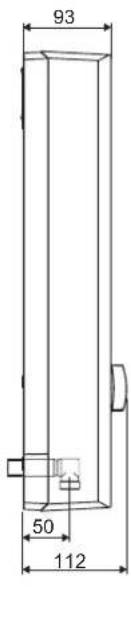
| b02 | Ввод дулэл ektrponровдуки | | ||
| c01 | Повдои xолдунь Вolyы | Hapyжнай pe36ba | G 1/2 A |
| c06 | Быntснай trуба горая вolyы Hapyжнай pe36ba G 1/2 A |
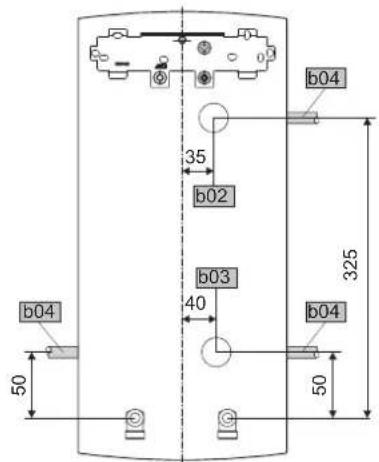
BapnntbI noKIOUeHn
D0000019778
b02BvOДгЯЗлктponpoBOKIN
b03 BBoДЯнэЛeКТрОпВОДКИ II
b04BboDnIy3neKtponpOboDknII
15.2 ΘeKtpnuecka cxema
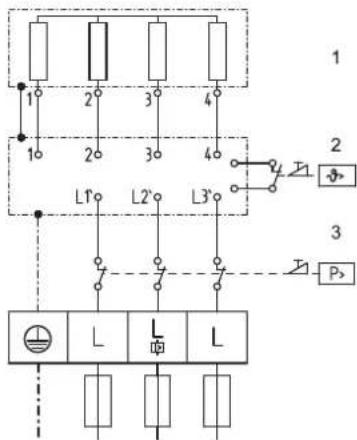
3/PE 380-415 B
85_02_02_0005
1 HarpeB
2 PpeoXpaHnteBnI orpaHnHTeB TeMnpaTpybI
3 PpeoxpaHntenbHbI orpaHnHTeIb daBHeH
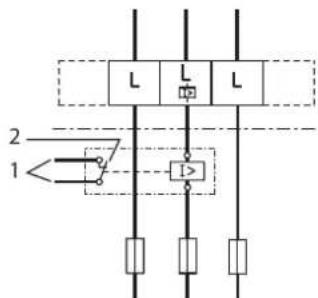
Pene c6poca harpy3kn LR 1-A
85_02_02_0003_
1 JINHUNI cENI ynpaBHeHINK KOHTaKTopy 2-ro npu6opa (HaNPmep,3NEKTPnueckomy BoInpey).
2 YnpabnIooN KOHTaKt pa3MbkaTc npBkIOueHnn npoTOHOrO BOHOHaRpeBaTeJ.
15.3 Poun3BOaNTeNbHocTb no ropaye Bode
PpOn3BODnTeNbHOCbNo rOpRyHe BOe 3aBncnt OT HApnPaKHeN B Cetn, Notpe6JIeMoM MoUHcTn npu6op a N TempeatpyblxOIOHOH BObl. CBeDeHnO HomHaIbHom HApnPaKHeN N HOMHaIbHOm MOUHcTn yKa3aHbI Ha 3aBOIDcOITabnue (cm. rAby «YCTpaHeHne HEnCnPabHocTe»).
| ПOTреблесья мошноctы, кВТ | 38 °C Ппориевский по гору-чey воре, л/мен. | |||||
| Номиналове наразожене Temпсаразурахолдου воры на радачe | ||||||
| 380 B | 400 B | 415 | B 5 °C | 10 °C | 15 °C | 20 °C |
| 16,2 | 7,0 | 8,3 | 10,1 | |||
| 16,3 | 7,1 | 8,3 | 10,1 | |||
| 18,0 | 7,8 | 9,2 | 11,2 | |||
| 19,0 | 8,2 | 9,7 | 11,8 | |||
| 19,4 | 8,4 | 9,9 | 12,0 | |||
| 21,0 | 9,1 | 10,7 | 13,0 | |||
| 21,7 | 9,4 | 11,1 | 13,5 | |||
| 22,6 | 9,8 | 11,5 | 14,0 | |||
| 23,5 | 10,2 | 12,0 | 14,6 | |||
| 24,0 | 10,4 | 12,2 | 14,9 | |||
| 24,4 | 10,6 | 12,4 | 15,2 | |||
| 25,8 | 11,2 | 13,2 | 16,0 | |||
| 26,0 | 11,3 | 13,3 | 16,1 | |||
| 27,0 | 11,7 | 13,8 | 16,8 | |||
15.6 Bo3MOxHbIe HencnpaBHOCTu
Pn HncnpabHocTn B Odo npoBOHOH CnCTeMe MoryT BO3NKAtB KpaTKOBpeMeHHbIe MaKcMaJIbHbIe Harpy3Kn, COpOBoXKaaEmbIe NObIWeHem TempeAtypbl do 95^ n daBHeHn do 1,2MPa
Urzhumskaya street 4,
building 2
129343 Moscow
Tel. 0495 7753889
Fax 04957753887
Switzerland
STIEBEL ELTRON AG
Industrie West
Gass 8
5242 Lupfig
Tel. 056 4640-500
Fax 0564640-501