IK 513 032 - Refrigerator GAGGENAU - Free user manual and instructions
Find the device manual for free IK 513 032 GAGGENAU in PDF.



| Product type | Refrigerator with freezer compartment |
| Brand | Gaggenau |
| Model | IK 513 032 |
| Power supply | 230 V ~ 50 Hz |
| Refrigerant | Isobutane (R600a), eco-friendly |
| Ambient operating temperature | 10 °C to 38 °C |
| Temperature setting | Dial from 0 to 7, normal position 5-7 |
| Freezing | Maximum quantity indicated on rating plate, pre-cool 1/2 notch before |
| Door balconies | Height-adjustable door balconies |
| Bottle drawer | Sliding, temperature approx. +10 °C |
| Refrigerator defrosting | Automatic, drainage via outlet |
| Freezer defrosting | Manual, use hot water (not boiling) |
| Interior lighting | Bulb T25 / 230 V / 15 W / E14 |
| Cleaning | Mild soapy water, vinegar water for odors |
| Safety | Household use, fragile refrigerant circuit, avoid open flames |
| Repairs | By a qualified technician only |
| Warranty | According to conditions, excludes bulbs and glass/plastic parts |
| Operating noises | Normal compressor and fluid circulation, some noise is unavoidable |
| Weight | Not specified in manual, approx. 60-80 kg (estimate for this type of appliance) |
| Dimensions (H x W x D) | Not specified, allow for a niche depth ≥ 550 mm and a ventilation cross-section of 200 cm² |
Frequently Asked Questions - IK 513 032 GAGGENAU
User questions about IK 513 032 GAGGENAU
0 question about this device. Answer the ones you know or ask your own.
Ask a new question about this device
Download the instructions for your Refrigerator in PDF format for free! Find your manual IK 513 032 - GAGGENAU and take your electronic device back in hand. On this page are published all the documents necessary for the use of your device. IK 513 032 by GAGGENAU.
USER MANUAL IK 513 032 GAGGENAU
Operating Instructions
25 Introduction
25 Safety hints and warnings
26 Switching on and temperature selection
27 Freezing
27 Variable inside door
28 Cooling zone
28 Bottle drawer
28 Defrosting
29 Cleaning
29 Tips
30 Replacing light bulb
30 Malfunctions
30 Guarantee
32 Operating noises
33 Installation / Dimensions
Installation
See Assembly Instructions in Installation Pack
Dear Customer
You are now the owner of an up-to-date, power-saving refrigerator. We congratulate you on your excellent choice.
This refrigerator complies with the approved state of the art as well as EU directive 73/23/EEC (low voltage directive), is SEV-tested according to EMV directive 899/336/ EwG and complies with the directive 96/57/EEC on energy efficiency.
Disposing of the old refrigerator
At the end of their useful life, refrigerators must immediately be rendered unusable (e.g. cut off the connecting cable). Please make sure that the cooling system tubes are not damaged before the refrigerator is removed to a proper environmentally friendly place of disposal. Please refer to the appropriate office in your local community for instructions on correct disposal. (Loosen the hinges and remove the door so that children cannot shut themselves in while playing, thus putting their lives at risk.)
Disposing of the packaging
All packaging materials used can be recycled.
Safety hints and warnings
Please read through the information contained in these Operating Instructions carefully before putting the refrigerator into operation and keep them in a safe place for later users.
- Electrical safety (shock-hazard protection) must be effected as part of the installation procedure.
Use this appliance only for domestic purposes and according to the description in the Operating Instructions.
If you have received a damaged refrigerator, please contact your supplier immediately.
Repairs and other interventions must always be carried out by a qualified service fitter. Do not use extension leads.
Cut off power when cleaning: disconnect the plug or fuse. Never pull the plug out of the socket by the lead or with wet hands. Always take hold of the plug and pull it straight out.
Bottles containing high-percentage alcohol must be kept tightly closed and upright, and do not keep any explosive substances in the refrigerator. Danger of explosion!
This appliance is free of CFC and HCFC and contains small quantities of the environmentally friendly coolant isobutane (R600a). - When handling the appliance make sure that the coolant circuit is not damaged. Should the coolant circuit suffer damage in spite of all precautions, avoid any
naked light or ignition source of any kind. Ventilate the room in which the appliance is standing for several minutes.
An appliance with a damaged coolant circuit must not be put into operation.
- When installed, make sure that the ventilation openings are not covered or blocked,
No mechanical or artificial means other than those recommended must be used to accelerate defrosting.
No liability is accepted for any damage if the appliance is used for any purpose other than that intended, if it is improperly operated or repaired by an unqualified person. In this case, the guarantee lapses and any other liability claims are null and void.
If the connecting lead of this appliance is damaged, it must be replaced by the manufacturer or the manufacturer's after-sales service or a similarly qualified person, in order to avoid any risk.
■ Warning: do not operate any electrical appliance inside the food storage area.
Switching on and temperature selection
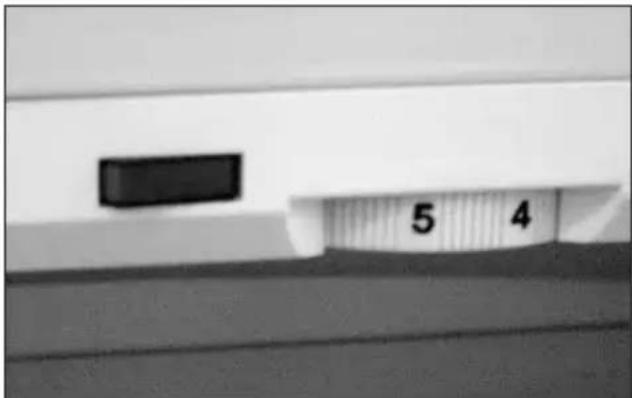
(Fig. 1)
The temperature regulator is used to set the cooling level and to switch the refrigerator on and off.
Important:
The appliance is designed to be operated at an ambient temperature of between 10 - 38^ If the ambient temperature is outside this range, there is no guarantee

that the inside temperature in the cooling zone and deep-freeze compartment will be maintained.
Normal: Position between 5-7
The minimum temperature in the deep-freeze compartment remains at 18^ when the temperature in the main cooling zone is +5^ or less.
Low ambient temperature
With ambient temperatures below +15^ the temperature in the deep-freeze can be kept at -18^ by pressing the red flip switch (switch light "ON"). This is necessary to prolong short operating cycles of the compressor. With ambient temperatures of 16^ or more, leave the switch in normal position (switch light "OFF").
Off: Position 0
Refrigeration and light are switched off. If left off for a long period, leave both doors open to prevent odours forming.
Freezing
Only fresh foodstuff is suitable for freezing.
In order to freeze the maximum amount allowed ( see ratings plate) change the switch setting to approx. 1/2 position warmer than "normal" immediately before putting in the food to be frozen (e.g. from position 6 to 5.5).
- Place the portions of food to be frozen side by side on the bottom of the deep-freeze compartment in order to obtain maximum cold transfer.
After 24h turn the switch back to the normal setting.
Small quantities can be frozen in any part of the deep-freeze. It is sufficient to leave the switch on normal setting in this case.
To prevent the temperature of the deep frozen food from rising too high, freeze only the maximum quantity allowed at any one time ( see ratings plate). It is advisable to make only small portions. The food to be frozen should not touch the frozen food already in the freezer.
Once food is thawed, do not freeze it again, as it may spoil.
2
3
4
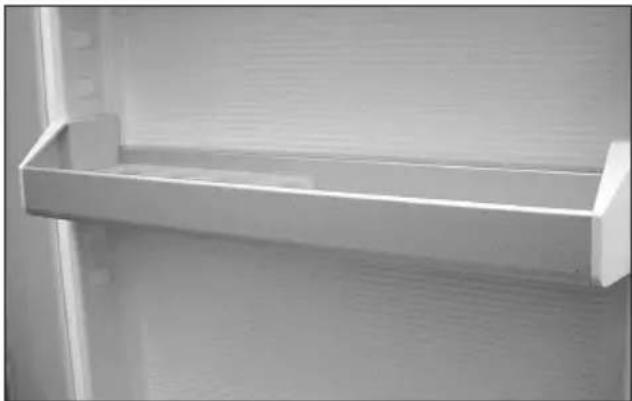
The compartments in the door can easily be adjusted and allow you to organise the divisions to suit your individual needs.
To adjust the door compartments (fig 2) and bottle drawer: first push up and pull out, adjust to the required height and proceed in inverse order to replace. Please note that the lid of the topmost compartment is not adjustable.
Cooling compartment
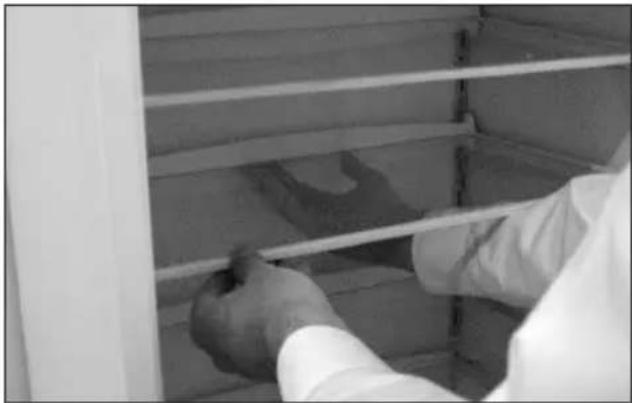
The glass shelves inserted at the back can be lifted and pulled out, and their position adjusted by proceeding in reverse order. (fig. 3). Make sure that the plastic packing pieces are removed from the track on the rear wall before adjusting the shelves.
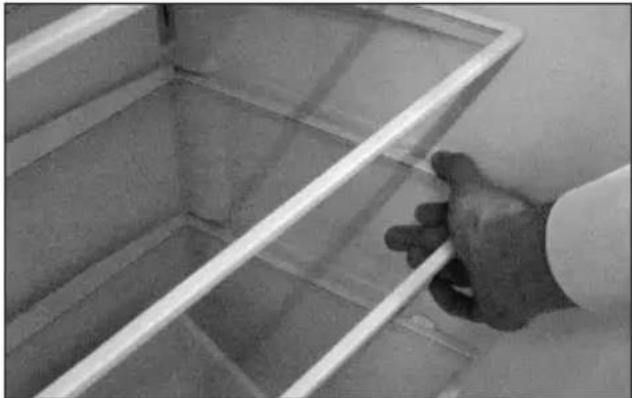
The glass shelves above and below the vegetable compartments can be removed by pressing the brackets on both sides at the same time, and lifting the shelves up and out (fig. 4). To re-insert, push the glass shelf into the groove at the back and press down at the front simultaneously into the two brackets on either side.
Bottle drawer
In this zone where the temperature is about 4 - 5^ higher than the rest of the fridge, drinks remain at the correct healthy drinking temperature of approx. 10^ .
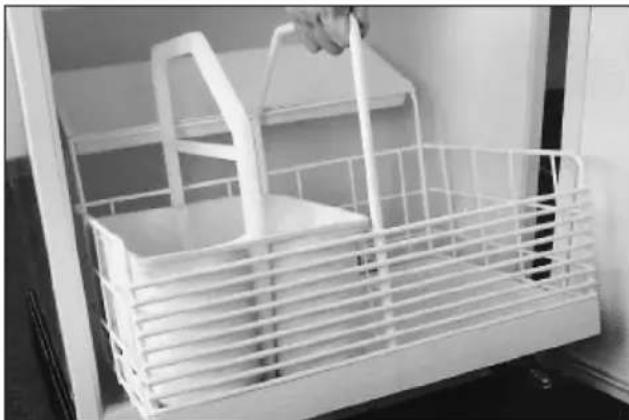
Pull out the basket: (fig. 5)
- Pull out the extension as far as it will go.
- Give a sharp pull on the operating handle and lift the basket up.
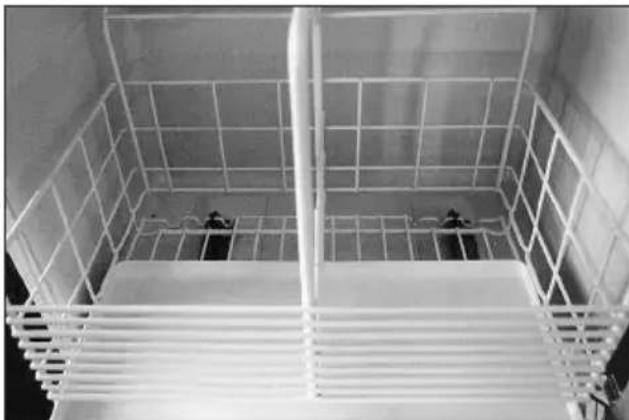
Replacing the basket: (fig. 6)
- Hold the basket against the inside wall opposite the hinges, lifting the front of the basket slightly.
Put the rear edge of the basket onto the tracks and push together as far as the stop.
Snap the front of the basket into place by pushing down on the operating handle.
5
6
Defrosting
The cooling compartment thaws entirely automatically. The ice that forms on the rear wall melts. The resulting water runs off through the weephole and evaporates in the drain pan outside the refrigerator.
Keep the collector duct and the weephole clean so that the water can drain off without obstruction. Clean the weephole with the green cleaner provided by moving it vertically and turning it.
Defrost the deep-freeze if large quantities of ice form. A thick layer of ice prevents the cold from reaching the frozen food. While defrosting, keep the deep-frozen food as cold as possible and well insulated, e.g. wrapped in newspaper.
- Turn the switch to position «0»
- Leave the door open.
The defrosting process can be considerably accelerated by placing a container of warm water (not boiling) in the deep-freeze compartment. Caution: Do not use any sharp or pointed objects to dislodge ice or frozen particles. Do not use any electrical heating appliance or naked flame to assist defrosting.
- The bottom tray of the deep-freeze collects the water as the ice thaws. Once defrosting is finished, the resulting water can be removed from the tray with a sponge or cloth.
- After defrosting, clean the inside and dry well.
- Turn the temperature regulator back to normal position and put the frozen food back.
Cleaning
To ensure perfectly hygienic storage of food, the refrigerator must be kept clean. Wash the cooling compartment out from time to time with a mild soapy solution and dry carefully. Wiping the inside of the fridge down with water containing a little vinegar also helps to combat smells and is recommended. Keeping the door seals clean prevents them from sticking and hence being damaged. Do not use any abrasive cleaning agents or scratchy cloths. Clean the door seals with a soft brush or paintbrush. If the fridge is out of use for any length of time, set the regulating knob to the position «0», empty the fridge, defrost, clean
and leave the doors of the cooling compartment and of the deep-freeze open.
- Make sure that no cleaning water gets into the regulator housing (risk of short circuit)
- Make sure that no cleaning water can get through the weephole into the evaporation tray.
- Before putting into operation, make sure that the appliance and the seals of the cooling and deep-freeze compartments are completely dry.
Tips
When using your new refrigerator, pay attention to the following points:
If possible do not install the fridge near radiators, heating pipes or chimneys, and protect it from direct sunlight.
A new fridge needs to run for approx.15 hours (with food) before it reaches normal operating temperatures.
- Do not keep the fridge door open any longer than necessary. Make sure when closing it that the door is properly closed and sealed. The self-closing hinges help in this.
Drinks and other foodstuffs may take up to 6 hours to cool down from room temperature to fridge temperature. The warmer the food is when put in the fridge, the longer it will take to cool.
Adjusting the temperature regulator has no effect on the cooling time, only on the temperature level.
- Let warm or hot food cool down outside the fridge first.
Storing goods that give off moisture may lead to condensation forming on the glass shelves.
Make sure that no food comes into contact with the rear wall of the fridge where it could freeze on and the water drain off into the cooling compartment when it thaws. -
When organising storage pay attention to the following:
-
Do not let oil or grease touch the plastic parts or the door seals
- Whatever the operating position of the temperature regulator, in the cooling compartment the coldest zones are at the back and above the bottom shelf. Therefore, put easily spoilt food on the bottom shelf.
Example of fridge organisation:
- In the deep-freeze compartment you can freeze and store food, and make ice.
- On the shelves, from top to bottom, come bread and cakes, ready-made dishes, dairy products, meat and sausages.
- In the door compartments from top to bottom: butter and cheese, tubes, small tins and eggs, large bottles.
- In the vegetable compartments vegetables, fruit and salad ingredients
- In the drawer: drinks, bottles
Replacing the light bulb
A faulty light bulb must be replaced immediately.
- Shut off the power: Disconnect the plug or fuse.
- Remove the protective cover on the light by pulling it off towards the rear, unscrew the light bulb and replace by a new one. Push the protective cover back onto the light from behind until it snaps into place.
Light bulbs are available from your nearest After-sales service point or in specialist shops. Use pilot lamps T25/230 V/ 15 W/E14. Oven lamps (300^) are not suitable.
Malfunctions
Your refrigerator has been tested to ensure that it functions perfectly before delivery. In the event of faulty operation, please contact your nearest After-sales service point and quote the type of refrigerator as well as the fault.
Malfunctions can also be caused by electric fuses going. The damage is easily remedied by replacing the appropriate fuse.
Guarantee
We grant you the guarantee from the date of delivery to the end user.
Any faults that may occur during the period of guarantee, despite the fridge being used according to the regulations, and which are due to a material or manufacturing defect, will be remedied under guarantee by the After-sales service.
The guarantee does not cover:
-faulty light bulbs
- breakage of glass shelves and plastic parts
- defects due to non-observance of the operating instructions or improper use of the appliance
claims for damages over and above the services covered by the guarantee
- appliances that have been repaired by a third party.
Operating noises
Noises which are totally normal
The refrigerator is cooled by a compressor (cooling aggregate). The compressor pumps coolant through the cooling system, and this produces noise. Even when the compressor cuts out, noises caused by temperature and pressure variations are unavoidable.
This cooler is fitted with a quiet compressor and low-noise cooling circuit in accordance with the latest state of technology. However, certain noises are unavoidable and their intensity depends on the size of the cooler.
Operating noises are most audible immediately after the compressor cuts in. They become quieter as the operating period continues.
Noises which are not normal
Most unusual noises are caused by improper installation. The cooler must be installed or built-in so that it is level and stable. Under no circumstances should pipes be in contact with a wall, other furniture or one another.
Where coolers are built in to open-plain kitchens or partition walls, normal operating noises will be more audible. However, this is due to the surrounding architecture and not to any fault with the cooler.
Description Cause Comment
| Droning Cooling aggregate Normal operating noise of the cooling aggregate. The level is dependent on the size of cooler | ||
| Humming Fan Normal operating noise of the fan | ||
| Gurgling Cooling circuit Normal operating noise as coolant flows through Babbling the circuit Murmuring | ||
| Hissing Cooling circuit Normal operating noise as coolant is injected into the condenser | ||
| Clicking Thermostat Normal switching sound of the electromechanical temperature controller | ||
| Rattling Shelves, baskets, Position the interior parts so that they don’t touch one fitted holders, refri- another, or so that they are fitted securely. gerator contents etc. | ||
| Cracking | Cooler housing | Normal as materials expand and contract due to temperature variations (e.g. plastics, insulation) |
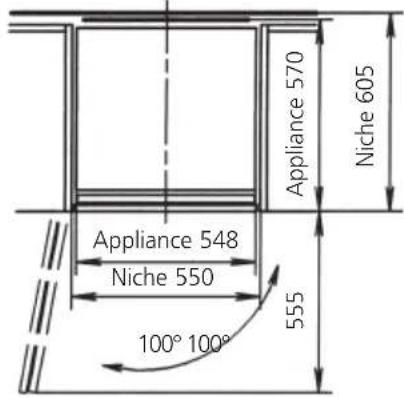
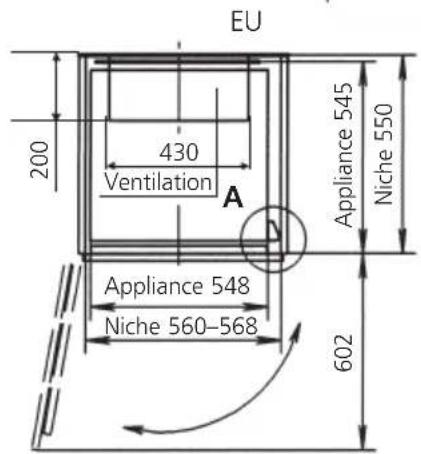
Built-in Refrigerator Niche SINK 14/6 (1778 mm)
Electrical safety (shock-hazard protection) must be effected as part of the installation procedure. If the power point is no longer accessible once the appliance is in place, a current breaker must be provided on installation. Current breakers are switches with a contact opening of at least 3mm , including LS switches and fuses as well as contactors.
Where the appliance space measures 550mm the output data of the appliance are also guaranteed.
Ventilation section top and bottom min. 200cm^2
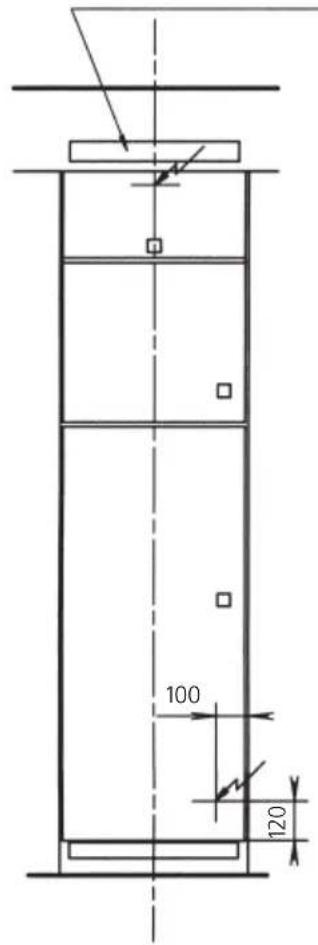
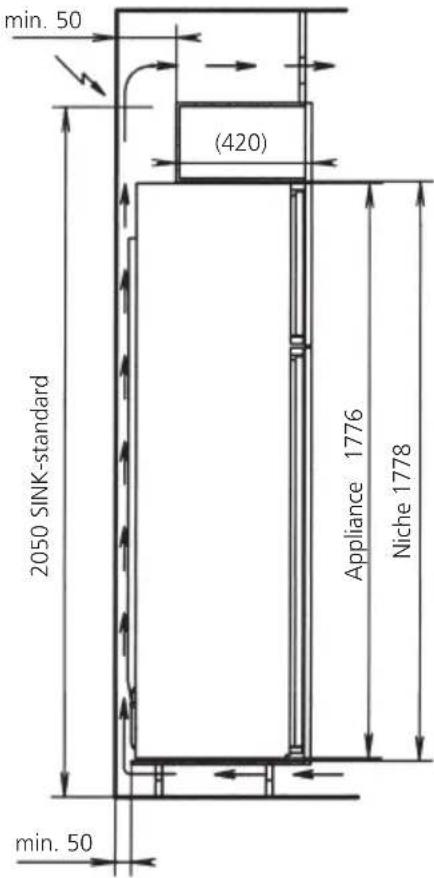
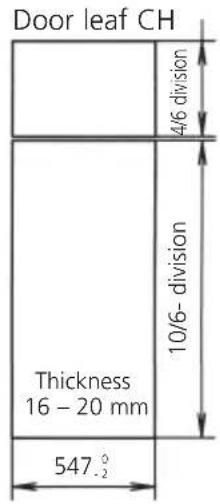
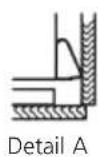
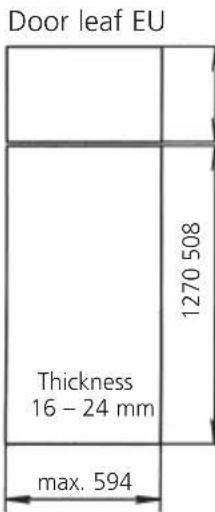

1270+ Niche projection
aannnnnne aannnnnne
Integrated CH Integrated
Summario
Subjecttoalterations.
Salvomodifiche.
- Dear Customer
- Disposing of the old refrigerator
- Disposing of the packaging
- Safety hints and warnings
- Switching on and temperature selection
- (Fig. 1)
- Important:
- Low ambient temperature
- Off: Position 0
- Freezing
- Cooling compartment
- Bottle drawer
- Defrosting
- Cleaning
- Tips
- Replacing the light bulb
- Malfunctions
- Guarantee
- Operating noises
- Built-in Refrigerator Niche SINK 14/6 (1778 mm)
- Summario
Brand : GAGGENAU
Model : IK 513 032
Category : Refrigerator