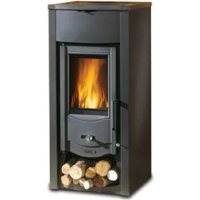
Giorgia - Heating La Nordica - Free user manual and instructions
Find the device manual for free Giorgia La Nordica in PDF.



| Product Type | Wood Stove (Fireplace) |
| Brand | La Nordica |
| Model | Giorgia |
| Nominal Power | 6 kW |
| Energy Efficiency | 81.3% |
| Flue Connection Diameter | 120 mm |
| Maximum Fuel Quantity (Wood) | 1.7 kg |
| Dimensions (H x W x D) | 930 x 414 x 471 mm |
| Net Weight | 92 to 135 kg |
| Firebox Dimensions (W x D) | 230 x 232 mm |
| Main Materials | Galvanized steel, enameled cast iron, thermo-radiant ceramic |
| Grate Type | Pivoting flat grate (outside) |
| Authorized Fuel | Dry wood logs (humidity <20%) |
| Air Controls | Primary air (under the door) and secondary air (above the door) |
| Door Type | Panoramic door with vitroceramic (resistant to 700°C), automatic closing |
| Safety Distances (Front) | 100 cm minimum (40 cm with protection) |
| Safety Distances (Sides) | 30 cm minimum (unless otherwise specified on label) |
| Floor Protection | Fireproof base required on flammable floor |
| Indicative Heating Volume | Up to 172 m3 (depending on insulation) |
| Maintenance | Annual flue cleaning, regular ash removal, clean glass when cold |
| Warranty | Declaration of performance compliant |
Frequently Asked Questions - Giorgia La Nordica
User questions about Giorgia La Nordica
0 question about this device. Answer the ones you know or ask your own.
Ask a new question about this device
Download the instructions for your Heating in PDF format for free! Find your manual Giorgia - La Nordica and take your electronic device back in hand. On this page are published all the documents necessary for the use of your device. Giorgia by La Nordica.
USER MANUAL Giorgia La Nordica
INSTRUCTIONS FOR INSTALLATION, USE AND MAINTENANCE - EN
According to the safety prescriptions on equipment, the purchaser and the operator are obliged to get informed about the correct operation according to the instructions for use.
DECLARATION OF CONFORMITY OF THE MANUFACTURER
Object: Absence of asbestos and cadmium
We declare that the materials used for the assembly of all our appliances are without asbestos parts or asbestos derivates and that in the material used for welding, cadmium is not present, as prescribed in relevant norm.
Object: CE n. 1935/2004 regulation.
We declare that in all products we produce, the materials which will get in touch with food are suitable for alimentary use, according to the a.m. CE regulation.
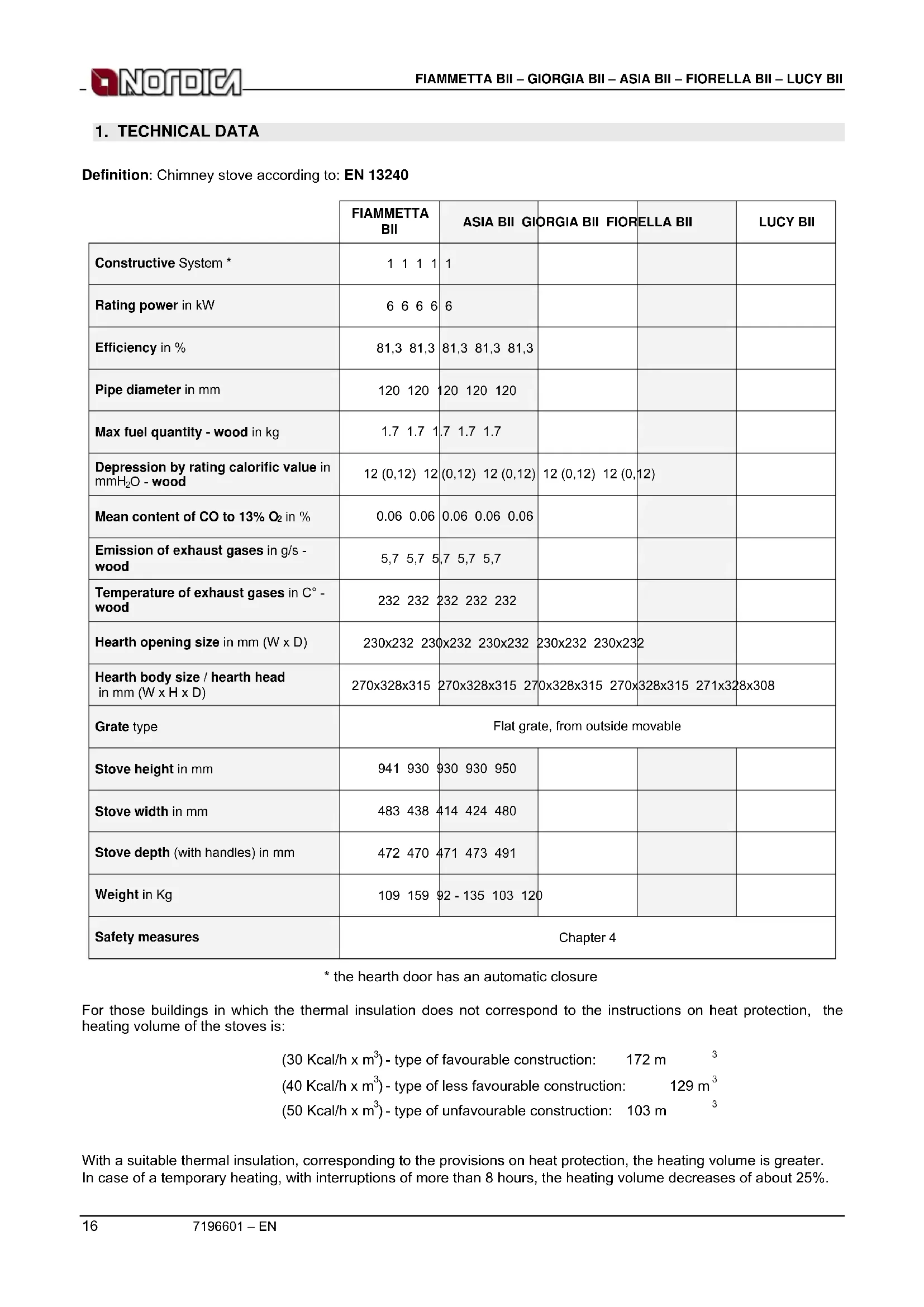
Definition: Chimney stove according to: EN 13240
| FIAMMETTA BII | ASIA BII | GIORGIA BII | FIORELLA BII | LUCY BII | |
| Constructive System * | 1 1 1 1 | 1 | |||
| Rating power in kW | 6 6 6 6 | 6 | |||
| Efficiency in % | 81,3 81,3 | 81,3 81,3 | 81,3 81,3 | ||
| Pipe diameter in mm | 120 120 | 120 120 | 120 120 | ||
| Max fuel quantity - wood in kg | 1.7 1.7 1.7 | 1.7 1.7 1.7 | |||
| Depression by rating calorific value in mmH2O - wood | 12 (0,12) 12 | (0,12) 12 (0,12) | 12 (0,12) 12 (0,12) | ||
| Mean content of CO to 13% O2in % | 0.06 0.06 | 0.06 0.06 0.06 | |||
| Emission of exhaust gases in g/s - wood | 5,7 5,7 5,7 | 7 5,7 5,7 | |||
| Temperature of exhaust gases in C° - wood | 232 232 | 232 232 232 | |||
| Hearth opening size in mm (W x D) | 230x232 230x232 | 230x232 230x232 | 230x232 230x232 | ||
| Hearth body size / hearth head in mm (W x H x D) | 270x328x315 | 270x328x315 270x328x315 | 270x328x315 270x328x315 | 271x328x315 271x328x315 | 271x328x315 271x328x315 |
| Grate type | Flat grate, from outside movable | ||||
| Stove height in mm | 941 930 | 930 930 950 | |||
| Stove width in mm | 483 438 | 414 424 480 | |||
| Stove depth (with handles) in mm | 472 470 | 471 473 491 | |||
| Weight in Kg | 109 159 | 92 - 135 103 120 | |||
| Safety measures | Chapter 4 | ||||
- the hearth door has an automatic closure
For those buildings in which the thermal insulation does not correspond to the instructions on heat protection, the heating volume of the stoves is:
(30 Kcal/h x m³)- type of favourable construction: 172 m
(40 Kcal/h x m³)- type of less favourable construction: 129 m³
(50 Kcal/h x m³)- type of unfavourable construction: 103 m³
With a suitable thermal insulation, corresponding to the provisions on heat protection, the heating volume is greater. In case of a temporary heating, with interruptions of more than 8 hours, the heating volume decreases of about 25% .
2. TECHNICAL DESCRIPTION
The chimney stoves of La Nordica are suitable to heat living spaces for some periods or to support an insufficient centralized heating system. They are ideal for holiday apartments and weekend houses or as an auxiliary heating system during the whole year. As fuel, it is possible to use wood logs.
The chimney stove is made of metal sheets in galvanized steel, enamelled cast iron and, depending on the versions, thermo radiant ceramics or soapstone plates. The hearth is totally sheathed with single cast-iron sheets. Its back is extractable. Thanks to calibrated holes, made on the same back, it is guaranteed a supply of pre-heated air inside the hearth, thus obtaining a post-combustion which increases the efficiency and reduces the emission of the unburnt gases. Inside it there is a turning and extractable grate.
The hearth is equipped with a panoramic door with ceramic glass (resistant up to 700°C ). This allows a wonderful view of the burning flames. Furthermore, it is thus avoided the output of sparks and smoke.
The heating of the environment is made:
a) by convection (about 70% ): the passage of air through the double sheath of the stove releases heat in the environment.
b) by radiation (about 30% ): through the panoramic glass and the external hot surfaces of the stove, the heat is radiated into the environment.
The chimney stove is equipped with registers of primary and secondary air by which it is adjusted the combustion air.
PRIMARY air register (A Picture 1)
With the air register placed under the door of the hearth, it is adjusted passage of air through the ash drawer and the grate in the fuel direction. The primary air is necessary for the combustion process. The ash drawer must be regularly emptied, so that the ash does not obstruct the primary air entry for the combustion. Through the primary air the fire is also kept alive.
During wood combustion, the register of primary air must be opened only for a while, because otherwise the wood burns fast and the stove may overheat.
SECONDARY air register (B Picture 1)
Over the hearth door there is the secondary air register. Also this valve must be opened (then moved to the right), especially for wood combustion, so that unburnt carbon undergoes a post-combustion. See paragraph 10.
3. RULES FOR INSTALLATION
The stove, assembled and ready for the installation, must be connected with a junction to the existing flue of the house. The junction must be possibly short, straight, horizontal or positioned a little uphill. The connections must be tight.
It is OBLIGATORY to respect the National and European rules, local regulations concerning building matter and also fireproofs rules. Please apply to your chimney sweeper for all information.


Picture 1
You should verify the sufficient air entrance for the combustion in the installation place, with particular attention to windows and doors with tight closing (seal ropes).
It is not allowed the connection of various appliances to the same chimney. The diameter of the opening for the connection must correspond at least to the diameter of the smokes pipe. The opening should be equipped with a wall connection for the reception of the exhaust pipe and a rose window.
Before installation, verify if your floor can support the weight of the stove (for ex. distributing weight plate).
LA NORDICA is not responsible in case of modification of the product and for the use of not original spare parts.
THE HEARTHSH MUST NOT BE MODIFIED.
4. FIRE SAFETY
In the installation of the stove the following safety measures are to be followed:
a) In order to ensure sufficient thermal insulation, respect the minimum safety distance from objects or furnishing components flammable and sensitive to heat (furniture, wood sheathings, fabrics. etc.) and from materials with flammable structure (Picture 2 A). All the minimum safety distances are shown on the product data plate and lower values must not be used.
b) in front of the chimney stove there must not be any flammable object or building material, sensitive to heat, at less 100 cm 's. of distance. This distance can be reduced to 40 cm 's if you will install in front of the element to protect a retro ventilated and heat resistant protection.
c) If the product is installed on a non-totally refractory floor, one must foresee a fireproof background. The floors made of inflammable material, such as moquette, parquet or cork etc., must be replaced by a layer of no-inflammable material, for instance ceramic, stone, glass or steel etc. (dimensions according to the local regulations). The platform must stick out 30 cm 's sideways and 50 cm 's on the front side over the loading door (Picture 2 B).
d) no flammable components (e.g. wall units) must be present above the product.


Picture 2
The chimney stove must operate exclusively with the ash drawer inserted. The solid residue of the combustion (ashes) must be collected in a hermetic container, resistant to fire. The stove must never be ignited when there are gas or steam emissions (e.g. glue for linoleum, gasoline, etc.). Never deposit flammable materials near the stove. During the combustion will be spread thermal energy which warms up the surfaces, the door, the fireplace glass, the handles and knobs, the smoke pipe and the front side of the stove. Please avoid the contact of these parts without gloves or the relevant tools.
Warn children of the danger and keep them away during the operation of the stove.
The use of a wrong or wet fuel causes the formation of creosote deposits in the flue and will fuel a chimney fire.
4.1. FIRST-AID MEASURES
Should any fire arise in the stack or in the flue:
a) Close the feeding door and the ash drawer door;
b) Close the controls of combustion air;
c) Extinguish the fire using carbon dioxide fire-fighting means (CO 2 dust);
d) Seek immediate intervention of FIRE BRIGADE.
DO NOT EXTINGUISH FIRE USING WATER JETS.
When the fire has been extinguished, let the flue check by an expert to find possible cracks and permeable points.
5. CHIMNEY CAP POSITION
Essential requirements for a correct operation of the appliance:
the internal section must be preferably circular;
- be thermally insulated and water-proof and produced with materials suitable to resist to heat, combustion products and possible condensates;
not be throttled and show a vertical arrangement with deviations not greater than 45°
if already used, it must be clean;
- observe the technical data of the instructions manual;
Should the flues have a square or rectangular section, internal edges must be rounded with a radius not lower than 20 mm. For the rectangular section, the maximum ratio between the sides must be ≤ 1.5 .
A too small section causes a decrease of the draught. It is suggested a minimum height of 4m
The following features are forbidden and therefore they endanger the good operation of the appliance: asbestos cement, galvanized steel, rough and porous internal surfaces. Picture 3 gives some examples of execution.
The minimum section must be 4dm2 (for example 20 × 20cm s) for appliances whose duct diameter is lower than 200mm , or 6.25dm2 (for example 25 × 25cm s) for appliances with diameter greater than 200mm .
The draught created by the flue must be sufficient, but not excessive. A too big flue section can feature a too big volume to be heated and consequently cause difficulties in the operation of the appliance; to avoid this, tube the flue along its whole height. A too small sectio causes a decrease of the draught.
The flue must be properly spaced from any flammable materials or fuels through a proper insulation or an air cavity.
It is forbidden to let plant piping or air feeding channels pass in the same flue. Moreover, it is forbidden to create movable or fixed openings on the same for the connection of further other appliances.
5.1. CHIMNEY CAP
The draught of the flue depends also on the suitability of the chimney cap.
Therefore, if it is handicraft constructed, the output section must be more than twice as big as the internal section of the flue. Should it be necessary to exceed the ridge of the roof, the chimney cap must assure the discharge also in case of windy weather (Picture 4).
The chimney cap must meet the following requirements:
have internal section equivalent to that of the stack.
have a useful output section twice as big as the flue internal one.
- be manufactured in such a way as to prevent the penetration of rain, snow, and any other foreign body in the flue.
- be easily checkable, for any possible maintenance and cleaning operation.
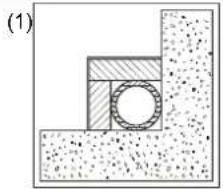


(1) AISI 316 steel flue with double chamber insulated with material resistant to 400°C . Efficiency 100% excellent.
(2) Refractory flue with double insulated chamber and external coating in lightweight concrete. Efficiency 100% excellent.
(3) Traditional clay flue square section with cavities. Efficiency 80% excellent.
(4) Avoid flues with rectangular internal section whose ratio differs from the drawing. Efficiency 40% poor.
Picture 3

(1) Industrial chimney cap with pre-fabricated elements - it allows an excellent discharge of the smokes.

(2) Handicraft chimney cap. The right output section must be at least twice as big as the internal section of the flue (ideal value: 2.5 times).

(3) Chimney cap for steel flue with conical deflector of smokes.
Picture 4


(1) In case of flues side by side, a chimney cap must be higher than the other one of at least 50 cm in order to avoid pressure transfers between the flues themselves.
Picture 5

(1) The chimney cap must not show hindrances within 10m from walls, pitches and trees. Otherwise raise it of at least 1 m over the hindrance.
The chimney cap must exceed the ridge of the roof of at least 1m
Picture 6

Picture 7
| CHIMNEY CAPS - DISTANCES AND POSITIONING UNI 10683/98 | ||
| Inclination of the roof | Distance between the roof ridge and the stack | Minimum height of the stack (measured from the outlet) |
| α | A (m) H (m) | |
| 15° | < 1.85 m 0.50 m above the roof ridge | |
| > 1.85 m 1.00 m from the roof | ||
| 30° | < 1.50 m 0.50 m above the roof ridge | |
| > 1.50 m 1.30 m from the roof | ||
| 45° | < 1.30 m 0.50 m above the roof ridge | |
| > 1.30 m 2.00 m from the roof | ||
| 60° | < 1.20 m 0.50 m above the roof ridge | |
| > 1.20 m 2.60 m from the roof | ||
6. CONNECTION TO THE CHIMNEY
For safety reasons the door of the appliances with constructive system 1, must be opened only for the loading of the fuel or for removing the ashes, while during the operation and the rest, the door of the hearth must remain closed.
The appliances with constructive system 2 must be connected to their own flue. The operating with open door is allowed under supervision.
The stove is endowed with an upper exhaust pipe. The connection pipe to the flue must be the shortest possible, right, tight and according to the current regulations.
The connection to the chimney must be performed with stable and strong pipes (we recommend a thickness of 2 mm). The pipe for smokes exhaust must be fixed hermetically to the chimney. The diameter inside the connection pipe must correspond to the external diameter of the smokes exhaust small trunk of the stove. This is ensured by pipes according to DIN 1298.
ATTENTION: Eventual flammable pieces in the area of 20 cm 's round the connection pipes must be changed with fireproof and not sensitive to heat materials.
For a good operation of the equipment it is essential that in the installation place it is introduced sufficient air for combustion (see chapter 7).
The depression on the chimney should be 12 Pascal (= 1.2mm of water column). The measurement must be done always with the equipment hot (rating calorific value). When the depression exceeds 17 PA (1.7mm of water column) it is necessary to reduce the same with the installation of an additional flue adjuster (butterfly valve) on the exhaust pipe or in the chimney.
For safety reasons the door of the stove must be opened only for the loading of the fuel or for removing the ashes, while during the operation and the rest, the door of the hearth must remain closed.
7. AIR ENTRANCE INTO THE INSTALLATION PLACE DURING COMBUSTION
As the stoves take their combustion air from the installation place, it is essential that a sufficient quantity of air is introduced in the installation room itself.
In case of tight doors and windows (for example houses built according to the energy saving criteria) it is possible that the air entrance is not guaranteed, compromising the draught, the welfare and the security of the people. It is necessary to guarantee a further air entrance through an external air intake, to be positioned in the nearby of the appliance or through air connection towards outside or a near ventilated room, with the exception of thermal units place or garages (FORBIDDEN).
The connection pipe must be flat with a minimum diameter of 120mm , a maximum length of 4m and with no more than 3 bends. If there is a direct connection with the outside it must be endowed with a special windbreak.
The air entrance for combustion into the installation place must not be closed during the operation of the stove. It is absolutely necessary that in the environment in which the stoves operate with the natural flue of the chimney, it is introduced as much air as necessary for the combustion, i.e. up to 20m3/ hour.
The natural recirculation of air must be ensured by some fixed openings on the outside. The size of the necessary openings for air is fixed by the relevant prescriptions. Ask information to your chimney sweeper. The openings should be protected with grids and should never be obstructed.
An extraction hood (aspirating) installed in the same room or in a room nearby, in case of insufficient flow of fresh air may negatively affect the functions of your appliance with the output of combusted gasses (smoke, smell even if with the door closed). As consequence the extraction hoods must not absolutely work at the same time with the stove.
The depression in an extraction hood can at worst hypothesis, transforms the flue into an external air intake, by sucking the smokes of the rooms with dangerous consequences for the people.
OPTIONAL
For a better comfort and corresponding oxygenation of environment, the stove combustion air can be directly withdrawn at the outside. order to do that, the stove can be connected to the external air socket by an optional junction (Picture 8 - C) ( Kit Ø 120 ).

8. ADMITTED/NOT ADMITTED FUEL
The fuels admitted are wood logs. One must use only logs of dry wood (water content max. 20% ). The size of wood logs should be 30 cm's long and 30 cm's max in circumference.
The wood used as fuel must have a moisture contents lower than 20% , which is obtained after at least 1 year drying (tender wood) or 2 years (hard wood) and must be stored in a dry and ventilated place (for ex. Under a shed). The wet wood makes ignition more difficult because it is necessary a greater quantity of energy to evaporate the existing water. The humid contents has the disadvantage that, with the temperature lowering, the water condensates first in the hearth and then in the chimney. The unseasoned wood contains about 60% of H20, then it is not suitable to be burnt. The following cannot be burnt: rests of coal, cut-offs, parts of barks and panels, wet wood or treated with varnished, plastic materials. In this case the guarantee on the appliance lapses. Paper and carton must be used only for ignition.
The combustion of wastes is FORBIDDEN by national law on the protection against emissions. This may damage the stove and the chimney, causing health damages and claims by the neighbourhood owing to the bad smell.
The wood is not a fuel which allows a continuous operation of the appliance, as consequence the heating all over the night is not possible.
| variety Kg/mc | KWh/Kg moistness 20% | |
| Beech 750 4,0 | ||
| Oak 900 4,2 | ||
| Elm 640 4,1 | ||
| Poplar 470 4,1 | ||
| Larch* 660 4,4 | ||
| Spruce* 450 4,5 | ||
| Scots pine * | 550 4,4 |
* RESINOUS WOOD NOT SUITABLE FOR THE BURNING
ATTENTION: the continuous and protracted use of aromatic wood (eucalyptus, myrtle etc.) quickly damages the cast iron parts (cleavage) of the product.
9. LIGHTING
IMPORTANT: The first time that the appliance is lit, there will be an odour given off (due to the drying of the adhesives of the junction chord), which disappears after a short use. It must be ensured, in any case, a good ventilation of the environment. Upon the first ignition we suggest loading a reduced quantity of fuel and slightly increasing the calorific value of the equipment.
To perform a correct first lighting of the products treated with paints for high temperature, it is necessary to know the following information:
- the construction materials of the involved products are not homogeneous, as matter of fact there are simultaneously parts in cast iron, steel, refractory material and majolica;
- the temperature to which the body of the product is subject is not homogeneous: from area to area, variable temperatures within the range of 300°C - 500°C are detected;
during its life, the product is subject to alternated lighting and extinguishing cycles in the same day, as well as to cycles of intense use or of absolute standstill when season changes; - the new appliance, before being considered seasoned has to be subject to many start cycles to allow all materials and paints to complete the various elastic stresses;
- in detail, initially it is possible to remark the emission of smells typical of metals subject to great thermal stress, as well as of wet paint. This paint, although during the manufacture it is backed at 250°C for some hours, must exceed many times and for a given period of time the temperature of 350°C before becoming completely embedded in the metallic surfaces.
Therefore, it is extremely relevant to take these easy steps during the lighting:
1) Make sure that a strong air change is assured in the room where the appliance is installed.
2) During the first starts, do not load excessively the combustion chamber (about half the quantity indicated in the instructions manual) and keep the product continuously ON for at least 6-10 hours with the registers less open than the value indicated in the instructions manual.
3) Repeat this operation for at least 4-5 or more times, according to your possibilities.
4) Then load more and more fuel (following in any case the provisions contained in the installation booklet concerning maximum load) and, if possible, keep the lighting periods long avoiding, at least in this initial phase, short ON/OFF cycles.
5) During the first starts, no object should be leaned on the appliance and in detail on enamelled surfaces. Enamelled surfaces must not be touched during heating.
6) Once the «break-in» has been completed, it is possible to use the product as the motor of a car, avoiding abrupt heating with excessive loads.
To light the fire, it is suggested using small wood pieces together with paper or other traded lighting means. It is FORBIDDEN to use any liquid substance as for ex. alcohol, gasoline, oil and similar.
The openings for air (primary and secondary) must be opened together just a little (you must open the eventual butterfly valve placed on the pipe of smokes exhaust). When the wood starts burning, adjust the air for combustion according to the instructions on paragraph 10.
Never overload the stove (compare the technical table - max. quantity of loadable fuel).
Too much fuel and too much air for the combustion may cause overheating and then damage the stove.
The warranty does not cover the damages due to overheating of the equipment.
For safety reasons the door of the appliances with constructive system 1, must be opened only for the loading of the fuel or for removing the ashes, while during the operation and the rest, the door of the hearth must remain closed. The appliances with constructive system 2 must be connected to their own flue. The operating with open door is allowed under supervision.
IMPORTANT: For safety reasons the door of the hearth can be opened only for the loading of the fuel. The hearth door must always remain closed during operation or rest.
The nominal power of the appliance (6 kW) will be reached with a minimum depression in the chimney of 12 Pa (= 1,2 mm of water column).
With the registers located on the front of the appliance it is possible to adjust the heat emission of the same. They have to be opened according to the calorific need. The best combustion (with minimum emissions) is reached when, by loading the wood, most part of the air for combustion flows through the secondary air register.
Never overload the appliance (see the hourly wood load in the table here below). Too much fuel and too much air for the combustion may cause overheating and then damage the stove.
The warranty does not cover the damages due to overheating of the equipment.
You should always use the stove with the door closed in order to avoid damages due to overheating (forge effect).
| FUEL PRIMARY air (A) SECONDARY air (B) | ||
| Wood CLOSED OPENED | ||
| Max quantity 1,8 kg/h | ||
Besides by the adjustment of air for the combustion, the intensity of combustion and then the calorific value of your stove is affected by the chimney. A good flue of the chimney requires a more reduced adjustment of air for the combustion, while a poor flue needs more an exact adjustment of air for combustion.
To verify the good combustion of the stove, check if the smoke coming out from the chimney is transparent. If it is white, it means that the stove is not correctly adjusted or the wood is too wet; if on the contrary the smoke is grey or black, it means that the combustion is not complete (it is necessary a greater quantity of secondary air).
11. OPERATION DURING TRANSITION PERIODS
During transition periods when the external temperatures are higher, if there is a sudden increase of temperature it can happen that the combustion gases inside the flue cannot be completely sucked up.
The exhaust gases do not come out completely (intense smell of gas). In this case, shake the grating more frequently and increase the air for the combustion. Then, load a reduced quantity of fuel in order to permit a rapid burning (growing up of the flames) and the stabilization of the draught.
Then, check that all openings for the cleaning and the connections to the stack are air-tight.
12. MAINTENANCE AND CARE
Let check the installation of your stove, the connection to chimney and the ventilation by your chimney sweeper.
For the cleaning of enamelled surfaces use soap water or not aggressive and not chemically abrasive detergents.
IMPORTANT: It is possible to use exclusively spare parts clearly authorized and offered by LA NORDICA. In case of need please apply to your dealer!
THE APPLIANCE CAN NOT BE MODIFIED!
12.1. CLEANING OF THE FLUE
A correct lighting, the burning of a proper fuel, the loading of the suggested quantity of fuel, the right adjustments of the secondary air control, the sufficient draught of the chimney and the presence of air for the combustion, are essential for the good operation of the appliance.
The appliance should be completely cleaned at least once a year or every time it is needed (in case of bad working and low yield). The cleaning must be carried out exclusively with cold equipment.
This operation should be carried out by a chimney sweeper who can simultaneously perform an audit of the flue (checking of possible deposits). During the cleaning, it is necessary to remove from the appliance the ash drawer and the smokes pipes. It is possible to clean the space for the collection of smokes from the hearth or through the smoke exhaust, by using a brush and a vacuum cleaner. Once the cleaning has been completed, the same has to be positioned back in its seat.
12.2. CLEANING OF THE GLASS
Thanks to a specific entry of the secondary air the building of deposit on the glass of the door is slowed down in a remarkable way. However the building of this deposit cannot be avoided with the use of solid fuels such as wet wood, and this is not to be considered as a defect of the appliance.
IMPORTANT: The cleaning of the sight glass must be carried out only and exclusively with cold appliance to avoid the explosion of the same. Do not use cloths, abrasive or chemically aggressive products by cleaning the hearth glass.
The correct lighting phase, the use of proper quantities and types of fuels, the correct position of the secondary air regulator, enough draught of the chimney-flue and the presence of combustion air are the essential elements for the optimal functioning of the appliance and for the cleaning of the glass.
BREAK OF GLASSES:
Considering that the glasses are manufactured in glass-ceramic and resistant to heat shock up to 750°C , they are not subject to thermal shocks. Their break can be caused only by mechanic shocks (bumps or violent closure of the door, etc.). Therefore, their replacement is not included in the warranty.
12.3. CLEANING OF THE ASH-DRAWER
All the appliances are equipped with a hearth grate and an ash drawer for the collection of the ashes.
It is suggested to empty periodically the ash drawer and to avoid it fills completely in order not to overheat the grate. Moreover, we recommend leaving always 3-4 cm of ash in the hearth.
ATTENTION: The ashes removed from the hearth have to be stored in a container made of fire-resistant material equipped with an air-tight cover.
The container has to be placed on a fire-resistant floor, far from flammable materials up to the switching off and complete cooling.
12.4. MAJOLICAS
LA NORDICA has chosen majolica tiles, which are the result of high-quality artisan work and therefore the majolica may present crackles, speckles, and shadings. These characteristics certify their precious origin.
Enamel and majolica, due to their different coefficient of dilatation, produce microcrackles, which show their authentic feature.
For the cleaning of the majolica we suggest using a soft and dry cloth; if you use a detergent or liquid, the latter might soak in and make the crackles more visible.
13. SUMMER STOP
After cleaning the hearth, chimney and hood, totally eliminating the ash and other eventual residues, close all the doors of the hearth and the relevant registers and disconnect the appliance from the chimney.
We suggest performing the cleaning operation of the flue at least once per year; verifying in the meantime the actual status of the rope seals which cannot ensure the good operation of the equipment if they are not in good condition and are not making a good seal! In this case the seals must be replaced.
In presence of dampness in the room where the stove has been placed, we advise you to put absorbent salts into the hearth.
If you want to keep for long the aesthetic look of the cooker it is important to protect its internal walls in row cast iron with neutral Vaseline.
14. CONNECTING A CHIMNEY OR OPEN FURNACE TO THE FLUE
The smoke channel is the section of tube that connects the product to the flue, in the connection these simple but very important principles must be followed:
- for no reason must the smoke channel be used with a diameter lower than that of the neck of the outlet with which the product is fitted:
- each metre of horizontal route of the smoke channel causes a small leak of charge which should be compensated for by raising the flue:
the horizontal section must never be higher than 2 m (UNI 10683-2005); -
each bend of the smoke channel considerably reduces the draught of the flue which must be compensated for by raising it suitably;
-
the UNI 10683-2005 Regulation -Italy requires that the bends or variations of direction must in no case be greater than 2 including the emission into the flue.
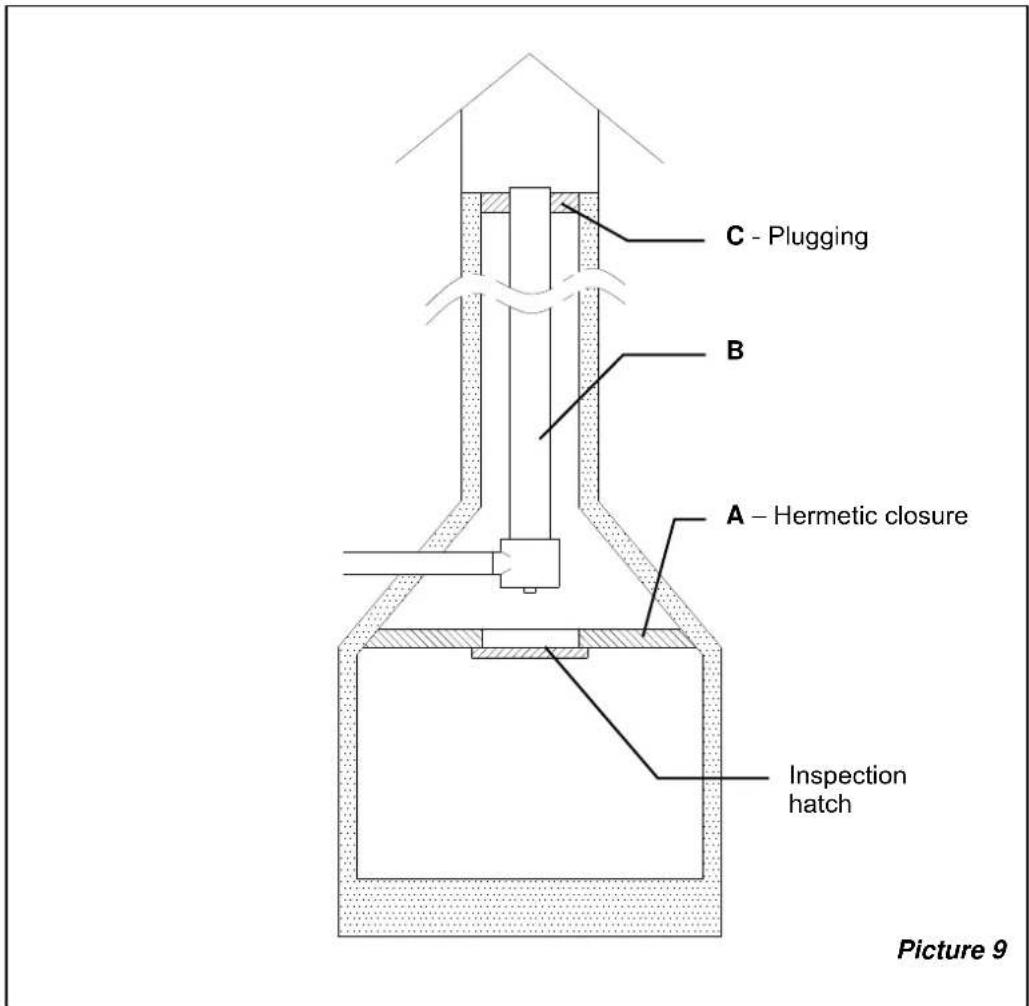
Wanting to use the flue of a chimney or open furnace, it will be necessary to close the hood hermetically below the inlet point of the smoke channel pos. A Picture 9.
If the flue is too large (e.g. cm 30x40 or 40x50) it is necessary to duct it with a stainless steel tube of at least 200mm of diameter, pos. B taking care to close the space between the tube itself and the flue immediately below the chimney cap pos. C.
For further information please contact your Dealer.
3. INSTALLATIONSVORSCHRIFTEN
6. RACCORDEMENT AU CONDUIT DE FUMEE
8. COMBUSTIBLES ADMIS / NON ADMIS
This declaration of performance is issued under the manufacturer's sole responsibility referred to in point 4.
CE MARKING INFORMATION
This declaration of performance is issued under the manufacturer's sole responsibility referred to in point 4.
CE MARKING INFORMATION
This declaration of performance is issued under the manufacturer's sole responsibility referred to in point 4.
Aministratore delegato Managing Director
CE MARKING INFORMATION
Data and models are not binding: the company reserves the right to carry out modifications and improvements without notice
- DECLARATION OF CONFORMITY OF THE MANUFACTURER
- TECHNICAL DESCRIPTION
- PRIMARY AIR REGISTER (A PICTURE 1)
- SECONDARY AIR REGISTER (B PICTURE 1)
- RULES FOR INSTALLATION
- FIRE SAFETY
- FIRST-AID MEASURES
- DO NOT EXTINGUISH FIRE USING WATER JETS
- CHIMNEY CAP POSITION
- CHIMNEY CAP
- CONNECTION TO THE CHIMNEY
- AIR ENTRANCE INTO THE INSTALLATION PLACE DURING COMBUSTION
- OPTIONAL
- ADMITTED/NOT ADMITTED FUEL
- RESINOUS WOOD NOT SUITABLE FOR THE BURNING
- LIGHTING
- OPERATION DURING TRANSITION PERIODS
- MAINTENANCE AND CARE
- CLEANING OF THE FLUE
- CLEANING OF THE GLASS
- BREAK OF GLASSES
- CLEANING OF THE ASH-DRAWER
- MAJOLICAS
- SUMMER STOP
- CONNECTING A CHIMNEY OR OPEN FURNACE TO THE FLUE
- INSTALLATIONSVORSCHRIFTEN
- RACCORDEMENT AU CONDUIT DE FUMEE
- COMBUSTIBLES ADMIS / NON ADMIS
Brand : La Nordica
Model : Giorgia
Category : Heating