RB 282100 - Fridge GAGGENAU - Free user manual and instructions
Find the device manual for free RB 282100 GAGGENAU in PDF.


| Product type | Three-zone refrigerator |
| Brand | Gaggenau |
| Model | RB 282100 |
| Refrigeration compartment | Adjustable temperature range from +3°C to +11°C |
| Special compartment | Temperature maintained between 0°C and 3°C, adjustable humidity (60% to 80% RH) |
| Freezer compartment | Adjustable temperature range from -14°C to -24°C |
| Freezing capacity | Up to 9 kg in 24 hours with Superfrost function |
| Superfrost function | Yes, activation to accelerate freezing, automatic shut-off after 24 h |
| Holiday mode | Allows switching off the refrigerator and special compartment, only the freezer remains in operation |
| Freshtimer | Indicator of food storage time in the special compartment |
| Defrosting | Automatic for refrigerator and special compartment; manual for freezer |
| Interior lighting | Two bulbs 15 W / 230 V / E14 |
| Alarms | Open door, temperature exceedance, probe or valve fault |
| Electrical connection | 220-240 V / 50 Hz, plug with minimum 10 A fuse |
| Refrigerant | R600a (isobutane) – eco-friendly |
| Cleaning | Mild soapy water, thorough drying before restarting |
| Safety | Do not use extension cord; defrost without sharp objects or flame; repairs by an authorized technician |
| Spare parts | Signal bulbs 15 W/230 V/E14 available from customer service |
Frequently Asked Questions - RB 282100 GAGGENAU
User questions about RB 282100 GAGGENAU
0 question about this device. Answer the ones you know or ask your own.
Ask a new question about this device
Download the instructions for your Fridge in PDF format for free! Find your manual RB 282100 - GAGGENAU and take your electronic device back in hand. On this page are published all the documents necessary for the use of your device. RB 282100 by GAGGENAU.
USER MANUAL RB 282100 GAGGENAU
natural_image
Line drawing of an open refrigerator with shelves and drawers (no text or symbols)Inhaltsverzeichnis
Operating instruction
23 Introduction
23 Disposal of your old appliance
23 Disposal of the packing materials
23 Safety hints and warnings
23 Electrical connection
24 Guarantee
24 Overall view
24 Operating instructions
24 Operating and checking elements
25 Variable door interior
25 Interior light
25 Fridge compartment
25 Special compartment
26 Freshtimer
26 Freezing compartment
27 Special freezing drawer
27 Cold accumulator
27 Defrosting
27 Freezing compartment
28 Cleaning
28 Tips
29 Faults
29 Alarm signals
31 Operating noises
Dear Customer
You are the owner of a modern and hence energy-saving refrigerator. We congratulate you on your purchase!
This refrigerator complies with the approved state of the art as well as EU directive 73/23/EEC (low voltage directive), is SEV-tested according to EMV directive 899/336/EWG and complies with the directive 96/57/EEC on energy efficiency.
Disposal of your old appliance
Render disused appliances unserviceable at once. Take care not to damage the pipelines of your old appliance until it is removed for proper environment-friendly disposal. Contact the responsible department of your local authority.
Disposal of the packing materials
All packing materials used are recyclable.
Safety hints and warnings
Before operating your appliance, read the operating instructions carefully and keep these in a safe place for a subsequent user.
■ Electrical safety (shock-hazard protection) must be effected as part of the installation procedure.
■ Use this appliance only for domestic purposes and as described in the operating instructions.
■ If your appliance is received in a damaged condition, contact your supplier at once.
■ Do not use extension leads.
■ Repairs and other interventions are only to be carried out by a service engineer.
■ Disconnect the supply when cleaning: Pull out the plug or trip the circuit breaker. Never pull the plug out of its socket by its lead or with wet hands. Always take hold of the plug and hold it straight when with drawing from the socket.
■ Always store beverages with a high alcohol content sealed and standing upright; never store explosive materials in the appliance. Danger of explosion!
■ The appliance is FCHC and FHC free and contains small amounts of the environment compatible refrigerant isobutane (R600a).
■ Take care not to damage the refrigerant circuit when handling the appliance. If damage should occur, keep away from fire and all kinds of ignition sources. Ventilate the room in which the appliance is situated for a few minutes.
Electrical connection
The appliance is to be connected to 220 – 240 V/50 Hz alternating current via a correctly installed connector socket.
The socket must be safeguarded with at least a 10 A fuse.
Guarantee
We grant you the guarantee from the date of delivery to the end user.
Any faults that may occur during this time, despite the fridge being used according to the regulations, and which are dues to a material or manufacturing defect, will be remedied under this guarantee by the After-sales service.
The guarantee does not cover:
– faulty light bulbs
- breakage of glass shelves and plastic parts
– defects due to non-observance of the operating instructions or improper use of the appliance
– claims for damages over and above the services covered by the guarantee
– appliances that have been repaired by a third party.
Overall View (Fig.1)
These operating instructions refer to several models.
The illustrations may differ.
* not all models
1 Operating and checking elements
2 Butter and cheese compartment *
3 Egg storage
4 Yoghurt and cream compartment
5 Bottle Rack
6 Glass shelf
7 Vegetable boxes
8 Special compartment
9 Freezing compartment
Operating instructions
This appliance has three temperature zones:
- fridge compartment: setting range from +3 °C to +11 °C
- special compartment: temperature is self-regulating between 0 °C and 3 °C.
- freezing compartment: setting range from -14^ to -24^
The temperature indication on the control panel is an averaged value and can vary from the instantaneous air temperature in the fridge compartment.
The appliance is designed for a room temperature of +10 °C to +32 °C.
Operating and checking elements
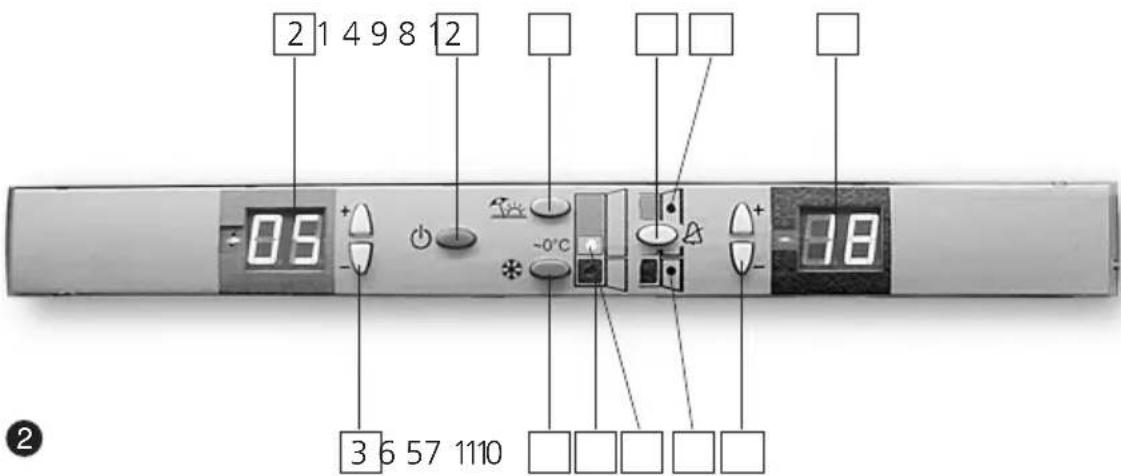
(Fig.) ^②
1 Main On / Off switch: Complete appliance: On / Off with child-proof feature: switch must be actuated for at least 3 sec.
② Fridge compartment temperature indication: Two digit indication with sign. Display of the averaged actual value. The set point is only displayed when the temperature is adjusted. The actual value is re-displayed 10 seconds after actuation. Flashing indication and acoustic alarm: temperature overshoot.
☐ Temperature setting for fridge compartment: By means of two push buttons. Top button hotter, bottom button colder.
4 Holiday setting: This cuts out both the fridge and special compartments. Only the freezing compartment remains in operation.
⑤ Operating indication for special compartment: Green: normal operation Green flashing and acoustic alarm: temperature overshoot.
☐ Superfrost button: Refrigeration unit runs continuously. Reset after 24 hours. Superfrost is switched off by pressing the button a second time.
7 «SUPER» indication: Yellow during Superfrost operation.
8 Door warning for fridge compartment: After door is open for 2 min.: flashing red and acoustic alarm.
9 Alarm reset button: Acoustic alarm is reset.
☐ Door warning for freezing compartment: After door is open for 2 min.: flashing red and acoustic alarm.
☐ Temperature setting for freezing compartment: By means of two push buttons. Top button hotter, bottom button colder.
12 Freezing compartment temperature indication: Two digit indication with sign. Display of the averaged actual value. The set point is only displayed when the temperature is adjusted. The actual value is re-displayed 10 seconds after actuation. Flashing indication and acoustic alarm: temperature overshoot.
Variable door interior
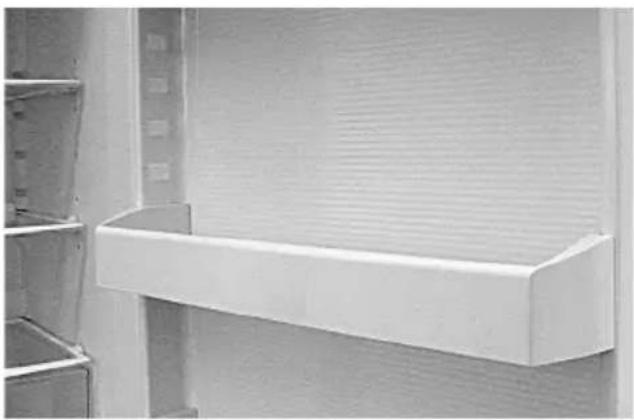
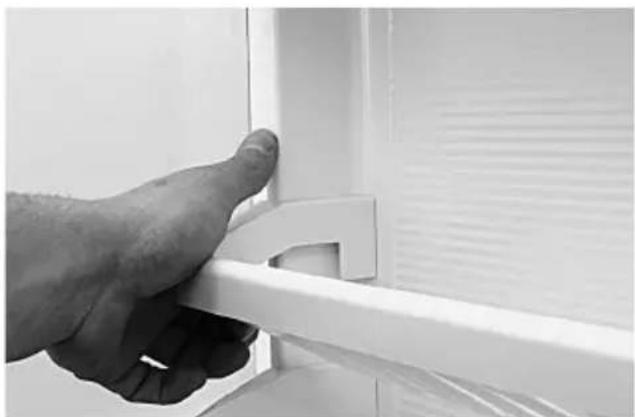
The hook-on elements (Fig.③) in the door are easy to adjust and can be arranged to individual requirements. Note that the cover for the topmost element is not adjustable. To move the bottle rack holder, first release one side by pressing (Fig.④).
Interior light
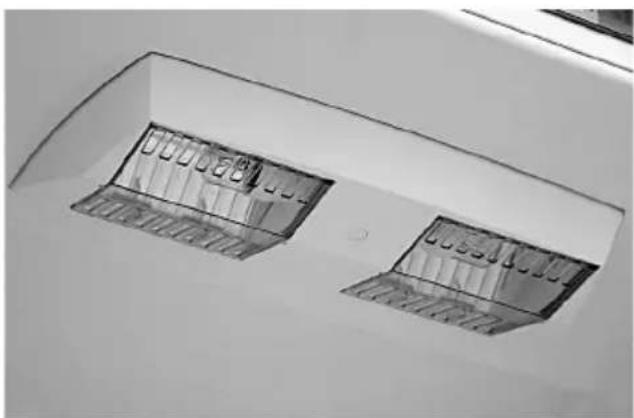
The appliance disposes of 2 bulbs (Fig.5).
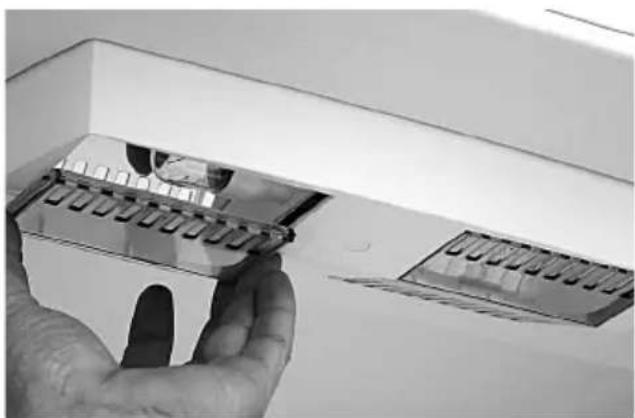
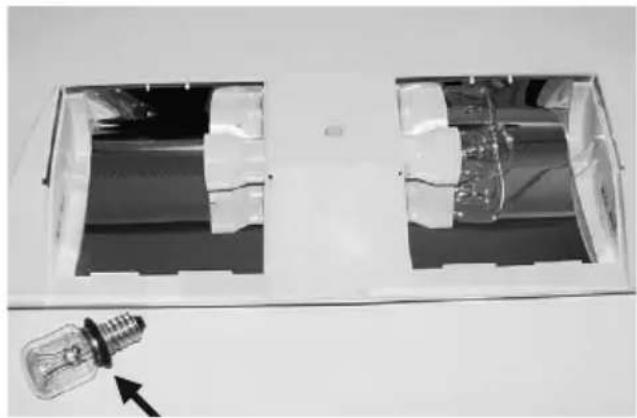
Changing the bulb (Fig.⑥)
Switch off the appliance. Press the light cover backward and unscrew the bulb. When inserting the new bulb, the existing seal (fig. 6a) have to be imperatively replaced. Replace the bulb only with bulbs of thesame type. The use of different bulbs can damage the appliance. Use only bulbs of the type 15 W/230 V/E14. Bulbs can be obtained from your nearest service agent or from an electrical spares dealer. The interior lighting is automatically switched of after the fridge compartment door is open for 20 minutes. It is only switched back in service after the door is closed.
Fridge compartment
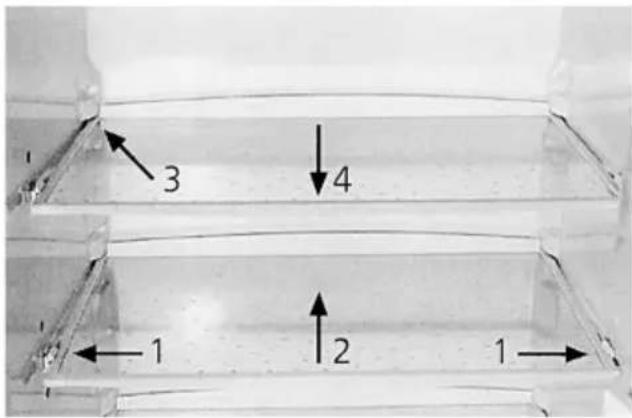
(Fig.7) The shatterproof glass shelves with spillage safeguard are individually adjustable in height. By simultaneously pressing the two side retainers the glass can be tilted upwards and withdrawn. To fix the glass shelf: Push shelf back into the guide and press front into the retainer from above.
Special compartment
The special compartment whose temperature is kept between 0^ C and 3^ C is especially suitable for storing:
- meat, sausages, fish, poultry, shellfish and crustaceans - salad, delicate vegetables, fruit, herbs, edible fungi etc.
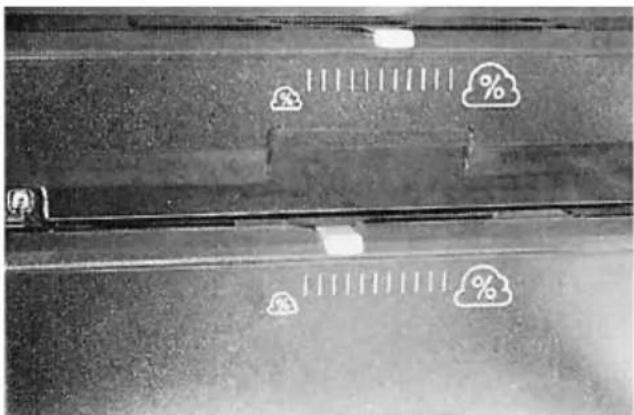
Humidity adjustment (Fig.⑧)
- Small humidity symbol: low relative humidity push slide to the left.
– Large humidity symbol: higher relative humidity push slide to the right.
The humidity in the special compartment is dependent on the type and packaging of the stored produce and varies between 60% and 80% relative humidity. Possible droplet formation can be avoided with the slide.
Freshtimer
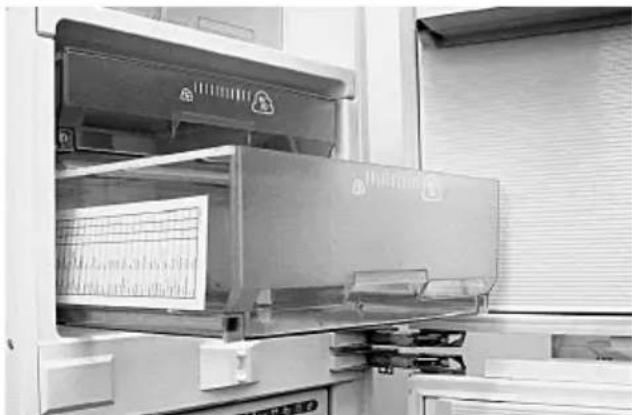
The Freshtimer (Fig.⑨) is to help consumers determine how long they can store different produce in the special compartment. The Freshtimer is multilingual. It can be placed at readiness in the mounting in the bottom large drawer on the right.
Note
■ The following should not be stored in the special compartment: hard cheeses, potatoes, vegetable sensitive to low temperatures such as cucumbers, peppers, aubergines, avocados, semi-ripe tomatoes, zuchetto and all sub-tropical and tropical fruits such as pineapples, bananas, grapefruit, melons, mangos, papayas etc. These should be kept in closed containers in the fridge compartment (to avoid drying-out).
■ Pay attention to the «freshness» when buying produce. The degree of freshness and the quality of produce are decisive factors for storage duration. But long periods of storage in all cases lead to a certain loss of nutrient values and vitamins.
Freezing compartment
Freezing
Only fresh produce is suitable for freezing.
Small quantities (up to 4,5 kg)
■ Press the Superfrost button on the control panel approximately 12 hours before placing in the produce (yellow indicator must light).
■ Place frozen produce in the top drawer and produce to be frozen in the drawer below.
■ The Superfrost phase terminates automatically. The appliance then returns to the normal energy-saving operating mode.
Large quantities (up to max. 9 kg)
■ Press the Superfrost button on the control panel approximately 24 hours before placing in the produce (yellow indicator must light).
■ Place frozen produce in the drawer below and produce to be frozen in the top drawer. Directly before placing in the fresh produce, press Superfrost once more.
■ Superfrost is automatically switched off after 24 hours. The freezing phase is then completed.
The appliance then returns to the normal energy-saving operating mode.
Storing produce
All drawers can be filled at once when storing already frozen produce. Superfrost is not required.
Spezial freeezing drawer
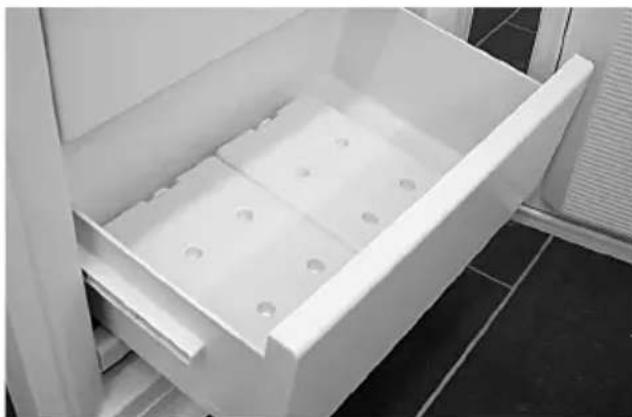
Fruit (berry varieties), herbs and vegetables can be carefully frozen for garnishing using the freezing drawer (Fig. 10). Spread the produce loosely over the tray, taking care that the separate pieces do not stick together. This will ensure that they retain their shape. After 10 to 12 hours, place produce in a bag or container and store in a freezer basket. Also spread the produce loosely for defreezing.
Cold accumulator
Functions of the cold accumulators: (Fig. 11)
- In the event of a power failure or fault, the cold accumulator delays an excessively fast temperature rise in the appliance. The quality of the produce is maintained for a longer period.
- Cold accumulators can also be used temporarily for keeping produce cold in cooling bags or boxes on journeys or picnics.
The cold accumulators produce their full cooling effect when cooled in the freezing compartment at -18^ C and then placed on the produce in the top drawer.
Defrosting
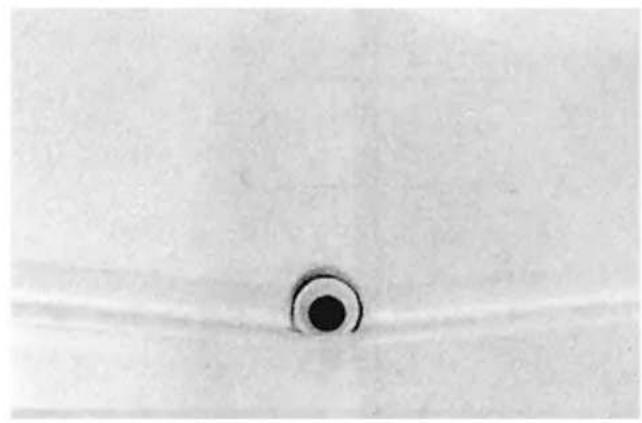
The fridge and special compartments defrost fully automatically; melting the ice which has formed on the back wall. The melt water flows through the drain hole (Fig. 12) and evaporates in the receptacle outside the appliance. Keep the channel and drain hole clean so that the water can flow through unhindered. Carefully clean channel and hole with wooden sticks or similar.
Freezing compartment
Large residues or accumulations of ice impair the performance and increase energy consumption. The freezing compartment is to be defrosted as required. Remove the frozen produce, wrapping it in newspaper or a blanket and storing in a cool place with the cold accumulators.
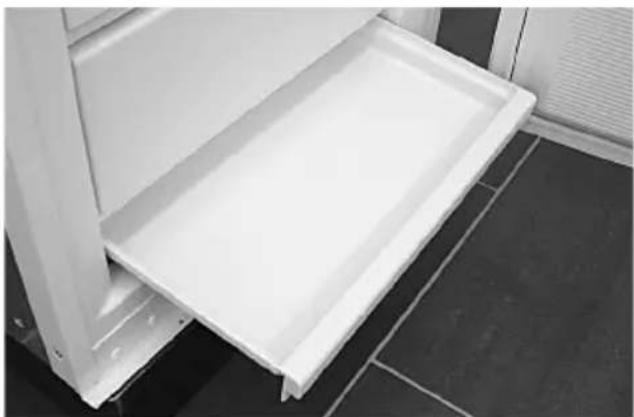
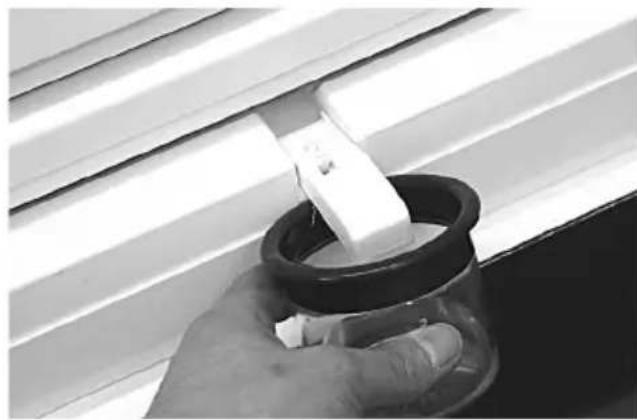
- Switch off the appliance at the main switch. Pull out the melt water drain and place a receptacle under the drain hole (Fig. 13).
Leave door open.
Defrosting can be speeded up by placing a vessel filled with hot water in the freezing compartment. Warning. Do not use sharp objects to remove ice or frozen-in objects. Do not use electrical heaters or open fire to defrost. Whilst defrosting the freezing compartment the fridge compartment should remain closed to keep the temperature rise in the fridge and special compartments as low as possible.
- After defrosting, clean an dry interior thoroughly.
Switch appliance back on at the main switch.
- Replace drawers and produce.
Cleaning
The appliance must be kept clean for the hygienic storage of food. Periodically wash out the fridge compartment with mild soapy water and then dry. An occasional wipe with a vinegar and water solution has an odour reducing effect and is recommended. The door seals should be kept clean to prevent sticking and damage. Use no abrasive cleaning products or cloths.
– Clean the control panel with a dry cloth.
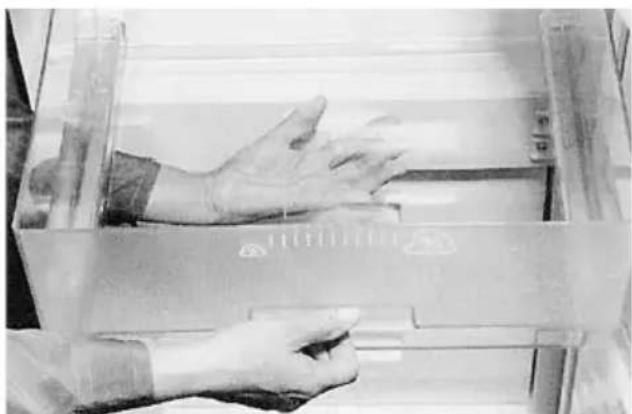
- The drawers of the special compartment can be removed for cleaning. Remove by pulling out and gently lifting from below (Fig. 14).
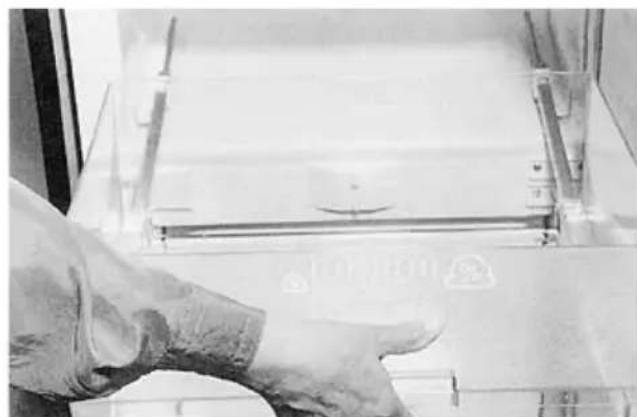
After washing, the thoroughly dried drawers are placed on the extended guide rails and pushed back until they engage (Fig. 15).
If the appliance is not being used for a lengthy period, switch off at the main switch, empty, defrost, clean and leave both doors open.
Ensure as far as possible that no cleaning water runs through the drain tubes into the evaporating dish. The appliance must be totally dry before placing in operation.
Tips
You will save energy and prevent possible build-up of condensation in the fridge compartment if you note the following points:
■ Do not set the temperature at the control panel unnecessarily low; +5°C in the fridge compartment and -18°C in the freezer compartment are normally sufficient.
■ Install the appliance as far away as possible from radiators, heating pipes or chimneys and protect from direct sunlight.
- Keep door opening periods as brief as possible. When closing, ensure that the door is fully sealed all round.
■ Allow warm or hot food to cool off outside the appliance.
■ Do not allow the produce to contact the back wall to prevent it from freezing-on and preventing the defrost water from running out of the fridge compartment.
■ To avoid the transfer of taste and odours, only store packed or covered produce in the appliance.
When arranging, ensure:
■ that oil and grease do not come into contact with the door seal.
■ At all temperature settings the coldest areas are against the back wall and above the bottommost shelf.
Faults
If a fault should occur, check whether you can rectify this yourself with the following instructions before contacting the after-sales service:
■ Appliance not cooling
Control panel and interior lights not lit:
- Power failure check fuse
- Mains connector plug not – or not correctly – inserted in socket → insert correctly
- Appliance switched off → switch on (press main switch for 3 sec.).
■ Only the freezing compartment light is lit; interior light is out and there is no cooling in fridge and special compartments:
- activate holiday setting → press holiday switch for 3 sec.
After a power failure the following temperatures are set automatically: + 5°C in the fridge and -18°C in the freezing compartment.
Temperature rise in the freezing compartment in the case of a power failure:
After a power failure the highest measured air temperature in the freezing compartment will remain flashing until the alarm is reset or the freezing compartment temperature setting buttons are activated. This function enables you to judge whether the produce has suffered damage during the power failure.
Alarm signals
The functions and temperatures of this appliance are electronically monitored. Faults are signalled acoustically and their cause is displayed. The acoustic alarm is automatically switched off after 5 min. and reappears for a further 20 sec. period approximately every hour until normalizing or resetting of the «Alarm off» button.
| Alarm | Cause | Measures |
| Temperature alarm for the fridge or freezing compartment:Flashing temperature indication of fridge or freezing compartment. | Temperature rise in fridge compartment after a long period with the door open or due to placing in produce which is too hot. | Not necessary because normalizing takes place after a few hours.If normalizing does not take place after a few hours and the temperature continues to riseCall after-sales service |
| Temperature alarm for the special compartment:Flashing green indication Special compartment operation | Temperature rise in special compartment after a long period with the door open or due to placing in produce which is too hot. | Not necessary because normalizing takes place after a few hours.If normalizing does not take place after a few hours and the temperature continues to riseCall after-sales service |
| Door alarm:Flashing red indication Door warning | Door open for too long. | Close doorCall after-sales service |
| Sensor malfunction:Indication of F1, F2 F3 or F4 instead of temperature display. | Malfunction of a sensor. | The appliance continues running in the emergency program. Opening the door or placing in products should be kept to the absolute minimum with ambient temperatures in excess of 20°C. |
| Valve malfunction:Indication of F5 or F6 instead of freezer temperature display 12 | Malfunction of a valve. | Reset by turning off and on the main-switch 1.If indication F5 or F6 reappears call after-sales service. |
Operating noises
Noises which are totally normal
The refrigerator is cooled by a compressor (cooling aggregate). The compressor pumps coolant through the cooling system, and this produces noise. Even when the compressor cuts out, noises caused by temperature and pressure variations are unavoidable.
This cooler is fitted with a quiet compressor and low-noise cooling circuit in accordance with the latest state of technology. However, certain noises are unavoidable and their intensity depends on the size of the cooler.
Operating noises are most audible immediately after the compressor cuts in. They become quieter as the operating period continues.
Noises which are not normal
Most unusual noises are caused by improper installation. The cooler must be installed or built-in so that it is level and stable. Under no circumstances should pipes be in contact with a wall, other furniture or one another.
Where coolers are built in to open-plan kitchens or partition walls, normal operating noises will be more audible. However, this is due to the surrounding architecture and not to any fault with the cooler.
Description Cause Comment
| Droning Cooling aggregate Normal operating noise of the cooling aggregate.The level is dependent on the size of cooler | ||
| Humming Fan Normal operating noise of the fan | ||
| Gurgling Cooling circuit Normal operating noise as coolant flows throughBabbling the circuitMurmuring | ||
| Hissing Cooling circuit Normal operating noise as coolant is injected intothe condenser | ||
| Clicking Thermostat Normal switching sound of the electromechanicaltemperature controller | ||
| Rattling Shelves, baskets, Position the interior parts so that they don’t touch onefitted holders, refri- another, or so that they are fitted securely.gerator contents etc. | ||
| Cracking | Cooler housing | Normal as materials expand and contract dueto temperature variations (e.g. plastics, insulation) |
Sommario
natural_image
Exterior view of a white wall-mounted shelf with a horizontal bar (no text or symbols visible)3
natural_image
Hand adjusting a white door handle, no visible text or symbols4
natural_image
Exterior view of a modern building corner with two recessed ventilation grilles (no signage or text)5
natural_image
Close-up of a hand inserting a plastic tray into a ceiling-mounted air vent (no text or symbols visible)6
natural_image
Interior view of a dual-chamber electronic device with a light bulb and arrow pointing to it (no text or symbols visible)●
76 a
8
natural_image
Interior view of a refrigerator with open lid and ventilation grilles (no visible text or symbols)9
natural_image
Close-up of a white plastic tray placed diagonally down an open metal cabinet (no text or symbols visible)10
natural_image
Interior view of a white plastic drawer with multiple recessed compartments and mounting holes (no text or symbols visible)●
natural_image
Close-up of a circular dark object on a light surface, possibly a lens or aperture (no text or symbols visible)12
natural_image
Close-up of a hand holding a black plastic bottle with a white clip attached, against a striped wall background (no text or symbols visible)13
natural_image
Close-up of a hand pressing down on a transparent plastic tray (no visible text or symbols)14
natural_image
Person in protective suit handling a transparent container with a curved lid (no visible text or symbols)●
Subject to alterations.
Salvo modifiche.
- Inhaltsverzeichnis
- Operating instruction
- Dear Customer
- Disposal of your old appliance
- Disposal of the packing materials
- Safety hints and warnings
- Electrical connection
- Guarantee
- Overall View (Fig.1)
- Operating instructions
- Operating and checking elements
- (Fig.) ②
- Variable door interior
- Interior light
- Fridge compartment
- Special compartment
- Freshtimer
- Note
- Freezing compartment
- Freezing
- Storing produce
- Spezial freeezing drawer
- Cold accumulator
- Defrosting
- Cleaning
- Tips
- Faults
- Alarm signals
- Operating noises
- Sommario
Brand : GAGGENAU
Model : RB 282100
Category : Fridge