Lavatherm 55840 - Tumble dryer AEG-ELECTROLUX - Free user manual and instructions
Find the device manual for free Lavatherm 55840 AEG-ELECTROLUX in PDF.


| Product Type | Condenser Tumble Dryer |
| Brand | AEG-Electrolux |
| Model | Lavatherm 55840 |
| Dimensions (H x W x D) | 85 x 60 x 58 cm |
| Depth with door open | 109 cm |
| Weight (empty) | Approx. 40 kg |
| Drum capacity | 108 litres |
| Maximum load | 7 kg (depending on program) |
| Voltage | 230 V |
| Required fuse | 16 A |
| Total power | 2350 W |
| Energy efficiency class | B |
| Average annual energy consumption | 284.1 kWh |
| Programs | Cotton (Extra dry, Ready to keep, Ready to iron), Synthetics, 30 min, Refresh, Sheets, Jeans |
| Functions | Delicates, Alarm, Delay start (3, 6, 9 h) |
| Cleaning | Filters, condensation water container, thermal condenser |
| Child safety | Yes (door lock, closing protection) |
| Door reversibility | Yes |
| Special accessories | Stacking kit, drain kit, drawer base |
| Permissible ambient temperature | +5°C to +35°C |
Frequently Asked Questions - Lavatherm 55840 AEG-ELECTROLUX
User questions about Lavatherm 55840 AEG-ELECTROLUX
0 question about this device. Answer the ones you know or ask your own.
Ask a new question about this device
Download the instructions for your Tumble dryer in PDF format for free! Find your manual Lavatherm 55840 - AEG-ELECTROLUX and take your electronic device back in hand. On this page are published all the documents necessary for the use of your device. Lavatherm 55840 by AEG-ELECTROLUX.
USER MANUAL Lavatherm 55840 AEG-ELECTROLUX
natural_image
Illustration showing a washing machine and a hand inserting a filter into a circular vent (no text or symbols)natural_image
Line drawing of a kitchen appliance with a circular button and arrow indicator (no text or symbols)natural_image
Pure diagram of a circular mechanical or electrical component with directional arrows, surrounded by dots and a small circle (no text or symbols)DELICAAT -functie
natural_image
Simple diagram with geometric shapes and a central light source (no text or symbols)ZOEMER functie
natural_image
Diagram of a circular device with internal components and a directional arrow, no visible text or symbols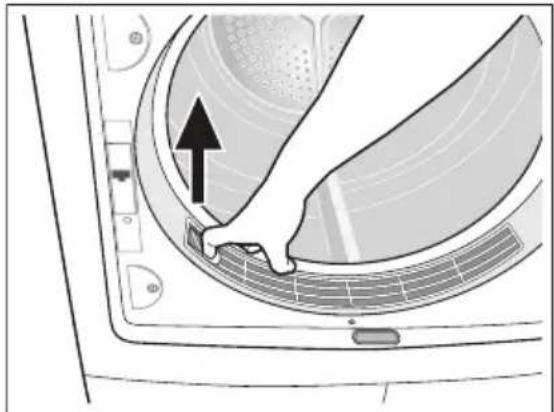
natural_image
Diagram of a washing machine interior showing a circular component with an arrow pointing to it, no text or symbols present.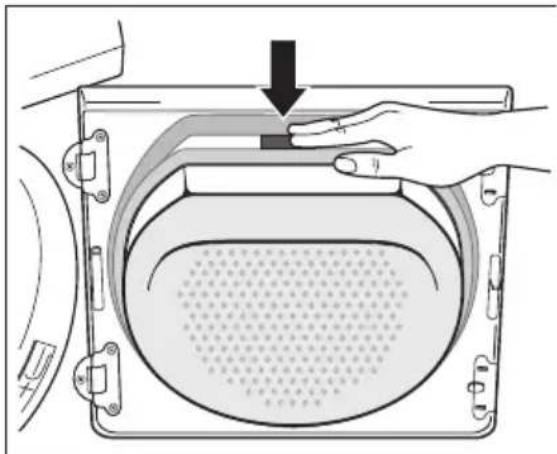
natural_image
Diagram of a hand pressing down on a device component with a downward arrow indicating force or insertion (no text or symbols present)natural_image
Diagram of a device with a circular component and a perforated base, showing hands interacting with it (no text or symbols present)natural_image
Illustration of a hand inserting a device into a device casing, showing a black arrow indicating direction (no text or symbols present)
natural_image
Illustration of a hand placing a textured circular object into a device casing (no text or symbols visible)De deurpakking schoonmaken
natural_image
Illustration of a hand using a tool to lift a component into a bowl (no text or symbols present)
natural_image
Diagram showing a device with a downward arrow and a rectangular panel, no text or symbols present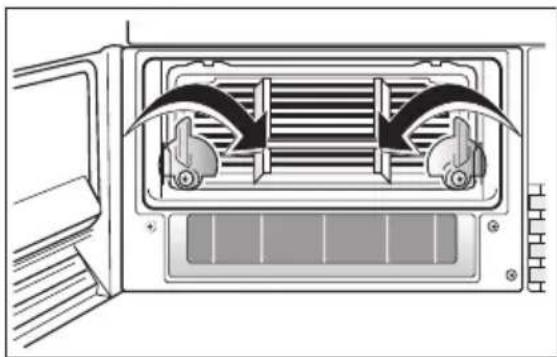
natural_image
Diagram of a ventilation system inside a rack-mounted unit, showing airflow direction arrows (no text or labels)natural_image
Illustration of hands installing a heat sink into a rack, with a black arrow indicating the direction (no text or symbols present)
LET OP!
natural_image
Illustration showing a washing machine with a door and a hand cleaning the interior of a circular vent (no text or symbols)natural_image
Line drawing of a kitchen appliance with a circular button and arrow indicator (no text or symbols)natural_image
Pure diagram of a circular mechanical or electrical component with directional arrows, surrounded by dots and a small circle (no text or symbols)Fonction DÉLICAT
natural_image
Simple diagram with geometric shapes and a central light source (no text or symbols)Pour l'activer :
natural_image
Diagram of a circular device with internal components and directional arrows, no readable text or symbols present.natural_image
Diagram of a car air conditioner interior showing airflow direction and component placement (no text or symbols)natural_image
Diagram of a hand pressing down on a device component with a black arrow indicating the process (no text or symbols present)natural_image
Diagram of a hand inserting a circular component into a device, showing internal structure and mounting bracket (no text or symbols)natural_image
Illustration of a hand inserting a device into a device casing with a black arrow indicating direction (no text or symbols)
natural_image
Illustration of a hand placing a textured circular object into a microwave oven (no text or symbols)natural_image
Illustration of a hand using a tool to lift a component into a bowl (no text or symbols present)
natural_image
Diagram showing airflow or ventilation process between a fan and a back panel (no text or symbols)natural_image
Diagram of a front panel with ventilation grilles and heat exchangers, showing airflow direction (no text or symbols)natural_image
Illustration of hands installing a heat sink into a rack (no text or symbols visible)natural_image
Illustration showing a washing machine with a door and a hand inserting a filter into a circular vent (no text or symbols)natural_image
Line drawing of a kitchen appliance with a circular button and arrow indicator (no text or symbols)natural_image
Pure diagram of a circular mechanical or electrical component with directional arrows, surrounded by dots and a small circle (no text or symbols)natural_image
Simple diagram with geometric shapes and a central light source (no text or symbols)natural_image
Diagram of a circular device with grid pattern and control panel, no visible text or symbolsnatural_image
Diagram of a car air conditioner interior showing airflow direction and component placement (no text or symbols)natural_image
Diagram of a hand pressing down on a device component with a black arrow indicating the process (no text or symbols present)natural_image
Diagram of a hand inserting a circular component into a device with a perforated base (no text or symbols)
natural_image
Illustration of a hand inserting a device into a device casing with a black arrow indicating direction (no text or symbols)
natural_image
Illustration of a hand placing a textured circular object into a microwave oven (no text or symbols)natural_image
Illustration of a hand using a tool to lift a component into a circular tank (no text or symbols)
natural_image
Diagram showing a mechanical assembly with a downward arrow and a rotating component (no text or symbols)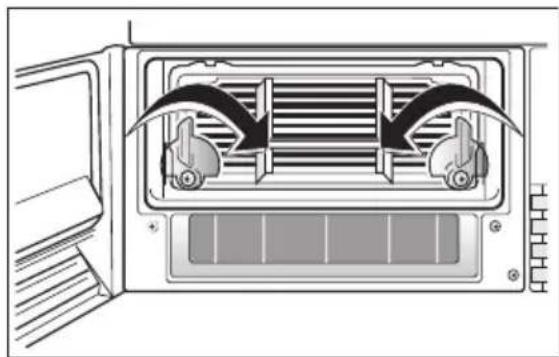
natural_image
Diagram of a ventilation system inside a rack-mounted air vent, showing airflow direction arrows (no text or labels)natural_image
Illustration of hands installing or adjusting a heat sink component with a downward arrow indicating motion (no text or symbols present)Thank you for choosing one of our high-quality products.
To ensure optimal and regular performance of your appliance please read this instruction manual carefully. It will enable you to navigate all processes perfectly and most efficiently. To refer to this manual any time you need to, we recommend you to keep it in a safe place. And please pass it to any future owner of the appliance.
We wish you much joy with your new appliance.
Contents
| Operating Instructions | |
| Important safety information | |
| Environment | |
| Installation | |
| Appliance positioning 68Removing transport safety packaging 69Electrical connection 69Changing door stop 69Special accessories 70 | |
| Product description | |
| Control panel | |
| Before first use | |
| Programme overview | |
| Daily use | 73 |
| Sorting laundry | 73 |
| Switching machine on | 74 |
| Laundry loading | 74 |
| Selecting the programme | 75 |
| DELICATE (DELICAAT) function | 75 |
| BUZZER (ZOEMER) function | 75 |
| DELAY START (STARTUITSTEL) function | 75 |
| Starting the programme | 76 |
| Changing programme | 76 |
| Cycle end / laundry unloading | 76 |
| Care and cleaning | 76 |
| Cleaning fluff filter | 76 |
| Cleaning the door seal | 78 |
| Emptying the condensate tank | 78 |
| Cleaning heat exchanger | 79 |
| Cleaning the drum 72 | 80 |
| Clean operating screen and housing | 80 |
| What to do if ...73 | 80 |
| Machine settings | 82 |
| Technical data | 82 |
| Service | 83 |
Subject to change without notice
Operating Instructions
Important safety information

In the interest of your safety and to ensure the correct use, before installing and first using the appliance, read this user manual carefully, including its hints and warnings. To avoid unnecessary mistakes and accidents, it is important to ensure that all people using the appliance are thoroughly familiar with its operation and safety features. Save these instructions and make sure that they remain with the appliance if it is moved or sold, so that everyone using it through its life will be properly informed on appliance use and safety.

- Please read the instruction book before using this appliance.
General safety
- It is dangerous to alter the specifications or attempt to modify this product in any way.
- This appliance is not intended for use by persons (including children) with reduced physical and sensory conditions or lack of experience and knowledge, unless they have been given supervision or instruction concerning use of the appliance by a person responsible for their safety.
- Make sure that small children and pets do not climb inside the drum. To avoid this, please check into the drum before using.
- Any objects such as coins, safety pins, nails, screws, stones or any other hard, sharp material can cause extensive damage and must not be placed into the machine.
- In order to avoid danger of fires caused by excessive drying, do not use appliance to dry the following items: Cushions, quilts and the like (these items accumulate heat).
- Items such as foam rubber (latex foam), shower caps, waterproof textiles, rubber backed articles and clothes or pillows fitted with foam rubber pads should not be dried in the tumble dryer.
• Always unplug the appliance after use, cleaning and maintenance. - Under no circumstances should you attempt to repair the machine yourself. Repairs carried out by inexperienced persons may cause injury or serious malfunctioning. Contact your local Service Centre. Always insist on genuine spare parts.
- Items that have been soiled with substances such as cooking oil acetone, petrol, kerosene, spot removers, turpentine, waxes and wax removers should be washed in hot water with an extra amount of detergent before being dried in the tumble dryer.
- Danger of explosion: Never tumble dry items that have been in contact with inflammable solvents (petrol, methylated spirits, dry cleaning fluid and the like). As these substances are volatile, they could cause an explosion. Only tumble dry items washed with water.
- Risk of fire: items that have been spotted or soaked with vegetable or cooking oil constitute a fire hazard and should not be placed in the tumble dryer.
- If you have washed your laundry with stain remover you must execute an extra rinse cycle before loading your tumble dryer.
- Please make sure that no gas lighters or matches have accidentally been left in pockets of garments in case they are loaded into appliance

WARNING!
- Risk of fire! Never stop a tumble dry before the end of the drying cycle unless all items are quickly removed and spread out so that the heat is dissipated.
- Lint must not be allowed to accumulate around the tumble dryer.
- Risk of electric shock! Do not spray down the appliance with jets of water.
- The final part of a tumble dryer cycle occurs without heat (cool down cycle) to ensure that the items are left at a temperature that ensures that items will not be damaged.
- The tumble dryer is not to be used if industrial chemicals have been used for cleaning.
- Ensure you have good ventilation in the installation room to avoid the back flow of gases into the room from appliances burning other fuels, including open fires.
Installation
- This appliance is heavy. Care should be taken when moving it.
- When unpacking the appliance, check that it is not damaged. If in doubt, do not use it and contact the Service Centre.
- All packaging must be removed before use. Serious damage can occur to the product and to property if this is not adhered to. See relevant section in the user manual.
- Any electrical work required to install this appliance should be carried out by a qualified electrician or competent person.
- If the machine is situated on a carpeted floor, please adjust the feet in order to allow air to circulate freely under the appliance.
- After having installed the appliance, check that it is not pressing or standing on its electrical supply cable.
- If the tumble dryer is placed on top of a washing machine, it is compulsory to use the stacking kit (optional accessory).
Use
- This appliance is designed for domestic use. It must not be used for purposes other than those for which it was designed.
- Only wash fabrics which are designed to be machine dried. Follow the instructions on each garment label.
- Do not dry unwashed items in the tumble dryer.
- Do not overload the appliance. See the relevant section in the user manual.
- Clothes which are dripping wet should not be placed in the dryer.
- Garments which have been in contact with volatile petroleum products should not be machine dried. If volatile cleaning fluids are used, care should be taken to ensure that the fluid is removed from the garment before placing in the machine.
- Never pull the power supply cable to remove the plug from the socket; always take hold of the plug itself.
- Never use the tumble dryer if the power supply cable, the control panel, the working surface or the base are damaged so that the inside of the tumble dryer is accessible.
- Fabric softeners, or similar products should be used as specified by the fabric softener instructions.
- Caution - hot surface : Do not touch the door light cover surface when the light is switched on.
(Only dryers equipped with internal drum light)
Child safety
- This machine is not intended for use by young children or infirm persons without supervision.
- Children often do not recognise the hazards associated with electrical appliances. Children should be supervised to ensure that they do not play with the appliance.

WARNING!
- Danger of suffocation! The packaging components (e.g. plastic film, polystyrene) can be dangerous to children - Keep them out of children's reach.
- Keep all detergents in a safe place out of children's reach.
- Make sure that children or pets do not climb inside the drum.
Environment
The symbol ☒ on the product or on its packaging indicates that this product may not be treated as household waste. Instead it should be taken to the appropriate collection point for the recycling of electrical and electronic equipment. By ensuring this product is disposed of correctly, you will help prevent potential negative consequences for the environment and human health, which could otherwise be caused by inappropriate waste handling of this product. For more detailed information about recycling of this product, please contact your local council, your household waste disposal service or the shop where you purchased the product.
Environmental tips
- In the dryer, laundry becomes fluffy and soft. Fabric softeners are not therefore needed when washing.
- Your dryer will function most economically if you:
- Always keep the ventilation slots on the base of the dryer unobstructed;
- Use the loading volumes specified in the programme overview;
- Ensure you have good ventilation in the installation room;
- Clean the micro-fine filter and fine strainer after each drying cycle;
- Spin the laundry well before drying.

Energy consumption depends on spinning speed set in washing machine. Higher spinning speed - lower energy consumption.
Environmental information
The packaging materials are environmentally friendly and can be recycled. The plastic components are identified by markings, e.g. >PE<, >PS<, etc. Please dispose of the packaging materials in the appropriate container at the community waste disposal facilities.

WARNING!
When the unit is no longer being used:
- Pull the plug out of the socket.
- Cut off the cable and plug and dispose of them.
- Dispose of the door catch. This prevents children from trapping themselves inside and endangering their lives.
Installation
Appliance positioning
- It is recommended that, for your convenience, the machine is positioned close to your washing machine.
- The tumble dryer must be installed in a clean place, where dirt does not build up.
- Air must be able to circulate freely all round the appliance. Do not obstruct the front ventilation grille or the air intake grilles at the back of the machine.
- To keep vibration and noise to a minimum when the dryer is in use, it should be placed on a firm, level surface.
- Once in its permanent operating position, check that the dryer is absolutely level with the aid of a spirit level. If it is not, raise or lower the feet until it is. - The feet must never be removed. Do not restrict the floor clearance through deep pile carpets, strips of wood or similar. This might cause heat built-up which would interfere with the operation of the appliance.

- The hot air emitted by the tumble dryer can reach temperatures of up to 60°C. The appliance must therefore not be installed on floors which are not resistant to high temperatures.
- When operating the tumble dryer, the room temperature must not be lower than +5^ and higher than +35^ , as it may affect the performance of the appliance.
- Should the appliance be moved, it must be transported vertically.
- The appliance must not be installed behind a lockable door, a sliding door a door with a hinge on the opposite side to that of the appliance in such a way that a full opening of the dryer is restricted.
Removing transport safety packaging

CAUTION!
Before use all parts of the transport packaging must be removed.
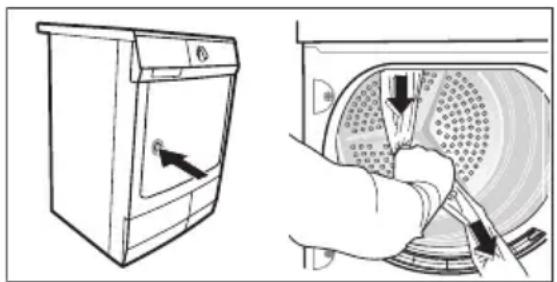
- Open loading door
- Pull off adhesive strips from inside machine on top of drum.
- Remove foil hose and polystyrene padding from the machine.
Electrical connection
Details on mains voltage, type of current and the fuses required should be taken from the type plate. The type plate is fitted near the loading aperture (see "Product description" chapter).
Connect the machine to an earthed socket, in accordance with current wiring regulations.

WARNING!
The manufacturer declines any responsibility for damage or injury through failure to comply with the above safety precautions.
Should the appliance power supply cable need to be replaced, this must be carried out by our Service Center.

WARNING!
The plug must be accessible after installing the machine.
Changing door stop

WARNING!
Before changing the door stop, disconnect the mains plug.
- Open loading door.
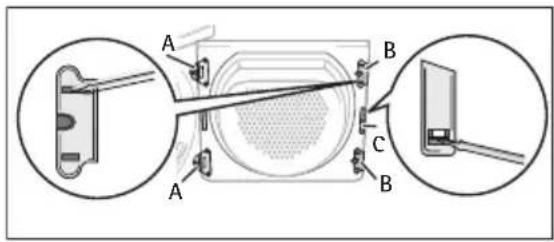
- Unscrew hinge A from the front of the machine and take off the loading door.
- Remove cover plates B. To do this, insert a thin screwdriver into the slots as shown in the illustration, press downwards slightly and pry out the cover plates.
-
Use an appropriate tool and exert pressure to unfasten locking block C from the snap-on fixture, take out and re-insert on the other side having rotated the block through 180°.
-
Unscrew hinge A from the loading door, rotate through 180^ , re-insert on the opposite side and screw down.
-
Re-insert cover plates B on the opposite site having first rotated them through 180^ .
-
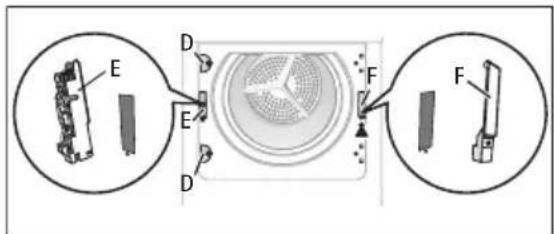
Unscrew cover plates D from the front of the machine, rotate through 180^ , screw on the opposite side.
-
Unscrew door lock E, push down slightly and remove from the front of the machine.
-
Press snap-in button F in and down, press cover down slightly and remove from front of the machine.
-
Change door lock E over to the opposite side, screw down the door interlock.
-
On the other side, insert cover F and allow snap-in button to lock into place.
-
Insert loading door and hinges into recesses on the front of the machine and screw down.
Note regarding contact protection: The machine is only secure for operations again once all plastic parts have been inserted.
Special accessories
- Stacking kit
These intermediate installation kits can be used to arrange the dryer and a washing machine (60 cm wide, front loaded) as a space-saving washer/dryer stack. The washing machine is at the bottom and the dryer is at the top.
Read carefully the instructions supplied with the kit.

Available from your Service Force Centre or your specialist dealer
- Draining kit
Installation kit for direct draining of the condensed water into a basin, siphon, gully, etc. The water reservoir then no longer has to be drained, it must however remain in its intended position in the machine.
Fixed hose has to be on the suitable height from minimum of 50 cm to maximum of 1 m from floor level and cannot be looped. If possible shorten the draining hose.
Read carefully the instructions supplied with the kit.

Available from your Service Force Centre or your specialist dealer
- Pedestal with the drawer
To situate the dryer at the optimal height and have some additional space to store (e.g. laundry).
Read carefully the instructions supplied with the kit.

Available from your Service Force Centre or your specialist dealer
Product description
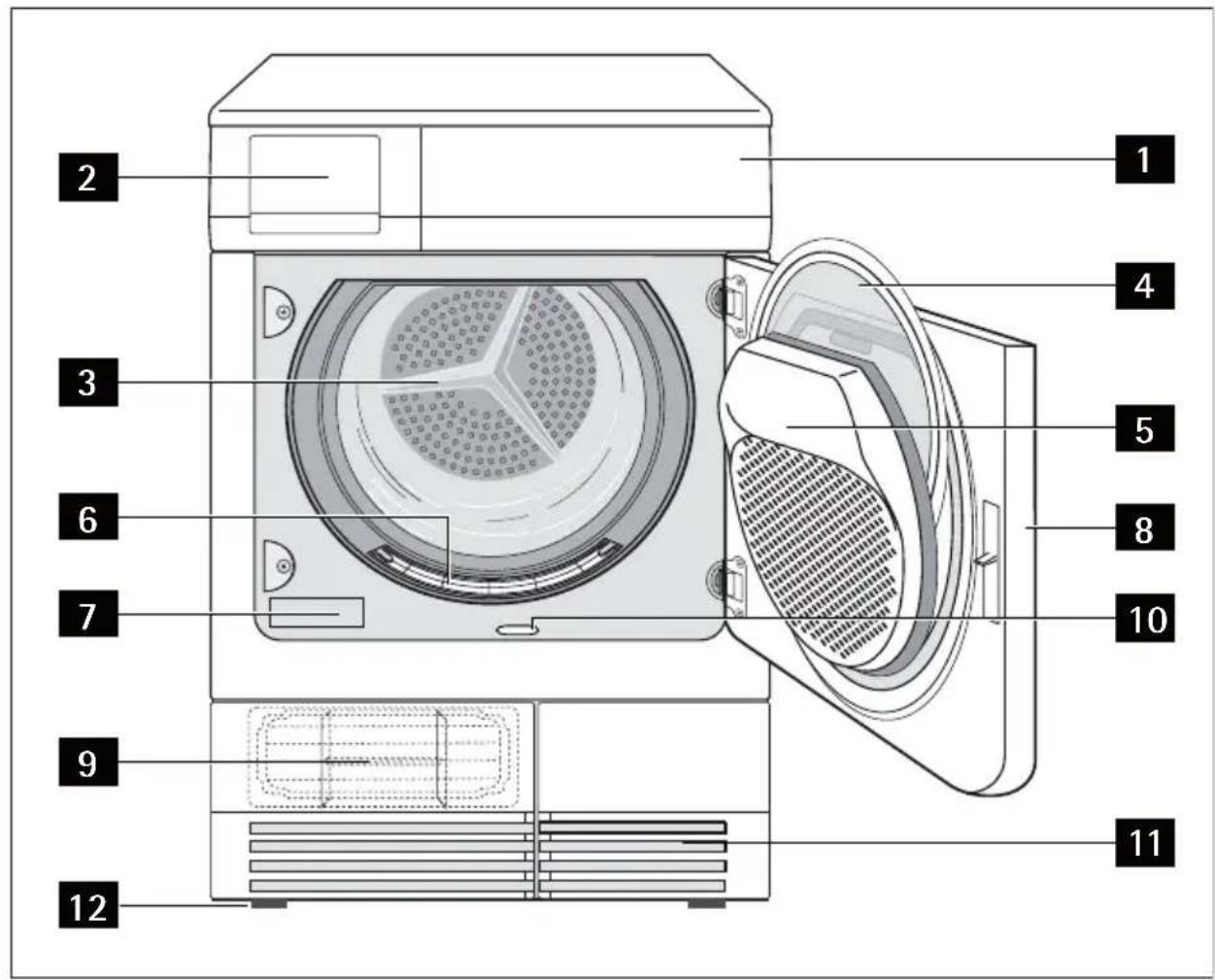
1 Control panel
2 Vater reservoir
3 Drum light
4 fine fluff filters
5 Course fluff filters
6 fluff filters
7 Rating plate
8 loading door (reversible)
9 Heat exchanger door
10 Button for opening door in plinth
11 Ventilation grille
12 Adjustable feet
Control panel
Control panel
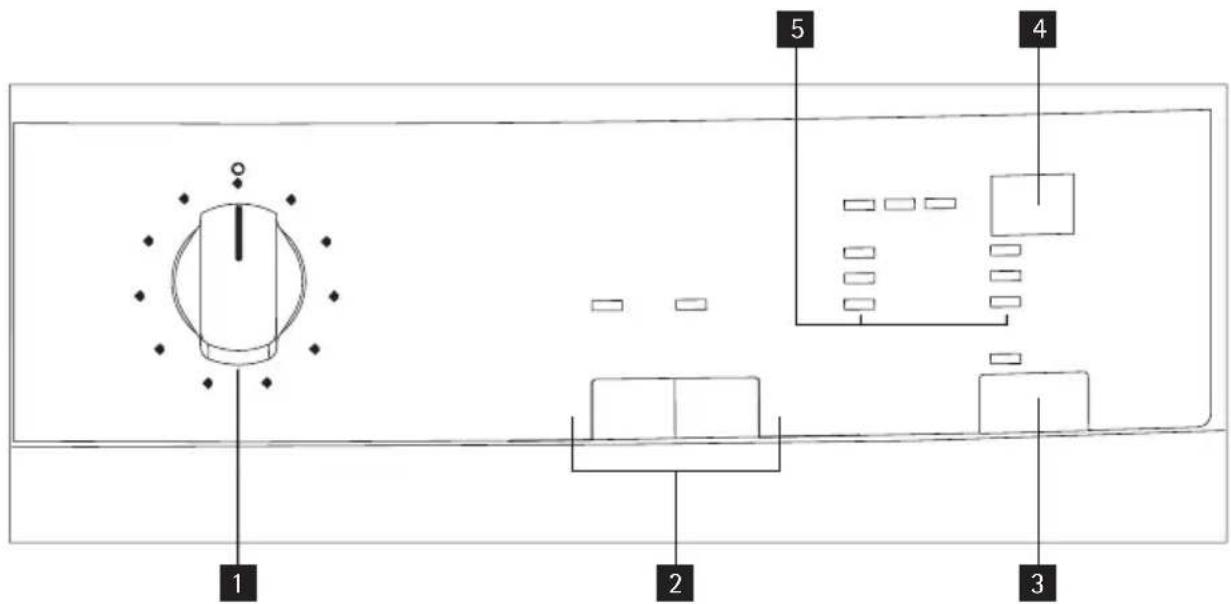
1 Programme selector and on/off switch
2 Function buttons
3 START PAUSE (START PAUZE) button
4 DELAY START (STARTUITSTEL) button and delay indicators 3, 6 or 9 hours
5 drying phase and warning lamps:
- DRYING (DROGEN) - drying phase of the cycle
• COOLING (AFKOELEN) - cooling phase of the cycle
• END (EINDE) - drying cycle is finished
- WATER RESERVOIR (TANK) - water reservoir has to be emptied
- FILTERS (ZEEF) - fluff filters has to be cleaned
- CONDENSER (WARMTEWISSELAAR) - condenser has to be cleaned
Before first use
In order to remove any residues which may have been produced during production, wipe the dryer drum with a damp cloth or carry out a brief drying cycle (ca. 30 min.) with damp cloths in the machine.
Programme overview
| Programmes | max. load1) | Application/properties | Options available | Care mark |
| COTTONS (KATOEN) | ||||
| EXTRA DRY(EXTRA DROOG) | 7 kg | Thorough drying of thick or multi-layered fabrics, e.g. terry towelling items, bathrobes. | all | |
| CUPBOARD DRY (KAST-DROOG) | 7 kg | Thorough drying of fabrics of even thicknesses, e.g. terry towelling items, knitwear, towels. | all | |
| IRON DRY (STRIJK-DROOG) | 7 kg | For normal thickness cotton or linen laundry, e.g. bedding, table linen. | all | |
| EASY CARE (SYNTHETISCH) | ||||
| EXTRA DRY(EXTRA DROOG) | 3 kg | Thorough drying of thick or multi-layered fabrics, e.g. pullovers, bedding, table linen. | all | |
| CUPBOARD DRY (KAST-DROOG) | 3 kg | For thin fabrics which are not ironed, e.g. easy care shirts, table linen, baby clothes, socks, lingerie with bones or wires. | all | |
| IRON DRY (STRIJK-DROOG) | 3 kg | For thin fabrics which are also to be ironed, e.g. knitwear, shirts. | all | |
| special | ||||
| 30 MIN. | 1 kg | For drying individual items of laundry. | all | |
| FRESHEN-UP(OPFRISSEN) | 1 kg | For refreshing textiles that have been in storage. | all | |
| BED LINEN(BEDLINNEN) | 3 kg | Bed linen (single and double sheet, pillow-case, bedspread, duvet cover). | all | |
| JEANS 7 kg | For leisure clothing, such as jeans, sweat-shirts, etc., of different material thicknesses (e.g. at the neck, cuffs and seams). | all | ||
1) maximal weight of dry clothes
Daily use
Sorting laundry
- Sort by fabric type:
- Cotton/linen for programmes in COTTON (KATOEN) programme group.
- Mixtures and synthetics for programmes in SYNTHETICS (SYNTHETISCH) programme group.
- Sort by care label: The care labels mean:
| Drying in the tumble dryer possible in principle | |
| Drying at normal temperature | |
| Drying at reduced temperature (press DELICATE (DELICAAT) button!) | |
| Drying in the tumble dryer not possible |

Do not place in the appliance any wet laundry which is not specified on the care label as being suitable for tumble-drying.
This appliance can be used for all wet laundry items which are labelled as suitable for tumble-drying.
- Do not dry new, coloured textiles together with light-coloured laundry items. Textile colours may bleed.
- Do not dry cotton jersey and knitwear with the EXTRA DRY (EXTRA DROOG) programme. Items may shrink!
Preparing laundry
- To avoid laundry becoming tangled: close zips, button up duvet covers and tie loose ties or ribbons (e.g. of aprons).
• Empty pockets. Remove metal items (paper clips, safety pins, etc). - Turn items with double-layered fabrics inside out (e.g. with cotton-lined anoraks, the cotton layer should be outermost). These fabrics will then dry better.

Do not overload the appliance. Observe max. loading volume of 7 kg.
Switching machine on
Turn the programme selector to any programme. The machine has been switched on. Led of START PAUSE (START PAUZE) button is flashing.
Laundry loading
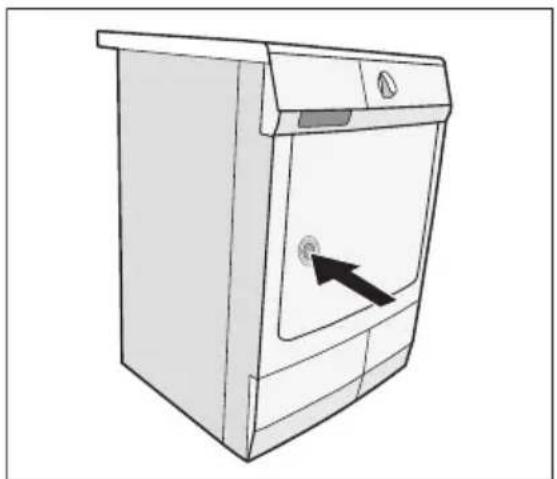
- Open loading door:
Use force to push against the loading door (push point) - Load your laundry (do not force it in).

CAUTION!
Do not jam laundry in between the loading door and rubber seal.
- Close loading door securely. Lock must audibly lock.
natural_image
Line drawing of a washing machine with a circular button and arrow indicator (no text or symbols)Selecting the programme
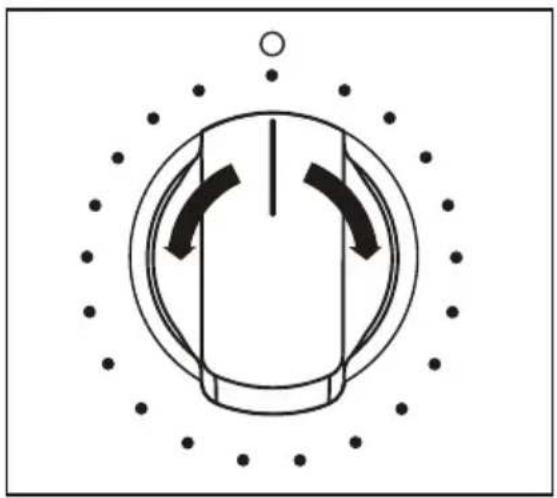
Use the programme selector to set the programme you require.
natural_image
Pure diagram of a circular mechanical or electrical component with directional arrows, surrounded by dots and a small circle (no text or symbols)DELICATE (DELICAAT) function
For especially gentle drying of sensitive fabrics with the ⚙ care label and for temperature-sensitive textiles (e.g. acrylic, viscose). Programme is executed with reduced heat.
Delicate function is only suitable for use with loads of up to 3kg.
To activate it:
- Choose the drying programme.
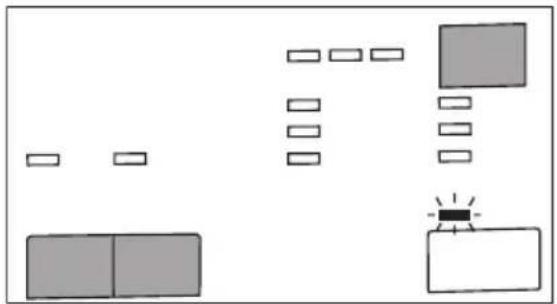
- Press DELICATE (DELICAAT) button - the LED above is on.
natural_image
Simple diagram with geometric shapes and a central light source (no text or symbols)To deselect function press again DELICATE (DELICAAT) button. The LED above is off.
BUZZER (ZOEMER) function
The appliance is supplied with the BUZZER (ZOEMER) function deactivated.
The buzzer sounds or plays a tune when activated during:
- cycle end
- anti-crease phase and when phase starts or ends
- cycle interruption by a warning
- a l a r m
To activate it:
- Choose the drying programme.
- Press BUZZER (ZOEMER) button (4) - the LED above is on.
To deselect function press again BUZZER (ZOEMER) button (4). The LED above is off.
DELAY START (STARTUITSTEL) function

Allows to delay the start of a drying programme: 3, 6 or 9 hours.
- Select the drying programme and additional functions.
- Press the DELAY START (STARTUITSTEL) button repeatedly until the required delay time is chosen.
- To activate the delay timer, press the START PAUSE (START PAUZE) button.
Starting the programme
Press the START PAUSE (START PAUZE) button.
Changing programme
To change a running programme:
- Turn the programme selector to OFF (UIT) position.
- Select new programme.
- Press START PAUSE (START PAUZE) button.
Cycle end / laundry unloading
If the drying cycle is complete the phase lamp END (EINDE) is on and acoustic signal sounds intermittently one minute (only when BUZZER (ZOEMER) function is active).

The drying cycle is automatically followed by an anti-crease phase which lasts around 30 minutes. The drum rotates at intervals during this phase. This keeps the laundry loose and free of creases. The laundry can be removed at any time during the anti-crease phase. (The laundry should be taken out towards the end of the anti-crease phase at the latest to prevent creases from forming.)
- Open the loading door.
- Remove the fluff from fluff filters. (See "Care and cleaning" chapter.)
- Unload the laundry.
- Turn off the dryer - programme selector on OFF (UIT) position.
- Close the loading door.

After each drying cycle:
- clean the fluff filters
- empty water reservoir
Care and cleaning
Cleaning fluff filter
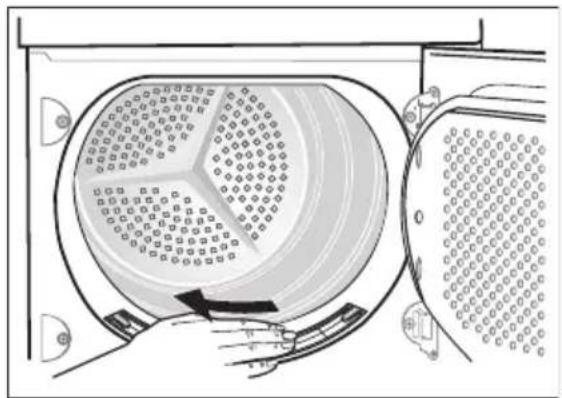
The filters collect all the fluff which accumulates during drying. To ensure that the dryer works perfectly, the fluff filters (micro-fine filter and fine strainer) must be cleaned after every drying cycle.
The warning led is on to remind you this operation.

CAUTION!
Never operate the dryer without fluff filters or with damaged or blocked fluff filters.
- Open loading door
-
Use a damp hand to clean the micro-fine filter, which is built into the lower part of the loading aperture.
-
After a period of time, a patina due to detergent residue on laundry forms on the filters. When this occurs, clean the filters with warm water using a brush. Remove the filter from the door pulling it out. It can be positioned with the tooth facing to the left or to the right).
After cleaning do not forget to put it back.
- Push down the unlock button on the large mesh filter.
Large mesh filter jumps up.
natural_image
Diagram of a circular device with internal grid pattern and control panel (no text or symbols)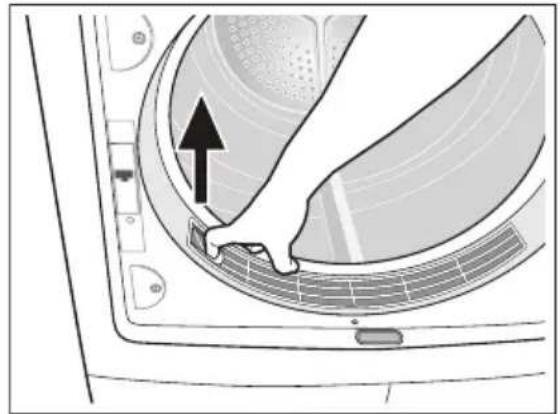
natural_image
Diagram of a car air drain with airflow direction arrow (no text or symbols)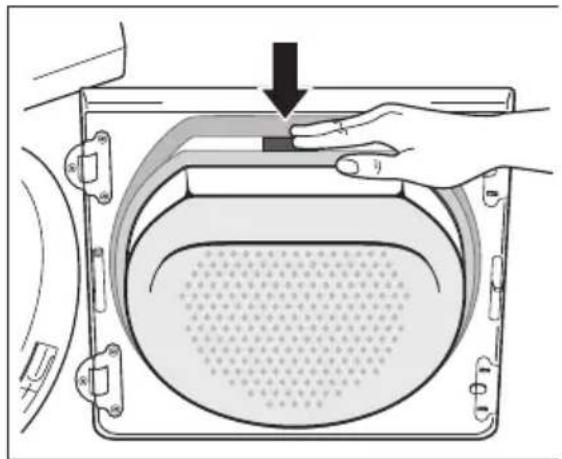
natural_image
Diagram of a hand pressing down on a device component with a black arrow indicating the process (no text or symbols present)- Take out fine strainer.
- Remove fluff from fine strainer. It is best to use a damp hand for this purpose.

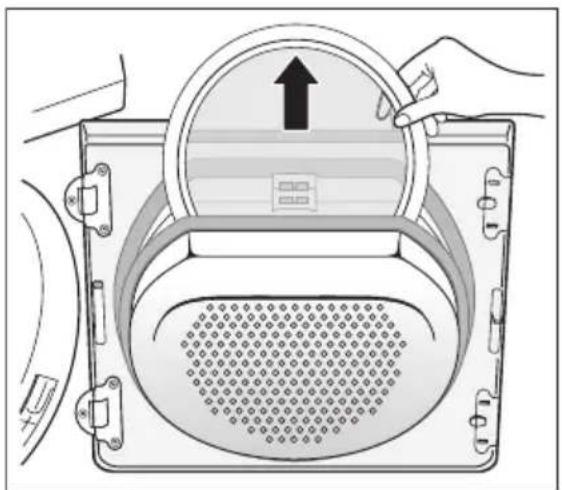
Clean the entire filter area
The strainer area does not have to be cleaned after every drying cycle, but should be checked regularly and cleaned of fluff if necessary.
- To do this, grip the top of the large mesh filter and pull it forwards until it comes loose from the two brackets.
natural_image
Diagram of a hand installing or adjusting a circular component with an arrow indicating upward motion (no text or symbols present)-
Remove fluff from the entire filter area. It is best to use a vacuum cleaner for this purpose.
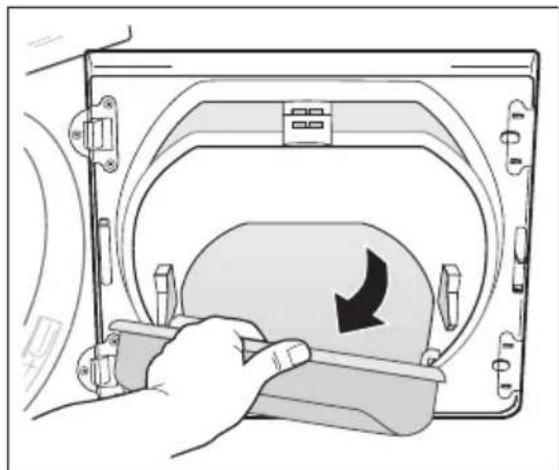
-
Press both journals of the large mesh filter into the brackets on the loading door until they snap into place.
-
Re-insert fine strainer.
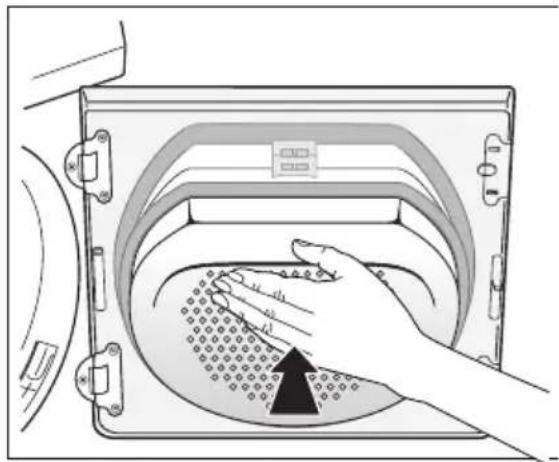
-
Press against the large mesh filter until it locks into the interlock.
natural_image
Illustration of a hand inserting a device into a device casing with a black arrow indicating the component (no text or symbols present)
If the fine strainer is not fitted, the large mesh filter will not snap into place and the loading door cannot be closed.
natural_image
Illustration of a hand placing a component into a washing machine casing with a patterned lid (no text or symbols)Cleaning the door seal
Wipe the door seal with a damp cloth immediately after the drying cycle has finished.
Emptying the condensate tank
Empty condensate tank after every drying cycle.
If the condensate tank is full, an active programme will break off automatically and the warning led light up. In order to continue the programme, the condensate tank must first be emptied.

WARNING!
The condensate is not suitable for drinking or for preparing foodstuffs.
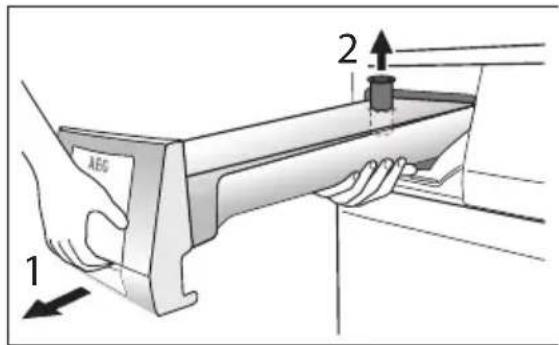
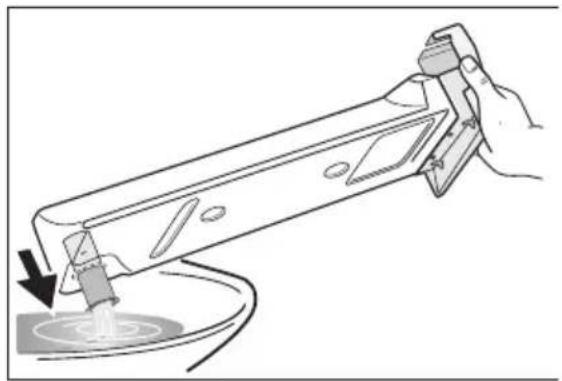
- Take out drawer containing condensed water container completely 1 and pull up the condensed water container's drainage pipe as far as it will go 2.
-
Pour condensed water out into a basin or similar receptacle.
-
Slide outlet connections in and refit condensate tank.
If the programme has been interrupted as a result of the condensate tank being full: Press the START PAUSE button to continue the drying cycle.
natural_image
Illustration of a hand using a tool to lift a component into a circular basin (no text or symbols)
The condensate tank has a volume of approx.
4 litres. This is sufficient for around 7 kg of laundry which has previously been spun at 1000 revolutions/ minute.

The condensate can be used as distilled water, e.g. for steam ironing. However first filter the condensate (e.g. with a coffee filter) to remove any residue and small pieces of fluff.
Cleaning heat exchanger
If the warning led is lighting, the heat exchanger needs to be cleaned.

CAUTION!
Operating when the heat exchanger is blocked with fluff can damage the dryer. This also increases energy consumption.
- Open door.
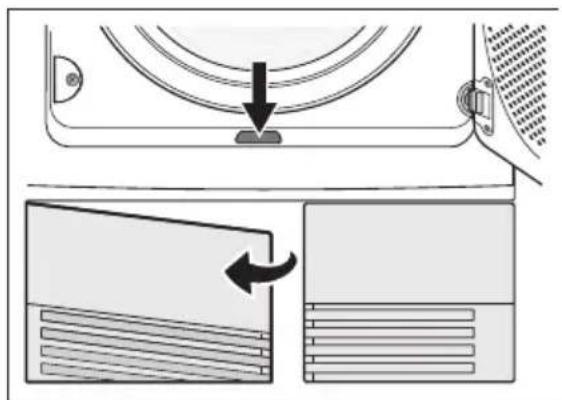
- Open door in plinth. To do this, press the release button on the bottom of the door aperture and open the door in the plinth to the left.
- Clean fluff from the inside of the door and the heat exchanger front chamber. Wipe the door seal with a damp cloth.
natural_image
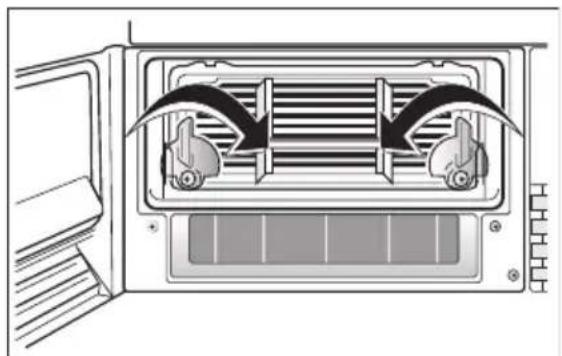
Diagram showing airflow or ventilation process between a fan and a rack, with no visible text or symbols- Turn both lock washers inwards.
natural_image
Diagram of a computer ventilation system showing airflow paths between two fans (no text or labels)-
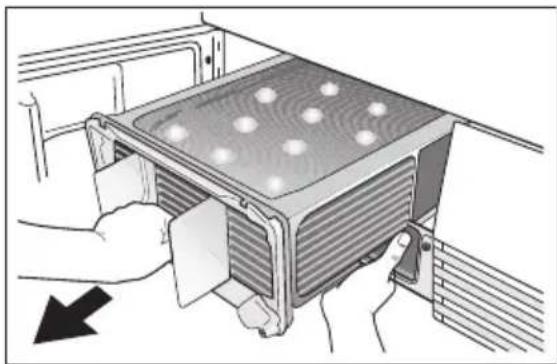
Use the handle to pull the heat exchanger out of the base and carry it horizontally to prevent any remaining water from spilling.
-
To empty the heat exchanger, hold vertically over a washing-up bowl.
natural_image
Illustration of hands installing or adjusting a heat exchanger unit with a grid of circular components (no text or symbols visible)
CAUTION!
Do not use sharp objects to clean. The heat exchanger could develop leaks.
- Clean heat exchanger.
It is best to use a brush or to rinse thoroughly with a hand-held shower.
-
Replace heat exchanger and lock into place (turn both lock washers outwards until they snap into place).
-
Close door in plinth.

CAUTION!
Never operate the dryer without the heat exchanger.
Cleaning the drum

CAUTION!
Do not use abrasives or steel wool to clean the drum.

Lime in the water or cleaning agents may form a barely visible lining on the inside of the drum. The degree to which the laundry has been dried is then no longer detected reliably. The laundry is damper than expected when removed from the dryer.
Use a standard domestic cleaner (e.g. vinegar-based cleaner) to wipe down the inside of the drum and drum ribs.
Clean operating screen and housing

CAUTION!
Do not use furniture cleaners or aggressive cleaning agents to clean the machine. Use a damp cloth to wipe down the operating screen and housing.
What to do if ...
1) In case of error message on the LCD (e.g. E51 - only dryers with the LCD): Switch the dryer off and on. Set programme. Press the START PAUSE button. Does not work? - inform local service and quote the error code.
2) follow program recommendation - see Programme overview chapter
3) see Care and cleaning chapter
4) see Machine settings chapter
5) only dryers with the LCD
6) Note: After around 5 hours the drying cycle ends automatically (see Drying cycle complete section).
Troubleshooting by yourself
| Problem 1) | Possible cause Remedy | |
| Dryer does not work. | Dryer not connected to mains supply. | Plug in at mains socket. Check fuse in fuse box (domestic installation). |
| Loading door opened. Close loading door | ||
| The START PAUSE button not pressed. Press the START PAUSE button. | ||
| Unsatisfactory drying results. | Incorrect programme set. | Set suitable programme. 2) |
| Fluff filters clogged. | Clean fluff filters. 3) | |
| Heat exchanger clogged. | Clean heat exchanger. ^3) | |
| Max. loading exceeded. Respect max. loading volume. | ||
| Covered ventilation grill. Uncover ventilation grill in base area. | ||
| Residue inside the drum. Clean the drum inside. | ||
| High water hardness. | Set suitable water hardness^4) . | |
| Loading door does not close | Filters not locked in place. | Install fine filter and/or snap course filter into place. |
| Err (Error) on the LCD ^5) | Attempt to change parameters after start of the programme. | Turn the dryer off and on. Set requested parameters. |
| No drum light | Programme selector in OFF position. | Turn it to DRUM LIGHT (if available) or to any programme. |
| Defective light bulb. Replace light bulb (see next section). | ||
| Abnormally elapsing time on the LCD ^5) | Time to end is calculated on the basis of: type, volume and dampness of laundry. | Automatic process; this is not a machine fault. |
| Programme inactive | Full water reservoir. | Empty water reservoir^3) , press START PAUSE button. |
| Drying cycle to short | Small laundry volume./Too dry laundry for selected programme. | Select time programme or higher drying level (e.g. EXTRA DRY). |
| Drying cycle to long ^6) | Fluff filters clogged. Clean fluff filters. | |
| To high loading volume. Respect max. loading volume. | ||
| Laundry insufficiently spun. Spun adequately the laundry. | ||
| Particularly high room temperature - no machine fault. | Lower the room temperature if possible. | |
Machine settings
| Setting Implementation | |
| Buzzer permanent on/off | 1. Turn the programme selector to any programme.2. Press simultaneously the DELICATE (DELICAAT) and BUZZER (ZOEMER) buttons and hold down for approx. 5 seconds.- diode above BUZZER (ZOEMER) button starts lighting - buzzer permanently on.- lighting diode comes off - buzzer permanently off.3. The buzzer is by default always off. You can use the BUZZER (ZOEMER) button to activate or deactivate sound but the machine does not memorize your selection. |
| Water hardness1) | 1. Turn the programme selector to any programme.2. Press simultaneously the DELICATE (DELICAAT) and START PAUSE (START PAUZE) buttons and hold down for approx. 5 seconds. The current setting is shown by the following red diodes:- WATER RESERVOIR (TANK) diode on - high conductivity >600 μS/cm- FILTERS (ZEEF) diode on - medium conductivity 300-600 μS/cm- CONDENSER (WARMTEWISSELAAR) diode on - low conductivity <300 μS/cm3. Press the START PAUSE (START PAUZE) button sequentially until you set desired level.4. To memorize setting press simultaneously the DELICATE (DELICAAT) and START PAUSE (START PAUZE) buttons or turn knob to OFF (UIT) position |
| Emptying water reservoir - warning LED off2) | 1. Turn the programme selector to any programme.2. Press simultaneously the BUZZER (ZOEMER) and DELAY START (STAR-TUITSTEL) buttons and hold down for approx. 5 seconds.The current setting is shown by the following red diode:- WATER RESERVOIR (TANK) diode flashes - diode warning is permanently off- WATER RESERVOIR (TANK) diode steady - diode warning is activated |
1) Water contains, a variable quantity of limestone and mineral salts of which quantities vary according to geographical locations thus varying its conductivity values. Relevant variations of the conductivity of the water compared to those prefixed by the factory could slightly influence the residual humidity of the laundry at the end of the cycle. Your dryer allows you to regulate the sensitivity of the drying sensor based on conductivity values of the water.
2) By default the warning LED is always on at the end of the drying cycle or during the cycle if the water reservoir is full. When using an external drain for the condensed water warning can be off
Technical data
| Parameter Value | |
| Height x width x depth 85 x 60 x 58 cm | |
| Drum volume 108 l | |
| Depth with loading door open 109 cm | |
| Height can be adjusted by 1.5 cm | |
| Weight when empty approx. 40 kg | |
| Loading volume (depends on programme)1) | max. 7 kg |
| Voltage 230 V | |
| Required fuse 16 A | |
| Total power 2350 W | |
| Energy efficiency class | B |
| Energy consumption (7 kg of cotton, pre-drained at 1000 rpm)2) | 3.92 kWh |
| Average annual energy consumption 284.1 kWh | |
| Use Domestic | |
| Permissible ambient temperature + 5°C to + 35°C | |
| Consumption valuesThe consumption values have been established under standard conditions. They may deviate when the machine is operated in domestic circumstances. | |
| Programme | Energy consumption in kWh / average drying time in min. |
| COTTON CUPBOARD DRY3) | 3.92 / 125 (7 kg load pre-drained at 1000 rpm)3,75 (7 kg load pre-drained at 1200 rpm)3,60 (7 kg load pre-drained at 1400 rpm)3,20 (7 kg load pre-drained at 1800 rpm) |
| COTTON IRON DRY3) | 3.34 / 107 (7 kg load pre-drained at 1000 rpm) |
| SYNTHETICS CUPBOARD DRY3) | 1.33 / 48 (3 kg load pre-drained at 1200 rpm) |
1) Different loading volume data may be needed in some countries as a result of different measuring methods.
2) in accordance with EN 61121
3) Hints for test institutes: cycle has to be checked in accordance with EN 61121
Service
In the event of technical faults, please first check whether you can remedy the problem yourself with the help of the operating instructions - see chapter What to do if....
If you were not able to remedy the problem yourself, please contact the Customer Care Department or one of our service partners.
In order to be able to assist you quickly, we require the following information:
- Model description
-
Product number (PNC)
-
Serial number (S No. is on rating plate stuck to the product - to find it see chapter Product description))
- Type of fault
- Any error messages displayed by the appliance
So that you have the necessary reference numbers from your appliance at hand, we recommend that you write them in here:
Model description: ....
PNC: ____
S No: ....
- DELICAAT -functie
- ZOEMER functie
- De deurpakking schoonmaken
- LET OP!
- Fonction DÉLICAT
- Operating Instructions
- Important safety information
- General safety
- WARNING!
- Installation
- Use
- Child safety
- Environment
- Environmental tips
- Environmental information
- Appliance positioning
- Removing transport safety packaging
- CAUTION!
- Electrical connection
- Changing door stop
- Special accessories
- - Stacking kit
- - Draining kit
- - Pedestal with the drawer
- Control panel
- Before first use
- Daily use
- Sorting laundry
- Preparing laundry
- Switching machine on
- Laundry loading
- Selecting the programme
- DELICATE (DELICAAT) function
- BUZZER (ZOEMER) function
- DELAY START (STARTUITSTEL) function
- Starting the programme
- Changing programme
- Cycle end / laundry unloading
- Care and cleaning
- Cleaning fluff filter
- Clean the entire filter area
- Cleaning the door seal
- Emptying the condensate tank
- Cleaning heat exchanger
- Cleaning the drum
- Clean operating screen and housing
- What to do if ...
- Technical data
- Service
Brand : AEG-ELECTROLUX
Model : Lavatherm 55840
Category : Tumble dryer