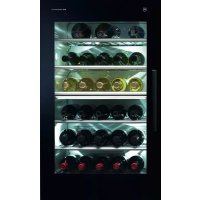
USER MANUAL Winecooler SL V-ZUG
Operating instructions
Lieber V-ZUG-Kundin, lieber V-ZUG-Kunde
Chere cliente, cher client,
| Safety instructions 46 |
| Disposal 47 |
| Installation 48
The appliance needs air 49
Installation 49
Electrical connection 50 |
| Product description 51 |
| User panel 51 |
| Commissioning – setting temperature, switching off | 5 |
| Adjusting storage racks 52 |
| Adjusting the temperature zone divider 53 |
| Changing the light fitting 53 |
| Proper loading 54 |
| Ideal drinking temperatures 54 |
| Defrosting 54 |
| Cleaning and maintenance 54 |
| Energy-saving tips 55 |
| What to do if... | 55 |
| Guarantee | 57 |
| Operating noises | 57 |
Dear Customer
Please read these instructions carefully before starting to use your appliance. They contain important information about the safe operation, installation and maintenance of your appliance.
Please keep them for reference and pass them on to any subsequent user.
Safety instructions
Warning: Do not operate any electrical appliances inside.
This appliance conforms to recognised technical regulations and to the EC guideline 73 / 23 / EEC (low voltage guideline). It has been checked for compliance with electrical safety regulations in accordance with EMC guideline 89 / 336 / EEC and EN 55014.1993.
. Electrical safety (shock-hazard protection) must be effected as part of the installation procedure.
. M ains voltage 230 V / 50 Hz.
. This appliance should be used for domestic purposes only in accordance with the user instructions.
. If you have received a faulty appliance, contact your supplier immediately.
. Repairs and modifications must only be carried out by a qualified service engineer.
. Disconnect from the mains when cleaning; pull out the plug or deactivate the fuse. Never pull the plug out of the socket by the cable or with wet hands. Always take hold of the plug itself and pull it straight out of the socket.
This appliance is CFC- and FC-free and contains small quantities of Isobutane (R600a), an environmentally friendly coolant.
. You must ensure that the cooling circuit is undamaged when handling this appliance. However, if it becomes damaged, avoid proximity to open fires and heat sources of all kinds. The room in which the appliance is located should be ventilated for a few minutes.
. Never use an appliance with a damaged circuit.
. Ensure that the ventilation openings to and from a built-in appliance are never blocked or covered. No liability will be accepted for any damage incurred owing to misuse of the appliance or as a result of repairs carried out by unqualified personnel. In this case neither the guarantee nor any other liability claims will apply.
. In the interests of safety, faulty connection cables for this appliance must be replaced by the manufacturer, his customer service department or similarly qualified personnel.
Disposal
Information about the appliance packaging
- Dispose of your appliance packaging properly. None of the packaging materials used are harmful to the environment and they may be re-used.
About the materials: the plastics may also be recycled and are identified as follows:
PE< for polyethylene e.g. in the outer casing and internal pockets.
PS< for polystyrene foam, e.g. in padding. Essentially CFC-free.
The cardboard used is made from recycled paper and should also be put out for old paper collection.
Disposal of old appliances
Refrigeration equipment must be properly disposed of in a way which protects the environment. This applies to your old appliance and to your new appliance once it has reached the end of its service life.
Warning: Please ensure that old, worn appliances are rendered unusable before disposal by removing the plug, cutting the network cable, and removing or destroying any snap fastenings or bolts. You will thus prevent children from locking themselves in the appliance during play (risk of suffocation) or endangering their lives in any other way.
Disposal instructions:
. The appliance must not be disposed of in the dustbin or with normal household rubbish.
. The coolant circuit, particularly the heat exchanger at the back of the appliance, must not be damaged.
. The symbol on the product or its packaging indicates that this product is not to be handled as normal household waste but is to be taken to a recycling collection point for electrical and electronic goods. By correctly disposing of this product you are contributing to the protection of the environment and to the health of your fellow human beings. Improper disposal endangers health and the environment. Further information about the recycling of this product may be obtained from your town hall, refuse collection department or the store where you purchased the product.
Installation
Installation site
The appliance should be positioned in a well-ventilated, dry room. The ambient temperature will influence energy consumption and the proper functioning of the appliance. For this reason, the appliance
. S hould not stand in direct sunlight;
Should not stand near a radiator, a stove or any other heat source;
. Should be located only where the ambient temperature is compatible with the climatic classification of the appliance.
You will find the climatic classification on the nameplate inside the appliance on the top right-hand side.
The following table specifies the ambient temperature range for each climatic classification:
| Climatic classification for an ambient temperature of |
| SN +10 °C to +32 °C |
| N | +16 °C to +32 °C |
| ST +18 °C to +38 °C |
| T | +18 °C to +43 °C |
To prevent the appliance from heating up, ensure that an adequate ventilation gap is retained and install a suitable thermal insulation panel. An adequate flow of air to and from the cooling aggregate must be ensured.
The appliance needs air
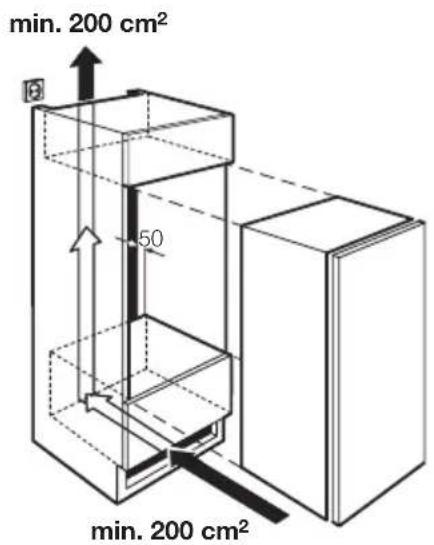
Warning! To ensure the proper functioning of the appliance, air vents should never be blocked or covered.
The appliance door seals the installation unit almost completely, so an air vent is provided in the base of the housing. Warmed air must be conducted via the ventilation shaft to the rear wall of the housing and then expelled upwards. The ventilation channels should measure at least 200cm^2 in cross-section.
Installation
Scale drawing
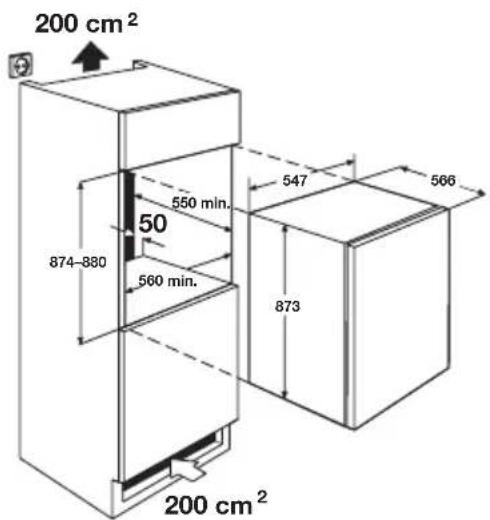
After installing, and particularly if the door hinge is reversed, please ensure that the door seal is tight all round. An imperfect door seal can lead to increased condensation and thus to higher energy consumption (see the section headed «What to do if...»).
Electrical connection
A properly installed socket outlet with earthing contact is required for electrical connection, positioned so that it is possible to pull out the mains plug.
The socket outlet with earthing contact used to connect the appliance should be positioned on the left or right-hand side adjacent to the housing.
Electrical fuse protection of at least 10/16 amperes must be provided. If the socke is no longer accessible once the appliance has been built-in, suitable measures must be taken during electrical installation to ensure that the appliance can be disconnected from the mains (fuse, LP [line protection] contact opening width of at least 3mm ).
The identification plate is located inside the appliance on the top right-hand side. Before operating the appliance, check the identification plate to ensure compliance of the connection voltage and type of current with the mains network values at the installation site.
e.g. AC 220 ... 240 V 50 Hz or
220...240V\~50Hz
(i.e. 220 to 240 volt alternating current, 50 Hertz)
Product description
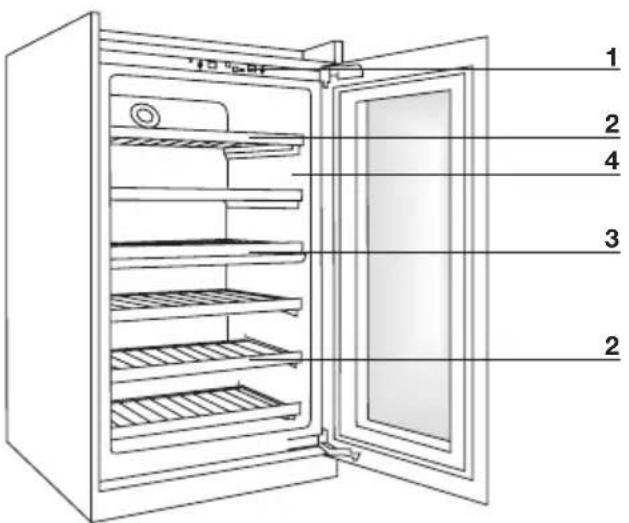
1 Control panel
2 Storage racks (adjustable)
3 Temperature zone divider (adjustable)
4 Identification plate
User panel
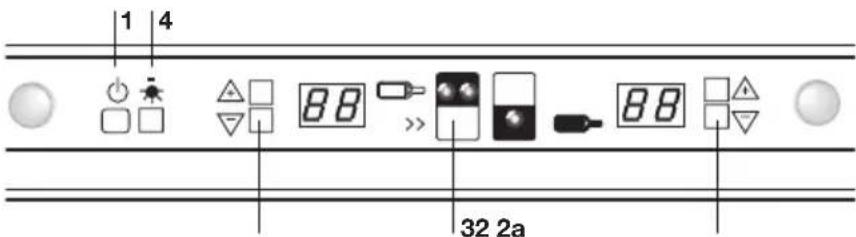
1 Appliance on/off Press for at least 3 seconds.
2 Select upper zone temperature (5 - 18^ ,adjustable) Recommendation: 5 - 12^ (ideal for white wine, see page 54) Press for at least 3 seconds indicator flashes The temperature can be adjusted in steps.
2a Select lower zone temperature (5-18 °C, adjustable)
Recommendation: 12-18 °C (ideal for red wine, see page 54)
The temperature set for the lower zone must always be the same as or higher than that in the upper zone.
3 Supercool
Press for 3 seconds - the yellow pilot light illuminates.
The appliance cools the upper zone for 24 hours at +5^ C
and then automatically at the set temperature.
4 Interior light switched on permanently:
Press for 3 seconds ON
Interior light on only while the door is open:
Press for 3 seconds OFF
If the door is kept open for longer than 5 minutes, an acoustic door alarm will sound. This can be switched off by briefly pressing any button.
Adjusting storage racks
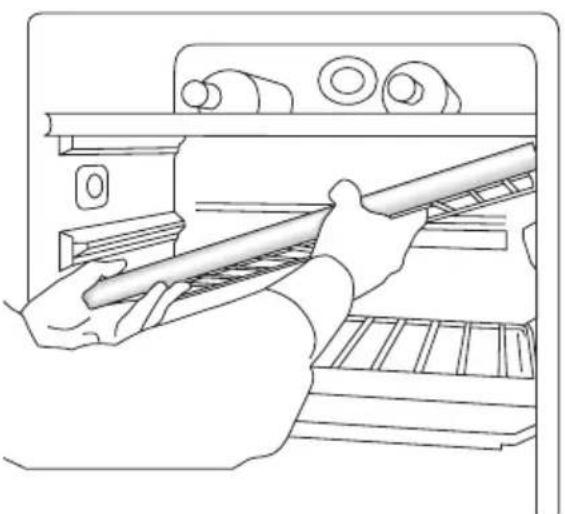
The height of the storage racks is adjustable.
Pull the shelf forwards, lift on the door side and remove.
Reverse this procedure to replace the shelf at a different level.
Adjusting the temperature zone divider
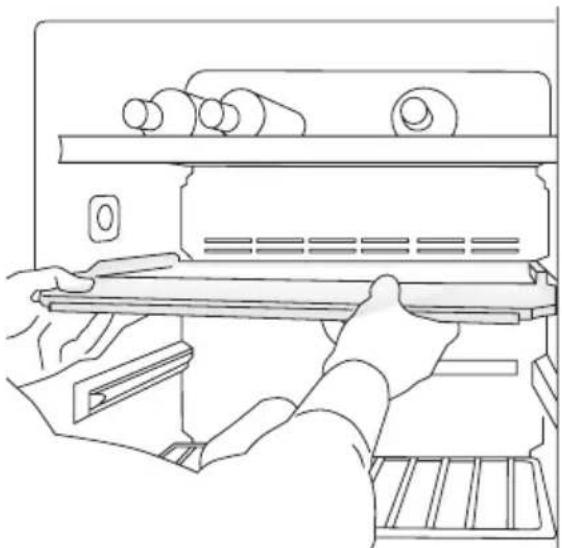
The temperature zone divider can be raised or lowered by 1 position.
Pull forwards away from the rear wall, and lift on door side.
Reverse this procedure to replace at a different level.
Please ensure that the rear section of the temperature zone divider slots into the groove provided in the rear wall.
Changing the light fitting
Note: Please use only original light fittings provided by the manufacturer.
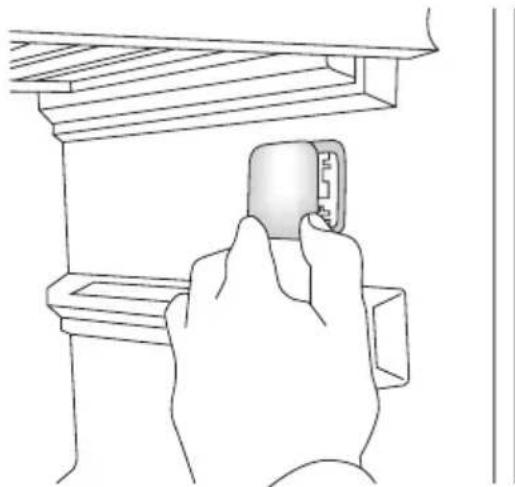
Click off the light cover. Loosen the plug of the light fitting. Reverse this procedure to insert a new light fitting.
Proper loading
The appliance is separated into 2 adjustable temperature zones (both adjustable from 5 - 18^ ):
Top compartment white wine, champagne, sparkling wine, rosé wine.
Bottom compartment—red wine
Please ensure that the temperature set for the bottom compartment is always at least the same as or higher than that in the top compartment.
Ideal drinking temperatures*
6-8 °C Champagne, sparkling wine, Chasselas, Riesling, Sauvignon Blanc, young Chardonnays and sweet wines, all rosé wines
8-10 °C Mature Chardonnays and Sauternes
13-15 °C Gamay, young Merlots, young Pinot Noir wines
15-17 °C Young Bordeaux, light Cabernet, Barbera, Merlot
16-18 °C Big Burgundies, Bordeaux, Italian, Spanish and Californians, etc.
17-18 °C Barolo, Reciotto Amarone
(The lower temperature is suitable for more simple wines, and the higher for the more complex, better quality wines of each category).
Defrosting
The cooler defrosts automatically.
The evaporator behind the rear wall of the cooler defrosts automatically. The condensate collects in the drainage channel behind the rear wall of the cooler, and flows through the drainage hole into the drip tray by the compressor where it evaporates.
Cleaning and maintenance
Warning! Because of the risk of electric shock, the appliance should not be connected to the mains during cleaning. Before cleaning, switch off the appliance, pull out the mains plug or deactivate or remove the fuse.
For reasons of hygiene, the interior of the appliance, including all internal fitments, should be cleaned regularly.
Never steam-clean the appliance. Dampness may penetrate the electrical components, creating the risk of an electric shock. Hot steam may damage the plastic components. The appliance must be dry before it is used again.
Caution! Plastic components may be attacked by essential oils and organic solvents such as fruit juices and the acids in butter, as well as by detergents containing vinegar. Such substances should not come into contact with appliance components. Do not use abrasive cleaning agents.
Energy-saving tips
- Do not install the appliance near stoves, radiators, or any other sources of heat. If the ambient temperature rises, the compressor operates more frequently and for longer.
. Ensure that the appliance is adequately ventilated . Never cover air vents .
. Only open the door for as long as necessary.
What to do if...
Troubleshooting
Any malfunction will probably be due to a minor fault which you will be able to rectify yourself with the aid of the following instructions. Do not attempt any more extensive repairs yourself, should the following information prove unhelpful in solving a particular problem.
| Fault Possible cause Solution |
| Appliance doesn’t work. | Appliance is not switched on. | Switch on. |
| Mains plug is loose or not plugged in. | Insert the mains plug. |
| Fuse has triggered or is defective. | Check fuse and replace if necessary. |
| Socket is defective. | Faults with the mains supply must be repaired by a qualified electrician. |
| Inadequate cooling chamber temperature. | Temperature has not been properly set. | Please see under «user panel» or «proper loading». |
| Door was open for a long period. | Only open door for as long as necessary. |
| The appliance is positio-ned next to a heat source. | Please see under «Installation site». |
| Interior light doesn’t work. | The light fitting is defective. | Please see under «changing the light fitting». |
| The compressor doesn’t cut in immediately after changing the temperature setting. | This is normal and not due to a fault. | The compressor cuts in automatically after a short time. |
| Error message F1 on control panel. | Upper sensor defective. | Contact customer service. |
| Error message F2 on control panel. | Lower sensor defective. | Contact customer service. |
| Error message F3 on control panel. | Fan defective. | Contact customer service. |
Guarantee
The guarantee runs from the date on which the appliance is delivered to the end user. Under the terms of the guarantee, the customer service department will rectify any faults which may occur despite proper use during the guarantee period and which may be attributable to faulty materials or manufacture.
Excluded from the guarantee are:
. Defects arising from improper use or failing to observe the operating instructions.
C claims for damages which exceed the terms of our guarantee.
. Appliances which have been repaired by a third party.
Operating noises
Noises which are entirely normal
The chill cabinet is cooled by a compressor (refrigeration aggregate). The compressor pumps coolant through the cooling system, producing operating noises. Even when the compressor cuts out, noises caused by changes in temperature and pressure are unavoidable.
This appliance is fitted with a quiet compressor and a low-noise cooling circuit designed in line with the latest technical developments. However, a certain level of noise, dependent on the size of the appliance, is inevitable. Operating noise will be most audible immediately after the compressor cuts in. It becomes quieter as the operating period continues.
Noises which are not normal
Unusual noise is normally the result of improper installation. The appliance must be installed or built-in so that it is level and stable. Under no circumstances must tubing come into contact with a wall, other furniture or with another tubing.
Where coolers are installed in open-plan kitchens or in partition walls, the level of operating noise will be heard more acutely. However, this is due to the surrounding architecture and not to a fault with the appliance.
| Description Cause Comment |
| Droning | Cooling aggregate | Normal operating noise of the cooling aggregate. The level is dependent on the size of appliance. |
| Humming Fan Normal operating noise of the fan. |
| Gurgling | Cooling circuit | Normal operating noise as coolant flows through the circuit. |
| Babbling | | |
| Murmuring | | |
| Hissing | Cooling circuit | Normal operating noise as coolant is injected into the condenser. |
| Cracking | Case or cabinet | Normal as materials expand and contract due to temperature variations (e.g. plastics, isolation). |
Reparatur-Service