 ManualGo.com
 LC756BB30 - Basket SIEMENS - Free user manual and instructions
Find the device manual for free LC756BB30 SIEMENS in PDF.


Download the instructions for your Basket in PDF format for free! Find your manual LC756BB30 - SIEMENS and take your electronic device back in hand. On this page are published all the documents necessary for the use of your device. LC756BB30 by SIEMENS.
USER MANUAL LC756BB30 SIEMENS
installation instructions
Information on protection of the environment 19
Before using the appliance for the rst time 19
Safety Instructions 20
Technical safety 20
Special information for gas cookers 21
Correct installation 22
Cleaning and Care 25
Removing and installing the grease lters 26
Removing and installing the metal-mesh grease lters 26
Installing and removing the activated carbon lters 26
Changing the bulbs 27
Installation instructions 28
Connecting Pipes 28
Electrical Connections 29
Installation preparations 30
Installing the ue ducts 3219
E-no. FD B EFORE USING THE APPLIANCE FOR THE FIRST TIME NOTE: These operating instructions apply to
several appliance models It is possible that
individual features are described which do not
apply to your appliance.
Before switching on your new appliance, plea-
se read the operating instructions carefully.
They contain important information on safety
and how to use and look after the appliance.
Keep the operating and instructions in a safe
place and pass them on to any subsequent
owner of the appliance.
INFORMATION ON PROTECTION OF THE ENVIRONMENT Disposal of transport packaging
Your new appliance was sent to you in
protective packaging. All utilised materials are
environmentally safe and recyclable. Please
help us by disposing of the packaging in an
environmentally friendly manner.
Packaging parts can be hazardous for children.
Therefore keep them outside the reach of
Disposal of the old appliance
Old appliances are not worthless rubbish.
Valuable raw materials can be reclaimed by
recycling old appliances.
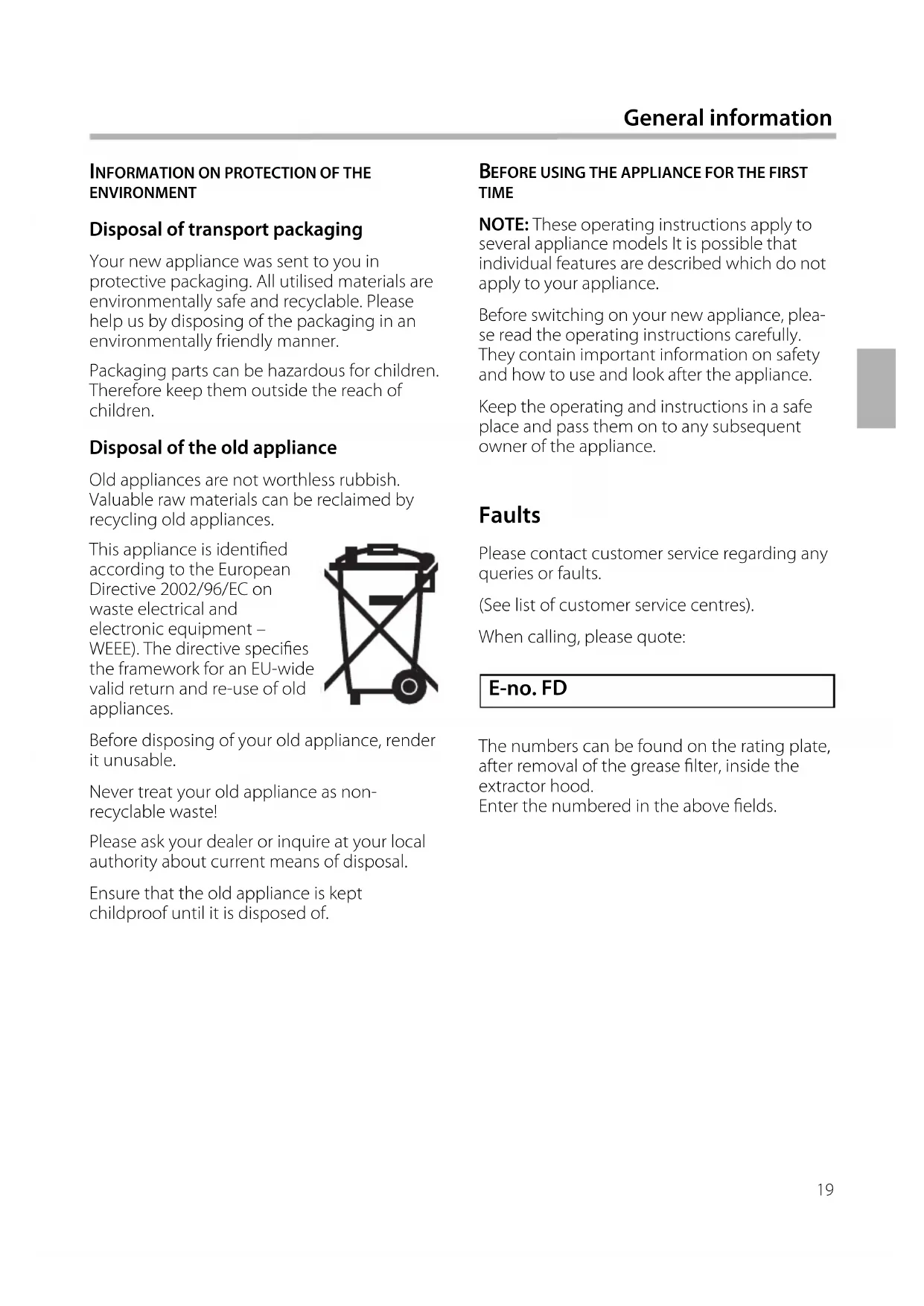
This appliance is identied
according to the European
Directive 2002/96/EC on
waste electrical and
electronic equipment –
WEEE). The directive species
the framework for an EU-wide
valid return and re-use of old
Before disposing of your old appliance, render
Never treat your old appliance as non-
Please ask your dealer or inquire at your local
authority about current means of disposal.
Ensure that the old appliance is kept
childproof until it is disposed of.
Please contact customer service regarding any
(See list of customer service centres).
When calling, please quote:
The numbers can be found on the rating plate,
after removal of the grease lter, inside the
Enter the numbered in the above elds.
This extractor hood complies with the
stipulated safety regulations. Improper use
may result in injury or damage.
The extractor hood may be used in the
household only. The manufacturer is not liable
for damage which is caused by improper use or
incorrect operation.
The manufacturer cannot be made
responsible for damage which can be attributed
to non-observance of the safety instructions.
RISK OF INJURY Do not allow children to play with the
extractor hood! Adults and children must
never operate the appliance unsupervised
– if they are not physically or mentally
capable of doing so,
– or if they do not have the knowledge and
experience to operate the appliance
correctly and safely.
The extractor hood left the factory in perfect
condition. Nevertheless check the appliance for
visible damage before installation. If it is
damaged, do not switch it on!
If the power cord of the extractor hood is
damaged, it must be replaced by the
manufacturer, his customer service or a
similarly qualied person to prevent hazardous
Only a qualied technician may install
(including electrical connection), service or
repair the extractor hood. Always isolate the
extractor hood by pulling out the mains plug
or switching o the fuse!
Safety instructions
If the appliance is improperly installed,
serviced or repaired, the user may be placed in
considerable danger for which the
manufacturer is not liable.
Changes to the electrical or mechanical
installation are dangerous and must not be
undertaken! They may also cause the extractor
hood to malfunction.
Simultaneous operation of the extractor
hood with a heating appliance which is
dependent on ambient air
Heating appliances which are dependent
on ambient air, e.g. gas, oil, wood, or solid-fuel
heaters, instantaneous water heaters, hot
water boilers, hobs or ovens, and which draw
combustion air out of the installation room
and whose exhaust gases are conveyed to the
RISK OF POISONING If the extractor hood is operated at the same
time as a heating appliance which is
dependent on ambient air, there is a risk of
poisoning due to combustion gases being
Safe operation is possible provided the low
pressure in the installation room of the heating
appliance does not exceed 4Pa (0.04mbar).
This can be achieved if the combustion air can
ow through non-closable openings, e.g. in
doors, windows, in conjunction with air
intake/exhaust air wall boxes or by other
Adequate intake air must therefore always
An intake/exhaust air wall box alone does not
ensure compliance with the limit value.
NOTE: When making your evaluation, always
consider the entire ventilation system in the
home. Include the advice of a competent
heating engineer when making your
If the extractor hood is used in circulating
air mode only, it can be operated without any
Special information for gas cookers
When installing the extractor hood above
gas hobs, observe the appropriate national
statutory regulations (e.g. in Germany:
Technische Regeln Gasinstallation TRGI).
Observe the currently valid installation
regulations and instructions of the gas
appliance manufacturer.
During installation, ensure that only one side
of the extractor hood is situated directly next to
a high-sided unit or a wall. Otherwise, there is a
risk of heat build-up. The gap between the
extractor hood and the wall or high-sided unit
must be at least 50 mm.
RISK OF BURNS Do not operate more than 2 gas cooking areas
simultaneously over a period of max.
15 minutes at maximum thermal load. Due to
the eect of the heat there is a risk of burns if
the surfaces of the housing are touched!
Note that one large burner of more than
5 kW (Wok) is equivalent to the power of 2 gas
The extractor hood may be damaged by
Never operate a gas cooking area without a
cooking utensil on it. Regulate the ame in
such a way that it does not project over the
Clean the extractor hood thoroughly before
using for the rst time.
Before cleaning and servicing the extractor
hood, isolate it from the power supply by
pulling out the mains plug or switching o the
Bulbs (especially halogen bulbs) become
very hot during operation. Even some time
after the appliance has been switched o,
there is still a risk of burns!
Before changing bulbs, isolate the extractor
hood from the power supply and leave the
Do not operate the extractor hood without
Always switch on the extractor hood if a
hotplate is being used. If the extractor hood is
not switched on, condensation may form. As a
result, the appliance may corrode.
RISK OF FIRE Do not ambé under the extractor hood or
work with a naked ame. When switched on,
the extractor hood draws ames into the lter.
There is a risk of re due to deposits on the
Do not leave pans, frying pans or deep-fat
fryers unattended if you are cooking food with
oils or fats, e.g. chips. Overheated oils or fats
A risk of re can be prevented by cleaning
the grease lters regularly and changing the
activated-carbon lter in good time.
Never operate the extractor hood without
Correct installation
Check the manufacturer’s specications for
the cooker to determine whether an extractor
hood can be operated over it.
If the manufacturer of the cooker has not
specied any signicant safety distances, the
following minimum distances apply
– 550 mm between electric hob and the
lower edge of the extractor hood
– 650 mm between gas hob (upper edge of
pan support) and the lower edge of the
(see g. 1, page 2).
If various cookers are used, the greatest
indicated distance applies.
The width of the extractor hood must
correspond to the width of the cooking area.
The extractor hood must not be installed
over a solid fuel heating appliance which may
be a re risk (e.g. ying sparks) unless the
heating appliance has a closed, non-
detachable cover and the country-specic
regulations are observed. This restriction does
not apply to gas cookers and gas hobs.
To avoid damaging the hob, cover it when
installing the extractor hood.
Safety instructions23
The extractor hood can be used in exhaust air and circulating air mode.
The air which is drawn in is cleaned by the
grease lters and conveyed to the exterior by a
Circulating-air mode
The air which is drawn in is cleaned by the
grease lters and an activated carbon lter and
conveyed back into the kitchen.
An activated carbon lter must be installed to
bind odours in circulating-air mode (see
”Removing and installing the grease lters”).
The complete installation set as well as the
replacement lters are available from specialist
outlets, customer service or the Online Shop.
The accessory number can be found at the
end of the operating instructions.24
Operation NOTE: It is recommended to switch on theblower when you start cooking and not toswitch it o again until several minutes afteryou have nished cooking. In this way thekitchen fumes are removed most eectively. Switching on the fan and selecting the
fan settings Press button 1. If kitchen fumes are thickerswitch to setting 2 or 3. Switching o the fan Press button 0. Light The light can be switched on and oindependently of the fan. For appliances with Intensive setting
The Intensive setting P generates maximum performance. It can be used if thick fumes orstrong odours occur temporarily.
The description of the operation applies toseveral appliance models. It is possible thatindividual features are described which do notapply to your appliance.
1230P Light Fan settingsLightFan settingsLightFan settingsIntensivesetting25
LOOKING AFTER THE APPLIANCE
Suitable cleaning agents and care products
for your appliance can be purchased via the
Hotline or from the Online Shop (see cover
NOTE: Observe the warranty regulations in the
enclosed service booklet. The appliance surfaces and controls are scratch-sensitive. Therefore observe the
following cleaning instructions:
– Avoid cleaning the extractor hood with dry
cloths, abrasive sponges, scouring agents,
cleaning agents containing sand, soda, acid,
chlorine or any other aggressive substances.
– Clean the appliance surfaces and controls
with a soft, damp cloth, washing-up liquid
or a mild window cleaner only.
– Do not scrape o dried dirt, but moisten with
– Clean carefully in the area of the controls to
avoid liquid from getting into the
NOTE: Clean the stainless steel surfaces in the
direction of the ground surface only!
Do not use stainless steel cleaner for the
The metal-mesh grease lters absorb the
grease particles from the kitchen fumes. The lter mats consist of re-proof metal.
RISK OF FIRE As the lters become more saturated with
greasy residue, the ammability increases. The
function of the extractor hood may also be
impaired. The risk of re is prevented by cleaning the metal-mesh grease lters in good time. When cleaning the grease lters, also remove grease deposits from the accessible
parts of the housing with a damp cloth.
Cleaning the metal-mesh grease lters ... Under normal operation (daily 1 to 2 hours), the metal-mesh grease lters must be cleaned
... in the dishwasher The metal-mesh grease lters can be cleaned in the dishwasher. Slight
discolouration may occur but this will not
aect the function of the grease lters. The lters must be placed loosely in the dishwasher. They must not be wedged in.
NOTE: Do not clean heavily saturated metal-
mesh grease lters together with utensils.
... by hand When cleaning by hand, soak the grease lters in a hot detergent solution, brush o the
dirt, rinse thoroughly and leave to dry. Do not use any aggressive, acidic or alkaline cleaning agents. If dirt is particularly stubborn, we recommend using a special grease solvent
spray. This can be ordered via the Online Shop.26
Removing and installing the grease filters
Activated carbon lters bind the odours in
circulating-air mode.
Installing and removing the activated
1. Remove the grease lters (see Removing
and installing the metal-mesh grease lters).
2. Insert the activated carbon lter.
4. Reinsert the grease lters (see Removing
and installing the metal-mesh grease lters).
Changing the activated carbon lter
Under normal operation (daily 1 to 2 hours)
the activated carbon lters must be replaced
approximately 2x year.
The activated carbon lter is available from
specialist outlets, customer service or the
Online Shop (see Optional accessories). Use
original lters only.
Activated carbon lters do not contain any
pollutants. They can be disposed of in the
Before removing and installing the grease
lters, always follow the instructions and
warnings in the chapter entitled ”Safety
Removing and installing the metal-mesh
1. Open the lock and fold down the grease
lters. In doing so, hold the underside of the
grease lters with your other hand.
(for appliances with edge extraction)
2. Clean the grease lters.
3. Reinsert the cleaned grease lters.27
Changing the lament bulbs
1. Lift the bulb cover slightly.
2. Push the bulb cover towards the middle of
3. Replace the defective bulb with a new one
of the same type and equivalent power (see
4. Reinsert the bulb cover.
5. Restore the power supply by inserting the
mains plug or switching on the fuse.
NOTE: If the light does not function, check
whether the bulbs have been inserted
Defective bulbs should be replaced
immediately to avoid overloading the
Before changing the bulbs, always follow
the instructions and warnings in the chapter
entitled ”Safety instructions”!
The description of changing the bulbs
applies to several appliance models.
NOTE: Observe the warranty regulations in the
enclosed service booklet.
Changing the halogen bulbs
Halogen bulbs become very hot during
operation. Even some time after the appliance
has been switched o, there is still a risk of
Before changing the halogen bulbs, ensure
that they have cooled down fully.
1. Carefully remove the bulb ring with a
2. Replace the defective bulb with a new one
of the same type and equivalent power (see
NOTE: When inserting halogen bulbs, do not
touch the glass tube. Therefore use a clean
cloth when inserting the bulb.
3. Reinsert the bulb cover.
4. Restore the power supply by inserting the
mains plug or switching on the fuse.
Prior to installation, always follow the
instructions and warnings in the chapter
entitled ”Safety instructions”!
The exhaust air is conveyed upwards via a
ventilation shaft or directly through the outer
wall to the exterior.
NOTE: The exhaust air must not be conveyed
into a functioning smoke or exhaust gas ue or
into a shaft which is used to ventilate
installation rooms which contain heating
Before conveying the exhaust air into a
non-functioning smoke or exhaust gas ue,
obtain the consent of the appropriate heating
Discharge exhaust air in accordance with
the ocial and statutory regulations (e.g.
regional building laws).
If the exhaust air is conveyed through the
outer wall, a telescopic wall box should be
To ensure optimum performance, the
extractor hood requires:
– a short, straight exhaust air pipe and
– the largest possible pipe diameter.
If pipe bends cannot be avoided, ensure
the largest possible radii.
NOTE: If long, rough exhaust air pipes, a lot of
pipe bends or pipe diameters less than
150 mm are used, the air capacity will be less
than optimum and there will be an increase in
Use only pipes or hoses made of non-
combustible material for installation of the
The manufacturer of the extractor hoods is
not responsible for complaints which can be
attributed to planning and design of the
The diameter of the exhaust air pipes
should not be less than 150 mm.
We recommend an inner diameter of
150 mm, however at least 120 mm.
Flat ducts must have the same inner cross-
section as round pipes.
There should be no sharp bends.
Ø 150 mm approx. 177 cm
Connection of 150 mm ø exhaust air pipe
Attach exhaust air pipe
directly to the air-pipe
appropriately. If using an
aluminium pipe, smooth the
connection area beforehand.
Connection of 120 mm ø exhaust air pipe
connector directly to the air-
Attach exhaust air pipe to
the reducing connector.
If a permanent connection is required
A disconnector must be provided on the
installation side. Switches with a contact
opening of more than 3 mm and all-pole
disconnection are regarded as disconnectors.
This includes LS switches, fuses and contactors.
Electrical specications
The required connection data can be found on
the rating plate inside the appliance when the
grease lters have been removed.
Length of the power cord: approx. 1.30 m.
This extractor hood complies with the EC
interference suppression regulations.
ELECTRICAL CONNECTION
Before connecting the appliance to the
power supply, always follow the instructions
and warnings in the chapter entitled ”Safety
instructions”! The extractor hood may only be connected by a qualied electrician who is familiar with
the regulations of the relevant electricity
RISK OF INJURY If the power cord of the extractor hood is
damaged, it must be replaced by the
manufacturer, his customer service or a
similarly qualied person to prevent hazardous
situations. The extractor hood may be connected to a correctly installed earthed socket only. Attach the earthed socket as directly as possible behind the ue duct.
– The earthed socket should be connected via
– If the earthed socket is no longer accessible
following installation of the extractor hood,
a disconnector must be tted as for a
permanent connection.
Installation instructions30
The extractor hood is designed to be
mounted on the wall.
During installation, optional accessories may
also require fitting. Observe the minimum distance between hob and extractor hood (see ”Safety
instructions”)! Avoid damaging the sensitive surfaces! Preparing the wall
DAMAGE TO PROPERTY Before drilling the holes for the designated
installation location, check for concealed
electrical cables and other lines. The wall must be level and vertical. The enclosed screws and wall plugs are suitable for solid brickwork. Use the
appropriate fixing materials for other wall
structures (e.g. plaster board, porous concrete,
Ensure that the wall has adequate load
Ensure that the depth of the drilled holes
corresponds with the length of the screws.
Ensure that the wall plugs are secure.
Max. weight in kg: 40
Design subject to modication in line with
technical development.
Installation preparations
1. Mark a centre line on the wall from the
ceiling to the lower edge of the extractor
2. Using the enclosed template, mark
positions for the screws and, to facilitate
attachment, the contour of the attachment
area. The lower edge of the template
corresponds to the lower edge of the
3. Drill 2x 8 mm holes for attachment of the
extractor hood and 2x 8 mm holes for the
xing bracket for the ue duct and press in
wall plugs ush with the wall.
4. Screw on the xing bracket for the ue
5. Screw on the brackets for the extractor
hood: hand tight, max. 3 Nm.
Ensure that the washers and brackets are
Attachment and alignment 1. Initially remove the protective foil from theback of the extractor hood and, followinginstallation, remove foil completely. 2. Mount the extractor hood, ensuring that theback is attached firmly to the brackets Ⓐ. 3. Align the extractor hood horizontally byturning the brackets.. If required, the extractor hood can bemoved to the right or left Ⓑ.
Locking screws and locking caps 1. Mark the holes for the safety screws. Detachthe extractor hood, drill holes for the safetyscrews and press in wall plugs ush withthe wall.2. Attach the extractor hood and screw in thesafety screws tightly.3. Press the safety caps with the arrow upwardsonto the brackets until they click intoposition Ⓒ.
RISK OF INJURY Check that all locking screws and locking capshave been attached securely!4. Connect the pipes (see ”Connecting pipes”).5. Connect to the power supply (see ”Electricalconnection”). Removing the safety caps Remove the locking caps from the bracketsusing a suitable tool, e.g. a at-bladescrewdriver.
4. Place ue ducts on the extractor hood, push
the inner ue duct upwards and attach the
left and right sides to the xing bracket.
5. Screw the inner ue duct with 2 screws to
the sides of the xing bracket.
Installing the ue ducts
RISK OF INJURY The insides of the ue ducts may have sharp
edges. We recommend wearing protective
gloves during installation.
1. Separate the ue ducts. To do this, remove
2. Remove the protective lm from both ue
3. Insert one ue duct into the other.
NOTE: Avoid scratching the ue ducts when
inserting them, e.g. by placing the installation
template as protection over the edge of the outer
Note the position of the slots in the ue
– Exhaust-air mode: Slots of the inner ue
– Circulating-air mode: Slots of the inner ue
electrical and electronic
and electronic equipment -
vetlters demonteert of monteert.
electrical and electronic
electrical and electronic
Printed in Germany 1008 Es.