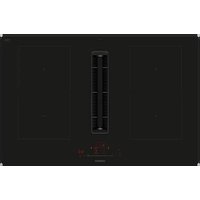
LI46930 - Basket SIEMENS - Free user manual and instructions
Find the device manual for free LI46930 SIEMENS in PDF.



User questions about LI46930 SIEMENS
0 question about this device. Answer the ones you know or ask your own.
Ask a new question about this device
Download the instructions for your Basket in PDF format for free! Find your manual LI46930 - SIEMENS and take your electronic device back in hand. On this page are published all the documents necessary for the use of your device. LI46930 by SIEMENS.
USER MANUAL LI46930 SIEMENS
Operating and installation instructions
natural_image
Technical line drawing of a cabinet or enclosure with open door, internal shelf, and cylindrical component (no text or symbols)LI 44930
LI 46930
de Seite 3-15
it pagina 55 - 67
en page 16 - 28
es página 68 - 80
fr page 29 - 41
pt página 81 – 93
nl pagina 42 – 54
Abb. 1
GAS ELEKTRO
GAZ ELECTR.
KAASU ELETT.
GASS EL.
text_image
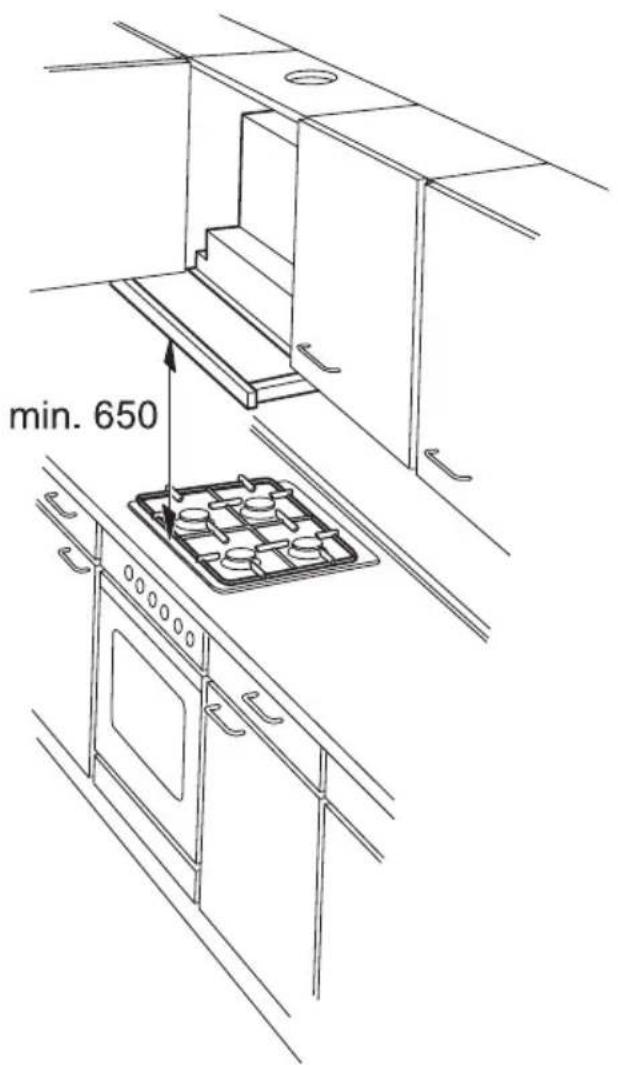
min. 650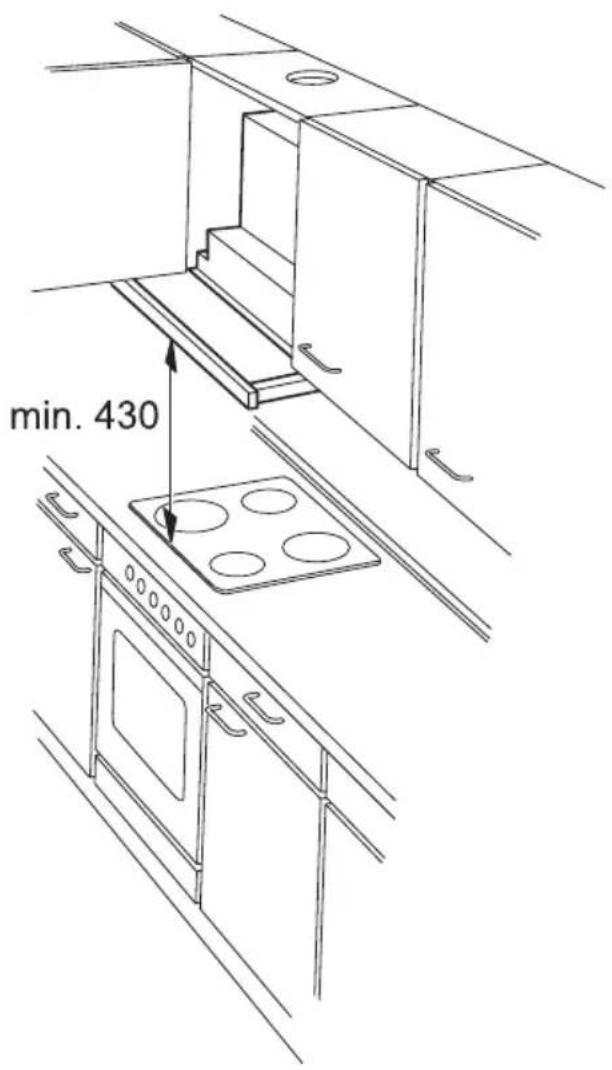
text_image
min. 430natural_image
Technical line drawing of a cabinet interior with open door, shelf, and internal components (no text or symbols)natural_image
Diagram showing two screens with mesh patterns and arrows indicating movement or transformation (no text or symbols)natural_image
Technical diagram of a ventilation duct with mesh insulation and directional arrows indicating airflow or movement (no text or symbols)natural_image
Technical diagram of a mechanical component with internal mesh structure and directional arrows (no text or symbols)natural_image
Technical diagram of a mechanical device with two arrows indicating assembly or component (no text or symbols present)natural_image
Illustration of a circular object with a handle and textured surface, resembling a magnifying glass or tool (no text or symbols visible)natural_image
Illustration of a hand holding a small object with an arrow pointing to it, no text or symbols presentnatural_image
Three schematic diagrams of airflow or ventilation systems in stepped structures, showing streamlines and directional arrows (no text or labels)natural_image
Technical diagram of a mechanical assembly with directional arrows indicating movement or force (no text or symbols present)natural_image
Technical illustration of a screwdriver inserted into a mechanical device component (no text or symbols visible)natural_image
Diagram of a screwdriver inserted into a mechanical component, showing tool path and mounting holes (no text or symbols)Gewicht in kg:
| Abluft Umluft | |
| 16,0 16,5 |
natural_image
Technical illustration of a mechanical assembly with screw fasteners and mounting brackets (no text or symbols)Operating instructions:
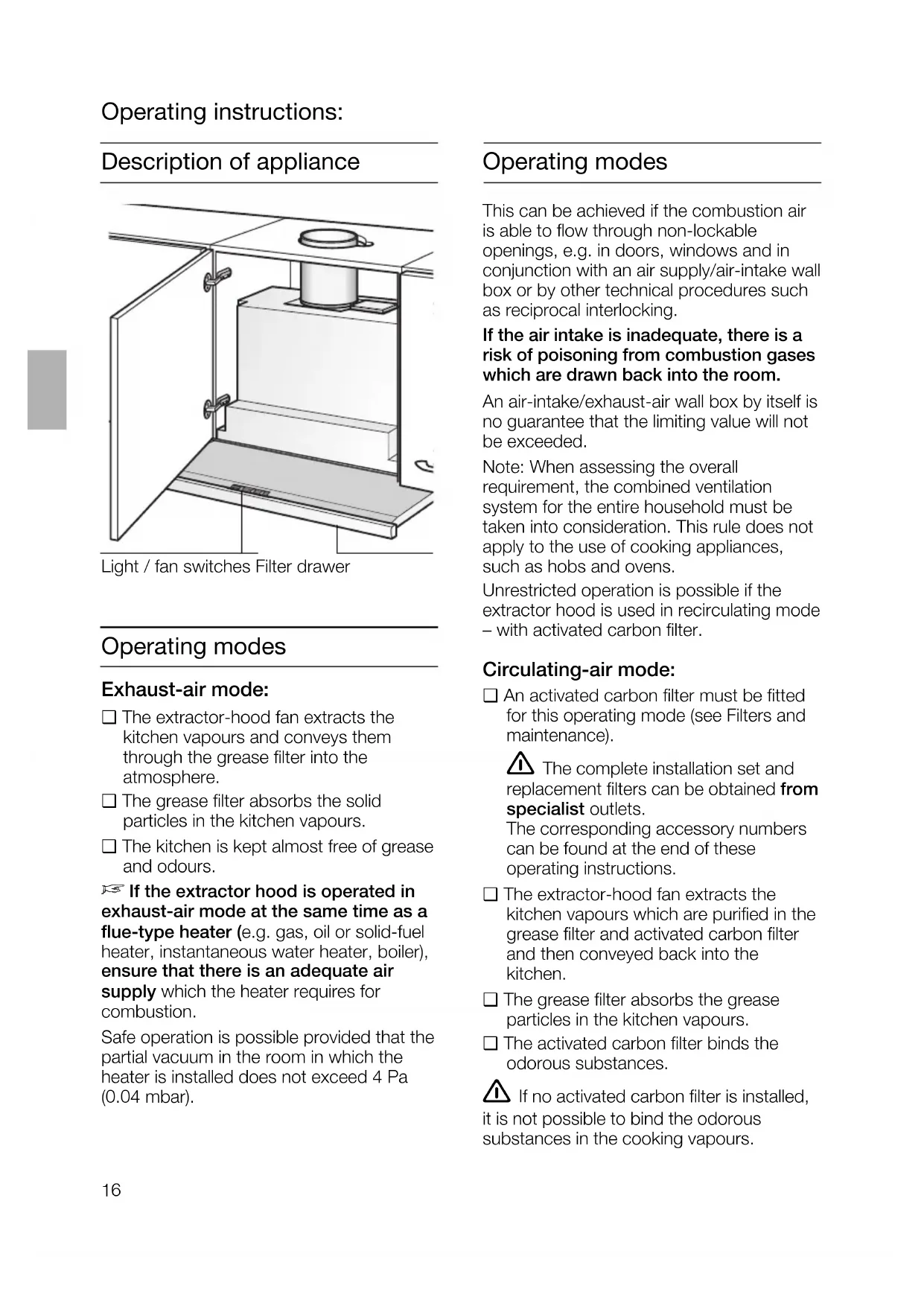
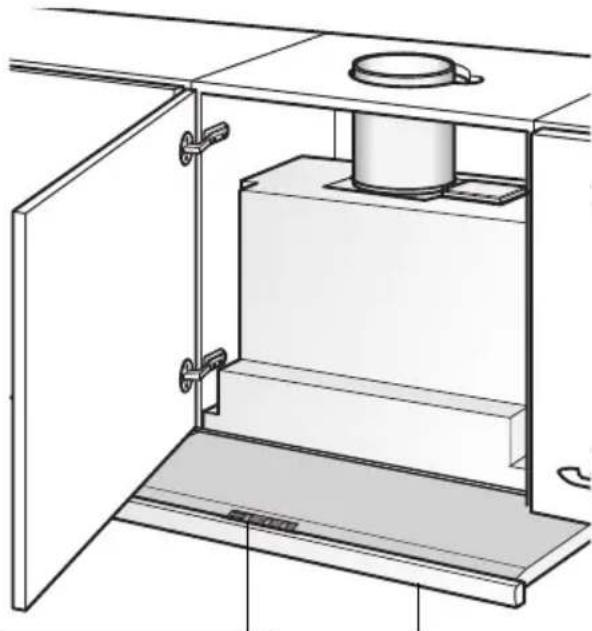
Description of appliance
natural_image
Technical line drawing of a cabinet interior showing door, shelf, and vent (no text or symbols)Light / fan switches Filter drawer
Operating modes
Exhaust-air mode:
☐ The extractor-hood fan extracts the kitchen vapours and conveys them through the grease filter into the atmosphere.
☐ The grease filter absorbs the solid particles in the kitchen vapours.
☐ The kitchen is kept almost free of grease and odours.
If the extractor hood is operated in exhaust-air mode at the same time as a flue-type heater (e.g. gas, oil or solid-fuel heater, instantaneous water heater, boiler), ensure that there is an adequate air supply which the heater requires for combustion.
Safe operation is possible provided that the partial vacuum in the room in which the heater is installed does not exceed 4 Pa (0.04 mbar).
Operating modes
This can be achieved if the combustion air is able to flow through non-lockable openings, e.g. in doors, windows and in conjunction with an air supply/air-intake wall box or by other technical procedures such as reciprocal interlocking.
If the air intake is inadequate, there is a risk of poisoning from combustion gases which are drawn back into the room.
An air-intake/exhaust-air wall box by itself is no guarantee that the limiting value will not be exceeded.
Note: When assessing the overall requirement, the combined ventilation system for the entire household must be taken into consideration. This rule does not apply to the use of cooking appliances, such as hobs and ovens.
Unrestricted operation is possible if the extractor hood is used in recirculating mode – with activated carbon filter.
Circulating-air mode:
☐ An activated carbon filter must be fitted for this operating mode (see Filters and maintenance).
⚠ The complete installation set and replacement filters can be obtained from specialist outlets.
The corresponding accessory numbers can be found at the end of these operating instructions.
☐ The extractor-hood fan extracts the kitchen vapours which are purified in the grease filter and activated carbon filter and then conveyed back into the kitchen.
☐ The grease filter absorbs the grease particles in the kitchen vapours.
☐ The activated carbon filter binds the odorous substances.
⚠️ If no activated carbon filter is installed, it is not possible to bind the odorous substances in the cooking vapours.
Before using for the first time
Important notes:
☐ The Instructions for Use apply to several versions of this appliance. Accordingly, you may find descriptions of individual features that do not apply to your specific appliance.
☐ This extractor hood complies with all relevant safety regulations.
Repairs should be carried out by qualified technicians only.
Improper repairs may put the user at considerable risk.
⚠ Do not use the appliance if damaged.
⚠ The appliance is not intended for use by young children or infirmed persons without supervision.
Young children should be supervised to ensure they do not play with the appliance.
⚠️ If the connecting cable for this appliance is damaged, the cable must be replaced by the manufacturer or his customer service or a similarly qualified person in order to prevent serious injury to the user.
⚠ The appliance may be connected to the mains by a qualified technician only.
⚠ Dispose of packaging materials properly (see Installation instructions).
Light bulbs must always be fitted when the extractor hood is in use.
⚠️ Defective bulbs should be replaced immediately to prevent the remaining bulbs from overloading.
⚠️ Never operate the extractor hood without a grease filter.
⚠️ Overheated fat or oil can easily catch fire.
If you are cooking with fat or oil, e.g. chips, etc., never leave the cooker unattended.
☐ Before using your appliance for the first time, please read these Instructions for Use carefully. They contain important information concerning your personal safety as well as on use and care of the appliance.
☐ Please retain the operating and installation instructions for a subsequent owner.
⚠ Do not flambé food directly under the extractor hood.
! Risk of grease filter catching fire due to flames.
⚠️ Restrictions apply to the use of the extractor hood over a solid-fuel burner (coal, wood, etc.). (See Installation instructions).
Gas hobs / gas cookers
⚠️ Always use gas hobs in a proper and safe manner.
Important:
The flames from the gas hob must always be covered by pots or pans.
The intense heat generated by the gas flames could cause damage to the extractor hood.
Operating the extractor hood

Cooking vapours are best eliminated
□ Switching on the extractor hood when you start cooking.
☐ Only switching off the extractor hood a few minutes after you have finished cooking.
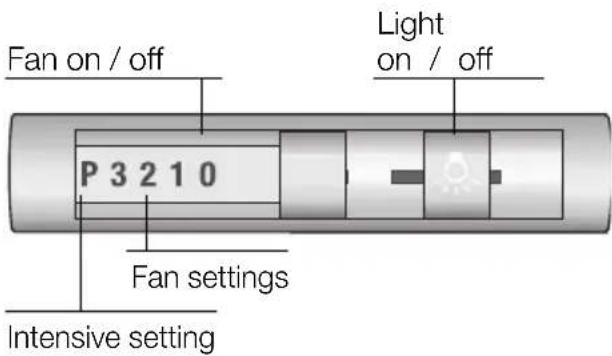
text_image
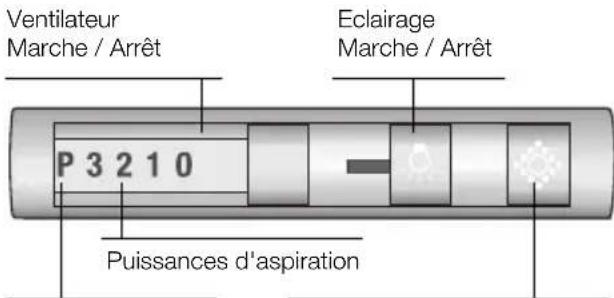
Fan on / off P 3 2 1 0 Light on / off Fan settings Intensive setting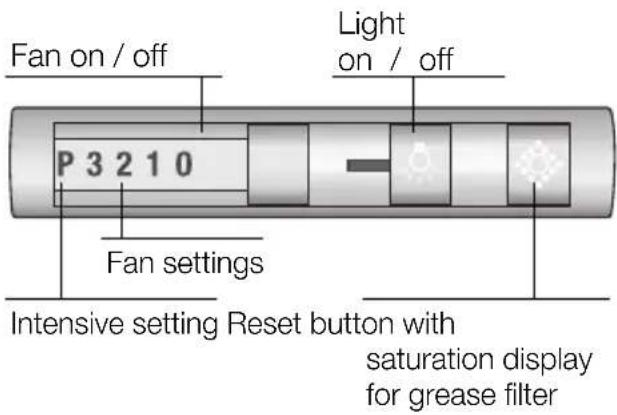
text_image
Fan on / off P 3 2 1 0 Light on / off Fan settings Intensive setting Reset button with saturation display for grease filterSwitching on:
☐ Take hold of filter drawer handle and pull out the drawer.
□ Select the required fan setting.
Switching off:
The extractor hood can be switched off in various ways.
Switch-off 1:
☐ Sliding switch to 0 – switch off fans.
Switch-off 2:
☐ Push in filter drawer to stop. (Sliding switch remains as selected).
☐ To switch on the extractor again, just pull out the filter unit.
The extractor hood will start at the most recent fan setting.
Light:
The light can be switched on at any time even when the appliance is off or the filter drawer is inserted.
Faults
If you have any queries or the appliance is faulty, please call customer service (see list of customer service units).
Please give the following details when you call:
Enter the numbers in the above box. The numbers can be found on the rating plate inside the extractor hood following removal of the filter screen.
Filters and maintenance
Grease filters:
Metal-mesh filters are used to trap the grease particles in the cooking vapours.
The filter mats are made from non-combustible metal.
Caution:
As the filter becomes more and more saturated with grease, there is an increased risk of fire and the function of the extractor hood may be impaired.
Important:
□ Clean the metal-mesh grease filters at regular intervals to prevent the risk of fire from the accumulation of heat when deep-fat frying or roasting.
☐ If used in normal mode (daily 1 to 2 hours), the metal-mesh grease filter must be cleaned 1x a month.
Saturation indicator:

When the grease filter is saturated, the indicator starts flashing.
You should now change the grease filter if you have not already done so.
☐ Ensure that the grease filters are cleaned at regular intervals (approx. 1 month).
Cleaning the metal-mesh grease filters:
☐ The filters can be cleaned in a dishwasher. However, they may become slightly discoloured.
Important:
Do not wash highly saturated metal-mesh grease filters with other utensils.
☐ If cleaning the filters by hand, soak them in a hot soap solution. Then brush the filters, rinse thoroughly and leave to drain.
⚠ Clean the support frame for the grease filters by hand.
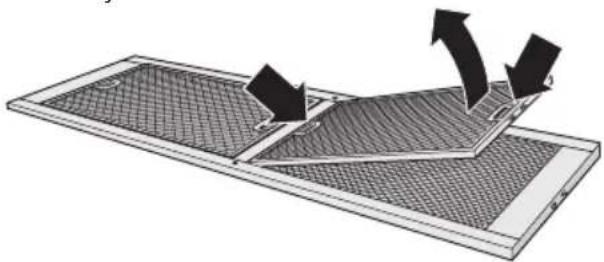
natural_image
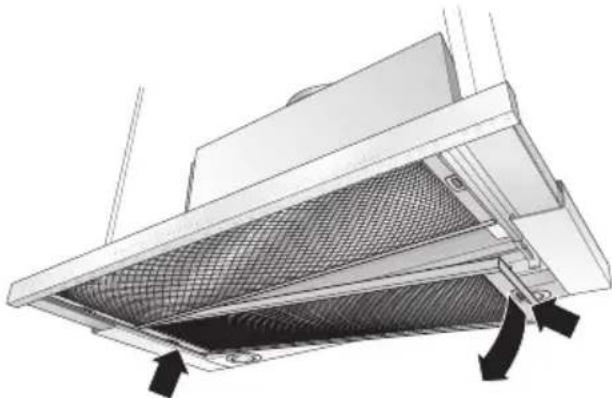
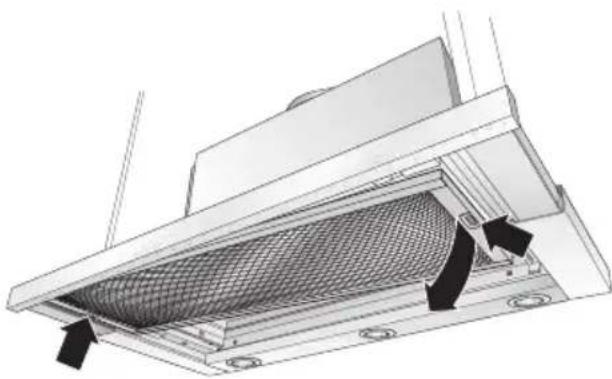
Diagram of a mesh panel being folded into a slatted sheet, showing directional arrows (no text or symbols)Removing and inserting the metal-mesh grease filters:
Warning: The halogen bulbs must be switched off and cool.
- Pull the filter drawer all the way out.
- Depress the catches at the rear of the grease filter and remove the grease filter.
natural_image
Technical diagram of a mechanical component with mesh structure and directional arrows indicating movement (no text or symbols)- Depress both catches at the front of the grease filter and remove the grease filter.
natural_image
Technical diagram of a mechanical component with internal mesh structure and directional arrows (no text or symbols)- Clean the filters.
- Insert the clean filters back into the hood.
- Cancel the ✿ in the display.
□ Press the 🔊 button.
Filters and maintenance
Activated carbon filter:
For neutralizing odours in recirculating mode.
Caution:
As the filter becomes more and more saturated with grease, there is an increased risk of fire and the function of the extractor hood may be impaired.
Important:
Change the activated carbon filter promptly to prevent the risk of fire from the accumulation of heat when deep-fat frying or roasting.
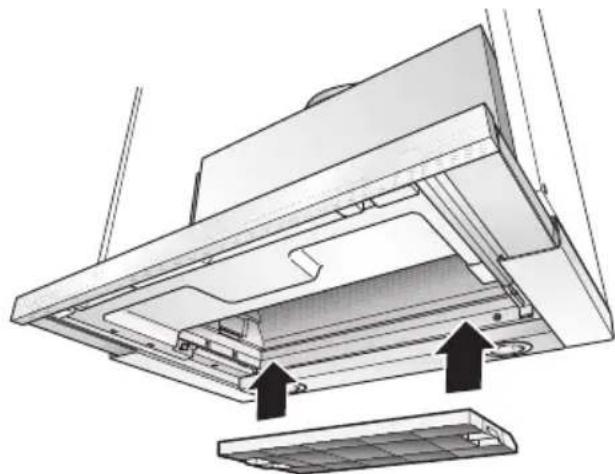
Inserting the filter:
Warning: The halogen bulbs must be switched off and cool.
-
Remove the metal-mesh filters (see "Removing and inserting the metal-mesh grease filters").
-
Insert the activated carbon filter.
natural_image
Technical diagram of a mechanical device with internal components and directional arrows indicating assembly or movement (no text or symbols present)-
Engage the catches at both sides.
-
Insert the metal-mesh grease filters (see "Removing and inserting the metal-mesh grease filters").
Removing the filter:
Warning: The halogen bulbs must be switched off and cool.
-
Remove the metal-mesh filters.
-
Depress the catches on both sides of the filter and remove the activated carbon filter.
-
Replacing the activated carbon filter:
☐ A replacement filter can be obtained from any authorized dealer (see optional accessories).
□ Use original filters only. This will ensure maximum performance.
- Insert the grease filters.
Disposing of the old activated carbon filter:
□ Activated carbon filters do not contain any pollutants and can be disposed of with domestic refuse.
Cleaning and care
Isolate the extractor hood by pulling out the mains plug or switching off the fuse.
☐ When cleaning the grease filters, remove grease deposits from accessible parts of the housing. This prevents the risk of fire and ensures that the extractor hood continues operating at maximum efficiency.
□ Clean the extractor hood with a hot soap solution or a mild window cleaner.
☐ Do not scrape off dried-on dirt but wipe off with a damp cloth.
☐ Do not use scouring agents or abrasive sponges.
☐ Note: Do not use alcohol (spirit) on plastic surfaces, as dull marks may appear.
Caution: Ensure that the kitchen is adequately ventilated. Avoid naked flames!
⚠ Clean the operating buttons with a mild soapy solution and a soft, damp cloth only. Do not use stainless-steel cleaner to clean the operating buttons.
Stainless steel surfaces:
□ Use a mild non-abrasive stainless steel cleaner.
□ Clean the surface in the same direction as it has been ground and polished.
Do not use any of the following to clean stainless steel surfaces: abrasive sponges, cleaning agents containing sand, soda, acid or chloride!
Aluminium and plastic surfaces:
□ Use a soft, non-linting window cloth or micro-fibre cloth.
□ Do not use dry cloths.
□ Use a mild window cleaning agent.
☐ Do not use aggressive, acidic or caustic cleaners.
☐ Do not use abrasive agents.
Replacing the light bulbs
- Switch off the extractor hood and pull out the mains plug or switch off the electricity supply at the fuse box.
When switched on, the halogen bulbs become very hot. Even for some time after the bulbs have been switched off there is still a risk of burns. - Remove the bulb ring with a screwdriver or similar tool.
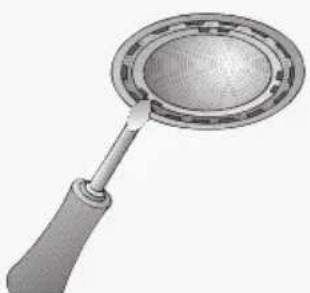
natural_image
Illustration of a magnifying glass with a handle and circular lens (no text or symbols)- Replace the halogen light bulb (conventional halogen bulb, 12 Volt, max. 20 Watt, G4 bulbholder). Caution: Plug-in bulbholder. Take hold of the bulb with a clean cloth.
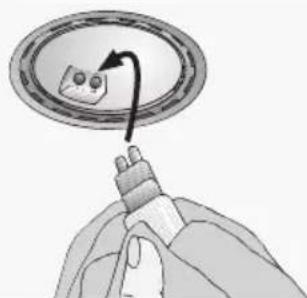
natural_image
Illustration of a hand holding a device with a curved arrow pointing to a circular component (no text or symbols)- Re-insert the bulb ring.
- Restore the power by inserting the mains plug or switching on the fuse.
Note: If the light does not function, check that the bulbs have been inserted correctly.
Important information
⚠️ Old appliances are not worthless rubbish. Valuable raw materials can be reclaimed by recycling old appliances. Before disposing of your old appliance, render it unusable.
⚠️ You received your new appliance in a protective shipping carton. All packaging materials are environmentally friendly and recyclable. Please contribute to a better environment by disposing of packaging materials in an environmentally-friendly manner.
Please ask your dealer or inquire at your local authority about current means of disposal.
⚠ The extractor hood can be used in exhaust air or circulating air mode.
⚠️ Always mount the extractor hood over the centre of the hob.
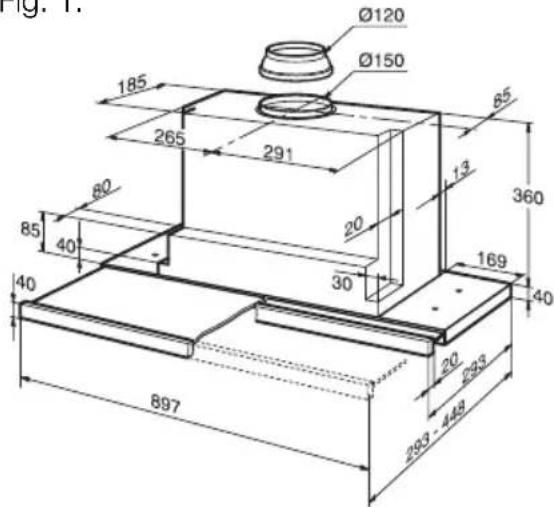
⚠️ Minimum distance between electric hob and bottom edge of extractor hood: 430 mm, Fig. 1.
Additional information concerning gas cookers:
⚠ When installing gas hotplates, comply with the relevant national statutory regulations (e.g. in Germany: Technische Regeln Gasinstallation TRGI).
⚠️ Always comply with the currently valid regulations and installation instructions supplied by the gas appliance manufacturer.
⚠️ Only one side of the extractor hood may be installed next to a high-sided unit or high wall. Gap at least 300 mm.
⚠ The installation of the extractor hood above gas cooking devices, at a minimum height of 650 mm – Fig. 1 – is permitted provided that the following nominal heat loads (Hs) are not exceeded:
☐ Gas cookers Load of one hotplate max. 3.0 kW Load of all hotplates max. 8.3 kW Load of the oven max. 3.9 kW
☐ Gas hobs Load of one hotplate max. 3.9 kW Load of all hotplates max. 11.3 kW
☐ Gas ceramic hotplate The nominal heat load specifications do not apply to closed gas ceramic hobs. Always observe the specifications of the hob manufacturer.
☐ Solid-fuel cookers The maximum nominal heat loads and the minimum distance are the same as for gas cookers.
The extractor hood must not be installed over a solid fuel cooker – a potential fire hazard (e.g. flying sparks) – unless the cooker features a closed, non-removable cover and all national regulations are observed.
⚠ The smaller the gap between the extractor hood and hotplates, the greater the likelihood that droplets will form on the underside of the extractor hood.
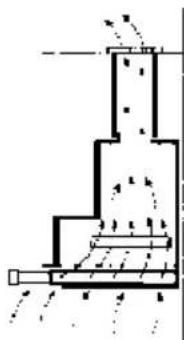
Exhaust-air mode
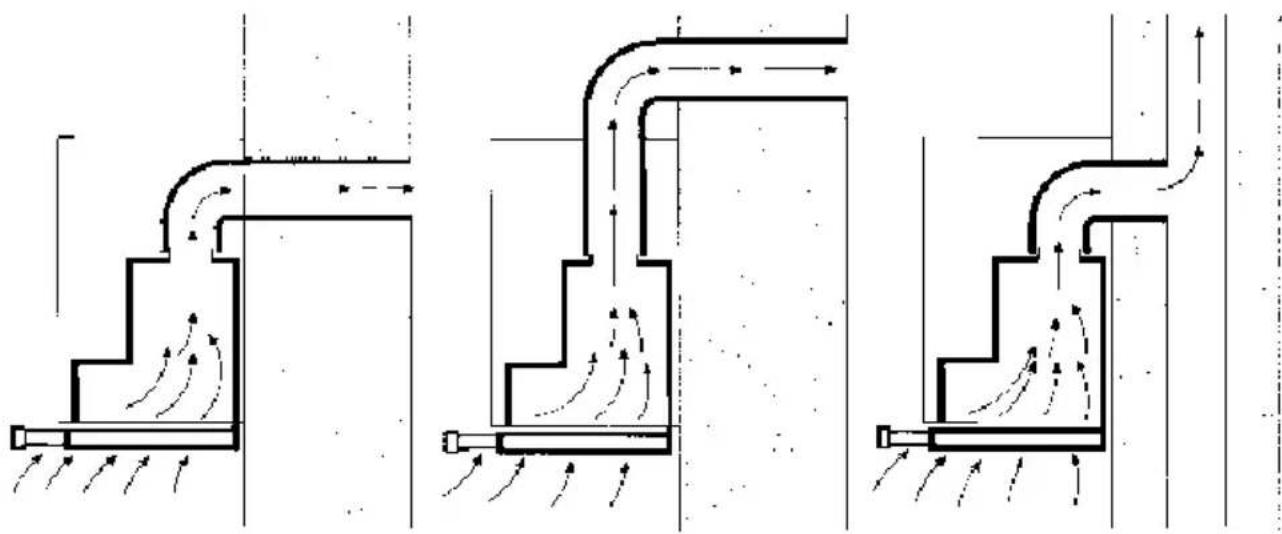
natural_image
Three schematic diagrams of airflow or ventilation systems in stepped structures, showing streamlines and directional arrows (no text or labels)The exhaust air is discharged upwards through a ventilation shaft or directly through the outside wall into the open.
Exhaust air must not be discharged via a smoke or exhaust gas flue which is already in use or via a shaft which is used for ventilating rooms in which fireplaces are located.
Discharge exhaust air in accordance with official and statutory regulations (e.g. national building regulations).
Discharge of air into smoke or exhaust air flues which are not in use requires the consent of a heating engineer.
If the extractor hood is operated in exhaust-air mode at the same time as a flue-type heater (e.g. gas, oil or solid-fuel heater, instantaneous water heater, boiler), ensure that there is an adequate air supply which the heater requires for combustion.
Safe operation is possible provided that the partial vacuum in the room in which the heater is installed does not exceed 4 Pa (0.04 mbar).
This can be achieved if the combustion air is able to flow through non-lockable openings, e.g. in doors, windows and in conjunction with an air supply/air-intake wall box or by other technical procedures such as reciprocal interlocking.
If the air intake is inadequate, there is a risk of poisoning from combustion gases which are drawn back into the room.
An air-intake/exhaust-air wall box by itself is no guarantee that the limiting value will not be exceeded.
Note: When assessing the overall requirement, the combined ventilation system for the entire household must be taken into consideration. This rule does not apply to the use of cooking appliances, such as hobs and gas cookers.
The extractor hood can be used without restriction in circulating air mode – with an activated carbon filter.
For exhaust air mode a one-way flap should be installed in the extractor hood unless already installed in the exhaust air pipe or wall box.
If a one-way flap is not enclosed with the extractor hood, you purchase one from your dealer.
If the exhaust air is conveyed through the outside wall, a telescopic wall box should be used.
Optimum efficiency of the extractor hood:
☐ Short, smooth exhaust pipe.
☐ As few bends as possible.
☐ Pipe diameter as large as possible (ideally 150 mm dia.) and wide pipe bends.
If long, rough exhaust-air pipes, many pipe bends or smaller pipe diameters are used, the air extraction rate will no longer be at an optimum level and there will be an increase in noise.
Round pipes
Short exhaust air pipe:
inside diameter min. 120 mm,
Longer exhaust air pipe:
inside diameter min. 150 mm.
☐ Flat ducts must have an inside
cross-section equivalent to that of the round pipes.
There should be no sharp bends.
∅ 120 mm dia. approx. 113 cm
∅ 150 mm dia. approx. 177 cm ^3
☐ If pipe diameters differ, insert sealing strip.
☐ Ensure that there is an adequate air supply for exhaust air mode.
Exhaust air directed backwards:
Only possible inside tall wall cupboards depending on the size of the exhaust air pipe.
☐ Make a hole in the rear panel of the wall cupboard, cutting out a notch for the power supply cable.
Circulating-air mode
☐ With activated carbon filter if exhaust-air mode is not possible.
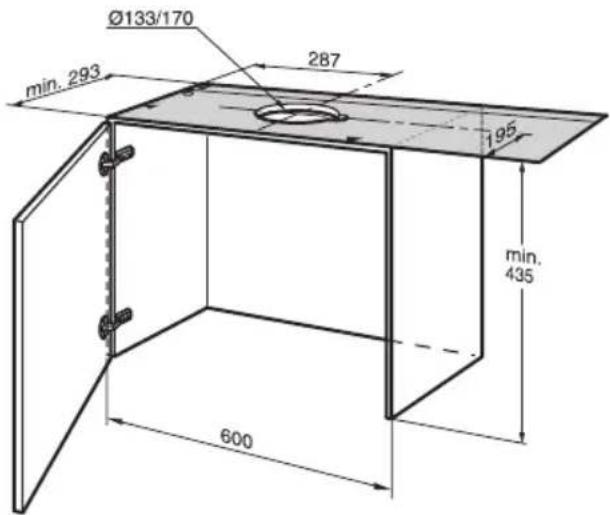
Exhaust air directed upwards:
text_image
Ø133/170 287 min. 293 195 min. 435 600- Make a hole in the top of the wall cupboard, cutting out a notch for the power supply cable.
- template ① enclosed -.
- If fitted, cut out the cupboard base to a min. depth of 270 mm over the entire width.
Note:
☐ An installation kit is required if the width of the cupboard is 900 mm.
Connecting a 150 mm exhaust pipe:
☐ Attach the exhaust pipe directly to the air connector.
Connection of 120 mm ∅ exhaust air pipe:
☐ Attach enclosed reducing connector to the air outlet.
Holes in the air outlet must be sealed.
☐ Attach exhaust air pipe to the reducing connector.
The complete installation set can be obtained from specialist outlets.
The corresponding accessory numbers can be found at the end of these operating instructions.
natural_image
Pure technical diagram of a stepped mechanical or structural component without any text, numbers, or symbolsPreparing the wall cupboard
This extractor hood is designed to be installed in a wall cupboard with the following dimensions:
width: 600 mm
depth: 293 to 350 mm
height: min. 435 mm.
If the cupboard is deeper than 293 mm, the extractor hood can be moved back, e.g. to put a spice rack in front of the extractor hood.
To do this, place the template Ⅲ further back.
⚠ Ensure that the cupboard is stable both during and after installation, even if fitted at the end of a row of kitchen units.
⚠ Do not install the extractor hood at the end of the kitchen line.
⚠️ Align the cupboards exactly. If required, place the side cupboards flush underneath.
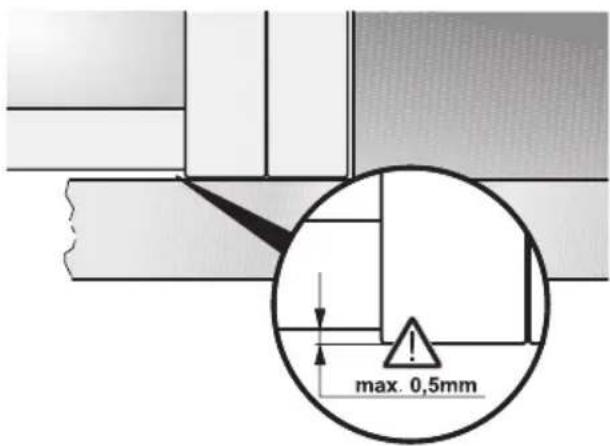
⚠ The side panels must not project over the base of the adjacent unit by more than 0.5 mm.
text_image
max. 0,5mmWeight in kg:
| Exhaust air Circulating air | |
| 16,0 16,5 | |
We reserve the right to construction changes within the context of technical development.
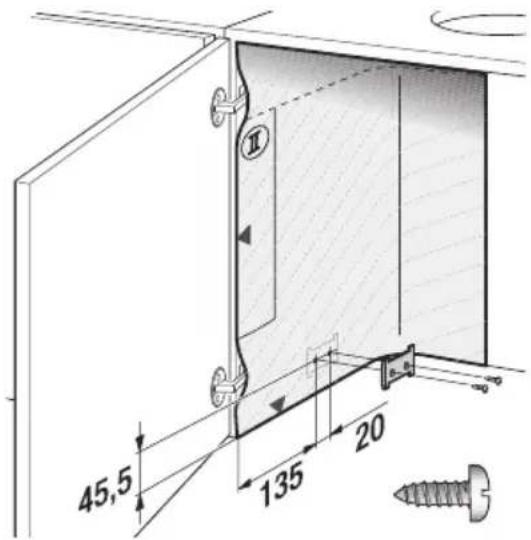
- Mark two attachment points on both the right and left inside faces of the cupboard and make holes with a bradawl.
text_image
45,5 135 20When you drill:
2 mm diameter - max. 10 mm in depth.
Use the enclosed template ⑪ to mark
the attachment points.
- Screw on both attachment plates.
- Attach the door to the cupboard and align.
⚠ Observe the minimum distance between hotplates and extractor hood!
Fig. 1.
text_image
185 265 291 Ø120 Ø150 85 13 360 80 85 40 20 30 169 40 40 20 293 448 293 897 Fig. 1.Fitting into wall cupboard
⚠️ Check door alignment and readjust if necessary.
- Remove grease filter (see Operating instructions).
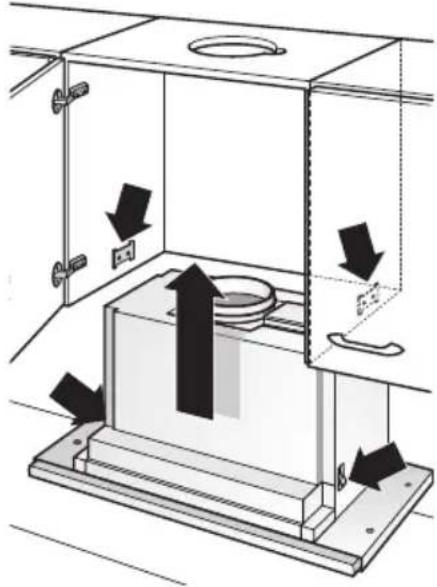
- Lift the extractor hood into the cupboard from below until both fixing lugs have locked firmly into position.
natural_image
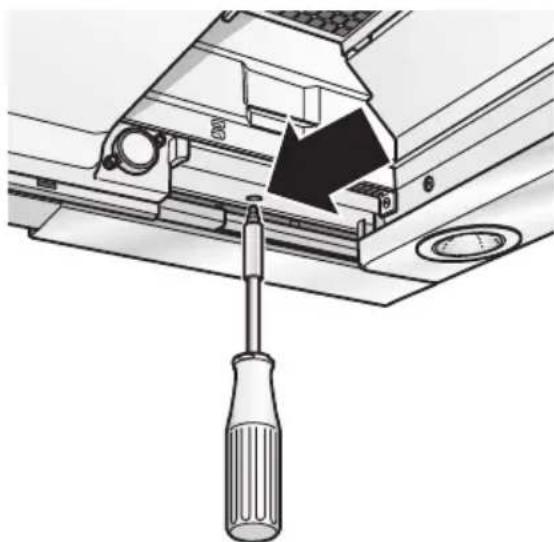
Technical diagram of a mechanical assembly with directional arrows indicating movement or force (no text or symbols present)- Screw in the adjusting screws by hand until the extractor hood is situated on the base of the cupboard.
natural_image
Diagram of a screwdriver inserted into a mechanical device component, showing a black arrow indicating the insertion direction (no text or symbols present)□ Align the extractor hood in the cupboard.
□ Carefully tighten both fastening screws.
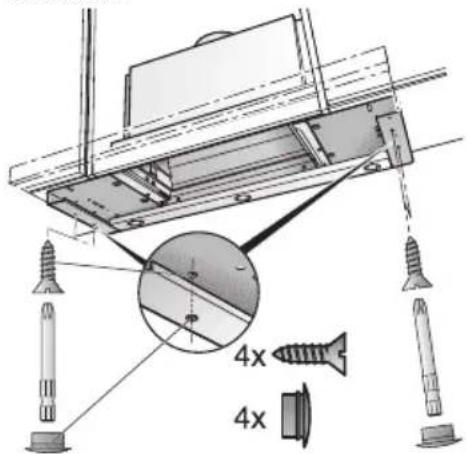
- Also attach the extractor hood to the left and right wall cupboards with 2 screws each side. First make pilot holes with a bradawl.
text_image
4x 4x- Seal the holes with 2 stoppers each on the left and right.
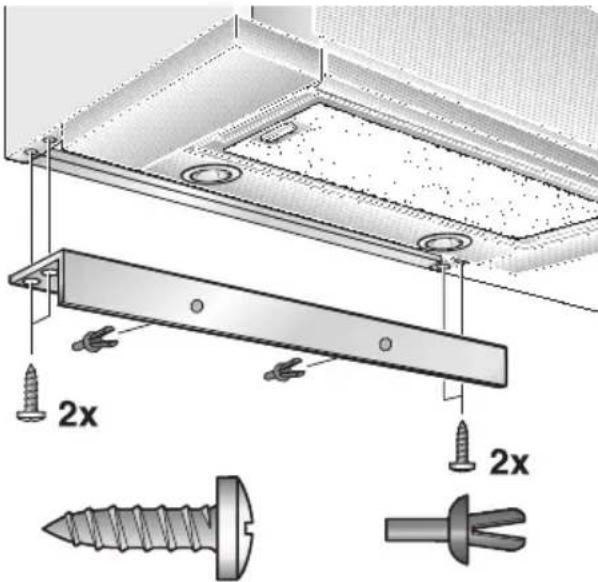
- If required, shorten the wall cover to the required dimension (e.g. saw off). Attach the wall cover with the enclosed clips. Screw the wall cover to the wall cupboard.
text_image
2x 2x- Feed the mains connection cable out of the cupboard.
- Connect the pipes in the wall cupboard.
- If required, attach the air hose to the cupboard ceiling - .
- Re-insert grease filter (see Operating instructions).
Fitting into wall cupboard
Note: The extractor hood housing can be clad inside the wall cupboard (e.g. with chipboard).
If so, observe the following:
☐ The intermediate base must not be placed on the extractor hood housing.
□ Never attach cladding to the housing.
☐ Provide access for customer service.
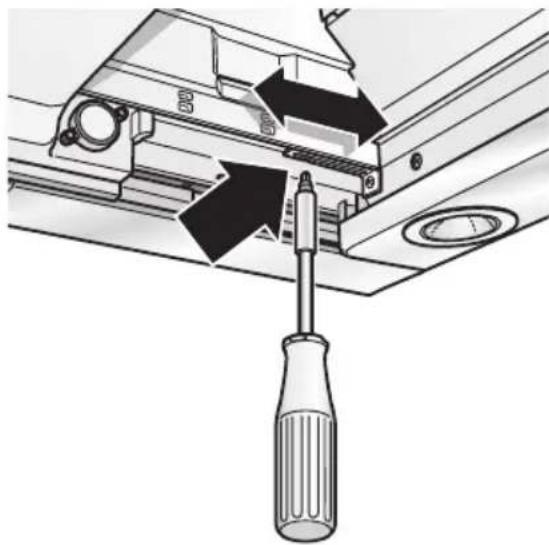
☐ If the extractor hood is to be installed further back in the cupboard, the stops for the filter drawer can be moved forwards.
☐ To do this, undo the screws, move the stops and retighten the screws.
natural_image
Diagram of a screwdriver inserted into a mechanical component, showing tool path and mounting holes (no text or symbols)Attaching the handle moulding:
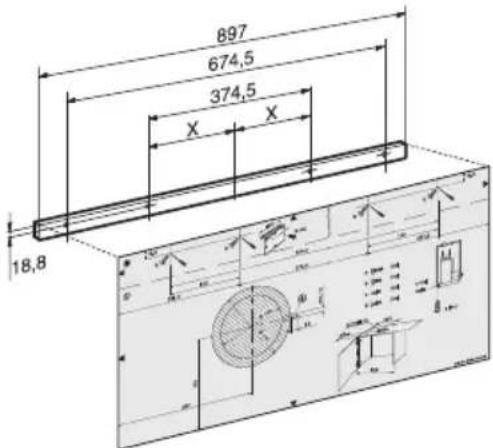
A handle moulding must be attached to the filter drawer.
This handle moulding may be a wooden strip which matches the kitchen units or a handle moulding available as an optional accessory (see optional accessories on the back page).
- Using the enclosed template Ⓗ mark the attachment points on the wooden strip and make holes with a bradawl. When you drill: 2 mm dia – max. 10 mm in depth.
text_image
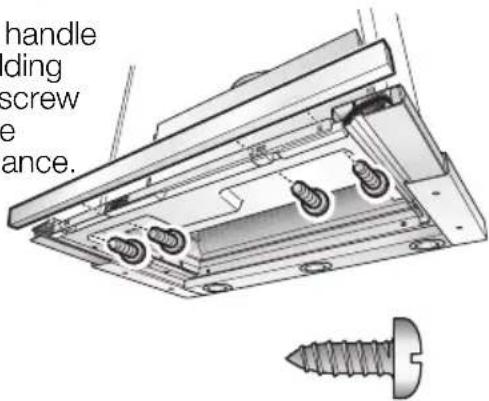
897 674,5 374,5 X X 18,8- Align handle moulding and screw to the appliance.
text_image
handle ding screw ance.Re-adjusting the limit switch:
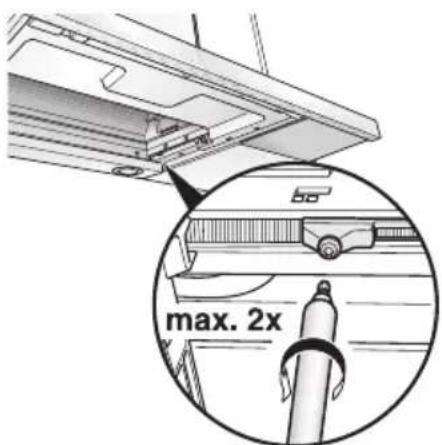
- Check whether the extractor hood switches off when the filter drawer is inserted.
- If the extractor hood does not switch off, re-adjust the limit switch.
- Unscrew the screw in small steps – max. 2 revolutions.
text_image
max. 2xElectrical connection
WARNING: THIS APPLIANCE MUST BE EARTHED
IMPORTANT: Fitting a Different Plug:
The wires in the power cord are colour-coded as follows:
Green and Yellow – Earth
Blue - Neutral
Brown – Live
If you fit your own plug, the colours of these wires may not correspond with the identifying marks on the plug terminals.
Proceed as follows:
- Connect the green and yellow (Earth) wire to the terminal in the plug marked 'E' or with the symbol (≡), or coloured green or green and yellow.
- Connect the blue (Neutral) wire to the terminal in the plug marked 'N' or coloured black.
- Connect the brown (Live) wire to the terminal marked 'L', or coloured red.
The extractor hood may be connected to a correctly installed earthed socket only. Attach the earthed socket near the extractor hood in an accessible position.
☐ The earthed socket should be connected via its own power circuit.
⚠️ If appliances do not feature the OFF delay function, the indicator may start flashing when the extractor hood has been switched off for several hours via a separate switch, even though the grease filters are not yet saturated.
(See instructions for use, section on filter and maintenance).
Electrical specifications:
These can be found on the rating plate inside the appliance following removal of the filter frames.
⚠️ Before carrying out repairs, always isolate the appliance.
Length of the connection cable: 1.30 m.
If permanent connection is required:
The extractor hood may only be connected by an electrician registered with the local electricity board.
A disconnecting device must be provided on the installation side. Switches with a contact opening of more than 3 mm and all-pole disconnection are regarded as disconnecting devices. These include LS switches and contactors.
This extractor hood complies with EU regulations on interference suppression.
Removal from the wall cupboard
- Disconnect from power.
- Disconnect pipes.
- Remove filters.
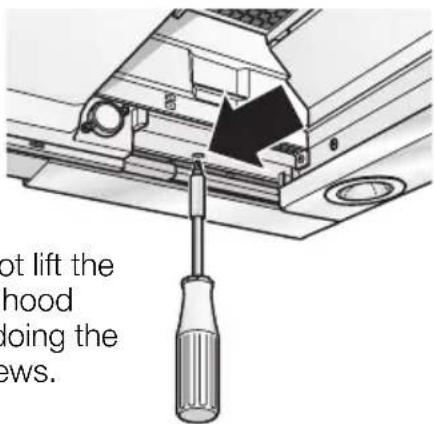
- Undo right and left fixing screws until the extractor hood cannot drop any further.
Do not lift the extractor hood when undoing the fixing screws.
text_image
not lift the hood doing the ews.- Raise the extractor hood briefly until the fixing lugs detach and the appliance can be lowered.
⚠️ Fastening screws may project. When raising the extractor hood, do not force in the filter drawer.
- Preparing for re-installation:
Screw in the left and right fixing screws until the lugs are pressed out at the sides.
Mode d'emploi:
natural_image
Technical line drawing of a cabinet interior with open door, lid, and shelf (no text or symbols)Aspiration intensive
Aspiration intensive
natural_image
Diagram of a mesh panel with arrows indicating movement or force, no text or symbols presentnatural_image
Technical diagram of a ventilation duct with mesh grille and airflow arrows (no text or symbols)natural_image
Technical diagram of a mechanical component with mesh insulation and directional arrows indicating movement (no text or symbols)natural_image
Diagram of a computer monitor with ventilation slots and an open lid, showing internal structure without any text or symbols.natural_image
Illustration of a magnifying glass with a handle and circular lens (no text or symbols)natural_image
Illustration of a hand holding a device with a curved arrow pointing to a circular component (no text or symbols)natural_image
Three technical diagrams showing stairwell ventilation system with airflow and exhaust paths (no text or labels)text_image
Technical diagram showing a stepped structure with dimension annotations and directional arrows, likely from an engineering or mechanical drawing.natural_image
Technical diagram of a mechanical assembly with directional arrows indicating movement or force (no text or symbols present)natural_image
Diagram of a screwdriver inserted into a mechanical device with a black arrow indicating the insertion point (no text or symbols present)natural_image
Diagram of a screwdriver inserted into a mechanical component, showing tool path and mounting detail (no text or symbols)Poids en kg:
natural_image
Technical illustration of a mechanical assembly with screw fasteners and a separate screw (no text or symbols)natural_image
Technical line drawing of a cabinet interior showing door, shelf, and vent (no text or symbols)natural_image
Diagram of a device with mesh screen and two arrows indicating movement or force (no text or symbols)natural_image
Technical diagram of a ventilation duct with mesh insulation and airflow arrows (no text or symbols)natural_image
Technical diagram of a mechanical component with internal mesh structure and directional arrows (no text or symbols)natural_image
Diagram of a computer monitor with ventilation slots and an open lid, showing internal structure and mounting points (no text or symbols)natural_image
Illustration of a magnifying glass with a handle and circular lens (no text or symbols)Let op: plugfitting.
natural_image
Illustration of a hand holding a circular object with an arrow pointing to it, no text or symbols present.natural_image
Three schematic diagrams of airflow or ventilation systems in stepped structures, showing fluid flow and streamlines without any text or symbols.natural_image
Pure technical diagram of a mechanical or fluidic component with no visible text, numbers, or symbolsnatural_image
Technical diagram of a mechanical assembly with directional arrows indicating movement or force (no text or symbols present)natural_image
Diagram of a screwdriver inserted into a mechanical device component, showing a black arrow indicating the insertion direction (no text or symbols present)natural_image
Diagram of a screwdriver inserted into a mechanical component, showing tool path and mounting holes (no text or symbols)Gewicht in kg:
natural_image
Technical illustration of a mechanical assembly with screw fasteners and mounting brackets (no text or symbols)natural_image
Technical line drawing of a cabinet interior with open door, internal shelf, and lid (no text or symbols)natural_image
Diagram of a mesh panel with arrows indicating movement or force, no text or symbols presentnatural_image
Technical diagram of a mechanical ventilation system with mesh insulation and directional arrows indicating airflow or movement (no text or symbols)natural_image
Technical diagram of a mechanical component with internal mesh structure and directional arrows (no text or symbols)natural_image
Diagram of a mechanical device with internal components and two arrows indicating assembly or movement (no text or symbols present)natural_image
Illustration of a magnifying glass with a handle and circular lens (no text or symbols)natural_image
Illustration of a hand holding a device with a circular component and an arrow indicating rotation (no text or symbols)natural_image
Pure architectural or engineering line drawing of a stepped structure without any text, numbers, or symbolsnatural_image
Technical diagram of a mechanical assembly with directional arrows indicating movement or force (no text or symbols present)natural_image
Mechanical assembly diagram showing a screwdriver inserted into a component with a black arrow indicating direction (no text or symbols present)natural_image
Diagram of a screwdriver inserted into a mechanical device component, showing tool path and mounting bracket (no text or symbols)Peso in kg:
natural_image
Technical diagram of a mechanical assembly with screw fasteners and mounting brackets (no text or labels)natural_image
Technical diagram of a mechanical ventilation system with mesh insulation and directional arrows indicating airflow or movement (no text or symbols)natural_image
Technical diagram of a mechanical component with internal mesh structure and directional arrows (no text or symbols)natural_image
Diagram of a mesh panel with arrows indicating direction, no text or symbols presentnatural_image
Diagram of a computer monitor with ventilation slots and an open lid, showing internal components and mounting points (no text or symbols)natural_image
Illustration of a magnifying glass with a handle and circular lens (no text or symbols)natural_image
Illustration of a hand holding a cable with a magnified circular component and an arrow indicating rotation (no text or symbols)natural_image
Technical diagram of a mechanical assembly with directional arrows indicating movement or force (no text or symbols present)natural_image
Diagram of a screwdriver inserted into a mechanical component, showing a black arrow indicating the insertion direction (no text or symbols present)natural_image
Diagram of a screwdriver inserted into a mechanical device with a magnified view (no text or symbols)Peso en kg:
natural_image
Technical illustration of a mechanical assembly with screw fasteners and mounting bracket (no text or symbols)Conexión eléctrica
natural_image
Technical line drawing of a cabinet or storage unit with a cylindrical component and open door (no text or symbols)natural_image
Diagram of a mesh panel with arrows indicating movement or force, no text or symbols presentDesmontar e montar os filtros metálicos:
natural_image
Technical diagram of a ventilation duct with mesh grille and airflow arrows (no text or symbols)natural_image
Technical diagram of a mechanical component with a mesh chamber and directional arrows indicating movement (no text or symbols)natural_image
Diagram of a computer monitor with ventilation slots and an open lid, showing internal components and mounting points (no text or symbols)natural_image
Illustration of a magnifying glass with a handle and circular lens (no text or symbols)- Substituir a lâmpada de halogéneo (lâmpada de halogéneo corrente no mercado, 12 Volt, máx. 20 Watt, casquilho G4).
natural_image
Illustration of a hand holding a small object with a curved arrow pointing to a circular component (no text or symbols)∅ 120 mm approx. 113 cm
∅ 150 mm approx. 177 cm²