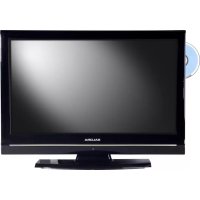
USER MANUAL LCD 3231 DVX SALORA
natural_image
Line drawing of a flat-screen television monitor (no text or symbols)
natural_image
Interior layout diagram of a room with furniture and appliances (no text or symbols)
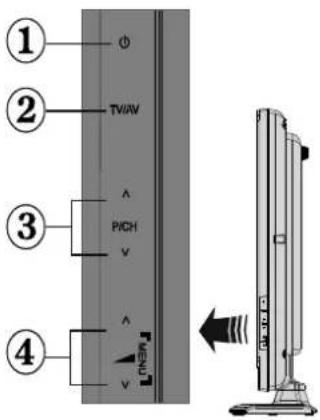
De toets Stand-by1.
TV/AV-toets2.
Antenneaansluiting
natural_image
Technical line drawing of a computer mouse with a button and handle, showing no text or symbols
Basisbedieningen
natural_image
Diagram showing transformation of a square with a circle inside, resulting in a square with circles and dots (no text or symbols)
natural_image
Diagram showing transformation of a square with circular elements into a grid-like pattern (no text or symbols)
Panoramisch
natural_image
Diagram showing transformation of a square with circular holes into a larger square with circles (no text or symbols)
natural_image
Diagram showing transformation of a square with a circle inside, resulting in a larger square with circles and dots (no text or symbols)
Bioscoop
natural_image
Diagram showing a square with four circles inside and a square with four circles inside, connected by an arrow (no text or symbols)
Ondertiteling
Zoom
natural_image
Diagram showing a square with a circle inside and a circular shape inside, connected by an arrow (no text or symbols)
PAL/SECAM B/G D/K K' I/I' L/L"
KANALEN ONTVANGEN
VHF (BAND I/III)
UHF (BAND U)
HYPERBAND
AANTAL VOORINGESTELDE KANALEN
200
KANAALINDICATOR
German + Nicam stereo
GELUIDSUITGANG STROOM (W _RMS ) (10% THD)
2×6
STROOMVERBRUIK (W)
150 W (max)
< 1 W (Standby)
PANEEL
32" schermgrootte
AFMETINGEN (mm)
KLASSE 1 LASER PRODUCT
natural_image
Two hand-drawn diagrams showing a circular object being cut with a tool, one marked with a cross and arrow, the other with a plus sign (no text or symbols)
natural_image
Illustration of a computer monitor with an arrow pointing to a CD or DVD disc (no text or symbols present)
flowchart
graph LR
    A["DVD"] --> B["USB"]
    C["MEDIA"] --> D["CARD"]
Safety Precautions 87
Power Source 87
Power Cord 87
Moisture and Water 87
Cleaning....87
Heat and Flames 87
Lightning 87
Replacement Parts 87
Servicing 87
Waste Disposal 87
Information for Users in European Union
Countries 87
Disconnecting the Device 87
Disconnecting the Device 87
Headphone Volume 88
Installation....88
LCD Screen 88
Warning 88
Overview of the Remote Control 89
LCD TV and Operating Buttons 90
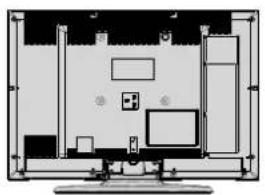
Viewing the Connections- Back Connectors ..... 90
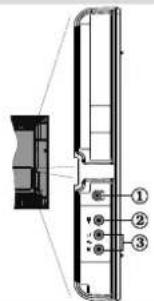
Viewing the Connections - Side Connectors ..... 91
Aerial Connection 91
Power Connection 92
Connecting the LCD TV to a PC 92
Connecting to a DVD Player....92
Using Side AV Connectors 92
Using Other Connectors 93
Connecting Other Equipment via Scart 93
Inserting Batteries in the Remote
Control Handset....93
Switching the TV On/Off 93
To Switch the TV On 93
To Switch the TV Off 93
First Time Installation 94
Input Selection 94
Basic Operations 94
Operation with the Buttons on the TV 94
Operation with the Remote Control 94
Menu System....95
Picture Menu....95
Sound Menu 96
Feature Menu 97
Install Menu 98
Install Menu in AV Modes 98
Program Table 98
Source Menu 99
PC Mode Menu System....99
PC Position Menu 99
Displaying TV Information 100
Mute Function 100
Picture Mode Selection.... 100
Freezing Picture 100
Zoom Modes....100
Teletext....101
Tips....102
Appendix A: PC Input Typical Display Modes ..... 103
Appendix B: AV and HDMI Signal Compatibility
(Input Signal Types) 103
Specifications 104
English - 85 -
Features
- Remote controlled colour LCD TV.
- HDMI connectors for digital video and audio. This connection is also designed to accept high definition signals.
• 200 programmes from VHF, UHF(analogue).
- OSD menu system.
- Scart socket for external devices (such as video, video games, audio set, etc.).
• Stereo sound system. (3D Panorama)
- Teletext, fastext, TOP text.
• Headphone connection.
• Automatic programming system.
- Forward or backward manual tuning.
- Sleep timer.
- Child lock.
• Automatic sound mute when no transmission.
- NTSC playback.
• AVL (Automatic Volume Limiting).
- When no valid signal is detected, after 5 minutes the TV switches itself automatically to standby mode.
- PLL (Frequency Search).
- PC input.
- Plug&Play for Windows 98, ME, 2000, XP, Vista.
- Audio line out.
• Game Mode (optional)
• Active antenna power (optional)
• SRS TruSurround XT (optional)
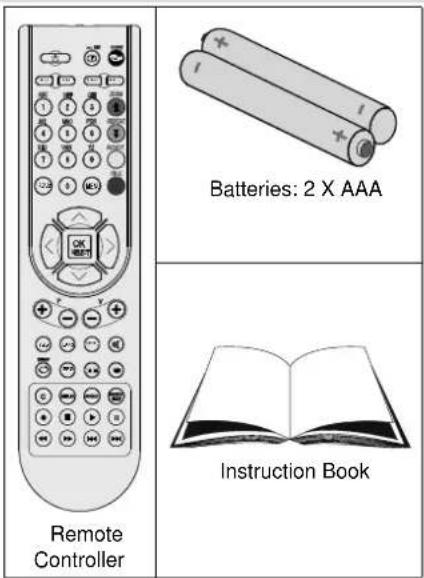
Accessories
Introduction
Thank you for choosing this product. This manual will guide you for the proper operation of your TV. Before operating the TV, please read this manual thoroughly.
Please do keep this manual in a safe place for future references.

Preparation
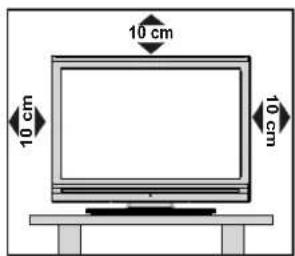
For ventilation, leave a free space of at least 10 cm all around the set. To prevent any fault and unsafe situations, please do not place any objects on top of the set.
Use this device in moderate climates.
English - 86 -
Safety Precautions
Please read the following recommended safety precautions carefully for your safety.
Power Source
The TV set should be operated only from a 220-240 V AC, 50 Hz outlet. Ensure that you select the correct voltage setting for your convenience.
Power Cord
Do not place the set, a piece of furniture, etc. on the power cord (mains lead) or pinch the cord. Handle the power cord by the plug. Do not unplug the appliance by pulling from the power cord and never touch the power cord with wet hands as this could cause a short circuit or electric shock. Never make a knot in the cord or tie it with other cords. The power cords should be placed in such a way that they are not likely to be stepped on. A damaged power cord can cause re or give you an electric shock. When it is damaged and needs to be replaced, it should be done by qualified personnel.
Moisture and Water
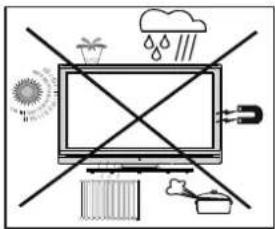
Do not use this device in a humid and damp place (avoid the bathroom, the sink in the kitchen, and near the washing machine). Do not expose this device to rain or water, as this may be dangerous and do not place objects filled with liquids, such as a lower vases, on top. Avoid from dripping or splashing.

If any solid object or liquid falls into the cabinet, unplug the TV and have it checked by qualified personnel before operating it any further.
Cleaning
Before cleaning, unplug the TV set from the wall outlet. Do not use liquid or aerosol cleaners. Use soft and dry cloth.
Ventilation
The slots and openings on the TV set are intended for ventilation and to ensure reliable operation. To prevent overheating, these openings must not be blocked or covered in anyway.
Heat and Flames
The set should not be placed near to open flames and sources of intense heat such as an electric heater. Ensure that no open flame sources, such as lighted candles, are placed on top of the TV. Bat not be exposed to excessive heat such as fire or the like.

Lightning
In case of storm and lightning or when going on holiday, disconnect the power cord from the wall outlet.
Replacement Parts
When replacement parts are required, make sure that the service technician has used replacement parts, which are specified by the manufacturer or have the same specifications as the original one. Unauthorized substitutions may result in fire, electrical shock or other hazards.
Servicing
Please refer all servicing to qualified personnel. Do not remove the cover yourself as this may result in an electric shock.

Waste Disposal
Instructions for waste disposal:
- Packaging and packaging aids are recyclable and should principally be recycled. Packaging materials, such as foil bag, must be kept away from children.
- Batteries, including those which are heavy metal-free, should not be disposed of with household waste. Please dispose of used battery in an environment friendly manner. Find out about the legal regulations which apply in your area.
- Cold cathode fluorescent lamp in LCD PANEL contains a small amount of mercury; please follow the local laws or regulations for disposal.
This symbol on the product or on its packaging means that your electrical and electronic device should be disposed at the end of its service life separately from your household wastes. There are separate collection systems for recycling in EU.
For more information, please contact the local authority or the dealer where you purchased the product.
Disconnecting the Device
The mains plug is used to disconnect TV set from the mains and therefore it must remain readily operable.
Disconnecting the Device
The mains plug is used to disconnect TV set from the mains and therefore it must remain readily operable.
English - 87 -
Headphone Volume
Excessive sound pressure from earphones and headphones can cause hearing loss.
Installation
To prevent injury, this device must be securely attached to the wall in accordance with the installation instructions when mounted to the wall (if the option is available).
LCD Screen
The LCD panel is a very high technology product with about a million thin film transistors, giving you fine picture details. Occasionally, a few non-active pixels may appear on the screen as a fixed blue, green or red point. Please note that this does not affect the performance of your product.
Warning
Do not leave your TV in standby or operating mode when you leave your house.
Licence Notification (optional)
SRS
TruSurround trademark of SRS Labs, Inc. TruSurround technology is incorporated under license from SRS Labs, Inc.
LICENSE NOTICE
Manufactured under license from Dolby Laboratories.
TRADEMARK ACKNOWLEDGMENT
"Dolby" and the double-D symbol are trademarks of Dolby Laboratories.
When you use the wall mount kit (optional) with the LCD TV, we would definitely recommend to plug all your cables into the back of the LCD before mounting to the wall.
Overview of the Remote Control
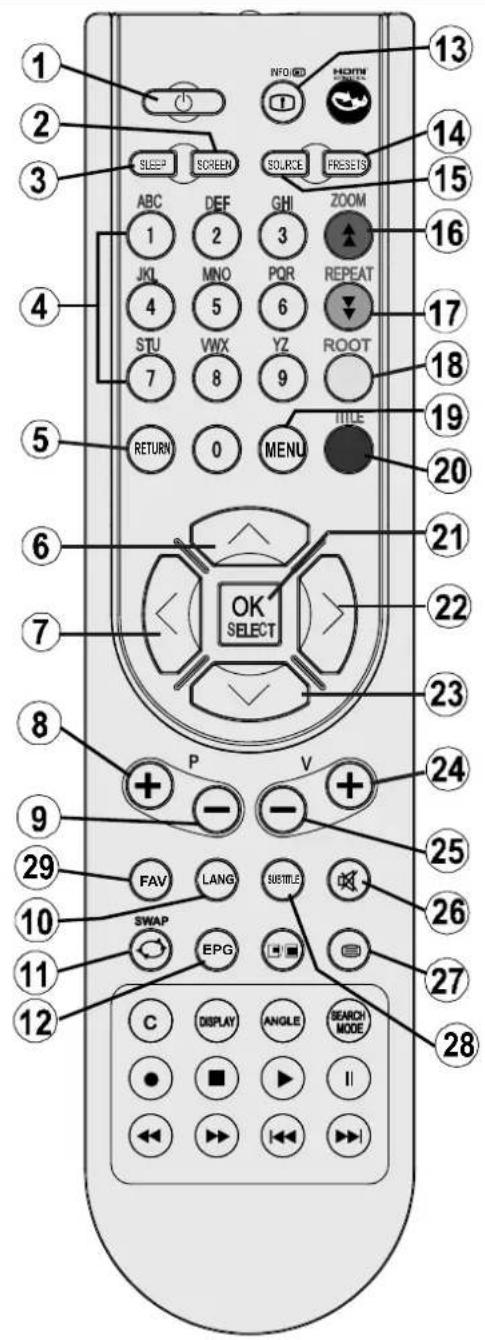
Standby1.
Image size2.
Sleep timer3.
Numeric buttons4.
Return / TXT Index5.
Cursor up / TXT up page6.
Cursor left 7.
Programme up8.
Programme down9.
Mono-Stereo / Dual I-II10.
Swap11.
No function12.
Info / TXT reveal13.
Picture mode selection14.
Source selection15.
Red / Sound 16.
-
Green / Picture
-
Yellow / Feature
Menu19.
-
Blue / Install
-
OK /Select
-
Cursor righ / TXT Subpage
-
Cursor down / TXT Downpage
-
Volume up
-
Volume down
-
Mute
Teletext / Mix27.
- TXT Subtitle
No function29.
Note: Buttons that are not indicated with a number on the remote control illustration are not functional in TV mode.
English - 89 -
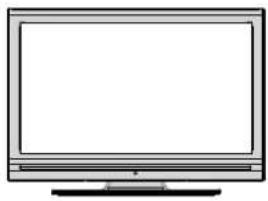
natural_image
Line drawing of a flat-screen television computer (no text or symbols)
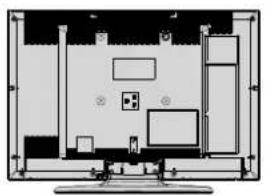
natural_image
Top-down architectural floor plan of a room with furniture layout (no text or labels)
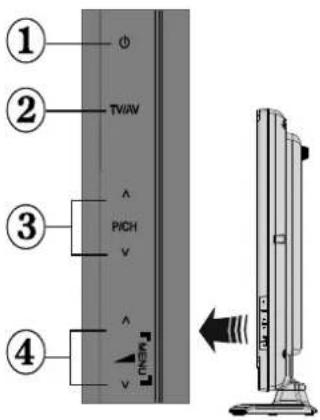
Standby button1.
TV/AV button2.
Programme Up/Down buttons3.
Volume Up/Down buttons4.
Note: Press "■/▲" + buttons at the same time to view main menu.
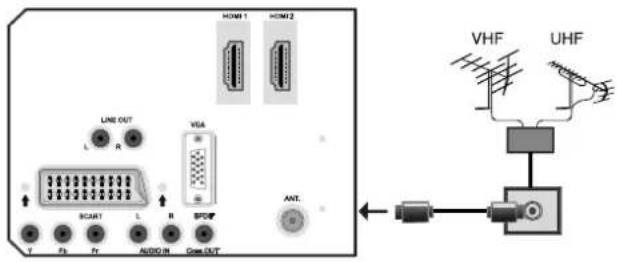
Viewing the Connections- Back Connectors
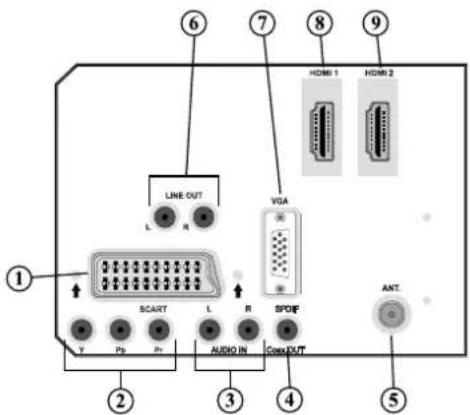
SCART socket1. inputs or outputs for external devices.
Connect the SCART cable between SCART socket on TV and SCART socket on your external device (such as a decoder, a VCR or a DVD player).
Note: If an external device is connected via the SCART socket, the TV will automatically switch to AV mode.
Component Video Inputs (YpBPr)2. are used for connecting component video.
You can connect the component video and audio sockets with a device that has component output.
Connect the component video cables between the COMPONENT VIDEO INPUTS on on the TV and the component video outputs of your device. While connecting, be sure that the letters on your TV, "Y", "Pb", "Pr" correspond with your device's connectors.
- PC/YPbPr Audio Inputs are used for connecting audio signals of a PC or a device that connects to the TV via YPbPr.
Connect the PC audio cable between the AUDIO INPUTS on the TV and audio output of your PC to enable PC audio.
Connect the audio cable between AUDIO INPUTS on the TV and audio outputs of your device to enable component audio.
English - 90 -

S/PDIF Out4. outputs digital audio signals of the currently watched source.
Use an S/PDIF coaxial cable to transfer audio signals to a device that has S/PDIF input. You should also set SPDIF Out option in the Sound Menu as On.
RF Input5. connects to an antenna or a cable.
Note that if you use a decoder or a media recorder, you should connect the aerial cable through the device to the television with an appropriate antenna cable, as shown in the illustration in the following pages.
- Audio Line Outs output audio signals to an external device such as an optional sound system.
To connect the external speakers to your TV, use AUDIO LINE OUTS of the TV with an audio cable. Note: Line out feature cannot be used while in HDMI source. You can use SPDIF instead.
PC Input7. is for connecting a personal computer to the TV set.
Connect the PC cable between the PC INPUT on the TV and the PC output on your PC.
HDMI 1:8. HDMI input
HDMI 2 : BUDMI input
HDMI Inputs are for connecting a device that has an HDMI socket.
Your LCD Television is capable of displaying High Definition pictures from devices such as a High Definition Satellite Receiver or DVD Player. These devices must be connected via the HDMI sockets or Component Socket. These sockets can accept either 480i, 480p, 576p, 576i, 720p, 1080i, 1080p signals. No sound connection is needed for an HDMI to HDMI connection.
Viewing the Connections - Side Connectors
Headphone jack is used for connecting an external headphone to the system. 1. Connect to the HEADPHONE jack to listen to the TV from headphones (optional).
-
Video Input is used for connecting video signals of external devices. Connect the video cable between the VIDEO IN socket on the TV and the VIDEO OUT jack on your device.
-
Audio Inputs are used for connecting audio signals of external devices. Connect the audio cable between the AUDIO INPUTS on the TV and the AUDIO OUTPUT jacks on your device.
Note: If you connect a device to the TV via the VIDEO INPUT, you should also connect your device with an audio cable to the AUDIO INPUTS of the TV to enable audio.
Aerial Connection
- Connect the aerial or cable TV plug to the AERIAL INPUT socket located at the rear of the TV.
English - 91 -
Power Connection
IMPORTANT : The TV set is designed to operate on 220-240V AC, 50 Hz.
• After unpacking, allow the TV set to reach the ambient room temperature before you connect the set to the mains.
- Plug the power cable to the mains socket outlet.
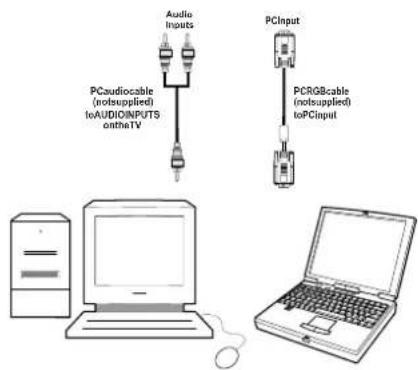
Connecting the LCD TV to a PC
For displaying your computer's screen image on your LCD TV, you can connect your computer to the TV set.
• Power off both computer and display before making any connections.
- Use 15-pin D-sub display cable to connect a PC to the LCD TV.
- When the connection is made, switch to PC source. See "Input selection" section.
- Set the resolution that suits your viewing requirements. Resolution information can be found in the appendix parts.
Connecting to a DVD Player
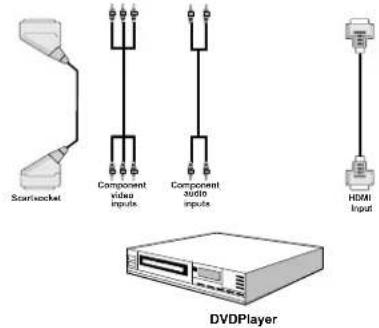
If you want to connect a DVD player to your LCD TV, you can use connectors of the TV set. DVD players may have different connectors. Please refer to your DVD player's instruction book for additional information. Power off both the TV and the device before making any connections.
Note: Cables shown in the illustration are not supplied.
- If your DVD player has an HDMI socket, you can connect via HDMI. When you connect to DVD player as illustrated below, switch to HDMI source. See, "Input Selection" section.
- Most DVD players are connected through COMPONENT SOCKETS. Use a component video cable to connect video input. For enabling audio, use a component audio cable as illustrated below.
When the connection is made, switch to YPbPr source. See, "Input selection" section.
- You may also connect through the SCART socket. Use a SCART cable as shown below.
Note: These three methods of connection perform the same function but in different levels of quality. It is not necessary to connect by all three methods.
Using Side AV Connectors
You can connect a range of optional equipment to your LCD TV. Possible connections are shown below. Note that cables shown in the illustration are not supplied.
- For connecting a camcorder, connect to the S-VIDEO or VIDEO IN socket and the AUDIO SOCKETS. Do not connect the camcoder to S-VIDEO and VIDEO IN socket at the same time since it can cause noise in the picture. For selecting the related source, see the section "Input selection" in the following parts.
- To listen the TV sound from headphones, connect to the HEADPHONE jack of theTV.
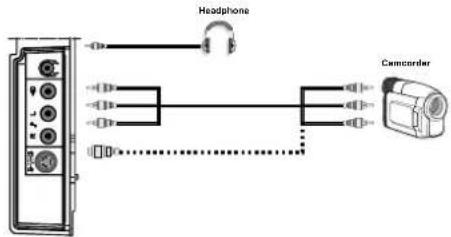
Using Other Connectors
You can connect a range of optional equipment to your LCD TV. Possible connections are shown below. Note that cables shown in the illustration are not supplied.
- To connect external speakers, use an audio cable. Do not reverse the AUDIO LEFT and AUDIO RIGHT jacks. Turn on the LCD TV and external speaker set after all connections are made. Refer to your speaker set's manual for further queries.
- For connecting a to a device that has SPDIF support, use an appropriate SPDIF cable to enable sound connection. You should also set SPDIF Out option in the Sound menu as On.
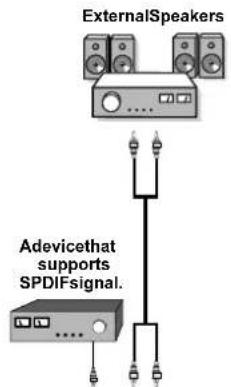
flowchart
graph TD
    A["ExternalSpeakers"] --> B["Adevicethat supports SPDIFsignal."]
    B --> C["ExternalSpeakers"]
    style A fill:#f9f,stroke:#333
    style B fill:#ccf,stroke:#333
Connecting Other Equipment via Scart
Most devices support SCART connection. You can connect a; DVD recorder, a VCR or a decoder to your LCD TV by using the SCART socket. Note that cables shown in the illustration are not supplied.
Power off both the TV and the devices before making any connections.
For more information, refer to your device's own instruction book.
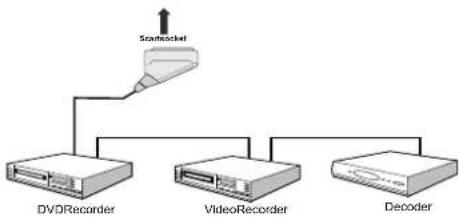
flowchart
graph TD
    A["Standrocket"] --> B["VideoRecorder"]
    A --> C["VideoRecorder"]
    A --> D["Decoder"]
Inserting Batteries in the Remote Control Handset
- Remove the battery cover located on the back of the handset by gently pulling backwards from the indicated part.
- Insert two AAA/R3 or equivalent type batteries inside. Place the batteries in the right directions and replace the battery cover.
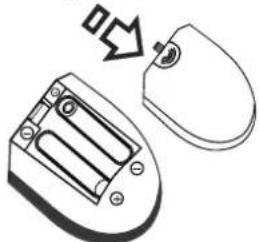
natural_image
Diagram of a computer mouse with a separate view showing internal components (no text or symbols)
Note: Remove the battery from remote control handset when it is not to be used for a long period. Otherwise it can be damaged due to any leakage of batteries.
Remote range is approximately 7m/23ft.
Switching the TV On/Off
To Switch the TV On
- Connect the power cord to the 220-240V AC 50 Hz. Then the standby LED lights up.
• To switch on the TV from standby mode either:
- Press the ⬤" button, P+ / P- or a numeric button on the remote control.
- Press the STANDBY button, -P/CH or P/CH+ button on the TV. The TV will then switch on.
Note: If you switch on your TV via PROGRAMME UP/DOWN buttons on the remote control or on the TV set, the programme that you were watching last will be reselected.
By either method the TV will switch on.
To Switch the TV Off
- Press the ⏻ button on the remote control or press the STANDBY switch on the TV, so the TV will switch to standby mode.
- To power down the TV completely, unplug the power cord from the mains socket.
Note: When the TV is switched to standby mode, standby LED can blink to indicate that features such as Standby Search, Over Air Download or Timer is active.
English - 93 -
First Time Installation
When the TV set is operated for the first time, the following menu screen will be displayed:
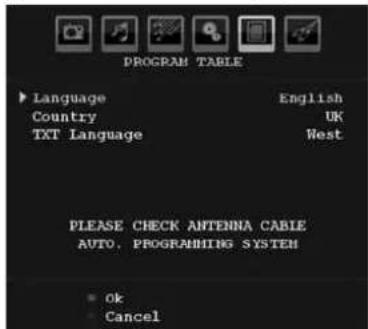
Select your Country, Language and Text language by using “◀” or “▶” and “▼or “ ”▲buttons. Press OK or RED button to continue. To cancel, press the BLUE button.
The following menu will be displayed during the automatic tuning:
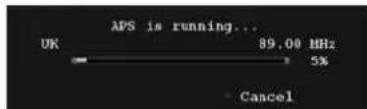
After APS is finalized, the programme table will appear on the screen. In the programme table you will see the programme numbers and names assigned to the programmes.
If you do not accept the locations and/or the programme names, you can change them via the program table.
Do not turn off the TV while initializing first time installation.
Once you have connected external systems to your TV, you can switch to different input sources.
- Press SOURCE button on your remote control for directly changing sources.
or,
- Select "Source" option from the main menu by using "◀ or "▶ button. Use then "▼" or "▲ button to highlight an input and press "▼" button to select.
Note: You can mark desired source options by pressing the OK button. Therefore, when SOURCE button is pressed, only the marked source options will be available (except for the TV source).
Basic Operations
You can operate your TV using both the remote control and onset buttons.
- Press button to decrease volume or button to increase volume, so a volume level scale (slider) will be displayed on the screen.
Programme Selection
- Press "P/CH+" button to select the next programme or "P/CH-" button to select the previous programme.
Viewing Main Menu
- Note: Press V+/V- buttons at the same time to view main menu. In the Main menu select sub-menu using "P/CH -" or "P/CH +" buttons and enter the sub-menu using "-" button. To learn the usage of the menus, refer to the menu system sections.
AV Mode
- Press the "TV/AV" button in the control panel on the TV to switch between AV modes.
Operation with the Remote Control
- The remote control of your TV is designed to control all the functions of the model you selected. The functions will be described in accordance with the menu system of your TV.
- Functions of the menu system are described in the following sections.
Volume Setting
- Press V+ button to increase the volume. Press V-button to decrease the volume. A volume level scale (slider) will be displayed on the screen.
Programme Selection (Previous or Next Programme)
- Press "P -" button to select the previous programme.
- Press "P+" button to select the next programme.
English - 94 -
Programme Selection (Direct Access)
- Press numeric buttons on the remote control to select programmes between 0 and 9. The TV will switch to the selected programme. To select programmes between 10 - 299 (for IDTV) or 10-199 (for analogue), press the numeric buttons consecutively. The limit of the delay time is 3 seconds.
- Press directly the programme number to reselect single digit programmes.
Picture Menu
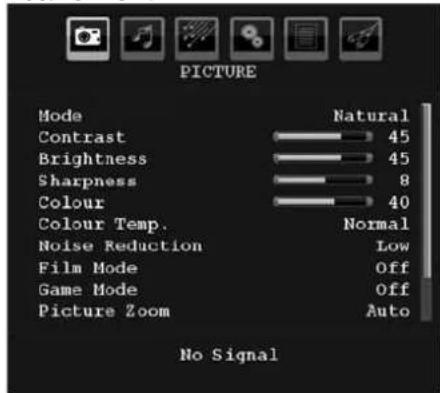
Mode
For your viewing requirements, you can set the related mode option.
Press "▼" or "▲button to select Mode. Press "◀" or "▶" button to choose from one of these options: Cinema, Dynamic and Natural.
Brightness/Contrast/Colour/Sharpness/Hue
Press "▼ or " " button to select the desired option.
Press "◀ or " " button to set the level.
Note: Hue option can only be visible when the TV receives an NTSC signal.
Colour Temp
Press "▼" or "▲" button to select Colour Temp. Press "◀" or " "to choose from one of these options: Cool, Normal and Warm.
Note :
- Setting Cool option gives white colours a slight blue stress.
- Setting Warm option gives white colours a slight red stress.
- For normal colours, select Normal option.
Noise Reduction
If the broadcast signal is weak and the picture is noisy, use Noise Reduction setting to reduce the noise amount.
Press ▼" or "▲button to select Noise Reduction. Press "▼or " "to choose from one of these options: Low, Medium, High or Off.
Film Mode
Films are recorded at a different number of frames per second to normal television programmes.
Press ▼" or "▲button to select Film Mode.
Press "◀" or "▶" button to set this feature On or Off. Turn this feature on when you are watching.
fi lms to see the fast motion scenes clearly.
Game Mode (optional)
Select Game Mode by pressing "▼" or "▲" button. Use "◀" or "▶" button to set Game Mode as On or Off. When Game Mode is set to On, specific game mode settings, which are optimized for better video quality, will be loaded.
Also; Picture Mode, Contrast, Brightness, Sharpness, Colour and Colour Temp settings will be invisible and disabled while Game Mode is on.
Note :
Picture mode selection button on the remote control will have no function while Game Mode is on.
Picture Zoom
Select Picture Zoom by pressing "▼" or "▲" button.
Use "◀" or "▶" buttons, to change picture zoom to Auto, 16:9, 4:3, Panoramic, 14:9, Cinema, Subtitle or Zoom.
Store
Press ▼ or “▲button to select Store. Press “”▶ or OK button to store the settings. “Stored...” will be displayed on the screen.
Reset
Press "▼" or "▲" button to select Reset. Press "◀" or "▶" or OK button to reset the picture modes to factory default settings.
English - 95 -
Sound Menu
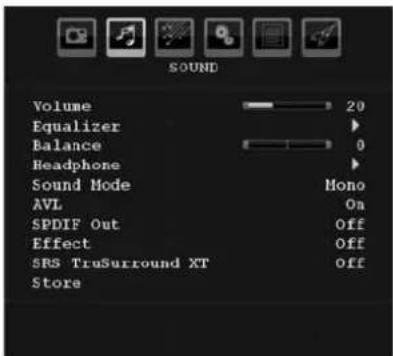
Volume
Press “▼” or “▲” button to select Volume. Press “◀” or “▶” button to change the level of the Volume.
Equalizer
Press “▼” or “▲” button to select Equalizer. Press “▶” button to view equalizer menu.
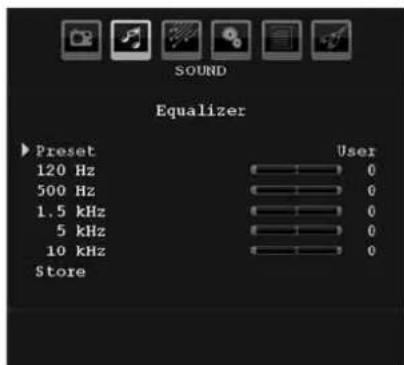
Press "◀" or "▶" button to change the preset. In equalizer menu, the preset can be changed to Music, Movie, Speech, Flat, Classic and User.
Select the desired frequency by pressing ▼” or “▲ button and increase or decrease the frequency gain by pressing “◀or “ ”button.
Press the "M" button to return to the previous menu. Note: Equalizer menu settings can be changed only when the Equalizer Mode is in User.
Balance
This setting is used for emphasizing left or right speaker balance.
Press "▼" or "▲" button to select Balance. Press "◀" or "▶" button to change the level of the balance. Balance level can be adjusted between -32 and +32.
Headphone
Press "▼" or "▲" button to select Headphone. Press "▶" button to view the headphone menu.
Note: Headphone will be disabled when SPDIF option is set to on.
Headphone sub-menu options are described below:
Volume
Press "▼" or "▲" button to select Volume. Press "▶" button to increase headphone volume level. Press "◀" button to decrease headphone volume level.
Headphone volume level can be adjusted between 0 and 63.
Sound Mode (optional)
Press "▼" or "▲" button to select Sound Mode. Using "▼" or "▼" button, you can select Mono, Stereo, Dual I or Dual II mode, only if the selected channel supports that mode.
AVL
Automatic Volume Limiting (AVL) function adjusts the sound to obtain fixed output level between programmes (For instance, volume level of advertisements tend to be louder than programmes).
Press “▼” or “▲” button to select AVL. Press “◀” or “▶” button to set the AVL as On or Off.
Spdif Out
Press "▼" or "▲" button to select Spdif Out. Press "◀" or "▶" button to set the Spdif Out. as On or Off.
Note: If Spdif Out is set to On, headphone will be disabled.
SRS TruSurr XT (optional)
By pressing “▼” or “▲” select SRS TruSurr XT. Press “◀” or “▶” button to set SRS TruSurr XT as on or off.
Note: If you set SRS TruSurr XT as On, some features in the Sound menu can be unavailable to be set.
Dolby Virtual Speaker (optional)
This feature is used to create the impression that sound is coming from around the room instead of the set speakers. Pressing the "◀ or "▶ buttons will turn the feature on or off.
Note: If you set Dolby Virtual Speaker as On, some features in the Sound menu can be unavailable to be set.
Effect
If you are watching a mono broadcast, set Effect on to obtain a better sound effect which will be more stereolike. If the current sound system is stereo, switching this effect on will give a more spatial effect.
Press "▼" or "▲button to select Effect. Press "◀" or "▶button to set as On or Off.
English - 96 -
Store
Press ▼ or "▲button to select Store. Press "▼" or OK button to store the settings. "Stored..." will be displayed on the screen.
Feature Menu
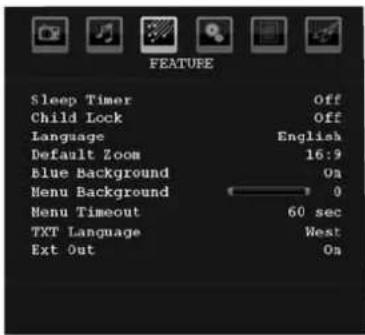
Sleep Timer
Press "▼" or "▲" button to select Sleep Timer. Use "◀" or "▼" button to set the Sleep Timer.
The timer can be programmed between Off and 120 minutes in steps of 10 minutes.
If Sleep Timer is activated, at the end of the selected time, the TV goes automatically to standby mode.
Child Lock
Press "▼ or " " button to select Child Lock.
Use "◀" or "▶" button to set the Child Lock On or Off. When On is selected, the TV can only be controlled by the remote control handset. In this case the control panel buttons will not work.
Hence, if one of those buttons is pressed, Child Lock On will be displayed on the screen when the menu screen is not visible.
Language
Press “▼” or “▲” button to select Language. Use “◀” or “▶” button to select the Language.
Default Zoom
While zoom mode is set as AUTO, the TV will set the zoom mode in accordance with the signal of the broadcast. If there is no WSS or aspect ratio information, the TV will then use this setting to adopt. Press "▼" or "▲" button to select Default Zoom. You can set Default Zoom to Panoramic, 16:9, 4:3 or 14:9 by pressing◀ or ►button.
Blue Background
If the signal is weak or absent, the TV will automatically change to a blue screen. To enable this, set Blue Background to On.
By pressing "▼" or "▲" button, select Blue Background. Press "◀" or "▶" button to set Blue Background as On or Off.
Press “▼” or “▲” button to select Menu Background. You can set menu background level by pressing “◀” or “▶” button.
Backlight
This setting controls the backlight level. Select Backlight by pressing ▼" or "▲ button. Press" ◀" or "▶" button to set Backlight to Auto, Medium, Maximum or Minimum.
To set a specific display timeout for menu screens, set a value for this option.
Press "▼" or "▲button to select Menu Timeout. Use "◀" or "▶button to change menu timeout to 15 sec, 30 sec or 60 sec.
Teletext Language
Press “▼” or “▲” button to select Teletext Language. Use “◀” or “▶” button to change Teletext Language to West, East, Turk/Gre, Cyrillic, Arabic or Persian.
Ext Out
Press▼ or "▲" button to select Ext Out. Use " " on "▲" button to set the Ext Out as On or Off.
Note :
For copying from a DVD or VCR device, you should choose desired source from source menu and turn "On" to EXT Out from feature menu.
Ext Out should be On in order to use Timers function in the DTV mode.
HDMI PC Full Mode (optional)
If you want to view PC screen in HDMI mode by using external connection, HDMI PC FULL MODE option should be On to adjust the screen ratio correctly. This item might be inactive in some resolutions.
Note: If you connect an HDMI device and switch the TV to HDMI mode, this feature will be visible (except for 1080i/1080P resolution).
Full Mode (optional)
If you connect a device via HDMI or YPbPr connectors and set 1080i/1080P resolutions, Full Mode item will be visible. You can set Full Mode as 1:1 or Normal by using "or" if you select 1:1, screen ratio will be adjusted correctly. If you set Normal, screen ratio may expand.
English - 97 -
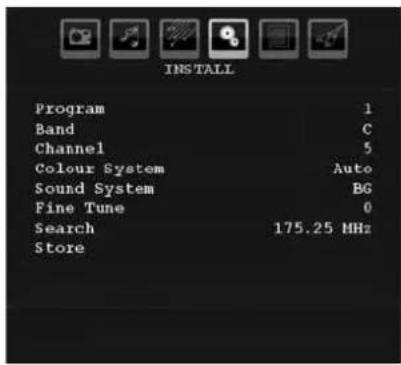
Program
Press ▼ or “▲” button to select Program. Use “”◀ or “▶” button to select the program number. You can also enter a number using the numeric buttons on the remote control. There are 200 programme storage between 0 and 199.
Band
Band can be selected either C or S. Press "◀" or "▶" button to set Band.
Channel
Channel can be changed by "◀" or "▶" button or numeric buttons.
Colour System
Press ▼ or “” button to select Colour System. Use “◀ or ” button to change the colour system to PAL, PAL 60, SECAM or AUTO.
Sound System
Press ▼' or "▲button to select Sound System. Press "◀or "▼" button to change the sound system to BG, DK, I, L or L'.
Fine Tune
Press ▼ or "▲" button to select Fine Tune. Press "◀" or "▶" button to adjust the tuning.
Search
Press ▼ or “▲button to select Search. Use “◀ or ▶button to start programme searching. You can also enter the desired frequency using the numeric buttons while Search item is highlighted.
Store
Press ▼ or “▲button to select Store. Press “”▶ or OK button to store the settings. “Stored...” will be displayed on the screen.
The following screen appears in the install menu when the TV is in AV modes. Note that limited options will be available. Switch to TV mode for viewing complete version of the Install menu.
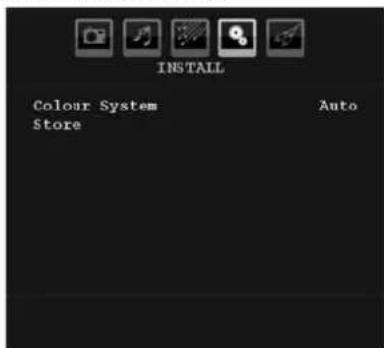
Colour System
Press "▼" or "▲" button to select Colour System. Use "◀" or "▶" button to change the colour system to PAL, SECAM, PAL60, AUTO, NTSC 4,43 or NTSC 3,58.
Store
Press "▼" or "▲" button to select Store Program. Press "▶" or OK button to store the settings. "Stored..." will be displayed on the screen.
Program Table
Select Program Table by pressing "▼" or "▲" button. Press "▶" to display Program Table:
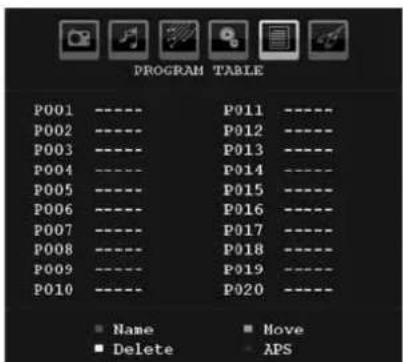
By moving the cursor in four directions you can reach 20 programmes in the same page. You can scroll the pages up or down by pressing the navigation buttons to see all the programmes in TV mode (except for the AV modes). By cursor action, programme selection is done automatically.
Name
To change the name of a programme, select the programme and press the RED button.
The first letter of the selected name will be highlighted. Press "▼" or "▲button to change that letter and "◀"
English - 98 -
or "button to select the other letters. By pressing the RED button, you can store the name.
Move
Select the programme which you want to move by navigation buttons. Press the GREEN button. By navigation buttons move the selected programme to the decided programme space and press the GREEN button again.
Delete
To delete a programme, press the YELLOW button. Pressing the YELLOW button again erases the selected programme from the programme list, and the following programmes shift one line up.
APS (Auto Programming System)
When you press the BLUE button for starting automatic tuning, Auto Programming System menu will appear on the screen:
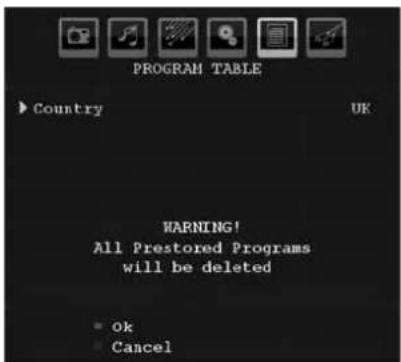
Country
Press ▼" or "▲button to select your country. If you want to exit from A.P.S. function, press the BLUE button.
When you press OK or RED button for starting automatic tuning, all stored programmes will be erased and the TV will search for available channels. During the search, the following OSD will be displayed:
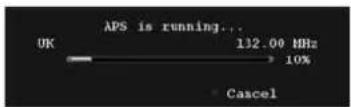
Whenever you press the BLUE button, APS function stops and Program Table appears on the screen. If you wait until the end of APS, Program Table will be displayed with the programmes found and located.
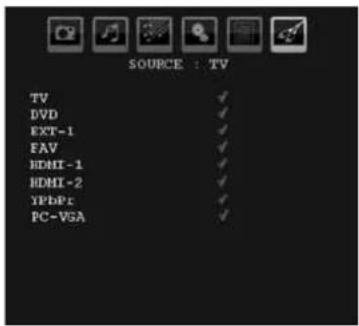
Press ▼ or “▲button and select the sixth icon. Then press ▶” or OK button. Source menu appears on the screen:
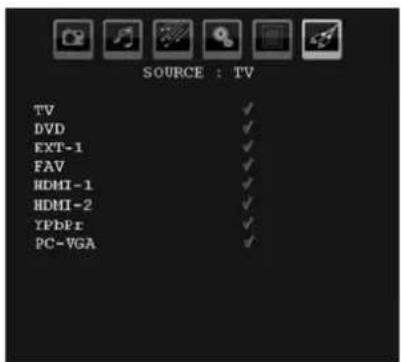
In source menu, highlight a source by pressing ▼ or “▲” button and switch to that mode by pressing “▶” button. Source options are; TV, DVD, EXT-1, FAV, HDMI-1, HDMI-2, YPbPr and PC-VGA.
Note: Once you have connected optional equipment systems to your TV, you should select the required input to view pictures from that source.
See "Connecting the LCD TV to a PC" section for connecting a PC to the TV set.
For switching to PC source, press "SOURCE" button on your remote control and select PC input. You can also use "Source" menu to switch to PC mode.
Note that PC mode menu settings are available only while the TV is in PC source.
Select the first icon by pressing "◀" or "▶" button. PC Position menu appears on the screen:
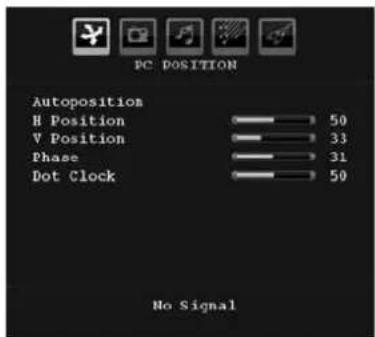
Autoposition
If you shift the picture horizontally or vertically to an unwanted position, use this item to put the picture into correct place automatically. This setting therefore automatically optimizes the display.
English - 99 -
Select Autoposition item by using "▼or " "▲buttons. Press OK or "◀" "▶button.
Warning: Please ensure auto adjustment is performed with a full screen image to ensure best results.
H (Horizontal) Position
This item shifts the image horizontally to right hand side or left hand side of the screen.
Select H Position item by using▼" or "▲" button. Use "◀" or "▼" button to adjust the value.
V (Vertical) Position
This item shifts the image vertically towards the top or bottom of the screen.
Select V Position item by using▼" or "▲" button. Use "◀" or "▶" button to adjust the value.
Phase
Depending on the resolution and scan frequency that you input to the TV set, you may see a hazy or noisy picture on the screen. In such a case you can use this item to get a clear picture by trial and error method.
Select Phase item by using▼" or "▲buttons. Use◄or "►button to adjust the value.
Dot Clock
Dot Clock adjustments correct the interference that appear as vertical banding in dot intensive presentations like spreadsheets or paragraphs or text in smaller fonts.
Select Dot Clock item by using▼" or "▲buttons. Use◄or " ►button to adjust the value.
For adjusting PC picture items, do the following: Press "◀" or "▶" button to select the second icon. PC Picture menu appears on the screen.
Brightness, Contrast, Colour and Colour Temperature settings in this menu are identical to settings defined in TV picture menu under "Analogue TV Menu System".
Note: If you set Colour Temp as User, you can define R, G, B settings manually.
Sound, Feature and Source settings are identical to the settings explained in Analog TV menu system.
Programme Number, Programme Name, Sound Indicator and Zoom Mode information is displayed on the screen when a new programme is entered or "INFO" button is pressed.
Mute Function
Press button to disable sound. Mute indicator will be displayed in the upper side of the screen.
To cancel mute, there are two alternatives; the first one is pressing the "×" button and the second one is increasing the volume level.
Picture Mode Selection
By pressing PRESETS button, you can change Picture Mode settings in accordance with your viewing requirements. Available options are Dynamic, Natural and Cinema.
Note: This feature cannot be set while in PC mode.
Freezing Picture
You can freeze the picture on the screen by pressing the "OK" button on the remote control. Press the "OK" button to freeze picture. Press again to quit freeze mode.
Zoom Modes
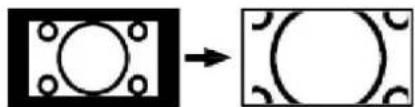
You can change the aspect ratio (image size) of the TV for viewing the picture in different zoom modes.
Press SCREEN button to directly change the zoom mode.
Available zoom modes are listed below.
Note:
In YPbPr and HDMI modes, while in 720p-1080i resolutions, only 16:9 mode is available.
Zoom mode cannot be changed while in PC mode.
Auto
When a WSS (Wide Screen Signalling) signal, which shows the aspect ratio of the picture, is included in the broadcast signal or the signal from an external device, the TV automatically changes the ZOOM mode according to the WSS signal.
- When the AUTO mode does not function correctly due to poor WSS signal quality or when you want to change the ZOOM mode, change to another ZOOM mode manually.
16:9
This uniformly stretches the left and right sides of a normal picture (4:3 aspect ratio) to fill the wide TV screen.
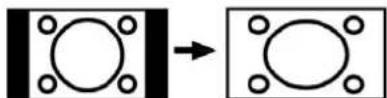
- For 16:9 aspect ratio pictures that have been squeezed into a normal picture (4:3 aspect ratio), use the 16:9 mode to restore the picture to its original shape.
English - 100 -
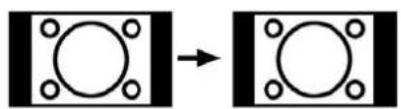
4:3
Use to view a normal picture (4:3 aspect ratio) as this is its original size.
natural_image
Diagram showing transformation of a square frame with circular holes into a larger square frame (no text or symbols)
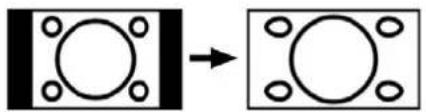
Panoramic
This stretches the left and right sides of a normal picture (4:3 aspect ratio) to fill the screen, without making the picture appear unnatural.
natural_image
Diagram showing transformation of a square with circular holes into a larger square with circles (no text or symbols)
The top and bottom of the picture are slightly cut off.
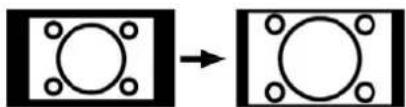
14:9
This zooms up the wide picture (14:9 aspect ratio) to the upper and lower limits of the screen.
natural_image
Diagram showing transformation of a square with a circle inside, resulting in a square with circles and dots (no text or symbols)
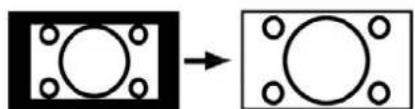
Cinema
This zooms up the wide picture (16:9 aspect ratio) to the full screen.
natural_image
Diagram showing a square with a circle inside and a square with circles inside, connected by an arrow (no text or symbols)
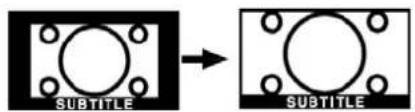
Subtitle
This zooms up the wide picture (16:9 aspect ratio) with subtitles to the full screen.
Zoom
This option zooms to the picture.
natural_image
Diagram showing transformation from a square with circular cutout to a square with circular cutout (no text or symbols)
Note: You can shift to screen up or down by pressing "▼/ " " buttons while picture zoom is selected as panaromic, 14:9, Cinema or Subtitle.
Teletext
Teletext system transmits information such as news, sports and weather on your TV. Note that is the signal degrades, for example in poor/adverse weather conditions, some text errors may occur or the teletext mode may be aborted.
Teletext function buttons are listed below:

Teletext On-Off
Activates teletext mode when pressed once. Pressing the button for the second time, activates teletext mix feature. Pressing again will quit the teletext mode.
"RETURN" - Index
Selects the teletext index page.

Subcode Pages
Selects subcode pages if available when the teletext is activated.
"INFO" - Reveal
Shows hidden information (e.g. solutions of games).
"SCREEN" - Expand
Press once to enlarge top half of the page, press again to enlarge the bottom half of the page. Press again to revert back to normal size.
P+ / P- and numbers (0-9)
Press to select a page.
Note: Most TV stations use code 100 for their index pages.
Your TV supports both FASTEXT and TOP text systems. When these systems are available, the pages are divided into groups or topics.
When FASTEXT system is available, sections in a teletext page will become colour-coded and can be selected by pressing the coloured buttons. Press a coloured button that corresponds to with your needs.
The coloured writings will appear, showing you which coloured buttons to use when TOP text transmission is present. Pressing P - or P + commands will request the next or previous page respectively.
Teletext Subtitle
If you press SUBTITLE button, teletext subtitle information will be displayed on the bottom right part of the screen (if available). You can set the desired option by highlighting it using "▼" or "▲button and then by pressing OK button.
English - 101 -
Tips
Screen Care
Clean the screen with a slightly damp, soft cloth. Do not use abrasive solvents as they may damage the coating layer of the TV screen.
For your safety, unplug the mains plug when cleaning the set. When moving the TV, hold it properly from the bottom part.
Image Persistence
Please note that ghosting may occur while displaying a persistent image. LCD TVs' image persistence may disappear after a short time. Try turning off the TV for a while.
To avoid this, do not leave the screen in still picture for extended periods.
No Power
If your TV system has no power, please check the main power cable and connection to the mains socket outlet.
Poor Picture
Have you selected the correct TV system? Is your TV set or house aerial located too close to a non-earthed audio equipment or neon lights, etc.?
Mountains or high buildings can cause double pictures or ghost images. Sometimes you can improve the picture quality by changing the direction of the aerial.
Is the picture or teletext unrecognisable? Check if you have entered the correct frequency. Please return the channels.
The picture quality may degrade when two peripherals are connected to the TV at the same time. In such a case, disconnect one of the peripherals.
No Picture
Is the aerial connected properly? Are the plugs connected tightly to the aerial socket? Is the aerial cable damaged? Are suitable plugs used to connect the aerial? If you are in doubt, consult your dealer.
No Picture means that your TV is not receiving a transmission. Have you selected the correct button on the remote control? Try once more.
Also make sure the correct input source has been selected.
Sound
You can not hear any sound. Did you perhaps interrupt the sound, pressing the button?
Sound is coming from only one of the speakers. Is the balance set to one extreme? See Sound Menu.
Remote Control
Your TV no longer responds to the remote control. Perhaps the batteries are exhausted. If so you can still use the local buttons at the bottom of the TV.
If you cannot select an input source, it is possible that no device is connected.
Check the AV cables and connections if you have tried to connect a device.
English - 102 -
The display has a maximum resolution of 1600 × 1200. The following table is an illustration of some of the typical video display modes.
Your TV may not support different resolutions. Supported resolution modes are listed below.
If you switch your PC to an unsupported mode, a warning OSD will appear on the screen.
| Index | Resolution Frequency | Standard |
| Hor Ver | Ver (Hz) | Hor (KHz) |
| 1 640 | 480 60 | 31.5 VE | SA | | |
| 2 640 | 480 72 | 37.9 VE | SA | | |
| 3 640 | 480 75 | 37.5 VE | SA | | |
| 4 800 | 600 56 | 35.2 VE | SA | | |
| 5 800 | 600 60 | 37.9 VE | SA | | |
| 6 800 | 600 70 | 43.8 | | | |
| 7 800 | 600 72 | 48.1 VE | SA | | |
| 8 800 | 600 75 | 46.9 VE | SA | | |
| 9 832 | 624 75 | 49.7 MAC | | | |
| 10 10 | 24 768 | 60 48.4 | VESA | | |
| 11 10 | 24 768 | 70 56.5 | VESA | | |
| 12 10 | 24 768 | 72 57.7 | | | |
| 13 10 | 24 768 | 75 60.0 | | | |
| 14 11 | 52 864 | 70 64.2 | VESA | | |
| 15 11 | 52 864 | 75 67.5 | VESA | | |
| 16 11 | 52 870 | 75 68.9 | MAC | | |
| 17 12 | 80 768 | 60 47.7 | VESA | | |
| 18 13 | 80 768 | 60 47.7 | | | |
| 19 12 | 80 960 | 60 60.0 | VESA | | |
| 20 12 | 80 1024 | 60 64.0 | VESA | | |
| 21 12 | 80 1024 | 75 80.0 | VESA | | |
| 22 16 | 100 1200 | 60 75.0 | VESA | | |
Appendix B: AV and HDMI Signal Compatibility (Input Signal Types)
| Source | Supported Signals | Available |
| EXT-1(SCART) | PAL 50/60 | O |
| NTSC 60 | O |
| RGB 50 | O |
| RGB 60 | O |
| FAV | PAL 50/60 | O |
| NTSC 60 | O |
| YPbPr | 480I | 60Hz | O |
| 480P 60Hz | O |
| 576I | 50Hz | O |
| 576P 50Hz | O |
| 720P 50Hz | O |
| 720P 60Hz | O |
| 1080I | 50Hz | O |
| 1080I | 60Hz | O |
| 1080P 50Hz | O |
| 1080P 60Hz | O |
| HDMI1HDMI2 | 480I | 60Hz | O |
| 480P 60Hz | O |
| 576I | 50Hz | O |
| 576P 50Hz | O |
| 720P 50Hz | O |
| 720P 60Hz | O |
| 1080I | 50Hz | O |
| 1080I | 60Hz | O |
| 1080P 50Hz | O |
| 1080P 60Hz | O |
| 1080P | 24 HZ | O |
(X: Not Available, O: Available)
Note : In some cases a signal on the LCD TV may not be displayed properly. The problem may be an inconsistency with standards from the source equipment (DVD, Set-top box, etc.). If you do experience such a problem please contact your dealer and also the manufacturer of the source equipment.
English - 103 -
Specifications
TV BROADCASTING
PAL/SECAM B/G D/K K' I/I' L/L'
RECEIVING CHANNELS
VHF (BAND I/III)
UHF (BAND U)
HYPERBAND
NUMBER OF PRESET CHANNELS
200
CHANNEL INDICATOR
On Screen Display
RF AERIAL INPUT
75 Ohm (unbalanced)
OPERATING VOLTAGE
220-240V AC, 50 Hz.
AUDIO
German+ Nicam Stereo
AUDIO OUTPUT POWER (W _RMS ) (10% THD)
2×6
POWER CONSUMPTION (W)
150 W (max)
< 1 W (Standby)
PANEL
32" wide display
DIMENSIONS (mm)
DxLxH (With foot): 212 x 776 x 567
Weight (Kg): 12,30
DxLxH (Without foot): 94 x 776 x 524
Weight (Kg): 11,60

Products
Battery
[European Union only]
These symbols indicate that equipment with these symbols should not be disposed of as general household waste. If you want to dispose of the product or battery, please consider the collection systems or facilities for appropriate recycling.
Notice: The sign Pb below the symbol for batteries indicates that this battery contains lead.
English - 104 -
Contents
Features 106
•General Properties 106
About this Manual 106
Safety Information 106
Notes on Discs 107
On handling discs 107
On cleaning.... 107
Licence Notification 107
How to Watch a DVD 107
DVD Control Panel Buttons 107
Using Digital Multimedia Connectors.... 108
MC Card Connection 108
USB Memory Connection 108
Overview of the Remote Control 109
USB & MC Modes Playback 110
General Control Buttons for Media Mode .....110
Control Buttons for Playback ....110
DVD Playback 110
Basic Play 110
For your reference: 111
Stopping Play 111
Stopping Play and Returning To
The Menu Screen ....111
Rapid Advance (Rapid Reverse) 111
Skipping Ahead or Back to Chapters .....111
Skipping ahead 111
Skipping back 111
Still Picture (PAUSE) 111
Frame Advance (STEP FORWARD) .....111
Slow-motion Play Forward 111
Direct Selection of Scenes....111
Selecting Scenes by Chapter Number .....111
Selecting Scenes by Title Number .....112
Selecting Scenes by Time ....112
Convenient Functions ....112
Displaying / Changing Subtitle Language .....113
Changing Audio Soundtrack Language .....113
Viewing From Another Angle ....113
Using a DVD Menu 114
Movie CD Playback 114
Basic Play 114
Stopping play 114
Rapid Advance / Rapid Reverse .....114
Skipping Ahead or Back to Chapters .....114
Skipping ahead 114
Skipping back 114
Still Picture (PAUSE) 115
Frame Advance (STEP Forward) .....115
Slow-motion Play 115
Direct Selection of Scenes....115
Selecting Scenes by Time ....115
CD Menu 115
Basic Play 115
MP3/MPEG/DivX File 116
PAUSE....116
Stopping Play....116
Rapid Advance (Rapid Reverse) 116
ZOOM....116
Repeat 116
Random....117
Shuffle....117
Display Function 117
Setup Menu 117
VIDEO SETUP PAGE 118
TV Type 118
DivX VOD 118
LANGUAGE SETUP 118
OSD LANG 118
AUDIO 118
DISC MENU 118
SUBTITLE....118
PREFERENCES....118
DEFAULT 118
DOWNMIX....118
PASSWORD (Change Password): .....118
Troubleshooting....119
The picture quality is poor (DVD)....119
Disc does not play 119
Wrong OSD language 119
Some functions (Angle, Zoom etc)
do not work 119
No picture 119
No sound 119
Distorted sound....119
No response from remote control .....119
If nothing works....119
Angle.... 120
Chapter Number 120
DVD 120
Subtitles....120
Time Number 120
Title Number 120
Track Number 120
Dolby Digital.... 120
Dolby Pro Logic 120
LPCM....120
MPEG 120
DivX 120
Supported File Formats for USB & MC Modes... 121
Supported Memory Card Types 121
Disc Types Compatible with This Unit 122
Specifications 123
English - 105 -
Features
• General Properties
- DVD / CD / CD-R / CD-RW / MP3 / JPEG / MPEG / DivX playback.
- USB & MC inputs.
- NTSC/PAL playback (according to disc content)
- User-friendly multilanguage OSD menu control.
DOLBY
• DIGITAL | , LPCM audio via coaxial and optical digital audio outputs. (optional)
- Multiple Aspect Ratio support (16:9 Widescreen, 4:3 Letterbox, 4:3 PAN & SCAN)
- Multi-Audio (up to 8) support (According to disc content)
- Multi-Subtitle (up to 32) support (According to disc content)
- Multi-Angle (up to 9) support (According to disc content)
• 8 level parental control
- Fast forward and rewind in 5 different speeds. (2x, 4x, 8x, 16x, 32x)
- Slow motion playback in 4 different speeds. (1/2x, 1/4x, 1/8x, 1/16x forward)
• Frame by frame forward playback.
- Time Search
- Repeat
• A B repeat
- Program function for Audio CD, MP3 and JPEG.
- Coaxial & Optical digital audio outputs (optional)
• Copied disks may be incompatible.
Note:
*** This DVD player may not support some MP3 recordings due to differences in recording formats or disc type.
*** Please read the owner's manual about MP3 playback.
*** CD-R/CD-RW discs recorded by CD-DA method can be played. Some CD-R/CD-RW discs may be incompatible due to laser pick-up and disc design.
*** DVD-R/RW discs recorded by DVD-Video method can be played. Some DVD-R/RW discs may be incompatible due to laser pick-up and disc design.
*** Some discs may be incompatible with JPEG Viewer function due to different recording format or condition of the discs.
About this Manual
CAUTION
DVD Player is a class 1 laser product. However this product uses a visible laser beam which could cause hazardous radiation exposure. Be sure to operate the player correctly as instructed.
CLASS1 LASERPRODUCT
- Manufactured under license from Dolby Laboratories. "Dolby", and the double-D symbol are trademarks of Dolby Laboratories.

RISK OF ELECTRIC SHOCK
The lightning flash with arrowhead symbol, within an equilateral triangle, is intended to alert the user to the presence of uninsulated "dangerous voltage" within the product's enclosure that may be of sufficient magnitude to constitute a risk of electric shock of persons.

The exclamation point within an equilateral triangle is intended to alert the user to the presence of important operating and maintenance (servicing) instructions in the literature accompanying the appliance.
English - 106 -
Notes on Discs
On handling discs
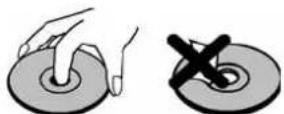
- To keep the disc clean, handle the disc by its edge. Do not touch the surface.
- Do not stick paper or tape on the disc.
- If the disc is contaminated with any substance like glue remove before using it.
- Do not expose the disc to direct sunlight or heat sources such as hot air ducts, or leave it in a car parked in direct sunlight as the temperature can rise quickly and damage the disc.
• After playing, store the disc in its case.
On cleaning
- Before playing, clean the disc with a cleaning cloth. Wipe the disc from the center out.
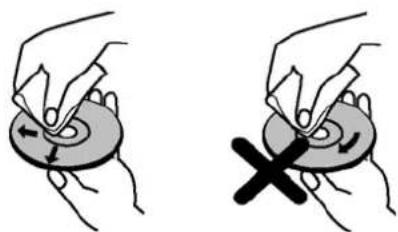
natural_image
Two hand-drawn diagrams showing a circular object being cut with a tool, one marked with a black X (no text or symbols present)
- Do not use solvents such as benzine, thinner, commercially available cleaners or anti-static spray intended for vinyl LPs.
Licence Notification
- This product incorporates copyright protection technology that is protected by method claims of certain U.S. patents and other intellectual property rights owned by Macrovision Corporation and other rights owners. Use of this copyright protection technology must be authorized by Macrovision Corporation, and is intended for home and other limited viewing uses only unless otherwise authorized by Macrovision Corporation. Reverse engineering or disassembly is prohibited.
How to Watch a DVD
When placing a disc into the loader, labeled side of the disc should be on the front:
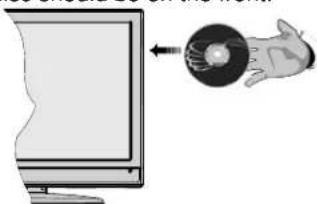
natural_image
Illustration of a rabbit sitting on a computer monitor with a CD inside, showing disc disc motion (no text or symbols)
When TV set is turned on, fi rst switch to DVD source by using the SOURCE button on the remote control. Press play on the remote control, or directly press play button at the front panel. If there is no disc inside the loader, place a DVD fi rst and press play.
Note: You can get DVD source output via scart socket.
DVD Control Panel Buttons
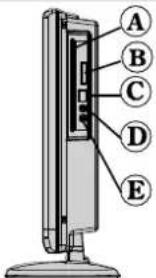
A. Disc loader
B. Memory card slot
C. USB input
D. Play / Pause
Plays/pauses the disc. When DVD menu (root menu) is active, this button functions as "button select" (selects the highlighted item in menu) if this is not prohibited by the disc.
E. Stop / Eject
Stop playing disc / Eject or Load the disc
Note:
- You cannot eject the disc via the remote control.
- While playing a file, you should press STOP button three times to eject.
English - 107 -

- Use SWAP button on the remote control to switch between USB and memory card.
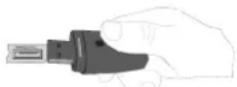
- You can connect USB/MC devices to your TV by using USB or MC input of the TV. This feature allows you to display/play files stored on a USB device or a MC card.
- It is possible that certain types of USB devices (MP3 Players) or Multimedia Card interfaces may not be compatible with this TV.
- You may back up your files before making any connections to the TV set in order to avoid any possible data loss. Note that manufacturer will not be responsible for any file damage or data loss.
- Do not pull out USB module or MC card while playing a file.
CAUTION: Quickly plugging and unplugging USB devices, is a very hazardous operation. Especially, do not repeatedly quickly plug and unplug the drive. This may cause physical damage to the USB player and especially the USB device itself.
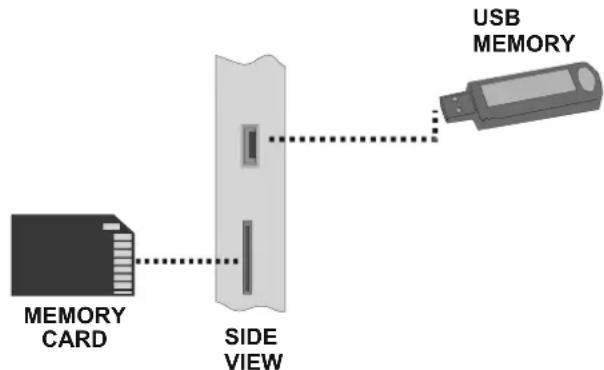
MC Card Connection
- Insert the MC card into the Memory Card Input of the TV. Make sure the gold contact area faces up. The card is designed to fit easily into the system one way only. Do not bend the card or force it into the slot. Insert only one card at a time.
- When you want to eject the card, do not grab the card all at once. Push to the card gently. Then it will pop out.
USB Memory Connection
- Plug your USB device to the USB input of the TV.
Note: USB hard drives are not supported.*
- It is recommended that you connect your USB device directly to the USB input of the TV. Some compatibility problems may occur if you use a separate cable connection.
Note: While in DVD mode, MEDIA screen will be displayed automatically when you plug USB or insert a valid memory card.
English - 108 -
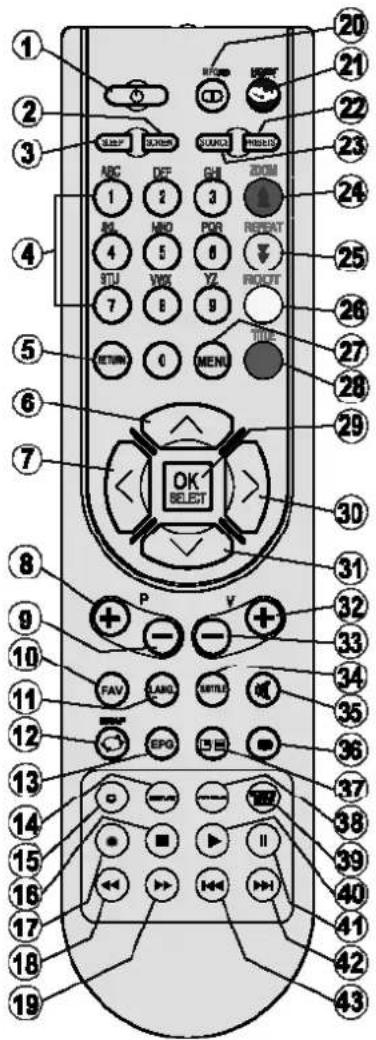
Overview of the Remote Control
Standby1.
Image size2.
Sleep timer3.
Numeric buttons4.
Return 5.
Cursor up6.
Cursor left7.
Programme up8.
Programme down9.
No function in DVD mode10.
Audio-Language selection11.
Swap / DVD media selection12.
No function in DVD mode13.
Display time / DVD menu14.
Clear15.
- Stop
No function17.
Rapid Reverse18.
-
Rapid advance
-
Info
No function21.
-
Picture mode selection
-
Source selection
-
Zoom
-
Repeat
-
Root
-
Menu
-
Title
OK / Select29.
-
Cursor right
-
Cursor down
-
Volume up
-
Volume down
-
Subtitle
-
Mute
No function in DVD mode.36.
-
No function
-
Angle
-
Search mode
-
Play
-
Pause / Play
-
Skip next
-
Skip previous
English - 109 -
USB & MC Modes Playback
Switch to DVD source by using the SOURCE or PLAY button on the remote control.
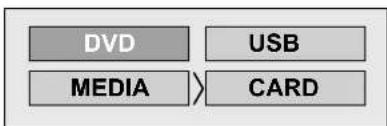
You can connect both USB and MC sources to your TV at the same time. Media selection OSD will automatically appear on the screen when a USB or MC is connected. Press SWAP button on the remote control to exit. Whenever you press SWAP button again, media selection OSD will appear on the screen.
flowchart
graph LR
    A["DVD"] --> B["USB"]
    C["MEDIA"] --> D["CARD"]
Select the desired input by using the cursor button and then press OK button to view contents. After OK button is pressed, the following screen (depending on the make and contents of the device) will appear after a short while:
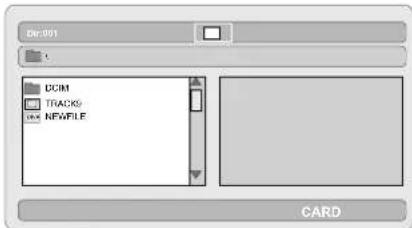
You can view or play contents of your device by using the related remote control buttons. See, General Control Buttons for Media Mode and Control Buttons for Video Playback.
Note:
- Whenever you press the SWAP key, available media sources will be listed.
- If there is an active playback, you have to press STOP button fi rst and then SWAP key to list available DMP inputs.
- If you have plugged only one source, then only that source will be available to be selected.
- Do not pull out the MC module while playing a file.
- It is possible that certain types of MC or USB devices may not be compatible with this TV.
OK / SELECT > Enter/View
▼/▲ > Highlight an item by moving up or down.
| ▶ | > | Play |
| ■ | > | Pause |
| ■ | > | Stop |
| RETURN selection. | > | Media source |
◀◀/▶▶ > Rapid reverse /
rapid advance/.
SEARCH > Search for a specific time.
DISPLAY > Displays time
ZOOM > Zooms picture.
Picture Playback
<</>> > Previous - next picture.
◀/▶ > Rotate picture
REPEAT > Displays repeat options.
ZOOM > Zooms picture.
ROOT > Go back to root folder.
DVD Playback
Basic Play
- Press on the power button
- Please insert a disc to the loader.
The disc will be automatically loaded and play commences if the disc does not have any menus recorded on it.
A menu may appear on the TV screen after a few moments or the film may start immediately after the introduction of the Film Company. This behaviour depends on the disc content and may change.
NOTE: Step 3 and 4 is available only when a menu is recorded on the disc.
- Press "▼/ "▲ /◄ or the number button (s) to select the preferred title.
- Press SELECT.
Play of the selected items now starts. The played item may be a motion picture, a still picture or another submenu depending on the disc.
English - 110 -

For your reference:
If an action corresponding to a button is prohibited the "∅" symbol appears.
Stopping Play
Press stop (■ twice (only for videos).
To stop the play permanently, press STOP (■) twice. When the STOP(■) button is pressed for the first time, a message "PRESS PLAY KEY TO CONTINUE" will appear on the screen to remind you if you want to continue the play. To stop the play, press the STOP (■) button again or you can press SELECT to continue.
Stopping Play and Returning To The Menu Screen
(When a menu is available on the disc)
Press MENU or TITLE button depending on the disc. Play is suspended, and the Disc menu screen is displayed.
Rapid Advance (Rapid Reverse)
Press SEARCH/SLOW (▶) on the remote control during play.
Normal play is resumed when the SELECT button or PLAY/PAUSE (▶) button is pressed.
The speed of advance ( 2x, 4x, 8x, 16x, 32x) or reverse ( 2x, 4x, 6x, 16x, 32x) changes for every press of the or button.
To return to normal play, press PLAY ▶.
Note: No sound will be heard during Rapid advance or Rapid reverse.
Skipping Ahead or Back to Chapters Skipping ahead
Press SKIP/ FRAME (▶)dn the remote control during play.
A chapter is skipped forward each time the button is pressed.
Skipping back
Press SKIP/ FRAME (◀◀) on the remote control during play.
When the button is pressed once midway through a chapter, play returns to the previous chapter.
Still Picture (PAUSE)
Press PAUSE (1) once during play.
The screen freezes.
To return to normal play press PLAY ▶).
Frame Advance (STEP FORWARD)
Press PAUSE (1) once during play.
The screen freezes.
Press SKIP/ FRAME (▶▶) on the remote control.
The next frame of the movie is displayed.
You can press SKIP/ FRAME (▶▶) for the following frames.
To return to normal play press PLAY ▶).
NOTE: Reverse stepping is not available.
Slow - motion Play Forward
Press PAUSE (1) once during play.
The screen freezes.
Press SEARCH/SLOW (▶) on the remote control.
The unit starts playing the movie at four different speeds (1/2, 1/4, 1/8 and 1/16).
You can increase or decrease the speed of the slow-motion play by pressing SEARCH/SLOW (◄◄ or ►►
The speed of slow motion play is displayed on the screen each time you change it.
To return to normal play, press PLAY ▶).
NOTE: No sound will be heard during Slow motion play.
NOTE: Reverse slow motion play is not available.
Direct Selection of Scenes
Selecting Scenes by Chapter Number
Press SEARCH MODE on the remote control once during playback.
The chapter/title search box is displayed on the screen. You can see the currently playing and total number of chapters in right hand side of the display bar as -- / xx.
Enter the number of the chapter using number buttons.
The selected chapter is played just after you enter the chapter number.
For your convenience:
English - 111 -
- If the chapter number you entered is between 0 and 9, player will automatically jump to the related chapter.
- You can clear the field by pressing the C button if you enter a wrong number.
- If you attempt to enter a number greater than the total number of chapters on the current title, the search box disappears and "Input Invalid" message is displayed on screen.
- If you wait five seconds without pressing any key for selecting scenes by chapter number, the operation is cancelled.
- You can press RETURN key to cancel title search.
Selecting Scenes by Title Number
Press SEARCH on the remote control once during playback.
The chapter/title search box is displayed on the screen. You can see the currently playing and total number of titles in left hand side of the display bar as -- / xx.
Enter the number of the title using the numeric buttons.
The selected title is played just after you enter the title number.
Note: You can switch to title by pressing numeric keys directly. You need to press 0 and then digit key to switch one digit titles. (example: to select 5 press 0 and 5)
Selecting Scenes by Time
You can view the DVD starting from any time point you want.
Press SEARCH MODE on the remote control "twice" during playback.
The time search box is displayed on the screen as Title xx/xx Time -- : -- : --.
Enter the time using number buttons.
The title is played beginning from the desired time just after you enter the time. If not prohibited by the DVD.
Press SEARCH MODE on the remote control "three times" during playback.
The time search box is displayed on the screen as Chapter xx/xx Time -- : -- : --.
Enter the time using number buttons.
The Chapter is played beginning from the desired time just after you enter the time. If not prohibited by the DVD.
For your convenience:
- You can clear the fi elds by pressing the C button if you enter wrong numbers.
- If you attempt to enter a number greater than the total time of the current title, the time search box disappears, "Input Invalid" message is displayed on screen.
- If you wait five seconds without pressing any key to enter time, selecting scenes by time option is cancelled.
- You can press RETURN key to cancel time search.
Convenient Functions
Displaying the time information
Press DISPLAY during play.
Some information is displayed on TV screen to indicate the current status of the disc. On the display screen you can find the following information lines:
Line 1: Time Counter Mode
Line 2: Title Number, Chapter Number, Time Counter
Line 3: Audio Number, Audio Format, Number of Output Channels, Audio Language
Line 4: Subtitle Number & Subtitle Language
Time counter modes can be selected by pressing INFO key consecutively.
The sequence for time counter modes is as follows: TITLE ELAPSED, TITLE REMAIN, CHAPTER ELAPSED and CHAPTER REMAIN.
- If "TITLE ELAPSED" is displayed, the elapsed time for the title is being displayed.
- If "TITLE REMAIN" is displayed the remaining time for the title is being displayed.
- If "CHAPTER ELAPSED" is displayed, the elapsed time for the chapter is being displayed.
- If "CHAPTER REMAIN" is displayed, the remaining time for the chapter is being displayed.
English - 112 -
Pressing the DISPLAY key for the second time closes display menu screen. "DISPLAY OFF" is displayed.
Displaying a scene with a larger and closer view
The ‘zoom in’ function enables you to take a closer look at the scene you are viewing that is especially an impressive function when you are seeing science fiction or adventure film.
Press ZOOM during play.
2X" is displayed on the screen and the picture is now larger. By pressing ZOOM key
consecutively you can reach “3X”, “4X, 1/2x, 1/4x” andes.
NOTE: You can move in the picture, i.e. change the zoomed location, by using the “◀(Left) or “▶(Right) / “▼(Down) / “ ” (Up) arrow keys.
To return to normal play
Press ZOOM again.
Displaying / Changing Subtitle Language
It is possible to change the subtitle language from the one selected at the initial settings to a different language, if available.
(This operation works only with discs on which multiple subtitle languages are recorded.)
Press SUBTITLE during play.
When no subtitles are recorded “∅” will be displayed instead of the selected language.
Press SUBTITLE a number of times until the preferred language is selected.
When this button is pressed once, the first subtitle recorded on the disc will display. The rest of the subtitles recorded will display in sequence for every press of the SUBTITLE button
NOTE:
<?> In some cases, the subtitle language is not changed immediately to the selected one.
For your convenience:
- When the preferred language is not selected even after pressing the button several times, it means that the language is not available on the disc.
- When the player is restarted or the disc is changed, the subtitle selection is automatically changed back to the initial settings.
- If a language is selected, which is not supported by the disc, the subtitle language will automatically be set to the disc's priority language.
- Usually a circulation will happen while switching to another language, that is you can cancel the subtitle by pressing this button a number of times until "Subtitle Off" appears on the screen.
Changing Audio Soundtrack Language
It is possible to change the audio language from the one selected at the initial settings to a different language, if available.
(This operation works only with discs on which multiple audio soundtrack languages are recorded, if not prohibited by the DVD.)
Press LANG. during play.
Press LANG. a number of times until the preferred language is selected.
For your convenience:
- When the preferred language is not selected even after pressing the button several times, it means that the language is not available on the disc.
- When the power is turned on or the disc is removed, the language heard is the one selected at the initial settings. If this language is not recorded on the disc, only the available language on the disc will be heard.
Viewing From Another Angle
* Angle mark feature is available for all models.
Some DVD discs may contain scenes, which have been shot simultaneously from a number of different angles. For these discs, the same scenes can be viewed from each of these different angles using the ANGLE button.
The number of recorded angles differs depending on the disc used.
“y/x” is displayed shortly on the screen during playback. This indicates that the multi-angle scene has just started. From that moment on, the yth angle of total x angles is played and
English - 113 -
you can change the viewing angle until the end of the multi-angle scene.
Press ANGLE during play.
The current angle is changed.
Press ANGLE a number of times until the preferred viewing angle is selected.
- This function will only work on discs where different angles have been recorded.
Some DVD discs have unique menu structures called DVD menus. For example, DVDs programmed with complex contents provide guide menus, and those recorded with various languages provide menus for audio and subtitle language. Although the DVD menus' contents and operation differ from disc to disc, the following explains basic operation when this feature is used.
Press TITLE on the remote control.
The DVD menu available on the disc is now displayed.
NOTE:
- If you press MENU, the root menu of DVD is displayed.
- If you press TITLE, the menu of the current title is displayed.
Press “◀” / “▶” / “▼” to select the preferred item.
Press SELECT.
The selected item is now executed.
For your convenience:
- You can also use number keys to select a DVD menu item. The player will automatically execute the item. To enter an item number which is more than 1 digit, press +10 key and then enter the item number.
NOTE:
- Some DVDs may not contain root and/or title menus.
- To resume the playback, select PLAY item in DVD menu.
Movie CD Playback
Basic Play
The details differ depending on the disc concerned. Also refer to the instructions accompanying the disc.
Press the number button(s) to select the preferred item and press OK button.
The player now starts to play the selected item.
NOTE:
- “◀” / “▶” / “▼” “arrow buttons can be used for selecting items for movie CDs.
Stopping play
- To stop the play permanently, press STOP (■) twice. When the STOP (■) button is pressed for the first time, a message "Press Play Key To Continue" will appear on the screen to remind you if you want to continue the play. To stop the play, press the STOP (■) button again or you can press PLAY (▶) to continue.
Rapid Advance / Rapid Reverse
Press (or) on the remote control during play.
- Normal play is resumed when the SELECT button or PLAY (▶) button is pressed.
- The speed of advance (2x, 4x, 8x, 16x, 32x) or reverse (2x, 4x, 8x, 16x, 32x) changes for every press of the (or) button.
To return to normal play, press PLAY ▶.
Note: No sound will be heard during Rapid advance or Rapid reverse.
Skipping Ahead or Back to Chapters Skipping ahead
Press (▶) on the remote control during play.
A track is skip ahead each time the button is pressed.
Skipping back
Press (◀◀) on the remote control during play. A track is skip back each time the button is pressed.
English - 114 -
Still Picture (PAUSE)
Press PAUSE (1) once during play. The screen freezes.
To return to normal play press PLAY (▶) again.
Frame Advance (STEP Forward)
Press PAUSE (III) once during play. The screen freezes.
Press (▶▶) on the remote control.
The next frame of the movie is displayed.
You can press (▶) for the following frames.
NOTE: Reverse stepping is not available.
Slow-motion Play
Press PAUSE (1) once during play. The screen freezes.
Press (▶) on the remote control.
You can increase or decrease the speed of the slow-motion play by pressing SEARCH/SLOW (◀◀ (or) ▶There are 4 slow motion modes
as 1/16, 1/8, 1/4, 1/2.
The speed of slow motion play is displayed on the screen each time you change it.
To return to normal play press PLAY (▶) again.
NOTE: No sound will be heard during Slow motion play.
NOTE: Reverse slow motion play is not available.
Direct Selection of Scenes
Selecting Scenes by Time
You can view the movie CD, starting from any time point you want.
Press SEARCH MODE on the remote control once time during playback.
The time search box is displayed on the screen as SELECT :__ / xx
Player goes to entered track of the disc.
Press SEARCH MODE on the remote control two times during playback.
The time search box is displayed on the screen as GOTO: : : :
Player goes to entered time of the current track.
Enter the time using number buttons.
The title is played beginning from the desired time just after you enter the time.
For your convenience:
- If you attempt to enter a number greater than the total time of the current title, the time search box disappears and “☑ Input Invalid” message appears on up-left corner of screen.
- If you give up entering the time simply press RETURN button, and the operation is cancelled.
Convenient Functions
Press INFO during play.
Each time this button is pressed, a different time information box is displayed on the screen.
- If “Single elapsed” is displayed, the elapsed time for the title which is being played will be displayed.
- If “Single remain” is displayed, the remaining time for the title which is being played will be displayed.
Pressing the INFO key again closes display menu screen. "DISPLAY OFF" is displayed.
Displaying a scene with a larger and closer view
CD Menu is used to display the directory structure of data discs which would contain files such as JPEG/MPEG/MP3/DivX and to display the tracks of Audio CDs.
Basic Play
- Please insert a CD-R disc to the loader.
"Loading" message appears on screen. Please wait for a moment.
CD MENU appears. Directories and the files in the root directory are listed. (For Audio CD, the tracks are listed.)
- Press “▼” or “▲” to select files or directories.
In the stop mode or while playing MP3 the user can navigate in the current directory.
- Press SELECT, “◀” or “▶” to switch between directories & files.
English - 115 -
If a directory is selected and SELECT or "key" is pressed then the selected directory content is displayed after reading directory.
To switch from a sub directory to an upper directory, press SELECT or “▶” key while the top-most option in the directory (“...”) is selected or press “◀”.
- Press SELECT on a file to play.
MP3/MPEG/DivX File
Selected MP3 / MPEG / DivX starts to play.
Elapsed or Remaining Time can be displayed using DISPLAY key and can be changed using INFO key.
JPEG File :
Selected JPEG is displayed in full screen and Slide Show starts automatically.
During slideshow, you may change slide type (effect) by pressing ANGLE button.
Audio CD Track:
Elapsed or Remaining Time can be displayed using DISPLAY key and can be changed using INFO key.
PAUSE
Press PAUSE (Ⅱ) once during play. The play freezes.
PAUSE message appears on screen.
To return to normal play press PLAY ▶ again.
Stopping Play
Press STOP (☐)
The play is stopped.
NOTE: If a JPEG file is displayed, pressing MENU also stops the play.
MP3/MPEG/DivX File: CD MENU is displayed.
Rapid Advance (Rapid Reverse)
MP3/MPEG/DivX CD Track:
Press SEARCH/SLOW (◀ or ▶) during play to decrease/increase play speed.

32x are the play speed modes.
To return to normal play, press PLAY ▶.
Skipping Ahead or Back to Tracks
Press SKIP/FRAME (◄◄◄/►) during play to jump to the previous/next file.
Next file in the current directory will be played. Press SKIP/FRAME ( | ◀◀ / ▶) during stop mode to jump to the previous/next page of the current directory.
ZOOM
MPEG:
This “zoom in” function enables you to take a closer look at the scene you are viewing that is especially an impressive function when you are seeing science fiction or adventure film.
Press ZOOM during play.
"2X" is displayed on the screen and the picture is now larger. By pressing ZOOM key consecutively you can reach "3X", "4X" modes.
NOTE: You can move in the picture, i.e. change the zoomed location, by using the (▲/ (▼/ ) ▲) arrow keys.
To return to normal play;
Press ZOOM again.
JPEG :
Press PLAY (▶) to start slide show. During slideshow, you may change slide type (effect) by pressing ANGLE button.
It is provided both ZOOM in/out and Zoom pan functions for JPEG pictures.
Press ZOOM to turn on/off this function.
When this mode is on, a message will indicate the current ratio on screen.
If zoom mode is on,
Press ◀◀ / ▶ to control the ratio of zoom in/out.
The zoom ratios are %50 and %75 for zoom out and %100, %125, %150 and %200 for zoom in. (The order is: %50, %75, %100, %125, %150, %200) (The initial ratio is %100)
With ZOOM mode off, a picture is scaled to fit the whole screen.
Note: Slide Show is disabled when the ZOOM mode is on.
Repeat
Press REPEAT to change current repeat mode.
In CD MENU it is displayed at the bottom.
English - 116 -

The options available are:
FOLDER: When this mode is selected, the current folder will be played once.
SINGLE: When this mode is selected, the current track will be played once.
REPEAT ONE: When this mode is selected, the current track will be repeated continuously.
REPEAT FOLDER: When this mode is selected, the current folder will be repeated continuously.
Random
Randomly play files in the current directory, forever and ever.
Shuffle
Randomly plays each file in the current directory once and only once, and then stops.
Display Function
Press INFO to change displayed time mode.
There are two time modes :
- Single Elapsed
- Single Remain
Time is displayed during MP3, MPEG/DivX and Audio CD track playback.
Press DISPLAY key on the remote control when the player is not in playback mode.
The setup menu-main page appears. To close the setup menu, press DISPLAY key.
MAIN PAGE
In the main page, the first page is selected by default.
Select pages using ◀/▶arrow buttons.
When selected, the page will be highlighted and the items of the selected page will be displayed.
Press SELECT or ▼ arrow button to enter selected page.
When entered a page, the first item of the page is selected and the sub-items of that item are listed on the right.
NOTE: To return to main page, press arrow button. To close the setup menu, press DISPLAY key.
USING PAGES
When entered a page, the first item of the page is selected by default and the sub-items of the selected item are listed on the right.
Use arrow buttons to change the selected item in the page.
The sub-items of the selected item are listed on the right.
Press SELECT or ▶ arrow button to select the sub-items of the selected item.
The sub-item is selected on the right menu.
Use ▼ / ▲arrow buttons to change the selected sub-item.
Press SELECT to choose the selected sub-item on the right menu.
English - 117 -
VIDEO SETUP PAGE
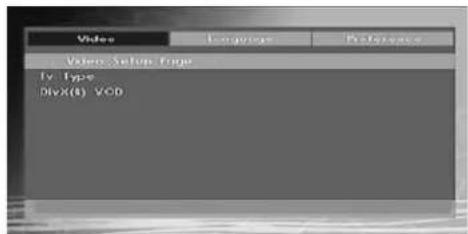
TV Type
TV Type is only available as 'PAL'. The TV set also supports NTSC signal; however, the signal will be converted to PAL when it appears on the screen.
DivX VOD
DivX VOD provides the convenience of streaming video in terms of quality and performance.
LANGUAGE SETUP
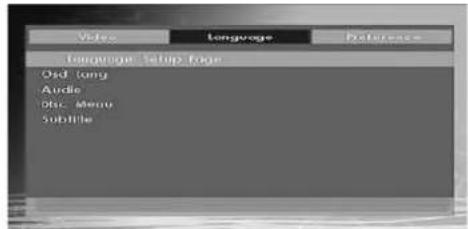
OSD LANG
You can select the default OSD language of the player menus
AUDIO
You can select the default audio language if supported by the DVD disc.
You can select the DVD's disc menu language among these languages. Disc menu appears in the selected language, if supported by the DVD disc.
SUBTITLE
You can select the default subtitle language if supported by the DVD disc.
PREFERENCES
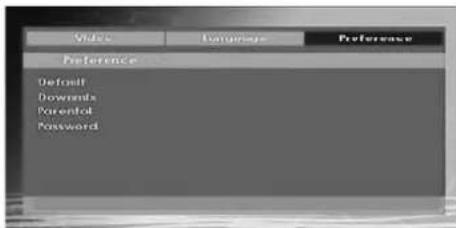
DEFAULT
If you choose RESET and press SELECT, the factory-presets are loaded. Parental level and parental password does not change.
DOWNMIX
This mode can be selected when the digital audio output of the TV is used.
SURROUND: Surround sound output.
STEREO: Two channels stereo.
PARENTAL (Parental Level)
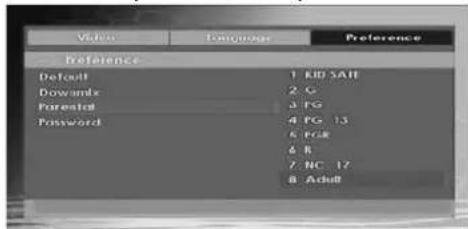
Playing some DVDs can be limited depending on the age of users. The "Parental Control" function allows playback limitation level to be set by the parent.
Parental Level can be adjusted to one of the eight levels. Level "8 ADULT" adjustment let you watch all of the DVD titles ignoring the DVD disc's parental level. You can watch the DVD discs, which has the same or lower parental level than the player's level only.
PASSWORD (Change Password):
Using this item you can change the current password.
To change the password you will be prompted to enter your old password. After you have entered your old password, you can now enter the new 4-digit password.
You can use C key to delete the incorrect entry.
English - 118 -
Note: Factory preset of the password is "0000". You have to enter XXXX digital password every time you want to change the parental level. If you forget your password please contact technical service.
Troubleshooting
The picture quality is poor (DVD)
- Make sure the DVD disc surface is not damaged. (Scratch, fingerprint etc.)
- Clean the DVD disc and try again.
See instructions described in "Notes on Discs" to clean your disc properly.
- Ensure that the DVD disc is in the drawer with the label uppermost.
- A damp DVD disc or condensation may effect the equipment. Wait for 1 to 2 hours in Stand-by to dry the equipment.
Disc does not play
• No disc in the machine.
Place a disc into the loader.
• Disc incorrectly loaded.
Ensure that the DVD disc is in the drawer with the label uppermost.
- Wrong type of disc. The machine cannot play CD-ROMS etc.
- The region code of the DVD must match the player.
Wrong OSD language
- Select the language in the set-up menu.
- The language for the sound or subtitles on a DVD cannot be changed.
- Multilingual sound and/or subtitles not recorded on the DVD.
- Try to change the sound or subtitles using DVD's title menu. Some DVD's do not allow the user to change these settings without using the disc's menu
Some functions (Angle, Zoom etc) do not work
• These functions are not available on the DVD.
- Angle can only be changed when the angle symbol is displayed.
No picture
- Have you pressed the correct buttons on the remote control? Try once more.
English - 119 -
No sound
- Check the volume is set to an audible level.
• Make sure you have not switched the sound off accidentally.
Distorted sound
- Check that the appropriate listening mode setting is correct.
No response from remote control
- Make sure the remote control is in the correct mode.
- Check batteries are fitted correctly.
- Change the batteries.
If nothing works
If you have tried the above solutions and none seem to work, try switching your TV-DVD off and on again. If this does not work, contact your supplier or TV-DVD repair technician. Never attempt to repair a defective TV-DVD yourself.
Definition of Terms
Angle
Recorded onto some DVD discs are scenes, which have been simultaneously shot from a number of different angles (the same scene is shot from the front, from the left side, from the right side, etc.). With such discs, the ANGLE button can be used to view the scene from different angles.
Chapter Number
These numbers are recorded on DVD discs. A title is subdivided into many sections, each of which are numbered, and specific parts of video presentations can be searched quickly using these numbers.
DVD
This refers to a high-density optical disc on which high-quality pictures and sound have been recorded by means of digital signals. Incorporating a new video compression technology (MPEG II) and high-density recording technology. DVD enables aesthetically pleasing full-motion video to be recorded over long periods of time (for instance, a whole movie can be recorded).
DVD has a structure consisting of two 0.6-mm thin discs, which are adhered to each other. Since the thinner the disc, the higher the density at which the information can be recorded, a DVD disc has a greater capacity than a single 1.2 mm thick disc. Since the two thin discs are adhered to each other, there is the potential to achieve double-sided play sometime in the future for even longer duration play.
Subtitles
These are printed lines appearing at the bottom of the screen, which translate or transcribe the dialogue. They are recorded on the DVD discs.
Time Number
This indicates the playtime, which has elapsed from the start of a disc or a title. It can be used to find a specific scene quickly. (Not all discs permit the time search feature to be used. Availability is determined by the disc's manufacturer.)
Title Number
These numbers are recorded on DVD discs. When a disc contains two or more movies, these movies are numbered as title 1, title 2, etc.
Track Number
These numbers are assigned to the tracks, which are recorded on AudioCDs. They enable specific tracks to be located quickly.
Dolby Digital
Many movie theatres are equipped with 5.1 channel surround systems. This same type of technology is available to you in your home. To enjoy full 5.1-channel surround, your DVD player must be connected to an external Dolby Digital decoder via the digital outputs (either coaxial or optical).
Dolby Pro Logic
This is Dolby Laboratories' technology to decode Dolby Surround encoded programs actively. Dolby Surround programs have four channels of audio (Left, Center, Right and Surround) encoded into a standard 2-channel stereo signal. The rear channel is monaural.
LPCM
LPCM stands for Pulse Code Modulation and is digital audio.
MPEG
Short for Moving Picture Experts Group. This is an international standard for compression of moving images. On some DVDs digital audio has been compressed and recorded in this format.
DivX
DivX is a digital video compression technology based on MPEG-4 and developed by DivX Networks Inc.
English - 120 -
Supported File Formats for USB & MC Modes
| Media | File Extension | Format | Remarks |
| Video Audio | (Maximum resolution/Bit rate etc.) |
| Movie | .mpg/.dat/.vob | MPEG1 MPEG Layer 1/2/3 | |
| MPEG2 MPEG2 | |
| XviD/3ivx PCM/MP3/WMA XviD Verson up to: 1.1.2 |
| MPEG4 PCM/MP3/WMA | |
| .avi | MS ISO MPEG4 | PCM/MP3/WMA Support SP and ASP |
| MJPEG PCM 30fps@VGA | |
| Music | -- PCM Sample Rate: 8K ~ 48KHz | |
| .mp3 - | | MPEG 1/2 Layer 1/2/3 (MP3) | Sample Rate: 8K ~ 48KHz, Bit Rate: 64K~320Kbps |
| .wma - | WMA | Sample Rate: 8K ~ 48KHz, Bit Rate: 5K ~ 192Kbps |
| Photo | .jpg | Baseline JPEG | WxH = 8902x8902 up to 77Mega-pixelSupport format: 444/440/422/420/Grayscale |
| Progressive JPEG | Up to 4 Mega-pixelSupport format: 444/440/422/420/Grayscale |
| External Subtitles | .ssa | | Support Text File Format, but do not supportPicture File Format |
| .ass | |
| .srt | |
| .smi | |
| .sub | |
Supported Memory Card Types
- SD (Secure Digital ^TM )
•MMC (Multi Media Card ^TM )
-MS (Memory Stick ^TM )
- MS PRO (Memory Stick Pro ^TM )
"Memory Stick" is a trademark of Sony Corporation.
"Secure Digital" is a trademark of SD Card Association.
"MULTIMEDIACARD" is a trademark of MultiMediCard
Association (MMCA).

MEMORY STICK


MULTIMEDIACARD
ASSOCIATION
English - 121 -
Disc Types Compatible with This Unit
This player can play the following discs.
| Disc Types (Logos) | Recording Types | Disc Size | Max. Playing Time | Characteristics |
| DVD DVD VIDEO | Audio + Video | 12 cm | Single - sided; 240 min. Double - sided; 480 min. | • DVD contains excellent sound and video due to Dolby Digital and MPEG-2 System. • Various screen and audio functions can be easily selected through the on screen menu. |
| 8 cm | Single - sided; 60 min. Double - sided; 180 min. |
| AUDIO-CD COMPACT DISC DIGITAL AUDIO | Audio | 12 cm | 74 min. | • An LP is recorded as an analog signal with more distortion. CD is recorded as a Digital Signal with better audio quality, less distortion and less deterioration of audio quality over time. |
| 8 cm | 20 min. |
| MP3-CD MP3 READABLE | Audio (xxxx.mp3) | 12 cm | It depends on MP3 quality. | • MP3 is recorded as a Digital Signal with better audio quality, less distortion and less deterioration of audio quality over time. |
| 8 cm |
| PICTURE-CD JPEG READABLE | Video (still picture) | 12 cm | It depends on JPEG quality. | • JPEG is recorded as a Digital Signal with better picture quality over time. Baseline Max resolution 2150 X 1432 Progressive Max resolution 1400 X 900 |
| 8 cm |
| DivX® DIVX® | Audio + Video | 12 cm | It depends on DivX quality | • Video & Audio with MPEG-4 Compression technology. |
| 8 cm |
English - 122 -
Specifications
DVD / CD / CD-R / CD-RW / MP3 / JPEG / MPEG / DivX player,
| TypesofDiscs Supported | DVD:SS/SL4.7"(DVD-5)SS/DL4.7"(DVD-9)DS/SL4.7"(DVD-10)DS/DL4.7"(DVD-18)CD-DACD-RCD-RWMP-3/JPEG |
| VideoType | MPEG-2VideoStandardDecoding(MPEG-1supported)Full-ScreenVideoDisplayof720x576(PAL)&720x480(NTSC)pixels50and60Hzframerefreshrates(PAL&NTSC)Digitalbit-streamprocessingrateupto108Mbits/secLineresolutionmorethan500lines |
| AudioType | DolbyDigitalDecodingMPEGMultichannelDecodingLPCM |
| AudioOutput | DigitalAudioOutputs:IEC958TOSLINKAnalogOutputs:24bit/48,44.1kHzdown-samplingDAC |
English - 123 -
Table des matières
Notification de licence (en option)
srs
natural_image
Line drawing of a flat-screen television computer (no text or symbols)
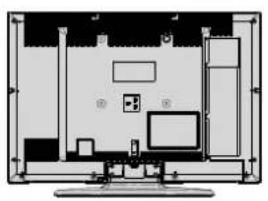
natural_image
Top-down architectural floor plan of a modern office or living room with furniture layout (no text or labels)
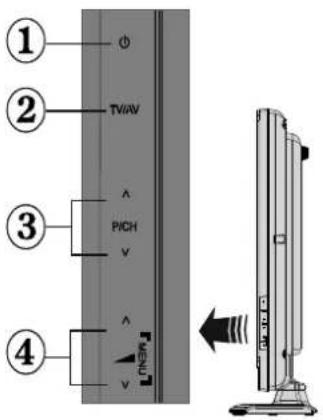
natural_image
Illustration of a computer mouse with a downward arrow indicating compression or disassembly (no text or symbols present)
Opérations de Base
natural_image
Diagram showing transformation of a square with circular elements into a square with four circles (no text or symbols)
natural_image
Diagram showing transformation of a square with circular holes into a larger square, both without any text or symbols.
Panoramique
natural_image
Diagram showing transformation of a square with circular holes into a larger square with circles (no text or symbols)
natural_image
Diagram showing transformation of a square with a circle inside, resulting in a square with circles and dots (no text or symbols)
Cinéma
natural_image
Diagram showing a square with a circle inside and a square with a circle inside, both rotated to form a larger square (no text or symbols)
Sous-titre
Zoom
natural_image
Diagram showing transformation of a square frame with a circle inside, resulting in a circular frame with corner handles (no text or symbols)
PAL/SECAM B/G D/K K' I/I' L/L'
RÉCEPTION DE CHAINES
VHF (BAND I/III)
UHF (BAND U)
HYPERBAND
natural_image
Two hand-drawn diagrams showing a circular object being held by two different objects, one marked with a cross and the other with arrows (no text or symbols)
natural_image
Illustration of a mouse interacting with a computer monitor and a circular device (no text or symbols)
D. Lecture / Pause (Play/Pause)
-
Lire
-
Lecture / Pause
-
Sauter Suivant
-
Skip previous
Français - 69 -
Lectures en modes USB & MC
“3X”, “1/2x”, 1/3x
1/4x”.