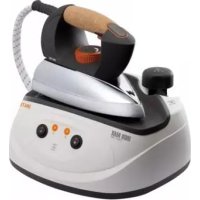
Iron Max Compact 1800 - Iron IMETEC - Free user manual and instructions
Find the device manual for free Iron Max Compact 1800 IMETEC in PDF.



| Product type | Steam station with iron |
| Brand | Imetec |
| Model | Iron Max Compact 1800 |
| Rated power | 1800 W |
| Power supply | 220-240 V ~ 50/60 Hz |
| Boiler capacity | 1 liter |
| Soleplate type | Stainless steel soleplate |
| Main functions | Dry and steam ironing, steam shot, temperature and steam adjustment, pressure gauge |
| Adjustable temperature | Yes, by thermostat for different fabrics |
| Indicator lights | Steam ready, soleplate temperature, water shortage |
| Maintenance and cleaning | Clean with a damp cloth; descaling recommended with demineralized water in hard water areas |
| Safety | Boiler safety cap; do not open during use; automatic shut-off not mentioned |
| Cable length | Approximately 1.8 m (estimate) |
| Dimensions (L x W x H) | Approximately 30 x 15 x 25 cm (estimate) |
| Weight | Approximately 1.5 kg (estimate) |
Frequently Asked Questions - Iron Max Compact 1800 IMETEC
User questions about Iron Max Compact 1800 IMETEC
0 question about this device. Answer the ones you know or ask your own.
Ask a new question about this device
Download the instructions for your Iron in PDF format for free! Find your manual Iron Max Compact 1800 - IMETEC and take your electronic device back in hand. On this page are published all the documents necessary for the use of your device. Iron Max Compact 1800 by IMETEC.
USER MANUAL Iron Max Compact 1800 IMETEC
Instructions for use
Mode d'emploi
Bedienungsanleitung
natural_image
Simple line drawing of a cup with handle and label '13' (no text or symbols on the cup itself)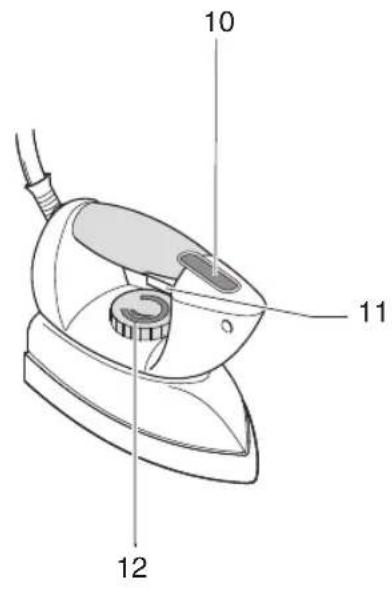
IRON MAX Compact 1900 IRON MAX Compact 2000
TYPE F1101
220-240 V 50 Hz 2200 W


TYPE F1102
220-240 V 50 Hz 2200 W


TYPE F1103
220-240 V 50 Hz 2200 W



ISTRUZIONI PER L'USO DEL FERRO A CALDAIA
Tel. +39.035.688.111 Fax +39.035.320.149

USER INSTRUCTIONS FOR THE BOILER IRON
Dear customer, IMETEC would like to thank you for purchasing this product. We are convinced that you will appreciate the quality and reliability of this appliance, which was developed and manufactured with customer satisfaction always in mind. These operating instructions were created based on the European standard EN 62079.
WARNING!
Instructions and warnings for safe use

Before using the appliance, carefully read the instructions for use and in particular the safety warnings and abide by them. Keep this manual for the entire duration of the appliance's life, for future reference. In case you pass the appliance on to another user, make sure to include also this documentation.
TABLE OF CONTENTS
INSTRUCTIONS FOR USE page 7
SAFETY WARNINGS page 7
APPLIANCE AND ACCESSORY DESCRIPTION page 9
PREPARATION page 9
ADVICE FOR GOOD IRONING page 9
USE page 10
- Filling the boiler when cold page 10
- Ironing page 10
- Filling the boiler when hot page 10
- Pressure gauge page 10
AFTER USE page 10
MAINTENANCE page 11
- Cleaning the appliance page 11
PROBLEMS AND SOLUTIONS page 11
DISPOSAL page 12
SERVICE AND WARRANTY page 12
IMAGE SECTION I-II
TECHNICAL SPECIFICATIONS III
SAFETY WARNINGS
- After removing the appliance from its packaging, check the appliance's integrity referring to the provided design and for any damage caused during transport. Should you have any doubts, do not use the appliance and take it to an authorised Service Centre.
- The packaging material is not suitable for children to play with! Keep the plastic bag out of the reach of children as there is risk of suffocation!
- Before connecting the appliance, check that the voltage indicated on the identification plate corresponds to that of the electrical mains supply available. The identification plate is on the appliance.
- This appliance must be used solely for the purpose for which it has been designed, that is as a boiler iron for home use. Any other use is to be considered improper and therefore dangerous.
- If there is a fault and/or the appliance operates irregularly, switch it off and do not tamper with it. For any repairs, only contact an authorised service centre.
- DO NOT touch the appliance with wet hands or with bare or damp feet.
GB
- DO NOT pull the power cord, or the appliance itself, to remove the plug from the socket.
- DO NOT expose the appliance to humidity or weather conditions (rain, sun).
- Always disconnect the appliance from the mains supply before cleaning or maintenance and when the appliance is not in use.
- The iron must only be used and rest on a stable surface. When the iron is placed on its iron rest, ensure the support surface is stable. The iron must not be used if it falls, if there are visible signs of damage or water leaks.
- If the power cord is damaged it must be replaced by a technical service centre, so as to prevent all risks.
- The electrical safety of this appliance can be guaranteed only if it is correctly connected to an efficient earthing system circuit as indicated by current electrical safety regulations. It is necessary to check this fundamental safety precaution, and if in doubt, ask a professionally qualified technician to check the system.
Specifically:
This appliance can be used by minors older than 12 years of age, by persons with limited physical, sensorial or mental faculties or by unskilled persons only if they are preventively instructed on its safe use and only if informed on the hazards connected to the product.
Children must not play with the appliance. Cleaning and maintenance on the appliance cannot be done by children without adult supervision.
Keep the appliance and the power cord out of reach of children under 12 years of age when the appliance is switched on or in the cooling down phase.
NEVER immerse the iron, cord or plug in any liquid.
DO NOT leave the hot iron touching fabrics or very inflammable surfaces.
DO NOT leave the iron unattended when it is connected to the power supply.
DO NOT release steam when the iron is on its mat.
DO NOT use chemical additives, scented substances or descalers.
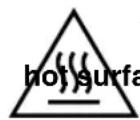
WARNING
IMPORTANT INSTRUCTIONS
The appliance was designed to function with tap water, however if the local water is too calcareous, mix tap water (50%) with distilled and/or demineralised water (50%); in coastal areas, the salt concentration in water is very high: in these cases, “demineralised water for irons” sold on the market must be used. When in doubt, use only demineralised water for irons.
Do not use chemical diluents, scented substances or descalers. Using such substances can damage the product.
Do not use water from dryers, air conditioning water or rainwater.
The boiler may still contain water since every product is tested before being sold.
When ironing for the first time, it is advisable to put a cloth between the iron and the fabric to be ironed.
Before ironing, we advise directing a shot of steam into the air to let off any remaining condensate.
APPLIANCE[DESCRIPTION[AND[ITS[ACCESSORIES[[Fig.[A]
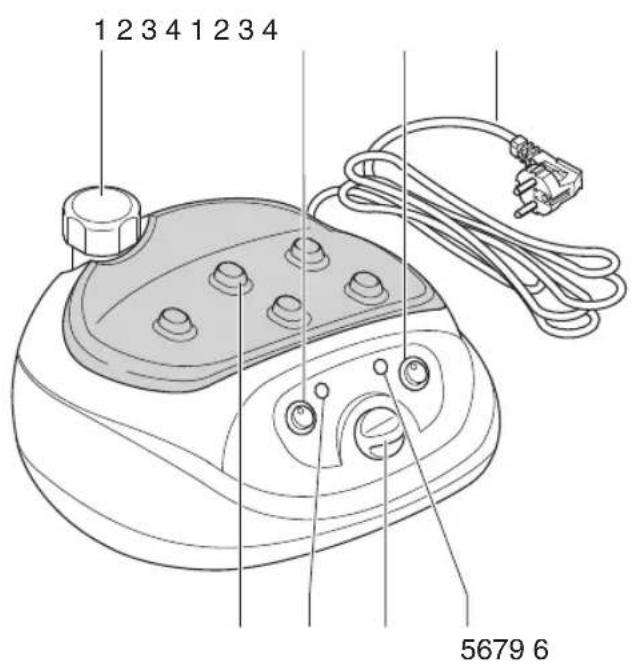
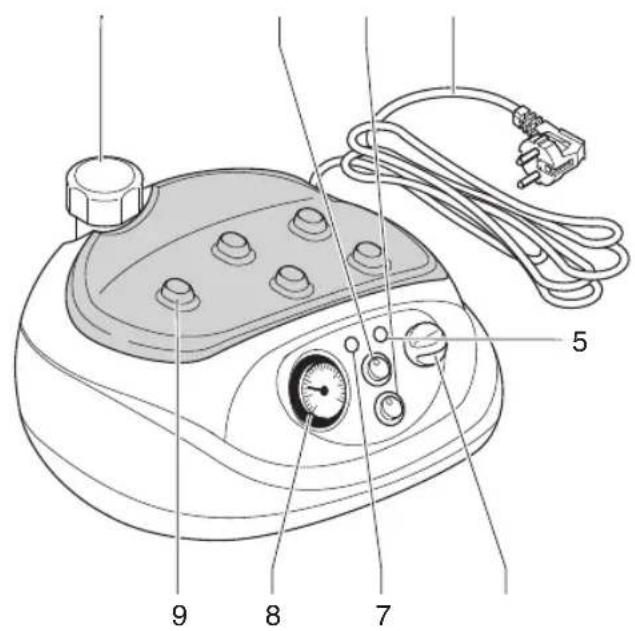
Refer to figure [A] of the illustrated guide to check the equipment supplied with your appliance. All the diagrams can be found on the cover pages of this instructions for use.
![IMETEC Iron Max Compact 1800 - APPLIANCE[DESCRIPTION[AND[ITS[ACCESSORIES[[Fig.[A] - 1](/content/2026/02/356870/images/1afa76249378f0f6f320f568ce6f17c1d20573b75a2058c9ee9d0da045973caa.jpg)
WARNING]
accessories[vary]according[to[model].[Identify]your[model]by[looking[at]the[illustrations]at[the]beginning[of[the[instruction]manual.
- boiler safety cap
- boiler on/off switch
- iron on/off switch
- plug
- steam ready indicator light
- steam regulation knob
- no water indicator light
- pressure gauge
- iron support mat
- plate temperature indicator light
- steam release push-button
- iron temperature regulation knob
- funnel
PREPARATION
Sort the linens to be ironed according to the international symbols on the garment label, or if this is missing, according to the type of fabric.
You can eliminate the risk of scorching fabrics and reduce waiting time by starting to iron items that need a lower temperature (the iron takes less time to heat up than to cool down).

synthetic, acrylic, nylon, polyester: low temperatures;

silk, wool: medium temperatures;

cotton, linen: high temperatures;

fabric not to be ironed.
ADVICE[FOR[GOOD[IRONING]
We recommend using the lowest temperatures with fabrics that have unusual finishes (sequins, embroidery, flush, etc.). If the fabric is blended (e.g. 40% cotton, 60% synthetics), set the thermostat to the temperature of the fibre requiring the lowest temperature.
If you do not know the composition of the fabric, test the temperature on a hidden corner of the garment.
Start with a low temperature and increase it gradually until it reaches the ideal temperature. Never iron areas with traces of perspiration or other marks: the heat of the plate fixes the stains on the fabric, making them irremovable. Starch is more effective if you use the dry iron at a moderate temperature: excess heat scorches it with the risk of forming a yellow mark.
To avoid making silk, woollen or synthetic garments shiny, iron them inside out. To avoid making velvet garments shiny, iron in one direction (following the fibre) and do not press down on the iron.
The more loaded the washing machine, the more creased the garments. This also happens with excessive spin drying. Many fabrics are easier to iron if they are not completely dry.
For example, silk should always be ironed damp.
GB
USE
FILLING THE BOILER WHEN COLD
- Ensure that the appliance is not connected to the mains.
- Unscrew the safety cap (1) completely and fill the boiler using the funnel provided (13), being careful not to overfill. The boiler has a capacity of approx. 1 litre.
- At the end of the operation, screw on the safety cap (1) tightly.
IRONING
- Insert the plug (4) in a suitable socket;
- press the on/off switches for the boiler (2) and iron (3). The plate temperature indicator light (10) will turn on;
- adjust the iron temperature regulation knob according to the international symbols found on the garment label. Wait until the indicator light (10) goes off;
- begin ironing when the steam ready indicator light (5) comes on. While ironing, the steam ready indicator light (5) and the plate temperature indicator light (10) go on and off, indicating that the machine is maintaining the pressure and temperature at optimal levels.
• to steam iron, press the steam release push-button (11); - turn the steam regulation knob (6) (where present) to regulate the quantity of steam desired.
- to dry iron, do not press the steam release push-button (11).

WARNING!
unscrew the boiler safety cap (1) during normal ironing operations.
FILLING THE BOILER WHEN HOT
When there is no more water inside the boiler, the iron stops producing steam and the no water indicator light (7) turns on:
- turn off the boiler on/off switch (2) and the iron on/off switch (3);
- disconnect the plug (4) from the socket, wait a few minutes and loosen the safety cap (1) slowly to release any remaining steam in the boiler;
- unscrew the safety cap (1) completely and wait a few minutes before filling up the tank;
- fill the boiler very slowly with water using the provided funnel (13), being careful not to overfill. The boiler has a capacity of approx. 1 litre;
- at the end of the operation, screw on the safety cap (1) tightly;
- Start ironing again, following the instructions in the "IRONING" paragraph.

WARNING!
temperature inside the boiler is very high. When cold water is added it immediately vaporises and steam is let off. So pay the utmost attention when filling up.
PRESSURE GAUGE (where present)
The pressure gauge (8) keeps the steam pressure level in the boiler under control. While you are ironing, the pointer will move according to the demand for steam and will position itself in the area between yellow and green.
AFTER USE
- Turn off the boiler on/off switch (2) and the iron on/off switch (3);
- then disconnect the plug (4) from the socket;
- wait for the appliance to cool down before putting it away.
PLEASE NOTE:
If you do not expect to use the appliance for several weeks, empty the boiler completely:
- wait until the appliance is completely cold;
- unscrew the safety cap (1);
- turn the boiler upside down over a sink;
• pour out all the water in the boiler.
MAINTENANCE
CLEANING THE APPLIANCE
Switch off the appliance and disconnect the plug (4) from the socket before you clean it!
Clean the appliance with a damp cloth when necessary. Never use solvents or other harsh abrasives or cleaners. These substances may damage the surfaces.
Before re-using the appliance, make sure that any parts you have cleaned are completely dry!
PROBLEMS AND SOLUTIONS
The most common problems related to appliance use will be discussed in this chapter. If you are not able to solve the problems with the following information, please contact the Authorised Service Centre in your country.
| Problem Possible causes Solution | ||
| The appliance does not switch on | the appliance is not switched on | Make sure that the appliance is properly connected to the power cord and that the iron and boiler on/off switches have been pressed. |
| After switching on the appliance the first time, you will notice that it gives off some smoke. | This is completely normal and due to expansion of plastic parts. | After a while, it will stop. |
| Debris particles come out of the iron's soleplate. | This is completely normal for a new iron. | These particles are completely harmless and will disappear after the iron has been used a few times. |
| Drops of water come out of the soleplate | The steam regulation knob has been set at too low a temperature for steam ironing. | Set the right temperature for steam ironing (see “IRONING” chapter). |
| The appliance does not produce steam. | The appliance is not switched on. | Press the on/off switches for the iron and boiler. |
| You are not pressing the steam push-button. | Press the steam release push-button when steam ironing. | |
| There isn't enough water in the tank. | Fill it (see “Filling the boiler when hot” chapter) | |
| The soleplate is dirty. | The impurities and chemical substances in water have deposited on the soleplate. | Clean the soleplate with a damp cloth. |
| The temperature you are using for ironing is too high. | Clean the soleplate with a damp cloth. Set the iron at the required ironing temperature (see “Preparation” and “Ironing” chapters). | |
GB
| Problem Possible causes Solution | ||
| While ironing, steam comes out of the tank fi lling opening. | The steam tank cap might not be properly closed or perhaps some water spilled out while filling. | Turn off the appliance and let it cool.Remove the steam tank cap, dry the water around the filling opening and put the cap back on. Now you can switch the appliance on again. |
| Areas on fabrics stay wet during ironing. | Sometimes wet areas appear on fabrics after ironing because steam has condensed on the ironing board. Iron over the wet areas several times to dry them without emitting steam. If the lower part of the ironing board is wet, dry it with a dry cloth. | Use an ironing board with a mesh cover to prevent steam from condensing on it. |
| I cannot rest the iron in the vertical position. | The iron was designed only for horizontal use. | Place the iron on the heat-resistant iron support mat. |
DISPOSAL

The product packaging consists of recyclable materials. Dispose of these in an environmentally appropriate manner.

In accordance with EU directive 2002/96/EC, the appliance must be disposed of properly at the end of its service life. This involves the recycling of valuable substances contained within the appliance and reduces the impact on the environment. For more information, contact your local disposal company or the store where you purchased the appliance.
SERVICE AND WARRANTY
For further information on repairs or new spare parts, please contact an authorised IMETEC service centre using the freephone number below or by visiting our website. A manufacturer warranty is provided for the appliance. Details can be found on the enclosed warranty sheet.
Failure to comply with the use and maintenance instructions provided in this user manual will invalidate all and any rights to the manufacturer's warranty.
IMETEC
www.imetec.it
Tenacta Group S.p.A. Via Piemonte 5/11 24052 Azzano S. Paolo (BG) ITALY
MI000239 0610 (MINY)
Tel. +39.035.688.111 Fax +39.035.320.149

MODE D'EMPLOI DE LA CENTRALE VAPEUR
INDICATIONS IMPORTANTES
Tel. +39.035.688.111 Fax +39.035.320.149

Tel. +39.035.688.111 Fax +39.035.320.149
0610(MMYY)
M1000239

INSTRUCCIONES PARA EL USO DE LA PLANCHA DE CALDERA
Tel. +39.035.688.111 Fax +39.035.320.149
0610(MMYY)
M1000239

INSTRUÇÕES DE USO DO FERRO COM CALDEIRA
PROBLEMAS E SOLUÇÕES
ELIMINAÇÃO
ASSISTÊNCIA E GARANTIA
GUIA ILUSTRATIVO
DADOS TÉCNICOS
pág. 34
pág. 34
pág. 35
pág. 35
pág. 35
pág. 36
pág. 36
I-II
III
AVISOS SOBRE A SEGURANÇA
PROBLEMAS E SOLUÇÕES
ASSISTÊNCIA E GARANTIA
Tel. +39.035.688.111 Fax +39.035.320.149

NAVODILA ZA UPORABO PARNEGA LIKALNIKA
Tel. +39.035.688.111 Fax +39.035.320.149
0610(MMYY)
M1000239

HASZNÁLATI UTASÍTÁS GÓZGENERÁTOROS VASALÓKHOZ
ELŐKÉSZÜLETEK old. 45
TANÁCSOK A JÓ VASALÁSHOZ old. 45
HASZNÁLAT old. 46
Tel. +39.035.688.111 Fax +39.035.320.149
0610(MNYN)
M1000239

UPUTE ZA UPORABU GLAČALA S PARNIM KOTLOM
Poštovani kupče, IMETEC Vam zahvaljuje na kupnji ovog proizvoda. Sigurni smo da ćete cijeniti kvalitetu i pouzdanost ovog aparata, projektiranog i proizvedenog stavljajući u prvi red zadovoljstvo kupca. Ovaj priručnik s uputama sastavljen je sukladno europskoj normi EN 62079.
POZOR!
pamuk, Ian: visoke temperature;

tkanina koja se ne glača.
SAVJETI[ZA[PRAVILNO[GLAČANJE]
U slučaju glačanja posebno dorađenih tkanina (štras, izvezeni detalji, saten i sl.), savjetujemo korištenje nižih temperatura. Ako je tkanina miješana (primjerice: 40% pamuk i 60% sintetika), podesite termostat na onu najnižu temperaturu koju zahtijeva najosjetljivije od tih vlakana.
Da biste odredili temperaturu za tkanine čiji sastav ne poznajete, isprobajte temperaturu na skrivenom djeliću tkanine; počnite od najniže te postupno povećavajte temperaturu sve dok ne postignete onu najpogodniju.
Nikada ne glačajte tragove znoja ili druge mrlje: toplina ploče učvršćuje mrlje na tkanini, radi čega postaju neizbrisive. Proizvod za štirkanje ima veći učinak ako se suho glačanje vrši pri srednjoj temperaturi: na previsokoj temperaturi bi izgorio, a postoji i mogućnost pojavljivanja žutih mrlja.
Kako bi se izbjeglo da svileno, vuneno ili sintetičko rublje zadobije neželjeni sjaj, glačajte ga preokrenutog. Kako bi se izbjeglo da plišane tkanine zadobiju neželjeni sjaj, glačajte ih u samo jednom pravcu (duž dlake), ali bez pritiskanja glačalom. Što je perilica za rublje punija, to će rublje biti više izgužvano. Isto vrijedi i za slučaj kad je centrifuga podešena na preveliki broj okretaja. Većina tkanina se bolje glača ako nije sasvim suha. To se odnosi i na svilu koju bi uvijek trebalo glačati vlažnu.
HR
UPORABA
PUNJENJE KOTLA NA HLADNO
Tel. +39.035.688.111 Fax +39.035.320.149
0610(MMYY)
M1000239

- ISTRUZIONI PER L'USO DEL FERRO A CALDAIA
- USER INSTRUCTIONS FOR THE BOILER IRON
- WARNING!
- Instructions and warnings for safe use
- TABLE OF CONTENTS
- SAFETY WARNINGS
- GB
- Specifically:
- WARNING
- IMPORTANT INSTRUCTIONS
- APPLIANCE[DESCRIPTION[AND[ITS[ACCESSORIES[[Fig.[A]
- WARNING]
- PREPARATION
- ADVICE[FOR[GOOD[IRONING]
- USE
- FILLING THE BOILER WHEN COLD
- IRONING
- FILLING THE BOILER WHEN HOT
- PRESSURE GAUGE (where present)
- AFTER USE
- PLEASE NOTE:
- MAINTENANCE
- CLEANING THE APPLIANCE
- PROBLEMS AND SOLUTIONS
- DISPOSAL
- SERVICE AND WARRANTY
- MODE D'EMPLOI DE LA CENTRALE VAPEUR
- INDICATIONS IMPORTANTES
- INSTRUCCIONES PARA EL USO DE LA PLANCHA DE CALDERA
- INSTRUÇÕES DE USO DO FERRO COM CALDEIRA
- AVISOS SOBRE A SEGURANÇA
- PROBLEMAS E SOLUÇÕES
- ASSISTÊNCIA E GARANTIA
- NAVODILA ZA UPORABO PARNEGA LIKALNIKA
- HASZNÁLATI UTASÍTÁS GÓZGENERÁTOROS VASALÓKHOZ
- UPUTE ZA UPORABU GLAČALA S PARNIM KOTLOM
- POZOR!
- SAVJETI[ZA[PRAVILNO[GLAČANJE]
- HR
- UPORABA
- PUNJENJE KOTLA NA HLADNO
Brand : IMETEC
Model : Iron Max Compact 1800
Category : Iron