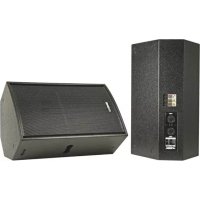
VDSPRO15 - Speaker HQ Power - Free user manual and instructions
Find the device manual for free VDSPRO15 HQ Power in PDF.


| Product type | Passive speaker |
| Brand | HQ Power |
| Model | VDSPRO15 |
| Dimensions (W × H × D) | 480 × 790 × 440 mm |
| Weight | 37.5 kg |
| Nominal power (RMS) | 450 W |
| Peak power | 900 W |
| Woofer | 15", die-cast aluminum basket, cellulose fiber cone |
| Tweeter | 75 mm voice coil, titanium diaphragm |
| Connectors | Neutrik Speakon 4-pole (NL4FX) |
| Max sound pressure (SPL) | 127 dB |
| Operating temperature | -5 °C to +45 °C |
| Relative humidity | ≤ 50 % |
| Care and cleaning | Wipe with a damp, lint-free cloth; avoid alcohol and solvents. |
| Safety | Protect from rain and moisture; installation and maintenance by qualified technician. |
| Spare parts and repairability | No user-serviceable parts; order from dealer. |
| Recommended cables | Up to 400 W: 2.5 mm²; above: 4 mm²; max. length: 30 m. |
| General information | Read manual before use; warranty void if instructions not followed. |
Frequently Asked Questions - VDSPRO15 HQ Power
User questions about VDSPRO15 HQ Power
0 question about this device. Answer the ones you know or ask your own.
Ask a new question about this device
Download the instructions for your Speaker in PDF format for free! Find your manual VDSPRO15 - HQ Power and take your electronic device back in hand. On this page are published all the documents necessary for the use of your device. VDSPRO15 by HQ Power.
USER MANUAL VDSPRO15 HQ Power
To all residents of the European Union Important environmental information about this product
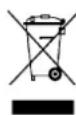
This symbol on the device or the package indicates that disposal of the device after its lifecycle could harm the environment.
Do not dispose of the unit (or batteries) as unsorted municipal waste; it should be taken to a specialised company for recycling.
This device should be returned to your distributor or to a local recycling service.
Respect the local environmental rules.
If in doubt, contact your local waste disposal authorities.
Thank you for buying the VDSPRO15 professional passive speaker! Please read the manual thoroughly before bringing this device into service. If the device was damaged in transit, don't install or use it and contact your dealer.
2. Safety Instructions
- Keep this device away from rain and moisture.
- Damage caused by disregard of certain guidelines in this manual is not covered by the warranty and the dealer will not accept responsibility for any ensuing defects or problems.
- A qualified technician should install and service this device.
Note that damage caused by user modifications to the device is not covered by the warranty. - Keep the device away from children and unauthorised users.
3. Safety Labels
Please respect the prescriptions on the safety labels!

Read the manual attentively before bringing the device into service. Only qualified personnel should use this device.
Have a qualified technician service the device and connect it to the mains. Beware of the high voltage at the screw connection. Turn off the amplifier before connecting the device.
Loud noise hazard. Protect your ears.
4. General Guidelines
- Important remark: the operation of an amplification system in public or industrial areas is subject to specific safety instructions. Contact the proper authorities for more information.
- Do not shake the device. Avoid brute force when installing or operating the device.
- Choose an installation spot where the device will not be exposed to extreme heat, moisture or dust. Don't leave cables lying around. They only endanger your own safety and that of others.
- Only use the device in an ambient temperature of -5^ to +45^ . Make sure there is sufficient ventilation if the device is built in.
The relative humidity must not exceed 50% . - Familiarise yourself with the functions of the device before actually using it. Do not allow operation by unqualified people. Any damage that may occur will most probably be due to unprofessional use of the device.
- Never use solvents or aggressive detergents in order to clean the device. Use a soft and damp cloth instead.
- Use the original packaging if the device is to be transported.
- Removing the serial bar code from the device will void the warranty.
VDSPRO15 1 VELLEMAN
- All modifications of the device are forbidden for safety reasons.
- Operate the device in the way described in this manual and only use the device for its intended purpose. All other uses may lead to short circuits, burns, electroshocks, hearing loss, etc. The warranty automatically becomes void in case of improper use.
- The figures in this manual describe the VDSPRO15. Other models and their features are comparable with the VDSPRO15.
5. Legal Provisions
- Operating an amplification system can produce extremely high noise levels that may cause permanent hearing loss. The legal instructions for using an amplification system vary from country to country. The user is responsible for respecting the legal provisions applicable in his country.
- Always monitor the sound pressure level when operating an amplification system in discos, concerts etc. Never exceed the permissible noise level as specified by the law.
- Hearing damage caused by high noise levels can be regarded as a physical injury and may lead to criminal prosecution.
- Please note that the organiser is responsible for respecting maximum noise levels.
6. Information on Hearing Loss
- More and more younger people suffer from hearing loss of 25dB or more, mainly caused by listening to loud music. Every person operating amplification systems should know to what sound pressure levels he is exposed to. In a discotheque, average levels of 75dB to 105dB are reached. At a rock concert, the sound pressure levels can rise from 95dB up to 115dB. Individual peaks can exceed the 130dB pain level. Such levels are typical for e.g. motor chain saws.
An Overview on the Different Noise Levels
10dB - Heartbeat
25dB-Whisper
40dB - Average home
50dB - Light traffic
60dB - Normal conversation
70dB - Vacuum cleaner
80dB - Telephone ringing
90dB - Pneumatic drill
100dB - Power mower
120dB - Boom box in car
130dB-Pain level
140dB - Jet plane 30m overhead
- It is important to know that a 3dB increase will double the sound level. The human hearing only recognises a doubling of the sound level when the noise level is increased by 10dB. Hearing loss does not depend on the sound level but on the noise level and starts way before than the pain level.
- Many a one deceives himself by thinking that noise is something you can get accustomed to. Nothing is further from the truth!
-
The reason why some people have got accustomed to a certain noise level and are no longer disturbed, is that they have already suffered hearing loss. The damage makes the hearing insensitive to the frequencies forming the loudest part of the noise. Getting accustomed to noise does not mean anything other than trying to get along with hearing loss in everyday life. Hearing loss cannot be recovered and can only be compensated with hearing aids. Subjectively, hearing loss feels like having dampened ears. This effect weakens with time but loss in hearing sensitivity is permanent.
-
In order to relax your hearing sufficiently, the noise level should not exceed 70dB for 10 hours. Higher noise levels during this relaxing period can prevent relaxation and promote permanent hearing damage or hearing loss.
WARNING: Protect your ears if you want to prevent hearing damage!
7. Input and Cable Installation
a. Inputs
- Your speaker system is equipped with 4-pole, lockable speaker sockets. Turn the plug to the right to lock the connection. To unlock: pull the unlock button, turn to the left and pull the plug out of the socket.
| PIN | |
| 1+2+ + | |
| 1-2-- |
- Unnecessarily long and thin cables will influence the damping factor and thus the low frequencies in a negative way. In order to safeguard good sound quality, the damping factor should be around 50. The longer a cable, the thicker it should be. Connect your speaker system via the speaker plugs.
b. Choosing appropriate connection cables
- Use sufficiently thick cables to connect the speaker system. Thin cables may heat up and cause significant power loss and loss in sound quality.
- For all speaker systems up to 400W, we recommend a cable diameter of 2.5mm^2 ; for all other speaker cables it's 4mm^2 .
- The high damping factor of your amplifier ensures a clear sound reproduction. Unnecessarily long and thin cables will influence the damping factor and thus the low frequencies in a negative way. In order to safeguard good sound quality, the damping factor should be around 50. The longer a cable, the thicker it should be.
- A damping factor of 200 is reduced to 47 (8 ohms) when using a diameter of 2.5mm^2 speaker cable of 10m in length. The power loss at 8 ohms is 1.63% , at 4 ohms it's 3.25% and at 2 ohms it's as much as 6.5% .
The maximum cable length is 30m
c. Installing the speaker cables
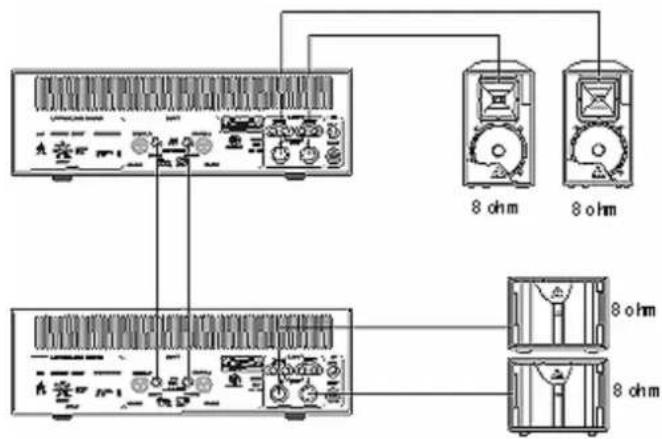
- Connect the cable of the first speaker system with speaker outputs CH-1 and output CH-2 of the amplifier. The signal will be transmitted to the individual speaker systems.
Always handle the cables with care and protect them from damage in transit. - Make sure no one can trip over the cables. Always fix them with an appropriate tape.
- Both cables should be of the same type and length.
- Do not loop the cables.
Always install the cables far away from power cables (never alongside them). - Never put heavy objects like speaker systems, flight cases etc. on cables.
Always roll cables loosely round the elbow.
8. Installation of the Speaker System
- This speaker system should be installed at a solid, plane, anti-slip, vibration-free, oscillation-free and fire-free location.
- To avoid damage and fire hazard it is recommended to install the speakers out of the reach of people.
-
Before installing the system, make sure the installation area can hold a minimum point load of 5 times the system's load (VDSPRO15: 37.5kg - point load: 190kg).
-
When installing the system on stage always try to install your sound system located behind the speakers to avoid unpleasant feedbacks.
- In order to have a good quality sound the system should be installed that they throw the sound over the audience's head. A full range of speakers system should be installed at listeners' eye level (see "Legal Provisions").
- Always install the system in a way that there is a minimum distance of 3m between the speakers and the audience.
9. Output System Connection
2 x 2-way or full-range speakers + 2 x 18" subwoofoers.
10. Cleaning and Maintenance
- All screws should be tightened and free of corrosion.
- The housing, visible parts, mounting supports and the installation location (e.g. ceiling, suspension, trussing) should not be deformed, modified or tampered with e.g. do not drill extra holes in mounting supports, do not change the location of the connections ...
- Moving mechanic parts must not show any signs of wear and tear.
- The electric power supply cables must not show any damage. Have a qualified technician maintain the device.
- Disconnect the device from the mains prior to maintenance activities.
- Wipe the device regularly with a moist, lint-free cloth. Do not use alcohol or solvents.
- There are no user-serviceable parts.
- Contact your dealer for spare parts if necessary.
10. Technical Specifications
Drivers
Woofer 15", cast aluminium basket, paper cone Tweeter 75mm voice coil, titanium diaphragm Input Power Capacity 450W rms (continuous), 900W
Input Connectors 4-pole Neutrik
Nominal Impedance 8 ohms
Box Tuning Frequency 44Hz
Max. Sound Pressure Level 127dB
Dimensions 480× 790× 440mm
Weight
© Speakon, order code NL4FX
For the SPL vs. frequency table, see the end of this manual.
The information in this manual is subject to change without prior notice.
VDSPRO15 4 VELLEMAN
1. Inleiding
11. Specifications techniques
Haut-parleurs