ERA36433W - Fridge ELECTROLUX - Free user manual and instructions
Find the device manual for free ERA36433W ELECTROLUX in PDF.



User questions about ERA36433W ELECTROLUX
0 question about this device. Answer the ones you know or ask your own.
Ask a new question about this device
Download the instructions for your Fridge in PDF format for free! Find your manual ERA36433W - ELECTROLUX and take your electronic device back in hand. On this page are published all the documents necessary for the use of your device. ERA36433W by ELECTROLUX.
USER MANUAL ERA36433W ELECTROLUX
This Quick user manual contains all the basic facts of your new product and is easy to use. Electrolux wants to lower our paper consumption related to user manuals by some 30%, which will help spare 12,000 trees every year. The Quick user manual is one of many steps taken by Electrolux for the environment. It may be a small step, but just by doing a little you do a lot.
A complete user manual can be found at www.electrolux.com

SAFETY INFORMATION
In the interest of your safety and to ensure the correct use, before installing and first using the appliance, read this user manual carefully, including its hints and warnings. To avoid unnecessary mistakes and accidents, it is important to ensure that all people using the appliance are thoroughly familiar with its operation and safety features. Save these instructions and make sure that they remain with the appliance if it is moved or sold, so that everyone using it through its life will be properly informed on appliance use and safety.
For the safety of life and property keep the precautions of these user's instructions as the manufacturer is not responsible for damages caused by omission.
Children and vulnerable people safety
- This appliance is not intended for use by persons (including children) with reduced physical, sensory or mental capabilities, or lack of experience and knowledge, unless they have been given supervision or instruction concerning use of the appliance by a person responsible for their safety.
Children should be supervised to ensure that they do not play with the appliance.
- Keep all packaging well away from children. There is risk of suffocation.
- If you are discarding the appliance pull the plug out of the socket, cut the connection cable (as close to the appliance as you can) and remove the door to prevent playing children to suffer electric shock or to close themselves into it.
- If this appliance featuring magnetic door seals is to replace an older appliance having a spring lock (latch) on the door or lid, be sure to make that spring lock unusable before you discard the old appliance. This will prevent it from becoming a death trap for a child.
General safety

Caution! Keep ventilation openings clear of obstruction.
- The appliance is designed exclusively for domestic use.
-
The appliance is intended for keeping foodstuff and/or beverages in a normal household as explained in this instruction booklet.
-
Do not use a mechanical device or any artificial means to speed up the thawing process.
- Do not use other electrical appliances (such as ice cream makers) inside of refrigerating appliances, unless they are approved for this purpose by the manufacturer.
- Do not damage the refrigerant circuit.
- The refrigerant isobutane (R600a) is contained within the refrigerant circuit of the appliance, a natural gas with a high level of environmental compatibility, which is nevertheless flammable. During transportation and installation of the appliance, be certain that none of the components of the refrigerant circuit become damaged. If the refrigerant circuit should become damaged:
- avoid open flames and sources of ignition
– thoroughly ventilate the room in which the appliance is situated
- It is dangerous to alter the specifications or modify this product in any way. Any damage to the cord may cause a short-circuit, fire and/or electric shock.

Warning! Any electrical component (power cord, plug, compressor) must be replaced by
a certified service agent or qualified service personnel.
- Power cord must not be lengthened.
- Make sure that the power plug is not squashed or damaged by the back of the appliance. A squashed or damaged power plug may overheat and cause a fire.
- Make sure that you can come to the mains plug of the appliance.
- Do not pull the mains cable.
- If the power plug socket is loose, do not insert the power plug. There is a risk of electric shock or fire.
-
You must not operate the appliance without the lamp cover ^1) of interior lighting.
-
This appliance is heavy. Care should be taken when moving it.
- Do not remove nor touch items from the freezer compartment if your hands are damp/wet, as this could cause skin abrasions or frost/freezer burns.
- Avoid prolonged exposure of the appliance to direct sunlight.
- Bulb lamps ^2) used in this appliance are special purpose lamps selected for household appliances use only. They are not suitable for household room illumination.
Daily Use
- Do not put hot pot on the plastic parts in the appliance.
- Do not store flammable gas and liquid in the appliance, because they may explode.
- Do not place food products directly against the air outlet on the rear wall. ^3)
- Frozen food must not be re-frozen once it has been thawed out.
- Store pre-packed frozen food in accordance with the frozen food manufacturer's instructions.
- Appliance's manufacturers storage recommendations should be strictly adhered to.
- Do not place carbonated or fizzy drinks in the freezer compartment as it creates pressure on the container, which may cause it to explode, resulting in damage to the appliance.
- Ice lollies can cause frost burns if consumed straight from the appliance.
Care and cleaning
- Before maintenance, switch off the appliance and disconnect the mains plug from the mains socket.
- Before using the appliance for the first time, wash the interior and all internal accessories with lukewarm water and some neutral soap so as to remove the typical smell of a brand-new product, then dry thoroughly.
- Do not clean the appliance with metal objects.
- Do not use sharp objects to remove frost from the appliance. Use a plastic scraper.
- Never use a hair drier or other heating appliances to speed up defrosting. Excessive heat may damage the plastic interior, and humidity could enter the electric system making it live.
- Regularly examine the drain in the refrigerator for defrosted water. If necessary, clean the drain. If the drain is blocked, water will collect in the bottom of the appliance.
Installation
Important! For electrical connection carefully follow the instructions given in specific paragraphs.
OPERATION
Switching on
Insert the plug into the wall socket.
Turn the Temperature regulator clockwise to a medium setting.
2) If the lamp is foreseen
3) If the appliance is Frost Free
4) If a water connection is foreseen
- Unpack the appliance and check if there are damages on it. Do not connect the appliance if it is damaged. Report possible damages immediately to the place you bought it. In that case retain packing.
- It is advisable to wait at least four hours before connecting the appliance to allow the oil to flow back in the compressor.
- Adequate air circulation should be around the appliance, lacking this leads to overheating. To achieve sufficient ventilation follow the instructions relevant to installation.
- Wherever possible the back of the product should be against a wall to avoid touching or catching warm parts (compressor, condenser) to prevent possible burn.
- The appliance must not be located close to radiators or cookers.
- Make sure that the mains plug is accessible after the installation of the appliance.
- Connect to potable water supply only. ^4)
Service
- Any electrical work required to do the servicing of the appliance should be carried out by a qualified electrician or competent person.
- This product must be serviced by an authorized Service Centre, and only genuine spare parts must be used.
Environment Protection
This appliance does not contain gasses which could damage the ozone layer, in either its refrigerant circuit or insulation materials. The appliance shall not be discarded together with the urban refuse and rubbish. The insulation foam contains flammable gases: the appliance shall be disposed according to the applicable regulations to obtain from your local authorities. Avoid damaging the cooling unit, especially at the rear near the heat exchanger. The materials used on this appliance marked by the symbol 🌐 are recyclable.
Switching off
To turn off the appliance, turn the Temperature regulator to the "O" position.
Temperature regulation
The temperature is automatically regulated. To operate the appliance, proceed as follows:
- turn the Temperature regulator toward lower settings to obtain the minimum coldness.
- turn the Temperature regulator toward higher settings to obtain the maximum coldness.

A medium setting is generally the most suitable.
However, the exact setting should be chosen keeping in mind that the temperature inside the appliance depends on:
- room temperature
• how often the door is opened
• the quantity of food stored - the location of the appliance.
Important! If the ambient temperature is high or the appliance is fully loaded, and the appliance is set to the lowest temperatures, it may run continuously causing frost to form on the rear wall. In this case the dial must be set to a higher temperature to allow automatic defrosting and therefore reduced energy consumption.
FIRST USE
Cleaning the interior
Before using the appliance for the first time, wash the interior and all internal accessories with lukewarm water and some neutral soap so as to remove the typical smell of a brand-new product, then dry thoroughly.
Important! Do not use detergents or abrasive powders, as these will damage the finish.
DAILY USE
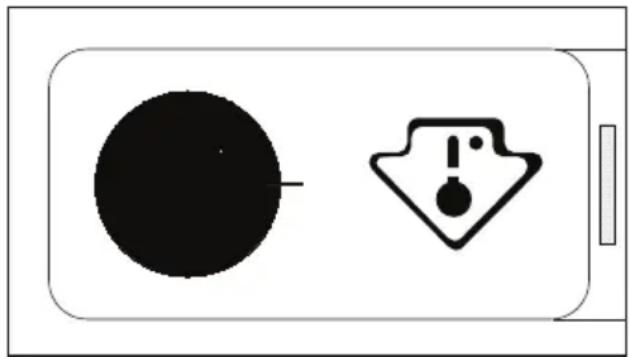
Important! this appliance is sold in France. In accordance with regulations valid in this country it must be provided with a special device (see figure) placed in the lower compartment of the fridge to indicate the coldest zone of it.
natural_image
Simple diagram with a black circle and a warning symbol (no text or labels)Freezing fresh food
The freezer compartment is suitable for freezing fresh food and storing frozen and deep-frozen food for a long time.
To freeze fresh foods it is not necessary to change the medium setting.
However, for a faster freezing operation, turn the temperature regulator toward higher settings to obtain the maximum coldness.
Important! In this condition, the refrigerator compartment temperature might drop below 0^ C. If this occurs reset the temperature regulator to a warmer setting.
Place the fresh food to be frozen on the top compartment.
Storage of frozen food
When first starting-up or after a period out of use, before putting the products in the compartment let the appliance run at least 2 hours on the higher settings.
Important! In the event of accidental defrosting, for example due to a power failure, if the power has been off for longer than the value shown in the technical characteristics chart under "rising time", the defrosted food must be consumed quickly or cooked immediately and then re-frozen (after cooling).
Thawing
Deep-frozen or frozen food, prior to being used, can be thawed in the refrigerator compartment or at room temperature, depending on the time available for this operation.
Small pieces may even be cooked still frozen, directly from the freezer: in this case, cooking will take longer.
Air cooling
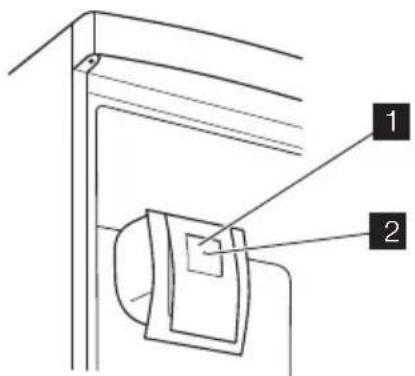
The Dynamic Air Cooling (DAC) fan let food cool quickly and a more uniform temperature in the compartment.
You can switch on the fan by pressing the switch (1). The green light (2) comes on.
text_image
Technical diagram showing a mechanical component with labeled parts 1 and 2This device allows for rapid cooling of foods and a more uniform temperature in the compartment.
Important! Switch on the fan when the ambient temperature exceeds 25^ C.
HELPFUL HINTS AND TIPS
Normal Operating Sounds
- You may hear a faint gurgling and a bubbling sound when the refrigerant is pumped through the coils or tubing. This is correct.
- When the compressor is on, the refrigerant is being pumped around and you will hear a whirring sound and a pulsating noise from the compressor. This is correct.
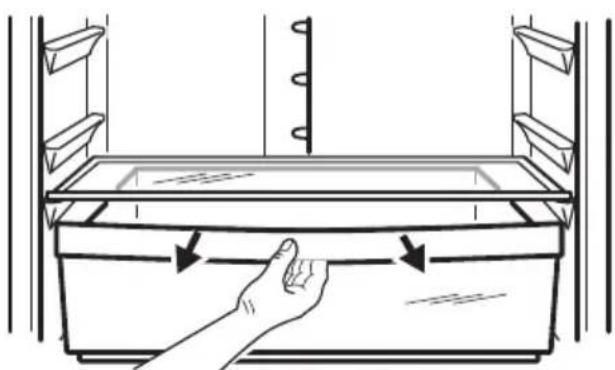
FreshZone drawer
The Fresh Zonedrawer is suitable for storing fresh food like fish, meat, seafood, because the temperature is lower here than in the rest of the fridge.
natural_image
Line drawing of a hand pressing down on a tray with arrows indicating motion (no text or symbols)CARE AND CLEANING

Caution! Unplug the appliance before carrying out any maintenance operation.

This appliance contains hydrocarbons in its cooling unit; maintenance and recharging must therefore only be carried out by authorized technicians.
Defrosting of the refrigerator
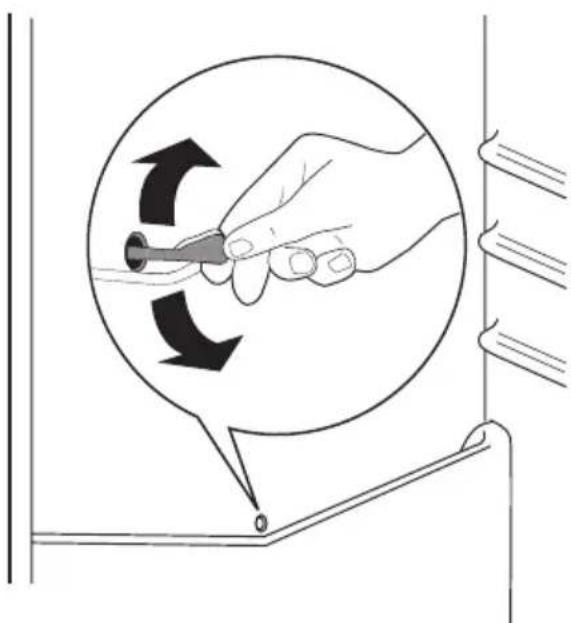
Frost is automatically eliminated from the evaporator of the refrigerator compartment every time the motor compressor stops, during normal use. The defrost water drains out through a trough into a special container at the back of the appliance, over the motor compressor, where it evaporates. It is important to periodically clean the defrost water drain hole in the middle of the refrigerator compartment channel to prevent the water overflowing and dripping onto the food inside. Use the special cleaner provided, which you will find already inserted into the drain hole.
- The thermic dilatation might cause a sudden cracking noise. It is natural, not dangerous physical phenomenon. This is correct.
- When the compressor switches on or switches off, you will hear a faint "click" of the temperature regulator. This is correct.
natural_image
Illustration of a hand holding a tool inside a circular arrow, with no text or symbols present.Defrosting the freezer
A certain amount of frost will always form on the freezer shelves and around the top compartment. Defrost the freezer when the frost layer reaches a thickness of about 3-5 mm.
To remove the frost, follow the instructions below:
- pull out the plug from the wall socket or switch off the appliance
- remove any stored food, wrap it in several layers of newspaper and put it in a cool place
- remove the freezer drawers
- put insulating material around the drawers, e.g. blankets or newspapers.
Defrosting can be accelerated by placing bowls with hot water (not boiling) inside the freezer.
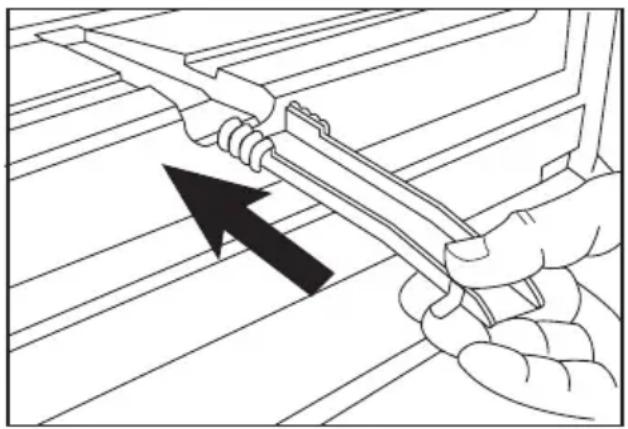
- Loosen the drainage channel from its resting position, push it in according to the illustration and place it in the bottom freezer drawer where water can collect
- carefully scrape off the ice when it starts to thaw. Use a wood or a plastic scraper
- when all the ice has melted, clean and wipe the cabinet dry, then put the drainage channel back in place.
- switch on the cabinet and replace the frozen foodstuff.
It is recommended to operate the appliance at the highest position of the thermostatic control for some hours so that it can reach the sufficient storing temperature as soon as possible.
Important! Never use sharp metal tools to scrape off frost from the evaporator as you could damage it. Do not use a mechanical device or any artificial means to speed up the thawing process other than those recommended by the manufacturer. A temperature rise of the frozen food packs, during defrosting, may shorten their safe storage life.
natural_image
Illustration of hands using a tool to adjust or install a component, with an arrow indicating the process (no text or symbols present)TECHNICAL DATA
| Dimension | ||
| Height 1850 mm | ||
| Width 595 mm | ||
| Depth 632 mm | ||
| Rising Time 20 h |
The technical information are situated in the rating plate on the internal left side of the appliance and in the energy label.
INSTALLATION

Caution! Read the "Safety Information" carefully for your safety and correct operation, e appliance before installing the appliance.
Positioning
Install this appliance at a location where the ambient temperature corresponds to the climate class indicated on the rating plate of the appliance:
| Climate class | Ambient temperature |
| SN +10°C to + 32°C | |
| N +16°C to + 32°C | |
| ST +16°C to + 38°C | |
| T +16°C to + 43°C |
Location
The appliance should be installed well away from sources of heat such as radiators, boilers, direct sunlight etc. Ensure that air can circulate freely around the back of the cabinet. To ensure best performance, if the appliance is positioned below an overhanging wall unit, the minimum distance between the top of the cabinet and the wall unit must be at least 100 mm. Ideally, however, the appliance should not be positioned below overhanging wall units. Accurate levelling is ensured by one or more adjustable feet at the base of the cabinet.

Warning! It must be possible to disconnect the appliance from the mains power supply; the plug must therefore be easily accessible after installation.
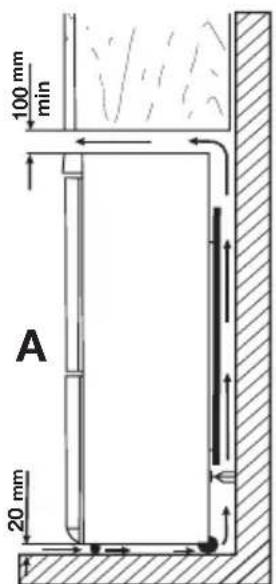
text_image
100 mm min A 20 mm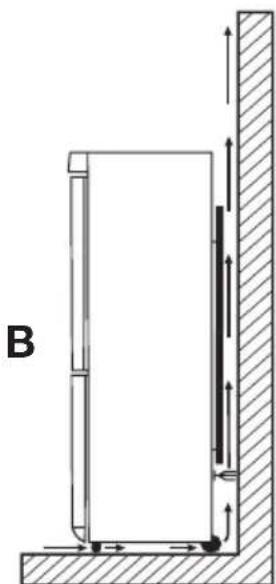
text_image
BElectrical connection
Before plugging in, ensure that the voltage and frequency shown on the rating plate correspond to your domestic power supply.
The appliance must be earthed. The power supply cable plug is provided with a contact for this purpose. If the domestic power supply socket is not earthed, connect the appliance to a separate earth in compliance with current regulations, consulting a qualified electrician.
The manufacturer declines all responsibility if the above safety precautions are not observed.
This appliance complies with the E.E.C. Directives.
Rear spacers
In the bag with the documentation, there are two spacers which must be fitted as shown in the figure.
Slacken the screws and insert the spacer under the screw head, then tighten again the screws.
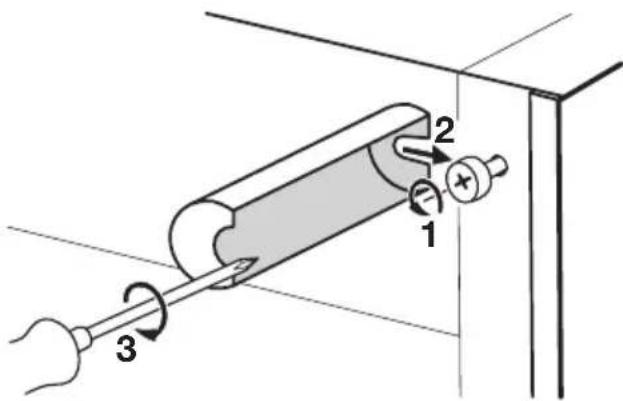
text_image
Diagram of a mechanical device with labeled parts and directional arrows indicating motion or forceLevelling
When placing the appliance ensure that it stands level. This can be achieved by two adjustable feet at the bottom in front.
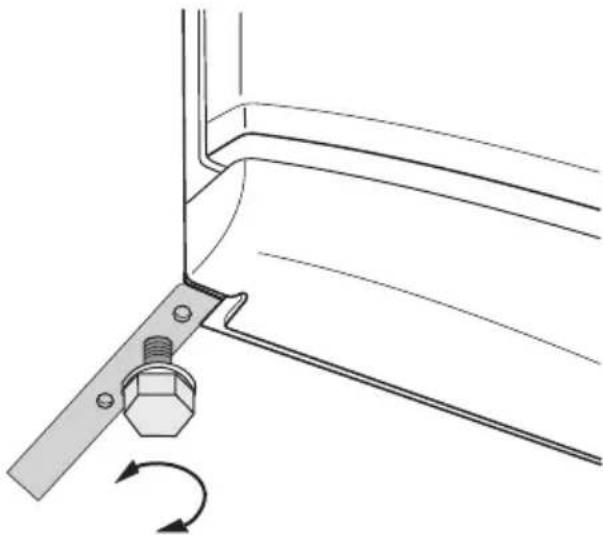
natural_image
Technical line drawing of a mechanical joint or bracket assembly with a rotating arrow indicating rotation (no text or symbols present)Removing the shelf holders
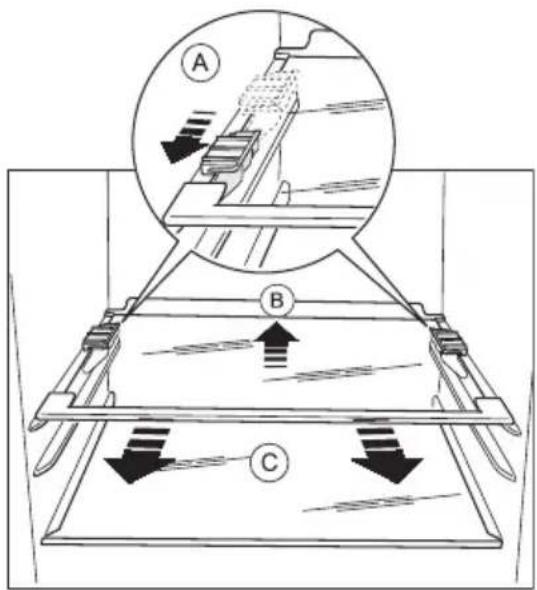
Your appliance is equipped with shelf retainers that make it possible to secure the shelves during transportation.
To remove them proceed as follows:
- Move the shelf holders in the direction of the arrow (A).
- Raise the shelf from the rear and push it forward until it is freed (B).
- Remove the retainers (C).
text_image
Technical diagram showing a mechanical assembly with labeled components A, B, and C, including directional arrows indicating motion or force.Door reversibility

Warning! Before carrying out any
operations, remove the plug from the power socket.
Important! To carry out the following operations, we suggest that this be made with another person that will keep a firm hold on the doors of the appliance during the operations.
To change the opening direction of the door, do these steps:
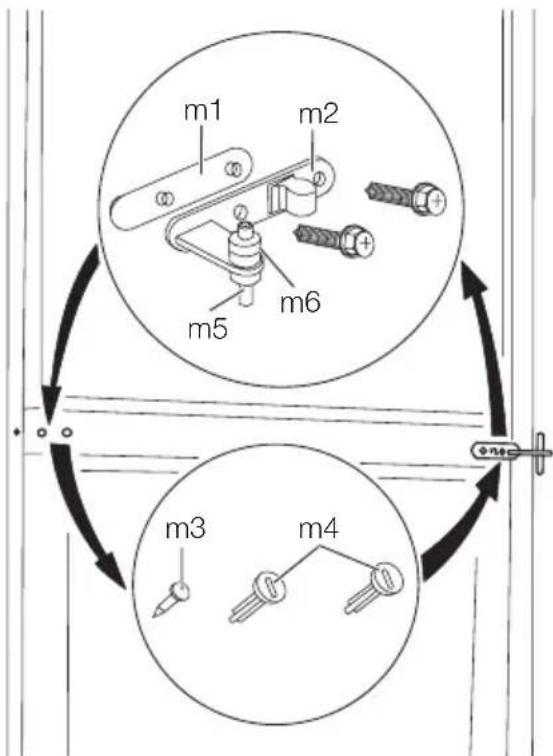
- Open the doors. Unscrew the middle hinge (m2). Remove the plastic spacer (m1).
-
Remove the doors.
-
Remove the spacer (m6) and move to the other side of the hinge pivot (m5).
-
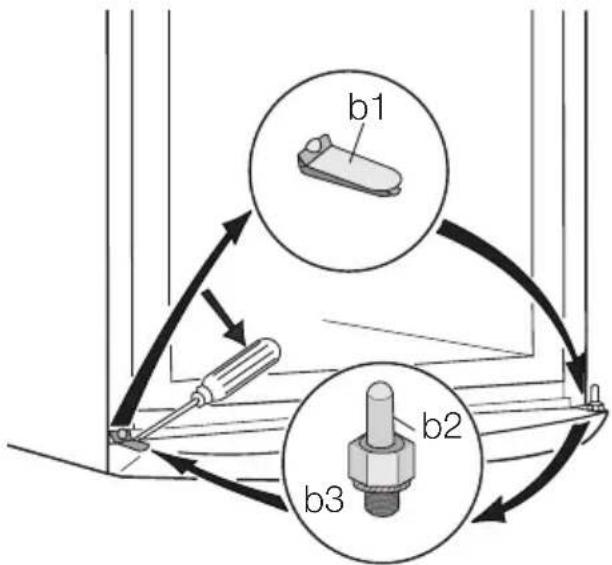
Remove using a tool the cover (b1). Unscrew the lower hinge pivot (b2) and the spacer (b3) and place them on the opposite side.
-
Re-insert the cover (b1) on the opposite side.
text_image
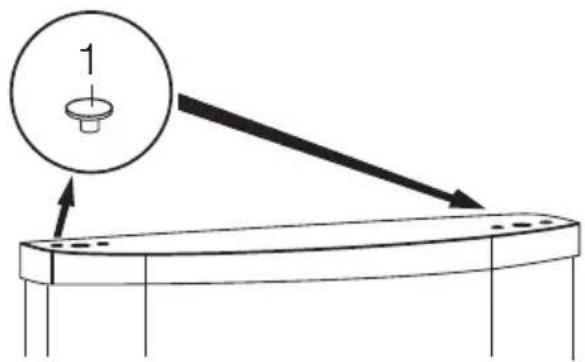
b1 b2 b3- Remove the stoppers (1) and move to the other side of the doors.
text_image
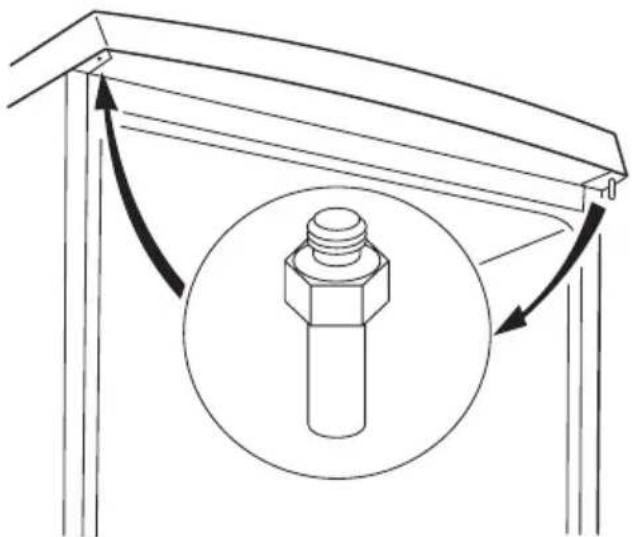
1- Unscrew the upper hinge pivot (t1) and screw it on the opposite side.
natural_image
Diagram showing a mechanical assembly with a hex nut and directional arrows indicating motion (no text or symbols)-
Remove the left-hand cover pin of the middle hinge (m3,m4) and move to the other side.
-
Fit the pin of the middle hinge (m5) into the left-hand hole of the lower door.
-
Re-insert the lower door on the lower hinge pivot (b2).
- Fit the upper door on the upper hinge pivot (t1).
- Re-insert the upper door on the middle hinge pivot (m5) slightly tilting both doors.
- Re-screw the middle hinge (m2). Do not forget the plastic spacer (m1) inserted under the middle hinge. Make sure that the edges of the doors run parallel to the side edge of the appliance.
- Reposition, level the appliance, wait for at least four hours and then connect it to the power socket.
ENVIRONMENTAL CONCERNS
The symbol on the product or on its packaging indicates that this product may not be treated as household waste. Instead it should be taken to the appropriate collection point for the recycling of electrical and electronic equipment. By ensuring this product is disposed of correctly, you will help prevent potential negative consequences for the Do a final check to make sure that:
- All screws are tightened.
- The magnetic seal adheres to the cabinet.
- The door opens and closes correctly. If the ambient temperature is cold (i.e. in Winter), the gasket may not fit perfectly to the cabinet. In that case, wait for the natural fitting of the gasket. In case you do not want to carry out the above mentioned operations, contact the nearest After Sales Service Force. The After Sales Service specialist will carry out the reversibility of the doors at your cost.
environment and human health, which could otherwise be caused by inappropriate waste handling of this product. For more detailed information about recycling of this product, please contact your local council, your household waste disposal service or the shop where you purchased the product.