CN228121 - Fridge BEKO - Free user manual and instructions
Find the device manual for free CN228121 BEKO in PDF.



| Brand | BEKO |
| Model | CN228121 (also CN228121T) |
| Product type | Combined refrigerator-freezer (Frost) |
| Total gross volume | 298 L |
| Total usable volume | 266 L |
| Useful refrigerator volume | 176 L |
| Useful freezer volume | 90 L |
| Freezing capacity | 4 kg/24 h |
| Energy class | A+ |
| Annual energy consumption | 324 kWh/an |
| Conservation autonomy in case of failure | 19 h |
| Noise level | 40 dB(A) |
| Refrigerant | R600a (eco-friendly, flammable) |
| Refrigerator defrost type | Automatic |
| Freezer defrost type | Automatic (fan) |
| Interior lighting | Bulb with E14 base, max 15 W |
| Temperature setting | Control knob (positions min 1 to max 6) |
| Quick freeze function | Yes (set the knob to max 24 hours before) |
| Ice cube tray | Yes, with holder |
| Adjustable feet | Yes, two front feet |
| Possibility to reverse the door | Yes (see manual figure 15) |
| Power supply | 220-240 V, 50 Hz (standard) |
| Recommended cleaning | Warm water and baking soda |
| Number of pages of the manual | 56 |
Frequently Asked Questions - CN228121 BEKO
User questions about CN228121 BEKO
0 question about this device. Answer the ones you know or ask your own.
Ask a new question about this device
Download the instructions for your Fridge in PDF format for free! Find your manual CN228121 - BEKO and take your electronic device back in hand. On this page are published all the documents necessary for the use of your device. CN228121 by BEKO.
USER MANUAL CN228121 BEKO
GB Instruction for use
In order to ensure a normal operation of your refrigerating appliance, which uses a completely environmentally friendly refrigerant the R600a (flammable only under certain conditions) you must observe the following rules:
-
Do not hinder the free circulation of the air around the appliance.
-
Do not use mechanical devices in order to accelerate the defrosting, others than the ones
recommended by the manufacturer.
-
Do not destroy the refrigerating circuit.
-
Do not use electric appliances inside the food keeping compartment, other than those that might have been recommended by the manufacturer.
ADVERTENCIA!
Electrical requirements /2
Transportation instructions /2
Installation instructions /2
Getting to know your appliance /3
Suggested arrangement of food in the appliance /3
Temperature control and adjustment /4
Before operating /4
Storing frozen food /4
Freezing fresh food /4
Making ice cubes /4
Defrosting /5
Replacing the interior light bulb /5
Cleaning and care /5
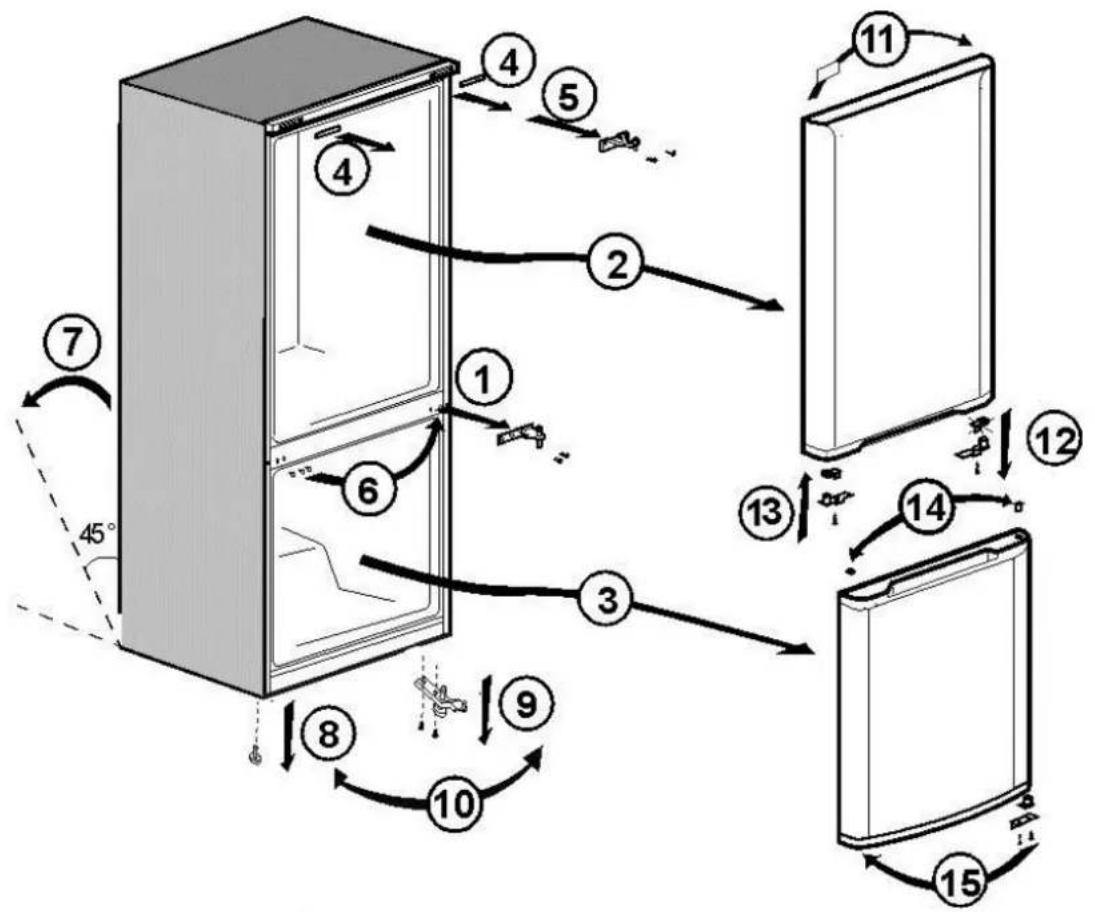
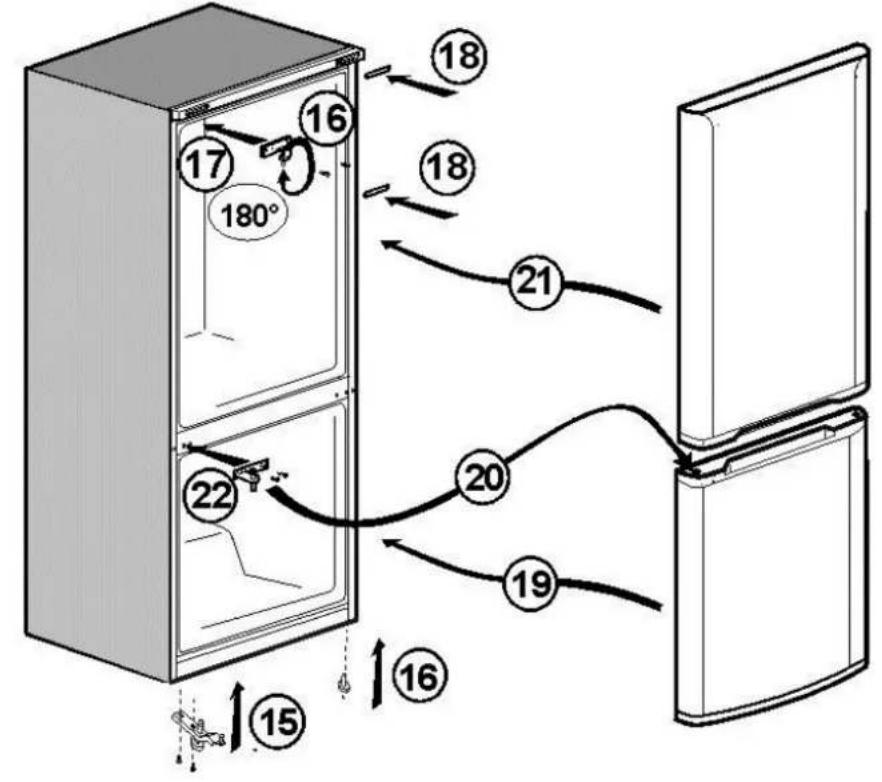
Repositioning the door /6
Do's and don'ts /6
Energy Consumption /7
Information concerning the noises /8
Trouble - shooting /8
Thechnical data /9
ES
Indices
UcHHeHH HeCnpaBHOCTeI /45
TexhiNi dahi/45
2
4
6
8
A
1
13
14
Congratulations on your choice of a BEKO Quality Appliance, designed to give you many years of service.
Safety first!
Do not connect your appliance to the electricity supply until all packing and transit protectors have been removed.
- Leave to stand for at least 12 hours before switching on, to allow compressor oil to settle, if transported horizontally.
- If you are discarding an old appliance with a lock or latch fitted to the door, ensure that it is left in a safe condition to prevent the entrapment of children.
- This appliance must only be used for its intended purpose.
- Do not dispose of the appliance on a fire. Your appliance contains non CFC substances in the insulation which are flammable. We suggest you contact your local authority for information on disposal and available facilities.
- We do not recommend use of this appliance in an unheated, cold room. (e.g. garage, conservatory, annex, shed, out-house etc.)
To obtain the best possible performance and trouble free operation from your appliance it is very important to read these instructions carefully. Failure to observe these instructions may invalidate your right to free service during the guarantee period.
Please keep these instructions in a safe place for easy reference.
This appliance is not intended for use by person with reduced physical, sensory or mental capabilities or lack of experience and knowledge unless they have been given supervision or instruction concerning use of the appliance by a person responsible for their safety. Children should be supervised to ensure that they do not play with the appliance.
Electrical requirements
Before inserting the plug into the wall socket make sure that the voltage and the frequency shown in the rating plate inside the appliance corresponds to your electricity supply.
We recommend that this appliance is connected to the mains supply via a suitably switched and fused socket in a readily accessible position.
Warning! This appliance must be earthed.
Repairs to electrical equipment should only be performed by a qualified technician. Incorrect repairs carried out by an unqualified person are carry risks that may have critical consequences for the user of the appliance.
ATTENTION!
This appliance operates with R600a which is an environmental friendly but flammable gas. During the transportation and fixing of the product, care must be taken not to damage the cooling system. If the cooling system is damaged and there is a gas leakage from the system, keep the product away from open flame sources and ventilate the room for a while.
WARNING - Do not use mechanical devices or other means to accelerate the defrosting process, others than those recommended by the manufacturer.
WARNING - Do not damage the refrigerant circuit.
WARNING - Do not use electrical appliances inside the food storage compartments of the appliance, unless they are of the type recommended by the manufacturer.
WARNING - If the supply cord is damaged, it must be replaced by the manufacturer, its service agent or similarly qualified persons in order to avoid a hazard.
Transportation instructions
- The appliance should be transported only in an upright position. The packing as supplied must be intact during transportation.
- If during the transport the appliance, has been positioned horizontally, it must not be operated for at least 12 hours, to allow the system to settle.
- Failure to comply with the above instructions could result in damage to the appliance, for which the manufacturer will not be held liable.
- The appliance must be protected against rain, moisture and other atmospheric influences.
Important!
- Care must be taken while cleaning/carrying the appliance not to touch the bottom of the condenser metal wires at the back of the appliance, as this could cause injury to fingers and hands.
- Do not attempt to sit or stand on top of your appliance as it is not designed for such use. You could injure yourself or damage the appliance.
- Make sure that the mains cable is not caught under the appliance during and after moving, as this could damage the cable.
- Do not allow children to play with the appliance or tamper with the controls.
Installation instructions
- Do not keep your appliance in a room where the temperature is likely to fall below -15 degrees C (5 degrees F) at night and/or especially in winter.
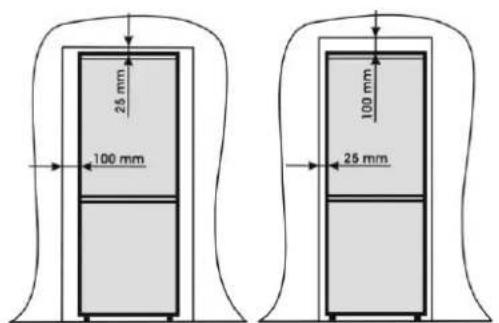
- Do not place the appliance near cookers or radiators or in direct sunlight, as this will cause extra strain on the appliance's functions. If installed next to a source of heat or freezer, maintain the following minimum side clearances: From Cookers 30 mm
From Radiators 300 mm
From Freezers 25mm
-
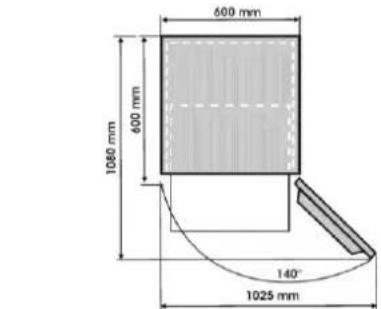
Make sure that sufficient room is provided around the appliance to ensure free air circulation (Item 2).
-
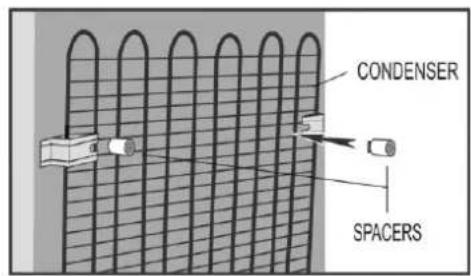
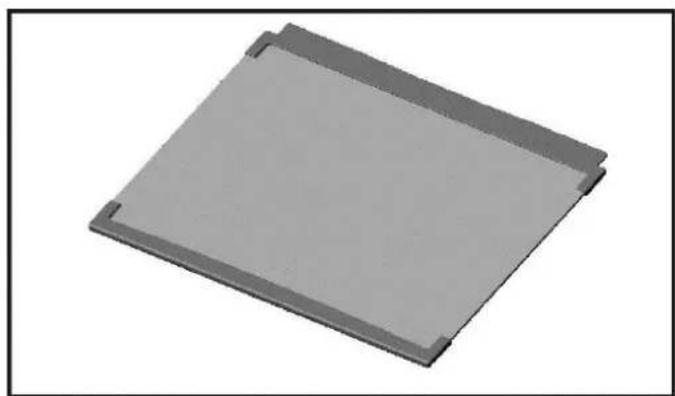
Put the back airing lid to the back of your refrigerator to set the distance between the refrigerator and the wall (Item 3).
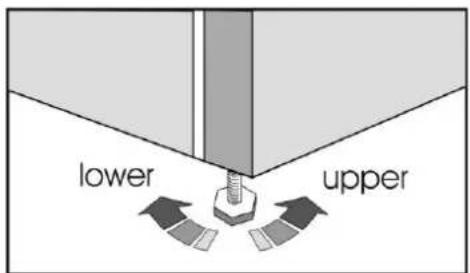
- The appliance should be positioned on a smooth surface. The two front feet can be adjusted as required. To ensure that your appliance is standing upright adjust the two front feet by turning clockwise or anti-clockwise, until firm contact is secured with the floor. Correct adjustment of feet prevents excessive vibration and noise (Item 4).
- Refer to "Cleaning and Care" section to prepare your appliance for use.
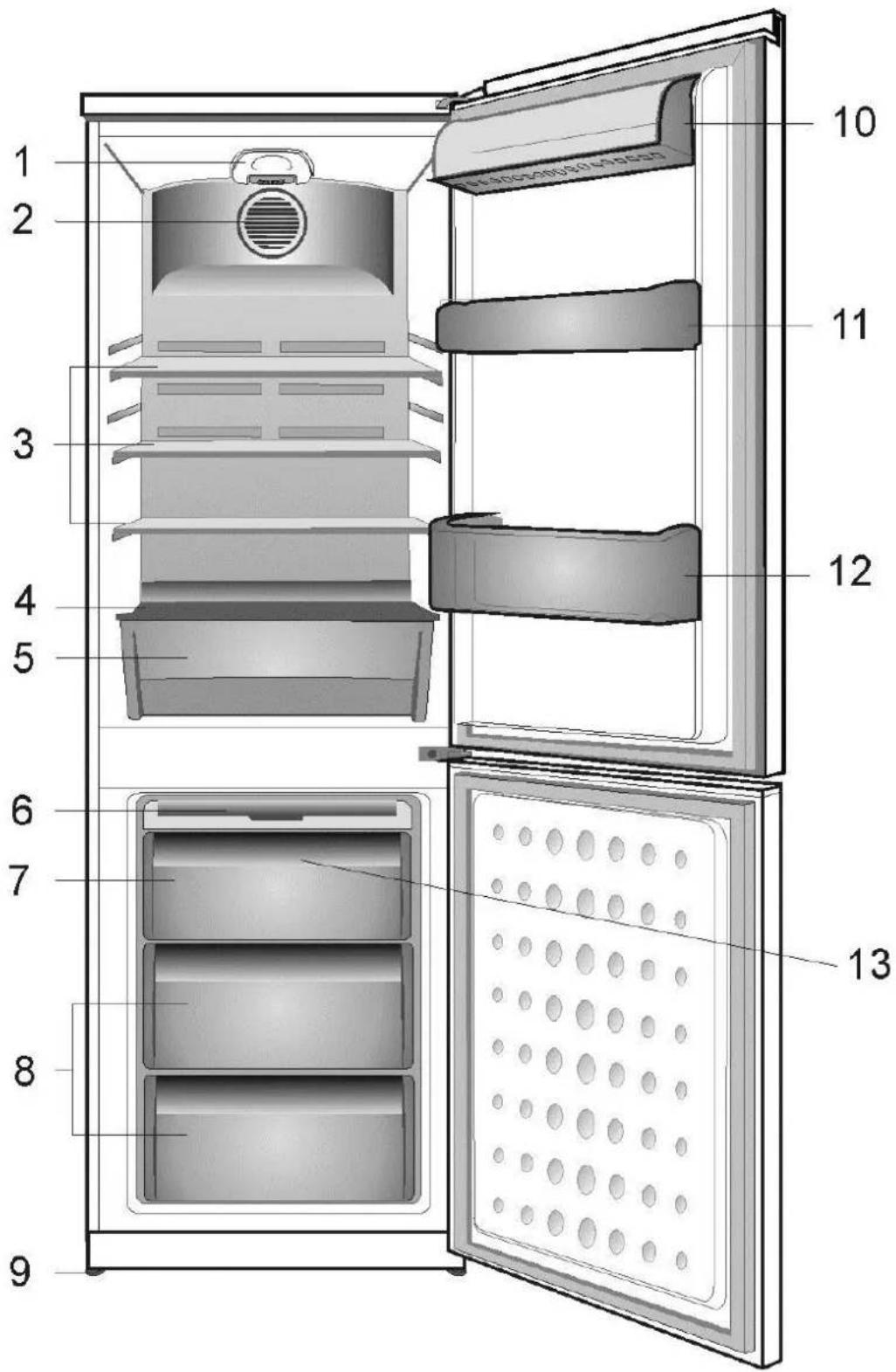
Getting to know your appliance (Item 1)
1 - Setting knob and interior light
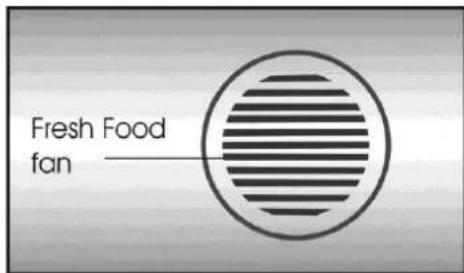
2 - Fresh Food fan
3 - Adjustable Cabinet shelves
4 - Crisper cover
5 - Fresh zone compartment/ Crispers
6 - Ice tray support & ice tray
7 - Compartment for quickly freezing
8 - Compartments for frozen froods keeping
9 - Adjustable foot
10 - Dairy Compartment
11 - Shelf for jars
12 - Shelf for bottles
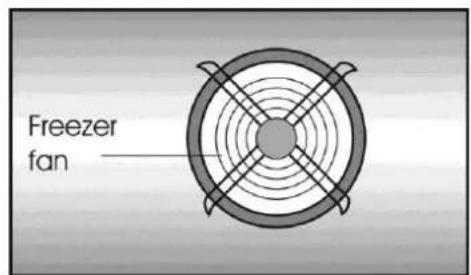
13 - Freezer fan
The fans has the purpose to provide the circulation of the air in compartment. It is connected in parallel with the motor-compressor. When the motor-compressor is off, the fans will also be off.
Suggested arrangement of food in the appliance
Guidelines for obtaining optimum storage and hygiene:
- The fridge compartment is for the short-term storage of fresh food and drinks.
- The freezer compartment is and suitable for the freezing and storage of pre-frozen food.
The recommendation for storage as stated on the food packaging should be observed at all times.
3. Dairy products should be stored in the special compartment provided in the door liner.
4. Cooked dishes should be stored in airtight containers.
5. Fresh wrapped produce can be kept on the shelf.
7. To store raw meat, wrap in polythene bags and place on the lowest shelf. Do not allow to come into contact with cooked food, to avoid contamination. For safety, only store raw meat for two to three days.
8. For maximum efficiency, the removable shelves should not be covered with paper or other materials to allow free circulation of cool air.
- Do not keep vegetable oil on door shelves. Keep the food packed, wrapped or covered. Allow hot food and beverages to cool before refrigerating. Leftover canned food should not be stored in the can.
- Fizzy drinks should not be frozen and products such as flavoured water ices should not be consumed too cold.
- Some fruit and vegetables suffer damage if kept at temperatures near 0^ . Therefore wrap pineapples, melons, cucumbers, tomatoes and similar produce in polythene bags.
- High-proof alcohol must be stored upright in tightly closed containers. Never store products that contain an inflammable propellant gas (e.g. cream dispensers, spray cans, etc.) or explosive substances. These are an explosion hazard.
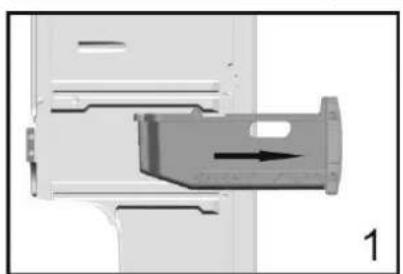
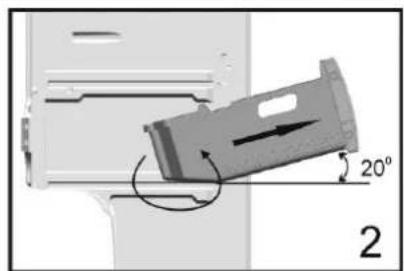
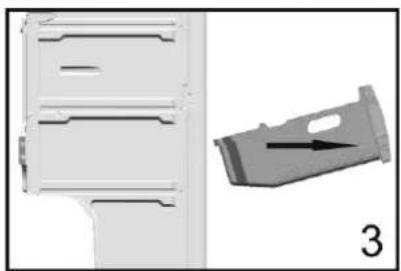
- To take out the baskets from the freezer compartment please proceed as in Item 12.
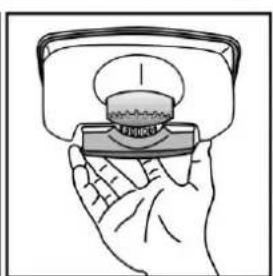
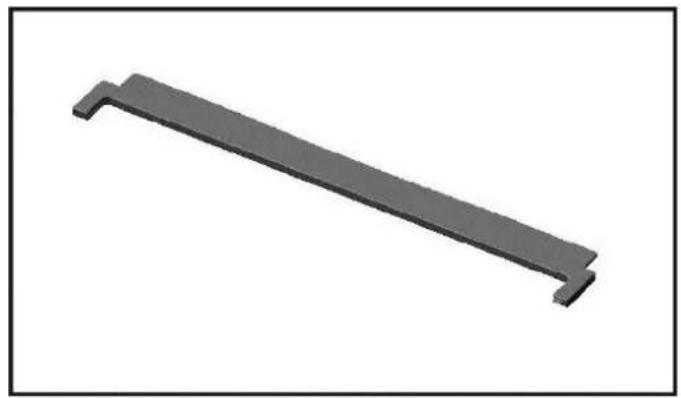
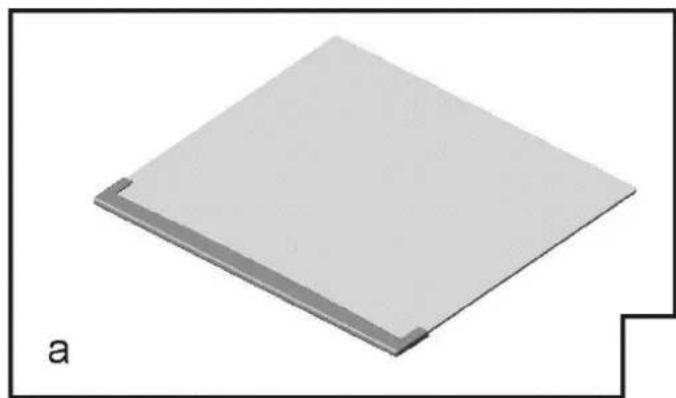
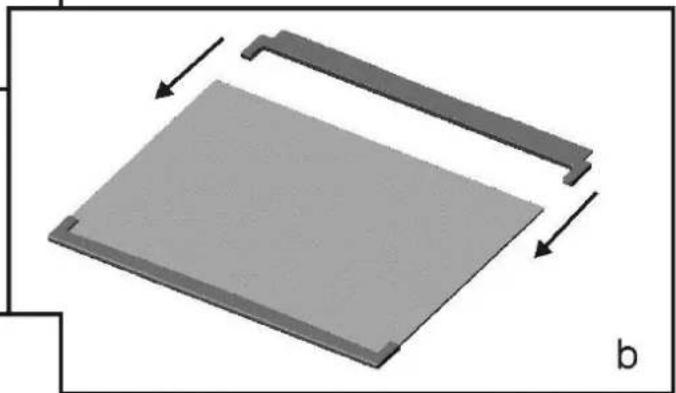
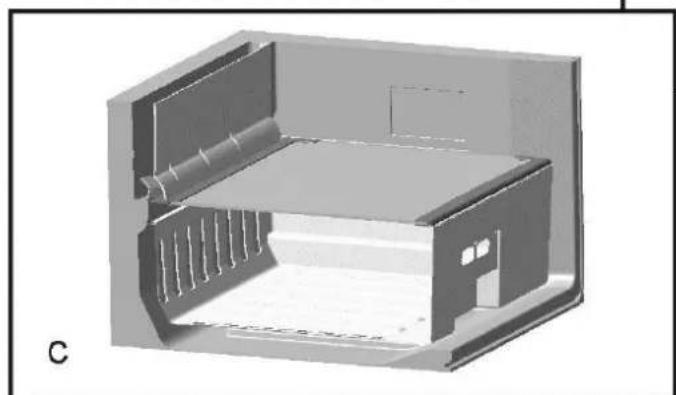
- In order to transform the chill compartment (used for easy perishable products - Item 1-point 5) into a vegetable box it is necessary to assembly in the rear side of the bottom glass shelf the ornament (Item 13) delivered as accessory according to the picture Item 14 (point a-c).
If the ornament will be not assembled the compartment (Item 1-point 5) will have biofresh functionality.
Temperature control and adjustment
Operating temperatures are controlled by the setting knob (Item 5) located on the ceiling of fridge compartment. Settings may be made from min, 1.. 6,max,max being the coldest position.
When the appliance is switched on for the first time, the setting knob should be adjusted so that after 24 hours, the average fridge temperature is no higher than +5^ (+41^) . We recommend you set the knob half way between the min and max setting and monitor to obtain the desired temperature i.e. towards max you will obtain a colder fridge temperature and vice versa. Some sections of the fridge may be cooler or warmer (such as the salad crisper and the top part of the cabinet) which is quite normal.
The normal storage temperature of the freezer should be -18^ (0^) . Lower temperatures may be obtained by adjusting setting knob towards max position.
We recommend that you check the temperature with an accurate thermometer to ensure that the storage compartments are kept to the desired temperature.
Remember you must take your reading very quickly since the thermometer temperature will rise very rapidly after you remove it from the freezer.
Please remember each time the door is opened cold air escapes and the internal temperature rises. Therefore never leave the door open and ensure it is closed immediately after food is put in or removed.
Before operating
Final Check
Before you start using the appliance check that:
- The feet have been adjusted for perfect levelling.
- The interior is dry and air can circulate freely at the rear.
- The interior is clean as recommended under "Cleaning and care."
- The plug has been inserted into the wall socket and the electricity is switched on. When the door is open the interior light will come on.
And note that:
- You will hear a noise as the compressor starts up. The liquid and gases sealed within the refrigeration system may also make some (noise), whether the compressor is running or not. This is quite normal.
- Slight undulation of the top of the cabinet is quite normal due to the manufacturing process used; it is not a defect.
- We recommend setting the knob midway and monitor the temperature to ensure the appliance maintains desired storage temperatures (See section Temperature Control and Adjustment).
- Do not load the appliance immediately it is switched on. Wait until the correct storage temperature has been reached. We recommend checking the temperature with an accurate thermometer (see; Temperature Control and Adjustment).
Storing frozen food
Your freezer is suitable for the long-term storage of commercially frozen foods and also can be used to freeze and store fresh food.
If there is a power failure, do not open the door. Frozen food should not be affected if the failure lasts for less than 19 hrs. If the failure is longer, then the food should be checked and either eaten immediately or cooked and then re-frozen.
Freezing fresh food
Please observe the following instructions to obtain the best results.
Do not freeze too large a quantity at any one time. The quality of the food is best preserved when it is frozen right through to the core as quickly as possible.
Do not exceed the freezing capacity of your appliance in 24 h.
Placing warm food into the freezer compartment causes the refrigeration machine to operate continuously until the food is frozen solid. This can temporarily lead to excessive cooling of the refrigeration compartment.
When freezing fresh food, to reach the best freezing capacity, put the setting knob to maximum position 24h before placing it. After freezing the knob can be set to the initial position. Small quantities of food up to 1/2kg . (1 lb) can be frozen without adjusting the temperature control knob.
Take special care not to mix already frozen food and fresh food.
Making ice cubes
Fill the ice - cube tray 3/4 full with water and place it in the freezer. Loosen frozen trays with a spoon handle or a similar implement; never use sharp-edged objects such as knives or forks.
Defrosting
A) Fridge compartment
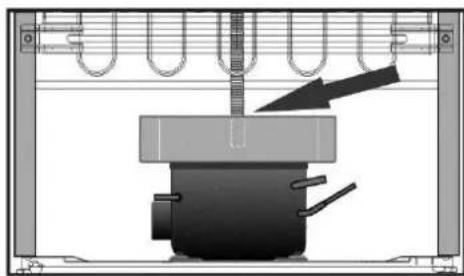
The fridge compartment defrosts automatically. The defrost water runs to the drain tube via a collection container at the back of the appliance. Check that the tube is permanently placed with its end in the collecting tray on the compressor to prevent the water spilling on the electric installation or on the floor (Item 6).
B) Freezer compartment
The NO FROST type defrost is completely automatic. No intervention from your side is required. The water is colected on the compressor tray. Due the heat of the compressor the water is evaporated.
Do not use pointed or sharp-edged objects, such as knives or forks to remove the frost.
Never use hairdryers, electrical heaters or other such electrical appliances for defrosting.
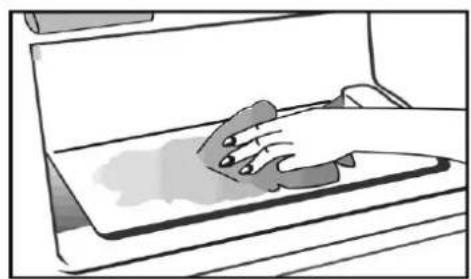
Sponge out the defrost water collected in the bottom of the freezer compartment. After defrosting, dry the interior thoroughly (Item 7 & 8).
Insert the plug into the wall socket and switch on the electricity supply.
Warnings!
The fans inside the freezer and fresh food compartments circulates cold air. Never insert any object through the guard. Do not allow children to play with the fresh food and freezer fan.
Never store products that contain inflammable propellant gas (eg dispensers, spray cans etc.) or explosive substances.
Don't cover the shelves with any protective materials, which may obstruct air circulation. Do not allow children to play with the appliance or tamper with the controls.
Do not obstruct the fan guards to ensure that you obtain the best possible performance from your appliance. (Item 9 and Item 10)
Warning!
Your appliance is fitted with a circulating fan which is essential for the performance of the refrigerator. Please ensure the fans are not blocked (stopped) or impaired by food or packaging. Blocking (stopping) or impairing the fan can result in an increase of the internal freezer temperature (Thawing).
Replacing the interior light bulb (Item 11)
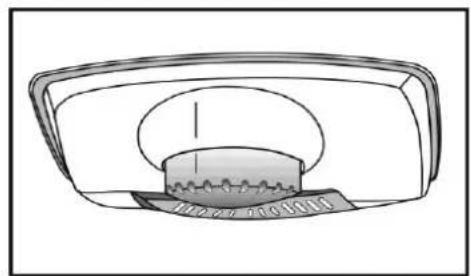
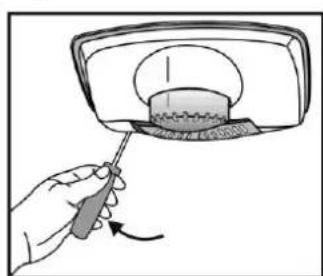
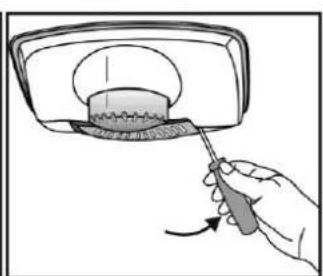
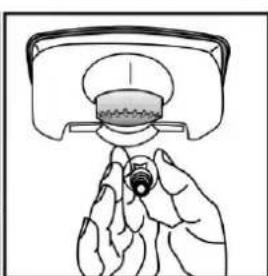
In case that the light bulb is out of function it is easily to replace. First make sure that the refrigerator / freezer is disconnected from the power supply by removing the plug. Take a flat screwdriver and keep it carefully without force into the left gap between lamp cover and internal cabinet. Then press the handle of the screwdriver carefully to the left side until you notice that the left pin of the cover is disengaged. Repeat this procedure on the right gap, however now press the handle of the screwdriver carefully to the right side. If both sides are loosened the cover can be removed easily.
Ensure that bulb is screwed securely in the bulb holder. Plug the appliance into the power supply. If the light still fails, replace E14 screw-cap type 15 Watt (Max) bulb from your local electrical store and then fit it. Carefully dispose of the burnt-out light bulb immediately.
If you have changed the light bulb please fix the cover again in it's former position. Take care that the cover snaps-in correctly.
Cleaning and care
- We recommend that you switch off the appliance at the socket outlet and pull out the mains plug before cleaning.
- Never use any sharp instruments or abrasive substances, soap, household cleaner, detergent or wax polish for cleaning.
- Use luke warm water to clean the cabinet of the appliance and wipe it dry.
- Use a damp cloth wrung out in a solution of one teaspoon of bicarbonate of soda to one pint of water to clean the interior and wipe it dry.
- Make sure that no water enters the temperature control box.
- If the appliance is not going to be used for a long period of time, switch it off, remove all food, clean it and leave the door ajar.
- We recommend that you polish the metal parts of the product (i.e. door exterior, cabinet sides) with a silicone wax (car polish) to protect the high quality paint finish.
- Any dust that gathers on the condenser, which is located at the back of the appliance, should be removed once a year with a vacuum cleaner.
-
Check door seals regularly to ensure they are clean and free from food particles.
-
Never:
-
Clean the appliance with unsuitable material; eg petroleum based products.
- Subject it to high temperatures in any way,
-
Scour, rub etc., with abrasive material.
-
Removal of dairy cover and door tray :
- To remove the dairy cover, first lift the cover up by about an inch and pull it off from the side where there is an opening on the cover.
- To remove a door tray, remove all the contents and then simply push the door tray upwards from the base.
- Make sure that the special plastic container at the back of the appliance which collects defrost water is clean at all times. If you want to remove the tray to clean it, follow the instructions below:
- Switch off at the socket outlet and pull out the mains plug
- Gently uncrimp the stud on the compressor, using a pair of pliers, so that the tray can be removed
- Lift it up
Clean and wipe it dry - Reassemble, reversing the sequence and operations
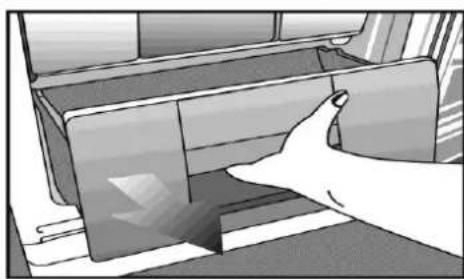
- To remove a drawer, pull it as far as possible, tilt it upwards and then pull it out completely.
Repositioning the door
Proceed in numerical order (Item 15).
Do's and don'ts
Do- Clean your appliance regularly.
Do- Keep raw meat and poultry below cooked food and dairy products.
Do- Take off any unusable leaves on vegetables and wipe off any soil.
Do- Leave lettuce, cabbage, parsley and cauliflower on the stem.
Do- Wrap cheese firstly in greaseproof paper and then in a polythene bag, excluding as much air as possible. For best results, take out of the fridge compartment an hour before eating.
Do- Wrap raw meat and poultry loosely in polythene or aluminium foil. This prevents drying.
Do- Wrap fish and offal in polythene bags.
Do- Wrap food with a strong odour or which may dry out, in polythene bags, or aluminium foil or place in airtight container.
Do- Wrap bread well to keep it fresh.
Do- Chill white wines, beer, lager and mineral water before serving.
Do- Check contents of the freezer every so often.
Do- Keep food for as short a time as possible and adhere to "Best Before" and "Use by" etc. dates.
Do- Store commercially frozen food in accordance with the instructions given on the packets.
Do- Always choose high quality fresh food and be sure it is thoroughly clean before you freeze it.
Do- Prepare fresh food for freezing in small portions to ensure rapid freezing.
Do- Wrap all food in aluminium foil or freezer quality polythene bags and make sure any air is excluded.
Do- Wrap frozen food immediately after purchasing and put it in to the freezer as soon as possible.
Don't- Store bananas in your fridge compartment.
Don't- Store melon in your fridge. It can be chilled for short periods as long as it is wrapped to prevent it flavouring other food.
Don't- Cover the shelves with any protective materials which may obstruct air circulation.
Don't- Store poisonous or any dangerous substances in your appliance. It has been designed for the storage of edible foodstuffs only.
Don't- Consume food which has been refrigerated for an excessive length of time.
Don't- Store cooked and fresh food together in the same container. They should be packaged and stored separately.
Don't- Let defrosting food or food juices drip onto food.
Don't- Leave the door open for long periods, as this will make the appliance more costly to run and cause excessive ice formation.
Don't- Use sharp edged objects such as knives or forks to remove the ice.
Don't- Put hot food into the appliance. Let it cool down first.
Don't- Put liquid-filled bottles or sealed cans containing carbonated liquids into the freezer, as they may burst.
Don't- Exceed the maximum freezing loads when freezing fresh food.
Don't- Give children ice-cream and water ices direct from the freezer. The low temperature may cause 'freeze burns' on lips.
Don't- Freeze fizzy drinks.
Don't- Try to keep frozen food which has thawed; it should be eaten within 24 hours or cooked and refrozen.
Don't- Remove items from the freezer with wet hands.
Energy Consumption
Maximum frozen food storage volume is achieved without using the middle and upper drawer provided in the freezer compartment. Energy consumption of your appliance is declared while the freezer compartment is fully loaded without using the middle and upper drawer.
Practical advice concerning the reduction of the electricity consumption.
- Make sure that the appliance is located in well-ventilated areas, far from any source of heat (cooker, radiator etc.). At the same time, the location of the appliance must be done in such a way that it prevents it to be under the direct incidence of the sunbeams.
- Make sure that the food purchased in refrigerated/frozen condition is placed into the appliance as soon as possible, especially during summertime. It is recommended to use thermal insulated bags to transport the food home.
- We recommend the thawing of the packets taken out from the freezer compartment be done in the refrigerator compartment. For this purpose, the packet which is going to be thawed will be placed in a vessel so that the water resulting from the thawing does not leak in the refrigerator compartment. We recommend you to start the thawing at least 24 hours before the use of the frozen food.
- We recommend reducing the number of door openings to the minimum.
- Do not keep the door of the appliance open more than necessary and make sure that after each opening the door is well closed.
Information concerning the noise and the vibrations which might appear during the operation of the appliance
- The operation noise can increase during the operation.
- In order to keep the temperatures at the adjusted temperatures, the compressor of the appliance starts periodically. The noise produced by the compressor becomes stronger when it starts and a click can be heard when it stops.
- The performance and operation features of the appliance can change according to the modifications of the temperature of the ambient environment. They must be considered as normal.
- Noises like liquids flowing or as being sprayed
- These noises are caused by the flow of the refrigerant in the circuit of the appliance and comply with the operation principle of the appliance.
- Noise similar to wind blowing.
- It is generated by the fan (fans) with which your appliance is endowed. These fans help to the efficient cooling of the appliance. This noise is normal, not a defect.
- Other vibrations and noises.
- The level of noise and vibrations can be caused by the type and the aspect of the floor on which the appliance is placed. Make sure that the floor does not have significant level distortions or if it can yield to the weight of the appliance (it is flexible).
- Another source of noise and vibrations is represented by the objects placed on the appliance. These objects must be removed from the appliance
- The bottles and the vessels placed in the refrigerator touching each other. In such cases move the bottles and the vessels so that there is a small distance between them.
Trouble - shooting
If the appliance does not operate when switched on, check;
- That the plug is inserted properly in the socket and that the power supply is on. (To check the power supply to the socket, plug in another appliance)
- Whether the fuse has blown/circuit breaker has tripped/main distribution switch has been turned off.
- That the temperature control has been set correctly.
- That the new plug is wired correctly, if you have changed the fitted, moulded plug.
If the appliance is still not operating at all after above checks, contact the dealer from whom you purchased the unit.
Please ensure that above checks have been done, as a charge will be made if no fault is found.
Technical data
| Brand | BEKO |
| Model | CN228121 & CN228121T |
| Appliance type | FROST FREE REFRIGERATOR-FREEZER type I |
| Total gross volume (l.) | 298 |
| Total usable volume (l.) | 266 |
| Freezer usable volume (l.) | 90 |
| Refrigerator useful volume | 176 |
| Freezing capacity (kg/24 h) | 4 |
| Energy class (1) | A+ |
| Power consumption (kWh/year) (2) | 324 |
| Autonomy (h) | 19 |
| Noise [dB(A) re 1 pW] | 40 |
| Ecological refrigerating agent R600a | |
| (1) Energy class : A +++ . . . D (A+++ = economical . . . D = less economical) (2) The real power consumption depends on using conditions and appliance location. | |

The symbol on the product or on packaging indicates that this product may not be treated as household waste. Instead it shall be handed over to the applicable collection point for the recycling of electrical and electronic equipment. By ensuring this product is disposed of correctly, you will help prevent potential negative consequences for the environment and human health, which could otherwise be otherwise caused by inappropriate waste handling of this product. For more detailed information about recycling of this product, please contact your local city office, you household waste disposal service or the shop where you purchased the product.
3aeepuanbHa nepeepka
Iepu HIX po3noaTu ekcnnyataciio XoNoJbHnKa, nepeBipTe, u BkoHaHi TaKi yMOBn:
- Hixk BiDperyIbOBAHo, iXoIoNJIbHnK NOBHiCTU BpiBHaHO.
- Ucepeunhi cyxo, hiOro He 3aBaxac BInbHin cnPKyIaui NOBITPR No3aD npnAay.
- YcepeHnHi YnCTO, Jk peKOMeHDoBaHO y po3diJi "NueHHra Ta DOrJIaD".
- BnIka Ka6eHIO JxuBneHHBCTaBHeHa Do CTiHHOI PO3eTK, eJIeKTPoCtpym yBIMKHeHo. PpN BiDUnHeHHI DBepaT BMnKaCTbCByTpipHc OCBiTJIeHHJ.
Takok 3eephimb yeay Ha make:
- Bn noyuTe wym, ockinbkn kOMnpecop noyne npaobatn. Pidna n ra3n, repmetnuho i3oIbObaHi BCNTeMI OXJIOJKeHHraTOKX MOxTy b CTBOPOBATn NEBHNI Wm, He3aJIeXHO BiD TORO, npaioK cOMnpecop Hn Hi. Lc zuikom HopMaIbHo.
- Cna6ka HepiBnHcTb NOBepxHi 7aΦn, cnpuHHeHa Ipouecom Bnpo6HnTBA, E zuIKOM HopMaJIbHOIO; ue He E deΦeKToM.
- PeKOMeHdYcMo BCTaHOBtN pyuKy
HaIaHTyBaHHa Y cepEdHe NonoJKeHHa I
CnOCTepirAtn 3a TempepaTPOIO dIa
3a6e3neueHHa NOTpi6Hnx TempepaTp 36epiraHHa (INB. po3dIn, KoHTpOJIb i peRyIIOBaHHa TempepaTpyu"). - He 3aBaHTaJxIe XOJIOnIbHnK BiDpa3y nicJra BMnKaHH. DooKeaItecA DoCraHHeHHa Notpi6HOI Tempeatypn 36epirAHn. PekomeHdycMo nepeBiprTn Tempeatypy 3a DonOMOroTochoro
TepMometpa (nB. po3dIn, KoHTpoJIb i peRyIIOBaHHa TempePaTypr).
36epi2aHHaMopoxKeHux npodykmie
Mop03nIbHe BiDIneHn npu3NaueHe dIy DOBROcTpOKOBOro 36epirAHn npOdyKTIB, npu6aHnx y 3amOpoxeHomy BnIjdi, a TakoK dIy 3AmOpoxyBaHHra Ta 36epirAHn CBIXN npOdyKTIB.
Kaio cTaIOcB iDKnIOUeHHe eKeTpoEhepr, He BIDnHrTe DBePra. BiKIOUeHHe eKeTPOeHepriHa 19 roHN i MeHwe He BnIBaTMHe Ha 3amOpoxeni npOyKTn. Kaio BiKIOUeHH TaNBae DOBWe, npOdyKTn CnId nepeBipNTi HeraHbBXHTN Bixy a6o npiroTOyBaTN i 3HOBY 3AMOpO3NTN.
3amopoxybaHHcBixux npodykmie
Для досгннг Найкраших peультатовдотримупеся HabeDEнх HнжчЕ Bka3iBOK. He 3amopoxуITE 3a6araTO npodykTIB 3a OINH pa3.ЯкICTьnpodykTIB NiIDTPmYETbcr HaikpaumMHOM,Якso BOHЯКHAИWBIDWE npOmeP3aIOTB. He nepeBnuyte do6oBOI HopMn 3amopoxyBaHHX XONODINbHNka.
P03MiueHnTeNnX npOyKtB y MOpO3NJbHNky
npMycntb XoNoDnblhnn arperat npaioBaTn
6e3nepepBHO, DOKN BOHn He 3amOpO3raTbcra
NOBHCIO. Lc MoKe npn3BeCTn Do TmUacOBOro
nepeoxoJOnOxHeHH XoNoDnblHoro BiDiJIeHHra.
Pn3amOpOxyBaHHi npOyKtB 3 MeTOO
DOcRHeHHMAkCImaJIbHOI 3daTHOCTI
3AmOPoxyBaHH BCTaHOBt pyKy-peryIaTOp B
MaKcImaJIbHe nOToxHeHH «24 h》, nepu HIX
NOMICTHTn npOyKtN y BiDiJIeHHra. Pn
3AmOpOxyBaHHI npOyKtB 3 MeTOO DOcRHeHH
MAkCImaJIbHOI 3daTHOCTI 3amOpOxyBaHH
BCTaHOBt pyKy-peryIaTOp B MaKcImaJIbHe
noToxHeHH «24 h》, nepu HIX NOMICTHTN
npOdyKtN y BiDiJIeHHra. Picna 3abepWeHH
3AmOpOxyBaHH peryJIaTOp MOxHa NOBepHyTu B
NochatKObe noToxHeHH. IpOdyKtN y HeBeNIki
KiNbKOCTi (do 0,5 Kr) MoxHa 3amOpOxyBaTn, He
peRyJIIOUChpyKy TepMOCTata.
3BepHbOc06nBy yBaIy Ha Te, 1o He MoXHa 3MiUyBaTN BKe 3AmOpOKeHi Ta CBIXi npOdyKTN.
PpuzomyeaHnaKy6ukieIbody
3aHnTe IOTOK JIyKbIKB Ha 3/4 BOIOIO I NOCTaTE B MOpOzINbHnK. BvBInbHnIe NID i3 3aMOpOxKeHnx IOTKIB 3a DOnOMoTOpyKn IooKn a6o aHaJIoUChNm PpNJadJaM; HikoJIr He KOpNCtYuTecra TocTpMn PpeDMetAmn, HAnPknlaD, HOXAMN YN BUndeJkAmn.
Po3MopoxybaHHa
A) XoJodunbHe iddineHHa
XoIOnnBHe BiDJIeHHe pO3MOpoxyCTbcra ABToMaTnUHO. TaJa BOJa npoxoINTb uepe3 DpeHaxHy Tpy6ky Do 36ipHOro KOHTeHepa Ha 3aHi n CTiHci npuNaY.
3a6e3neuTe, 0b KiHeTpy6Kn 3aBxDn 6yB cnPMAOBAHn Do 36ipHoro NotKa Ha Komnpecopi, a6n 3anO6irtn npoINBaHHo BOiHa eJIeKtpnHe 0bnadHaHHa 6o NiDnory (no3.6).
B) Mop03unbHe iddineHHa
Po3mOpoxyBaHH Tnny NO FROST e NobHicTIO aBTOMaTHNIM. BOHO He nOTpe6yE KoDHorO BTPuHaHH 3 BaWoRo 60ky.Boa 36npaTebC y IOTKy Ha KOMnpecopi. 3aBnKn Tenny BiD KOMnpecopa Boa BnnapoByTbcra.
He 3actocobyTe IJRA BndaJIeHnIiIO roctpnx npedMeTIB Ha 3pa3OK HOxIB a6o BndeJNoK.
Hikon He 3actocobyte pehn, eJeKtpnHi obirpiBayi ta iHwi noDibhi eJeKtpponpnaIaI npo3M0pOxyBaHHa.
36epitb ry6koTany BODy, 10HaKoNnHnaCnHa HnXhni yactnHi MOpO3nBHoro BiDinEnHn. Nicnpo3MOPOxyBaHHCTapaHHo BNtpiB hAcxO BHyTpIshIO qactnHy (no3.7 i8). BcTaBTe BnKy y CTINHY PO3ETky N yBIMKHITb XNBHeHHn npInaNy.
PonepeJxehn!
BeHTnIaTOpN B MOpO3nJIbHOMy BiDJIeHHi Ta y BiDiJIeHHi Ira 36epirAHnC bIXnx npOdyKTIB 3a6e3neuyIOB cnpKpyuio xoNoHoro nobITpy. Hi B YKOMy pa3i He BCTabJnTe B pewiTy CTOPOHn IpeDMetn. He Do3BOJnTe dITram rpaTncs 3 BeHTnJIaTOpAMn B MOpO3nJIbHOMy BiDiJIeHHi Ta y BiDiJIeHHi Ira 36epirAHn CBIXnx npOdyKTIB. HikOnn He 36epiraTe B XoNoJNbHnky KOHTeHepn, kki BMiuYIOB JERKO3aMmCTn CTtCHEnn ra3 (HaPnKJaD, BepkN B aepo30nbHi ynaKOBu, aepo30nbHi 6aNoHnuKn Too), qN BV6yxOBI peOboHN.
He cπiδ nakpmbatn noJIuCi 6ydb-ЯКIMN 3axncHMMaTepiIaMn, kI MoKyTb nepeWkoJxatn uRpkUyIci ii nobITpr.
He do3B0JnTe dIITm rpaTnc 3 npuJaOM a6o nCyBaTu eIemEnTu npaBnHH.
He 3aTyIyIte peWiITky BeHTnIaTopa, IIO6 3a6e3neuHTn JkHaNkpaU npOdyKTNBHICTb po6OTn XoJOnIbHnka. (no3.9 i no3.10)
PonepeJxehn!
BaW xOJIoNJIbHnK 6bJaHaHo BeHTNJIaTOpOM
UnpKyIaIIOBITpR, Heo6XiIDHM dIpy Ioro
HopMaJIbHOi PO6OTu. 3a6e3neUte, 0o6
BeHTNJIaTOpH He 6yNo 3a6NOKOBaHO (3yInHeHO)
YH 3aKpIto PPOdYKTAMn a6o yNaKOBKOIO.
BLOkyBaHHra (3yINHka) YN nepeWkoDxKaHHr po6OtI
BeHTNJIaTOpA MoKe Pn3BecTN Do NiDbNueHHra
TempepaTyPi MOpO3NJbHOrO BiDiineHHra (do
po3MeP3aHHra).
3amHa JAmnoUku EHympiuHbO2o ocBimIeHHa
JaKuo lamnoquk BHyTpihbOro oCBiTneHnpeperopina, ii Ierko 3amHHTn. Hacamnped, yneBHitbcraB TOMy, 10xo XoNoJbHNK / MOpO3nIbHnK BiDKnIOUeHm BiD eJeKtpomepexi, BnHRAWn WTeNCeJIbHy BnNKy 3 po3eTKn. Bi3bMitb Pnacky BnKpyTKy i OBepeXHo, He 3actocobyOu nCny, BCTaBte II B NIBN npOMIXOK mIX KpnIkoIO JAmIOUKN I BHYTpIHbOIO NOBepxHeIO KOpNcy. Notim obepExHO HaTnCKaIte Ha pyKyu BnKpyTKn BnIBO, DOKn He NOMITNe, 10 IO NIBN BVCTyn KpnIKu BnBInhNBcR. NobTopt b onepaio 3 npABIM npomixkOM, aIe Tenep obepexHO HATnCKaIte pyKyu BnKpyTKN Bnpabo. KaIO o6nDbI CTOPOH NBIbHEHi, KPNKyo MOXHa JERKO 3HrTn. PepeKaItec, 10 JaMNOUka uINbHO BkpyeHa B NaTPoH. YBIMKHITb eJeKtponpuaId Do MepeXI. RaKuo lamnoquk BCE x He npaioe, 3amHITb II HOBOI lamnoquKOIO 3 OOKoNEm E14 notyxHicTIO 15 BT (MaKcMym), npndany B na6nXchMy MaRa3nHI eJeKtpoTOBapiB, i BkpyTITb II. HeraHoy tynl3ynte neperopiny lamnouy.
KuO BV 3aMHnN nAMNoy OCBiTNeHHBCTaHOBIb KpUkY Ha Mice B NOpEpeHcNOJoxHn. IpekoHaTecra, Uo KpuKaBCTaBHeHa npabInbHo.
UuueHHma dozJrdo
-
PekomeHnyeMo npeD noaTkom YnueHHy BIMKHyTu eJeKTpOponpnaT Ta BNTaRHyTu 3 p03eTKN.
2.He KopnctyIeTcA JIy NUeHJrTOCTpIMN IHCTpyMeHTa T a6pa3NBHMn peOBUHAMn, NO6yTOBUM 3acOBAMn DJIY NUIeHHN, MNUOUM 3acOBAMn YI BOCBOIO NOITypoIO.
3.ПомиTe Wafy XOIOIbHnka JeDb TeNIOBOBOIO Ta BntpiTb Hacyxo.
4.ДЯ MИKBIIDJIeHb ycepeDnHi XOJOnIbHnKa KOpNCTuNTecra RaHcipKOIO, 3MOueHO y po3uHI, kIy CKJaDaeTbcra 3aHHOI NOxKn NHTHOI COnHa NiBNIITpa BODn, NotIM BnTpIb IX HAcYxo. -
3ano6iraaTe noTpapanHnIO BODI do 6loky perynobAHNr Tempepatypn.
6.Якwopepe6aaycHe BnKOpncTOByBaTu npuaI npotraom TpnbanoR O acy, BmKHiTb Ioro, 3BilbHITb BiI npOdyKTIB, npOBeDiTb YIuSeHHra Ta 3aIIuWTe DBePi npOuyHeHIMN. - PekomeHdyEmO yHCTHTM MeTaneBi deTani XoIOnIbHnKa (TO6TO 3OBHIuHO naHeJI bDBePcAIT, 6OKoBI CTiHKn) CUNIKOHBOIO MaCTNKOIO (ДЯ NOIpyBaHHaBOMaWH), Uo6 3axNCTNTN BUCOKOAKIChe ap6oBaHe NOKpTTT.
8.Пи,цо 3бираettingа Ha KOндсатopoHa 3aHii CTiHci npnnaDy, cnID Buaanr pa3 Ha pik 3a DonomoroIO nINOCoca.
9.CniD peryIpyHNo nepeBiprTu yUcJIbHeHHn DBePurT nla 3a6e3neuHn HxHbOi YnCTOTn BIDcyTHoCTi UMaToQkIB iXi. - Hi B ykomy pa3i:
He nctitb xolnoJIbHnK HeBIDNOBIHNMaTepiIaMn, HApNknaI, npOdyKTAMn Ha OCHOBiHaΦTu. - He niiDaaBaiTe NOro BnNBy niDnueHnx TemnepaTyp.
He nctitb i He npotpaTe a6pa3NBHMMaTepiama. - 3nTkpiuKb iDineHHn MNoCHnx npdyktib I Notka y DBepratax:
-Дя 3нЯТТКршкВ BiДиЕнгДЯ MОLOЧнx npodykTIB CNoUaTKу TPOXn ПДнHIMITb Kpшky Ta 3HIMITb 360ky, KOny y Kpшцi 3'ЯВИТбСЯ OTbIP.
-ДяЗЯТТЯ NOTka DBepaT 3BInbHITb Ioro BiD npOdyKTiB i npOCTo NiIDTuOBXHiTB 3Hn3y DorOpn. - 3a6e3neuTe noctiHy uHCTOTy cneiaIbHoro
nIpaTmacOBoro KOHTeHepa No3ady npuIady dIra
36opy TaOoi BOdu. JaKIO Bu XOueTe 3HrTu
KOHTeHepdJa MNTT, DoTPmMyTEcb TaKnx
IHcTpkyci:
BumkhHtbe eJeKtpOxNbJIeHHa Ta BntaRHiTb BuNKy Ka6enIO KnBneHH.
-ObepexHo BiIgBnHTiTb 6oNT Ha Komnpecopi 3a DonomoroIO NIOCKORY6uB, 0o6 MoXHa 6yIo 3HrTu KOHTeHep.
-Пидимить НOrO. - PpomnIte i npotpiHacyxo.
36epitb deTani, iioyn y 3BOPOTHomy npaiky. - Ⅲo6 BnTgHyTN BnCyBHN JaunK, BnTgHITb NOrO HACKINbKN MOxNtBO, HaxuNITb DOropn BnTgHITb NOBHCTIO.
IpehaiwyaHnHaepaam
IInTe y npAky Hymepaui (no3.14).
Iio cnid i yozo He cnid po6umu
CniD:peryIpaHOnuNCTiBxOJIoMnIbHnK.
Cni: 36epiratnu cnpe M'rco Ta nTnucio ni npiroTOBaHmM MoNoOHmN npOdyKTamN.
Cni: BndaTn He npTaTHe JInCTHa OBOaX i BNTnpaTn 3a6pydHeHH.
Cni: 3aannatn CanaT-NaTyK, KanycTy, nepTuKy N KOJIbOpOBy Kanycty Ha CTe6Jax.
CniD: 3aropTaTn Cnp Cnoyatky B KInpoHe npOnHKn Hnip, a Notim y nonietnneHOBn naket, 3anobiraoun Doctny nobitpr. Haikpaue BnMaTu npOdyKTn 3XoJOnuJIbHnKa 3a rOdHy do cNoKBAHH.
CniD: 3aropTaTn Cnpe M'roCo i NTnUHO He Tyro y nonietnHeoby oBropkA6o anHmiEBy fonbry. Lc 3anobiracixhOmy BucnxHaHHIO.
Cni: 3aropTaTu pu6y N TeIb6yxu B nonietnneHObi nakeTu.
Cni: 3aropTaTn npOdykTu i3 cnIbHm 3anaxom a6o Ti, uo MoKyTB BnCOxHyTu, B nonietnneHOi naKeTu, aniomHieBy fOnbry a6o KnaCTn Do repMeTuHnx KOHTeHepiB.
Cni:do6pe 3aropTaTu xJIi6,uo6 BIn 36epirABcBcIXM.
CniD: nepeB BxNBaHHm OxOIOJyBaTn 6iJI BnHa, NBO, NaepHe NBO Ta MiHepaIbHy BOdy.
Cni: qac BID qacy nepeBiprtn BMiT Mopo3nIbHOro BiDJIeHHa.
Cni: 36epiratn npodykTn npotrrom kOMORA MeHwOrO yacy i DoTPmByBaTncBkA3aHnx Ha eTKeKax DaT «PnPdaTHoCTi Do BKNOPNCtAHN» Ta TepMiHIB «BXNTn Do...
Cni: 36epiratn npoodykTN, 10 npoiaotbcra 3amopoxeHmN, BiINObIDHO do iHctpyKcii Ha ynaKOBkax.
CniD: 3aBXKn Bn6npatu BnCOKOKiCi CBIXI npOdykTN n peTeNbHO MNTn IX nepeD 3amOpOxyBaHHm.
Cni: po3diNITn cbixi npOdykTN Ha HeBeJIki nopuii DnA 3a6e3neueHHra WbNdkoro 3amOpOxyBaHH.
CniD: 3arOpHyTN Bci npOdyKTH B aIiOMiHieBy pOJbry a6o kICHi nOIietnHeHOBI naKeTn IINr MOpO3nIbHoro BiDiineHHr i NepeKHaTnCR B TOMy, IO BOHN He npOnyckaHTb NOBITpr.
Cii: HeraHNo 3aropHyTN npOdykTN, npuIbahi 3amOpOxKeHmN, i kOMora WbUdWe nOKnactn IX Do MOp03nIbHoro BiDJIeHHra.
He cIi: 36epiratn 6aHaHn B XOJIOINbHOMy BiDIneHHi.
He cIi: 36epiratn dHi B xOIOuNbHky. MoKeTe oxoIoNTn ix npOTaROM HeTpNBanoro acy B 3arOpHyTomy BuRJaDi, 06 BOHn He HadaBann 3anaxy iHsIM npOdyKTam.
He cIi: Hakpnbatn noJIuCi 6yDb-yaKIMN 3axncHMM MaTepiJaanm, kI MOxyTb nepeuKOxKatn unpkyJra ii NobiTpa.
He cIi: 36epiratn B xOJOnHbNky OtpuHi a6o 6yIb-ki He6e3neHi peOvBnH. BiH npn3NaueHn dnn 36epiraHHa TInbKn ICTIBNX npOdyKTIB.
He cIi: BxNBAtn iKy, rKa HaMipHO IOBRO 36epiranacr B XOJOnnHbHnky.
He cJIi: 36epiratn pa3OM B ODHOMy KOHTeHepi npirotoBahi Ta cbixi npodykTN. Ix cIi3aropHytn i 36epiratn Okpemo.
He cJIi: Oo3BOJrTn KpaIrrm BiD po3MOpOKeHnx npOyKTIB a6o COKy BiD iXi CTikatn Ha iHwi npOyKTI.
He cIi: TpnbaiJn Yac 3aJIuWaTN DBepuTAt BIDHHeHIMN, OCKIbKn Ue CnpuHHTb HeekOHOMHy po60Tu XoJIoJIbHnKa i CnpraTmE HaMipHomy IbODoYTBOpEHNO.
He cIi: BnKOpNCTOBByBaTn IJIy BnMAmHn Ky6NkIB JbOdy roCTpi npEaMeTu Ha 3pa3OK HOxKiB a6o BnDEJok.
He cii:Knactn rapa npodyktn do xoJIoNbHnka. CnooyKy daTe IM OxOJHOHTN.
He cIi:KnaCTn Do MOpO3nIbHoro BiDineneHHaIIaIKN 3 pIDINHO a6o repMeTNUHO 3akpnti 6aHKN 3ra3OBaHUMn HAnoMn, OCKJIbKn BOHN MOKyTB po3ipBaTnC.
He cIi: npeBnUyBaTn MaKcImMaJIbHe 3aBaHTaXeHHN dIg 3aMOpOxyBaHHnPiD Yac 3aMOpOxyBaHHcBIXnx npOdykTtB.
He cIi: daBaTu DiTm MOpO3uBO Ta BODy IIOH0 3 XOJIoNtBnHaKa. Hn3bKa TempePaTypa MOKe BnKJInKaTu MOpO3Hi OnIKn r6.
He cIi: 3aMOPOKyBaTu r3ObAHi Hanoi.
He cni:HAMaraTnca npoObKByBaTu 36epiratu 3amopoxeHmnpodykTu,ki BiTaHyn. Ix cpiBxNtBuIxy npotraRom 24 roDnH a6o npiroTyBaTu n 3amopo3ntu.
He cIi: BnMaTn npOdyKTn 3 MOpO3nHbHoro BiDJIeHnHa MOKpMn pykAmn.