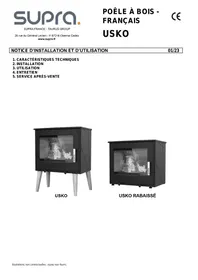
USKO - Wood stove SUPRA - Free user manual and instructions
Find the device manual for free USKO SUPRA in PDF.



| Product Type | Swiveling Wood Stove |
| Brand | SUPRA |
| Model | USKO |
| Operating Category | Intermittent (door closed only) |
| Nominal Power | 8.7 kW |
| Energy Efficiency | 77% (seasonal efficiency 67%) |
| Authorized Fuel | Firewood logs (50 cm max, 15-20% humidity) |
| Nominal Hourly Load | 2.86 kg |
| Refueling Interval | 45 minutes |
| Flue Outlet Diameter | 150 mm |
| Minimum Chimney Height | 4 m |
| Operating Draft | 12 Pa ± 2 Pa (max 20 Pa) |
| Connection | Horizontal or vertical (removable flue spigot) |
| External Air Intake | Possible (spigot Ø100 mm, free area 50 cm²) |
| Controls | Primary air (intensity regulation) and secondary air (ignition) |
| Accessories Included | Insulating glove |
| Safety Distances | 2 m between glass and any flammable material |
| Mandatory Sweeping | 2 times per year (including one during heating season) |
| Glass Maintenance | Cold cleaning with damp cloth and wood ash |
| Ash Removal | Regular, removable ash pan |
| Wear Parts | Gaskets, baffle, parts in contact with flame |
| Warranty | Subject to compliance with draft (<20 Pa) and proper installation |
Frequently Asked Questions - USKO SUPRA
User questions about USKO SUPRA
0 question about this device. Answer the ones you know or ask your own.
Ask a new question about this device
Download the instructions for your Wood stove in PDF format for free! Find your manual USKO - SUPRA and take your electronic device back in hand. On this page are published all the documents necessary for the use of your device. USKO by SUPRA.
USER MANUAL USKO SUPRA
https://www.youtube.com/watch?v=ebOr4vmj2Jo
INSTALLATION INSTRUCTIONS AND USER MANUAL
01/23
- TECHNICAL SPECIFICATIONS
- INSTALLATION
- USE
- MAINTENANCE
- AFTER-SALES SERVICE
- IMPORTANT -
You have just purchased a wood burning stove from our range. We would first like to congratulate you on your choice. This appliance has been carefully designed. In order to make the most of all its advantages, we would advise you to request the services of one of our specialists. This will ensure that the installation is made in accordance with good practices and will guarantee the best operating and safety conditions, bearing all the responsibility for the final installation.
Before lighting the fire for the first time, please read these installation instructions and user manual carefully. Retain the manual and warranty (which indicates the model and serial No.). The person performing the installation work shall be fully responsible for any failure to comply with the instructions set out in these documents.
- IMPORTANT ASSEMBLY INFORMATION -
Your stove has a "good draw" but you do not know its draught value! The chimney draught is measured in Pascal (Pa). The inserts, fireboxes and stoves have been designed, optimised and manufactured in accordance with standards NF EN 13229 (or NF EN 13240) to operate connected to a chimney with a draught of 12Pa . It frequently happens (in more than one in two chimneys) that the draught is far too high (over 20Pa ) due to the fact that the chimney is either too high or due to the flue liner. In this case, the appliances will operate in abnormal conditions which may lead to:
- Excessive wood consumption: this can be three times as much as an appliance with a draught of 12 Pa.
- A fire that "does not last" and burns too quickly while producing insufficient heat.
- A quick and inevitable deterioration of the appliance (cracks in the cast iron panels or in the refractory bricks)
- A voided warranty.
To avoid all these problems, there is only one solution!
Get a professional to check the chimney draught (with the appliance operating) and, if it is above 20 Pa, then install a damper or an adaptor at the flue connection.
1. TECHNICAL SPECIFICATIONS
| SWIVEL STOVE | USKO |
| Stove category | Intermittent |
| Rated heat output (1) | 8.7 kW |
| Operating mode | Only with the door closed |
| Connection type | Horizontal or vertical |
| Mean flue gas temperature | 301 °C |
| Efficiency | 77 % |
| Seasonal efficiency | 67 % |
| CO concentration (13% 02) | 0.08 % |
| CO2 concentration (13% 02) | 9.4 % |
| Dust concentration (13% 02) | 40 mg/Nm3 |
| VOC | 55 mg/Nm3 |
| NOX | 130 mg/Nm3 |
| Fuel | Wood |
| Log size | 50 cm |
| Nominal load per hour approx. | 2.86 kg |
| Refuelling | 45 m. |
| Prohibited fuels | All the rest, including coal and its derivatives |
| Approx. flue gas mass flow | 8.92 g/s |
| Flue pipe nominal diameter | 150 mm |
| Characteristics of the flue pipe | |
| Minimum dimensions of the chimney terminal | 20 x 20 cm |
| Ø min. flue lining or insulated metal duct | 150 mm |
| Minimum height of the pipe above the appliance | 4 m |
| Ventilation of the room | 1.2 dm2 |
| Draught (10 Pa = 1 mm CE) | |
| Nominal efficiency | 12 Pa ± 2 Pa |
| Performance in slumber mode (min. permitted) | 6 Pa ± 1 Pa |
| Max. permitted | 20 Pa |
| Nameplate | On the rear of the appliance |
| Accessories supplied | |
| Insulating glove | |
| Option available | |
| - | |
C
- WARNINGS -
This appliance is designed to burn wood. Liquid fuels, coal and its derivatives are not permitted, and the stove must not be used as a garbage incinerator.
When installing and using the stove, you must comply with local and national regulations as well as with European standards (2).
The stove heats up during operation, particularly the glass window. It remains hot for a long time, even when the flames are no longer visible. Take care to prevent any contact with the stove (prevent children from going near it).
Before accessing the electrical connection devices, the power supply must be disconnected.
This appliance must be installed in accordance with the specifications of the applicable standards (2). Professional installation is recommended.
The instructions provided in this manual must be carefully followed. Keep this manual in a safe place.
The manufacturer's liability is limited to the supply of the appliance. The manufacturer is not liable for failure to comply with these instructions.
It is particularly forbidden to:
Position materials that could be damaged or affected by the heat (furniture, wallpaper, woodwork, etc.) close to the appliance. Install any type of heat recovery system.
Use any fuel other than natural wood or lignite.
Make any changes to the appliance or installation not indicated by the manufacturer. This would exempt the manufacturer from liability and void the warranty. Only the spares recommended by the manufacturer should be used.
The person performing the installation work shall be fully liable for any failure to comply with the instructions set out in these documents. Installations in public places are subject to the municipal health regulations of your local authorities.
The manufacturer reserves the right to change without prior notice the presentation and dimensions of the models, as well as their assembly, if necessary. The diagrams and texts hereof are the sole property of the manufacturer and must not be reproduced without the manufacturer's written authorisation.
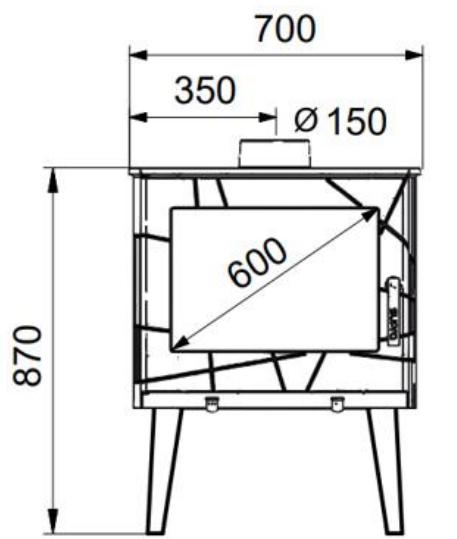

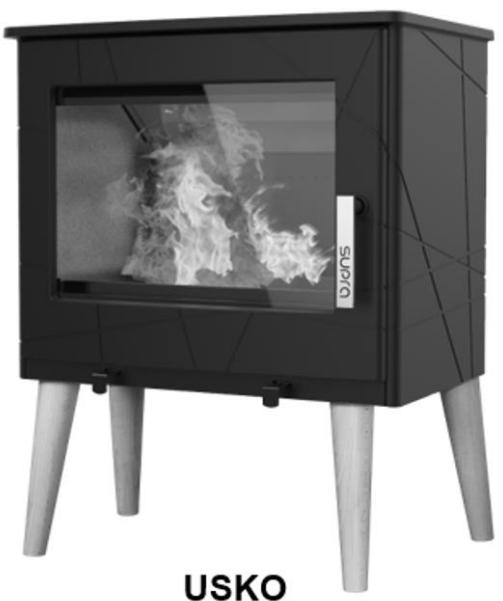
USKO
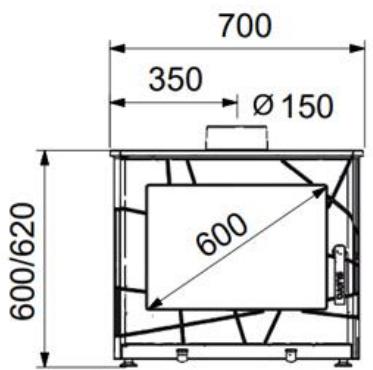
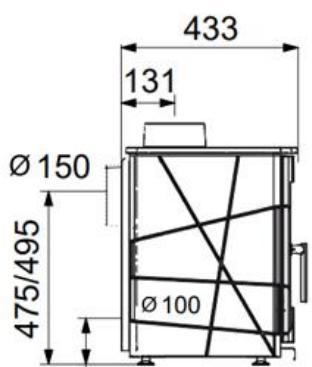
115/135
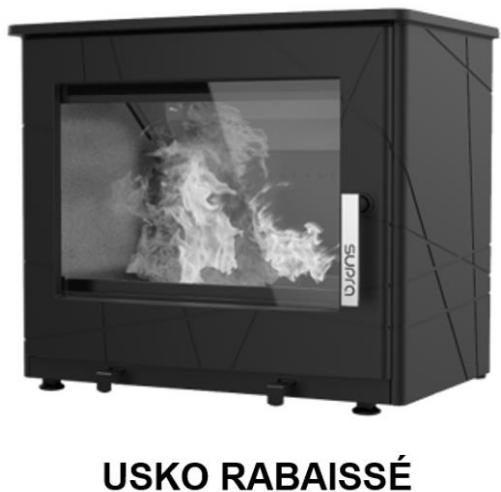
USKORABAISSE
2. INSTALLATION:
DEFINITION
Wood burning stove designed for installation close to a wall, and which can be moved with no need for additional work. The connection to the flue pipe is made through stainless steel or vitreous enamel pipes conforming to standard NFD 35-302. The connection must be made to an individual flue pipe.
SAFETY CLEARANCE
Comply with the safety clearances indicated between the wall and the sides or the back of the appliance. If the wall is noncombustible, then the safety clearance does not apply. Regardless of the orientation of the stove, there must be a clearance of 2m between the glass and the wall or any flammable material.
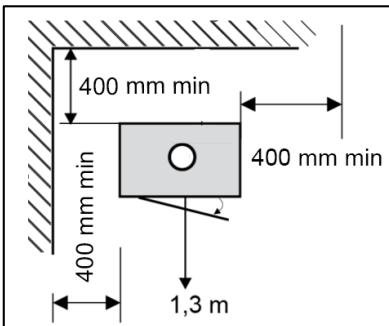
PREPARATION OF THE STOVE
Unpack the appliance: remove the screws securing it to the pallet. Install the stove on a floor with sufficient load-bearing capacity. If the floor cannot support the load, then measures should first be taken (for example, the installation of a load distribution plate). Position the stove in its definitive location and level it. For ease of maintenance, it is recommended to lay tiles or some other type of covering in the load-bearing area.
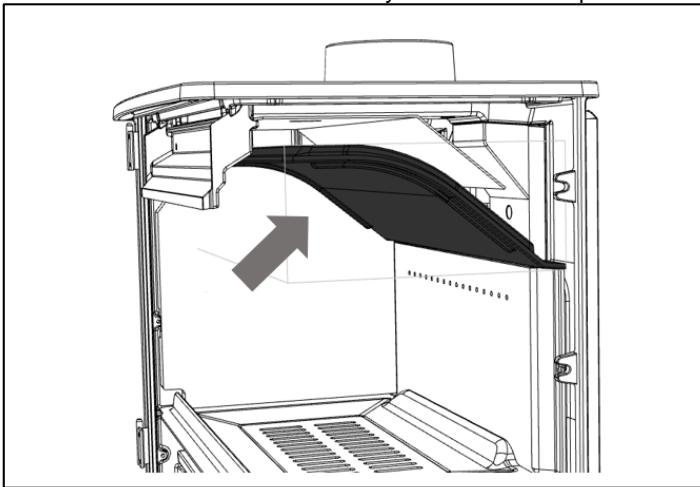
MOUNTING THE BAFFLE PLATE
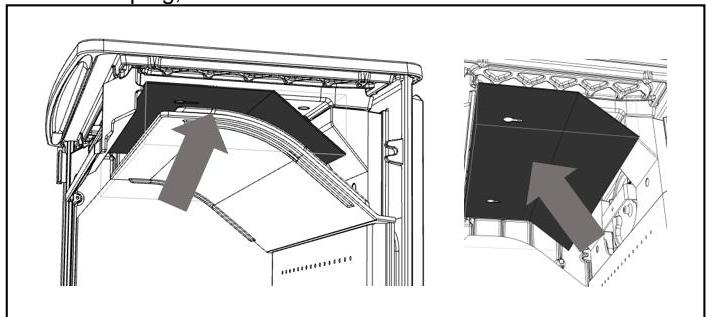
An important element of the appliance's performance, the cast iron smoke deflector facilitates the collection of soot during sweeping. On delivery, the deflector is mounted in the device. Before putting the wood stove into service, assemble and disassemble the deflector several times to familiarize yourself with this operation.
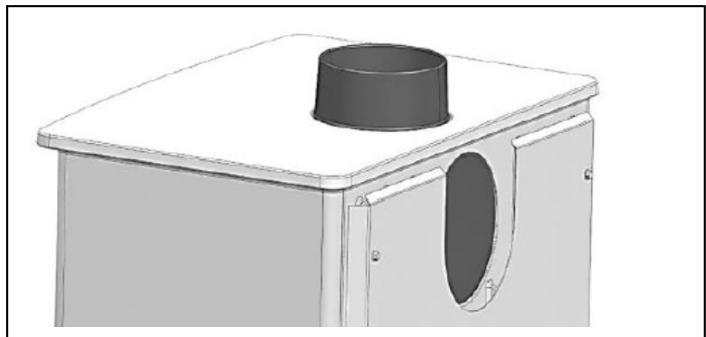
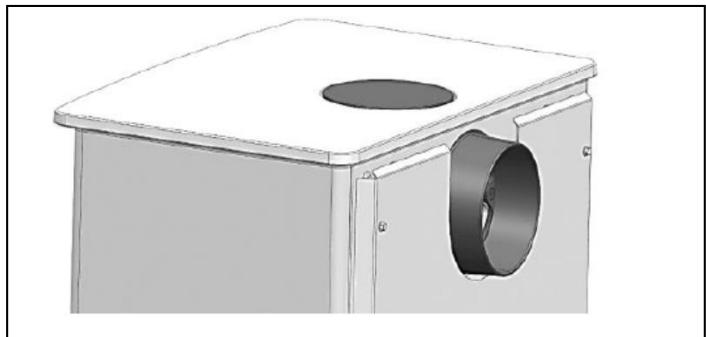
CHANGING FROM A TOP TO REAR OUTLET
At the time of delivery, the 0150 collar is mounted on the top outlet of the stove. Depending on the flue type, the collar can also be installed on the rear outlet of the appliance.
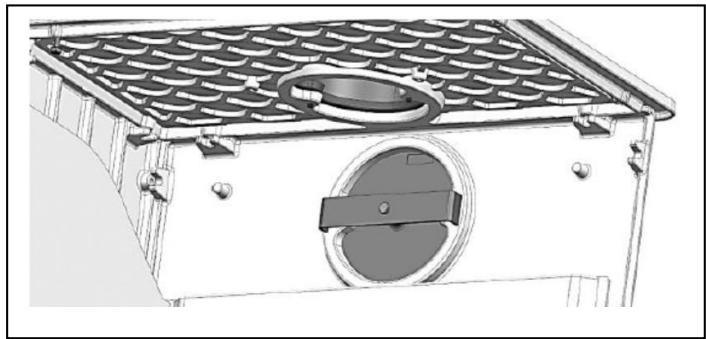
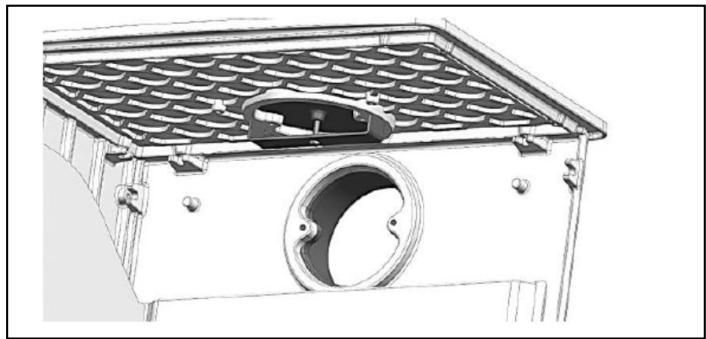
To reverse the collar, proceed as follows:
- Unscrew the two screws on the flue collar.
- Release the clips on the plate at the back of the appliance.
- Loosen the rear stop
-
Screw the flue collar on to the back of the appliance.
-
Screw the stop back onto the top of the appliance.
CONNECTING THE FLUE PIPE
Treat this point of the installation with care and attention in accordance with DTU 24.1. This appliance must not be connected to a shared flue system. For ducts that are already in place: get it cleaned (mechanical chimney brush). Get an authorised stove-maker to check it for soundness and suitability (stability, air tightness, compatibility of materials, diameter, etc.). If the flue is not compatible (old, cracked, considerable blockage): - contact a specialist so that it can be repaired in order to comply with the regulations in force.
CONNECTING PIPES
Use pipes made from enamelled T450 stainless steel or 316 stainless steel (available at your stockist), without reducing their length.
The connection to the flue must be made in the room in which the appliance is installed. Provide access for chimney sweeping and to clean the flue pipe. The pipe must not stick out of the flue pipe and the connections must be removable and airtight.
Maintain a minimum distance of 3 × diameter between the connecting pipe and the wall.
Avoid having a long horizontal section in front of the flue. If this is inevitable, then give it a rising slope of 5 cm per metre.
COMBUSTION AIR CONNECTION
Outdoor air intake not connected.
If it is not possible to connect the collar to an outdoor air intake, then it will be necessary to get an additional fresh air intake positioned facing the prevailing winds to permit correct combustion, particularly if the house is heavily insulated and/or fitted with a controlled mechanical ventilation system (C. M.V.) It must have a minimum air passage of: 1dm^2 . Do not operate the stove if a smoke extractor hood is operating. If the house does not have a ventilation system that is based on the air sweeping principle (in accordance with Spanish decree of March 1982), then the air inlet must be free from obstruction.
Outdoor air intake connected.
There is a 100 outdoor air connection at the back of the stove. It is designed to take in as much combustion air as possible from outdoors. This increases the efficiency of the instillation and reduces the discomfort caused by the input of pure air. Given that not all the combustion air is taken through this outdoor air inlet, an additional air input of 50~cm^2 must be foreseen.
Principles for the supply of combustion air:
1) Directly through the wall.
2) Through a duct that ends in a sanitary vacuum; the section of the sanitary vacuum ventilation grid (in cm^2 ) must be equal to 5 times the surface area of the same (in m^2 ).
3) Through a buried duct (one 90^ elbow at most)
| L max with Ø 80 mm duct | 6 m |
| L max with Ø 100 mm duct | 8 m |
Connect the collar with a clamp (not supplied) to the outside (with a flexible aluminium tube, not supplied). Remount the rear plate (if necessary). The air inlet must not be obstructed. On the outside, the air inlet duct must be oriented towards the prevailing winds. A grid should be installed over the duct opening to prevent obstructions, with a free cross-section that is the same as that of the duct and with a mesh of more than 3 mm.
3. USE
TAKE NOTE:
This wood burning stove is designed to be used with the door closed. The door must remain closed except for refuelling.
To avoid burns, do not touch the appliance and wear gloves to operate the controls.
The heat emitted through the glass makes it necessary to maintain a safety clearance with any material that could be damaged by the heat (furniture, wallpaper, woodwork, etc.). A 2 m clearance will avoid any risk.
FUEL
Wood
Only burn air-dried logs (2 to 3 years, stored in a sheltered and well-ventilated place) with a maximum humidity of 15 to 20% . Preferably hardwoods (birch, hornbeam, beech, etc.).
Avoid softwoods (lime, chestnut, willow, poplar).
It is strictly forbidden to permanently use softwoods (pine, fir, etc.) as well as the use of waste from processed wood (railway sleepers, woodworking waste, etc.) and household scraps (vegetables or plastics).
Never use small wood, boxes, woodchips and vine shoots as these will lead to sudden overheating.
Lignite
Lignite briquettes can be used by themselves or with wood for slow burning. Place the briquettes in a single layer on a bed of embers, limited to the surface area of the grid.
TAKE NOTE: The use of coal or its derivatives is strictly prohibited, even on an occasional basis. This appliance must not be used to burn domestic waste.
CONTROLS
Combustion air control
The air control regulates the combustion air flow and permits the precise control of the fire.
| TABLE (*) | PRIMARY AIR DAMPER (1) | SECONDARY AIR DAMPER (2) |
| Lighting the fire | Open / Draught | Open / Draught |
| Nominal efficiency | 1/2 | 1/2 |
| Performance in slumber mode | 1/2 | Closed/Pressed |
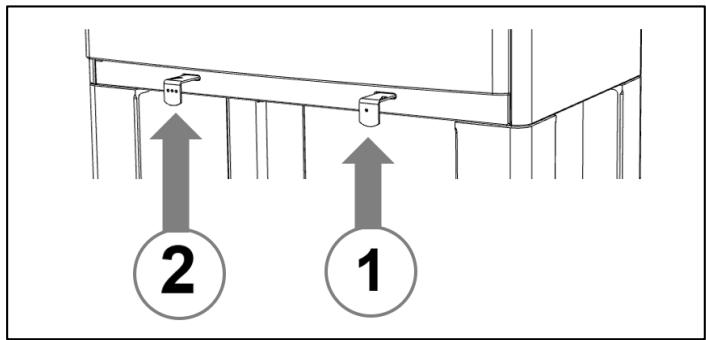
Damper 1 controls the heat output. Damper 2 is only used to heat the stove when lighting it. Once the stove is hot, close it. Keeping damper 2 open when the stove is already hot may cause overheating and damage internal parts.
Door handle
To open-close the door:
- When the appliance is cold, directly with your hands
- When the appliance is hot, with an insulating glove.
LIGHTING THE FIRE FOR THE FIRST TIME
Remove the self-adhesive labels (except for the nameplate), any possible blocking cards, and make sure that the ash tray is empty. Start with a small fire and gradually increase the load. This progressive heating allows the materials to expand slowly and to stabilise. There may be some fumes and odours, due to the paintwork. These will gradually disappear. Do this for a few days until normal use. Open the windows during the first hours of operation.
When heating up for the first time, check the draught according to the technical specifications table.
SERVICE
Lighting the fire
To light your appliance, preferably follow the fire lighting procedure described above. This fire lighting technique makes it possible to heat up the flue and to remove any blockages (negative pressure) that may form when the weather is bad or cold, thereby preventing the air from blowing back into the room when the fire is lit.
The procedure is as follows:
- Put the air combustion control to the maximum setting.
- Place 2 logs on the firebox grid.
- Place the kindling wood in the shape of a tower on top of the logs.
- Put 1 or 2 fire-lighter cubes on the wood and set alight.
- Lose the door.
For further information, view the Supra video on YouTube at: https://www.youtube.com/watch?v=ebOr4vMj2Jo
TAKE NOTE: Never use petrol, alcohol or fuel-oil, etc.
Reloading
Reload the appliance once there is a good bed of embers and the flames have gone out. Gently open the loading door, to prevent fumes from getting out (if opening during the combustion stage) or embers from falling. Once the wood has been loaded, close the door.
Nominal efficiency
Adjust the controls according to the table (^*) . The intensity of the fire will be determined by the amount of fuel. The correct operation of the appliance depends on a suitable air supply.
NOMINAL LOADING
For the optimum operation, load 2 small logs of wood. Place the logs to the back of the appliance to prevent embers from falling out.
Performance in slumber mode
Adjust the controls according to the table (^*) . Do not operate the appliance in slumber mode for long periods of time. The temperature of the combustion gases is insufficient and, instead of being eliminated, they condense in the flue pipe. This increases the amount of dirt in the chimney and appliance (walls and glass).
IN THE EVENT OF AN INCIDENT
In the event of an incident in the room (fire in the chimney, fire in the room, etc.), quickly close the loading door and all the stove controls. Do not pour water into the firebox. Call the fire brigade.
4. MAINTENANCE - RECOMMENDATIONS
ASH REMOVAL
The ashes can be removed when the stove is operating. Regularly empty the removable ash tray. The build-up of ashes hinders the air flow under the grid, distorting the flow and affecting combustion. Then replace the ash tray.
CLEANING THE FRONT AND SIDES
Do not use water, solvents or abrasive products (not even slightly) to clean the stove, only a soft, dry cloth.
CLEANING THE GLASS WINDOW
Clean the glass when it is cold, with a damp cloth dipped in wood ashes. The air sweep system keeps the glass as clean as possible. However, during normal operation, there may be a slight darkening in some areas of the glass. In slumber mode, the air sweep is less efficient.
SOOT REMOVAL
The legislation provides for 2 chimney sweeps a year (including one during the heating period) to be performed with mechanical means (rotary brush). Keep the documents signed by the company responsible for this work as proof that this has been done. When sweeping, remove the second deflector.
ANNUAL MAINTENANCE
After each heating season, clean the stove thoroughly and check that all moving parts of the appliance are operating correctly. Check the conditions of the seals and the parts in contact with the flames.
5. AFTER-SALES SERVICE
The appliance has parts that are subject to wear and tear and should be checked during the annual maintenance. Your stockist will supply you with the necessary spares.
When requesting information or spares, you need to indicate the part number and the serial number of the appliance, which can be found on the nameplate. Only use the spares supplied by the manufacturer.
https://www.youtube.com/watch?v=ebOr4vMj2Jo
CUIDADO: Nunca utilize gasolina, álcool ou oleos combustibileis, etc.
Carregamento
https://www.youtube.com/watch?v=ebOr4vMj2Jo

- INSTALLATION INSTRUCTIONS AND USER MANUAL
- - IMPORTANT -
- - IMPORTANT ASSEMBLY INFORMATION -
- TECHNICAL SPECIFICATIONS
- - WARNINGS -
- INSTALLATION:
- DEFINITION
- SAFETY CLEARANCE
- PREPARATION OF THE STOVE
- MOUNTING THE BAFFLE PLATE
- CHANGING FROM A TOP TO REAR OUTLET
- CONNECTING THE FLUE PIPE
- CONNECTING PIPES
- COMBUSTION AIR CONNECTION
- Outdoor air intake not connected.
- Outdoor air intake connected.
- Principles for the supply of combustion air:
- USE
- TAKE NOTE:
- FUEL
- Wood
- Lignite
- CONTROLS
- Combustion air control
- Door handle
- LIGHTING THE FIRE FOR THE FIRST TIME
- SERVICE
- Lighting the fire
- The procedure is as follows:
- Reloading
- Nominal efficiency
- NOMINAL LOADING
- Performance in slumber mode
- IN THE EVENT OF AN INCIDENT
- MAINTENANCE - RECOMMENDATIONS
- ASH REMOVAL
- CLEANING THE FRONT AND SIDES
- CLEANING THE GLASS WINDOW
- SOOT REMOVAL
- ANNUAL MAINTENANCE
- AFTER-SALES SERVICE
- Carregamento
Brand : SUPRA
Model : USKO
Category : Wood stove