Compact kettle 47 noir - Barbecue WEBER - Free user manual and instructions
Find the device manual for free Compact kettle 47 noir WEBER in PDF.



| Product type | Charcoal barbecue |
| Brand | Weber |
| Model | Compact Kettle 47 black |
| Bowl diameter | 47 cm |
| Weight | Approximately 17 kg |
| Fuel type | Manual (charcoal) |
| Main material | Steel with porcelain coating |
| Cooking grate | Plated steel, diameter 47 cm |
| Cooking methods | Direct and indirect |
| Recommended number of briquettes (direct) | 40 briquettes |
| Recommended number of briquettes (indirect) | 20 on each side (first hour), 7 on each side (following hours) |
| Ventilation openings | Adjustable lower and upper |
| Lid | With hanging hook and handle |
| Ash catcher | Integrated, removable |
| Charcoal separators | Included (rails for indirect cooking) |
| Recommended fire starter | RapidFire® chimney starter or Weber® fire starter cubes |
| Maximum temperature | Approximately 300 °C |
| Usage | Outdoor only |
| Maintenance | Cleaning with water and mild detergent, brushing the grate |
| Safety | Detailed safety instructions (do not use indoors, keep away from combustible materials) |
| Warranty | 2 years (subject to terms) |
Frequently Asked Questions - Compact kettle 47 noir WEBER
User questions about Compact kettle 47 noir WEBER
0 question about this device. Answer the ones you know or ask your own.
Ask a new question about this device
Download the instructions for your Barbecue in PDF format for free! Find your manual Compact kettle 47 noir - WEBER and take your electronic device back in hand. On this page are published all the documents necessary for the use of your device. Compact kettle 47 noir by WEBER.
USER MANUAL Compact kettle 47 noir WEBER
GB English 2
Finnish 13
FR French. 24
IT Italian. 35
NO Norwegian. 46
DK Danish. 57
ES Spanish 68
SE Swedish. 79
DE German 90
NL Dutch 101
PT Portuguese 112
PL Polish 123
RU Russian. 134
SAFETY SYMBOLS will
alert you to important SAFETY information.
Signal words DANGER,
WARNING, or CAUTION will
be used with the SAFETY
SYMBOL.
DANGER will identify the most serious hazard.
Please read all safety information contained in this Owner's Guide.
DANGER
- This barbecue is designed for outdoor use only. If used indoors, toxic fumes will accumulate and cause serious bodily injury or death.
- Do not add charcoal starter fluid or charcoal impregnated with charcoal starter fluid to hot or warm charcoal. Cap starter fluid after use and place a safe distance away from the barbecue.
- Do not use petrol, alcohol, or other highly volatile fluids to ignite charcoal. If using charcoal starter fluid, remove any fluid that may have drained through the bottom vents before lighting the charcoal.
- Do not leave infants, children, or pets unattended near a hot barbecue.
- Do not attempt to move a hot barbecue.
- Do not use barbecue within five feet of any combustible material.
-
Do not use barbecue unless all parts are in place. Make sure the ash catcher is properly attached to the legs underneath the bowl of the barbecue.
-
Do not remove ashes until all charcoal is completely burned out and fully extinguished.
- Do not wear clothing with loose flowing sleeves while lighting or using the barbecue.
- Do not use barbecue in high winds.
WARNING
- To light or re-light do not use alcohol or gasoline! Use only fire lighters corresponding to EN 1860-3!
- Keep the barbecue in a level position at all times.
- Remove the lid from the barbecue while lighting and getting the charcoal started.
Always put charcoal on top of the charcoal grate and not directly into the bottom of the bowl. - Never touch the cooking or charcoal grate or the barbecue to see if they are hot.
- Use barbecue mitts or hot pads to protect hands while cooking or adjusting the vents.
GENERAL SAFETY
- Use proper barbecuing tools with long, heat-resistant handles.
- Use the hook on the inside of the lid to hang the lid on the side of the bowl of the barbecue. Avoid placing a hot lid on carpeting or grass. Do not hang the lid on the bowl handle.
- To extinguish the charcoal, place lid on the bowl and close all of the vents. Do not use water because it will damage the porcelain finish.
- To control flare-ups, place the lid on the kettle. Do not use water.
- Handle and store hot electric starters carefully.
- Keep electrical wires away from the hot surfaces of the barbecue.
CAUTION
- Lining the bowl with aluminum foil will obstruct the air flow. Instead, use a drip pan to catch drippings from meat when cooking by the Indirect Method.
-
Using sharp objects to clean the cooking grate or remove ashes will damage the finish.
-
Using abrasive cleaners on the cooking grate or the barbecue itself will damage the finish.
FOOD SAFETY TIPS
- Wash your hands thoroughly with hot, soapy water before starting any meal preparation and after handling fresh meat, fish, and poultry.
- Do not defrost meat, fish, or poultry at room temperature. Defrost in the refrigerator.
- Never place cooked food on the same plate the raw food was on.
- Wash all plates and cooking utensils which have come into contact with raw meats or fish with hot, soapy water and rinse.
FAILURE TO HEED THESE DANGER, WARNING, AND CAUTION STATEMENTS MAY CAUSE SERIOUS BODILY INJURY OR DEATH, OR A FIRE OR EXPLOSION RESULTING IN DAMAGE TO PROPERTY.
- Remove the lid and open all air vents before building the fire. NOTE: For proper airflow, remove accumulated ashes from the bottom of the barbecue if present (only after the coals are fully extinguished). Charcoal requires oxygen to burn, so be sure nothing clogs the vents.
- Mound the briquettes into a pyramid-shaped pile or pile the charcoal into a Weber® RapidFire® chimney starter.
-
Place either lighter cubes (they are non-toxic, odorless and tasteless) or crumpled newspaper under the pile of briquettes and light. NOTE: We purposely left out instructions for using lighter fluid. That's because we think the choices previously outlined are superior. Lighter fluid is messy and can impart a chemical taste to your food unless it is thoroughly burned off. If you choose to use lighter fluid, follow the manufacturer's instructions and NEVER add lighter fluid to a burning fire.
-
When coals are covered with a light grey ash (usually 25 to 30 minutes), arrange the coals with long-handled tongs according to the cooking method you are going to use.
- For additional smoke flavor, consider adding hardwood chips or chunks (soaked in water for at least 30 minutes and drained) or moistened fresh herbs such as rosemary, thyme, or bay leaves. Place the wet wood or herbs directly on the coals just before you begin cooking.
- When removing the barbecue lid during cooking, lift to the side, rather than straight up. Lifting straight up may create suction, drawing ashes up onto your food.
EASY STEPS TO BARBECUING GREATNESS
Follow these tips and you won't go wrong. And neither will your dinner.
-
Direct, Indirect, or a little of both? Read the recipe and look for the instructions for setting up your barbecue. There are two methods of cooking in a Weber® barbecue—Direct and Indirect. See the following pages for specific instructions.
-
Don't try to save time by placing food on a barbecue that's not quite ready. Let charcoal burn until it has a light grey ash coating (keep the vents open so the fire does not go out).
- Use a spatula and tongs but leave the fork. You've probably seen people poking their meat with one, but it causes juices and flavor to escape and that can dry out your food.
- Make sure the food fits on the barbecue with the lid down. At least 1 inch clearance between the food and the lid is ideal.
- Resist the urge to open the lid to check on your dinner every couple of minutes. Every time you lift the lid heat escapes, which means it will take longer to get dinner on the table.
Unless the recipe calls for it, turn your food over only once. - You will control flare-ups, reduce cooking time, and get altogether better results if you barbecue with the lid down.
HELPFUL HINTS
- Resist the urge to use a spatula to press down on foods such as burgers. You'll squeeze out all that wonderful flavor.
- A light coating of oil will help brown your food evenly and keep it from sticking to the cooking grate. Always brush or spray oil on your food, not the cooking grate.
EASY BARBECUE CARE
Add years to the life of your Weber® barbecue by giving it a thorough cleaning once a year.
IT'S EASY TO DO:
- Make sure the barbecue is cool and coals are totally extinguished.
- Remove the cooking and charcoal grates.
- Remove ashes.
- Wash your barbecue with a mild detergent and water. Rinse well with clear water and wipe dry.
- It is not necessary to wash the cooking grate after each use. Simply loosen residue with a brass bristle barbecue brush or crumpled aluminium foil, then wipe off with paper towels.
USING CHARCOAL DIVIDERS
- Open the top and bottom vents of the barbecue and remove the lid.
- Position the charcoal grate so that the steel rungs run across the kettle from handle to handle. By doing this, the charcoal dividers will be installed opposite the kettle handles, so that the briquettes will be away from the handles.
- Position the charcoal dividers so they hook over the outside straight rungs of the charcoal grate. The front of the charcoal dividers should slip over the third rung of the charcoal grate and click into place.
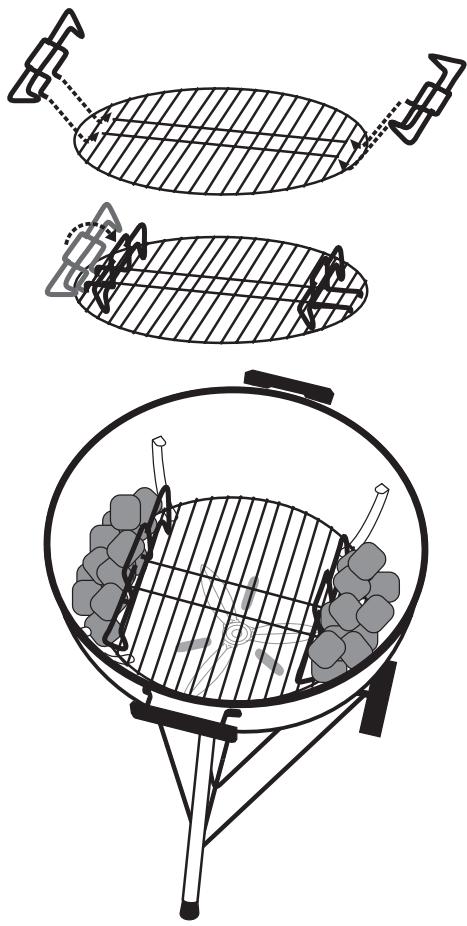
Using Charcoal Dividers
The Direct Method means that the food is cooked directly over prepared coals. For even cooking, food should be turned once, halfway through the barbecuing time. Use the Direct Method for foods that take less than 25 minutes to cook: steaks, chops, kebabs, vegetables, and the like.
- Open all vents.
-
Heap the recommended amount of charcoal briquettes in the center of the charcoal grate (refer to the chart below).
-
Ignite the charcoal briquettes. Leave the lid off until the briquettes have a light coating of grey ash, about 25 to 30 minutes.
- Spread prepared briquettes evenly across the charcoal grate.
- Position the cooking grate over the coals.
- Place food on the cooking grate.
- Place the lid on the barbecue. Consult your recipe for recommended cooking times.
| Charcoal Briquette Guide for the Direct Method of Cooking | |
| Barbecue Diameter | Briquettes Needed |
| 14 1/2" (37 cm) | 30 |
| 18 1/2" (47 cm) | 40 |
| 22 1/2" (57 cm) | 50 |
| 37 1/2" (95 cm) | 150 |
Use the Indirect Method for foods that require 25 minutes or more of barbecuing time or for foods so delicate that direct exposure to the heat source would dry them out or scorch them. Examples include joints, bone-in poultry pieces, and whole fish as well as delicate fish fillets. To set up for Indirect cooking, prepared charcoal briquettes are set on either side of the food. Heat rises, reflects off the lid and inside surfaces of the barbecue, and circulates to slowly cook the food evenly on all sides. There's no need to turn the food over.
NOTE: For meats that require more than one hour to cook, additional briquettes must be added to each side as indicated in the chart below.
- Open all vents.
-
Place the recommended amount of charcoal briquettes on each side of the charcoal grate (refer to the chart below). Leave enough room for a drip pan between the coals.
-
Ignite the charcoal briquettes. Leave the lid off until the coals have a light coating of grey ash, about 25 to 30 minutes.
- Place a drip pan between the coals in the center of the charcoal grate.
- Position the cooking grate over the coals.
- Place food on the cooking grate directly above the drip pan.
- Place the lid on the barbecue. Consult your recipe for recommended cooking times.
| Charcoal Briquette Guide for the Indirect Method of Cooking | ||
| Barbecue Diameter | Standard Briquettes for first hour | Standard Briquettes to add for each additional hour |
| 14 1/2" (37 cm) | 9 per side | 6 per side |
| 18 1/2" (47 cm) | 20 per side | 7 per side |
| 22 1/2" (57 cm) | 25 per side | 8 per side |
| 37 1/2" (95 cm) | 75 per side | 22 per side |
BARBECUING GUIDE
GB
The following cuts, thicknesses, weights, and barbecuing times are meant to be guidelines rather than hard and fast rules. Cooking times are affected by such factors as altitude, wind, outside temperature, and desired doneness.
Barbecue steaks, fish fillets, boneless chicken pieces, and vegetables using the Direct Method for the time given on the chart or to the desired doneness, turning once halfway through barbecuing time.
Barbecue joints, bone-in poultry pieces, whole fish, and thicker cuts using the Indirect Method for the time given on the chart or until an instant-read thermometer reaches the desired internal temperature. Cooking times for beef are for the US Department of Agriculture's definition of medium doneness unless otherwise noted.
NOTE: General rule for barbecuing fish: 4 to 5 minutes per 1.25 cm thickness; 8 to 10 minutes per 2.5 cm thickness.
| Beef | Thickness or Weight | Approximate Barbecuing Time |
| Steak: New York, porterhouse, rib-eye, Tenderloin | 2 cm thick | 8–10 min. Direct Medium |
| 2.5 cm thick | 10–12 min. Direct Medium | |
| Minced beef patty | 2 cm thick | 8–10 min. Direct Medium |
| Pork | Thickness or Weight | Approximate Barbecuing Time |
| Chop: rib, loin, or shoulder | 2 to 2.5 cm thick | 10–15 min. Direct Medium |
| Loin chop, boneless | 2.5 to 4.5 cm thick | 10–12 min. Direct Medium |
BARBECUING GUIDE
GB
| Poultry | Thickness or Weight | Approximate Barbecuing Time |
| Chicken breast, boneless, skinless | 170 g | 8–12 min. Direct Medium |
| Chicken thigh, boneless, skinless | 113 g | 8–10 min. Direct Medium |
| Chicken pieces, bone-in breast/wing | 30–40 min. Indirect Medium | |
| Chicken pieces, bone-in leg/thigh | 40–50 min. Indirect Medium |
| Fish | Thickness or Weight | Approximate Barbecuing Time |
| Fish, fillet or steak | 0.6 to 1.25 cm thick | 3-5 min. Direct High |
| 1.25 to 2.5 cm thick | 5-10 min. Direct High | |
| 2.5 to 4 cm thick | 10-12 min. Direct High | |
| Fish, whole | 0.45 kg | 15-20 min. Indirect High |
| Vegetables | Thickness or Weight | Approximate Barbecuing Time |
| Asparagus | 6-8 min. Direct Medium | |
| Maize, husked | 10-12 min. Direct Medium | |
| in husk | 25-30 min. Direct Medium | |
| Mushroom, shiitake or button | 8-10 min. Direct Medium | |
| portabello | 12-15 min. Direct Medium | |
| Onion | 1.25 cm slices | 8-12 min. Direct Medium |
| Potato | 1.25 cm slices | 14-16 min. Direct Medium |
| Courgette | Halved | 6-10 min. Direct Medium |
| 1.25 cm slices | 6-8 min. Direct Medium |
WHOLE ROAST CHICKEN
Indirect/Medium
1 whole chicken, 1.8 - 2.25 kg
Cooking oil
Salt and freshly ground pepper
Rinse chicken and pat dry with paper towels. Twist wing tips under back and tie legs together with string. Brush entire outer surface of chicken with oil and lightly season with salt and pepper.
Place chicken, breast side up, on the cooking grate and barbecue until the internal temperature reaches 180^ / 82^ in the thickest part of the thigh and 170^ / 77^ in the breast, 1-1/4 to 1-1/2 hours. Transfer chicken to serving platter; let stand 10 minutes before carving.
Makes 4 to 6 servings.
SPICY LAMB KEBABSS
Direct/Medium
For the marinade:
1/2 cup olive oil
1/4 cup red wine vinegar
1 tablespoon lemon juice
2 tablespoons grated orange rind
1 green onion and top, chopped
1/4 teaspoon ground cinnamon
1/8 teaspoon ground cloves
0.9 kg lean lamb, cut into 3.8 cm cubes
To make the marinade: Combine the marinade ingredients in a shallow, glass baking dish or plastic bag. Refrigerate, covered, 4 to 6 hours. Drain lamb; reserve marinade. Pour reserved marinade into a small sauce pan. Bring to a boil over high heat and boil for 1 full minute.
Arrange lamb on 4 to 6 skewers. Barbecue lamb over Direct Medium heat to medium doneness, about 10 minutes, turning and basting with the reserved marinade once halfway through barbecuing time.
Makes 4 to 6 servings.
SIMPLE STEAKS
Direct/Medium
4 New York strip, tenderloin, steak sirloin, or rib-eye beef steaks, about 0.34kg each and 2.5 cm thick
Kosher salt
Freshly ground black pepper
Extra-virgin olive oil
Season both sides of the steaks with salt and pepper, pressing the spices into the meat. Allow to stand at room temperature for 20 to 30 minutes before barbecuing. Lightly spray or brush both sides of the steaks with olive oil. Barbecue the steaks over Direct Medium heat until the internal temperature reaches 145^ / 62^ for medium rare, 8 to 10 minutes, turning once halfway through barbecuing time.
Remove from the barbecue and stand for 3 to 5 minutes. Serve warm.
Makes 4 servings.
CLASSIC BONE-IN CHICKEN BREASTS
Indirect/Medium
4 chicken breast halves (with bone and skin), 285 - 340 g each Kosher salt Freshly ground black pepper Extra-virgin olive oil
Rinse the chicken breasts under cold water and pat dry with paper towels. Season the breasts with salt and pepper and lightly brush or spray both sides with olive oil. Barbecue the chicken, skin side up, over Indirect Medium heat until the juices run clear and the meat is no longer pink at the bone, 30 to 40 minutes. For crispier skin, barbecue the breasts, skin side down, over Direct Medium heat during the last 5 minutes of barbecuing time. Serve warm.
Makes 4 servings.
FABULOUS FISH FILLETS
Direct/High
4 swordfish or halibut fillets, 170 - 227 g each and about 2.5 cm thick Kosher salt Freshly ground black pepper Extra-virgin olive oil Lemon wedges (optional)
Season the fish fillets with salt and pepper and lightly brush or spray both sides with olive oil. Barbecue the fillets over Direct High heat until opaque in the center, 8 to 10 minutes, turning once halfway through barbecuing time. Serve warm with lemon wedges, if desired.
Makes 4 servings.
SALMON STEAK KYOTO
Direct/Medium
4 salmon steaks, about 2.5 cm thick Olive oil
For the marinade:
1/3 cup soy sauce
1/4 cup orange juice concentrate
2 tablespoons olive oil
2 tablespoons tomato sauce
1 teaspoon lemon juice
1/2 teaspoon prepared mustard
1 tablespoon spring onion and top, chopped
1 clove garlic, crushed
1/2 teaspoon ground ginger root
To make the marinade: In a small bowl whisk together the marinade ingredients; pour mixture over salmon steaks in shallow glass baking dish. Refrigerate, covered, 30 to 60 minutes. Drain salmon and reserve marinade. Pour the reserved marinade into a small saucepan. Bring to a boil over high heat and boil for 1 full minute. Lightly brush or spray steaks with olive oil and place on the cooking grate. Barbecue over Direct Medium heat until fish is tender and flakes with a fork, 5 to 10 minutes, depending upon thickness of fish. Turn salmon and brush with marinade once halfway through cooking time.
Makes 4 servings.
SHRIMP KEBABS WITH CURRY BUTTER
Direct/High
For the curry butter:
1/4 cup butter
2 tablespoons finely chopped onion
1 teaspoon snipped fresh dill
1 to 1-1/2 teaspoons curry powder
Dash garlic powder
16 to 20 jumbo shrimp, 0.68 - 0.90 kg, peeled and veined
Olive oil
Lime or lemon wedges
Fresh dill or parsley sprigs
To make the curry butter: Melt the butter in a small pan over medium-high heat. Stir in onion, dill, curry powder, and garlic powder; cook 5 minutes.
Thread shrimp on skewers, leaving space between pieces. Lightly brush or spray the shrimp with olive oil. Barbecue over Direct High heat until the shrimp turn pink and are tender, 2 to 5 minutes, turning and brushing with the curry butter once halfway through barbecuing time. Arrange shrimp on serving plate. Garnish with lime wedges and dill.
Makes 4 servings.
GRILLED RED SWEET PEPPERS STUFFED WITH MOZZARELLA CHEESE
Indirect/Medium
1 small loaf crusty Italian bread
3 tablespoons olive oil
3 medium red sweet peppers
1 cup fresh mozzarella cheese, cut into small cubes
1-1/2 teaspoons dried basil
1 clove garlic, finely chopped
1 tablespoon olive oil Salt
Freshly ground black pepper
Thinly slice bread, remove crusts and cut into enough 1/2 croutons to make 1 cup. Warm the olive oil in a skillet, add the croutons, and sauté until golden; drain on paper towels. Cut tops off peppers about 1/2 from top, and reserve tops. Carefully remove seeds and membranes. In a bowl combine croutons, mozzarella, basil, garlic, and oil. Mix well, adding salt and pepper to taste. Stuff peppers with mixture, replace tops and secure with toothpicks. Place peppers on the cooking grate, top sides up, over Indirect Medium heat until peppers are soft but still hold their shape, 12 to 15 minutes. Remove tops and cut in half lengthwise.
Makes 6 servings.
PARADISE GRILLED
from Weber®s Big Book of Grilling™
Indirect/Medium
For the glaze:
3/4 cup fresh orange juice
1 tablespoon honey
1 tablespoon fresh lime juice
2 teaspoons cornstarch
4 slices fresh pineapple, about 1/2 inch thick each
1 teaspoon cracked dried green peppercorns or cracked black peppercorns
4 scoops vanilla ice cream
To make the glaze: In a small saucepan combine the glaze ingredients and whisk until smooth. Bring to a boil over medium-high heat and cook until thickened, 1 to 2 minutes. Keep the glaze warm or reheat when ready to serve.
Season both sides of the pineapple slices with the peppercorns. Barbecue over Indirect Medium heat until well marked, 6 to 8 minutes, turning once halfway through barbecuing time. Serve each
pineapple slice with a scoop of ice cream and some of the glaze drizzled over the top.
Makes 4 servings.
TURVALLISUUSSYMBOLIT
VEDLIKEHOLD AV GRILLEN
Du forlenger levetiden for din Weber grill ved a rengjore den grundig en gang om aret.
DET ER ENKELT:
Forsikre deg om at grillen er kald og at det/DDke lenger finnes glor i grillkullet.
Ta av grill- og kullristene.
Fjern aske.
Vask grillen med et mildt vaskemiddel og vann. Skyll grundig med rent vann. Tork opp vannet.
- Det er ikke nødvendig Å rengjore grillristen etter hver gangs bruk. Fjern ganske enkelt eventuelle rester med en grillbørste i messing ellr ltt sammenkrøllet aluminiumsfolie, og tørk av med et papirhändkle.
BRUK AV BRIKETTSKILLERE
- Åpne topp- og bunnventilene på grillen og ta av lokket.
- Plasser kullristen slick at brikettskillerne vender fra händtak til händtak. På denen maten anbringes brikettskillerne motsatt av grillens händtak, og brikettene holdes vekk fra händtakene.
- Plasser briketskillerne slick at de hukes over de ytre, rette stålstengene på kullristen. Fronten på briketskillerne skal på smette over den tredje stålstangen på kullristen og klikke på plass.
DET ER NEMT AT GORE:
FABELHAFTES FISCHFILETS
Aus Weber's Big Book of GrillingTM
make u attend op belangrijke VEILIGHEIDSINFORMATIE.
De woorden GEVAAR,
WAARSCHUWING of
VOORZICHTIG worden
Weber's Big Book of GrillingTM
Pośrednia/Średnia
Polewa:
3/4 filizanki swiezego soku z pomaranczy
He nCnoJIb3yI Te Body.
- Пюявлай Te octopoЖноctb риобрашени и xpaанени Горачх Эль ekтуческп пожiroВ.
Cneinte 3a tem, uTo6bI B6n3n OT rOpauHx NOBepXHOCTe IprnJI He OKa3aJIncb 3JIeKTPnueckne npoBOda.
OCTOPOXHO
- 06eptbBaHne yaun anHOMnHneBOI ΦoIbro 6ydet npenrTCTBOBaTb nToKy BO3dyxa, BmecTo 3tOrO, noIb3yIteCb KaIpeynOBHTeJeM, uTo6bl Co6paTb KaIIN C Mca npn npIrTOBJIeHN HEnpMaIM cnOco6om.
IcnoJb3OBAHne OCTpbix npedMeTOB IJIY UNTKn peWETKN IJIY NIIU INI YdaJIeHn 3OJIbIOBpeDIT NOKpbITHe. - Исторын cpeintb Ha peiTeKe Дя пии писamom Гпл e NOBpeint nokpbltne.
COBETBIPO BE3OPIACHOMU OBPAUENIO C PNIUEI
MoIte TuaTeNbHO pyKn CMbIOM nepeH naJOM nOdrTOBkn IIO6bIX NnueBbIX npOdyKToB IN oCne pa3dEJIKN CBeJcEro Mca,
pbblnNTnbl.
- He pa3mopajnBaIte Maco, pb6y nIn nTnUy npN KOMHaTHoI TeMnepaType. Pa3mopajnBaIte B XOJIOINJIbHnke.
- HNKoIa He KlaInte npnroTOBneHny O NNUy Ha Ty JKe camYIO nOcyu, rHe HaxOdnacb cbipra NIIua.
MoTe BcIO nocuyu KxOHHbIe np6Opbl, KOtOpblc KOHTaKTnPOBaJI N C cbIpIM MRCOM nn pbl6oI, ropaeBBOOJ CMbIOM I ONJaCKNBAIte.
HEBbIOJHHeHNE TAKNX IPEdIINCAHn, KAK ONACHO,BHIMAHNE N OCTOPOXHO,MOXET CTATb PnUHHoN CEPbE3HOTo TEJIeCHOTO IOBPEKJDEHnI Nm CMEPTN,A TAKXE Bbl3BATb POxAP nI IN B3PbIB,PNIBOJaI K IOBPEKJDEHIO IMyIeCTBA.
KAK PA3XECh BAAI TPNJIb HA DPEBECHOM YTJE
- CHIMITE KpbIswky I OTKPOIte BCE BeHTnIaUHOHHbIe OTBepCTNnepepa3BeDeHHeM OrH.IPIMEUAHHe:ДЯ npabuNbHOro BO3duShoro NOTOKa, ydaJInteCKONINBswyOc 30Jy CO dHa rPnIa,ecNI TaKOBaY eCTb (ToIbKO NOcIe TOrO, KaK yIiN NOnHOCTbHO NOTyxHyT).ДЯ rOpEHnIApeBecHO rYIa Heo6XoDmKncLOpO,Io3tOMy y6eINTecb,уTO BeHTnIaUHOHHbIe OTBepCTNHiueM He 3acOpehbl.
Cnojnte 6pikketb B npamndy nn HabaIte dpBecehbl yroIb B cTapTe pna po3Knra yrnei WeberRapidFire.
-ПОLOЖNTe Ил 3апальнBLE КУБИКи (Они He TOKСИЧны, 6e3 3anaxa n 6e3 Bkyca), Ил NСКOMKaHHyO ra3ety NOД СLOJOKEHbIe 6pIKeTbI n NOdoJOxRITe. ПРIMEUAHHe: Мbl HaMepeHNo NpOlyCTnII INHCTpyKUIN N NcNoJIb3OBAHnIO JxIDKOCTn DnIa P03JrA. 3TO NOTOMy, yTO Mbl CunTaem, yTO OINCAHNbIX NepeD ЗТIMВарnaHTOB 6OJIeue Yem ДоCTaTOUHO. JxIDKOCTb DnIa P03JrA IMeET HENpIaTHbI 3aIax И мОжET npIdaTb XIMnueckn прИВкyc Baшe ПиSe, ecIn OHa ПОЛHOCtBu He BblOpHt. EcIn
BbBb6epeteJnKoCTbIpy
po3Knra, cneyTe HNcTpyKuYAM
npOn3BOUnteH NIKOΓDA
HeD06aBnTe JnKoCTbIpy
po3KnraBTOpaH.
- Korga yrgn nokpojOTc cBeTIOcePOI 30JOn (O6bIuHO uepe325-30 mHyT), pa3MeWaiTe yrgn UINUAMN C dInHHbIMn pyukamNB COOTBETCTBUN CO CNOC6OBm npnroTOBJIeHNA, KOtOpBI Bblco6npaTeEc bCNOJIb3OBaTb.
Для пиданя apomata konчehnia, npeducmptnTe Do6ablenHe uenblI IIN KyCKOB TBepdoI dpeBecnHbI (3amauNbatb B BOde He Mehee 30 MInHy T n DaTb Cteu B Ode) IIN yBnaJxHHbIX CBExnx pacteHni TaKnx, KaK pO3MapuH, Ya6peU IIN JIABPOBbie NcTbI. IIOJOKeTIe CbipyO dpeBecnHy IIN paCTeHni npramo Ha yIIN HENOCpeDCTBeHHO nepeTeM, KaK Bbl Nauchete FOToBNTb. - Ecni Bam noHaio6nIOcb ChrTb KpbIkwy BO Bpemr nprirotOBneHn, NOHMaTe KpbIwky B CTOpOHy, a He npraMo BBepx. Ppi NODHTN npraMo BBepx, MoKeT Bo3HnKaTb TaRa, n 3OJa 6ydet nonadatb Ha BaWu NiUy.
JIEGKNEIaNGKOCBOEHNIO TPNIA
CleyuTe 3Tm COBetam, N Bbl
HnueRo He nCnpTnte. B TOM uNcNeu Baaw o6eJ.
UJIAR JXAPEHAR KUPULA
Henpmao/Cpehnh HarpB
1 ueanay kypua, 1,8-2,25 kr.
Macono dny Jxapkn
CobnCBexemolntbinypeu
OnolochnTe Kpyu N BbITPte Hacyx 6yMaJHbIMN NOIOTeUAMn.3aHNTe KOChk KpbJIbeB NOd Hm3 IN CBAJTE NaIb HtKoH. Haecnte Ha BcO BHeWHOIO NOBepXHOCTb KpyuMb MacNo IeToQKO n ClerKa 3anpaBbTe CoJbHn nepcM.
IPOCTbIE KUCKN MRACA
Ppmao/CpeaHnHarpeB
4 HbO-Opckcn 6nΦwTeKc, Bblpe3Ka, fnei, nnn 6nΦwTeKcb n3 MmCToN qactn CnHbI, OKONO 0,34 Kr KaJdbI n ToIunHO 2,5 cm
Koepnacn
CbeJemolotb uehnynepeu
Cbepxnctoe oJINBkoBOe MaCIO
PnpnpaBte Obe CToPOhBi 6HΦWTeKOB CoIbHO nepuem, npJxab Cneun K MRCy. DaIte NoCToarTp npKOMHaTHOH TeMnepaType B TeueHne 20- 30 MNHT nepei npriTOBLeHem B rpnJe. CzERKa C6pbl3HnTE nIN CMAKbTe UeTOUkO MRCO OINKBOBbIM MaclON. FOTOBBe B rpnJe npin PpRmOM CpeHem HarpReBe, noka BHyTpeHHra TEmnpaTypa He DoCTurHet 145 F/62 C dna CpeHne HnpoJXapHeHou qACh, ot 8 do 10 MNHT, nepeBepHyB OOnH pa3 no IcTeueHnn NIOBHNbI BpemeHn npriTOBLeHn.
CHINMITE C rPnIa I daIte NoCToTb B TeueHne 3-5 MNHT. POnBaAte B TTeNlOM BIne.
Pa3dennTe Ha 4 nopuzn.
KJIACCSUECKNE KUPINHbIE Tpydkn HA KOCTOCHKAX
Henpmao/Cpehnh HarpB
4 noIobHKn KpydOK (KoCTaMn N KOxKei), 285-340KaJda KaepHa cObl CBeXeMoJIoTb YepHbI nepec CBePxuHCToe ONBkoBOe MaCIO
OnolochnTe KpyHbIe rpyKn nOJ xOLOHOB OBOH
In pOMOKHnTe HAcxO 6yMaJXhblIMN NOLOTEHcAMn.
PpnpabBe TpyKn CoIbH N nepUem N CJIeKa
CMaxbTe INN C6pb3HNTe ObE CTOpObH OINBKOVBIM
MAClOM.TOTOBt KpyuB B rpyne, KOxHcE BvEPx,
PnPi PmOM CpeHem HarpeBE, Noka COK eCTaHET
npo3paHbM, A MRCO 60bHe 6yDeT PO3OBtHa
KoCtOuykax, 30-40 MNHT.ДЯ XPYCTaUeKOPouKn,
TOTOBt TpyKn B rpyne, CTOpOHOI KOxHcBi
BHN3, npn Ppamom CpeHem HarpeBE B TeueHne
nocJeHHx 5 MNHT ppirotoblenra B rpyne.
PiDaBaIte B TeNlOM BnDE.
Pa3deHnTe Ha 4 nopuzn.
N3YMNTENbHbIE PbIbHbIe ΦNJIe
OT 16 KpynhbIX KpeBETOK,
do 20 0,68-0,90 kT, ouHueHHbIX n C ydaenHHbIMN JnlaMn
OlnKBoE MaCNO
Дольклайmaилимона
Ipykn Cbexero ykpona nnn neTpuykN
Длгпг�отовленн Macna кappи: Pactonite MacnoВ mAneHbKoI ФОМУ пriСрднEM-ВысКOM Harpebe. Добавte И поемаштЕ lyk, укpon, кappи-noposok И поposok chechoka, варпte 5 MInHyT.
HaedeHbTe KpeBETKn Ha BepTeNa, OCTaBnMecTo MEmxdy Kyckamn. Cnerka CmaXbTe HIN C6pb3HnTe KpeBETKN OlNBKOblm MacnOM. TOTOBtBe R pRnIe npn PpAmom Bbcokom HarpeB, noka KpeBETKn He NopOZoBEOr Hne CTaHyT MaKmN, OT 2 Do 5 MnHT, NpeBepHyB u Cma3ab Hx MacnOM Kappn OOnH pa3 No IcTeueHN NonoBnHb BpeMeHn npriTOBLeHn. Pa3NoXhTE KpeBETKn Ha pa3DaTOChHom 6bnHe. YkpcbTe IomTKAMn LaMa n YkPONOM.
Pa3dennTe Ha 4 nopun.
OBXAPEHHbIE KPACHbIE CIAJKNE IEPUbl, APUPOBAHHbIE CbIPOM MO3APEJIJA
Henpmao/CpeDnHarpeB
1 MaIeHbKa IaJIbHaHcKa 6yIka C KOpouKoI
3 YaHbIX IOJKN OINBKOBOrMaCna
3 cpeHnX kpaChbIX CnaKnx nepa
1 yauka cBeJero cbpa Mozaepnna, nope3aHHoro Ha MaJIeHbKne Ky6nKu
1-1/2 yaHbIx loKKn BbcUyehHo 6a3nInka
1 roJOBkaYeCHOKa,MeNKo nope3aHHoro
1 yainha J0jka OINBKOBOO MaCna CoNb
CbeMeMOIotb uehnynepeu
HapejbTe TOHKHe JOMTKn XLe6a, CHMnTE KOpOky
HapejbTe Ha rpehkn no 1/2" (1,25 cm), UTo6bl
3anolnnb 1 qawKy. NDoORpeIe OJINKBOKOE MaCNo
BCKOPOPe C dInHHoR pUyKO, D06abTe rpeHKn,
N NOJXapBe Do 30JONTOCToro Ubeta; O6CyWnte
Ha 6yMaJHXbN PONOTenuax. CpejbTe BepxUKN
nepeBn HA npImpeHNO 1/2" (1,25 cm) OT bepxA n
OTNoKtNe BepxUKN. OCTOPQHO YdaNITE CeMueKn
m Mem6paHbI. B uawe Cmeaai Te rpeHKn, cbip
Mo3apEnna, 6a3nIINK, ueChok n MacNo. XopoWo
nepeMeauTe, DO6abVB COIb n nepeu n Bkycu.
HaFapunpyte nepCu CBMEcBo, BEPHNT Ha MeCTO
BepxUKN 3aKpENITe IN 3y6OUnCTkAmn. IonoJHTe
nepu H pewETKdI nnu, BepxUKMn BBexp,
npn Ppamom CpeDhem HApReE, NoK nepu He CTaNyt MArKIMn, HO eune 6yDuT dpExzatb CBOHO
ΦopMy,OT 12 Do 16 MNHyT. CHMnTE BepxUKN
pa3pejbTe Ha noLOOBHN KBDOnb.
Pa3dennTe Ha 6 nopui.
PAICKOE BJIIOB B TPNIE
n3 KnIg NWeber's Big Book of GrillingTM
Henpmao/CpeDnHarpeB
Дягзур:
3/4 yαшka cБжero anelbciHOBoro coka
1 yaiHnJnoKKa Meda
1 yainha lojka coka laMa
2 2aHbIX IOKKMaIeHbI
4 JOMTnka aHaHaca,OKO10 1/2IHOIma(1,25cm)TOJIuHoiKakJbIy
1 chaHna loXka pa3dpO6neHHoro BbCyUeHHORo 3eNEHO rnpa rpoowkom INI pa3dpO6neHHORO YepHORO nepca rpoowkom
4 IOJKeuB BaHnIbHOrO MOpOJeHOrO

- SAFETY SYMBOLS will
- Signal words DANGER,
- WARNING, or CAUTION will
- be used with the SAFETY
- SYMBOL.
- DANGER
- WARNING
- GENERAL SAFETY
- CAUTION
- FOOD SAFETY TIPS
- EASY STEPS TO BARBECUING GREATNESS
- HELPFUL HINTS
- EASY BARBECUE CARE
- IT'S EASY TO DO:
- USING CHARCOAL DIVIDERS
- BARBECUING GUIDE
- GB
- WHOLE ROAST CHICKEN
- SPICY LAMB KEBABSS
- SIMPLE STEAKS
- CLASSIC BONE-IN CHICKEN BREASTS
- FABULOUS FISH FILLETS
- SALMON STEAK KYOTO
- SHRIMP KEBABS WITH CURRY BUTTER
- GRILLED RED SWEET PEPPERS STUFFED WITH MOZZARELLA CHEESE
- PARADISE GRILLED
- TURVALLISUUSSYMBOLIT
- VEDLIKEHOLD AV GRILLEN
- DET ER ENKELT:
- BRUK AV BRIKETTSKILLERE
- DET ER NEMT AT GORE:
- FABELHAFTES FISCHFILETS
- OCTOPOXHO
- COBETBIPO BE3OPIACHOMU OBPAUENIO C PNIUEI
- KAK PA3XECh BAAI TPNJIb HA DPEBECHOM YTJE
- JIEGKNEIaNGKOCBOEHNIO TPNIA
- UJIAR JXAPEHAR KUPULA
- IPOCTbIE KUCKN MRACA
- KJIACCSUECKNE KUPINHbIE Tpydkn HA KOCTOCHKAX
- N3YMNTENbHbIE PbIbHbIe ΦNJIe
- OBXAPEHHbIE KPACHbIE CIAJKNE IEPUbl, APUPOBAHHbIE CbIPOM MO3APEJIJA
- PAICKOE BJIIOB B TPNIE
Brand : WEBER
Model : Compact kettle 47 noir
Category : Barbecue