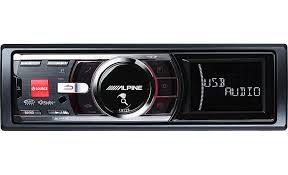
USER MANUAL IDA-X300 ALPINE
iDA-X200
MP3

AAC


Radio®



iDA-X300
MP3

AAC

Radio



- OWNER'S MANUAL Please read before using this equipment.
- MODE D'EMPLOI
Veuillez lire avant d'utiliser cet appareil.
- MANUAL DE OPERACION Léalo antes de utilizar este equipo.
ALPINE ELECTRONICS MARKETING, INC.
1-1-8 Nishi Gotanda, Shinagawa-ku,
Tokyo 141-0031, Japan Phone 03-5496-8231
ALPINE ELECTRONICS OF AMERICA, INC.
19145 Gramercy Place, Torrance, California 90501, U.S.A.
Phone 1-800-ALPINE-1 (1-800-257-4631)
ALPINE ELECTRONICS OF CANADA, INC.
777 Supertest Road, Toronto, Ontario M3J 2M9, Canada
Phone 1-800-ALPINE-1 (1-800-257-4631)
ALPINE ELECTRONICS OF AUSTRALIA PTY. LTD.
161-165 Princes Highway, Hallam
Victoria 3803, Australia
Phone 03-8787-1200
ALPINE ELECTRONICS GmbH
Frankfurter Ring 117, 80807 Munchen, Germany Phone 089-3242640
ALPINE ELECTRONICS OF U.K. LTD.
Alpine House
Fletchamstead Highway, Coventry CV4 9TW, U.K.
Phone 0870-33 33 763
ALPINE ELECTRONICS FRANCE S.A.R.L.
(RCS PONTOISE B 338 101 280)
98, Rue de la Belle Etoile, Z.I. Paris Nord II
B.P. 50016, 95945 Roissy Charles de Gaulle
Cedex, France
Phone 01-48638989
Operating Instructions
WARNING
WARNING 4
CAUTION 4
PRECAUTIONS 4
Double Action Encoder Operation (iDA-X200 only)
Getting Started
Accessory List 7
Turning Power On and Off 7
Detaching and Attaching the Front Panel 7
Initial System Start-Up 7
Adjusting Volume 7
Setting the Calendar 8
Setting the Time 8
Displaying the Calendar/Time 8
Radio
Listening to Radio 9
Presetting Stations Manually 9
Presetting Stations Automatically 9
Tuning to Preset Stations 9
Frequency Search Function 10
Receiving a Multicast Station (HD Radio mode only) 10
Changing the Display (HD Radio mode only) 10
iPod® (Optional)
Playback 11
Searching for a desired Song/Title 11
PercentSkipFunction 12
Alphabet Skip Function (Only when iDA-X200 is connected via USB) 12
Up/Down Function 13
Search Position Memory 13
Random Play Shuffle 13
Random Play Shuffle All 13
Repeat Play 13
Changing the Display 13
USB memory/Portable audio player (iDA-X200 only)/Changer (Optional)
BANK Function (USB memory) 14
Playback 14
Selecting a Disc (Changer) (Optional) 14
Multi-Changer Selection (Optional) 15
Repeat Play 15
M.I.X. (Random Play) 15
Searching for CD Track Number (CD changer only) 15
Searching for a desired Song (USB memory/Portable audio player (iDA-X200 only)) .... 16
File/Folder Name Search (MP3 Changer) ....16
Switching between Quick Search mode and Folder up/down mode (MP3 changer) (iDA-X300 only) 17
Quick Search (changer) 17
Select the desired Folder (Folder up/down) (MP3/WMA/AAC) 17
Changing the Display 17
About MP3/WMA/AAC 18
Sound Setting
Adjusting Subwoofer/Bass/Treble/Balance (Between Left and Right)/Fader (Between Front and Rear)/Loudness/D defeat 19
Turning Subwoofer ON/OFF 20
Setting the Subwoofer System 20
Setting the Bass Control 20
Setting the Treble Control 21
Adjusting the High Pass Filter 21
Operating the External Audio Processor 21
SETUP
Bluetooth Setting
Setting the Bluetooth Connection 22
Audio Setting (Only when external audio processor is connected)
Operating the External Audio Processor (USER PRESET) 23
Turning Media Xpander ON/OFF 23
Setting the MX Level 23
Subwoofer On and Off 23
General Setting
Setting of Calendar Display Pattern Switching (CALENDAR) 23
Setting the Clock Display (CLK MODE) 23
Connecting an MP3 Changer (PLAY MODE) 23
Sound (Beep) Guide Function (iDA-X200 only) 23
Turning Mute Mode On/Off (INT MUTE) 23
Setting the AUX+ Mode 23
Setting the AUX+ NAME Mode 24
Setting the AUX Mode (V-Link) 24
Setting the Changer Name 24
Setting the External Digital Input (DIGITAL AUX) 24
Setting the AUX+ Level (AUX IN GAIN) 24
Connecting to an External Amplifier (POWER IC) 24
Demonstration 24
Display Setting
Dimmer Control 24
Scroll Type Setting 24
Scroll Setting (TEXT SCROLL) 25
iPod Setting
iPod Search Mode Setting 25
TUNER Setting (Only when HD/SAT receiver is connected)
HD Radio Station Call Setting 25
Digital Seek On/Off Setting 25
SAT Radio Receiver (Optional)
Receiving Channels with the SAT Radio Receiver (Optional) 25
Checking the SAT Radio ID Number 26
Storing Channel Presets 26
Receiving Stored Channels 26
Storing the desired Sports Team (SIRIUS only) 26
Storing the desired Song / Artist (SIRIUS only) 27
Recalling the stored information (SIRIUS only) 27
Canceling the stored Alert Memory (SIRIUS only) 27
Search Function 28
Switching between Quick Search mode and Category up/down mode (iDA-X300 only) 28
Quick Search Function 28
Select the desired CATEGORY (Category up/down) 28
Receiving Weather or Traffic Information from SAT Radio 29
Instant Replay Function (SIRIUS only) 29
Changing the Display 29
Setting the Auxiliary Data Field Display (XM only) 30
IMPRINT Operation (Optional) (iDA-X200 only)
Changing MultEQ mode 30
Adjusting Sound Setting in Manual Mode ....31
USER PRESET. 31
Storing the Audio Adjustment Level 31
Recalling the Audio Adjustment Level 31
Turning Media Xpander ON/OFF 31
Equalizer Presets (Factory's EQ) (FR-EQ). 31
Sound Field Adjustment 32
Adjusting the Parametric Equalizer Curve 32
Adjusting the Graphic Equalizer Curve 32
Adjusting the Time Correction 32
Adjusting the Crossover Settings (X-OVER) 33
Turning Subwoofer ON/OFF. 34
Setting the Subwoofer System. 34
Setting the Subwoofer Phase 34
Setting the Subwoofer Channel (SUBW CHANNEL) 34
Setting the Response Slope for the High Range Speaker (TW Setup). 34
Setting EQ mode. 34
Setting the Filter type. 34
Setting the Time Correction Unit (TCR Parameter) 34
Setting the MX Level. 34
About Time Correction 35
About the Crossover 36
About IMPRINT 37
In Case of Difficulty 38
Specifications 41
Installation and
Connections
Warning 42
Caution 42
Precautions 42
Installation 43
Connections 45
LIMITED WARRANTY
Operating Instructions
WARNING

WARNING
This symbol means important instructions. Failure to heed them can result in serious injury or death.
DO NOT OPERATE ANY FUNCTION THAT TAKES YOUR ATTENTION AWAY FROM SAFELY DRIVING YOUR VEHICLE.
Any function that requires your prolonged attention should only be performed after coming to a complete stop. Always stop the vehicle in a safe location before performing these functions. Failure to do so may result in an accident.
KEEP THE VOLUME AT A LEVEL WHERE YOU CAN STILL HEAR OUTSIDE NOISES WHILE DRIVING.
Excessive volume levels that obscure sounds such as emergency vehicle sirens or road warning signals (train crossings, etc.) can be dangerous and may result in an accident. LISTENING AT LOUD VOLUME LEVELS IN A CAR MAY ALSO CAUSE HEARING DAMAGE.
MINIMIZE DISPLAY VIEWING WHILE DRIVING.
Viewing the display may distract the driver from looking ahead of the vehicle and cause an accident.
DO NOT DISASSEMBLE OR ALTER.
Doing so may result in an accident, fire or electric shock.
USE ONLY IN CARS WITH A 12 VOLT NEGATIVE GROUND.
(Check with your dealer if you are not sure.) Failure to do so may result in fire, etc.
KEEP SMALL OBJECTS SUCH AS BOLTS OR SCREWS OUT OF THE REACH OF CHILDREN.
Swallowing them may result in serious injury. If swallowed, consult a physician immediately.
USE THE CORRECT AMPERE RATING WHEN REPLACING FUSES.
Failure to do so may result in fire or electric shock.
DO NOT BLOCK VENTS OR RADIATOR PANELS.
Doing so may cause heat to build up inside and may result in fire.
USE THIS PRODUCT FOR MOBILE 12V APPLICATIONS.
Use for other than its designed application may result in fire, electric shock or other injury.

CAUTION
This symbol means important instructions. Failure to heed them can result in injury or material property damage.
Failure to do so may cause personal injury or damage to the product. Return it to your authorized Alpine dealer or the nearest Alpine Service Center for repairing.

PRECAUTIONS
Product Cleaning
Use a soft dry cloth for periodic cleaning of the product. For more severe stains, please dampen the cloth with water only. Anything else has the chance of dissolving the paint or damaging the plastic.
Temperature
Be sure the temperature inside the vehicle is between +60°C (+140°F) and -10°C (+14°F) before turning your unit on.
Maintenance
If you have problems, do not attempt to repair the unit yourself. Return it to your Alpine dealer or the nearest Alpine Service Station for servicing.
Installation Location
Make sure this unit will not be installed in a location subjected to:
- Direct sun and heat High humidity and water
- Excessive dust
- Excessive vibrations
Protecting the USB connector
- Only a USB memory, iPod (iDA-X200 only) or Portable audio player (iDA-X200 only) can be connected to the USB connector on this unit. Correct performance using other USB products cannot be guaranteed.
- If the USB connector is used, be sure to connect it to the unit by using a USB extension cable (iDA-X200 supplied/iDA-X300 sold separately). A USB hub is not supported.
- Depending on the connected USB memory device, the unit may not function or some functions may not be performed.
- The audio file format that can be played back on the unit is MP3/WMA/AAC.
- Artist/song name, etc., can be displayed, however characters may not be correctly displayed.
On Handling USB Memory
- To prevent malfunction or damage, note the following points. Read the USB memory Owner's Manual thoroughly. Do not touch the terminals by hand or metal. Do not subject USB memory to excessive shock. Do not bend, drop, disassemble, modify or soak in the water
- Avoid usage or storage in the following locations: Anywhere in the car exposed to direct sunlight or high temperatures. Anywhere the possibility of high humidity or corrosive substances are present. Fix the USB memory in a location where driver operation will not be hindered.
- USB memory may not function correctly at high or low temperature.
- Use only certified USB memory. Note that even certified USB memory, may not function correctly depending on its type or state.
- USB memory function is not guaranteed. Use USB memory according to the terms of agreement.
- Depending on the settings of the USB memory type, memory state or encoding software, the unit may not play back or display properly.
- A file that is copy-protected (copyright protection) cannot be played back.
- USB memory may take time to start playback. If there is a particular file other than audio in the USB memory, it may take considerable time before the file is played back or searched.
- The unit can play back "mp3," "wma" or "m4a" file extensions.
- Do not add the above extensions to a file other than audio data. This non-audio data will not be recognized. The resulting playback may contain noise that can damage speakers and/or amplifiers.
- It is recommended to back up important data on a personal computer.
- Do not remove the USB device while playback is in progress. Change SOURCE to something other than USB, then remove the USB device to prevent possible damage to its memory.
On Handling Portable audio player (iDA-X200 only)
- The unit can control a Portable audio player with the USB interface. Playable audio file formats are MP3 and WMA.
- Portable audio player function is not guaranteed. Use Portable audio player according to the terms of agreement. Read the Portable audio player Owner's Manual thoroughly.
- Avoid usage or storage in the following locations: Anywhere in the car exposed to direct sunlight or high temperatures. Anywhere the possibility of high humidity or corrosive substances are present. Fix the Portable audio player in a location where driver operation will not be hindered.
- Portable audio player may not function correctly at high or low temperature.
- Depending on the settings of the Portable audio player type, memory state or encoding software, the unit may not play back or display properly.
- If the Portable audio player has an MSC/MTP setting, set to MTP.
- A Portable audio player in which data is stored by USB Mass Storage may not be playable on the unit.
- Depending on the Portable audio player settings, USB Mass Storage may be supported. For setting, refer to the Owner's Manual of the player.
- The unit can play back MP3/WMA files synchronized by Windows Media Player (Ver. 7.1, 8, 9, 9.1, 9.2), and are then forwarded to the player. The "mp3" or "wma" extensions are playable.
- If data is not synchronized by Windows Media Player and is forwarded in another way, the unit may not be able to correctly play back the files. WMDRM10 is supported by the unit.
- A file that is copy-protected (copyright protection) cannot be played back.
- It is recommended to back up important data on a personal computer.
- Do not remove the USB device while playback is in progress. Change SOURCE to something other than USB, then remove the USB device to prevent possible damage to its memory.
- Windows Media and the Windows logo are trademarks, or registered trademarks of Microsoft Corporation in the United States and/or other countries.
- iPod is a trademark of Apple Inc., registered in the U.S. and other countries.
- HD Radio™ and the HD Radio Ready logo are proprietary trademarks of iBiquity Digital Corp.
- MPEG Layer-3 audio coding technology licensed from Fraunhofer IIS and Thomson.
- Supply of this product only conveys a license for private, non-commercial use and does not convey a license nor imply any right to use this product in any commercial (i.e. revenue-generation) real time broadcasting (terrestrial, satellite, cable and/or any other media), broadcasting/streaming via internet, intranets and/or other networks or in other electronic content distribution systems, such as pay-audio or audio-on-demand applications. An independent license for such use is required. For details, please visit http://www.mp3licensing.com
- Manufactured under license from Audyssey Laboratories. MultEQ XT is a trademark of Audyssey Laboratories.
Double Action Encoder Operation (iDA-X200 only)
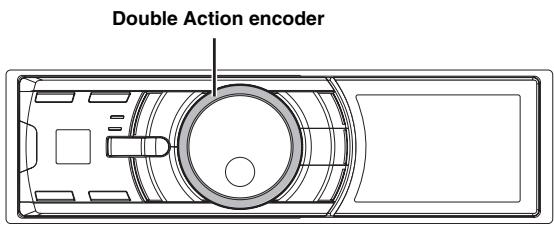
There are 2 ways to operate the Double Action encoder.
Normal operation
Turn the Double Action encoder to the left or right.
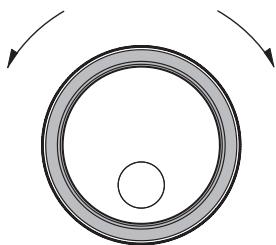
The volume is adjusted, and an item is selected.
Useful operation
Turn the Double Action encoder to the left or right.
When you release the Double Action encoder, the display changes.
Double Action encoder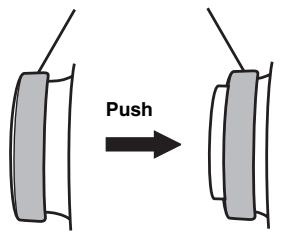
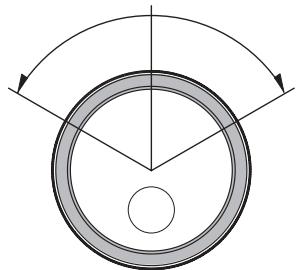
Depending on the situation, you can change an item or display. If you press and turn the Double Action encoder to the left or right, you can change items/displays continuously.
Getting Started
iDA-X200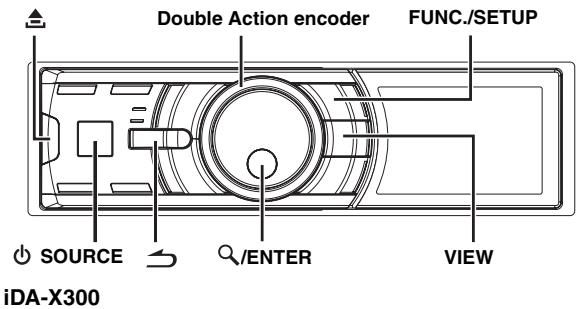
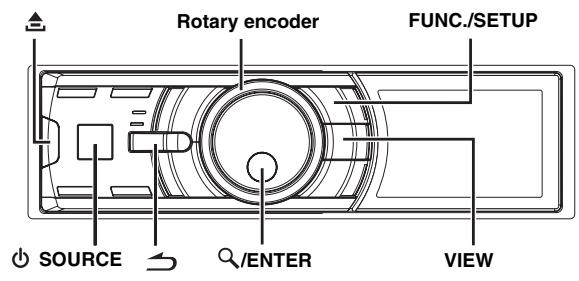
Accessory List
Digital Media receiver. 1 Power cable. 1 FULL SPEED™ Connection Cable (iDA-X300 only) 1 USB cable (iDA-X200 only) 1 - iPod Dock interface cable (iDA-X200 only). 1 - Mounting sleeve. 1 - Carrying case. 1 - Bracket key. 2 - Screw (M5x8) 4 - Owner's Manual 1 set
Turning Power On and Off
Press SOURCE to turn on the unit.
- The unit can be turned on by pressing any other button except , (Release), Double Action encoder (iDA-X200 only) and VIEW. The unit is also automatically turned on if a USB memory is connected. Press and hold SOURCE for at least 2 seconds to turn off the unit.
- The first time power is turned on, the volume will start from level 12.
Detaching and Attaching the Front Panel
Detaching
1 Turn off the unit power. 2 Press (Release) at the middle left side until the front panel pops out.
3 Grasp the left side of the front panel and pull it out.
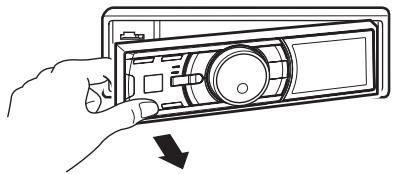
- The front panel may become hot in normal usage (especially the connector terminals on the back of the front panel.) This is not a malfunction.
- To protect the front panel, place it in the supplied carrying case.
Attaching
1 Insert the right side of the front panel into the main unit. Align the groove on the front panel with the projections on the main unit. 2 Push the left side of the front panel until it locks firmly into the main unit.
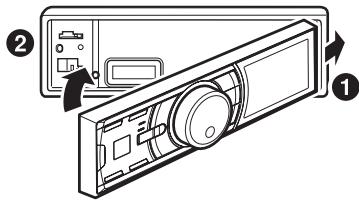
- Before attaching the front panel, make sure that there is no dirt or dust on the connector terminals and no foreign object between the front panel and the main unit.
- Attach the front panel carefully. Hold the panel by its sides to avoid pushing any buttons by mistake.
Initial System Start-Up
Be sure to press the RESET switch when using the unit for the first time, after changing the car battery, etc.
1 Turn off the unit power. 2 Press (Release) to remove the front panel. 3 Press RESET with a ballpoint pen or similar pointed object.

Adjusting Volume
Turn the Double Action encoder (iDA-X200 only) or Rotary encoder (iDA-X300 only) until the desired sound is obtained.
Setting the Calendar
1 Press and hold FUNC./SETUP for at least 2 seconds to activate the SETUP selection mode. 2 Turn the Double Action encoder (iDA-X200 only) or Rotary encoder (iDA-X300 only) to select the GENERAL mode, and then press Q/ENTER.
BT 1 ↔ AUDIO 2 ↔ GENERAL ↔ DISPLAY ↔ IPOD ↔ TUNER *3 ↔ BT
1 Displayed only when INT MUTE is set to OFF, and the mode is set to other than BT AUDIO. 2 Displayed only when an external audio processor is connected. For details, refer to the Owner's Manual of the external audio processor. *3 Only when HD Radio / SAT Radio receiver is connected. 3 Turn the Double Action encoder (iDA-X200 only) or Rotary encoder (iDA-X300 only) to select CALENDAR ADJ, and then press /ENTER. 4 Turn the Double Action encoder (iDA-X200 only) or Rotary encoder (iDA-X300 only) to set year. 5 Press ENTER. 6 Repeat steps 4 and 5 above to set month, day. 7 Press and hold → for at least 2 seconds to return to normal mode. - Pressing during the procedure will return to the previous mode. - If no operation is performed for 60 seconds, the unit will return to normal mode automatically.
Setting the Time
1 Press and hold FUNC./SETUP for at least 2 seconds to activate the SETUP selection mode. 2 Turn the Double Action encoder (iDA-X200 only) or Rotary encoder (iDA-X300 only) to select the GENERAL mode, and then press /ENTER.
BT 1 ↔ AUDIO 2 ↔ GENERAL ↔ DISPLAY ↔ IPOD ↔ TUNER *3 ↔ BT
1 Displayed only when INT MUTE is set to OFF, and the mode is set to other than BT AUDIO. 2 Displayed only when an external audio processor is connected. For details, refer to the Owner's Manual of the external audio processor. *3 Only when HD Radio / SAT Radio receiver is connected. 3 Turn the Double Action encoder (iDA-X200 only) or Rotary encoder (iDA-X300 only) to select CLK ADJ, and then press Q/ENTER. 4 Turn the Double Action encoder (iDA-X200 only) or Rotary encoder (iDA-X300 only) to set hour. 5 Press ENTER. 6 Repeat steps 4 and 5 above to set minutes. 7 Press and hold → for at least 2 seconds to return to normal mode.
- Pressing ⊃ during the procedure will return to the previous mode.
- If no operation is performed for 60 seconds, the unit will return to normal mode automatically.
Displaying the Calendar/Time
Press VIEW.
The calendar/time is displayed. Pressing VIEW again will return to normal mode.
07/12/31 12:00
- If an HD Radio Tuner is connected, text information can be displayed. Refer to "Changing the Display (HD Radio mode only)" (page 10).
- If an XM receiver is connected, the Auxiliary Data Field can be displayed. Refer to "Setting the Auxiliary Data Field Display (XM only)" (page 30).
Controllable With Remote Control
Point the optional remote control transmitter at the remote control sensor.
Remote control sensor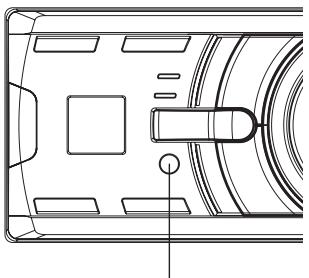
Connectable to Steering Remote Control Interface Box (iDA-X200 only)
You can operate this unit from the vehicle's control unit when an Alpine Steering Remote Control Interface Box (optional) is connected. For details, contact your Alpine dealer.
Radio
iDA-X200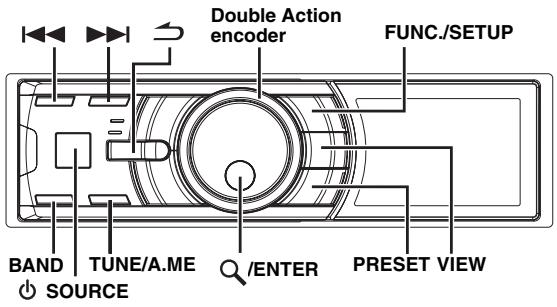
iDA-X300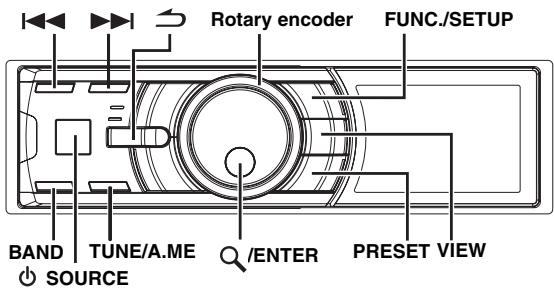
This unit cannot receive HD Radio signals (digital terrestrial radio). In order to activate the digital radio functions described below, an optional HD Radio Tuner module must be connected through the Ai-NET bus.
Listening to Radio
HD Radio can be received if the HD Radio TUNER MODULE (TUA-T500HD) is connected. While receiving HD Radio, the unit can automatically switch between the analog and digital signal.
1 Press SOURCE to select TUNER mode. 2 Press BAND repeatedly until the desired radio band is displayed.
FM1 -> FM2 -> AM -> FM1
3 Press TUNE/A.ME to select the tuning mode.
DX SEEK (Distance mode) -> SEEK (Local mode) -> (Blank) (Manual mode) -> DX SEEK (Distance mode)
- The initial mode is Distance mode.
Distance mode:
Both strong and weak stations will be automatically tuned in (Automatic Seek Tuning).
Local mode:
Only strong stations will be automatically tuned in (Automatic Seek Tuning).
Manual mode:
The frequency is manually tuned in steps (Manual tuning).
4 Press or to tune in the desired station. Holding down or will change the frequency continuously. - If DIGITAL SEEK is set to ON, the SEEK UP/DOWN functions only stop on digital station frequencies while receiving HD radio. Refer to "Digital Seek On/Off Setting" (page 25).
Presetting Stations Manually
1 Select the radio band and tune in a desired radio station you wish to store in the preset memory. 2 Press PRESET.
The Preset screen is displayed.
3 Turn the Double Action encoder (iDA-X200 only) or Rotary encoder (iDA-X300 only) to select the preset number. 4 Press and hold Q/ENTER for at least 2 seconds.
The selected station is stored.
The display shows the band, preset number and station frequency memorized.
- A total of 18 stations can be stored in the preset memory (6 stations for each band; FM1, FM2 and AM).
- If you store a station in a preset memory which already has a station, the current station will be cleared and replaced with the new station.
Presetting Stations Automatically
1 Press BAND repeatedly until the desired radio band is displayed. 2 Press and hold TUNE/A.ME for at least 2 seconds.
The tuner will automatically seek and store 6 strong stations in the selected band. They will be stored 1 to 6 in order of signal strength.
When the automatic memory has been completed, the tuner goes to the station stored in preset location No.1.
- If no stations are stored, the tuner will return to the original station you were listening to before the auto memory procedure began.
Tuning to Preset Stations
1 Press BAND repeatedly until the desired band is displayed. 2 Press PRESET.
The Preset screen is displayed.
3 Turn the Double Action encoder (iDA-X200 only) or Rotary encoder (iDA-X300 only) to select a radio station. 4 Press Q/ENTER.
The display shows the band, preset number and frequency of the station selected.
Frequency Search Function
You can search for a radio station by its frequency.
1 Press ENTER in Radio mode to activate Frequency search mode. 2 Turn the Double Action encoder (iDA-X200 only) or Rotary encoder (iDA-X300 only) to select the desired frequency. 3* Press ENTER to receive the selected frequency.
- Operation is not required during HD Radio reception.
- Press → in the search mode to cancel. Or, the search mode will be canceled if no operation is performed for 10 seconds.
Receiving a Multicast Station (HD Radio mode only)
Multicasting is the ability to broadcast multiple program streams over a single FM frequency, thereby increasing the amount and diversity of content choices. A maximum of eight multicast station channels can be selected on this unit.
1 When a multicast station is received, the program number is displayed, and the <A> indicator lights up.
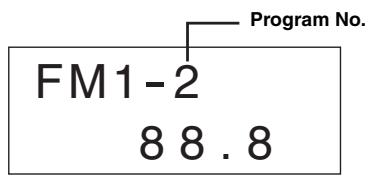
2 Press FUNC./SETUP to display the Program Type screen. 3 Turn the Double Action encoder (iDA-X200 only) or Rotary encoder (iDA-X300 only) to select a program, and press Q/ENTER.
The selected program is received.
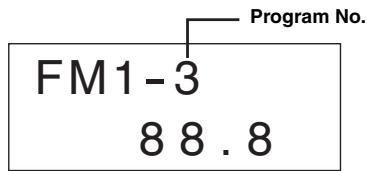
| Program Service example: |
| Multicast Radio Station | Program No. | Program Service |
| 88.8 | 1 | MPS: Main Program Service |
| 88.8 | 2 | SPS: Sub-program Service |
| 88.8 | 3 | SPS: Sub-program Service |
| . | |
| . | |
| . | |
| 88.8 | 8 | SPS: Sub-program Service |
Changing the Display (HD Radio mode only)
Press VIEW.
Each time you press VIEW, the display changes.
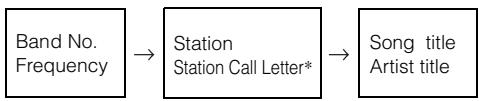
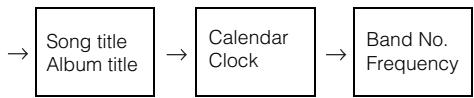
- You can set a long or short HD Radio station name. Refer to "HD Radio Station Call Setting" (page 25).
iPod® (Optional)
iDA-X200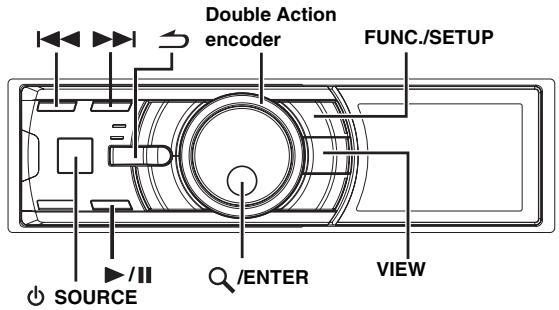
iDA-X300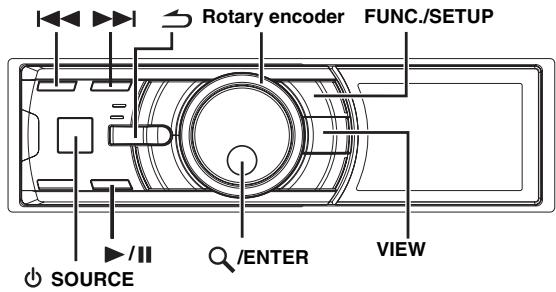
An iPod® can be connected to this unit by using the proprietary ALPINE FULL SPEED™ Connection Cable (KCE-422i) (iDA-X200 sold separately/iDA-X300 supplied) (or the iPod Dock interface cable (supplied, iDA-X200 only)). When this unit is connected by using the cable, the controls on the iPod are not functional.
- Only 5th generation iPod, first generation iPod nano and second generation iPod nano can be connected via a USB device (iDA-X200 only).
- Set AUX + to OFF when an iPod is connected (refer to "Setting the AUX + Mode" on page 23).
- If the Bluetooth Box and an iPod are connected at the same time, be sure to disconnect the iPod from the Bluetooth Box while turning ACC to OFF.
About iPods usable with this unit
- The unit can be used with the fourth generation and above iPod, iPod photo, iPod mini, the first generation iPod nano or the second generation iPod nano only. However, future generation iPod compatibility cannot be guaranteed.
- Touch wheel or scroll wheel type iPods without the dock connector cannot be connected to the unit.
- The unit can be used with the following iPod.
(iDA-X200 only)
Fifth generation iPod
First generation iPod nano
Second generation iPod nano
Fourth generation iPod
Fifth generation iPod
iPod photo
iPod mini
First generation iPod nano
Second generation iPod nano
- If the unit is used with iPod software versions of iTunes earlier than 7.1.0.59, correct function and performance are not guaranteed.
Playback
1 Press SOURCE to switch to the IPOD or USB IPOD (iDA-X200 only) mode. 2 Press or to select the desired song.
Return to the beginning of the current song:
Press
Fast backward through current song:
Press and hold
Advance to the beginning of the next song:
Press ▶
Fast forward through current song:
Press and hold
3 To pause playback, press ▶/II.
Pressing ▶/ again will resume playback.
- If a song is playing on the iPod when it is connected to this unit, it will continue playing after the connection.
- An episode or audiobook may have several chapters; the chapter can be changed by pressing ◀◀ or ▶▶▶.
Searching for a desired Song/Title
An iPod can contain hundreds of songs. By keeping these songs organized in playlists, this unit can use these to ease song searches.
Using the Playlist/Artist/Album/Podcast/Audiobook/Genre/Composer/Song search mode's individual hierarchy, you can narrow down your search as shown in the table below.
| Hierarchy 1 | Hierarchy 2 | Hierarchy 3 | Hierarchy 4 |
| PLAYLISTS | SONG | — | — |
| ARTISTS* | ALBUM* | SONG | — |
| ALBUMS* | SONG | — | — |
| POODCASTS | EPISODE | — | — |
| AUDIOBOOKS | — | — | — |
| GENRES* | ARTIST* | ALBUM* | SONG |
| COMPOSERS* | ALBUM* | SONG | — |
| SONGS | — | — | — |
- You can select your preferred search mode. Refer to "iPod Search Mode Setting" (page 25).
For example: Searching by Artist name
The following example explains how an ARTISTS search is performed. Another search mode can be used for the same operation, although the hierarchy differs.
1 Press ENTER to activate the Menu Select mode. 2 Turn the Double Action encoder (iDA-X200 only) or Rotary encoder (iDA-X300 only) to select the ARTISTS, and then press Q/ENTER.
The artist search mode is activated and artists names are displayed.
3 Turn the Double Action encoder (iDA-X200 only) or Rotary encoder (iDA-X300 only) to select the desired Artist, and then press ENTER.
The album search mode is activated and albums names are displayed.
4 Turn the Double Action encoder (iDA-X200 only) or Rotary encoder (iDA-X300 only) to select an album, and then press Q/ENTER.
The song search mode is activated and songs names are displayed.
5 Turn the Double Action encoder (iDA-X200 only) or Rotary encoder (iDA-X300 only) to select a song and press Q/ENTER.
The selected song is played back.
- While in the search mode, if you press and hold the right arrow for at least 2 seconds, the search mode is canceled.
- In the search mode, pressing the back arrow will return to the previous mode.
- When search is made during M.I.X. play, the M.I.X. play mode will be canceled.
- "NO SONG" will be displayed if there are no songs in the selected playlist in the PLAYLISTS search mode.
- "NO PODCAST" will be displayed if there is no podcast data in the iPod in the PODCASTS search mode.
- "NO A-BOOK" will be displayed if there is no audiobook data in the iPod in AUDIOBOOKS search mode.
- If the iPod's name is selected in the Playlist Search mode and Q/ENTER is pressed, all songs in the iPod are searchable. If you press and hold Q/ENTER for at least 2 seconds, all songs in the iPod are played back beginning from the first song listed.
- The display "NO SUPPORT" is scrolled if text information is not compatible with this unit.
- After selecting [ALL] in the search mode with “*”, press and hold Q/ENTER for at least 2 seconds to play back all songs in the iPod or selected search mode.
- If percent skip function is activated in the search mode, a search can be made quickly by skipping to the specified location. For details, refer to "Percent Skip Function" on page 12.
- If Alphabet Skip Function is activated in the search mode, a search can be made quickly by Alphabet skip function to find the desired artist or song, etc. For details, refer to "Alphabet Skip Function (Only when iDA-X200 is connected via USB)" on page 12.
- In the search mode, you can scroll the page by pressing and turning the Double Action encoder. (iDA-X200 only.)
- If no operation is performed for 60 seconds, the unit will return to normal mode automatically.
Percent Skip Function
The unit is provided with a percent skip function for effective searching. When you use this function in the search mode, you can quickly search an artist or a song, etc.
If there are 100 songs in your iPod, they are divided into 10 groups using percentages (shown below).
| Number of song % | All 100 songs |
| 10th song | 20th song | ... | 50th song | ... | 80th song | ... | 100th song |
| 10 % | | | | | | | | |
| 20 % | | | | | | | | |
| : | | | | | | | | |
| 50 % | | | | | | | | |
| : | | | | | | | | |
| 80 % | | | | | | | | |
| : | | | | | | | | |
| 100 % | | | | | | | | |
- You can select to show a percentage of the total stored songs, in 10% steps.
By using this function on iDA-X200
1 Press FUNC./SETUP repeatedly to choose the percent skip mode.
When the unit is connected via USB> Alphabet skip function → Percent skip function → Normal search mode → Alphabet skip function
Percent skip function → Normal search mode → Percent skip function
2 Press and turn the Double Action encoder.
Each turn of the Double Action encoder to the right will jump 10%, 20%, and 100% in ascending order. Each turn of the Double Action encoder to the left will jump 100%, 90%, and 10% in descending order.
Scroll bar display example (if 50% is shown)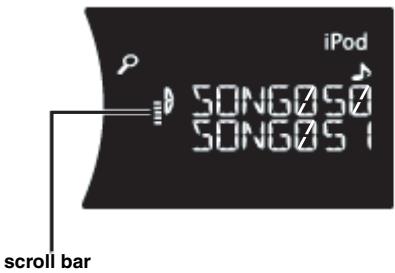
By using this function on iDA-X300
1 Press FUNC./SETUP to activate the percent selection mode. 2 Turn the Rotary encoder to select a designated percent parameter, and then press ENTER.
The percent skip function jumps to the following selected 10% → 20% … 50% … 80% … 100% → 10%.
- The iDA-X300 is available only for the direct connection, and is not available for the USB connection.
Alphabet Skip Function (Only when iDA-X200 is connected via USB)
The initial skip function is skipped to the next number, symbol or letter such as from A to B, B to C.
You can skip in reverse order such as B to A by turning the Double Action encoder to the left.
1 Press FUNC./SETUP repeatedly to choose the alphabet skip mode.
Alphabet skip function → Percent skip function →
Normal search mode → Alphabet skip function
2 Press and turn the Double Action encoder.
A list is skipped to the next page or next number, symbol or letter.
- If the Double Action encoder is pressed and turned to the left or right, the display continuously changes.
- The Alphabet Skip Function in the song search mode is available only when a song search is selected on the Menu select screen.
Up/Down Function
If you select an album and press and hold Q/ENTER in the search mode, this album will be played back repeatedly. To go to the previous or next Album, use the Up/Down function.
By using this function on iDA-X200
Press and turn the Double Action encoder to the left.
Returns to the previous item.
Press and turn the Double Action encoder to the right.
Advances to the next item.
By using this function on iDA-X300
Press and hold Q/ENTER for at least 2 seconds, then turn the Rotary encoder to select the desired Playlist/Artist/Album/Genre/Composer.
- If you do not perform a search or only search for a song name or audiobook, this function is not valid.
- During an artist search, albums for that artist can be played.
- If an album is selected during an artist search, the Up/Down function can be used to play other albums by that artist.
- This function is inactive during shuffle playback.
Search Position Memory
During iPod playback, you can quickly return to the last-selected hierarchy level in the search mode.
1 Press ⋃
The hierarchy you selected last in the search mode is displayed.
Random Play Shuffle
1 Press FUNC./SETUP. 2 Turn the Double Action encoder (iDA-X200 only) or Rotary encoder (iDA-X300 only) to select MIX, and press Q/ENTER.
The Shuffle mode is activated. 3 Turn the Double Action encoder (iDA-X200 only) or Rotary encoder (iDA-X300 only) to select the MIX (Shuffle) playback mode, and press /ENTER.
MIX ALBUM : An album in the iPod is selected at random, and is played back in the album song order.
SONG : If you select a song in the search mode, all songs in the selected mode are played back at random.
OFF : Shuffle mode off.
4 Press FUNC./SETUP.
The songs will be played back in random sequence.
- If no operation is performed for 10 seconds, the unit will return to normal mode.
- To cancel, select OFF in the above procedure.
- Shuffle Album/Shuffle Song works the same way as iPod Shuffle Albums/Shuffle Songs.
Random Play Shuffle All
Shuffle ALL plays all songs in the iPod randomly.
1 Press ENTER.
The Menu Select screen is displayed.
2 Press Q/ENTER while selecting SHUFFLE ALL.
The indicator ALL lights, and the songs will be played back in random sequence.
- To cancel, set the Shuffle mode to OFF. Refer to "Random Play Shuffle" (page 13).
- If SHUFFLE ALL is selected, the selected ones which are being played back in the search mode are canceled.
Repeat Play
1 Press FUNC./SETUP.
The Function screen is displayed.
2 Press ENTER.
The Repeat mode is activated.
3 Turn the Double Action encoder (iDA-X200 only) or Rotary encoder (iDA-X300 only) to select REPEAT SONG, and press Q/ENTER.
REPEAT SONG : A single song is repeatedly played back.
OFF: Repeat mode off.
4 Press FUNC./SETUP.
The song is repeatedly played back.
- If no operation is performed for 10 seconds, the unit returns to normal mode.
- To cancel, select OFF in the above procedure.
- During repeat playback, no other songs are selectable by pressing ▲▲▲ or ▶▶.
Changing the Display
Press VIEW.
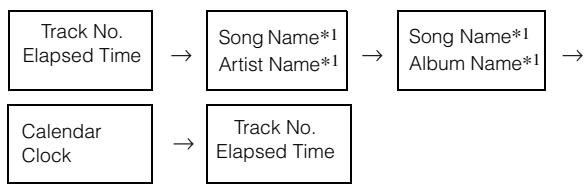
*1 TAG information
"ARTIST"/"ALBUM"/"SONG" is displayed if there is no tag information.
- Only alphanumeric characters can be displayed.
- The maximum number of characters is 128 (128 bytes).
- Some characters may not be correctly displayed.
- "NO SUPPORT" is displayed when text information is not compatible with this unit.
USB memory/Portable audio player (iDA-X200 only)/Changer (Optional)
iDA-X200
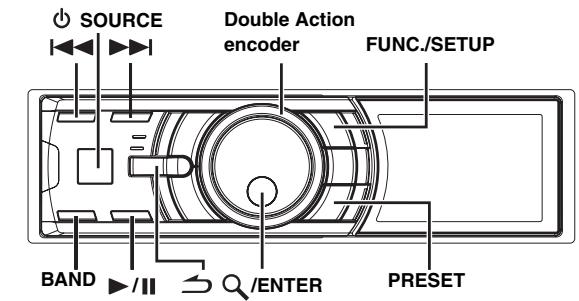
iDA-X300
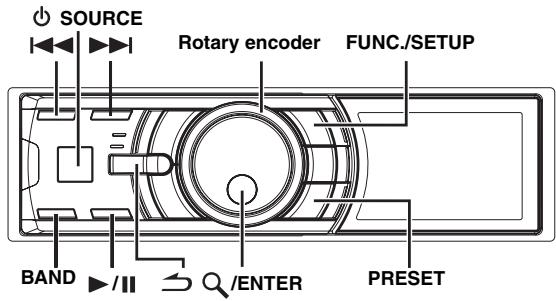
If a USB memory device/Portable audio player (iDA-X200 only) or changer is connected to the unit, MP3/WMA/AAC files can be played back.
- In the USB mode, when this unit is reset, ACC is switched from OFF to ON, or when the USB is connected to this unit, "BANKING" is displayed for several seconds.
BANK Function (USB memory)
This unit has a BANK function that automatically divides every 1,000 songs stored in USB memory into individual banks to make searching and playing back a song easier. A maximum of 1,000 songs for one bank can be stored according to the order stored in USB memory. A maximum of 10 banks (10,000 songs) can be recognized. BANK1 (songs 1 to 1,000) is set as the default. If you want to search beyond 1,000 songs, perform the following operation to select a different bank.
| BANK No. | Song number |
| BANK1 | 1~1,000 |
| BANK2 | 1,001~2,000 |
| : | : |
| BANK10 | 9,001~10,000 |
1 Press PRESET.
The BANK selection mode is displayed.
2 Turn the Double Action encoder (iDA-X200 only) or Rotary encoder (iDA-X300 only).
Select the desired BANK.
You can scroll the page by pressing and turning the Double Action encoder. (iDA-X200 only.)
3 Press ENTER.
Each operation can be performed in the selected bank.
- Even if the files are contained in the same folder, they may be saved as different BANK.
Playback
1 Press SOURCE to select the USB AUDIO or CD CHANGER mode.
2 Press or to select the desired track (file).
Returning to the beginning of the current track (file):
Press
Fast backward:
Press and hold
Advancing to the beginning of the next track (file):
Press
Fast forward:
Press and hold
- When a Portable audio player is connected, fast-forwarding/fast-reversing is not available.
3 To pause playback, press ▸ /II.
Pressing ▸ / again will resume playback.
- WMA format files that are protected by DRM (Digital Rights Management), AAC format files that have been purchased from the iTunes Store and files that are copy-protected (copyright protection) cannot be played back on this unit.
- The playback time may not be correctly displayed when a VBR (Variable Bit Rate) recorded file is played back.
- If there is tag information, artist name/album name/track name is displayed.
- ID3 tag/WMA tag
If an MP3/WMA/AAC file contains ID3 tag/WMA tag information, the ID3 tag/WMA tag information is displayed (e.g., song name, artist name, and album name). All other tag data is ignored.
- "NO SUPPORT" is displayed when text information is not compatible with this unit.
- Before disconnecting USB memory, be sure to change to another source or set to pause.
Selecting a Disc (Changer) (Optional)
An optional 6-disc or 12-disc CD Changer may be connected to this unit if it is Ai-NET compatible. With a CD Changer connected to the
Ai-NET input of this unit, the CD Changer will be controllable from this unit.
Using the KCA-410C (Versatile Link Terminal) multiple changers can be controlled by this unit.
See "Multi-Changer Selection (Optional)" on page 15 for selecting the CD Changers.
- The controls on this unit for CD Changer operation are operative only when a CD Changer is connected.
- The DVD changer (optional) is controllable from this unit as well as the CD changer.
1 Press PRESET.
The DISC CHANGE screen is displayed.
2 Turn the Double Action encoder (iDA-X200 only) or Rotary encoder (iDA-X300 only) to select a disc.
You can scroll the page by pressing and turning the Double Action encoder. (iDA-X200 only.)
3 Press ENTER.
The selected disc number appears in the display and CD/MP3/WMA/AAC playback starts.
Multi-Changer Selection (Optional)
When using KCA-410C (Versatile Link Terminal), you can connect two changers and two external outputs (AUX).
1 Press SOURCE on this unit to activate the CD CHANGER mode. 2 Press BAND to activate the CD Changer Selection mode.
The CD Changer Selection mode remains active for several seconds.
3 Press BAND until the desired CD Changer appears on the display. - For further details about the external input (AUX) when using KCA-410C, see "Setting the AUX+ NAME Mode" on page 24.
Repeat Play
1 Press FUNC./SETUP. 2 Press ENTER. The repeat mode is activated. 3 Turn the Double Action encoder (iDA-X200 only) or Rotary encoder (iDA-X300 only) to select the Repeat playback mode.
USB memory mode :
| REPEAT ONE | : Only a track is repeatedly played back. |
| FOLDER | : Only files in a folder are repeatedly played back. |
| OFF | : Repeat mode is turned off. |
Portable audio player mode (iDA-X200 only)
| REPEAT SONG | : Only a track is repeatedly played back. |
| OFF | : Repeat mode is turned off. |
| REPEAT ONE | : Only a file is repeatedly played back. |
| FOLDER * | : Only files in a folder are repeatedly played back. |
| DISC | : A disc is repeatedly played back. |
| OFF | : Repeat mode is turned off. |
- When an MP3 compatible CD changer is connected.
- If REPEAT DISC is set to ON during MIX ONE play in CD changer mode, M.I.X. will apply to the current disc only.
4 Press ENTER.
5 Press FUNC./SETUP.
The track (file) will be played repeatedly.
- If no operation is performed for 10 seconds, the unit returns to normal mode.
- To cancel, select OFF in the above procedure.
M.I.X. (Random Play)
1 Press FUNC./SETUP. 2 Turn the Double Action encoder (iDA-X200 only) or Rotary encoder (iDA-X300 only) to select M I X. 3 Press ENTER.
The M.I.X. mode is activated.
4 Turn the Double Action encoder (iDA-X200 only) or Rotary encoder (iDA-X300 only) to select the MIX playback mode.
USB memory mode:
| MIX FOLDER | × : Only files in a folder are played back in random sequence. |
| ALL | × ALL : All songs in USB memory (current Bank) are played back in random sequence. |
| OFF | : M.I.X. mode is turned off. |
Portable audio player mode (iDA-X200 only)
| MIXSONG | × : Only files in a folder are played back in random sequence. |
| ALL | × ALL : All songs in Portable audio player are played back in random sequence. |
| OFF | : M.I.X. mode is turned off. |
CD changer mode:
| MIX ONE | × : All files in a disc are played back in random sequence, and playback shifts to the next disc. |
| FOLDER *1 | × : Only files in a folder are played back in random sequence. |
| ALL *2 | × ALL : All the tracks on all the CDs in the current magazine will be played back in the random sequence. |
| OFF | : M.I.X. mode is turned off. |
1 When an MP3 compatible CD changer is connected. 2 When a CD changer equipped with the ALL M.I.X. function is connected.
- When a song is played back during Random (M.I.X.) play in the USB mode, the song can be played back again randomly even if not all songs on the USB Memory have been played back.
- If MIX ONE is set to ON during REPEAT DISC play in CD changer mode, M.I.X. will apply to the current disc only.
5 Press ENTER. 6 Press FUNC./SETUP.
The tracks (files) will be played back in random sequence.
- If no operation is performed for 10 seconds, the unit returns to normal mode.
- To cancel, select OFF in the above procedure.
Searching for CD Track Number (CD changer only)
You can search for a song by track number.
1 Press Q/ENTER during play.
This will set the search mode.
2 Turn the Double Action encoder (iDA-X200 only) or Rotary encoder (iDA-X300 only) to select the desired track, and then press ENTER.
This will play the selected track.
- Press in the search mode to cancel. Or, the search mode is canceled if no operation is performed for 60 seconds.
- During list selection, if you turn the Double Action encoder to the left or right while pressed, the list screen scrolls screen by screen. If you turn and hold the Double Action encoder to the left or right while pressed, the list screen continuously scrolls (iDA-X200 only).
- When CD Track Number Search is made during M.I.X. play, the M.I.X. play mode will be canceled.
Searching for a desired Song (USB memory/Portable audio player (iDA-X200 only))
A USB memory device/Portable audio player can contain hundreds of songs. By using file tag information and keeping these songs organized in playlists, this unit's search functions will ease song searches.
Each music category has its own individual hierarchy. Use the Playlist/Artist/Album/Genre/Composer/Song/Folder/File search mode to narrow searches based on the table below.
| Hierarchy 1 | Hierarchy 2 | Hierarchy 3 | Hierarchy 4 |
| PLAYLIST | SONG | — | — |
| ARTIST | ALBUM | SONG | — |
| ALBUM | SONG | — | — |
| GENRE | ARTIST | ALBUM | SONG |
| COMPOSER | ALBUM | SONG | — |
| SONG | — | — | — |
| FOLDER | FILE | — | — |
| FILE | — | — | — |
For example: Searching by Artist name
The following example explains how an ARTIST search is performed. Another search mode can be used for the same operation, although the hierarchy differs.
1 Press ENTER to activate the search selection mode. 2 Turn the Double Action encoder (iDA-X200 only) or Rotary encoder (iDA-X300 only) to select the ARTIST search mode, and then press ENTER.
PLAYLIST ↔ ARTIST ↔ ALBUM ↔ GENRE ↔ COMPOSER ↔ SONG ↔ FOLDER ↔ FILE ↔ PLAYLIST
3 Turn the Double Action encoder (iDA-X200 only) or Rotary encoder (iDA-X300 only) to select the desired Artist, and then press ENTER. 4 Turn the Double Action encoder (iDA-X200 only) or Rotary encoder (iDA-X300 only) to select an album, and then press ENTER. 5 Turn the Double Action encoder (iDA-X200 only) or Rotary encoder (iDA-X300 only) to select a song and press ENTER.
The selected song is played back.
- After pressing and holding ENTER for at least 2 seconds while in each hierarchy (except SONG/FILE hierarchy), all songs of the selected hierarchy are played back.
- Press and hold ⊃ for at least 2 seconds in the search mode to cancel.
- While in the Search mode, press → to switch to the previous mode.
- When search is made during M.I.X. play, the M.I.X play mode will be canceled.
- "ROOT" is displayed for the root folder which does not have folder name.
- In the search mode, you can scroll the page by pressing and turning the Double Action encoder (iDA-X200 only).
- If no operation is performed for 60 seconds, the unit will return to normal mode automatically.
- In the search mode, when there is no tag information in the searched files, "NO DATA" will be displayed, it may also be displayed when searching some files depending on the property of the files.
- In FOLDER/FILER search mode, only the current BANK's folders/files can be searched.
File/Folder Name Search (MP3 Changer)
Folder and file names may be searched and displayed during playback.
1 During MP3/WMA/AAC playback, press Q/ENTER to activate the search mode. 2 Turn the Double Action encoder (iDA-X200 only) or Rotary encoder (iDA-X300 only) to select Folder Name Search mode or File Name Search mode, and then press Q/ENTER.
Folder Name Search mode
3 Turn the Double Action encoder (iDA-X200 only) or Rotary encoder (iDA-X300 only) to select the desired folder.
You can scroll the page by pressing and turning the Double Action encoder (iDA-X200 only).
4 Press and hold Q/ENTER for at least 2 seconds to play back the first file in the selected folder.
- Press and hold ⊃ for at least 2 seconds in the search mode to cancel. Or, the search mode is cancelled if no operation is performed for 60 seconds. To search for files in the Folder Name Search mode, press ENTER. Files in the folder may be searched.
- Press ⊃ to exit Folder Name Search mode in step 3 in order to select File Name Search mode.
- "ROOT" is displayed for the root folder which does not have folder name.
- When Folder Name Search is made during M.I.X. play, the M.I.X. play mode will be canceled.
File Name Search mode
3 Select the desired file by turning the Double Action encoder (iDA-X200 only) or Rotary encoder (iDA-X300 only).
You can scroll the page by pressing and turning the Double Action encoder (iDA-X200 only).
4 Press ENTER to play back the selected file.
- Press and hold ⋙ for at least 2 seconds in the search mode to cancel. Or, the search mode is canceled if no operation is performed for 60 seconds.
- Press ⋙ in the search mode to return to the previous mode.
- When File Name Search is made during M.I.X. play, the M.I.X. play mode will be cancelled.
Switching between Quick Search mode and Folder up/down mode (MP3 changer) (iDA-X300 only)
When an MP3 changer is connected, you can switch between the Quick Search mode and Folder up/down mode.
1 Press FUNC./SETUP.
QUICK SEARCH: Quick Search mode
FOLDER UP/DN: Folder up/down mode (Initial Setting)
3 Press ENTER.
The ON/OFF screen is displayed.
4 Turn the Rotary encoder.
Select ON.
When ON is set, either Quick Search mode or Folder up/down mode can be used.
5 Press ENTER.
- You cannot set both Quick Search mode and Folder up/down mode to ON.
- If no operation is performed for 10 seconds, the unit will return to normal mode automatically.
Quick Search (changer)
You can search for tracks (files).
1 Press and hold Q/ENTER for at least 2 seconds in the Changer mode to activate Quick Search mode.
2 Turn the Double Action encoder (iDA-X200 only) or Rotary encoder (iDA-X300 only) to select a desired track (file).
The selected track is played back immediately.
- Press → in the search mode to cancel. Or, the search mode is canceled if no operation is performed for 10 seconds.
- When an MP3 changer is connected, set the Quick Search mode to ON. For details, refer to "Switching between Quick Search mode and Folder up/down mode (MP3 changer) (iDA-X300 only)" (iDA-X300 only) (page 17).
Select the desired Folder (Folder up/down) (MP3/WMA/AAC)
By using this function on iDA-X200
Press and turn the Double Action encoder to select the desired folder.
Turning to the right will advance to the next folder.
Turning to the left will return to the previous folder.
The first file in the selected folder is played back.
By using this function on iDA-X300
1 Press ENTER for at least 2 seconds.
The Folder up/down mode is activated.
2 Turn the Rotary encoder.
Turning to the right will advance to the next folder. Turning to the left will return to the previous folder. The first file in the selected folder is played back.
- When an MP3 changer is connected, set the Folder up/down mode to ON. For details, refer to "Switching between Quick Search mode and Folder up/down mode (MP3 changer) (iDA-X300 only)" (iDA-X300 only) (page 17).
- If no operation is performed for 10 seconds, the unit will return to normal mode automatically (iDA-X300 only).
- USB Memory/Portable Audio Player (iDA-X200 only) During playback in normal mode, if you press and turn the Double Action encoder before you perform a search operation, the FOLDER UP/DOWN function will become activate. During playback in normal mode, if you press and turn the Double Action encoder after you perform a search operation, the Up/Down Function will become activate.
Changing the Display
Press VIEW.
USB/Portable audio player (iDA-X200 only) mode:
CDChangermode: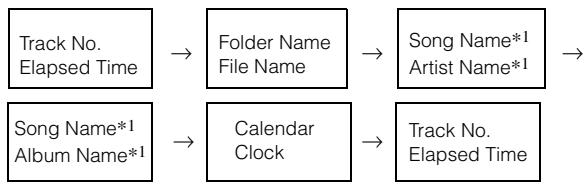
MP3Changermode: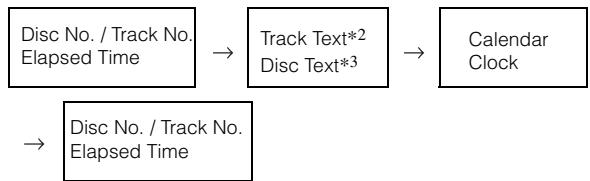
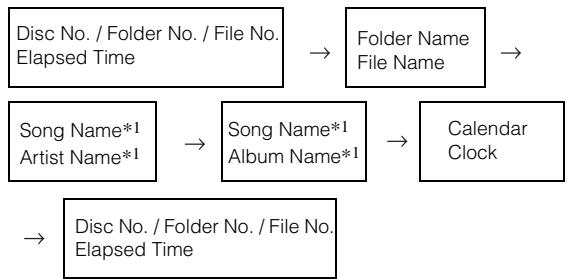
1 TAG information "ARTIST"/"ALBUM"/"SONG" is displayed if there is no tag information. 2 “T TEXT” is displayed if there is no Track Text. *3 "D TEXT" is displayed if there is no Disc Text.
- Only alphanumeric characters can be displayed.
- The maximum number of characters is 128 (128 bytes) for USB and Portable audio player.
- The maximum number of characters is 64 (64 bytes) for Change.
- Some characters may not be correctly displayed.
- "NO SUPPORT" is displayed when text information is not compatible with this unit.
About MP3/WMA/AAC
CAUTION
Except for private use, duplicating audio data (including MP3/WMA/AAC data) or distributing, transferring, or copying it, whether for free or for a fee, without permission of the copyright holder is strictly prohibited by the Copyright Act and by international treaty.
What is MP3?
MP3, whose official name is "MPEG-1 Audio Layer 3," is a compression standard prescribed by the ISO, the International Standardization Organization, and MPEG, which is a joint activity institution of the IEC.
MP3 files contain compressed audio data. MP3 encoding is capable of compressing audio data at extremely high ratios, reducing the size of music files to as much as one-tenth their original size. This is achieved while still maintaining near CD quality. The MP3 format realizes such high compression ratios by eliminating the sounds that are either inaudible to the human ear or masked by other sounds.
What is AAC?
AAC is the abbreviation for "Advanced Audio Coding," and is a basic format of audio compression used by MPEG2 or MPEG4.
What is WMA?
WMA, or "Windows Media™ Audio," is compressed audio data. WMA is similar to MP3 audio data and can achieve CD quality sound with small file sizes.
Method for creating MP3/WMA/AAC files
Audio data is compressed by using MP3/WMA/AAC specified software. For details on creating MP3/WMA/AAC files, refer to the user's manual for that software.
MP3/WMA/AAC file extensions that can be played back on the unit are as follows:
MP3: "mp3"
WMA: "wma" (ver. 7.1, 8, 9, 9.1, 9.2 supported)
AAC: "m4a"
WMA is not supported for the following files: Windows Media Audio Professional, Windows Media Audio 9 Voice, or Windows Media Audio 9 Pro Lossless.
Depending on the software that is used to create AAC, the file format may differ from the extension.
Playback of AAC files encoded by iTunes is supported.
Supported playback sampling rates and bit rates
MP3
Sampling rates: 48 kHz, 44.1 kHz, 32 kHz, 24 kHz, 22.05 kHz, 16 kHz, 12 kHz, 11.025 kHz, 8 kHz
Bit rates: 32 - 320 kbps
WMA
Sampling rates: 48 kHz, 44.1 kHz, 32 kHz, 24 kHz, 22.05 kHz, 16 kHz
Bit rates: 16 - 320 kbps
AAC
Sampling rates: 48 kHz, 44.1 kHz
Bit rates: 8 - 576 kbps
This device may not play back correctly depending on sampling rates.
The playback time may not be correctly displayed when a VBR (Variable Bit Rate) recorded file is played back.
This device supports ID3 tag v1 and v2.2.0, v2.3.0 and WMA tag. The following files do not support compression, coding, grouping or non-synchronization.
If tag data is in an MP3/WMA/AAC file, this device can display the title (track title), artist name, and album name ID3 tag/WMA tag data.
This device can only display single-byte alphanumeric characters and the underscore. For non-supported characters, "NO SUPPORT" is displayed.
The tag information may not be correctly displayed, depending on the contents.
Do not make a file's playback time more than 1 hour.
Playing back MP3/WMA/AAC
MP3/WMA/AAC files are prepared, and then written to USB memory. Or, synchronize an MP3/WMA file using Windows Media Player (Ver. 7.1, 8, 9, 9.1, 9.2), and then forward to the Portable audio player.
A USB memory device can hold up to 10,000 files/1000 folders (including Root Folders). Playback may not be performed if a USB memory / Portable audio player device exceeds the limitations described above.
Do not make a file's playback time more than 1 hour.
This device can play back USB memory / Portable audio player media.
Corresponding File Systems
This device supports FAT 12/16/32.
Order of tracks
The unit plays the files in the order that the writing software writes them. Therefore, the playing order may not be the same as the order you input. The playback order of the folders and files is as follows. However, the folder and file playback order differs from the folder and file number indicated on the display.
* The folder No. will not be displayed if no file is contained in the folder.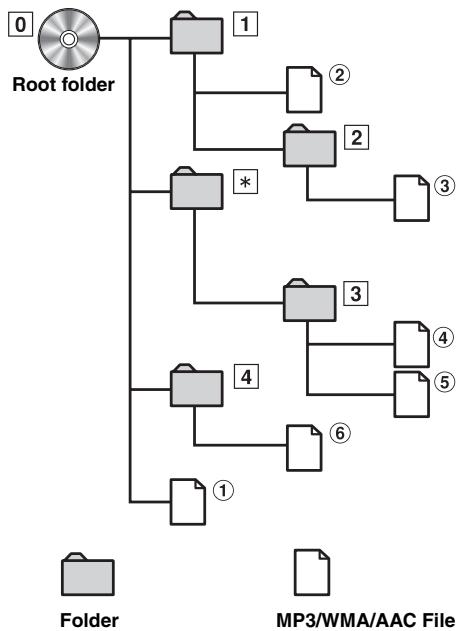
Terminology
Bit rate
This is the "sound" compression rate specified for encoding. The higher the bit rate, the higher the sound quality, but also the larger the files.
Sampling rate
This value shows how many times per second the data is sampled (recorded). For example, music CDs use a sampling rate of 44.1 kHz, so the sound is sampled (recorded) 44,100 times per second. The higher the sampling rate, the higher the sound quality, but also the larger the volume of data.
Encoding
Converting music CDs, WAVE (AIFF) files, and other sound files into the specified audio compression format.
Tag
Song information such as track titles, artist names, album names, etc., written into MP3/WMA/AAC files.
Root folder
The root folder is found at the top of the file system. The root folder contains all folders and files.
Sound Setting
iDA-X200 iDA-X300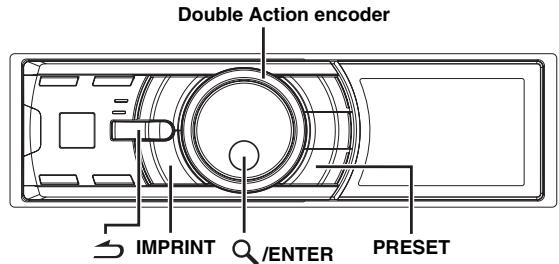
Adjusting Subwoofer/Bass/Treble/ Balance (Between Left and Right)/Fader (Between Front and Rear)/Loudness/ Defeat
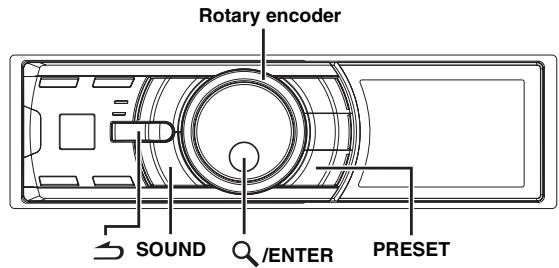
1 Press IMPRINT (iDA-X200 only) or SOUND (iDA-X300 only) repeatedly to choose the desired mode.
Each press changes the mode as follows:
SUBW LV*1 → BASS LV → TREBLE LV → BALANCE LV →
FADER LV*2 → LOUD*3 → DEFEAT → VOLUME →
SUBW LV*1
Subwoofer: 0 ~ 15
Bass level: -7 ~ +7
Treble level: -7 ~ +7
Balance: -15 to +15
Fader: -15 to +15
Loudness: ON/OFF
Defeat: ON/OFF
Volume: 0 to 35
- If IMPRINT (iDA-X200 only) or SOUND (iDA-X300 only) is not pressed within 5 seconds after selecting the Subwoofer, Bass, Treble, Balance, or Fader mode, the unit automatically returns to normal mode.
- Loudness introduces a special low- and high-frequency emphasis at low listening levels. This compensates for the ear's decreased sensitivity to bass and treble sound. The function is inoperable when DEFEAT is set to ON. 1 When the subwoofer mode is set to OFF, its level cannot be adjusted. 2 If you set the 4.2ch (FRONT/REAR/SUBW.)/2.2ch (3WAY) switch of the IMPRINT audio processor (PXA-H100) to 2.2ch (3WAY), you cannot adjust the FADER mode. For details, refer to the Owner's Manual of PXA-H100. *3 When an external audio processor is connected, this setting cannot be made.
2 Turn the Double Action encoder (iDA-X200 only) or Rotary encoder (iDA-X300 only) until the desired sound is obtained in each mode.
- Depending on the connected devices, some functions and display indications do not work.
Turning Subwoofer ON/OFF
When the subwoofer is on, you can adjust the subwoofer output level (refer to page 19).
For iDA-X200, the following setting can be made only when the IMPRINT audio processor (PXA-H100) is not connected.
1 Press and hold IMPRINT (iDA-X200 only) or SOUND (iDA-X300 only) for at least 2 seconds to activate the AUDIO selection mode. 2 Turn the Double Action encoder (iDA-X200 only) or Rotary encoder (iDA-X300 only) to select the SUBW mode, and then press ENTER.
SUBW ↔ SUBW SYSTEM* ↔ BASS ↔ TREBLE ↔ HPF ↔ SUBW
- Displayed only when subwoofer is ON.
3 Turn the Double Action encoder (iDA-X200 only) or Rotary encoder (iDA-X300 only) to select SUBW ON/OFF, and then press ENTER.
ON ↔ OFF
4 Press → to return to normal mode.
- If no operation is performed for 15 seconds, the unit will return to normal mode automatically.
- If ⊃ is pressed during setting, the unit returns to the previous item.
Setting the Subwoofer System
When the subwoofer is on, you can select either SYS 1 or SYS 2 for the desired subwoofer effect.
For iDA-X200, the following setting can be made only when the IMPRINT audio processor (PXA-H100) is not connected.
1 Press and hold IMPRINT (iDA-X200 only) or SOUND (iDA-X300 only) for at least 2 seconds to activate the AUDIO selection mode. 2 Turn the Double Action encoder (iDA-X200 only) or Rotary encoder (iDA-X300 only) to select the SUBW SYSTEM mode, and then press ENTER.
SUBW ↔ SUBW SYSTEM* ↔ BASS ↔ TREBLE ↔ HPF ↔ SUBW
- Displayed only when subwoofer is ON. 3 Turn the Double Action encoder (iDA-X200 only) or Rotary encoder (iDA-X300 only) to select the SUBW SYS 1 or SUBW SYS 2, and then press ENTER.
SYS 1 ↔ SYS 2
4 Press → to return to normal mode.
- If no operation is performed for 15 seconds, the unit will return to normal mode automatically.
- If ⊃ is pressed during setting, the unit returns to the previous item.
- This function is inoperable when Subwoofer is set to OFF.
Setting the Bass Control
You can change the Bass Frequency emphasis to create your own tonal preference.
For iDA-X200, the following setting can be made only when the IMPRINT audio processor (PXA-H100) is not connected.
1 Press and hold IMPRINT (iDA-X200 only) or SOUND (iDA-X300 only) for at least 2 seconds to activate the AUDIO selection mode. 2 Turn the Double Action encoder (iDA-X200 only) or Rotary encoder (iDA-X300 only) to select the BASS Adjustment mode, and then press ENTER.
SUBW ↔ SUB SYSTEM* ↔ BASS ↔ TREBLE ↔ HPF ↔ SUBW
- Displayed only when subwoofer is ON.
Setting the Bass Level
3-1*Turn the Double Action encoder (iDA-X200 only) or Rotary encoder (iDA-X300 only) to select the desired bass level (-7 to +7), and then press ENTER.
You can emphasize or weaken the bass level.
Setting the Bass Bandwidth
3-2 Turn the Double Action encoder (iDA-X200 only) or Rotary encoder (iDA-X300 only) to select the desired bass bandwidth, and then press ENTER.

Changes the boosted bass bandwidth to wide or narrow. A wider setting will boost a wide range of frequencies above and below the center frequency. A narrower setting will boost only frequencies near the center frequency.
Setting the Bass Center Frequency
3-3 Turn the Double Action encoder (iDA-X200 only) or Rotary encoder (iDA-X300 only) to select the desired bass center frequency, and then press ENTER.
80(Hz)→ 100(Hz)→ 200(Hz)→ 60(Hz)→ 80(Hz)
Emphasizes the displayed bass frequency ranges.
4 Press to return to normal mode.
- If no operation is performed for 15 seconds, the unit will return to normal mode automatically.
- If is pressed during setting, the unit returns to the previous item.
- The function is inoperable when DEFEAT is set to ON.
*1 The adjustment can also be made by pressing IMPRINT (iDA-X200 only) or SOUND (iDA-X300 only). Refer to "Adjusting Subwoofer/ Bass/Treble/Balance(Between Left and Right)/Fader (Between Front and Rear)/Loudness/D defeat" (page 19).
Setting the Treble Control
You can change the Treble Frequency emphasis to create your own tonal preference.
For iDA-X200, the following setting can be made only when the IMPRINT audio processor (PXA-H100) is not connected.
1 Press and hold IMPRINT (iDA-X200 only) or SOUND (iDA-X300 only) for at least 2 seconds to activate the Audio Selection mode. 2 Turn the Double Action encoder (iDA-X200 only) or Rotary encoder (iDA-X300 only) to select the TREBLE Adjustment mode, and then press ENTER.
SUBW ↔ SUBW SYSTEM* ↔ BASS ↔ TREBLE ↔ HPF ↔ SUBW
- Displayed only when subwoofer is ON.
Setting the Treble Level
3-1 *2 Turn the Double Action encoder (iDA-X200 only) or Rotary encoder (iDA-X300 only) to select the desired treble level (-7 +7) , and then press ENTER.
You can emphasize the treble level.
Setting the Treble Center Frequency
3-2 Turn the Double Action encoder (iDA-X200 only) or Rotary encoder (iDA-X300 only) to select the desired treble center frequency, and then press ENTER.
1 0.0 kHz → 12.5 kHz → 15.0 kHz → 17.5 kHz → 10.0 kHz
Emphasizes the displayed treble frequency ranges.
4 Press → to return to normal mode.
- If no operation is performed for 15 seconds, the unit will return to normal mode automatically.
- If ⊃ is pressed during setting, the unit returns to the previous item.
- The function is inoperable when DEFEAT is set to ON.
*2 The adjustment can also be made by pressing IMPRINT (iDA-X200 only) or SOUND (iDA-X300 only). Refer to "Adjusting Subwoofer/Bass/Treble/Balance (Between Left and Right)/Fader (Between Front and Rear)/Loudness/Defeat" (page 19).
Adjusting the High Pass Filter
The High Pass Filter on this unit can be adjusted to suit your personal taste.
For iDA-X200, the following setting can be made only when the IMPRINT audio processor (PXA-H100) is not connected.
1 Press and hold IMPRINT (iDA-X200 only) or SOUND (iDA-X300 only) for at least 2 seconds to activate the AUDIO selection mode.
2 Turn the Double Action encoder (iDA-X200 only) or Rotary encoder (iDA-X300 only) to select the HPF Adjustment mode, and then press ENTER.
SUBW ↔ SUBSYSTEM* ↔ BASS ↔ TREBLE ↔ HPF ↔ SUBW
- Displayed only when subwoofer is ON. 3 Turn the Double Action encoder (iDA-X200 only) or Rotary encoder (iDA-X300 only) to select the desired HPF frequency, and then press Q/ENTER.
OFF ↔ 80 (Hz) ↔ 120 (Hz) ↔ 160 (Hz)
Press to return to normal mode.
- If no operation is performed for 15 seconds, the unit will return to normal mode automatically.
- If \ is pressed during setting, the unit returns to the previous item.
- The function is inoperable when DEFEAT is set to ON.
Operating the External Audio Processor
You can call up the preset memory of the external audio processor from this unit.
1 Press and hold PRESET for at least 2 seconds to call the external audio processor mode when the external audio processor is connected. The AP Preset screen is displayed. 2 Turn the Double Action encoder (iDA-X200 only) or Rotary encoder (iDA-X300 only) to select the preset number, and press Q/ENTER. - For the operation of external audio processor, refer to the Owner's Manual of the external audio processor you purchased.
SETUP
Use the SETUP menu to flexibly customize the unit to suit your own preferences and usage. Choose settings from GENERAL, DISPLAY, etc., to make the desired changes.
iDA-X200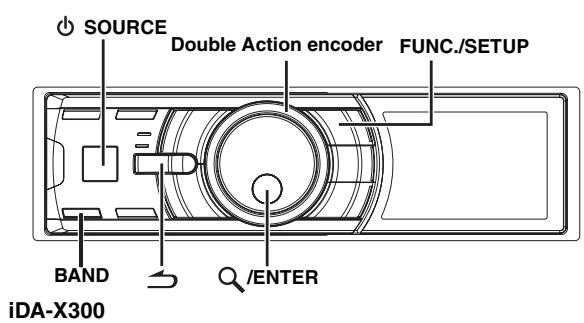
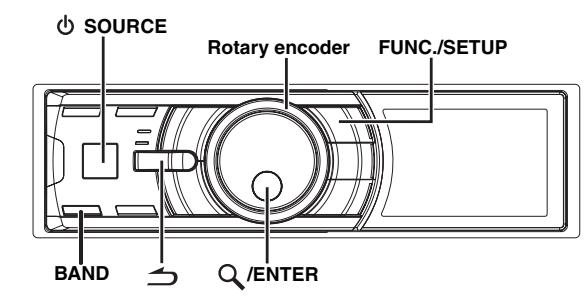
Follow steps 1 to 5 to choose an item to change. See the item descriptions following Step 5 for further details.
1 Press and hold FUNC./SETUP for at least 2 seconds to activate the SETUP selection mode. 2 Turn the Double Action encoder (iDA-X200 only) or Rotary encoder (iDA-X300 only) to select the desired item, and then press ENTER.
(e.g. Select GENERAL)
1 Displayed only when INT MUTE is set to OFF, and the mode is set to other than BT AUDIO. 2 Displayed only when an external audio processor is connected. For details, refer to the Owner's Manual of the external audio processor. *3 Only when HD / SAT receiver is connected.
3 Turn the Double Action encoder (iDA-X200 only) or Rotary encoder (iDA-X300 only) to select a setting item, and then press Q/ENTER.
(e.g. Select POWER IC)
BT:
BT IN
AUDIO*4:
USER PRESET 5 ↔ MX 5 ↔ SUBW 5 ↔ MX LEVEL 6
GENERAL:
CALENDAR ↔ CALENDAR ADJ* CLK MODE ↔
CLK ADJ*8 ↔ PLAY MODE ↔ BEEP*9 ↔ INT MUTE*10 ↔
AUX+ ↔ AUX+ NAME*11 ↔ AUX ↔ AUX NAME*11 ↔
CHANGER NAME ↔ DIGITAL AUX ↔ D-AUX NAME*12
AUX IN GAIN*13 ↔ POWER IC ↔ DEMO
DISPLAY:
DIMMER ↔ SCROLL TYPE ↔ TEXT SCROLL
IPOD:
PLAYLISTS ↔ ARTISTS ↔ ALBUMS ↔ PODCASTS ↔ AUDIOBOOKS ↔ GENRES ↔ COMPOSERS ↔ SONGS
TUNER:
XM_ADF*14 ↔ GAME_ALERT*14 ↔ STATIONCALL*15 ↔ DIGITALSEEK*15
4 If IMPRINT audio processor is connected, you can make more detailed settings for the audio setting. For details, refer to "IMPRINT Operation (Optional) (iDA-X200 only)" (page 30). 5 Displayed only when an external audio processor is connected. 6 Displayed only when MX is set to ON and an external audio processor is connected (or the IMPRINT audio processor is connected (iDA-X200 only)). 7 Refer to "Setting the Calendar" (page 8). 8 Refer to "Setting the Time" (page 8). 9 iDA-X200 only. 10 Displayed only when BT IN is OFF. 11 The setting can be made only when AUX+/AUX is set to ON. 12 Displayed only when DIGITAL AUX is set to ON. 13 Displayed only when AUX+ is set to ON. 14 Displayed only when SAT radio receiver is connected. For the SAT Radio Setting, refer to "SAT Radio Receiver (Optional)" (page 25). 15 Displayed only when HD Radio TUNER MODULE (TUA-T500 HD) is connected.
4
Turn the Double Action encoder (iDA-X200 only) or Rotary encoder (iDA-X300 only) to change the setting, and then press ENTER.
(e.g. Select POWER IC ON or POWER IC OFF.)
5
Press and hold → for 2 seconds to return to normal mode.
- Pressing ⊃ during the procedure will return to the previous mode.
- If no operation is performed for 60 seconds, the unit will return to normal mode automatically.
Bluetooth Setting
Select BT from the setup main menu in step 2 above.
If an optional Bluetooth Box is connected, you can place a hands-free call by a Bluetooth-equipped mobile phone.
Make this setting when the Bluetooth Box is connected and the
Bluetooth function is used. For details, refer to the Owner's Manual of the optional Bluetooth Box.
Set ADPT when the Bluetooth Box is connected.
- If the Bluetooth Box compatible with the Voice Dial function is connected, the Voice Dial function can be used.
- When INT MUTE is set to ON, the Bluetooth setting cannot be made. When the Bluetooth box is connected, set INT MUTE to OFF. Refer to "Turning Mute Mode On/Off (INT MUTE)" (page 23).
Setting the Bluetooth Connection
BT IN ADPT / BT IN OFF (Initial Setting)
Audio Setting (Only when external audio processor is connected)
AUDIO is selected on the setup menu in step 2.
Operating the External Audio Processor (USER PRESET)
PRE-1 (Initial Setting) / PRE-2 / PRE-3 / PRE-4 / PRE-5 / PRE-6
Turn the Double Action encoder (iDA-X200 only) or Rotary encoder (iDA-X300 only) to select the desired preset number, and then press Q/ENTER.
In normal mode, you can also call up the preset memory of the external audio processor by pressing and holding "PRESET" for at least 2 seconds. Refer to "Operating the External Audio Processor" on page 21.
- For the operation of external audio processor, refer to the Owner's Manual of the external audio processor you purchased.
OFF (Initial setting) / ON
When the Media Xpander is on, and an external audio processor is connected, you can adjust the Media Xpander level.
Setting the MX Level
MX (Media Xpander) makes vocals or instruments sound distinct regardless of the music source. The FM radio, CD, USB memory and iPod, will be able to reproduce the music clearly even in cars with a lot of road noise. The initial setting is different depending on the source.
Subwoofer On and Off
SUBW ON (Initial setting) / SUBW OFF
The adjustment can also be made by pressing and holding IMPRINT* (iDA-X200 only) or SOUND (iDA-X300 only) for at least 2 seconds. Refer to "Turning Subwoofer ON/OFF" (page 20).
- For iDA-X200, when connecting IMPRINT audio processor, you can't turn the subwoofer ON or OFF by pressing IMPRINT.
General Setting
GENERAL is selected on the setup main menu in step 2.
Setting of Calendar Display Pattern Switching (CALENDAR)
M/D/Y (Initial setting) / Y/M/D / D/M/Y
You can switch the calendar display pattern to be shown when the time is displayed.
Y: shows the year
M: shows the month
D: shows the day
ex. M/D/Y → 12/31/2007
Setting the Clock Display (CLK MODE)
24H/12H (Initial setting)
You can select the clock display type, 12-hour or 24-hour, depending on your preference.
Connecting an MP3 Changer (PLAY MODE)
CD-DA (Initial setting) / CD-DA&MP3
Perform this setting when connecting an MP3 changer. The MP3 changer can play CDs containing both CD and MP3 data. However, in some situations (some enhanced CDs), playback may be difficult. For these special cases, you can select playback of CD data only. When a disc contains both CD and MP3 data, playback starts from the CD data portion of the disc.
CD-DA: Only CD data can be played back.
CD-DA&MP3: Both CD data and MP3 file tracks can be played back.
- Change discs after performing this setting.
Sound (Beep) Guide Function (iDA-X200 only)
Beep On (Initial setting) / Beep Off
This function will give audible feedback with varying tones depending upon the button pressed.
Turning Mute Mode On/Off (INT MUTE)
INT MUTE ON / INT MUTE OFF (Initial setting)
If a device having the interrupt feature is connected, audio will be automatically muted whenever the interrupt signal is received from the device.
- When Bluetooth is set to ADPT, INT MUTE cannot be set. Refer to "Setting the Bluetooth Connection" (page 22).
- When the Bluetooth box is connected, set INT MUTE to OFF.
Setting the AUX+ Mode
AUX+ ON / AUX+ OFF (Initial setting)
You can input the audio of a connected external device, (such as a portable player) to the iPod Direct connector of this unit, using an iPod Direct/RCA Interface cable.
An external device and an iPod cannot be connected at the same time.
AUX+ ON: Set to ON when an external device is connected. If SOURCE is pressed and AUX+ is selected, the sound of the external device is input to the unit.
AUX+ OFF: Set to OFF when an iPod is connected.
Setting the AUX+ NAME Mode
AUX (Initial setting) / TV / DVD / PORTABLE / GAME
You can change the AUX+ NAME when AUX+ is ON.
Setting the AUX Mode (V-Link)
AUX ON / AUX OFF (Initial setting)
You can input TV/video sound by connecting an optional Ai-NET/RCA Interface cable (KCA-121B) or Versatile Link Terminal (KCA-410C) to this component.
You can change the AUX NAME display when AUX is set to ON. Press ENTER when AUX is set to ON, and select AUX NAME by turning the Double Action encoder (iDA-X200 only) or Rotary encoder (iDA-X300 only), then press ENTER.
After that, turn the Double Action encoder (iDA-X200 only) or Rotary encoder (iDA-X300 only) to select the desired AUX name.
If the KCA-410C is connected, it is possible to select two AUX names.
- Via KCA-410C, up to 2 external devices with RCA output can be connected. In this case, press SOURCE to select AUX mode and then press BAND to select your desired device.
Setting the Changer Name
CHANGER (Initial setting)/PORTABLE
When an optional changer is connected, you can set the displayed mode name. - The setting can be made only when a changer is connected. When two changers are connected, the CHANGER1 NAME/CHANGER2 NAME is displayed, and the setting can be made respectively.
DIGITAL AUX ON / DIGITAL AUX OFF (Initial setting)
When an ALPINE Ai-NET compatible digital audio processor (PXA-H701) and a DVD player (DVE-5207) not compatible with Ai-NET are connected, set DIGITAL AUX to ON to enjoy 5.1-channel surround sound.
You can change the D-AUX Name when DIGITAL AUX is set to ON. Press ENTER when DIGITAL AUX is set to ON, and select D-AUX NAME by turning Double Action encoder (iDA-X200 only)
or Rotary encoder (iDA-X300 only), then press ENTER.
- Press SOURCE, and select the D-AUX mode, and adjust the volume, etc.
- After input selection is completed, turn the ignition off and back on again. Setting of the optical digital input switch is completed.
- Depending on the connected audio processor, DVD player sound may continue to be output, even though the source is changed to another one. If this occurs, set the DVD player's power to OFF.
Setting the AUX+ Level (AUX IN GAIN)
LOW (Initial setting) / HI
After setting to ON in "Setting the AUX+ Mode", this setting can be carried out.
LOW: Decreases the external input audio level.
HI: Increases the external input audio level.
Connecting to an External Amplifier (POWER IC)
ON (Initial setting) / OFF
When an external amplifier is connected, sound quality can be improved by stopping the power supply of the built-in amplifier.
POWER IC OFF: Use this mode when the front pre-amplifier of the unit is used to drive an external amplifier connected to the speakers. In this setting, the head unit's internal amplifier has no output to drive speakers.
iDA-X200:
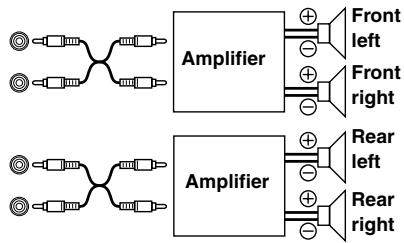
iDA-X300:
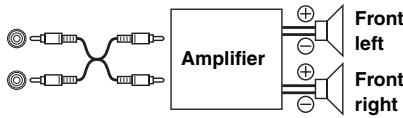
POWER IC ON: The speakers are driven by the built-in amplifier.
Speakers
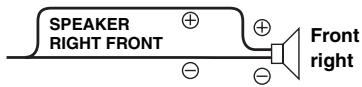
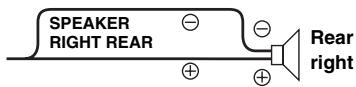
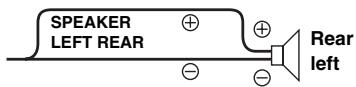
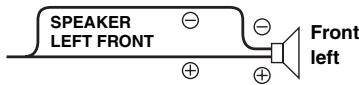
- No sound is produced by the system when the power output is set to OFF.
Demonstration
DEMO ON / DEMO OFF (Initial setting)
This unit has a Demonstration feature for the display.
- To quit Demo mode, set to DEMO OFF.
Display Setting
DISPLAY is selected on the setup main menu in step 2.
Dimmer Control
MANUAL / AUTO (Initial setting)
Set the Dimmer control to AUTO to decrease the illumination brightness of the unit with the head lights of the vehicle ON. This mode is useful if you feel the unit's backlighting is too bright at night.
TYPE1 / TYPE2 (Initial setting)
Choose from two scrolling methods.
Select the type you prefer.
TYPE1: The characters scroll from right to left, a single character at a time.
TYPE2: Words are built up from left to right, a single character at a time. When the display is filled, it is cleared and the remaining words are displayed the same way until all words of the title have been shown.
Scroll Setting (TEXT SCROLL)
AUTO/MANUAL (Initial setting)
You can set a scroll type such as song title or file name on the source screen. If the search mode screen displays fills with text, the display scrolls.
TEXT SCROLL AUTO: Text information are scrolled automatically.
TEXT SCROLL MANUAL : The first display scrolls text information one time only.
- In parts of the display, scrolling may not occur, or scroll content may differ.
- Regardless of this setting, if the display is filled with text, the display scrolls.
iPod Setting
IPOD is selected on the setup main menu in step 2.
iPod Search Mode Setting
ON/OFF
The unit allows you to search for the iPod using eight different search modes.
When the search mode is in PLAYLISTS/ARTISTS/ALBUMS/ PODCASTS/AUDIOBOOKS, the initial setting is On, and when the search mode is in GENRES/COMPOSERS/SONGS, the initial setting is Off.
- For search mode details, refer to "Searching for a desired Song/ Title" (page 11).
TUNER Setting (Only when HD/SAT receiver is connected)
TUNER is selected on the setup main menu in step 2.
HD Radio Station Call Setting
STATION CALL LONG / STATION CALL SHORT (Initial setting)
In the HD radio mode, the number of display characters for the HD radio station name can be selected.
LONG: 56 characters
SHORT: 7 characters (FM)
4 characters (AM)
Digital Seek On/Off Setting
DIGITAL SEEK ON/DIGITAL SEEK OFF (Initial Setting)
ON: SEEK UP/DOWN is used only for Digital Radio Station.
OFF: SEEK UP/DOWN is used for all Radio Stations.
SAT Radio Receiver (Optional)
iDA-X200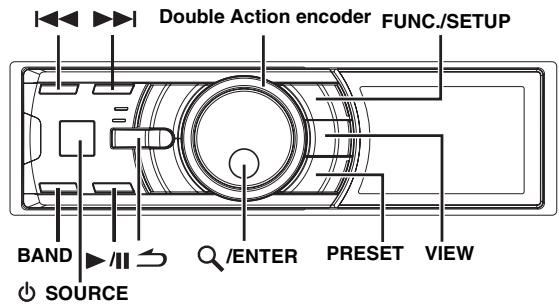
iDA-X300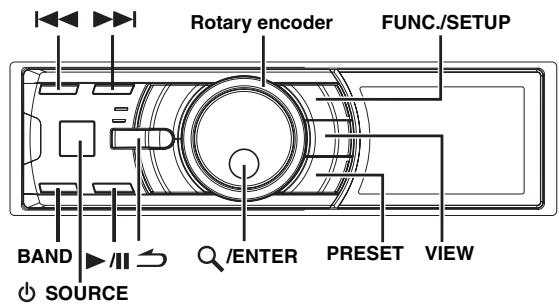
SAT Receiver: XM or SIRIUS Receiver
When an optional XM or SIRIUS Receiver Box is connected via the Ai-NET bus, the following operations may be performed. However, the XM Receiver and SIRIUS Receiver cannot be connected at the same time.
SIRIUS Receiver: Verify the features of the connected SIRIUS Receiver Box. Not all SIRIUS Receivers have identical functions and some may not be performed on this unit. For details about individual functions, refer to the SIRIUS Receiver's Owner's Manual.
Receiving Channels with the SAT Radio Receiver (Optional)
About SAT Radio
Satellite Radio* is the next generation of audio entertainment, with over 100 digital audio channels. For a small monthly fee, subscribers can hear crystal-clear music, sports, news and talk, coast-to-coast via satellite. For more information, visit XM's website at www.xmradio.com, or SIRIUS' website at www.sirius.com.
To receive SAT Radio, the separately sold XMDirect™ or SIRIUS Satellite Radio Tuner and an appropriate Ai-NET Interface Adapter will be required. For details, consult you nearest Alpine dealer.
- XM and its corresponding logos are trademarks of XM Satellite Radio Inc.
- SIRIUS and its corresponding logos are trademarks of SIRIUS Satellite Radio Inc.
- The SAT Receiver controls on this unit are operative only when a SAT Receiver is connected.
1 Press SOURCE to activate the SAT Radio mode. 2 Press BAND to select one of the three SAT Radio Preset Bands.
Each press changes the band:
XM mode:
XM1 → XM2 → XM3 → XM1
SIRIUS mode:
SR1 → SR2 → SR3 → SR1
3 Press or to select the desired channel.
Holding down or will change channels continuously.
- When using the optional remote control (RUE-4190, etc.), an SAT Radio Channel can be directly called up with the numeric keypad of the remote control.
1 While in XM or SIRIUS Radio mode, enter the Channel number you want to call up with the numeric keypad on the remote control. 2 Press ENTER on the remote control within 5 seconds to receive the channel. If the channel number is input without pressing ENTER, the channel is automatically received after 5 seconds.
Checking the SAT Radio ID Number
A unique Radio ID number is required to subscribe to SAT Radio programming. Each third party XM or SIRIUS radio comes with this number.
This number is an 8 character (for XM Radio) or 12 character (for SIRIUS Radio) alphanumeric number. It is printed on a label found on the SAT Receiver.
It can also be displayed on the screen of this unit in the following way.
XM:
1 While receiving a XM Radio band, press I ▶ or ▷ to select channel “0” for XM. 2 To cancel the ID number display, select the channel other than "0."
SIRIUS:
1 While receiving a SIRIUS Radio band, press I ▶ or ▷▶ to select channel “255” for SIRIUS. 2 To cancel the ID number display, set the channel to other than "255". - You cannot use "O," "S," "I," or "F" for the ID Number (XM radio Receiver only). - You can check the ID number printed on a label on your third party, SAT Radio Receiver package.
Storing Channel Presets
1 Press BAND to select the desired band you want to store. 2 Press PRESET.
The Preset screen is displayed.
3 Turn the Double Action encoder (iDA-X200 only) or Rotary encoder (iDA-X300 only) to select the preset number. 4 Press and hold Q/ENTER for at least 2 seconds.
The selected station is stored.
5 Repeat the procedure to store up to 5 other channels onto the same band.
- To use this procedure for other bands, simply select the band desired and repeat the procedure.
- A total of 18 channels can be stored in the preset memory for either XM or SIRIUS. 6 Channels are stored in each band (XM1, XM2 and XM3 for XM; SIRIUS1, SIRIUS2 and SIRIUS3 for SIRIUS).
- If you store a channel in a preset memory which already has a station, the current channel will be cleared and replaced with the new one.
Receiving Stored Channels
1 Press BAND to select the desired band. 2 Press PRESET.
The Preset screen is displayed.
3 Turn the Double Action encoder (iDA-X200 only) or Rotary encoder (iDA-X300 only) to select a radio station. 4 Press ENTER.
Storing the desired Sports Team (SIRIUS only)
Store a favorite team from one of the available leagues SIRIUS covers. Once stored, game times and scores for that team are announced using the interruption Alert display while receiving other programming. To receive these announcements, refer to page 27.
This function becomes effective after performing the following two operations.
Storing while receiving a game broadcast
1. Select the channel broadcasting your favorite team's game. 2. Press FUNC./SETUP to activate the Function mode. 3. Turn the Double Action encoder (iDA-X200 only) or Rotary encoder (iDA-X300 only) to select MEMORY, then press Q/ENTER to activate the Memory mode.
4. Turn the Double Action encoder (iDA-X200 only) or Rotary encoder (iDA-X300 only) to select the desired team for the game being broadcast, and then press ENTER. 5. Turn the Double Action encoder (iDA-X200 only) or Rotary encoder (iDA-X300 only) to select alert type, and then press Q/ENTER.
UPDATE (Initial setting) ↔ INITIAL
INITIAL: The Alert display interrupts when the game begins. UPDATE: The Alert display interrupts by game progress (change of score, game result, etc.).
6. Press FUNC./SETUP to cancel the Function mode.
- When you want to store but the memory area is full, "MEMORY FULL" is displayed. If you want to replace the team after you have performed the procedure in step 4, turn the Double Action encoder (iDA-X200 only) or Rotary encoder (iDA-X300 only) to select "REPLACE YES," and then press ENTER.
Game Alert Setup
1. Press and hold FUNC./SETUP for at least 2 seconds to enter the Setup mode. 2. Turn the Double Action encoder (iDA-X200 only) or Rotary encoder (iDA-X300 only) to select a TUNER item, and then press Q/ENTER. 3. Turn the Double Action encoder (iDA-X200 only) or Rotary encoder (iDA-X300 only) to select GAME ALERT and then press ENTER. 4. Turn the Double Action encoder (iDA-X200 only) or Rotary encoder (iDA-X300 only) to select the desired league, and then press Q/ENTER. 5. Turn the Double Action encoder (iDA-X200 only) or Rotary encoder (iDA-X300 only) to select a team you want to store, and then press ENTER. 6. Turn the Double Action encoder (iDA-X200 only) or Rotary encoder (iDA-X300 only) to select an alert type, and then press Q/ENTER.
UPDATE (Initial setting) ↔ INITIAL
INITIAL: The Alert display interrupts when the game begins.
UPDATE: The Alert display interrupts by game progress (change of score, game result, etc.).
7. Press and hold → for at least 2 seconds to cancel the SETUP mode.
- Pressing ⊃ returns to the previous Setup mode.
- You can store a maximum of one team per league.
- If no operation is performed for 60 seconds, the unit will return to normal mode automatically.
Storing the desired Song / Artist (SIRIUS only)
A stored song title or artist name is announced whenever a matching title or artist is found on another channel. The interruption Alert is displayed while listening to a program on another channel. For receiving interruption information, refer to "Recalling the stored information (SIRIUS only)" (page 27).
1 Press FUNC./SETUP to activate the Function mode when a Song or the song of an Artist you want to store is being broadcast. 2 Turn the Double Action encoder (iDA-X200 only) or Rotary encoder (iDA-X300 only) to select MEMORY, press Q/ENTER to activate the Memory mode. 3 Turn the Double Action encoder (iDA-X200 only) or Rotary encoder (iDA-X300 only) to select SONG or ARTIST, and then press /ENTER. - If no operation is performed for 10 seconds, the unit returns to normal mode. - When you want to store but the memory area is full, MEMORY FULL is displayed. If you want to replace the Song title or Artist name after you have performed the procedure in step 3, turn the Double Action encoder (iDA-X200 only) or Rotary encoder (iDA-X300 only) to select "REPLACE YES", and then press ENTER.
Whenever the stored sports team, song(s) or artist(s) are playing, an interruption Alert appears in the display of the unit.
1 After displaying "GAME ALERT", "SONG ALERT" or "ARTIST ALERT", an alert list will be automatically displayed. 2 Turn the Double Action encoder (iDA-X200 only) or Rotary encoder (iDA-X300 only) to select the desired information. 3 Press ENTER.
The selected channel containing the desired information is received.
- If no operation is performed for 10 seconds, the unit returns to normal mode.
- Only a single sports team, song or artist can be displayed as an interruption Alert. For example, both song and artist cannot be displayed as an Alert at the same time.
Canceling the stored Alert Memory (SIRIUS only)
1 During usual reception, press FUNC./SETUP to turn the Function mode. 2 Turn the Double Action encoder (iDA-X200 only) or Rotary encoder (iDA-X300 only) to select DELETE, and press /ENTER.
The memory list appears. If no Alert Memory is stored, "NO MEMORY" is displayed.
3 Turn the Double Action encoder (iDA-X200 only) or Rotary encoder (iDA-X300 only) to select a list you want to delete, and then press ENTER. 4 Turn the Double Action encoder (iDA-X200 only) or Rotary encoder (iDA-X300 only) to select DELETE YES, and then press ENTER.
DELETE NO ↔ YES
Select "NO" the unit will return to the Memory List display.
5 Press FUNC./SETUP to cancel the Function mode. - If no operation is performed for 10 seconds, the unit returns to normal mode.
Search Function
You can search for programs by Category, Channel, Artist or Song.
1 Press ENTER in the XM or SIRIUS mode. 2 Turn the Double Action encoder (iDA-X200 only) or Rotary encoder (iDA-X300 only) to select Search mode, and then press Q/ENTER.
CATEGORY ↔ CHANNEL ↔ ARTIST* ↔ SONG*
* SIRIUS Only.
Category Search mode
3 Turn the Double Action encoder (iDA-X200 only) or Rotary encoder (iDA-X300 only) to select the desired Category, and then press ENTER. 4 Turn the Double Action encoder (iDA-X200 only) or Rotary encoder (iDA-X300 only) to select the desired Channel Name, and then press Q/ENTER.
- While in Category Search mode, press to select a different search mode.
- The Search mode is canceled if you press and hold ⊃ for at least 2 seconds in Category Search mode.
- If Alert interruption occurs in the search mode, the search mode is canceled.
Channel/Artist/Song Search mode
3 Turn the Double Action encoder (iDA-X200 only) or Rotary encoder (iDA-X300 only) to select the desired Channel/Artist/Song Name, and then press ENTER.
- While in Channel/Artist/Song Search mode, press to select a different search mode.
- The Search mode is canceled if you press and hold ⋃ for at least 2 seconds in Channel/Artist/Song Search mode.
- Channel search is possible only in the category (last mode).
- If Alert interruption occurs in the search mode, the search mode is canceled.
Switching between Quick Search mode and Category up/down mode (iDA-X300 only)
1 Press FUNC./SETUP. 2 Turn the Rotary encoder to select the desired adjust menu.
QUICK SEARCH: Quick Search mode
CATEGORY UP/DN: Category up/down mode
3 Press ENTER.
The ON/OFF screen is displayed.
4 Turn the Rotary encoder. Select ON. When ON is set, either Quick Search mode or Category up/down mode can be used. 5 Press ENTER. - You cannot set both QUICK SEARCH and CATEGORY UP/DN mode to ON.
Quick Search Function
You can search for all channels in numerical order.
1 Press and hold Q/ENTER for at least 2 seconds in XM or SIRIUS mode to activate Quick Search mode. 2 Turn the Double Action encoder (iDA-X200 only) or Rotary encoder (iDA-X300 only) to select the desired Channel within 10 seconds.
The selected Channel is received.
- When using the Quick Search function, be sure to set QUICK SEARCH to ON. For details, refer to "Switching between Quick Search mode and Category up/down mode (iDA-X300 only)" on page 28.
Select the desired CATEGORY (Category up/down)
By using this function on iDA-X200
Press and turn the Double Action encoder to the left or right.
Turning to the right will advance to the next Category.
Turning to the left will return to the previous Category.
The first channel in the selected Category is played back.
By using this function on iDA-X300
1 Press ENTER for at least 2 seconds.
The Category up/down mode is activated.
2 Turn the Rotary encoder.
Turning to the right will advance to the next Category.
Turning to the left will return to the previous Category.
The first channel in the selected Category is played back.
- When using the Category up/down function, be sure to set CATEGORY to ON. For details, refer to "Switching between Quick Search mode and Category up/down mode (iDA-X300 only)" on page 28.
1 Select the SAT Radio Channel for your local traffic/weather information. 2 Press and hold ▸ / ‖ for at least 2 seconds in the SAT mode.
The received weather or traffic channel is stored.
3 Press and hold BAND for at least 2 seconds.
The stored Weather or Traffic channel will be recalled.
4 Press and hold BAND for at least 2 seconds.
Returns to normal mode.
- Channels other than Weather or Traffic can also be stored and recalled.
Instant Replay Function (SIRIUS only)
In SIRIUS mode, the current channel is saved using the Instant Replay memory function. Use this function to pause the channel content at any time. When playback is continued, it will begin at the position it was paused. This function can be used to store up to 44 minutes of audio.
1 During SIRIUS reception, press ▸ to select the Instant Replay mode.
"INSTANT REPLAY" is displayed, and the received station is stored.
2 Press ▸ / ‖ again to select the play mode.
The stored contents are played back.
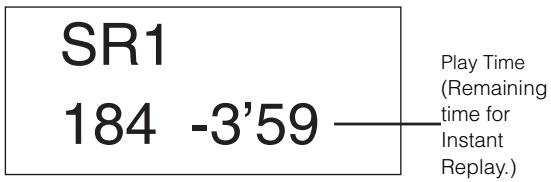
During Instant Replay playback:
Fast reverse: Press and hold. Fast forward: Press and hold.
- If you continue to press Fast forward until the end, the Instant Replay mode is canceled, and the unit will change to usual reception.
3 Press for at least 2 seconds to cancel the Instant Replay mode.
The unit returns to usual SIRIUS broadcasting mode.
Changing the Display
Text information, such as the channel name, artist name/feature, and song/program title, is available with each XM or Sirius channel. The unit can display this text information as explained below.
In XM or SIRIUS mode, press VIEW.
Each time you press this button, the display changes as shown below.
XM mode:
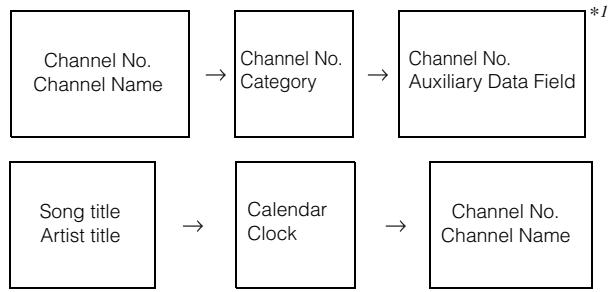
SIRIUS mode:
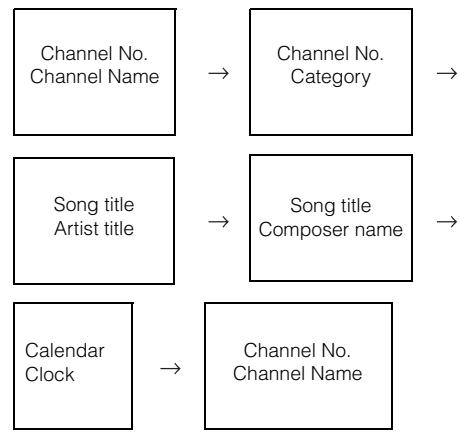
*1 When ADF is turned OFF, this information is not displayed (see "Setting the Auxiliary Data Field Display (XM only)" on page 30).
- When the "Scroll Setting (TEXT SCROLL)" (page 25) is set to "AUTO", the channel name and song title scrolls continuously. When the Scroll Setting is set to "MANUAL", the song title scrolls only once.
- Depending on the model, the display may differ from the one shown above.
Setting the Auxiliary Data Field Display (XM only)
The XM Auxiliary Data Field (ADF) display can be switched on or off. There is no ADF function for the SIRIUS receiver.
1 Press and hold FUNC./SETUP for at least 2 seconds to enter the Setup mode. 2 Turn the Double Action encoder (iDA-X200 only) or Rotary encoder (iDA-X300 only) to select the TUNER mode, and then press Q/ENTER. 3 Turn the Double Action encoder (iDA-X200 only) or Rotary encoder (iDA-X300 only) to select XM ADF, and then press Q/ENTER. 4 Turn the Double Action encoder (iDA-X200 only) or Rotary encoder (iDA-X300 only) to select ON/OFF, and then press Q/ENTER.
When setting to On, Auxiliary Data Field is displayed by pressing VIEW (Refer to the "Changing the Display" section page 29.)
5 Press and hold for 2 seconds to return to normal mode. - Pressing during the procedure will return to the previous mode.
IMPRINT Operation (Optional) (iDA-X200 only)
Alpine introduces IMPRINT - the world's first technology that thoroughly eliminates in-car acoustic problems that normally degrade sound quality, which enables us to experience music the way the artist intended, refer to "About IMPRINT" (page 37).
When the IMPRINT audio processor (PXA-H100) (sold separately) is connected to this unit, MultEQ and the following sound adjustment can be performed.
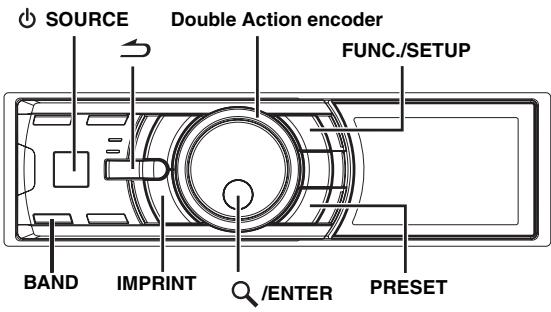
Changing MultEQ mode
MultEQ, developed by Audyssey Labs, automatically corrects the audio for the listening environment. The system is optimized for selected positions in the vehicle. To accomplish this, MultEQ must take measurements of the vehicles response characteristics. For details on the set up procedure, consult your authorized Alpine dealer.
1 Press and hold IMPRINT for at least 2 seconds. 2 Press ENTER. 3 Turn the Double Action encoder to select the MultEQ mode, and then press ENTER.
OFF (Manual Mode) → CURVE 1 (MultEQ-1) → CURVE 2 (MultEQ-2) → OFF (Manual Mode)
4 Press and hold IMPRINT for at least 2 seconds to return to normal mode.
- The Curve mode can be selected only when curve 1 and curve 2 are stored.
- When using MultEQ, MX, X-OVER, Time Correction, Factory's EQ, SUBW PHASE, SUBW CHANNEL, TW Setup, EQ Mode, Filter Type, Parametric EQ and Graphic EQ are set automatically. They are no longer user adjustable.
- When an external audio processor is connected, the MultEQ function cannot be used.
Adjusting Sound Setting in Manual Mode
You can change these sound settings to create your own preference when the MultEQ mode is set to MultEQ off (Manual Mode). However, the subwoofer in the subwoofer system can be set to ON/OFF regardless of whether the MultEQ setting is ON or OFF.
Use steps 1 to 5 to select one of the Sound menu modes to modify. See the applicable section below for details about the selected item.
1 Press and hold FUNC./SETUP for at least 2 seconds to activate the SETUP selection mode. 2 Turn the Double Action encoder to select AUDIO, and then press Q/ENTER.
BT ↔ AUDIO ↔ GENERAL ↔ DISPLAY ↔ IPOD ↔ TUNER ↔ BT
1 Displayed only when INT MUTE is set to OFF, and the mode is set to other than BT AUDIO. 2 Only when HD / SAT receiver is connected.
3 Turn the Double Action encoder to select the desired item, and then press Q/ENTER.
USER PRESET ↔ MX ↔ FR-EQ ↔ SOUND FIELD*3 ↔ SUBW ↔ SUBW SYS*4 ↔ SUBW PHASE*4 ↔ SUBW CHANNEL*4 ↔ TW*5 ↔ EQ MODE ↔ FILTER ↔ TCR ↔ MX LEVEL*6 (e.g. Select SUBW)
3 In step 3, three sound adjustment items (PARAMETRIC EQ/ GRAPHIC EQ, TIME CORRECTION, X-OVER) can be selected in Sound Field Adjustment mode. Turn the Double Action encoder to select the desired item, and then press Q/ENTER to continue to step 4. 4 These functions are inoperable when Subwoofer is set to OFF. 5 This function is operable only when PXA-H100 (sold separately) is connected and 2.2ch (3 WAY) mode is set. For details, refer to the Owner's Manual of PXA-H100. 6 This function is inoperable when MX is set to OFF.
4 Turn the Double Action encoder to change the setting, and then press Q/ENTER.
(e.g. Select SUBW ON or SUBW OFF)
5 Press and hold the forward button for at least 2 seconds to return to normal mode.
Media Xpander, Factory's EQ, Parametric EQ/Graphic EQ Adjustment, EQ Mode and MX Level Adjustment are inoperable when DEFEAT is set to ON. - Pressing the back button returns to the previous Sound menu mode. - If no operation is performed for 60 seconds, Sound menu mode is canceled.
USER PRESET
- If IMPRINT audio processor is connected, you can make more detailed settings for the audio setting. For details, refer to "IMPRINT Operation (Optional) (iDA-X200 only)" (page 30).
Storing the Audio Adjustment Level
You can store up to 3 adjusted/set contents on this unit.
All of the following adjusted/set items are stored in a preset memory.
| Items to be adjusted/set | Reference page |
| EQ ADJ (parametric EQ/Graphic EQ) | page 32 ~ page 32 |
| TCR | page 32 |
| X-OVER | page 33 |
1 Turn the Double Action encoder to select a preset number, and press and hold Q/ENTER for at least 2 seconds. 2 Turn the Double Action encoder to select PROTECT YES/NO, and then press ENTER to store the adjusted contents.
PROTECT YES (Initial setting) ↔ PROTECT NO
- If YES is selected, the adjusted contents are protected and stored into the preset numbers. When you want to store the parameter into a protected preset number, "REPLACE NO/YES" can be selected.
- If PROTECT NO is selected, the preset is stored.
- While performing this operation, all adjusted contents of Parametric EQ/Graphic EQ, Time Correction and X-Over will be stored in the preset number.
- The stored contents are not deleted even when resetting the unit or disconnecting the battery.
Recalling the Audio Adjustment Level
You can recall the contents stored in "Storing the Audio Adjustment Level" (page 31).
1 Turn the Double Action encoder to select a preset number, and press ENTER.
Adjusted/set contents of the selected number are recalled.
- The User Preset screen can also be recalled in normal mode by pressing and holding PRESET for at least 2 seconds.
When the Media Xpander is on, you can adjust the Media Xpander level (refer to page 34).
OFF (Initial setting) ↔ ON
Equalizer Presets (Factory's EQ) (FR-EQ)
10 typical equalizer settings are preset at the factory for a variety of musical source material.
FLAT ↔ POPS ↔ ROCK ↔ NEWS ↔ JAZZ&BLUES ↔ ELECTRICAL DANCE ↔ HIPHOP&RAP ↔ EASY LISTENING ↔ COUNTRY ↔ CLASSICAL ↔ USER1 ↔ USER2 ↔ USER3 ↔ USER4 ↔ USER5 ↔ USER6
- By selecting User's 1 to 6, you can recall the stored preset number in "Adjusting the Graphic Equalizer Curve" (page 32) or "Adjusting the Parametric Equalizer Curve" (page 32).
Sound Field Adjustment
The setting of Parametric EQ/Graphic EQ Adjustment, Time Correction and X-Over can be adjusted in this mode.
Adjusting the Parametric Equalizer Curve
You can modify the Equalizer settings to create a response curve more appealing to your personal taste. To adjust the Parametric Equalizer Curve, set the EQ mode to PARAMETRIC EQ. For details, refer to "Setting EQ mode" (page 34).
1 After selecting EQ ADJ (Parametric EQ) from the Sound Field Adjustment mode, turn the Double Action encoder to select the band adjustment, and then press ENTER.
BAND1 → BAND2 → BAND3 → BAND4 → BAND5 → BAND1
2 Turn the Double Action encoder to select an item to adjust, then press ENTER.
| FC → (frequency) | LV → (level) | Q → (bandwidth) | FC (frequency) |
Frequency Adjustment
3-1 Turn the Double Action encoder to select frequency bands.
Adjustable frequency bands:
20 Hz to 20 kHz (in 1/3 octave steps)
BAND1: 20Hz 80Hz (63 Hz)
BAND2: 50 Hz~200 Hz (150 Hz)
BAND3: 125 Hz~3.2 kHz (400 Hz)
BAND4: 315 Hz~8 kHz (1 kHz)
BAND5: 800 Hz~20 kHz (2.5 kHz)
Level Adjustment
3-2 Turn the Double Action encoder to adjust the level.
Adjustable level: -6 to +6 dB
Bandwidth (Q) Adjustment
3-3 Turn the Double Action encoder to set the bandwidth (Q).
Adjustable bandwidth: 1, 1.5, 3
4 To adjust another band, repeat steps 1 to 3 and adjust all bands.
- The frequencies of adjacent bands cannot be adjusted within 4 steps.
- While adjusting the Parametric EQ, you should consider the frequency response of the connected speakers.
- You can select the next band by pressing and turning the Double Action encoder.
- The User Preset screen can be recalled in the normal mode by pressing and holding PRESET for 2 seconds.
Adjusting the Graphic Equalizer Curve
You can modify the equalizer settings to create a response curve more appealing to your personal taste. To adjust the graphic equalizer curve, set the EQ mode to GRAPHIC EQ. For details, refer to "Setting EQ mode" (page 34).
1 After selecting EQ ADJ (Graphic EQ) from the Sound Field Adjustment mode, turn the Double Action encoder to select the band adjustment, and then press ENTER.
BAND1 → BAND2 → BAND3 → BAND4 → BAND5 → BAND6 → BAND7 → BAND1
BAND-1 (63 Hz) / BAND-2 (150 Hz) / BAND-3 (400 Hz) / BAND-4 (1 kHz) / BAND-5 (2.5 kHz) / BAND-6 (6.3 kHz) / BAND-7 (17.5 kHz)
2 Press ENTER to activate the level adjusting mode. 3 Turn the Double Action encoder to adjust the level.
Adjustable output level: -6 to +6 dB
4 To adjust another band, repeat steps 1 to 3, and then adjust all bands.
- You can select the next band by pressing and turning the Double Action encoder.
- The User Preset screen can be recalled in the normal mode by pressing and holding PRESET for 2 seconds.
Adjusting the Time Correction
Before performing the following procedures, refer to "About Time Correction" (page 35).
1 After selecting TIME CORRECTION from the Sound Field Adjustment mode, turn the Double Action encoder to select the band adjustment, and then press Q/ENTER.
2.2ch (3WAY) System
| F-L (Initial setting) → F-R → R-L → R-R → (Mid-L) (Mid-R) (High-L) (High-R) |
| SW-L → SW-R → F-L (Mid-L) |
4.2ch (FRONT/REAR/SUBW.) System
| F-L (Initial setting) → F-R → R-L → R-R → (Front-L) (Front-R) (Rear-L) (Rear-R) SW-L → SW-R → F-L (Front-L) |
2 Press ENTER to activate the Time Correction input mode. 3 Turn the Double Action encoder to adjust the distance (0.0 to 336.6cm).
L = (distance to farthest speaker) - (distance to other speakers)
Refer to "Time Correction Value List" on page 35.
4 Repeat steps 1 to 3 to set another speaker. By setting these values to make its sound reach the listening position at the same time as the sound of other speakers. - You can select the next band by pressing and turning the Double Action encoder. - The User Preset screen can be recalled in the normal mode by pressing and holding PRESET for 2 seconds.
Adjusting the Crossover Settings (X-OVER)
Before performing the following procedures, refer to "About the Crossover" (page 36).
2.2ch (3WAY) System
1 After selecting X-OVER from the Sound Field Adjustment mode, turn the Double Action encoder to select the band adjustment, and then press ENTER.
2.2ch (3WAY) System / NORMAL (L = R)
Setting items: LOW/MID-L/MID-H/HIGH
2.2ch (3WAY) System / INDIVIDUAL (L/R)
Setting items: LOW-L/LOW-R/MID-L-L/MID-L-R/MID-H-L/MID-H-R/HIGH-L/HIGH-R
2 Turn the Double Action encoder to select an item to adjust, then press Q/ENTER.
FC → LV → SLP → FC (cut-off level) (slope) (frequency)
Cut-off frequency
3-1 Turn the Double Action encoder to select the desired cut-off frequency (Crossover Point).
Adjustable frequency bands:
2.2ch (3WAY) System
Setting items: LOW/MID-L 20 Hz~200 Hz, MID-H 20 Hz~20 kHz, HIGH (1 kHz~20 kHz)*1 / (20 Hz~20 kHz)*2
1 When Maker's is selected, refer to "Setting the Response Slope for the High Range Speaker (TW Setup)" (page 34). 2 When User's is selected, refer to "Setting the Response Slope for the High Range Speaker (TW Setup)" (page 34).
Level Adjustment
3-2 Turn the Double Action encoder to adjust the output level.
Adjustable output level: -12 to 0 dB.
Slope Adjustment
3-3 Turn the Double Action encoder to adjust the slope.
Adjustable slope: FLAT*, 6 dB/oct., 12 dB/oct., 18 dB/oct., 24 dB/oct.
- FLAT can be set for the HIGH slope only when User's is selected in "Setting the Response Slope for the High Range Speaker (TW Setup)" (page 34). Depending on the response characteristics of the speaker, care should be taken when setting the response slope to FLAT, as speaker damage may result. With this unit, a message is displayed when the response slope for the high range speaker is set to FLAT.
4 Repeat steps 1 to 3 to make adjustment to the other bands.
4.2ch (FRONT/REAR/SUBW.) System
1 After selecting X-OVER from the Sound Field Adjustment mode, turn the Double Action encoder to select the band adjustment, and then press ENTER.
4.2ch (FRONT/REAR/SUBW.) System / NORMAL (L = R)
Setting items: LOW (SUB-W) / MID (REAR) / HIGH (FRONT)
4.2ch (FRONT/REAR/SUBW.) System / INDIVIDUAL (L/R)
Setting items: LOW (SUB-W)-L / LOW (SUB-W)-R / MID (REAR)-L / MID (REAR)-R / HIGH (FRONT)-L / HIGH (FRONT)-R
2 Turn the Double Action encoder to select an item to adjust, then press ENTER.
FC → LV → SLP → FC (cut-off frequency, level, slope, frequency)
Cut-off frequency
3-1 Turn the Double Action encoder to select the desired cut-off frequency (Crossover Point).
Adjustable frequency bands:
4.2ch (FRONT/REAR/SUBW.) System
Setting items: 20 Hz~200 Hz
Level Adjustment
3-2 Turn the Double Action encoder to adjust the output level.
Adjustable output level: -12 to 0 dB.
Slope Adjustment
3-3 Turn the Double Action encoder to adjust the slope.
Adjustable slope: FLAT, 6 dB/oct., 12 dB/oct., 18 dB/oct., 24 dB/oct.
4 Repeat steps 1 to 3 to make adjustment to the other bands.
- You can select the next band by pressing and turning the Double Action encoder.
- While adjusting the crossover, you should consider the frequency response of the connected speakers.
- About the 2.2ch (3WAY)/4.2ch (FRONT/REAR/SUBW.) system You can switch to 2.2ch (3WAY)/4.2ch (FRONT/REAR/SUBW.) system mode with the 2.2ch (3WAY)/4.2ch (FRONT/REAR/SUBW.) switch on the PXA-H100. For details, refer to the Owner's Manual of PXA-H100.
- The User Preset screen can be recalled in the normal mode by pressing and holding PRESET for 2 seconds.
Turning Subwoofer ON/OFF
When the subwoofer is on, you can adjust the subwoofer output level (refer to page 19).
OFF ↔ ON (Initial setting)
Setting the Subwoofer System
When the subwoofer is on, you can select either SYS 1 or SYS 2 for the desired subwoofer effect.
1 (Initial setting) ↔ 2
SYS 1: Subwoofer level changes according to the main volume setting. SYS 2: Subwoofer level change is different from the main volume setting. For example, even at low volume settings, the subwoofer is still audible.
Setting the Subwoofer Phase
NORMAL (Initial setting) ↔ REVERSE
The subwoofer output phase is toggled SUBWOOFER NORMAL (0°) or SUBWOOFER REVERSE (180°). To adjust the level, turn the Double Action encoder.
Setting the Subwoofer Channel (SUBW CHANNEL)
You can set the subwoofer output to stereo or monaural. Make sure to set the correct output for your subwoofer type.
STEREO (Initial setting) ↔ MONO
STEREO: Subwoofer stereo (L/R) output
MONO: Subwoofer monaural output
Setting the Response Slope for the High Range Speaker (TW Setup)
Depending on the response characteristics of the speaker, care should be taken when setting the response slope of the high range speaker to FLAT in 2.2ch (3WAY) mode (see "Adjusting the Crossover Settings (X-OVER)" on page 33), as speaker damage may result.
MAKER'S (Initial setting) ↔ USER'S
MAKER'S: As protection from possible speaker damage, FLAT cannot be set for the response slope of the high range speaker in 2.2ch (3WAY) mode.
USER'S: The FLAT setting is possible in 2.2ch (3WAY) mode.
Setting EQ mode
This setting gives you a choice of 5-band parametric, or 7-band graphic equalizer.
PARAMETRIC (Initial setting) ↔ GRAPHIC
Setting the Filter type
NORMAL (Initial setting) ↔ INDIVIDUAL
NORMAL (L = R): Left and right speakers are adjusted equally.
INDIVIDUAL (L/R): Left and right speakers are individually adjusted.
Setting the Time Correction Unit (TCR Parameter)
You can change the unit, (cm or inch) of time correction.
CM (Initial setting) ↔ INCH
Setting the MX Level
MX (Media Xpander) makes vocals or instruments sound distinct regardless of the music source. The FM radio, CD, USB memory and iPod, will be able to reproduce the music clearly even in cars with a lot of road noise.
FM (MX level 1 to 3):
The medium to high frequencies become clearer, and produces well balanced sound at all frequencies.
CD (MX level 1 to 3):
CD mode processes a large amount of data during playback. MX takes advantage of this large data quantity to reproduce a more clear, clean output.
CMPM/SAT (MX level 1 to 3):
This corrects information that was lost at the time of compression. This reproduces a well-balanced sound close to the original.
DVD (MX level 1 to 3):
A DVD or Video CD contains a large quantity of data such as music clip. MX uses this data to reproduce the sound accurately.
AUX (MX level 1):
Choose the MX mode (CMPM, MOVIE, or MUSIC) that corresponds to the media connected.
- The initial setting of MX is different depending on the source. Each music source, such as FM radio, CD, and MP3/WMA/AAC can have its own MX setting.
- On disks with both MP3/WMA/AAC and CD-DA, when the source changes from "MP3/WMA/AAC to CD-DA" or "CD-DA to MP3/WMA/AAC", MX-mode switching may delay playback slightly.
- Setting to Non Effect sets MX mode of each music source to OFF.
- This function is inoperable when DEFEAT is set to ON.
- There is no MX mode for AM radio.
- If an audio processor with the MX function (PXA-H701, etc.) is connected, its own MX processing is applied to the music source. Since the processor MX settings may not match the head unit, the audio processor needs to be adjusted. For details, refer to the Owner's Manual of the audio processor.
- "CMPM" is applied for MP3/WMA/AAC and iPod.
- "SAT" is applied for XM radio and SIRIUS radio.
About Time Correction
The distance between the listener and the speakers in a car varies widely due to the complex speaker placement. This difference in the distances from the speakers to the listener creates a shift in the sound image and frequency characteristics. This is caused by the time delay between the sound reaching the listener's right versus the left ear.
To correct this, this unit is able to delay the audio signal to the speakers closest to the listener. This effectively creates a perception of increased distance for those speakers. The listener can be placed at an equal distance between the left and right speakers for optimum staging.
The adjustment will be made for each speaker in 3.4 cm steps.
Example 1. Listening Position: Front Left Seat
Adjust the time correction level of the front left speaker to a high value and the rear right to zero or a low value.
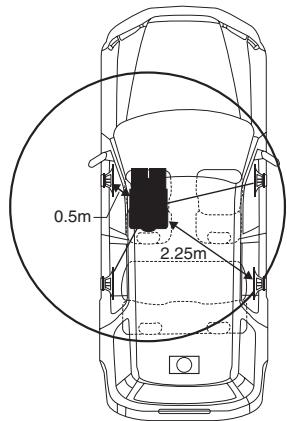
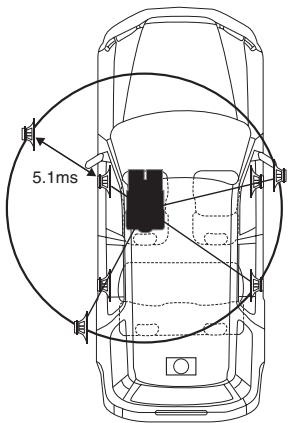
The sound is not balanced because the distance between the listening position and the various speakers is different.
The difference in distance between the front left speaker and the rear right speaker is 1.75 m (68-7/8").
Here we calculate the time correction value for the front left speaker in the diagram above.
Conditions:
Farthest Speaker - listening position: 2.25 m (88-9/16")
Front left speaker - listening position: 0.5 m (19-11/16")
Calculation: L = 2.25 m - 0.5 m = 1.75 m (68-7/8")
Time correction = 1.75 ÷ 343*1 × 1000 = 5.1 (ms)
*1 Speed of sound: 343 m/s (765 mph) at 20°C
In other words, giving the front left speaker a time correction value of 5.1 ms makes it seem as if its distance from the listener is the same as the distance to the farthest speaker.
Time correction eliminates the differences in the time required for the sound to reach the listening position.
The time of the front left speaker is corrected by 5.1 ms so that its sound reaches the listening position at the same time as the sound of other speakers.
Example 2. Listening Position: All Seats
Adjust the time correction level of each speaker to almost the same level.
1 Sit in the listening position (driver's seat, etc.) and measure the distance (in meters) between your head and the various speakers.
2 Calculate the difference between the distance correction value to the farthest speaker and the other speakers.
L = (distance to farthest speaker) - (distance to other speakers)
These values are the time correction values for the different speakers. Setting these values to make each sound reach the listening position at the same time as the sound of other speakers.
Time Correction Value List
| Delay Number | Time Difference (ms) | Distance (cm) | Distance (inch) | Delay Number | Time Difference (ms) | Distance (cm) | Distance (inch) |
| 0 | 0.0 | 0.0 | 0.0 | 51 | 5.1 | 173.4 | 68.3 |
| 1 | 0.1 | 3.4 | 1.3 | 52 | 5.2 | 176.8 | 69.7 |
| 2 | 0.2 | 6.8 | 2.7 | 53 | 5.3 | 180.2 | 71.0 |
| 3 | 0.3 | 10.2 | 4.0 | 54 | 5.4 | 183.6 | 72.4 |
| 4 | 0.4 | 13.6 | 5.4 | 55 | 5.5 | 187.0 | 73.7 |
| 5 | 0.5 | 17.0 | 6.7 | 56 | 5.6 | 190.4 | 75.0 |
| 6 | 0.6 | 20.4 | 8.0 | 57 | 5.7 | 193.8 | 76.4 |
| 7 | 0.7 | 23.8 | 9.4 | 58 | 5.8 | 197.2 | 77.7 |
| 8 | 0.8 | 27.2 | 10.7 | 59 | 5.9 | 200.6 | 79.1 |
| 9 | 0.9 | 30.6 | 12.1 | 60 | 6.0 | 204.0 | 80.4 |
| 10 | 1.0 | 34.0 | 13.4 | 61 | 6.1 | 207.4 | 81.7 |
| 11 | 1.1 | 37.4 | 14.7 | 62 | 6.2 | 210.8 | 83.1 |
| 12 | 1.2 | 40.8 | 16.1 | 63 | 6.3 | 214.2 | 84.4 |
| 13 | 1.3 | 44.2 | 17.4 | 64 | 6.4 | 217.6 | 85.8 |
| 14 | 1.4 | 47.6 | 18.8 | 65 | 6.5 | 221.0 | 87.1 |
| 15 | 1.5 | 51.0 | 20.1 | 66 | 6.6 | 224.4 | 88.4 |
| 16 | 1.6 | 54.4 | 21.4 | 67 | 6.7 | 227.8 | 89.8 |
| 17 | 1.7 | 57.8 | 22.8 | 68 | 6.8 | 231.2 | 91.1 |
| 18 | 1.8 | 61.2 | 24.1 | 69 | 6.9 | 234.6 | 92.5 |
| 19 | 1.9 | 64.6 | 25.5 | 70 | 7.0 | 238.0 | 93.8 |
| 20 | 2.0 | 68.0 | 26.8 | 71 | 7.1 | 241.4 | 95.1 |
| 21 | 2.1 | 71.4 | 28.1 | 72 | 7.2 | 244.8 | 96.5 |
| 22 | 2.2 | 74.8 | 29.5 | 73 | 7.3 | 248.2 | 97.8 |
| 23 | 2.3 | 78.2 | 30.8 | 74 | 7.4 | 251.6 | 99.2 |
| 24 | 2.4 | 81.6 | 32.2 | 75 | 7.5 | 255.0 | 100.5 |
| 25 | 2.5 | 85.0 | 33.5 | 76 | 7.6 | 258.4 | 101.8 |
| 26 | 2.6 | 88.4 | 34.8 | 77 | 7.7 | 261.8 | 103.2 |
| 27 | 2.7 | 91.8 | 36.2 | 78 | 7.8 | 265.2 | 104.5 |
| 28 | 2.8 | 95.2 | 37.5 | 79 | 7.9 | 268.6 | 105.9 |
| 29 | 2.9 | 98.6 | 38.9 | 80 | 8.0 | 272.0 | 107.2 |
| 30 | 3.0 | 102.0 | 40.2 | 81 | 8.1 | 275.4 | 108.5 |
| 31 | 3.1 | 105.4 | 41.5 | 82 | 8.2 | 278.8 | 109.9 |
| 32 | 3.2 | 108.8 | 42.9 | 83 | 8.3 | 282.2 | 111.2 |
| 33 | 3.3 | 112.2 | 44.2 | 84 | 8.4 | 285.6 | 112.6 |
| 34 | 3.4 | 115.6 | 45.6 | 85 | 8.5 | 289.0 | 113.9 |
| 35 | 3.5 | 119.0 | 46.9 | 86 | 8.6 | 292.4 | 115.2 |
| 36 | 3.6 | 122.4 | 48.2 | 87 | 8.7 | 295.8 | 116.6 |
| 37 | 3.7 | 125.8 | 49.6 | 88 | 8.8 | 299.2 | 117.9 |
| 38 | 3.8 | 129.2 | 50.9 | 89 | 8.9 | 302.6 | 119.3 |
| 39 | 3.9 | 132.6 | 52.3 | 90 | 9.0 | 306.0 | 120.6 |
| 40 | 4.0 | 136.0 | 53.6 | 91 | 9.1 | 309.4 | 121.9 |
| 41 | 4.1 | 139.4 | 54.9 | 92 | 9.2 | 312.8 | 123.3 |
| 42 | 4.2 | 142.8 | 56.3 | 93 | 9.3 | 316.2 | 124.6 |
| 43 | 4.3 | 146.2 | 57.6 | 94 | 9.4 | 319.6 | 126.0 |
| 44 | 4.4 | 149.6 | 59.0 | 95 | 9.5 | 323.0 | 127.3 |
| 45 | 4.5 | 153.0 | 60.3 | 96 | 9.6 | 326.4 | 128.6 |
| 46 | 4.6 | 156.4 | 61.6 | 97 | 9.7 | 329.8 | 130.0 |
| 47 | 4.7 | 159.8 | 63.0 | 98 | 9.8 | 333.2 | 131.3 |
| 48 | 4.8 | 163.2 | 64.3 | 99 | 9.9 | 336.6 | 132.7 |
| 49 | 4.9 | 166.6 | 65.7 | |
| 50 | 5.0 | 170.0 | 67.0 |
About the Crossover
Crossover (X-OVER):
This unit is equipped with an active crossover. The crossover limits the frequencies delivered to the outputs. Each channel is controlled independently. Thus, each speaker pair can be driven by the frequencies for which they have been optimally designed.
The crossover adjusts the HPF (high pass filter) or LPF (low pass filter) of each band, and also the slope (how fast the filter rolls off the highs or lows).
Adjustments should be made according to the reproduction characteristics of the speakers. Depending on the speakers, a passive network may not be necessary. If you are unsure about this point, please consult your authorized Alpine dealer.
4.2ch (FRONT/REAR/SUBW.) mode
| Cut-off frequency (1/3 octave steps) | Slope | Level |
| HPF | LPF | HPF | LPF |
| Low range speaker | ---- | 20 Hz - 200 Hz | ---- | FLAT, 6, 12, 18, 24 dB/ oct. | 0 to -12 dB |
| Rear high range speaker | 20 Hz - 200 Hz | ---- | FLAT, 6, 12, 18, 24 dB/oct. | ---- | 0 to -12 dB |
| Front high range speaker | 20 Hz - 200 Hz | ---- | FLAT, 6, 12, 18, 24 dB/oct. | ---- | 0 to -12 dB |
(Different from actual display)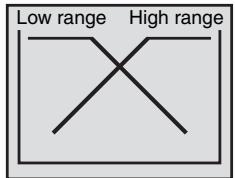
2.2ch (3WAY) mode
| Cut-off frequency (1/3 octave steps) | Slope | Level |
| HPF | LPF | HPF | LPF |
| Low range speaker | ---- | 20 Hz - 200 Hz | ---- | FLAT, 6, 12, 18, 24 dB/oct. | 0 to -12 dB |
| Mid range speaker | 20 Hz - 200 Hz | 20 Hz - 20 kHz | FLAT, 6, 12, 18, 24 dB/oct. | FLAT, 6, 12, 18, 24 dB/oct. | 0 to -12 dB |
| High range speaker | 1 kHz - 20 kHz, (20 Hz ~ 20 kHz)* | ---- | FLAT* 6, 12, 18, 24 dB/oct. | ---- | 0 to -12 dB |
- Only when selecting User's in "Setting the Response Slope for the High Range Speaker (TW Setup)" (page 34).
(Different from actual display)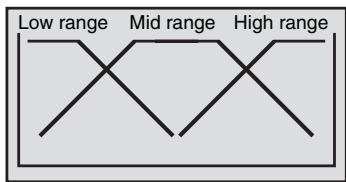
Level adjusting
(0 to -12 dB) Output frequency range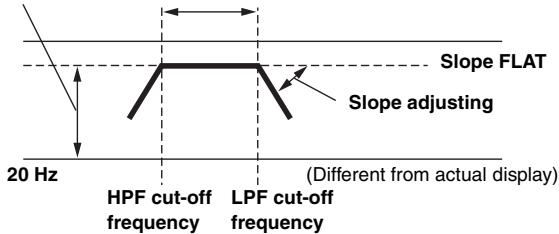
HPF (high pass filter): Cuts the lower frequencies and allows the higher frequencies to pass. - LPF (low pass filter): Cuts the higher frequencies and allows the lower frequencies to pass. - Slope: The level change (in dB) for a frequency change of one octave. - The higher the slope value, the steeper the slope becomes. - Adjust the slope to FLAT to bypass the HP or LP filters. - Do not use a tweeter without the HPF on or set to a low frequency, as it may cause damage to the speaker due to the low frequency content. - You cannot adjust the crossover frequency higher than the HPF or lower than the LPF. - Adjustment should be made according to the recommended crossover frequency of the connected speakers. Determine the recommended crossover frequency of the speakers. Adjusting to a frequency range outside that recommended may cause damage to the speakers.
For the recommended crossover frequencies of Alpine speakers, refer to the respective Owner's Manual.
We are not responsible for damage or malfunction of speakers caused by using the crossover outside the recommended value.
About IMPRINT

VISION VS. REALITY
All good music starts as an artist's vision. After countless hours of rehearsing, recording and mixing, that vision is ready for us to hear on discs, radio and other media. But do we hear it as the artist created it? Unfortunately, the reality is that we are almost never able to listen to it in the exact way the artist intended. Especially when we are listening in a car.
CARS ARE TERRIBLE LISTENING SPACES
Car interiors are full of materials that obstruct and degrade sound quality. For example, windows amplify and reflect high frequencies. Seat and dashboard coverings change certain frequencies. Carpets absorb and suppress mid frequencies. Graphic and parametric EQs are only partial remedies for these problems. In addition, the speakers are not located at equal distances from listeners, creating an unbalanced, uncentred sound stage. Time correction can help fix this, but only for one listening position.
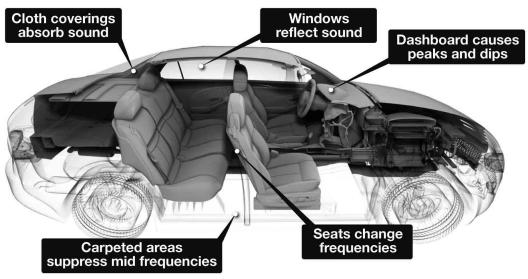
INTRODUCING IMPRINT
These acoustical problems are so severe that no correction system has been able to overcome them. Until now, with the introduction of IMPRINT, Alpine provides a hardware/software combination that not only solves these problems, it actually improves the sound stage, tonal balance and definition - and does it automatically, in a matter of minutes!
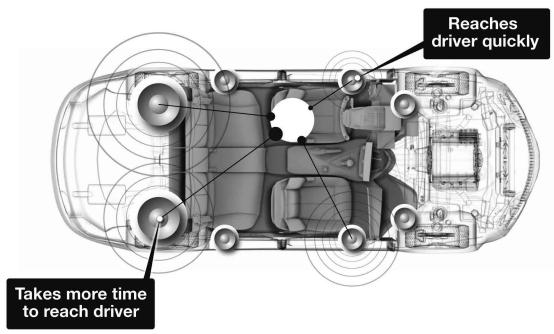
HOW IMPRINT IS DIFFERENT
IMPRINT using MultEQ is superior to other equalisation systems in five ways.
- It is the only system that measures the entire listening area, capturing time domain information from each listening location and applying a proprietary method for processing it to represent all seat locations. This gives the people in each seat the optimal listening experience.
- It corrects both time and frequency problems, for an improved soundstage and smoother, more natural sound.
- It uses dynamic frequency allocation to apply hundreds of points of correction to those areas where the sound problems are greatest.
- It determines optimized blending points for low frequency crossovers.
- It provides, in minutes, vehicle sound tuning that generally takes skilled professionals days to accomplish.
In Case of Difficulty
If you encounter a problem, please turn the power off, then on again. If the unit is still not functioning normally, please review the items in the following checklist. This guide will help you isolate the problem if the unit is at fault. Otherwise, make sure the rest of your system is properly connected or consult your authorized Alpine dealer.
Basic
No function or display.
- Vehicle's ignition is off.
- If connected following instructions, the unit will not operate with the vehicle's ignition off.
- Improper power lead (Red) and battery lead (Yellow) connections.
- Check power lead and battery lead connections.
- Blown fuse.
- Check the fuse of the unit; replace with the proper value if necessary.
- Internal micro-computer malfunctioned due to interference noise etc.
- Press the RESET switch with a ball-point pen or other pointed article.
Radio
Unable to receive stations.
- No antenna or open connection in cable.
- Make sure the antenna is properly connected; replace the antenna or cable if necessary.
Unable to tune stations in the seek mode.
- You are in a weak signal area.
- Make sure the tuner is in the DX mode.
- If the area you are in is a primary signal area, the antenna may not be grounded and connected properly.
- Check your antenna connections; make sure the antenna is properly grounded at its mounting location.
- The antenna may not be the proper length.
- Make sure the antenna is fully extended; if broken, replace the antenna with a new one.
Broadcast is noisy.
The antenna is not the proper length. - Extend the antenna fully; replace it if it is broken. The antenna is poorly grounded. - Make sure the antenna is grounded properly at its mounting location.
MP3/WMA/AAC
MP3, WMA or AAC is not played back.
- Writing error occurred. The MP3/WMA/AAC format is not compatible.
- Make sure the MP3/WMA/AAC has been written in a supported format. Refer to "About MP3/WMA/AAC"
(pages 18-19), then rewrite in the format supported by this device.
Audio
The sound is not output from the speakers.
- Unit has no output signal of the internal amplifier.
- POWER IC is switched to "ON" (page 24).
iPod
iPod does not play and no sound is output.
- The iPod has not been recognized.
- Reset this unit and the iPod. Refer to "Initial System Start-Up" (page 7). To reset the iPod, refer to the Owner's Manual of the iPod.
Indication for iPod Mode (USB connection, iDA-X200 only)
CURRENT ERROR
- Abnormal current is run to the USB connector device (an error message may be displayed if the USB device that is not compatible with the unit is connected).
- Attempt to connect another iPod.
DEVICE ERROR
- An iPod that is not supported by the unit is connected.
- Connect an iPod that is supported by the unit.
NO USB DEVICE
- An iPod is not connected.
- Make sure the iPod is correctly connected and the cable is not excessively bent.
NO SONG
There are no songs in the iPod. - Download songs to the iPod and connect to this unit.
NO SUPPORT
- Text information that is not supported on the unit has been input.
- Use an iPod in which text information is input that is supported on the unit.
ERROR-01
- Communication error
- Turn the ignition key off, and then set to ON again.
- Verify in the display after reconnecting the iPod to the iPod Dock interface cable and to the USB cable.
ERROR-02
- Caused by the iPod Software Version not being compatible with this unit.
- Update the iPod Software Version to be compatible with this unit.
ERROR-03
- The iPod is not verified.
- Change another iPod.
Indication for iPod Mode (Direct Connection)
NO IPOD
- The iPod is not connected.
- Make sure the iPod is correctly connected (refer to
"Connections").
Make sure the cable is not bent excessively.
NO SONG
There are no songs in the iPod.
- Download songs to the iPod and connect to this unit.
ERROR-01
- Communication error.
- Turn the ignition key off, and then set to ON again.
- Check the display by reconnecting between the iPod and this unit using the FULL SPEED™ Connection Cable (KCE-422i).
ERROR-02
- Caused by the iPod Software Version not being compatible with this unit.
- Update the iPod Software Version to be compatible with this unit.
Indication for USB memory
CURRENT ERROR
- Abnormal current is run to the USB connector device (an error message may be displayed if the USB device that is not compatible with the unit is connected). USB memory is a malfunction or it is shorted.
- Connect another USB memory.
DEVICE ERROR
- A USB device that is not supported by the unit is connected.
- Connect a USB device that is supported by the unit.
NO USB DEVICE
- A USB memory is not connected.
- Make sure the USB memory device is correctly connected and the cable is not excessively bent.
NO SONG
- No song (file) is stored in the USB memory.
- Connect the USB memory device after storing songs (files).
UNSUPPORT
- A sampling rate/bit rate not supported by the unit is used.
- Use a sampling rate/bit rate that is supported by the unit.
PROTECT
- A copy-protected WMA file was played back.
- You can only play back non-copy-protected files.
- Text information that is not recognizable by the unit has been input.
- Use a USB memory device with input text information that is supported by the unit.
Indication for Portable audio player Mode (iDA-X200 only)
CURRENT ERROR
- Abnormal current is run to the USB connector device (an error message may be displayed if the USB device that is not compatible with the unit is connected).
- Attempt to connect another Portable audio player.
DEVICE ERROR
- A Portable audio player that is not supported by the unit is connected.
- Attempt to connect another Portable audio player.
NO USB DEVICE
- A Portable audio player is not connected.
- Make sure the Portable audio player is correctly connected and the cable is not excessively bent.
NO SONG
- There are no songs in the Portable audio player.
- Download songs to the Portable audio player and connect to this unit.
NO SUPPORT
- Text information that is not supported on the unit has been input.
- Use a Portable audio player in which text information is input that is supported on the unit.
ERROR-01
- Communication error
- Turn the ignition key off, and then set to ON again.
- Verify in the display after reconnecting the Portable audio player to the connection cable.
ERROR-02
- Caused by the Software Version not being compatible with this unit.
- Update the Portable audio player Software Version.
ERROR-03
- The Portable audio player is not verified.
- Change another Portable audio player.
Indication for CD Changer
HI-TEMP
- Protective circuit is activated due to high temperature.
- The indication will disappear when the temperature returns to normal operating range.
ERROR-01
- Malfunction in the CD Changer.
- Consult your Alpine dealer. Press the magazine eject button and pull out the magazine.
Check the indication. Insert the magazine again. If the magazine cannot be pulled out, consult your Alpine dealer.
- Magazine ejection not possible.
- Press the magazine eject button. If the magazine does not eject, consult your Alpine dealer.
- A disc is left inside the CD Changer.
- Press the eject button to activate the eject function. When the CD Changer finishes the eject function, insert an empty CD magazine into the CD Changer to receive the disc left inside the CD Changer.
NO MAGAZINE
- No magazine is loaded into the CD Changer.
- Insert a magazine.
NO DISC
No indicated disc. - Choose another disc.
Indication for SAT Receiver Mode
ANTENNA
- The XM or SIRIUS antenna is not connected to the XM or SIRIUS radio module.
- Check whether the XM or SIRIUS antenna cable is attached securely to the XM or SIRIUS radio module.
UPDATING
- Radio is being updated with latest encryption code.
- Wait until encryption code is being updated. Channels 0 and 1 should function normally.
NO SIGNAL
(XM mode)
ACQUIRING SIGNAL
(SIRIUS mode)
- XM or SIRIUS signal is too weak at the current location.
- Wait until the car reaches a location with a stronger signal.
LOADING
- Radio is acquiring audio or program information.
- Wait until the radio has received the information.
OFF AIR
(XM mode)
ACQUIRING SIGNAL
(SIRIUS mode)
- The channel currently selected has stopped broadcasting.
- Select another channel.

- The user has selected a channel number that does not exist or is not subscribed to.
- The unit will revert back to the previously selected channel.
- There is no artist name/feature, song/program title, or additional information associated with the channel at that time.
- No action needed.
ERROR
- If an error or other problem occurs.
- Change channels or consult your Alpine dealer.
Specifications
FM TUNER SECTION
Tuning Range 87.7-107.9 MHz Mono Usable Sensitivity 9.3 dBf (0.8μV/75 ohms) 50 dB Quieting Sensitivity 13.5 dBf (1.3μV/73 ohms) Alternate Channel Selectivity 80 dB Signal-to-Noise Ratio 65 dB Stereo Separation 35 dB Capture Ratio 2.0 dB
AM TUNER SECTION
Tuning Range 530-1,710 kHz
Sensitivity (IEC Standard) 22.5 μV / 27 dB
USB SECTION
USB requirements USB 1.1/2.0 Max. Power Consumption 500mA USB Class Mass Storage File System FAT 12/16/32 MP3 Decoding MPEG-1/2 AUDIO Layer-3 WMA Decoding Windows MediaTM Audio AAC Decoding AAC-LC format “.m4a” file Number of Channels 2-Channel (Stereo) Frequency Response* 5-20,000 Hz (±1 dB) Total Harmonic Distortion 0.008% (at 1 kHz) Dynamic Range 95 dB (at 1 kHz) Signal-to-Noise Ratio >105 dB Channel Separation 85 dB (at 1 kHz)
- Frequency response may differ depending on the encoder software/bit rate.
GENERAL
Power Requirement 14.4 V DC
(11-16 V allowable)
Power Output 16 W RMS × 4*
*Primary amplifier ratings per CEA-2006 Standard Power output: measured at 4 Ohms and ≤ 1% THD+N S/N: 80 dBA (reference: 1 W into 4 Ohms)
Maximum Pre-Output Voltage 2 V/10 k ohms
Bass ±14 dB at 100 Hz
Treble ±14 dB at 10 kHz
Weight 1.0 kg (2 lbs. 3 oz)
CHASSIS SIZE
Width 178 mm (7")
Height 50 mm (2")
Depth 156 mm (6-1/8")
NOSEPIECE SIZE
Width 170 mm (6-3/4")
Height 46 mm (1-13/16")
Depth 27 mm (1-1/16")
- Due to continuous product improvement, specifications and design are subject to change without notice.
Installation and Connections
Before installing or connecting the unit, please read the following and pages 4 and 5 of this manual thoroughly for proper use.

Warning
MAKE THE CORRECT CONNECTIONS.
Failure to make the proper connections may result in fire or product damage.
USE ONLY IN CARS WITH A 12 VOLT NEGATIVE GROUND.
(Check with your dealer if you are not sure.) Failure to do so may result in fire, etc.
BEFORE WIRING, DISCONNECT THE CABLE FROM THE NEGATIVE BATTERY TERMINAL.
Failure to do so may result in electric shock or injury due to electrical shorts.
DO NOT SPLICE INTO ELECTRICAL CABLES.
Never cut away cable insulation to supply power to other equipment. Doing so will exceed the current carrying capacity of the wire and result in fire or electric shock.
DO NOT DAMAGE PIPE OR WIRING WHEN DRILLING HOLES.
When drilling holes in the chassis for installation, take precautions so as not to contact, damage or obstruct pipes, fuel lines, tanks or electrical wiring. Failure to take such precautions may result in fire.
DO NOT USE BOLTS OR NUTS IN THE BRAKE OR STEERING SYSTEMS TO MAKE GROUND CONNECTIONS.
Bolts or nuts used for the brake or steering systems (or any other safety-related system), or tanks should NEVER be used for installations or ground connections. Using such parts could disable control of the vehicle and cause fire etc.
KEEP SMALL OBJECTS SUCH AS BOLTS OR SCREWS OUT OF THE REACH OF CHILDREN.
Swallowing them may result in serious injury. If swallowed, consult a physician immediately.
DO NOT INSTALL IN LOCATIONS WHICH MIGHT HINDER VEHICLE OPERATION, SUCH AS THE STEERING WHEEL OR GEARSHIFT.
Doing so may obstruct forward vision or hamper movement etc. and results in serious accident.
DO NOT ALLOW CABLES TO BECOME ENTANGLED IN SURROUNDING OBJECTS.
Arrange wiring and cables in compliance with the manual to prevent obstructions when driving. Cables or wiring that obstruct or hang up on places such as the steering wheel, gear lever, brake pedals, etc. can be extremely hazardous.

Caution
HAVE THE WIRING AND INSTALLATION DONE BY EXPERTS.
The wiring and installation of this unit requires special technical skill and experience. To ensure safety, always contact the dealer where you purchased this product to have the work done.
USE SPECIFIED ACCESSORY PARTS AND INSTALL THEM SECURELY.
Be sure to use only the specified accessory parts. Use of other than designated parts may damage this unit internally or may not securely install the unit in place. This may cause parts to become loose resulting in hazards or product failure.
Route the cables and wiring away from moving parts (like the seat rails) or sharp or pointed edges. This will prevent crimping and damage to the wiring. If wiring passes through a hole in metal, use a rubber grommet to prevent the wire's insulation from being cut by the metal edge of the hole.
DO NOT INSTALL IN LOCATIONS WITH HIGH MOISTURE OR DUST.
Avoid installing the unit in locations with high incidence of moisture or dust. Moisture or dust that penetrates into this unit may result in product failure.
Precautions
- Be sure to disconnect the cable from the (-) battery post before installing your iDA-X200/iDA-X300. This will reduce any chance of damage to the unit in case of a short-circuit.
- Be sure to connect the color coded leads according to the diagram. Incorrect connections may cause the unit to malfunction or damage to the vehicle's electrical system.
- When making connections to the vehicle's electrical system, be aware of the factory installed components (e.g. on-board computer). Do not tap into these leads to provide power for this unit. When connecting the iDA-X200/iDA-X300 to the fuse box, make sure the fuse for the intended circuit of the iDA-X200/iDA-X300 has the appropriate amperage. Failure to do so may result in damage to the unit and/or the vehicle. When in doubt, consult your Alpine dealer.
- The iDA-X200/iDA-X300 uses female RCA-type jacks for connection to other units (e.g. amplifier) having RCA connectors. You may need an adaptor to connect other units. If so, please contact your authorized Alpine dealer for assistance.
- Be sure to connect the speaker (-) leads to the speaker (-) terminal. Never connect left and right channel speaker cables to each other or to the vehicle body.
IMPORTANT
Please record the serial number of your unit in the space provided below and keep it as a permanent record. The serial number or the engraved serial number is located on the bottom of the unit.
SERIAL NUMBER: INSTALLATION DATE: INSTALLATION TECHNICIAN: PLACE OF PURCHASE:
Installation
Caution
Do not block the unit's heat sink, thus preventing air circulation. If blocked, heat will accumulate inside the unit and may cause a fire.
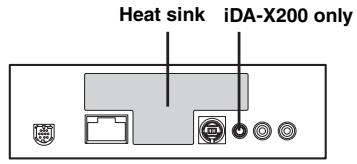
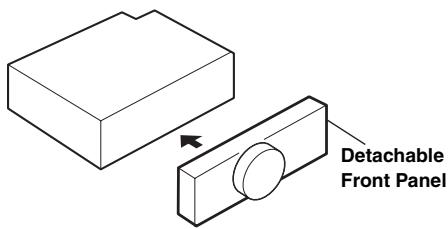
Caution
When you install this unit in your car, do not remove the detachable front panel.
If the detachable front panel is removed during installation, you might press too hard and warp the metal plate that holds it in place.
- The main unit must be mounted within 35 degrees of the horizontal plane, back to front.
Less than 35°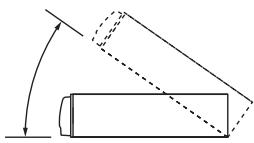
1 Mounting Sleeve (Included)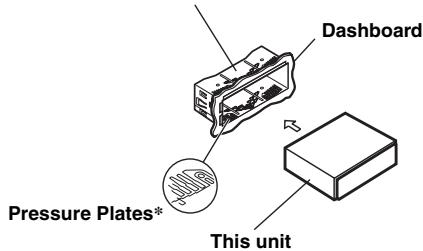
- If the installed mounting sleeve is loose in the dashboard, the pressure plates may be bent slightly to remedy the problem.
Remove mounting sleeve from the main unit (see "Removal" on page 43).
2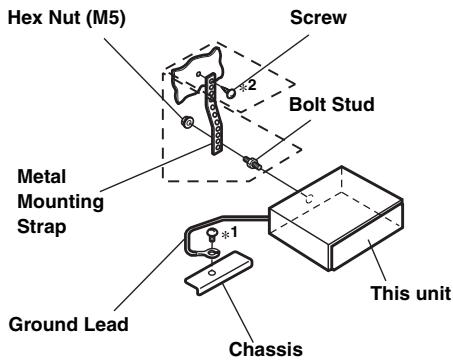
Reinforce the head unit with the metal mounting strap (not supplied). Secure the ground lead of the unit to a clean metal spot using a screw (*1) already attached to the vehicle's chassis.
- For the screw marked “*2”, use an appropriate screw for the chosen mounting location.
Connect each input lead coming from an amplifier or equalizer to the corresponding output lead coming from the left rear of the iDA-X200/iDA-X300. Connect all other leads of the iDA-X200/iDA-X300 according to details described in the CONNECTIONS section.
3 Slide the iDA-X200/iDA-X300 into the dashboard until it clicks. This ensures that the unit is properly locked and will not accidentally come out from the dashboard. Install the detachable front panel.
Removal
- Remove the detachable front panel.
- Insert the bracket keys into the unit, along the guides on either side. The unit can now be removed from the mounting sleeve.
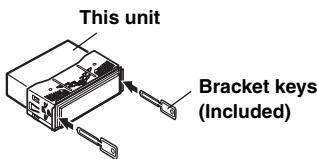
- Pull the unit out, keeping it unlocked as you do so.
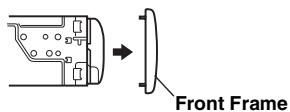
Secure the ground lead of the unit to a clean metal spot using a screw (already attached to the vehicle's chassis).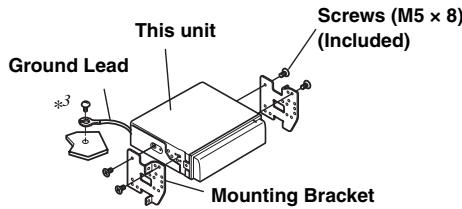
iPod Connection (sold separately) USB connection (iDA-X200 only)
Connect USB cable to an iPod with iPod Dock interface cable.
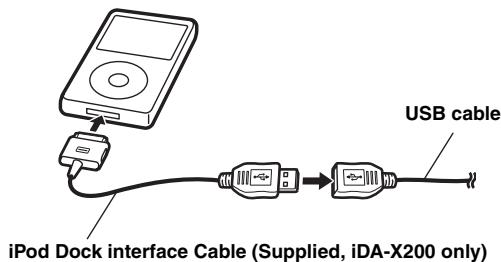
Direct connection
Connect iPod direct connector to an iPod with FULL SPEED™ connection cable (KCE-422i).
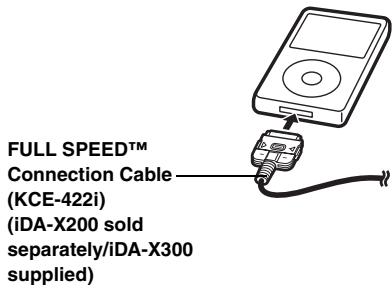
Remove the iPod
Remove the iPod from FULL SPEED™ Connection Cable (or iPod Dock interface cable (iDA-X200 only)).
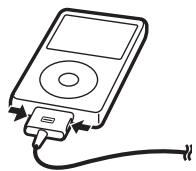
- If USB is connected, after the unit has been changed to a source other than the iPod, remove the iPod. If the iPod is removed in the iPod mode, data may cause damage.
- If sound is not output or the iPod is not recognized even when the iPod is connected, remove the iPod once, then connect it again, or reset the iPod.
USB memory Connection (sold separately)
Connect USB memory
Connect USB memory to USB cable.
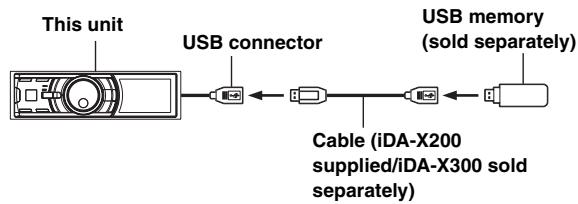
Remove USB memory
Pull out USB memory squarely from the USB cable.
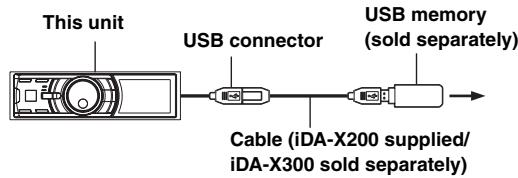
- When removing USB memory, pull it out straight.
- If sound is not output or USB memory is not recognized even when USB memory is connected, remove USB memory once, then connect it again.
- Change to a source other than the USB memory mode, then remove the USB memory. If the USB memory is removed in the USB memory mode, data may be damaged.
- Route the USB cable away from other cables.
Portable Audio Player Connection (sold separately, iDA-X200 only)
Connecting a Portable audio player
Connect the cable supplied with a Portable audio player to the USB cable.
Disconnect the Portable audio player.
Disconnect the cable supplied with the Portable audio player from the USB cable.
Refer also to the Owner's Manual of the Portable audio player.
1 The system switch is located on the bottom of the unit. 2 When Subwoofer is OFF: Output is for Front speakers. When Subwoofer is ON: Output is for Subwoofer.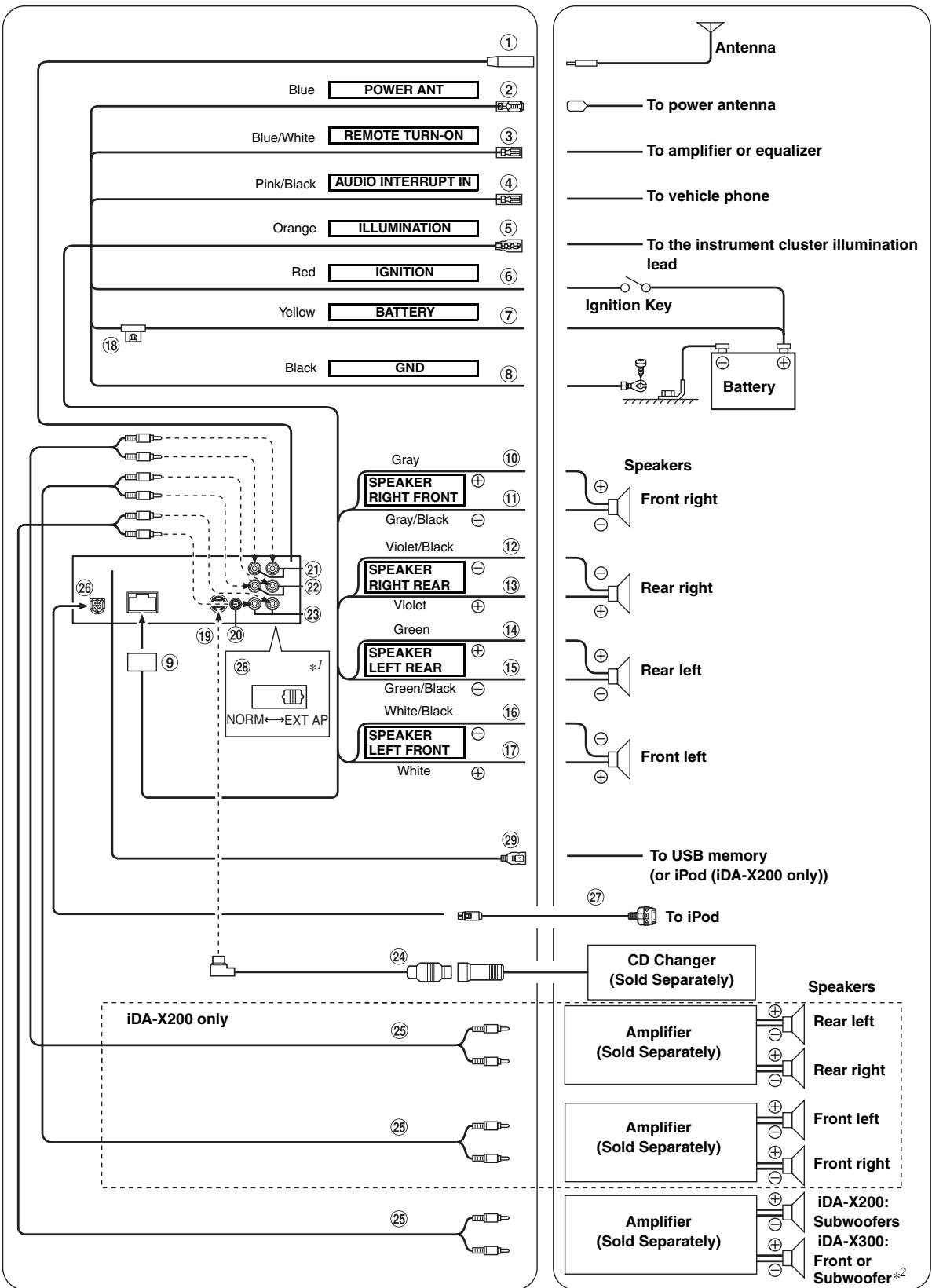
For details on how to set the Subwoofer to ON/OFF, see "Turning Subwoofer ON / OFF" on page 20.
① Antenna Receptacle ② Power Antenna Lead (Blue)
Connect this lead to the +B terminal of your power antenna, if applicable.
- This lead should be used only for controlling the vehicle's power antenna. Do not use this lead to turn on an amplifier, or a signal processor, etc. ③ Remote Turn-On Lead (Blue/White)
Connect this lead to the remote turn-on lead of your amplifier or signal processor.
④ Audio Interrupt In Lead (Pink/Black) ⑤ Illumination Lead (Orange)
This lead may be connected to the vehicle's instrument cluster illumination lead. This will allow the backlighting of the iDA-X200/iDA-X300 to dim whenever the vehicle's lights are turned on. ⑥ Switched Power Lead (Ignition) (Red) Connect this lead to an open terminal on the vehicle's fuse box or another unused power source which provides (+) 12V only when the ignition is turned on or in the accessory position. ⑦ Battery Lead (Yellow) Connect this lead to the positive (+) post of the vehicle's battery. ⑧ Ground Lead (Black) Connect this lead to a good chassis ground on the vehicle. Make sure the connection is made to bare metal and is securely fastened using the sheet metal screw provided. 9 Power Supply Connector Right Front (+) Speaker Output Lead (Gray) Right Front (-) Speaker Output Lead (Gray/Black) Right Rear (-) Speaker Output Lead (Violet/Black) Right Rear (+) Speaker Output Lead (Violet) 14 Left Rear (+) Speaker Output Lead (Green) 15 Left Rear (-) Speaker Output Lead (Green/Black) 16 Left Front (-) Speaker Output Lead (White/Black) 17 Left Front (+) Speaker Output Lead (White) 18 Fuse Holder (10A) 19 Ai-NET Connector
Connect this to the output or input connector of another device (CD Changer, Equalizer, HD Radio TUNER MODULE, etc.) equipped with Ai-NET.
- Interface adapter for iPod (KCA-420i) is not recommended for use with this product. 20 Steering Remote Control Interface Connector (iDA-X200 only)
To steering remote control interface box.
Rear Output/Input RCA Connectors (iDA-X200 only) It can be used as Rear Output or Input RCA Connectors. RED is right and WHITE is left. 22 Front Output/Input RCA Connectors (iDA-X200 only) It can be used as Front Output or Input RCA Connectors. RED is right and WHITE is left. 23 Subwoofer Output RCA Connectors (iDA-X200 only) 23 Front/Subwoofer Output RCA Connectors (iDA-X300 only) RED is right and WHITE is left. 24 Ai-NET Cable (Included with CD Changer) 25 RCA Extension Cable (sold separately) iPod Direct Connector Control iPod signals.
Connect this to an iPod or to an optional Bluetooth Box. To use a hands-free mobile phone, an optional Bluetooth Box connection is required. For details on connection, refer to the Owner's Manual of the Bluetooth Box.
You can also connect this to an external device (such as a portable player) by using iPod Direct/RCA Interface cable (sold separately).
- Refer to "Setting the AUX + Mode" (page 23).
AUX+ ON: When the external device is connected.
AUX+ OFF: When an iPod is connected.
27 FULL SPEED™ Connection Cable (KCE-422i) (iDA-X200 sold separately/iDA-X300 supplied) 28 System Switch
When connecting a processor or divider using Ai-NET, place this switch in the EXT AP position. When no device is connected, leave the switch in the NORM position. iDA-X200 only:
When switched to NORM, the RCA Connectors 21 and 22 can be used as Output RCA Connectors.
When switched to EXT AP, the RCA Connectors 21 and 22 can be used as Input RCA Connectors.
- Be sure to turn the power off to the unit before changing the switch position. 29 USB Connector
Connect this to an USB memory (or to an iPod (iDA-X200 only)). To use an iPod, iPod Dock interface cable connection is required (iDA-X200 only).
- Use the supplied USB cable. If a USB cable other than the supplied is used, correct performance cannot be guaranteed.
- Route the USB cable away from other cables.
To prevent external noise from entering the audio system.
- Locate the unit and route the leads at least 10 cm away from the car harness.
- Keep the battery power leads as far away from other leads as possible.
- Connect the ground lead securely to a bare metal spot (remove any paint, dirt or grease if necessary) of the car chassis.
- If you add an optional noise suppressor, connect it as far away from the unit as possible. Your Alpine dealer carries various noise suppressors, contact them for further information.
- Your Alpine dealer knows best about noise prevention measures so consult your dealer for further information.
LIMITED WARRANTY
ALPINE ELECTRONICS OF AMERICA, INC. AND ALPINE OF CANADA INC. ("Alpine"), are dedicated to quality craftsmanship and are pleased to offer this Warranty. We suggest that you read it thoroughly. Should you have any questions, please contact your Dealer or contact Alpine at one of the telephone numbers listed below.
- PRODUCTS COVERED:
This Warranty covers Car Audio Products and Related Accessories ("the product"). Products purchased in Canada are covered only in Canada. Products purchased in the U.S.A. are covered only in the U.S.A.
• LENGTH OF WARRANTY:
This Warranty is in effect for one year from the date of the first consumer purchase.
WHO IS COVERED:
This Warranty only covers the original purchaser of the product, who must reside in the United States, Puerto Rico or Canada.
WHAT IS COVERED:
This Warranty covers defects in materials or workmanship (parts and labor) in the product.
WHAT IS NOT COVERED:
This Warranty does not cover the following:
① Damage occurring during shipment of the product to Alpine for repair (claims must be presented to the carrier). ② Damage caused by accident or abuse, including burned voice coils caused by over-driving the speaker (amplifier level is turned up and driven into distortion or clipping). Speaker mechanical failure (e.g. punctures, tears or rips). Cracked or damaged LCD panels. Dropped or damaged hard drives. ③ Damage caused by negligence, misuse, improper operation or failure to follow instructions contained in the Owner's manual. ④ Damage caused by act of God, including without limitation, earthquake, fire, flood, storms or other acts of nature. Any cost or expense related to the removal or reinstallation of the product. ⑤ Service performed by an unauthorized person, company or association. ⑥ Any product which has the serial number defaced, altered or removed. ⑦ Any product which has been adjusted, altered or modified without Alpine's consent. ⑧ Any product not distributed by Alpine within the United States, Puerto Rico or Canada. ⑨ Any product not purchased from an Authorized Alpine Dealer.
HOW TO OBTAIN WARRANTY SERVICE:
① You are responsible for delivery of the product to an Authorized Alpine Service Center or Alpine for repair and for payment of any initial shipping charges. Alpine will, at its option, repair or replace the product with a new or reconditioned product without charge. If the repairs are covered by the warranty, and if the product was shipped to an Authorized Alpine Service Center or Alpine, Alpine will pay the return shipping charges. You should provide a detailed description of the problem(s) for which service is required.
③ You must supply proof of your purchase of the product. ④ You must package the product securely to avoid damage during shipment. To prevent lost packages it is recommended to use a carrier that provides a tracking service.
HOW WE LIMIT IMPLIED WARRANTY:
ANY IMPLIED WARRANTY, INCLUDING FITNESS FOR USE AND MERCHANTABILITY, IS LIMITED IN DURATION TO THE PERIOD OF THE EXPRESS WARRANTY SET FORTH ABOVE. NO PERSON IS AUTHORIZED TO ASSUME FOR ALPINE ANY OTHER LIABILITY IN CONNECTION WITH THE SALE OF THE PRODUCT.
HOW WE EXCLUDE CERTAIN DAMAGES:
ALPINE EXPRESSLY DISCLAIMS LIABILITY FOR INCIDENTAL AND CONSEQUENTIAL DAMAGES CAUSED BY THE PRODUCT. THE TERM "INCIDENTAL DAMAGES" REFERS TO EXPENSES OF TRANSPORTING THE PRODUCT TO THE ALPINE SERVICE CENTER, LOSS OF THE ORIGINAL PURCHASER'S TIME, LOSS OF THE USE OF THE PRODUCT, BUS FARES, CAR RENTALS OR OTHER COSTS RELATING TO THE CARE AND CUSTODY OF THE PRODUCT. THE TERM "CONSEQUENTIAL DAMAGES" REFERS TO THE COST OF REPAIRING OR REPLACING OTHER PROPERTY WHICH IS DAMAGED WHEN THIS PRODUCT DOES NOT WORK PROPERLY. THE REMEDIES PROVIDED UNDER THIS WARRANTY ARE EXCLUSIVE AND IN LIEU OF ALL OTHERS.
HOW STATE/PROVINCIAL LAW RELATES TO THE WARRANTY:
This Warranty gives you specific legal rights, and you may also have other rights which vary from state to state and province to province. In addition, some states/provinces do not allow limitations on how long an implied warranty lasts, and some do not allow the exclusion or limitation of incidental or consequential damages. Accordingly, limitations as to these matters contained herein may not apply to you.
IN CANADA ONLY:
This Warranty is not valid unless your Alpine car audio product has been installed in your vehicle by an Authorized Installation Center, and this warranty is stamped upon installation by the installation center.
Should the product require service, please call the following number for your nearest Authorized Alpine Service Center.
CAR AUDIO
1-800-ALPINE-1 (1-800-257-4631)
NAVIGATION
1-888-NAV-HELP (1-888-628-4357)
Or visit our website at: http://www.alpine-usa.com
ALPINE
iDA-X200
MP3

AAC


Radio®



iDA-X300
MP3

AAC

Radio®



- OWNER'S MANUAL Please read before using this equipment. MODE D'EMPLOI Veuillez lire avant d'utiliser cet appareil.
- MANUAL DE OPERACION Léalo antes de utilizar este equipo.
ALPINE ELECTRONICS MARKETING, INC.
1-1-8 Nishi Gotanda, Shinagawa-ku.
Tokyo 141-0031, Japan Phone 03-5496-8231
ALPINE ELECTRONICS OF AMERICA, INC.
19145 Gramercy Place, Torrance, California 90501, U.S.A.
Phone 1-800-ALPINE-1 (1-800-257-4631)
ALPINE ELECTRONICS OF CANADA, INC.
777 Supertest Road, Toronto, Ontario M3J 2M9, Canada
Phone 1-800-ALPINE-1 (1-800-257-4631)
ALPINE ELECTRONICS OF AUSTRALIA PTY. LTD.
161-165 Princes Highway, Hallam
Victoria 3803, Australia
Phone 03-8787-1200
ALPINE ELECTRONICS GmbH
Frankfurter Ring 117, 80807 Munchen, Germany Phone 089-32 42 640
ALPINE ELECTRONICS OF U.K. LTD.
Alpine House
Fletchamstead Highway, Coventry CV4 9TW, U.K.
Phone 0870-33 33 763
ALPINE ELECTRONICS FRANCE S.A.R.L.
(RCS PONTOISE B 338 101 280)
98, Rue de la Belle Etoile, Z.I. Paris Nord II
B.P. 50016, 95945 Roissy Charles de Gaulle
Cedex, France
Phone 01-48638989
Installation and connections
Warning 42
Caution 42
Precautions 42
Installation 43
Connections 45
LIMITED WARRANTY
User manual
WARNING

WARNING
This symbol means important instructions. Failure to heed them can result in injury or material property damage.
STOP USING THE DEVICE IMMEDIATELY IF A PROBLEM OCCURS.
Sampling rates: 48 kHz, 44.1 kHz, 32 kHz, 24 kHz, 22.05 kHz, 16 kHz, 12 kHz, 11.025 kHz, 8 kHz
Adjustable slope: FLAT*, 6 dB/oct, 12 dB/oct, 18 dB/oct, 24 dB/oct.
LOW (SUB-W)-L / LOW (SUB-W)-R / MID (REAR)-L /
MID (REAR)-R / HIGH (FRONT)-L / HIGH (FRONT)-R
HOW IMPRINT IS DIFFERENT
Unable to receive stations.
Information regarding iPod mode (USB connection, iDA-X200 only)
CURRENT ERROR
Information regarding iPod mode (direct connection)
NO IPOD
1.0 kg (2 lbs. 3 oz)
CHASSIS SIZE
Width
178 mm (7")
Height
50 mm (2")
Depth
156 mm (6-1/8")
NOSEPIECE SIZE
Width
170 mm (6-3/4")
Height
46 mm (1-13/16")
Depth
27 mm (1-1/16")
Installation and Connections
PRODUCTS COVERED BY THE WARRANTY
WARRANTY EXCLUSIONS
ALPINE EXPRESSLY STATES THAT IT IS NOT RESPONSIBLE FOR INCIDENTAL AND CONSEQUENTIAL DAMAGES CAUSED BY THE PRODUCT. INCIDENTAL DAMAGES INCLUDE THE COST OF TRANSPORTING THE PRODUCT TO AN ALPINE SERVICE CENTER, THE ORIGINAL PURCHASER'S LOSS OF TIME, LOSS OF USE OF THE PRODUCT, BUS FARES, CAR RENTAL, AND ALL OTHER COSTS RELATED TO THE CARE OF THE PRODUCT. CONSEQUENTIAL DAMAGES INCLUDE THE COST OF REPAIRING OR REPLACING OTHER PROPERTY DAMAGED AS A RESULT OF THE PRODUCT'S MALFUNCTION. THE REMEDIES PROVIDED HEREIN EXCLUDE AND REPLACE ALL OTHER REMEDIES.
RELATIONSHIP BETWEEN WARRANTY AND LAW
- CLAUSE APPLICABLE TO CANADA ONLY
iDA-X200
MP3

AAC





iDA-X300
MP3

AAC




- OWNER'S MANUAL Please read before using this equipment. MODE D'EMPLOI Veuillez lire avant d'utiliser cet appareil.
- OPERATION MANUAL Read before using this equipment.
ALPINE ELECTRONICS MARKETING, INC.
1-1-8 Nishi Gotanda, Shinagawa-ku,
Tokyo 141-0031, Japan Phone 03-5496-8231
ALPINE ELECTRONICS OF AMERICA, INC.
19145 Gramercy Place, Torrance, California 90501, U.S.A.
Phone 1-800-ALPINE-1 (1-800-257-4631)
ALPINE ELECTRONICS OF CANADA, INC.
777 Supertest Road, Toronto, Ontario M3J 2M9, Canada
Phone 1-800-ALPINE-1 (1-800-257-4631)
ALPINE ELECTRONICS OF AUSTRALIA PTY. LTD.
161-165 Princes Highway, Hallam
Victoria 3803, Australia
Phone 03-8787-1200
ALPINE ELECTRONICS GmbH
Frankfurter Ring 117, 80807 Munchen, Germany Phone 089-3242640
ALPINE ELECTRONICS OF U.K. LTD.
Alpine House
Fletchamstead Highway, Coventry CV4 9TW, U.K.
Phone 0870-33 33 763
ALPINE ELECTRONICS FRANCE S.A.R.L.
(RCS PONTOISE B 338 101 280)
98, Rue de la Belle Etoile, Z.I. Paris Nord II
B.P. 50016, 95945 Roissy Charles de Gaulle
Cedex, France
Phone 01-48638989
BAND4: 315 Hz~8 kHz (1 kHz)
BAND5: 800 Hz~20 kHz (2.5 kHz)