EasyManual
V8426 - Camera VIVITAR - Free user manual and instructions
Find the device manual for free V8426 VIVITAR in PDF.


User questions about V8426 VIVITAR
0 question about this device. Answer the ones you know or ask your own.
Ask a new question about this device
Download the instructions for your Camera in PDF format for free! Find your manual V8426 - VIVITAR and take your electronic device back in hand. On this page are published all the documents necessary for the use of your device. V8426 by VIVITAR.
USER MANUAL V8426 VIVITAR
Introduction 2
What's Included 2
Parts of the Camera 3
Initial Camera Setup 4
Main Camera Modes 7
Camera Technical Specifications 8
Computer System Requirements 9
Powering the Camera On/Off 10
Changing Camera Mode 11
Navigating the Menus. 12
Status Icon Description 13
Photo Capture Mode 15
PhotoPlaybackMode 24
Video Capture Mode 26
VideoPlaybackMode 27
Installing the Software 28
Connecting the Camera to the Computer 29
Getting Photos and Videos from your Camera to Your Computer 30
Get Started! 31
Transferring Images from my Camera to my Computer Manually 31
Camera Maintenance 32
Sakar Warranty Card 33
Technical Support 34
Troubleshooting 34
Introduction
Thank you for purchasing this camera. Everything you need to take quality digital photos and videos is included with your camera.
Vivitar makes capturing those special moments as easy as possible.
Please read this manual carefully first in order to get the most out of your digital camera.
Note: Your camera needs a Micro SD Memory card (up to 32GB) for normal use.
Micro SD Memory cards are not included and need to be purchased separately.
Important:
- Do not open the battery door underwater.
- Close the battery door properly for best water sealing.
- rinse with clean water after use and keep dry for storage.
What's Included
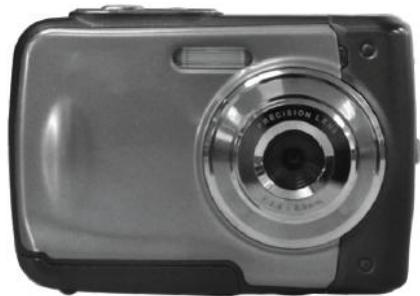
①
- Digital Camera
- USB cable
- Vivitar Experience Image Manager software Installation CD
- Wrist Strap
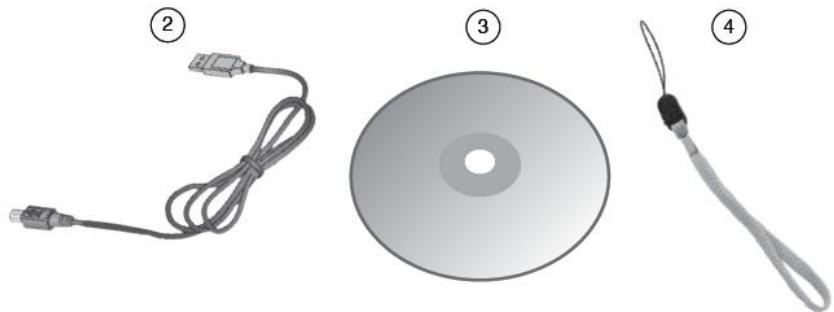
Note: SD Memory Card and batteries not included.
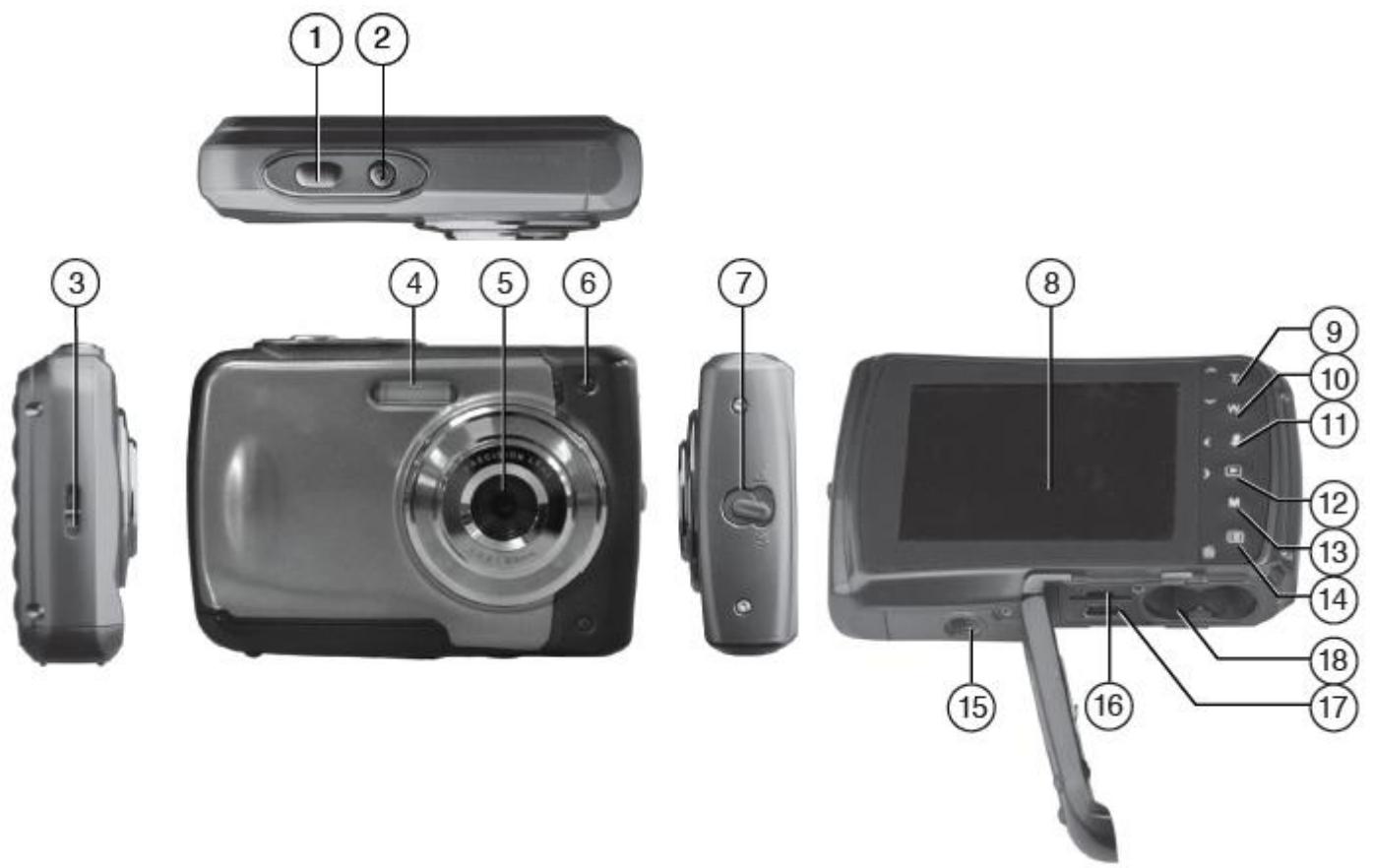
- Shutter / OK Button
- Power Button
- Wrist Strap Connector
- Flash
- Lens
- LED Busy Indicator
- MACRO Switch
- LCD Screen
-
Up / Zoom In Button
-
Down / Zoom Out Button
- Left / Flash Button
- Right / Playback Button
- MODE Button
- MENU / Delete Button
- Tripod Mount
- Micro SD Memory Card Slot
- USB Port
- Battery Compartment
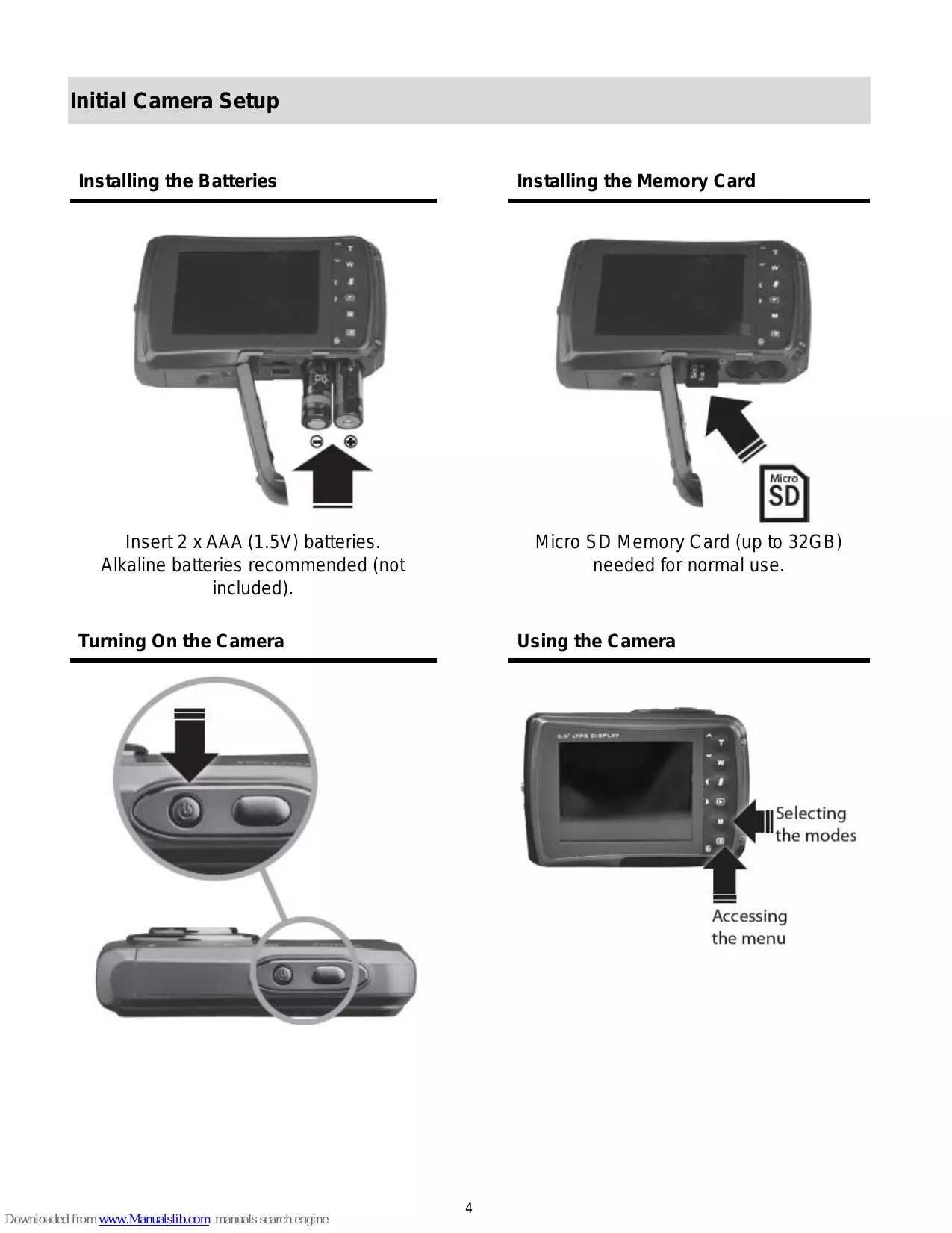
Installing the Batteries
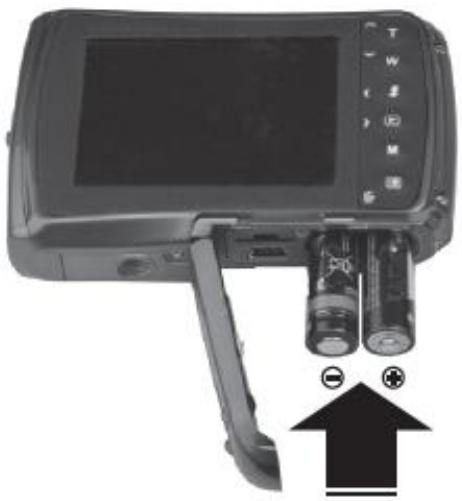
Insert 2 x AAA (1.5V) batteries. Alkaline batteries recommended (not included).
Turning On the Camera
Installing the Memory Card
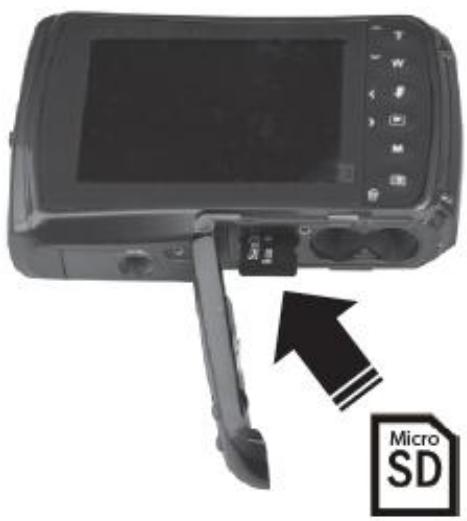
Micro SD Memory Card (up to 32GB) needed for normal use.
Using the Camera
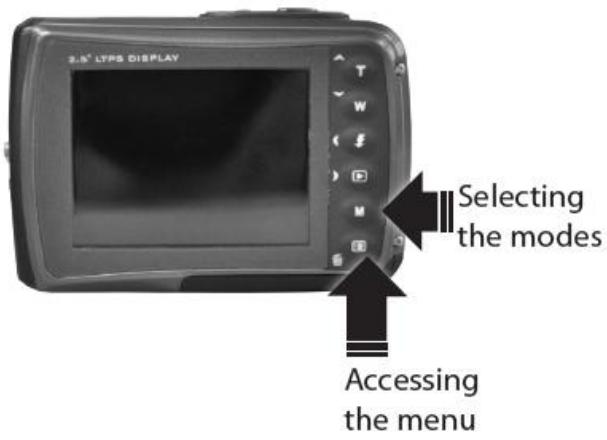
When powering the camera ON for the first time the camera will take you through the INITIAL CAMERA SETUP.
Powering the Camera ON
1) Batteries
Make sure the batteries have been inserted properly into your digital camera, according to the polarity shown inside the battery compartment.
Use 2x AAA (1.5V) batteries. Alkaline batteries are recommended. (Batteries not included.)
Note:
- Remove the batteries from the camera when not in use for an extended period.
- Do not mix alkaline and non-alkaline batteries.
Some features, such as Flash, will not work if the battery power level is low. - When the battery power is low the battery icon turns red and the camera will automatically turn off a few seconds later.
- The energy status of the power is displayed on LCD as shown below:

Full battery power

Medium battery power

Low battery power
2) Micro SD Memory Card
Make sure a Micro SD card has been properly inserted into your camera. (SD card not included.)
To properly insert the Memory Card:
- Turn off the Camera.
- Open the battery door.
- Insert the micro SD Card into the slot in the direction shown on the camera (see SD icon by the micro SD card slot). Push the Micro SD Card until you hear a slight clicking sound.
This indicates the memory card has been inserted correctly.
Note:
- There is only one right direction to insert the micro SD memory card into the slot. Do not force the card into the memory card slot, since it may damage both the camera and the micro SD memory card.
- The micro SD memory card must be formatted before taking photographs.
See the following sections for more information:
Formatting the Micro SD Memory Card
- Press the MENU button ( ) in Photo Capture or Video Capture mode.
- Select the Setup Menu options by press the right button.
- Press the W ( ) button to highlight and select the Format icon and press the SHUTTER/OK button to confirm.
-
To format the Micro SD Memory Card, select 'SD Card' and press the SHUTTER/OK button to confirm.
-
After the camera is powered on, a memory card icon will appear on the LCD display. If you do not see the SD icon on the display, please check if the card was inserted properly.
3) Power On
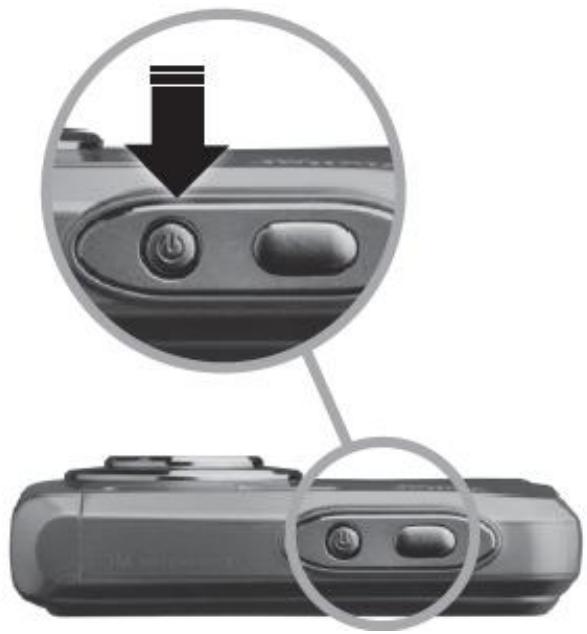
Press the POWER button to turn on the camera.
Main Camera Modes
Your camera has different modes for the various camera functions.

Photo Capture Mode
Use this mode to capture pictures with your camera.
This is the default mode when the camera is powered ON.
To take a picture, aim your camera as desired and press the Shutter button.
The picture will be automatically saved to your camera's memory card.
To access the various menus for the Photo Capture mode, press the MENU button while in the Photo Capture mode.

Video Capture Mode
Use this mode to capture videos with your digital camera.
After turning on your camera, press the MODE (M) button once to open the Video Capture mode. To take a video, aim your camera as desired and press the Shutter button to start the record. A red record indicator will appear on the LCD screen while record is in progress. To stop the record, press the Shutter button again. The video will be automatically saved to your camera's memory card.
To access the various menus for the Video Capture mode, press the MENU button while in the Video Capture mode.

Playback Mode (Photos & Videos)
Use this mode to view and manage the photos and videos on your camera.
After turning on your camera, press the PLAYBACK button to open the Playback mode for photos and videos. You can scroll through the photos and videos that you've previously taken to view or delete them as desired.
To access the various menus for the Playback mode for photos and videos, press the MENU button while in the Playback mode.
Camera Technical Specifications
| Image Sensor | CMOS Sensor |
| Image Resolution | 8M = 3264X2448; 5M = 2560x1920; 3M = 2048x1536; 1.3M = 1280x960; VGA = 640x480 |
| Video Resolution | 720P / VGA 640X480 pixels / QVGA 320X240 pixels |
| File Format | JPEG (Photo) /AVI (Video) |
| External Memory | Micro SD Memory Card (up to 32GB) |
| LCD Display | 2.5 Inch TFT |
| Lens | f=8.5 mm F2.8 |
| Zoom | 8X Digital Zoom |
| Exposure | ±2.0, ±5/3, ±4/3, ±1.0, ±2/3, ±1/3, 0 |
| White Balance | Auto, Daylight, Cloudy, Tungsten, Fluorescent |
| ISO | Auto / 50 / 100 / 200 |
| Scene | Auto, Landscape, Backlight, Night Scene, Portrait, Sports |
| Flash | No Flash, Forced On, Auto Flash |
| Self-Timer | 10 second delay |
| Anti-Shake | Yes |
| Face Detect | Yes - Auto |
| Smile Detection | Yes |
| Languages | English, German, French, Spanish, Italian, Portuguese, S-Chinese, T-Chinese, Japanese |
| Microphone | Yes |
| Macro | Yes, Manual Switch |
| USB Interface | USB 2.0 |
| System Requirements | Windows XP (SP 3), Vista (SP1) and 7 ; Mac OSX v10.5.x and above |
| Battery | 2 * AAA (1.5V) alkaline batteries |
| Working Temperature | 0~45°C |
WINDOWS OS
To be able to download photos and videos to your PC using the Vivitar Experience Image Manager Software, you will need the following minimum configuration:
- Microsoft® Windows XP with Service Pack 3, Windows Vista with Service Pack 1 or Windows 7
- Pentium® 4 processor (or above)
1 GMB of RAM, with 250 MB of free hard disk space
16-bit Color monitor, 1024 X 768 recommended screen resolution - CD-ROM Drive
- QuickTime® 6 or higher
Microsoft® Internet Explorer 7 or higher - Windows Media Player 10 or higher
- DirectX 9 or higher
- Internet connection required
MACINTOSH OS
To be able to download photos and videos to your Macintosh using the Vivitar Experience Image Manager Software, you will need the following minimum configuration:
Intel processor running Mac OS X v10.5.x or later
1 GB RAM, 250 MB free hard disk space
Display: 1024 x 768 or higher-resolution monitor
- QuickTime® 6 or higher
- Internet connection required
Powering the Camera On/Off
- Make sure the batteries have been inserted properly into your digital camera. If your camera comes with a rechargeable lithium battery, make sure it is fully charged before the first use.
- Make sure a Micro SD card has been inserted into your camera.
(Micro SD card up to 32GB - not included)
Please see Initial Camera Setup for more information.
Powering the camera ON
Press the Power button to turn your camera ON.
After powering on, the camera emits a sound and the LED light turns on briefly.
- The LCD screen turns on with your camera in Photo Capture mode to start.
Powering the camera OFF
While the camera is on, you can press the Power button again at any point to turn your camera OFF.
- A "Goodbye" screen appears and then the camera will power off completely.
Note: Your digital camera also has an Auto Power Off feature that will automatically turn off your camera after a specific period of time that your camera is left idle. The Auto Power Off settings can be set from the Auto Power Off settings menu (in either Photo Capture Mode or Video Capture Mode general Camera Settings menu).
Changing Camera Mode
Your camera has three main modes:
1) Photo Capture Mode - Use this mode to capture photos with your camera.
2) Video Capture Mode - Use this mode to capture videos with your camera.
3) Playback Mode (for photos and videos) - Use this mode to view the photos and videos you have already taken with your camera.
- When the camera is first powered ON, the Photo Capture Mode will be active.
- The icons that appear on the LCD screen are the best default settings so that you can begin to capture and enjoy clear quality photos.
To change the active camera mode, make sure the camera is powered ON and press the MODE (M) button.

When in Photo Capture Mode, this icon will display on the top-left corner of the LCD display.

When in Video Capture Mode, this icon will display on the top-left corner of the LCD display.

When in Playback Mode, these icons will display on the top-left corner of the LCD display. Note: Press the PLAYBACK button to enter the Playback Mode.
Navigating the Menus
Each camera mode has a set of menus specific to that mode.
The general Camera Settings can also be accessed from the menu.
Photo Capture, Video Capture and Playback Mode Menus:
1) Press the MENU ( ) button to open the menus for the current mode.
2) Press the T/Up ( ) button or the W/Down ( ) button to scroll between the various menus for the current mode.
3) Press the SHUTTER button to select and open the highlighted menu option.
4) Press the T/Up ( ) button or the W/Down ( ) button to scroll between the various options within the selected menu.
5) Press the SHUTTER button to confirm and save the highlighted menu option.
6) Changes made to these options will remain until you decide to change them again at a later time. The selected menu option appears as an icon on the LCD.
7) At any time you can press the MENU button to exit the menus and return to the previous screen.
Setup Menus (accessed from the Photo/Video Capture Mode):
1) Press the MENU ( 3 ) button to open the menus for the current mode.
2) Press the ±b /Left ( ) button or the Right ( ) button to select the Setup Menu
3) Press the T/Up ( ) button or the W/Down ( ) button to scroll between the various options within the Setup menu.
4) Press the SHUTTER button to select and open the highlighted menu option.
5) Press the T/Up ( ) button or the W/Down ( ) button to scroll between the various options within the selected menu.
6) Press the SHUTTER button to confirm and save the highlighted menu option.
7) Changes made to these options will remain until you decide to change them again at a later time.
8) At any time you can press the MENU button to exit the menus and return to the previous screen.
Status Icon Description
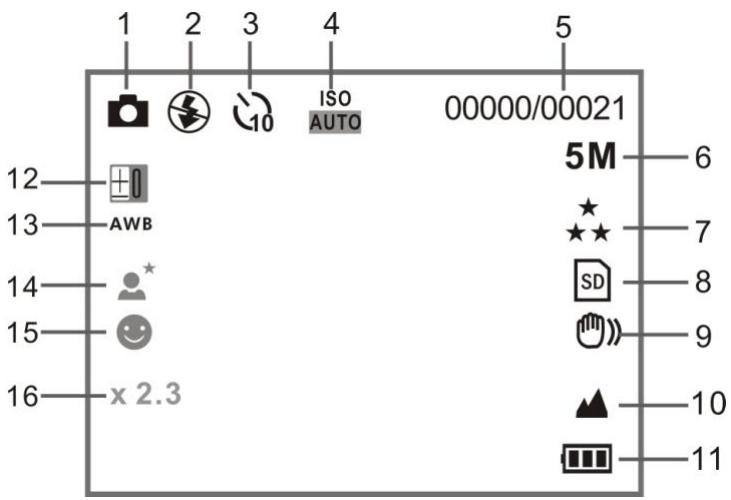
The following icons appear on the LCD screen and indicate the selected menu options and camera status.
| Item | Function | Description |
| 1 | Mode selected | Photo Capture Mode Video Capture Mode VideoPlayback Mode PhotoPlayback Mode |
| 2 | Flash indicator | Force flash: The flash is always on - in any environment. Auto flash: The camera determines if the flash should be used or not. No flash: The flash is turned off. |
| 3 | Self-timer | Displays the selected Self-timer setting |
| 4 | ISO | Displays the selected ISO setting |
| 5 | Photo/Video Counter | Photo mode: Displays the number of pictures already taken and the number of pictures still available to take according to the camera settings and space on the memory card. Video mode: While recording - displays the recording time. While in Standby - displays the time still available to record according to the |
| camera settings and space on the memory card. Playback mode: Displays the image (photo/video) number. | ||
| 6 | Selected Resolution | Photos: 8M = 3264X2448; 5M = 2560x1920; 3M = 2048x1536;1.3M = 1280x960; VGA = 640x480 Videos: 720P / VGA 640X480 pixels / QVGA 320X240 pixels |
| 7 | Picture Quality | Super fine Fine Normal |
| 8 | The Micro SD Card Indication | Indicates that the Micro SD card is inserted properly and will be used as storage for captures Photos and Videos |
| 9 | Anti-Shaking | Shows Anti-Shaking ON/Off |
| 10 | Normal/Macro Mode Indicator | Normal Mode (0.5m – infinity) Macro Mode (11cm – 18cm): Close-up Photography |
| 11 | Battery Indicator | Indicates that the camera batteries are full Indicates that the camera batteries are empty |
| 12 | Exposure Value | Shows selected EV± value. |
| 13 | White Balance | Shows selected White-balance mode |
| 14 | Scene mode | Shows selected Scene mode ( Landscape/Backlight/Night scene/Portrait/Sports) |
| 15 | Smile detection | Shows Smile detection On/Off |
| 16 | Zoom indicator | Displays Zoom ratio |
Photo Capture Mode
The Photo Capture mode allows you to capture pictures with your digital camera.
Taking a Picture
1) While in Photo Capture mode, use the LCD display on the back of the camera to direct the camera at the scene you would like to capture.
2) Press the T/Zoom In and W/Zoom Out buttons to zoom in/out if desired.
You can magnify your subject up to 8 times using the digital zoom.
3) Press the Shutter button to take the picture.
4) The picture will automatically be saved to the camera's Micro SD memory card.
Photo Capture Mode Quick Function Buttons
Your digital camera has a four-directional pad that functions as Quick Function buttons:
| Button | Function |
| Left | Flash Options – Toggles the Flash options appearing on the LCD |
| T/Up | Zooms In |
| W/Down | Zooms Out |
Other
| Shutter | • Captures the photo • Saves selected Menu Option |
| MENU | Opens and exits the menu options for Photo Capture Mode |
| MODE (M) | Toggles between the Photo Capture Mode and Video Capture Mode |
Flash Options
There are several Flash options available on your camera. The options appear on the Photo Capture Mode LCD screen in sequence.
To change the Flash mode, press the LEFT Quick Function button until you arrive at your desired settings.
Important: When using Flash, stand between 8 to 10 feet away from the scene you would like to capture.
Note: The MACRO mode must be turned OFF when you want to use the Flash.
- To turn off MACRO mode: Slide the MACRO Switch down to the mountain icon▲.
- When MACRO is OFF, the mountain icon▲ appears on the LCD display.
| Flash Type | Description |
| Forced Off (Default) | No flash will appear. Use this when you do not want to activate Flash. NOTE: A ‘Turn On Flash’ message appears when the camera detects a need for flash. When this message appears, it is recommended to press the Flash/Up button and select one of the flash options: Auto Flash, Forced On or Red-Eye Reduction. |
| Auto Flash | When you want the camera to determine if Flash is needed, select Auto Flash. The flash will automatically turn on according to the lighting conditions. When the LED light stops blinking, the Flash is ready for use. Note: In some cameras, an initial flash appears to test your lighting conditions. If flash is needed, a second flash will appear upon taking the photo. |
| Forced On | The flash is enabled for each photo. Note: If you use this option in a well lit environment, your photo may be appear too bright/light (overexposed). |
Macro Switch
MACRO ON: Close-up Photographs
Your camera has a Macro Switch that allows you to manually enable or disable the Macro mode on your camera. While using the Macro mode, you can capture images at close range (11cm ~ 18 cm). To turn the Macro mode ON, slide the Macro Switch on the side of your camera DOWN to the flower icon
- When enabled, the Macro mode will allow your camera to focus on an object that is close to the camera.
- The flower icon will appear on the LCD and indicates that the Macro mode is ON.
MACRO OFF: Normal Mode
To turn the Macro mode OFF-
- Slide the Macro Switch on the side of the camera UP to the mountain icon. The mountain icon will appear on the LCD display.
- When Macro mode is off, photos can be captured from 0.5m - (infinity).
Note:
- The Macro mode must be turned OFF when you want to use the following features of your camera: Flash.
- To Turn the Macro mode OFF: Slide the Macro Switch up to the mountain icon▲ to turn Macro mode OFF.
The mountain icon will appear on the LCD display.
Photo Capture Mode Menus
To select the Photo Capture Mode menu:
1) While in Photo Capture Mode, press the MENU ( 日 ) button to open the menus options.
2) Press the T/Up ( ) button or the W/Down ( ) button to scroll between the various menus for the current mode.
3) Press the SHUTTER button to select and open the highlighted menu option.
4) Press the T/Up ( ) button or the W/Down ( ) button to scroll between the various Submenu options within the selected menu.
5) Press the SHUTTER button to confirm and save the highlighted submenu option.
6) Changes made to these options will remain until you decide to change them again at a later time. The selected menu option appears as an icon on the LCD.
7) At any time you can press the MENU button to exit the menus and return to the previous screen.
The following are the menus and menu options that appear in your camera's Photo/Video Capture Mode and Setup Mode:
| Menu Name and Description | Menu Options | Submenu Options |
| Capture Mode | Single / 10s Timer | Single or 10s timer selection |
| Resolution | 8.0M pixel resolution | 3264 x 2448 |
| 5.0M pixel resolution | 2560 x 1920 | |
| 3.0M pixel resolution | 2048 x 1536 | |
| 1.3M pixel resolution | 1280 x 960 | |
| VGA resolution | 640 x 480 | |
| Quality | Super Fine/Fine/Normal | Picture quality setting |
| Sharpness | Strong/Normal/Soft | Sharpness setting |
| Exposure | ±2.0, ±5/3, ±4/3, ±1.0, ±2/3, ±1/3, 0 | Exposure setting |
| White Balance | Auto | Automatic white balance |
| Daylight | White balance selected for daylight surrounding | |
| Cloudy | White balance selected for cloudy surrounding | |
| Tungsten | White balance selected for tungsten lighting | |
| Fluorescent | White balance selected for fluorescent surrounding | |
| Scene | Auto/Landscape/Backlight/Night Scene/Portrait/Sports | Scene setting |
| ISO | Auto/50/100/200 | Sensitivity select |
| Smile detection | On / Off | Smile detection setting |
| Anti-shaking | On / Off | Anti-shaking setting |
| Date/Time | YY/MM/DD | Date or time setting |
| Auto power off | Off / 1Minute / 3 Minutes | Auto power off selection |
| Beep sound | Off/On | Beep sound setting |
| Language | English / French / German / Italian / Portuguese / Spanish / S-Chinese / T-Chinese / Japanese | Select display language |
| Date stamp | Date &Time /Date /Off | Date stamp |
| Frequency | 50Hz / 60Hz | Select power frequency in your location |
| Format | Micro SD card | Format the memory location selection. |
| Default setting | Cancel / OK | Default setting |
| Version | See the firmware version |
Menu Descriptions
Scene Menu
The Scene Menu allows you to choose scene settings that let your camera to adapt properly to your current environment.
Note: When selecting the HIGH SENSITIVITY Option, by default the camera switches off the FLASH automatically (if it's ON) to optimize the picture quality. If however, you would like to override it and manually turn ON the flash – you can do so.
Image Resolution Menu
The Image Resolution menu allows you to choose the desired size of the images taken by your camera. Keep in mind that images with a higher resolution will also take up more of your camera's memory.
Image Quality Menu ★
The Image Quality menu allows you to select the desired quality level of the images taken by your camera. Keep in mind that images with a higher image quality level will also take up more memory on your camera.
Self-Timer Menu
The Self-Timer menu allows you to set a delay between the time that the camera's Shutter button is pressed and the actual capture of the picture.
This is an optimal feature if you don't just want to take the picture but would also like to be in the picture yourself. Just set the desired Self-Timer delay, press the Shutter button on your camera and position yourself in front of the camera as desired.
Anti-Shake Menu
The Anti-Shake feature reduces image distortion that can be caused by movement of the camera while capturing the image.
White Balance Menu
The White Balance feature allows your camera to adjust the coloring of the captured images depending on the type of light source in the current environment.
Properly adjusting the White Balance setting to match your current environment will allow the camera to properly balance the colors in the images that are taken with your camera.
Image Sharpness Menu
You can set the level of sharpness in the images taken with your camera. The sharpness level dictates if the edges of objects in the image are more or less distinct.
Light Exposure Menu
The Light Exposure setting helps you control the amount of light that enters your camera's lens. This setting should be adjusted when the environment is lighter or darker than normal.
When the environment has more light than is needed, reduce the exposure setting (by using the negative - count) to reduce the amount of light allowed into the lens by your camera.
If the environment has less light (darker) than is needed, increase the exposure setting (by using the positive + count) to increase the amount of light allowed into the lens by your camera.
ISO Menu ISO
The ISO menu allows you to set the level of sensitivity that your camera has to light in the surrounding environment. When the ISO level is increased, the image sensor in your camera will be more sensitive to light and allow you to capture images in lower-light situations. The higher sensitivity to light however, may reduce the quality of the images that are taken.
When the ISO is reduced, the image sensor in your camera will be less sensitive to light and will optimize the image quality in environments with bright lighting.
Language Menu
You can select your camera's language setting by selecting the desired language from the Language menu.
Date/Time Menu
When you capture an image with your camera, the image will include a time stamp with the date and time that the image was taken.
The Date/Time menu allows you to set your camera's date and time as desired. You can also disable the timestamp for future images that will be taken with your camera.
On – The timestamp will appear on photos taken
Off – The date stamp will not appear on photos taken
Beep Sound Menu
You have the option of activating the camera's bee sounds - to disable all of the sound effects (except for beeps heard during the Self-Timer countdown) that the camera emits when performing camera functions.
Auto Power Off Menu
You can use the Auto Power Off feature in order to conserve you camera's battery life. The designated time represents when your camera will automatically power off.
When the camera sits idle for the designated period of time, the camera will shut off completely and will need to be powered on again with the power button before the next use.
Frequency Menu HZ
The options in the Frequency menu represent the frequency of the electrical current in fluorescent lighting sources in your locale. If your camera is set to a frequency that does not match your country's electric current, you may see waves on the images taken by your camera.
50Hz - UK, Europe and Australia
60Hz - US, Canada and South America
Format Memory Card Menu
You can use the Format Memory Card menu to delete all of the content that is currently on your camera's memory card.
Keep in mind that formatting the memory card will permanently delete all of the content on your camera's memory card.
This option will delete all of the content at one time. If you would like to delete individual images, use the delete menu in the camera's Playback mode.
Firmware (Factory Default Settings) Menu
Use this menu to view the Firmware version on your camera or to reset your camera settings to the Factory Default Settings.
PhotoPlaybackMode
The Playback Mode allows you to review and edit photos and videos that you've already taken with you camera.
- When you first turn on the camera, the camera will be in Photo Capture mode by default.
- Press the PLAYBACK button to open the Playback Mode.
- The latest captured image appears on the LCD screen. If there are no images stored, a message (No File) appears.
Viewing Photos on Your Camera
1) Select your Photo:
- Once in Playback Mode, press the LEFT or RIGHT direction buttons to scroll through the images on your camera's memory card until you find the image you would like to view.
Each captured image (video and photo) is displayed on the LCD screen. - Photos appear with an photo icon on the top left of the LCD screen.
2) Zooming In/Out of your selected Photo:
- Press the T / Zoom In button to Zoom In and magnify the selected photo.
Use the UP / DOWN / LEFT / RIGHT direction buttons to navigate around the photo.
- Press the W/Zoom Out button to Zoom Out of the selected photo.
Use the UP / DOWN / LEFT / RIGHT direction buttons to navigate around the photo.
Thamburger View
Easily navigate and select the image you wish to view by using the Thumbnail View.
The images on your camera will be displayed in a 3 X 3 matrix where you can use the direction
buttons to scroll and select images from the thumbnails.
1) Press the W/Zoom Out button.
All the images on your camera will appear in the Thumbnail View.
2) Use the UP / DOWN / LEFT / RIGHT direction buttons to scroll and select the image you wish to view.
3) Press the SHUTTER button to enlarge the selected image full size.
Photo Playback Mode Menus
The following are the menus that appear in your camera's Photo Playback Mode:
Delete, Protect, Slide Show
Delete Menu
While in the Playback Mode, you can delete pictures from your camera through the Delete menu. You can delete a single photograph / video clip, or delete all the photographs / video clips in the SD card.
Follow the instructions below to delete photograph.
- Press the Playback (▶) button to enter the playback mode.
- Press the LEFT or RIGHT button to select a photograph or video you would like to delete.
- Press the MENU/Delete button (空) and select "Delete This Image(Video)" or "All".
- Press the SHUTTER button, then select OK to confirm.
- Press the MODE button to exit.
NOTE: Select "All" and Press the SHUTTER button to confirm: all the pictures and videos will be deleted.
Protect Menu
Pictures and Videos taken with your camera can be protected or "locked" to prevent any deletion or alteration being made to the files.
Slide Show Menu
You can view a Slide Show of all the pictures taken with your camera by pressing the SHUTTER button while in Playback mode. The Slide Show menu allows you to set the interval length of time that each picture will display during the slide show.
Video Capture Mode
The Video Capture Mode allows you to capture videos with your digital camera.
When the camera is first powered ON, the camera will be in Photo Capture Mode.
Press the MODE button once to access the Video Capture Mode.
Taking a Video
1) While in Video Capture Mode use the LCD display to direct the camera at the scene you would like to capture.
2) Press the T/Zoom In and W/Zoom Out buttons to better set the camera display if desired.
3) Press the Shutter button on the top of the camera to START the video capture.
4) You will see a red icon at the top of the LCD indicating that the record is in progress.
5) To STOP the video record, press the Shutter button again.
6) The video will automatically be saved to the camera's Micro SD card.
VideoPlaybackMode
The Playback Mode allows you to review and edit photos and videos that you've already taken with you camera.
- When you first turn on the camera, the camera will be in Photo Capture mode by default.
- Press the Playback button to enter the Playback Mode.
- The latest captured image appears on the LCD screen. If there are no images stored, a message (No File) appears.
Playing Videos on Your Camera
1) Select your Video:
- Once in Playback mode, press the LEFT or RIGHT direction buttons to scroll through the images on your camera's memory card until you find the video you would like to view.
Each captured image (video and photo) is displayed on the LCD screen. - Videos appear with a video icon on the top left of the LCD screen.
2) Play your selected video:
- Press the Shutter button to START playing the video.
- Press the Shutter button again to PAUSE the video and to continue playing and pausing as needed.
- To fully STOP the video and restore the icons to the LCD, press the UP button.
- While the Video is playing all the icons on the top section of the LCD disappear.
Thamburger View
Easily navigate and select the image you wish to view by using the Thumbnail View.
The images on your camera will be displayed in a 3 X 3 matrix where you can use the direction buttons to scroll and select images from the thumbnails.
1) Press the W/Zoom Out button
All the images on your camera will appear in the Thumbnail View.
2) Use the UP / DOWN / LEFT / RIGHT direction buttons to scroll and select the image you wish to view.
3) Press the SET button to enlarge the image full size.
4) Once the selected video is full size you can play and view the video.
Installing the Software
You must be connected to the internet to install and run the Vivitar Experience Image Manager software.
1) Insert the installation CD into your CD-ROM drive. The installation screen should automatically open.
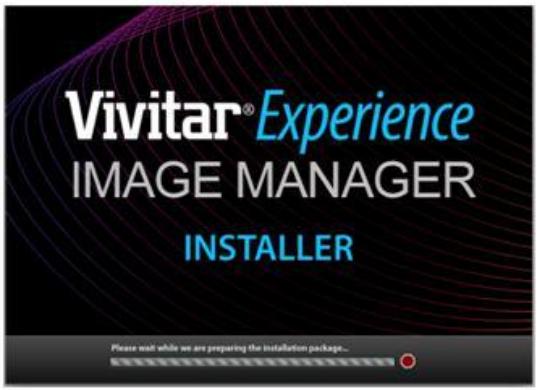
2) On PC: The Vivitar Experience Image Manager Installer window appears. If the window does not appear, open the application's CD/DVD drive and click on "Setup.exe" to launch the installer.
3) On Macintosh: Click the icon that appears on the desktop to install the Vivitar Experience Image Manager.
4) If you do not have internet access at the time of inserting the CD-ROM, connect to the internet and then click the "Install Vivitar Experience Image Manager" button to begin the installation.
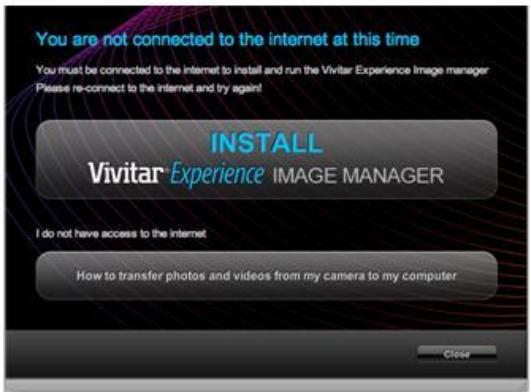
Note: If you do not have internet access, you can still download media from the camera. Click the "How to transfer photos and videos from my camera to my computer" button for instructions.
5) If you have internet access, the "Choose your language" window opens, choose your language and click "Next" to open the next window.
6) Select your camera model from the list and click "Next" to open the next window.
7) Click "Next" to confirm your camera model selection and to install the application.
8) Please wait while the application is being installed on your computer.
9) Please review the license terms. On PC and Macintosh: Click the "I accept the terms of this license agreement" and then click "Next" to continue.
10) On PC only: Let the "Vivitar Experience Image Manager" installer create the folder to where the program will be installed, and then click "Install".
11) Please wait while the application continues the installation process on your computer.
12) On PC: Click the "Close" button when the installation is complete. Click the "Launch Vivitar Experience Image Manager" to open the application.
13) On Macintosh: Click the "Quit" button when the installation is complete. Click the "Launch Vivitar Experience Image Manager" to open the application.
14) If you close the application you can run the Vivitar Experience Image Manager from the Programs (PC) or Applications (Mac) menu on your computer.
Connecting the Camera to the Computer
1) Use the USB cable that came with your camera to connect your camera to your computer.
2) Power the camera ON.
3) The first time you connect the device to the computer you will have to wait a few seconds until the computer recognizes the device.
Getting Photos and Videos from your Camera to Your Computer
An SD card needs to be inserted. Do not disconnect the cable during transfer. Doing so will cancel the transfer of any files on their way to your computer.
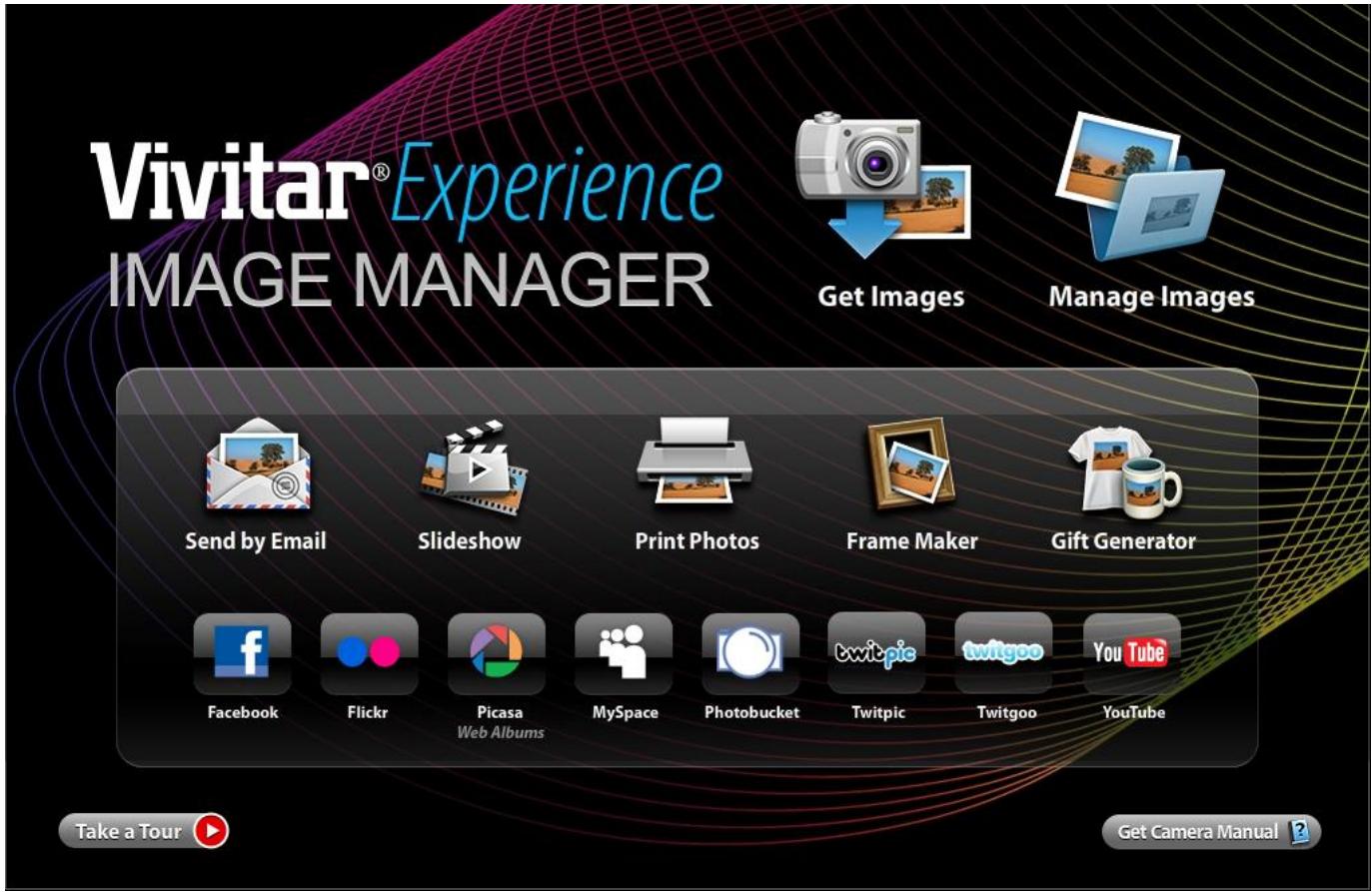
1) Select the "Get Images" button from the Main menu.
2) The "Get media from device" window opens.
3) You can select to download photos, videos or both.
4) Select your camera (removable disk) from the device window. If your camera is the only USB device connected then it will be selected automatically.
5) Select a location on the computer where to place the new photo and video files.
6) Add the new photo and video files to albums if desired.
7) Select to remove the media files from the selected device (removable disk) after the import.
8) Click the "Get Media" button to transfer the photos and videos from your camera to your computer.
9) A media download progress bar appears on the bottom left showing the number of media files downloading to your computer. A message appears when the download is complete.
10) The photo and video files that you selected are now downloaded to your computer to the selected folder and albums ready for your use.
Get Started!
Using the Vivitar Experience Image Manager, you can:
- Upload and manage photos and videos to and from the most popular photo sharing and social networking sites - Facebook, Flickr, Picasa, MySpace, Photobucket, Twitpic, Twitgoo and YouTube
- Seamlessly transfer photos and videos from one social network to another
- Organize your images by creating offline and online albums
- Edit images using automatic and manual tools
- Use automatic "Geotagging" with built in Google Maps
For more details on how to use the Vivitar Experience Image Manager open the Help file or click the “Take a Tour” button on the application’s Home screen.
Transferring Images from my Camera to my Computer Manually
Transferring Photos and Videos: WINDOWS
1) Use the USB cable that came with your camera to connect your camera to your computer.
2) A window appears with a list of options, select "Open folder to view files" and click OK.
3) Open the DCIM folder and the folder inside to view the media files.
4) Select the media and copy the files from this folder into your computer. Optionally, select the files and choose Copy from the Edit menu. Then select a folder and choose Paste from the Edit menu.
5) We recommend that you copy the images into the Pictures/My Pictures folder and the videos into the Videos/My Videos folder.
6) Do not disconnect the cable during transfer. Doing so will cancel the transfer of any files on their way to your computer.
Transferring Photos and Videos: MACINTOSH
1) Use the USB cable that came with your camera to connect your camera to your computer.
2) The camera's device icon appears on the desktop.
3) Click on the device icon and open the DCIM folder and the folder inside to view the media files.
4) Select the files and drag them into your computer. Optionally, select the files and choose Copy from the Finder's Edit menu. Then select a folder and choose Paste from the Edit menu.
5) We recommend that you copy the images into the Pictures folder and the videos into the Movies folder.
6) Do not disconnect the cable during transfer. Doing so will cancel the transfer of any files on their way to your computer.
Camera Maintenance
The digital camera is a delicate device. Please handle your camera with care to avoid damaging it. Do not expose your camera to heat sources.
Sakar Warranty Card
This warranty covers for the original consumer purchaser only and is not transferable. Products that fail to function properly UNDER NORMAL USAGE, due to defects in material or workmanship will be repaired at no charge for parts or labor for a period of one year from the time of purchase.
What Is Not Covered By Warranty:
Damages or malfunctions not resulting from defects in material or workmanship and damages or malfunctions from other than normal use, including but limited to, repair by unauthorized parties, tampering, modification or accident.
What To Do When Service Is Required:
When returning your defective product (postage pre-paid) for service, your package should include:
1) Copy of original bill of sale
2) A detailed written description of the problem.
3) Your return address and telephone number (Daytime)
MAIL TO ADDRESS BELOW:
| Sakar US | Sakar UK/Europe | Sakar Australia |
| Sakar International | Attention: Service Department 2D, Siskin Parkway East | Return faulty camera to the Refund Counter at the store where purchased |
| Attention: Service Department | ||
| 195 Carter Drive | 4020 Middlemarch Business | |
| Edison, NJ | Park | |
| 08817 | Coventry, CV3 4PE |
Technical Support
For technical support issues please visit our website at www.vivitar.com. You can find manuals, software and FAQ's at the website. Can't find what you are looking for? E-mail us at support@vivitar.com and one of our technical support team members will answer your questions. For phone support in the US please call 1-800-592-9541, in the UK call 0800 917 4831, in Australia call 1800-006-614. If you would like to call from anywhere else, please visit www.vivitar.com for your local toll free number.
Troubleshooting
Q: I have taken photos and selected the “Get Images” button. I get a message that the images were successfully transferred but the photos do not appear on my computer. What do I do?
First ensure that you have in fact taken photos. Press the Shutter button to take some sample photos and then try downloading them again.
With test photos if the camera powers off before you upload them to the computer the photos are not stored in the camera's memory. These photos should be uploaded quickly before the camera powers off. If the photos are saved to the SD memory card then all the photos should appear.
Q: How do I make sure I don't lose important pictures?
This camera requires an SD card for normal use. If the camera powers off nothing will happen to the images stored on the SD memory card. We recommend always downloading your photos to your computer as soon as possible to prevent unintentional data loss.
Q: I deleted images using the Vivitar Experience Image Manager. The images were also deleted from my computer. How do I recover images that I accidentally deleted?
All images deleted using the Vivitar Experience Image Manager are sent to your computer's Recycle or Trash Bin and can be retrieved from there.
V8426 ver2-TA-123011