
NC - Hob DE DIETRICH - Free user manual and instructions
Find the device manual for free NC DE DIETRICH in PDF.

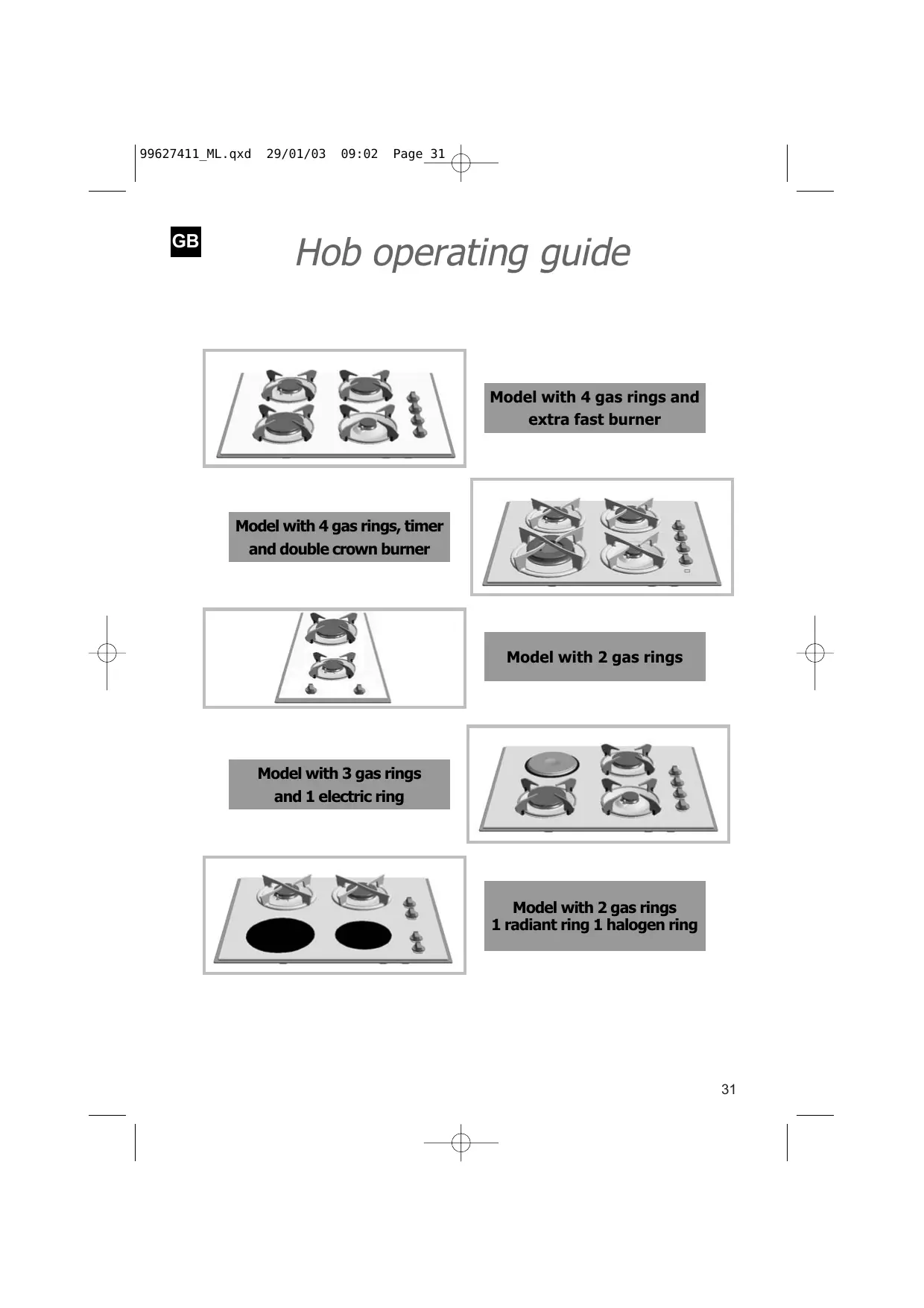


| Product Type | Built-in Hob |
| Brand | De Dietrich |
| Model | NC (gas, mixed or electric hob depending on version) |
| Overall dimensions (W x D x H) | 65 cm x 51.8 cm x 5 cm (65 cm model) / 31 cm x 51 cm x 5 cm (30 cm model) |
| Cut-out dimensions | 56 cm x 49 cm (65 cm model) / 26.5 cm x 49 cm (30 cm model) |
| Power supply | Gas (G20/G25/G30/G31) and/or electric 230 V~ 50 Hz |
| Total gas power (max) | Up to 8.65 kW (depending on model) |
| Electric power (if applicable) | Up to 3000 W (radiant/halogen zones) |
| Number of burners/zones | 2 to 4 gas burners, options: electric, radiant, halogen zone |
| Burner types | Auxiliary (0.85 kW), semi-rapid (1.5 kW), rapid (2.3 kW), large rapid (3.1 kW), double crown (4 kW) |
| Ignition | Integrated into controls, with thermocouple safety |
| Timer | On some models (up to 99 min with automatic shut-off) |
| Residual heat indicator | Yes (for electric zones) |
| Surface material | Ceramic glass (for models with electric zones) or glass (for all-gas models) |
| Safety | Automatic gas shut-off in case of flame extinction, child safety (not explicitly mentioned but standard) |
| Maintenance and cleaning | Clean with hot water and special ceramic glass cleaner; avoid abrasives; unblock injectors with a pin |
| Spare parts available | Injectors, ignition spark plugs, burner heads, caps, grates, sealing gasket |
| Repairability | Repairability index not provided; after-sales service intervention recommended for power cable |
| General information | Delivered pre-set for natural gas; adaptable to butane/propane with supplied kit; energy class not specified |
Frequently Asked Questions - NC DE DIETRICH
User questions about NC DE DIETRICH
0 question about this device. Answer the ones you know or ask your own.
Ask a new question about this device
Download the instructions for your Hob in PDF format for free! Find your manual NC - DE DIETRICH and take your electronic device back in hand. On this page are published all the documents necessary for the use of your device. NC by DE DIETRICH.
USER MANUAL NC DE DIETRICH
Raccordements possibles
GAZ DISTRIBUTE PAR CANALISATION (GAZ NATUREL) OU AIR PROPANÉ/AIR BUTANE.
Raccordements possibles
GAZ DISTRIBUTE PAR BOUTEILLE OU RÉ-SERVOIR (GAZ BUTANE/PROPANE).
- 1 foyer radiant 1200 W
+1 foyer halogene 1800 W
| Gaz Naturel | Gaz Butane/Propane | Air proposéAir butané | |||
| 94 | 137 | 62 | 88 | 165 | 298 |
Model with 4 gas rings and extra fast burner
Model with 4 gas rings, timer and double crown burner
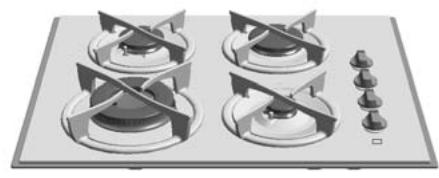
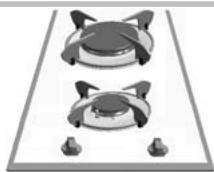
Model with 2 gas rings
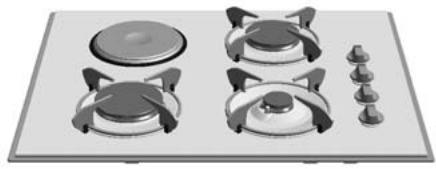
Model with 3 gas rings and 1 electric ring
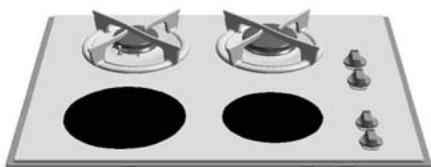
Model with 2 gas rings 1 radiant ring 1 halogen ring
List of contents
Using your hob in complete safety 34
What your hob looks like? 35
Installing your hob in all simplicity 36
Fitting recommendations 36-38
Electrical connections 39
Gas connections 40-42
Changing the type of gas supply 43-49
Using your hob in all simplicity 50
How to use your gas burners 50
How to use the timer 51
Which pans are best adapted for use on the gas burner? 52
How to use the radiant and halogen rings 53
Which pans work best on a radiant/halogen ring? 54
How to use the electric hotplate? 55
Which pans are best adapted for use on the electric hotplate? 55
How to look after your hob? 56
Minor troubleshooting 57
Gas-cooking guide 58
Cooking guide for radiant/halogen rings 59
Cooking guide for electrical hobs 60
In this Manual,

displays safety instructions
displays tips and hints
Editorial
Dear Customer,
Thank you for buying a DE DIETRICH hob.
Our research teams have designed a new generation of kitchen appliances. As a result of our unique expertise, we have produced a range of goods whose quality, design and technical advance are unsurpassed.
You will find that the clean lines and modern look of your DE DIETRICH hob blends in perfectly with your kitchen décor. It is easy to use and performs to a high standard.
DE DIETRICH also makes a range of products that will enhance your kitchen such as hobs, extractor hoods, built-in dishwashers and refrigerators. There are models to complement your new DE DIETRICH hob.
Of course, we make every effort to ensure that our products meet all your requirements, and our Customer Relations department is at your disposal, to answer all your questions and to listen to all your suggestions (see back cover of manual).
DE DIETRICH is certain that by setting new standards of excellence by which comparisons can be made, customers will find that DE DIETRICH appliances offer a better and more exciting way of living.
DE DIETRICH.
Your hob in complete safety
Using your hob in complete safety
We have designed your hob for private domestic use.
With a view to the constant improvement of our products, we reserve the right to make any changes in their technical, functional or aesthetic characteristics as a result of technical evolution.
These hobs are designed exclusively for the cooking of drinks and foodstuffs. These products do not contain any asbestos-based component parts.
You must always keep an eye on your cooking.
Please read the instructions before installing and using this appliance.
Should a crack appear on the glass, disconnect your appliance immediately and contact your After-Sales Service.
Never leave any CLEANING ou INFLAMMABLE products in the cupboard or drawer beneath your hob (aerosols or other pressurised cans, papers, recipe books, etc.).
Using a gas-powered hob produces both heat and humidity in the room where it is used. Make sure your kitchen is well ventilated.
Disconnect your hob from both electrical and gas supplies before carrying out any maintenance operations.
For safety reasons, do not forget to close the main gas valve for built in gas lines or the valve on the top of your butane/propane gas cylinder.
If a knob is difficult to turn, DO NOT FORCE IT. Call up your installer.
The EC mark of conformity can be found on all these hobs.
YOUR HOB IS DELIVERED PRE-SET FOR USE WITH NATURAL TOWN GAS.
What your hob looks like?
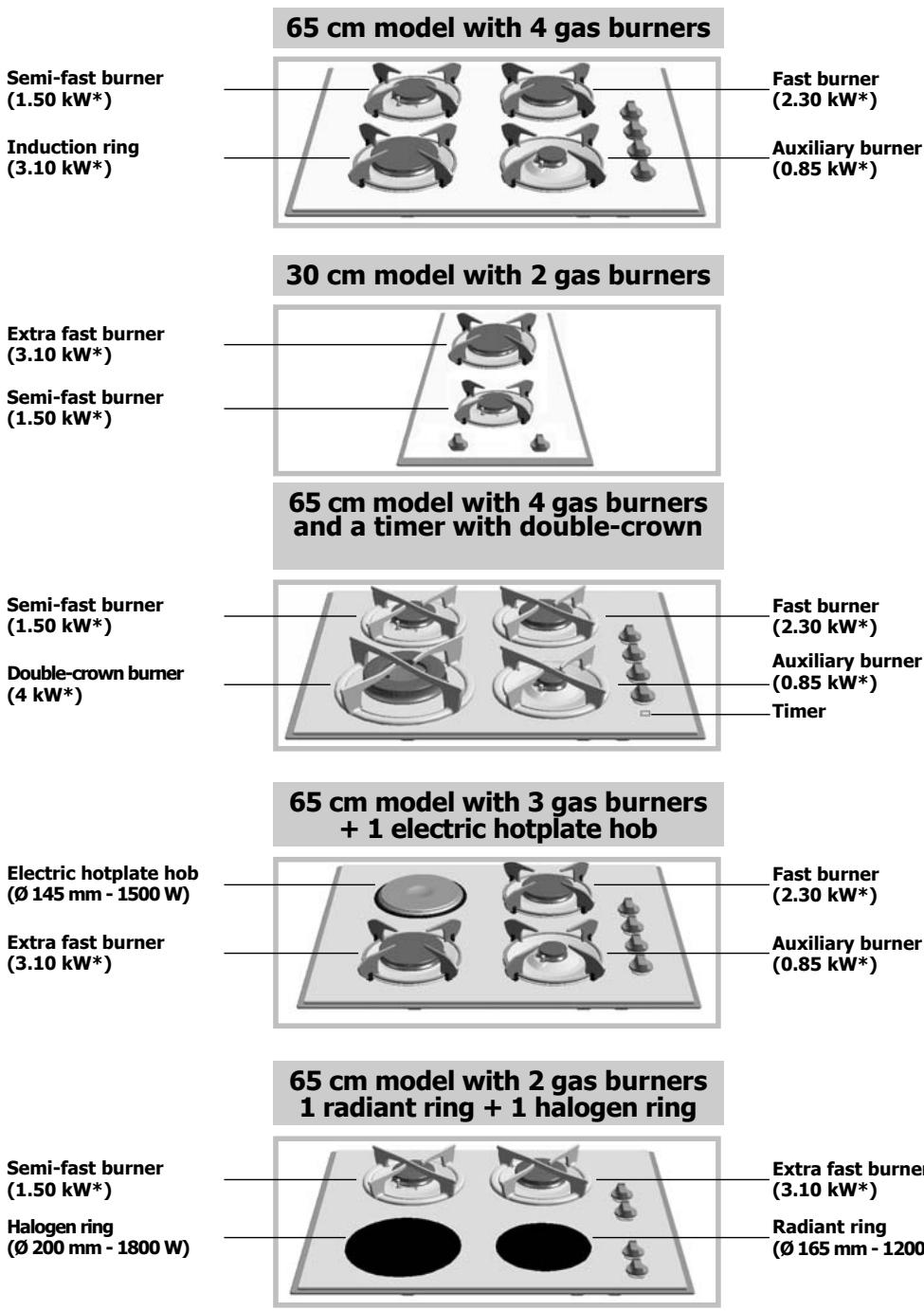
* Power obtained using G20 natural gas.
Installing your hob in all simplicity
Fitting recommendations
| Width | Depth | Height | ||||
| Model | 30 cm | 65 cm | 30 cm | 65 cm | 30 cm | 65 cm |
| Cut-out | 26,5 cm | 56 cm | 49 cm | 49 cm | Depending on cupboard | |
| Outside dimensions above the work surface | 31 cm | 65 cm | 51 cm | 51,8 cm | 5 cm | 5 cm |
| Hob with double-crown burner | 6 cm | |||||
| Outside dimensions under work surface | 26 cm | 55 cm | 47 cm | 47 cm | 5,1cm | 5,1cm |
This appliance should be installed by a qualified technician / installer.
Prior to installation, ensure that the local distribution conditions (nature of the gas and gas pressure) and the adjustment conditions of the appliance are compatible.
The adjustment conditions are stated on a label in the wallet and also on the packaging.
Since this appliance is not connected to a combustion products evacuation device, it must be installed in accordance with current installation regulations and used in a well-ventilated place. Particular attention should be given to the relevant requirements regarding ventilation.
On this subject, combustion can take place only if oxygen from the air is present, so this air must be constantly renewed and the combustion products must be evacuated (a minimum air input of 2 m3/hour per kw of gas energy is required).
E.g.: 65 cm model - 4 gas burners :
Total power :
$$ \begin{array}{l} 1, 5 + 2, 3 + 3, 1 + 0, 8 5 = 7, 7 5 \mathrm {k W}. \ 7, 7 5 \mathrm {k W} \times 2 = 1 5, 5 \mathrm {m} 3 / \mathrm {h} \text {m i n i m u m} \ \end{array} $$
These hobs have type X protection (in accordance with standard EN 60.335.2.6) against overheating of cupboards and Class 3 for installation itself (in accordance with standard EN 30.1.1).
Fitting recommendations (cont'd)
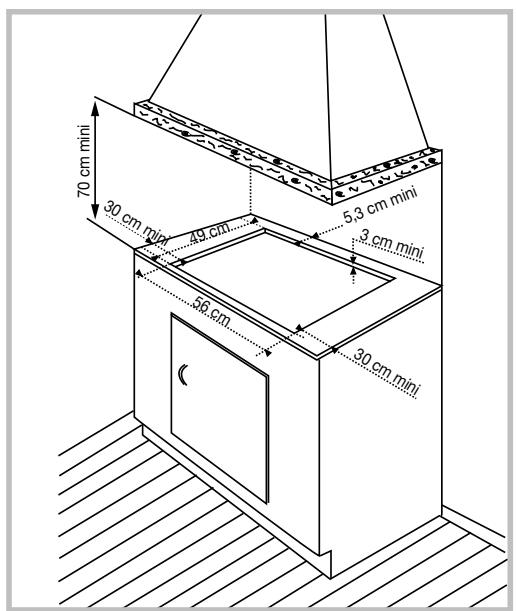
The hob must be built into the worktop of a support cupboard. This worktop must be at least 3cm thick and heat-resistant or else coated with a heat resistant material.
A side-clearance of at least 30~cm should be left to the right and left of the hob. A tall cupboard or partition too close to the hob would hinder free movement of kitchen utensils.
If a horizontal partition is put under the hob, it must be placed between 10 and 15cm from the bottom of the worktop. In any case, do not keep any sprays or pressurized containers in the compartment which could be just under the hob.
Place the hob unit into the opening in the worktop by carefully pulling it towards you.
Put the burners, caps and pan grates back into position.
Connect the hob power cable to your kitchen electricity supply (See "Electrical Connections" for your hob).
If you want, you can fix the hob in position on its four corners, using the four lugs and screws provided (See diagram).
Only use the holes provided.
Stop screwing when the lug starts to bend.
Do not use a power screwdriver.
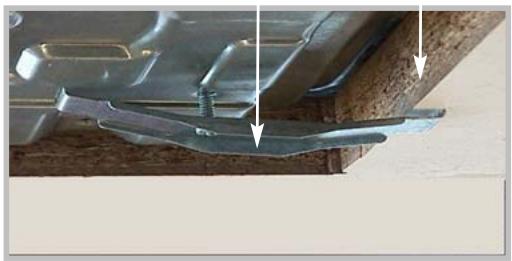
Mounting pad.
Worktop
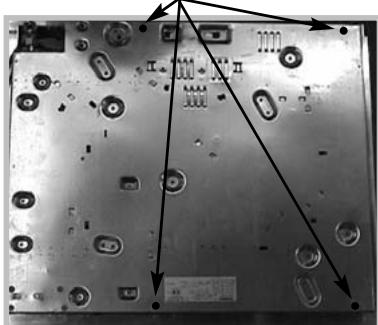
Fixing holes
Installing your hob in all simplicity
Fitting recommendations (cont'd)
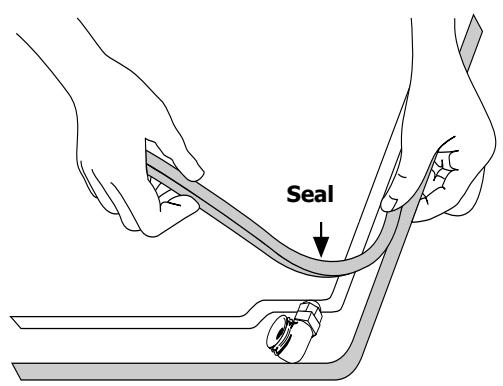
To make sure that nothing can get between the frame and the worktop, stick the foam seal around the outside of the hob.
Affix the joint provided in the folder before installing the hob :
1- Remove the pan support grates, the burner caps and heads after checking their position.
2- Turn the hob over and place it gently over the opening in the worktop paying attention not to damage the control knobs, thermocouples and lighters.
3- Stick the foam seal delivered with the appliance around the outside of the hob. This seal prevents anything getting between the glass and the worktop.
4- Put the burners, caps and pan grates back into position.
Installing your hob in all simplicity
Electrical connections
Mixed and all-gas hobs
Hobs are delivered with a three-conductor (2 phase + earth) H05VVF - T105, ou H05V2V2F - T90 1mm section cable, and must be connected to a 230V single phase mains supply by the intermediary of a two phase + CEI 60083 standardised earth plug, or a single pole cut-off device with a contact opening by at least 3mm.
CROSS SECTION OF THE CABLE TO USE
| 230 V~ - 50 Hz All-gas and mixed (3+1) | 2+ 2 radiants | |
| Cable H05WF-T105 or H05V2V2F - T90 | 3 conductors of which 1 is to be earthed | |
| Cross section of conductors in mm² | 1 | 1,5 |
| Fuse | 10 A | 16 A |

The protective conductor is connected to the earth connection on the hob and therefore must also be connected to an external earth connection.
If this cable is damaged, have it replaced by your After-Sales Service as special tooling is required to connect it correctly.
Installing your hob in all simplicity
Gas connections
- Preliminary remarks
If the hob is to be installed above an oven or if other nearby heating appliances risk heating and damaging the gas hose then it is essential that a rigid pipe be installed instead. If a flexible hose is used (in the case of butane gas) then it must not be installed in a place where it may be in contact with a moving part of the kitchen unit or a place likely to get cluttered.

Access to the whole length of the connection hose must be possible and the gas hose must be replaced before its use before date (indicated on the hose). Whatever means of connections is chosen, make sure that it is gas sound after installation by using soapy-water.
Installing your hob in all simplicity
Gas connections (Cont'd)
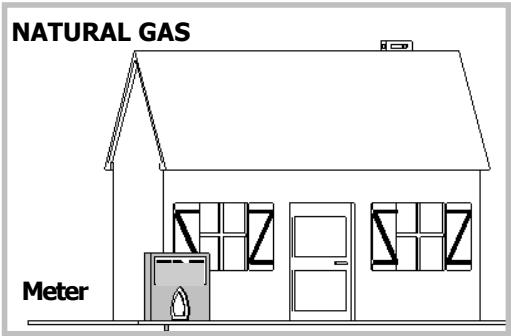
Possible connections
TOWN GAS (NATURAL GAS)OR AIR-PROPANE / AIR-BUTANE.
One of the 3 following connections must be used:
- connection with a rigid pipe (gas standard G1/2).
The connection should be made at the end of the elbow seal on the appliance,
or - connection with a reinforced, braided, flexible gas hose with threaded connectors (fig. A on the preceding page).
You may also use a "Gazinox" type, stainless steel flexible tube available from your local distributor,
or - connection with a flexible gas hose with threaded connectors (fig. B on the preceding page).
These hoses must not exceed 2 metres in length and their entire length must be accessible.
Gas connections (Cont'd)
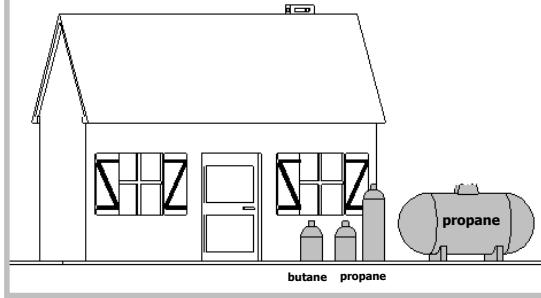
Possible connections
BOTTLED OR TANKED GAS (BUTANE/PROPANE).
For the user's safety, we advise the connection to be made with a rigid pipe if this is possible, or with a reinforced, braided, flexible gas hose (maximum length 2 metres) (fig. A).
For an existing installation, where it is not possible to fit a reinforced, braided, flexible gas hose, the connection can be made with a flexible gas hose (maximum length 2 metres), with two jubilee clips: one on the connector (fig. B), and the other on the pressure regulator, and a gas proof washer should be fitted between the connector and the elbow seal on the hob.
You will find the sealing washer and the adaptor in the wallet delivered with the unit.
BUTANE/PROPANE
Pressure regulator compulsory
fig. A
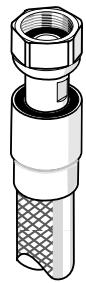
Reinforced, braided, flexible gas hose with threaded connectors
fig.B
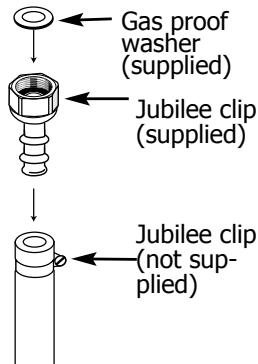
Flexible hose connection

Temperatures above 30^ would cause overheating of the gas hose. To avoid this, check that there are no heat-producing devices nearby.
Screw on the connector with a torque not exceeding 2.5m / daN (m / kgF)
Installing your hob in all simplicity
Changing the type of gas supply
Preliminary remarks
Your hob is delivered regulated for natural gas.
The injectors for adapting the hob for use with butane or propane are in the wallet containing the instructions, together with the adaptor and the sealing washer. Please see the corresponding paragraph on "Gas Connections".
You can obtain an adapter sachet from your After-sales Service.
Every time you change your gas supply, mark the square on the label in the wallet that corresponds to the new type of gas (See "Gas Rating" in this chapter).
Changing the type of gas supply (cont'd)
- Changing from natural gas to butane/propane gas
When carrying out this operation, you should successively:
Adapt the gas connection
Change the injectors
Adjust the retarder on the taps
ADAPT THE HOB CONNECTION to the new gas adjustment. Refer to the paragraph "Gas connections".
CHANGES THE INJECTORS in the following way:
- Remove the supports, and all the burner caps and heads.
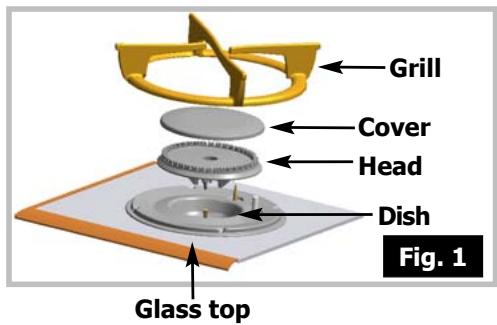
- Using the spanner supplied, unscrew the injectors at the bottom of each dish and remove them (fig 1).
- Replace these with the injectors supplied in the wallet, in accordance with the gas rating table at the end of the chapter; to do this:
Screw in the injectors by hand until they are tight.
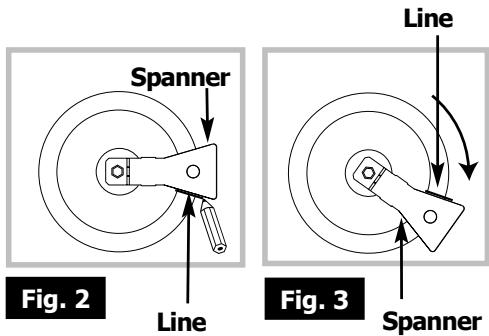
Put the spanner well onto the injector.
With a pencil draw a line on the hearth plate as indicated (fig. 2).
Turn the spanner clockwise until the line appears on the other side (fig. 3). Warning! Do not go beyond this limit as you are liable to cause damage.
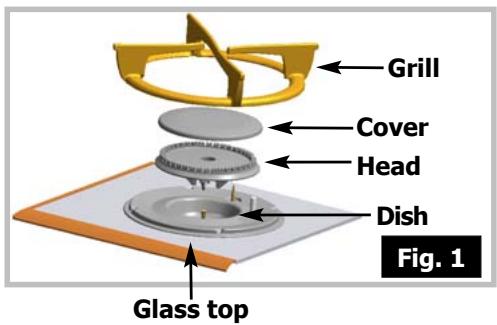
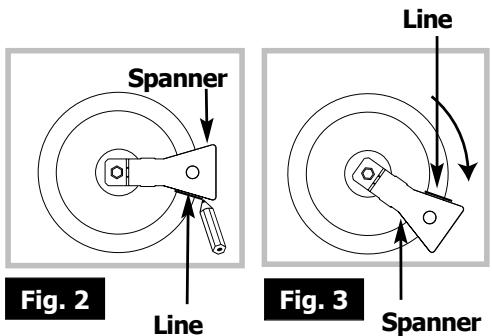
Installing your hob in all simplicity
Changing the type of gas supply (cont'd)
- Changing from natural gas to butane/propane gas (cont'd).
ADJUST THE RETARDER ON THE TAPS located under the knobs. Proceed as follows:
Work on one tap at a time.
- Remove the control knobs by pulling them upwards.
- Using a small screwdriver screw fully the brass, adjustment screw (yellow) (Fig. 4) clockwise.
- Check the position of the knobs before putting them back in place. Make sure the knobs are pushed down as far as possible.
- Put all the burners, covers and grills back in position.
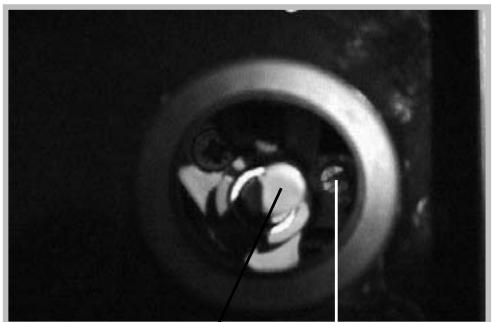
Tap axis
Adjustment screw
Fig. 4
Installing your hob in all simplicity
Changing the type of gas supply (cont'd)
- Changing from butane / propane gas to natural gas or air-propane / air-butane.
When carrying out this operation, you should successively:
Adapt the gas connection
Change the injectors
Adjust the retarder on the taps
ADAPT THE HOB CONNECTION to the new gas adjustment. Refer to the paragraph "Gas connections".
2 CHANGE THE INJECTORS in the following way:
- Remove the supports, and all the burner caps and heads.
- Using the spanner supplied, unscrew the injectors at the bottom of each dish and remove them (fig 1).
- Replace these with the injectors supplied in the wallet, in accordance with the gas rating table at the end of the chapter; to do this:
Screw in the injectors by hand until they are tight.
Put the spanner well onto the injector.
With a pencil draw a line on the hearth plate as indicated (fig. 2).
Turn the spanner clockwise until the line appears on the other side (fig. 3). Warning! Do not go beyond this limit as you are liable to cause damage.
- Put all the burners, covers and grills back in position.
Changing the type of gas supply (cont'd)
- Changing from butane / propane gas to natural gas or air-propane / air-butane (cont'd).
3 ADJUST THE RETARDER ON THE TAPS located under the knobs. Proceed as follows:
Work on one burner at a time.
- Light up the burner at maximum heat.
- Remove the corresponding control knob
- Using the small screwdriver, unscrew the brass, adjustment screw (yellow) turning it round twice, anti-clockwise (Fig. 4).
- Put the control knob back in place and turn to minimum flame.
- Remove the knob again then turn the adjustment screw clockwise as low as possible without extinguishing the flames.
- Put back the sealing ring and control knob then turn it several times from maximum position to minimum position : the flame must not be extinguished. Otherwise, re-adjust it by slightly screwing or unscrewing the adjustment screw so that a stable flame is obtained when the knob is turned from maximum to minimum position.
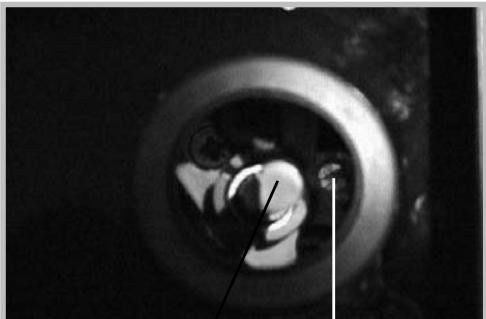
Tap axis
Adjustment screw
Fig. 4
Installing your hob in all simplicity
Changing the type of gas supply (cont'd)
| ● Gaz rating | PT FR-GB-ES | FR-GB ES-PT | FR-GB ES-PT | FR | FR |
| Appliance designed for installation: FR .....................Cat: III1C2E+3+ ES - GB - PT.....................Cat: II2H3+ Hourly input -see below: at 15°C at 1,013 mbar | Butane G30 28-30 mbar | Propane G31 37 mbar | Natural gas G20 20 mbar | Natural gas G25 25 mbar | Air- propane Air- butane G130 8 mbar |
| Double-crown burner Indicator marked on injector | 95 | 95 | 147 | 147 | 360 |
| Nominal heat rating (kW) | 3,60 | 3,60 | 4,00 | 4,00 | 3,60 |
| Low heat rating (kW) | 1,450 | 1,550 | 1,300 | ||
| Hourly output (g/h) | 262 | 257 | 381 | 443 | 503 |
| Hourly output (l/h) | |||||
| Fast burner Indicator marked on injector | 78 | 78 | 121 | 121 | 210 |
| Nominal heat rating (kW) | 2,25 | 2,25 | 2,30 | 2,30 | 2,40 |
| Low heat rating (kW) | 0,830 | 0,870 | 0,650 | ||
| Hourly output (g/h) | 164 | 161 | 219 | 255 | 336 |
| Hourly output (l/h) | |||||
| Extra fast burner Indicator marked on injector | 88 | 88 | 137 | 137 | 298 |
| Nominal heat rating (kW) | 3,10 | 3,10 | 3,10 | 3,10 | 3,10 |
| Low heat rating (kW) | 0,830 | 0,870 | 0,780 | ||
| Hourly output (g/h) | 225 | 221 | 295 | 343 | 434 |
| Hourly output (l/h) | |||||
| Semi-fast burner Indicator marked on injector | 62 | 62 | 94 | 94 | 165 |
| Nominal heat rating (kW) | 1,45 | 1,45 | 1,50 | 1,50 | 1,50 |
| Low heat rating (kW) | 0,620 | 0,615 | 0,400 | ||
| Hourly output (g/h) | 105 | 104 | 143 | 166 | 210 |
| Hourly output (l/h) | |||||
| Auxiliary burner Indicator marked on injector | 45 | 45 | 63 | 63 | 122 |
| Nominal heat rating (kW) | 0,750 | 0,750 | 0,850 | 0,850 | 0,850 |
| Low heat rating (kW) | 0,300 | 0,350 | 0,350 | ||
| Hourly output (g/h) | 55 | 54 | 81 | 94 | 119 |
| Hourly output (l/h) | |||||
| 65 cm model with 4 gas burners Total heat nominal rating (kW) | 7,55 | 7,55 | 7,75 | 7,75 | 7,85 |
| Maximum output (g/h) | 549 | 540 | 738 | 858 | 1099 |
| 65 cm model with 4 gas rings, and double crown burner Total heat nominal rating (kW) | 8,05 | 8,05 | 8,65 | 8,65 | 8,35 |
| Maximum output (g/h) | 647 | 576 | 824 | 958 | 1168 |
| 30 cm model with 2 gas burners Total heat nominal rating (kW) | 4,55 | 4,55 | 4,60 | 4,60 | 4,60 |
| Maximum output (g/h) | 330 | 325 | 438 | 509 | 644 |
| 65 cm model with 3 gas burners + 1 electric ring Total heat nominal rating (kW) | 6,10 | 6,10 | 6,25 | 6,25 | 6,35 |
| Maximum output (g/h) | 444 | 436 | 595 | 692 | 889 |
| 65 cm model with 2 gas burners + 1 radiant ring 1200 W + 1 halogen ring 1800 W Total heat nominal rating (kW) | 4,55 | 4,55 | 4,60 | 4,60 | 4,60 |
| Maximum output (g/h) | 330 | 325 | 438 | 509 | 644 |
Installing your hob in all simplicity
Changing the type of gas supply (cont'd)
Gaz rating
MARK ON THE INJECTORS
This table shows the position of the injectors on your hob depending on the type of gas you use. The number is marked on each injector.
65 cm model with 4 gas burners
| Natural gas | Butane/Propane gas | Air-Butane/Air-Propane | |||
| 94 | 121 | 62 | 78 | 165 | 210 |
| 137 | 63 | 88 | 45 | 298 | 122 |
65 cm model with 4 gas rings, and double crown burner
| Natural gas | Butane/Propane gas | Air-Butane/Air-Propane | |||
| 94 | 121 | 62 | 78 | 165 | 210 |
| 147 | 63 | 95 | 45 | 360 | 122 |
30 cm model with 2 gas burners
| Natural gas | Butane/Propane gas | Air-Butane/Air-Propane |
| 137 | 88 | 298 |
| 94 | 62 | 165 |
65 cm model with 3 gas burners
+1 electric ring 1500 W
| Natural gas | Butane/Propane gas | Air-Butane/Air-Propane |
| 121 | 78 | 210 |
| 137 | 88 | 45 |
65 cm model with 2 gas burners
+ 1 radiant ring 1200 W
+1 halogen ring 1800 W
| Natural gas | Butane/Propa ne gas | Air-Butane/Air-Propane | |||
| 94 | 137 | 62 | 88 | 165 | 298 |
Using your hob in all simplicity
How to use your gas burners?
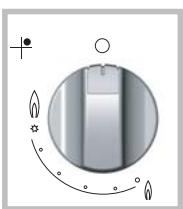
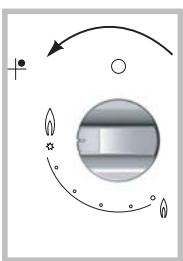
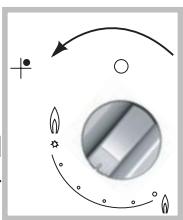
To set off the safety system, keep the knob pressed completely down for a few seconds after the flame has lit up.
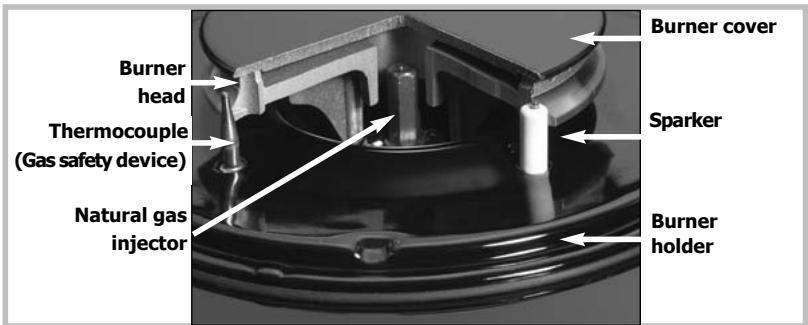
- Each burner is controlled by a tap fitted with a safety device, which cuts the gas off automatically, if ever the flame goes out by accident (overflowing, drafts, etc.).
The safety device for the burners is in the form of a metal rod (a thermocouple) beside to the flame. - Your hob is fitted with an automatic lighting system integrated into the control knobs.
-
Should there be an electricity cut, you can always light a burner using a match and by pressing down on the control knob at the same time.
-
Choose the ring you need using the symbols at the side of each control knob; (E.g. back right-hand burner).
For lighting a burner:
- Press down on the control knob and turn it anti-clockwise to maximum flame height. The lighter for the burner will spark as long as you keep the control knob pressed down.
- Set the flame height as required.
The gas tap is closed when in the "O" position.
-
The flames on the burner are smaller near the grate supports to avoid any damage being done to the enamel.
-
The noise made by certain burners is related to their power and burning gas; this does not harm the quality of cooking in any way.

- If ever your flame goes out, relight it as per normal procedure.
Using your hob in all simplicity
How to use the timer (Model with 4 rings and a double crown burner)
The back right-hand burner is equipped with a timer (maximum cooking time 99 minutes). It can, however, be used independently.
Light the back right-hand burner (see previous page).
- Set it to the flame height you require.
- Press the + or - touch control
on the timer.
As soon as you put your finger on one of these two controls, the timer starts and the cooking time (in minutes) scrolls down on the display.
- Keep your finger on the touch control until the cooking time you require is displayed.
When the time is up, the burner will go out and the timer will blink 00. An intermittent beep will sound.
To switch it off, touch any of the timer controls.
- Turn the back right-hand burner control knob back to "O".
To change the cooking time, you can press the + or - controls. - To stop the timer during cooking, put your finger on the + and - touch controls at the same time, until the timer display goes out.
The burner will stay alight without the timer.
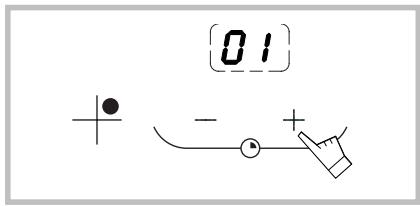
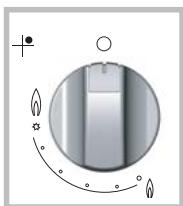

Should there be a power cut when the back right-hand burner is being used with the timer, the timer cuts itself off when the power supply comes back on.

When cooking time has over, the gas supply to the burner is cut off immediately and the burner goes out.
Using your hob in all simplicity
Which pans are best adapted for use on the gas burner?
Recommended pan sizes:
| Extra burner | Extra burner | Medium burner | Small burner | |
| double-crown | Extra fast | fast | Semi-fast | auxiliary burner |
| 20 to 30 cm | 18 to 28 cm | 16 to 26 cm | 12 to 20 cm | 8 to 14 cm |
| Fry-ups Bringing to the boil | Searing | Sauces, Reheating | Simmering | |
Adjust the flames so that they do not lick up the side of your pan.
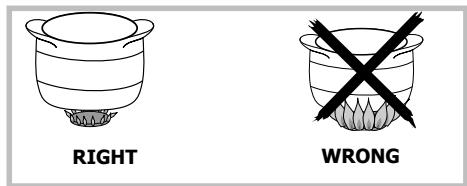
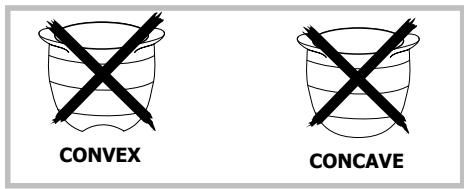
Do not use a pan with a convex or concave bottom.
Do not leave the gas on beneath an empty pan.
Do not use pans whose handles may partially cover control knobs.
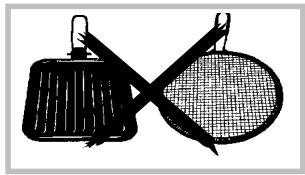
Do not use heat regulators, toasters, steel meat grills or stew-pots that touch the glass-top.

Keep all natural air-vents open or have a mechanical ventilation system installed (a mechanically ventilated hood).
- Prolonged, intensive use of the hob may require extra ventilation; by opening a window for example or producing more efficient ventilation by increasing the power of the existing mechanical ventilation (a minimum air input of 2m3/hour per kW of gas energy is required).
E.g.: for 65 cm hob with 4 gas-rings
Total power: 1.5 + 2.3 + 3.1 + 0.85 = 7.75 kW . 7.75 kW × 2 = 16.5 m^3/h per hour minimum flow-rate.
Using your hob in all simplicity
How to use the radiant and halogen rings
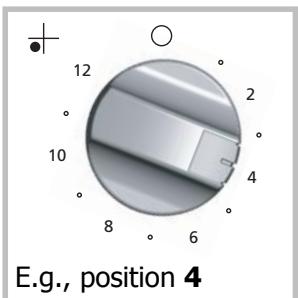
- For starting cooking, turn the control knob to the most suitable position for your dish (see cooking table at the end of the guide). The ring "power on" light comes on immediately.
- The residual heat light comes on under the ceramic top as soon as the heating zone reaches a high temperature.
- Finish off your cooking by turning the control knob back to "O" just before the end of cooking time; this enables you to take advantage of all the residual heat.
- The power level of the rings automatically adjusts (a bright light fading to almost nothing) so that they maintain an even output temperature to suit your cooking.
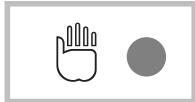
- Residual heat indicator As long as a cooking zone stays hot, the light on the display that corresponds to the zone in question stays lit. When a cooking zone is switched off, but is still hot, the residual heat indicator will blink.

-
Do not put any plastic or aluminium object on the heating surface if it is still hot.
-
You will get best results by using a saucepan with a diameter close to the diameter drawn on the ceramic top.
-
Wipe the underneath of your pan before use.
- The ceramic surface is highly resistant, but not completely unbreakable. Avoid bumping it with saucepans.
- Avoid dragging any saucepans on the hob top as, in the long run, this is liable to wear out the signs on the ceramic-top.

-
Do not touch the heating zone before the residual heat light has gone out. (Even after a prolonged power cut the temperature of the rings may still be quite high).
-
Do not stare for any length of time at the halogen lamps in the cooking zones.
- Should a crack appear on the ceramic top, disconnect your appliance immediately and contact your After-Sales Service.
Using your hob in all simplicity
Which pans work best on a radiant/halogen ring?
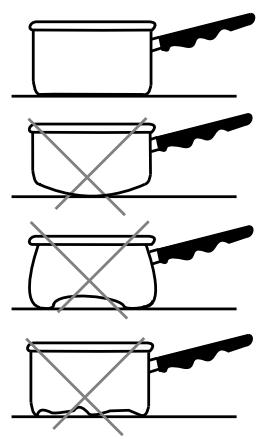
Always use a pan of suitable size: the diameter of the pan must be equal to or larger than the diameter of the radiant ring.
- Use recipients with flat bottoms that are in perfect contact with the heating surface:
- Stainless steel with a thick trimetal or "sandwich" base,
- Aluminium with a thick (smooth) base,
- Enamelled steel.
- The bottom surfaces of recipients in poor condition may hold or transport substances liable to stain or scratch the hob surface.
- Make sure that the underneath of your pan and the heating surface are clean and dry.
- Use a recipient that is big enough to contain all the foodstuffs to be cooked and choose a setting that is not liable to cause any overflowing or splashing.
- The most suitable recipients give the most successful results.
-
Use high-walled saucepans for dishes containing a lot of liquid, so that nothing is liable to overflow when boiling.
-
The bottom of the saucepan and the heating zone should be the same size.
- Make sure your saucepan is in the middle of the heating zone.
- Heating zones should always be clean, for dirty heating zones and saucepan bottoms not only deteriorate the heating surface but also increase electricity consumption.
- Use the residual heat as well as possible by turning off the heat 5 minutes before the end of cooking.
- Never place any food wrapped in aluminium or plastic recipients on the heating zone.
If ever you connect any domestic appliance to a plug near the hob, make sure that its cable does not come into contact with any hot zones.
Using your hob in all simplicity
How to use the electric hotplate
To heat it up
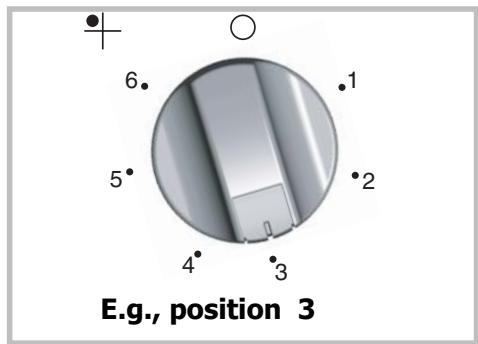
Turn the knob to the point that corresponds to the cooking you want to do (See cooking table at the end of the instruction booklet). The electric hotplate 'on' light comes on.
The first time you use the electric hotplate, leave it on for 3 minutes at maximum temperature without using a pan to harden the surface coating.
Which pans are best adapted for use on the electric hotplate?
- Which pans are to be used on the electric hotplate?
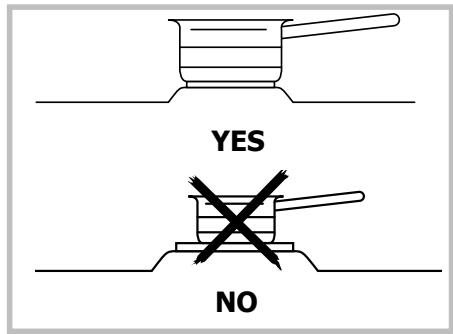
Use pans with flat bottoms that are in complete contact with the electric hot-plate surface:
- Stainless steel with a thick trimetal or "sandwich" base,
- Aluminium with a thick (smooth) base,
- Enamelled steel.
Finish off your cooking with the knob turned to (O). This lets you take advantage of the heat that has accumulated in the electric hotplate.
- Whenever possible use a cover on your pans to avoid losing any heat by evaporation.
Always use a pan of suitable size: the diameter of the pan must be larger than the diameter of the electric hotplate.
-
Whenever possible use a cover on your pans to avoid losing any heat by evaporation.
-
The electric hotplate stays hot for a certain time after it has been switched off in the "O" position.
How to look after your hob?
Keeping your hob in good condition is easy if you clean it before it is completely cold. Even so, never clean it when it is in use. Put all the electric and gas control knobs at zero.
| HOW TO PROCEED | ACCESSORIES TO BE USED | ||
| Looking after sparkers and injectors | - If ever the sparkers get dirty, clean them with a stiff non-metallic brush. -The gas injectors are in the centre of each burner in the form of a "pot". Make sure not to block them up partially when cleaning the hob, as this will considerably reduce the performance of your gas-rings. | Injector Nut Spharker thermocouple | - Small hard-bristled brush. |
| Looking after the grills and gas burners | - Use a non-abrasive cream for removing any persistent stains. Then rinse with clean water. Dry each burner element carefully before re-lighting your hob. | - Non-abrasive cream - Household sponge. | |
| Looking after your glass top | - Clean it with hot water, then wipe dry. Use special ceramic glass cleaning products for any persistent stains. | - Household sponge - Special ceramic glass products E.g. Cera-Clen | |
| Looking after the electric hotplate | - The electric hotplate is protected by a black surface coating. Therefore, avoid using any abrasive products. After use, wipe it clean with an oily cloth. If ever a electric hotplate starts to rust, remove the rust with (with emery paper or similar) and re-coat the electric hotplate with a high-temperature renovating product to be found at your local distributor. | - Household sponge - Special ceramic glass products E.g. Cera-Clen | |

- Should a crack appear on the glass-top, disconnect your appliance immediately and contact your After-Sales Service.
Minor troubleshooting
You have doubts about whether your hob is working correctly ......... this does not necessarily mean there is a breakdown. Nevertheless, check the following points
IF YOU REALIZE THAT
Lighting the burners:
There is no sparking when the control knobs or buttons are pressed down.
When you only press down one control knob all the burners spark.
Sparking takes place but the burners do not light up.
If your hob is fitted with a gas safety device and the flames go out as soon as you release the control knob.
In the low position the flames go out or are too high.
Flames are irregular.
The knobs get hot during cooking.
-Displayed on the timer "Et".
WHAT SHOULD YOU DO?
- Check the electrical connections on the hob.
- Check that the sparkers are clean.
- Check that the burners are clean and in position.
- If the hob is fixed to the worktop, make sure that the fixing clamps have not been twisted.
- Check that the sealing rings have not come out of place.
This is normal. The lighter system is centralised, and all the burners spark at the same time.
- Check that the gas inlet pipe has not been squashed.
- Check that the gas inlet pipe tube is less than 2m long.
- Check that the main gas tap is open.
- If you use gas tanks or cylinders check that they are not empty.
- If you have just installed your hob or changed a gas cylinder, keep the control knob wide open for a few seconds so that the gas can get through.
- Make sure the injector is not blocked up. If this is the case, clear it with a safety pin.
-
Light up your gas burner before putting a pan on it.
-
Push the control knob down completely and keep it under pressure for a few seconds after the burner has lit.
- Check that the burner parts are in place.
- Check that the sealing rings under the control knobs have not come out of place.
- Avoid any severe drafts in the room.
-
Light the burner before putting your pan on it.
-
Avoid any severe drafts in the room.
-
Check that the gas you are using corresponds to the injectors that have been installed (See injector identification in the "Gas Rating" chapter).
Remember that gas hobs are delivered preset for use with natural gas. Check the adjustment of the low power screw (See paragraph "Changing the type of gas supply").
- Check that the burners and injectors are clean and assembled correctly.
- Check you have enough gas in your gas cylinders.
Use small pans on the burners next to the control knobs. Large pans are to be put on the large burners furthest away from the knobs. Put the pan in place with the burner in the middle. The pan should not be above the control knobs.
Your appliance has a fault in it.
Please contact the After-Sales Service.
Gas-cooking guide
| DISHES | TIME | EXTRA-FAST | FAST | SEMI-FAST | DOUBLE-CROWN | AUXILIARY | |
| SOUPS | Broths Thick soups | 8-10 minutes | X | X | X | ||
| FISH | Court-bouillon Grilled | 8-10 minutes | X | X | X | ||
| SAUCES | Hollandaise, bearnaise Bechamel, aurore | 8-10 minutes | X | X | X | X | |
| 10 minutes | X | X | X | ||||
| VEGETABLES | Endives, Spinach Peas In Sauce | 25-30 minutes | X | X | X | ||
| Provence Tomatoes | 15-20 minutes | X | X | ||||
| Fried Potatoes | X | X | |||||
| Pasta | X | X | |||||
| MEAT | Steack Blanquette, Osso-bucco | 90 minutes | X | X | |||
| Fried Escalope | 10-12 minutes | X | |||||
| Tournedos (cast iron grill pan) | 10 minutes | X | X | ||||
| FRYING | Chips Fritters | X | X | ||||
| X | X | ||||||
| DESERTS | Rice Pudding Stewed Fruits | 25 minutes | X | X | X | ||
| Pancakes | 3-4 minutes | X | X | ||||
| Chocolat | 3-4 minutes | X | |||||
| Custard | 10 minutes | X | X | ||||
| Coffee (Small Coffee-Pot) | |||||||
Cooking guide for radiant/halogen rings
| DISHES | VERY HOT 12-11 | HOT 10-9 | MEDIUM 8-7-6 | LOW 5 | SIMMERING 4-3 | KEEPING WARM 2-1 | |
| SOUPS | Broths Thick soups | 6 | 5 | ||||
| FISH | Count-bouillon Frozen | 7 | 6 | ||||
| SAUCES | Thick made with flour Made with butter and eggs (Bearmaise, Hollandaise) | 4-3 | |||||
| VEGETABLES | Endives, Spinach Peas In Sauce, Boiled Potatoes Boiled Potatoes Saute Potatoes Defrosting vegetables | 7→6 | 5 | 3 | |||
| 7→6 | 5 | 4 | |||||
| MEAT | Thinly sliced meat Frying steaks Grilling | 12 | 12 | ||||
| 11 | 12 | ||||||
| FRYING | Frozen chips Fresh chips | 12 | 12 | ||||
| 12 | 12 | ||||||
| MISCELLANEOUS | Pressure cooker Stewed fruit Pancakes Custard Melting chocolate Jam Milk Fried eggs Pasta Baby food in jars (pains marie) Stews Rice pudding keeping warm | 12 | 10 | 6 | (once it hisses) 4 3 1 | ||
| 11 | 9 | 6 | 5 4 3 2-1 | ||||
To get the best possible results, follow the examples in the charts and remember that maximum power (12 - 11) is only to be used for rapid frying and boiling.
Cooking guide for electrical hobs
| DISHES | VERY HOT 6 | HOT 5 | MEDIUM 3-4 | SIMMERING 2 | KEEPING WARM 1 | |
| SOUPS | Broths Thick soups | 6--→5 | 3 | |||
| FISH | Court-bouillon Frozen | 6--→5 | ||||
| SAUCES | Thick made with butter | 3-4 | 2 | |||
| VEGETABLES | Endives, Spinach Peas In Sauce Boiled Potatoes Fried Potatoes Saute Potatoes | 5 5 5 | 3-4 3-4 | |||
| MEAT | Steacks Grilling | 6 6 | ||||
| FRYING | Chips | 6 | ||||
| MISCELLANEOUS | Sewed Pancakes Custard Melting chocolate Jam Milk Pasta Rice pudding keeping warm | 6 6--→5 | 3-4 | 2 2 2 | 1 1 | |
PT

- List of contents
- Editorial
- Your hob in complete safety
- Using your hob in complete safety
- What your hob looks like?
- Installing your hob in all simplicity
- Fitting recommendations
- E.g.: 65 cm model - 4 gas burners :
- Fitting recommendations (cont'd)
- Electrical connections
- Gas connections
- - Preliminary remarks
- Gas connections (Cont'd)
- BOTTLED OR TANKED GAS (BUTANE/PROPANE).
- Changing the type of gas supply
- Your hob is delivered regulated for natural gas.
- Changing the type of gas supply (cont'd)
- MARK ON THE INJECTORS
- Using your hob in all simplicity
- Which pans are best adapted for use on the gas burner?
- How to use the radiant and halogen rings
- Which pans work best on a radiant/halogen ring?
- Always use a pan of suitable size: the diameter of the pan must be equal to or larger than the diameter of the radiant ring.
- How to use the electric hotplate
- To heat it up
- Which pans are best adapted for use on the electric hotplate?
- Always use a pan of suitable size: the diameter of the pan must be larger than the diameter of the electric hotplate.
- How to look after your hob?
- Minor troubleshooting
- IF YOU REALIZE THAT
- Lighting the burners:
- WHAT SHOULD YOU DO?
- Cooking guide for electrical hobs
- PT
Brand : DE DIETRICH
Model : NC
Category : Hob