USER MANUAL LE32B551A6W SAMSUNG
If you have any questions or comments relating to Samsung products, please contact the SAMSUNG customer care centre.
| Country | Customer Care Centre | Web Site |
| AUSTRIA | 0810 - SAMSUNG (7267864, € 0.07/min) | www.samsung.com/at |
| BELGIUM | 02 201 2418 | www.samsung.com/be www.samsung.com/be_fr |
| CZECH REPUBLIC | 800 - SAMSUNG (800-726786) | www.samsung.com/cz |
| Distributor pro Českou republiku: Samsung Zrt., Česká organizační složka, Oasis Florenc, Sokolovská394/17, 180 00, Praha 8 |
| DENMARK | 8 - SAMSUNG (7267864) | www.samsung.com/dk |
| EIRE | 0818 717 100 | www.samsung.com/ie |
| FINLAND | 30 - 6227 515 | www.samsung.com/fi |
| FRANCE | 01 4863 0000 | www.samsung.com/fr |
| GERMANY | 01805 - SAMSUNG (7267864, € 0.14/Min) | www.samsung.de |
| HUNGARY | 06 - 80 - SAMSUNG (7267864) | www.samsung.com/hu |
| ITALIA | 800 - SAMSUNG (7267864) | www.samsung.com/it |
| LUXEMBURG | 02 261 03 710 | www.samsung.com/lu |
| NETHERLANDS | 0900-SAMSUNG (0900-7267864) (€ 0,10/Min) | www.samsung.com/nl |
| NORWAY | 3 - SAMSUNG (7267864) | www.samsung.com/no |
| POLAND | 0 801 1SAMSUNG(172678) 022 - 607 - 93 - 33 | www.samsung.com/pl |
| PORTUGAL | 808 20 - SAMSUNG (7267864) | www.samsung.com/pt |
| SLOVAKIA | 0800 - SAMSUNG (7267864) | www.samsung.com/sk |
| SPAIN | 902 - 1 - SAMSUNG (902 172 678) | www.samsung.com/es |
| SWEDEN | 075 - SAMSUNG (726 78 64) | www.samsung.com/se |
| SWITZERLAND | 0848 - SAMSUNG (7267864, CHF 0.08/min) | www.samsung.com/ch |
| U.K | 0845 SAMSUNG (7267864) | www.samsung.com/uk |
| TURKEY | 444 77 11 | www.samsung.com/tr |
| ESTONIA | 800-7267 | www.samsung.com/ee |
| LATVIA | 8000-7267 | www.samsung.com/lv |
| LITHUANIA | 8-800-77777 | www.samsung.com/lt |
| KAZAHSTAN | 8-10-800-500-55-500 | www.samsung.com/kz_ru |
| KYRGYZSTAN | 00-800-500-55-500 | - |
| RUSSIA | 8-800-555-55-55 | www.samsung.ru |
| TADJIKISTAN | 8-10-800-500-55-500 | - |
| UKRAINE | 8-800-502-0000 | www.samsung.ua |
| UZBEKISTAN | 8-10-800-500-55-500 | www.samsung.com/kz_ru |
LCD TV user manual
imagine the possibilities
Thank you for purchasing this Samsung product. To receive more complete service, please register your product at
www.samsung.com/register
Model ____ Serial No. ____
Digital TV Notice
- Functionalities related to Digital TV(DVB) are only available in countries/areas where DVB-T (MPEG2 and MPEG4 AVC) digital terrestrial signals are broadcasted or where you are able to access to a compatible DVB-C(MPEG2 and MPEG4 AAC) cable-TV service. Please check with your local dealer the possibility to receive DVB-T or DVB-C signal.
- DVB-T is the DVB European consortium standard for the broadcast transmission of digital terrestrial television and DVB-C is that for the broadcast transmission of digital TV over cable. However, some differentiated features like EPG (Electric Programme Guide), VOD (Video on Demand) and so on, are not included in this specification. So, they cannot be workable at this moment.
- Although this TV set meets the latest DVB-T and DVB-C standards, as of [August, 2008], the compatibility with future DVB-T digital terrestrial and DVB-C digital cable broadcasts cannot be guaranteed.
- Depending on the countries/areas where this TV set is used some cable-TV providers may charge an additional fee for such a service and you may be required to agree to terms and conditions of their business.
- Some Digital TV functions might be unavailable in some countries or regions and DVB-C might not work correctly with some cable service providers.
- For more information, please contact your local Samsung customer care centre.
☐ Precautions When Displaying a Still Image
A still image may cause permanent damage to the TV screen
- Do not display still image and partially still on the LCD panel for more than 2 hours as it can cause screen image retention. This image retention is also known as screen burn. To avoid such image retention, reduce the degree of brightness and contrast of the screen when displaying a still image.
- Watching the LCD TV in 4:3 format for a long period of time may leave traces of borders displayed on the left, right and centre of the screen caused by the difference of light emission on the screen. Playing a DVD or a game console may cause a similar effect to the screen. Damages caused by the above effect are not covered by the Warranty.
- Displaying still images from Video games and PC for longer than a certain period of time may produce partial after-images. To prevent this effect, reduce the ‘brightness’ and ‘contrast’ when displaying still images.
CONTENTS
SETTING UP YOUR TV
■ Viewing the Control Panel 2
■ Accessories .... 3
■ Viewing the Connection Panel....4
■ Viewing the Remote Control....6
■ Installing Batteries in the Remote Control 7
■ Viewing the menus .... 7
■ Placing Your Television in Standby Mode 8
■ Plug & Play Feature....8
■ Viewing the Display 9
CHANNEL
■ Channel Menu 9
■ Managing Channels 12
PICTURE
■ Configuring the Picture Menu .... 14
■ Using Your TV as a Computer (PC) Display 18
■ Setting up the TV with your PC.... 19
SOUND
■ Configuring the Sound Menu....20
■ Selecting the Sound Mode 21
SETUP
■ Configuring the Setup Menu....22
■ Setting the Time....24
■ Input Menu....26
■ Support Menu 26
■ Connecting a USB Device 28
■ Using the Media Play Menu....29
■ Using the PHOTO (JPEG) List 30
■ Using the MP3 List 33
■ Using the Setup Menu 34
ANYNET+
■ Connecting Anynet ^+ Devices.... 35
■ Setting Up Anynet ^+ 36
■ Switching between Anynet ^+ Devices.... 36
■ Recording 37
■ Listening through a Receiver (Home theatre).... 37
■ Troubleshooting for Anynet ^+ 38
RECOMMENDATIONS
■ Teletext Feature....39
■ Installing the Stand 40
■ Disconnecting the Stand....41
■ Installing the Wall Mount Kit 41
■ Assembling the Cables....41
■ Anti-Theft Kensington Lock 41
■ Securing the Installation Space 42
■ Securing the TV to the Wall 42
■ Troubleshooting: Before Contacting Service Personnel 43
■ Specifications 44
License

TruSurround HD, SRS and (●) symbol are trademarks of SRS Labs, Inc. TruSurround HD technology is incorporated under license from SRS Labs, Inc.

Manufactured under license from Dolby Laboratories. Dolby and the double-D symbol are trademarks of Dolby Laboratories.
Symbol
[Non-Text]
Note
#
One-Touch Button
[Non-Text]
TOOLS Button
A
Press
Figures and illustrations in this User Manual are provided for reference only and may differ from actual product appearance. Product design and specifications may be changed without notice in order to enhance product performance.
Viewing the Control Panel
The product colour and shape may vary depending on the model.
The front panel buttons can be activated by touching it with your finger.
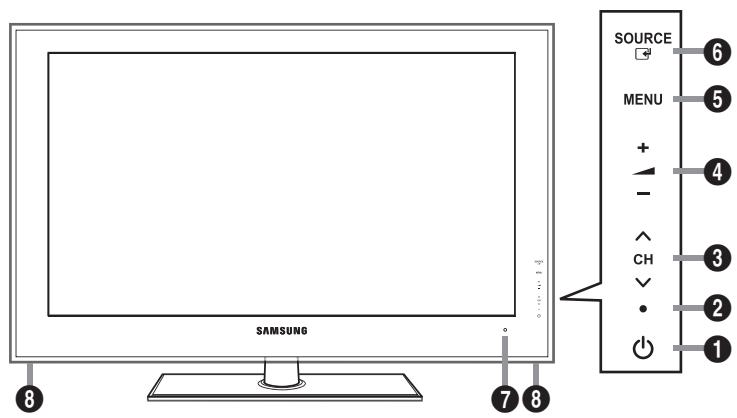
① ⏻ (POWER): Press to turn the TV on and off.
② POWER INDICATOR: Blinks and turns off when the power is on and lights up in stand-by mode.
③ √ CH ∧: Press to change channels. In the on-screen menu, use the √ CH ∧ buttons as you would use the ▼ and ▲ buttons on the remote control.
4 - +: Press to increase or decrease the volume.
In the on-screen menu, use the - ▲ + buttons as you would use the ◀ and ▶ buttons on the remote control.
⑤ MENU: Press to see an on-screen menu of your TV's features.
6 SOURCE ☐: Toggles between all the available input sources. In the on-screen menu, use this button as you would use the ENTER ☐ button on the remote control.
⑦ REMOTE CONTROL SENSOR: Aim the remote control towards this spot on the TV.
8 SPEAKERS
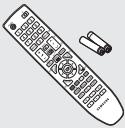 |  | 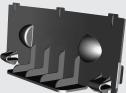 |
| Remote Control & Batteries (AAA x 2) | Power Cord | Cover-Bottom |
 |  (M4 X L16) (M4 X L16) |  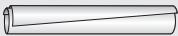 |
| Warranty Card / Safety Guide (Not available in all locations) | Stand Screw X 4(Depending on the model) | Cleaning Cloth Holder-Wire Cable(Depending on the model) |
☑ Please make sure the following items are included with your LCD TV. If any items are missing, contact your dealer.
The items colour and shape may vary depending on the model.
![[TV Side Panel] 1 2 3 4 [TV Rear Panel] COMMON INTERFACE HDMI IN 2 HDMI IN 3 (DVD) 2 AudiO PC PC IN R - AUDIO - L R - AUDIO - COMPONENT IN ANT IN EXT 2 (AV) 1 (RGB) R - AUDIO - AUDIO OUT DIGITAL AUDIO OUT (OPTICAL) 9 8 7 6 5 Power Input](/content/2020/05/26005/images/b1ace69110beef289c3d63189bfbd0e29e21cb6e9ce24589b49dea28f6fc289c.jpg)
The product colour and shape may vary depending on the model.
① COMPONENT IN
Connects Component video / audio.
② HDMI IN 1, 2, 3(DVI), 4 / DVI AUDIO IN
Connects to the HDMI jack of a device with an HDMI output.
No sound connection is needed for an HDMI to HDMI connection.
What is HDMI?
- HDMI(High-Definition Multimedia Interface), is an interface that enables the transmission of digital audio and video signals using a single cable.
- The difference between HDMI and DVI is that the HDMI device is smaller than DVI's one.
The TV may not output sound and pictures may be displayed with abnormal colour when DVD / Blu-ray player / Cable Box / Satellite receiver (Set-Top Box) supporting HDMI versions older than 1.3 are connected. When connecting an older HDMI cable and there is no sound, connect the HDMI cable to the HDMI IN 3(DVI) jack and the audio cables to the DVI AUDIO IN jacks on the back of the TV. If this happens, contact the company that provided the DVD / Blu-ray player / Cable Box / Satellite receiver (Set-Top Box) to confirm the HDMI version, then request an upgrade.
Use the HDMI IN 3(DVI) jack for DVI connection to an external device. Use a DVI to HDMI cable or DVI-HDMI adapter (DVI to HDMI) for video connection and the DVI AUDIO IN jacks for audio. When using an HDMI / DVI cable connection, you must use the HDMI IN 3(DVI) jack.
HDMI cables that are not 1.3 may cause annoying flicker or no screen display.
③ PC IN [PC] / [AUDIO]
Connects to the video and audio output jacks on your PC.
If your PC supports an HDMI connection, you can connect this to the HDMI IN 1, 2, 3(DVI) or 4 terminal.
If your PC supports a DVI connection, you can connect this to the HDMI IN 3(DVI) / DVI AUDIO IN terminal.
4 ANT IN
Connects to an antenna or cable TV system.
⑤ KENSINGTON LOCK (depending on the model)
The Kensington Lock (optional) is a device used to physically fix the system when used in a public place. If you want to use a locking device, contact the dealer where you purchased the TV.
The location of the Kensington Lock may be different depending on its model.
6 (HEADPHONE)
Headphone may be connected to the headphone output on your set. While the head phone is connected, the sound from the built-in speakers will be disabled.
Using the sound function is restricted when connecting headphones to the TV.
☐ Prolonged use of headphones at a high volume may damage your hearing.
You will not hear sound from the speakers when you connect headphones to the TV.
The headphone volume and TV volume are adjusted separately.
⑦ DIGITAL AUDIO OUT (OPTICAL)
Connects to a Digital Audio component such as a Home theatre receiver.
When a Digital Audio System is connected to the DIGITAL AUDIO OUT (OPTICAL) jack: Decrease the volume of the TV and adjust the volume level with the system's volume control.
5.1CH audio is possible when the TV is connected to an external device supporting 5.1CH.
When the receiver (home theatre) is set to On, you can hear sound output from the TV's Optical jack. When the TV is displaying a DTV(air) signal, the TV will send out 5.1 channel sound to the Home theatre receiver. When the source is a digital component such as a DVD / Blu-ray player / Cable Box / Satellite receiver (Set-Top Box) and is connected to the TV via HDMI, only 2 channel sound will be heard from the Home Theatre receiver. If you want to hear 5.1 channel audio, connect the digital audio out jack on DVD / Blu-ray player / Cable Box / Satellite receiver (Set-Top Box) directly to an Amplifier or Home Theatre, not the TV.
⑧ AUDIO OUT [R-AUDIO-L]
Connects to the audio input jacks on your Amplifier/Home theatre.
When an audio amplifier is connected to the AUDIO OUT [R-AUDIO-L] jacks: Decrease the volume of the TV and adjust the volume level with the Amplifier's volume control.
⑨ EXT1, 2
Inputs or outputs for external devices, such as VCR, DVD, video game device or video disc players.
In EXT Mode, DTV Out supports MPEG SD Video and Audio only.
– Input/Output Specification
| Connector | Input | Output |
| Video | Audio (L / R) | RGB | Video + Audio (L / R) |
| EXT 1 | O | O | O | Only TV or DTV output is available. |
| EXT 2 | O | O | X | Output you can choose. |
10 AV IN [VIDEO] / [R-AUDIO-L]
Video and audio inputs for external devices, such as a camcorder or VCR.
11 USB
Connector for software upgrades and Media Play, etc.
12 COMMON INTERFACE Slot
- When not inserting 'CI CARD' in some channels, 'Scrambled Signal' is displayed on the screen.
- The pairing information containing a telephone number, CI CARD ID, Host ID and other information will be displayed in
- about 2\~3 minutes. If an error message is displayed, please contact your service provider.
- When the channel information configuration has finished, the message 'Updating Completed' is displayed, indicating that
– the channel list is now updated.
You must obtain a CI CARD from a local cable service provider. Remove the CI CARD by carefully pulling it out with your
☑ hands since dropping the CI CARD may cause damage to it.
Insert the CI-Card in the direction marked on it.
The place of the COMMON INTERFACE Slot may be different depending on its model.
CAM is not supported in some countries and regions, check with your authorized dealer.
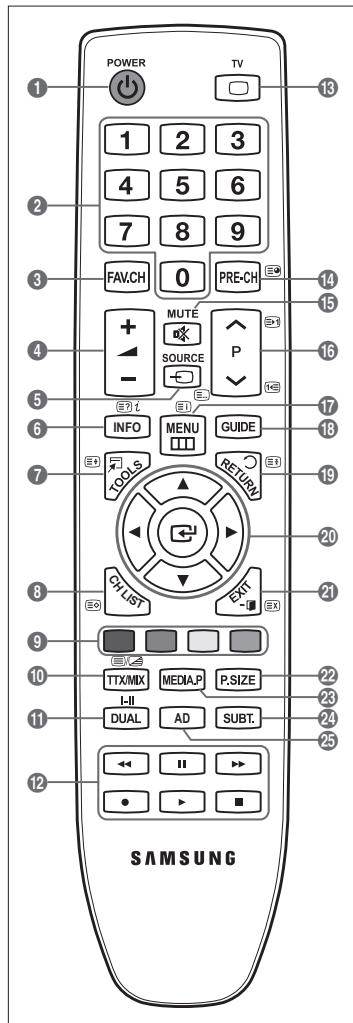
You can use the remote control up to a distance of about 23 feet from the TV.
The performance of the remote control may be affected by bright light.
The product colour and shape may vary depending on the model.
① POWER : Turns the TV on and off.
② NUMERIC BUTTONS : Press to change the channel.
3 FAV.CH : Used to display Favourites Channel Lists on the screen.
④ - ▲ + : Press to increase or decrease the volume.
5 SOURCE : Press to display and select the available video sources.
6 INFO : Press to display information on the TV screen.
⑦ TOOLS : Use to quickly select frequently used functions.
⑧ CH LIST : Used to display Channel Lists on the screen.
⑨ COLOURS BUTTONS : Use these buttons in the Channel list, Media Play menu, etc.
11 DUAL : Sound effect selection
12 Use these buttons in the Media Play and Anynet ^+ modes. (●): This remote can be used to control recording on Samsung recorders with the Anynet ^+ feature)
13 TV : Selects the TV mode directly.
14 PRE-CH : Enables you to return to the previous channel you were watching.
15 MUTE ☑️ : Press to temporarily cut off the sound.
16 ∨ P ∧ : Press to change channels.
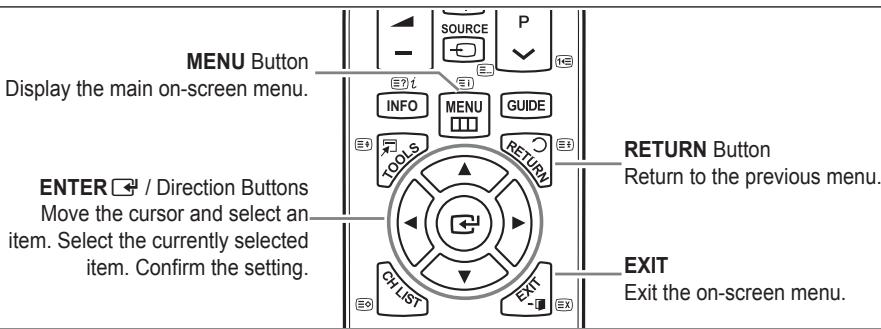
⑰ MENU : Displays the main on-screen menu.
18 GUIDE : Electronic Programme Guide (EPG) display.
19 RETURN : Returns to the previous menu
20 UP ▲ / DOWN ▼ / LEFT ◀ / RIGHT ▶ / ENTER : Use to select on-screen menu items and change menu values.
21 EXIT : Press to exit the menu.
22 P.SIZE : Picture size selection.
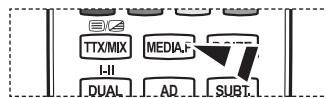
23 MEDIA.P : Allows you to play music files and pictures.
24 SUBT.: Digital subtitle display
25 AD : Audio Description selection.
Teletext Functions
5 : Teletext mode selection (LIST / FLOF)
6 ≡? : Teletext reveal
7 : Teletext size selection
8 : Teletext store
9 Fastext topic selection
10 📄/✉ : Alternately select Teletext, Double, or Mix.
13 ☐ : Exit from the Teletext display
14: Teletext sub page
16 ☑: Teletext next page
1-☐: Teletext previous page
17 ≡i : Teletext index
19 : Teletext hold
21 ☒ : Teletext cancel
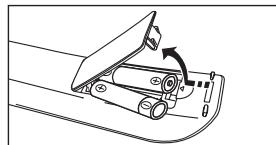
- Lift the cover at the back of the remote control upward as shown in the figure.
- Install two AAA size batteries.
Make sure to match the ‘+’ and ‘-’ ends of the batteries with the diagram inside the compartment.
natural_image
Diagram of a mechanical device with rotating arm and base, no text or symbols present
- Replace the cover.
Remove the batteries and store them in a cool, dry place if you won't be using the remote control for a long time. (Assuming typical TV usage, the batteries should last for about one year.)
If the remote control doesn't work, check the following:
- Is the TV power on?
- Are the plus and minus ends of the batteries reversed?
- Are the batteries drained?
- Is there a power outage or is the power cord unplugged?
- Is there a special fluorescent light or neon sign nearby?
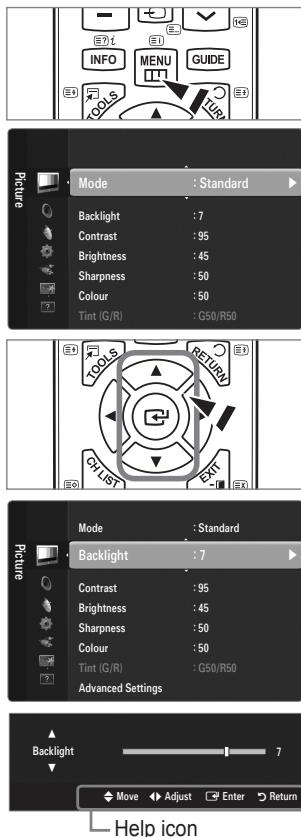
Before using the TV, follow the steps below to learn how to navigate the menu in order to select and adjust different functions.
☐ Operation the OSD (On Screen Display)
The access step may differ depending on the selected menu.
-
Press the MENU button.
-
The main menu appears on the screen. The menu's left side has icons: Picture, Sound, Channel, Setup, Input, Application, Support.
-
Press the ▲ or ▼ button to select one of the icons.
-
Then press the ENTER button to access the icon's sub-menu.
-
Press the ▲ or ▼ button to select the icon's submenu.
-
Press the ◀ or ▶ button to decrease or increase the value of a particular item. The adjustment OSD may differ depending on the selected menu.
-
Press the ENTER button to complete the configuration. Press the EXIT button to exit.
Your set can be placed in standby mode in order to reduce the power consumption. The standby mode can be useful when you wish to interrupt viewing temporarily (during a meal, for example).
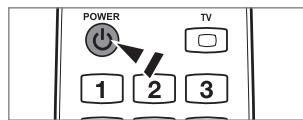
- Press the POWER ⏻ button on the remote control.
The screen is turned off and a standby indicator appears on your set.
2. To switch your set back on, simply press the POWER ⏻ button again.
Do not leave your set in standby mode for long periods of time (when you are away on holiday, for example). It is best to unplug the set from the mains and aerial.
Plug & Play Feature
When the TV is initially powered on, basic settings proceed automatically and subsequently.
- Press the POWER button on the remote control.
You can also use the POWER ⏻ button on the TV.
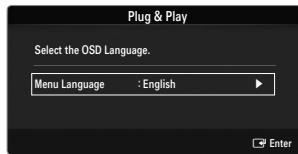
The message Select the OSD Language. is displayed.
-
Press the ENTER button. Select the appropriate language by pressing the ▲ or ▼ button. Press the ENTER button to confirm your choice.
-
Press the ◀ or ▶ button to select Store Demo or Home Use, then the ENTER □ button.
We recommend setting the TV to Home Use mode for the best picture in your home environment.
Store Demo mode is only intended for use in retail environments.
If the unit is accidentally set to Store Demo mode and you want to return to Home Use (Standard): Press the volume button on the TV. When the volume OSD is displayed, press and hold the MENU button on the TV for 5 seconds.
- Press the ENTER button. Select the appropriate country by pressing the ▲ or ▼ button. Press the ENTER button to confirm your choice.
- Press the ▲ or ▼ button to select Air or Cable, then press the ENTER □ button.
Air: Air antenna signal.
Cable: Cable antenna signal.
- Press the ▲ or ▼ button to select the channel source to memorize. Press the ENTER ↩ button to select Start.
When setting the antenna source to Cable, a step appears allowing you to set a value for the digital channel search. For more information, refer to Channel → Auto Store.
Digital & Analogue: Digital and Analogue channels.
Digital: Digital channels.
Analogue: Analogue channels.
The channel search will start and end automatically.
Press the ENTER button at any time to interrupt the memorization process.
☑ After all the available channels are stored, the message Set the Clock Mode. is displayed.
- Press the ENTER button. Press the ▲ or ▼ button to select Auto, then Press the ENTER button.
If you select Manual, Set current date and time is displayed.
If you have received a digital signal, the time will be set automatically. If not, select Manual to set the clock.
-
The description for the connection method providing the best HD screen quality is displayed. Check the description and press the ENTER button.
-
The message Enjoy your TV. is displayed. When you have finished, press the ENTER button.
If you want to reset this feature...
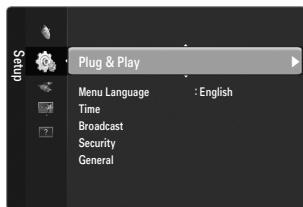
- Press the MENU button to display the menu. Press the ▲ or ▼ button to select Setup, then press the ENTER button.
- Press the ENTER button again to select Plug & Play.
- Enter your 4 digit PIN number. The default PIN number of a new TV set is '0-0-0-0'.
If you want to change PIN number, use the Change PIN function.
The Plug & Play feature is only available in the TV mode.
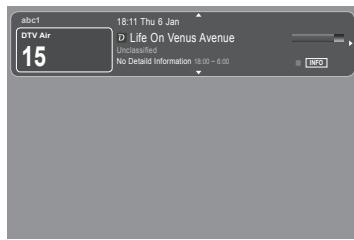
The display identifies the current channel and the status of certain audio-video settings.
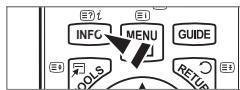
Press the INFO button to viewing the information.
Press the INFO button on the remote control. The TV will display the channel, the type of sound, and the status of certain picture and sound settings.
- ▲, ▼: You can view other channel's information. If you want to move to the currently selected channel, press ENTER button.
- ◀, ▶: You can view the desired program's information at the current channel.
Press the INFO button once more or wait approximately 10 seconds and the display disappears automatically.
CHANNEL
□ Country
Analogue Channel
You can change the country for analogue channels.
Digital Channel
You can change the country for digital channels.
The PIN number input screen appears. Enter your 4 digit PIN number.
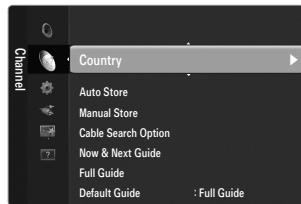
Auto Store
You can scan for the frequency ranges available to you (and availability depends on your country). Automatically allocated programme numbers may not correspond to actual or desired programme numbers.
If a channel is locked using the Child Lock function, the PIN input window appears.
Air / Cable
Antenna source to memorize
• Digital & Analogue: Digital and Analogue channels.
• Digital: Digital channels.
• Analogue: Analogue channels.
When selecting Cable → Digital & Analogue or Cable → Digital:
Provide a value to scan for cable channels.
• Search Mode → Full / Network /Quick
Quick
● Network ID: Displays the network identification code.
● Frequency: Displays the frequency for the channel. (Differs in each country)
- Modulation: Displays available modulation values.
- Symbol Rate: Displays available symbol rates.
☑ Scans for all channels with active broadcast stations and stores them in the TV's memory.
If you want to stop Auto Store, press the ENTER button.
The Stop Auto Store? message will be displayed.
Select Yes by pressing the ◀ or ▶ button, then press the ENTER □ button.
Manual Store
☑ Scans for a channel manually and stores it in the TV's memory.
If a channel is locked using the Child Lock function, the PIN input window appears.
Digital Channel
Manual store for digital channels.
Digital Channel is only available in DTV mode.
- Channel: Set the Channel number using the ▲, ▼ or number (0\~9) buttons.
- Frequency: Set the frequency using the number buttons.
- Bandwidth: Set the bandwidth using the ▲, ▼ or number (0\~9) buttons.
When it has finished, channels are updated in the channel list.
Analogue Channel
Manual store for analogue channel.
- Programme (Programme number to be assigned to a channel): Sets the programme number using the ▲, ▼ or number (0\~9) buttons.
- Colour System → Auto / PAL / SECAM / NTSC4.43: Sets the colour system value using the ▲ or ▼ button.
- Sound System → BG / DK / I / L: Sets the sound system value using the ▲ or ▼ button.
- Channel (When you know the number of the channel to be stored): Press the ▲ or ▼ button to select C (Air channel) or S (Cable channel). Press the ▶ button, then press the ▲, ▼ or number (0\~9) buttons to select the required number.
You can also select the channel number directly by pressing the number (0\~9) buttons.
If there is abnormal sound or no sound, reselect the sound standard required.
- Search (When you do not know the channel numbers): Press the ▲ or ▼ button to start the search. The tuner scans the frequency range until the first channel or the channel that you selected is received on the screen.
- Store (When you store the channel and associated programme number): Set to OK by pressing the ENTER button.
Channel mode
- P (Programme mode): When completing tuning, the broadcasting stations in your area have been assigned to position numbers from P00 to P99. You can select a channel by entering the position number in this mode.
- C (Air channel mode): You can select a channel by entering the assigned number to each air broadcasting station in this mode.
- S (Cable channel mode): You can select a channel by entering the assigned number for each cable channel in this mode.
☐ Cable Search Option (depending on the country)
Sets additional search options such as the frequency and symbol rate for cable network searches.
- Freq.Start (Frequency Start): Set the start frequency (Differs in each country)
- Freq.Stop (Frequency Stop): Set the stop frequency (Differs in each country)
- Modulation: Displays available modulation values.
- Symbol Rate: Displays available symbol rates.
Now & Next Guide / Full Guide
The EPG (Electronic Programme Guide) information is provided by the broadcasters. Programme entries may appear blank or out of date as a result of the information broadcast on a given channel. The display will dynamically update as soon as new information becomes available.
For detailed procedures on using Now & Next Guide and Full Guide, refer to the descriptions on page 11.
You can also display the guide menu simply by pressing the GUIDE button. (To configure the Default Guide, refer to the descriptions.)
Now & Next Guide
For the six channels indicated in the left-hand column, displays the Current programme and the Next programme information.
Full Guide
Displays the programme information as time ordered One hour segments. Two hours of programme information is displayed which may be scrolled forwards or backwards in time.
☐ Default Guide → Now & Next Guide / Full Guide
You can decide whether to display either the Now & Next Guide or the Full Guide when the GUIDE button on the remote control is pressed.
Channel List
For detailed procedures on using the Channel List, refer to the ‘Managing Channels’ instructions.
You can select these options by simply pressing the CH LIST button on the remote control.
Channel Mode
When press the P √/∧ button, Channels will be switched within the selected channel list.
Added Ch.
Channels will be switched within the memorized channel list.
Favourite Ch.
Channels will be switched within the favourite channel list.
Fine Tune
If the reception is clear, you do not have to fine tune the channel, as this is done automatically during the search and store operation. If the signal is weak or distorted, you may have to fine tune the channel manually.
Fine tuned channels that have been saved are marked with an asterisk ‘*’ on the right-hand side of the channel number in the channel banner.
To reset the fine-tuning, select Reset by pressing the ▲ or ▼ button and then press the ENTER ← button.
Only Analogue TV channels can be fine tuned.
Using the Now & Next Guide / Full Guide
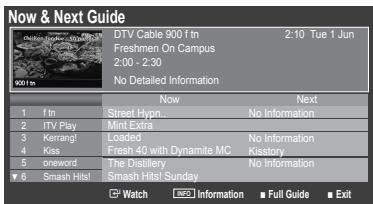
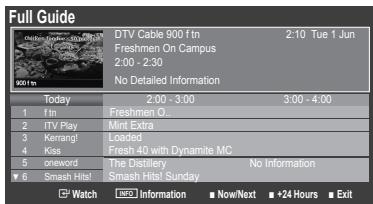
| To... | Then... |
| Watch a programme in the EPG list | Select a programme by pressing the ▲, ▼, ◀, ► button. |
| Exit the guide | Press the blue button |
| If the next programme is selected, it is scheduled with the clock icon displayed. If the ENTER button is pressed again, press the ►, ► button to select Cancel Schedules, the scheduling is cancelled with the clock icon gone. |
| View programme information | Select a programme of your choice by pressing the ▲, ▼, ◀, ► button.Then press the INFO button when the programme of your choice is highlighted.The programme title is on the upper part of the screen centre. |
| Please click on INFO button for the detailed information. Channel Number, Running Time, Status Bar, Parental Level, Video Quality Information (HD / SD), Sound Modes, Subtitle or Teletext, languages of Subtitle or Teletext and brief summary of the highlighted programme are included on the detailed information. ‘...’ will be appeared if the summary is long. |
| Toggle between the Now & Next Guide and Full Guide | Press the Red button repeatedly. |
| In Full GuideScrolls backwards quickly (24 hours).Scrolls forwards quickly (24 hours). | Press the Green button repeatedly.Press the Yellow button repeatedly. |
Using this menu, you can add / delete or set favourites channels and use the programme guide for digital broadcasts.
All Channels
Shows all currently available channels.
Added Channels
Shows all added channels.
Favourites
Shows all favourite channels.
To select the favourites channels you have set up, press the FAV.CH button on the remote control.
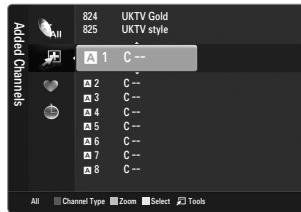
Programmed
Shows all current reserved programmes.
Select a channel in the All Channels, Added Channels or Favourites screen by pressing the ▲ / ▼ buttons, and pressing the ENTER button. Then you can watch the selected channel.
Using the Colour buttons with the Channel List
- Red (Channel Type): Toggle between your TV, Radio, Data / Other and All.
– Green (Zoom): Enlarges or shrinks a channel number.
- Yellow (Select): Selects multiple channel lists. You can perform the add/delete or add to favourites/delete from favourites function for multiple channels at the same time. Select the required channels and press the Yellow button to set all the selected channels at the same time. The √ mark appears to the left of the selected channels.
- TOOLS (Tools): Displays the Delete (or Add), Add to Favourite (or Delete from Favourite), Lock (or Unlock), Timer Viewing, Edit Channel Name, Edit Channel Number, Sort, Select All (or Deselect All), Auto Store menu. (The Options menus may differ depending on the situation.)
Channel Status Display Icons
• A : An Analogue channel.
- ✓ : A channel selected by pressing the Yellow button.
• ♥ : A channel set as a Favourite.
• ☐ : A programme currently being broadcast.
• 🔒 : A locked channel.
- 📊 : A reserved programme
Press the TOOLS button to use the option menu.
☑ Option menu items may differ depending on the channel status.
Add / Delete
You can delete or add a channel to display the channels you want.
All deleted channels will be shown on All Channels menu.
A gray-coloured channel indicates the channel has been deleted.
The Add menu only appears for deleted channels.
You can also delete a channel to the Added Channels or Favourites menu in the same manner.
■ Add to Favourite / Delete from Favourite
You can set channels you watch frequently as favourites.
Press the TOOLS button to display the Tools menu. You can also set the add to (or delete from) Favourite by selecting Tools → Add to Favourite (or Delete from Favourite).
The ‘♥’ symbol will be displayed and the channel will be set as a favourite.
All favourite channels will be shown on Favourites menu.
Timer Viewing
If you reserve a programme you want to watch, the channel is automatically switched to the reserved channel in the Channel List; even when you are watching another channel. To reserve a programme, set the current time first.
Only memorized channels can be reserved.
☐ You can set the channel, day, month, year, hour and minute directly by pressing the number buttons on the remote control.
☐ Reserving a programme will be shown in the Programmed menu.
Digital Programme Guide and Viewing Reservation
When a digital channel is selected, and you press the ▶ button, the Programme Guide for the channel appears. You can reserve a programme according to the procedures described above.
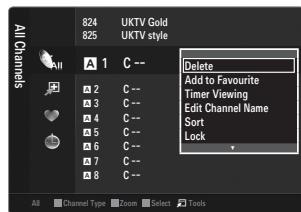
■ Edit Channel Name (analogue channels only)
Channels can labelled so that their call letters appear whenever the channel is selected.
The names of digital broadcasting channels are automatically assigned and cannot be renamed.
■ Edit Channel Number (digital channels only)
You can also edit the channel number by pressing the number buttons on the remote control.
Sort (analogue channels only)
This operation allows you to change the programme numbers of the stored channels. This operation may be necessary after using the auto store.
Lock / Unlock
You can lock a channel so that the channel cannot be selected and viewed.
This function is available only when the Child Lock is set to On.
The PIN number input screen appears. Enter your 4 digit PIN number.
The default PIN number of a new TV set is '0-0-0-0'. You can change the PIN, by selecting Change PIN from the menu.
The ‘☐’ symbol will be displayed and the channel will be locked.
Select All / Deselect All
- Select All: You can select all the channels in the channel list.
- Deselect All: You can deselect all the selected channels.
You can only select Deselect All when there is a selected channel.
Auto Store
For detailed procedures on setting up options, refer to the 'Channel Menu' instructions.
If a channel is locked using the Child Lock function, the PIN input window appears.
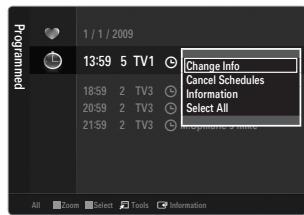
You can view, modify or delete a reservation.
Press the TOOLS button to use the option menu.
Change Info
Select to change a viewing reservation.
Cancel Schedules
Select to cancel a viewin`g reservation.
Select to view a viewing reservation.
(You can also change the reservation information.)
Select All
Select all reserved programmes.
Mode
You can select the type of picture which best corresponds to your viewing requirements.
Press the TOOLS button to display the Tools menu. You can also set the picture mode by selecting Tools → Picture Mode.
Dynamic
Selects the picture for increased definition in a bright room.
Standard
Selects the picture for the optimum display in a normal environment.
Natural
Selects the picture for an optimum and eye-comfortable display.
This function is not available in PC mode.
Movie
Selects the picture for viewing movies in a dark room.
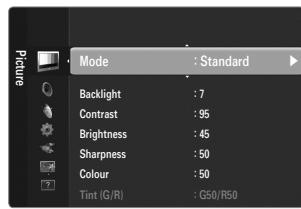
☐ Backlight / Contrast / Brightness / Sharpness / Colour / Tint (G/R)
Your television has several setting options that allow you to control the picture quality.
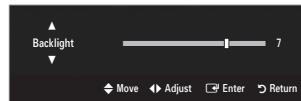
- Backlight: Adjusts the brightness of LCD back light.
- Contrast: Adjusts the contrast level of the picture.
- Brightness: Adjusts the brightness level of the picture
- Sharpness: Adjusts the edge definition of the picture.
• Colour: Adjusts colour saturation of the picture.
• Tint (G/R): Adjusts the colour tint of the picture.
In analogue TV, Ext., AV modes of the PAL system, you cannot use the Tint (G/R) Function.
When you make changes to Backlight, Contrast, Brightness, Sharpness, Colour or Tint (G/R) the OSD will be adjusted accordingly.
In PC mode, you can only make changes to Backlight, Contrast and Brightness.
Settings can be adjusted and stored for each external device you have connected to an input of the TV.
The energy consumed during use can be significantly reduced if the brightness level of the picture is lowered, which will reduce the overall running cost.
□ Advanced Settings
Samsung's new TVs allow you to make even more precise picture settings than previous models.
Advanced Settings is available in Standard or Movie mode.
In PC mode, you can only make changes to Gamma and White Balance from among the Advanced Settings items.
Black Tone → Off / Dark / Darker / Darkest
You can select the black level on the screen to adjust the screen depth.
■ Dynamic Contrast → Off / Low / Medium / High
You can adjust the screen contrast so that the optimal contrast is provided.
Gamma
You can adjust the primary colour (red, green, blue) intensity.
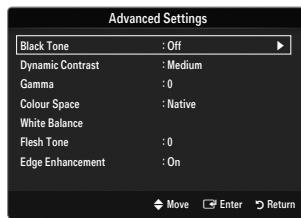
Colour Space
Colour space is a colour matrix composed of red, green and blue colours. Select your favourites colour space to experience the most natural colour.
- Auto: Auto Colour Space automatically adjusts to the most natural colour tone based on Programme sources.
- Native: Native Colour Space offers deep and rich colour tone.
White Balance
You can adjust the colour temperature for more natural picture colours.
• R-Offset: Adjusts the red colour darkness.
• G-Offset: Adjusts the green colour darkness.
• B-Offset: Adjusts the blue colour darkness.
• R-Gain: Adjusts the red colour brightness.
• G-Gain: Adjusts the green colour brightness.
• B-Gain: Adjusts the blue colour brightness.
- Reset: The previously adjusted white balance will be reset to the factory defaults.
Flesh Tone
You can emphasize the pink ‘flesh tone’ in the picture.
Changing the adjustment value will refresh the adjusted screen.
■ Edge Enhancement → Off / On
You can emphasize object boundaries in the picture.
xvYCC → Off / On
Setting the xvYCC mode to on increases detail and colour space when watching movies from an external device (ie. DVD player) connected to the HDMI or Component IN jacks.
xvYCC is available when the picture mode is set to Movie, and the external input is set to HDMI or Component mode.
This function may not be supported depending on your external device.
Picture Options
In PC mode, you can only make changes to the Colour Tone and Size from among the items in Picture Options.
Colour Tone → Cool / Normal / Warm1 / Warm2 / Warm3
Warm1, Warm2 or Warm3 is only activated when the picture mode is Movie.
Settings can be adjusted and stored for each external device you have connected to an input of the TV.
| Picture Options |
| Colour Tone | : Normal |
| Size | : Auto Wide |
| Screen Mode | : 16:9 |
| Digital NR | : Auto |
| HDMI Black Level | : Normal |
| Film Mode | : Off |
| Blue Only Mode | : Off |
Size
Occasionally, you may want to change the size of the image on your screen. Your TV comes with several screen size options, each designed to work best with specific types of video input. Your cable box/satellite receiver may have its own set of screen sizes as well. In general, though, you should view the TV in 16:9 mode as much as possible.
You can select these options by simply pressing the P.SIZE button on the remote control.
• Auto Wide: Automatically adjusts the picture size to the 16:9 aspect ratio.
• 16:9: Adjusts the picture size to 16:9 appropriate for DVDs or wide broadcasting.
- Wide Zoom: Magnify the size of the picture more than 4:3.
- Zoom: Magnifies the 16:9 wide picture (in the vertical direction) to fit the screen size.
- 4:3: This is the default setting for a video movie or normal broadcasting.
- Screen Fit: Use the function to see the full image without any cut-off when HDMI (720p / 1080i / 1080p) or Component (1080i / 1080p) signals are input.
Depending on the input source, the picture size options may vary.
The items available may differ depending on the selected mode.
In PC Mode, only 16:9 and 4:3 mode can be adjusted.
Settings can be adjusted and stored for each external device you have connected to an input of the TV.
Temporary image retention may occur when viewing a static image on the set for more than two hours.
Wide Zoom: Press the ▶ button to Select Position, then press the ENTER ☐ button. Press the ▲ or ▼ button to move the picture up / down. Then press the ENTER ☐ button.
Zoom: Press the ▶ button to Select Position, then press the ENTER ☐ button. Press the ▲ or ▼ button to move the picture up and down. Then press the ENTER ☐ button. Press the ▶ button to Select Size, then press the ENTER ☐ button. Press the ▲ or ▼ button to magnify or reduce the picture size in the vertical direction. Then press the ENTER ☐ button.
☑ After selecting Screen Fit in HDMI (1080i / 1080p) or Component (1080i / 1080p) mode: Select Position by pressing the ◀ or ▶ button. Use the ▲, ▼, ◀ or ▶ button to move the picture.
- Reset: Press the ◀ or ▶ button to select Reset, then press the ENTER ➕ button. You can initialize the setting.
If you use the Screen Fit function with HDMI 720p input, 1 line will be cut at the top, bottom, left and right as in the Overscan function.
Screen Mode → 16:9 / Wide Zoom / Zoom / 4:3
When setting the picture size to Auto Wide in a 16:9 wide TV, you can determine the picture size you want to see the 4:3 WSS (Wide Screen Service) image or nothing. Each individual European country requires different picture size so this function is intended for users to select it.
• 16:9: Sets the picture to 16:9 wide mode.
- Wide Zoom: Magnify the size of the picture more than 4:3.
- Zoom: Magnify the size of the picture vertically on screen.
• 4:3: Sets the picture to 4:3 normal mode.
This function is available in Auto Wide mode.
This function is not available in PC, Component or HDMI mode.
Digital NR → Off / Low / Medium / High / Auto
If the broadcast signal received by your TV is weak, you can activate the Digital Noise Reduction feature to help reduce any static and ghosting that may appear on the screen.
When the signal is weak, select one of the other options until the best picture is displayed.
HDMI Black Level → Normal / Low
You can select the black level on the screen to adjust the screen depth.
This function is active only when an external device is connected to the TV via HDMI (RGB signals).
Film Mode → Off / Auto1 / Auto2
The TV can be set to automatically sense and process film signals from all sources and adjust the picture for optimum quality.
Film Mode is supported in TV, AV, COMPONENT(480i / 1080i) and HDMI(480i / 1080i).
- Off: Turn the Film Mode function off.
- Auto1: Automatically adjusts the picture for the best quality when watching a film.
- Auto2: Automatically optimizes the video text on the screen (not including closed captions) when watching a film.
Blue Only Mode → Off / On
This function is for AV device measurement experts. This function displays the blue signal only by removing the red and green signals from the video signal so as to provide a Blue Filter effect that is used to adjust the Colour and Tint of video equipment such as DVD players, Home Theatres, etc. Using this function, you can adjust the Colour and Tint to preferred values appropriate to the signal level of each video device using the Red / Green / Blue / Cyan / Magenta / Yellow Colour Bar Patterns, without using an additional Blue Filter.
Blue Only Mode is available when the picture mode is set to Movie or Standard.
☐ Picture Reset → Reset Picture Mode / Cancel
Resets all picture settings to the default values.
Reset Picture Mode: Current picture values return to default settings.
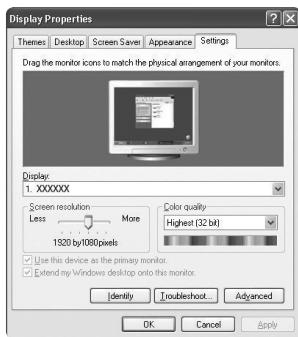
Setting Up Your PC Software (Based on Windows XP)
The Windows display-settings for a typical computer are shown below. The actual screens on your PC will probably be different, depending upon your particular version of Windows and your particular video card. However, even if your actual screens look different, the same basic set-up information will apply in almost all cases. (If not, contact your computer manufacturer or Samsung Dealer.)
- First, click on 'Control Panel' on the Windows start menu.
- When the control panel window appears, click on 'Appearance and Themes' and a display dialog-box will appear.
-
When the control panel window appears, click on 'Display' and a display dialogbox will appear.
-
Navigate to the 'Settings' tab on the display dialog-box.
-
The correct size setting (resolution) - Optimum: 1920 X 1080 pixels
- If a vertical-frequency option exists on your display settings dialog box, the correct value is '60' or '60 Hz'. Otherwise, just click 'OK' and exit the dialog box.
Display Modes
If the signal from the system equals the standard signal mode, the screen is adjusted automatically. If the signal from the system doesn't equal the standard signal mode, adjust the mode by referring to your videocard user guide; otherwise there may be no video. For the display modes listed on the next page, the screen image has been optimized during manufacturing.
D-Sub and HDMI/DVI Input
| Mode | Resolution | Horizontal Frequency (KHz) | Vertical Frequency (Hz) | Pixel Clock Frequency (MHz) | Sync Polarity (H / V) |
| IBM | 640 x 350 | 31.469 | 70.086 | 25.175 | +/- |
| 720 x 400 | 31.469 | 70.087 | 28.322 | -/+ |
| MAC | 640 x 480 | 35.000 | 66.667 | 30.240 | -/- |
| 832 x 624 | 49.726 | 74.551 | 57.284 | -/- |
| 1152 x 870 | 68.681 | 75.062 | 100.000 | -/- |
| VESA CVT | 720 x 576 | 35.910 | 59.950 | 32.750 | -/+ |
| 1152 x 864 | 53.783 | 59.959 | 81.750 | -/+ |
| 1280 x 720 | 44.772 | 59.855 | 74.500 | -/+ |
| 1280 x 720 | 56.456 | 74.777 | 95.750 | -/+ |
| 1280 x 960 | 75.231 | 74.857 | 130.000 | -/+ |
| VESA DMT | 640 x 480 | 31.469 | 59.940 | 25.175 | -/- |
| 640 x 480 | 37.861 | 72.809 | 31.500 | -/- |
| 640 x 480 | 37.500 | 75.000 | 31.500 | -/- |
| 800 x 600 | 37.879 | 60.317 | 40.000 | +/+ |
| 800 x 600 | 48.077 | 72.188 | 50.000 | +/+ |
| 800 x 600 | 46.875 | 75.000 | 49.500 | +/+ |
| 1024 x 768 | 48.363 | 60.004 | 65.000 | -/- |
| 1024 x 768 | 56.476 | 70.069 | 75.000 | -/- |
| 1024 x 768 | 60.023 | 75.029 | 78.750 | +/+ |
| 1152 x 864 | 67.500 | 75.000 | 108.000 | +/+ |
| 1280 x 1024 | 63.981 | 60.020 | 108.000 | +/+ |
| 1280 x 1024 | 79.976 | 75.025 | 135.000 | +/+ |
| 1280 x 800 | 49.702 | 59.810 | 83.500 | -/+ |
| 1280 x 800 | 62.795 | 74.934 | 106.500 | -/+ |
| 1280 x 960 | 60.000 | 60.000 | 108.000 | +/+ |
| 1360 x 768 | 47.712 | 60.015 | 85.500 | +/+ |
| 1440 x 900 | 55.935 | 59.887 | 106.500 | -/+ |
| 1440 x 900 | 70.635 | 74.984 | 136.750 | -/+ |
| 1680 x 1050 | 65.290 | 59.954 | 146.250 | -/+ |
| VESA GTF | 1280 x 720 | 52.500 | 70.000 | 89.040 | -/+ |
| 1280 x 1024 | 74.620 | 70.000 | 128.943 | -/- |
| VESA DMT / DTV CEA | 1920 x 1080p | 67.500 | 60.000 | 148.500 | +/+ |
When using an HDMI / DVI cable connection, you must use the HDMI IN 3(DVI) jack.
The interlace mode is not supported.
The set might operate abnormally if a non-standard video format is selected.
Separate and Composite modes are supported. SOG is not supported.
Too long or low quality VGA cable can cause picture noise at high resolution modes (1920x1080).
☑ Preset: Press the SOURCE button to select PC mode.
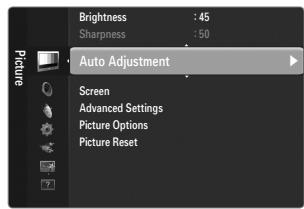
Auto Adjustment
Use the Auto Adjust function to have the TV automatically adjust the video signals it receives. The function also automatically fine-tunes the settings and adjusts the frequency values and positions.
Press the TOOLS button to display the Tools menu. You can also set the Auto Adjustment by selecting Tools → Auto Adjustment.
This function does not work in DVI-HDMI mode.
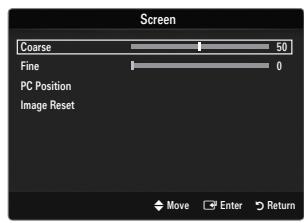
Screen
Coarse / Fine
The purpose of picture quality adjustment is to remove or reduce picture noise. If the noise is not removed by Fine-tuning alone, then adjust the frequency as best as possible (Coarse) and Fine-tune again. After the noise has been reduced, readjust the picture so that it is aligned on the centre of screen.
PC Position
Adjust the PC's screen positioning if it does not fit the TV screen.
Press the ▲ or ▼ button to adjusting the Vertical-Position. Press the ◀ or ▶ button to adjust the Horizontal-Position.
Image Reset
You can replace all image settings with the factory default values.
Mode → Standard / Music / Movie / Clear Voice / Custom
Press the TOOLS button to display the Tools menu. You can also set the sound mode by selecting Tools → Sound Mode.
- Standard: Selects the normal sound mode.
• Music: Emphasizes music over voices.
• Movie: Provides the best sound for movies.
• Clear Voice: Emphasizes voice over other sounds.
- Custom: Recalls your customized sound settings.
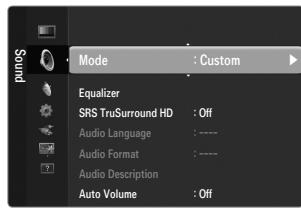
Equalizer
The sound settings can be adjusted to suit your personal preferences.
- Mode: Selects the sound mode among the predefined settings.
• Balance L/R: Adjusts the balance between the right and left speaker.
- 100Hz / 300Hz / 1KHz / 3KHz / 10KHz (Bandwidth Adjustment): To adjust the level of different bandwidth frequencies.
- Reset: Resets the equalizer settings to the default values.
☐ SRS TruSurround HD → Off / On
SRS TruSurround HD is a patented SRS technology that solves the problem of playing 5.1 multichannel content over two speakers. TruSurround delivers a compelling, virtual surround sound experience through any two-speaker playback system, including internal television speakers. It is fully compatible with all multichannel formats.
Press the TOOLS button to display the Tools menu. You can also set the SRS TruSurround HD by selecting Tools → SRS TS HD.
□ Audio Language
You can change the default value for audio languages. Displays the language information for the incoming stream.
While viewing a digital channel, this function can be selected.
You can only select the language among the actual languages being broadcast.
When sound is emitted from both the main speaker and the audio receiver, a sound echo may occur due to the decoding speed difference between the main speaker and the audio receiver. In this case, use the TV Speaker function.
While viewing a digital channel, this function can be selected.
The Audio Format appears according to the broadcasting signal.
Audio Description
This is an auxiliary audio function that provides an additional audio track for visually challenged persons. This function handles the Audio Stream for the AD (Audio Description), when it is sent along with the Main audio from the broadcaster. Users can turn the Audio Description On or Off and control the volume.
Press the AD button on the remote control to select Off or On.
■ Audio Description → Off / On
Turn the audio description function on or off.
Volume
You can adjust the audio description volume.
Volume is active when Audio Description is set to On.
While viewing a Digital channel, this function can be selected.
☐ Auto Volume → Off / On
Each broadcasting station has its own signal conditions, and so it is not easy to adjust the volume every time the channel is changed. This feature lets you automatically adjust the volume of the desired channel by lowering the sound output when the modulation signal is high or by raising the sound output when the modulation signal is low.
Speaker Select
When you watch TV with it connecting to a Home theatre, turn the TV speakers off so you can listen to sound from the Home theatre's (external) speakers.
- External Speaker: Used to listen to the sound of the External (Home Theatre) Speakers.
• TV Speaker: Used to listen to the sound of the TV Speakers.
The volume and MUTE buttons do not operate when the Speaker Select is set to External Speaker.
If you select External Speaker in the Speaker Select menu, the sound settings will be limited
| TV's Internal Speakers | Audio Out (Optical, L/R Out) to Sound System |
| RF / AV / Component / PC / HDMI | RF / AV / Component / PC / HDMI |
| TV Speaker | Sound Output | Sound Output |
| External Speaker | Mute | Sound Output |
| Video No Signal | Mute | Mute |
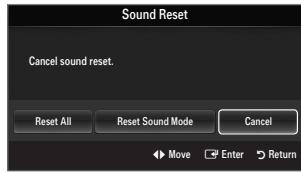
☐ Sound Reset → Reset All / Reset Sound Mode / Cancel
You can restore the Sound settings to the factory defaults.
☐ Reset Sound Mode: Current sound values return to default settings.
Selecting the Sound Mode
You can set the sound mode by pressing the DUAL button. When you press it, the current sound mode is displayed on the screen.
| Audio Type | Dual 1 / 2 | Default |
| A2 Stereo | Mono | MONO | Automatic change |
| Stereo | STEREO ↔ MONO |
| Dual | DUAL 1 ↔ DUAL 2 | DUAL 1 |
| NICAM Stereo | Mono | MONO | Automatic change |
| Stereo | MONO ↔ STEREO |
| Dual | MONO ↔ DUAL 1DUAL 2 ← | DUAL 1 |
If the stereo signal is weak and an automatic switching occurs, then switch to the mono.
This function is only activated in stereo sound signal. It is deactivated in mono sound signal.
This function is only available in TV mode.
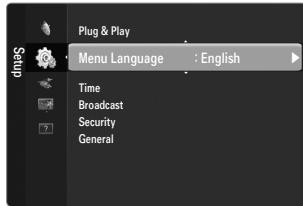
You can set the menu language.
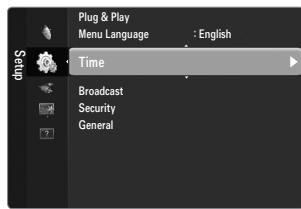
Time
For detailed procedures on setting up options, refer to the ‘Setting the Time’ instructions.
Broadcast
Subtitle
You can activate and deactivate the sub titles. Use this menu to set the Subtitle Mode. Normal under the menu is the basic subtitle and Hard of hearing is the subtitle for a hearing-impaired person.
- Subtitle → Off / On
Switches subtitles on or off.
• Mode → Normal / Hard of hearing
Sets the subtitle mode.
- Subtitle Language
Set the subtitle language.
If the programme you are watching does not support the Hard of hearing function, Normal automatically activates even though Hard of hearing mode is selected.
English is the default in cases where the selected language is unavailable in the broadcast.
You can select these options simply by pressing the SUBT. button on the remote control.
■ Digital Text → Disable / Enable (UK only)
If the programme is broadcast with digital text, this feature is enabled.
MHEG (Multimedia and Hypermedia Information Coding Experts Group)
An International standard for data encoding systems used in multimedia and hypermedia. This is at a higher level than the MPEG system which includes data-linking hypermedia such as still images, character service, animation, graphic and video files as well as multimedia data. MHEG is user runtime interaction technology and is being applied to various fields including VOD (Video-On-Demand), ITV (Interactive TV), EC (Electronic Commerce), tele-education, tele-conferencing, digital libraries and network games.
Teletext Language
You can set the Teletext language by selecting the language type.
English is the default in cases where the selected language is unavailable in the broadcast.
Preference
- Primary Audio Language / Secondary Audio Language / Primary Subtitle Language / Secondary Subtitle Language / Primary Teletext Language / Secondary Teletext Language
Using this feature, users can select one of the languages. The language selected here is the default when the user selects a channel.
If you change the language setting, the Subtitle Language, Audio Language, and the Teletext Language of the Language menu are automatically changed to the selected language.
The Subtitle Language, Audio Language, and the Teletext Language of the Language menu show a list of languages supported by the current channel and the selection is highlighted. If you change this language setting, the new selection is only valid for the current channel. The changed setting does not change the setting of the Primary Subtitle Language, Primary Audio Language, or the Primary Teletext Language of the Preference menu.
Common Interface
This enables the user to select from the CAM-provided menu.
Select the CI Menu based on the menu PC Card.
- Application Info.
This contains information on CAM inserted in the CI slot and displays it.
The Application Info inserting is about the 'CI CARD'. You can install the CAM anytime whether the TV is ON or OFF.
-
Purchase the CI CAM module by visiting your nearest dealer or by phone.
-
Insert the 'CI CARD' into the CAM in the direction of the arrow until it fits.
-
Insert the CAM with the 'CI CARD' installed into the common interface slot. (Insert the CAM in the direction of the arrow, right up to the end so that it is parallel with the slot.)
-
Check if you can see a picture on a scrambled signal channel.
CAM is not supported in some countries and regions, check with your authorized dealer.
□ Security
Child Lock → Off / On
This feature allows you to prevent unauthorized users, such as children, from watching unsuitable programme by muting out video and audio.
Before the setup screen appears, the PIN number input screen appears. Enter your 4 digit PIN number.
The default PIN number of a new TV set is '0-0-0-0'. You can change the PIN by selecting Change PIN from the menu.
You can lock some channels in Channel List.
Child Lock is available only in TV mode.
■ Parental Lock → Parental Rating
This feature allows you to prevent unauthorized users, such as children, from watching unsuitable programme by a 4-digit PIN (Personal Identification Number) code that is defined by the user.
The Parental Rating item differs depending on the country.
Before the setup screen appears, the PIN number input screen appears. Enter your 4 digit PIN number.
The default PIN number of a new TV set is '0-0-0-0'. You can change the PIN by selecting Change PIN from the menu.
When the parental ratings are set, the ‘💡’ symbol is displayed.
Allow All: Press to unlock all TV ratings.
Block All: Press to lock all TV ratings.
Change PIN
You can change your personal ID number that is required to set up the TV.
Before the setup screen appears, the PIN number input screen appears. Enter your 4 digit PIN number.
The default PIN number of a new TV set is '0-0-0-0'.
If you forget the PIN code, press the remote control buttons in the following sequence, which resets the PIN to '0-0-0-0': POWER (Off) → MUTE → 8 → 2 → 4 → POWER (On).
General
Game Mode → Off / On
When connecting to a game console such as PlayStation ^™ or Xbox ^™ , you can enjoy a more realistic gaming experience by selecting game menu.
Restrictions on game mode (Caution)
- To disconnect the game console and connect another external device, set Game Mode to Off in the setup menu.
- If you display the TV menu in Game Mode, the screen shakes slightly.
Game Mode is not available in regular TV, PC and Ext. mode.
If the picture is poor when external device is connected to TV, check if Game Mode is On. Set Game Mode to Off and connect external devices.
If Game Mode is On:
– Picture mode is automatically changed to Standard and cannot be changed.
– Sound mode is automatically changed to Custom and cannot be changed. Adjust the sound using the equalizer.
- The Reset Sound function is activated. Selecting the Reset function after setting the equalizer resets the equalizer settings to the factory defaults.
Energy Saving → Off / Low / Medium / High / Picture Off / Auto
This feature adjusts the brightness of the TV in order to reduce power consumption. When watching TV at night, set the Energy Saving mode option to High to reduce eye fatigue as well as power consumption.
If you select Picture Off, the screen is turned off and you can only hear the sound. Press any button to get out of Picture Off.
In the Tools menu, Picture Off function is not supported.
Press the TOOLS button to display the Tools menu. You can also set the Energy Saving option by selecting Tools → Energy Saving.
Melody → Off / Low / Medium / High
A melody sound can be set to come on when the TV is powered On or Off.
The Melody does not play
- When no sound is output from the TV because the MUTE button has been pressed.
- When no sound is output from the TV because the volume has been reduced to minimum with the volum (-) button.
- When the TV is turned off by Sleep Timer function.
Setting the Time
Clock
Setting the clock is necessary in order to use the various timer features of the TV.
The current time will appear every time you press the INFO button.
If you disconnect the power cord, you have to set the clock again.
Clock Mode
You can set up the current time manually or automatically.
- Auto: Set the current time automatically using the time from the digital broadcast.
- Manual: Set the current time to a manually specified time.
Depending on the broadcast station and signal, the auto time may not be set correctly. If this occurs, set the time manually.
The Antenna or cable must be connected in order to set the time automatically.
Clock Set
You can set the current time manually.
This function is only available when Clock Mode is set to Manual.
☐ You can set the day, month, year, hour and minute directly by pressing the number buttons on the remote control.
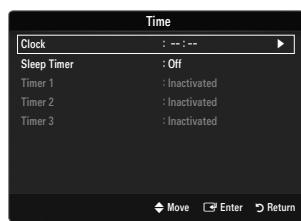
Sleep Timer
The sleep timer automatically shuts off the TV after a preset time (30, 60, 90, 120, 150 and 180 minutes).
Press the TOOLS button to display the Tools menu. You can also set the sleep timer by selecting Tools → Sleep Timer.
To cancel the Sleep Timer function, select Off.
☐ Timer 1 / Timer 2 / Timer 3
Three different on / off timer settings can be made. You must set the clock first.
On Time
Set the hour, minute, and activate / inactivate.
(To activate timer with the setting you've chosen, set to Activate.)
Off Time
Set the hour, minute, and activate / inactivate.
(To activate timer with the setting you've chosen, set to Activate.)
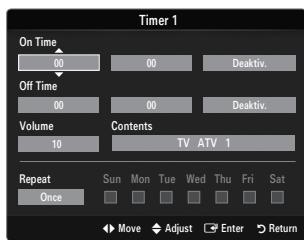
Volume
Set the desired volume level.
Contents → TV / USB
You can select the TV or USB device content to be played when the TV turns on automatically. Select TV or USB. (Make sure that an USB device is connected to your TV.)
When there is only one photo file in the USB, the Slide Show will not play.
- Antenna (when TV / USB is set to TV)
Select ATV or DTV.
– Channel (when TV / USB is set to TV)
Select the desired channel.
– Music or Photo (when TV / USB is set to USB)
You can select a folder on the USB Device with music or photo files to be played when the TV turns on automatically.
If the folder name is too long, the folder can not be selected.
If the folder name to be configured by the Contents function is too long, it cannot be selected.
Repeat
Select Once, Everyday, Mon\~Fri, Mon\~Sat, Sat\~Sun or Manual.
When Manual is selected, press the ▶ button to select the desired day of the week. Press the ENTER ➕ button over the desired day and the √ mark will appear.
You can set the hour, minute and channel by pressing the number buttons on the remote control.
Auto Power Off
When you set the timer on, the television will eventually turn off, if no controls are operated for 3 hours after the TV was turned on by the timer. This function is only available in timer on mode and prevents overheating, which may occur if a TV is on for too long time.
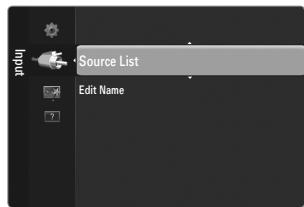
Source List
Use to select TV or other external input sources such as DVD / Blu-ray players / Cable Box / Satellite receivers (Set-Top Box) connected to the TV. Use to select the input source of your choice.
Press the SOURCE button on the remote control to view an external signal source. TV mode can be selected by pressing the TV button.
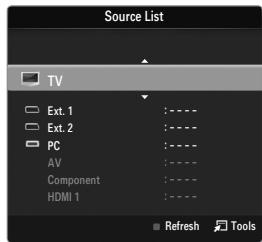
TV / Ext.1 / Ext.2 / AV / Component / PC / HDMI1 / HDMI2 / HDMI3/DVI / HDMI4
You can choose only those external devices that are connected to the TV. In the Source List, connected inputs will be highlighted and sorted to the top. Inputs that are not connected will be sorted to the bottom.
Ext. and PC always stay activated.
Using the Colour buttons on the remote with the Source list
- Red (Refresh): Refreshes the connected external devices. Press this if your Source is on and connected, but does not appear in the list.
- TOOLS (Tools): Displays the Edit Name and Information menus.
Edit Name
VCR / DVD / Cable STB / Satellite STB / PVR STB / AV Receiver / Game / Camcorder / PC / DVI / DVI PC / TV / IPTV / Blu-ray / HD DVD / DMA
Name the device connected to the input jacks to make your input source selection easier.
When a PC with a resolution of 1920 x 1080 @ 60Hz is connected to the HDMI IN 3(DVI) port, you should set the HDMI3/DVI mode to DVI PC in the Edit Name of the Input mode.
When connecting an HDMI/DVI cable to the HDMI IN 3(DVI) port, you should set the HDMI3/DVI mode to DVI or DVI PC in the Edit Name of the Input mode. In this case, a separate sound connection is required.
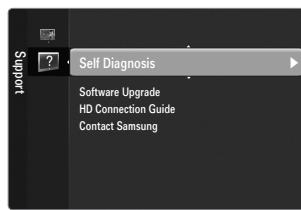
□ Self Diagnosis
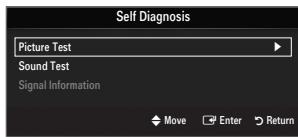
Picture Test
If you think you have a picture problem, perform the picture test. Check the colour pattern on the screen to see if the problem still exists.
- Yes: If the test pattern does not appear or there is noise in the test pattern, select Yes. There may be a problem with the TV. Therefore, contact Samsung's call centre for assistance.
- No: If the test pattern is properly displayed, select No. There may be a problem with your external equipment. Please check your connections. If the problem still persists, refer to the external device's user manual.
Sound Test
If you think you have a sound problem, please perform the sound test. You can check the sound by playing a built-in melody sound through the TV.
If you hear no sound from the TV's speakers, before performing the sound test, make sure Speaker Select is set to TV speaker in the Sound menu.
The melody will be heard during the test even if Speaker Select is set to External Speaker or the sound is muted by pressing the MUTE button.
- Yes: If during the sound test you can hear sound only from one speaker or not at all, select Yes. There may be a problem with the TV. Therefore, contact Samsung's call centre for assistance.
- No: If you can hear sound from the speakers, select No. There may be a problem with your external equipment. Please check your connections. If the problem still persists, refer to the external device's user manual.
Unlike analogue channels, which can vary in reception quality from ‘snowy’ to clear, digital (HDTV) channels have either perfect reception quality or you will not receive them at all. So, unlike analogue channels, you cannot fine tune a digital channel. You can, however, adjust your antenna to improve the reception of available digital channels.
If the signal strength meter indicates that the signal is weak, physically adjust your antenna to increase the signal strength. Continue to adjust the antenna until you find the best position with the strongest signal.
Software Upgrade
Samsung may offer upgrades for the TV's firmware in the future. These upgrades can be performed via the TV when it is connected to the Internet, or by downloading the new firmware from samsung.com to a USB memory device.
Current Version is the software already installed in the TV.
Alternative Software (Backup) shows the previous version that will be replaced.
Software is represented as 'Year/Month/Day_Version'. The more recent the date, the newer the software version. Installing the latest version is recommended.
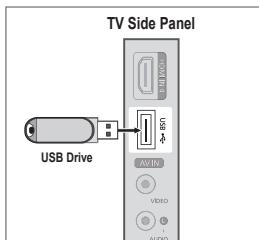
By USB
Insert a USB drive containing the firmware upgrade downloaded from samsung.com into the TV. Please be careful to not disconnect the power or remove the USB drive while upgrades are being applied. The TV will turn off and turn on automatically after completing the firmware upgrade. Please check the firmware version after the upgrades are complete (the new version will have a higher number than the older version).
When software is upgraded, video and audio settings you have made will return to their default (factory) settings. We recommend you write down your settings so that you can easily reset them after the upgrade.
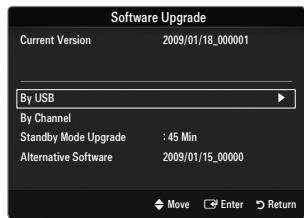
By Channel
Upgrades the software using the broadcasting signal.
If the function is selected during the software transmission period, this function searches for available software and downloads the software.
The time required to download the software is determined by the signal status.
Standby Mode Upgrade
To continue software upgrade with master power on, Select On by pressing the ▲ or ▼ button. 45 minutes after entering standby mode, a manual upgrade is automatically conducted. Since the power of the unit is turned on internally, the screen may be on slightly for the LCD product. This phenomenon may continue for more than 1 hour until the software upgrade is completed.
Alternative Software (Backup)
If there is an issue with the new firmware and it is affecting operation, you can change the software to the previous version.
If software was changed, existing software is displayed.
☐ You can change current software to alternative software by ‘Alternative Software’.
☐ HD Connection Guide
This menu presents the connection method that provides the optimal quality for the HD TV. Refer to this information when connecting external devices to the TV.
View this information when your TV does not work properly or when you want to upgrade the software. You can view the information regarding the call centre, product and software file download method.
Connecting a USB Device
- Press the POWER button to turn the TV on.
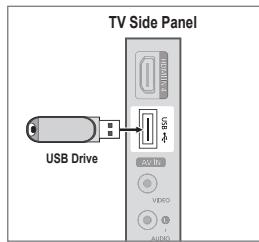
- Connect a USB device containing photo and/or music files to the USB jack on the side of the TV.
- When the Application selection screen is displayed, press the ENTER button to select Media Play (USB).
MTP (Media Transfer Protocol) is not supported.
The file system only supports FAT16/32 (The NTFS file system is not supported)
Certain types of USB Digital camera and audio devices may not be compatible with this TV.
Media Play only supports the USB Mass Storage Class device (MSC). MSC is a Mass Storage Class Bulk-Only Transport device. Examples of MSC are Thumb drives and Flash Card Readers (Both USB HDD and HUB are not supported.)
☑ Please connect directly to the USB port of your TV. If you are using a separate cable connection, there may be a USB compatibility problem.
☑ Before connecting your device to the TV, please back up your files to prevent them from damage or loss of data. SAMSUNG is not responsible for any data file damage or data loss.
Do not disconnect the USB device while it is loading.
The higher the resolution of the image, the longer it takes to display on the screen.
The maximum supported JPEG resolution is 15360X8640 pixels.
For unsupported or corrupted files, the 'Not Supported File Format' message is displayed.
MP3 files with DRM that have been downloaded from a non-free site cannot be played. Digital Rights Management (DRM) is a technology that supports the creation of content, the distribution and management of the content in an integrated and comprehensive way, including the protection of the rights and interests of the content providers, the prevention of the illegal copying of contents, as well as managing billings and settlements.
When moving to a photo, loading may take a few seconds. At this point, the loading icon will appear at the screen.
☑ If more than one MSC device is connected, some of them may not be recognized. If a device requires high power (more than 500mA or 5V), the USB device may not be supported.
☑ If an over-power warning message is displayed while you are connecting or using a USB device, the device may not be recognized or may malfunction.
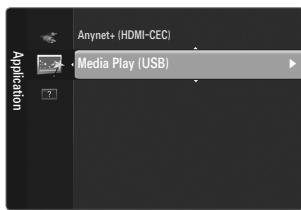
- Press the MENU button. Press the ▲ or ▼ button to select Application, then press the ENTER ↩ button.
-
Press the ▲ or ▼ button to select Media Play (USB), then press the ENTER ↙ button.
-
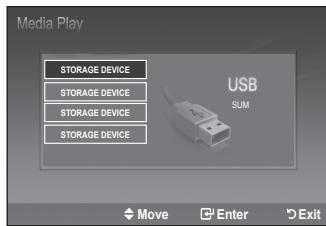
Press the ▲ or ▼ button to select the corresponding USB Memory Device, then press the ENTER button.
The Media Play (USB) menu differs depending on the USB Memory Device connected to TV.
Some devices may not be supported due to compatibility problems.
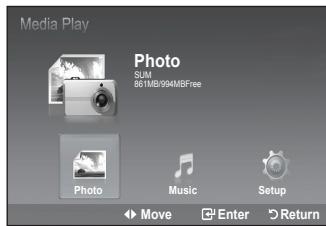
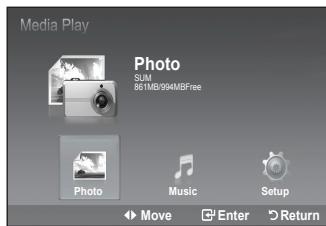
- Press the ◀ or ▶ button to move to an icon, then press the ENTER ➕ button.
To exit Media Play mode, press the MEDIA.P button on the remote control.
Press the MEDIA.P button on the remote control to display a Media Play menu.
flowchart
graph TD
    A["IDE"] --> B["TTX/MIX"]
    B --> C["I-II"]
    C --> D["DUAL"]
    C --> E["AD"]
    C --> F["SUBT"]
    G["MEDIA.F"] --> H["Arrow pointing to a black arrow"]
    style G fill:#f9f,stroke:#333
Using the Remote Control Button in Media Play (USB) Menu
| Button | Operations |
| ▲/▼/◄/► | Move the cursor and select an item. |
| ENTER ➔ | Select the currently selected item. |
| ▶ | Play the Slide Show or MP3 file. |
| ■ | Play the Slide Show or MP3 file. |
| RETURN | Return to the previous menu. |
| INFO | Run various functions from the Photo and Music menus. |
| ■ | Stop the current slide show or MP3 file. |
| ◄◄/►► | Page Up or Down (file list item) |
| EXIT | Stop the current function and return to the previous high-level menu. |
This menu shows JPEG files and folders saved on an USB memory device.
- Complete Steps 1 to 3 of "Using the Media Play Menu". (Refer to page 29)
-
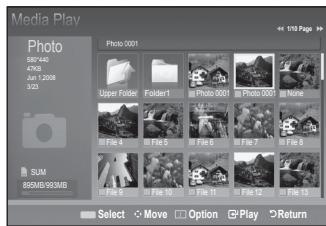
Press the ◀ or ▶ button to move to Photo, then press the ENTER ☐ button. The saved file information is displayed as a folder or file.
-
Press the ▲, ▼, ◀ and ▶ buttons to select a file.
-
Pressing the ENTER button over a photo icon shows the currently selected photo in full screen.
- Pressing the ENTER button over a folder icon shows the JPEG files included in the folder.
To exit Media Play mode, press the MEDIA.P button on the remote control.
Moving to a photo may take a few seconds to load the file. At this point, the icon will appear at the top left of the screen.
It takes time to show JPEG files as Thumbnail images.
This menu only shows files whose file extension is jpg. Files of other formats such as bmp or tiff will not be displayed.
The files are displayed on a page. 15 thumbnail photos are displayed per page.
The thumbnails are numbered from left to right and from top to bottom, from 1 to 15.
☑ Certain types of USB Digital camera and audio devices may not be compatible with this TV.
Folders are displayed first and they are followed by all JPEG files in the current folder.
The folders and JPEG files appear in the order of the time they were saved to the USB memory device.
If the photo is displayed in full screen, you can zoom in and out or rotate the photo on the screen.
While a full screen is displayed, ◀ or ▶ button will let you see another photo image in the same folder.
Press the ▶ button when a Photo icon is selected to start a Slide Show.
☑ Photos without EXIF information may not be displayed as thumbnail images in the PHOTO LIST depending on the picture quality and resolution.
Viewing a Slide Show
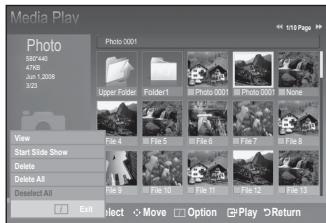
- Press the INFO button to display the option View, Start Slide Show, Delete (or Delete Selected file), Delete All, Deselect All
- Press the ▲ or ▼ button to select Start Slide Show then press the ENTER ↩ button.
During the slide show, files are displayed in order from the currently shown file.
☑ MP3 files can be automatically played during the Slide Show if the Default Background Music is set to On. To enable this function, MP3 files and other photo files must be located in the same folder on the USB Memory Device.
- Press the INFO button during the slide show to set the following options (Slide Show Speed, Background Music, Background Music Setting, List). Press the ▲ or ▼ button to select the option, then press the ENTER ➕ button.
- After setting the option press the ENTER ↩ button to make a change.
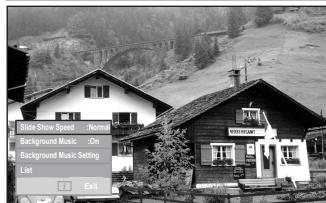
Start Slide Show
You can start a Slide Show.
Delete / Delete All / Delete Selected File (When multiple files are selected)
Select a photo to delete. (Alternatively, select multiple files by pressing the Yellow button.)
You cannot recover a deleted file.
■ Deselect All (When at least one file is selected)
You can deselect all files.
The √ mark indicating the corresponding file is selected is hidden.
Slide Show Speed
Select to control the slide show speed.
Press the ▲ or ▼ button to select the required option
(Fast, Normal, Slow), then press the ENTER button.
Background Music
Select to choose whether you want to play an MP3 file during a slide show.
Press the ▲ or ▼ button to select the required option (On, Off), then press the ENTER button.
Background Music Setting
While the slide show is in progress, MP3 files and folders under the same directory are displayed.
Press the ▲ or ▼ button to select a music file, then press the yellow button.
The (√) mark appears to the left of the selected music.
Repeat the above operation to select multiple music files.
Press the ENTER ← button.
If you turn Off the Background Music, even if the Background Music Settings have been set up, the background music will not be played.
List
The file information is displayed as a folder or JPEG file.
To exit Media Play mode, press the MEDIA.P button on the remote control.
When selecting a photo file, the photo file information is displayed on the left side of the TV screen, such as the resolution, the date modified and the order of the file in the current directory.
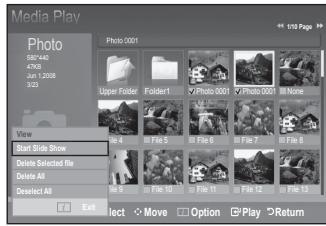
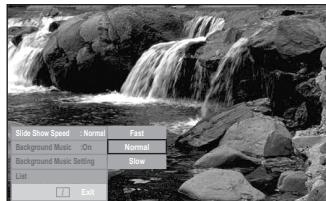
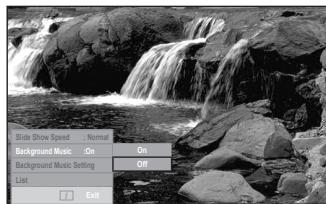
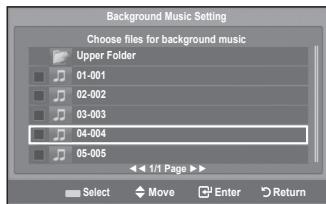
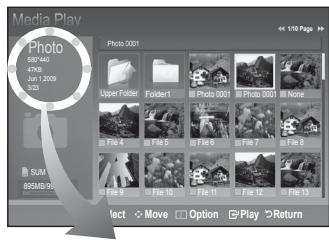

: Folder icon

: Photo icon

: Move to the previous folder stage icon
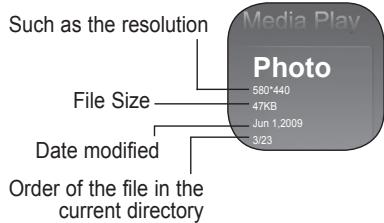
- Complete Steps 1 to 3 of "Using the Media Play Menu". (Refer to page 28)
- Press the ◀ or ▶ button to move to Photo, then press the ENTER button. The saved file information is displayed as a folder or file.
- Press the ▲, ▼, ◀ and ▶ button to select a file, then press the ENTER button. Pressing the button over a photo thumbnail displays the photo in full screen.
- Press the INFO button to display the option (Start Slide Show, Zoom, Rotate, List)
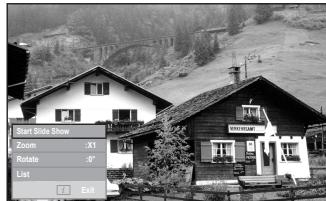
Start Slide Show
Press the ▲ or ▼ button to select Start Slide Show, then press the ENTER ↩ button. You can start a Slide Show.
Zoom
Press the ▲ or ▼ button to select Zoom, then press the ENTER ↩ button.
Select the required option by pressing the ▲ or ▼ button, then press the ENTER button. (X1, X2, X4)
To pan up/down/left/right in the zoomed-in photo, press the INFO button to exit option menu, then press the ▲, ▼, ◀ and ▶ buttons.
Start Slide Show or Rotate is disabled when the Zoom option is selected.
✗ x1 : Restore a photo to its original size.
x2 : Zoom-in to a photo x2.
x4 : Zoom-in to a photo x4.
▼ / ▲ / ◀ / ▶ : Move the zoomed-in photo up/down/right/left.
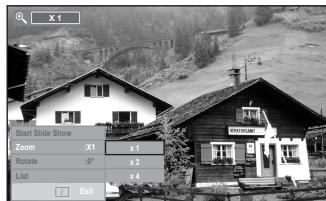
Rotate
Press the ▲ or ▼ button to select Rotate, then press the ENTER ↩ button.
Select the required option by pressing the ▲ or ▼ button, then press the ENTER button. (0°, 90°, 180°, 270°)
The rotated file is not saved.
Start Slide Show or Zoom is disabled when the Rotate option is selected.
0° : This rotates a photo to its original position
90° : This rotates a photo by 90 degrees
180°: This rotates a photo by 180 degrees
270°: This rotates a photo by 270 degrees
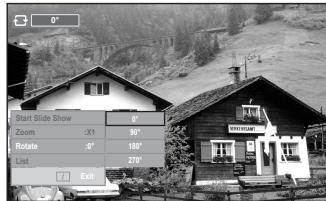
This menu shows MP3 files from among the files saved on a USB memory device.
- Complete Steps 1 to 3 of "Using the Media Play Menu". (Refer to page 29)
-
Press the ◀ or ▶ button to move to Music, then press the ENTER 🔊 button. The saved file information is displayed as a folder or file.
-
Press the ▲ or ▼ button to move to an icon, then press the ENTER ↩ button.
-
Pressing the ENTER button over a musical note icon immediately plays the music file.
- Pressing the ENTER button over a folder icon shows the music files included in the folder.
-
To select a file on the next page, press the ◀◀ or ▶▶ button to move to the next page.
-
To select all files or a file, press the INFO button to display the Music menus. Press the ENTER button to select Play, Repeat Music, Delete, Delete All or Deselect All. To exit Media Play mode, press the MEDIA.P button on the remote control.
The folders and MP3 files appear in the order of the time they were saved to the USB memory device.
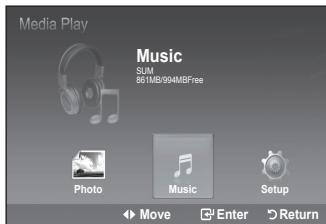
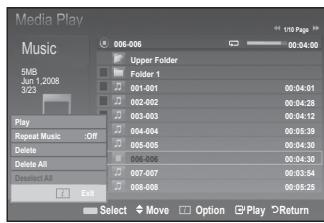
Play
Select to play MP3 files.
Press the □ button while playing an MP3 file to pause the file.
Press the ■ button to exit Play mode.
This menu only shows files with the MP3 file extension. Files with other file extensions are not displayed, even if they are saved on the same USB device.
The selected file is displayed on the top with its playing time.
To adjust the music volume, press the -▲+ button on the remote control. To mute the sound, press the MUTE button on the remote control.
If the sound is odd when playing MP3 files, exit Media Play mode and adjust the Equalizer and SRS TS HD in the Sound menu. (An over-modulated MP3 file may cause a sound problem.)

: Folder icon

: Music icon

: Move to the previous folder stage icon
Repeat Music
Select to repeatedly play MP3 files in the current folder. You can select On or Off.
- Delete / Delete All / Delete Selected File (When multiple files are selected)
Select the file to delete. (Alternatively, select multiple files by pressing the Yellow button.)
You cannot recover a deleted file.
■ Deselect All (When at least one file is selected)
You can deselect all files.
The √ mark indicating the corresponding file is selected is hidden.
: When all music files in the folder (or the selected file) are repeated. Repeat Music is On.
: When all music files in the folder (or the selected file) are played once. Repeat Music is Off.
: When pressing the ▶ /□ button on the remote control while music is playing.
: When pressing the ■ button on the remote control when music is stopped.
Setup displays the user settings of the Media Play menu.
- Complete Steps 1 to 3 of "Using the Media Play Menu". (Refer to page 29)
- Press the ◀ or ▶ button to move to Setup, then press the ENTER □ button.
- Press the ▲ or ▼ button to select an item you want, then press the ENTER ☐ button. (Slide Show Speed, Background Music, Background Music Setting, Repeat Music, Screen Saver, Remove Safely)
- Press the ▲ or ▼ button to select the option, then press the ENTER ↩ button.
To exit Media Play mode, press the MEDIA.P button on the remote control.
Slide Show Speed
Select to control the slide show speed. You can select Fast, Normal or Slow.
Background Music
Select to determine whether to play an MP3 file during a slide show. You can select Music On or Music Off.
Background Music Setting
While a slide show is in progress, use the Background Music Setting to select a music file to listen to. Select an MP3 file as the background music.
Repeat Music
Select to determine whether to repeat playing the music when all MP3 files in the current folder have been played.
Screen Saver
Select to set the waiting time before the screen saver appears. The screensaver will appear when no button is pressed for 2, 4, 8, 10 hours or Off.
Remove Safely
You can remove the device safely from the TV.
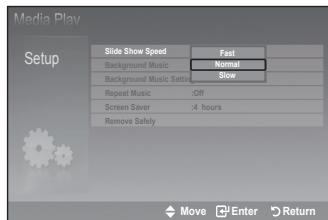
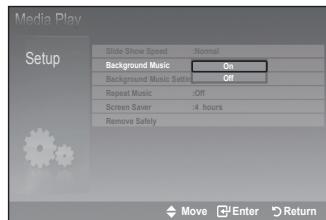
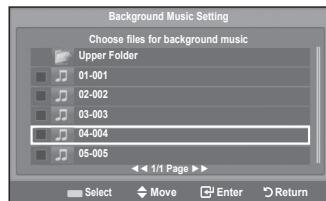
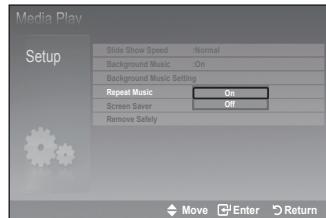
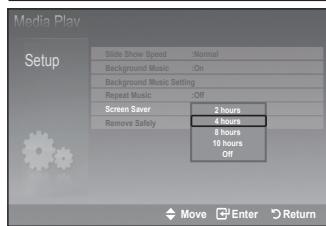
What is Anynet+?
Anynet ^+ is a function that enables you to control all connected Samsung devices that support Anynet+ with your Samsung TV's remote. The Anynet ^+ system can be used only with Samsung devices that have the Anynet ^+ feature. To be sure your Samsung device has this feature, check if there is an Anynet ^+ logo on it.
To connect to a TV
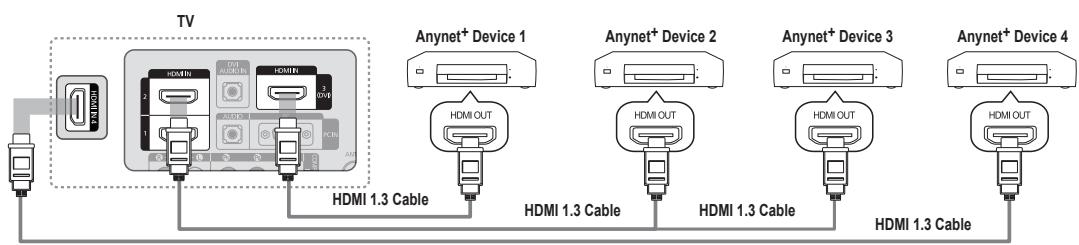
- Connect the HDMI IN (1, 2, 3(DVI) or 4) jack on the TV and the HDMI OUT jack of the corresponding Anynet ^+ device using an HDMI cable.
To connect to Home Theatre
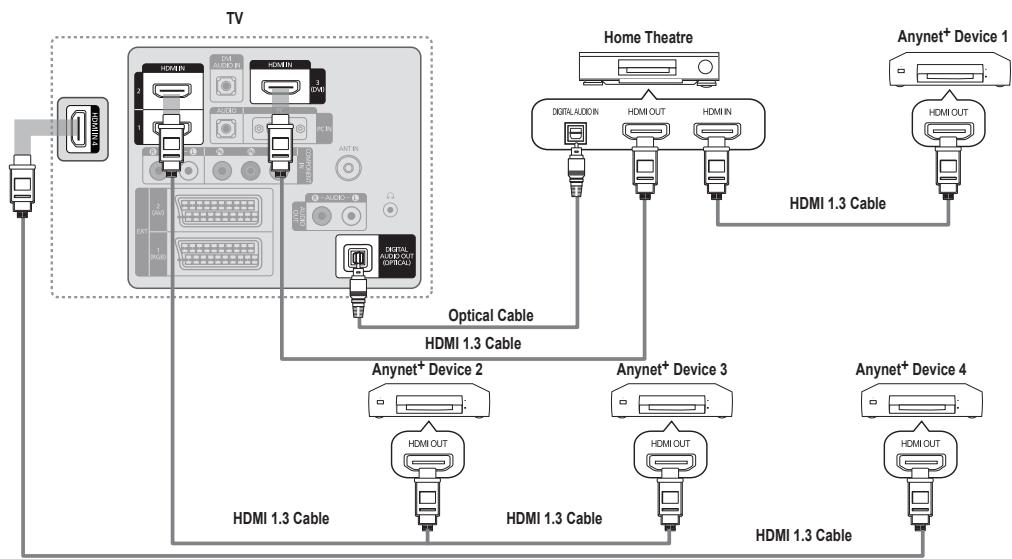
flowchart
graph TD
    TV["TV"] -->|Optical Cable| HomeTheatre["Home Theatre"]
    TV -->|Optical Cable| Anynet+Device1["Anynet+ Device 1"]
    TV -->|Optical Cable| Anynet+Device2["Anynet+ Device 2"]
    TV -->|Optical Cable| Anynet+Device3["Anynet+ Device 3"]
    TV -->|Optical Cable| Anynet+Device4["Anynet+ Device 4"]
    HomeTheatre -->|HDMI 1.3 Cable| Anynet+Device1
    HomeTheatre -->|HDMI 1.3 Cable| Anynet+Device2
    HomeTheatre -->|HDMI 1.3 Cable| Anynet+Device3
    HomeTheatre -->|HDMI 1.3 Cable| Anynet+Device4
    Anynet+Device1 -->|HDMI 1.3 Cable| Anynet+Device2
    Anynet+Device1 -->|HDMI 1.3 Cable| Anynet+Device3
    Anynet+Device1 -->|HDMI 1.3 Cable| Anynet+Device4
- Connect the HDMI IN (1, 2, 3(DVI) or 4) jack on the TV and the HDMI OUT jack of the corresponding Anynet ^+ device using an HDMI cable.
- Connect the HDMI IN jack of the home theatre and the HDMI OUT jack of the corresponding Anynet ^+ device using an HDMI cable.
Connect the Optical cable between the DIGITAL AUDIO OUT (OPTICAL) jack on your TV and the Digital Audio Input on the Home Theatre.
When following the connection above, the Optical jack only outputs 2 channel audio. You will only hear sound from the Home Theatre's Front Left and Right speakers and the subwoofer. If you want to hear 5.1 channel audio, connect the DIGITAL AUDIO OUT (OPTICAL) jack on the DVD / Satellite Box (ie Anynet Device 1 or 2) directly to the Amplifier or Home Theatre, not the TV.
Connect only one Home Theatre.
You can connect an Anynet ^+ device using the HDMI 1.3 cable. Some HDMI cables may not support Anynet ^+ functions.
☑ Anynet ^+ works when the AV device supporting Anynet ^+ is in the Standby or On status.
Anynet ^+ supports up to 12 AV devices in total. Note that you can connect up to 3 devices of the same type.
Setting Up Anynet+
Press the TOOLS button to display the Tools menu. You can also display Anynet ^+ menu by selecting Tools → Anynet ^+ (HDMI-CEC).
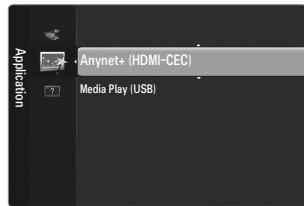
Setup
Anynet ^+ (HDMI-CEC) → Off / On
To use the Anynet ^+ Function, Anynet ^+ (HDMI-CEC) must be set to On.
When the Anynet ^+ (HDMI-CEC) function is disabled, all the Anynet ^+ related operations are deactivated.
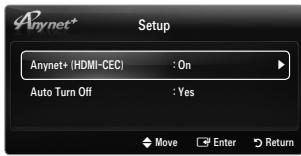
■ Auto Turn Off → No / Yes
Setting an Anynet ^+ Device to turn Off automatically when the TV is turned Off.
The active source on the TV remote must be set to TV to use the Anynet ^+ function.
If you set Auto Turn Off to Yes, connected external devices are also turned off when the TV is turned off. If an external device is still recording, it may or may not turn off.
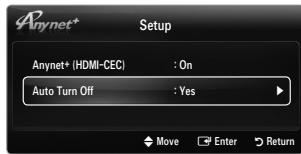
Switching between Anynet ^+ Devices
- Press the TOOLS button. Press the ENTER ↩ button to select Anynet+ (HDMI-CEC).
- Press the ▲ or ▼ button to select Device List, then press the ENTER ↩ button.
Anynet ^+ devices connected to the TV are listed.
If you cannot find a device you want, press the red button to scan for devices.
- Press the ▲ or ▼ button to select a particular device and press the ENTER ➕ button. It is switched to the selected device.
Only when you set Anynet ^+ (HDMI-CEC) to On in the Application menu, the Device List menu appears.
Switching to the selected devices may take up to 2 minutes. You cannot cancel the operation during the switching operation.
The time required to scan for devices is determined by the number of connected devices.
When the device scan is complete, the number of devices found are not displayed.
Although the TV automatically searches the device list when the TV is turned on via the power button, devices connected to the TV may not always be automatically displayed in the device list. Press the red button to search for the connected device.
If you have selected external input mode by pressing the SOURCE button, you cannot use the Anynet ^+ function. Make sure to switch to an Anynet ^+ device by using the Device List.
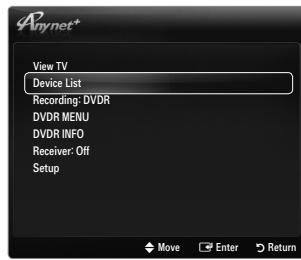
The Anynet ^+ menu changes depending on the type and status of the Anynet ^+ devices connected to the TV.
| Anynet+ Menu | Description |
| View TV | Anynet+ mode changes to TV broadcast mode. |
| Device List | Shows the Anynet+ device list. |
| (device_name) MENU | Shows the connected device menus. E.g. If a DVD recorder is connected, the disc menu of the DVD recorder will appear. |
| (device_name) INFO | Shows the play menu of the connected device. E.g. If a DVD recorder is connected, the play menu of the DVD recorder will appear. |
| Recording: (*recorder) | Starts recording immediately using the recorder. (This is only available for devices that support the recording function.) |
| Stop Recording: (*recorder) | Stops recording. |
| Receiver | Sound is played through the receiver. |
If more than one recording device is connected, they are displayed as (*recorder) and if only one recording device is connected, it will be represented as (*device_name).
| Device Type | Operating Status | Available Buttons |
| Anynet^+ Device | After switching to the device, when the menu of the corresponding device is displayed on the screen. | Numeric buttons▲/▼/◄/►/ ENTER ➕buttonsColour buttons / EXIT button |
| After switching to the device, while playing a file. | ◀◀(Backward search) / ►▶(Forward search) / ■(Stop) / ▶(Play) / □(Pause) |
| Device with built-in Tuner | After switching to the device, when you are watching a TV program. | P √ / P ∧ button |
| Audio Device | When Receiver is activated. | - ↗ + / MUTE button |
The Anynet ^+ function only works when the active source on the TV remote control is set to TV.
The ● button works only while in the recordable state.
You cannot control Anynet ^+ devices using the buttons on the TV. You can control Anynet ^+ devices only using the TV remote control.
The TV remote control may not work under certain conditions. If this occurs, reselect the Anynet ^+ device.
The Anynet ^+ functions do not operate with other manufacturers' products.
The ◀◀, ▶▶ operations may differ depending on the device.
Recording
You can make a recording of a TV program using a Samsung recorder.
- Press the TOOLS button. Press the ENTER ↩ button to select Anynet+ (HDMI-CEC).
- Press the ▲ or ▼ button to select Recording Immediately and press the ENTER button. Recording begins.
When there is more than one recording device
When multiple recording devices are connected, the recording devices are listed. Press the ▲ or ▼ button to select a recording device and press the ENTER □ button. Recording begins.
When the recording device is not displayed select Device List and press the Red button to search devices
- Press the EXIT button to exit.
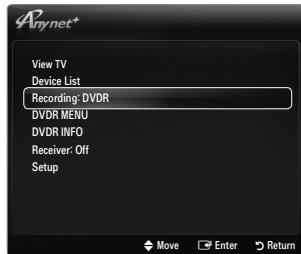
You can record the source streams by selecting Recording: (device_name).
Pressing the ● button will record whatever you are currently watching. If you are watching video from another device, the video from the device is recorded.
Before recording, check whether the antenna jack is properly connected to the recording device. To properly connect an antenna to a recording device, refer to the recording device's users manual.
Listening through a Receiver (Home theatre)
You can listen to sound through a receiver instead of the TV speaker.
- Press the TOOLS button. Press the ENTER ↩ button to select Anynet ^+ (HDMI-CEC).
- Press the ▲ or ▼ button to select Receiver. Press the ◀ or ▶ button to select On or Off.
- Press the EXIT button to exit.
If your receiver supports audio only, it may not appear in the device list.
The receiver will work when you have properly connected the optical in jack of the receiver to the DIGITAL AUDIO OUT (OPTICAL) jack of the TV.
When the receiver (home theatre) is set to On, you can hear sound output from the TV's Optical jack. When the TV is displaying a DTV(air) signal, the TV will send
out 5.1 channel sound to the Home Theatre receiver. When the source is a digital component such as a DVD and is connected to the TV via HDMI, only 2 channel sound will be heard from the Home Theatre receiver.
If there is a power interruption to the TV when the Receiver is set to On (by disconnecting the power cord or a power failure), the Speaker Select may be set to External Speaker when you turn the TV on again.
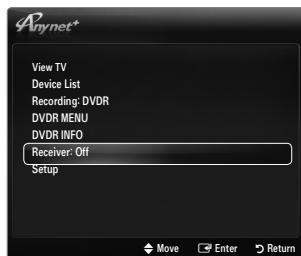
| Problem | Possible Solution |
| Anynet^+ does not work. | Check if the device is an Anynet^+ device. The Anynet^+ system supports Anynet^+ devices only.Connect only one receiver (home theatre).Check if the Anynet^+ device power cord is properly connected.Check the Anynet^+ device’s Video/Audio/HDMI 1.3 cable connections.Check whether Anynet^+ (HDMI-CEC) is set to On in the Anynet^+ setup menu.Check whether the TV remote control is in TV mode.Check whether it is Anynet^+ exclusive remote control. Anynet^+ doesn’t work in certain situations. (Searching channels, Operating Media Play, Plug & Play, etc.)When connecting or removing the HDMI 1.3 cable, please make sure to search devices again or turn your TV off and on again.Check if the Anynet^+ Function of Anynet^+ device is set on. |
| I want to start Anynet^+ . | Check if the Anynet^+ device is properly connected to the TV and check if the Anynet^+ (HDMI-CEC) is set toOnin the Anynet^+ Setupmenu.Press the TV button on the TV remote control to switch to TV. Then press theTOOLSbutton to show the Anynet^+ menu and select a menu you want. |
| I want to exit Anynet^+ . | SelectView TVin the Anynet^+ menu.Press theSOURCEbutton on the TV remote control and select a device other than Anynet^+ devices.PressP√/^, PRE-CH, and FAV.CHto change the TV mode. (Note that the channel button operates only when a tuner-embedded Anynet^+ device is not connected.) |
| The message‘Connecting to Anynet+ device...’ appears on the screen. | You cannot use the remote control when you are configuring Anynet^+ or switching to a view mode.Use the remote control when the Anynet^+ setting or switching to view mode is complete. |
| The Anynet^+ device does not play. | You cannot use the play function when Plug & Play is in progress. |
| The connected device is not displayed. | Check whether or not the device supports Anynet^+ functions.Check whether or not the HDMI 1.3 cable is properly connected.Check whether Anynet^+ (HDMI-CEC) is set toOnin the Anynet^+ setup menu.Search Anynet^+ devices again.You can connect an Anynet^+ device using the HDMI 1.3 cable only. Some HDMI cables may not support Anynet^+ functions.If it is terminated by an abnormal situation such as disconnecting the HDMI cable or power cord or a power failure, please repeat the device scan. |
| The TV program cannot be recorded. | Check whether the antenna jack on the recording device is properly connected. |
| The TV sound is not output through the receiver. | Connect the optical cable between TV and the receiver. |
Teletext Feature
Most television stations provide written information services via Teletext. The index page of the Teletext service gives you information on how to use the service. In addition, you can select various options to suit your requirements by using the remote control buttons.
For Teletext information to be displayed correctly, channel reception must be stable. Otherwise, information may be missing or some pages may not be displayed.
1 ≡... (mode)
Press to select the Teletext mode (LIST/ FLOF). If you press it in the LIST mode, it switches into the List save mode. In the List save mode, you can save Teletext page into list using the ☐(store) button.
② ≡? (reveal)
Used to display the hidden text (answers to quiz games, for example). To display normal screen, press it again.
3 (size)
Press to display the double-size letters in the upper half of the screen. For lower half of the screen, press it again. To display normal screen, press it once again.
4 Store
Used to store the Teletext pages.
5 Colour buttons (red/green/yellow/blue)
If the FASTEXT system is used by a broadcasting company, the different topics covered on a Teletext page are colour-coded and can be selected by pressing the coloured buttons. Press one of them corresponding to the required. The page is displayed with other coloured information that can be selected in the same way. To display the previous or next page, press the corresponding coloured button.
6 📊/(Z) (Teletext on/mix)
Press to activate Teletext mode after selecting the channel providing the Teletext service. Press it twice to overlap the Teletext with the current broadcasting screen.
⑦ □ (exit)
Exit from the Teletext display.
8 (sub-page)
Used to display the available sub-page.
9 ≡1 (page up)
Used to display the next Teletext page.
10 1≡ (page down)
Used to display the previous Teletext page.
11 (hold)
Used to hold the display on a given page if the selected page is linked with several secondary pages which follow on automatically. To resume, press it again.
12 ≡i (index)
Used to display the index (contents) page at any time while you are viewing Teletext.
13 ≡x (cancel)
Used to display the broadcast when searching for a page.
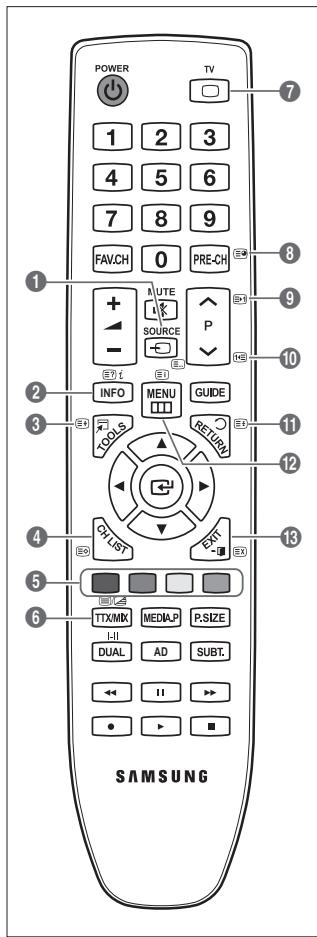
You can change Teletext pages by pressing the numeric buttons on the remote control.
The Teletext pages are organized according to six categories:
| Part | Contents |
| A | Selected page number. |
| B | Broadcasting channel identity. |
| C | Current page number or search indications. |
| D | Date and time. |
| E | Text. |
| F | Status information. |
| FASTEXT information. |
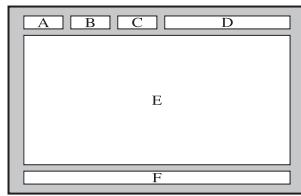
Teletext information is often divided between several pages displayed in sequence, which can be accessed by:
- Entering the page number
– Selecting a title in a list
– Selecting a coloured heading (FASTEXT system)
Teletext level supported by the TV is version 2.5 which is capable of displaying additional graphics or text.
Depending upon the transmission, blank side panels can occur when displaying Teletext.
In these cases, additional graphics or text is not transmitted.
Older TV's which do not support version 2.5 are not capable of displaying any additional graphics or text, regardless of the Teletext transmission.
Press the TV button to exit from the Teletext display.
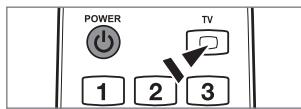
Installing the Stand
☑ Preset: Place the Guide Stand and Cover Neck onto the stand and fasten it using the screws. Applicable to 32inch models only.
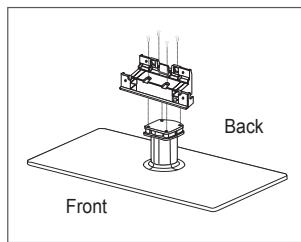
- Attach your LCD TV to the stand.
Two or more people should carry the TV.
Make sure to distinguish between the front and back of the stand when assembling them.
To make sure the TV is installed on the stand at a proper level, do not apply excess downward pressure to the upper left of right sides of the TV.
- Fasten screws at position ① and then fasten screws at position ②.
Stand the product up and fasten the screws. If you fasten the screws with the LCD TV placed down, it may lean to one side.
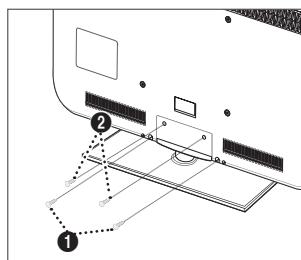
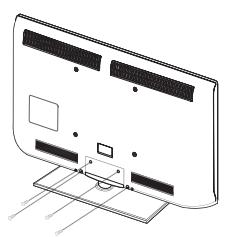
natural_image
Diagram of a flat-screen TV with two panels and a stand, showing no text or symbols
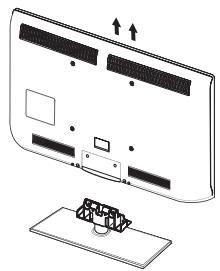
natural_image
Diagram of a computer monitor with an attached display stand (no text or symbols)
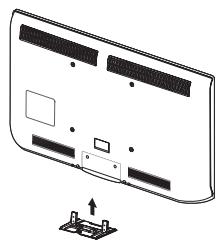
natural_image
Diagram of a computer monitor with ventilation slots and an attached base mount (no text or symbols)
- Remove screws from the back of the TV.
- Separate the stand from the TV.
☐ Two or more people should carry the TV.
- Cover the bottom hole with the cover.
Installing the Wall Mount Kit
Wall mount items (sold separately) allow you to mount the TV on the wall.
For detailed information on installing the wall mount, see the instructions provided with the Wall Mount items. Contact a technician for assistance when installing the wall mounted bracket.
Samsung Electronics is not responsible for any damage to the product or injury to yourself or others if you elect to install the TV on your own.

Do not install your Wall Mount Kit while your TV is turned on. It may result in personal injury due to electric shock.
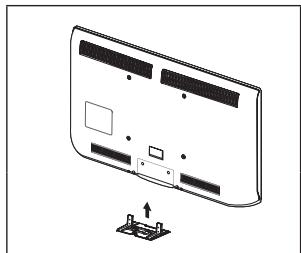
natural_image
Diagram of a computer monitor with a base mount and an arrow indicating orientation (no text or symbols present)
Assembling the Cables
Enclose the cables in the Holder-Wire Cable so that the cables are not visible through the transparent stand.
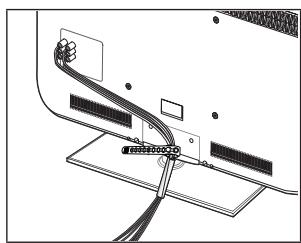
natural_image
Pure electrical circuit lines without any symbols
Anti-Theft Kensington Lock
The Kensington Lock is a device used to physically fix the system when using it in a public place. The appearance and locking method may differ from the illustration depending on the manufacturer.
Refer to the manual provided with the Kensington Lock for proper use.
The locking device has to be purchased separately.
The location of the Kensington Lock may be different depending on its model.
- Insert the locking device into the Kensington slot on the LCD TV (①) and turn it in the locking direction (②).
- Connect the Kensington Lock cable (③).
- Fix the Kensington Lock to a desk or a heavy stationary object.
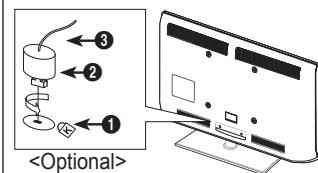
Keep the required distances between the product and other objects (e.g. walls) to ensure proper ventilation.
Failing to do so may result in fire or a problem with the product due to an increase in the internal temperature of the product.
Install the product so the required distances shown in the figure are kept.
When using a stand or wall-mount, use parts provided by Samsung Electronics only.
- If you use parts provided by another manufacturer, it may result in a problem with the product or an injury due to the product falling.
- If you use parts provided by another manufacturer, it may result in a problem with the product or fire due to an increase in the internal temperature of the product due to poor ventilation.
The appearance may differ depending on the product.
When installing the product with a stand
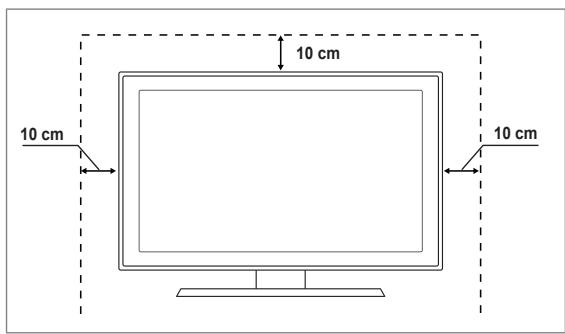
When installing the product with a wall-mount
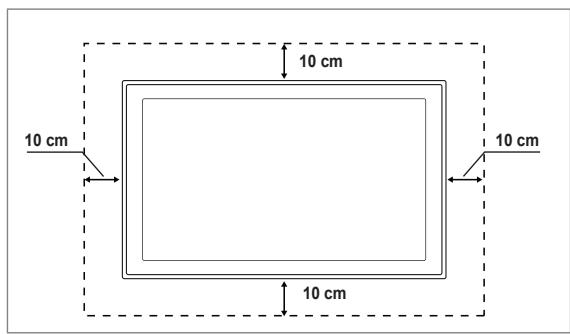
Securing the TV to the Wall

Caution: Pulling, pushing, or climbing on the TV may cause the TV to fall. In particular, ensure your children do not hang over or destabilize the TV; doing so may cause the TV to tip over, causing serious injuries or death.
Follow all safety precautions provided on the included Safety Flyer. For added stability, install the anti-fall device for safety purposes, as follows.
■ To avoid the TV from falling:
- Put the screws into the clamps and firmly fasten them onto the wall. Confirm that the screws have been firmly installed onto the wall.
You may need additional material such as an anchor depending on the type of wall.
Since the necessary clamps, screws, and string are not supplied, please purchase these additionally.
- Remove the screws from the centre back of the TV, put the screws into the clamps, and then fasten the screws onto the TV again.
Screws may not be supplied with the product. In this case, please purchase the screws of the following specifications.
Screw Specifications
Install the TV near to the wall so that it does not fall backwards.
It is safe to connect the string so that the clamps fixed on the wall are equal to or lower than the clamps fixed on the TV.
☐ Untie the string before moving the TV.
- Verify all connections are properly secured. Periodically check connections for any sign of fatigue for failure. If you have any doubt about the security of your connections, contact a professional installer.
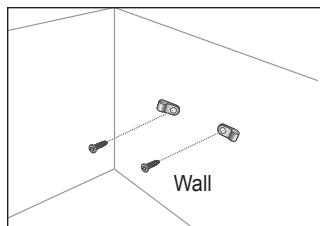
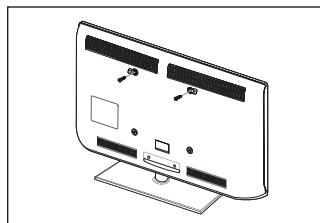
natural_image
Illustration of a computer monitor with labeled buttons and screen (no text or symbols)
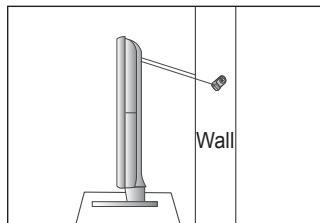
natural_image
Diagram of a vertical wall-mounted device with a lit bulb, labeled 'Wall' (no other text or symbols)
| No sound or picture | Check that the mains lead has been connected to a wall socket.Check that you have pressed the button on your set.Check the picture contrast and brightness settings.Check the volume. |
| Normal picture but no sound | Check the volume.Check whether the MUTE button has been pressed on the remote control.Check the Speaker Select settings. |
| Screen is black and power indicator light blinks steadily | On your computer check; Power, Signal Cable.The TV is using its power management system.Move the computer's mouse or press any key on the keyboard. |
| No picture or black and white picture | Adjust the colour settings.Check that the broadcast system selected is correct. |
| Sound and picture interference | Try to identify the electrical appliance that is affecting the set and move it further away.Plug your set into a different mains socket. |
| Blurred or snowy picture, distorted sound | Check the direction, location and connections of your aerial.This interference is often due to the use of an indoor aerial. |
| Remote control malfunctions | Replace the remote control batteries.Clean the upper edge of the remote control (transmission window).Check the battery terminals. |
| ‘Check signal cable.’ message is displayed | Check that the signal cable is firmly connected to the PC or video sources.Check that the PC or video sources are turned on. |
| On PC mode, ‘Not Supported Mode.’ message is displayed | Check the maximum resolution and the frequency of the video adaptor.Compare these values with the data in the Display Modes. |
| The damaged picture appears in the corner of the screen | If Screen Fit is selected in some external devices, the damaged picture may appear in the corner of the screen. This symptom is caused by external devices, not TV. |
| The ‘Resets all settings to the default values.’ message appears. | This appears when you press and hold the EXIT button for a while. The product settings are reset to the factory defaults. |
| You may see small particles if you look closely at the edge of the bezel surrounding the TV screen. | This is part of the product's design and is not a defect. |
This TFT LCD panel uses a panel consisting of sub pixels (6 220 800) which require sophisticated technology to produce. However, there may be few bright or dark pixels on the screen. These pixels will have no impact on the performance of the product.
| Model Name | LE32B550, LE32B551LE32B553, LE32B554 | LE37B550, LE37B551LE37B553, LE37B554 |
| Screen Size(Diagonal) | 32 inch | 37 inch |
| PC Resolution(Optimum) | 1920 x 1080 @ 60 Hz | 1920 x 1080 @ 60 Hz |
| Sound(Output) | 10W X 2 | 10W X 2 |
| Dimensions (WxDxH)BodyWith stand | 794 X 77 X 524 mm794 X 240 X 570 mm | 917 X 79 X 592 mm917 X 255 X 658 mm |
| WeightWith Stand | 13 kg | 16 kg |
| Environmental ConsiderationsOperating TemperatureOperating HumidityStorage TemperatureStorage Humidity | 10°C to 40°C (50°F to 104°F)10% to 80%, non-condensing-20°C to 45°C (-4°F to 113°F)5% to 95%, non-condensing |
| Stand Swivel(Left / Right) | -20° ~ 20° |
| Model Name | LE40B550, LE40B551LE40B553, LE40B554 | LE46B550, LE46B551LE46B553, LE46B554 |
| Screen Size(Diagonal) | 40 inch | 46 inch |
| PC Resolution(Optimum) | 1920 x 1080 @ 60 Hz | 1920 x 1080 @ 60 Hz |
| Sound(Output) | 10W X 2 | 10W X 2 |
| Dimensions (WxDxH)BodyWith stand | 982 X 79 X 626 mm982 X 255 X 676 mm | 1116 X 79 X 706 mm1116 X 275 X 770 mm |
| WeightWith Stand | 18 kg | 23 kg |
| Environmental ConsiderationsOperating TemperatureOperating HumidityStorage TemperatureStorage Humidity | 10°C to 40°C (50°F to 104°F)10% to 80%, non-condensing-20°C to 45°C (-4°F to 113°F)5% to 95%, non-condensing |
| Stand Swivel(Left / Right) | -20° ~ 20° | |
☑ Design and specifications are subject to change without prior notice.
This device is a Class B digital apparatus.
For the power supply and Power Consumption, refer to the label attached to the product.
This page is intentionally left blank.
⑦ DIGITAL AUDIO OUT (OPTICAL)
⑧ AUDIO OUT [R-AUDIO-L]
natural_image
Diagram of a mechanical component with a curved arrow indicating rotation or movement (no text or symbols)
- Replacez le couvercle.
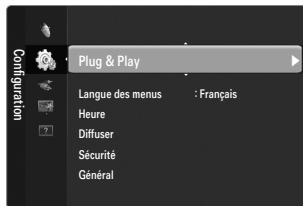
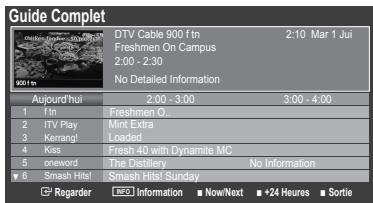
Modes d'affichage
☐ SRS TruSurround HD → Arr. / Mar.
MHEG (Multimedia and Hypermedia Information Coding Experts Group)
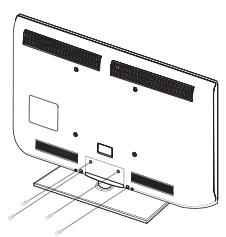
natural_image
Diagram of a flat-screen monitor with two slats and a stand, showing front panel and screen (no text or symbols)
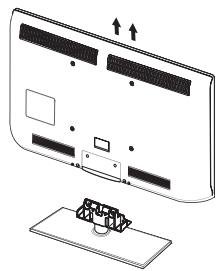
natural_image
Diagram of a computer monitor with an attached display stand (no text or symbols)
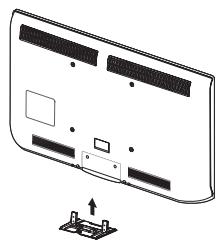
natural_image
Diagram of a computer monitor with ventilation slots and an attached base mount (no text or symbols)
natural_image
Diagram of a computer monitor with a base mount and an arrow indicating orientation (no text or symbols present)
natural_image
Pure electrical circuit lines without any symbols
Verrou antivol Kensington
natural_image
Illustration of a flat-screen monitor with display screen and control buttons (no text or symbols)
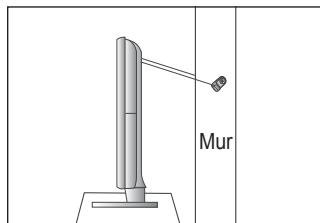
The provided image contains no text or OCR-able content. It displays a simple icon of a pencil inside a square frame.
Hinweis
#
Zielwahltaste
[Non-Text]
TOOLS-Taste
A
Drücken
⑦ DIGITAL AUDIO OUT (OPTICAL)
8 AUDIO OUT [R-AUDIO-L]
natural_image
Diagram of a mechanical device with rotating components and a curved base (no text or symbols)
KANAL
Kanalmenü
Land
Analog Sender
Anzeigemodi
MHEG (Multimedia and Hypermedia Information Coding Experts Group)
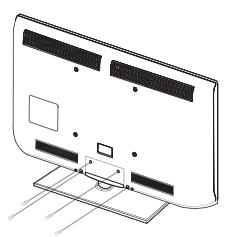
natural_image
Diagram of a flat-screen monitor with two slats and a stand, showing front panel and screen (no text or symbols)
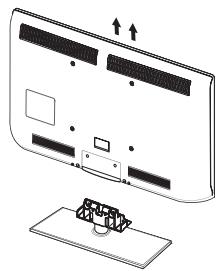
natural_image
Diagram of a computer monitor with an attached stand and two arrows indicating upward motion (no text or symbols present)
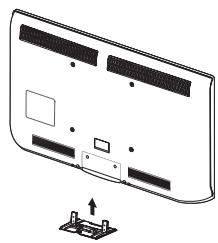
natural_image
Diagram of a computer monitor with ventilation slots and an attached base mount (no text or symbols)
natural_image
Diagram of a computer monitor with an attached base mount (no text or symbols)
Verlegen der Kabel
natural_image
Pure electrical circuit lines without any symbols
natural_image
Line drawing of a flat-screen TV with display panels and buttons (no text or symbols)
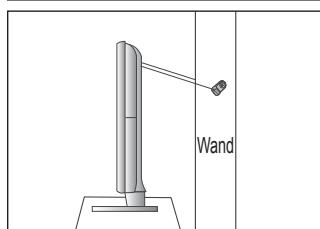
⑦ DIGITAL AUDIO OUT (OPTICAL)
⑧ AUDIO OUT [R-AUDIO-L]
natural_image
Diagram of a mechanical component with a rotating arm and base, showing no text or symbols
Weergavemodi
MHEG (Multimedia and Hypermedia Information Coding Experts Group)
Selecteer ATV of DTV.
Connecting a USB Device
Using the Remote Control Button in Media Play (USB) Menu
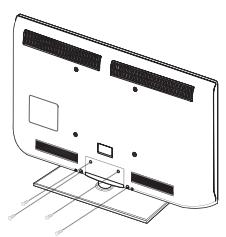
natural_image
Diagram of a flat-screen monitor with two slats and a stand, showing front panel and screen (no text or symbols)
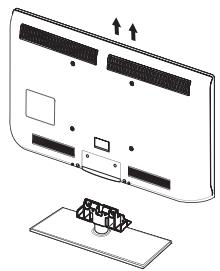
natural_image
Diagram of a computer monitor with an attached display stand (no text or symbols)
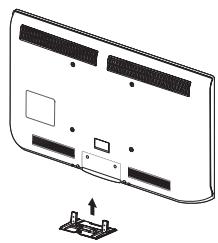
natural_image
Diagram of a computer monitor with ventilation slots and an attached base mount (no text or symbols)
natural_image
Diagram of a computer monitor with a stand and an arrow indicating orientation (no text or symbols present)
natural_image
Pure mechanical assembly diagram showing a curved component connected to a base plate (no text or symbols)
natural_image
Illustration of a flat-screen TV with display screen and buttons (no text or symbols)
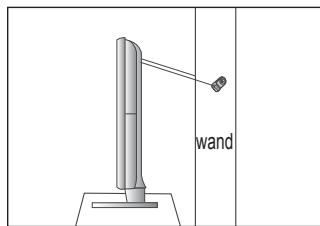
⑦ DIGITAL AUDIO OUT (OPTICAL)
⑧ AUDIO OUT [R-AUDIO-L]
natural_image
Diagram of a mechanical device with rotating arm and base, no text or symbols present
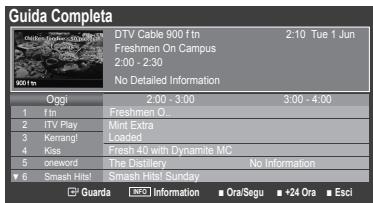
MHEG (Multimedia and Hypermedia Information Coding Experts Group)
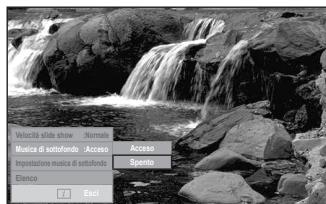
![SAMSUNG LE32B551A6W - ⑧ AUDIO OUT [R-AUDIO-L] - 3](/content/2020/05/26005/images/d03c02192e97e006d363118d710de5ba005055d357deb58a5a7d215e20e0cfd1.jpg)
natural_image
Diagram of a flat-screen monitor with two slats and a stand, showing no text or symbols
![SAMSUNG LE32B551A6W - ⑧ AUDIO OUT [R-AUDIO-L] - 4](/content/2020/05/26005/images/31d0c51c4dbbf1442d8973e4b2442ec7fd4ee2879e214b0742bd520c4f9c3352.jpg)
natural_image
Diagram of a computer monitor with an attached display stand (no text or symbols)
![SAMSUNG LE32B551A6W - ⑧ AUDIO OUT [R-AUDIO-L] - 5](/content/2020/05/26005/images/3beb64f429546b2da6b8fd8e4a66b66b03820e651422c8bcf43c3bcd8cf4723a.jpg)
natural_image
Diagram of a computer monitor with ventilation slots and an attached base mount (no text or symbols)
natural_image
Diagram of a computer monitor with ventilation slots and an attached mounting base (no text or symbols)
natural_image
Diagram of a cable or connector assembly with connectors and components (no text or symbols visible)
natural_image
Illustration of a flat-screen TV with display screen and buttons (no text or symbols)
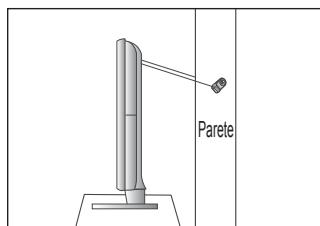
The provided image contains no text or OCR-able content. It displays a simple icon of a pencil inside a square frame.
Nota
#
⑦ DIGITAL AUDIO OUT (OPTICAL)
⑧ AUDIO OUT [R-AUDIO-L]
natural_image
Mechanical assembly diagram showing a rotating component with arrows indicating motion (no text or symbols)
Modos de pantalla
☐ SRS TruSurround HD → Des. / Act.
natural_image
Diagram of a flat-screen monitor with two slats and a stand, showing front panel and screen (no text or symbols)
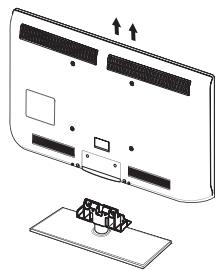
natural_image
Diagram of a computer monitor with an attached stand and two arrows indicating upward motion (no text or symbols present)
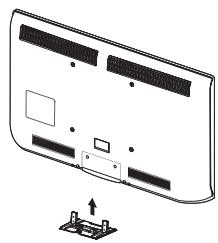
natural_image
Diagram of a computer monitor with ventilation slots and a base mount (no text or symbols)
natural_image
Diagram of a computer monitor with an attached stand and a small arrow indicating motion (no text or symbols)
natural_image
Pure electrical circuit lines without any symbols
Bloqueo antirrobo Kensington
natural_image
Illustration of a flat-screen TV with display screen and buttons (no text or symbols)
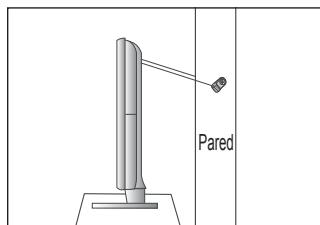
⑦ DIGITAL AUDIO OUT (OPTICAL)
⑧ AUDIO OUT [R-AUDIO-L]
natural_image
Diagram of a mechanical device with a rotating lever and guide mechanism (no text or symbols)
- Volte a colocar a tampa.
MHEG (Multimedia and Hypermedia Information Coding Experts Group)
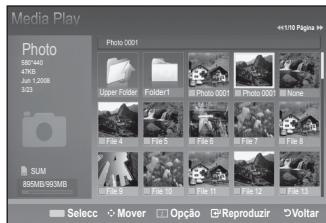
6 (activar teletexto/sobrepor)
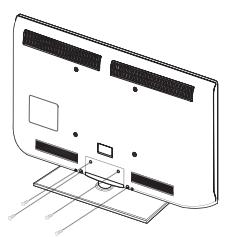
natural_image
Diagram of a flat-screen monitor with two slats and a stand, showing front panel and screen (no text or symbols)
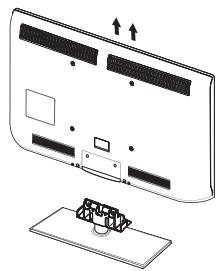
natural_image
Diagram of a computer monitor with an attached display stand (no text or symbols)
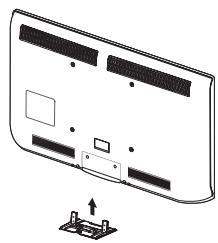
natural_image
Diagram of a computer monitor with ventilation slots and an attached circuit board (no text or symbols)
natural_image
Diagram of a computer monitor with ventilation slots and an attached mounting base (no text or symbols)
Montar os cabos
natural_image
Pure electrical circuit lines without any symbols
Dispositivo anti-roubo Kensington
natural_image
Illustration of a flat-screen monitor with display screen and control buttons (no text or symbols)
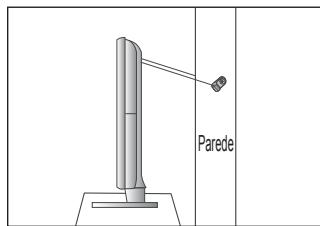
The provided image contains no text or OCR-able content. It displays a simple icon of a pencil inside a square frame.
Opomba
#
Gumb na dotik
[Non-Text]
Gumb TOOLS
A
Pritisnite
⑦ DIGITAL AUDIO OUT (OPTICAL)
8 AUDIO OUT [R-AUDIO-L]
natural_image
Diagram of a mechanical device with rotating arm and base, no text or symbols present
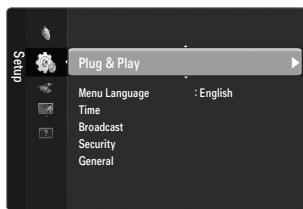
Ogled prikaza
Prikaz označuje trenutni kanal in stanje določenih zvočnih in slikovnih nastavitev.
Za ogled informacij pritisnite gumb INFO.
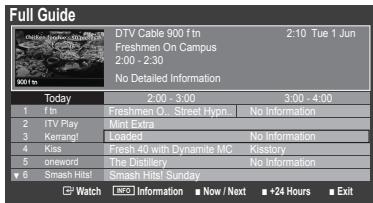
■ Add to Favourite / Delete from Favourite
Select All / Deselect All
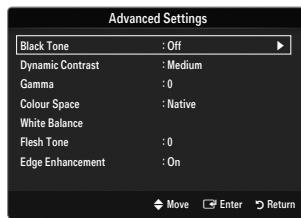
Colour Space
Načini zaslona
Če je signal iz sistema enak načinu standardnega signala, se zaslon samodejno prilagodi. Če signal iz sistema ni enak načinu standardnega signala, prilagodite način v skladu z navodili za uporabo grafične kartice, sicer slika morda ne bo prikazana. Za načine prikaza, navedene na naslednji strani, je bila slika zaslona optimizirana med izdelavo.
Vhod D-Sub in HDMI/DVI
| Način | Ločljivost | Vodoravna frekvenca (KHz) | Navpična frekvenca (Hz) | Točkovna ura (MHz) | Polariteta sinhr. (V/N) |
| IBM | 640 x 350 | 31,469 | 70,086 | 25,175 | +/- |
| 720 x 400 | 31,469 | 70,087 | 28,322 | -/+ |
| MAC | 640 x 480 | 35,000 | 66,667 | 30,240 | -/- |
| 832 x 624 | 49,726 | 74,551 | 57,284 | -/- |
| 1152 x 870 | 68,681 | 75,062 | 100,000 | -/- |
| VESA CVT | 720 x 576 | 35,910 | 59,950 | 32,750 | -/+ |
| 1152 x 864 | 53,783 | 59,959 | 81,750 | -/+ |
| 1280 x 720 | 44,772 | 59,855 | 74,500 | -/+ |
| 1280 x 720 | 56,456 | 74,777 | 95,750 | -/+ |
| 1280 x 960 | 75,231 | 74,857 | 130,000 | -/+ |
| VESA DMT | 640 x 480 | 31,469 | 59,940 | 25,175 | -/- |
| 640 x 480 | 37,861 | 72,809 | 31,500 | -/- |
| 640 x 480 | 37,500 | 75,000 | 31,500 | -/- |
| 800 x 600 | 37,879 | 60,317 | 40,000 | +/+ |
| 800 x 600 | 48,077 | 72,188 | 50,000 | +/+ |
| 800 x 600 | 46,875 | 75,000 | 49,500 | +/+ |
| 1024 x 768 | 48,363 | 60,004 | 65,000 | -/- |
| 1024 x 768 | 56,476 | 70,069 | 75,000 | -/- |
| 1024 x 768 | 60,023 | 75,029 | 78,750 | +/+ |
| 1152 x 864 | 67,500 | 75,000 | 108,000 | +/+ |
| 1280 x 1024 | 63,981 | 60,020 | 108,000 | +/+ |
| 1280 x 1024 | 79,976 | 75,025 | 135,000 | +/+ |
| 1280 x 800 | 49,702 | 59,810 | 83,500 | -/+ |
| 1280 x 800 | 62,795 | 74,934 | 106,500 | -/+ |
| 1280 x 960 | 60,000 | 60,000 | 108,000 | +/+ |
| 1360 x 768 | 47,712 | 60,015 | 85,500 | +/+ |
| 1440 x 900 | 55,935 | 59,887 | 106,500 | -/+ |
| 1440 x 900 | 70,635 | 74,984 | 136,750 | -/+ |
| 1680 x 1050 | 65,290 | 59,954 | 146,250 | -/+ |
| VESA GTF | 1280 x 720 | 52,500 | 70,000 | 89,040 | -/+ |
| 1280 x 1024 | 74,620 | 70,000 | 128,943 | -/- |
| VESA DMT/DTV CEA | 1920 x 1080p | 67,500 | 60,000 | 148,500 | +/+ |
Screen
Coarse / Fine
Namen prilagajanja kakovosti slike je odstraniti ali zmanjšati šum slike. Če šum ni odstranjen s fino naravnavo, čim bolje prilagodite frekvenco (Coarse) in znova fino naravnajte. Po zmanjšanju šumov znova nastavite sliko tako, da bo poravnana na sredino zaslona.
PC Position
☐ SRS TruSurround HD → Off / On
• Mode → Normal / Hard of hearing
MHEG (Multimedia and Hypermedia Information Coding Experts Group)
- Primary Audio Language / Secondary Audio Language / Primary Subtitle Language / Secondary Subtitle Language / Primary Teletext Language / Secondary Teletext Language
Child Lock → Off / On
Parental Lock → Parental Rating
☐ Energy Saving → Off / Low / Medium / High / Picture Off / Auto
Volume
- TOOLS (Tools): prikaz menijev Edit Name in Information.
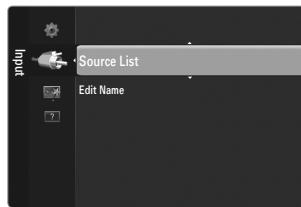
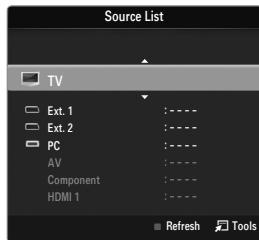
Edit Name
VCR / DVD / Cable STB / Satellite STB / PVR STB / AV Receiver / Game / Camcorder / PC / DVI / DVI PC / TV / IPTV / Blu-ray / HD DVD / DMA
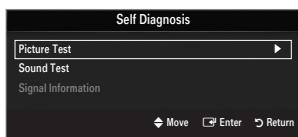
By Channel
Standby Mode Upgrade
- Pritisnite gumb MENU. Pritisnite gumb ▲ ali ▼ za izbiro opcije Application, in potem pritisnite gumb ENTER ↙.
-
Pritisnite gumb ▲ ali ▼ za izbiro opcije Media Play (USB), in potem pritisnite gumb ENTER ↙.
-
Pritisnite gumb ▲ ali ▼ za izbiro ustreznega USB pomnilnika in potem pritisnite gumb ENTER ☐.
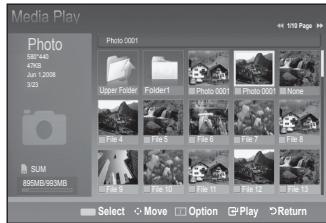
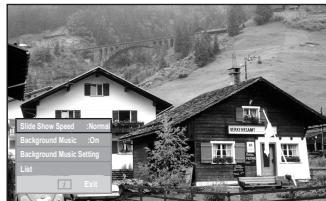
- Delete / Delete All / Delete Selected File (When multiple files are selected)
■ Deselect All (When at least one file is selected)
Slide Show Speed
Za uravnavanje hitrosti diaprojekcije.
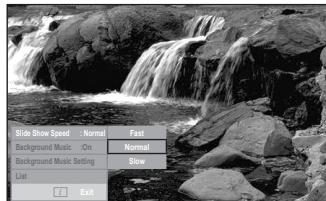
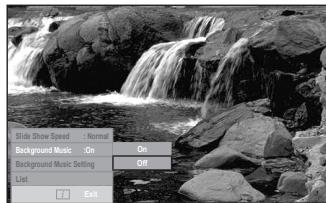
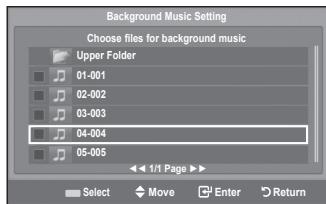
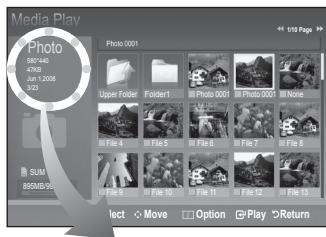

: Folder icon

: Photo icon

: Move to the previous folder stage icon
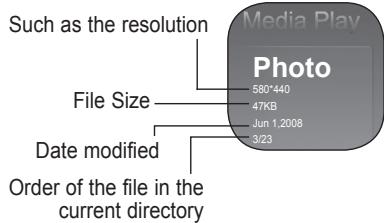
□ Uporaba menija z opcijami
- Ponovite korake 1 do 3 iz "Uporaba Media Play menija". (Poglejte stran 29)
- Pritisnite gumb ◀ ali ▶ in označite ikono Photo, in potem pritisnite gumb ENTER ▼ Informacije o datoteki se bojo prikazale kot mapa ali datoteka.
- Spritiskom na gumbe ▲, ▼, ◀ in ▶, izberite datoteko in potem pritisnite gumb ENTER □ Če pritisnete gumb, potem ko ste izbrali sličico za predogled, se bo slika prikazala na celem zaslonu.
- Pritisnite gumb INFO za prikaz opcije (Start Slide Show, Zoom, Rotate, List)
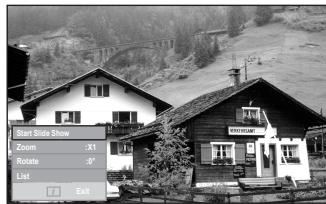
Start Slide Show
S pritiskom na gumb ▲ ali ▼, izberite opcijo Start Slide Show, in potem pritisnite gumb ENTER 📄 Lahko zaženete diaprojekcijo.
Zoom
S pritiskom na gumb ▲ ali ▼, izberite opcijo Zoom, in potem pritisnite gumb ENTER ▼. S pritiskom gumba ▲ ali ▼ izberite želeno možnost, nato pa pritisnite gumb ENTER ▼ (X1, X2, X4)
Rotate
S pritiskom na gumb ▲ ali ▼, izberite opcijo Rotate, in potem pritisnite gumb ENTER.
S pritiskom gumba ▲ ali ▼ izberite želeno možnost, nato pa pritisnite gumb ENTER (0°, 90°, 180°, 270°)
Ta meni prikazuje MP3 datoteke izmed datotek shranjenih na USB pomnilniku.
- Ponovite korake 1 do 3 iz "Uporaba Media Play menija". (Poglejte stran 29)
- Spritiskom na gumb ◀ ali ▶, označite ikono Music in potem pritisnite gumb ENTER □. Informacije o datoteki se bojo prikazale kot mapa ali datoteka.
- Pritisnite ▲ ali ▼ gumb za označevanje ikone, in potem pritisnite gumb ENTER ↙.
- Če izberete ikono glasbene note in pritisnete gumb ENTER ↙, se bo takoj začelo predvajanje glasbene datoteke.
- Če izberete ikono mape in pritisnete gumb ENTER ↩, prikazale se bojo glasbene datoteke katere se nahajajo v izbrani mapi.
-
Za izbiro datoteke na naslednji strani, pritisnite gumb ◀◀ ali ▶▶ za odpiranje nove strani.
-
Za izbiro ene ali vseh datotek, pritisnite gumb INFO za prikaz glasbenih menijev. Pritisnite gumb ENTER → za izbiro opcij Play, Repeat Music ali Select All.Za izhod iz "WISELINK" načina, pritisnite gumb W.LINK na daljinskem upravljalcu.
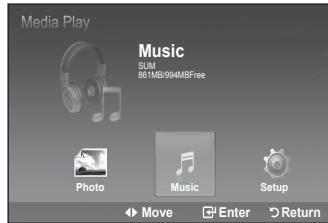
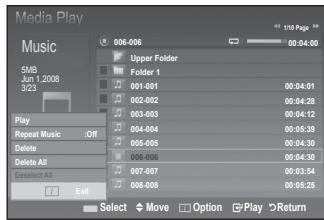
□ Uporaba menija z opcijami
Play
Predvaja MP3 datoteke.
Delete / Delete All/Delete Selected File (When multiple files are selected)
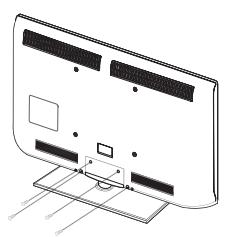
natural_image
Diagram of a flat-screen monitor with two slats and a stand, showing front panel and screen (no text or symbols)
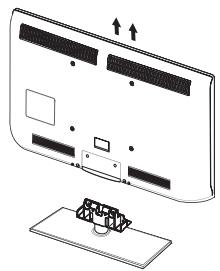
natural_image
Diagram of a computer monitor with an attached stand and two arrows indicating upward motion (no text or symbols present)
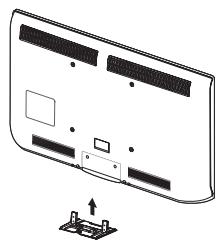
natural_image
Diagram of a computer monitor with ventilation slots and an attached base mount (no text or symbols)
natural_image
Diagram of a computer monitor with a base mount and an arrow indicating orientation (no text or symbols present)
Združitev kablov
natural_image
Pure electrical circuit lines without any symbols
Ključavnica Kensington proti kraji
natural_image
Illustration of a flat-screen monitor with display screen and control buttons (no text or symbols)
The provided image contains no text or OCR-able content. It displays a simple icon of a pencil inside a square frame.
Not
[Non-Text]
Tek Basmalı Düğme
[NO TEXT]
TOOLS Düğmesi
△
Basin
⑦ DIGITAL AUDIO OUT (OPTICAL)
8 AUDIO OUT [R-AUDIO-L]
natural_image
Diagram of a mechanical device with rotating arm and base, no text or symbols present
Menülere bakış
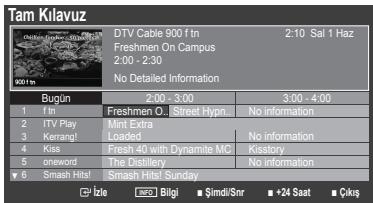
Ekran Modları
☐ SRS TruSurround HD → Kpalı / Açık
MHEG (Multimedia and Hypermedia Information Coding Experts Group)
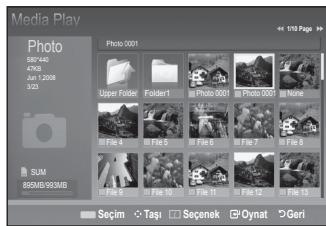
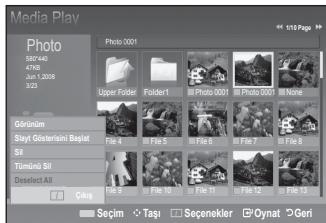
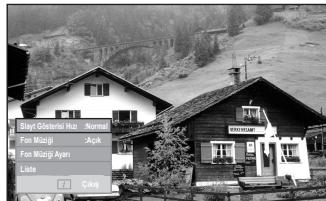
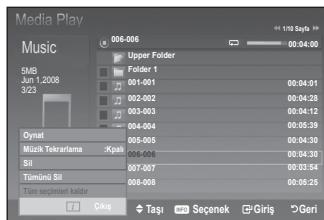
: When pressing the ■ button on the remote control when music is stopped.
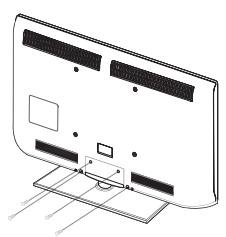
natural_image
Diagram of a flat-screen monitor with two slats and a stand, showing front panel and screen (no text or symbols)
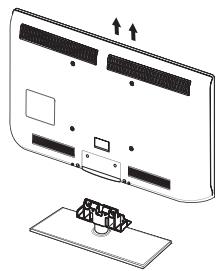
natural_image
Diagram of a computer monitor with an attached stand and two arrows indicating upward motion (no text or symbols present)
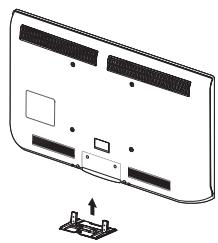
natural_image
Diagram of a computer monitor with ventilation slots and an attached base mount (no text or symbols)
natural_image
Diagram of a computer monitor with an attached stand and indicator lights (no text or symbols)
Kabloların Montajı
natural_image
Pure electrical circuit lines without any symbols
natural_image
Illustration of a computer monitor with labeled buttons and screen (no text or symbols)