
EFC226R - Fridge ELECTROLUX - Free user manual and instructions
Find the device manual for free EFC226R ELECTROLUX in PDF.
 FR
FR
 AR
AR
 BG
BG
 CS
CS
 DA
DA
 DE
DE
 EL
EL
 EN
EN
 ES
ES
 ET
ET
 FI
FI
 HU
HU
 IT
IT
 KK
KK
 LT
LT
 LV
LV
 MK
MK
 NL
NL
 NO
NO
 PL
PL
 PT
PT
 RO
RO
 RU
RU
 SK
SK
 SL
SL
 SQ
SQ
 SR
SR
 SV
SV
 TR
TR
 UK
UK
| Product type | Range hood |
| Brand | Electrolux |
| Model | EFC226R |
| Number of speeds | 3 (0-1, 2, 3) |
| Lighting | Yes, 4W bulb, E14 base, 220-240 V |
| Lighting power | 4 W |
| Bulb base | E14 |
| Supply voltage | 220-240 V |
| Grease filter | Dishwasher safe, monthly cleaning recommended |
| Charcoal filter | Optional, non-washable, replace every 4 to 6 months |
| Filter maintenance | Clean grease filters every month; replace charcoal filter at least every 4 months |
| Safety | Disconnect the appliance before any maintenance operation; use protective gloves to replace the bulb |
| Repairability | Spare parts available: grease filters, charcoal filter, bulb |
| Installation type | Wall or under-cabinet mounting |
| Recommended use | Let it run for 15 minutes after cooking |
Frequently Asked Questions - EFC226R ELECTROLUX
User questions about EFC226R ELECTROLUX
0 question about this device. Answer the ones you know or ask your own.
Ask a new question about this device
Download the instructions for your Fridge in PDF format for free! Find your manual EFC226R - ELECTROLUX and take your electronic device back in hand. On this page are published all the documents necessary for the use of your device. EFC226R by ELECTROLUX.
USER MANUAL EFC226R ELECTROLUX
natural_image
Technical line drawing of a mechanical component with two labeled parts (1 and 2), showing internal structure without any text or symbols.natural_image
Technical line drawing of a mechanical component with two labeled parts (1 and 2), showing internal structure without any text or symbols.natural_image
Technical line drawing of a mechanical component with two labeled parts (1 and 2), showing internal structure and rotation arrows (no text or symbols beyond labels)natural_image
Technical line drawing of a mechanical component with two labeled parts (1 and 2), showing internal structure and rotation arrows (no text or symbols beyond labels)natural_image
Technical line drawing of a mechanical component with two labeled parts (1 and 2), showing internal structure without any text or symbols.WE'RE THINKING OF YOU
Thank you for purchasing an Electrolux appliance. You've chosen a product that brings with it decades of professional experience and innovation. Ingenious and stylish, it has been designed with you in mind. So whenever you use it, you can be safe in the knowledge that you'll get great results every time.
Welcome to Electrolux.
Visit our website to:

Get usage advice, brochures, trouble shooter, service and repair information: www.electrolux.com/support

Register your product for better service: www.registerelectrolux.com

Buy Accessories, Consumables and Original spare parts for your appliance: www.electrolux.com/shop
CUSTOMER CARE AND SERVICE
Always use original spare parts.
When contacting our Authorised Service Centre, ensure that you have the following data available: Model, PNC, Serial Number.
The information can be found on the rating plate.
⚠ Warning / Caution-Safety information
i General information and tips
Environmental information
Subject to change without notice.
1. SAFETY INFORMATION AND INSTALLATION

WARNING!
Refer to the separate Installation Instructions booklet for Safety Information and Installation. Read carefully the Safety chapters before any use or maintenance of the appliance.
2. PRODUCT DESCRIPTION
2.1 Control panel overview
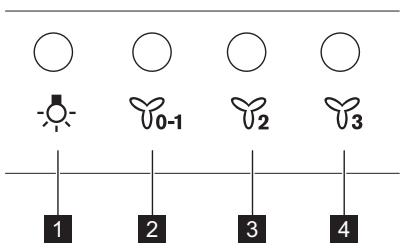
| Function | Description | |
| 1 | Lamp | Turns the lights on and off. |
| 2 | First speed / Off | The motor switches to first speed level. Second press turns off the appliance. |
| 3 | Second speed | The motor switches to second speed level. |
| 4 | Third speed | The motor switches to third speed level. |
3. DAILY USE
3.1 Using the hood
Check the recommended speed according to the table below.
 | While heating up food, cooking with covered pots. |
 | While cooking with covered pots on multiple cooking zones or burners, gentle frying. |
 | While boiling and frying big quantities of food without a lid, cooking on multiple cooking zones or burners. |

It is recommended to leave the hood operating for approximately 15 minutes after cooking.
To operate the hood:
- Press the first speed button 🎨0-1 to switch on the appliance.
- If needed, change the speed by pressing the desired button.

The hoods light works independently to other hood functions. To illuminate the cooking surface press the light button ⚙️.
To turn off the appliance press the first speed button 📋0-1 again.
4. CARE AND CLEANING
4.1 Notes on cleaning
 Cleaning Agents Cleaning Agents | Do not use abrasive detergents and brushes.Clean the surface of the appliance with a soft cloth with warm water and a mild detergent. |
| After cooking some parts of appliance can get hot. To avoid stains appliance must be cooled down and dried with clean cloth or paper towels. | |
| Clean stains with a mild detergent. | |
 Keep the hood clean Keep the hood clean | Clean the appliance and grease filters each month. Clean the interior and grease filters carefully from fat. Fat accumulation or other residue may cause fire. |
| Grease filters can be washed in a dishwasher.The dishwasher must be set to a low temperature and a short cycle. The grease filter may discolour, it has no influence on the performance of the appliance. | |
 Charcoal filter Charcoal filter | The time of saturation of the charcoal filter varies depending on the type of cooking and the regularity of cleaning the grease filter. The activated charcoal filter is not washable, cannot be regenerated and must be replaced approximately every 4/6 months of operation, or more frequently for particularly heavy usage. |
4.2 Cleaning the grease filter
Filters are mounted with the use of clips and pins on the opposite side.
To clean the filter:
- Press the handle of the mounting clip on the filter panel underneath the hood (1).
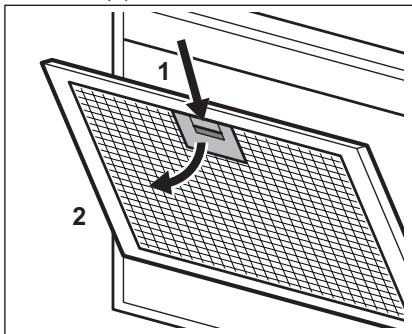
- Slightly tilt the front of the filter downwards (2), then pull.
Repeat the first two steps for all filters.
- Clean the filters using a sponge with non abrasive detergents or in a dishwasher.

The dishwasher must be set to a low temperature and a short cycle. The grease filter may discolour, it has no influence on the performance of the appliance.
- To mount the filters back follow the first two steps in reverse order. Repeat the steps for all filters if applicable.
4.3 Replacing the charcoal filter - optional

WARNING!
The charcoal filter is NON-washable! The filter cannot be regenerated!
To replace the charcoal filter:
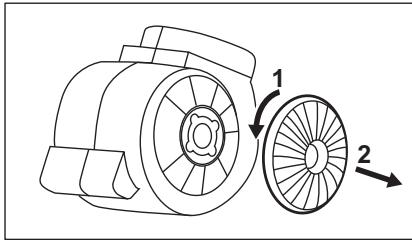
- Remove the grease filters from the appliance.
Refer to "Cleaning the grease filter" in this chapter. - Turn the filter counterclockwise (1) and then pull (2).
natural_image
Technical line drawing of a mechanical component with two labeled parts (1 and 2), showing internal structure without any text or symbols.To mount the filters back follow the steps in reverse order.
In any case, it is necessary to replace the filters at least every four months.
4.4 Replacing the lamp

WARNING!
Risk of burns and electric shock! Disconnect the appliance from the electricity before the operation! Make sure that the light bulb has cooled down before touching it.

WARNING!
Risk of injury! Use protective gloves to replace the lamp.

Risk of damage to the appliance! Do not use sharp edged tools!
Replace the burnt light bulb in accordance with the specifications:
| Power (W) | 4 |
| Socket | E14 |
| Voltage (V) | 220 - 240 |
| Dimensions (mm) | 37 x 100 (diameter x length) |
| ILCOS D Code (according IEC 61231) | DRBB/ F-4-220-240- E14-37/100 |
To replace the lamp:
- The lamp cover has two slots on each side. Use a flat non sharp plastic tool. Gently remove the lamp cover from the appliance.
- Replace the lamp.
- Mount the lamp cover.
5. ENVIRONMENTAL CONCERNS
Recycle materials with the symbol 📊. Put the packaging in relevant containers to recycle it. Help protect the environment and human health by recycling waste of electrical and electronic appliances. Do not dispose of
appliances marked with the symbol 📄 with the household waste. Return the product to your local recycling facility or contact your municipal office.
CONTENIDO
natural_image
Technical line drawing of a mechanical component with two labeled parts (1 and 2), showing internal structure and rotation arrows (no text or symbols beyond labels)natural_image
Technical line drawing of a mechanical component with two labeled parts (1 and 2), showing internal structure without any text or symbols.natural_image
Technical line drawing of a mechanical component with two labeled parts (1 and 2), showing internal structure without any text or symbols.natural_image
Technical line drawing of a mechanical component with two labeled parts (1 and 2), showing internal structure and rotation arrows (no text or symbols beyond labels)The results of the present study are presented in Table 1. The mean values of the three parameters were 2.0% (range, 1.5 - 3.0% ) and 2.4% (range, 1.5 - 3.0% ). The mean values of the other parameters were 1.8% (range, 1.5 - 2.5% ) and 1.9% (range, 1.5 - 2.5% ).
OU
3. SVAKODNEVNA UPORABA
3.1 Uporaba nape
natural_image
Technical line drawing of a mechanical component with two labeled parts (1 and 2), showing internal structure and rotation arrows (no text or symbols beyond labels)natural_image
Technical line drawing of a mechanical component with two labeled parts (1 and 2), showing internal structure without any text or symbols.natural_image
Technical line drawing of a mechanical component with two labeled parts (1 and 2), showing internal structure without any text or symbols.natural_image
Technical line drawing of a mechanical component with two labeled parts (1 and 2), showing internal structure and rotation arrows (no text or symbols beyond labels)natural_image
Technical line drawing of a mechanical component with two labeled parts (1 and 2), showing internal structure and rotation arrows (no text or symbols beyond labels)natural_image
Technical line drawing of a mechanical component with two labeled parts (1 and 2), showing internal structure and rotation arrows (no text or symbols beyond labels)natural_image
Technical line drawing of a mechanical component with two labeled parts (1 and 2), showing internal structure without any text or symbols.natural_image
Technical line drawing of a mechanical component with two labeled parts (1 and 2), showing internal structure and rotation arrows (no text or symbols beyond labels)natural_image
Technical line drawing of a mechanical component with two labeled parts (1 and 2), showing internal structure and rotation arrows (no text or symbols beyond labels)natural_image
Technical line drawing of a mechanical component with two labeled parts (1 and 2), showing internal structure without any text or symbols.natural_image
Technical line drawing of a mechanical component with two labeled parts (1 and 2), showing internal structure and rotation arrows (no text or symbols beyond labels)flowchart
graph TD
    A[" "] --> B[" "]
    C[" "] --> D["0-1"]
    E[" "] --> F["2"]
    G[" "] --> H["3"]
    I[" "] --> J["4"]
    style A fill:#fff,stroke:#000
    style C fill:#fff,stroke:#000
    style E fill:#fff,stroke:#000
    style G fill:#fff,stroke:#000
    style I fill:#fff,stroke:#000
    style J fill:#fff,stroke:#000