KS 9869 - Kitchen appliance SEVERIN - Free user manual and instructions
Find the device manual for free KS 9869 SEVERIN in PDF.



| Product Type | Combined refrigerator/freezer |
| Brand | SEVERIN |
| Model | KS 9869 |
| Dimensions (H x W x D) | 1760 x 600 x 650 mm |
| Weight | 70 kg |
| Energy efficiency class | A+++ |
| Annual energy consumption | 142 kWh/year |
| Total refrigerator capacity | 191 liters |
| Total freezer capacity | 88 liters |
| Freezing capacity | 4 kg/24 h |
| Storage time in case of power failure | 25 hours |
| Climate class | T (16 °C to 43 °C) |
| Refrigerant | Isobutane (R600a) |
| Noise level | 40 dB(A) |
| Refrigerator defrosting | Automatic |
| Freezer defrosting | Manual |
| Interior lighting | LED (not replaceable by user) |
| Reversible door | Yes, right or left |
| Number of refrigerator shelves | 4 (height-adjustable) |
| Vegetable drawer | 1 drawer & fresh fruits |
| Quick freezing compartment | Yes (Fast Freeze) |
| Ice cube tray | Yes |
| Power supply | See rating plate (230 V ~ 50 Hz) |
Frequently Asked Questions - KS 9869 SEVERIN
User questions about KS 9869 SEVERIN
0 question about this device. Answer the ones you know or ask your own.
Ask a new question about this device
Download the instructions for your Kitchen appliance in PDF format for free! Find your manual KS 9869 - SEVERIN and take your electronic device back in hand. On this page are published all the documents necessary for the use of your device. KS 9869 by SEVERIN.
USER MANUAL KS 9869 SEVERIN
natural_image
Exterior view of a modern stainless steel refrigerator with two doors and a front panel (no visible text or symbols)KS 9770, 9773, 9774
KS 9775, 9776, 9777
KS 9778, 9862, 9869
KS 9872, 9873, 9874
KS 9897, 9898, 9899
GB Instructions for use Fridge/freezer combination 14
natural_image
Line drawing of a kitchen appliance with a bowl and side-mounted tray (no text or symbols)natural_image
Simple line drawing of a structural beam or support frame (no text or symbols)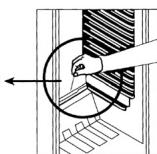
natural_image
Diagram showing a hand holding a circular object with an arrow pointing to it, surrounded by layered materials (no text or symbols)Before using the appliance, read the following instructions carefully and keep this manual for future reference. The appliance must only be used by persons familiar with these instructions.
Transporting the appliance
- To prevent damage to the unit during transport, ensure that all accessories and components inside and around the appliance are securely fastened.
- The unit must only be transported in its vertical position; do not tilt any more than 30^ . For positioning, we recommend that you tilt the unit slightly backwards. In this way, the transport rollers can be used to move it to its intended place of installation.
- Once the unit has been positioned, wait for about 30 minutes before it is connected to the mains.
- If the unit has been tilted more than 30^ during transport, allow it to stand in an upright position for at least 4 hours before it is connected to the mains.
Connection to the mains supply
- The appliance should only be connected to an earthed socket installed in accordance with the regulations.
Make sure that the supply voltage corresponds with the voltage marked on the rating label. The green mains indicator next to the temperature control shows that the unit is connected to the mains. - This product complies with all binding CE labelling directives.
- Do not operate this unit by means of a transformer.
- To prevent noise vibration, ensure that the power cord does not touch any part of the rear of the unit.
Intended use
- This appliance is a compressor refrigerator, designed for the short-term storage of food in the main cabinet and long-term storage of food in the freezer compartment.
- Using it in any way other than the above is not advised.
- No responsibility is accepted if damage results from improper use, or if these instructions are not complied with.
- This appliance is intended for
domestic or similar applications, such as
- in staff kitchens in shops, offices and similar working environments,
- in agricultural working environments,
- by customers in hotels, motels etc. and similar accommodation,
- in bed-and breakfast type environments.
- This appliance is not intended for commercial use, nor for use in the catering business or similar wholesale environments.
Important safety instructions
■
The cooling circuit in this appliance contains the refrigerant isobutane (R600a), a natural
gas with a high level of environmental compatibility, which is nevertheless flammable. Ensure, therefore, that none of the components of the refrigerant circuit become damaged during transportation and installation of the appliance. If damage to the cooling circuit does occur, do not switch on or connect the appliance to the mains power. In the case that there is an open fire or any other sources of ignition in the vicinity of the refrigerant gas, make sure it is removed immediately from this area and that the room is then thoroughly ventilated.
- Warning: Keep ventilation openings, in the appliance enclosure or in the
built-in structure, clear of obstruction. Sufficient ventilation must be ensured at all times.
- Warning: Do not damage the cooling circuit. Any escaping refrigerant causes damage to the eyes; there is also a danger of the gas igniting.
- Warning: Do not use any external device (e.g.; heaters or heating fans) to accelerate de-frosting; follow only the methods recommended in this manual.
- Warning: Do not operate any electrical appliances (e.g. ice makers) inside the storage compartment that are not specifically permitted in these instructions.
- Before it is connected to the mains power, the unit must be thoroughly checked for transport damage, including its power cord. In the event of any such damage being found, the appliance must not be connected to the mains.
- When positioning the appliance, ensure the supply cord is not trapped or damaged.
- Do not locate portable multible socket-outlets or portable power supplies at the rear oft he appliance.
- This appliance is not designed for the storage of explosive substances such as aerosol cans with a flammable propellant.
- If the unit is sold, handed over to a third party or disposed of at a suitable recycling facility, attention must be drawn to the presence of the insulation
agent ‘cyclopenthane’ as well as to the refrigerant R600a. For additional information on correct recycling please refer to the Disposal section.
- In order to comply with safety regulations and to avoid hazards, any repairs or modifications to this unit must be carried out by our authorised service personnel, including the replacement of the power cord.
- This appliance may be used by children (at least 8 years of age) and by persons with reduced physical, sensory or mental capabilities, or lacking experience and knowledge, provided they have been given supervision or instruction concerning the use of the appliance and fully understand all dangers and safety precautions involved.
- Children must not be permitted to play with the appliance.
- Children aged from 3 to 8 years are allowed to load and unload refrigerating appliances.
- Children must not be permitted to carry out any cleaning or maintenance work on the appliance.
- For frequent cleaning we recommend the use of warm water with some mild detergent. For detailed information on cleaning the appliance, please refer to the section De-frosting and cleaning.
- Caution: Do not remove the cover of the interior LED light. If there should be any malfunction, please contact the customer service for assistance (see appendix).
To avoid contamination of food respect the following instructions:
- Opening the door for long periods can cause a significant increase of the temperature in the compartments of the appliance.
- Clean regularly surfaces that can come in contact with food and accessible drainage systems.
- Store raw meat and fish in suitable containers in the refrigerator so that it is not in contact with or drip onto other food.
- If the refrigerating appliance is left empty for long periods switch off, defrost, clean, dry and leave the door open to prevent mould developing within the appliance.
Storing food
Main cabinet
- Different areas of the refrigerator cabinet are affected differently by the cooling effect. The warmest area is around the door in the higher part of the cabinet, the coldest around the rear wall and in the lower part of the cabinet.
- The food should therefore be stored as follows:
- On main cabinet shelves (from top to bottom): bakery items, ready meals, dairy products, meat, fish and cold meats/sausages.
-
In the vegetable compartment: vegetables, salad and fruit.
-
In the door (from top to bottom): butter, cheese, eggs, tubes (eg mustard), small bottles, large bottles, milk and fruit-juice tetra-packs.
- To prevent the risk of personal injury or damage to the unit, it must only be transported while in its original packaging. Two people are required for unpacking and installation.
- Caution: Keep any packaging materials well away from children: there is a risk of suffocation.
- The ice removed from the unit during de-frosting or cleaning is not suitable for human consumption.
- The power cord should be regularly examined for any signs of damage. In the event of such damage being found, the appliance must no longer be used.
- To avoid the risk of fire, do not place any electric appliances on top of the unit. Do not place liquid containers on top of the unit, to prevent any leaking or escaping liquid damaging the electrical insulation.
- This unit is designed for storing food only.
- Alcoholic substances may be stored only in properly sealed containers and in upright positions.
- Do not store any glass bottles containing liquids, especially carbonated ones, which are liable to freeze in the freezer compartment: such bottles may burst during the freezing process.
- To avoid the risk of food poisoning, do not consume food after its storage time has expired. Thawed foods must not be frozen a second time.
- Do not lean or put undue weight on the shelves, compartments, door etc.
- Protect the inside of the refrigerator at all times from open flames and any other sources of ignition.
- Remove the plug from the wall socket
- in case of any malfunction,
- before de-frosting,
- during cleaning,
- before maintenance or repair work is carried out.
- When removing the plug from the wall socket, never pull on the power cord; always grip the plug itself.
• We reserve the right to introduce technical modifications.
Familiarisation
- The components of your refrigerator-freezer unit may differ in quantity and design from those described here. This description refers to a unit of the group of two-compartment refrigerator-freezer combinations. The unit consists of two parts: Refrigerator (A) and Freezer cabinet (B).
- The quick-freeze compartment inside the freezer cabinet carries the symbol Fast Freeze.
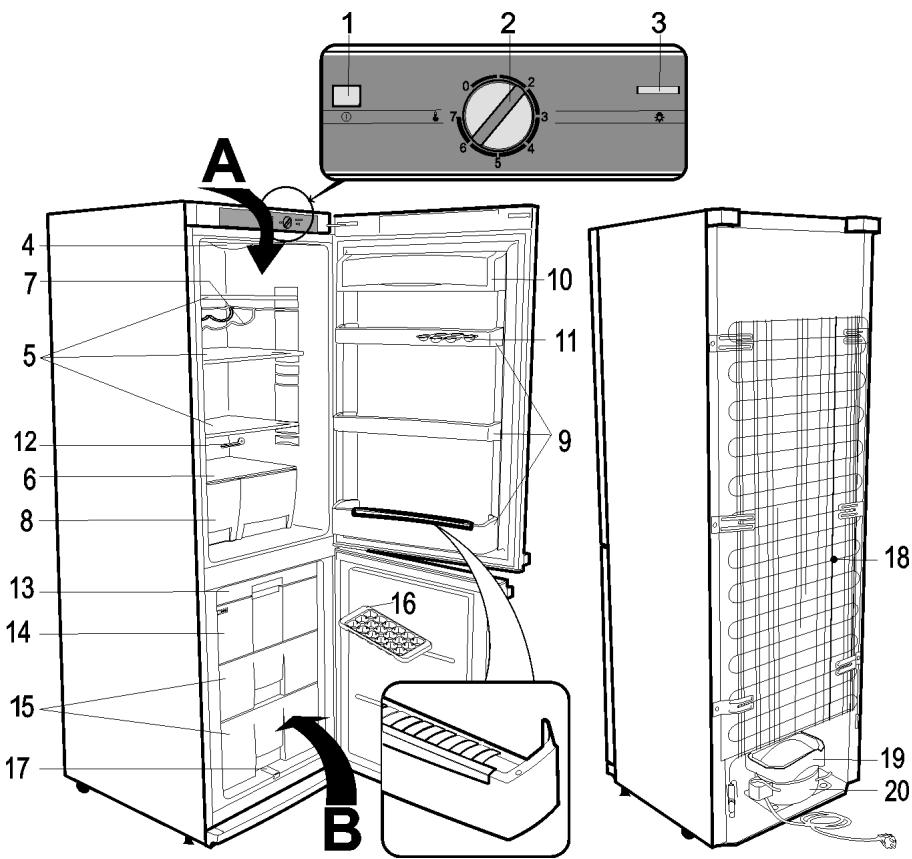
- Mains indicator light (green)
- Temperature control
- On/Off switch for interior light
- Interior light
- Storage shelves (height-adjustable)
- Glass storage shelf
- Bottle rack
- Vegetable/fruit fresh storage compartment
- Door storage
- Butter/cheese storage compartment
- Egg storage
- Drain channel cleaning tool
- Freezer tray
- Quick-freeze compartment
- Freezer compartments
- Ice-cube tray
- Freezer unit melt-water drain
- Condenser
- Melt-water evaporation tray
- Compressor
Before using for the first time
- Remove any exterior and interior packaging materials completely, including the red transport securing devices.
• The packaging materials must be properly disposed of. - NOTE: When the door to the freezer unit is opened, a small red component will fall out; this is for transport only and can be disposed of.
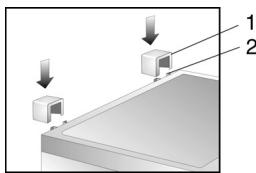
- Fit the two spacer elements (1, provided) into the corresponding guide slots (2) on the rear.
- Before it is connected to the mains, the unit must be thoroughly checked for transport damage, including its power cord.
- Clean the unit as described in the section De-frosting and cleaning.
- When the unit is first switched on, a slight 'new' smell may be noticed. However, this will disappear once the cooling process has begun.
Installation
- The appliance should be set up in a well-ventilated, dry room.
- It should be operated in conditions where the relative humidity is no more than 70 %.
- Refrigeration appliances are classified into certain climate classes. This classification indicates the ambient temperature at which the device can be operated. Please refer to the product data sheet for information on the classification for this unit; the data sheet can be found at the end of this manual.
- Do not use the appliance outdoors.
- Ensure that the plug is accessible and can be removed from the wall socket at any time.
- Do not expose the appliance to direct sunlight, and do not position it next to any heat sources (radiators, cookers etc). If this cannot be avoided, however, suitable insulation must be in installed between the heat source and the unit.
- The unit must not be installed inside a cabinet, nor directly below a hanging cupboard, shelf or similar object.
- In the case of uneven floors, the adjustable front feet on the unit can be used to compensate and ensure optimum stability.
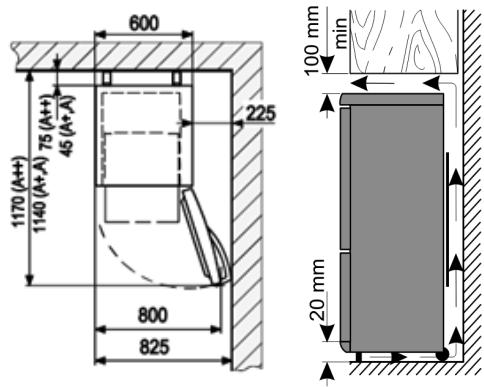
- If the unit is installed next to a wall, a minimum lateral distance of 225 mm is necessary, so that the doors can open wide enough for the drawers to be taken out.
Set-up dimensions
Ventilation
Ensure that there is enough space around the unit so that the air circulation round and behind it is not obstructed. (Rear, sides and top 100 mm.)
Temperature control
- The unit is re-activated by connecting it to the mains. It is only switched off completely when the plug is removed from the wall socket. In position '0', the cooling function is switched off, though the appliance is still connected to the mains.
- The temperature in the refrigerator cabinet can be adjusted by setting the temperature control. Turning the control clockwise will decrease the temperature, while turning it anti-clockwise will increase it.
- The medium settings are usually most suitable for home use.
- We recommend using a thermometer to check the actual temperature inside the cabinet and make adjustments as necessary.
- Following a power interruption, or if the unit has been switched off on purpose, it may take around 5 minutes before it switches on again.
Interior lighting
Caution: Do not remove the cover of the interior LED light. If there should be any malfunction, please contact the customer service for assistance.
Storing and freezing food
The temperatures inside the refrigerator cabinet and freezer compartment depend mainly on the ambient temperature, the temperature control setting and the amount of food stored. It should also be noted that the interior temperature may increase every time the door is opened.
Main cabinet
- Liquid or strong-smelling food, or food which is likely to absorb strong odours (e.g. cheese, fish, butter), should be stored separately or in hermetically sealed containers.
- Warm food should be left to cool down to room temperature before being placed in the refrigerator.
- Always ensure that the door is properly closed and that the seal is not obstructed by food stored inside the cabinet or door.
Freezer compartment:
- The freezer compartment is designed for deep-freezing and long-term storage of frozen food, and for making ice cubes.
- To ensure that nutritious elements such as vitamins are not lost, fresh food should be deep-frozen right through as quickly as possible. For this reason, prepared food should be put in the quick-freeze compartment, spaced out in one or two rows. The quick-freeze area inside the freezer compartment is marked Fast Freeze, where we recommend you first put the food to be frozen for quick-freezing, before moving it to other compartments (as appropriate) after 24 hours.
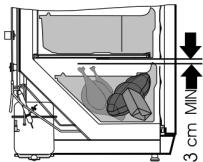
- To ensure sufficient distribution of cold air, keep a minimum distance of 3 cm between the vapouriser assembly and the tray containing the food to be frozen.
- Do not allow unfrozen food to come into contact with food that is already frozen.
- Caution: Do not exceed the maximum freezing capacity per day. The product data sheet at the end of this manual contains details of the maximum daily freezing capacity.
- For quick-freezing, set the temperature control to Max. After 24 hours, once the food is well frozen, the temperature control can be set back to its original position.
- The time required to freeze food may be shortened by dividing it into smaller portions.
- Suitable packaging materials for frozen food are transparent (i.e. non-coloured) plastic wrap or bags, or aluminium foil. The packaging materials should be well aired before use; check that the package is air-tight before freezing the food. We strongly recommend that you label every item stored in the freezer with all relevant information such as type of food, freezing date and use-by date.
- Do not attempt to deep-freeze carbonated beverages, warm food or any kind of bottled liquids.
- Frozen food can be defrosted in the refrigerator. This way, the food is defrosted at a slower rate, retaining its taste. Furthermore, the frozen food helps to keep the temperature inside the refrigerator at its intended level.
Use-by dates for frozen food are specified (in months) in the table below.
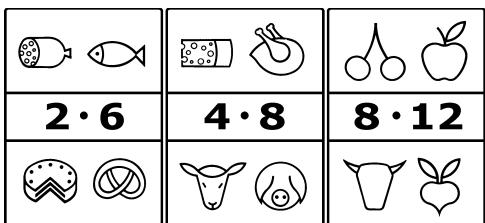
- Do not exceed these storage times.
- However, always observe the manufacturer's use-by dates for the frozen food.
- If the unit remains switched off for an extended period (eg during a power failure), the door should be kept closed; this will help to maintain the lowest possible temperature in the cabinet. The product data sheet contains detailed information of the maximum safe
storage time in case of malfunction. Even a slight rise in the inside temperature will shorten the storage life of the food.
Freezer tray
The freezer tray allows for gentle freezing of delicate foods such as herbs and fruit, while preventing them from sticking together. Place the goods to be frozen onto the tray individually and freeze them. After 8-10 hours, remove the frozen items and put them into suitable containers.
Making ice cubes
A special ice-cube tray is provided for making ice cubes. Fill the tray up to 34 with drinking water and place it in the freezer compartment for a few hours. The ice cubes are easier to remove from the tray if the tray is left standing at room temperature for 5 minutes.
De-frosting and cleaning
- Always remove the plug from the wall socket before cleaning.
- Do not pour water over or inside the unit.
- For frequent cleaning we recommend the use of warm water with some mild detergent. To prevent any unpleasant odour within the refrigerator, it should be cleaned about once a month.
- Any accessories should be cleaned separately with soapy water. Do not put them in a dishwasher.
- Do not use abrasives or harsh cleaning solutions or any cleaning agents that contain alcohol.
- After cleaning, thoroughly clean all surfaces with fresh water before wiping them completely dry.
- When re-inserting the plug into the wall socket ensure that you have dry hands.
- Take care not to remove or damage the rating plate inside the cabinet during cleaning.
De-frosting the freezer compartment
- After a certain period of operation and depending on several factors (e.g. how often the door has been opened), a layer of ice will form on the evaporators located below the drawers and on the drawer fronts themselves. Once the build-up of ice has reached a thickness of 3 to 5 mm, the unit must be de-frosted, as the build-up of ice increases the power consumption of the appliance.
- The freezer should be thoroughly cleaned at least twice a year.
- Always remove the plug from the wall socket before cleaning.
- Remove all food from the compartment and store it in a cool location, eg together with pre-frozen freezer-packs in a closed plastic container. Note that, even with a slight increase in temperature, the storage life will be shortened and the food should be used as soon as possible.
- Keep the door open.
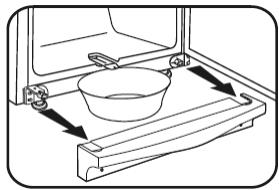
- Remove the cover panel.
natural_image
Line drawing of a kitchen appliance with a bowl and directional arrows indicating motion (no text or symbols)- Pull out the drain channel from the freezer cabinet, turn it 180° and secure it (see diagram). Place a suitable container underneath the channel outlet.
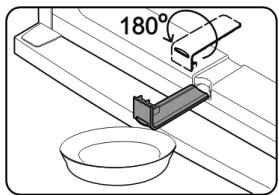
- To accelerate defrosting, one or several containers with hot (but not boiling) water may be placed inside the freezer compartment. Do not pour water over or inside the unit.
- Warning: Do not use any external device or other means (e.g. heaters or heating fans) to accelerate defrosting.
- Clean the unit with a damp cloth and a little detergent. Wipe thoroughly dry afterwards.
- Replace the drain channel and cover panel.
- Set the temperature control to its maximum position. After 24 hours, it may be turned back to its normal setting.
Defrosting the refrigerator cabinet :
- The refrigerator cabinet does not require de-frosting, but only proper cleaning.
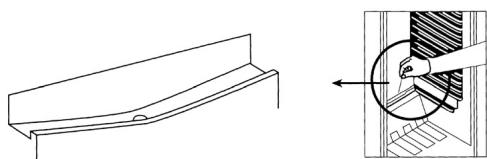
- The integral vapouriser is sealed in foam in the rear wall; you may therefore notice a build-up of frost around the rear area. This layer of frost will start melting when the compressor is not working. Through a system of hoses, the melt-water drains into the collection tray below the compressor, where it will be absorbed into the surrounding air.
natural_image
Technical line drawing of a mechanical component with an inset showing a magnified cross-section (no text or symbols)- To enable the melt-water to drain freely, always ensure that the channel and discharge opening in the cabinet are free of any blockage.
- Any water collecting in the bottom should be removed.
Energy saving tips
- The appliance should be set up in a well-ventilated, dry room.
- Do not expose the appliance to direct sunlight, and do not position it next to any heat sources (radiators, cookers etc.). If this cannot be avoided, however, suitable insulation must be installed between the heat source and the unit.
- Ensure sufficient air circulation around the sides of the unit.
- The compressor (at the rear) should be cleaned at regular intervals. Accumulated dust causes an increase in energy consumption.
- Warm food should be allowed to cool down before it is stored inside.
- To prevent an increased build-up of ice, do not leave the doors of the unit open for too long when loading or taking out food.
- Frequent de-frosting helps to save energy. For detailed information on cleaning the appliance, please refer to the section De-frosting and cleaning.
- Do not set a lower-than-necessary temperature. For detailed information on the temperature settings, please refer to the section Temperature control.
Operating noise
- Certain typical sounds can be heard when the appliance is switched on. These sounds are:
- caused by the electrical motor within the compressor assembly; during compressor start-up the sound level will be slightly
higher for a limited period of time.
- caused by the cooling agent flowing through the circuit.
Trouble-shooting
The following table lists possible malfunctions and their probable causes and solutions. In the event of operational problems, check first whether a solution can be found using this table. If the problem persists, disconnect the appliance from the mains power and contact our Customer Service Department.
| Problem | Possible cause and solution |
| The appliance is not working at all. | The temperature control is set to ‘0’. → Use a higher temperature setting.The wall socket is defective. → Check the fuse. If necessary, have the wall outlet checked by a qualified electrician. |
| The temperature inside the refrigerator cabinet or freezer compartment is not low enough. | Too much food has been stored in the appliance. → Do not store excessive food (see product data sheet).The doors are not properly closed. → Ensure that the doors are properly closed.The door seals are defective. → Check the door seals and contact our Customer Service if necessary.There is too much dust on the condenser. → Clean the condenser regularly.Insufficient ventilation: the unit is too close to a wall or other structure or object. → see section ‘Ventilation’.The temperature control is set too low. → Use a higher setting. |
| The normal operating sound changes or becomes louder. | The unit is not firmly set on the floor. → Use the adjustable front feet to align the unit properly.Adjacent furniture or objects are affected by the running of the cooling unit (i.e. causing them to vibrate). → Keep the stated clearances.Any objects on top of the unit might be vibrating → Remove such objects. |
| Water is collecting on the bottom of the unit. | The melt-water drain system is blocked. → Remove the blockage and clean the system. |
| Excessive build-up of frost on the rear of the main cabinet. | Hot food has been stored inside the cabinet. → Let the food cool down before putting it in.The door seals are defective. → Check the door seals and contact our Customer Service, if necessary.The temperature control is set too high. → Use a lower temperature setting. |
| Excessive build-up of frost inside the freezer compartment. | It is necessary to de-frost the freezer compartment manually. → See ‘De-frosting and cleaning’See ‘Excessive build-up of frost on the rear of the main cabinet’ (above). |
Reversible door
- If required, the door may be reversed, i.e. from right-hinged (default installation) to left.
- To avoid the risk of personal injury or damage to the unit, two people are needed to reverse the door.
- Warning: Always disconnect the unit from the mains before any maintenance or repair work is carried out.
• Before you start, please note the following: - Always ensure that the correct number of washers is used on all hinge bolts and screws.
-
So that the doors can close tightly against the frame, take the utmost care that they are properly aligned during re-assembly.
-
Remove the four covers C from the housing and inside of the door.
- Unscrew the hinge bolt on the inside of the door in the area C/6. Caution: Support the door.
- Take off the refrigerator door.
- Take out the fixing screws and remove the upper bracket 6. Note the small plastic plate underneath the bracket.
-
Turn the bracket 6 including the small plastic plate through 180° and replace it on the other side of the refrigerator, using the two screw holes adjacent to each other.
-
Place the refrigerator door on a soft surface. Remove the hinge support 5 from the underside of the door and fit the hinge support provided on the opposite side.
- Take out the covering caps and then remove the hinge support in the middle 4. Note the small plastic plate underneath the bracket. Caution: Support the door.
- Take off the freezer door 3.
- Remove the lower panel 1 by lifting it up slightly.
- Take out the fixing screws and remove the bracket 2 with its hinge bolt. Note the small plastic plate underneath the bracket.
- Unscrew the hinge bolt, together with the washers, from the bracket, and fit it into the corresponding opening on the opposite side of the bracket.
- Remove the bracket 7 and replace it with the holding bracket 2 with its hinge bolt.
- Now install the holding bracket 7 in the previous position of the bracket 2.
- Take out the sealing plugs 8 from the partition separating the refrigeration and freezer compartments and replace them in the openings on the opposite side.
- Take out sealing plugs 9 from the freezer door and replace it in the opening on the opposite side.
- Place the freezer door onto the hinge bolt on holding bracket 2. Caution: Support the door.
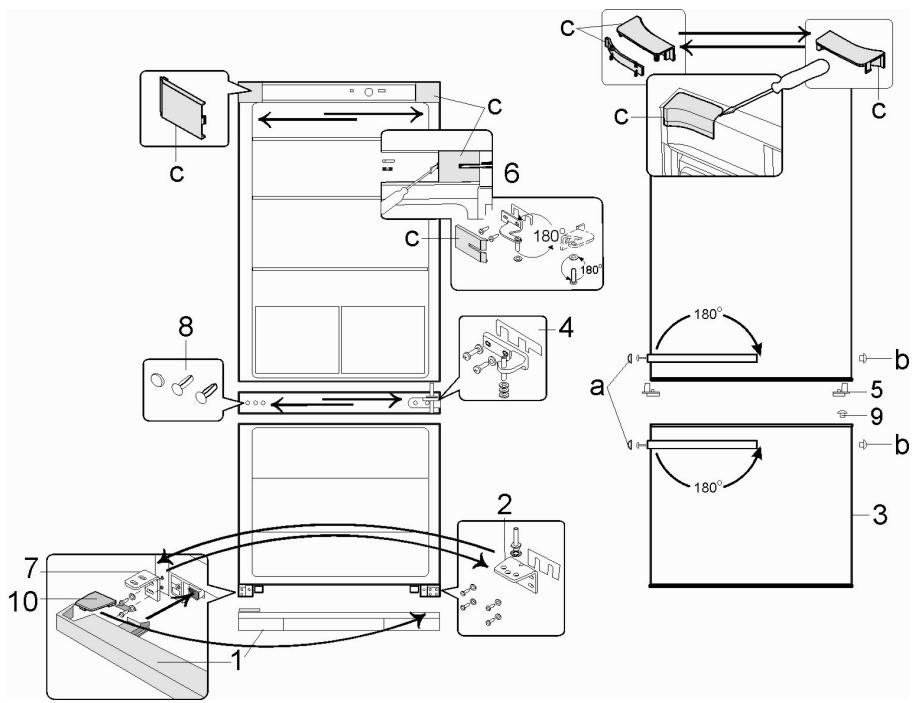
- Turn the holding bracket 4 with its hinge bolt and plastic plate through 180°.
- Replace the bracket bolt on the opposite side of the freezer door and secure it with the screws.
- Replace the covering caps over the screw heads.
- Place the refrigerator door onto the hinge bolt on holding bracket 4. Caution: Support the door.
- Re-insert the hinge bolt of the bracket 6 into the refrigerator door and secure it with the screws.
- Fit the four covers C over the bracket and the openings.
- Remove the screw covering caps a.
- Take out the screws holding the door handles. Move the handle slightly towards the side with the screw and then pull the handle off to the front.
- Fit the handles on the opposite side, using the fixing screws to secure them (note that the screws need to go through the sealing plugs b). Push the sealing plugs provided (b) into the now empty openings in the door and replace the covering caps (a) on the screw heads.
- Take out the cover 10 from the lower panel 1 and replace it on the opposite side.
- Replace the panel 1 on the appliance.
Disposal

Appliances that are marked with this symbol have to be disposed of separately from household rubbish. These appliances contain valuable resources that can be recycled. A correct waste
disposal protects the environment and the health of those around you. To get informed about it, either defer to your municipal administration or the retailer.
- Pull the mains plug out of the socket and disconnect it from the appliance before getting rid of it.
The cooling medium Isobutane (R600a) and the propellant in the isolation Cyclopentane (C5H10) are inflammable substances, thus,
need to be appropriately disposed of. - Make sure the tubes of the cooling circuit don't get damaged before the proper disposal
Guarantee
This product is guaranteed against defects in materials and workmanship for a period of two years from the date of purchase. Under this guarantee the manufacturer undertakes to repair or replace any parts found to be defective, providing the product is returned to one of our authorised service centres. This guarantee is only valid if the appliance has been used in accordance with the instructions, and provided that it has not been modified, repaired or interfered with by any unauthorised person, or damaged through misuse.
This guarantee naturally does not cover wear and tear, nor breakables such as glass and ceramic items, bulbs etc. This guarantee does not affect your statutory rights, nor any legal rights you may have as a consumer under applicable national legislation governing the purchase of goods. If the product fails to operate and needs to be returned, pack it carefully, enclosing your name and address and the reason for return. If within the guarantee period, please also provide the guarantee card and proof of purchase.
Information needed by the Customer Service Department
Should repairs to the appliance become necessary, please contact our Customer Service Department, providing a detailed fault description and quoting the model number KS ... on the rating plate of the appliance (see picture). This information will help us to handle your request efficiently.
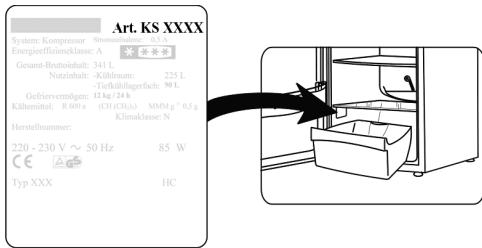
In case of any malfunction or other problem, please contact our Customer Services Department. The address can be found in the appendix to this manual.
Product data sheet for refrigerating appliances *
| Art. no. | KS 9770, 9773, 9774, 9775, 9776, 9777, 9897, 9898, 9899 | KS 9778, 9872, 9873, 9874 | KS 9862, 9869 |
| Household refrigerating appliance category | 7 - Fridge/freezer | 7 - Fridge/freezer | 7 - Fridge/freezer |
| Energy efficiency classification | A++ | A++ | A+++ |
| Energy consumption in kWh/year ** | 179 | 204 | 142 |
| Usable capacity - Refrigerator (litres) | 173 | 191 | 191 |
| Usable capacity - Zero-degree zone compartment (litres) | --- | --- | --- |
| Usable capacity **** - Freezer unit (litres) (without drawers) | 54 | 88 | 88 |
| Frost-free : refrigeration unit | yes | yes | yes |
| Frost-free : freezer unit | no | no | no |
| Safe storage time in case of malfunction, hrs. | 18 | 20 | 25 |
| Freezing capacity, kg/24h | 6 | 8 | 4 |
| Climate classification | ST | ST | T |
| Ambient temperature range, °C | 16-38 | 16-38 | 16-43 |
| Noise emission in dB(a) | 40 | 40 | 40 |
| Dimensions (H x W x D) in mm | 1500 x 600 x 650 | 1760 x 600 x 650 | 1760 x 600 x 650 |
| Weight (kg) | 55 | 64 | 70 |
| Electrical specifications | See rating plate | See rating plate | See rating plate |
* In accordance with EU directive 1062/2010 Annexe III
** The actual consumption depends on the pattern of use and the location of the appliance
Chère cliente, Cher client,
Compartiment congélation
natural_image
Line drawing of a kitchen appliance with a bowl and directional arrows indicating motion (no text or symbols)Vriezer compartiment:
natural_image
Line drawing of a kitchen appliance with a bowl and side-mounted handles (no text or symbols)natural_image
Technical line drawing of a mechanical component with an inset showing a magnified view of a gear or gear assembly (no text or symbols present)natural_image
Line drawing of a kitchen sink with a bowl and directional arrows indicating movement (no text or symbols)natural_image
Simple line drawing of a structural beam or support (no text or symbols)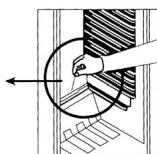
natural_image
Diagram showing a hand pressing down on a mechanical component with an arrow indicating direction (no text or symbols present)natural_image
Line drawing of a kitchen sink with a bowl and directional arrows indicating movement (no text or symbols)natural_image
Technical line drawing of a mechanical component with an inset showing a magnified view of internal components (no text or symbols)natural_image
Line drawing of a kitchen appliance with a bowl and side-mounted legs, no text or symbols presentnatural_image
Simple line drawing of a 3D rectangular object with a sloped top and corner edge (no text or symbols)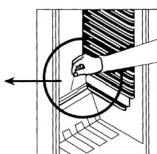
natural_image
Diagram showing a hand holding a circular object with an arrow pointing to it, overlaid on a mechanical component (no text or symbols present)natural_image
Line drawing of a kitchen appliance with a bowl and directional arrows indicating motion (no text or symbols)natural_image
Simple line drawing of a structural beam or support frame (no text or symbols)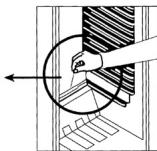
natural_image
Diagram showing a hand operating a circular component with a striped pattern, no text or symbols presentnatural_image
Line drawing of a kitchen appliance with a bowl and directional arrows indicating motion (no text or symbols)natural_image
Pure technical line drawing of a structural beam or support (no text or symbols)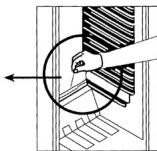
natural_image
Diagram showing a hand pressing down on a mechanical component with a circular arrow indicating direction (no text or symbols present)Regulator temperature
natural_image
Line drawing of a kitchen sink with a bowl and directional arrows indicating flow or movement (no text or symbols)natural_image
Technical line drawing of a mechanical component with an inset showing a magnified view of internal components (no text or symbols)natural_image
Line drawing of a kitchen appliance with a bowl and side-mounted stand (no text or symbols)natural_image
Technical line drawing of a mechanical component with an inset showing a magnified cross-section (no text or symbols)natural_image
Line drawing of a kitchen appliance with a bowl and handle, showing directional arrows indicating movement (no text or symbols)natural_image
Simple line drawing of a structural beam or support (no text or symbols)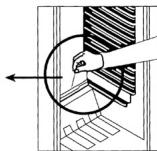
natural_image
Diagram showing a hand pressing down on a mechanical component with a circular arrow indicating direction (no text or symbols present)B4-061/062 NO,181 Exhibition Road,
Jiangdong District, Ningbo
Tel.: +86 400 166 0336
Fax.: +86 0574 55331669
Web: www.nbautin.com.cn
Web: www.autin.com.cn
Czech Republic
BVZ Commerce s.r.o.
Parkerova 618
CZ 25067 Klecany
Tel.: +420 233 55 94 74
Fax: +420 233 55 81 59
Danmark
F&H of Scandinavia A/S
Gl. Skivevej 70
DK-8800 Viborg
Tel.: +45 8928 1300
Fax: +45 8928 1301
26 Oaktree Business Park
Trim Co., Meath
Tel.: 046 94 83100
Fax: 046 94 83663
Web: www.bluestone.ie
Italia
ASSISTENZA POST-VENDITA
NUMERO VERDE 800224155
E-Mail: assistenza@severinitalia.it
Indonesia
PT. Setai Modern Elektronik
Email.: info@severin.co.id
Web.: www.severin.co.id
Jakarta
Komp. Glodok Plaza Blok F No. 9, Jl. Pinangsia Raya,
Jakarta Barat
021 65911888 / 021 6592889
Medan
Al Bahar Building P.O. Box 148
Safat 13002 Kuwait
Tel.: +965 4810855
Latvia
SIA GTCL BALTIC
Piedrujas iela 7
LV - Riga 1073
Tel.: +371 29119989
Fax: +371 67297769
Lebanon
Khoury Home
7th Floor, Cité Dora 3 Building, Dora
P.O.Box 70611
Antelias, Lebanon
Tel.: +961 1 244200
Fax:+966 1 253535
E-Mail: info@khouryhome.com
Internet: www.khouryhome.com
Luxembourg
Ser-Tec
A.A.K & Partners L.L.C.
P.O Box:-1650, Muttrah
Postal Code - 114
Sultanate of Oman
Tel.: +968 24834470
Fax.: +968 24835186
E-Mail: aakpllc@gmail.com
Philippines
COLOMBO MERCHANT PHILIPPINES, INC.
Mezzanine 1, South Center Tower
2206 Venture Street, Madrigal Business Park
Alabang, Muntinlupa City
Tel.: 809 34 41
E-Mail: severinconsumercare@colombophils.com.ph
Polska
Severin Polska Sp.z o.o.
Al.Jerozolimskie 56 C
00-803 Warszawa
Tel.: +48 882 000 370
6 Tagore Drive, #03-04
Singapore 787623
Tel.: +65 6455 0005
Fax: +65 6455 4010
Web: www.beste.com.sg
E-Mail: info@beste.com.sg
Slovenia
SEVTIS d.o.o.
Smartinska 130
1000 Ljubljana
Tel.: +386 1 542 1927
Fax: +386 1 542 1926
Slowak Republic
BVZ Commerce s.r.o.
Parkerova 618
CZ 25067 Klecany
Tel.: +420 233 55 94 74
Fax: +420 233 55 81 59
South Africa
AL&CD Ashley (PTY) Ltd.
3rd Floor, Grove Exchange
9 Grove Avenue
Claremont
South Africa
7708
Tel: +27 21 674 0294
Fax: +27 21 674 0295
Web: http://www.alcdashley.co.za
Mail: service@alcdashley.co.za
Svenska
Rakspecialisten HS
Möllevångsgatan 34
214 20 Malmö
Tel.: +46 40 12 07 70
Fax: +46 40 6 11 03 35
E-Mail: info@rakspecialisten.se
Switzerland
BLUEPOINT Service Sagl
Via Cantonale 14
CH-6917 Barbengo
Tel.: +41 91 980 49 72
Fax: +41 91 605 37 55
E-Mail: info@bluepoint-service.ch
Thailand
Verasu Ltd. part.
83/7 Wireless Rd., Lumpini,
Patumwan, Bangkok 10330
Tel.: +662 254 81 008
E-Mail: askverasu@verasu.com
United Kingdom
Homespares Centres Limited
Firwood Industrial Estate
Thicketford Road
Bolton, BL2 3TR
Tel.: 01204 558160
Fax: 01204 558169
HO CHI MINH CITY, VIETNAM
Tel.: +84 862 899 648
Fax: +84 862 899 649
E-Mail: info@brandpartner.vn
Stand: 10.2018 (Special Edition)