
ERCVE190-60B1 - Fridge ESSENTIELB - Free user manual and instructions
Find the device manual for free ERCVE190-60B1 ESSENTIELB in PDF.


| Product type | Combined refrigerator |
| Brand | ESSENTIELB |
| Model | ERCVE190-60B1 |
| Energy class | Class A |
| Total capacity | 190 L |
| Power supply | 220-240 V ~ 50 Hz |
| Refrigerant | R600a |
| Functions | Quick cooling, temperature adjustment, reversible door |
| Defrost | Automatic (frost-free) |
| Freezer star rating | 4 stars |
| Weight | 45 kg (approx.) |
| Dimensions (H x W x D) | 145 x 55 x 60 cm (approx.) |
| Noise level | 40 dB (approx.) |
| Included accessories | Egg holder, ice cube tray |
| Door reversal | Yes |
| Warranty | 36 months |
| Maintenance | Cleaning with mild detergent, automatic defrost |
| Spare parts | Available for 5 years |
| Expected lifespan | 5 years |
Frequently Asked Questions - ERCVE190-60B1 ESSENTIELB
User questions about ERCVE190-60B1 ESSENTIELB
0 question about this device. Answer the ones you know or ask your own.
Ask a new question about this device
Download the instructions for your Fridge in PDF format for free! Find your manual ERCVE190-60B1 - ESSENTIELB and take your electronic device back in hand. On this page are published all the documents necessary for the use of your device. ERCVE190-60B1 by ESSENTIELB.
USER MANUAL ERCVE190-60B1 ESSENTIELB
cleaning and maintenance 32
troublesheooting 33
tips For energy saving 33
warranty and limitation of liability 35
safety instructions
Before using this appliance, read the following instructions carefully and keep the operating instructions for future use.
- This appliance can be used by children aged from 8 years and above and persons with reduce physical sensory or mental capabilities or lack of experience and knowledge if they have been given supervision or instruction concerning use of the appliance in a safe way and understand the hazards involved.
- Children shall not play with the appliance.
- Cleaning and user maintenance shall not be made by children without supervision.
- This appliance is not intended to be used in household and similar applications such as:
- staff kitchen areas in shops, offices and other working environments;
- farm houses and by clients in hotels, motels and other residential type environments;
- bed and breakfast type environments;
- catering and similar non-retail applications.
- This product is a household refrigerator and shall be only suitable for the storage of foods. According to national standards, household refrigerators shall not be used for other purposes, such as storage of blood, drugs or biological products.
- Warning: When positioning the appliance, ensure the supply cord is not trapped or damaged.
- This refrigeration appliance is not intended to be used as an integrated appliance. The appliance can not be built into furniture, wall or similar locations.
- Before connecting the appliance to an electrical outlet, make sure that the local power supply corresponds to that indicated on the rating label affixed to the appliance.
- A special plug is installed to the power cable of your
appliance. This plug must be plugged into a grounded wall outlet with at least 16 A. If you should not have such a wall outlet, have it installed by a qualified electrician.
- Warning - Do not damage the refrigerant circuit.
- The refrigerant gas R600a that is contained in the refrigerator is a natural gas. It is not harmful to the environment, but combustible. It is therefore important to transport and install your refrigerator carefully so as not to damage the refrigerant ducts. In the event of a gas leak, avoid contact with nearby flames or fires and ventilate the room.
- Risk of electric shock! Do not try to repair the appliance yourself. In case of malfunction, repairs must be carried out by qualified personnel.
- If the supply cord is damaged, it must be replaced by the manufacturer, its service agent or similarly qualified persons in order to avoid a hazard.
- Warning - Keep ventilation openings, in the appliance enclosure or in the built-in structure, clear of obstruction.
- Warning – Do not use mechanical devices or other means to accelerate the defrosting process, other than those recommended by the manufacturer.
- Warning – Do not use electrical appliances inside the food storage compartments of the appliance, unless they are of the type recommended by the manufacturer.
- Do not store explosive substances such as aerosol cans with a flammable propellant in this appliance.
- Do not put flammable, explosive, volatile and highly corrosive items in the refrigerator to prevent damages to the product or fire accidents.
- Do not place flammable items near the refrigerator to avoid fires.
- Do not place items such as bottled or sealed container of fluid such as bottled beers and beverages in the freezer to prevent bursts and other losses.
- The appliance has to be unplugged after use and
before carrying out user maintenance on the appliance.
-
Tips for cleaning the appliance can be found in the "Cleaning and maintenance" chapter.
-
Defective electrical appliances must be recycled and not disposed of in
the household waste. Please actively help us in our efforts to conserve resources and protect the environment by depositing this device in collection centres and waste disposal centres.
- Dispose of the appliance according to local regulators as it uses flammable blowing gas and refrigerant.
- Before scrapping the appliance, remove the doors to prevent children from becoming trapped.
- Risk of suffocation! Keep all packaging materials out of the reach of children and babies!
- Recycle packaging materials in accordance with regulations. Ask the local authorities where collection centres or waste disposal centres are located.
- Children aged from 3 to 8 years are allowed to load and unload refrigerating appliances.
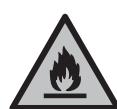
- WARNING: Risk of fire / flammable materials.
- WARNING: When positioning the appliance, ensure the supply cord is not trapped or damaged.
WARNING: Do not locate multiple portable socket-outlets or portable power supplies at the rear of the appliance.
-
To avoid contamination of food, please respect the following instructions:
-
Opening the door for long periods can cause a significant increase of the temperature in the compartments of the appliance.
- Clean regularly surfaces that can come in contact with food and accessible drainage systems.
- Clean water tanks if they have not been used for 48 ~h ; flush the water system connected to a water
supply if water has not been drawn for 5 days.
- Store raw meat and fish in suitable containers in the refrigerator, so that it is not in contact with or drip onto other food.
- Two-star frozen-food compartments are suitable for storing pre-frozen food, storing or making icecream and making ice cubes.
- One-, two- and three-star compartments are not suitable for the freezing of fresh food.
- If the refrigerating appliance is left empty for long periods, switch off, defrost, clean, dry, and leave the door open to prevent mould developing within the appliance.
32. The drawers, trays and shelves are organised as shown in the description of the appliance so that the energy is used as efficiently as possible.
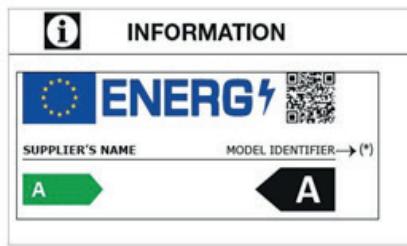
You can find the information on the models as they have been recorded in the product database on the following website by conducting a search for the model's ID (^*) shown on the energy label: https://eprel.ec.europa.eu/
The service life of your appliance is 5 years. During this time, the original replacement parts will be available to ensure your appliance works properly.
Link to the supplier's website for the information in appendix, point 4 a), of regulation (EU) 2019/2019 of the Commission: https://www.boulanger.com/info/assistance/
components
- Cooling 1
- Cooling 2
- Cooling 3
- Cooling 4
-
Cooling 5
-
Fast cool
- Set button
Accessories provided: egg tray and ice-cube tray.
installation
Reversing the direction of the door opening

Warning! Disconnect the appliance from the wall outlet when reversing the direction of the door opening.
| Steps | Tool needed | Fig. |
| Remove the knuckle guard. | A | |
| Remove the top hinge. | B | |
| Remove the door of the refrigerating compartment. | C | |
| Remove the middle hinge. | Screwdriver | D |
| Remove the door of the freezing compartment. | E | |
| Remove the hinge assembly. Assemble the lower hinge assembly to the left side of the cabinet. | Screwdriver | F |
| Assemble the door of the freezer compartment on the lower hinge. | G | |
| Assemble the middle hinge assembly on the left side of the cabinet. | H | |
| Assemble the refrigerator's door. | I | |
| Take on knuckle guard. | J |
before First use
Unpacking
- Unpack all parts.
- After unpacking, check for completeness of delivery and for shipping damage. If your delivery is damaged or incomplete, please contact our after-sales service.
Choosing an appropriate location

Warning! Position the appliance so that it is not exposed to direct sunlight. This appliance should not be used outdoors or exposed to rain.

Warning! The appliance must be separated by a distance of at least 50~cm from heat sources (such as stoves, ovens, radiators, etc.) and at least 5cm from electric ovens.
- Place the refrigerator in a well ventilated room on a dry, stable and level surface, away from direct sunlight and other heat sources.
- Ensure sufficient air circulation at the rear of the appliance. Do not place the appliance against a wall to avoid noise caused by vibration. Make sure that the air can still circulate freely around the appliance. Insufficient ventilation would result in malfunction and increased energy consumption. Leave a space of at least 10cm between the refrigerator and the wall, and at least 30~cm between the top of the refrigerator and the ceiling.
- Leave enough space to access and open the door easily: ≥ 990 × 1025 ~mm (fig. K). If necessary, change the direction of the door opening (→ REVERSING THE DIRECTION OF THE DOOR OPENING).
- If the refrigerator is placed on an uneven surface, level the appliance using the adjustable feet (fig. L). This will ensure proper operation without vibration.
operation
Commissioning the appliance
- After transport, unpacking and installation and before the first use, let the appliance rest for 2 hours in vertical position.
- Clean the appliance and its components (7. CLEANING AND MAINTENANCE).
- Connect the power plug with a wall outlet.
- Set the temperature to a high level using the SET button (TEMPERATURE CONTROL (REFRIGERATOR)).
- Let the refrigerator run for 24 hours before inserting fresh or frozen foods.
Temperature control (refrigerator)
Note: The temperature inside the appliance is the result of several factors, such as the ambient temperature, the quantity of food stored, the frequency of opening of the door, etc. Adjust the setting accordingly using the SET button.
- Turn the SET button to the desired position. Position 2 is for the coldest temperature, position 8 is the least cold. To stop the refrigerator completely, disconnect it from the all outlet.
- Fast cool: Press the SET button several times until "SUPER" is shown in the display. The appliance will now operate for 150 minutes in a rapid cooling mode. Press the SET button again if you want to change to a different cooling setting.
Temperature control (Freezer)
The temperature control inside the freezer compartment offers 3 settings:
Setting
| NORMAL | Default position. |
| COLD | Ambient temperature above 35 °C. This setting is most useful during the summer. |
| COLDER | Ambient temperature below 10 °C. This setting is most useful during the winter. Appropriate setting for normal & daily use. |
Accessories
Various glass or plastic storage shelves are included with your appliance - different models have different combinations.
Always slide one of the full size glass storage shelves into the lowest set of guides, above the fruit and vegetable containers.
Keeping Food in the appliance
Cooked meats/fishes should always be stored on a shelf above raw meats/fishes to avoid bacterial transfer. Keep raw meats/fishes in a container which is large enough to collect juices and cover it properly. Place the container on the lowest shelf.
- Leave space around your food, to allow air to circulate inside the appliance. Ensure all parts of the appliance are kept cool.
To prevent transfer of flavours and drying out, pack or cover the food separately. Fruit and vegetables do not need to be wrapped.
Preserving an excessive amount of food during operation may adversely affect the cooling capability of the refrigerator.
Refrigerating compartment
The refrigerating compartment is suitable for storage of a variety of fruits, vegetables, beverages and other food consumed in the short term.
- Cooking foods shall not be put in the refrigerating compartment until cooled to room temperature.
- Foods are recommended to be sealed up before putting into the refrigerator.
The glass shelves can be adjusted up or down for a proper storage space and easy use.
Freezing compartment
The low temperature freezing compartment may keep food fresh for a longer time and it is mainly used to store frozen foods and making ice.
The freezing compartment is suitable for storage of meat, fish and other foods not to be consumed in short term.
- Chunks of meat are preferably to be divided into small pieces for easy access. Please be noted food shall be consumed with the shelf time.
Note: Storage of too much food during operating after the initial connection to power may adversely affect the freezing effect of the refrigerator. Foods stored shall not block the air outlet; or otherwise the freezing effect will also be adversely affected.
Noise inside the appliance
You may notice that your appliance makes some unusual noises. Most of these are perfectly normal. These noises are caused by the circulation of the refrigerant liquid in the cooling system. This is not a fault and will not affect the performance of your appliance.
Changing the luminary
The luminary shall be replaced by professionals only.
cleaning and maintenance

Warning! Always disconnect the power plug from the wall outlet before cleaning.

Warning! Do not use any corrosive detergent, wire brush, abrasive cleaner, sharp object or metal to clean the appliance.
| Parts | Cleaning |
| Inserts and interior surfaces | Remove all the shelves, the crisper and the egg tray. Wash the parts in lukewarm water with a mild, odourless detergent (e.g. dishwashing liquid). Rinse with water and dry thoroughly. |
| Housing | Wipe off regularly with a soft cloth and mild detergent. The dust behind the refrigerator and on the floor must be cleaned in a timely manner to maintain the cooling capability and energy saving. |
DeFrosting
This appliance is a frost-free refrigerator. It does not require manual defrosting.
Moving the appliance

Warning! Do not place the appliance upside down or sideways. During transport, the inclination must not exceed 45^ .
- If the appliance needs to be moved: Remove all food and items stored inside and secure all accessories inside the refrigerator with tape.
- Attach the adjustable feet.
- Close the door and secure with tape.
- Secure the power cord on the outside of the appliance with tape to prevent transport damages.
Switching off For long periods of time
When the appliance is not in use for a long period of time, disconnect it from the mains supply, remove all food and clean the appliance. Leaving the door slightly ajar to prevent unpleasant smells.
troubleshooting
| Problem | Solution |
| No operation. | Check whether the appliance is plugged in and connected to power. Low voltage. Failure power or tripping circuit. |
| Odour. | Odorous foods should closely wrapped. Check whether foods are rotten. Check whether the interior shall be cleaned. |
| Long-term operation of compressor. | The appliance operates for longer time in summer when the ambient temperature is higher. Do not put too much food in the appliance at one time. Do not put foods until they are cooled. Frequent opening of refrigerator door. |
| Illuminating light remains off. | Check whether the refrigerator is connected to power. Check whether the illuminating light is damaged. |
| The refrigerator door cannot be properly closed. | The freezer door is stuck by food packages. Too much food inside the appliance. Tilt the refrigerator by a few degrees. |
| Loud noises. | Check whether the food is levelled and whether the appliance is balanced. Check whether the refrigerator accessories are properly inserted. |
- The refrigerator enclosure may emit heat during operation, especially in summer. This is caused by the condenser, and it is a normal phenomenon.
- Condensation phenomenon will be detected on the exterior surface and door seals of the freezer when the ambient humidity is large. This is normal. Wipe off condensation with a dry towel.
tips For energy saving
Try not to open the door too often, especially when the weather is wet and hot. Once you open the door, close it as soon as possible.
Every now and then check if the appliance is sufficiently ventilated (adequate air circulation behind the appliance).
In normal climatic conditions, arrange the thermostat at the middle setting.
Before loading the appliance with packages of fresh food, make sure they are cooled to ambient temperature.
- Ice and frost layer increases energy consumption, so clean the appliance as soon as the layer is 3 to 5mm thick.
- Keep the rear of the appliance free from dust.
The appliance should be located in the coolest area of the room, away from heat producing appliances or heating ducts, and out of the direct sunlight.
- Let hot foods cool to room temperature before placing in the appliance. Overloading the appliance forces the compressor to run longer. Foods that freeze too slowly may lose quality, or spoil.
- Wrap foods properly, and wipe containers dry before placing them in the appliance. This cuts down on frost build-up inside the appliance.
- Do not line the appliance's storage bin with aluminium foil, wax paper, or paper towelling. Liners interfere with cold air circulation, making the appliance less efficient.
- Organize and label food to reduce door openings and extended searches. Remove as many items as needed at one time. Close the door as soon as possible.
Food storage tips
| Refrigerator compartments | Type of food |
| Door compartments | Foods with natural preservatives, such as jams, juices, drinks, condiments. Do not store perishable foods. |
| Crisper drawer | Fruits, herbs and vegetables should be placed separately in the crisper bin. Fresh bananas, potatoes, onions and garlic should not be kept in the refrigerator. |
| Refrigerator shelf – bottom Chiller box/drawer | Raw meat, poultry, fish (for short-term storage) |
| Refrigerator shelf – middle | Dairy products, eggs |
| Refrigerator shelf – top | Foods that do not need cooking, such as ready-to-eat foods, deli meats, leftovers. |
| Freezer drawer/shelf | Foods for long-term storage. Bottom drawer/shelf for raw meat, poultry, fish. Middle drawer/shelf for frozen vegetables, chips. Top drawer/shelf for ice cream, frozen fruit, frozen baked goods. |
To avoid contamination of food, please respect the following instructions:
- Opening the door for long periods can cause a significant increase of the temperature in the compartments of the appliance.
Clean regularly surfaces that can come in contact with food and accessible drainage systems. - Clean water tanks if they have not been used for 48h : flush the water system connected to a water supply if water has not been drawn for 5 days.
- Store raw meat and fish in suitable containers in the refrigerator, so that it is not in contact with or drip onto other food.
- Two-star frozen-food compartments are suitable for storing pre-frozen food, storing or making ice-cream and making ice cubes.
One, two-and three-star compartments are not suitable for the freezing of fresh food.
If the refrigerating appliance is left empty for long periods, switch off, defrost, clean, dry, and leave the door open to prevent mould developing within the appliance. - Do not place hot foods and/or liquids directly in the appliance. Always allow them to cool down before placing them in the appliance.
Do not place food against the rear wall of the appliance.
Store cleaned fruits and vegetables in the crispier drawers (3), butter and cheeses in airtight containers and milk bottles in the door compartments (4). - When placing foods in containers or bags, write the date on the packaging to remind you when the food was stored.
- Avoid opening the doors too often and for too long to reduce the loss of cold air and prevent humidity build-up in the appliance compartments.
Do not refreeze frozen foods after thawing. - Follow the food manufacturer's storage recommendations for frozen foods.
- Do not place items such as bottled or sealed containers of fluid (e. g. bottled beers and beverages) in the freezer, as they may burst and spoil other food items.
Prepare food in small batches to allow it to freeze and thaw more quickly. It also allows you to thaw and cook a suitable quantity of food.
warranty and limitation of liability
This product is guaranteed for a period of 36 months (defined by local law) from the date of purchase against any failure resulting from manufacturing or material defects.
This warranty does not cover damage caused by improper installation, improper use, or normal wear and tear of the product.
More specifically, the warranty does not cover:
- Damage or problems caused by improper use, accident, alteration or electrical connection of improper intensity or voltage.
- Modified products, those whose warranty seal or serial number have been damaged, altered, removed or oxidized.
- Replaceable batteries and accessories are guaranteed for a period of 6 months.
- Failure of the battery due to overcharging or failure to observe the safety instructions explained in the instruction manual.
Cosmetic damage, including scratches, dents, or any other element. - Damage caused by any intervention carried out by an unauthorised person.
Defects caused by normal wear and tear or due to normal ageing of the product. - Software updates due to a change in network settings.
Product failures due to the use of third party software to modify, change or adapt the existing software.
Product failures caused by use without accessories approved by the manufacturer. - Oxidised products.
Under no circumstances can the manufacturer be responsible for the loss of data stored on the disk. Similarly, the manufacturer is not required to verify that the SIM/SD cards are removed from the returned products.
Repaired or replaced products may include new and/or reconditioned components and equipment.
Terms and conditions of implementation
To obtain a warranty service, you are requested to return your product to the customer service desk of your retail outlet with your proof of purchase (receipt, invoice, ...), the product and its supplied accessories, with its original packaging.
It is important to have the date of purchase, the model and the serial or IMEI number on hand as information (this information usually appears on the product, the packaging or your proof of purchase).
Failing this, you must return the product with the accessories necessary for its proper operation (power supply, adaptor, etc.).
In the event that your claim is covered by the warranty, the after-sales service may, within the limits of local law, either:
Repair or replace defective parts.
Exchange the returned product with a product that has at least the same functionality and that is equivalent in terms of performance.
Refund the product at the purchase price of the product mentioned on the proof of purchase.
If one of these 3 solutions is used, this does not give rise to the extension or renewal of the warranty period.
INDICE
59810 Lesquin, France

Faites un geste