USER MANUAL ERAVE180-90V2 ESSENTIELB
To help you get the best out of your purchase
PLEASE READ THE INSTRUCTIONS CAREFULLY BEFORE USING THE APPLIANCE AND KEEP THEM IF NEEDED FOR FUTURE REFERENCE.
WARNING:
Risk of fire!
WARNING: Keep ventilation openings, in the appliance enclosure or in the built-in structure, clear of obstruction.
WARNING: Do not use mechanical devices or other means to accelerate the defrosting process except as recommended by the manufacturer.
WARNING: Do not damage the refrigeration circuit.
WARNING: Do not use electrical appliances other than those recommended by the manufacturer inside the food storage compartments of your product.
WARNING: When positioning the appliance, ensure the supply cord is not trapped or damaged.
WARNING: Do not locate multiple portable socket-outlets or portable power supplies at the rear of the appliance.
Transportation and positioning of refrigerators
Transportation
- Avoid leaning on the refrigerator, vibrating or turning it upside down.
- During transportation, do not tilt to an angle of greater than 45 degrees.
- When moving the appliance, do not snag the door or hold the refrigerator by the door.
Positioning
- Make sure that air can circulate freely around the refrigerator. Do not place the appliance near a heat source. Also, do not expose it to direct sunlight, moisture or water. Avoid rust and weakening of the insulation.
- The space at the top must be at least 30~cm . The space on both sides and at the back must be at least 10~cm from the wall so that the door can be opened and closed and heat can escape. Install the refrigerator on a flat and solid floor (if the floor is not flat, you will not be able to adjust the leveling system).
- WARNING: Make sure that the power cord is not caught under the refrigerator or other heavy objects. If the power cord is damaged, there could be an immediate malfunction. Before connecting the power cord, please check carefully the voltage range of the refrigerator and power cord.
Cleaning
- Leftover food left in the refrigerator can smell unpleasant. The refrigerator must therefore be cleaned regularly.
- For added safety, disconnect the power cord before cleaning.
- Use a soft cloth or sponge with hot water to clean the refrigerator.
- Remove water from the surface of the refrigerator with a dry cloth.
- This appliance is designed for use in homes and similar places such as:
- kitchen areas in shops, offices and other professional settings;
- secondary homes, hotel and motel rooms and other types of residences;
- dining areas;
- restaurants and retail spaces.
- The appliance must be unplugged after use. The appliance must also be unplugged before servicing.
- Children aged from 3 to 8 years are allowed to load and unload refrigerating appliances. This appliance may be used by children at least 8 years of age and by persons with reduced physical, sensory or mental capabilities or lack of experience or knowledge, provided that they are properly supervised or instructed in the safe use of the
appliance and understand the risks involved. Children must not play with this appliance. The appliance must not be cleaned or serviced by unattended children.
- If the power cord is damaged, it must be replaced by the manufacturer, its representative or qualified personnel to avoid any risk.
- Please use and dispose of this refrigerator in accordance with local regulations as the appliance uses flammable gas and refrigerant.
- Do not store explosive substances such as aerosols with a flammable propellant in this appliance.
- For information on the installation, handling, maintenance and disposal of the appliance, please refer to the next paragraph of the manual.
When food needs to be frozen quickly, let it cool to room temperature first. Then place it in the freezer and activate the "Super Freezing" function for quick freezing.
- The mains plug must remain accessible or a switch must be installed in the fixed circuit in accordance with the installation rules in order to ensure that the appliance can be disconnected from the mains power supply under all circumstances.
- Please refer to the end of this manual for information on cleaning and maintenance of this appliance.
To avoid contamination of food, please respect the following instructions:
- Opening the door for long periods can cause a significant increase of the temperature in the compartments of the appliance.
- Clean regularly surfaces that can come in contact with food and accessible drainage systems.
- Clean water tanks if they have not been used for 48 ~h ; flush the water system connected to a water supply if water has not been drawn for 5 days.
- Store raw meat and fish in suitable containers in the refrigerator, so that it is not in contact with or drip onto other food.
- Two-star frozen-food compartments are suitable for storing pre-frozen food, storing or making ice-cream and making ice cubes.
- One-, two- and three-star compartments are not suitable for the freezing of fresh food.
- If the refrigerating appliance is left empty for long periods, switch off, defrost, clean, dry, and leave the door open to prevent mould developing within the appliance.
https://eprel.ec.europa.eu/
We thank you for purchasing an Essentiel b brand product. We pay special attention to the RELIABILITY, EASE OF USE and DESIGN of our products.
We hope that you will be fully satisFied with this American-style Fridge-Freezer.
contents
Before using the appliance
| Overview of the appliance | 47 |
| Description of appliance | 47 |
| Control panel | 48 |
| Use of the appliance | 50 |
| Installation | 50 |
| Use | 54 |
| Useful tips and tricks | 56 |
| Practical information | 58 |
| Cleaning and maintenance | 58 |
| Troubleshooting | 59 |
| INFORMATIONS | 60 |
Overview of the appliance
Description of appliance
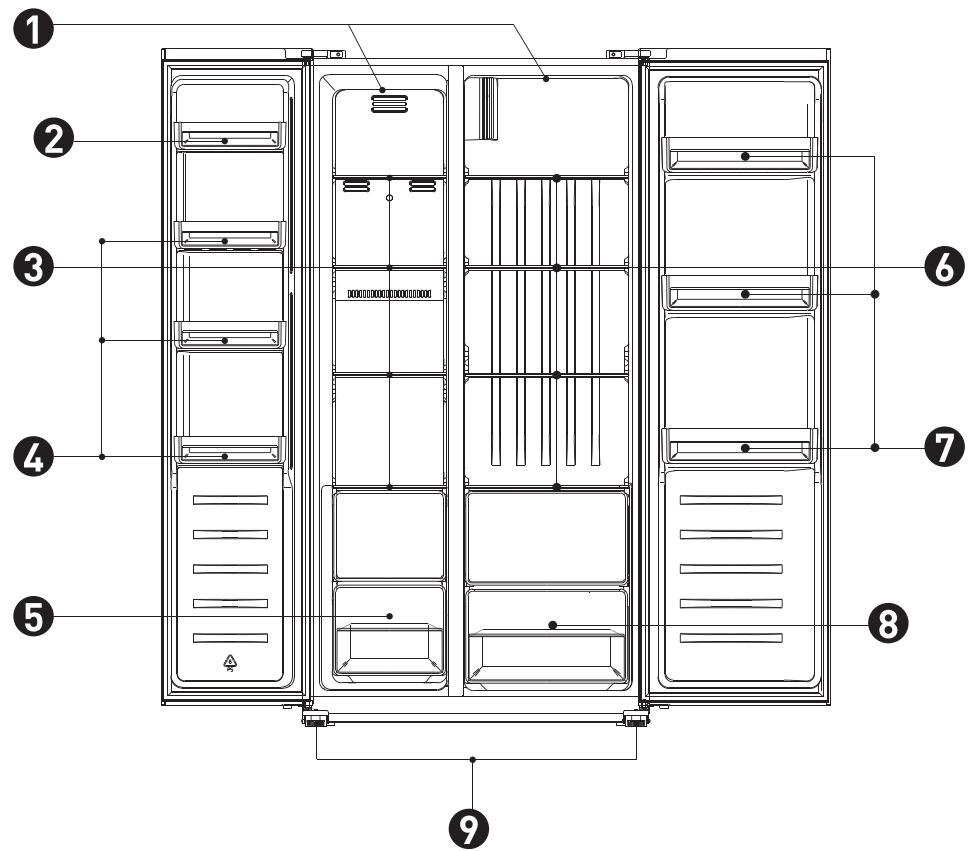
-
LED lights
-
Door bin

-
Freezer shelves
-
Freezer door bins
-
Freezer drawer(s)
-
Refrigerator shelves
-
Refrigerator door bins
- Refrigerator drawer(s)
- Adjustment leg
NOTE: The image opposite is provided for information purposes only. Your model may differ from the illustration.
Control panel
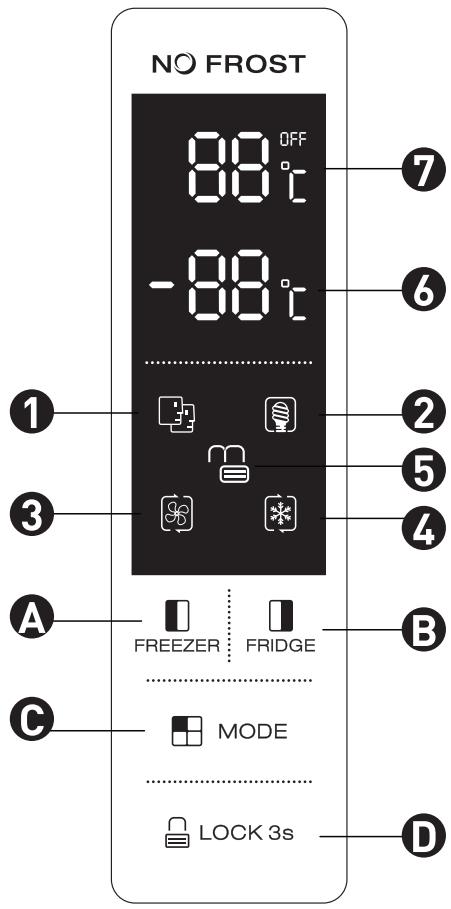
A. Press this button to adjust the temperature of the freezer compartment (left side) from -14^ to -22^ .
B. Press this button to adjust the temperature of the refrigeration compartment (right side) from 2^ to 8^ or to turn it off. If you select "OFF", the refrigeration compartment will be turned off.
C. Press this button to select the operating mode: "SMART", "ECO", "SUPER COOLING", "SUPER FREEZING" or USER SETTINGS (no symbol displayed).
D. Press and hold this button for 3 seconds to lock the other three buttons. Press this button for 1 second to unlock the other three buttons.
Display
- In "SMART" mode, the refrigerator automatically regulates the temperature of the two compartments, based on the internal temperature and the ambient temperature.
- In "ECO" (economy) mode, the refrigerator selects the setting for minimum energy consumption.
- In "SUPER COOLING" mode, the refrigeration compartment operates at its lowest temperature for about 2 hours. At the end of this period, the temperature that was set before activating this mode is automatically restored.
- In "SUPER FREEZING" mode, the freezer compartment operates at its lowest temperature for about 6 hours. At the end of this period, the temperature that was set before activating this mode is automatically restored.
- "LOCK": This symbol lights up if the buttons are locked.
- Displays the temperature set for the freezer compartment.
- Displays the temperature set for the refrigeration compartment.
Door opening alarm
If one of the doors is left open for 90 seconds, an audible signal will sound steadily until the door is closed.
Use of the appliance
Installation
- NOTE: For all electrical connections, please carefully follow the instructions given in the corresponding sections.
- Unpack the appliance and check for damage. Do not connect the appliance if it is damaged. Report any damage immediately to the point of sale where you purchased the appliance. In this case, keep the packaging.
- It is advisable to wait at least four hours before connecting the appliance to allow the oil to return to the compressor.
- Ensure good air circulation around the appliance to avoid overheating. To ensure sufficient ventilation, please follow the installation instructions.
- Whenever possible, the product spacers should be installed against a wall, so that users cannot touch or hang on to hot parts (compressor, condenser) and thus avoid burns.
- The appliance must not be installed near radiators or cookers.
- Make sure that the power outlet is accessible once the appliance is installed.
- This refrigerator is not intended to be used as an integrated appliance.
Servicing
- Any electrical operation required to service the appliance must be performed by a qualified electrician or another competent person.
- This appliance must be serviced by an Authorized Service Center and only original spare parts should be used.
Energy savings
- Do not place hot food in the appliance.
- Do not store food too closely together; this prevents proper air circulation.
- Make sure that the food does not touch the back of the compartment(s).
- Do not open the door(s) in the event of a power failure.
- Do not open the door(s) too often.
- Do not leave the door(s) open for too long.
-
Do not set the thermostat to temperatures that are too cold.
-
It is possible to take out some of the fridge accessories, such as the bins, to give a greater storage capacity. The appliance description presents the most efficient arrangement of the drawers, bins and shelves in terms of energy use
Removing the doors
Required tool: Phillips screwdriver, flat-bladed screwdriver.
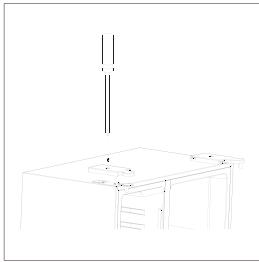
- Disconnect the wiring harness.
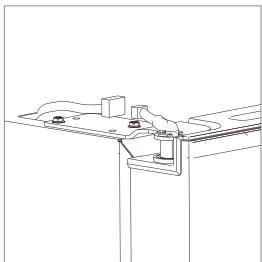
- Unscrew the top hinge.
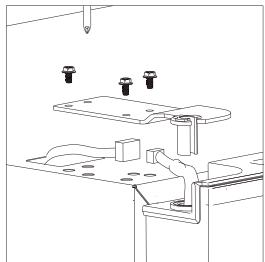
- Lift the door and place it on a soft, padded surface. Next, remove the other door following the same procedure.
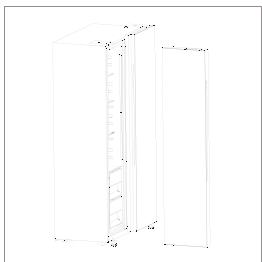
- Unscrew the lower hinges.
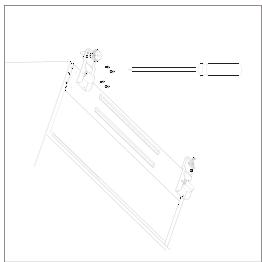
- Once the appliance is in place, reinstall the doors by following the same procedure in reverse.
Required space
- Choose a location that is not exposed to direct sunlight.
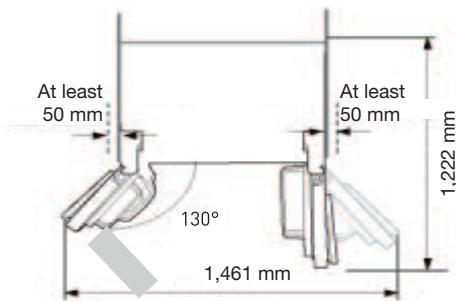
- Be sure to leave enough room for the refrigerator doors to open easily.
- Select an area with a flat (or almost flat) floor.
-
Allow enough room to install the refrigerator on a flat surface.
-
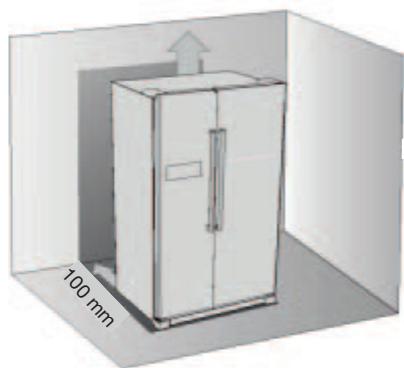
Leave space on the right, left, rear and top of the appliance when installing it. This will help reduce your electricity consumption and lower your energy bills.
Leveling and stabilizing the refrigerator
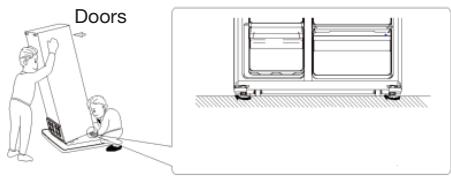
- Level and stabilize the refrigerator by adjusting its legs.
- Turn the legs clockwise to raise them manually.
- Turn the legs counterclockwise to lower them manually.
Environment
Install the appliance in a place where the ambient temperature corresponds to the climate class indicated on the nameplate:
| Climate class | Ambient temperature |
| SN | from +10 °C to +32°C |
| N | from +16 °C to +32°C |
| ST | from +16 °C to +38°C |
| T | from +16 °C to +43°C |
Positioning
- The appliance must be installed at a safe distance from heat sources such as radiators, boilers, direct sunlight, etc. Make sure that air can circulate freely at the rear of the appliance. For optimum operation, if the appliance is placed under a wall unit, the distance between the top of the appliance and the wall unit should be at least 100mm . However, if possible, it is preferable not to place the appliance under wall units. Precise leveling is possible thanks to one or more adjustable legs located at the bottom of the appliance.
- WARNING: It must be possible to unplug the appliance from the mains outlet; the mains outlet must therefore remain easily accessible after installation.
Electrical connections
Before connecting the appliance, make sure that the voltage and frequency indicated on the nameplate match the power supply to your home. The appliance must be grounded. The plug of the power cord has a contact for this purpose. If the plug on your power supply is not grounded, get a qualified electrician to connect the appliance to a separate grounding line that complies with applicable regulations.
The manufacturer declines all responsibility in the event of failure to comply with the above safety precautions.
The appliance conforms to EC directives.
Use
Before using the appliance for the first time
Cleaning the interior
Before using the appliance for the first time, wash the interior and all internal accessories with warm water and neutral soap to eliminate the characteristic odor of new appliances. Dry them thoroughly.
NOTE: Do not use detergents or abrasive powders, as these will damage the finish of the appliance.
Daily use
Freezing fresh food
- The freezer compartment is suitable for freezing fresh food and keeping food frozen or deep-frozen for an extended period of time.
- Place the fresh food you want to freeze in the lower compartment.
- The maximum amount of food that can be frozen in 24 hours is indicated on the nameplate.
- The freezing process takes 24 hours: do not add any other food to be frozen during this period.
Preservation of frozen foods
When using for the first time or after a long period of non-use, before placing products in the compartment, let the appliance run for at least 2 hours at the lowest temperature setting.
NOTE: In the event of accidental thawing (e.g. if the power has been cut for longer than the time indicated in the table of technical data under the heading "Rise time"), the thawed food should be consumed quickly, or cooked immediately and then refrozen (after cooking).
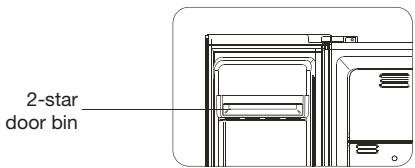
WARNING: The 2-star door bin, whose temperature is between -12^ and -18^ , is not suitable for ice cream storage.
Thawing
Before using frozen or deep-frozen food, it can be thawed in the refrigerator compartment or at room temperature, depending on how much time you have for this operation.
Small portions can even be cooked while they are still frozen, as soon as they are removed from the freezer. In this case, they will take longer to cook.
Accessories
Removable shelves
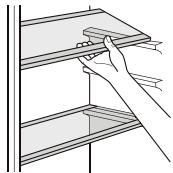
The walls of the refrigerator are equipped with various rails to allow you to position the shelves at your convenience.
Positioning the door bins
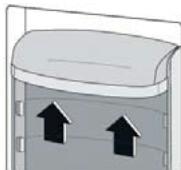
The door bins can be positioned at different heights to accommodate different sizes of food packaging. To make these adjustments, proceed as follows: gradually pull the door bin in the direction of the arrows until it is fully removed. Reposition it as you see fit.
Useful tips and tricks
Freezing tips
To optimize the freezing process, here are some important tips:
- The maximum amount of food that can be frozen in 24 hours is indicated on the nameplate.
- The freezing process takes 24 hours. No other food should be added during that period.
- Only freeze fresh, top-quality, perfectly clean food.
- Prepare small portions so that they can freeze completely and quickly and to allow you to subsequently thaw only the required amount.
- Wrap the food in foil or cling film and make sure the packages are airtight.
- Do not allow fresh, unfrozen food to come into contact with already frozen food as this will cause the temperature of the food to rise.
- Lean foods keep better and longer than fatty foods. Salt reduces the shelf life of food.
- If consumed immediately after being removed from the freezer compartment, ice cubes can cause cold burns.
- Frozen food, immediately after being removed from the freezer compartment, can cause cold burns.
- It is advisable to mark the date visibly on each individual frozen portion so that the shelf life can be tracked.
Tips for storing frozen food
To optimize the performance of this appliance:
- ensure that the frozen food has been properly stored by the retailer;
- make sure you transport frozen food from the grocery store to your freezer as quickly as possible;
- do not open the door frequently, or leave it open longer than necessary.
- Do not refreeze thawed food as it will spoil quickly.
- Do not exceed the expiry date indicated by the food manufacturer.
Tips for refrigerating fresh food
For optimum performance:
- Do not store hot foods or liquids that evaporate in the refrigerator.
- Cover or wrap food, especially if it has a strong flavor.
Refrigeration tips
Useful tips:
- Wrap food in polyethylene bags and place it on the glass shelves above the crisper.
- As a precaution, only store food in this way for a day or two at the most.
- Cooked food, cold dishes, and so on should be covered and can be placed on any shelf.
- Fruit and vegetables should be thoroughly washed and placed in the specific bin(s) provided.
- Butter and cheese should be placed in special airtight containers or wrapped in aluminum foil or polyethylene bags to exclude as much air as possible.
- Milk bottles, with caps, should be stored in the door bins.
- Bananas, potatoes, onions and garlic should not be stored in the refrigerator if they are not packaged.
Checking the temperature
We recommend that when using your refrigerator for the first time, the refrigerator temperature should be set to 3^ and the freezer temperature to -18^ . If the OK symbol does not appear inside the refrigerator, lower the thermostat to 2^ . If you wish to change the temperature, please follow the instructions below.
WARNING: The temperature setting corresponds to an average temperature over the entire refrigerator.
WARNING: The temperatures within each compartment may therefore differ from the temperature values indicated on the panel, depending on the amount of food stored and how you have placed it. The ambient temperature may also cause the temperature inside the appliance to vary.
Cleaning and maintenance
For hygiene reasons, the interior of the appliance and its interior accessories must be cleaned regularly.
WARNING: Shock hazard! Do not clean the appliance when it is connected to the power supply. Before cleaning, switch off the appliance and pull out the mains plug or switch off the appliance and switch off the circuit breaker or remove the fuse.
WARNING: Never clean the appliance with a steam cleaner. Moisture could accumulate in the electrical components; this could result in a risk of electric shock! Hot steam can damage plastic parts. The appliance must be completely dry before putting it back into operation.
WARNING: Essential oils and organic solvents, such as lemon juice or juice from orange peel, butyric acid and cleaners containing acetic acid can attack plastic parts.
- Do not allow such substances to come into contact with any part of the appliance.
- Do not use abrasive cleaners.
- Remove the food from the freezer. Place it, suitably covered, in a cool place.
- Switch off the appliance and pull out the mains plug or switch off the appliance and turn off the circuit breaker or remove the fuse.
- Clean the appliance and its interior accessories with a cloth dampened with warm water. After cleaning, wipe with cold water and dry with a dry cloth.
- Once everything is dry, the appliance can be switched back on.
Troubleshooting
WARNING: Before troubleshooting, switch off the power supply. Only a qualified electrician or competent person should perform troubleshooting not described in this manual.
NOTE: Noise may occur during normal use (compressor, refrigerant circulation).
NOTE: The LED bulbs are not replaceable by the user. In case of malfunction, please contact customer service.
| Problems | Potential causes | Solutions |
| The appliance does not work. | The mains plug is not plugged in or is not inserted correctly. | Insert the mains plug correctly. |
| The fuse has blown or is defective. | Check the fuse and replace it if necessary. |
| The mains outlet is defective. | Mains malfunctions must be corrected by an electrician. |
| The food is too hot. | The temperature is not adjusted properly. | Please refer to the initial chapter on setting the temperature. |
| The door was left open for an extended period of time. | Do not leave the door open longer than necessary. |
| A large amount of hot food has been placed in the appliance in the last 24 hours. | Temporarily set the temperature to a colder setting. |
| The unit is located near a heat source. | Please refer to the chapter on the installation location of the appliance. |
| The appliance cools too much. | The temperature setting is too cold. | Temporarily turn the temperature knob to a warmer setting. |
| Unusual noises | The appliance is not level. | Re-adjust the legs of the appliance. |
| The appliance is touching the wall or other objects. | Move the appliance slightly. |
| A component, e.g. a pipe at the back of the appliance, comes into contact with another part of the appliance or the wall. | If necessary, gently bend the component so that the space is free. |
Water drips onto the floor.
The water drain hole is clogged.
Refer to the "Cleaning and maintenance" section.
The side panels are hot
This is normal. Heat exchanges occur inside the side panels.
Wear gloves to touch the side panels if necessary.
If the malfunction persists, contact the service center.

ESSENTIAL B
ENERG
ERAVE180-90v2
A
You can find the information on the models as they have been recorded in the product database on the following website by conducting a search for the model's ID (^*) shown on the energy label:
https://eprel.ec.europa.eu/
The service life of the appliance is 5 years. During this period, the original spare parts will be available so that the appliance may be kept in proper working order.
Internet link to the manufacturer's website where the information referred to in point 4 (a) of the appendix of Commission Regulation (EU) 2019/2019 can be found:
https://www.boulanger.com/info/assistance/
ATENCION: Cuando ajuste la temperatura, esta se aplicará a todo el compartmento del frigorífico. Las temperatas的情感 de cada compartmentoSEOSEOSEOSEOSEOSEOSEOSEOSEOSEOSEOSEOSEOSEOSEOSEOSEOSEOSEOSEOSEOSEOSEOSEOSEOSEOSEOSEOSEOSEOSEOSEOSEOSEOSEOSEOSEOSEOSEOSEOSEOSEOSEOSEOSEOSEOSEOSEOSEOSEOSEOSEOSEOSEOSEOSEOSEOSEOSEOSEOSEOSEOSEOSEOSEOSEOSEOSEOSEOSEOSEOSEOSEOSEOSEOSEOSEOSEOSEOSEOSEOSEOSEOSEOSEOSEOSEOSEOSEOSEOSEOSEOSEOSEOSEOSEOSEOSEOSEOSEOEO
https://eprel.ec.europa.eu/
https://eprel.ec.europa.eu/
https://eprel.ec.europa.eu/
Protection of the environment
This symbol attached to the product means that it is an appliance whose disposal is subject to the directive on waste from electrical and electronic equipment (WEEE). This appliance may not in any way be treated as household waste and must be subject to a specific type of removal for this type of waste. Recycling and recovery systems are available in your area (waste removal) and by distributors. By taking your appliance at its end of life to a recycling facility, you will contribute to environmental conservation and prevent any harm to your health.
*EN. 3 year warranty
Tested in our laboratories
Warranty valid from the date of purchase (receipt as proof of purchase). This warranty does not cover defects or damage caused by improper set up, incorrect use, or normal wear and tear of this product.
Getest in once laboratoria
Please behave responsibly towards
the environment. Recycle this product
at the end of its life.