
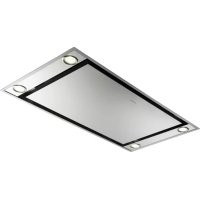
TENDER X A120 - Range hood FABER - Free user manual and instructions
Find the device manual for free TENDER X A120 FABER in PDF.


| Product type | Extractor hood |
| Brand | FABER |
| Model | TENDER X A120 |
| Dimensions (L x D x H) | 120 x 50 x 70 cm |
| Weight | 15 kg |
| Power supply | 220-240 V, 50/60 Hz |
| Suction power | 600 m³/h |
| Noise level | 60 dB (max) |
| Extraction mode | Extraction or recirculation |
| Lighting | Integrated LED |
| Controls | Touch or slide |
| Grease filter | Metal, dishwasher safe |
| Charcoal filter | Optional (recirculation) |
| Routine maintenance | Clean grease filter every month |
| Safety | Automatic shut-off in case of overheating |
| Spare parts | Filters, bulbs, controls |
| Repairability | Repairability score 7.5/10 |
| Warranty | 2 years |
| Energy class | A+ |
| Country of manufacture | Italy |
Frequently Asked Questions - TENDER X A120 FABER
User questions about TENDER X A120 FABER
0 question about this device. Answer the ones you know or ask your own.
Ask a new question about this device
Download the instructions for your Range hood in PDF format for free! Find your manual TENDER X A120 - FABER and take your electronic device back in hand. On this page are published all the documents necessary for the use of your device. TENDER X A120 by FABER.
USER MANUAL TENDER X A120 FABER
For your safety and correct operation of the appliance, read this manual carefully before installation and use. Always keep these instructions with the appliance even if you move or sell it. Users must fully know the operation and safety features of the appliance.
The wire connection has to be done by specialized technician.
- The manufacturer will not be held liable for any damages resulting from incorrect or improper installation.
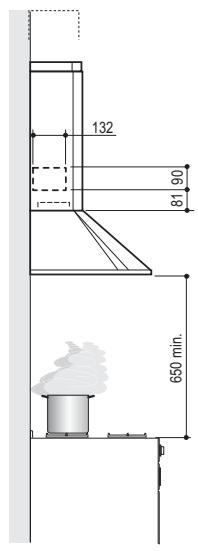
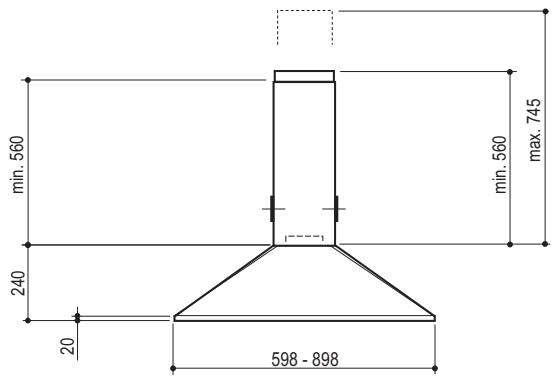
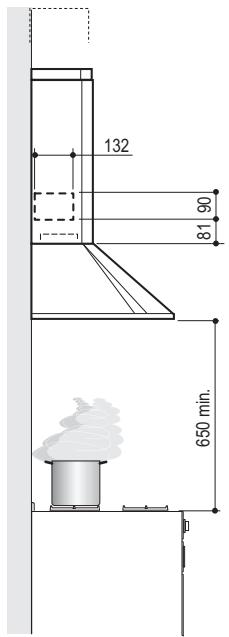
- The minimum safety distance between the cooker top and the extractor hood is 650 mm (some models can be installed at a lower height, please refer to the paragraphs on working dimensions and installation).
- If the instructions for installation of the gas hob specify a greater distance, this must be respected.
- Check that the mains voltage corresponds to that indicated on the rating plate fixed to the inside of the hood.
- Means for disconnection must be incorporated in the fixed wiring in accordance with the wiring rules.
- For Class I appliances, check that the domestic power supply guarantees adequate earthing.
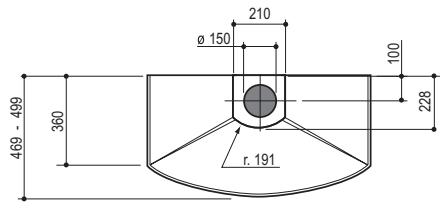
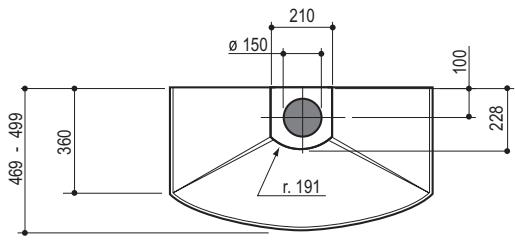
- Connect the extractor to the exhaust flue through a pipe of minimum diameter 120 mm . The route of the flue must be as short as possible.
- Regulations concerning the discharge of air have to be fulfilled.
- Do not connect the extractor hood to exhaust ducts carrying combustion fumes (boilers, fireplaces, etc.).
-
If the extractor is used in conjunction with non-electrical appliances (e.g. gas burning appliances), a sufficient degree of aeration must be guaranteed in the room in order to prevent the backflow of exhaust gas. When the cooker hood is used in conjunction with appliances supplied with energy other than electric, the negative pressure in the room must not exceed 0.04 mbar to prevent fumes being drawn back into the room by the cooker hood.
-
The air must not be discharged into a flue that is used for exhausting fumes from appliances burning gas or other fuels.
- If the supply cord is damaged, it must be replaced from the manufacturer or its service agent.
- Connect the plug to a socket complying with current regulations, located in an accessible place.
- With regards to the technical and safety measures to be adopted for fume discharging it is important to closely follow the regulations provided by the local authorities.
WARNING: Before installing the Hood, remove the protective films.
-
Use only screws and small parts supplied with the hood.
WARNING: Failure to install the screws or fixing device in accordance with these instructions may result in electrical hazards. -
Do not look directly at the light through optical devices (binoculars, magnifying glasses...).
- Do not flambe under the range hood; risk of fire.
- This appliance can be used by children aged from 8 years and above and persons with reduced physical, sensory or mental capabilities or lack of experience and knowledge if they have been given supervision or instruction concerning use of the appliance in a safe way and understand the hazards involved. Children shall not play with the appliance. Cleaning and user maintenance shall not be made by children without supervision.
-
Children should be supervised to ensure that they do not play with the appliance.
-
The appliance is not to be used by persons (including children) with reduced physical, sensory or mental capabilities, or lack of experience and knowledge, unless they have been given supervision or instruction.
Accessible parts may become hot when used with cooking appliances. - Clean and/or replace the Filters after the specified time period (Fire hazard). See paragraph Care and Cleaning.
- There shall be adequate ventilation of the room when the range hood is used at the same time as appliances burning gas or other fuels (not applicable to appliances that only discharge the air back into the room).
- The symbol on the product or on its packaging indicates that this product may not be treated as household waste. Instead it shall be handed over to the applicable collection point for the recycling of electrical and electronic equipment. By ensuring this product is disposed of correctly, you will help prevent potential negative consequences for the environment and human health, which could otherwise be caused by inappropriate waste handling of this product. For more detailed information about recycling of this product, please contact your local city office, your household waste disposal service or the shop where you purchased the product.
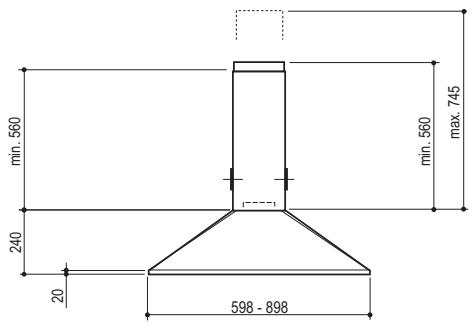
Dimensions
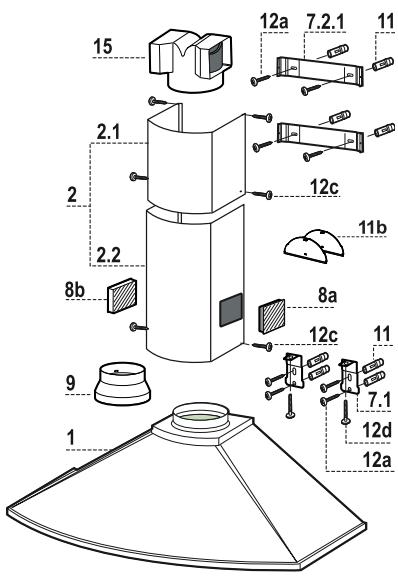
Components
| Ref. | Q.ty | Product Components |
| 1 | 1 | Hood Body, complete with: Controls, Light, Blower, Filters |
| 2 | 1 | Telescopic Chimney comprising: |
| 2.1 | 1 | Upper Section |
| 2.2 | 1 | Lower Section |
| 8a | 1 | Right Air Outlet Grill |
| 8b | 1 | Left Air Outlet Grill |
| 9 | 1 | Reducer Flangeø 150-120 mm |
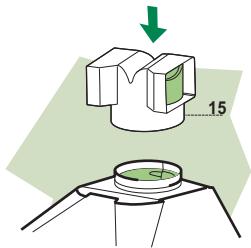
| 15 | 1 | Air Outlet Connection |
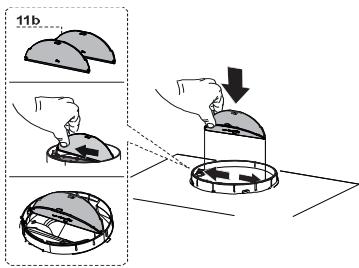
| 11b | 2 | Flap |
Ref. Q.ty Installation Components
| 7.1 | 2 | Hood Body Fixing Brackets |
| 7.2.1 | 2 | Upper Chimney Section Fixing Brackets |
| 11 | 8 | Wall Plugs |
| 12a | 8 | Screws 4.2 x 44,4 |
| 12c | 6 | Screws 2.9 x 9.5 |
| 12d | 2 | Screws M4 x 25 |
Q.ty Documentation
1 Instruction Manual
Wall drilling and bracket fixing
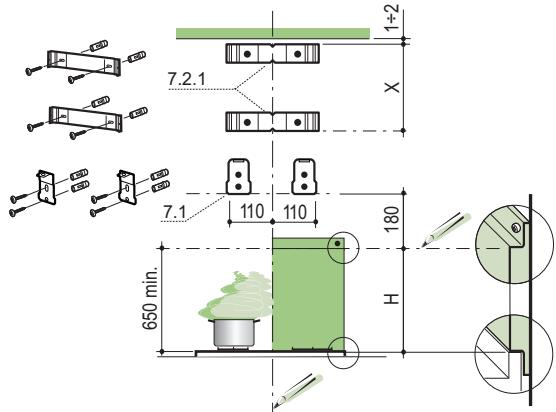
Wall marking:
- Draw a vertical line on the supporting wall up to the ceiling, or as high as practical, at the centre of the area in which the hood will be installed.
- Draw a horizontal line at 650 mm above the hob for installation without the back panel, or at height H (height of the visible part of the panel) for installation with the back panel.
- Place bracket 7.2.1 on the wall as shown about 1 - 2mm from the ceiling or upper limit, aligning the centre (notch) with the vertical reference line.
- Mark the wall at the centres of the holes in the bracket.
- Place bracket 7.2.1 on the wall as shown at X mm below the first bracket ( X = height of the upper chimney section supplied), aligning the centre (notch) with the vertical line.
- Mark the wall at the centres of the holes in the bracket.
- Place bracket 7.1 as shown 110mm from the vertical reference line and 180mm above the horizontal reference line.
- Mark the centres of the holes in the bracket.
- Repeat this operation on the other side.
REAR PANEL (OPTIONAL)
The Rear Panel must be fitted before fixing the hood body and, if it is to be fixed at both top and bottom, must be fitted at the correct height prior to installing the bases. As this operation is rather complex, it should be carried out either by the kitchen installer or a qualified person who knows the final dimensions of the units.
For fixing at the top only, proceed as follows:
- Rest the back panel on the base, inserting the lower plate between the upper surface and the wall, centring it on the vertical reference line.
- Mark the centres of the two holes in the upper plate.
- Drill 8 mm holes at all the centre points marked.
-
Insert the wall plugs 11 in the holes.
Fix the brackets using the 12a screws supplied.
Fix the back panel (where present) using the 12a screws supplied. -
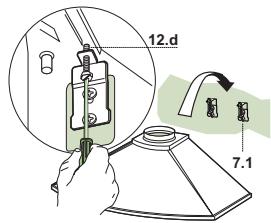
Screw the two screws 12d supplied onto the brackets 7.1.
- Hook the hood body onto the bracket 7.1, centring it around the vertical line.
- Use the adjusting screws 12d underneath the hood to level the hood body.
Connections
AIR OUTLET DUCTING VERSION
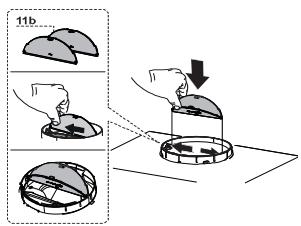
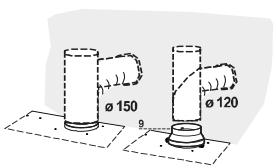
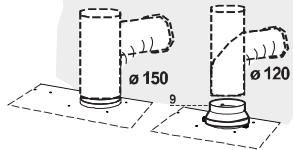
When installing the Ducting version, join the Hood to the outlet duct using a rigid or flexible pipe 150 or 120 mm , selection of which is at the discretion of the installation technician.
- Insert flaps 11b on the Hood Canopy Outlet.
Connecting the o 150 pipe
- Fasten the pipe using suitable pipe clamps. The materials required to do so are not provided.
Connecting the 0120 pipe
- To connect using a φ 120 mm pipe,in insert the reduction Flange 9 onto the Hood Canopy Outlet.
- Fasten the pipe using suitable pipe clamps. The materials required to do so are not provided.
- In both cases, any Activated Charcoal Filters must be removed.
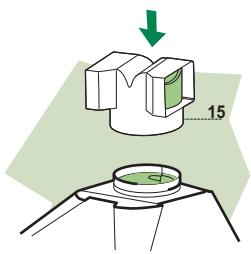
RECIRCULATION VERSION AIR OUTLET
- Push fit the air outlet fitting 15 onto the air outlet of the hood body.
- Ensure that the activated charcoal filters have been inserted.
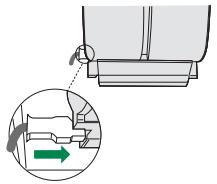
ELECTRICAL CONNECTION
- Connect the hood to the mains through a two-pole switch having a contact gap of at least 3mm .
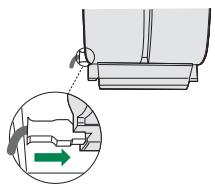
- Remove the grease filters (see paragraph Maintenance) being sure that the connector of the feeding cable is correctly inserted in the socket placed on the side of the fan.
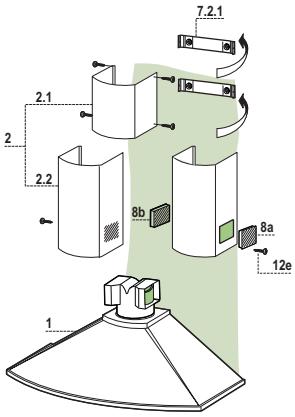
Chimney assembly
Upper chimney section
- Slightly widen the two sides of the upper chimney and hook them behind the brackets 7.2.1, making sure that they are properly housed.
- Secure the sides to the brackets using the 4 screws 12c (2,9× 9,5) supplied.
Lower chimney section
- Slightly widen the two sides of the section and hook them between the upper section and the wall, making sure that they are properly housed.
Fix the sides of the bottom section to the hood body using the 2 screws 12c (2,9 x 9,5) supplied. - When installing the recirculation version, fit the directional grills 8a - 8b in their housings so that the directional symbols are at the top and towards the front of the hood. Ensure that they are inserted correctly in the outlet connection piece 15.
Control panel
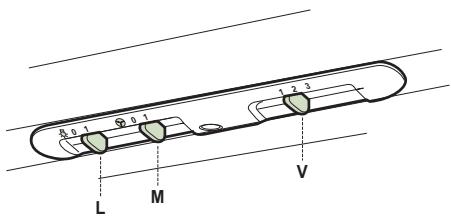
L Light Switches the lighting system on and off.
M Motor Switches the extractor motor on and off.
V Speed Sets the operating speed of the extractor:
- Low speed, used for a continuous and silent air change in the presence of light cooking vapour.
- Medium speed, suitable for most operating conditions given the optimum treated air flow/noise level ratio.
- Maximum speed, used for eliminating the highest cooking vapour emission, including long periods.

s V1
V1
V2
V3

V3
L Light Switches the lighting system on and off.
S Led Motor running led.
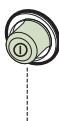
V1 Motor Switches the extractor motor on and off at low speed.
Used to provide a continuous and silent air change in the presence of light cooking vapours.
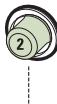
V2 Speed Medium speed, suitable for most operating conditions given the optimum treated air flow/noise level ratio.
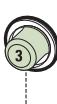
V3 Speed Maximum speed, used for eliminating the highest cooking vapour emission, including long periods.
Grease filters
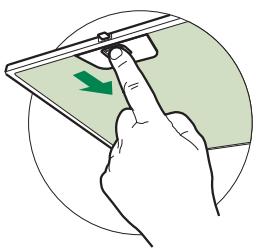
CLEANING METAL SELF- SUPPORTING GREASE FILTERS
- The filters must be cleaned every 2 months of operation, or more frequently for particularly heavy usage, and can be washed in a dishwasher.
- Remove the filters one at a time by pushing them towards the back of the group and pulling down at the same time.
- Wash the filters, taking care not to bend them. Allow them to dry before refitting.
- When refitting the filters, make sure that the handle is visible on the outside.
Grease filters
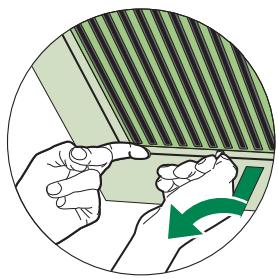
CLEANING METAL GREASE FILTERS
The filters are washable at least every 2 months of operation, or more frequently for particularly heavy usage.
- Remove the filters one at a time by supporting them with one hand and turning the safety knobs (pull and turn).
- Wash the filters, taking care not to bend them. Allow them to dry before refitting.
- Refit them and fix them using the safety knobs provided (pull and turn).
Activated charcoal filter (Recirculation version)
These filters are not washable and cannot be regenerated, and must be replaced approximately every 4 months of operation, or more frequently with heavy usage.
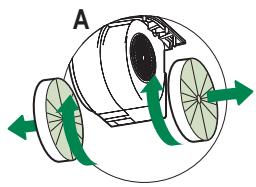
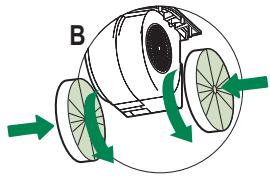
REPLACING THE ACTIVATED CHARCOAL FILTER
- Remove the metal grease filters
- Remove the saturated activated charcoal filter as shown (A).
- Fit the new filters (B).
- Replace the metal grease filters.
Lighting
LIGHT REPLACEMENT
- Remove the metal grease filters.
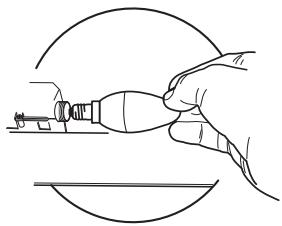
- Unscrew the bulbs and replace them with new ones having the same characteristics.
- Replace the metal grease filters.
| Lamp | Power (W) | Socket | Voltage (V) | Dimension (mm) | ILCOS Code |
| 4 | E14 | 220-240 | 107 x 37 | DRBB/F-4-220-240-E14-35/100 | |
| 5 | GU10 | 230 | 52 x 50 | DRPAR-5/840-220/240-GU10-35/36 DRPAR-5/830-220/240-GU10-35/36 |
J 1
J 650 n j Jn Jn Jn Jn Jn Jn Jn Jn Jn Jn Jn Jn Jn Jn Jn Jn Jn Jn Jn Jn Jn Jn Jn Jn Jn Jn Jn Jn Jn Jn Jn Jn Jn Jn Jn Jn Jn Jn Jn Jn Jn Jn Jn Jn Jn Jn Jn Jn Jn Jn Jnn nn nn nn nn nn nn nn nn nn nn nn nn nn nn nn nn nn nn nn nn nn nn nn nn nn nn nn nn nn nn nn nn nn nn nn nn nn nn nn nn nn nn nn nn nn nn nn nn nn nn nn nn nn nn nn nn nn nn nn nn nn nn nn nn nn nn nn nn nn nn nn nn nn nn nn nn nn nn nn nn nn nn nn nn nn nn nn nn nn nn nn nn nn nn nn nn nn nn nn nn nee
J 10000000000000000000000000000000000000000000000000000000000000000000000000000000000000000000000000000
-aaaii aaiin (jiaai i jai
aaii iie 1
d( 1,2)
.
ailll aall o jil lll all yjll jll jll jll
i 1
15 2) 15
(b)
J 1
aie aiee eae eae eae eae eae eae eae eae eae eae eae eae eae eae eae eae eae eae eae eae eae eae eae eae eae eae eae eae eae eae eae eae eae eae eae eae eae
a a a a a a a a a a a a a a a a a a a a a a
dclj 1 jc caiagkall no yjol aydiis ciall coy jolll
a 1
iiiall 1ia ci jjil 5ll jaiill
L
Jlll lllllllllllllllllllllllll
Ialallg clll lclc
b10 180 2000000000000000000000000000000000000000000000000000
Iolall lcl Jolll clll iJi 1
. jii 1i
()
aiee aee eae eae eae eae eae eae eae eae eae eae eae eae eae eae eae eae eae eae eae eae eae eae eae eae eae eae eae eae eae eae eae eae eae eae eae eae eae eae
a aal aal aal aal aal aal aal aal aal aal aal aal aal aal aal aal aal aal aal aal aal aal aal aal aal aal aal aal aal aal aal aal aal aal aal aal aal aal aal aal aal aal aal aal aal aal aal aal aal aal aAL
11b
0 150
aJyJzJgall aJyJzJgll JzJzJgll JzJzJgll
jieso 2
0120
p 9 0120
a.s 2011
a aJll alall aaliall cull llaaabw y
jiee 10000000
Jg jlll lal ll jyll 5j
1.
111 1
blallll 15)
blalil jldj0y jll jg j
()
J 1
e 88888888888888888888888888
a
a#
:glalj
Eubiuall jie aiaai (jglal jjll g
jLkJLaJlSjJnJ2sJ (1/2/7) JalJg
∴ b1 = 2,b2 = - 4
2.9) (12A) 4a
(9.5X 9
:
jall o jll l jll 8B- (8A)
Jus 4 Jklll 1 j klll j klll o
Jluii Juaeui 10uuiuiia jaej
j 1
aal jolil jil


- WALL DRILLING AND BRACKET FIXING
- WALL MARKING
- REAR PANEL (OPTIONAL)
- CONNECTIONS
- AIR OUTLET DUCTING VERSION
- CONNECTING THE O 150 PIPE
- CONNECTING THE 0120 PIPE
- RECIRCULATION VERSION AIR OUTLET
- ELECTRICAL CONNECTION
- CHIMNEY ASSEMBLY
- UPPER CHIMNEY SECTION
- LOWER CHIMNEY SECTION
- CONTROL PANEL
- GREASE FILTERS
- CLEANING METAL SELF- SUPPORTING GREASE FILTERS
- CLEANING METAL GREASE FILTERS
- ACTIVATED CHARCOAL FILTER (RECIRCULATION VERSION)
- REPLACING THE ACTIVATED CHARCOAL FILTER
- LIGHTING
- LIGHT REPLACEMENT
- 111 1
- A
Brand : FABER
Model : TENDER X A120
Category : Range hood