
CF 249 F W625C - CF 249 F W625C - Freezer VALBERG - Free user manual and instructions
Find the device manual for free CF 249 F W625C - CF 249 F W625C VALBERG in PDF.



| Product type | Freezer |
| Brand | VALBERG |
| Model | CF 249 F W625C |
| Climate class | SN (10°C-32°C), N (16°C-32°C), ST (16°C-38°C), T (16°C-43°C) |
| Power supply | 220-240 V ~ 50 Hz |
| Refrigerant | R600a (environmentally friendly) |
| Dimensions (approx.) | Width: 80 cm, Depth: 60 cm, Height: 85 cm |
| Weight (approx.) | 50 kg |
| Estimated useful capacity | 200 L |
| Thermostat adjustment | 6 positions (1-6); recommended 3-4; OFF position for stop |
| Defrosting | Manual with drainage holes and recovery tray |
| Indicators | Power (on), Run (operation), Alarm (high temperature) |
| Interior lighting | Bulb replaceable only by a professional |
| Supplied accessories | Rack basket, ice tray (not specified but likely) |
| Cleaning and maintenance | Clean with a damp cloth and mild detergent; do not use abrasives or organic solvents |
| Safety | Unplug before cleaning; do not damage the cooling circuit; do not use mechanical devices to defrost |
| Repairability | Spare parts available via Electro Dépôt after-sales service; lamp replacement by a professional |
| Warranty | 2 years against manufacturing defects (upon presentation of receipt) |
| General information | Brand distributed by Electro Dépôt; manual available online |
Frequently Asked Questions - CF 249 F W625C - CF 249 F W625C VALBERG
User questions about CF 249 F W625C - CF 249 F W625C VALBERG
0 question about this device. Answer the ones you know or ask your own.
Ask a new question about this device
Download the instructions for your Freezer in PDF format for free! Find your manual CF 249 F W625C - CF 249 F W625C - VALBERG and take your electronic device back in hand. On this page are published all the documents necessary for the use of your device. CF 249 F W625C - CF 249 F W625C by VALBERG.
USER MANUAL CF 249 F W625C - CF 249 F W625C VALBERG
This product is guaranteed for a period of 2 years from the date of purchase* against any failure resulting from a manufacturing or material defect. This warranty does not cover defects or damage resulting from incorrect installation, improper use or abnormal wear of the product.
*as shown on the sales receipt.
WARRANTY CONDITIONS
FR
Thank you for choosing this VALBERG product. Chosen, tested and recommended by ELECTRO DEPOT, VALBERG branded products are easy to use, reliable, and of an impeccable standard. With every use of this appliance, you can be sure of complete satisfaction.
Welcome to ELECTRO DEPOT.
Visit our website: www.electrodepot.fr
Table of contents

Overview of the appliance
Recommended ambient temperature range Temperature control setting Components

Using the appliance
Appropriate use of freezers Equipment of the product Temperature control Lamp and bulb replacement Defrosting Interruption of use

Cleaning and maintenance
Cleaning and maintenance Repair
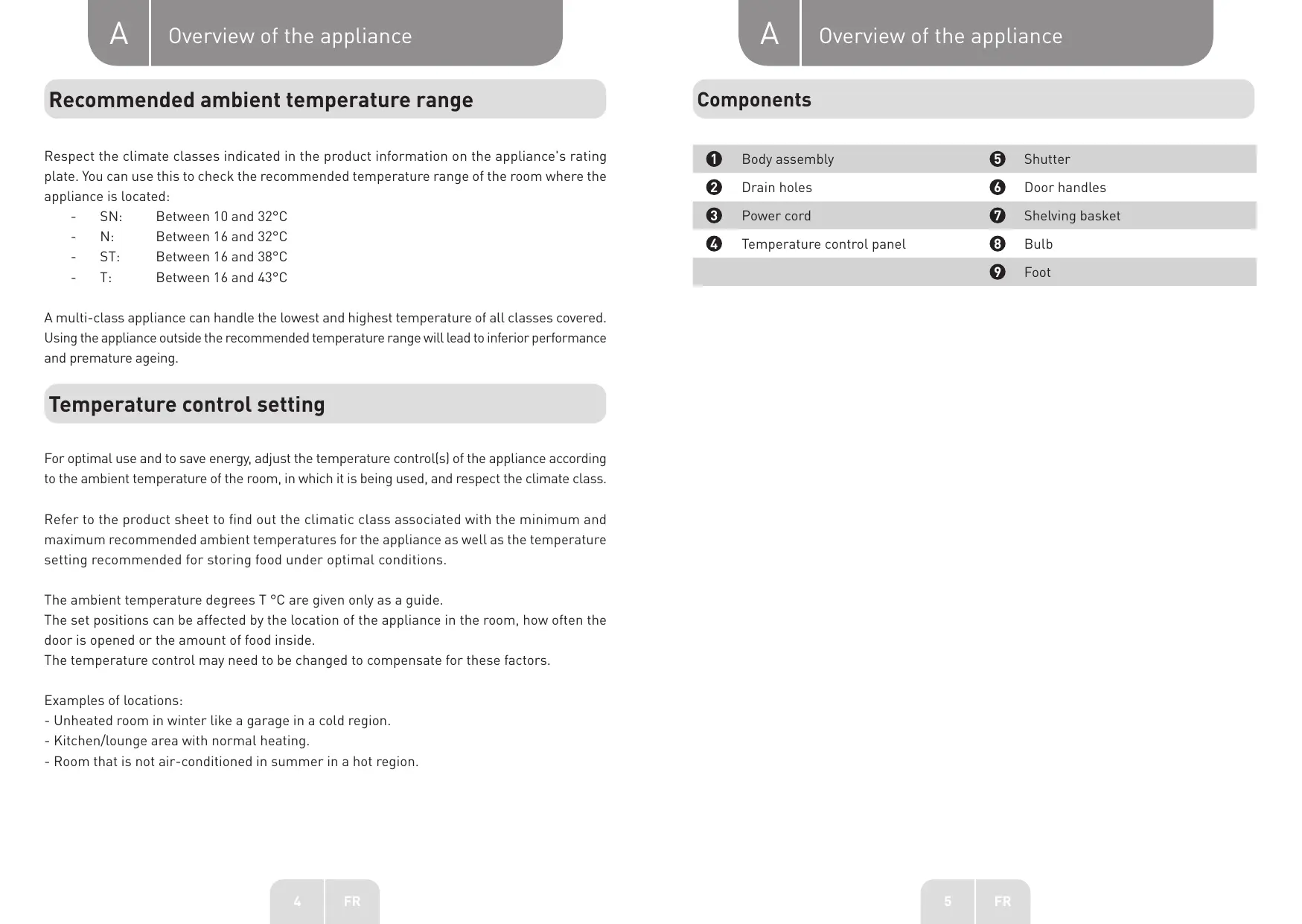
Recommended ambient temperature range
Respect the climate classes indicated in the product information on the appliance's rating plate. You can use this to check the recommended temperature range of the room where the appliance is located:
SN: Between 10 and 32°C - N: Between 16 and 32°C - ST: Between 16 and 38°C - T: Between 16 and 43°C
A multi-class appliance can handle the lowest and highest temperature of all classes covered. Using the appliance outside the recommended temperature range will lead to inferior performance and premature ageing.
Temperature control setting
For optimal use and to save energy, adjust the temperature control(s) of the appliance according to the ambient temperature of the room in which it is being used, and respect the climate class.
Refer to the product sheet to find out the climatic class associated with the minimum and maximum recommended ambient temperatures for the appliance as well as the temperature setting recommended for storing food under optimal conditions.
The ambient temperature degrees T°C are given only as a guide.
The set positions can be affected by the location of the appliance in the room, how often the door is opened, or the amount of food inside.
The temperature control may need to be changed to compensate for these factors.
Examples of locations:
- Unheated room in winter like a garage in a cold region.
- Kitchen/lounge area with normal heating.
- Room that is not air-conditioned in summer in a hot region.
Components
Body assembly 2 Drain holes 3 Power cord Temperature control panel
5 Shutter Door handles 7 Shelving basket Bulb 9 Foot
Appropriate use of freezers
- The low temperature of the freezer can keep food chilled for a long time, and it is mainly used for storing frozen food and making ice.
- The freezer is suitable for storing meat, fish, prawns, meatballs, rice balls and other foods that cannot be consumed in the short term.
- Meat should preferably be divided into small pieces for ease of use. Please note that food should be consumed within the expected shelf life.
Note:
Please refer to the appliance as the freezer equipment and accessories you purchased may not fully comply with the captions.
Equipment of the product
- The refrigerator has a brand name efficient compressor that offers excellent performance and good reliability.
- Structure of the foam door: integrated mosaic door seals for dust-proof effect that is easy to remove and clean.
- Environmentally friendly R600a coolant and cyclopentane blower compounds are used to help protect the environment.
- Integrated safety glass doors.
Temperature control
Connect through the power supply connection. The Power indicator lights up. The Run indicator lights up during operation. The ALARM lights up when the interior temperature is too high.
The compartment temperature is regulated with the temperature control knob. The numbers "1, 2, 3, 4, 5, 6" do not signify a specific temperature; the lower the number, the higher the temperature inside and vice versa.
We recommend that you set the thermostat to 3-4. "OFF" means the appliance is switched off.
Note:
Please refer to the appliance as the freezer indicator you purchased may not fully comply with the captions.
Lamp and bulb replacement
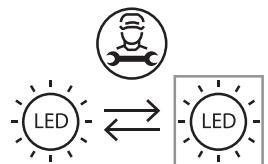
Lamp replacement must be carried out by professionals only.
Positioning
Before using the freezer, remove all packing materials including bottom padding and foam fillings as well as any tape inside the freezer. Then tear off the protective film on the freezer door and body. The freezer should be placed in a well ventilated area indoors on level and sturdy floors. Place away from heat and avoid direct sunlight. In order to prevent rusting or reducing the insulating effect, do not place the freezer in humid places or near splashing water. In order to facilitate opening and closing and heat dissipation, the space above the freezer should be more than 70 centimetres and the distances on both sides and back will be more than 20 centimetres.
Wipe down the freezer inside and out with a cloth dampened with hot water (add a little washing-up liquid to the hot water and wipe dry afterwards with clean water).
Start
The freezer must remain on for half an hour before connecting it to the 220-240 V/50 Hz power supply when it is first switched on. The freezer should operate 2 to 3 hours before loading it with fresh or frozen food. In summer, however, it should run longer, i.e. more than 4 hours to take into account the higher ambient temperature.
Defrosting
- The freezer must be manually defrosted. Unplug the freezer and open the freezer door. Then remove food and drawers before defrosting. Open the discharge holes and the drainage holes (please position a container for collecting water at the outlet holes). The ice inside will melt naturally. Wipe off the water with a dry, soft cloth. When the ice becomes soft, an ice scraper can be used to speed up the defrosting process.
- Before removing the accessories, please remove the food and put it in a cool place during defrosting.
Note: other mechanical appliances or other means should not be used to accelerate it except those recommended by the manufacturer. Do not damage the coolant circuit.
Interruption of use
- Food can be stored for a couple of hours, even in summer, during a power cut. It is recommended to reduce the frequency of opening the door and not to put fresh food in the freezer.
- Please unplug the freezer if it is not used for a long time and for cleaning. Keep the door open to avoid bad odours.
- Do not turn the refrigerator over or position it horizontally and do not shake it. The angle allowed for transport must not be greater than 45°. Please hold the door and hinges while moving it.
Note: continuous operation is recommended after the freezer is put into service. Please do not move the freezer under normal circumstances, so as not to affect the life of the freezer.
Cleaning and maintenance
Cleaning
WARNING! Unplug the freezer to defrost and clean.
- Dust behind the freezer and on the floor should be cleaned regularly in order to improve the cooling effect and save energy.
- To avoid odours, the interior of the freezer should be cleaned regularly.
- Dish towels or a soft sponge dampened with water and neutral, non-corrosive dishwashing liquid are recommended for cleaning.
- The freezer will finally be cleaned with clean water and dried with a cloth. Open the door for natural drying before switching back on again.
Do not use hard brushes, steel balls, wire brushes, abrasives, such as toothpaste, organic solvents (such as alcohol, acetone, banana oil, etc.); boiling water, acids or alkaline solutions are not considered as cleaning agents for the refrigerator because they can damage the surface and the interior of the refrigerator.
- Do not rinse with running water so as not to affect the electrical insulation properties. Please use a dry cloth to clean the temperature control knob and electrical components.
Repair
The following problems can be solved by the user. Please contact the after-sales service department if these problems are not resolved.
| Problem | Cause/solution |
| The appliance does not work at all. | ·Low voltage. ·Make sure the freezer is plugged in and connected to the power supply. ·Make sure the temperature control knob is positioned within the correct operating range. |
| Odour. | ·Strong-smelling foods should be well wrapped. ·Check for rotten food. ·Check whether the interior needs cleaning. |
| Operation of the compressor for a long time. | • Thick layer of ice (defrost required). • Do not put too much food in the freezer at the same time. • Do not place food that is not completely cooled. • Frequent opening of the freezer door. |
| Note: it is normal that refrigerator operates for longer time in summer when the ambient temperature is higher; | |
| The light does not turn on. | • Make sure the freezer is connected to the power supply. • Check whether the indicator is damaged. |
| The refrigerator door does not close properly. | • Too much food. • The freezer door is stuck by packages containing food. |
| Loud noises. | • Check that the food is level and the freezer is not unstable. • Make sure that the parts in the freezer are placed correctly. |
Advice concerning heat:
- The body of the refrigerator may give off heat during operation, especially in summer. This heat is caused by radiation from the condenser and is a normal phenomenon.
- Condensation: condensation will be spotted on the exterior surface and the seals of the freezer door when the ambient humidity is high; this is a normal phenomenon and the condensation can be wiped off with a dry cloth.
- Air flow noise: coolants circulating in the refrigeration circuit produce noises and rumblings which are normal and do not affect the cooling effect.
- Humming sound: a humming sound is produced when the compressor is running, and is particularly noticeable when it starts or stops.
- Clicking: the solenoid valve or electric switching valve will make a clicking sound; it is a normal phenomenon which does not affect the operation.

- WARRANTY CONDITIONS
- TABLE OF CONTENTS
- RECOMMENDED AMBIENT TEMPERATURE RANGE
- TEMPERATURE CONTROL SETTING
- COMPONENTS
- APPROPRIATE USE OF FREEZERS
- NOTE
- EQUIPMENT OF THE PRODUCT
- TEMPERATURE CONTROL
- LAMP AND BULB REPLACEMENT
- POSITIONING
- START
- DEFROSTING
- INTERRUPTION OF USE
- CLEANING AND MAINTENANCE
- CLEANING
- WARNING! UNPLUG THE FREEZER TO DEFROST AND CLEAN
- REPAIR
- ADVICE CONCERNING HEAT
Brand : VALBERG
Model : CF 249 F W625C - CF 249 F W625C
Category : Freezer