USER MANUAL UF NF 254 F S180C - UF NF 254 F S180C VALBERG
This product is guaranteed for a period of 2 years from the date of purchase* against any failure resulting from a manufacturing or material defect. This warranty does not cover defects or damage resulting from incorrect installation, improper use or abnormal wear of the product.
*as shown on the sales receipt.
WARRANTY CONDITIONS
Thank you for choosing this VALBERG product. Chosen, tested and recommended by ELECTRO DEPOT, VALBERG branded products are easy to use, reliable, and of an impeccable standard. With every use of this appliance, you can be sure of complete satisfaction.
Welcome to ELECTRO DEPOT.
Visit our website: www.electrodepot.fr
Table of contents

Overview of the appliance
Ambient temperature of use Temperature control setting

Using the appliance
Installation Use

Practical information
Cleaning and maintenance Repair
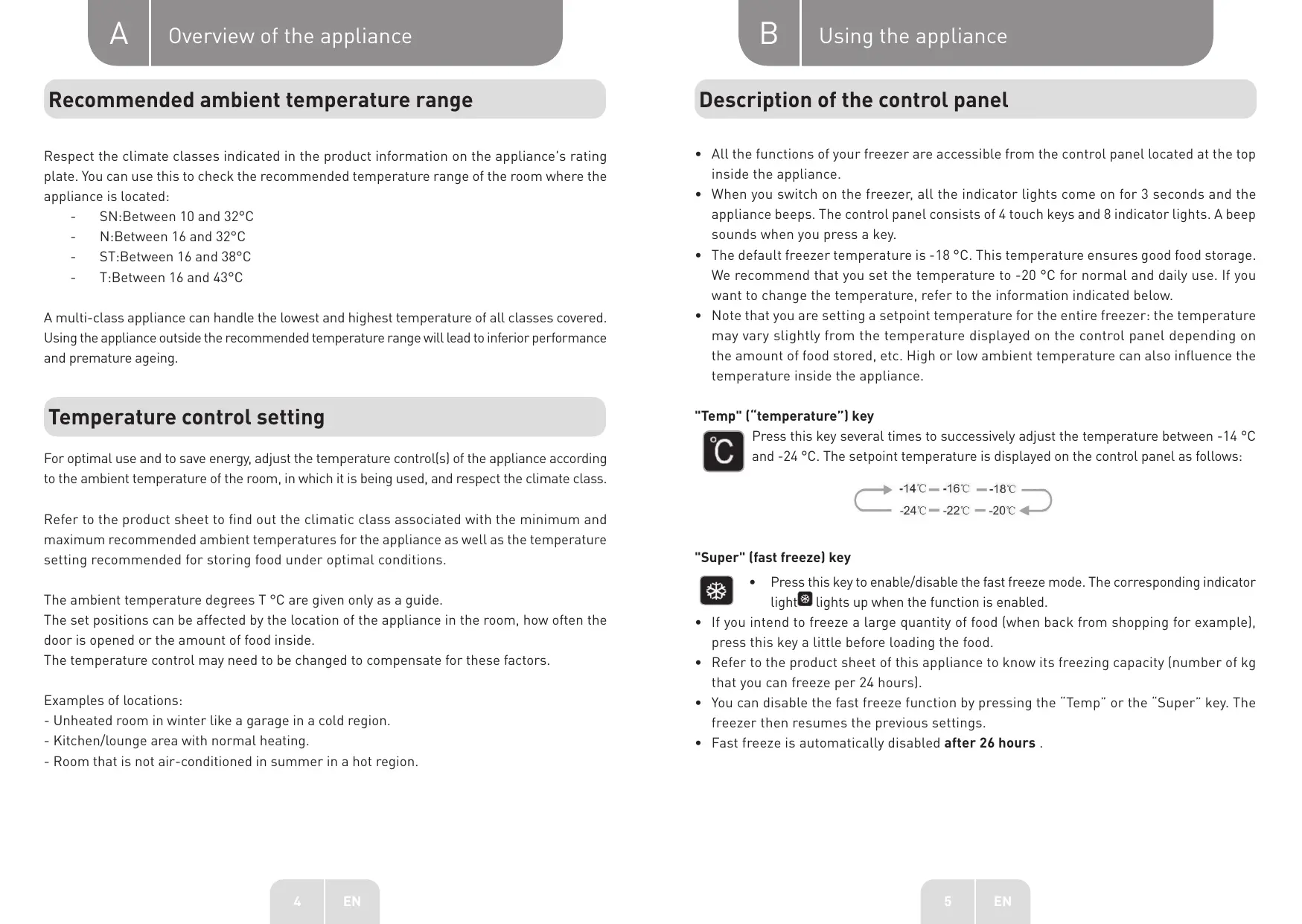
Recommended ambient temperature range
Respect the climate classes indicated in the product information on the appliance's rating plate. You can use this to check the recommended temperature range of the room where the appliance is located:
SN: Between 10 and 32°C; N: Between 16 and 32°C; ST: Between 16 and 38°C; T: Between 16 and 43°C
A multi-class appliance can handle the lowest and highest temperature of all classes covered. Using the appliance outside the recommended temperature range will lead to inferior performance and premature ageing.
Temperature control setting
For optimal use and to save energy, adjust the temperature control(s) of the appliance according to the ambient temperature of the room in which it is being used, and respect the climate class.
Refer to the product sheet to find out the climatic class associated with the minimum and maximum recommended ambient temperatures for the appliance as well as the temperature setting recommended for storing food under optimal conditions.
The ambient temperature degrees T°C are given only as a guide.
The set positions can be affected by the location of the appliance in the room, how often the door is opened, or the amount of food inside.
The temperature control may need to be changed to compensate for these factors.
Examples of locations:
- Unheated room in winter like a garage in a cold region.
- Kitchen/lounge area with normal heating.
- Room that is not air-conditioned in summer in a hot region.
Description of the control panel
- All the functions of your freezer are accessible from the control panel located at the top inside the appliance.
- When you switch on the freezer, all the indicator lights come on for 3 seconds and the appliance beeps. The control panel consists of 4 touch keys and 8 indicator lights. A beep sounds when you press a key.
- The default freezer temperature is -18 °C. This temperature ensures good food storage. We recommend that you set the temperature to -20 °C for normal and daily use. If you want to change the temperature, refer to the information indicated below.
- Note that you are setting a setpoint temperature for the entire freezer: the temperature may vary slightly from the temperature displayed on the control panel depending on the amount of food stored, etc. High or low ambient temperature can also influence the temperature inside the appliance.
"Temp" ("temperature") key

Press this key several times to successively adjust the temperature between -14 °C and -24 °C. The setpoint temperature is displayed on the control panel as follows:

"Super" (fast freeze) key

- Press this key to enable/disable the fast freeze mode. The corresponding indicator light lights up when the function is enabled.
- If you intend to freeze a large quantity of food (when back from shopping for example), press this key a little before loading the food.
- Refer to the product sheet of this appliance to know its freezing capacity (number of kg that you can freeze per 24 hours).
- You can disable the fast freeze function by pressing the "Temp" or the "Super" key. The freezer then resumes the previous settings.
- Fast freeze is automatically disabled after 26 hours.
"Alarm" (alarm) key

When the freezer door is open for more than 2 minutes, the door alarm is activated and the corresponding indicator light on the control panel comes on.
The alarm sounds 3 times per minute for 10 minutes. Closing the door stops the beep.
To save energy, do not leave the door open for an extended period of time.
NOTE:
It is normal, when the power is restored after a power failure, for the alarm to sound. In this case, press the "Alarm" key to stop it.
"Power" key (on/off)

If you want to clean the appliance or stop using it, you can turn it off by pressing and
holding the "Power" [on / off] key down for 8 seconds.
WARNING:
- do not add any other food to the freezer during this time. To turn the appliance back on, press the "Power" key for 1 second.
Making ice cubes
- Fill an ice cube tray with cold water up to three quarters of its height and place it in the freezer. The ice cubes will be ready after about two hours.
- You can easily collect your ice cubes by slightly twisting the tray that contains them.
Using the flap drawers
- Lift the flap by grasping it by its handle and slide it up when you want to remove food from the upper compartment.
- To close the flap, hold it by its handle and lift it before sliding it down.
Rating of appliances
| Types of appliance | Temperatures in the coldest compartment | Storage times |
| No stars | Freezer: 0°C | Ice cubes |
| * | Freezer: -6 °C | Ice cubes
Short frozen storage:3-4 days (*) |
| ** | Freezer: -12 °C | Ice cubes
Medium frozen storage:1-4 weeks (*) |
| *** | Storage compartment: Lower than or equal to -18 °C | Ice cubes
Long frozen storage:3 months to 12 months |
| **** | Freezer compartment:-18°C to -24°C | Ice cubes
Long frozen storage:3 months to 12 months
Freezing of fresh products possible |
(*) storage life depends on the type of food; see manufacturer's instructions on product packaging. - Your appliance bears the standardized "4 star" symbol. You can use this appliance to store frozen food for up to 12 months. You can also use this appliance to freeze fresh food and make ice cubes.
Placing food in the freezer
Put the frozen food in the freezer as soon as possible, and make sure you:
- Do not store too many items in the storage drawers.
- Allow air to circulate around each element.
- Do not store unpackaged food.
Energy savings advice
Avoid leaving the door open for too long as hot air will enter the freezer and the cold air will escape, which will waste energy. Make sure there are no obstructions preventing the door from closing properly.
For better food hygiene
- Do not place hot dishes in the freezer until they have cooled, as food that is already frozen may rot. Place the fresh food to be frozen in the flap(s) and use the drawers to store the products already frozen. Do not mix already frozen products with fresh products.
- When you want to freeze foods (meat, minced meat, fish, etc.), consider dividing them into portions so that they can be eaten all at once.
- Do not refreeze foods that have thawed. This incurs risks to your health such as, for example, food poisoning.
- When buying frozen food, make sure it has been frozen in good conditions and that the packaging is not torn.
- When storing frozen foods, the storage conditions indicated on the packaging must be observed. If there are no instructions, the food should be eaten as quickly as possible.
- Food should be transported in appropriate packaging to maintain the quality of the food and should be returned to the freezer as soon as possible.
- If the packaging of a frozen food is damp and smells bad, the food may have been stored in poor conditions previously. Do not store this food!
- The shelf life of frozen food changes depending on the ambient temperature, repeated opening and closing of the door, the temperature setting, the type of food and the time that has elapsed between when the food was purchased and where it was placed in the freezer. Always follow the instructions on the packaging and never exceed the use-by date.
WARNING:
- Bottles and cans should not be placed in the freezer. They could burst when freezing contents, and soft drinks can even explode! Never store lemonades, juices, beers, sparkling wines, etc. in the freezer.
- Do not put ice cream or ice cubes in your mouth immediately after taking them out of the freezer. Very cold ice can freeze on your lips or tongue and cause injury.
- Do not touch frozen food with wet hands. The frost could make your hands stick to the food.
- Do not use electrical appliances in the freezer (e.g. electric ice cream makers, mixers, etc.).
Cleaning
- Before cleaning the appliance, you must always switch it off and unplug it, or remove the fuses or switch off the circuit breaker.
- We advise you to clean and disinfect your appliance regularly (at least once a year) for better hygiene and food storage.
- Remove all food from the freezer.
- Clean the inside and outside of the freezer with bicarbonate of soda dissolved in water (1 tablespoon per 4 litres of water).
- Do not use alcohol, abrasive powders or detergents as they may damage the surfaces.
- Rinse with water then dry with a soft cloth.
Defrosting
Your ventilated cold appliance defrosts automatically. Defrost water is collected in the evaporator tray located at the bottom rear of the freezer. The water evaporates from this container automatically.
Correcting a malfunction
Malfunctioning may be due to a minor problem that you can resolve on your own using the instructions below. Before calling your store's after-sales service, carry out the following checks:
1) Your freezer does not work:
Check:
- That it is properly connected,
- That the circuit breaker has not been disabled.
2) The freezer is getting too cold:
The temperature is set too high.
3) The freezer is not cold enough.
- You may have put hot food or too much food in the freezer. The door is not closed properly. The door seals may be damaged. The temperature may not be set correctly.
4) The freezer door is difficult to open:
- You may have difficulty opening the freezer door that you just closed. When the door is open, the cold air which escapes from the tank is replaced by air at room temperature. As this hot air cools, a depression is formed, a vacuum is created and the door becomes difficult to open. After a few minutes the freezer returns to normal pressure and you can open the door easily.
If the above information does not help you resolve your specific problem, do not attempt to repair the appliance yourself; contact your store's after-sales service.
IMPORTANT:
Only service technicians are qualified to perform repairs on this appliance. Non-compliant repairs may constitute a danger for the user and are not covered by the warranty.
Noises heard while operating
The following noises are characteristic of freezing appliances:
Clicking
When the compressor comes on or off, it makes a clicking sound.
Purring
As soon as the compressor is on, you hear it purring.
purring.
Gurgling / splashing
As the coolant flows through the narrow tubes, gurgling and splashing sounds are heard. Even after the compressor is turned off, these noises continue to be heard for a short time.
In case of a power cut
- If the power cut is short-lived, there is no risk of spoilage for the food. However, do not open the door. The operating autonomy of your appliance is indicated in the "PRODUCT SHEET". This duration is appreciably shortened depending on the load of the appliance. If the outage is to be prolonged, transfer the frozen products to another freezer. As soon as you notice food starting to thaw, it should be eaten as quickly as possible.
- Warning! Thawed food should never be refrozen.
Thank you!