
JU380110 ELEA - Food Processor MOULINEX - Free user manual and instructions
Find the device manual for free JU380110 ELEA MOULINEX in PDF.



| Brand | Moulinex |
| Model | JU380110 ELEA |
| Product type | Food processor (juicer with citrus press function depending on model) |
| Power supply | Alternating current (check voltage on rating plate) |
| Number of speeds | 2 (I: slow, II: fast) |
| Processing capacity | Up to 3 kg of carrots in 2 minutes (approximate) |
| Maximum continuous use time | 2 minutes |
| Included accessories | Pusher, lid, filter, pulp container, anti-drip pouring spout, cleaning brush, cord storage; depending on model: cone, citrus press grid, 3 glasses, glass holder |
| Safety | Side safety locks, lockable lid, pusher to guide food, stop before disassembly |
| Cleaning | Removable parts dishwasher safe (except motor block and citrus press accessory) |
| Filter maintenance | Clean with provided brush; replace if worn or damaged |
| Use | Household use only |
| After-sales service | Groupeseb.com, Tel: 00 33 472 18 18 18 |
| Manufacturer reference | JU380110 ELEA |
Frequently Asked Questions - JU380110 ELEA MOULINEX
User questions about JU380110 ELEA MOULINEX
0 question about this device. Answer the ones you know or ask your own.
Ask a new question about this device
Download the instructions for your Food Processor in PDF format for free! Find your manual JU380110 ELEA - MOULINEX and take your electronic device back in hand. On this page are published all the documents necessary for the use of your device. JU380110 ELEA by MOULINEX.
USER MANUAL JU380110 ELEA MOULINEX
natural_image
Line drawing of a portable oven or blender with lid, side panels, and control buttons (no text or symbols)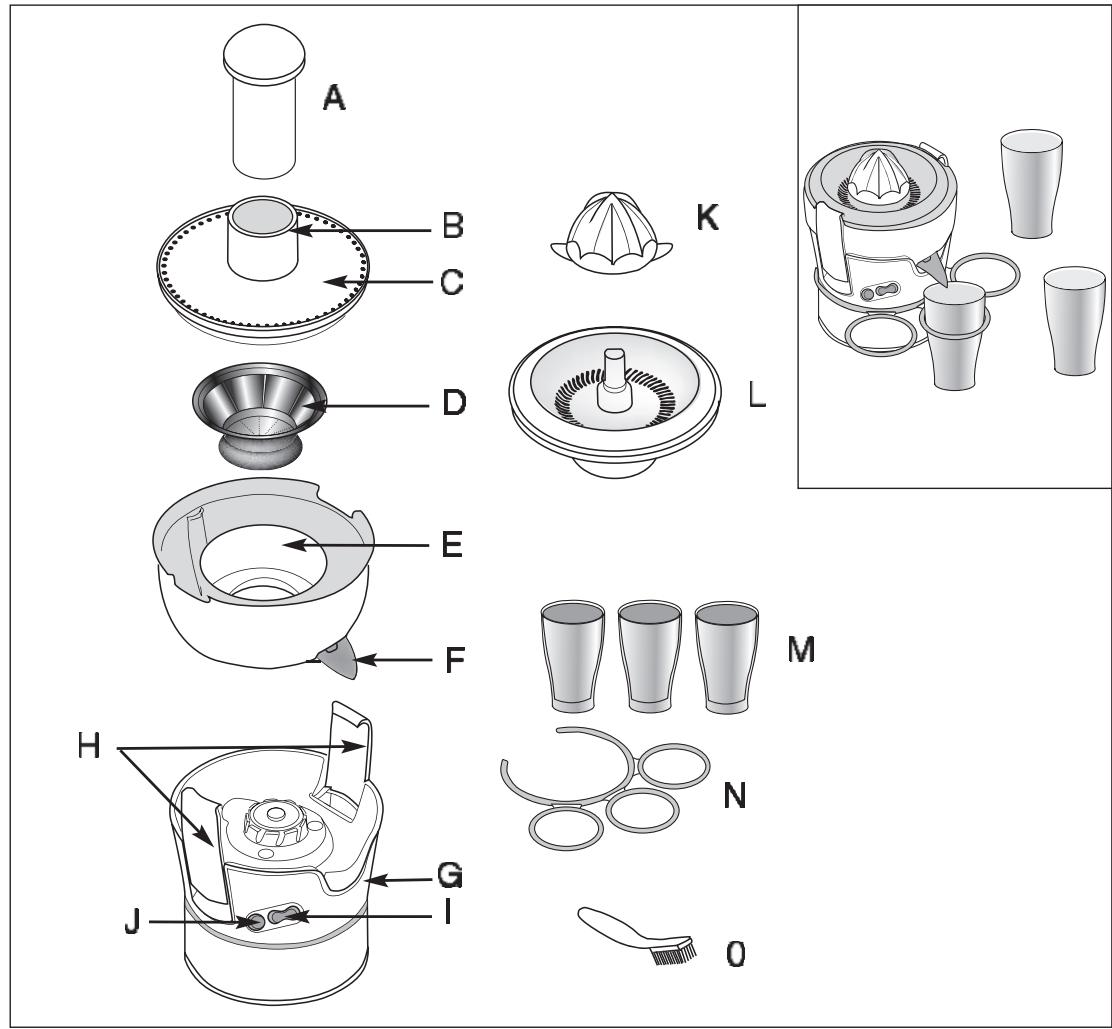
natural_image
Technical diagram of a circular mechanical component with labeled pins (P, D) and a terminal plug, no readable text or symbols present.natural_image
Symbol of a trash bin crossed out by two crossed lines, with no text or labels present.1. Safety instructions
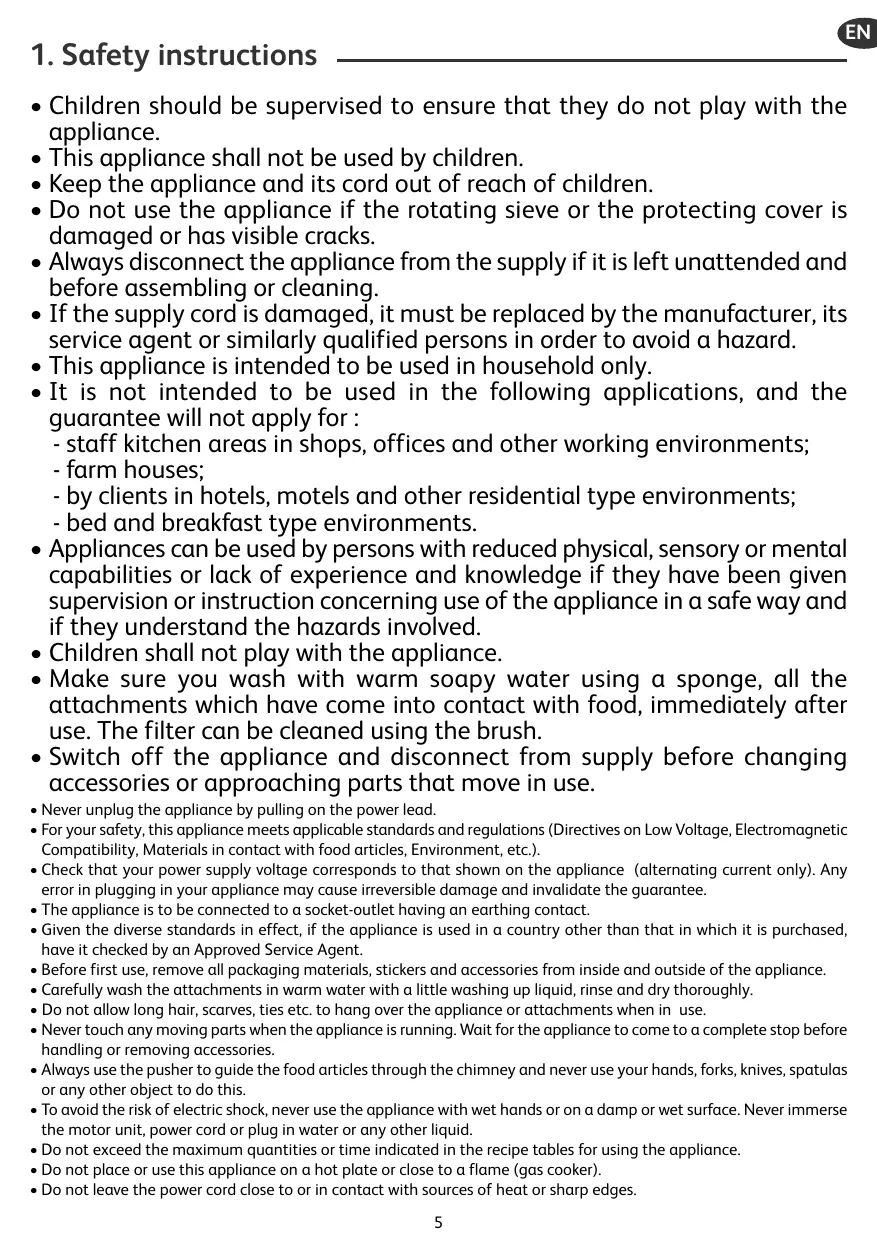
- Children should be supervised to ensure that they do not play with the appliance.
- This appliance shall not be used by children.
- Keep the appliance and its cord out of reach of children.
- Do not use the appliance if the rotating sieve or the protecting cover is damaged or has visible cracks.
- Always disconnect the appliance from the supply if it is left unattended and before assembling or cleaning.
- If the supply cord is damaged, it must be replaced by the manufacturer, its service agent or similarly qualified persons in order to avoid a hazard.
- This appliance is intended to be used in household only.
- It is not intended to be used in the following applications, and the guarantee will not apply for :
- staff kitchen areas in shops, offices and other working environments;
- farm houses;
- by clients in hotels, motels and other residential type environments;
- bed and breakfast type environments.
- Appliances can be used by persons with reduced physical, sensory or mental capabilities or lack of experience and knowledge if they have been given supervision or instruction concerning use of the appliance in a safe way and if they understand the hazards involved.
- Children shall not play with the appliance.
- Make sure you wash with warm soapy water using a sponge, all the attachments which have come into contact with food, immediately after use. The filter can be cleaned using the brush.
- Switch off the appliance and disconnect from supply before changing accessories or approaching parts that move in use.
- Never unplug the appliance by pulling on the power lead.
- For your safety, this appliance meets applicable standards and regulations (Directives on Low Voltage, Electromagnetic Compatibility, Materials in contact with food articles, Environment, etc.).
- Check that your power supply voltage corresponds to that shown on the appliance (alternating current only). Any error in plugging in your appliance may cause irreversible damage and invalidate the guarantee.
- The appliance is to be connected to a socket-outlet having an earthing contact.
- Given the diverse standards in effect, if the appliance is used in a country other than that in which it is purchased, have it checked by an Approved Service Agent.
- Before first use, remove all packaging materials, stickers and accessories from inside and outside of the appliance.
- Carefully wash the attachments in warm water with a little washing up liquid, rinse and dry thoroughly.
- Do not allow long hair, scarves, ties etc. to hang over the appliance or attachments when in use.
- Never touch any moving parts when the appliance is running. Wait for the appliance to come to a complete stop before handling or removing accessories.
- Always use the pusher to guide the food articles through the chimney and never use your hands, forks, knives, spatulas or any other object to do this.
- To avoid the risk of electric shock, never use the appliance with wet hands or on a damp or wet surface. Never immerse the motor unit, power cord or plug in water or any other liquid.
- Do not exceed the maximum quantities or time indicated in the recipe tables for using the appliance.
- Do not place or use this appliance on a hot plate or close to a flame (gas cooker).
- Do not leave the power cord close to or in contact with sources of heat or sharp edges.
- Only use the appliance on a stable work surface away from any water that may spray on to it.
- Do not use an extension lead. If you accept liability for doing so, only use an extension lead which is in good condition, has a plug with an earth connection and is suited to the power rating of the appliance.
- Do not use your appliance if it does not operate correctly, if it has been dropped or damaged or if the power cord or plug is damaged. To maintain safety, these parts must be replaced by an Approved Service Centre.
- Any intervention other than normal cleaning and maintenance by the customer must be performed by an Approved Service Centre.
- For you own safety, only use accessories and spare parts from the appliance manufacturer, which are especially designed for your appliance.
- The identification plate and the main features are to be found on the underneath of the appliance.
Carrot juice
Please note: This appliance can process 3kg of carrots in around 2 minutes (not including the time needed to remove the pulp). When you are making carrot juice, once you have processed 1kg of carrot, turn off and unplug the appliance, and remove the pulp from the reservoir, the lid and the filter. When you have finished processing the carrots, unplug the appliance and allow it to cool down to room temperature.
2. Appliance description
A Pusher
B Funnel
C Lid
D Filter
E Pulp container
F Anti-drip spout
G Body of appliance
H Side safety lock clips
I ON/OFF switch
J Speed selector
K Cone (according to model)
L Citrus press sieve (according to model)
M 3 glasses (according to model)
N Glass holder accessory (according to model)
0 Cleaning brush
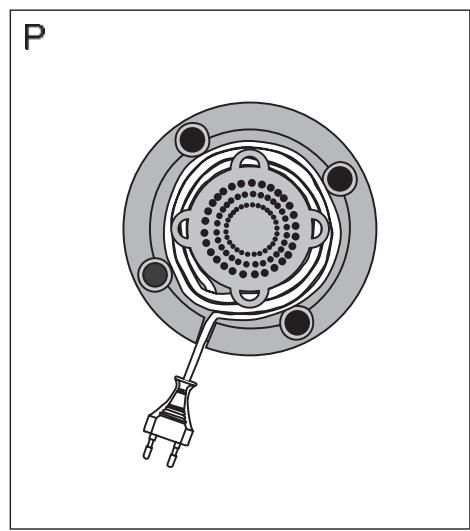
P Cord storage
3. Before first use
Read these instructions carefully before using your appliance for the first time and keep to hand for future reference: failure to comply with the instructions will release the manufacturer from all responsibility.
- Completely release the side safety lock clips (H). Remove the pusher (A), lid (C), filter (D), pulp container (E), glass-holder accessory (N) and glasses (M).
- Clean all the accessories in warm water with washing-up liquid, dry and then re-assemble the appliance.
4. Using the Juicer
You can use the juicer to get juice from practically all fruits and vegetables, whether they are hard or soft. However, you will not manage to extract juice from bananas, coconuts, avocado pears, blackberries, figs and aubergines.
4 A - STARTING UP THE JUICER
- Lock the side safety clips (H) and lid (C) securely.
- Cut the fruit or vegetables into pieces and remove stones. See section below "P4 - Practical hints on using your Juicer" for more details on preparation.
- Place a glass under the spout to collect the juice.
-
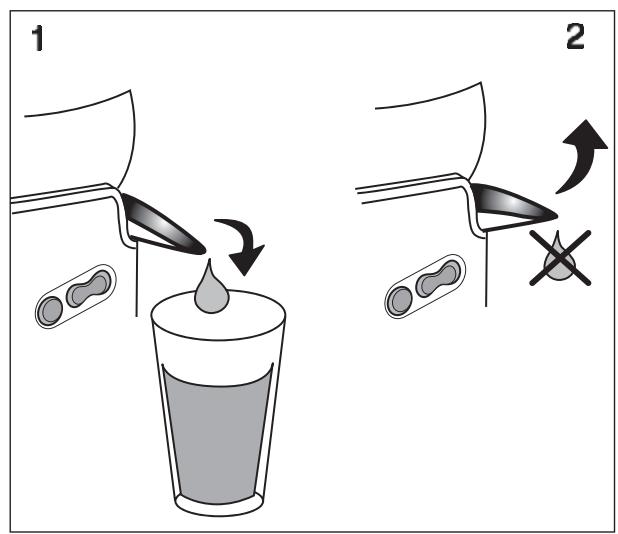
Make certain that the spout is in the low position (fig 1).
-
Plug in the appliance.
- Start up the juicer by pressing the switch (I).
- Select the speed to correspond to the fruit (see table below) using button (J).
- Remove the pusher and insert the fruit or vegetables in pieces through the funnel.
You must insert fruit and vegetables with the motor running.
- Use the pusher to push the food down but do not force it. Do not use any other utensil. Above all, DO NOT USE YOUR FINGERS to push the food. The juice will flow into the glass through the spout while the pulp will collect in the pulp container.
- Once your glass is full, stop the appliance and push the spout up into the raised position again (fig 2).
- Once the pulp container looks full or the flow of juice slows down, empty the pulp container using the handle of the brush (O) and clean the filter with the brush, if necessary.
- When you have finished using the appliance, you are advised to clean the accessories straight away using the brush (O) so that food does not dry onto them. Apart from the body of the appliance, you can put all these accessories in the dishwasher (top basket).
Cleaning – Foods which stain plastics : Over time the strong coloured natural juices from food such as carrots and beetroot may stain the plastic parts of your appliance - this is normal. These parts may be cleaned by soaking them in mild bleach (non abrasive) straight after use.
- Some hints :
| Ingredients | Recommended speed :I : low,II : fast,Max. 2 minutes | Approximate number of fruits before you need to empty the pulp container | Approximate weight | Quantity of juice obtained (*)(1 glass = about 250ml) |
| Carrots | II | 10 | 1 kg | 500ml |
| Cucumbers | II | 2 | 1 kg | 600ml |
| Apples | II | 5 | 1,2 kg | 700ml |
| Pears | II | 5 | 1,2 kg | 750ml |
| Melons | I | 1 - 2 | 1,5 kg | 900ml |
| Pineapples | II | 2 | 2 kg | 1000ml |
| Grapes | I | 2 kg | 1200ml | |
| Lettuce | II | 2 - 3 | 0,5 kg | 250ml |
| Tomatoes | I | 7 | 1,5 kg | 900ml |
| Celery | II | 3 | 1,5 kg | 900ml |
| Ginger | II(max. 30 seconds) | 2 | 80 g | 60ml |
(*) The quality and quantity of the juice obtained will vary considerably according to the date of harvest and the variety of each vegetable or fruit. The quantities of juice shown above therefore provide only a rough guide.
4 B - PRACTICAL HINTS ON USING YOUR JUICER
- Choose fresh, ripe fruit and vegetables.
- Carefully wash the fruit and vegetables before cutting them and removing the stones.
- Peel thick-skinned fruit such as citrus fruits (as the peel is bitter) and pineapples (plus the core).
- The juicier the fruit (as with tomatoes) the slower the speed you should use (see table above for information).
- If you prepare juice from grapes, quinces, blueberries or blackcurrant, you should clean the filter every time you press 1/2 kg.
- If you juice over-ripe fruit, you will obtain a fairly thick liquid, the filter will tend to get clogged up and you should then clean it more regularly. You will also have to empty the pulp container more or less often according to the quality of the fruit or vegetables processed.
- Important: all juices should be drunk immediately. When they come into contact with the air, they oxidise very quickly and this may impair their taste and colour. Apple and pear juice quickly takes on a brown colour. Add a few drops of lemon to prevent the juice going brown too quickly.
5. Using the Citrus-Press Accessory (according to model)
- Release the side safety lock clips (H).
- Remove the lid (C) and filter (D).
- Position the citrus press sieve (L) on the pulp container (E) with the cone (K).
- Secure the citrus press sieve (L) to the pulp container (E) using the safety lock clips (H).
- Plug in the appliance.
- Make certain that the spout is in the low position (fig 1)
- Select the slowest speed I (J) and set the switch (I) to "On".
- Press the citrus fruit.
6. Cleaning and maintenance
- All the removable juicer parts (A, B, C, D, E, M, N) can be cleaned in the dishwasher.
- The citrus-press accessory parts (K, L) cannot be washed in the dishwasher. Wash them under running water.
- This appliance is easier to clean if you do it immediately after use.
- Do not use scouring pads, acetone, alcohol (white spirit) etc. to clean your appliance.
- The filter must be handled with care. Avoid any improper handling which may cause damage. The filter can be cleaned with the brush (O).
Replace the filter as soon as it shows signs of wear or tear. - Wipe the motor unit down with a damp cloth. Dry it carefully.
- Never place the motor unit under a running tap.
7. Electrical or electronic product at end of service life
natural_image
Symbol of a trash bin crossed out by two crossed lines, with no text or labels present.Environment protection first!
Your appliance contains valuable materials which can be recovered or recycled.
Leave it at a local civic waste collection point.
If you have any product problems or queries, please contact our Customer Relations Team first for expert help and advice:-
HELPLINE:
0845 602 1454
(01) 677 4003
or consult our website
- UK
- ROI
- www.tefal.co.uk
natural_image
Symbol of a trash bin crossed out by two crossed lines, with no text or labels present.natural_image
Symbol of a trash bin crossed out by two crossed lines, with no text or labels present.natural_image
Symbol of a trash bin crossed with no text or labels, representing waste sorting or disposal (no text present)
natural_image
Symbol of a trash bin crossed with a diagonal line, no text or labels presentnatural_image
Symbol of a trash bin crossed out by two crossed lines, with no text or labels present.natural_image
Symbol of a trash bin crossed out by two crossed lines, with no text or labels present.Tenk miljøvern!

natural_image
Symbol of a trash bin crossed with a diagonal line, no text or numbers presentVar rädd om miljön!

natural_image
Symbol of a trash bin crossed out by two crossed lines, with no text or labels present.
natural_image
Symbol of a trash bin crossed out by two crossed lines, with no text or labels present.

- Safety instructions
- Carrot juice
- Appliance description
- Before first use
- Using the Juicer
- A - STARTING UP THE JUICER
- You must insert fruit and vegetables with the motor running.
- B - PRACTICAL HINTS ON USING YOUR JUICER
- Using the Citrus-Press Accessory (according to model)
- Cleaning and maintenance
- Electrical or electronic product at end of service life
- Environment protection first!
- HELPLINE:
- Tenk miljøvern!
- Var rädd om miljön!
Brand : MOULINEX
Model : JU380110 ELEA
Category : Food Processor