BV82 - Fridge BORETTI - Free user manual and instructions
Find the device manual for free BV82 BORETTI in PDF.


User questions about BV82 BORETTI
0 question about this device. Answer the ones you know or ask your own.
Ask a new question about this device
Download the instructions for your Fridge in PDF format for free! Find your manual BV82 - BORETTI and take your electronic device back in hand. On this page are published all the documents necessary for the use of your device. BV82 by BORETTI.
USER MANUAL BV82 BORETTI
Important Safety Instructions
It is most important that this instruction book should be retained with the appliance for future reference. Should the appliance be sold or transferred to another owner, or should you move house and leave the appliance, always ensure that the book is supplied with the appliance in order that the new owner can be acquainted with the functioning of the appliance and the relevant warnings.
These warnings are provided in the interest of safety. You must read them carefully before installing or using the appliance.
General Safety
- This appliance is not intended for use by persons (including children) with reduced physical, sensory or mental capabilities, or lack of experience and knowledge, unless they have been given supervision or instruction concerning use of the appliance by a person responsible for their safety.
Children should be supervised to ensure that they do not play with the appliance. - It is dangerous to alter the specifications or modify this product in any way.
- Before any cleaning or maintenance work is carried out, be sure to switch off and unplug the appliance.
- This appliance is heavy. Care should be taken when moving it.
- Ice follies can cause frost burns if consumed straight from the appliance.
- Take utmost care when handling your appliance so as not to cause any damages to the cooling unit with consequent possible fluid leakages.
- The appliance must not be located close to radiators or gas cookers.
- Avoid prolonged exposure of the appliance to direct sunlight.
- There must be adequate ventilation round the back of the appliance and any damage to the refrigerant circuit must be avoided.
- For freezers only (except built-in models): an ideal location is the cellar or basement.
- Do not use other electrical appliances (such as ice cream makers) inside of refrigerating appliances.
Service / Repair
- Any electrical work required to install this appliance should be carried out by a qualified electrician or competent person.
This appliance should be serviced by an authorised Service Centre, and only genuine spare parts should be used. - Under no circumstances should you attempt to repair the appliance yourself. Repairs carried out by inexperienced persons may cause injury or more serious malfunctioning. Refer to your local
Service Centre, and always insist on genuine spare parts.
- This appliance contains hydrocarbons in its cooling unit; maintenance and recharging must therefore only be carried out by authorised technicians.
Use
- The domestic refrigerators and freezers are designed to be used specifically for the storage of edible foodstuffs only.
- Frozen food must not be re-frozen once it has been thawed out.
- Manufacturers' storage recommendations should be strictly adhered to. Refer to relevant instructions.
- The inner lining of the appliance consists of channels through which the refrigerant passes. If these should be punctured this would damage the appliance beyond repair and cause food loss. DO NOT USE SHARP INSTRUMENTS to scrape off frost or ice. Frost may be removed by using a scraper. Under no circumstances should solid ice be forced off the liner. Solid ice should be allowed to thaw when defrosting the appliance. See defrost instructions.
- Do not place carbonated or fizzy drinks in the freezer as it creates pressure on the container, which may cause it to explode, resulting in damage to the appliance. Do not use a mechanical device or any artificial means to speed up the thawing process other than those recommended by the manufacturer. Never use metal objects for cleaning your appliance as it may get damaged.
Installation
- Care must be taken to ensure that the appliance does not stand on the electrical supply cable.
Important: if the supply cable is damaged, it must be replaced by authorised service or qualified personnel using a special cable of the same type.
- During normal operation, the condenser and compressor at the back of the appliance heat up considerably. For safety reasons, minimum ventilation must be as shown in the relevant paragraph.
Attention: keep ventilation openings clear of obstruction.
- If the appliance is transported horizontally, it is possible that the oil contained in the compressor flows in the refrigerant circuit. It is advisable to wait at least two hours before connecting the appliance to allow the oil to flow back in the compressor.
- There are working parts in this product which heat up. Always ensure that there is adequate ventilation as a failure to do this will result in component failure and possible food loss. See installation instructions.
- Parts which heat up should not be exposed. Wherever possible the back of the product should be against a wall.
- If the appliance has been transported horizontally, it is possible that the oil contained in the compressor flows in the refrigerant circuit. It is advisable to wait at least two hours before connecting the appliance to allow the oil to flow back in the compressor.

Environment Protection
- This appliance does not contain gasses which could damage the ozone layer, in either its refrigerant circuit or insulation materials. The appliance shall not be discarded together with the urban refuse and rubbish. Avoid damaging the cooling unit, especially at the rear near the heat exchanger. Information on your local disposal sites may be obtained from your municipal authorities.
The materials used on this appliance marked with the symbol are recyclable.
Disposal of old Appliances
The symbol on the product or on its packaging indicates that this product may not be treated as household waste. Instead it shall be handed over to the applicable collection point for the recycling of electrical and electronic equipment. By ensuring this product is disposed of correctly, you will help prevent potential negative consequences for the environment and human health, which could otherwise be caused by inappropriate waste handling of this product. For more detailed information about recycling of this product, please contact your local city office, your household waste disposal service or the shop where you purchased the product.
Contents
Important Safety Instructions 26
Use Cleaning the interior / Starting-up / Temperatur control /Quick freezing / Warning light 28
Temperatur acoustic alarm / Open door acoustic alarm / Freezing calendar 29
Freezing of fresh foods / Storage of frozen food / Thawing / Ice-cube production 29
Hints Hints for freezing / Hints for storage of frozen food 30
Maintenance Defrosting 30
Periodic cleaning / Periodic of non-operation 31
Customer service and spare parts 31
Technical specifications 31
Door reversibility 32
Installation Positioning 32
Electrical connection / Grid preparation 33
Building in the appliance under a worktop 33
Fitting the plinth 36
Use
The freezer is marked with the XXXXX symbol, which means that the compartment is suitable for freezing presie food and long-term storage of frozen food.
Cleaning the interior
Before using the appliance for the first time, wash the interior and all internal accessories with lukewarm water and some neutral soap so as to remove the typical smell of a brand-new product, then dry thoroughly.
Freezer controls
Do not use detergents or abrasive powders, as these will damage the finish.

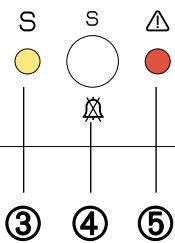
1 Pilot light (green)
2 Thermostat control knob
3 Fast freeze light (yellow)
Starting-up
Insert the plug into the wall socket.
Turn the thermostat knob (2) clockwise after the position «O». The pilot light (1) will light up and a sound is on only for 2 sec., indicating that the appliance is powered. The warning light (5) will blink and the sound signal alarm will get on, indicating that the temperature inside the appliance is too high.
Push the button (4), the sound signal alarm will get off and pushing the button a second time the super control light (3) light up. The freezer will start to operate.
To stop operation, simply turn the thermostat knob to position «O» and a sound is on only for 2 sec.
Temperature control
- Turn knob () beyond the «O» position until its pointer coincides with the required setting.
- The minimum setting (least cold) is represented by the lowest number and the maximum setting (coldest) by the highest number.
- To safely store frozen and deep-frozen foods, the inner temperature of the freezer must be at least -18^ or colder.
A medium setting is generally the most suitable.
4 Fast freeze switch and for stopping the acoustic alarm (warning light on)
5 Warning light (red)
- The following effects are of significance in respect of the interior temperature:
- Ambient temperature
- Quantity and temperature of the food stored;
- Frequency with which the door is opened and how long it is left open
- the location of the appliance.
Quick freezing
Activate fast freeze by depressing the fast freeze switch (4). The pilot lamp (3) will then light up.
If the quick-freezing function is not ended manually, the appliance switch off the quick-freezing function after 52 hours. The yellow light goes out.
The SUPER function can be ended by pressing the button (4) again. The yellow light goes out.
Warning light (red)
If the temperature warning light (5) blinks, it indicates that the temperature within the freezer has reached a level where the safe food storage is no longer ensured.
When the freezer is first switched on, the warning light blinks until the temperature has dropped to a safe level for the storage of frozen food.
Temperature acoustic alarm
This appliance incorporates an alarm which gives off an audible signal whenever the warning light blinks. This signal can be temporarily stopped by depressing the push button for fast-freezing (4).
The fast-freezing push button can be released as soon as the warning light is off.
Open door acoustic alarm
This appliance also incorporates an alarm which sounds if the door is left open for more than 60 seconds. The signal will be stopped when the door is closed again.
Freezing Calendar
The symbols on the upper drawer show different types of frozen goods.
The numbers indicate storage times in months for the appropriate types of frozen goods. Whether the upper or lower value of the indicated storage time is valid depends on the quality of the foods and pretreating before freezing.
Freezing of fresh foods
To quick-freeze foods when the appliance has not been in use, switch on the freezer and let it run on the quick-freeze setting for at least three hours before putting the food to be frozen in the compartment.
If instead the appliance is already in operation, it should run on the quick-freeze setting for at least 24 hours before the foods are put in the freezer. Once the foods have been placed in the freezer, the freezing operation can be considered to be complete 24 hours later. Once freezing is complete, the freezer should be reset for normal storage use.
Food to be frozen has to be placed in the appliance's two top compartments; if freezing only a small amount of food, use the top compartment.
The maximum amount of food which is freezable in 24 hours is indicated on the rating plate. This is to be found on the bottom left-hand side.
You should never freeze all at once a greater quantity of foods than the maximum indicated on the appliance's rating plate.
Storage of frozen food
When you first start the freezer or if the freezer has been out of use for some time, we advise you to run your appliance for at least two hours in the «fast freeze» mode before storing frozen food.

Important
If there is a power failure when food is in the freezer, do not open the door of the freezer. The frozen food will not be affected if the power cut is of short duration (up to 20 hours) and the freezer is full, otherwise, it is recommended that the food should be used within a short time (a temperature increase of the frozen food shortens its safe storage period).
To remove the drawers, proceed as follows: pull the drawer out until it comes to a stop, then tilt it upwards (see figure).

Thawing
Deep-frozen or frozen food, prior to being used, can be thawed in the refrigerator or at room temperature, depending on the time available for this operation.
Small pieces may even be cooked still frozen, directly from the freezer: in this case, cooking will take longer.
Ice-cube production
This appliance is equipped with one or more trays for the production of ice-cubes.
Fill these trays with water, then put them in the freezer.

Do not use metallic instruments to remove the trays from the freezer.
i Hints
Hints for freezing
To help you make the most of the freezing process, here are some important hints:
- The maximum quantity of food which can be frozen in 24 hrs. is shown on the rating plate.
- The freezing process takes 24 hours. No further food to be frozen should be added during this period.
- Only freeze top quality, fresh and thoroughly cleaned, foodstuffs.
- Prepare food in small portions to enable it to be rapidly and completely frozen and to make it possible subsequently to thaw only the quantity required.
- Lean foods store better and longer than fatty ones; salt reduces the storage life of food.
- Wrap up the food in aluminium foil or polythene and make sure that the packages are airtight.
- During the freezing process, do not add further foods for freezing and do not open the freezer door.
- The foods for freezing should not be placed in contact with already frozen foods, but put in the special freezing compartment. This will stop the temperature of already frozen foods from rising.
- Do not put carbonated liquids (fizzy drinks, etc.) in the freezer as they may burst.
Maintenance

Unplug the appliance before carrying out any maintenance operation.

Warning This appliance contains hydrocarbons in its cooling unit maintenance and recharging must therefore only be carried out by authorised technicians.
Defrosting
The freezer compartment will become progressively covered with frost. This should be removed with the special plastic scraper provided, whenever the thickness of the frost exceeds 1/4^n .
During this operation it is not necessary to switch off the power supply or to remove the foodstuffs. However, when the ice becomes very thick on the inner liner, complete defrosting should be carried out and it is advisable to carry out this operation when the appliance is empty.
To carry out complete defrosting proceed as follows:
-
Remove any stored food, wrap it in several layers
-
Never put hot foods or liquids in the freezer and take care not to 1/2 ll recipients up to the brim if they are covered with a lid.
- It is advisable to show the freezing-in date on each individual pack to enable you to keep tab of the storage time.
Hints for storage of frozen food
To get the best out of your freezer, in the case of storage of commercially frozen food you should ensure that:
- Make sure that the commercially frozen foodstuffs were adequately stored by the retailer.
- Be sure that frozen foodstuffs are transferred from the foodstore to the freezer in the shortest possible time.
- Not open the door frequently or leave it open longer than absolutely necessary.
- Once defrosted, food deteriorates rapidly and cannot be refrozen.
- Do not exceed the storage period indicated by the food manufacturer.
Water ices, if consumed immediately after removal from the freezer compartment, can possibly cause the skin to be freeze burnt.
of newspaper and put it in a cool place.
- Turn the thermostat control to the «O» setting.
- Leave the door open.
- Remove the three large drawers.
- When defrosting is completed, remove the water that has collected in the small bottom drawer and dry the interior thoroughly.
Keep the scraper for future use.
- Turn the thermostat control to a medium setting and, after letting the appliance run for at least two hours in the «fast freeze» mode, replace the previously removed food into the compartments.

Warning
Never use metal objects for defrosting your appliance as it may get damaged.
Do not use a mechanical device or any artificial means to speed up the thawing process other than those recommended by the manufacturer.
A temperature increase of the frozen food shortens its safe storage period.
Periodic cleaning

Never use metal objects for clearing your appliance as it may get damaged.
Clean the inside with warm water and bicarbonate of soda. Rinse and dry thoroughly.
The appliance is equipped with a ventilation grid. Keep clean to guarantee good ventilation and good working order of the appliance.
An accumulation of dust will affect the performance of the appliance and cause excessive electricity consumption.
The structure of the appliance permits cleaning of the rear zone close to the wall, using a vacuum cleaner.
- Remove the plinth (1), then the ventilation grid (2);
- Carefully pull the air deflector out (3).

Periods of non-operation
When the appliance is not in use for long periods, take the following precautions:
- remove the plug from the wall socket;
- remove all food:
- defrost and clean the interior and all accessories;
- leave the door ajar to allow air to circulate to prevent unpleasant smells.
Customer service and spare parts
If the appliance is not functioning properly, check that:
- the plug is firmly in the wall socket and the mains power switch is on;
- there is an electricity supply (find out by plugging in another appliance);
- the thermostat knob is in the correct position.
If your appliance is still not working properly after making the above checks, contact the nearest service centre.
To obtain fast service, it is essential that when you apply for it you specify the model and serial number of your appliance which can be found on the guarantee certificate or on the rating plate located inside the appliance, on the bottom left-hand side.
i Technical specifications
The technical data is indicated in the rating plate on the left side inside the appliance.
Door reversibility
To reverse the opening direction of the door, proceed as follows:


Warning!
If the ambient temperature is cold (i.e. in Winter), the gasket may not fit perfectly to the cabinet. In that case, wait for the natural fitting of the gasket or accelerate this process by heating up the part involved with a normal hairdrier.


Installation
Positioning
The appliance should be installed well away from sources of heat such as radiators, boilers, direct sunlight etc.
Best performance is obtained with ambient temperature between +18^ and +43^ (class T); +18^ and +38^ (class ST); +16^ and +32^ (class N); +10^ and +32^ (class SN).
The class of your appliance is shown on its rating plate.
For building-in and door reversibility refer to the relevant instructions.
Electrical connection
Before plugging in, ensure that the voltage and frequency shown on the serial number plate correspond to your domestic power supply.
Voltage can vary by ± 6% of the rated voltage.
For operation with different voltages, a suitably sized auto-transformer must be used.

Important
The appliance must be earthed.
The power supply cable plug is provided with a contact for this purpose.
If the domestic power supply socket is not earthed, connect the appliance to a separate earth in compliance with current regulations, consulting a specialist technician.
The Manufacturer declines all responsibility if the above safety precautions are not observed.

Attention!
It must be possible to disconnect the appliance from the mains power supply; the plug must therefore be easily accessible after installation.
This appliance complies with the following E.E.C.
Directives:

-
87/308 EEC of 2/6/87 relative to radio interference suppression.
-
73/23 EEC of 19.2.73 (Low Voltage Directive) and subsequent modifications.
- 89/336 EEC of 3.5.89 (Electromagnetic Compatibility Directive) and subsequent modifications.
Grid preparation
Left door opening:
Remove the left side (A) of the grid cutting it from the rear (see figure).

Right door opening:
Remove the right side (B) of the grid cutting it from the rear (see figure).
To position the grid on the appliance proceed as follows:
Apply the grid to the base of the appliance by pushing on to the clasps (a) until they click.

Building in the appliance under a worktop
Dimensions of the recess
The dimensions of the recessed installation area must correspond with those indicated in the figure.

Installation kit

-
Two cabinet securing brackets are supplied with the installation pack. They need to be assembled onto the cabinet prior to cabinet being pushed into the Kitchen aperture.
-
To fit these brackets remove the two screws at the top left and right hand front corners of the cabinet.
- Position the two brackets as shown in the figure and replace the two securing screws.

- Push the appliance into place. The plug socket necessary for connection of the appliance to the electricity supply should be positioned, so that the plug is not placed in the recess.

-
To adjust the height proceed as follows:
-
Loosen or tighten the two front feet.
- The rear feet are adjusted by turning the screw in the front kick plate to the left or right.

- The joint cover (B) is to be assembled after having installed the appliance in the recess.


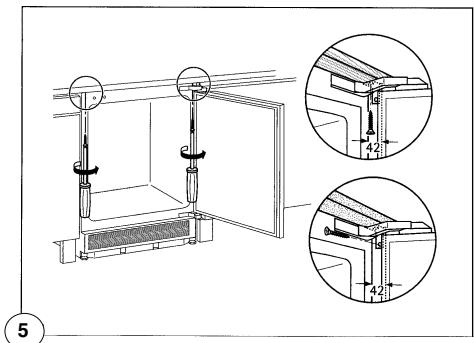
- Screw appliance into place and retain the cabinet with screws through the securing brackets into the worktop or adjacent woodwork as necessary.
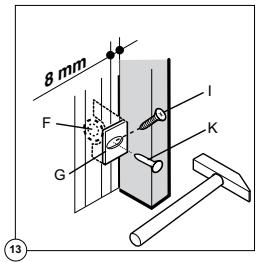
- To mount the furniture door proceed as shown in the figures:

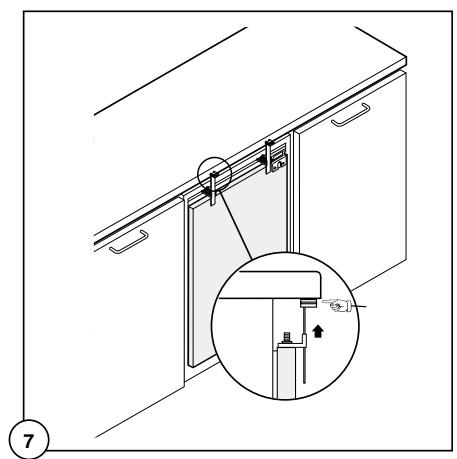

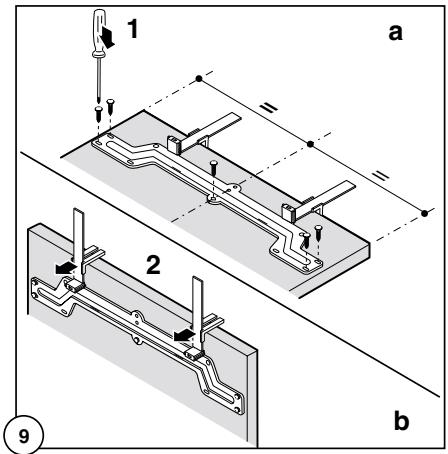
UPPER PART OF KITCHEN FURNITURE PANEL

LOWER PART OF KITCHEN FURNITURE PANEL


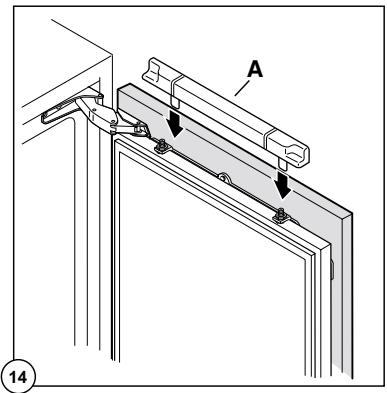
7. Refit the covering strip.

Fitting the plinth
Important
For the efficient operation of the appliance, it is important that the original ventilation grid is used.
- For an opening height dimension A = 820 mm and a plinth height dimension a = 100 mm , the plinth may be fitted without adjustments. The same applies to an opening height dimension B = 890 mm and a plinth height dimension b = 170 mm .
- For plinth heights greater than a = 100 mm , b = 170 mm , a cut should be made in the plinth, 580 mm wide, in the centre of the appliance position, leaving a remaining height of a = 100 mm , b = 170 mm .
- Attach plinth to the kitchen units.

Important The plinth
The plinth must be positioned at a minimum distance of 25mm from the door.