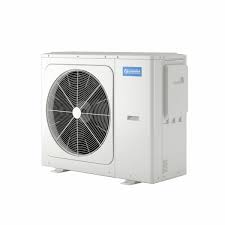
SHERPA - Portable air conditioner OLIMPIA SPLENDID - Free user manual and instructions
Find the device manual for free SHERPA OLIMPIA SPLENDID in PDF.


| Product type | Air-water heat pump (reversible) for air conditioning and heating |
| Model | SHERPA (variants 8M, 12M, 15M, 15T, 18T) |
| Brand | OLIMPIA SPLENDID |
| Indoor unit dimensions (W x H x D) | 505 x 900 x 300 mm |
| Outdoor unit dimensions (W x H x D) | 940 x 780 x 340 mm (8-12) / 940 x 1230 x 340 mm (15-18) |
| Indoor unit weight | 43 kg (8M/12M) to 48 kg (18T) |
| Outdoor unit weight | 67 kg (8M) to 109 kg (15-18) |
| Power supply | 230 V ~ 50 Hz single-phase (8-15M) / 400 V 3N ~ 50 Hz three-phase (15T-18T) |
| Nominal cooling capacity | 6.27 kW (8M) to 13.9 kW (18T) |
| Nominal heating capacity | 8.2 kW (8M) to 16.9 kW (18T) |
| Refrigerant | R410A (charge from 1.9 to 3.6 kg depending on model) |
| Indoor unit noise level | 30 dB(A) (sound pressure) |
| Outdoor unit noise level | 48-50 dB(A) (sound pressure) |
| Operating range (heating) | Outdoor temperature from -20°C to 20°C |
| Operating range (air conditioning) | Outdoor temperature up to 45°C |
| Maintenance and cleaning | External cleaning with a soft cloth; periodic filter inspection by a professional |
| Safety | Mandatory residual current circuit breaker; grounding; protection against overvoltages and frost |
| Spare parts | Only original OLIMPIA SPLENDID spare parts |
| Repairability | Interventions reserved for qualified approved personnel; warranty void if installed by a non-professional |
| General information | Complies with European directives: Low Voltage, EMC, WEEE, RoHS |
Frequently Asked Questions - SHERPA OLIMPIA SPLENDID
User questions about SHERPA OLIMPIA SPLENDID
0 question about this device. Answer the ones you know or ask your own.
Ask a new question about this device
Download the instructions for your Portable air conditioner in PDF format for free! Find your manual SHERPA - OLIMPIA SPLENDID and take your electronic device back in hand. On this page are published all the documents necessary for the use of your device. SHERPA by OLIMPIA SPLENDID.
USER MANUAL SHERPA OLIMPIA SPLENDID
INSTRUCTIONS FOR INSTALLATION, USE AND MAINTENANCE GB
INSTRUCTIONS POUR L'INSTALLATION, L'EMPLOI ET L'ENTRETIEN
F
4 1 GENERALITA
2.9.1 Sizing table of the power supply line
2.9.2 Accessing the control panel
2.9.3 Electrical mains supply connection
2.9.4 Electrical connection of the external unit
2.10 CONNECTIONS TO THE TERMINAL STRIP
2.11 AUXILIARY HEATER MANAGEMENT (RESISTANCE OR SUPPORT BOILER)
2.12 HANDING OVER THE SYSTEM
2.13 WIRING DIAGRAM
2.13.1 Single-phase + resistance wiring diagram
2.13.2 Three-phase + resistance wiring diagram
2.13.3 Single-phase wiring diagram
2.13.4 Three-phase wiring diagram
3 USE AND MAINTENANCE
3.1 SYSTEM COMPONENTS AND DESCRIPTION OF THE PARTS
3.2 EXTERNAL UNIT CONTROL PANEL
3.2.1 Operation - Temperature adjustment
3.3 CONTROLLER SETTINGS
1 GENERALITES
1.1 INFORMATIONS GENERALES
1.2 SYMBOLOGIE
3.3.1 Function of the keys
3.3.2 Accessing the user menu, displaying and modifying the information
3.3.3 Info menu
3.3.4 Stand-by
3.3.5 Keypad lock
3.3.6 Displays
3.4 SETTING AND GENERAL START UP
3.4.1 Preparation for first starting up
3.4.2 Before start-up
3.4.3 External unit switch-on and control panel setting
3.4.4 Controller switch-on and setting
3.4.5 Activation and deactivation
3.4.6 Checks during and after the first starting up.
3.5 LONG-TERM SHUTDOWN
3.6 CLEANING
3.7 MAINTENANCE
3.8 OPERATING ASPECTS THAT SHOULD NOT BE INTERPRETED AS PROBLEMS
4 TROUBLESHOOTING
4.1 TABLE OF PROBLEMS AND SOLUTIONS
4.2 ALARMS SHOWN ON THE CONTROL PANEL OF THE EXTERNAL UNIT
4.2.1 Symptoms and inspection points
4.2.2 Meaning of the warning lights on the electronic board of the external unit
4.3 TECHNICAL CHARACTERISTICS
4.3.1 Partial loading performance tables in relation to the external thermohygrometric conditions and water temperature
4.4 FLOWRATE/HEAD DIAGRAMS AT THE MAXIMUN AND AVERAGE SPEED OF THE CIRCULATOR
We would first of all like to thank you for having chosen one of our products and congratulate you on your choice of air-water heat pump.
We are sure you will be happy with it because it represents the state of the art in the technology of home air conditioning.
This manual serves to provide you with the instructions and explanations you need to make the best possible use of your air-conditioner.
We suggest that you read it carefully before starting to use the appliance.
By following the suggestions contained in this manual, the air-water heat pump that you have purchased will operate without problems giving you optimum room temperatures with minimum energy costs.
ATTENTION
The manual is divided into 3 sections or chapters:
CHAP. 1 GENERAL INFORMATION
Contains information for the specialized installer and end user.
It contains information, technical data and important warnings to heed before installing and using the air-water heat pump.
CHAP. 2 INSTALLATION
Contains information exclusively intended for the specialized installer.
It contains all the information necessary for the positioning and mounting of the air-water heat pump in the place where it will be installed.
The installation of the air-water heat pump by non-specialised personnel will invalidate the warranty conditions.
CHAP. 3 USE AND MAINTENANCE (by user)
It contains useful information for understanding the use and programming of the air-water heat pump and the most common maintenance interventions.

GENERALITES
INFORMATIONS GENERALES
This document is restricted in use to the terms of the law and may not be copied or transferred to third parties without the express authorization of the manufacturer, OLIMPIA SPLENDID.
Our machines are subject to change and some parts may appear different from the ones shown here, without this affecting the text of the manual in any way.
Read this manual carefully before performing any operation (installation, maintenance, use) and follow the instructions contained in each chapter.
THE MANUFACTURER IS NOT RESPONSIBLE FOR DAMAGES TO PERSONS OR PROPERTY CAUSED BY FAILURE TO FOLLOW THE INSTRUCTIONS IN THIS MANUAL.
The manufacturer reserves the right to make any changes it deems advisable to its models, although the essential features described in this manual remain the same.
The installation and maintenance of air-conditioners like this one may be hazardous as they contain a cooling gas under pressure as well as powered parts.
Therefore, the installation, first startup and subsequent maintenance should be carried out exclusively by authorized, qualified personnel (see first start-up request sheet attached to the device).
This unit complies with European Directives:
Low voltage 2006/95/CE
Electro-magnetic compatibility 2004/108/CE;
- Use restrictions of hazardous substances in electrical and electronic devices 2002/95/CE (RHOS);
- Refuse from electrical and electronic devices2002/96/CE (RAEE).
And subsequent amendments.
Failing to comply with the instructions contained in this manual, and using the unit with temperatures exceeding the permissible temperature range will invalidate the warranty.
Routine maintenance and general external cleaning can also be done by the user as these operations are not difficult or dangerous.
During installation and maintenance, respect the precautions indicated in the manual, and on the labels applied inside the units, as well as all the precautions suggested by good sense and by the safety regulations in effect in your country.
Et modifications successives.
The pictograms in the next chapter provide the necessary information for correct, safe use of the machine in a rapid, unmistakable way.
Editorial pictograms
Service
- Refers to situations in which you should inform the SERVICE department in the company:
CUSTOMER TECHNICAL SERVICE.
Index
- Paragraphs marked with this symbol contain very important information and recommendations, particularly as regards safety.
Failure to comply with them may result in:
- danger of injury to the operators
- loss of the warranty
- refusal of liability by the manufacturer.
Raised hand
- Refers to actions that absolutely must not be performed.
Safety pictograms
Danger of high voltage
- Signals to the personnel that the operation described could cause electrocution if not performed according to the safety rules.
Generic danger
- Signals to the personnel that the operation described could cause physical injury if not performed according to the safety rules.
Danger due to heat
- Signals to the personnel that the operation described could cause burns if not performed according to the safety rules.
SYMBOLOGIE
- Installation should be left to the dealer or another professional; improper installation may cause water leakage, electrical shock, or fire.
Install the air-water heat pump following the instructions indicated in this manual; if installation is not performed correctly there may be the risk of a water leak, electric shock or fire. - Be sure to use the supplied or specified installation parts; use of other parts may cause the unit to come to lose, water leakage, electrical shock, or fire.
- Install the external unit onto a solid base that is able to support the weight: if installed incompletely or onto an inappropriate base, the external unit could cause damage to persons or things if it should detach from the base.
- Electrical work should be carried out in accordance with the installation manual and the national electrical wiring rules or code of practice; insufficient capacity or incomplete electrical work may cause electrical shock or fire.
- Be sure to use a dedicated power circuit; never use a power supply shared by another appliance.
- For wiring, use a cable long to cover the entire distance with no connection; do not use an extension cord; do not put other loads on the power supply, use a dedicated power circuit; (failure to do so may cause abnormal heat, electric shock or fire).
- Use the specified types of wires for electrical connections between the indoor and outdoor units; firmly clamp the interconnecting wires so their terminals receive no external stresses; incomplete connections or clamping may cause terminal overheating or fire.
- After connecting interconnecting and supply wiring be sure to shape the cables so that they do not put undue force on the electrical covers or panels; install covers over the wires; incomplete cover installation may cause terminal overheating, electrical shock, or fire.
- If any refrigerant has leaked out during the installation work, ventilate the room; (the refrigerant produces a toxis gas if exposed to flames).
AVERTISSEMENTS
Call immediately the OLIMPIA SPLENDID customer technical service or other professionally qualified personnel; do not intervene personally on the equipment.
Keep the packing at least through the warranty period, in case you need to ship the air-conditioner to the service centre for repair.
Dispose of the packing materials in compliance with the rules in effect for waste disposal.
EXTERNAL UNIT
The external unit is currently available in 4 models (fig. 1):
| External units | 8-12 |
| Height (mm) | 780 |
| Width (mm) | 940 |
| Depth (mm) | 340 |
| External units | 15-18 |
| Height (mm) | 1230 |
| Width (mm) | 940 |
| Depth (mm) | 340 |
INTERNAL UNIT
The internal unit is currently available in 4 models, all having the same external dimensions (fig. 2):
| Internal unit | 8-12-15-18 |
| Height (mm) | 900 |
| Width (mm) | 505 |
| Depth (mm) | 300 |
Note importante:
LIST OF THE MAIN COMPONENTS (FIG. 3)
A Jolly system air breather
B Coolant receiver
C Differential pressure switch
D Plate exchanger
E Coolant fixture
F Electronic board
G External unit control panel
H Expansion tank
1 Manifold with resistance (if present)
L Control panel
M Pump
N Power supply
Water outlet
P Water inlet
LIST OF COMPONENTS SUPPLIED AND DESCRIPTION OF THE PARTS
The equipment is delivered with standard packaging consisting of a carton shell and a series of protections in expanded polystyrene.
There is a small pallet beneath the packaging of the external unit that facilitates the transfer and handling operations while the packaging of the internal unit is fitted with handles that facilitates handling.
Supplied with the device, the following parts can be found inside the package:
- N.1 bracket for wallmounting the device
- N 1 template in cardboard for wall and floor mounting.
STORAGE
Store the cartons in a closed environment protected against atmospheric agents and raised off the floor by planks or a pallet. TO NOT TURN THE CARTON UPSIDE DOWN.
NOMENCLATURE DES COMPOSANTS PRINCIPAUX (FIG. 3)
To ensure that the installation is correct and the equipment operates perfectly, follow carefully the indications in this manual. Failure to observe these indications could cause a machine malfunction and relieve the OLIMPIA SPLENDID company of all warranty obligations or responsibility for any damage caused to persons, animals or property.
It is essential that the electrical plant is installed following all the regulations in force and respecting the data indicated in the Technical Features chapter and includes a correct earthing.
The equipment must be installed so that maintenance can be carried out easily.
INSTALLATION OF THE INTERNAL UNIT (FIG. 4)
PREARRANGE:
- 4 M10 plugs for wall fixing.
- an area with sufficient free lateral space to allow removal of the cover
- a water drain in the vicinity
- a water supply in the vicinity
- a conforming power supply in the vicinity
- fixing elements that are appropriate for that kind of weight
INSTALLATION
MODE D'INSTALLATION
The internal unit must always be fixed to a wall within the home and in the room chosen by the client.
Thanks to the high level of acoustic isolation of the device, the choice of the room into which the client may install the internal unit is very broad.
The internal unit must be fixed to the wall at the height of a person using M10 plugs and ensuring that sufficient free space is left on either side.
Panel opening: front, upper and side
- Open the door (fig. 5 ref. A) simultaneously pressing with the thumbs on the knurled parts. At this point the door will open downwards.
- Remove the plastic side guards (fig. 5 ref. B).
- Unscrew the two fixing screws (fig. 5 ref. C) from the control panel.
- Remove the inspection panel by pulling it towards you.
INSTALLATION OF THE EXTERNAL UNIT
The maximum length of the connection lines to the internal unit must be 50m in each sense (for lengths greater than 30m it will be necessary to top up the R410A load with 40g for each meter). Furthermore, the maximum difference in height between the internal and external unit must not exceed the figures indicated in the table on Page 18.
It is very important that the installation place be chosen with extreme care in order to ensure adequate protection of the device against impact or possible consequential damage.
The external unit can be installed onto specific wall fixing brackets (using the appropriate wall assembly kit that can be ordered separately as an accessory) or else onto a concrete base.
WARNING
- Mount the external unit in a position that is capable of supporting the weight.
- Choose a place that is adequately ventilated and in which the external temperature in summer does not exceed 45^ C .
- Leave sufficient free space around the device in order to avoid recycling and to facilitate the maintenance operations.
- Underneath the device prearrange a layer of gravel for the drainage of the defrosting water.
- When installed in a location with high snow fall, mount the support of the device at a height that is greater than the maximum level of snow.
- When installed in a location of severe snow storms, prearrange a sheath for the device.
Appropriate brackets for wall fixing are available upon request (optional).
In this case prearrange vibration damping blocks in order to prevent the transmission of the vibrations.
- Use concrete or a similar material to make the base, and ensure good drainage.
Ordinarily, ensure a base height of 5cm or more. If a drain pipe is used, or for use in cold-weather regions, ensure a height of 15cm or more at the feet on both sides of the unit. (In this case, leave clearance below the unit for the drain pipe, and to prevent freezing of drainage water in cold-weather regions).
Open the casing on the side for access to the connectors (fig. 7).
A Inter-unit control wiring outlet
B Inspection panel
C Cover A
D Front
E Down
F Tubing outlet
G Right
H Cover B
I Rear
L 5 / 8 gas line joint
IMPORTANT:
Do not make the connections using normal hydraulic pipes that could contain residues of flashing, dirt or water and that could damage the parts inside the unit and interfere with proper operation.
Use only special copper pipes for cooling, that are supplied clean and sealed at the ends.
After cutting the proper lengths, seal the ends immediately on the roll and cut piece.
Pipes for refrigeration with preinsulation can also be used.
Only use pipes with the a diameter suitable for the dimensions described in the technical data sheets.
- Plan the route of the pipeline so as to reduce the length and number of bends as much as possible for best performance of the system. The maximum length of the connection line of the internal unit must be 50m in each sense (for lengths greater than 30 m it will be necessary to top up the R410A load with 40g for each meter). Furthermore, the maximum difference in height between the internal and external unit must not exceed the amounts indicated in the table on Page 18.
- Fasten a cable raceway to the wall (possibly with internal partitioning) of suitable size for the pipes and electric wires to pass through.
BRANCHEMENTS FRIGORIFIQUES
- Cut the sections of pipe leaving an extra 3-4 cm on the ends.
IMPORTANT: use a wheel pipe cutter only to cut the pipes (fig. 8) clamping it in short lengths so as not to crush the pipe.
NEVER USE A NORMAL HANDSAW, scraps could fall inside the pipe and enter the circuitry of the system, damaging the parts severely (fig. 9 A). - Remove possible burrs with the special tool.
IMPORTANT: immediately after cutting and deburring the pipes, seal the ends with insulating tape.
If you do not use preinsulated pipes, they must be insulated as follows:
- material: polyurethane foam with closed cells
- max. coefficient of transmission : 0,45 W/ (Kx m^2 ) or 0.39 kcal/(hxCx m^2 )
- minimum thickness: 6 mm (for liquid pipes)
- minimum thickness: 9 mm (for gas pipes)
Do not place both pipes in the same sheath, as this would jeopardize the proper operation of the system (fig. 9 B).
- Bind any joints in the sheath securely with insulating tape.
F
-
Before flaring the pipe ends, insert the fastening nut (fig. 10 A).
Flare the pipe ends using the special tool. Take care not to break, crack or split the pipe (fig. 10 B). -
Lubricate the connecting thread with oil for coolant (DO NOT USE ANY OTHER TYPE OF LUBRICANT).
- Screw the pipe nut manually on the connecting thread.
- Tighten using a wrench to hold the threaded part of the connector, so as to avoid twisting the pipe, and a dynamometric wrench on the nut (fig. 11) calibrated with the following values depending on the size of the pipe:
- Diameter 3/8" 34 N/m < tightening torque < 42 N/m
- Diameter 5 / 8'' 68 N/m < tightening torque < 82 N/m
Length of the 3/8" and 5/8" connection pipes without complementary load of gas 5m to 30m
Maximum allowable length 50 m
Complementary load of R410A per meter of pipe between 30 and 50 m 40 g/m
Limit of elevation difference between the 2 units. Outdoor unit is placed higher 30m
Limit of elevation difference between the 2 units. Outdoor unit is placed lower 15m
Tests and inspection
Once the pipes have been connected it is necessary to check that the cooling system has a perfect seal.
To perform the operations described below it is necessary to use a pressure gauge unit that is specific for R410A and a vacuum pump with a minimum flow rate of 40l/min (fig.12):
1 - Unscrew the closure cap of the gas line service joint (fig. 14 ref. C).
2 - Connect the vacuum pump and the pressure gauge unit using flexible pipes with a 5/16" fitting to the gas line service joint (fig.13).
3 - Start the pump and open the taps of the pressure gauge unit.
4 - Reduce the pressure to -101kPa (-755mmHg, -1bar).
5 - Keep the pressure reduced for at least 1 hour.
6 - Close the taps of the pressure gauge unit and switch off the pump.
7 - After 5 minutes and only if the pressure has remained at -101kPa (-755mmHg, -1bar), go to point 8. If the pressure within the circuit has risen to a value greater than -101kPa (-755mmHg, -1bar) it will be necessary to search for the leak (using a soapy solution or leak detector), once identified and repaired, it will be necessary to restart from point 3.
If the length of the pipe is greater than 30m it is necessary to top up the R410A gas load by 40g per meter. Refer to paragraph 2.4.2 and then restart from point 8.
8 - With a 4mm hexagonal socket wrench open the liquid valve stem completely.
9 - With a 5mm hexagonal socket wrench open the gas valve stem completely.
10 - Remove the flexible loading pipe connected to the gas pipe service joint.
11 - Reposition the cap of the gas pipe service joint and fix it with a torsion wrench or an open-end wrench.
12 - Reposition the caps of the service valves stems of both the gas and liquid and tighten them.
Figure 13:
A Pressure gauge unit
B Possible vacuum gauge
C Vacuum pump
D Flexible pipe tap (open)
E Service joint (closed)
F Gas pipe
G Liquid pipe
H External unit
Figure 14:
A Valve stem
B Valve stem cap
C Charging port
D Main valve
Charging Additional Refrigerant
If the length of the pipe is greater than 30m it is necessary to top up the R410A gas load by 40g per meter.
- Connect a cylinder of R410A cooling gas to the pressure gauge unit and place it onto an analytical balance.
- Open the taps of the pressure gauge unit.
- Open the tap of the cylinder liquid.
- Load the required amount of coolant.
- Close the taps of the cylinder and pressure gauge unit and disconnect the cylinder.
- Record the length of the pipes and the quantity of coolant added onto the label of the product (within the panel).
Figure 15:
A Pressure gauge unit
B Possible vacuum gauge
C Liquid cylinder tap
D Cylinder of R410A gas
E Service joint (closed)
F Gas pipe
G Liquid pipe
H External unit"
HYDRAULIC CONNECTIONS
The choice and installation of components is decided by the installer, who must operate in compliance with good workmanship and current legislation. Before connecting the pipes, ensure they are free from stones, grit, rust, debris or any foreign bodies that may damage the system.
It is good practice to create a by-pass in the system so that the appliance does not have to be disconnected in order to wash the plate heat exchanger.
The connecting pipes must be supported, so that their weight does not rest on the appliance.
The hydraulic connections should be completed by installing:
- a 3 way valve to divert water to the sanitary circuit. This valve must enable water to circulate during the diversion, to prevent untimely triggering of the alarm FL.
We recommend using the 3 point valve with 90^ movement available in the appliance accessories (B0606 suited to both 1"and 1"1/4 connections). This valve has 2 microswitches with 6(2)A contacts for controlling the pumps, zone valves, etc.; - a metallic mesh filter (available as accessory B0607 1" for Sherpa 8,12 and 15 and B0608 1"1/4 for Sherpa 18) on the return line of the system in an easily accessible position for routine maintenance;
- air relief valves at the highest points of the pipes;
- flexible elastic joints;
- on/off valves.
The hydraulic connections are positioned in the lower part of the unit (fig. 16). Installation onto walls must follow the indications described in paragraph 2.2 "INSTALLATION OF THE INTERNAL UNIT".
M 1" water delivery (1 1/4" for 18)
R 1" water return (1 1/4" for 18)
L 3/8" liquid line
A 5 / 8" suction line
E electrical connections
The nominal minimum diameter of the connection pipes must be 1^ (1 1/4" for model 18). To allow the maintenance and repair operations it is indispensable that each hydraulic connection is fitted with respective manual closing valves.
The maximum pressure losses allowed are those defined in the technical data paragraph. Should more head be necessary due to high pressure loss in the system an external pump must be added with relative inertial vessel.
The distribution pipes for the cooled water must be adequately insulated with expanded polyethylene or similar material with a thickness of at least 13mm .
Even the interception valve, the curves and union joints must be adequately insulated. To avoid pockets of air inside the circuit we strongly recommend including automatic or manual breather devices in all points (high pipes, siphons etc) where air can accumulate.
Always check the thermal difference between the system inlet and outlet - which must be between 4 - 7^ - checking the parameter t1 and t3 with the i key (see paragraph 3.2.2). If the thermal difference is less than 4^ , set a lower speed for the circulator.
If, on the contrary, the difference is greater than 7^ , check that all of the valves present on the system are open and possibly add an external pump to increase the water flow. If the mains water pressure is more than 3 bar, install a pressure reducer on the supply.
Internal unit hydraulic circuit
1 System return temperature probe (adjustment) T1
2 Plate exchanger
3 System inlet temperature probe (antifreeze) T3
4 Manifold
5 Air relief
6 Safety valve (3 bar)
7 Pressure gauge
8 Circulation pump
9 Expansion tank
10 Differential pressure switch
11 Vibration-damping joint
12 Mesh filter
13 Calibration valve
14 3-way diverter valve (optional)
15 On/off valve
16 2/4/6 kW element (optional)
17Domestic water boiler temperature probe T2
A Water inlet
B Water outlet
C System
D Unit
E Domestic boiler
Upon initial start-up, the specialized technician will have to obtain the reference values of the system's water using appropriate test kits.
REFERENCE VALUES OF SYSTEM'S WATER
pH: 6.5 to 7.8
Electric conductivity: between 250 and 800~ S / cm
Total hardness: between 5 and 20^
Total iron: below 0.2 ppm
Manganese: below 0.05 ppm
Chlorides: below 250 ppm
Sulphur ions: absent
Ammonium ions: absent
If the total hardness is above 20^ or some of the make-up water reference values are not within the indicated limits, contact our pre-sales service to determine the treatments to be used.
Bore or groundwater not from water supply system should always be carefully analysed and if necessary treated with appropriate systems. If installing a softener, in addition to following the manufacturer's guidelines, adjust the hardness of the outlet water to no lower than 5^ (also run pH and salinity tests) and check the concentration of chlorides at outlet after regeneration of resins.
Warning: do not introduce acids into the wash circuit.
In the case of possible freezing, empty the system and introduce an antifreeze liquid in a proportion that is appropriate for the minimum temperatures that can be reached.
Solutions of water and ethylene glycol used as heat-transfer liquids in place of water cause a reduction in the performance of the unit. Add a maximum of 35% of ethylene glycol (protection equivalent to as low as -20^) to the water.
Ions ammonium:absents
Once the hydraulic connections have been completed the system will have to be filled. It will then be necessary to simultaneously release the air from the inside of the pipes and device itself.
During these operations, the machine must be disconnected from the mains power supply.
If an external auxiliary pump is used it must also be switched off.
The working pressure of the system must not exceed 1.5bar with the pump switched off. To check any possible leaks from the system when setting up we suggest you increase the test pressure and then reduce it successively it to reach the working pressure.
Once all the electrical connections have been made and the circulation pump is activated, check that there are no pockets of air in the system. If this happens, stop the pump, release the air and re-start, repeating the procedure until it is all cleared. To avoid dangerous cavitations that could damage the pump and make the entire system less efficient, the inlet pressure with the pump switched on must not be less than 0.6 bar, measurable with the manometer on the device.
If during the first startup, alarm FL appears after the circulator has started, check that: the valves in the system are open, there is at least one user with the circuit open, the external sieve filter is not clogged, there are no air bubbles in the circuit, the water pressure in the system is correct and the circulator is not blocked. Eventually, rearm the alarm and at the same time unblock the circulator (fig. 17).
REMPLISSAGE DE L'INSTALLATION
Before carrying out any intervention, make sure that the electrical power supply is switched off. For electrical connections, refer to the wiring diagram in the following paragraph, especially concerning the power supply terminal strip.
The power supply voltage must be equal to that shown in the technical data table.
The wires must have pointer terminals with a cross section proportionate to the connecting wires before their insertion into the terminal strip.
The power supply must be adequately dimensioned to avoid voltage drops or overheating of the wires or other devices along the line. For data relating to sizing, refer to the table below (fig. 18).
It must be possible to isolate the power line must be from the mains supply of the building with the thermomagnetic circuit breaker suitable for the absorption of the machine with differential relay with a maximum calibration equal to that indicated by the individual electrical standards.
Check that during the compressor operation the electrical power voltage corresponds to the nominal value +/- 10%.
It is forbidden to use the gas or water pipes to earth the device.
The manufacturer is not responsible for any damage resulting from the lack of an earth connection or the failure to observe that indicated in the wiring diagrams.
Sizing table of the power supply line (fig.18)
A Voltage
B Maximum absorbed power (version without resistance)
C Maximum absorbed current (version without resistance)
D Maximum absorbed power (version with resistance)
E Maximum absorbed current (version with resistance)
CONNEXIONS ELECTRIQUES
Accessing the control panel
The electrical panel is positioned on the right hand side of the machine. It will be necessary to remove the front panel to access it. This operation can only be performed by specialized personnel.
Electrical mains supply connection
The connection cable must be sized as indicated in table 18 on page 26. However, a cable with a minimum of 4mm^2 is recommended. The cable must be double-insulated, multi-polar mod. H05VVF for indoor applications and mod. H07RNF for outdoor applications in a conduit.
Electrical connection of the external unit
The electrical power supply of the external unit (single-phase or three-phase) is to be connected together with the electrical power supply clamps of the internal unit using cables of an appropriate size in order to avoid voltage drops or overheating.
CONNECTIONS TO THE TERMINAL STRIP (FIG. 20)
clamps 1-2: inlet for the probe that detects the temperature of the domestic boiler water (supplied and to be connected by the installer to a maximum distance of 50m ).
clamps 3-4-5: summer/winter room thermostat connection (purchased separately and to be connected by the installer) Clamps 3 and 4 enable the summer operation while clamps 3 and 5 the winter one. N.B: when the contact 3-5 is open, the production of hot domestic water is inhibited.
external thermostat connection for integration of element to be calibrated between 0 and -15^ (available as accessory B0567).
clamps 8-9: configurable inlet for the activation of the anti-Legionella function (to purchase separately, together with a timer, and to be connected by the installer).
Through the activation of the anti-Legionella function, the adjuster is able to conduct the thermal disinfection procedures autonomously on domestic hot water systems equipped with recirculation, considerably reducing the risk of the presence and proliferation of the bacteria responsible for Legionella.
The numerous variables related to the creation of the systems into which our products may be installed do not allow the total exclusion of the risk.
Activation of the disinfection function can be performed by connecting a timer to the inlet that has a default value set for 2 am the night between Sunday and Monday; as statistically this is a time with a low probability of employment on behalf of the users.
The duration of the action is determined by the characteristics of the system. The Legionella bacteria react differently depending upon the maximum temperature reached within the ring and, with the increase of temperature, the duration time decreases.
The default parameters set in the device are: temperature setting >60^ for a duration of 2 hours but other settings are also possible taking into consideration the following rules:
- above 70^ disinfection lasts 30 minutes.
- between 65^ and 70^ disinfection lasts 60 minutes,
- between 60^ and 65^ disinfection lasts 120 minutes,
- between 57.5^ and 60^ disinfection lasts 180 minutes,
- between 55^ C and 57.5^ C disinfection lasts 240 minutes.
The adjuster indicates the execution of the anti-Legendella function through the flashing of the LED , it performs a check of the effective execution of the action on the basis of the preset parameters and then eventually exits the function after a timeout of 5 hours.
During execution of the anti-Legionella function the cooling and heating requirements of the system are not satisfied.
In order to avoid getting burnt when hot water is taken during the thermal disinfection phase, it is advisable to introduce a safety device against burns on every system.
clamps 10-1: external unit control panel connection (performed in the factory)
clamps 12-13: external unit serial connection (installer's responsibility). Respect the polarity of the terminals!
If a voltage of 230V is accidentally applied, the 0.5A fuse of the external unit will trip in order to protect the electronic board (fig. 19).
clamps 14-15: 230Vpower supply (max 1A) for the support boiler.
terminals 15-16-17
power supply 230V (max 3A) for 2 or 3 point diverter valve in the system/sanitary circuit (available as accessory B0606).
AUXILIARY HEATER MANAGEMENT (RESISTANCE OR SUPPORT BOILER)
When in heating mode, the controller performs an automatic integration of the unit in heat pump whenever the water temperature is below 30^^* by activating the contactor K1 that runs the auxiliary heater (only in the units fitted with support resistances) and the exclusion of the support boiler (clamps 14-15).
*This threshold can be modified by the C.A.T. (Technical Assistance Centre).
In the units equipped with support resistances it is possible to connect the three stages (2, 4 or 6kW depending upon the requirements and the power available.
Consult the table of power absorption for the various conditions and add the power of the resistances connected in order to determine the size of the electrical system.
In the single-phase units the electrical absorption increases each stage connected by 9A.
In the three-phase units the electrical absorption increases by 9A on each phase connected to the resistance; when only one or two stages are connected, the absorption will be 9A, even on the neutral.
Adequately size the electrical connector of the neutral.
Solely for the units equipped with a support, using the RO switch it is possible to disenable the heat pump so that only the integration operates. In the units that do not have a support resistance, the boiler exclusion will be activated.
For domestic use, above 50^^* the switch from heat pump / auxiliary heater is performed automatically. The contactor K1 is therefore activated and runs the auxiliary heater (only in the units fitted with a support resistance) and the support boiler exclusion (clamps 14-15) while the operation of the external unit is simultaneously stopped.
- This threshold can be modified by the C.A.T. (Technical Assistance Centre). The function is signalled by the flashing LED on the user interface.
By connecting an external thermostat to the clamps 6 and 7 it is possible to perform an integration of the unit while in pump mode (also performed through the activation of the contactor K1) below the setpoint set on the thermostat. This function is performed during both heating as well as during domestic operation and is not indicated on the user interface.
Inside the collector where the resistance is fitted there is a sensor for the thermostat TS calibrated at 80^ that proceeds to mechanically disconnect (by opening the magnetothermic switch Q2 through the releasing device C) the electrical power supply to the resistances if the threshold is exceeded.
HANDING OVER THE SYSTEM
When all the checks and controls for the correct operation of the system have been completed, the installer must show the user the basic functional features, the instructions for use and the ordinary maintenance.
Single-phase + resistance wiring diagram
Q1 Master switch
E/I Summer/winter selector
K1 Resistance/boiler contactor
K2 External unit ON relay
K3 Summer/winter relay
RO External unit exclusion switch with warning light
TA Room thermostat (installer's responsibility)
TE Resistance integration external thermostat (installer's responsibility)
AL Anti-Legionella timer contact (installer's responsibility)
INN-PDC-01 Control board
RE 2/4/6 kW Support resistances (bridge it to the desired power)
P1 Circulation pump
T1 Inlet water probe
T2 Domestic water probe (max. 50 m)
T3 Outlet water probe
TP PACHYDROKIT inlet water probe
FL Flow meter
TS Resistance safety thermostat
C Resistance opening releaser
Q2 Resistance thermomagnetic switch
EV Domestic/system solenoid valve (max. 3A) (installer's responsibility)
Tr Transformer
GR Grey
B White
NR Black
G Yellow
R Pink
A Boiler power supply 230V
Bu External unit bus
BL Blue
OP Open
CL Closed
SCHEMAS ELECTRIQUES
2.13
Scheme electrolyte monophasée + resistance
2.13.1
T2 Sonda acqua sanitaryaria (max. 50m
Three-phase + resistance wiring diagram
Q1 Master switch
E/I Summer/winter selector
K1 Resistance/boiler contactor
K2 External unit ON relay
K3 Summer/winter relay
RO External unit exclusion switch with warning light
TA Room thermostat (installer's responsibility)
TE Resistance integration external thermostat (installer's responsibility)
AL Anti-Legionella timer contact (installer's responsibility)
INN-PDC-01 Control board
RE 2/4/6 kW Support resistances (bridge it to the desired power)
P1 Circulation pump
T1 Inlet water probe
T2 Domestic water probe (max. 50 m)
T3 Outlet water probe
TP PACHYDROKIT inlet water probe
FL Flow meter
TS Resistance safety thermostat
C Resistance opening releaser
Q2 Resistance thermomagnetic switch
EV Domestic/system solenoid valve (max. 3A) (installer's responsibility)
Tr Transformer
GR Grey
B White
NR Black
G Yellow
R Pink
A Boiler power supply 230V
Scheme electrolyte triphase + resistance
Q1 Master switch
E/I Summer/winter selector
K1 Boiler contactor
K2 External unit ON relay
K3 Summer/winter relay
External unit operation lamp
TA Room thermostat (installer's responsibility)
TE Resistance integration external thermostat (installer's responsibility)
AL Anti-Legionella timer contact (installer's responsibility)
INN-PDC-01 Control board
P1 Circulation pump
T1 Inlet water profile
T2 Domestic water probe (max. 50 m)
T3 Outlet water probe
TP PACHYDROKIT inlet water probe
FL Flow meter
EV Domestic/system solenoid valve (max. 3A)
Tr Transformer
GR Grey
B White
NR B
G Yellow
A Boiler power supply 230V
Bu External unit bus
BL Blue
Scheme electrolyque monophasé
Three-phase wiring diagram
Q1 Master switch
E/I Summer/winter selector
K1 Boiler contactor
K2 External unit ON relay
K3 Summer/winter relay
External unit operation lamp
TA Room thermostat (installer's responsibility)
TE Resistance integration external thermostat (installer's responsibility)
AL Anti-legionella timer contact (installer's responsibility)
INN-PDC-01 Control board
P1 Circulation pump
T1 Inlet water probe
T2 Domestic water probe (max. 50 m)
T3 Outlet water probe
TP PACHYDROKIT inlet water probe
FL Flow meter
EV Domestic/system solenoid valve (max. 3A)
Tr Transformer
GR Grey
B White
NR Black
G Yellow
A Boiler power supply 230V
Bu External unit bus
BL Blue
The system consists of a metallic structure that encloses, in a series of panels, all the operational parts.
From the outside, only the control panel can be accessed (fig. 21).
The panel includes the following devices:
A Unit master cut-off switch.
B External heat pump operation warning light.
In the units with a resistance there is a RO switch that disables the operation of the external unit (support resistance or boiler) and should only be used for certain requirements and only in the heating or domestic functions.
Do not turn off the switch while in cooling mode.
C The controller that adjusts and coordinates all the main functions of the unit. This device is for adjusting and controlling all the main functions of the unit.
During normal operation the water temperature detected by probe t2 positioned inside the domestic boiler is indicated on the display.
D The summer/stop/winter selector through which it is possible to set the summer, winter mode or to switch-off the circulation pump during those periods where the device is not used.
E The pressure gauge displays the system water pressure. It allows the checking of the correct water pressure inside the circuit; the values must be between 1 and 2 bar.
UTILISATION ET ENTRETIEN
ELEMENTS COMPOSANT LE SYSTEME ET DESCRIPTION DES PIECES
The external unit control panel is not a remote control: it is solely used to adjust the setpoint of the return water temperature for just the heating mode and to indicate the technical parameters or alarms. Programming of some of the parameters must be performed exclusively by an authorised and qualified installer.
Operation - Temperature adjustment
1 MARCHE / ARRET key
2 Operation warning light Light on: normal operation. Flashing light: anomalous operation.
3 MODE key The panel must always and only operate in AUTO mode A. Do not modify this setting
4 Temperature adjustment keys The temperature is pre-adjusted by the installer. Do not ever attempt to modify it.
5 VENTILATION key It is necessary that high speed is always selected
6 Key No function.
7 UNIT key No function.
8 PROGRAM key No function.
9 Filtre key No function.
PANNEAU DE COMMANDE UNITE EXTERNE (FIG. 22)
Reserved for the installer - never use this key.
12 SOMMEIL key
No function.
13 Room temperature probe
Not used.
CONTROLLER SETTINGS
User interface
The interface (fig.23) normally displays the temperature of the water in the domestic boiler and allows performing all of the operations related to the use of the instrument and in particular:
Set the stand by/on operation mode;
- Display and rearm the alarm situations;
- Check the state of the resources (setpoint, temperature, etc).
Apart from what is described in this chapter, there are many other settings possible which imply an in depth knowledge of the device and system to which it is connected in order to prevent serious damage to the device.
It is equipped with a 3 digit display for displaying the temperatures or parameters and any alarms, 6 LEDs that indicate the comma (between the second and third digit, indicated only for the measurements below 20^ ), summer/winter state, domestic request, external unit ON and alarm signalling.
On the basis of the readings from the probes of the system return temperature (T1) and domestic water (T2), for the setpoints and state of the inlets, the software automatically performs the thermostatic adjustments:
The production of domestic water, which has priority over the other adjustments, imposes heat pump operation of the external unit until the desired setpoint is reached (factory set at 40^ and adjustable between 30 and 50^ ) and simultaneously activates the 3-way valve in order to hydraulically divert the hot water produced into the domestic water boiler.
This adjustment is indicated by the switching on of the appropriate LED

10 Touche VENTILATION
Sans fonction.
11 Touche OUTILS
The cooling operation selected with the summer/winter selector positioned on the control panel imposes the production of cold water to the setpoint set at 12^ on the return water (adjustable between 10 and 20^ ).
This adjustment is indicated by the switching on of the appropriate LED.
The heating operation selected with the summer/winter selector positioned on the control panel acts in order to operate the external unit in heat pump mode to the setpoint set at 45^ on the return water (adjustable between 20 and 50^ ).
To exploit the external unit modulation algorithm it is necessary to set the setpoint ensuring that the one of the adjustor is always greater or equal to the one set on the control panel of the external unit.
This adjustment is indicated by the switching-on of the appropriate LED.
The external unit is enabled every time that there is a thermostatic request of the controller and is indicated by the switching-on of the LED.
The adjustments are mutually excluding and the setting is memorised even in the event of a power failure.
Function of the keys

Info key / Setpoint / keypad lock / Buzzer silence

Decrease value key / Reset alarm
ALr (5 seconds)

Increase value key

Menu exit key / Stand-by
Accessing the user menu, displaying and modifying the information
Press and immediately release the key i
With the keys or select the data to display from that indicated in the INFO MENU table;
Maintain the key i pressed to display the value;
To modify the setpoint of the active function SEt or the domestic function SA, maintain it pressed i and use the or keys to set the value desired (within the minimum SL and maximum SH limit);
When the i key is released the new value will be memorized and the next parameter will be displayed.
To exit the menu press the × key or wait 10 seconds
Info menu
The information available on the INFO menu is:
t1 System return probe temperature
SAn Domestic operation setpoint
SEt Setpoint of active operation (summer or winter)
Loc * Keypad state (lock)
- Keypad locked by selecting YES, unlocked by selecting no.
Stand-by
The × , key, pressed for 3 seconds, allows to change the state of the regulator between the operations of the exits and standby.
The stand-by state is indicated by oFF on the display.
N.B. There is no antifreeze function when the device is on stand-by.
Keypad lock
Locking the keys prevents undesired and potentially damaging operations that may occur whenever the adjuster is operating in a public environment.
To activate the function set Loc=YES in the INFO menu; to return to the normal function reprogram Loc=no.
With the keypad lock activated it is possible to vary the setpoints (within the minimum SPL and maximum SPH limit) but it is not possible to place the device on stand-by or to access the menus.
Displays
During normal operation the display will indicate the temperature detected or else the following indications:
FL Intervention of the flow meter connected to DI1
Lo Low temperature alarm detected by the probe T3
E1 Failure of the probe T1
hi High temperature alarm detected by probe T3
E2 Failure of the probe T2
ALr Intervention in a time of one of the alarms for no.>ASM
E3 Failure of the probe T3
oFF Adjuster on stand-by
Opening of the inlet to which the differential pressure switch is connected and which performs the flow meter operation causes the alarm FL to signal once a period of 10 seconds have lapsed.
Through the system inlet temperature probe 13 which is positioned at the outlet of the plate exchanger, the low temperature (antifreeze 5^ indicated by the prompt Lo on the display) and high temperature (80^,hi on the display) alarms are managed.
Furthermore, the E1, E2 and E3 signals are also possible in the case of failure or incorrect detection of the three temperature probes. There is no antifreeze protection foreseen for the device on stand-by.
Any alarm signal is accompanied by the block of the outlets and by the switching on of the LED as well as the buzzer and is subject to the maximum hourly frequency check (3 alarms per hour).
Below this limit rearming of the alarm will be automatic while if the value is exceeded rearming will be manual (in this case the alarm signal will be alternated with the signal ALr that will indicate the definitive block of the device).
To silence the buzzer press the i key.
When the cause of the alarm ceases, the LED will switch-off.
To reset the alarm press the key for 5 seconds.
SETTING AND GENERAL START UP
Preparation for first starting up
The first start-up of the air-water heat pump must be performed by the OLIMPIA SPLENDID Customer Technical Service.
Before starting-up the air-water heat pumps ensure that:
- All the safety conditions have been respected;
- The air-water heat pump has been appropriately fixed to the support surface.
- The minimum distance has been observed;
- The hydraulic connections have been carried out in accordance with the instruction booklet;
- The hydraulic system has been filled and bled of any air;
- The hydraulic circuit interception valves are open;
- The electrical connections have been made correctly;
- The voltage is within a 10% tolerance of the nominal voltage of the unit;
- The three-phase power supply for the 15-18 models has a maximum imbalance between phases of 3% .
- The system is correctly earthed;
- All the electrical connections have been correctly tightened;
- The power cables have a section that is adequate for the absorption of the unit and the length of the connection made;
- The water hardness adjustment has been carried out and the potentiometer is correctly positioned on the wash control card.
- All loose matter is removed from the cabinet especially steel filings. bits of wire, and clips.
- The control wiring is correctly connected and all electrical connections are tight.
- The protective spacers for the compressor used for transportation have been removed. If not, remove them now.
- The transportation pads for the indoor fan have been removed. If not, remove them now.
- The power has been supplied to the unit for at least 5 hours before starting the compressor.
- A quello punto premere il tasto di accensione del pannello di lavoro (fig. 26 rif. 1).
- Premere una sola volta il tasto di selezione della funzione per passare da ad (fig. 26 rif. 2).
-
Sul pannello compare il symbolo
-
Both the gas and liquid tube service valves are open. If not, open them now (Fig. 24).
A Liquid tube
B Gas tube - Request that the customer be present for the test run. Explain the contents of the instruction manual, and then have the customer actually operate the system.
- Be sure to give the instruction manual and warranty certificate to the customer.
- When replacing the control PCB, be sure to make all the same settings on the new PCB as were in use before replacement. The existing EEPROM is not changed, and is connected to the new control PCB.
Before start-up
- Turn the system master switch to "ON".
- Turn the cut-off switch on the unit to the I-ON position.
- Check that the display of the controller indicates OFF, otherwise press the × key for 3 seconds.
In versions 15 and 18 three-phase, if alarm P05 appears on the control panel of the external unit, two phases of the power supply must be inverted.
The prompt SETTING will appear and flash on the control panel of the external unit. This signal will cease within a maximum time of 4-5 minutes once the panel has correctly communicated with the external unit.
If during the SETTING procedure the symbol appears accompanied by the prompt R.C.1., open the external unit inspection panel and press the AUTO ADD pushbutton (Automatic address button) on the electronic board (fig. 25).
External unit switch-on and control panel setting
A Anything to be done is the subject of this question.
Take the setpoint of the return water temperature to 45 so that it coincides with the one set on the user interface fitted on the control panel by pressing the key (fig.26 rif.3).
Controller switch-on and setting
To use the external unit modulation algorithm it is indispensable to set the setpoint ensuing that the one of the adjuster is always greater or equal to the one set on the external unit control panel.
- Select the summer or winter operation through the appropriate selector on the control panel.
- Press the × key on the user interface.
- Check that the display indicates the water temperature in the domestic boiler and that the LED of the operation selected (summer or winter) is switched on.
At this point, if the domestic boiler temperature is lower than the setpoint set (40^ factory set) the LEDs and switch-on and the external unit will start in heat pump mode after a time that will vary between 2 and 5 minutes (necessary for the device to perform the internal checks).
If, on the contrary, the domestic boiler setpoint is satisfied, the device will switch on in order to satisfy the request of the cooling or heating operation selected.
The programs exclude one another and the setting remains memorized even if the power supply is cut off.
Activation and deactivation
To perform the ACTIVATION and DEACTIVATION operations operate from the CONTROL PANEL.
If during this initial phase the signal "FL" should appear on the display, follow the instructions (see anomaly table on page 48):
- Check the water flow and the circulator unblocking.
To access the control panel: - Open the door (fig. 27 ref. A) simultaneously pressing with the thumbs on the knurled parts. At this point the door will open downwards.
When the operations on the control panel are terminated: - Close the door
Activation
- Select summer or winter operation through the appropriate selector on the control panel.
- Press the × key on the user interface.
- Check that the display indicates the domestic boiler water temperature and that the LED of the operation selected (summer or winter) switches on.
At this point, if the domestic boiler temperature is lower than the setpoint set (40^ factory set) the LEDs and switch-on and the external unit will start in heat pump mode after a time that varies between 2 and 5 minutes (necessary for the device to perform the internal checks).
If, on the contrary, the domestic boiler setpoint is satisfied, the device will switch on in order to satisfy the request of the cooling or heating operation selected.
The programs exclude one another and the setting remains memorized even if the power supply is cut off.
Activation et désactivation
- Press the × key on the user interface until oFF appears on the display
- Position the summer/stop/winter selector in the central position.
Checks during and after the first starting up.
When the start-up has been completed check that:
- The current absorbed by the compressor should be less than the maximum indicated in table 18 on page 26.
- Check that during the compressor operation the electrical power voltage corresponds to the nominal value +/- 10%.
- Check that the three-phase power supply has a maximum imbalance between phases of 3% .
- Check that the noise level three-phase compressor is normal, otherwise invert the two power-supply phases.
- The unit operates in the recommended operating conditions (see "technical data" chapter).
- All air has been completely bled from the hydraulic circuit
- The air-water heat pump performs a stop and then restarts.
- Always check the thermal difference between the system inlet and return - that must be between 4 - 7^
- checking parameters t1 and t3 with the i key (see paragraph 3.3.1).
If the thermal difference is less than 4^ set a lower speed for the circulator. If, on the contrary, the difference is greater than 7^ check that all of the valves of the system are open and possibly add an external pump in order to increase the flow rate of the water.
- Check the correct positioning of the inlet probe ensuring that the temperature indicated by the controller on the display is consistent with the temperature of the water at the inlet of the air-water heat pump.
LONG-TERM SHUTDOWN
When the air-water heat pump is not used for a long period of time, the following operations are to be performed:
- Press the ×少 key on the user interface until oFF appears on the display.
- Position the summer/stop/winter selector to the central position.
- Rotate the master switch of the device to the position 0-.OFF.
After having deactivated the unit:
- Deactivate the internal terminal units by turning the switch of each unit to "OFF"
- Turn the master switch to "OFF".
- Close the water taps.
Désactivation
If the outside temperature could fall below zero and there is a risk of freezing, the hydraulic system MUST BE EMPTIED, or else antifreeze must be added (e.g. ethylene glycol) in the dosage recommended by the producer of the liquid. The Customer technical service should be contacted.
To re-start the air-water heat pump after a long period of stop and inactivity, request an intervention of the Customer Technical Service.
When there is a boiler in the system, check that the circulating water temperature within the air-water heat pump does not exceed 65^ when it is operating.
CLEANING
The only cleaning operation required on behalf of the person responsible for the system is the external brushing of the air-water heat pump that is to be performed using only cloths dampened with water and soap. For persistent stains, use a solution of 50% methylated spirit in water or a specific product. When the cleaning is completed carefully dry the surfaces.
Do not use sponges with abrasive products or powder detergents.
All cleaning operations are forbidden until the unit has been disconnected from the mains power supply by turning the master switch on the system to OFF.
MAINTENANCE
Periodic maintenance is indispensable for maintaining the air-water heat pump always efficient, safe and reliable in time.
This can be carried out every six months, for some interventions and annually for others by the Customer technical service that is technically prepared and authorised and always has original spare parts available.
The annual maintenance programme that the OLIMPIA SPLENDID customer technical service or the authorised technician must perform envisages the following checks and operations:
- Check of the expansion tank pressure.
- Filling the water circuit.
- Air presence in water circuit.
- Efficiency of safety units.
- Power supply voltage.
- Electrical absorption.
- Tighten electrical connections.
- State of compressor contactor.
- Cleaning the fan grills and external unit battery fins.
- Check the metallic mesh filter for dirt.
OPERATING ASPECTS THAT SHOULD NOT BE INTERPRETED AS PROBLEMS
- The compressor does not start again until 3 minutes after being shut off.
- During operation in heating mode of systems with heat pump, heat is produced a few minutes after the compressor starts.
- Periodical defrosting cycles are performed during heating.
4.1 TABLE OF PROBLEMS AND SOLUTIONS
TROUBLESHOOTING
| Effect | Cause | Solution |
| After the general switch-on, the alarm FL will appear on the display of the controller. (first intervention rearms automatically; then manually thereafter) | The water does not circulate well in the system. | Check that: the interception valves are open, that the 3-way valve for the hot-cold deviation is in the correct position, that there are no air bubbles in the circuit, that at least one of the user-units has the circuit open or is fitted with a three-way valve, that the external sieve filter is not blocked, that the water pressure in the system is correct, that the circulation pump is working correctly (unblock if necessary) |
| There are unusual noises or vibrations coming from the hydraulic circuit | There is air inside the circuit. | Bleed the air both with the external units and the vent on the machine inertial tank and return the circuit to the correct load pressure. Check that the suction pressure (hydraulic circuit return) is more than 0.6 BAR with the pump ON. |
| Alarm Lo appears (first intervention rearms automatically; then manually thereafter) | The anti-freeze minimum temperature alarm has intervened. The outlet water temperature has fallen below 5 °C. | Check that there is nothing that could prevent proper circulation of the water within the system (air, partially closed valve, external sieve filter clogged etc). Check that the thermal difference between the system inlet and outlet is between 4-7°C - checking the parameters t1 and t3 with the i key (see paragraph 3.3.1). If the thermal difference is less than 4°C set a lower speed for the circulator. If, on the contrary, the difference is greater than 7°C check that all of the valves present on the system are open and possibly add an external pump in order to increase the water flow. |
| Alarm E1 appears (automatic re-arm) | The inlet water temperature probe is faulty or not correctly connected | Check the connection and if necessary replace the probe |
| Alarm E2 appears (automatic re-arm) | The probe that measures the temperature positioned within the domestic boiler (to be connected to clamps 1-2) is faulty or is not connected correctly. | Check the connection and if necessary replace the probe |
| Alarm E3 appears (automatic re-arm) | The antifreeze/outlet water temperature probe is faulty or not correctly connected | Check the connection and if necessary replace the probe |
| Alarm hi appears (automatic re-arm) | The inlet water temperature has exceeded 80°C. | If a boiler is installed in the system, check the system deviator valves |
| La pompa di calore non funziona. | There is no communication with the external unit and on the control panel display of the external unit the symbol \(\bigtriangleup\) appears and is accompanied by the prompt R.C.1. | Open the inspection panel of the external unit and press the AUTO ADD button (Automatic address button) positioned on the electronic board (fig. 25). |
| In version 15 or 18 three-phase, alarm P05 appears on the control panel of the external unit. | Invert two of the three-phase power supply phases | |
| Line voltage is too low. | Contact an electrician or your installer. | |
| The operation pushbutton is in the off position. | Press the pushbutton again. | |
| The wire remote control or the heat pump does not work correctly (the inspection symbol as well as the letters E,F,H,L,P and some numbers appear on the liquid crystal display of the remote control). | Contact the installer. | |
| Presence of an obstacle in front of the external unit exchanger. | Remove the obstacle. | |
| The compressor switches on but stops immediately after. | Problem with the circulation of water. | Clean and/or check the heating hydraulic circuit. |
| Unsatisfactory heating. | Doors and/or windows open. | Close them in order to prevent air from entering. |
| The programmed outflow water temperature is adjusted to a value that is too low (heating mode) or too high (cooling mode) on the control box. | The thermostat is adjusted to a temperature that is too high for cooling (or too low for heating). | Adjust the temperature to a higher or lower value. |
| Defrosting of the system does not work. | Contact the installer. |
If during operation of the unit there is an interruption in the current, when the power is reconnected the unit will restart and will maintain the same settings that were entered before the power was interrupted.

4.1 TABLEAU DES ANOMALIES ET DES REMDESE
ANOMALIES ET REMEDES
The control panel of the external unit allows access to the alarms that should activate during the operation of the heat pump. The operating light ref. 2 fig. 23 flashes in the event of a fault.
To do so, keep the pushbuttons and pressed simultaneously for 5 seconds.
The code of the last alarm will appear to the right hand side of the display while on the left side the alarm code will be shown. With the arrows or to the right of the box, scroll the codes of the other 3 previous alarms.
To cancel the alarms press the CL key.
To return to the normal operating position press the key.
Symptoms and inspection points.
4.2.1
| Alarms displayed | Meaning | Condition for the alarm signalling | Alarm interruption conditions | Check and connections |
| P03 | Anomalous reflow temperatureReflow temperature > or = to the limit temperature | The device stops the moment that the temperature exceeds 111°C | Interruption during restart | 1. Check the refrigeration cycle (for any leaks)2. Defect of the pressure regulator3. Check the reflow probe |
| P05 | Phase absence detection (CT disconnected or defect in the power supply) | The value of the intensity of current sent by MDC to the external board is low.Lack of electric power for 3 or more minutes | Interruption during restart | 1. Check the presence and sequence of phases R, S and T2. Check the Inverter board3. Check the main external board |
| P15 | Insufficient cooling power detected | 1 minute of continuous operation in the following conditions:- T° reflow of 95°C or greater- Opening of the electronic pressure regulator at 480 Pas- Value of the intensity of current of MDC equal to 1.7 A (three-phase) or 1.0 A (single-phase) or less | Interruption during restart | Check the refrigeration cycle (for any leaks) |
| P19 | Blocked 4-way valve.This warning appears after the compressor has been operating for 5 minutes. | T° exceeds 64°C and no longer drops below 55°C [min (E1, E2)] ≤ 10°C T° of the internal exchanger increases even though it is in cold mode [E2 ≥ 40°C] | Interruption during restart | 1. Check the 4-way valve2. Check the electrical power supply of the 4-way valve3. Check the external electronic board |
| P20 | High pressure protection activated due to an excess of the C2 temperature in cold mode. | The temperature exceeds 65°C and no longer drops below 55°C or less> 30 s of continuous operation: the alarm is displayed when the first case occurs< 30 s of continuous operation: the Inverter is stopped | Interruption during restart | 1. Thermodynamic cycle overheating2. Check the C2 temperature probe |
| P22 | External fan motor defect,circuit protectionInverter activated or blocked on the external fan motor | The Inverter stops after the intervention of the alarm | Interruption during restart | 1. Positioning defect detected2. Protection circuit against overloading due to overcurrent of the external fan motor activated:- check the external electronic board- see the checking method of the external fan |
| Alarms displayed | Meaning | Condition for the alarm signalling | Condition for alarm interruption | Check and connections |
| P26 | Protection circuit Inverter connected or GTR in short-circuit (short period of 0.8 sec or less) in the Inverter check | Stop of the Inverter after the defect has been detected Alarm is displayed after 4 consecutive stops | Interruption when restarted | 1. Immediate stop or restart2. Check the Inverter board: cabling defect |
| P29 | Defect in the power supply | The Inverter blocks after the intervention of the alarm. The alarm is displayed after 4 consecutive stops of the Inverter | Interruption when restarted | 1. Immediate stop after restart2. Check the Inverter board: cabling defect |
| Compressor defect Compressor inverter defect MDC defect | Stop of the inverter after intervention of the alarm | Interruption when restarted | 1. Thermodynamic defect Operating in overload2. Tightening defect between the HIC board and cooling radiator3. Cooling defect of the radiant plate4. Check external board cabling | |
| The compressor does not work (the overcurrent protection was activated some time after the re-start of the compressor) | Stop of the inverter after intervention of the alarm | Interruption when restarted | 1. Compressor defect (block, etc.): replace the compressor2. Power supply defect to the compressor (missing phase) | |
| Compressor malfunction. The frequency decreases shortly after start up then it stops | Stop of the inverter after intervention of the alarm | Interruption when restarted | 1. Check the power supply voltage 200V +/- 20V2. Thermodynamic circuit in overload3. Check the CA control circuit | |
| Defect in the state of the inverter board check | Stop of the inverter after intervention of the alarm | Interruption when restarted | The controller of the state is activated even when the 3P connector is disconnected - replace the Inverter control board | |
| F04 | Reflow probe (TD) disconnected, interrupted or in short circuit | Probe defect detected (90°C or above, 15 min after the stop of the compressor). (conductor interrupted) | Interruption when restarted | 1. Check the reflow probe (TD)2. Connect the external electronic board |
| F06 | Exchanger probe (C1) disconnected, interrupted or in short circuit | Interruption or short circuit | Interruption when restarted | 1. Check the external exchanger probe (C1)2. Connect the external electronic board |
| F07 | Exchanger probe (C2) disconnected, interrupted or in short circuit | Interruption or short circuit | Interruption when restarted | 1. Check the external exchanger probe (C2)2. Connect the external electronic board |
| F08 | External temperature probe (TO) disconnected, interrupted or in short circuit | Interruption or short circuit | Interruption when restarted | 1. Check the external temperature probe (TO)2. Connect the external electronic board |
| F12 | Aspiration probe (TS) disconnected or in short circuit | Interruption or short circuit | Interruption when restarted | 1. Check the aspiration probe (TS)2. Connect the external electronic board |
| F31 | EEPROM defect | Lack of reading or writing | Interruption of the alarm for interruption to the power supply + restoration of the power supply | 1. Check EEPROM (IC0901)2. Check the ME electronic board |
| Alarms displayed | Meaning | Condition for the alarm signalling | Condition for the alarm interruption | Check and connections |
| L02 | Incompatibility between the MI and ME range | Incompatible ME model with MI | Interruption when restarted | 1. Check the EEPROM of MI 2. Check the external electronic board of MI |
| L04 | Defect in the definition of the parameters | ME address duplicated (addressing system) | Interruption when restarted | 1. Check the address of ME 2. Check the communication cabling bus |
| L07 | Defect in the definition of the parameters | On the internal unit there is an error in the cabling. | Interruption of the alarm for interruption to the power supply + restoration of the power supply | 1. Check the address of MI 2. Check the communication cabling bus |
| L10 | Defect in the definition of the parameters | The power parameter is absent in the ME | Interruption of the alarm for interruption to the power supply + restoration of the power supply | EEPROM of ME check |
| L13 | Incompatibility between the MI and ME range | MI model is incompatible with ME | Interruption of the alarm for interruption to the power supply + restoration of the power supply | 1. Check the EEPROM of MI 2. Check the external electronic board |
| E06 | ME detects an anomalous signal from the MI | Defect in the reception of the information (unsuccessful check for the number of MI) | Automatic interruption of the alarm | 1. Check ME 2. Check the com munication cabling bus |
| E07 | Missing communication from ME towards MI | Defect in communication upon start-up | Automatic interruption of the alarm | 1. Check the communication cabling bus 2. Check the external electronic board |
| E14 | Defect in the definition of the parameters | Duplication of the main unit in a multi-simultaneous system (detection of ME) | Interruption of the alarm for interruption to the power supply + restoration of the power supply | 1. Check the communication cabling bus 2. Check the MI combination |
| E15 | Defect during automatic addressing | MI power too low | Interruption of the alarm for interruption to the power supply + restoration of the power supply | 1. Check the communication cabling bus 2. Check the external electronic board |
| E16 | Defect during automatic addressing | MI power too high | Interruption of the alarm for interruption to the power supply + restoration of the power supply | 1. Check the communication cabling bus 2. Check the external electronic board |
| E20 | Interrupted automatic addressing | ME cannot receive any signal arriving from MI | Interruption of the alarm for interruption to the power supply + restoration of the power supply | 1. Check the communication cabling bus 2. Check the external electronic board |
| E31 | Communication defect within the unit | Impossible to communicate with the MDC for 3 or more minutes | Automatic interruption of the alarm | Check the external electronic board |
| H01 | Overcurrent | The Inverter stops when the alarm intervenes | Interruption when restarted | 1. Thermodynamic defect Operation in overload 2. Tightening defect between the HIC board and the cooling radiator 3. Cooling defect of the radiant plate 4. Check external board cabling |
4.2 ALARMES AFFICHEES SUR LE PANNEAU DE COMMANDE DE L'UNITE EXTERNE
Meaning of the warning lights on the electronic board of the external unit
ME = external unit
-
switched on
-
switched off
-
flashing (0.25/0.75) - the warning light remains switched on for 0.25 seconds, then remains switched off for 0.75 seconds. In the absence of other indications the warning light flashes (0.5/0.5)
| Meaning | LED 1 | LED 2 | Notes |
| When powered : | |||
| 1. absence of communication with the MI of the system | ○ | ○ | When it is not possible to move to point 3, repeat the operations described in points 1 and 2. |
| 2. communication established with one or more MI of the system | ● | ○ | |
| 3. normal communication OK (power and quantity checked) | ● | ● | At point 3, the warning lights switch-off. |
| When in normal operation: | |||
| Error EEPROM (F31) | ○ | ※ | Display upon initial automatic addressing and communication set-up. |
| Pre-trip (insufficient load) | ※ (0.25/0.75) | ● | P03 |
| Pre-trip (P20) | ※ (0.75/0.25) | ● | |
| Pre-trip (other) | ※ | ● | |
| Alarms | Alternate flashing during alarm LED 1 flashes M times, then LED 2 flashes N times.The cycle then repeats.M = 2 : Alarm P 3 : Alarm H 4 : Alarm EM = 5 : Alarm F 6 : Alarm LN := alarm number(see the following table with examples) | ||
| Missing load indicator | ※ | ● | |
| Refrigerant recovery mode | ※ | ● | |
| Automatic addressing | |||
| Automatic addressing in course | ※ | ※ | Alternating flashingSimultaneous flashing |
| Automatic addressing alarm (E15) | ※ (0.25/0.75) | ※ (0.25/0.75) | |
| Automatic addressing alarm (E20) | ※ (0.75/0.25) | ※ (0.75/0.25) | Simultaneous flashing |
| Other automatic addressing alarms | ※ | ※ | Simultaneous flashing |
Performances detected according to standard EN14511
(*)T.water out 35^ / T .air out 7^
(^**)T. water out 35^ / T. air out -7^
(^**) T. water out 7^ / T air out 35^
(^****) T. water out 18^ / T air out 35^
4.3 CHARACTERISTIQUES TECHNIQUES
Partial loading performance tables in relation to the external thermohygroscopic conditions and water temperature.
Cooling data
T. ae = T external environment
T. a = T outlet water
PF = Cooling power
PA = Absorbed power (including the water pump)
PF = Puissance frigorifique
PA = Puissance totale absorbée (y compris la pompe de circulation)
| Tae | 20 | 25 | 30 | 35 | 40 | |||||||||||
| mod. | Ta | PF | PA | EER | PF | PA | EER | PF | PA | EER | PF | PA | EER | PF | PA | EER |
| 8 | 7 | 7,34 | 1,51 | 4,85 | 7,02 | 1,69 | 4,15 | 6,65 | 1,90 | 3,50 | 6,27 | 2,13 | 2,94 | 5,89 | 2,39 | 2,47 |
| 10 | 8,07 | 1,53 | 5,26 | 7,72 | 1,72 | 4,50 | 7,31 | 1,93 | 3,79 | 6,90 | 2,16 | 3,19 | 6,48 | 2,42 | 2,68 | |
| 13 | 8,88 | 1,55 | 5,71 | 8,50 | 1,74 | 4,88 | 8,04 | 1,95 | 4,12 | 7,59 | 2,19 | 3,46 | 7,13 | 2,45 | 2,91 | |
| 15 | 9,39 | 1,57 | 5,99 | 8,99 | 1,75 | 5,12 | 8,51 | 1,97 | 4,32 | 8,03 | 2,21 | 3,64 | 7,54 | 2,47 | 3,05 | |
| 18 | 10,20 | 1,59 | 6,40 | 9,76 | 1,78 | 5,47 | 9,24 | 2,00 | 4,62 | 8,72 | 2,24 | 3,89 | 8,19 | 2,51 | 3,26 | |
| 22 | 11,37 | 1,62 | 7,01 | 10,88 | 1,82 | 6,00 | 10,30 | 2,04 | 5,06 | 9,72 | 2,28 | 4,26 | 9,14 | 2,56 | 3,57 | |
| 12 | 7 | 10,34 | 2,11 | 4,90 | 9,90 | 2,36 | 4,19 | 9,37 | 2,65 | 3,54 | 8,84 | 2,97 | 2,98 | 8,31 | 3,33 | 2,50 |
| 10 | 11,38 | 2,14 | 5,32 | 10,89 | 2,39 | 4,55 | 10,31 | 2,69 | 3,84 | 9,72 | 3,01 | 3,23 | 9,14 | 3,37 | 2,71 | |
| 13 | 12,51 | 2,17 | 5,77 | 11,98 | 2,43 | 4,94 | 11,34 | 2,72 | 4,16 | 10,70 | 3,05 | 3,50 | 10,05 | 3,42 | 2,94 | |
| 15 | 13,24 | 2,18 | 6,06 | 12,67 | 2,45 | 5,18 | 11,99 | 2,74 | 4,37 | 11,32 | 3,08 | 3,68 | 10,64 | 3,45 | 3,09 | |
| 18 | 14,38 | 2,22 | 6,47 | 13,76 | 2,49 | 5,54 | 13,02 | 2,79 | 4,67 | 12,29 | 3,13 | 3,93 | 11,55 | 3,50 | 3,30 | |
| 22 | 16,03 | 2,26 | 7,09 | 15,35 | 2,53 | 6,06 | 14,52 | 2,84 | 5,11 | 13,70 | 3,18 | 4,30 | 12,88 | 3,57 | 3,61 | |
| 15 | 7 | 13,10 | 2,68 | 4,88 | 12,54 | 3,01 | 4,17 | 11,87 | 3,37 | 3,52 | 11,20 | 3,78 | 2,96 | 10,53 | 4,23 | 2,49 |
| 10 | 14,41 | 2,72 | 5,30 | 13,80 | 3,05 | 4,53 | 13,06 | 3,42 | 3,82 | 12,32 | 3,83 | 3,21 | 11,58 | 4,29 | 2,70 | |
| 13 | 15,86 | 2,76 | 5,75 | 15,18 | 3,09 | 4,91 | 14,37 | 3,47 | 4,14 | 13,55 | 3,89 | 3,49 | 12,74 | 4,35 | 2,93 | |
| 15 | 16,77 | 2,78 | 6,03 | 16,06 | 3,11 | 5,16 | 15,20 | 3,49 | 4,35 | 14,34 | 3,92 | 3,66 | 13,48 | 4,39 | 3,07 | |
| 18 | 18,21 | 2,83 | 6,45 | 17,44 | 3,16 | 5,51 | 16,50 | 3,55 | 4,65 | 15,57 | 3,98 | 3,91 | 14,63 | 4,46 | 3,28 | |
| 22 | 20,31 | 2,88 | 7,06 | 19,44 | 3,22 | 6,04 | 18,40 | 3,61 | 5,09 | 17,36 | 4,05 | 4,28 | 16,32 | 4,54 | 3,60 | |
| 18 | 7 | 16,26 | 3,34 | 4,87 | 15,57 | 3,74 | 4,17 | 14,73 | 4,19 | 3,51 | 13,90 | 4,70 | 2,96 | 13,07 | 5,26 | 2,48 |
| 10 | 17,89 | 3,38 | 5,29 | 17,12 | 3,79 | 4,52 | 16,21 | 4,25 | 3,81 | 15,29 | 4,77 | 3,21 | 14,37 | 5,34 | 2,69 | |
| 13 | 19,68 | 3,43 | 5,74 | 18,84 | 3,84 | 4,90 | 17,83 | 4,31 | 4,14 | 16,82 | 4,83 | 3,48 | 15,81 | 5,41 | 2,92 | |
| 15 | 20,82 | 3,46 | 6,02 | 19,93 | 3,87 | 5,15 | 18,86 | 4,34 | 4,34 | 17,79 | 4,87 | 3,65 | 16,72 | 5,45 | 3,07 | |
| 18 | 22,61 | 3,51 | 6,43 | 21,64 | 3,93 | 5,50 | 20,48 | 4,41 | 4,64 | 19,32 | 4,95 | 3,90 | 18,16 | 5,54 | 3,28 | |
| 22 | 25,21 | 3,58 | 7,05 | 24,13 | 4,01 | 6,02 | 22,84 | 4,49 | 5,08 | 21,55 | 5,04 | 4,28 | 20,25 | 5,64 | 3,59 | |
The data is calculated with external relative humidity of 47%
Heating data
T. ae = T external environment
T. a = T outlet water
PH = Thermal power
PA = Absorbed power (including the circulation pump)
The data is calculated with external relative humidity of 85%

- 1 GENERALITA
- USE AND MAINTENANCE
- GENERALITES
- TROUBLESHOOTING
- ATTENTION
- CHAP. 1 GENERAL INFORMATION
- CHAP. 2 INSTALLATION
- CHAP. 3 USE AND MAINTENANCE (by user)
- GENERALITES
- INFORMATIONS GENERALES
- Editorial pictograms
- Service
- Index
- Raised hand
- Safety pictograms
- Danger of high voltage
- Generic danger
- Danger due to heat
- SYMBOLOGIE
- AVERTISSEMENTS
- EXTERNAL UNIT
- INTERNAL UNIT
- Note importante:
- LIST OF THE MAIN COMPONENTS (FIG. 3)
- LIST OF COMPONENTS SUPPLIED AND DESCRIPTION OF THE PARTS
- STORAGE
- NOMENCLATURE DES COMPOSANTS PRINCIPAUX (FIG. 3)
- INSTALLATION OF THE INTERNAL UNIT (FIG. 4)
- PREARRANGE:
- INSTALLATION
- MODE D'INSTALLATION
- Panel opening: front, upper and side
- INSTALLATION OF THE EXTERNAL UNIT
- WARNING
- IMPORTANT:
- BRANCHEMENTS FRIGORIFIQUES
- F
- Tests and inspection
- Figure 13:
- Figure 14:
- Charging Additional Refrigerant
- Figure 15:
- HYDRAULIC CONNECTIONS
- Internal unit hydraulic circuit
- REFERENCE VALUES OF SYSTEM'S WATER
- REMPLISSAGE DE L'INSTALLATION
- Sizing table of the power supply line (fig.18)
- CONNEXIONS ELECTRIQUES
- Accessing the control panel
- Electrical mains supply connection
- Electrical connection of the external unit
- CONNECTIONS TO THE TERMINAL STRIP (FIG. 20)
- AUXILIARY HEATER MANAGEMENT (RESISTANCE OR SUPPORT BOILER)
- HANDING OVER THE SYSTEM
- SCHEMAS ELECTRIQUES
- Scheme electrolyque monophasé
- Three-phase wiring diagram
- UTILISATION ET ENTRETIEN
- ELEMENTS COMPOSANT LE SYSTEME ET DESCRIPTION DES PIECES
- Operation - Temperature adjustment
- PANNEAU DE COMMANDE UNITE EXTERNE (FIG. 22)
- SOMMEIL key
- Room temperature probe
- CONTROLLER SETTINGS
- User interface
- Touche VENTILATION
- Touche OUTILS
- Function of the keys
- Accessing the user menu, displaying and modifying the information
- Info menu
- Stand-by
- Keypad lock
- Displays
- SETTING AND GENERAL START UP
- Preparation for first starting up
- Before start-up
- External unit switch-on and control panel setting
- Controller switch-on and setting
- Activation and deactivation
- Activation
- Activation et désactivation
- Checks during and after the first starting up.
- LONG-TERM SHUTDOWN
- When the air-water heat pump is not used for a long period of time, the following operations are to be performed:
- After having deactivated the unit:
- Désactivation
- CLEANING
- MAINTENANCE
- OPERATING ASPECTS THAT SHOULD NOT BE INTERPRETED AS PROBLEMS
- TABLE OF PROBLEMS AND SOLUTIONS
- TROUBLESHOOTING
- TABLEAU DES ANOMALIES ET DES REMDESE
- ANOMALIES ET REMEDES
- ALARMES AFFICHEES SUR LE PANNEAU DE COMMANDE DE L'UNITE EXTERNE
- CHARACTERISTIQUES TECHNIQUES
- Cooling data
- Heating data
Brand : OLIMPIA SPLENDID
Model : SHERPA
Category : Portable air conditioner