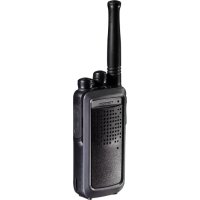
TWINTALKER 5400 - Talkie Walkie TOPCOM - Free user manual and instructions
Find the device manual for free TWINTALKER 5400 TOPCOM in PDF.



| Product type | Walkie-talkie |
| Brand | TOPCOM |
| Model | TWINTALKER 5400 |
| Number of channels | 8 |
| CTCSS subcode | 38 codes |
| Frequency | 446.00625 MHz - 446.09375 MHz |
| Maximum range | Up to 10 km in open terrain |
| Transmission power | ERP < 500 mW |
| Modulation type | FM - F3E |
| Power supply | 3 AAA alkaline or NiMH rechargeable batteries (supplied) |
| Charger | Dual charger with 230 V AC / 50 Hz mains adapter, output 9 V AC / 200 mA |
| Charging time | 12 to 14 hours |
| Main functions | Call, iVOX, channel scan, stopwatch, Roger Beep, key lock, backlight, monitor |
| Volume adjustment | 15 levels |
| Maintenance and cleaning | Soft damp cloth, no solvent. Dry completely after contact with water. |
| Safety | Do not touch a damaged antenna; keep at least 15 cm away from a pacemaker; turn off in areas with risk of explosion. |
| Included accessories | 2 belt clips, 1 dual charger, 1 mains adapter, 2 NiMH battery packs (3xAAA), instruction manual |
| Headset compatibility | 2.5 mm jack socket (optional headset) |
Frequently Asked Questions - TWINTALKER 5400 TOPCOM
User questions about TWINTALKER 5400 TOPCOM
0 question about this device. Answer the ones you know or ask your own.
Ask a new question about this device
Download the instructions for your Talkie Walkie in PDF format for free! Find your manual TWINTALKER 5400 - TOPCOM and take your electronic device back in hand. On this page are published all the documents necessary for the use of your device. TWINTALKER 5400 by TOPCOM.
USER MANUAL TWINTALKER 5400 TOPCOM
UK The features described in this manual are published with reservation to modifications.
NL De in deze handleiding beschreiben mogelijkheden worden gepubliceerd onder voorbehoud van wijzigingen.
FR Les possibités décrites dans ce manuel sont publiées sous réserve de modifications.
DE Die in dieser Bedienungsanleitung umschriebenen Mochlichkeiten, werden vorbehaltlich Änderungen publiziert.
ES Las caracteristicas descritas en este manual peuvent ser objeto de futuras modificaciones.
SE Funktionerna ienna bruksanvising publiceras med reservation for andringar.
PT As caracteristicas descritas neste manual são pubblicas sobreshva de modifica 己
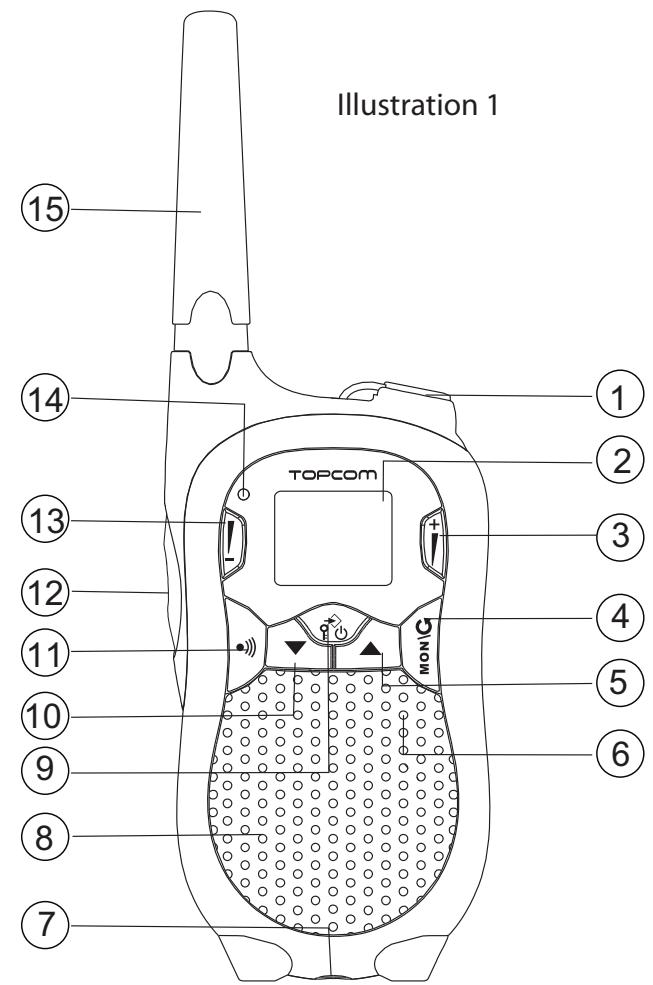
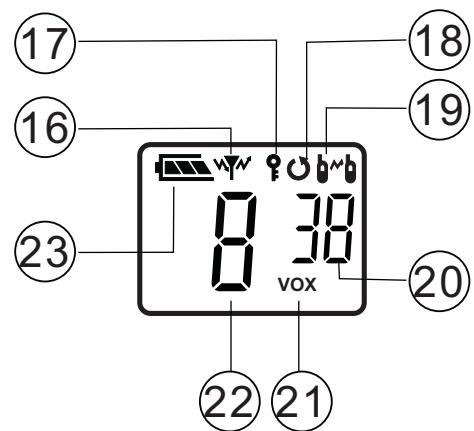
Illustration 2
1 Introduction
Thank you for purchasing the Twintalker 5010. It's a long range, low powered radio communication device with a range of maximum 10Km . It has no running costs other than the minimal cost of re-charging the batteries. TheTwintalker operates on 8 channels.
2 Intended purpose
It can be used for recreational purposes. For example: to keep in contact during travelling with 2 or more cars, biking, skiing. It can be used to keep in contact with your children when they are playing outside, etc...
3 CE Mark
The CE symbol on the unit, user guide and gift box indicates that the unit complies with the essential requirements of the R&TTE directive 1995/5/EC.
4 Safety instructions
4.1 General
Please read carefully through the following information concerning safety and proper use. Make yourself familiar with all functions of the device. Keep this manual in a safe place for future use.
4.2 Burning injuries
- If the cover of the antenna is damaged, do not touch because when an antenna comes in contact with the skin, a minor burn may result when transmitting.
- Batteries can cause property damage such as burns if conductive material such as jewellery, keys or beaded chains touches exposed terminals. The material may complete an electrical circuit (short circuit) and become quite hot. Exercise care in handling any charged battery, particularly when placing it inside a pocket, purse or other container with metal objects.
4.3 Injuries
- Do not place your device in the area over an air bag or in the air bag deployment area. Air bags inflate with great force. If a PMR is placed in the bag deployment area and the air bag inflates, the communicator may be propelled with great force and cause serious injury to the occupants of the vehicle.
- Keep the PMR at least 15 centimetres away from a pacemaker.
- Turn your PMR off as soon as interference is taking place with medical equipment.
4.4 Danger of explosion
-
Do not replace batteries in a potentially explosive atmosphere. Contact sparking may occur while installing or removing batteries and cause an explosion.
-
Turn your PMR off when in any area with a potentially explosive atmosphere. Sparks in such areas could cause an explosion or fire resulting in bodily injury or even death.
- Never throw batteries in fire as they may explode.

Areas with potentially explosive atmospheres are often, but not always, clearly marked. They include fuelling areas such as below deck on boats, fuel or chemical transfer or storage facilities; areas where the air contains chemicals or particles, such as grain, dust or metal powders; and any other area where you would normally be advised to turn off your vehicle engine.
4.5 Poisoning danger
- Keep batteries away from small children.
4.6 Legal
- In some countries it is prohibited to use your PMR while driving a vehicle. In this case leave the road before using the device.
- Turn your PMR off when on board an aircraft when instructed to do so. Any use of the PMR must be in accordance with airline regulations or crew instructions.
- Turn your PMR off in any facilities where posted notices instruct you to do so. Hospitals or health care facilities may be using equipment that is sensitive to external RF energy.
- Replacing or modifying the antenna may affect the PMR radio specifications and violate the CE regulations. Unauthorized antennas could also damage the radio.
4.7 Notes
- Do not touch the antenna while transmitting, it could affect the range.
- Remove the batteries if the device is not going to be used for a long period.
5 Cleaning and maintenance
- To clean the unit, wipe with a soft cloth dampened with water. Don't use a cleaner or solvents on the unit; they can damage the case and leak inside, causing permanent damage.
Battery contacts may be wiped with a dry lint-free cloth. - If the unit gets wet, turn it off and remove the batteries immediately. Dry the battery compartment with a soft cloth to minimize potential water damage. Leave the cover off the battery compartment overnight or until completely dry. Do not use the unit until completely dry.
6 Using a PMR device
To communicate between PMR devices they need to be set all on the same channel and CTCSS code and within receiving range (up to max. 10km in open field). Since
these devices use free frequency bands (channels), all devices in operation share these channels(total 8 channels). Therefore, privacy is not guaranteed. Anybody with a PMR set to your channel can overhear the conversation. If you want to communicate (transmitting a voice signal) you need to press the PTT-button ⑫ . Once this button pressed, the device will go into transmit mode and you can speak into the microphone. All other PMR devices in range, on the same channel and in standby mode (not transmitting) will hear your message. You need to wait until the other party stops transmitting before you can reply to the message. At the end of each transmission the unit will send a beep if the roger beep is enable (see chapter 13.15). To reply, just press the PTT-button ⑫ and speak into the microphone.

If 2 or more users press the PTT-button ② at the same time the receiver will receive only the stongest signal and the other signal(s) will be suppressed. Therefore you should only transmit a signal (press PTT-button ② ) when the channel is free.

The range of radio waves is strongly affected by obstacles such as buildings, concrete/metal structures, the unevenness of the landscape, woodland, plants, ... This implies that the range between two or more PMR's may in some extreme cases be restricted to a maximum of a few tens of meters. You will soon notice that PMR works best when there is a minimum of obstacles between users.
7 Included in the package
2xTwintalker 5010
2x Belt clip
1x Duo charger
1xPoweradapter
- 2 × NiMH (3 x AAA) battery pack
ECO User guide
8 Getting started
8.1 Installing/removing the belt clip
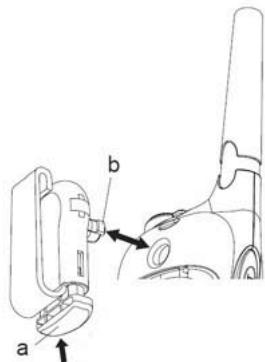
- To install the belt clip, align the pin with the hole in the backside. Gently push until it clicks into position.
- To remove the belt clip from the unit, push the belt clip (a), while pulling the clip away from the unit (b).
8.2 Battery installation
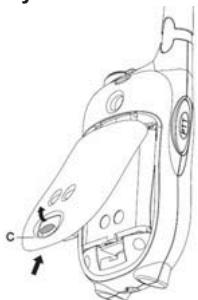
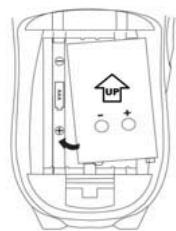
- Remove the belt clip (see chapter 8.1).
- Pull the battery cover tab (c) and gently remove the battery cover.
- Install the rechargeable battery pack following the polarity as shown. The metal contacts should face outwards from the radio to connect on the battery
door. Or install 3 'AAA' alkaline or rechargeable batteries following the polarity as shown.
- Re-install the battery cover and belt clip (see chapter 8.1).
9 Charging batteries
When NiMh battery packs are installed, the desktop charger provides drop-in charging convenience.
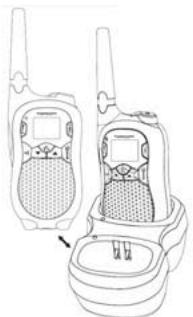
1.Put the desktop charger on a flat surface.
2. Plug the supplied adapter into the electric socket. Pay attention to the mentioned voltage and compare this with the indications of the power supply. Connect the low tension plug at the end of the cable with the connector at the backside of the desktop charger.
3.Put the PMR in the charger as indicated.
4. The charging LED will turn on if it's properly inserted and charging.
It will take about 12 to 14 hours to fully charge the batteries. There is no indication on the display when the batteries are being charged.

The device can also operate with 3 x AAA NiMh batteries or with 3 x AAA Alkaline batteries.
3 × AAA Alkaline batteries cannot be charged with the charger.
10 Battery charge level
The battery charge level is indicated by the number of squares present inside the battery icon on the LCD display.
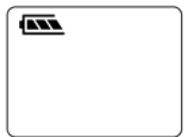
Battery full Battery 2/3 charged
Battery 1/3 charged Battery empty
When the battery charge level is low, a beep will be heard.
11 Description
See folded cover page - illustration 1
- Earpiece connector
- LCD display
- Volume up button
- Monitor / scan button MON /
- Up button
- Microphone
- Optional power supply connector
- Speaker
- Menu / on-off / unlock button /
- Down button
- Call button
- Push to talk button PTT
- Volume down button!
- Power / transmission LED
- Antenna
12 LCD display information
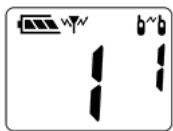
See folded cover page - illustration 2
- Antenna icon
- Key lock icon
- Scan icon
- Roger beep icon
- CTCSS code
- VOX indication
- Channel number
- Battery charge level indication
13 Using the Twintalker 5010

If the segments and icons of the displays are shown in light grey in this user guide, it indicates that they are blinking and/or selectable.
13.1 Turning the unit on/off
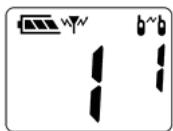
To turn on:
- Press and hold the -button 9 for 3 seconds. The unit will "beep" and the LCD display will display the current channel.
To switch off:
- Press and hold the -button 9 for 3 seconds. The unit will "beep" and the LCD display will turn blank..
13.2 Adjusting speaker volume
There are 15 levels of speaker volume
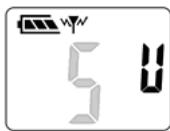
- Press the volume up button ③ in stand-by-mode to increase the speaker volume. The volume level is displayed.
- Press the volume down button! ⑬ to decrease the speaker volume.
13.3 Receiving a signal
The unit is continuously in the receive mode when the unit is switched on and not transmitting.

In order for other people to receive your transmission, they must also be on the same channel and have set the same CTCSS code. (See chapter 13.5 and 13.6)
13.4 Transmitting a signal
- Press and hold the PTT-button ⑫ to transmit. The TX LED will be on.
Hold the unit in a vertical position with the microphone. 10 cm from the mouth and speak into the microphone. - Release the PTT-button ⑫ when you want to stop transmitting.

To check the channel activity use the monitor function (see chapter 13.7). The maximum transmitting time is limited to 1 minute. Release and press PTT-button ① to restart transmitting.
13.5 Changing channels
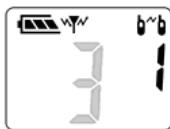
- Press the -button ⑤ or -button ⑩ to change the channel.
13.6 CTCSS (Continuous Tone Coded Squelch System)
The 2 digit CTCSS code corresponds to a specific tone frequency the radio emits. Two users, with the same channel and CTCSS set can hear one another. They will not be able to hear anyone else on the channel unless the other radios have the same exact CTCSS code enabled. The Twintalker 5010 has 38 CTCSS codes available.
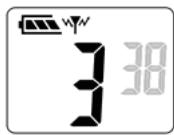
- Press the -button ⑨, the current CTCSS code flashes on the display.
- Press the -button ⑤ or -button ⑩ to change to another code.
- Press the PTT-button ⑫ to confirm and return to stand-by mode.

It is recommended to set a CTCSS code for each channel. This way you will have minimum interference from other users on the same channel.
To disable CTCSS code, set the code to '0'.

If no button is pressed within 5 seconds during setting, the unit will return to standby.
13.7 Monitor
You can use the monitor feature to check for weaker signals in the current channel.
- Press and hold the MON -button ④ to activate channel monitoring.
- Release the MON button to stop monitoring.
13.8 Call tones
A call tone alerts other users that you want to start talking to.
13.8.1 Setting the call tone
The Twintalker 5010 has 10 call tones
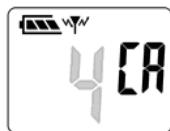
- Press the -button ⑨ two times.
- Press the -button ⑤ or -button ⑩ to change to another call tone. Select '0' to disable the call tones.
- Press the PTT-button ⑫ to confirm and return to stand-by mode.
13.8.2 Sending a call tone
Press the button ① briefly. The call tone will be transmitted on the set channel.
13.9 iVOX Selection
The PMR is capable of intelligent voice activated (iVOX) transmission. In iVOX mode, the radio will transmit a signal when it is activated by your voice. iVOX operation is not recommended if you plan to use your radio in a noisy or windy environment.
13.9.1 Activating iVOX
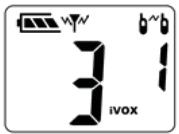
- Switch off the PMR (press the -button 9 for three seconds)
- Press-and-hold the PTT-button ⑫ while switching on the PMR by pressing the -button ⑨ for three seconds
The iVOX-icon appears
13.9.2 De-activating iVOX
- Switch off the PMR (press the -button ⑨ for three seconds).
- Switch on the PMR again (press the -button (9) for three seconds). The iVOX icon will be gone.

- When you use the PMR with the optional earpiece (see chapter 14), the iVOX function will be disabled as soon as you plug in the earpiece connector.
iVOX mode will be disabled when you press the PTT-button ⑫.
The iVOX-icon will blink while disabled. To enable iVOX again, press the PTT-button ⑫ briefly.
13.9.3 Adjusting the iVOX level
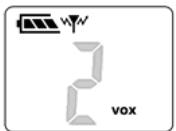
Press the -button 9 three times.
Use the -button ⑤ or -button ⑩ to set the desired level.
1 - High ambient noise
2 - Normal ambient noise
3 - Low ambient noise
- Press the PTT-button (12) to confirm and return to stand-by mode.
13.10 Channel scan
Channel scan performs searches for active signals in an endless loop from channel 1 to 8 including the CTCSS codes..
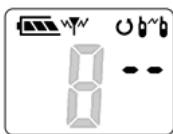
- Press the MON button ④ briefly to activate channel scan. The channel scan icon is displayed.
- When an active signal (one of 8 channels with CTCSS code) is detected, you will hear the conversation. Press the PTT-button ⑫ to start communicating over the active channel. If you don't press the PTT-button ⑫ , channel scan will resume after 5 seconds if there is no more activity.
- Press the -button ⑤ or -button ⑩ to bypass the current channel and continue to search for another active channel.
- Press the MON button ④ briefly to deactivate channel scan.
13.11 Multi channel scan (group scan)
It is possible to scan only a specific group of channels only.
13.11.1 Selecting the group scan channels
Each channel can be programmed as a member of this group.
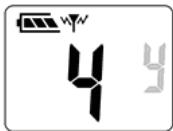
- Select a channel using the -button ⑤ or -button ⑩
Press the -button 9 six times. - Press the -button ⑤ or -button ⑩ to enable (Y) or disable (-).
- Press the PTT-button ⑫ to confirm and return to stand-by mode.
Repeat this action for each channel you want to add or remove from the group scan.
13.11.2 Activating the group scan
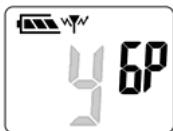
- Press the -button ⑨ seven times.
- Press the -button (5) or -button (10) to enable (Y) or disable (-).
-
Press the PTT-button ⑫ to confirm and return to stand-by mode.
-
Press the MONU button ④ briefly to start the group scan. The channel scan icon is displayed.
- Press the MON button (4) briefly again to stop the group scan.

When group scan is enabled, the stand-by channel will always be included during the group scan.
13.12 Automatic power off (APO)
To save energy, you can activate the automatic power off function. In case you forgot to power off the unit, it will switch off automatically after the set time.
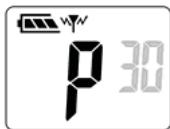
- Press the button ⑨ four times, the current power off time flashes on the display. (0, 30, 60 or 90 minutes).
Use the -button 5 or -button 10 to change the time. Select 0' to disable the APO feature. - Press the PTT-button ⑫ to confirm and return to stand-by mode.
13.13 Key tone on/off
When a button is pressed, the unit will beep briefly.
- Switch off the PMR (press the -button 9 for three seconds).
- Press-and-hold the -button 10 while switching on the PMR by pressing the -button 9 for three seconds.
The key tone will be switched.
13.14 Stopwatch
The Twintalker 5010 has a stopwatch function (mm:ss).
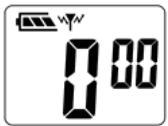
- Press the -button ⑨ five times. The counter is displayed.
- Press the -button (5) to start counting.
- Press the -button (5) again to stop counting and see the lap time. The counter continues in the background. Press the -button (5) to proceed counting.
- When the counter is stopped, press the -button to reset the counter.

After selecting this function, and also after resetting the counter, the measurement should be started within 5 seconds. If not, the device shall return to stand-by.
13.15 Roger beep on/off
After the PTT-button ⑫ is released, the unit will send out a roger beep to confirm that you have stopped talking.
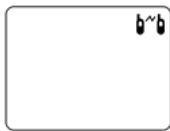
- Switch off the PMR (press the -button 9
- Press-and-hold the -button ⑤ while switching on the PMR by pressing the (I) -button ⑨.
The roger beep function will be switched on or off.
If the roger beep icon appears in the display, it means that this function is on.
13.16 Key lock
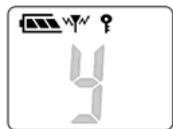
Press the -button ⑨ eight times.
Use the -button 5 or -button 10 to select Y.
- Press the PTT-button (12) to confirm and return to stand-by mode.
- Press the -button ⑨ for four seconds to disable the key lock.

The Button Lock is not valid for the monitor function, the button (9) , -button (11) and the PTT-button (12) .
13.17 Display back light
To activate the backlight of the LCD display, press any button except the PTT-button ⑫ or the button ⑪
The LCD backlight will light up for 5 seconds.
14 Earpiece connection
The Twintalker 5010 can be used with an optional earpiece.
The connector is located under the protective rubber cover on the top of the unit.
To attach the earpiece, remove the rubber flap to expose the connector.
Insert the earpiece plug into the connector (2,5mm jack) ①.
The small button on the earpiece has the same function as the PTT-button (12) on the unit.
When you use the PTT-button ⑫ from the Earpiece, you must also use the microphone from the earpiece wire.

Do not connect earpieces from a different model. This may damage your device.
15 Technical specifications
| Channels | 8 |
| Sub-code | CTCSS 38 |
| Frequency | 446.00625MHz - 446.09375 MHz |
| Range | Up to 10 Km (open field) |
| Batteries | 3 x AAA Alkaline or NiMH rechargeable |
| Transmission power | < 500mW ERP |
| Modulation type | FM - F3E |
| Channel spacing | 12,5 kHz |
| Duo charger adapter | Input : 230V AC / 50Hz - Output : 9V AC / 200mA |
| Channel Frequency Chart: | CTCSS Code Chart | ||||||||
| Channel | Frequency (MHz) | Code | Frequency (Hz) | Code | Freq. (Hz) | Code | Freq. (Hz) | Code | Freq. (Hz) |
| 1 | 446,00625 | 0 | Disabled | 10 | 94.8 | 20 | 131.8 | 30 | 186.2 |
| 2 | 446,01875 | 1 | 67.0 | 11 | 97.4 | 21 | 136.5 | 31 | 192.8 |
| 3 | 446,03125 | 2 | 71.9 | 12 | 100.0 | 22 | 141.3 | 32 | 203.5 |
| 4 | 446,04375 | 3 | 74.4 | 13 | 103.5 | 23 | 146.2 | 33 | 210.7 |
| 5 | 446,05625 | 4 | 77.0 | 14 | 107.2 | 24 | 151.4 | 34 | 218.1 |
| 6 | 446,06875 | 5 | 79.7 | 15 | 110.9 | 25 | 156.7 | 35 | 225.7 |
| 7 | 446,08125 | 6 | 82.5 | 16 | 114.8 | 26 | 162.2 | 36 | 233.6 |
| 8 | 446,09375 | 7 | 85.4 | 17 | 118.8 | 27 | 167.9 | 37 | 241.8 |
| 8 | 88.5 | 18 | 123.0 | 28 | 173.8 | 38 | 250.3 | ||
| 9 | 91.5 | 19 | 127.3 | 29 | 179.9 | ||||
1 Inleiding
13.6 CTCSS (Continuous Tone Coded Squelch System)
Piles charged at 2/3
13.6 CTCSS (Continuous Tone Coded Squelch System)
4.4 Risk for explosion
13.1 Sla pa/av encheten (on/off)
Slà pá: