
TE1416B - Hob BRANDT - Free user manual and instructions
Find the device manual for free TE1416B BRANDT in PDF.


| Product type | Mixed gas/electric hob |
| Brand | BRANDT |
| Model | TE1416B |
| Overall dimensions above worktop | 60 × 53 × 5.8 cm |
| Overall dimensions below worktop | 55 × 47.5 × 3.4 cm |
| Cut-out dimensions | 56 × 49 cm |
| Power supply | 220-240 V ~ 50 Hz, 10 A |
| Compatible gas type | Natural gas (G20/G25) or butane/propane (G30/G31) |
| Number of gas burners | 4 (large rapid, rapid, semi-rapid, auxiliary) |
| Gas burner power (natural gas) | Large rapid 3.05 kW, Rapid 2.25 kW, Semi-rapid 1.50 kW, Auxiliary 0.85 kW |
| Electric plate | 1.5 kW, diameter 145 mm |
| Ignition | Electronic (spark) with push button |
| Safety | Safety thermocouple on burners (flame detection) |
| Installation class | Class 3 (built-in) |
| Finish | Enamel or stainless steel depending on model |
| Certifications | CE, compliant with EN 30-1-1 and EN 60335-2-6 |
| Maintenance | Manual cleaning with non-abrasive cream; do not use steam cleaner |
| Spare parts available | Injectors, spark plugs, valves, knobs, etc. |
Frequently Asked Questions - TE1416B BRANDT
User questions about TE1416B BRANDT
0 question about this device. Answer the ones you know or ask your own.
Ask a new question about this device
Download the instructions for your Hob in PDF format for free! Find your manual TE1416B - BRANDT and take your electronic device back in hand. On this page are published all the documents necessary for the use of your device. TE1416B by BRANDT.
USER MANUAL TE1416B BRANDT
Chere Client, Cher Client
criptions presentes.
- RELATIONS CONSOMMATEURS
You have just acquired a BRANDT hob and we would like to thank you.
We have invested all our dedication and know-how in this appliance so that it would best meet your needs. With innovation and power, we designed it to be always easy to use.
In the BRANDT product line, you will also find a wide range of ovens, microwaves, ventilation hoods, ranges, dishwashers, washers, driers, fridges and freezers, that you can coordinate with your new BRANDT hob.
Of course, in an ongoing effort to best satisfy your demands with regard to our products, our after-sales service department is at your disposal and ready to listen in order to respond to all of your questions and suggestions (contact information at the end of this booklet).
Visit our website www.Brandt.fr where you will find all of our products, as well as useful and complementary information.
BRANDT
Now, I say Brandt
As part of our commitment to constantly improving our products, we reserve the right to make changes to them based on technical advances to their technical and functional features and appearance.
Warning: Before installing and using your appliance, please carefully read this Guide to Installation and Use, which will allow you to quickly familiarise yourself with its operation.
- Safety recommendations 25
- Environmental protection 26
Description of your appliance 27
1 / INSTALLING YOUR APPLIANCE
- Proper positioning 28
- Flush mounting 28
- Tips for flush mounting 29
- Electrical connection 29
Gas connection 30 - Changing the gas supply 32
2 / USING YOUR APPLIANCE
Description of the top 36
- Switching on / Turning on 37
Cookware for gas burners 38
Cookware for the electric plate 39
3 / DAILY CARE OF YOUR APPLIANCE
- Maintaining your appliance 40
4 / SPECIAL MESSAGES, DIFFICULTIES
During operation 41
5 / COOKING GUIDES
Gas cooking guide 42
Electric cooking guide 42
6 / NOTE 43
7/ AFTER-SALES SERVICE 44
IMPORTANT SAFETY INSTRUCTIONS - READ CAREFULLY AND RETAIN FOR FUTURE USE.
This user guide is available for download on the brand's website.
- We have designed this cooking hob for use by private individuals in their homes.
- This appliance must be installed in compliance with currently applicable regulations and used only in a well-ventilated location. Consult this guide before installing and using your appliance.
- All cooking should take place under your surveillance.
- These cooking hobs are meant to be used exclusively for cooking beverages and foodstuffs and do not contain any asbestos-based materials.
- This appliance is not connected to a combustion by-product disposal system. It must be installed and connected in compliance with all applicable laws. Special attention should be given to applicable regulations concerning ventilation.
- The use of a gas cooking appliance produces heat and humidity in the room where it is located. Ensure that the kitchen is well-ventilated: keep mechanical ventilation orifices open. Intensive and prolonged use of the appliance may require additional ventilation, for example opening a window, or more efficient ventilation, for example by increasing the power of the mechanical ventilation if present.
- Do not store CLEANING products or FLAMMABLE products (aerosol cans or containers under pressure, as well as papers, cookbooks, etc.) in the cabinet underneath your cooking hob.
- If you use a drawer located under the hob, we recommend that you avoid storing in it items that are heat sensitive (plastic, papers, aerosol cans, etc.).
- The conditions for setting this appliance are described on the label inside the bag or on the rating plate.
In order to easily locate the reference information for your appliance, we recommend that you note them on the «After-Sales Service Department and Customer Relations» page (this page also explains to you where to find this information on your appliance).
- Your hob should be disconnected from power and fuel supplies (electricity and gas) before any repairs.
- When you connect the power cables of any electrical appliances plugged in close to the hob, ensure that they are not in contact with the cooking zones.
- It must be possible to disconnect the appliance from the power supply, either using a plug or by fitting a switch on the fixed wiring system in accordance with installation rules.
- The electrical plug must remain accessible after installation.
- As a safety measure, do not forget to close the general supply tap for gas distributed by pipe or the tap of the tank for butane or propane gas after use.
- When a knob becomes difficult to turn, DO NOT FORCE IT. Request an emergency service call for the installer.
- The EC mark of conformity is affixed to these hobs.

Warning
Installation should only be performed by installers and qualified technicians.
Before installation, ensure that the conditions of local distribution (gas type and pressure) and the settings of the appliance are compatible.
This hob complies with the EN 60335-2-6 standard with regard to the heating of cabinets and the Class 3 standard with regard to installation (according to the EN 30-1-1 standard).
- This appliance may be used by children aged 8 years and older, and by persons with impaired physical sensorial or mental capacities, or without experience or knowledge, if they are supervised or have received prior instructions on how to use the appliance safely and have understood the risks involved. Children must not be allowed to play with the appliance. Cleaning and maintenance operations must not be carried out by children without supervision..
- Children must be supervised to prevent them from playing with the appliance.
- If the power cable is damaged, it should be replaced by the manufacturer, its after-sales service department or by a similarly qualified person in order to avoid danger.
- This unit is not intended to be operated using an external timer or a separate remote control system.
- Do not use a steam cleaner.
-
Never use tin foil for cooking. Never put products wrapped in tin foil on your appliance. The aluminium may melt and irreparably damage your appliance.
-
WARNING: it is dangerous to cook with oil or fat if the hob is left unattended, as this may cause a fire. Do not attempt to extinguish a fire with water but switch off the appliance, then cover the flame with a lid or a fire blanket.
- WARNING: risk of fire: do not use the cooking surfaces to store things.
ENVIRONMENTAL PROTECTION
This appliance's packing materials are recyclable. Recycle them and play a role in protecting the environment by depositing them in local authority containers provided for this purpose.
-
Your appliance also contains many recyclable materials. It is therefore marked with this logo to indicate that used appliances must not be mixed with other waste. Recycling of the appliances organised by your manufacturer will thus be undertaken in optimum conditions, in accordance with European directive 2002/96/CE relating to electrical and electronic equipment waste. Contact your local council or your retailer to find out the drop-off points for used appliances that are nearest to your home.
-
We thank you for your help in protecting the environment.
DESCRIPTION OF YOUR HOB
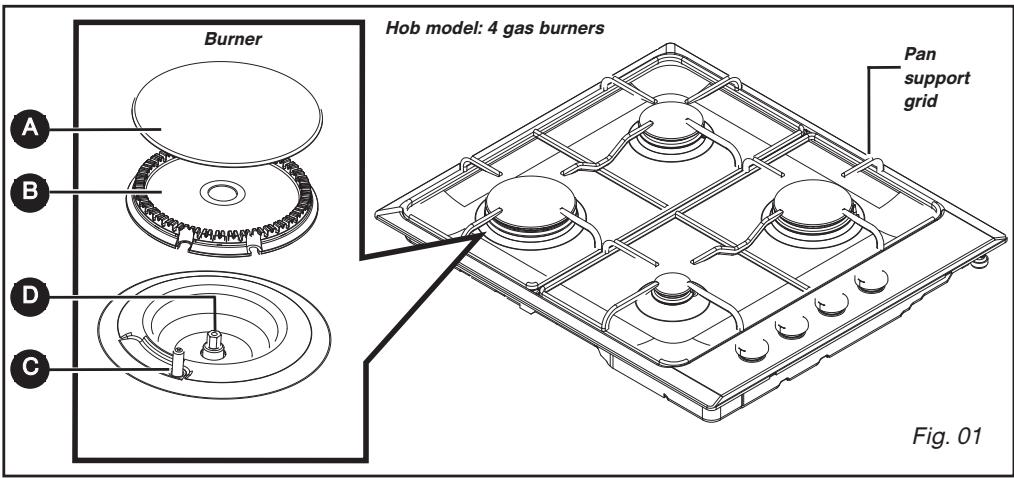
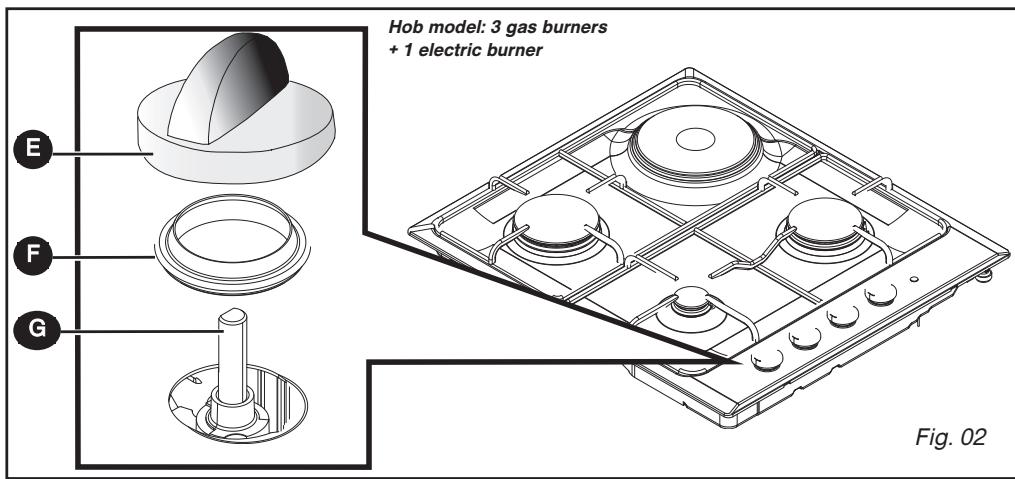
A Burner covers
D Injector
G Tap
B Burner head
E Knob
Spark plug
F Gasket

Tip
This Guide to Installation and Use is valid for several models. Minor differences in details and fittings may emerge between your appliance and the descriptions provided.
| APPLIANCE | |||
| Width | Depth | Thickness | |
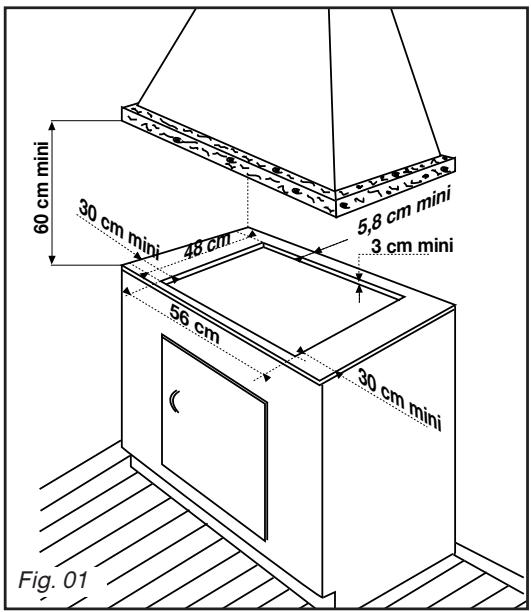
| Cut cabinet | 56 cm | 49 cm | next cabinet |
| Dimensions total above the work top | 60 cm | 53 cm | 5.8 cm |
| Dimensions total dimensionalities below the work top | 55 cm | 47.5 cm | 3.4 cm |
PROPER POSITIONING
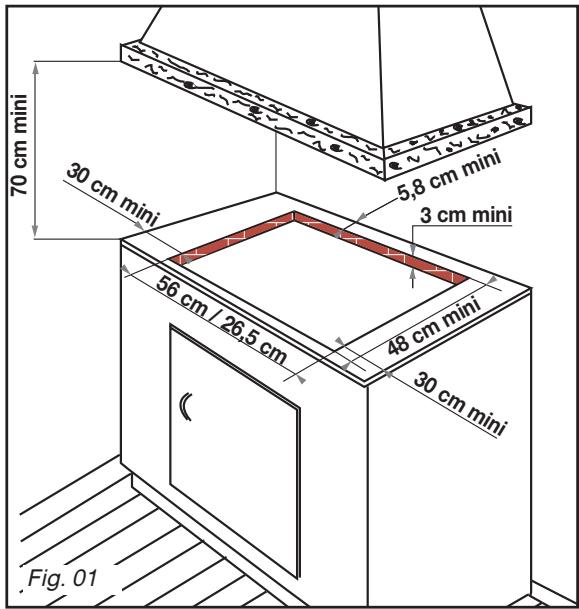
Your appliance should be flush mounted in the surface of a support cabinet that is a minimum of three cm thick, made of a material that resists heat or that is covered with such a material.
So as not to disturb movement of cooking utensils, there should not be to the right or left or back any obstacle within 30~cm of the hob. If a horizontal divider wall is positioned under the hob, it should be placed between 10~cm and 15~cm away from the top of the work top. In any event, do not store aerosol cans or containers under pressure in any compartment that may exist under the hob (See "Safety Recommendations" chapter).
- FLUSH MOUNTING
Follow the diagram (Fig. 01).
- Remove the pan supports, the burner covers and burner heads, noting their positions.
-
Turn the hob over and carefully place it on top of the opening in the cabinet so as not to damage the knobs and spark plugs.
-
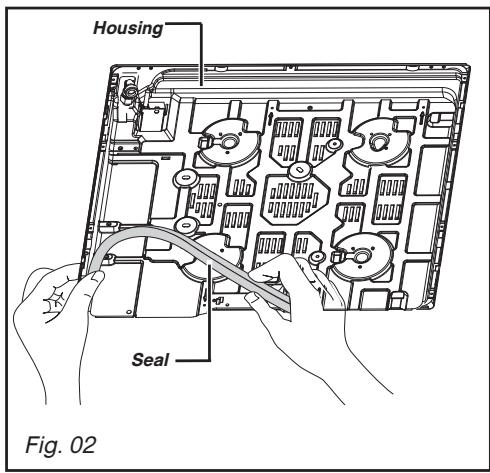
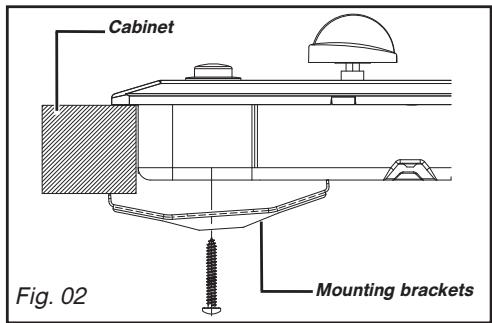
To ensure a tight seal between the housing and the work top, glue the foam seal along the exterior edge of the housing before installing the hob (Fig. 02).
TIPS FOR FLUSH MOUNTING
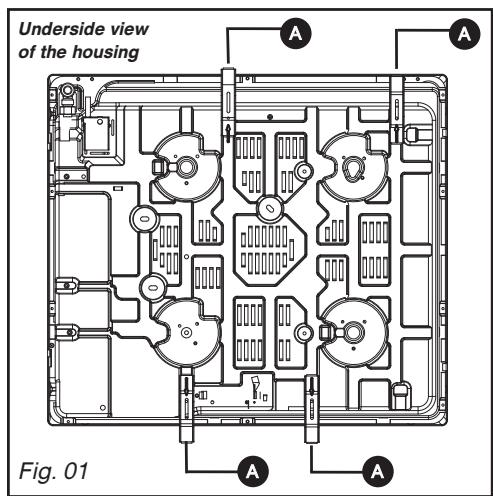

Mounting brackets
Place your hob in the opening of the support cabinet, carefully pulling the table towards you.
Reposition the burner heads, burner covers and pan supports on the hob.
Connect your hob to the gas supply (See "Gas Connection" chapter) and to the power supply (See "Electrical Connection" chapter).
If you wish, you can immobilise the hob using the four mounting brackets delivered with a screw (Fig. 02) to attach them to the four corners of the housing. You must use the holes provided for this purpose, according to the diagram above (Fig. 01).
Stop screwing when the mounting bracket starts to become deformed.
Do not use a screwdriver.
ELECTRICAL CONNECTION
Your hob is sold with a power cable (type H05V2V2F - T90, cross-section 1 mm²) with three conductors (phase + ground + neutral). After-sales service reference: 77X3767 (6470.1516). It must be connected to a 220-240 V~ monophase grid via a standardised IEC 60083 electrical outlet with phase + ground + neutral or or an all-pole cut-off device with a minimum distance between contact openings of 3.5 mm.
The plug of the electrical outlet must be accessible after installation.
| CABLE CROSS-SECTION TO BE USED | |
| 220-240 V~ - 50 Hz Gas and dual | |
| H05V2V2F -T90 cable | 3 conductors including one ground wire |
| Cross-section of conductors in mm² | 1 |
| Fuse | 10 A |

Warning
The safety wire (green/yellow) is connected to the appliance's ground terminal and must be connected to the ground lead of the electrical set-up.
The fuse in your set-up must be 10 amperes.
If the power cable is damaged, it must be replaced by a cable or a special kit available from the manufacturer or its After-Sales Service Department.

Tip
In order to easily locate the reference information for your appliance, we recommend that you note them on the "After-Sales Service Department and Customer Relations" page (this page also explains to you where to find this information on your appliance).
- GAS CONNECTION
Preliminary comments
If your hob is installed above an oven or if proximity to other heating elements poses a threat of overheating the connection, you absolutely must insulate the cable in a rigid pipe. If a hose or soft pipe (in the case of butane gas) is used, it should not come into contact with a moving part of the cabinet, nor should it pass through a location that may become blocked.
The gas connection must be installed in compliance with applicable regulations in the country of installation.
Gas distributed by pipe; natural gas,
For your safety, you must choose from the three following connection options:
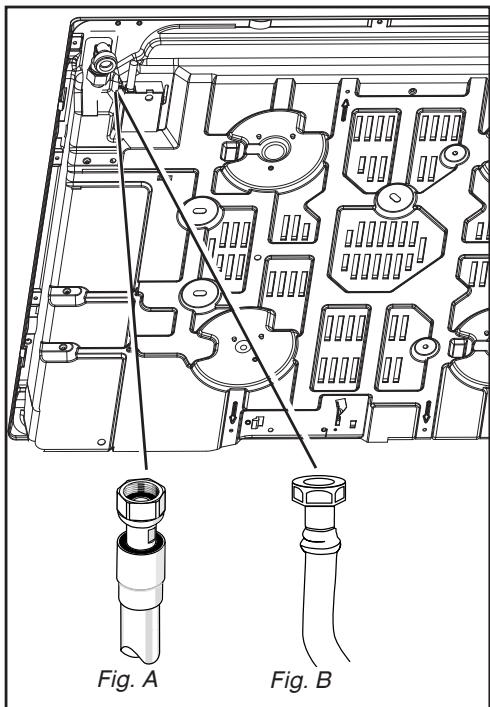
- Connection with a rigid pipe made from copper and with screw-on mechanical connectors (G1/2 gas standard mark). Make the connection directly to the end of the elbow fitted on the appliance.
- Connection with a flexible metal hose (stainless steel) with screw-on mechanical connectors (compliant with NF D 36-121 standard) whose service life is unlimited (Fig. A).
- Connection with a flexible rubber hose reinforced with screw-on mechanical connectors (compliant with the NF D 36-103 standard) whose service life is 10 years (Fig. B).

Warning
When connecting your hob's gas supply, if you have to change the direction of the elbow fitted on the appliance:
① Change the gasket.
Screw on the elbow's nut, careful not to exceed a torque of 17 N.m.
Gas supplied by cylinder or tank (butane/propane)
For your safety, you must choose from the three following connection options:
- Connection with a rigid pipe made from copper and with screw-on mechanical connectors (G1/2 gas standard mark). Make the connection directly to the end of the elbow fitted on the appliance.
- Connection with a flexible metal hose (stainless steel) with screw-on mechanical connectors (compliant with NF D 36-125 standard) whose service life is unlimited (Fig. 01).
- Connection with a flexible rubber hose reinforced with screw-on mechanical connectors (compliant with the XP D 36-112 standard) whose service life is 10 years (Fig. 02).
In an existing system, a soft pipe fitted with clamps whose service (compliant with the XP D 36-110 standard) whose service life is five years may be used. It is necessary in this case to use an adaptor without forgetting to fit a sealing washer between the adaptor and the hob's elbow. (Fig. 03).

Tip
You can obtain the adaptor and the seal,ger from your After-Sales Service Department.

Warning
Screw on the adaptor with a torque not exceeding 25 N.m.
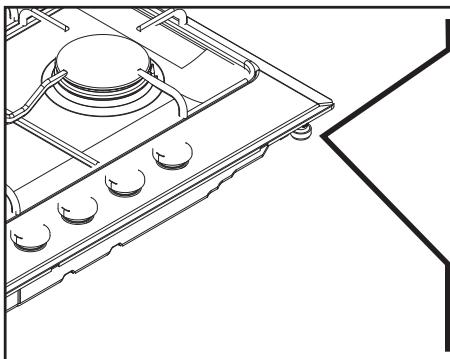
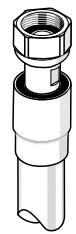
Fig. 01
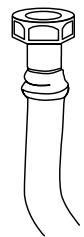
Fig. 02
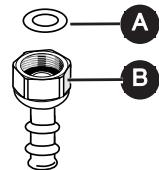
Fig. 03
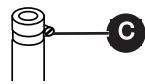

Sealing washer (not supplied)

Adaptor (not supplied)

Clamp (not supplied)

Warning
All soft pipes and hoses whose service life is limited must have a maximum length of two meters and must be accessible along their entire length. They must be replaced before the end of their service life (indicated on the pipe). Regardless of the means of connection chosen, ensure that the connection is sealed, after installation, with soapy water. In France, you must use a hose or a pipe
bearing the stamp NF Gaz

CHANGING THE GAS SUPPLY

Warning
Your appliance is sold pre-set for
natural gas.
The injectors required for adaption to butane/propane can be found in the plastic bag containing this guide.
Each time you change the gas supply, you must complete the following:
- Adapt the gas connection
- Change the injectors
-
Adjust the hob connections
-
Adapt the gas connection : Refer to the "Gas Connection" section.
-
Change the injectors, proceeding as follows:
-
Remove the pan supports, heads and covers from all burners.
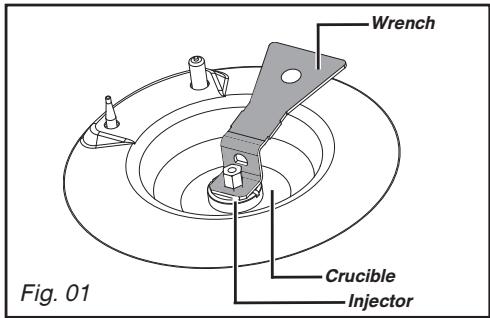
- Using the wrench provided, unscrew the injectors located under each crucible and remove them (Fig. 01).
- Replace with the corresponding gas injectors, in compliance with the placement of the injectors and the table of gas properties at the end of this section; to do so:
- First screw them in manually until the injector locks into place.
- Apply the wrench to the injector as far as it will go.
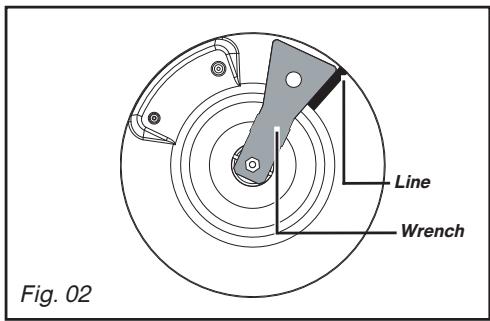
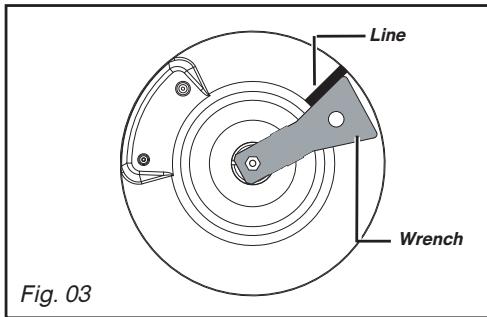
- Draw a line on the burner plate using a pencil at the place indicated (Fig. 02).
- Turn the wrench clockwise until the line appears on the other side(Fig. 03).

Warning
Exceeding this limit may damage the act.
- Reposition the burner heads, burner covers and pan supports on the hob.

Tip
Each time you change the gas supply, lock the box corresponding to the new gas level on the label found in the plastic bag. Refer to the corresponding "Gas Connection" section.
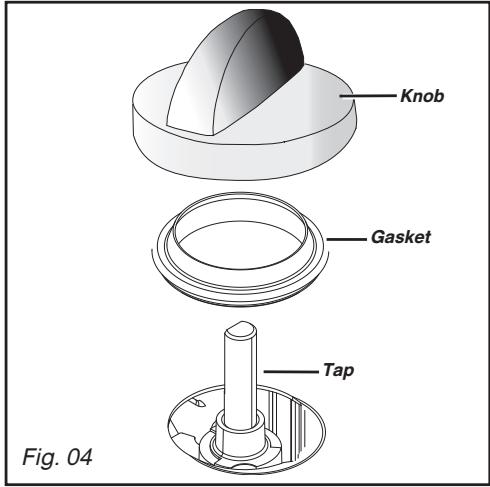
- Adjust the hob connections: they are located underneath the knobs (Fig. 04).
- Proceed one tap at a time.
-
Remove the knobs and the gaskets by pulling them up.
-
Switching from natural gas to butane/propane
-
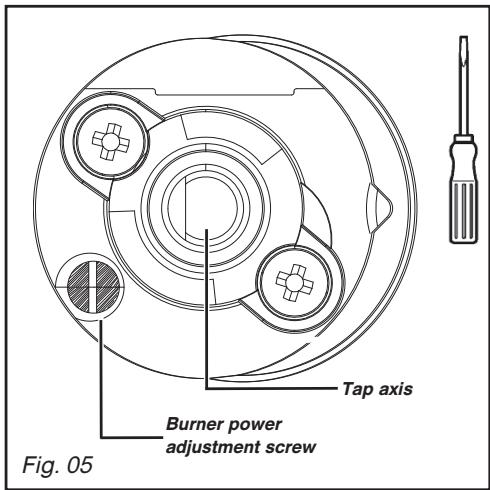
With a small flat-head screwdriver, screw in all the way the brass (yellow) burner power screws(Fig. 05), in a clockwise direction.
-
Replace the gaskets and the knobs, paying careful attention to their direction and ensuring that the knobs are pushed in all the way.
-
Switching from butane/propane to natural gas
-
Unscrew the brass (yellow) burner power screws (Fig. 05), using a small flat-head screwdriver, by turning two times counterclockwise.
-Replace the knob, - Light the burner in maximum heat mode, then turn down to reduced heat mode.
- Remove the knob again, then turn the burner power screws clockwise until it reaches the lowest possible setting that does not extinguish the flame.
- Replace the gasket and knob.
- Make several attempts to shift from the maximum flow rate to the minimum: the flame should not go out; if it does, unscrew the burner power screw so as to obtain good flame retention during these position switches.
- Markings on the injectors
MARKINGS ON THE INJECTORS
The adjacent table shows where the injectors are positioned on your appliance according to the type of gas used. Each number is marked on the injector.
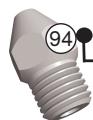
Example:
Injector marking 94
Four-burner gas model*
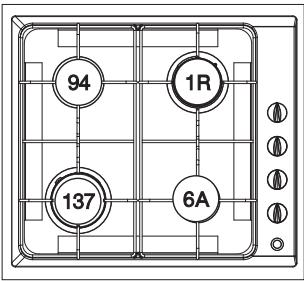
Natural Gas
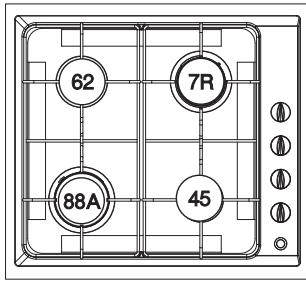
Butane/Propane Gas
Three-burner gas model ^* +1 electric plate
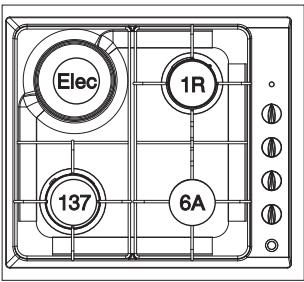
Natural Gas
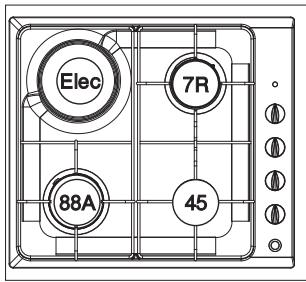
Butane/Propane Gas
- See "Description of the Top" chapter
Gas properties
| FR-GB | FR-GB | FR-GB | FR | ||
| Appliance intended to be installed in: | Butane | Propane | Natural Gas | Natural Gas | |
| FR..............cat: II2E+3+GB..........cat: II2H3+Hourly rate below:At 15° C under 1013 mbars | G30 | G31 | G20 | G25 | |
| 28-30mbar | 37 mbar | 20 mbar | 25 mbar | ||
| HIGH-SPEED BURNER | |||||
| Marking engraved on injector | 7R | 7R | 1R | 1R | |
| Nominal heat release rate | (kW) | 2.15 | 2.15 | 2.25 | 2.25 |
| Reduced heat release rate | (kW) | 0.830 | 0.870 | 0.870 | |
| Hourly rate | (G/H) | 156 | 154 | ||
| Hourly rate | (l/h) | 214 | 249 | ||
| SUPER FAST BURNER | |||||
| Marking engraved on injector | 88A | 88A | 137 | 137 | |
| Nominal heat release rate | (kW) | 3.10 | 3.10 | 3.05 | 3.05 |
| Reduced heat release rate (with safety) | (kW) | 0.830 | 0.870 | 0.870 | |
| Hourly rate | (G/H) | 225 | 221 | ||
| Hourly rate | (l/h) | 290 | 338 | ||
| SEMI-FAST BURNER | |||||
| Marking engraved on injector | 62 | 62 | 94 | 94 | |
| Nominal heat release rate | (kW) | 1.50 | 1.50 | 1,50 | 1.50 |
| Reduced heat release rate (with safety) | (kW) | 0.620 | 0.615 | 0.615 | |
| Hourly rate | (G/H) | 109 | 107 | ||
| Hourly rate | (l/h) | 143 | 166 | ||
| AUXILIARY BURNER | |||||
| Marking engraved on injector | 45 | 45 | 6A | 6A | |
| Nominal heat release rate | (kW) | 0.70 | 0.70 | 0.85 | 0.85 |
| Reduced heat release rate | (kW) | 0.300 | 0.350 | 0.350 | |
| Hourly rate | (G/H) | 51 | 50 | ||
| Hourly rate | (l/h) | 81 | 94 | ||
| 60 cm HOB FOUR GAS BURNERS WITH SUPER FAST | |||||
| Total heat release rate | (kW) | 7.45 | 7.45 | 7.65 | 7.65 |
| Maximum flow rate | (G/H) | 541 | 532 | ||
| (l/H) | 728 | 847 | |||
| 60 cm THREE BURNERS + 1500 W ELECTRIC PLATE | |||||
| Total heat release rate | (kW) | 5.95 | 5.95 | 6.15 | 6.15 |
| Maximum flow rate | (G/H) | 432 | 425 | ||
| (l/H) | 585 | 681 | |||
DESCRIPTION OF THE TOP
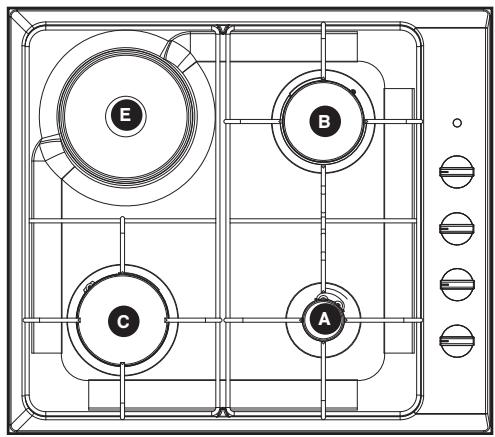
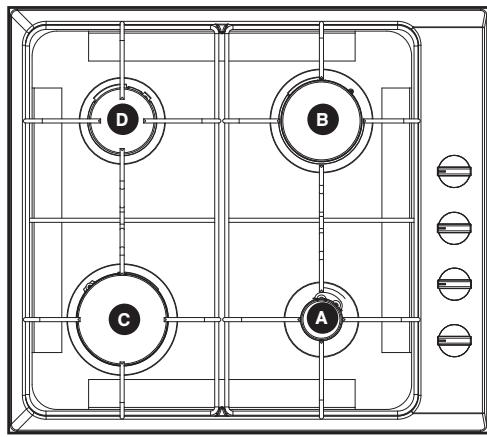
A Auxiliary burner 0.85kW()
B High-speed burner 2.25 kW (^)
Super fast burner 3.05kW^()
Semi-fast burner 1.50 kW ()
E Electric plate 1.50kW - diameter 145 mm
(*) Power obtained with natural gas G20
- Lighting the hob
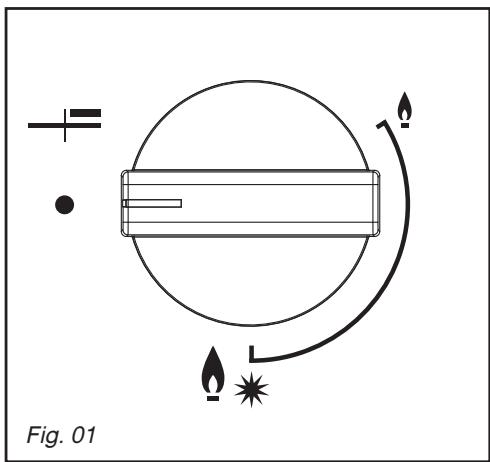
Each burner is supplied by a tap which can be opened by pressing it and turning it in in a counterclockwise motion.
The "●" point corresponds to closing the tap.
Choose the desired burner by using the symbols located near the knobs (e.g.: Rear right burner ).
To light a burner, press the electronic starter button by turning the knob to the maximum position
Keep pressing the starter button until the burner ignites.
The setting for more moderate flame intensities is between the A and the symbol A.

Tip
- If the flame goes out, reignite
normally following the starter instructions.
-
The burner's flames are smaller near the support's indexes to protect the support's enamel.
-
The noise made by certain burners is related to their high power and to gas combustion; it does not alter cooking quality.
- In the event of a power cut, approach a match to the open burner.
- Which burner should you use depending on your cookware?
| Diameter of the cookware | Burner | Use |
| 18 to 28 cm | Super fast | Frying - Boiling |
| 16 to 28 cm | High-speed | Searing foods |
| 12 to 24 cm | Semi-fast | Sauces - Reheating |
| Auxiliary | Gentle simmer |

Warning
-
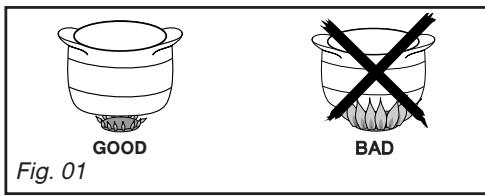
Adjust the ring of flames so that they do not extend beyond the edges of the cookware (Fig. 01).
-
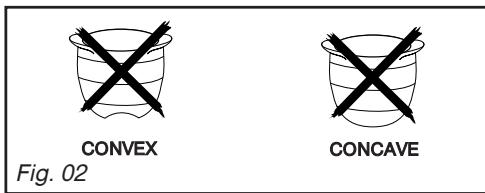
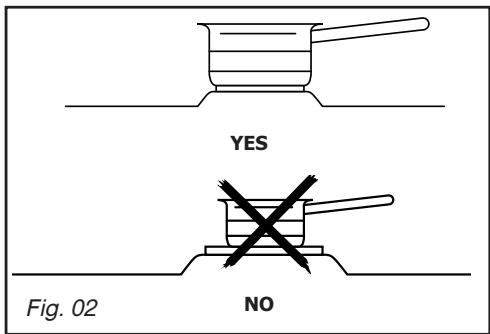
Do not use cookware with a concave or convex bottom (Fig. 02).
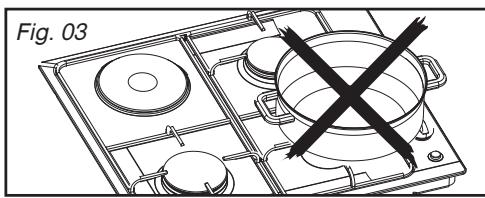
- Do not use cookware that partially covers the knobs (Fig. 03).
- Do not leave a gas burner operating with empty cookware.

Tip
Keep natural ventilation outlets in your home open or install a mechanical ventilation device (mechanical ventilation hood).
Intensive, prolonged use of the appliance may require additional ventilation; you can, for example, open a window or provide more effective ventilation or increase power to the mechanical ventilation, if you have it (a minimum air flow of 2m^3 per kW of gas power is required).
Example: 60 cm - Four gas burners
Total power: 1.5 + 2.25 + 3.1 + 0.85 = 7.7 kW 7.7 kW × 2 = 15.4 m^3/h minimum flow.
- MOST SUITABLE COOKWARE FOR THE ELECTRIC PLATE (depending on model)
Use cookware with flat bottoms that perfectly hug the surface of the burner:
-in stainless steel with a thick, tri metal or "sandwich" bottom",
- in aluminium with a thick (smooth) bottom,
- in enamelled steel.
- POWERING ON THE ELECTRIC PLATE (depending on the model)
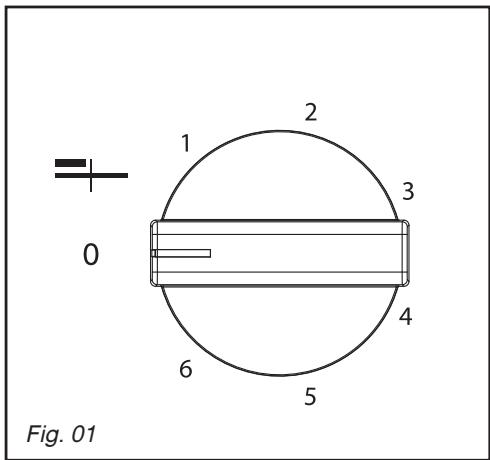
Position the knob on the marking that corresponds to the desired cooking method (Fig. 01) (see cooking guide at the end of this guide). The cooking zone's power indicator lights up.
Upon first use, allow the plate to heat up with no cookware at maximum power for three minutes to harden the coating.

Tip
- Use cookware of an appropriate
size: the diameter of the bottom should be greater than or equal to the diameter of the electric cooking zone (Fig. 02).
- When cooking is nearly complete, turn the knob to the "O" off position to take advantage of the heat accumulated in the plate.
- Use a lid on your cookware as often as possible to reduce the loss of heat by evaporation.

Warning
Do not operate an electric cooking
zone without cookware (except during initial use) or with an empty pot.

Warning
The electric plate will remain hot for a
certain time after the knob has been turned to the "O" position. Do not touch this zone because there is a risk of burning.
MAINTAINING YOUR APPLIANCE
| MAINTENANCE...... | WHAT TO DO | PRODUCTS/ACCESSORIES TO BE USED |
| Of the spark plugs and injectors | In the event that the spark plugs become soiled, clean them using a small, hard-bristled brush (non-metallic). The crucible-shaped gas injector is located in the centre of the burner. Be careful not to obstruct it during cleaning, as this will undermine the performance of your hob. In the event of obstruction, use a safety pin to unclog the injector. | Small, hard-bristled brush. Safety pin |
| Of the pan supports and gas burners | If tough stains occur, use a non-abrasive cream, then rinse with clean water. Carefully wipe each part of the burner before using your hob again. | Gentle scrubbing cream Cleaning sponge |
| Of the electric plate | The heating plate is protected by a black coating, so you should avoid using any abrasive products. After each use, wipe it with a thick towel. If the plate shows signs of rusting, remove the rust (with an emery cloth, for example) and restore the black coating with a commercially available high-temperature restorative product. | Commercially available restorative product |
| Of the enamel or stainless steel | To clean the hob's enamel, use a scrubbing cream. Polish it with a dry cloth. Do not allow acidic liquids such as lemon juice, vinegar, etc. to remain in contact with the enamel. To clean the hob's stainless steel, use a sponge and soapy water or a commercially available special stainless steel product. | Gentle scrubbing cream Commercially available specialised stainless steel product. |

Warning
It will be easier to maintain your hob if you clean it before it has completely cooled down. However, never clean your appliance while it is in operation. Set all the electric and gas controls to zero.

Tip
-
It is better to clean the parts of the hob by hand rather than in the dishwasher.
-
Do not use an abrasive sponge to clean your hob.
- Do not use steam cleaner.
DURING OPERATION
| YOU OBSERVE THAT: | WHAT YOU SHOULD DO: |
| ·Lighting the burners:There is no spark when you press on the starter button. | . Check the electrical connection of your appliance. . Check that the spark plugs are clean. . Check that the burners are clean and properly assembled. . If the hob is attached to the work top, check that the mounting brackets are not deformed. . Check that the gaskets under the knobs are not coming out of their lodging. |
| ·When you press on the starter button, there are sparks on all of the burners simultaneously. | This is normal. The lighting function is centralised and controls all of the burners simultaneously. |
| ·There are sparks, but the burner (burners) does (do) not light. | . Check that the gas inlet pipe is not pinched. . Check that the length of the gas inlet pipe is less than two meters. . Check that the gas inlet pipe is open. . If you have gas in a cylinder or tank, check that it is not empty. . If you have just installed the hob or changed the gas cylinder, hold the knob down in maximum open position until gas arrives in the burners. . Check that the injector is not clogged; if it is, unclog it with a safety pin. . Light your burner before placing your saucepan on it. |
| ·In reduced heat mode, the burner goes out or the flames remain high. | . Avoid strong draughts in the room. . Check that the gas type being used corresponds to the injectors installed (Read about markings on the injectors in the “Changing the Gas Supply” chapter). Reminder: The cooking hobs are sold pre-set for use with network gas (natural gas). . Check that the burner power screws are properly set (See the “Changing the Gas Supply” chapter). |
| ·The flames look irregular or uneven. | . Check the cleanliness of the burners and injectors under the burners, the assembly of the burners, etc. . Check that there is enough gas in the bottle. |
| ·During cooking, the knobs become hot. | . Use small saucepans on the burners located closest to the knobs. Large cookware should be used on the largest burners, which are farther away from knobs. . Properly place the saucepan in the centre of the burner. |
GAS COOKING GUIDE
| PREPARATIONS | TIMES | LARGE FAST | FAST | SEMI-FAST | AUXILIARY | |
| SOUPS | Bouillons | 8-10 minutes | X | X | ||
| Thick soups | ||||||
| FISH | Court-bouillon | 8-10 minutes | X | |||
| Barbecue | 8-10 minutes | X | ||||
| SAUCES | Hollandaise, béarnaise | X | X | |||
| Béchamel, aurore | 10 minutes | X | X | |||
| VEGETABLES | Endives, spinach | X | ||||
| Cooked peas | 25-30 minutes | X | X | |||
| Provençal tomatoes | 15-20 minutes | X | X | |||
| Golden brown potatoes | X | X | ||||
| Pasta | X | |||||
| MEATS | Steak | X | ||||
| Blanquette, Osso-bucco | 90 minutes | X | ||||
| Sauteed poultry breasts | 10-12 minutes | X | ||||
| Tourneds | 10 minutes | X | ||||
| FRIEDFOODS | French fries | X | ||||
| Doughnuts | X | |||||
| DESSERTS | Rice pudding | 25 minutes | X | X | ||
| Fruit compote | X | X | ||||
| Crêpes | 3-4 minutes | X | X | |||
| Chocolate | 3-4 minutes | X | ||||
| Crème anglaise | 10 minutes | X | ||||
| Coffee (small percolator) | X |
ELECTRICAL COOKING GUIDE
| PREPARATIONS | VERY HIGH 6 | HIGH 5 | MEDIUM 3-4 | GENTLE SIMMER 2 | KEEP WARM 1 | |
| SOUPS | Bouillons | X | →X | X | ||
| Thick soups | X | →X | ||||
| FISH | Court-bouillon | X | →X | X | ||
| Frozen foods | X | →X | ||||
| SAUCES | Thick | X | X | |||
| In butter | ||||||
| VEGETA- BLES | Endives, spinach | X | X | |||
| Dried beans | ||||||
| Boiled potatoes | X | X | ||||
| Golden brown potatoes | X | X | ||||
| MEATS | Steak | X | ||||
| Barbecue | X | |||||
| FRIED FOODS | French fries | X | ||||
| MISCELLA- NEOUS | Fruit compotes | X | X | |||
| Crêpes | X | |||||
| Crème anglaise | ||||||
| Melted chocolate | X | |||||
| Preserves | X | |||||
| Milk | X | |||||
| Pasta | X | →X | ||||
| Rice pudding | X | |||||
| Keep warm | X |
Any maintenance on your equipment should be undertaken by:
- either your dealer,
- or another qualified mechanic who is an authorized agent for the brand appliances. When making an appointment, state the full reference of your equipment (model, type and serial number). This information appears on the manufacturer's nameplate attached to your equipment.
Brandt France SAS, tenant-manager - SAS with share capital of €1.000.000 RCS Nanterre 801 250 531

- - RELATIONS CONSOMMATEURS
- / INSTALLING YOUR APPLIANCE
- / USING YOUR APPLIANCE
- / DAILY CARE OF YOUR APPLIANCE
- / SPECIAL MESSAGES, DIFFICULTIES
- / COOKING GUIDES
- / NOTE 43
- 7/ AFTER-SALES SERVICE 44
- IMPORTANT SAFETY INSTRUCTIONS - READ CAREFULLY AND RETAIN FOR FUTURE USE.
- This user guide is available for download on the brand's website.
- Warning
- ENVIRONMENTAL PROTECTION
- DESCRIPTION OF YOUR HOB
- Tip
- PROPER POSITIONING
- - FLUSH MOUNTING
- TIPS FOR FLUSH MOUNTING
- ELECTRICAL CONNECTION
- - GAS CONNECTION
- Preliminary comments
- Gas distributed by pipe; natural gas,
- Gas supplied by cylinder or tank (butane/propane)
- CHANGING THE GAS SUPPLY
- - Markings on the injectors
- MARKINGS ON THE INJECTORS
- Four-burner gas model*
- Three-burner gas model * +1 electric plate
- Gas properties
- DESCRIPTION OF THE TOP
- - Lighting the hob
- - MOST SUITABLE COOKWARE FOR THE ELECTRIC PLATE (depending on model)
- - POWERING ON THE ELECTRIC PLATE (depending on the model)
- MAINTAINING YOUR APPLIANCE
Brand : BRANDT
Model : TE1416B
Category : Hob