
POE-100CAM - Surveillance Camera AIRLIVE - Free user manual and instructions
Find the device manual for free POE-100CAM AIRLIVE in PDF.

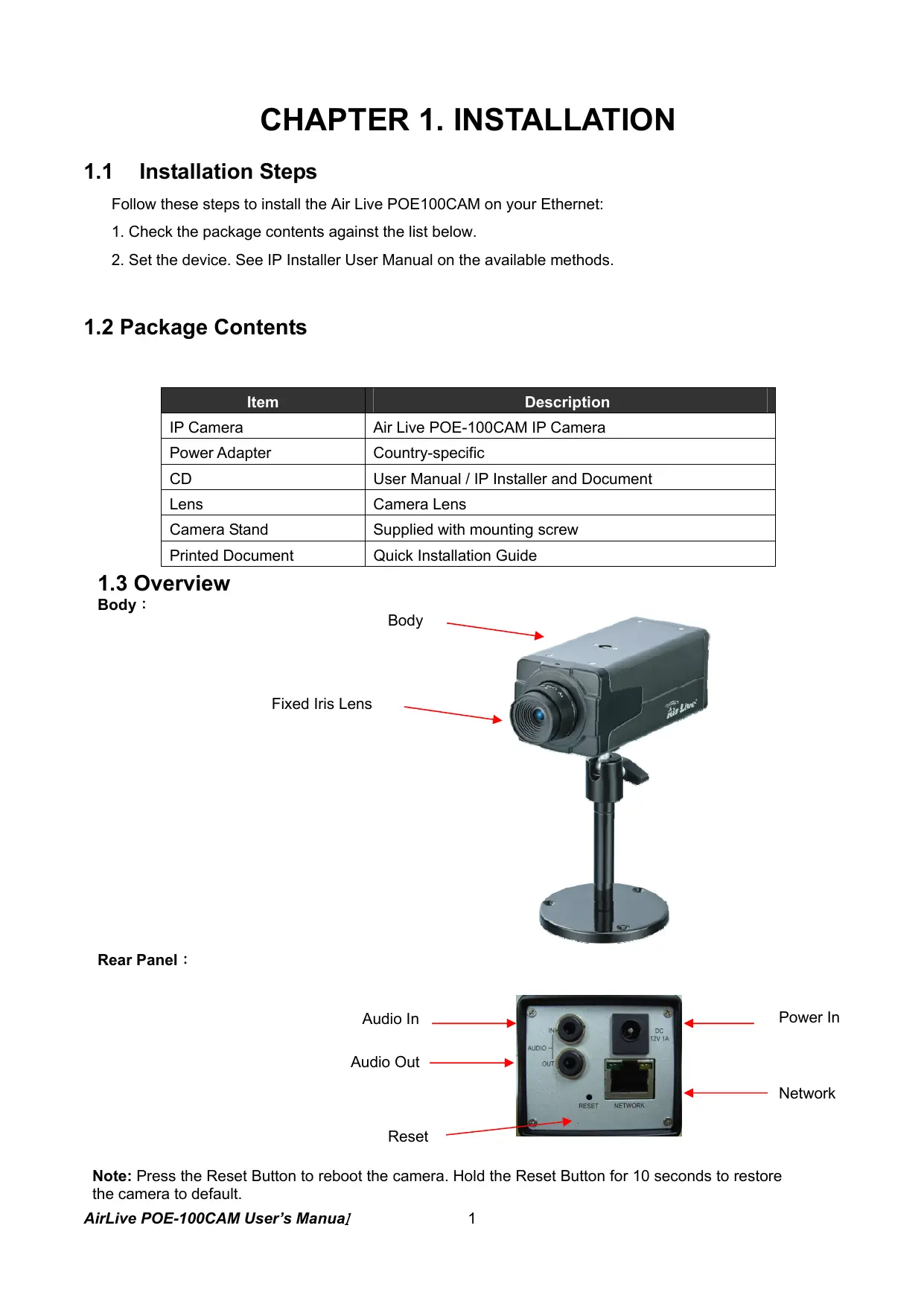

| Product Type | IP Surveillance Camera |
| Brand | AIRLIVE |
| Model | POE-100CAM |
| Power Supply | Power adapter (country-specific) |
| Video Resolution | Up to 704×480 (NTSC) or 704×576 (PAL) |
| Video Compression | MPEG4 and MJPEG |
| Main Features | IP streaming, motion detection, FTP/SMTP/HTTP upload, alarm, 3G/2.5G mobile viewing, RTSP, HTTPS, PPPoE, DDNS, UPnP |
| Connectivity | Ethernet 10/100 Base-T, PoE |
| Mobile Support | 3G (RTSP) and 2.5G (WML) |
| Storage | Upload to FTP server or email; no local storage |
| Security | Account authentication (admin/users), HTTPS, SSL encryption |
| Operating Temperature | 0°C to +50°C (32°F to 122°F) |
| Maintenance and Cleaning | Soft dry cloth; for stubborn stains, slightly damp cloth with mild detergent, then wipe dry. Do not use alcohol, benzene, or solvents. |
| Package Contents | IP camera, power adapter, CD (manual, IP Installer), lens, camera bracket with screws, quick installation guide |
| Repairability | In case of malfunction, contact an authorized Air Live reseller; do not open the casing |
| Compliance | CE, 2004/108/EC, 1999/5/EC, EN 55022, EN 61000, EN 55024 |
Frequently Asked Questions - POE-100CAM AIRLIVE
User questions about POE-100CAM AIRLIVE
0 question about this device. Answer the ones you know or ask your own.
Ask a new question about this device
Download the instructions for your Surveillance Camera in PDF format for free! Find your manual POE-100CAM - AIRLIVE and take your electronic device back in hand. On this page are published all the documents necessary for the use of your device. POE-100CAM by AIRLIVE.
USER MANUAL POE-100CAM AIRLIVE
POE 1/3 Sharp CCD Dual
Stream IP Camera
User's Manual
Declaration of Conformity
We, Manufacturer/Importer
OvisLink Corp.
5F., NO.6, Lane 130, Min-Chuan Rd.,
Hsin-Tien City, Taipei County, Taiwan
Declare that the product
1/3 Sharp CCD Dual Stream IP Carema
AirLive POE-100CAM
is in conformity with
In accordance with 2004/108/EC Directive and 1999/5 EC-R & TTE Directive
Clause
Description
EN 55022:2006 Class B
Limits and methods of measurement of radio disturbance characteristics of information technology equipment
EN 61000-3-2:2000+
Disturbances in supply systems caused by household appliances and similar electrical equipment "Harmonics
A2:2005 Class A
EN 61000-3-3:1995+
A1:2001+A2:2005
Disturbances in supply systems caused by household appliances and similar electrical equipment "Voltage fluctuations
EN 55024:1998+A1:2001
+A2:2003
Information Technology equipment-Immunity characteristics-Limit And methods of measurement
■ AS/NZS CISPR22:2006
Class B
Electromagnetic compatibility-requirements for radio disturbance characteristics of information technology equipment
CE marking

Manufacturer/Importer
Signature :
Name :
Position/ Title :
allert U.
Albert Yeh
Vice President

(Stamp)
Date: 2008/10/1
AirLive POE-100CAM CE Declaration Statement
| Country | Declaration | Country | Declaration |
| cs Cesky [Czech] | OvisLink Corp. tímtó prohlášuje, Že tento AirLive POE-100CAM je ve shodě se základními požadavyk a dalşimi príslušnám iustanoveními směrnice 1999/5/ES. | It Lietuviu [Lithuanian] | Śuo OvisLink Corp. deklarojuka, kad šis AirLive POE-100CAM atitinka esminius reikalavimus irKitas 1999/5/EB Direktyvos nuostatas. |
| da Dansk [Danish] | Undertegnede OvisLink Corp. erkrærer herved, at følgende udstyr AirLive POE-100CAM overholder de væsentlige krav og øvrige relevante krav i direktiv 1999/5/EF. | nl Netherlands [Dutch] | Hierbij verklaart OvisLink Corp. dat het toestel AirLive POE-100CAM in overeenstemming is met de essentièle eisen en de andere relevante bepalingen van richtlijn 1999/5/EG. |
| de Deutsch [German] | Hiermit erklart OvisLink Corp., dass sich das Gerät AirLive POE-100CAM in Übereinstimmung mit den grundlegenden Anforderungen und den übrigen einschlögigen Bestimmungen der Richtlinie 1999/5/EG befindet. | mt Malti [Maltese] | Hawnhekk, OvisLink Corp. jiddikjara li dan AirLive POE-100CAM jikkonforma mal-htigi-jiet essenjali um provvedimenti ohrajn relevanti li hemm fid-Dirrettiva 1999/5/EC. |
| et Eesti [Estonian] | Käesolevaga kinnitab OvisLink Corp. seadme AirLive POE-100CAM vastavust direktivi 1999/5/EU põhinöutele ja nimetatud direktivistulenevatele teistele asjakohastele sātetele. | hu Magyar [Hungarian] | Az OvisLink Corporation kijelenti, hogy az AirLive POE-100CAM megfelel az 1999/05/CE irányelv alapvető kovetelményinek és egyeb vonatkozörrendelkezéseinek. |
| en English | Hereby, OvisLink Corp., declares that this AirLive POE-100CAM is in compliance with the essential requirements and other relevant provisions of Directive 1999/5/EC. | pl Polski [Polish] | Niniejszym OvisLink Corp öswiadcza, ze AirLive POE-100CAM jest zgodny z zasadniczymi wymogami oraz pozialnymi stosownymi postanowieniams Dyrektywy 1999/5/EC. |
| es Español [Spanish] | Por medio de la presente OvisLink Corp. declara que el AirLive POE-100CAM cumple con los requisitos esenciales y caulesquiera或其他 dispositions aplicables o exigibles de la Directive 1999/5/CE. | pt Português [Portuguese] | OvisLink Corp declara que este AirLive POE-100CAM está conforme com os requisitos essenciais e autres dispositions da Directive 1999/5/CE. |
| el Eλληνική [Greek] | ME THN ΠΑΝΟΥΣΑ OvisLink Corp. ΔΗλΩNEI OTI AirLive POE-100CAM ΣΥΜΜΟΦΩNETAI ΠΡΟΣ TΙΣ ΜΥΣΙΔΕΙΣ ΑΠΑΙΤΗΣΕΙΣ KAI TΙΣ ΛΟΙΠΕΣ ΣχETAΕΣ ΔΙΑΤΑΞΕΙΣ ΘΗ ΕΔΗΓΙΑΣ 1999/5/EK. | sl Slovensko [Slovensk] | OvisLink Corp izjavla, da je ta AirLive POE-100CAM v skladu z bistvenimi zahtevami in ostalimi relevantnimi dolocili direktive 1999/5/ES. |
| fr Français [French] | Par la présente OvisLink Corp. declare que l'appareil AirLive POE-100CAM est conforme aux exigences essentielles et aux autres dispositions pertinentes de la directive 1999/5/CE. | sk Slovensky [Slovak] | OvisLink Corp týmto vyhlasuje, Že AirLive POE-100CAM splña základné požiadavky a vsetky príslušné ustanovenia Smerince 1999/5/ES. |
| it Italiano [Italian] | Con la presente OvisLink Corp. dichiara que Anything AirLive POE-100CAM è conforme ai requisiti essenziali ed alle autres dispositions pertinenti stabilite dalla direktiva 1999/5/CE. | fi Suomi [Finnish] | OvisLink Corp vakuuttaa taten etta AirLive POE-100CAM tyyppinen laite on direktivin 1999/5/EY oleellisten vaatimusten ja sită koskevien direktivin muiden ehtoen mukainen |
| lv Latviski [Latvian] | Ar so OvisLink Corp. declarē, ka AirLive POE-100CAM atbisl Direktīvas 1999/5/EK būtiskajām prisibām un citiem ar to saistītajiem noteikumiem. | Íslenska [Icelandic] | Hér með lýsr OvisLink Corp yfir pví aδ AirLive POE-100CAM er i smræmi við grunnkröfur og aðrar kröfur, sem gerðar eru i tilskipun 1999/5/EC. |
| sv Svenska [Swedish] | Härmed intygår OvisLink Corp. attenna AirLive POE-100CAM stär I overensstammelse med de väsentliga eigenskapskrav och övriga relevanta bestämmler som framgår av direktiv 1999/5/EG. | no Norsk [Norwegian] | OvisLink Corp erklærer herved at utstret AirLive POE-100CAM er i smsvar med de grunnleggende krav og övrige relevante krav i direktiv 1999/5/EF. |
A copy of the full CE report can be obtained from the following address:
OvisLink Corp.
5F, No.6 Lane 130
Min-Chuan Rd, Hsin-Tien City,
Taipei, Taiwan, R.O.C.
This equipment may be used in AT, BE, CY, CZ, DK, EE, FI, FR, DE, GR, HU, IE, IT, LV, LT, LU, MT, NL, PL, PT, SK, SI, ES, SE, GB, IS, LI, NO, CH, BG, RO, TR
This Air Live product has been designed with safety in mind. However, if not used properly electrical products can cause fires which may lead to serious body injury. To avoid such accidents, be sure to heed the following.
Legal Caution
Video and audio surveillance can be forbidden by laws that vary from country to country. Check the laws in your local region before using this product for surveillance purposes.
Heed the safety precautions
Be sure to follow the general safety precautions and the "Operation Notice."
In case of a breakdown
In case of system breakdown, discontinue use and contact your authorized Air Live dealer.
In case of abnormal operation
- If the unit emits smoke or an unusual smell,
- If water or other foreign objects enter the cabinet, or
- If you drop the unit or damage the cabinet:
1 Disconnect the cable and the connecting cables.
2 Contact your authorized Air Live dealer or the store where you purchased the product.
Operation Notice - Operating or storage location
Avoid operating or storing the camera in the following locations:
- Extremely hot or cold places (Operating temperature: 0irc C to +50irc C [32 °F to 122 °F])
- Exposed to direct sunlight for a long time, or close to heating equipment (e.g., near heaters)
- Close to sources of strong magnetism
- Close to sources of powerful electromagnetic radiation, such as radios or TV transmitters
- Locations subject to strong vibration or shock
Ventilation
To prevent heat buildup, do not block air circulation around the device.
Transportation
When transporting the camera, repack it as originally packed at the factory or in materials of equal quality.
Cleaning
- Use a soft, dry cloth to clean the external surfaces of the device. Stubborn stains can be removed using a soft cloth dampened with a small quantity of detergent solution, then wipe dry.
- Do not use volatile solvents such as alcohol, benzene or thinals as they may damage the surface.
CONTENT
CHAPTER 1. INSTALLATION
1.1 INSTALLATION STEPS 1
1.2 PACKAGE CONTENTS 1
1.3 OVERVIEW 1
CHAPTER 2. USING IP CAMERA VIA MOBILE PHONE 2
2.1 3G MOBILE PHONE VIEWING 2
2.2 2.5G MOBILE PHONE VIEWING 2
CHAPTER 3. USING IP CAMERA VIA WEB BROWSER. 3
CHAPTER 4. INITIAL ACCESSING THE IP CAMERA 4
CHAPTER 5. CONFIGURATION OF MAIN MENU 8
5.1 Setting 8
5.2 Client Setting 8
5.3 IMAGE SETUP 8
5.4 LIVE VIEW 9
CHAPTER 6. SETTING 10
6.1.BASIC 10
6.2 SYSTEM 10
6.3CAMERA 13
6.4 NETWORK 18
6.5 SECURITY 23
CHAPTER 7. ADVANCE 25
7.1 FTP CLIENT 25
7.2 SMTP 28
7.3 HTTP EVENT 32
7.4 SCHEDULE 34
7.5 ALARM BUFFER 35
7.6 Motion Detection 36
7.7 SYSTEMLOG 37
APPENDIX A - FRAME RATE & BIT RATE TABLE 38
APPENDIX B - STORAGE REQUIREMENT TABLE. 42
CHAPTER 1. INSTALLATION
1.1 Installation Steps
Follow these steps to install the Air Live POE100CAM on your Ethernet:
- Check the package contents against the list below.
- Set the device. See IP Installer User Manual on the available methods.
1.2 Package Contents
| Item | Description |
| IP Camera | Air Live POE-100CAM IP Camera |
| Power Adapter | Country-specific |
| CD | User Manual / IP Installer and Document |
| Lens | Camera Lens |
| Camera Stand | Supplied with mounting screw |
| Printed Document | Quick Installation Guide |
1.3 Overview
Body :
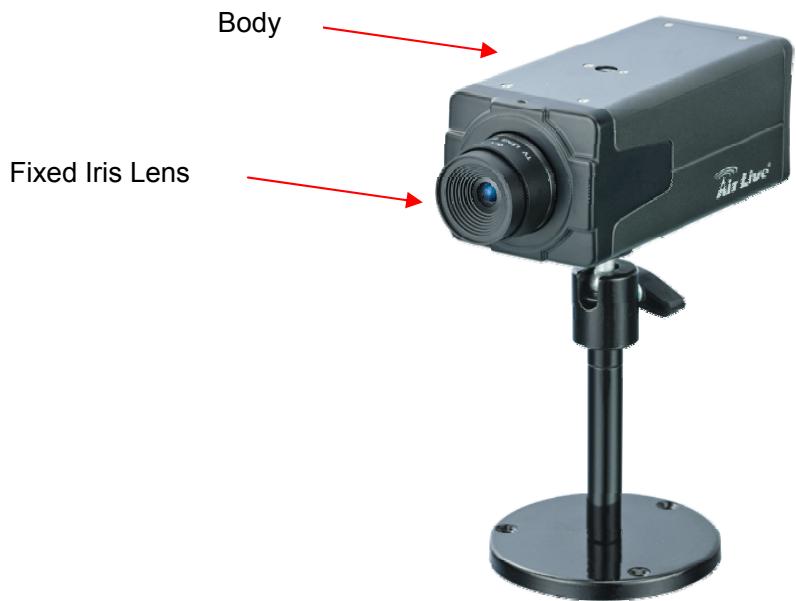
Rear Panel :
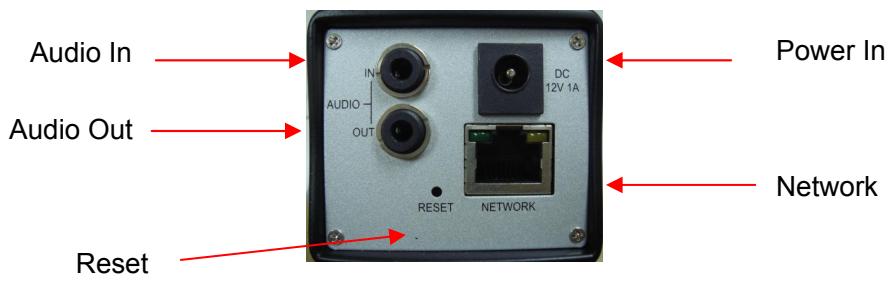
Note: Press the Reset Button to reboot the camera. Hold the Reset Button for 10 seconds to restore the camera to default.
Chapter 2. Using IP Camera via Mobile Phone
To use IP cameras via mobile phones, please make sure your RTSP is set to "ON". (Default is "ON") To change the settings of IP cameras, please see "Settings" for details.
2.1 3G Mobile Phone viewing
For 3G mobile phone viewing, type "rtsp://
Example: rtsp://100.10.10.1:8554/video.3gp
Note:
- You can also use RTSP clients (RealPlayer, MPlayer, Windows Media Player, Quicktime...etc.) to view RTSP streaming, just type in "rtsp://
:/ /video.3gp" as the Player's URL
2.2 2.5G Mobile Phone viewing
For 2.5G mobile phone viewing, type "/mobile.wml" into your 2.5G web browser.
Chapter 3. Using IP Camera via Web Browser
3.1 System Requirement
To use the product normally, we strongly recommend your computer follows our minimum system requirement (Computer level lower than this might cause some problems)
| Item | Requirements |
| CPU | Pentium 4 1600MHz (or equivalent AMD) |
| Graphic Card | 64MB RAM graphic cards (or equivalent on-board graphic cards) |
| RAM | 512MB |
| Operating System | Windows 98, ME (Please see Note) Windows 2000, 2003, XP, Vista |
| Web Browser | Internet Explorer 6 or later |
Note:
-
If you're using Windows 98 or ME, please install IP Installer before using WEB UI to ensure the system runs normally.
-
If you can't view the recorded video file (missing video decoder), please install Xvid codec while installing Intelligent IP Installer. (For Windows 98, ME or 2000 server, the codec might not work properly. You'll need to download Xvid codec 1.0 from the internet.
Chapter 4. Initial accessing the IP camera
Camera installation
- Insert CD into your PC/Laptop.
- Auto Run Screen then shows up, click “Install Driver And Utility ” to install the configuration tool software
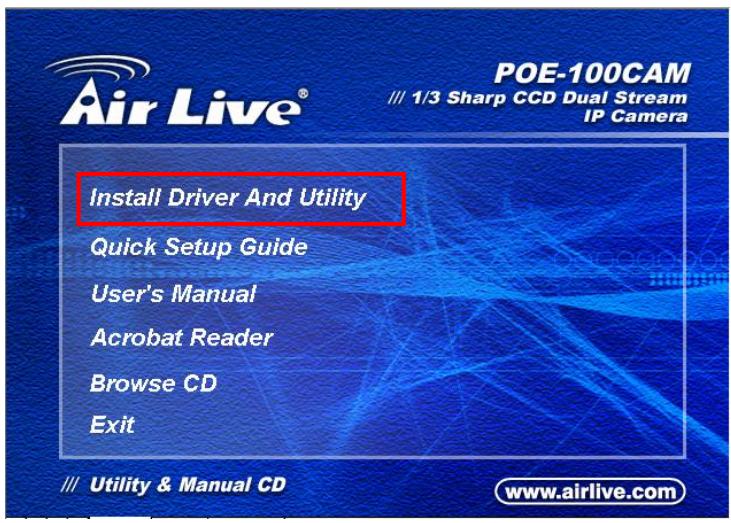
- After complete installation, Run the configuration tool software
- The Software scans the network and finds the IP Camera, then list in the dialog box.
- If the Camera's IP address is in the same IP segment as your LAN, select the founded IP Camera and click "Link to IE" to proceed.
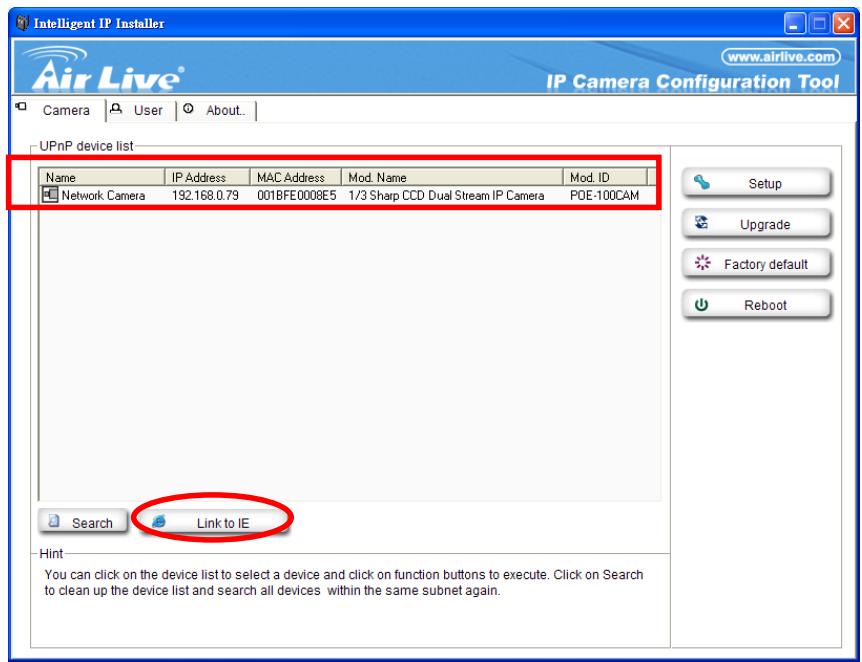
- If the IP is not in your IP segment, select the founded IP Camera and click "Setup" Note that the text color of the listed IP Camera is red if it is not in same the IP segment with your PC.
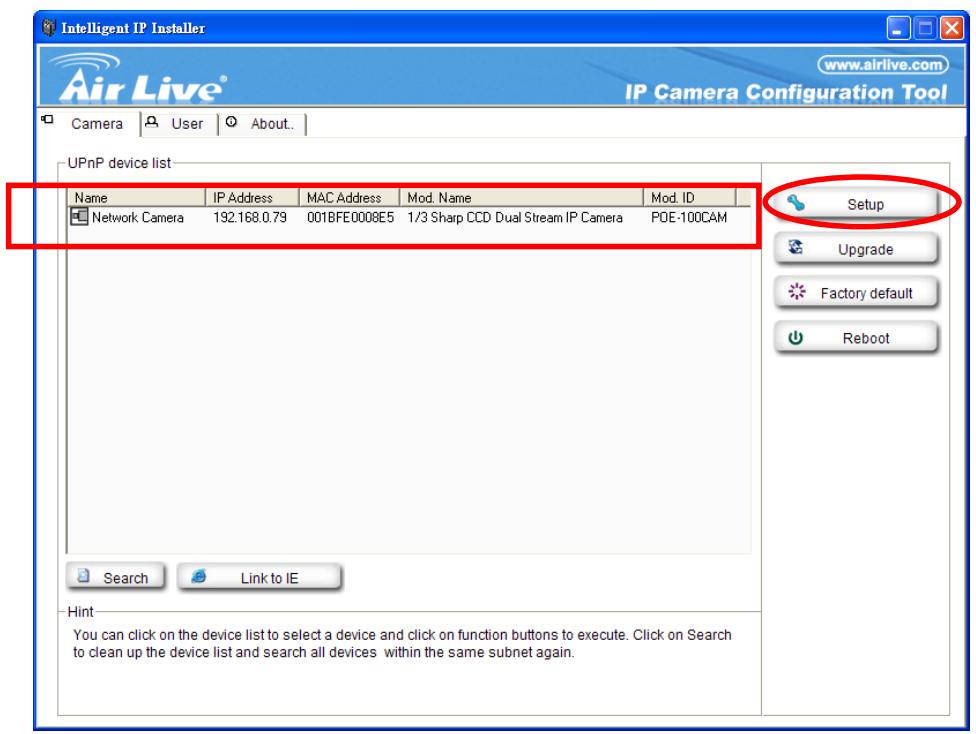
- Follows setup instruction to change the IP address of the IP Camera.
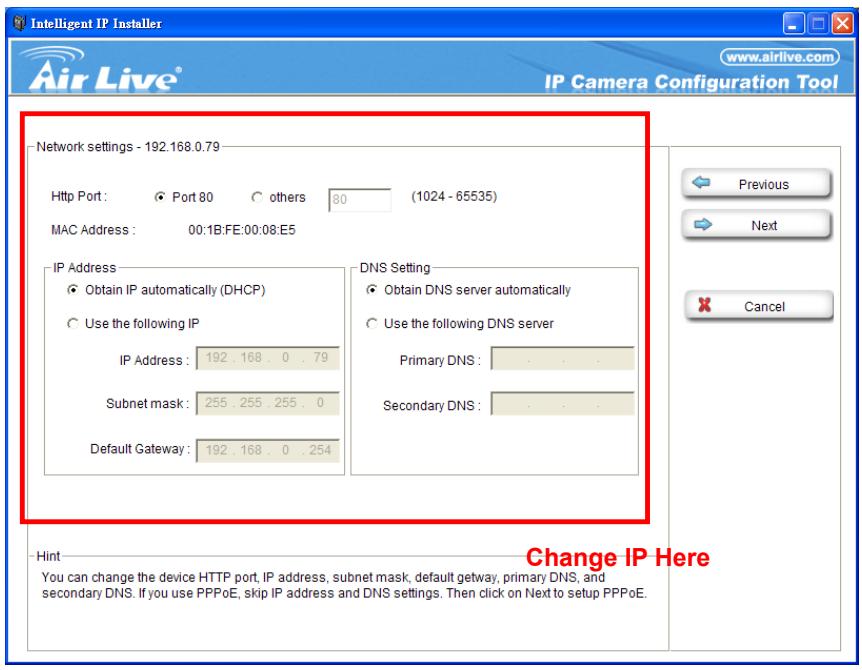
- At the end of the setup instruction, the IP Camera Reboot
- Click the Search button to search again
-
Click "Link to IE" to proceed.
-
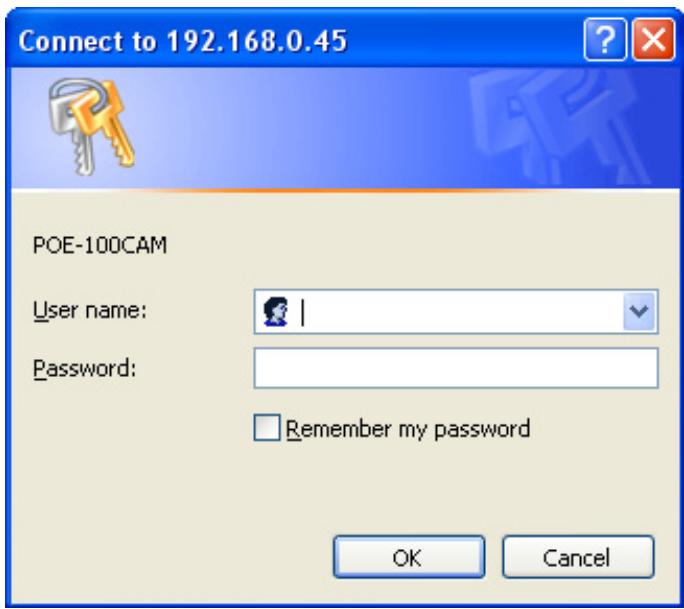
The tool launch your Internet Explorer and prompts up the login dialog
- Enter default user name and password: admin / airlive
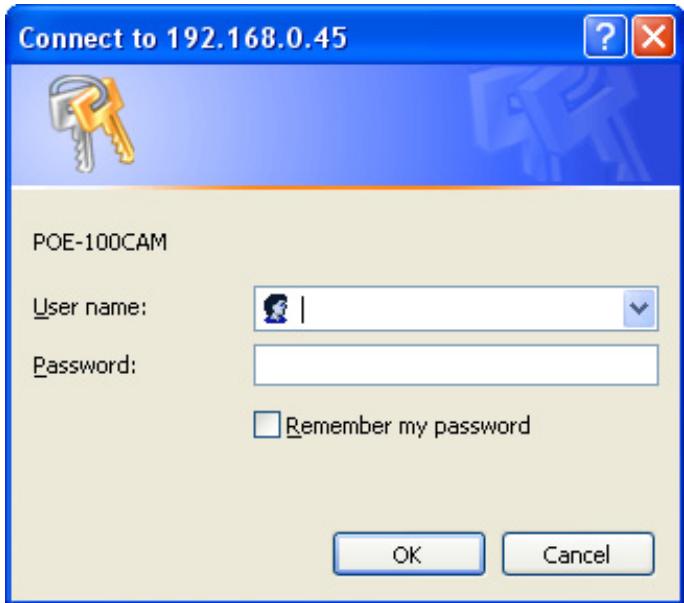
- After a successful login, the browser asks for ActiveX installation.

Note:
If you need a public IP for your Router, please contact your ISP for the service.
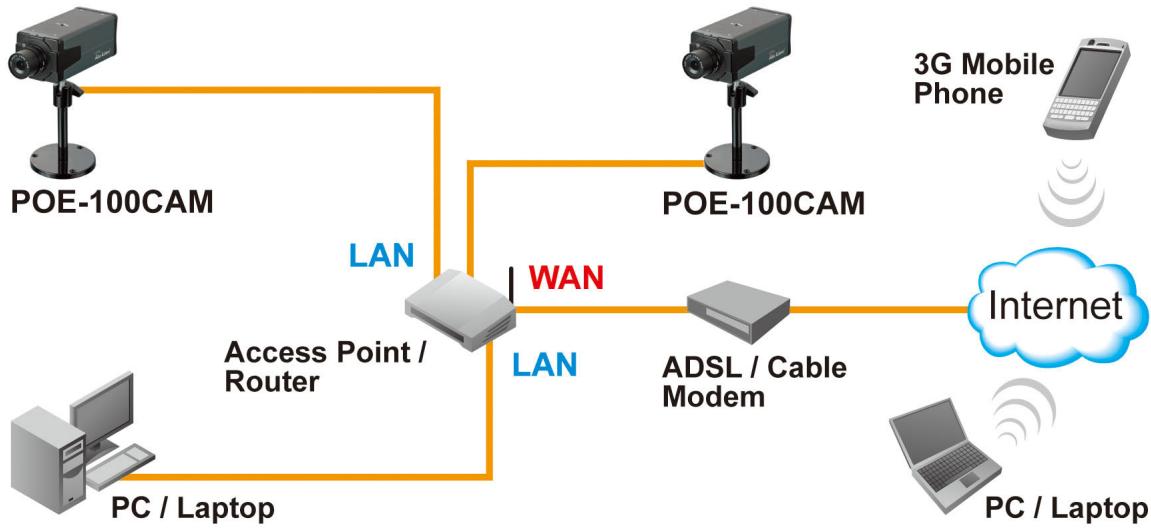
- Start your web browser, and enter the IP address or host name of the AIR LIVE IP camera in the Location / Address field of your browser.
Note :
-
If you only want to view the video without setting page, enter "http://
/index2.htm" as your web URL. -
Use the default account "admin" and default password "airlive".
Note :
- The default user name "admin" and the password are set at the factory for the administrator. You can change them in the Account Menu under Setting.
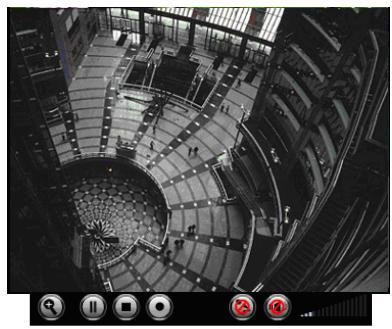
- The monitor image will be displayed in your browser.
Chapter 5. Configuration of Main Menu


Internet
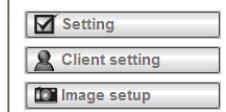
5.1 Setting

Setting
This function is only for the Administrator. Click this button to get into the Basic and Advance settings menu.
5.2 Client Setting

Client setting
Mode: Click the pulldown box to choose between MPEG4 and MJPEG video compression mode.
Note: MJPEG streaming is unavailable if RTSP mode is ON.
View Size: Select the desired display image resolution to 640X480 or 320X240.
Protocol: Select the transferring protocol from TCP, UDP, HTTP and Multicast.
Video Buffer: Turn the Video Buffer function On/Off. The Video Buffer function makes the streaming more smoothly in unsteady network environment, but might cause a little delay in live viewing.
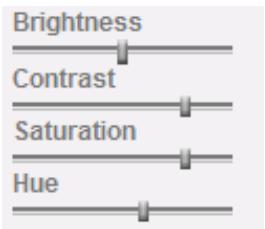
5.3 Image Setup

Image setup
You can use the tool bar to optimize video brightness, contrast, and saturation.
5.4 Live View
Snapshot:
You can capture a still image shot by the camera and save it in your computer.
- Press , and a snapshot window will appear.
- Click "Save" to save the picture in your computer.
- Click "Close" to return to the view page.
Digital Zoom in / out the image via the monitor window
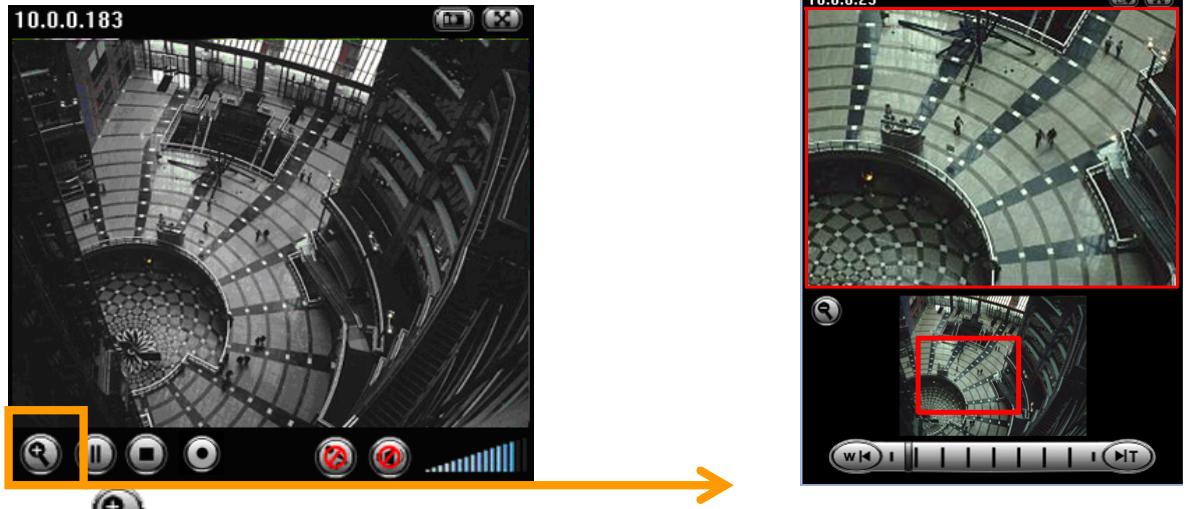
- Click to display the digital zoom in window.
- Pull the to adjust the digital zoom range, and it will be showed on the above window.
- You can use the left click of your mouse to move the to any where on the window.
Audio buttons :
: Volume control bar.
Note :
It means the speakers of your computer are turned on to transmit the sounds from the connected IP camera(s). Similarly, means you can broadcast to the connected IP camera(s) via the Ethernet using your microphone.
Video play buttons:

: Pause the current video

: Stop the current video.

: Play the video.

: Record the current video.
Chapter 6. Setting
6.1. Basic
Click the "Basic" folder to display the sub folders, including System, Camera, Network, and Security.
6.2 System
6.2.1 Information
The Information page provides you with product factory information, including Product name, Firmware version, and Web version.

HOME
SETTING
BASIC
Product name
1/3 Sharp CCD Dual Stream IP Camera
Firmware version
LM.1.6.16.02_sign Fri Aug 22 19:06:23 CST 2008
Web version
LM.1.6.16.02_sign

System
Information
Date/Time
Initialize
Camera
Network
Security
Advance
6.2.2 Day & Time
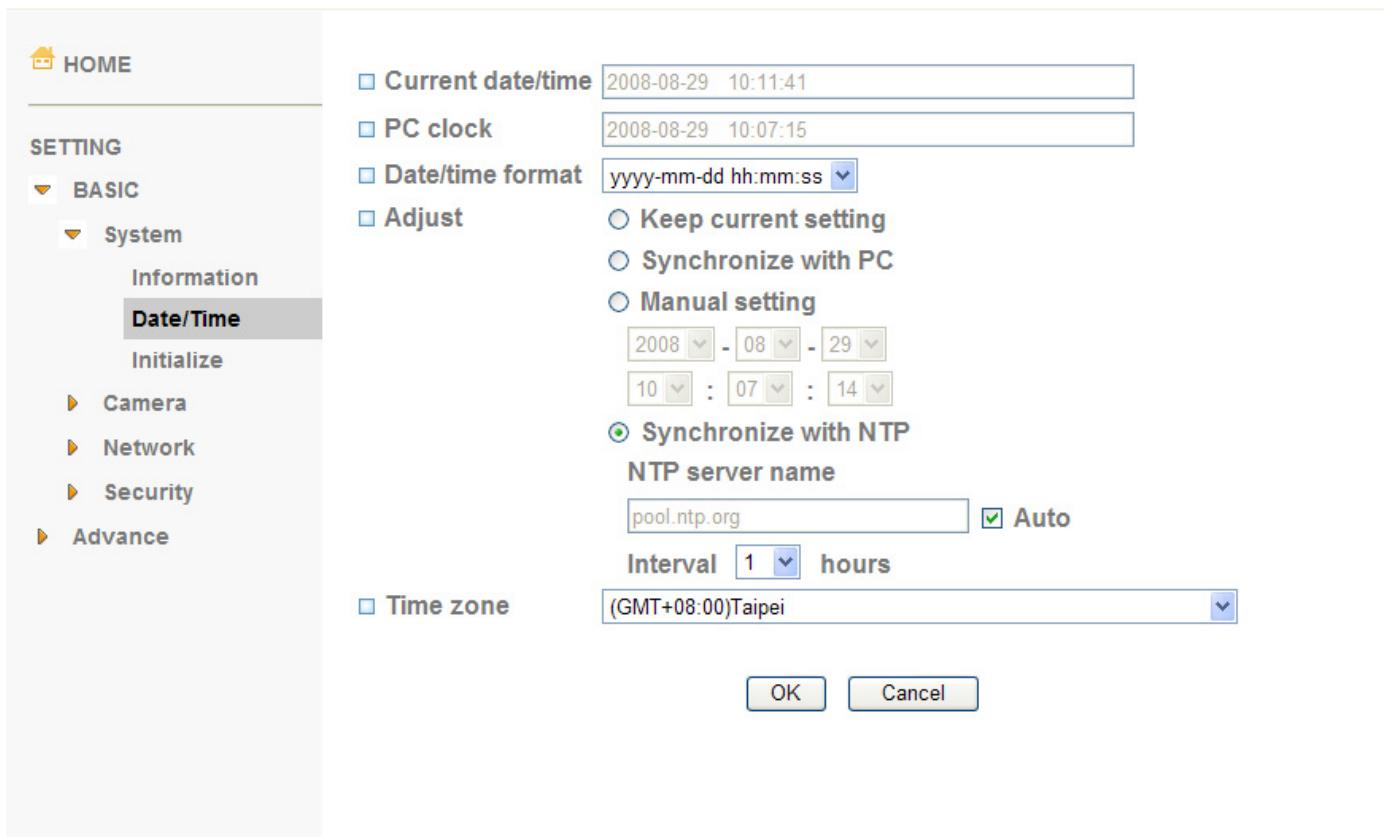
Current date & time : This displays the current date and time of the device.
PC clock : This displays the date and time of the monitoring PC clock.
Date & time format: Click the pulldown box to select among different time display formats, including yyyy-mm-dd hh:mm:ss (year-month-day hour:minute:second), mm-dd-yyyy hh:mm:ss (month-day-year hour:minute:second), and dd-mm-yyyy hh:mm:ss (day-month-year hour:minute:second).
Adjust : Select one of four time adjusting modes.
Keep current setting : Select this mode to keep the current date and time of the device.
Synchronize with PC : Select this mode to make the date and time of the device the same as the monitoring PC.
Manual setting : Select this mode to manually adjust the date & time of the device.
Synchronize with NTP : Specify the NTP server name and the Refresh Interval to synchronize the date and time of the device with those of the time server, known as the NTP (Network Time Protocol) server.
Note:
- The NTP server (Network Time Protocol) is the time server which is an Internet standard protocol (built on top of TCP/IP) that assures accurate synchronization to the millisecond of computer clock times in a network of computers.
NTP server name : Type the host name or IP address of the NTP server, up to 64 characters.
Time zone : Select the time zone and time difference from Greenwich Mean Time in the area where the device is installed from the pulldown box.
6.2.3 Initialize
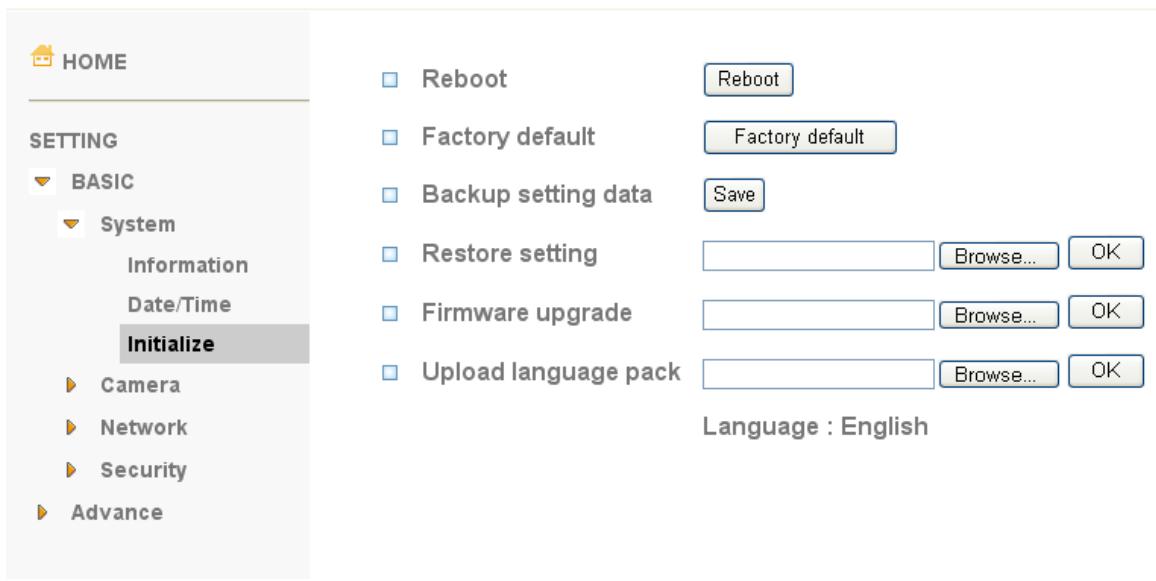
Reboot : Click this button to reboot the device. A confirmation dialogue will appear. Click OK to proceed. It takes about two minutes to reboot the device.
Factory default : Click this button to reset the device to the factory default settings. A confirmation dialogue will appear. Click OK to proceed, the network indicator on the device will start to blink. After completing adjustments to the default settings, the device will reboot automatically. Do not turn off the device until the device reboots.
Backup setting data : Save the setting data of the device to a file. Click Save, and follow the instructions on the browser to save the setting data file to your specified location.
Restore setting : Load the saved setting data of the device. Click Browse and select the file in which the setting data is stored. Click OK, and the device is adjusted according to the loaded data and restarted.
Firmware update : Upgrade the device software. Click Browse and select the file for upgrading. A confirmation dialogue will appear. Click OK to start upgrading. The device will reboot upon completion.
Note:
- Use only upgrade files that are special for this device. Problems may occur otherwise.
- Do not turn off the device power or disconnect the network until the upgrading is completed.
Upload language pack : Upgrade the device language pack. Click Browse and select the file for upgrading. A confirmation dialogue will appear. Click OK to start upgrading. The upgrade is applied immediately. The default language is "English"
6.3 Camera
6.3.1 General

HOME
SETTING
BASIC
System
Camera
General
MPEG4
MJPEG
Network
Security
Advance
RTSP
□Deinterlace Filter
Overlay
Text color
Background color
Alias
Date/Time
Display position

On Off

On Off

Text overlay Privacy mask Off

ite

ck

On Off

Top O Bottom

OK Cancel
RTSP: Switch the RTSP streaming On/Off.
Note :
- RTSP: Real Time Streaming Protocol. RTSP is supported by most of the media clients. (RealPlayer, Media Player, QuickTime, etc...)
Deinterlace Filter : Switch the deinterlace filter on/off.
Overlay : Select to add Text Overlay or Privacy Mask on/off the display screen.
Text Overlay: Enables users to see some information on the display screen, including Date/Time and user-defined text. You can also change the background color.
Privacy Mask : Enables users to conceal an area of the video image.
6.3.2 MPEG4
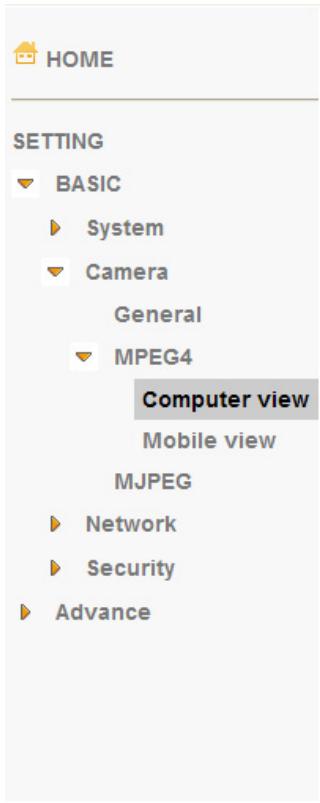
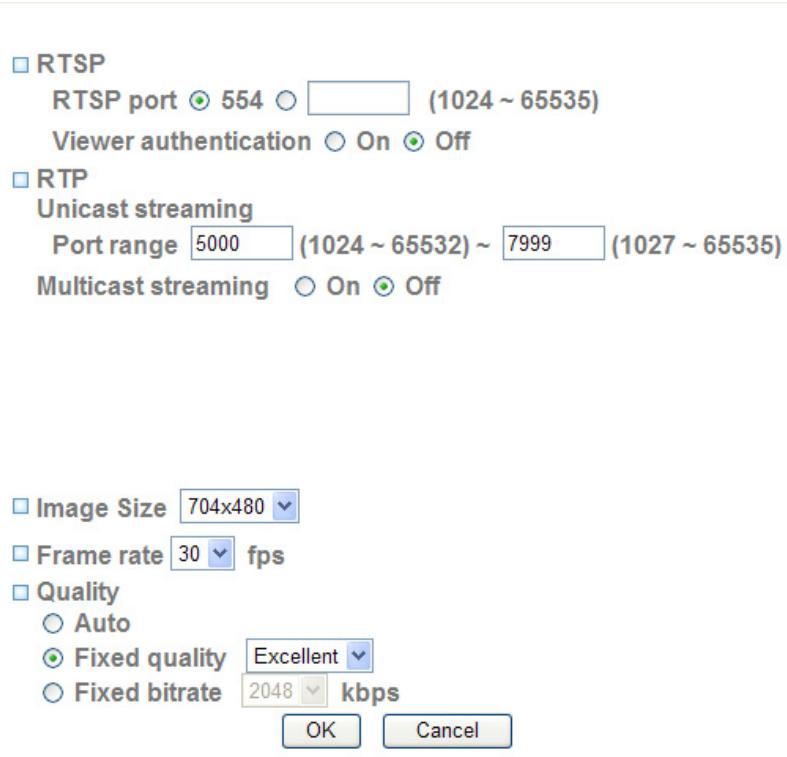
6.3.2.1 Computer View
RTSP (If RTSP mode is ON)
RTSP port: Specify the transmission port number of RTSP streaming video. Default value is 554.
Viewer authentication: If the viewer authentication is ON, users viewing through RTSP will be requested to key-in username and password.
RTP (If RTSP mode is ON)
Unicast streaming:
Unicast streaming Video/Audio port range: Specify the transmission port range of RTP streaming video. RTP will select a port randomly from the range.
Multicast streaming:
Multicast address: Specify the multicast server address.
Video / Audio Port: Specify the transmission port number of the video data. Specify an even number from 1024 to 65534.
Time-To-Live: Set the maximum TTL that multicast can pass through.
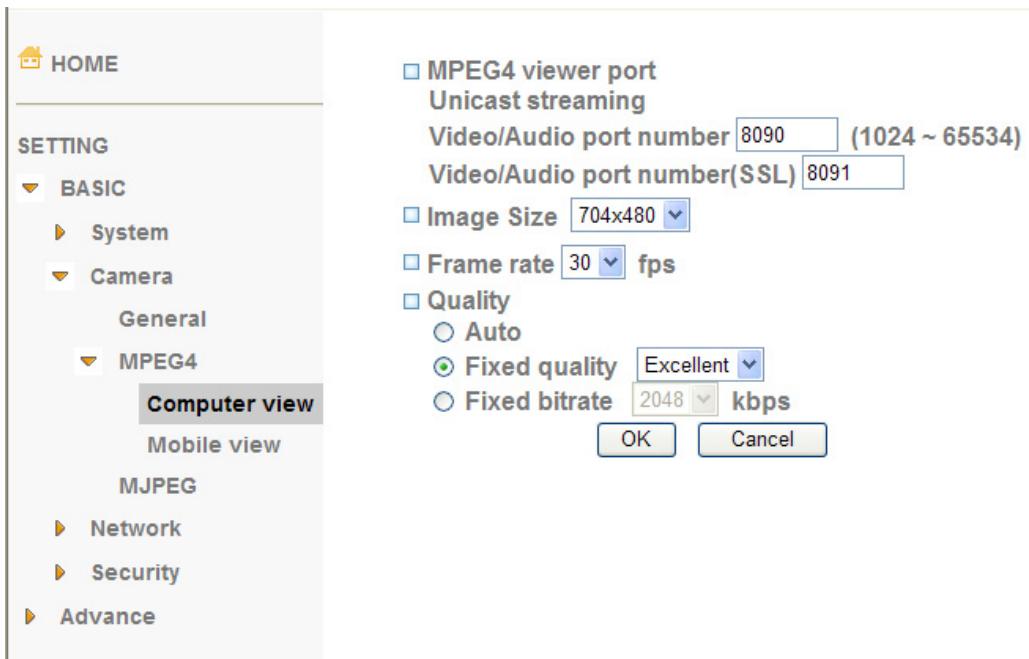
MPEG4 viewer port (If RTSP mode is OFF)
Unicast streaming Video/Audio port number : Specify the transmission port number of the video data. It is initially set to 8090. Specify an even number from 1024 to 65534.
Image Size: Specify the image size the network camera transmits. You can choose among 704 × 480 , 352 × 240 and 176 × 120 for NTSC mode and 704 × 576 , 352 × 288 and 176 × 144 for PAL mode.
Frame rate : Set the frame rate of the MPEG4 image. Selectable values are 5, 10, 15, 20, 25, 30 fps. The unit "fps" stands for "frames sent per second".
Quality
Auto : The quality and bitrate will be automatically decided according to the frame rate.
Fixed Quality : The selectable values are Medium, Standard, Good, Detailed and Excellent.
Fixed Bitrate : Set the bit rate of MPEG4 image transmission for a line. Selectable values are 64, 128, 256, 384, 512, 768, 1024, 1280, 1536 and 2048 kbps.
Note :
- The selected frame rate and bit rate are a tentative value. The actual frame rate and bit rate may be different according to the image size, the shooting scene or the network condition.
6.3.2.2 Mobile View
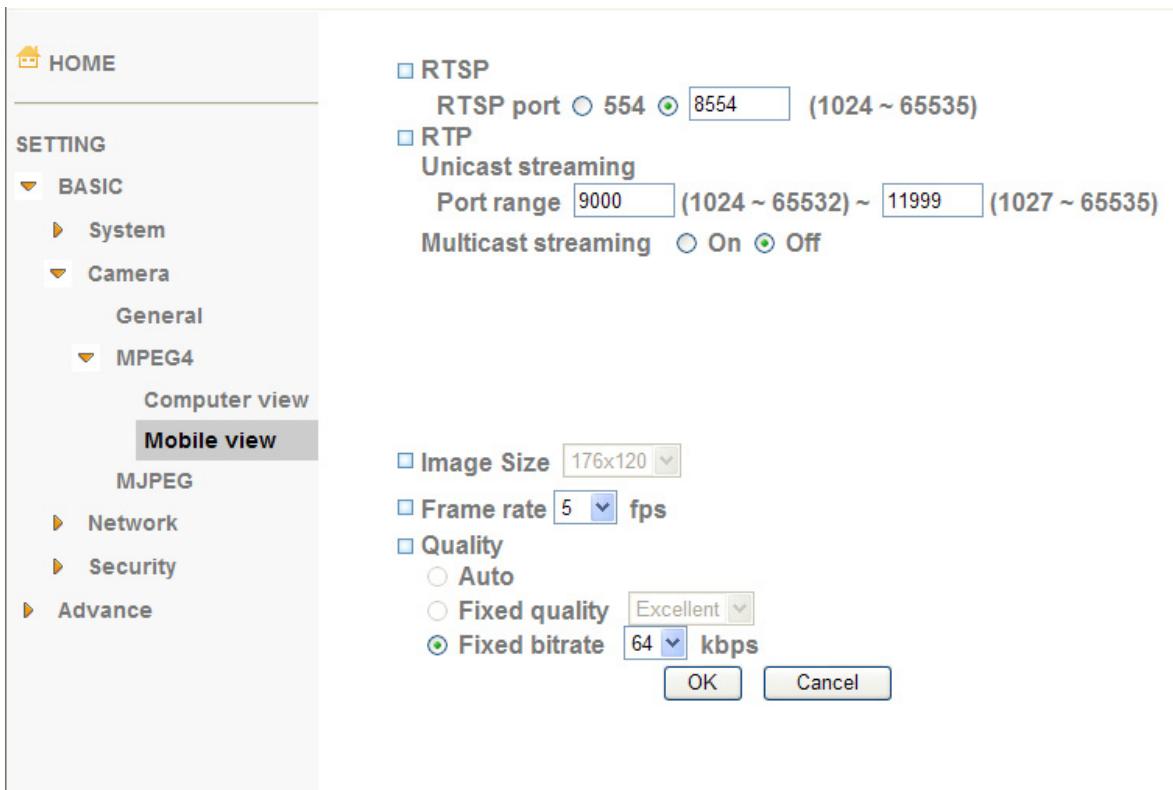
RTSP (If RTSP mode is ON)
RTSP port: Specify the transmission port number of RTSP streaming video. Default value is 8554.
RTP (If RTSP mode is ON)
Unicast streaming:
Unicast streaming Video/Audio port range: Specify the transmission port range of RTP streaming video. RTP will select a port randomly from the range.
Multicast streaming:
Multicast address: Specify the multicast server address.
Video / Audio Port: Specify the transmission port number of the video data. It is initially set to 10000 and 11000. Specify an even number from 1024 to 65534.
Time-To-Live: Set the maximum TTL that multicast can pass through.
Image Size: The Image size of Mobile view is fixed at 176x120.
Frame rate : Set the frame rate of the MPEG4 image. Selectable values are 5, 10, 15, 20 fps. The unit “fps” stands for “frames sent per second”.
Quality
Fixed Bitrate : Set the bit rate of MPEG4 image transmission for a line. Selectable values are 64, 32, and 16kbps..
6.3.3 MJPEG
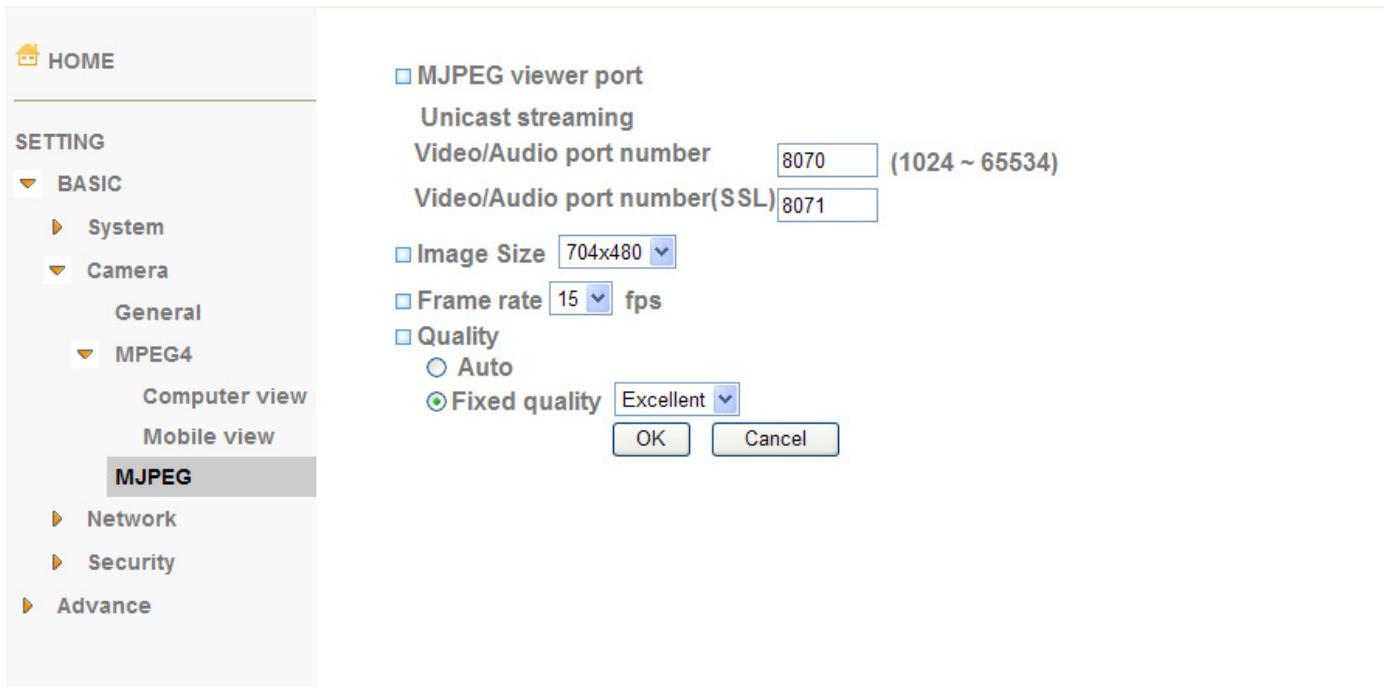
Note :
- MJPEG settings are unavailable if the RTSP mode is ON, which means the MJPEG streaming is closed.
MJPEG viewer port
Unicast streaming Video/Audio port number : Specify the transmission port number of the video data. It is initially set to 8070. Specify an even number from 1024 to 65534.
Note :
- Unicast streaming: Specify the transmission port number of the video data and audio data used when UDP (Unicast) is selected with the TCP/UDP transmission switching icon in the main viewer.
Image Size : Specify the image size the network camera transmits. You can choose among 704 × 480 , 352 × 240 and 176 × 120 for NTSC mode and 704 × 576 , 352 × 288 and 176 × 144 for PAL mode.
Frame rate: Set the frame rate of the MJPEG image. Selectable values are 5, 10, 15 fps. The unit "fps" stands for "frames sent per second".
Quality
Auto : The quality will be automatically decided.
Fixed quality : The selectable values are Medium, Standard, Good, Detailed and Excellent.
6.4 Network
6.4.1 Information

HOME
SETTING

BASIC
System
Camera
Network
Information
PPPoE
DDNS
UPnP
IP Notification
Security

Advance

MAC address

Obtain an IP address automatically (DHCP)

Use the following IP address
IP address
Subnet mask
Default gateway
00:1B:FE:00:08:E5
192.168.0.45
255.255.255.0
192.168.0.254
Use the following DNS server address
Primary DNS server
0.0.0.0
Secondary DNS server
0.0.0.0

HTTP port number

(1024 to 65535)
OK
Cancel
MAC address : Display the MAC address of the device.
Obtain an IP address automatically (DHCP) : If a DHCP server is installed on the network, to select this while the IP address is assigned by the DHCP server.
Note :
- When you set Obtain an IP address automatically (DHCP), make sure that the DHCP server is working on the network.
Use the following IP address : Select this when a fixed IP address is set.
IP address : Enter the IP address of the device.
Subnet mask: Enter the subnet mask.
Default gateway: Enter the default gateway.
Use the following DNS server address : Select this when you set the fixed address as the IP address of DNS server.
Primary DNS server: Enter the IP address of the primary DNS server.
Secondary DNS server : Enter the IP address of the secondary DNS server, if necessary.
HTTP port number : Select 80 in general situations. If you want to use a port number other than 80, select the text box and enter a port number between 1024 and 65535.
Note :
- When you have set the HTTP port number to a number other than 80 on the Network setting page or in the Setup Program, access the device by typing the IP address of the device on the web browser as follows:
Example: when HTTP port number is set to 2000 → http://192.168.1.100:2000/
6.4.2 PPPoE
Use this when you connect the device through PPPoE (Point -to- Point Protocol over Ethernet). PPPoE connection is the protocol that is widely used in xDSL (digital affiliate line such as ADSL, VDSL or SDSL) as the authentication and connection system.
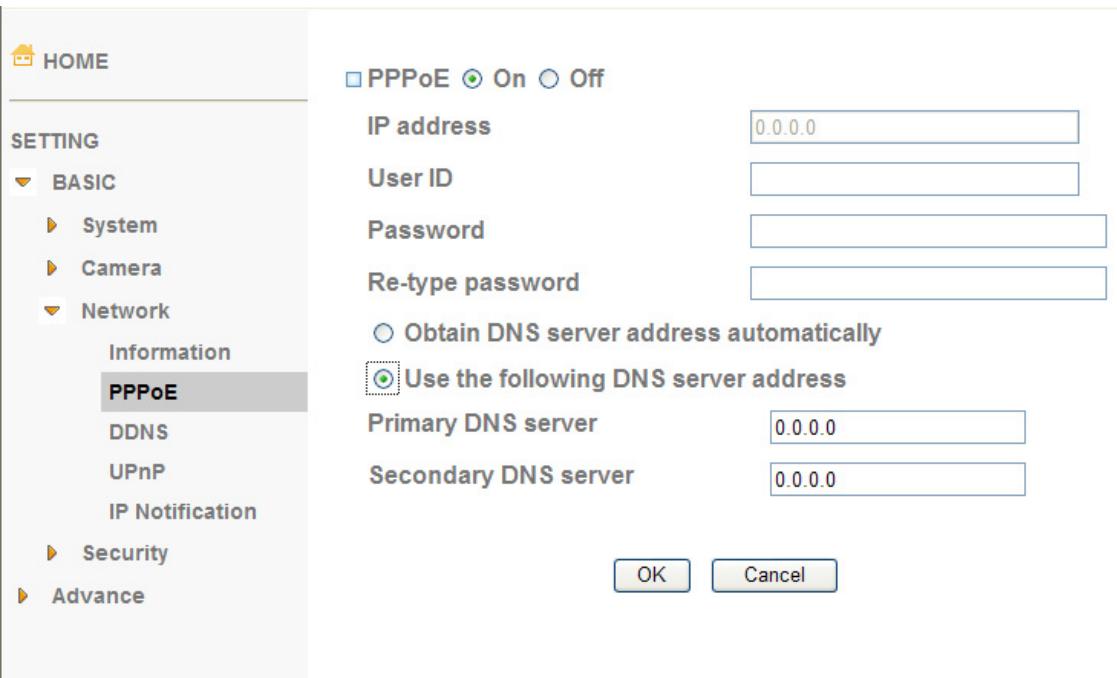
IP address : The IP address obtained at the PPPoE connecting with network.
User ID : Enter the user ID for authentication necessary for PPPoE connections. Type it up to 64 characters.
Password: Enter the password for authentication necessary for PPPoE connections. Type it up to 32 characters.
Re-type password : Re-type the password to confirm.
Obtain DNS server address automatically : Select this to obtain the address of DNS server automatically.
Use the following DNS server address : Select this when you set the fixed address as the IP address of DNS server.
Primary DNS server : Enter the IP address of the primary DNS server.
Secondary DNS server : Enter the IP address of the secondary DNS server.
6.4.3 DDNS
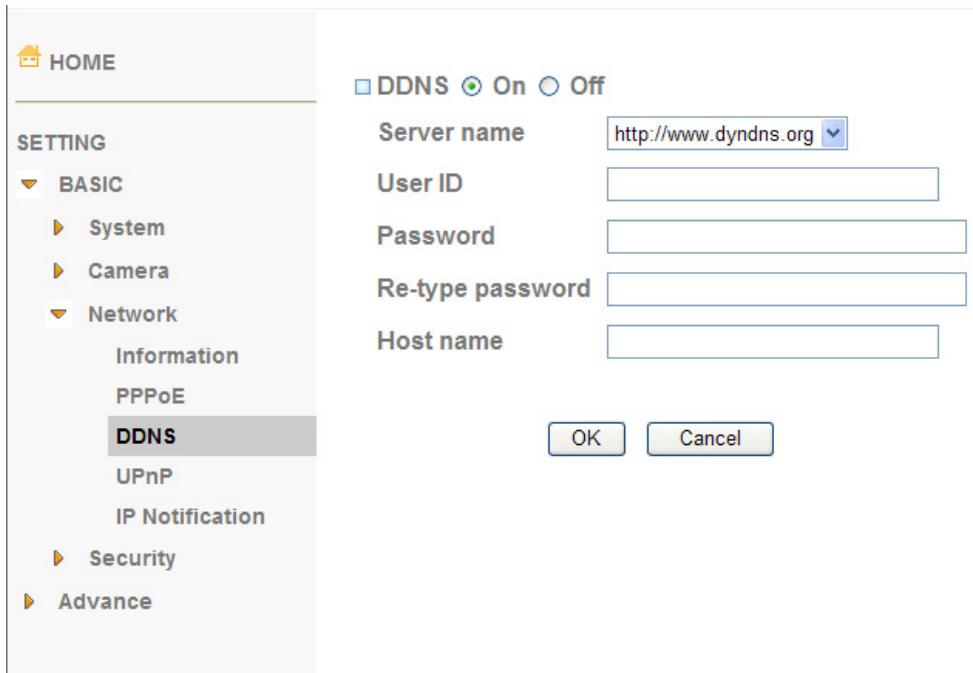
Server name : Choose the DDNS Server from the list.
User ID : Enter the user ID for authentication necessary for DDNS connections. Type it up to 64 characters.
Password : Enter the password for authentication necessary for DDNS connections. Type it up to 32 characters.
Re-type password : Re-type the password to confirm.
Host name: Enter the host name that is registered to the DDNS server.
Note :
- When you want to use DDNS function, you need to register an account in DDNS server first.
6.4.4 UPnP
The device includes support for UPnP, which is enabled by default. If also enabled on your computer, the device will automatically be detected and a new icon will be added to "My Network Places." It provides port forwarding for opening a port in a router or firewall in a private network in order to let a party from the outside world contact a user inside.

HOME
SETTING

BASIC
System
Camera
Network
Information
PPPoE
DDNS
UPnP
IP Notification
Security

Advance
UPnP On Off
Turn On UPnP port forwarding
HTTP port
80
(1024~65535)
SSL Port
443
(1024~65535)
MPEG4 viewer port
8090
(1024~65535)
MPEG4 viewer port(SSL)
8091
(1024~65535)
MJPEG viewer port
8070
(1024~65535)
MJPEG viewer portSSL)
8071
(1024~65535)
MPEG4 RTSP port
Computer view
8050
(1024~65535)
Mobile view
8030
(1024~65535)
OK
Cancel
HTTP port : Enter the HTTP port number and default HTTP port is 80.
SSL port: Enter the SSL port number and default SSL port is 443.
MPEG4 viewer port : Enter the MPEG4 viewer port number and default MPEG4 viewer port is 8090.
MPEG4 viewer port(SSL): Enter the MPEG4 SSL viewer port and default is 8091.
MJPEG viewer port : Enter the MJPEG viewer port number and default MJPEG viewer port is 8070.
MJPEG viewer port(SSL): Enter the MPEG4 SSL viewer port and default is 8071.
MPEG4 RTSP port: Enter the MPEG4 RTSP port, default value is 8050 for computer view, 8030 for mobile view.
6.4.5 IP Notification
When network notify type is set to On, you can send an e-mail notification of the completion of the network setting.
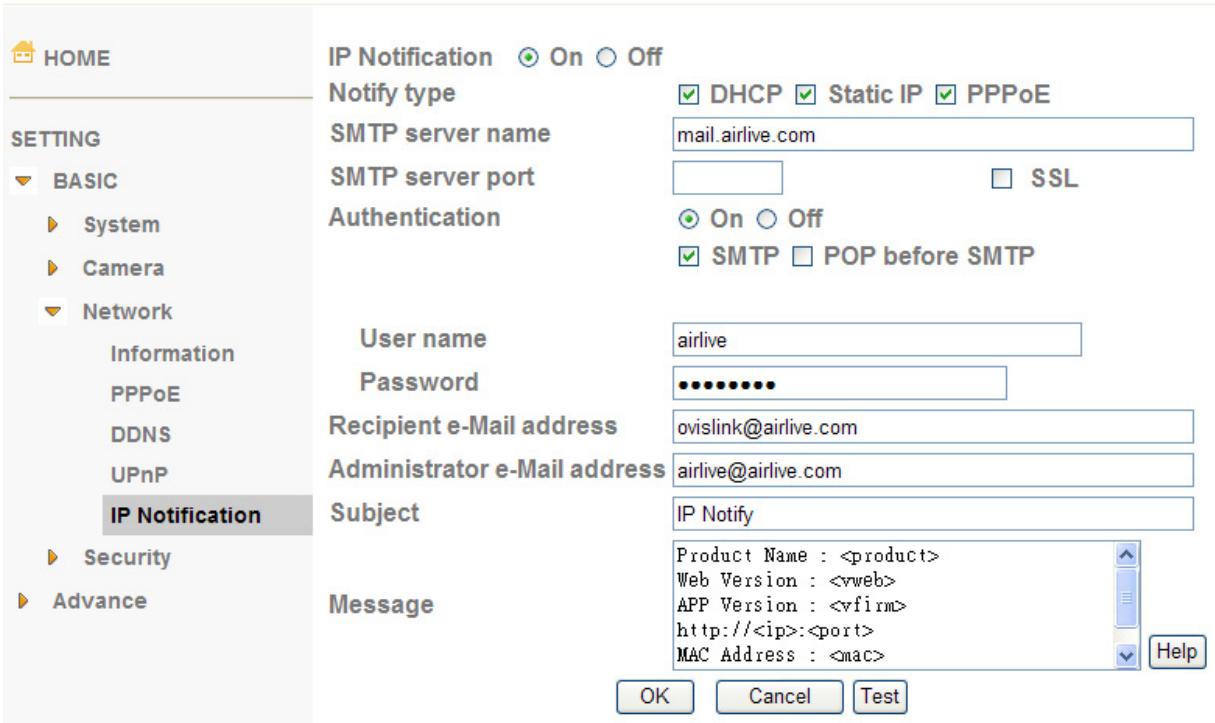
- Notify type: Select type of DHCP, Static IP and PPPoE will notify.
- SMTP server name: Type the SMTP server name up to 64 characters, or the IP address of the SMTP server.
Authentication : Select the authentication required when you send an email. - Off: Select if no authentication is necessary when an email is sent.
- On: When authentication is necessary an e-mail is sent, select one of the authentication methods from the followings.
- SMTP: Select if SMTP authentication is necessary when an e-mail is sent.
POP before SMTP: Select if POP before SMTP authentication is necessary when an e-mail is sent.
Note :
-
When you set to On, be sure to select either or both SMTP or/and POP before SMTP.
-
POP server name : It is necessary when the POP before SMTP is selected in Authentication. Type the POP (receiving mail) server name up to 64 characters, or type the IP address of the POP server. This setting is necessary when the SMTP server which sends e-mails performs authentication using the POP user account.
- User name, Password : Type the user name and Password of the user who has the mail account. This setting is necessary when the SMTP server which sends e-mails performs authentication.
- Recipient e-mail address : Type the recipient e-Mail address up to 64 characters. You can specify up to three recipient E-mail addresses.
- Administrator e-mail address: Type the Administrator e-Mail address up to 64 characters. This address is used for reply mail and sending system messages from the SMTP server.
- Subject : Type the subject/title of the e-Mail up to 64 characters. With respect to mail which is sent
according to the IP notification.
- Message : Type the text of the E-mail up to 384 characters. Default value provides network information including IP, Port, MAC, Model, Firmware Version and Web Version.
6.5 Security
6.5.1 Account
The device default account and password setting is "admin/admin". That means everyone might access the device including the configuration as long as the IP address is known. It is necessary to assign a password if the device is intended to be accessed by others. Use this menu to set the user names and passwords of Administrator and up to 9 different users (User 1 to User 9), and the access right of each user.
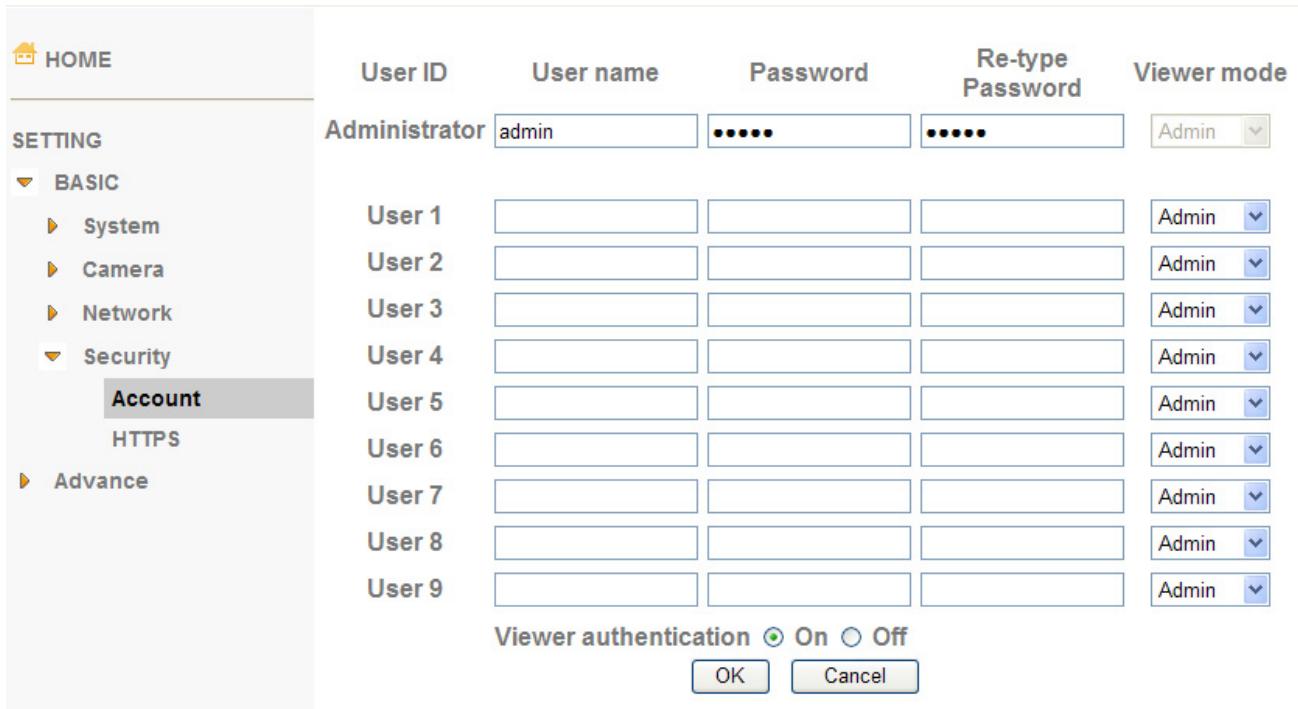
```java User name : Set a user name between 5 and 16 characters.
Password : Set a password between 5 and 16 characters.
Re-type password : Re-type the password to confirm.
Viewer Mode : Set a user to Admin, Operator or Viewer mode.
Viewer authentication : Allows any viewer direct access to Live View.
6.5.2 HTTPS
HTTPS is a URI scheme used to indicate a secure HTTP connection. It is syntactically identical to the http:// scheme normally used for accessing resources using HTTP. Using an https: URL indicates that HTTP is to be used, but with a different default TCP port (443) and an additional encryption/authentication layer between the HTTP and TCP. You can use the IP camera through HTTPS easily by using https:// instead of http://.
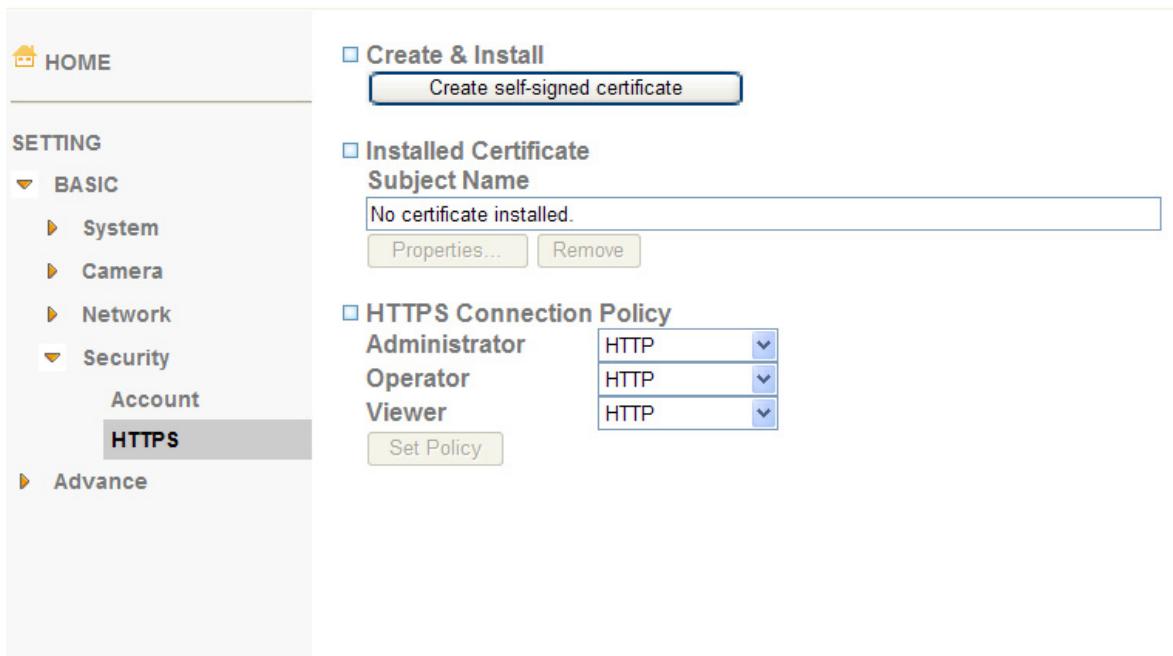
To use the HTTPS encryption, please set up "Create self-signed certificate" for the first time you use the HTTPS function, then set up the connection policy for different users, and click "Set Policy" to apply the settings.
Create & Install: Create a self-signed certificate for HTTPS to recognize.
Installed Certificate: Display or remove the properties of the installed certificate.
HTTPS Connection Policy: Set HTTPS connection policy for different level of users.
Chapter 7. Advance
7.1 FTP Client
Use this menu to set up for capturing and sending images to an FTP server. By using FTP client function, you can send the image and audio file which has been shot and recorded linked with the external sensor input or with the built-in motion detection function to FTP server. FTP client setting menu is composed of two tabs, General, Alarm sending and Periodical sending.
7.1.1 General
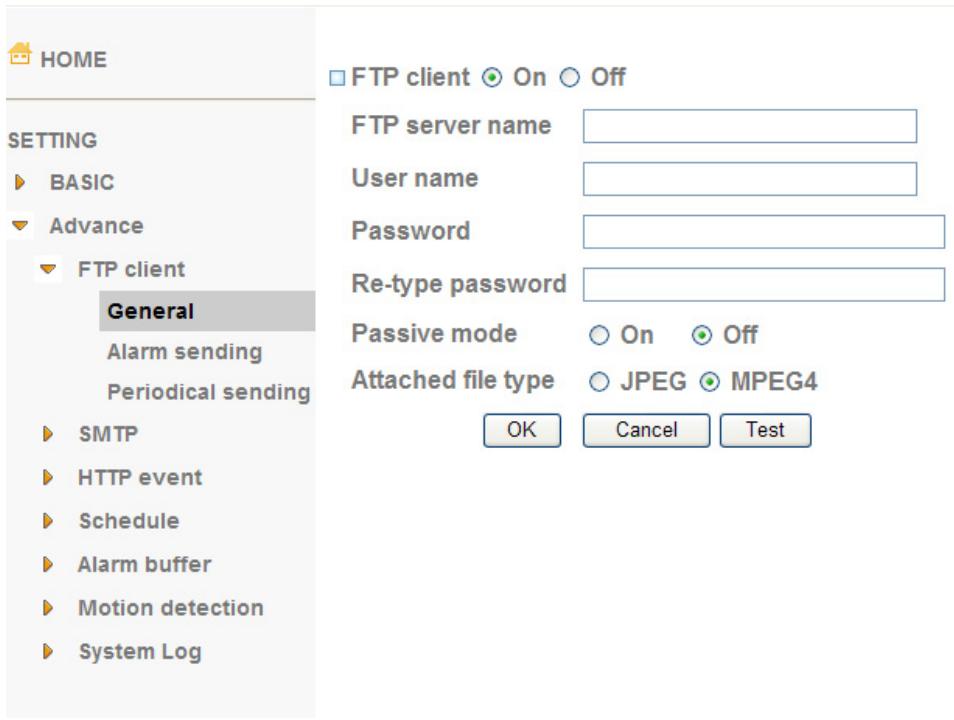
FTP client function : To activate the FTP client function, select On. The FTP client setting page appears. When you do not wish to use the FTP client function, select Off.
Note :
- The frame rate and operability on the main viewer may decrease while a file is being transmitted by the FTP client function.
FTP server name : Type the FTP server name to upload still images up to 64 characters, or the IP address of the FTP server.
```java User name : Type the user name for the FTP server.
Password : Type the password for the FTP server.
Retype password : To confirm the password, type the same characters as you typed in the Password box.
Passive mode : Set whether you use the passive mode of FTP server or not when connecting to FTP server. Select On to connect to FTP server using the passive mode.
Attached file type : Set attached file type to MJPEG or MPEG.4
7.1.2 Alarm sending
Set to forward the image and audio file to the specified FTP server linked with the alarm detection by the external sensor input or by the built-in motion detection function. Select On to send the image and audio file to FTP server linked with the alarm detection.
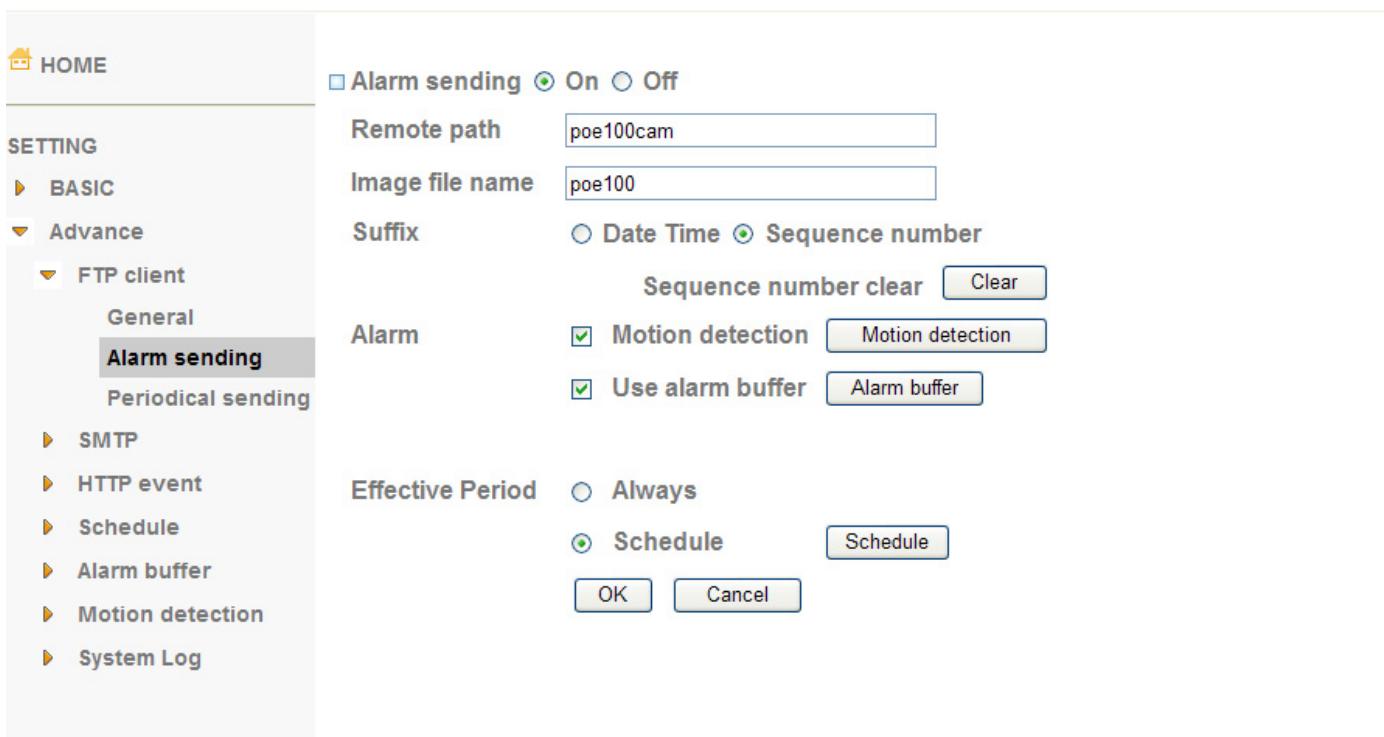
- Remote path: Type the path to the destination in FTP server up to 64 characters.
- Image file name : Type the file name you want to assign to the images when sending to the FTP server. You can use up to 10 alphanumeric characters, - (hyphen) and _ (underscore) for naming.
- Suffix : Select a suffix to add to the file name:
Date & time: The date & time suffix is added to the Image file name. The date/time suffix consists of lower two-digits of year (2 digits), month (2 digits), date (2 digits), hour (2 digits), minute (2 digits), second (2 digits), and consecutive number (2 digits), thus 14-digit number is added to the file name.
Sequence number: A consecutive number of 10 digits between 0000000001 and 4294967295 and two fixed digits 00 is added to the Image file name.
- Motion Detection : Click it on for using Motion Detection function as a sensor. You can set the motion detection function page.
Note :
-
Motion Detection works only when the Video mode is set to MPEG4 and the Cropping is set to Off.
-
Alarm Buffer : Select Use alarm buffer when you forward the image/ audio of before and after the alarm detection (pre-alarm, post-alarm). If you do not select it, only the image of the moment of the alarm detection is forwarded. Click Alarm buffer to display the Alarm buffer setting menu. For details, see "Setting the Alarm Buffer — Alarm buffer setting Menu on page.
-
Effective period : Set the period when the periodical sending is effective.
Always : The periodical sending is always effective. -
Schedule: You can specify the period when the periodical sending is effective in the schedule setting in the other section. Click Schedule and the setting menu for the effective period is displayed.
7.1.3 Periodical sending
You can set to send an image file to FTP server periodically by selecting On to send the image file to FTP server linked with setting period.
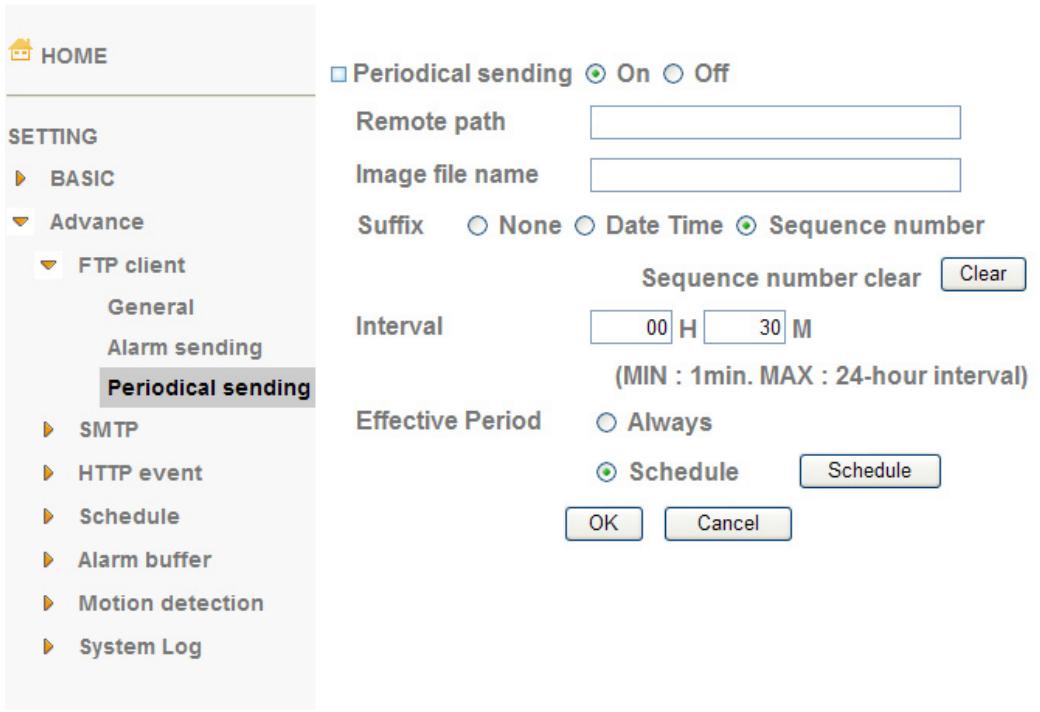
- Remote path : Type the remote path up to 64 characters.
- Image file name : Type the file name of the image sent to FTP server up to 10 alphanumeric characters, - (hyphen) and _ (under score).
- Suffix : Select a suffix to be added to the file name sent to FTP server.
- None : The name of the sent file will be the Image file name.
- Date & time : The date & time suffix is added to the Image file name. The date & time suffix consists of lower two-digits of year (2 digits), month (2 digits), date (2 digits), hour (2 digits), minute (2 digits) and second (2 digits), and consecutive number (2 digits), thus 14-digit number is added to the file name.
- Sequence number : A consecutive number is added to the Image file name.
- Sequence number clear : Click Clear and the suffix of the sequence number returns to 1 .
- Interval : Set the periodical sending is effective interval. Min value is 1 min and Max value is 24 hour.
- Effective period : Set the period when the periodical sending is effective.
Always : The periodical sending is always effective.
Schedule : You can specify the period when the periodical sending is effective in the schedule setting in the other section. Click Schedule and the setting menu for the effective period is displayed. ("Setting the Schedule — Schedule setting Menu" on page 34)
7.2 SMTP
Set the SMTP menu when you want to send an image via e-mail. By using Mail (SMTP) function, you can send a mail with attached image which has been shot linked with the external sensor input or with the built-in motion detection function. The image file can also be sent periodically. E-Mail (SMTP) setting menu is composed of three tabs, General, Alarm sending and Periodical sending.
7.2.1 General
Select On when you use the SMTP function. The common setting options are displayed below. If you do not wish to use the e-Mail (SMTP) function, select Off and click OK.

Note :
- During transmission of an image file via mail, the frame rate and operation performance of the monitor image of the main viewer decline.
- While the camera video mode is set to MPEG4, the image of the composite video signal output from the video output connector of the camera may be distorted during mail transmission.
-
You cannot send an audio file by using the mail sending function.
-
SMTP server name: Type the SMTP server name up to 64 characters, or the IP address of the SMTP server.
Authentication : Select the authentication required when you send an email. - Off: Select if no authentication is necessary when an email is sent.
- On: When authentication is necessary an e-mail is sent, select one of the authentication methods from the followings.
- SMTP: Select if SMTP authentication is necessary when an e-mail is sent.
POP before SMTP: Select if POP before SMTP authentication is necessary when an e-mail is sent.
Note :
- When you set to On, be sure to select either or both SMTP or/and POP before SMTP.
POP server name : It is necessary when the POP before SMTP is selected in Authentication. Type the POP (receiving mail) server name up to 64 characters, or type the IP address of the POP server. This setting is necessary when the SMTP server which sends e-mails performs authentication using the POP user account.
```java User name, Password : Type the user name and Password of the user who has the mail account. This setting is necessary when the SMTP server which sends e-mails performs authentication.
Recipient e-mail address : Type the recipient e-Mail address up to 64 characters. You can specify up to three recipient E-mail addresses.
Administrator e-mail address : Type the Administrator e-Mail address up to 64 characters. This address is used for reply mail and sending system messages from the SMTP server.
Attached File Type: Select to attach the file as JPEG or MPEG4.
Subject : Type the subject/title of the e-Mail up to 64 characters. With respect to mail which is sent according to the alarm detection when Alarm sending of the alarm tab is set to On, the characters standing for the sensor type added to the subject.
Message : Type the text of the E-mail up to 384 characters. (A line break is equivalent to 2 characters.)
7.2.2 Alarm sending
Set to send the mail with connection to the alarm detection by the external sensor input or by the built-in motion detection function.
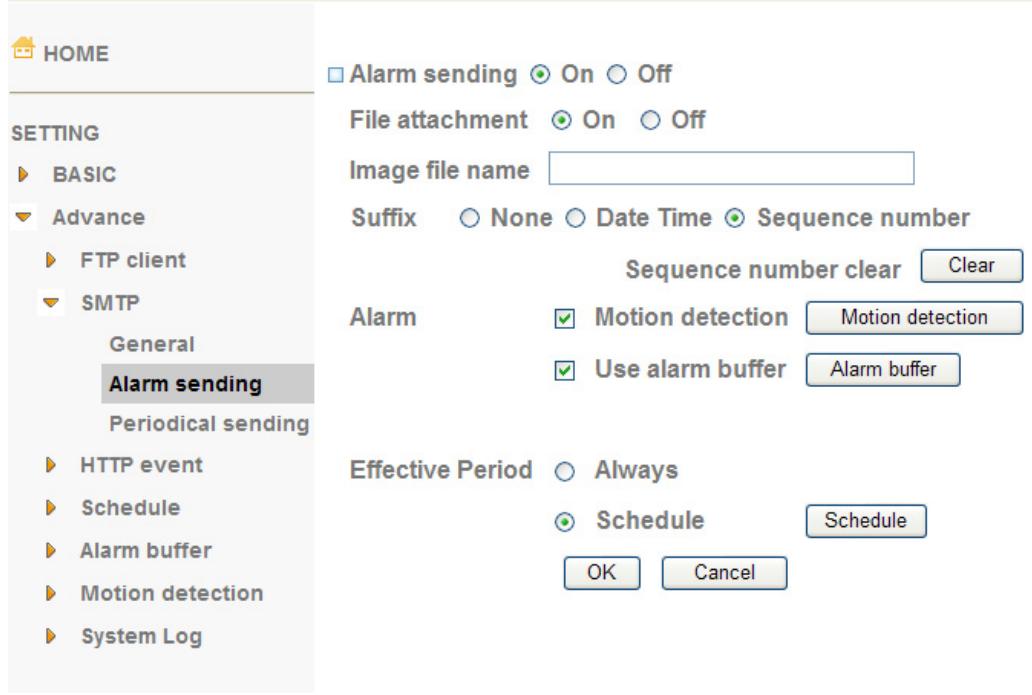
- Alarm sending: Select On to set to send mail with connection to the alarm detection.
- File attachment: Set whether an image file is attached to the mail sent or not. When On is selected, the image file made by the settings below is attached. When Off is selected, only the message is sent.
- Image file name: Type the file name you want to assign to the image to attach a mail. You can use up to 10 alphanumeric, - (hyphen) and _ (underscore) for naming.
- Suffix : Select a suffix to add to the file name:
None: No suffix is added. The Image file name is assigned to the image to be sent via an e-Mail.
Date & time: The date & time suffix is added to the Image file name. The date/time suffix consists of lower two-digits of year (2 digits), month (2 digits), date (2 digits), hour (2 digits), minute (2 digits), second (2 digits), and consecutive number (2 digits), thus 14-digit number is added to the file name.
Sequence number: A consecutive number of 10 digits between 000000001 and 4294967295 and two fixed digits 00 is added to the Image file name.
- Motion Detection : Click it on for using Motion Detection function as a sensor. You can set the motion detection function page.
Note :
Motion Detection works only when the Video mode is set to MPEG4 and the Cropping is set to Off.
- Alarm Buffer : Select Use alarm buffer when you forward the image/ audio of before and after the alarm detection (pre-alarm, post-alarm). If you do not select it, only the image of the moment of the alarm detection is forwarded. Click Alarm buffer to display the Alarm buffer setting menu. For details, see "Setting the Alarm Buffer — Alarm buffer setting Menu on page.
7.2.3 Periodical sending
You can set to send an image file by SMTP server periodically by selecting On to send the image file by SMTP server linked with setting period.
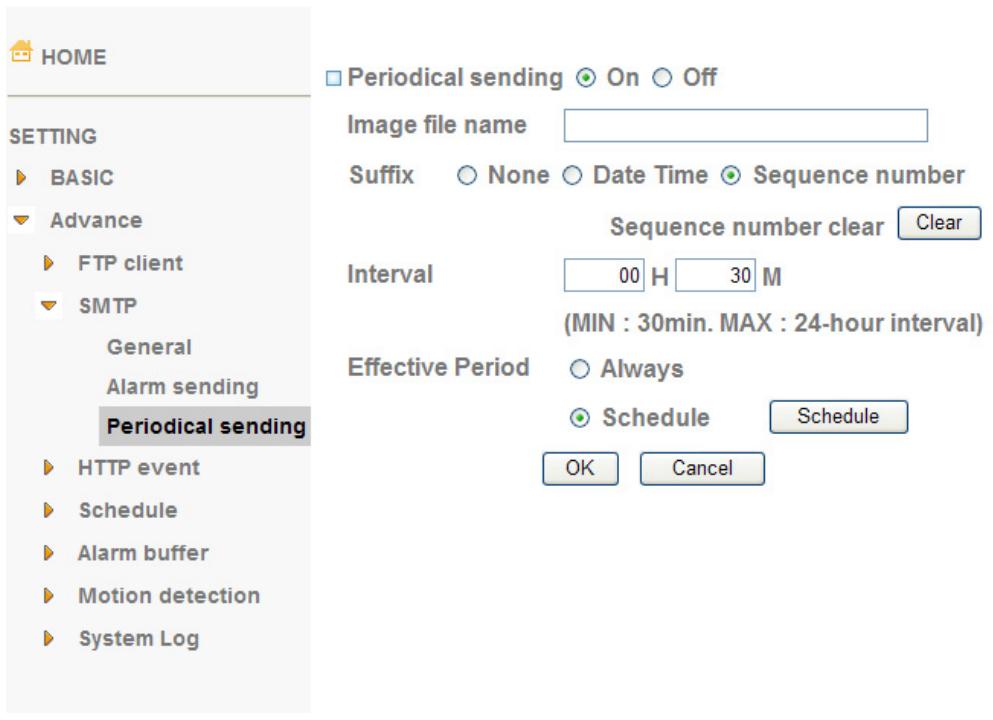
- Image file name : Type the file name of the image sent by SMTP up to 10 alphanumeric characters, - (hyphen) and _ (under score).
- Suffix : Select a suffix to be added to the file name sent by SMTP.
None : The name of the sent file will be the Image file name.
Date & time : The date & time suffix is added to the Image file name. The date & time suffix consists of lower two-digits of year (2 digits), month (2 digits), date (2 digits), hour (2 digits), minute (2 digits) and second (2 digits), and consecutive number (2 digits), thus 14-digit number is added to the file name.
Sequence number : A consecutive number is added to the Image file name.
Sequence number clear : Click Clear and the suffix of the sequence number returns to 1 .
- Interval : Set the periodical sending is effective interval. Min value is 30 min and Max value is 24 hour.
- Effective period : Set the period when the periodical sending is effective.
Always : The periodical sending is always effective.
Schedule : You can specify the period when the periodical sending is effective in the schedule setting in the other section. Click Schedule and the setting menu for the effective period is displayed. ("Setting the Schedule — Schedule setting Menu" on page 34)
7.3 HTTP Event
Use this menu to set up for capturing and sending images to an HTTP server. By using HTTP client function, you can send the image and audio file which has been shot and recorded linked with the external sensor input or with the built-in motion detection function to HTTP server. HTTP client setting menu is composed of two tabs, General and Alarm sending.
7.3.1 General
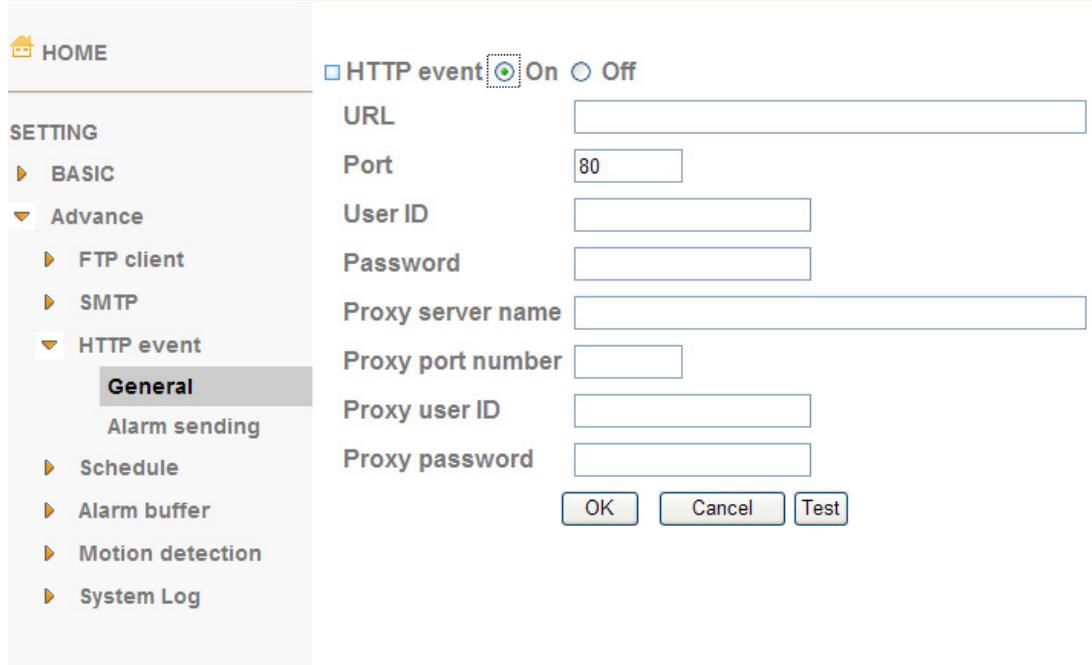
HTTP event: Set up the HTTP server URL, port, user id, password, and proxy server settings.
7.3.2 Alarm sending
Set to send the mail with connection to the alarm detection by the external sensor input or by the built-in motion detection function.
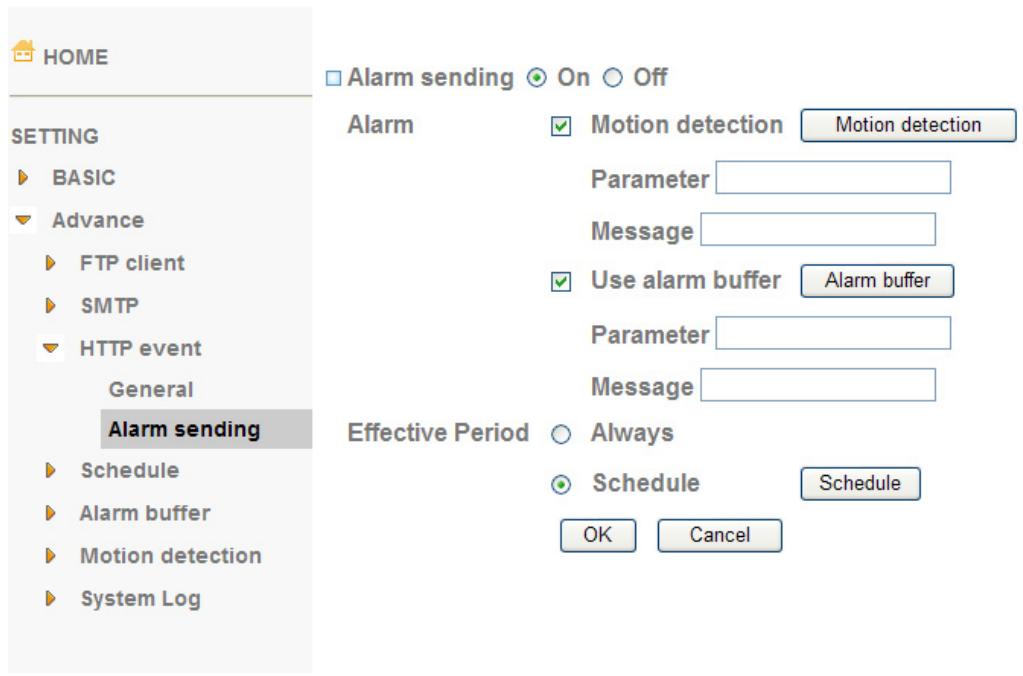
- Alarm sending: Select On to set to send mail with connection to the alarm detection.
- Motion Detection : Click it on for using Motion Detection function as a sensor. You can set the motion detection function page.
Note :
-
Motion Detection works only when the Video mode is set to MPEG4 and the Cropping is set to Off.
-
Alarm Buffer : Select Use alarm buffer when you forward the image/ audio of before and after the alarm detection (pre-alarm, post-alarm). If you do not select it, only the image of the moment of the alarm detection is forwarded. Click Alarm buffer to display the Alarm buffer setting menu. For details, see "Setting the Alarm Buffer — Alarm buffer setting Menu on page.
- Effective period : Set the period when the periodical sending is effective.
Always : The periodical sending is always effective.
Schedule : You can specify the period when the periodical sending is effective in the schedule setting in the other section. Click Schedule and the setting menu for the effective period is displayed.
7.4 Schedule
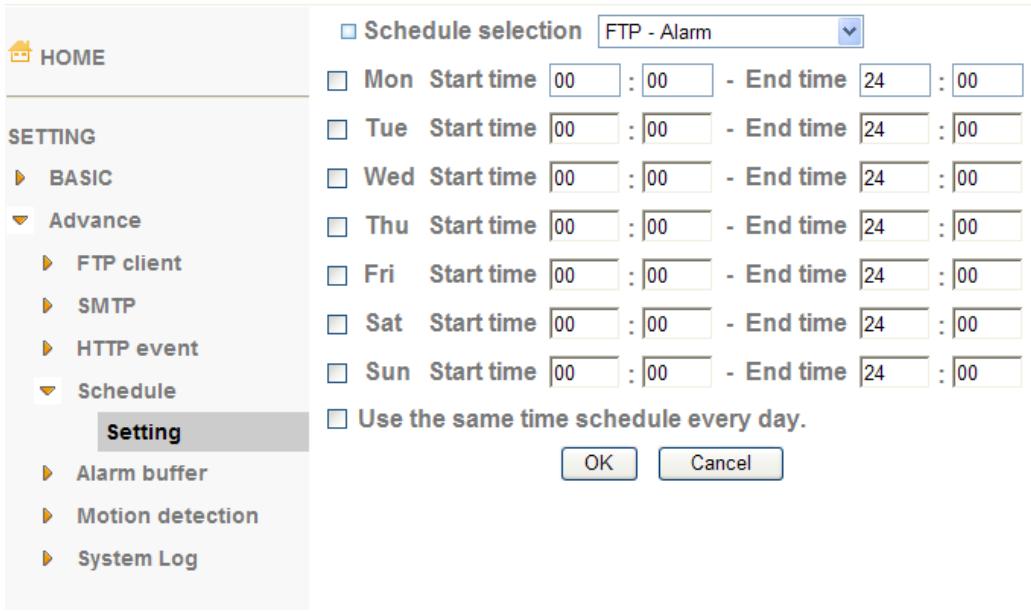
When you click Schedule on the Advanced mode menu, the Schedule setting menu appears. This is the same menu as the setting menu which is displayed when you click Schedule to set Effective period and Schedule in FTP client setting menu, e-Mail (SMTP) setting menu, Alarm out setting menu and so on. Example: When setting e-Mail (SMTP) (the alarm sending) in the Schedule setting menu.
7.4.1 Setting
Schedule selection
Select the list box to specify the schedule you want to set. e-Mail (SMTP) - Alarm, e-Mail (SMTP) - Periodical, FTP - Alarm, FTP - Periodical, HTTP event - Alarm, Alarm output - Alarm or Alarm output - Timer, can be selected.
Mon (Monday) to Sun (Sunday)
The time period on the right of the checked day is the effective period of the schedule.
Start time, End time
Specify the Start time and the End time.
Use the same time schedule every day
When this is checked, the Start time and End time set to Mon (Monday) are applied to all days. In this case, the Start time and End time of the other days than Mon (Monday) cannot be input.
7.5 Alarm Buffer
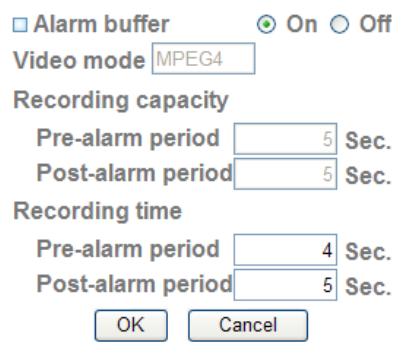
You can set the Pre-alarm image and audio (the image and audio before the alarm detection) and the Post - alarm image and audio. These can be set when Alarm sending FTP client setting menu or Image memory setting menu is set to On, and besides when Use alarm buffer is selected.
7.5.1 Setting
Alarm buffer: To activate the Alarm buffer function, select On. The basic setting options are displayed below.
When you do not use the Alarm output function, select Off.
Recording capacity
Pre-alarm period : Display the maximum recording capacity of image/audio before the alarm detection.
Post-alarm period : Display the maximum recording capacity of image/audio after the alarm detection.
Recording time
Set the recording time for the Pre-alarm image/audio and Post alarm image/audio.
Pre alarm period : Type it with recording time of the image/audio before the alarm detection.
Post alarm period : Type it with recording time of the image/audio after the alarm detection.
Note :
- The value of Recording capacity differs depending on Image size, Bitrate (for MPEG4) and Image quality (for MPEG4 and MJPEG) in the camera setting menu.
7.6 Motion Detection
When you click Motion Detection on the Advance mode menu, the Motion Detection setting menu appears. There are three Motion Detection functions as sensors to set for different detecting zones. Each one has Threshold and Sensitivity inputs which you can adjust to specific zone sequentially. Motion Detection function can support to FTP, SMTP and Alarm output for capturing and sending images or starting alarm output.
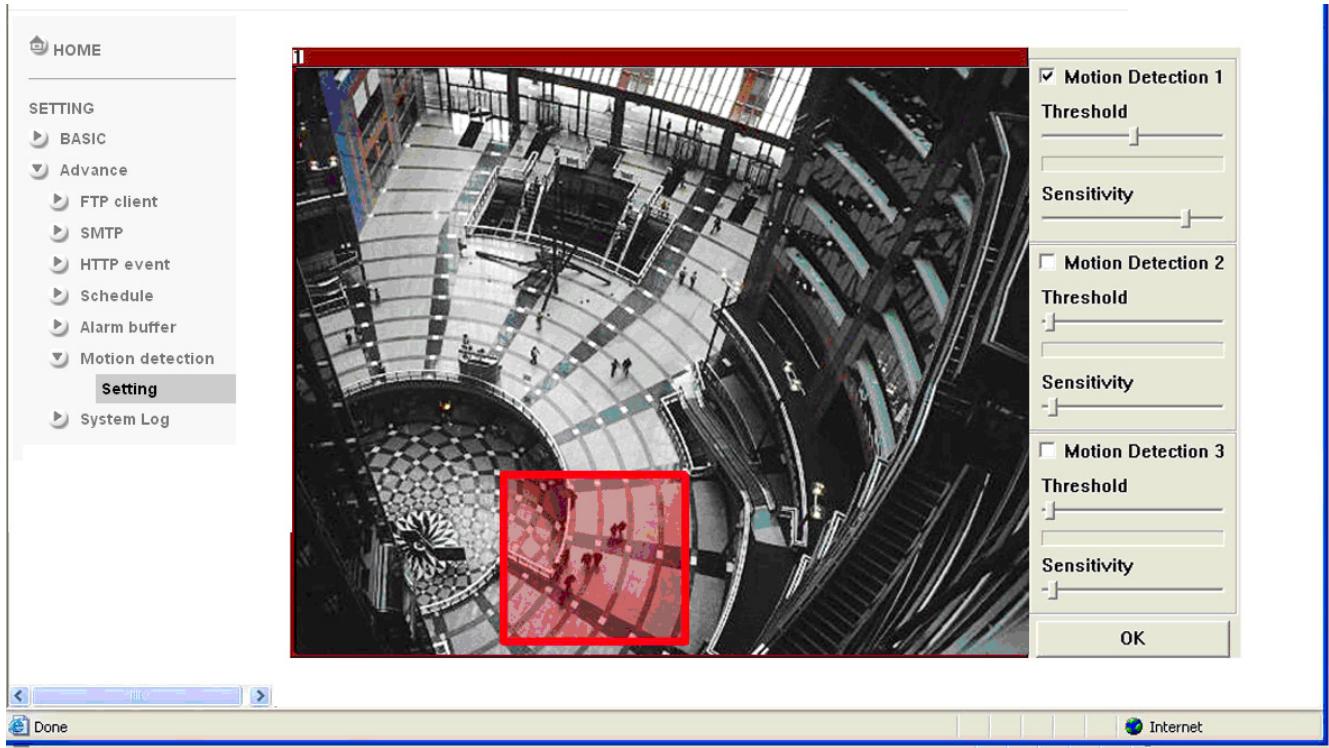
Click it On when you use the Motion Detection function and detecting zone appears for adjusting and moving. The common setting options are displayed below. If you do not wish to use the Motion Detection function, click it Off and press OK.
Motion Detection 1: Click it on for using Motion Detection 1 function as a sensor. You can adjust and move the detecting zone by using mouse.
Motion Detection 2: Click it on for using Motion Detection 2 function as a sensor. You can adjust and move the detecting zone by using mouse.
Motion Detection 3: Click it on for using Motion Detection 3 function as a sensor. You can adjust and move the detecting zone by using mouse.
Threshold: You can use the tool bar to set up-limit value. When detecting zone signals are over setting value, it would carry on assigned work.
Sensitivity: You can use the tool bar to set down-limit value. When detecting zone signals are over setting value, it would carry on assigned work.
Carry out the following steps :
- Click On to Motion Detection 1 choose one of eight orders.
- A detecting zone 1 appears and use mouse to adjust and move the zone boundaries and position.
- Use tool bar to set Threshold and Sensitivity value.
- Follow the steps to set the other Motion Detection.
- Click the OK to save the setting.
Note :
- Be careful! Motion Detection function don't work with Patrol function at same time.
7.7 System Log
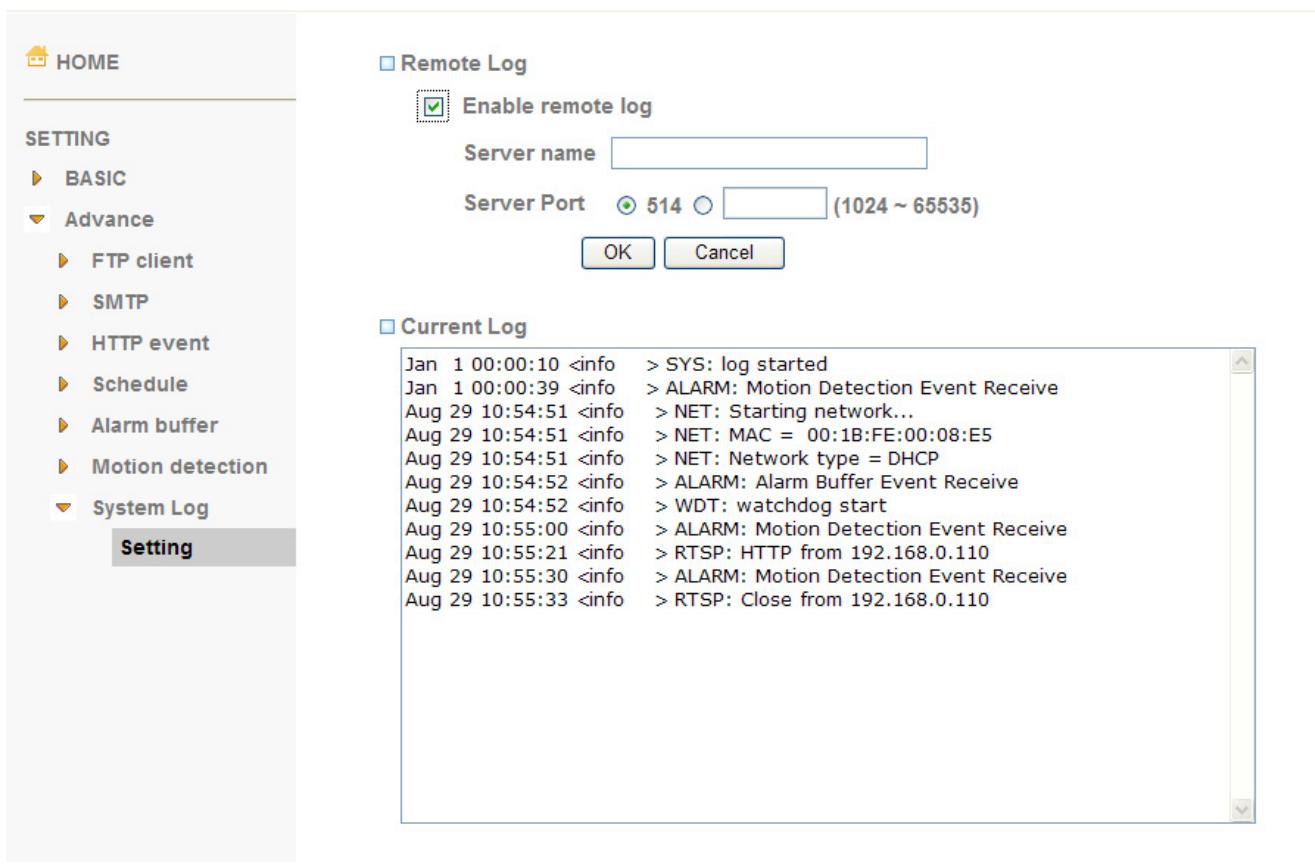
The System Log function allows users to review any changes and events happened. The system starts logging automatically after started.
Remote Log: Enables user to send the log data to a specified log server.
APPENDIX A - FRAME RATE & BIT RATE TABLE
This chapter provides tables that helps you to optimize your IP camera with your network environment. Based on your network upload environment to choose the best Image-Quality setting.
For example, if the network environment is ADSL 256Kb( upload) / 2Mb(download), the most fluent Image-Quality needs to set up under 256 Kb situation.
A.1. NTSC CCD IPCamera
A.1.1. MPEG4 @ 30fps / kbps
| Quality | 704*480 | 352*240 | 176*120 |
| Excellent | 2000 | 800 | 200 |
| Detailed | 850 | 250 | 80 |
| Good | 450 | 150 | 60 |
| Standard | 350 | 110 | 50 |
| Medium | 250 | 90 | 40 |
A.1.2. MPEG4 / kbps, fps
| Image-Size | Bitrate Setting | Frame-Rate Setting | Current Bitrate | Current Frame-Rate |
| 704*480 | 2048 | 30 | 1800 | 25 |
| 704*480 | 2048 | 15 | 2100 | 16 |
| 704*480 | 1536 | 30 | 1500 | 30 |
| 704*480 | 1536 | 15 | 1700 | 16 |
| 704*480 | 1024 | 30 | 1050 | 30 |
| 704*480 | 1024 | 15 | 1100 | 16 |
| 704*480 | 512 | 30 | 520 | 30 |
| 704*480 | 512 | 15 | 650 | 16 |
| 352*240 | 1536 | 30 | 1500 | 30 |
| 352*240 | 1536 | 15 | 1600 | 16 |
| 352*240 | 1024 | 30 | 1100 | 30 |
| 352*240 | 1024 | 15 | 1100 | 16 |
| 352*240 | 512 | 30 | 530 | 30 |
| 352*240 | 512 | 15 | 600 | 16 |
| 176*120 | 1024 | 30 | 1000 | 30 |
| 176*120 | 1024 | 15 | 900 | 16 |
| 176*120 | 512 | 30 | 530 | 30 |
| 176*120 | 512 | 15 | 550 | 16 |
| 176*120 | 128 | 30 | 150 | 30 |
| 176*120 | 128 | 15 | 150 | 16 |
A.1.3. MJPEG @ 15fps / kbps
| Quality | 704*480 | 352*240 | 176*120 |
| Excellent | 7500 | 2800 | 1000 |
| Detailed | 5000 | 1500 | 700 |
| Good | 3500 | 1000 | 500 |
| Standard | 2000 | 800 | 400 |
| Medium | 1300 | 500 | 300 |
A.1.4. MJPEG / kbps, fps
| Image-Size | Quality Setting | Frame-Rate Setting | Current Bitrate | Current Frame-Rate |
| 704*480 | Excellent | 15 | 7500 | 11 |
| 704*480 | Excellent | 5 | 4000 | 5 |
| 704*480 | Good | 15 | 3500 | 13 |
| 704*480 | Good | 5 | 1500 | 5 |
| 704*480 | Medium | 15 | 1300 | 13 |
| 704*480 | Medium | 5 | 550 | 5 |
| 352*240 | Excellent | 15 | 2800 | 12 |
| 352*240 | Excellent | 5 | 1200 | 5 |
| 352*240 | Good | 15 | 1000 | 12 |
| 352*240 | Good | 5 | 450 | 5 |
| 352*240 | Medium | 15 | 500 | 12 |
| 176*120 | Medium | 5 | 220 | 5 |
| 176*120 | Excellent | 15 | 1000 | 15 |
| 176*120 | Excellent | 5 | 400 | 5 |
| 176*120 | Good | 15 | 500 | 15 |
| 176*120 | Good | 5 | 200 | 5 |
| 176*120 | Medium | 15 | 300 | 15 |
| 176*120 | Medium | 5 | 100 | 5 |
A.2. PAL CCD IPCamera
A.2.1. MPEG4 @ 25fps / kbps
| Quality | 704*576 | 352*288 | 176*144 |
| Excellent | 1800 | 400 | 100 |
| Detailed | 600 | 150 | 50 |
| Good | 400 | 100 | 40 |
| Standard | 300 | 80 | 30 |
| Medium | 200 | 60 | 20 |
A.2.2. MPEG4 / kbps, fps
| Image-Size | Bitrate Setting | Frame-Rate Setting | Current Bitrate | Current Frame-Rate |
| 704*576 | 2048 | 25 | 2000 | 23 |
| 704*576 | 2048 | 15 | 2100 | 16 |
| 704*576 | 1536 | 25 | 1600 | 25 |
| 704*576 | 1536 | 15 | 1700 | 16 |
| 704*576 | 1024 | 25 | 1100 | 25 |
| 704*576 | 1024 | 15 | 1200 | 16 |
| 704*576 | 512 | 25 | 550 | 25 |
| 704*576 | 512 | 15 | 650 | 16 |
| 352*288 | 1536 | 25 | 1500 | 25 |
| 352*288 | 1536 | 15 | 1600 | 16 |
| 352*288 | 1024 | 25 | 1100 | 25 |
| 352*288 | 1024 | 15 | 1100 | 16 |
| 352*288 | 512 | 25 | 550 | 25 |
| 352*288 | 512 | 15 | 600 | 16 |
| 176*144 | 1024 | 25 | 1000 | 25 |
| 176*144 | 1024 | 15 | 1000 | 16 |
| 176*144 | 512 | 25 | 550 | 25 |
| 176*144 | 512 | 15 | 600 | 16 |
| 176*144 | 128 | 25 | 150 | 25 |
| 176*144 | 128 | 15 | 150 | 16 |
A.2.3. MJPEG @ 15fps / kbps
| Quality | 704*576 | 352*288 | 176*144 |
| Excellent | 7800 | 1700 | 650 |
| Detailed | 4300 | 1000 | 450 |
| Good | 2500 | 650 | 350 |
| Standard | 1300 | 450 | 250 |
| Medium | 1000 | 300 | 180 |
A.2.4. MJPEG / kbps, fps
| Image-Size | Quality Setting | Frame-Rate Setting | Current Bitrate | Current Frame-Rate |
| 704*576 | Excellent | 15 | 7800 | 11 |
| 704*576 | Excellent | 5 | 4000 | 5 |
| 704*576 | Good | 15 | 2500 | 11 |
| 704*576 | Good | 5 | 1200 | 5 |
| 704*576 | Medium | 15 | 1000 | 11 |
| 704*576 | Medium | 5 | 500 | 5 |
| 352*288 | Excellent | 15 | 1700 | 11 |
| 352*288 | Excellent | 5 | 900 | 5 |
| 352*288 | Good | 15 | 650 | 11 |
| 352*288 | Good | 5 | 330 | 5 |
| 352*288 | Medium | 15 | 300 | 11 |
| 352*288 | Medium | 5 | 160 | 5 |
| 176*144 | Excellent | 15 | 650 | 12 |
| 176*144 | Excellent | 5 | 300 | 5 |
| 176*144 | Good | 15 | 350 | 12 |
| 176*144 | Good | 5 | 150 | 5 |
| 176*144 | Medium | 15 | 180 | 12 |
| 176*144 | Medium | 5 | 75 | 5 |
APPENDIX B - STORAGE REQUIREMENT TABLE
This chapter provides tables that helps you set your recording storage system.
Please refer to the following table to find out the capability for recording into your hard disk.
B.1 MPEG4 Storage Requirement GB / channel / day @ 30fps
| Quality | 704*480 | 352*240 | 176*120 |
| Excellent | 21.1 | 8.4 | 2.1 |
| Detailed | 9.0 | 2.6 | 0.8 |
| Good | 4.7 | 1.6 | 0.6 |
| Standard | 3.7 | 1.2 | 0.5 |
| Medium | 2.6 | 0.9 | 0.4 |
B.2 MPEG4 Storage Requirement GB / channel / day @ 15fps
| Quality | 704*480 | 352*240 | 176*120 |
| Excellent | 10.5 | 4.2 | 1.1 |
| Detailed | 4.5 | 1.3 | 0.4 |
| Good | 2.3 | 0.8 | 0.3 |
| Standard | 1.8 | 0.6 | 0.2 |
| Medium | 1.3 | 0.5 | 0.2 |
B.3 MPEG4 Storage Requirement GB / channel / day
| Image-Size | Bitrate Setting | Frame-Rate Setting | Storage Requirement |
| 704*480 | 2048 | 30 | 23.0 |
| 704*480 | 2048 | 15 | 22.1 |
| 704*480 | 1536 | 30 | 18.5 |
| 704*480 | 1536 | 15 | 17.9 |
| 704*480 | 1024 | 30 | 11.1 |
| 704*480 | 1024 | 15 | 11.6 |
| 704*480 | 512 | 30 | 5.5 |
| 704*480 | 512 | 15 | 6.9 |
| 352*240 | 1536 | 30 | 15.8 |
| 352*240 | 1536 | 15 | 16.9 |
| 352*240 | 1024 | 30 | 11.6 |
| 352*240 | 1024 | 15 | 11.6 |
| 352*240 | 512 | 30 | 5.6 |
| 352*240 | 512 | 15 | 6.3 |
| 176*120 | 1024 | 30 | 10.5 |
| 176*120 | 1024 | 15 | 9.5 |
| 176*120 | 512 | 30 | 5.6 |
| 176*120 | 512 | 15 | 5.8 |
| 176*120 | 128 | 30 | 1.6 |
| 176*120 | 128 | 15 | 1.6 |
B.4 MJPEG Storage Requirement GB / channel / day @ 15fps
| Quality | 704*480 | 352*240 | 176*120 |
| Excellent | 79.1 | 29.5 | 10.5 |
| Detailed | 52.7 | 15.8 | 7.4 |
| Good | 36.9 | 10.5 | 5.3 |
| Standard | 21.1 | 8.4 | 4.2 |
| Medium | 13.7 | 5.3 | 3.2 |
B.5 MJPEG Storage Requirement GB / channel / day
Image-Size Quality Setting Frame-Rate Setting Current Bitrate
| 704*480 | Excellent | 15 | 79.1 |
| 704*480 | Excellent | 5 | 42.2 |
| 704*480 | Good | 15 | 36.9 |
| 704*480 | Good | 5 | 15.8 |
| 704*480 | Medium | 15 | 13.7 |
| 704*480 | Medium | 5 | 5.8 |
| 352*240 | Excellent | 15 | 29.5 |
| 352*240 | Excellent | 5 | 12.7 |
| 352*240 | Good | 15 | 10.5 |
| 352*240 | Good | 5 | 4.7 |
| 352*240 | Medium | 15 | 5.3 |
| 176*120 | Medium | 5 | 2.3 |
| 176*120 | Excellent | 15 | 10.5 |
| 176*120 | Excellent | 5 | 4.2 |
| 176*120 | Good | 15 | 5.3 |
| 176*120 | Good | 5 | 2.1 |
| 176*120 | Medium | 15 | 3.2 |
| 176*120 | Medium | 5 | 1.1 |
- Declaration of Conformity
- 1/3 Sharp CCD Dual Stream IP Carema
- AirLive POE-100CAM
- Clause
- Description
- Manufacturer/Importer
- AirLive POE-100CAM CE Declaration Statement
- Legal Caution
- Heed the safety precautions
- In case of a breakdown
- In case of abnormal operation
- Operation Notice - Operating or storage location
- Ventilation
- Transportation
- Cleaning
- CONTENT
- CHAPTER 1. INSTALLATION
- CHAPTER 2. USING IP CAMERA VIA MOBILE PHONE 2
- CHAPTER 3. USING IP CAMERA VIA WEB BROWSER. 3
- CHAPTER 4. INITIAL ACCESSING THE IP CAMERA 4
- CHAPTER 5. CONFIGURATION OF MAIN MENU 8
- CHAPTER 6. SETTING 10
- CHAPTER 7. ADVANCE 25
- APPENDIX A - FRAME RATE & BIT RATE TABLE 38
- APPENDIX B - STORAGE REQUIREMENT TABLE. 42
- Installation Steps
- Package Contents
- Overview
- Chapter 2. Using IP Camera via Mobile Phone
- 3G Mobile Phone viewing
- Note:
- 2.5G Mobile Phone viewing
- Chapter 3. Using IP Camera via Web Browser
- System Requirement
- Chapter 4. Initial accessing the IP camera
- Camera installation
- Chapter 5. Configuration of Main Menu
- Setting
- Setting
- Client Setting
- Client setting
- Image Setup
- Image setup
- Live View
- Snapshot:
- Digital Zoom in / out the image via the monitor window
- Audio buttons :
- Note :
- Video play buttons:
- Chapter 6. Setting
- Basic
- System
- Information
- Day & Time
- Initialize
- Camera
- General
- MPEG4
- Computer View
- RTSP (If RTSP mode is ON)
- RTP (If RTSP mode is ON)
- Unicast streaming:
- Multicast streaming:
- MPEG4 viewer port (If RTSP mode is OFF)
- Quality
- Mobile View
- MJPEG
- MJPEG viewer port
- Network
- Information
- Information
- PPPoE
- DDNS
- UPnP
- UPnP On Off
- Turn On UPnP port forwarding
- IP Notification
- Security
- Account
- HTTPS
- Chapter 7. Advance
- FTP Client
- General
- Alarm sending
- Periodical sending
- SMTP
- General
- Alarm sending
- Periodical sending
- HTTP Event
- General
- Alarm sending
- Schedule
- Setting
- Schedule selection
- Mon (Monday) to Sun (Sunday)
- Start time, End time
- Use the same time schedule every day
- Alarm Buffer
- Setting
- Recording capacity
- Recording time
- Motion Detection
- Carry out the following steps :
- System Log
- APPENDIX A - FRAME RATE & BIT RATE TABLE
- A.1.2. MPEG4 / kbps, fps
- A.1.3. MJPEG @ 15fps / kbps
- A.1.4. MJPEG / kbps, fps
- A.2.3. MJPEG @ 15fps / kbps
- A.2.4. MJPEG / kbps, fps
- APPENDIX B - STORAGE REQUIREMENT TABLE
Brand : AIRLIVE
Model : POE-100CAM
Category : Surveillance Camera